Vi använder cookies för att ge dig bästa möjliga upplevelse. Välj vilka cookies du tillåter.
Läs mer i vår integritetspolicy
Jörgen Thornberg
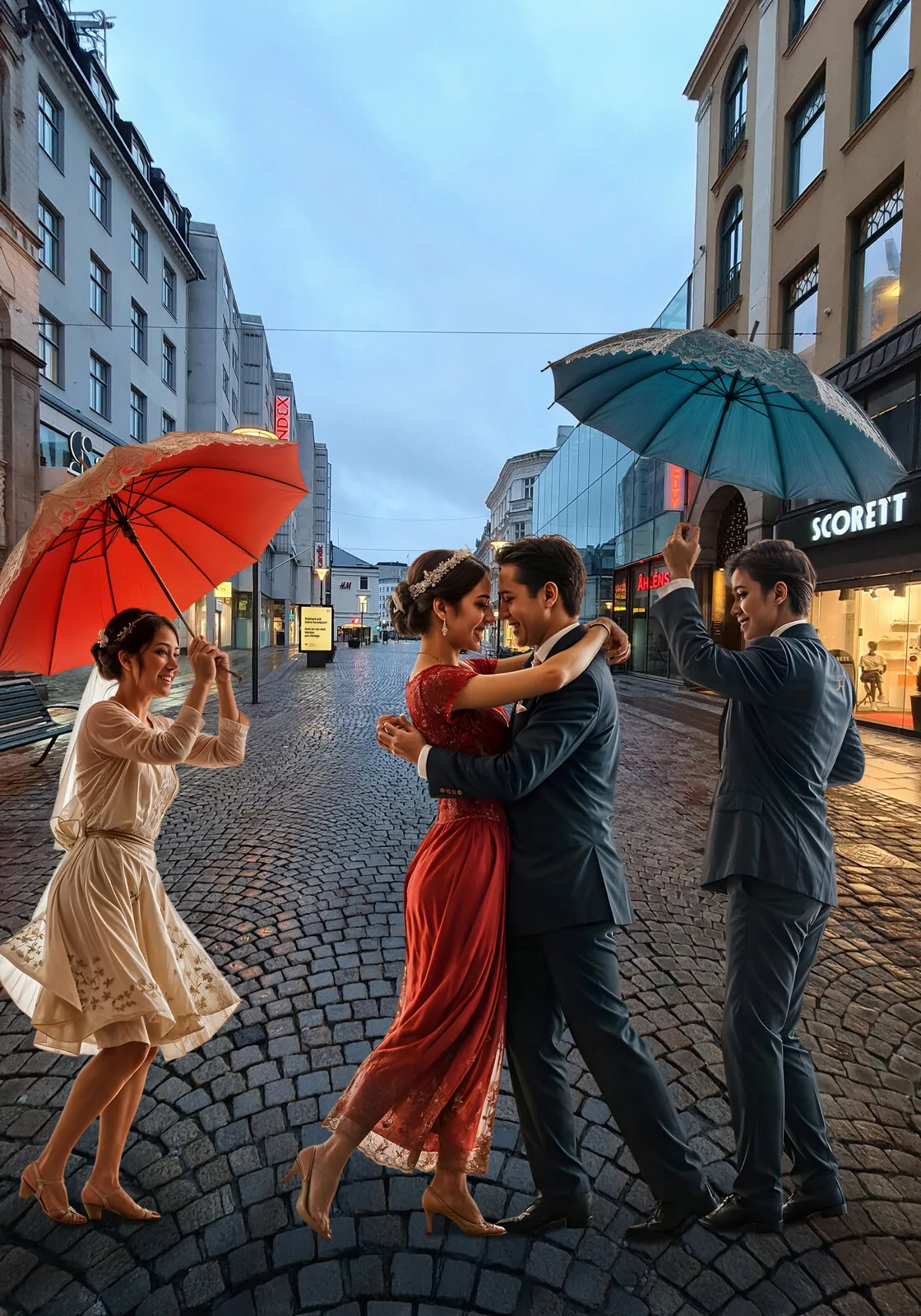
The Bridal Waltz, 2025
Digital
50 x 70 cm
3 200 kr
The Bridal Waltz
The song 'Singin’ in the Rain' has a rich history, dating back to 1929 when Herb Brown and Arthur Freed first penned it. Its debut in The Hollywood Revue by Cliff Edwards marked a significant milestone in the film industry, symbolising the shift from silent to sound. The song's iconic status was further solidified by Gene Kelly’s memorable dance scene in the rain, a sequence filmed under challenging conditions, with Kelly battling a high fever and rainwater mixed with milk to enhance the visual effect on camera.
The film 'Singin' in the Rain' is not merely a musical but a self-aware homage to Hollywood's evolution, with Freed’s old lyrics, particularly 'Singin’ in the Rain', serving as its centrepiece. The film’s narrative is carried by a strong cast, with Debbie Reynolds, then just 19 years old, portraying Kathy Selden—the film’s moral and emotional anchor—opposite Kelly’s charismatic lead. Donald O’Connor's acrobatic comedy as Cosmo Brown and Jean Hagen's biting, Oscar-nominated performance as Lina Lamont, the shrill-voiced silent film star, add depth and dimension to the film.
Together, the cast and crew of 'Singin’ in the Rain' have crafted a film that transcends the boundaries of a mere musical. It is a timeless reflection on the themes of change, illusion, and joy. The couple dancing in the street, with music playing from a Bluetooth speaker, serves as a poignant reminder that sometimes, all we need for joy is a little music and some careful planning.
Discover a unique perspective on superhero relationships and why this story is a must-read.
”Waltz in Rain
I'm singin' in the rain,
Just singin' in the rain,
What a glorious feeling,
I'm happy again!
I'm laughing at clouds.
So dark up above,
The sun's in my heart and I'm ready for love!
Let the stormy clouds chase
Everyone from the place,
Come on with your rain,
I've got a smile on my face!
I'll walk down the lane
With a happy refrain,
Just singin', singin' in the rain!
Why am I smiling, and why do I sing?
Why does a rainy Malmö seem sunny as Spring?
Why do I get up each morning to start
Happy and head-up with joy in my heart?
Why is each new task a trifle to do?
Because I am living a life full of you!
Hey, I'm singin' in the rain,
Just singin' in the rain,
What a glorious feeling,
I'm happy again!
I'm laughing at clouds.
So dark up above,
The sun's in my heart and I'm ready for love!
Let the stormy clouds chase
Everyone from the place,
Come on with your rain,
I've got a smile on my face!
I'll walk down the lane
With a happy refrain,
Just singin', singin' in the rain!”
Herb Brown/Arthur Freed, 1929
The Bridal Waltz
In Sweden, Felix Mendelssohn’s 'Wedding March' (from ‘A Midsummer Night’s Dream’) is by far the most common piece for the bridal procession. It is often played on the organ as the couple walks down the aisle. However, when it comes to the ‘brudvals’—the wedding waltz where the couple dances together in front of the guests—this is a significant moment in the wedding. The 'brudvals' symbolises the couple's first dance as a married pair, and the music for this dance varies from traditional to modern. In this particular instance, when the bride and groom chose to leave the reception hall and dance outside on Södergatan, the music, fittingly enough, was ‘Dancing in the Rain’.
The choice of music for the first dance is a fascinating aspect of wedding traditions, and it's a celebration of love and joy. It varies significantly from country to country, offering a rich tapestry of musical expressions that will surely intrigue you and open your mind to new possibilities.
In Sweden, the most popular pieces include:
‘Brudvalsen’ by Evert Taube
‘The Blue Danube’ – Johann Strauss II
‘Så skimrande var aldrig havet’ – also by Evert Taube, played in waltz time
The waltz from Disney’s ‘Snow White’
‘Elvira Madigan’ (Mozart, Piano Concerto No. 21 – second movement), sometimes rearranged
In England:
‘Greensleeves’ – traditional, sometimes arranged as a waltz
‘When I Fall in Love’ – Nat King Cole
‘Moon River’ – Henry Mancini, often used for slow dancing
‘A Nightingale Sang in Berkeley Square’ – for elegance and nostalgia
‘Perfect’ – Ed Sheeran, a modern classic for romantic first dances
Surprisingly, many English couples today are opting for contemporary songs in 3/4 or 6/8 time over classical waltzes, adding a modern twist to this age-old tradition.
In France:
‘La Vie en Rose’ – Édith Piaf
‘Sous le ciel de Paris’ – Yves Montand / Piaf
‘Que reste-t-il de nos amours’ – Charles Trenet
‘Amélie from Montmartre’ – Yann Tiersen, especially ‘Comptine d’un autre été’
Classic musette waltzes, featuring the accordion, are also sometimes played to create an authentic Parisian feel.
In Austria and Germany:
‘Kaiser-Walzer’, ‘The Blue Danube’ – Johann Strauss II
‘Vienna, Vienna, Only You Alone’ – traditional Viennese waltz
‘Lili Marleen’ may also occasionally appear if the couple is more mature.
In the USA:
‘The Anniversary Waltz’ – Al Jolson
‘Unchained Melody’ – The Righteous Brothers (not a waltz, but often rearranged)
‘Can’t Help Falling in Love’ – Elvis Presley – slow, often played in ¾ time
In Mexico and Latin America:
‘Vals de las Mariposas’
‘Sobre las Olas’ – a waltz by Juventino Rosas
Romantic ‘boleros’ or ‘rancheras’ rearranged into waltz form
Regardless of the country, the first dance is a poignant moment where music, memory, and emotion intertwine. It's a moment that connects us all, creating a shared emotional experience that is sure to bring a sentimental tear to your eye.
Back to the choice this time—’Singin' in the Rain’. The music was composed by Herb Brown, with lyrics by Arthur Freed. It was first published in 1929, long before the famous 1952 film starring Gene Kelly, which made the song immortal.
The song first appeared in a musical revue that same year, ‘The Hollywood Revue’, where it was performed by Cliff Edwards (better known as "Ukulele Ike") alongside musical acts and dance numbers from various MGM stars, including a young Joan Crawford—who, of course, would go on to become a major star. Initially, the song was written to mark the transition from silent films to sound films, making it all the more fitting that it experienced a renaissance in a movie precisely about that very transition—the one featuring Gene Kelly and Debbie Reynolds.
Why is the song so powerful? Is it the rain?
The song, 'Singin' in the Rain', is a powerful expression of joy in the face of adversity. Its simplicity is striking, resonating both sincerely and ironically, depending on the context. In the film, it’s used as an exuberant act of freedom following a romantic turning point. Yet, in modern popular culture, it can just as easily be interpreted as black humour or defiance. This resilience in the face of challenges is what makes the song so inspiring and uplifting.
When Gene Kelly performed the song in ‘Singin’ in the Rain’ (1952), it became one of the most iconic moments in film history. His dancing in the pouring rain, twirling an umbrella, with a smile that practically bursts through the screen, is a testament to his unparalleled talent and dedication. The scene was filmed despite Kelly suffering from a fever of 102°F (39°C), and the rainwater was mixed with milk to enhance the studio lighting, further highlighting the extraordinary effort put into this iconic performance.
Interestingly, the idea for the film was built around the song’s title, rather than the other way around. Arthur Freed, by then a powerful producer at MGM, wanted to create a film using a selection of his old lyrics as a framework, and ‘Singin’ in the Rain’ became the centrepiece.
In the 1952 classic, Gene Kelly starred alongside three co-stars, each of whom contributed something essential to the film, helping it become one of the most beloved works in the history of the musical. Each brought their distinct qualities to the story and tone, ranging from youthful charm and physical comedy to biting satire.
Debbie Reynolds played Kathy Selden, a young woman with talent, integrity, and dreams of becoming a serious actress. Her character serves as the film’s heart, capable of both speaking and singing at a time when the shift to talking pictures demanded new skills from actors. Reynolds was only 19 during filming, while Gene Kelly, who not only starred but also choreographed much of the film, was 39. Despite the romantic chemistry on screen, the shoot was far from easy for Reynolds. Kelly was known for his perfectionism and, according to many accounts, could be challenging and demanding. Nevertheless, Reynolds delivered a performance brimming with energy and charm that has become iconic. One of the film’s most symbolically rich moments occurs when Kathy, hidden behind a curtain, provides the voice for Lina Lamont—a metaphor for the invisible labour women have often undertaken behind the scenes.
Donald O’Connor played Cosmo Brown, Kelly’s ever-present sidekick, pianist, and comic relief. With his quick wit, acrobatic dance, and physical humour, he was the perfect counterbalance to Kelly’s more romantic and dramatic performance. His number "Make ’Em Laugh" is one of the most physically gruelling comedic scenes ever filmed, leaving O’Connor so exhausted that he had to rest for several days afterwards. Already known as a gifted comedian, this became a high point in his career. Through Cosmo, he added a touch of joyful madness and musical brilliance that elevated the film’s overall tone.
Jean Hagen, who portrayed silent film diva Lina Lamont, emerged as the film’s hidden ace. With her shrill voice and inflated ego, her character symbolised everything old Hollywood sought to leave behind when sound arrived. She is also the story’s primary obstacle—her voice is so ill-suited to sound films that Kathy has to dub her. Hagen approached the role with such sharp satire that she received an Oscar nomination for Best Supporting Actress. Ironically, it’s Jean Hagen herself who dubs Reynolds in the scene where Reynolds is meant to be dubbing Hagen, creating an elegant meta-commentary on acting, illusion, and artifice.
Together, Reynolds, O’Connor, and Hagen formed a rich harmony for Kelly’s lead. Through humour, contrast, movement, and emotion, ‘Singin’ in the Rain’ became more than just a musical. It became a self-reflexive celebration of cinema itself—a glittering tribute to one of Hollywood’s most creative eras. This celebration of cinema's creativity is sure to make any film enthusiast feel proud and appreciative of the art of cinema.
And if anyone wonders how the wedding couple in the picture managed to dance in the middle of the street without music, the answer is simple. They did indeed have music. Among the crowd clapping in rhythm, one person had a good speaker connected via Bluetooth to his phone. That was all it took.
Jörgen Thornberg
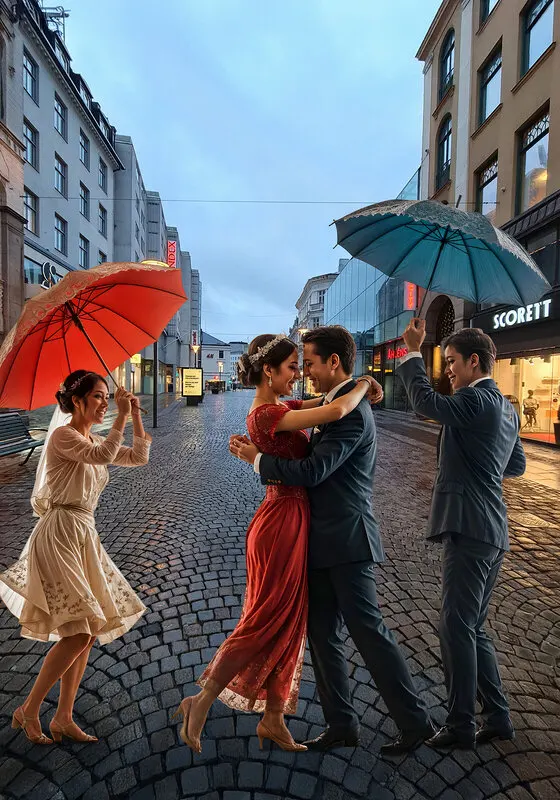
The Bridal Waltz, 2025
Digital
50 x 70 cm
3 200 kr
The Bridal Waltz
The song 'Singin’ in the Rain' has a rich history, dating back to 1929 when Herb Brown and Arthur Freed first penned it. Its debut in The Hollywood Revue by Cliff Edwards marked a significant milestone in the film industry, symbolising the shift from silent to sound. The song's iconic status was further solidified by Gene Kelly’s memorable dance scene in the rain, a sequence filmed under challenging conditions, with Kelly battling a high fever and rainwater mixed with milk to enhance the visual effect on camera.
The film 'Singin' in the Rain' is not merely a musical but a self-aware homage to Hollywood's evolution, with Freed’s old lyrics, particularly 'Singin’ in the Rain', serving as its centrepiece. The film’s narrative is carried by a strong cast, with Debbie Reynolds, then just 19 years old, portraying Kathy Selden—the film’s moral and emotional anchor—opposite Kelly’s charismatic lead. Donald O’Connor's acrobatic comedy as Cosmo Brown and Jean Hagen's biting, Oscar-nominated performance as Lina Lamont, the shrill-voiced silent film star, add depth and dimension to the film.
Together, the cast and crew of 'Singin’ in the Rain' have crafted a film that transcends the boundaries of a mere musical. It is a timeless reflection on the themes of change, illusion, and joy. The couple dancing in the street, with music playing from a Bluetooth speaker, serves as a poignant reminder that sometimes, all we need for joy is a little music and some careful planning.
Discover a unique perspective on superhero relationships and why this story is a must-read.
”Waltz in Rain
I'm singin' in the rain,
Just singin' in the rain,
What a glorious feeling,
I'm happy again!
I'm laughing at clouds.
So dark up above,
The sun's in my heart and I'm ready for love!
Let the stormy clouds chase
Everyone from the place,
Come on with your rain,
I've got a smile on my face!
I'll walk down the lane
With a happy refrain,
Just singin', singin' in the rain!
Why am I smiling, and why do I sing?
Why does a rainy Malmö seem sunny as Spring?
Why do I get up each morning to start
Happy and head-up with joy in my heart?
Why is each new task a trifle to do?
Because I am living a life full of you!
Hey, I'm singin' in the rain,
Just singin' in the rain,
What a glorious feeling,
I'm happy again!
I'm laughing at clouds.
So dark up above,
The sun's in my heart and I'm ready for love!
Let the stormy clouds chase
Everyone from the place,
Come on with your rain,
I've got a smile on my face!
I'll walk down the lane
With a happy refrain,
Just singin', singin' in the rain!”
Herb Brown/Arthur Freed, 1929
The Bridal Waltz
In Sweden, Felix Mendelssohn’s 'Wedding March' (from ‘A Midsummer Night’s Dream’) is by far the most common piece for the bridal procession. It is often played on the organ as the couple walks down the aisle. However, when it comes to the ‘brudvals’—the wedding waltz where the couple dances together in front of the guests—this is a significant moment in the wedding. The 'brudvals' symbolises the couple's first dance as a married pair, and the music for this dance varies from traditional to modern. In this particular instance, when the bride and groom chose to leave the reception hall and dance outside on Södergatan, the music, fittingly enough, was ‘Dancing in the Rain’.
The choice of music for the first dance is a fascinating aspect of wedding traditions, and it's a celebration of love and joy. It varies significantly from country to country, offering a rich tapestry of musical expressions that will surely intrigue you and open your mind to new possibilities.
In Sweden, the most popular pieces include:
‘Brudvalsen’ by Evert Taube
‘The Blue Danube’ – Johann Strauss II
‘Så skimrande var aldrig havet’ – also by Evert Taube, played in waltz time
The waltz from Disney’s ‘Snow White’
‘Elvira Madigan’ (Mozart, Piano Concerto No. 21 – second movement), sometimes rearranged
In England:
‘Greensleeves’ – traditional, sometimes arranged as a waltz
‘When I Fall in Love’ – Nat King Cole
‘Moon River’ – Henry Mancini, often used for slow dancing
‘A Nightingale Sang in Berkeley Square’ – for elegance and nostalgia
‘Perfect’ – Ed Sheeran, a modern classic for romantic first dances
Surprisingly, many English couples today are opting for contemporary songs in 3/4 or 6/8 time over classical waltzes, adding a modern twist to this age-old tradition.
In France:
‘La Vie en Rose’ – Édith Piaf
‘Sous le ciel de Paris’ – Yves Montand / Piaf
‘Que reste-t-il de nos amours’ – Charles Trenet
‘Amélie from Montmartre’ – Yann Tiersen, especially ‘Comptine d’un autre été’
Classic musette waltzes, featuring the accordion, are also sometimes played to create an authentic Parisian feel.
In Austria and Germany:
‘Kaiser-Walzer’, ‘The Blue Danube’ – Johann Strauss II
‘Vienna, Vienna, Only You Alone’ – traditional Viennese waltz
‘Lili Marleen’ may also occasionally appear if the couple is more mature.
In the USA:
‘The Anniversary Waltz’ – Al Jolson
‘Unchained Melody’ – The Righteous Brothers (not a waltz, but often rearranged)
‘Can’t Help Falling in Love’ – Elvis Presley – slow, often played in ¾ time
In Mexico and Latin America:
‘Vals de las Mariposas’
‘Sobre las Olas’ – a waltz by Juventino Rosas
Romantic ‘boleros’ or ‘rancheras’ rearranged into waltz form
Regardless of the country, the first dance is a poignant moment where music, memory, and emotion intertwine. It's a moment that connects us all, creating a shared emotional experience that is sure to bring a sentimental tear to your eye.
Back to the choice this time—’Singin' in the Rain’. The music was composed by Herb Brown, with lyrics by Arthur Freed. It was first published in 1929, long before the famous 1952 film starring Gene Kelly, which made the song immortal.
The song first appeared in a musical revue that same year, ‘The Hollywood Revue’, where it was performed by Cliff Edwards (better known as "Ukulele Ike") alongside musical acts and dance numbers from various MGM stars, including a young Joan Crawford—who, of course, would go on to become a major star. Initially, the song was written to mark the transition from silent films to sound films, making it all the more fitting that it experienced a renaissance in a movie precisely about that very transition—the one featuring Gene Kelly and Debbie Reynolds.
Why is the song so powerful? Is it the rain?
The song, 'Singin' in the Rain', is a powerful expression of joy in the face of adversity. Its simplicity is striking, resonating both sincerely and ironically, depending on the context. In the film, it’s used as an exuberant act of freedom following a romantic turning point. Yet, in modern popular culture, it can just as easily be interpreted as black humour or defiance. This resilience in the face of challenges is what makes the song so inspiring and uplifting.
When Gene Kelly performed the song in ‘Singin’ in the Rain’ (1952), it became one of the most iconic moments in film history. His dancing in the pouring rain, twirling an umbrella, with a smile that practically bursts through the screen, is a testament to his unparalleled talent and dedication. The scene was filmed despite Kelly suffering from a fever of 102°F (39°C), and the rainwater was mixed with milk to enhance the studio lighting, further highlighting the extraordinary effort put into this iconic performance.
Interestingly, the idea for the film was built around the song’s title, rather than the other way around. Arthur Freed, by then a powerful producer at MGM, wanted to create a film using a selection of his old lyrics as a framework, and ‘Singin’ in the Rain’ became the centrepiece.
In the 1952 classic, Gene Kelly starred alongside three co-stars, each of whom contributed something essential to the film, helping it become one of the most beloved works in the history of the musical. Each brought their distinct qualities to the story and tone, ranging from youthful charm and physical comedy to biting satire.
Debbie Reynolds played Kathy Selden, a young woman with talent, integrity, and dreams of becoming a serious actress. Her character serves as the film’s heart, capable of both speaking and singing at a time when the shift to talking pictures demanded new skills from actors. Reynolds was only 19 during filming, while Gene Kelly, who not only starred but also choreographed much of the film, was 39. Despite the romantic chemistry on screen, the shoot was far from easy for Reynolds. Kelly was known for his perfectionism and, according to many accounts, could be challenging and demanding. Nevertheless, Reynolds delivered a performance brimming with energy and charm that has become iconic. One of the film’s most symbolically rich moments occurs when Kathy, hidden behind a curtain, provides the voice for Lina Lamont—a metaphor for the invisible labour women have often undertaken behind the scenes.
Donald O’Connor played Cosmo Brown, Kelly’s ever-present sidekick, pianist, and comic relief. With his quick wit, acrobatic dance, and physical humour, he was the perfect counterbalance to Kelly’s more romantic and dramatic performance. His number "Make ’Em Laugh" is one of the most physically gruelling comedic scenes ever filmed, leaving O’Connor so exhausted that he had to rest for several days afterwards. Already known as a gifted comedian, this became a high point in his career. Through Cosmo, he added a touch of joyful madness and musical brilliance that elevated the film’s overall tone.
Jean Hagen, who portrayed silent film diva Lina Lamont, emerged as the film’s hidden ace. With her shrill voice and inflated ego, her character symbolised everything old Hollywood sought to leave behind when sound arrived. She is also the story’s primary obstacle—her voice is so ill-suited to sound films that Kathy has to dub her. Hagen approached the role with such sharp satire that she received an Oscar nomination for Best Supporting Actress. Ironically, it’s Jean Hagen herself who dubs Reynolds in the scene where Reynolds is meant to be dubbing Hagen, creating an elegant meta-commentary on acting, illusion, and artifice.
Together, Reynolds, O’Connor, and Hagen formed a rich harmony for Kelly’s lead. Through humour, contrast, movement, and emotion, ‘Singin’ in the Rain’ became more than just a musical. It became a self-reflexive celebration of cinema itself—a glittering tribute to one of Hollywood’s most creative eras. This celebration of cinema's creativity is sure to make any film enthusiast feel proud and appreciative of the art of cinema.
And if anyone wonders how the wedding couple in the picture managed to dance in the middle of the street without music, the answer is simple. They did indeed have music. Among the crowd clapping in rhythm, one person had a good speaker connected via Bluetooth to his phone. That was all it took.
3 200 kr

Jörgen Thornberg
Malmö
Lite om bilder och mig. Translation in English at the end.
Jag är en nyfiken person som ser allt i bilder, även det jag fäster i ord, gärna tillsammans för bakom alla mina bilder finns en berättelse. Till vissa bilder hör en kortare eller längre novell som följer med bilden.
Bilder berättar historier. Jag omges av naturlig skönhet, intressanta människor och historia var jag än går. Jag använder min kamera för att dokumentera världen och blanda det jag ser med vad jag känner för att fånga den dolda magin.
Mina bilder berättar mina historier. Genom mina bilder, tryck och berättelser. Jag bjuder in dig att ta del av dessa berättelser, in i ditt liv och hem och dela min mycket personliga syn på vår värld. Mer än vad ögat ser. Jag tänker i bilder, drömmer och skriver och pratar om dem; följaktligen måste jag också skapa bilder. De blir vad jag ser, inte nödvändigtvis begränsade till verkligheten. Det finns en bild runt varje hörn. Jag hoppas att du kommer att se vad jag såg och gilla det.
Jag är också en skrivande person och till många bilder hör en kortare eller längre essay. Den följer med tavlan, tryckt på fint papper och med en personlig hälsning från mig.
Flertalet bilder startar sin resa i min kamera. Enkelt förklarat beskriver jag bilden jag ser i mitt inre, upplevd eller fantiserad. Bilden uppstår inom mig redan innan jag fått okularet till ögat. På bråkdelen av ett ögonblick ser jag vad jag vill ha och vad som kan göras med bilden. Här skall jag stoppa in en giraff, stålmannen, Titanic eller vad det är min fantasi finner ut. Ännu märkligare är att jag kommer ihåg minnesbilden långt efteråt när det blir tid att skapa verket. Om jag lyckas eller inte, är upp till betraktaren, oftast präglat av en stråk av svart humor – meningen är att man skall bli underhållen. Mina bilder blir ofta en snackis där de hänger.
Jag föredrar bilder som förmedlar ett budskap i flera lager. Vid första anblicken fylld av feel-good, en vacker utsikt, fint väder, solen skiner, blommor på ängen eller vattnet som ligger förrädiskt spegelblankt. I en sådan bild kan jag gömma min egentliga berättelse, mitt förakt för förtryckare och våldsverkare, rasister och fördomsfulla människor - ett gärna återkommande motiv mer eller mindre dolt i det vackra motivet. Jag försöker förena dem i ett gemensamt narrativ.
Bild och formgivning har löpt som en röd tråd genom livet. Fotokonst känns som en värdig final som jag gärna delar med mig.
Min genre är vid som framgår av mina bilder, temat en blandning av pop- och gatukonst i kollage som kan bestå av hundratals lager. Vissa bilder kan ta veckor, andra någon dag innan det är dags att överlämna resultatet till printverkstaden. Fine Art Prints är digitala fotocollage. I dessa kollage sker rivandet, klippandet, pusslandet, målandet, ritandet och sprayningen digitalt. Det jag monterar in kan vara hundratals år gamla bilder som jag omsorgsfullt frilägger så att de ser ut att vara en del av tavlan men också bilder skapade av mig själv efter min egen fantasi. Därefter besöks printstudion och för vissa bilder numrera en limiterad upplaga (oftast 7 exemplar) och signera för hand. Vissa bilder kan köpas i olika format. Det är bara att fråga efter vilka. Gillar man en bild som är 70x100 men inte har plats på väggen, går den kanske att få i 50x70 cm istället. Frågan är fri.
Metoden Giclée eller Fine Art Print som det också kallas är det moderna sättet för framställning av grafisk konst. Villkoret för denna typ av utskrifter är att en högkvalitativ storformatskrivare används med åldersbeständigt färgpigment och konstnärspapper eller i förekommande fall på duk. Pappret som används möter de krav på livslängd som ställs av museer och gallerier. Normalt säljer jag mina bilder oinramade så att den nya ägaren själv kan bestämma hur de skall se ut, med eller utan passepartout färg på ram, med eller utan glas etc..
Under många år ställde jag bara ut på nätet, i valda grupper och på min egen Facebooksida - https://www.facebook.com/jorgen.thornberg.9
Jag finns också på en egen hemsida som tyvärr inte alltid är uppdaterad – https://www.jth.life/ Där kan du också läsa en del av de berättelser som följer med bilden.
UTSTÄLLNINGAR
Luftkastellet, oktober 2022
Konst i Lund, november 2022
Luftkastellet, mars 2023
Engleson Galleri Caroli, april 2023
Hydra, Greece June 2023
Engleson Galleri Caroli, oktober 2023
Toppen, Höllviken december 2023
Luftkastellet, mars 2024
Torups Galleri, mars 2024
Venice, May 2024
Luftkastellet, oktober 2024
Konst i Advent, December 2024
Galleri Engleson, Caroli December 2024
Jäger & Jansson Galleri, april 2025
A bit about pictures and me.
I'm a curious person who sees everything in pictures, even what I express in words, often combining them, for behind all my pictures lies a story. These narratives, some as short as a single image and others as long as a novel, are the heart and soul of my work.
Pictures tell stories. Wherever I go, I'm surrounded by natural beauty, exciting people, and history. I use my camera to document the world and blend what I see with what I feel to capture the hidden magic.
My images tell my stories. Through my pictures, prints, and narratives, I invite you to partake in these stories in your life and home and share my deeply personal perspective of our world. More than meets the eye. I think in pictures, dream, write, and talk about them; consequently, I must create images too. They become what I see, not necessarily confined to reality. There's a picture around every corner. I hope you'll see what I saw and enjoy it.
I'm also a writer, and many images come with a shorter or longer essay. It accompanies the painting, printed on fine paper with my personal greeting.
Many pictures start their journey on my camera. Simply put, I describe the image I see in my mind, experienced or imagined. The image arises within me even before I bring the eyepiece to my eye. In a fraction of a moment, I see what I want and what can be done with the picture. Here, I'll insert a giraffe, Superman, the Titanic, or whatever my imagination conjures up. Even stranger is that I remember the mental image long after it's time to create the work. Whether I succeed is up to the observer, often imbued with a streak of black humour – the aim is to entertain. My pictures usually become a talking point wherever they hang.
I prefer pictures that convey a message in multiple layers. At first glance, they're filled with feel-good vibes, a beautiful view, lovely weather, the sun shining, flowers in the meadow, or the water lying deceptively calm. But beneath this surface beauty, I often conceal a deeper story, a narrative that challenges societal norms or explores the human condition. I invite you to delve into these hidden narratives and discover the layers of meaning within my work.
Picture and design have been a thread running through my life. Photographic art feels like a fitting finale, and I'm happy to share it.
My genre is varied, as seen in my pictures; the theme is a blend of pop and street art in collages that can consist of hundreds of layers. Some images can take weeks, others just a day before it's time to hand over the result to the print workshop. Fine Art Prints are digital photo collages. In these collages, tearing, cutting, puzzling, painting, drawing, and spraying happen digitally. What I insert can be images hundreds of years old that I carefully extract so they appear to be part of the painting, but also images created by myself, now also generated from my imagination. Next, visit the print studio and, for certain images, number a limited edition (usually 7 copies) and sign them by hand. Some images may be available in other formats. Just ask which ones. If you like an image that's 70x100 but doesn't have space on the wall, you might be able to get it in 50x70 cm instead. The question is open.
The Giclée method, or Fine Art Print as it's also called, is the modern way of producing graphic art. This method ensures the highest quality and longevity of the artwork, using a high-quality large-format printer with archival pigment inks and artist paper or, in some cases, canvas. The paper used meets the longevity requirements set by museums and galleries. I sell my pictures unframed, allowing the new owner to personalise their artwork, confident in the lasting value and quality of the piece.
For many years, I only exhibited online, in selected groups, and on my Facebook page - https://www.facebook.com/jorgen.thornberg.9. I also have my website, which unfortunately is not constantly updated - https://www.jth.life/. You can also read some of the stories accompanying the pictures there.
EXHIBITIONS
Luftkastellet, October 2022
Art in Lund, November 2022
Luftkastellet, March 2023
Engleson Gallery Caroli, April 2023
Hydra, Greece June 2023
Engleson Gallery Caroli, October 2023
Toppen, Höllviken December 2023
Luftkastellet, March 2024
Torup Gallery, March 2024
Venice, May 2024
UTSTÄLLNINGAR
Luftkastellet, oktober 2022
Konst i Lund, november 2022
Luftkastellet, mars 2023
Engleson Galleri Caroli, april 2023
Hydra, Greece June 2023
Engleson Galleri Caroli, oktober 2023
Toppen, Höllviken december 2023
Luftkastellet, mars 2024
Torups Galleri, mars 2024
Venice, May 2024
Luftkastellet, October 2024
Konst i Advent, December 2024
Galleri Engleson, Caroli December 2024
Jäger & Jansson Galleri, April 2025
Utbildning
Autodidakt
Medlem i konstnärsförening
Öppna Sinnen
Med i konstrunda
Konstrundan i Skåne
Utställningar
Luftkastellet, October 2022
Art in Lund, November 2022
Luftkastellet, March 2023
Engleson Gallery Caroli, April 2023
Hydra, Greece June 2023
Engleson Gallery Caroli, October 2023
Toppen, Höllviken December 2023
Luftkastellet, March 2024
Torup Gallery, March 2024
Venice, May 2024