Vi använder cookies för att ge dig bästa möjliga upplevelse. Välj vilka cookies du tillåter.
Läs mer i vår integritetspolicy
Jörgen Thornberg
When the Circus Came to Caroli, 2025
Digital
70 x 50 cm
3 200 kr
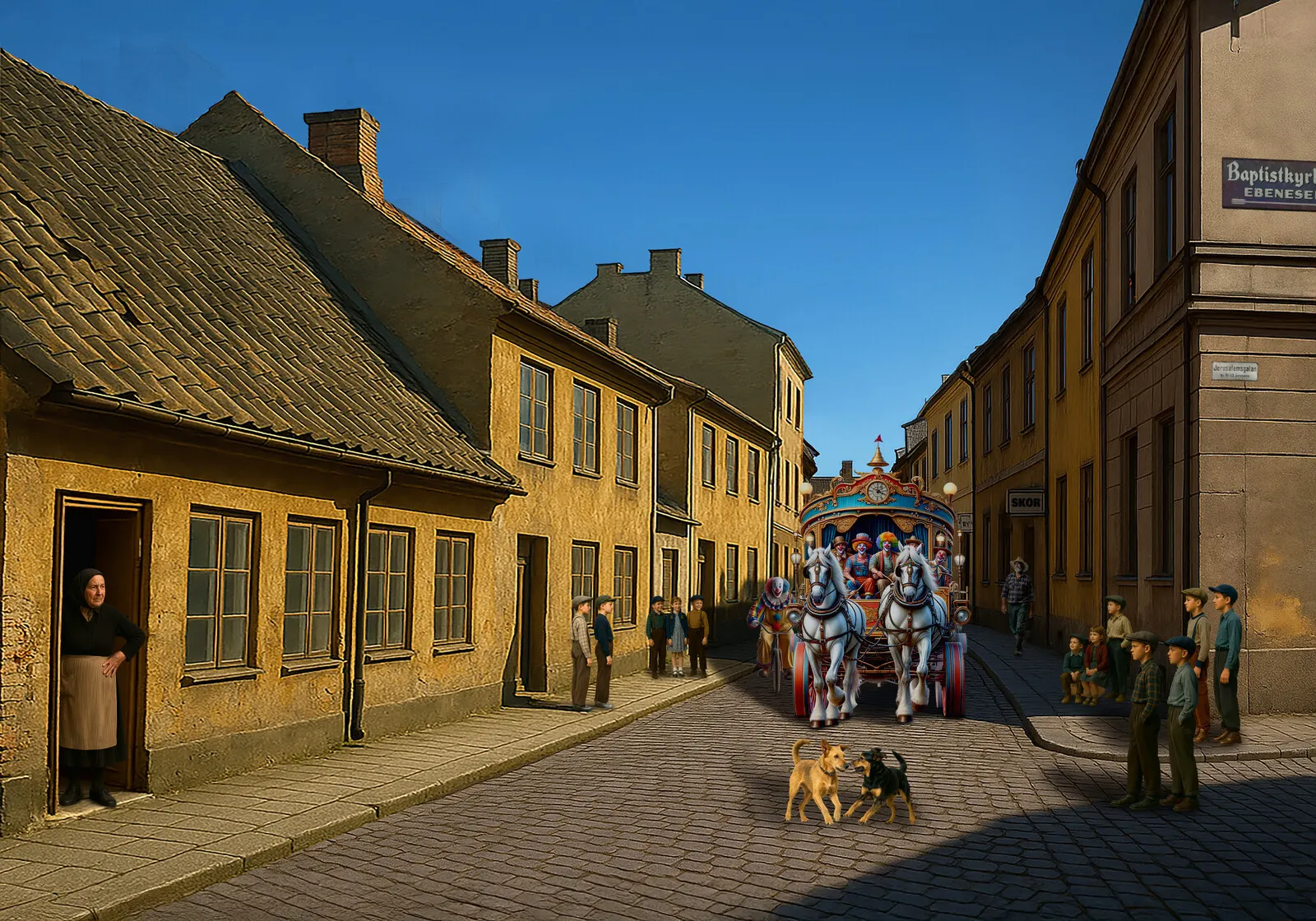
When the Circus Came to Caroli
This is not a tale of conquest, nor quite one of nostalgia. It is the story of a game that got out of hand, a circus that sparked dreams, and a city that quietly forgot how its streets once felt beneath the soles of children.
It begins, as these stories so often do, with a rumour—rattan shortages in Motala, feathers missing from roosters, aniline dye vanishing from shop shelves. Boys had turned into braves, tomahawks were carved from scrap wood, and even a light cat-pelt could pass for buckskin. The year was 1897, and the Wild West had arrived in Sweden—not by train, but by imagination. It had helped, of course. His name was Texas Jack.
But this is also the story of Malmö. Of Caroli. Of a corner of the old town where a circus once rolled in, and everything changed. Where laundry lines sagged beneath the weight of childhood excitement. Where the smell of horsehair and sawdust slipped between cracked facades and cobblestones, and where, for a brief and colourful moment, magic was not make-believe—it was scheduled for 3 p.m.
This is the story of what happens when memory becomes mural, when a rickety wagon pulled by white horses can still outshine a shopping centre. It is about the joy that the circus brought, the erasure of its physical presence, and the quiet resilience of play that remains.
It is about the time the circus came to Caroli—and its memory never truly left. Because sometimes, all it takes is a feather in the cap – and the world, with its ever-changing perspectives, can be swayed. Please click the link below to learn more about my pictures, writing, and why this story is a must-read.
https://www.konst.se/jorgen-thornberg
”A Circus Ballad
It was morning in Caroli, sunlight ran wide,
And the houses stood quiet with time on their side.
A woman in an apron, hands on her hips,
Stood framed in her doorway with words on her lips.
Two mongrels were barking out front on the stones,
Their snarls like trumpets, like laughter in tones.
Then came the wagon—like dream turned to brass—
With white horses prancing and clowns full of sass.
Their painted-on grins gleamed red, blue, and gold,
A fairy-tale fresco from stories of old.
And children lined up in a respectful parade,
In sweaters and caps, wide-eyed and unswayed.
The clowns tossed a wink, the wheels hummed a song,
The dogs gave chase; the shadows grew long.
A boy held his breath, while another just beamed—
For this was the circus that no one had dreamed.
It smelled of sawdust and echoes and string,
Of music half-heard and magical things.
And time, for a moment, bent slightly its law—
And left all who saw it both dazzled and raw.
For this was Caroli, where cobblestones knew
The rhythm of hooves and the sparkle of blue.
Where wonder rolled in on four wheels and a tune,
And vanished again before the rising of the moon.
So let it be said, as the old windows glow,
That once, down this street, walked a carnival show.
And those who were watching—young, quiet, and small—
Still carry the circus, inside them, through all.”
Malmö May 2025
When the Circus Came to Caroli
In 1897, a truly unexpected news item swept across Sweden: the entire stock of rattan in the shops of Motala had sold out, all thanks to an unforeseen craze among children playing “Texas Jack,” a game of cowboys and Indians. The sudden surge in demand for rattan, a material known for making excellent peace pipes, was so intense that it frequently snapped in two during the games. As one newspaper reported: “All the town’s roosters have been stripped of their brightest feathers, every drop of aniline dye has gone into painting redskin faces, and the boys parade in Indian-style headdresses, a light cat-pelt draped over their shoulders, trousers richly adorned with feathers, and a wooden tomahawk in hand.”
The spark behind this phenomenon was Carl Max Alexander Rhodin’s “Texas Jack” show—a so-called Wild West performance that toured Sweden. Rhodin, a native of Malmö, had been travelling since the early 1890s, mostly with his circus troupe. His inspiration came from America, where William Frederick Cody had launched the wildly popular “Buffalo Bill’s Wild West,” a show that featured reenactments of cowboy life and Native American culture, and also toured Europe (though never Sweden). Rhodin, a showman and entrepreneur, saw the potential of bringing this American spectacle to Sweden, and his efforts were met with resounding success.
At the turn of the century, these Wild West shows enjoyed tremendous success. They were not just shows, but authentic experiences—the “Indians” in the ring were real Native Americans, and the cowboys were genuine Americans. This authenticity brought the Wild West to life for the audience, making the shows more than just entertainment. And, of course, the shows were vigorously advertised. The Americans were masters of publicity. Circus Brazi Jack had followed in their footsteps, and posters were plastered everywhere across the Caroli district. No wonder children lined the streets when the circus wagon rolled into town—more about the circus at the end.
The image captures a staged — yet emotionally accurate — glimpse of what Caroli once was: the trembling final years of the old quarter in the early 1960s. It shows the intersection of Kattsundsgatan and Jerusalemsgatan, two of the older streets in what was then referred to as ‘Gamla Staden’ (the Old Town), where children and adults witnessed a vibrant moment: the arrival of the circus. This event was not just a passing spectacle, but a significant marker of change in the area. It signified the beginning of a new era, as the old quarter was about to transform. This is a place steeped in history, a living testament to the past.
The buildings, with their visibly worn yet charming features – plastered, yellowed façades with cracks, weathered wooden windows, plain roof tiles, and sooty brick chimneys- tell a story of a working-class neighbourhood. It was a place not just to live, but a community where everyone knew each other. The cobblestones remain in place, a testament to the history they've witnessed. An older woman stands in a doorway on the left, her expression a mix of scepticism and curiosity – the kind of look that belongs to someone who’s seen it all before.
Children of various ages – boys in caps and knitted sweaters, typical working-class kids of the time – have gathered along the walls, eager yet respectful. A clear social hierarchy is evident: the older children, who have lived in the neighbourhood longer and perhaps have more experience with such events, remain on the sides, but every eye is fixed forward. This hierarchy reflected the community's structure, where respect for elders and their experience was paramount. Change is in the air. Sweden is growing wealthy from Europe’s postwar reconstruction, and prosperity is slowly creeping even into these weary blocs.
At the colourful centre of the scene: a baroque, almost fairy-tale circus wagon drawn by four white horses in parade formation, led by clowns and performers. The colours are intense, with painted wheels, ornate details, and smiling clown faces grinning from the sides. Today, it seems almost too fantastical to be real – more like something conjured from a dream or a memory, which only enhances its magic.
Two dogs, a pair of scruffy mongrels, wrestle or bark in the foreground – a common sight in old Malmö neighbourhoods. One is a sandy-colored mutt, the other a black-and-white mix. They introduce movement, everyday life, and a touch of animal chaos to the otherwise staged fantasy.
The image radiates both nostalgia and wonder, as if all its phases have been freshly repainted. It is at once documentary and dreamlike. It evokes that childhood moment when something unusual – a circus, a laugh, a frightening clown’s face – imprints itself forever in the memory. It serves as a poignant reminder of what was lost when the Caroli blocks were demolished: not only buildings, but lives, routines, stories, and magic. It's a call to remember and cherish the past.
This is not merely a staged depiction of “when the circus came to town” – it is a portrait of an era when reality itself, in all its simplicity, could still hold a flicker of enchantment.
The Old Caroli Blocks
Before the city planning decision of 1970, the Caroli area consisted of a handful of distinct blocks, each with its name, shaped by centuries of life and architecture. Many of these names have faded from public memory, although they remain on maps, and some persist in modern, altered forms.
Kv. 6 – Magnus Smek
Situated between Östergatan, St Tomasgatan (the northern part of Kattsundsgatan), Mårtensgatan, and Mäster Nilsgatan, this was one of the best-preserved parts of the Old Town in terms of historic buildings. Houses here ranged from the 1600s to the early 1800s. The block derived its name from King Magnus Eriksson, and when Mårtensgatan vanished during the 1970s redevelopment, the area was renamed after another king: Erik Menved.
Kv. 7 – Carolus
Bounded by Östergatan, Humlegatan, S:t Tomasgatan, and the old route of Grönegatan, the name appeared in various forms – some signs used "Karolus" with a K, while others favoured the Latinized "Carolus". Today, the entire area is collectively referred to as Carolus, forming what is now known as Caroli City.
Kv. 8 – Humle
Grönegatan, Humlegatan, Norregatan, and Östergatan framed this block. Two alleyways cut into it: Larmgränd and Norregränd. The latter still exists today, albeit reduced to a narrow passage.
Kv. 13 – Jerusalem
Named after Jerusalemsgatan, this block was encircled by the old part of Grönegatan, Kattsundsgatan, and Rundelsgatan. Only the easternmost fringe – east of the modern extension of Humlegatan – still bears the name Jerusalem.
Kv. 14 – Hjorten
This block came into being with the construction of Jerusalemsgatan in 1861. The name originates from a tavern once located here, marked by a golden stag above the door – hence ‘Hjorten’ (the Deer). It was bordered by Jerusalemsgatan, Stora Kvarngatan, Rundelsgatan, and Kattsundsgatan.
Kv. 15 – Erik Menved
Framed by Rundelsgatan, Kattsundsgatan, Mårtensgatan, and Mäster Nilsgatan. When Mårtensgatan was removed in 1970, the entire block was renamed Erik Menved. Previously, Ringaregränd also ran through this area – it, too, was absorbed into the block after the reorganisation.
The Old Streets of Caroli
Before the 1970 city plan redrew the map, Caroli was a maze of older streets – some dating back to the Middle Ages, while others were added during the 19th-century expansion. Below are some of the most significant streets, as they once wound through Malmö’s eastern old town.
Grönegatan
Grönegatan serves as a sort of backbone. It has been a main street since the late 1200s, first recorded in 1532 but likely older. The street curves through the district from the southern tip of Humlegatan toward S:t Tomasgatan. In the early 1800s, it was extended eastward after the city’s fortifications were dismantled, creating what became known as Nya Grönegatan. By the 1880s, locals began calling the older, crooked segment ‘Gamla Gatan’. In 1945, the authorities unified the name to ‘Grönegatan’. Today, only the newer section remains – Caroli City's delivery entrances replaced the oldest part long ago.
Humlegatan
Humlegatan runs north from Grönegatan toward Östergatan. Here, some of the older buildings escaped demolition – including the Dieden House, the Sjöberg Palace, and the old warehouse of the Malmö Roller Blind Factory. On the west side stood Johan Dieden Sr.’s grain warehouse from the mid-1800s. Initially, locals distinguished between Stora Humlegatan (now Humlegatan) and Lilla Humlegatan (now Bagersgatan). The name change in 1898 was prompted by residents on Lilla Humlegatan wanting to distance themselves from the association with the prostitution that had tarnished the reputation of Stora Humlegatan. Earlier, the street had been known as ‘Humlegränd’. In 1970, Humlegatan was extended south to Stora Kvarngatan, roughly where Jerusalemsgatan once ended.
Jerusalemsgatan
Jerusalemsgatan is a child of the 19th century, built in 1861, and originally little more than a drainage ditch, which explains its absence from earlier maps. The name was adopted three years later, in 1864, after a housing complex called ‘Jerusalem’ had grown up on the site in 1806. That complex was demolished in 1888 and replaced by brick buildings in the 1890s. In the 1930s, locals nicknamed the street ‘Bakgatan’ (Back Street). The entire street was erased in 1970.
Kattsundsgatan stretches from Rundelsgatan up towards Östergatan. Medieval in form but first documented in 1532 as "Kattesund" – a name referring to a narrow passage, often water-filled. S:t Tomasgatan was sometimes considered part of this street. The name Kattsundsgatan was officially adopted in 1864.
Larmgränd led into the Humle block from the south, coming from Nya Grönegatan. It was created in the early 19th century alongside the tobacco factory "Försöket," built on what was then a vacant lot just north of the alley. As the city ramparts still stood, the alley became the only access point – hence its angled course running parallel to the rampart. The factory closed in 1825. The name appeared only in the 1950s. The street sign was removed on August 25, 1974, one year after Caroli City was inaugurated.
Mårtensgatan ran from S:t Tomasgatan toward Sankt Petri Church. It disappeared in 1970; today, only a pedestrian walkway remains beneath the concrete complex. The street has old roots – it was mentioned in 1522 as "Byecircke-stredet," meaning "the street to the village church." The name refers to its direction towards S:t Petri.
Mäster Nilsgatan still runs from the intersection of Rundelsgatan and Själbodgatan up to Östergatan. It survived the worst of the demolitions.
Despite the sweeping changes, Norregatan still stands, stretching from Drottningtorget via Stora Kvarngatan down towards Södra Promenaden. Its survival provides a sense of continuity and a tangible connection to the past, offering a comforting link to Malmö's history amidst the urban transformation.
Norregränd was a short alley leading westwards from Norregatan into the Humle block. It was established in the early 1800s but wasn’t named until 1911. "Caroligränd" was proposed but rejected to avoid confusion with Caroli Church. During the demolitions, the alley was extended to Humlegatan but never became a block-dividing street.
Ringaregränd is a historical footnote – established in 1962, just eight years before the total demolition. It ran from Mårtensgatan into the Erik Menved block. The name refers to the church bell-ringer. The alley was created when a house was torn down and existed for only five years before the area was levelled.
Rundelsgatan, however, remains, winding from Stora Kvarngatan up toward Sankt Petri Church. The street has preserved its medieval curve, adapted to the original landscape, serving as a testament to the city's commitment to keeping its historical roots.
S:t Tomasgatan, sometimes spelt S:t Thomasgatan, was long considered part of the northern stretch of Kattsundsgatan. The name appears as early as 1522 as "Oluf Persens strede." It was officially named in 1864 but disappeared in 1970 when the street was reabsorbed into Kattsundsgatan. It was also known as "Tyska kyrkogatan," after the German church – now the Caroli Church. The name "Caroli Kyrkoplan" was first used in 1936 to refer to the square surrounding the church.
"Snurran" was the popular name for the small square formed at the intersection of Grönegatan and Humlegatan. Its roots date to the 13th century, although the square itself emerged only with the dismantling of the city ramparts in the early 1800s. Despite the changes, the place remains a silent reminder.
Stora Kvarngatan, which stretches from Östra Promenaden to Rundelsgatan, has a significant historical evolution. Until the 1870s, it was known as 'Qvarngatan'. The establishment of 'Lilla Kvarngatan' in the 1870s led to the renaming of the larger street to 'Stora Kvarngatan'. These changes in street names reflect the city's growth and development over time.
Östergatan, Malmö's oldest street, is steeped in history, laid out around 1250. It followed the coastline, then located at today's Norra Vallgatan, and runs from Drottningtorget, past the Caroli blocks, westward toward Gamla Väster. For centuries, this was the main street of the eastern city, and much of the 19th-century architecture still survives.
Background to the Total Demolition
The Caroli blocks – together with large parts of the eastern Old Town – became the focus of a wave of total demolitions that swept through Sweden after World War II. This was no sudden idea, but a mindset that had taken root over the course of decades. The devastation of the war had left many European cities in ruins, and the post-war period saw a widespread push for urban renewal and modernisation. In Sweden, as in many other countries, this often meant the destruction of historic city centres in favour of modern, functionalist architecture.
This view gained full effect in the 1950s and 1960s. A new city would be built for a new time: light, airy blocks with straight streets and broad traffic lanes. Cars needed access, housing would be standardised, and space would be created for shops and parking garages. The old city was seen as an obstacle to modernity – quite literally. In Malmö, as in so many other cities, demolition plans were drawn with rulers and visionary zeal.
Already in 1937, City Engineer Erik Bülow Hübe presented the first proposal for demolishing the Caroli blocks. His plan included tearing down entire blocks while preserving the street grid. It never came to fruition. Yet, the full impact of modernism arrived, bringing with it a new city plan in 1967. This plan, which was a culmination of years of urban planning and architectural vision, marked a significant shift in Malmö's urban landscape.
This would not merely involve demolition. Streets would be widened, surfaces levelled, heights raised, and layouts simplified. Old houses were not just impractical; they were seen as obstacles. Even buildings in good condition were not spared. Only about 20 per cent of the Caroli area’s buildings were deemed genuinely dilapidated according to contemporary reports, but that was inconsequential. Everything was to be cleared. The land was necessary, and large-scale development was considered ideal. Economically, the calculation was straightforward: more square metres meant higher returns. A new city centre would emerge.
Both conservative and Social Democrat politicians backed the plans – in Malmö, particularly Oscar Stenberg, Carl Ljungbeck, and Eric Svenning. Behind the practical implementation was Skånska Cementgjuteriet, a powerful construction company that not only managed the demolition and construction work but also held significant stakes in the new properties. The initiative for Caroli City came from builder Hugo Åberg, who became synonymous with this type of transformation.
Jerusalemsgatan, once storied yet long infamous, disappeared entirely, along with the oldest sections of Grönegatan and Mårtensgatan. These narrow medieval streets, with their winding paths, were deemed unsuitable for both traffic and the future, and were entirely demolished. The street network, which had largely remained intact since the 13th century, was sacrificed. Yet, even buildings that were not dilapidated were demolished; in the logic of modernism, there was simply no place for them. New constructions took their place: tall, heavy, and large-scale.
There was also an ambition to entice people back from the suburbs into the city centre. Malmö's inner city was to regain its allure. The dark realities they sought to erase – overcrowding, poverty, public intoxication – were not merely to be hidden but obliterated. The Caroli area was viewed as a problem district, and the solution was radical: total transformation. This change not only altered the physical landscape of Malmö but also had profound social and economic implications, shaping the city's future development.
A first development plan was presented in 1967. There were even proposals to elevate Caroli City to thirteen stories, a bold plan that aimed to maximise the use of space and create a modern, high-rise city centre. However, these ambitious proposals were later shelved, and what remained was still massive: three old blocks were merged into one. The name became Carolus.
Construction commenced swiftly. In autumn 1969, the first tenants moved into the new buildings on Kattsundsgatan. Section by section, the area was completed by autumn 1973. On September 20 of that year, Malmö's largest shopping centre was inaugurated: Caroli City – 55 shops along a glass-covered, two-level pedestrian street. It was grand, typical of its time, and back then, it represented the future.
At the opening, Skånska Cementgjuteriet’s CEO Ulf Widerström spoke. He compared the city's core to a tree: "The core must be kept healthy for the tree to flourish." What was meant by "healthy" was never quite explained, but it was clear what was considered rotten: the old.
However, it did not take long for the media to begin writing about "the dream district that became a problem area." The issues in the old eastern quarters – in the Caroli blocks, but also neighbouring areas such as Möllebacken, Rostock, and Stralsund – had not vanished. They had merely been given new, concrete-grey facades.
What little remains
Of the entire old Caroli quarter, only tiny remnants exist today. The Dieden House, dating back to the 1620s, still stands, a testament to its enduring strength. So too does Caroli Church, built in 1880, and the Sjöberg warehouse on Humlegatan. The Thott House from 1558 survives only in the facade – little remains behind the brickwork, but its presence is a reminder of the past.
A few older buildings remain on the fringes – at Norregatan and Stora Kvarngatan in what was once the Jerusalem block. This is because Humlegatan was extended southward in 1970, allowing that area to escape total demolition. A few buildings along Nya Grönegatan also remain. But these are exceptions.
The entire urban landscape that once comprised Malmö's eastern medieval city centre – a weave of streets, alleys, homes, shops, noise, and life – vanished, leaving behind a void and a sense of nostalgia.
The rest, as they say, is history. Or in the case of Caroli City: a history that barely had time to begin before it began to age, a stark reminder of the transient nature of urban development.
Malmö's oldest circus.
Circus Brazil Jack, the world’s oldest touring circus, boasts a rich history spanning over a century. Its wagons, during its heyday, rolled through Caroli, leaving a trail of entertainment and wonder.
The Rhodin family’s circus legacy began in 1899 when Carl Rhodin, better known as Brazil Jack, founded Circus Brazil Jack, inspired by the remarkable success of American showman Buffalo Bill and his European tour with Buffalo Bill’s Wild West Show between 1887 and 1893. In its early years, Circus Brazil Jack featured elaborate Western pantomimes, including stagecoach raids, with Rhodin himself as the heroic cowboy performing lasso tricks, sharpshooting, knife throwing, and more. He also played the violin, sang comic songs, performed magic, and created shadow images. The show quickly grew into one of Scandinavia’s most prominent circuses and was eventually renamed ’Circus London’.
In 1982, the third generation of the Rhodin family—siblings Trolle Rhodin Jr., Carlo Rhodin, and Diana Rhodin, children of the renowned director Trolle Rhodin—launched a revival under the original name: Circus Brazil Jack. They chose to revert to the original name to honour their grandfather's legacy and to rekindle the spirit of the circus as it was in his day. In addition to traditional circus performances, the new troupe occasionally staged musical productions, such as Annie Get Your Gun, featuring Eva Rydberg in the title role and Teddy Rhodin as Sitting Bull. Opera singer and actor Toni Rhodin has also been part of the company for many years, performing as a classic clown, among other roles. The circus tours Sweden annually and maintains its winter quarters at Mariedals Gård in Malmö.
In tribute to its early roots, Circus Brazil Jack refers to itself as Sweden’s national circus, although the title is legally registered as a trademark by Circus Maximum.
Since 2018, Circus Brazil Jack has been completely animal-free. This decision was made in line with the growing global concern for animal welfare and the changing attitudes towards the use of animals in entertainment. Traditional whiteface clowns have also been phased out, replaced by comic characters with a more contemporary flair.
Jörgen Thornberg
When the Circus Came to Caroli, 2025
Digital
70 x 50 cm
3 200 kr
When the Circus Came to Caroli
This is not a tale of conquest, nor quite one of nostalgia. It is the story of a game that got out of hand, a circus that sparked dreams, and a city that quietly forgot how its streets once felt beneath the soles of children.
It begins, as these stories so often do, with a rumour—rattan shortages in Motala, feathers missing from roosters, aniline dye vanishing from shop shelves. Boys had turned into braves, tomahawks were carved from scrap wood, and even a light cat-pelt could pass for buckskin. The year was 1897, and the Wild West had arrived in Sweden—not by train, but by imagination. It had helped, of course. His name was Texas Jack.
But this is also the story of Malmö. Of Caroli. Of a corner of the old town where a circus once rolled in, and everything changed. Where laundry lines sagged beneath the weight of childhood excitement. Where the smell of horsehair and sawdust slipped between cracked facades and cobblestones, and where, for a brief and colourful moment, magic was not make-believe—it was scheduled for 3 p.m.
This is the story of what happens when memory becomes mural, when a rickety wagon pulled by white horses can still outshine a shopping centre. It is about the joy that the circus brought, the erasure of its physical presence, and the quiet resilience of play that remains.
It is about the time the circus came to Caroli—and its memory never truly left. Because sometimes, all it takes is a feather in the cap – and the world, with its ever-changing perspectives, can be swayed. Please click the link below to learn more about my pictures, writing, and why this story is a must-read.
https://www.konst.se/jorgen-thornberg
”A Circus Ballad
It was morning in Caroli, sunlight ran wide,
And the houses stood quiet with time on their side.
A woman in an apron, hands on her hips,
Stood framed in her doorway with words on her lips.
Two mongrels were barking out front on the stones,
Their snarls like trumpets, like laughter in tones.
Then came the wagon—like dream turned to brass—
With white horses prancing and clowns full of sass.
Their painted-on grins gleamed red, blue, and gold,
A fairy-tale fresco from stories of old.
And children lined up in a respectful parade,
In sweaters and caps, wide-eyed and unswayed.
The clowns tossed a wink, the wheels hummed a song,
The dogs gave chase; the shadows grew long.
A boy held his breath, while another just beamed—
For this was the circus that no one had dreamed.
It smelled of sawdust and echoes and string,
Of music half-heard and magical things.
And time, for a moment, bent slightly its law—
And left all who saw it both dazzled and raw.
For this was Caroli, where cobblestones knew
The rhythm of hooves and the sparkle of blue.
Where wonder rolled in on four wheels and a tune,
And vanished again before the rising of the moon.
So let it be said, as the old windows glow,
That once, down this street, walked a carnival show.
And those who were watching—young, quiet, and small—
Still carry the circus, inside them, through all.”
Malmö May 2025
When the Circus Came to Caroli
In 1897, a truly unexpected news item swept across Sweden: the entire stock of rattan in the shops of Motala had sold out, all thanks to an unforeseen craze among children playing “Texas Jack,” a game of cowboys and Indians. The sudden surge in demand for rattan, a material known for making excellent peace pipes, was so intense that it frequently snapped in two during the games. As one newspaper reported: “All the town’s roosters have been stripped of their brightest feathers, every drop of aniline dye has gone into painting redskin faces, and the boys parade in Indian-style headdresses, a light cat-pelt draped over their shoulders, trousers richly adorned with feathers, and a wooden tomahawk in hand.”
The spark behind this phenomenon was Carl Max Alexander Rhodin’s “Texas Jack” show—a so-called Wild West performance that toured Sweden. Rhodin, a native of Malmö, had been travelling since the early 1890s, mostly with his circus troupe. His inspiration came from America, where William Frederick Cody had launched the wildly popular “Buffalo Bill’s Wild West,” a show that featured reenactments of cowboy life and Native American culture, and also toured Europe (though never Sweden). Rhodin, a showman and entrepreneur, saw the potential of bringing this American spectacle to Sweden, and his efforts were met with resounding success.
At the turn of the century, these Wild West shows enjoyed tremendous success. They were not just shows, but authentic experiences—the “Indians” in the ring were real Native Americans, and the cowboys were genuine Americans. This authenticity brought the Wild West to life for the audience, making the shows more than just entertainment. And, of course, the shows were vigorously advertised. The Americans were masters of publicity. Circus Brazi Jack had followed in their footsteps, and posters were plastered everywhere across the Caroli district. No wonder children lined the streets when the circus wagon rolled into town—more about the circus at the end.
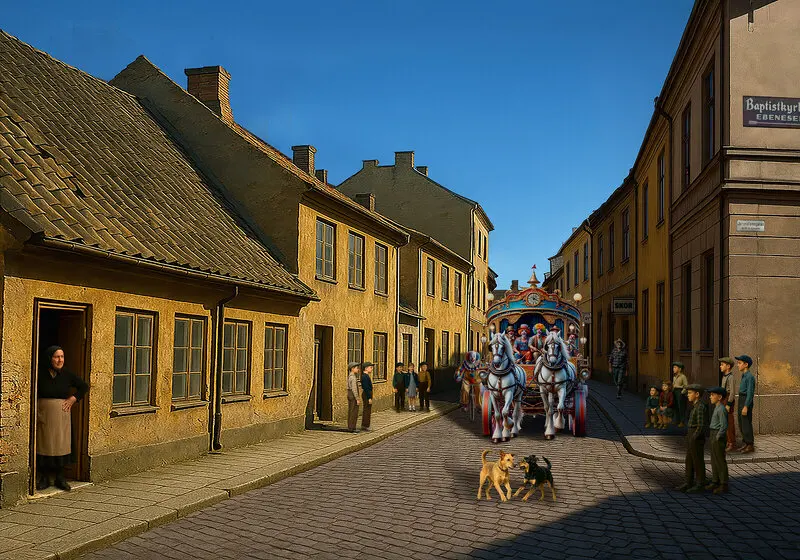
The image captures a staged — yet emotionally accurate — glimpse of what Caroli once was: the trembling final years of the old quarter in the early 1960s. It shows the intersection of Kattsundsgatan and Jerusalemsgatan, two of the older streets in what was then referred to as ‘Gamla Staden’ (the Old Town), where children and adults witnessed a vibrant moment: the arrival of the circus. This event was not just a passing spectacle, but a significant marker of change in the area. It signified the beginning of a new era, as the old quarter was about to transform. This is a place steeped in history, a living testament to the past.
The buildings, with their visibly worn yet charming features – plastered, yellowed façades with cracks, weathered wooden windows, plain roof tiles, and sooty brick chimneys- tell a story of a working-class neighbourhood. It was a place not just to live, but a community where everyone knew each other. The cobblestones remain in place, a testament to the history they've witnessed. An older woman stands in a doorway on the left, her expression a mix of scepticism and curiosity – the kind of look that belongs to someone who’s seen it all before.
Children of various ages – boys in caps and knitted sweaters, typical working-class kids of the time – have gathered along the walls, eager yet respectful. A clear social hierarchy is evident: the older children, who have lived in the neighbourhood longer and perhaps have more experience with such events, remain on the sides, but every eye is fixed forward. This hierarchy reflected the community's structure, where respect for elders and their experience was paramount. Change is in the air. Sweden is growing wealthy from Europe’s postwar reconstruction, and prosperity is slowly creeping even into these weary blocs.
At the colourful centre of the scene: a baroque, almost fairy-tale circus wagon drawn by four white horses in parade formation, led by clowns and performers. The colours are intense, with painted wheels, ornate details, and smiling clown faces grinning from the sides. Today, it seems almost too fantastical to be real – more like something conjured from a dream or a memory, which only enhances its magic.
Two dogs, a pair of scruffy mongrels, wrestle or bark in the foreground – a common sight in old Malmö neighbourhoods. One is a sandy-colored mutt, the other a black-and-white mix. They introduce movement, everyday life, and a touch of animal chaos to the otherwise staged fantasy.
The image radiates both nostalgia and wonder, as if all its phases have been freshly repainted. It is at once documentary and dreamlike. It evokes that childhood moment when something unusual – a circus, a laugh, a frightening clown’s face – imprints itself forever in the memory. It serves as a poignant reminder of what was lost when the Caroli blocks were demolished: not only buildings, but lives, routines, stories, and magic. It's a call to remember and cherish the past.
This is not merely a staged depiction of “when the circus came to town” – it is a portrait of an era when reality itself, in all its simplicity, could still hold a flicker of enchantment.
The Old Caroli Blocks
Before the city planning decision of 1970, the Caroli area consisted of a handful of distinct blocks, each with its name, shaped by centuries of life and architecture. Many of these names have faded from public memory, although they remain on maps, and some persist in modern, altered forms.
Kv. 6 – Magnus Smek
Situated between Östergatan, St Tomasgatan (the northern part of Kattsundsgatan), Mårtensgatan, and Mäster Nilsgatan, this was one of the best-preserved parts of the Old Town in terms of historic buildings. Houses here ranged from the 1600s to the early 1800s. The block derived its name from King Magnus Eriksson, and when Mårtensgatan vanished during the 1970s redevelopment, the area was renamed after another king: Erik Menved.
Kv. 7 – Carolus
Bounded by Östergatan, Humlegatan, S:t Tomasgatan, and the old route of Grönegatan, the name appeared in various forms – some signs used "Karolus" with a K, while others favoured the Latinized "Carolus". Today, the entire area is collectively referred to as Carolus, forming what is now known as Caroli City.
Kv. 8 – Humle
Grönegatan, Humlegatan, Norregatan, and Östergatan framed this block. Two alleyways cut into it: Larmgränd and Norregränd. The latter still exists today, albeit reduced to a narrow passage.
Kv. 13 – Jerusalem
Named after Jerusalemsgatan, this block was encircled by the old part of Grönegatan, Kattsundsgatan, and Rundelsgatan. Only the easternmost fringe – east of the modern extension of Humlegatan – still bears the name Jerusalem.
Kv. 14 – Hjorten
This block came into being with the construction of Jerusalemsgatan in 1861. The name originates from a tavern once located here, marked by a golden stag above the door – hence ‘Hjorten’ (the Deer). It was bordered by Jerusalemsgatan, Stora Kvarngatan, Rundelsgatan, and Kattsundsgatan.
Kv. 15 – Erik Menved
Framed by Rundelsgatan, Kattsundsgatan, Mårtensgatan, and Mäster Nilsgatan. When Mårtensgatan was removed in 1970, the entire block was renamed Erik Menved. Previously, Ringaregränd also ran through this area – it, too, was absorbed into the block after the reorganisation.
The Old Streets of Caroli
Before the 1970 city plan redrew the map, Caroli was a maze of older streets – some dating back to the Middle Ages, while others were added during the 19th-century expansion. Below are some of the most significant streets, as they once wound through Malmö’s eastern old town.
Grönegatan
Grönegatan serves as a sort of backbone. It has been a main street since the late 1200s, first recorded in 1532 but likely older. The street curves through the district from the southern tip of Humlegatan toward S:t Tomasgatan. In the early 1800s, it was extended eastward after the city’s fortifications were dismantled, creating what became known as Nya Grönegatan. By the 1880s, locals began calling the older, crooked segment ‘Gamla Gatan’. In 1945, the authorities unified the name to ‘Grönegatan’. Today, only the newer section remains – Caroli City's delivery entrances replaced the oldest part long ago.
Humlegatan
Humlegatan runs north from Grönegatan toward Östergatan. Here, some of the older buildings escaped demolition – including the Dieden House, the Sjöberg Palace, and the old warehouse of the Malmö Roller Blind Factory. On the west side stood Johan Dieden Sr.’s grain warehouse from the mid-1800s. Initially, locals distinguished between Stora Humlegatan (now Humlegatan) and Lilla Humlegatan (now Bagersgatan). The name change in 1898 was prompted by residents on Lilla Humlegatan wanting to distance themselves from the association with the prostitution that had tarnished the reputation of Stora Humlegatan. Earlier, the street had been known as ‘Humlegränd’. In 1970, Humlegatan was extended south to Stora Kvarngatan, roughly where Jerusalemsgatan once ended.
Jerusalemsgatan
Jerusalemsgatan is a child of the 19th century, built in 1861, and originally little more than a drainage ditch, which explains its absence from earlier maps. The name was adopted three years later, in 1864, after a housing complex called ‘Jerusalem’ had grown up on the site in 1806. That complex was demolished in 1888 and replaced by brick buildings in the 1890s. In the 1930s, locals nicknamed the street ‘Bakgatan’ (Back Street). The entire street was erased in 1970.
Kattsundsgatan stretches from Rundelsgatan up towards Östergatan. Medieval in form but first documented in 1532 as "Kattesund" – a name referring to a narrow passage, often water-filled. S:t Tomasgatan was sometimes considered part of this street. The name Kattsundsgatan was officially adopted in 1864.
Larmgränd led into the Humle block from the south, coming from Nya Grönegatan. It was created in the early 19th century alongside the tobacco factory "Försöket," built on what was then a vacant lot just north of the alley. As the city ramparts still stood, the alley became the only access point – hence its angled course running parallel to the rampart. The factory closed in 1825. The name appeared only in the 1950s. The street sign was removed on August 25, 1974, one year after Caroli City was inaugurated.
Mårtensgatan ran from S:t Tomasgatan toward Sankt Petri Church. It disappeared in 1970; today, only a pedestrian walkway remains beneath the concrete complex. The street has old roots – it was mentioned in 1522 as "Byecircke-stredet," meaning "the street to the village church." The name refers to its direction towards S:t Petri.
Mäster Nilsgatan still runs from the intersection of Rundelsgatan and Själbodgatan up to Östergatan. It survived the worst of the demolitions.
Despite the sweeping changes, Norregatan still stands, stretching from Drottningtorget via Stora Kvarngatan down towards Södra Promenaden. Its survival provides a sense of continuity and a tangible connection to the past, offering a comforting link to Malmö's history amidst the urban transformation.
Norregränd was a short alley leading westwards from Norregatan into the Humle block. It was established in the early 1800s but wasn’t named until 1911. "Caroligränd" was proposed but rejected to avoid confusion with Caroli Church. During the demolitions, the alley was extended to Humlegatan but never became a block-dividing street.
Ringaregränd is a historical footnote – established in 1962, just eight years before the total demolition. It ran from Mårtensgatan into the Erik Menved block. The name refers to the church bell-ringer. The alley was created when a house was torn down and existed for only five years before the area was levelled.
Rundelsgatan, however, remains, winding from Stora Kvarngatan up toward Sankt Petri Church. The street has preserved its medieval curve, adapted to the original landscape, serving as a testament to the city's commitment to keeping its historical roots.
S:t Tomasgatan, sometimes spelt S:t Thomasgatan, was long considered part of the northern stretch of Kattsundsgatan. The name appears as early as 1522 as "Oluf Persens strede." It was officially named in 1864 but disappeared in 1970 when the street was reabsorbed into Kattsundsgatan. It was also known as "Tyska kyrkogatan," after the German church – now the Caroli Church. The name "Caroli Kyrkoplan" was first used in 1936 to refer to the square surrounding the church.
"Snurran" was the popular name for the small square formed at the intersection of Grönegatan and Humlegatan. Its roots date to the 13th century, although the square itself emerged only with the dismantling of the city ramparts in the early 1800s. Despite the changes, the place remains a silent reminder.
Stora Kvarngatan, which stretches from Östra Promenaden to Rundelsgatan, has a significant historical evolution. Until the 1870s, it was known as 'Qvarngatan'. The establishment of 'Lilla Kvarngatan' in the 1870s led to the renaming of the larger street to 'Stora Kvarngatan'. These changes in street names reflect the city's growth and development over time.
Östergatan, Malmö's oldest street, is steeped in history, laid out around 1250. It followed the coastline, then located at today's Norra Vallgatan, and runs from Drottningtorget, past the Caroli blocks, westward toward Gamla Väster. For centuries, this was the main street of the eastern city, and much of the 19th-century architecture still survives.
Background to the Total Demolition
The Caroli blocks – together with large parts of the eastern Old Town – became the focus of a wave of total demolitions that swept through Sweden after World War II. This was no sudden idea, but a mindset that had taken root over the course of decades. The devastation of the war had left many European cities in ruins, and the post-war period saw a widespread push for urban renewal and modernisation. In Sweden, as in many other countries, this often meant the destruction of historic city centres in favour of modern, functionalist architecture.
This view gained full effect in the 1950s and 1960s. A new city would be built for a new time: light, airy blocks with straight streets and broad traffic lanes. Cars needed access, housing would be standardised, and space would be created for shops and parking garages. The old city was seen as an obstacle to modernity – quite literally. In Malmö, as in so many other cities, demolition plans were drawn with rulers and visionary zeal.
Already in 1937, City Engineer Erik Bülow Hübe presented the first proposal for demolishing the Caroli blocks. His plan included tearing down entire blocks while preserving the street grid. It never came to fruition. Yet, the full impact of modernism arrived, bringing with it a new city plan in 1967. This plan, which was a culmination of years of urban planning and architectural vision, marked a significant shift in Malmö's urban landscape.
This would not merely involve demolition. Streets would be widened, surfaces levelled, heights raised, and layouts simplified. Old houses were not just impractical; they were seen as obstacles. Even buildings in good condition were not spared. Only about 20 per cent of the Caroli area’s buildings were deemed genuinely dilapidated according to contemporary reports, but that was inconsequential. Everything was to be cleared. The land was necessary, and large-scale development was considered ideal. Economically, the calculation was straightforward: more square metres meant higher returns. A new city centre would emerge.
Both conservative and Social Democrat politicians backed the plans – in Malmö, particularly Oscar Stenberg, Carl Ljungbeck, and Eric Svenning. Behind the practical implementation was Skånska Cementgjuteriet, a powerful construction company that not only managed the demolition and construction work but also held significant stakes in the new properties. The initiative for Caroli City came from builder Hugo Åberg, who became synonymous with this type of transformation.
Jerusalemsgatan, once storied yet long infamous, disappeared entirely, along with the oldest sections of Grönegatan and Mårtensgatan. These narrow medieval streets, with their winding paths, were deemed unsuitable for both traffic and the future, and were entirely demolished. The street network, which had largely remained intact since the 13th century, was sacrificed. Yet, even buildings that were not dilapidated were demolished; in the logic of modernism, there was simply no place for them. New constructions took their place: tall, heavy, and large-scale.
There was also an ambition to entice people back from the suburbs into the city centre. Malmö's inner city was to regain its allure. The dark realities they sought to erase – overcrowding, poverty, public intoxication – were not merely to be hidden but obliterated. The Caroli area was viewed as a problem district, and the solution was radical: total transformation. This change not only altered the physical landscape of Malmö but also had profound social and economic implications, shaping the city's future development.
A first development plan was presented in 1967. There were even proposals to elevate Caroli City to thirteen stories, a bold plan that aimed to maximise the use of space and create a modern, high-rise city centre. However, these ambitious proposals were later shelved, and what remained was still massive: three old blocks were merged into one. The name became Carolus.
Construction commenced swiftly. In autumn 1969, the first tenants moved into the new buildings on Kattsundsgatan. Section by section, the area was completed by autumn 1973. On September 20 of that year, Malmö's largest shopping centre was inaugurated: Caroli City – 55 shops along a glass-covered, two-level pedestrian street. It was grand, typical of its time, and back then, it represented the future.
At the opening, Skånska Cementgjuteriet’s CEO Ulf Widerström spoke. He compared the city's core to a tree: "The core must be kept healthy for the tree to flourish." What was meant by "healthy" was never quite explained, but it was clear what was considered rotten: the old.
However, it did not take long for the media to begin writing about "the dream district that became a problem area." The issues in the old eastern quarters – in the Caroli blocks, but also neighbouring areas such as Möllebacken, Rostock, and Stralsund – had not vanished. They had merely been given new, concrete-grey facades.
What little remains
Of the entire old Caroli quarter, only tiny remnants exist today. The Dieden House, dating back to the 1620s, still stands, a testament to its enduring strength. So too does Caroli Church, built in 1880, and the Sjöberg warehouse on Humlegatan. The Thott House from 1558 survives only in the facade – little remains behind the brickwork, but its presence is a reminder of the past.
A few older buildings remain on the fringes – at Norregatan and Stora Kvarngatan in what was once the Jerusalem block. This is because Humlegatan was extended southward in 1970, allowing that area to escape total demolition. A few buildings along Nya Grönegatan also remain. But these are exceptions.
The entire urban landscape that once comprised Malmö's eastern medieval city centre – a weave of streets, alleys, homes, shops, noise, and life – vanished, leaving behind a void and a sense of nostalgia.
The rest, as they say, is history. Or in the case of Caroli City: a history that barely had time to begin before it began to age, a stark reminder of the transient nature of urban development.
Malmö's oldest circus.
Circus Brazil Jack, the world’s oldest touring circus, boasts a rich history spanning over a century. Its wagons, during its heyday, rolled through Caroli, leaving a trail of entertainment and wonder.
The Rhodin family’s circus legacy began in 1899 when Carl Rhodin, better known as Brazil Jack, founded Circus Brazil Jack, inspired by the remarkable success of American showman Buffalo Bill and his European tour with Buffalo Bill’s Wild West Show between 1887 and 1893. In its early years, Circus Brazil Jack featured elaborate Western pantomimes, including stagecoach raids, with Rhodin himself as the heroic cowboy performing lasso tricks, sharpshooting, knife throwing, and more. He also played the violin, sang comic songs, performed magic, and created shadow images. The show quickly grew into one of Scandinavia’s most prominent circuses and was eventually renamed ’Circus London’.
In 1982, the third generation of the Rhodin family—siblings Trolle Rhodin Jr., Carlo Rhodin, and Diana Rhodin, children of the renowned director Trolle Rhodin—launched a revival under the original name: Circus Brazil Jack. They chose to revert to the original name to honour their grandfather's legacy and to rekindle the spirit of the circus as it was in his day. In addition to traditional circus performances, the new troupe occasionally staged musical productions, such as Annie Get Your Gun, featuring Eva Rydberg in the title role and Teddy Rhodin as Sitting Bull. Opera singer and actor Toni Rhodin has also been part of the company for many years, performing as a classic clown, among other roles. The circus tours Sweden annually and maintains its winter quarters at Mariedals Gård in Malmö.
In tribute to its early roots, Circus Brazil Jack refers to itself as Sweden’s national circus, although the title is legally registered as a trademark by Circus Maximum.
Since 2018, Circus Brazil Jack has been completely animal-free. This decision was made in line with the growing global concern for animal welfare and the changing attitudes towards the use of animals in entertainment. Traditional whiteface clowns have also been phased out, replaced by comic characters with a more contemporary flair.
3 200 kr

Jörgen Thornberg
Malmö
Lite om bilder och mig. Translation in English at the end.
Jag är en nyfiken person som ser allt i bilder, även det jag fäster i ord, gärna tillsammans för bakom alla mina bilder finns en berättelse. Till vissa bilder hör en kortare eller längre novell som följer med bilden.
Bilder berättar historier. Jag omges av naturlig skönhet, intressanta människor och historia var jag än går. Jag använder min kamera för att dokumentera världen och blanda det jag ser med vad jag känner för att fånga den dolda magin.
Mina bilder berättar mina historier. Genom mina bilder, tryck och berättelser. Jag bjuder in dig att ta del av dessa berättelser, in i ditt liv och hem och dela min mycket personliga syn på vår värld. Mer än vad ögat ser. Jag tänker i bilder, drömmer och skriver och pratar om dem; följaktligen måste jag också skapa bilder. De blir vad jag ser, inte nödvändigtvis begränsade till verkligheten. Det finns en bild runt varje hörn. Jag hoppas att du kommer att se vad jag såg och gilla det.
Jag är också en skrivande person och till många bilder hör en kortare eller längre essay. Den följer med tavlan, tryckt på fint papper och med en personlig hälsning från mig.
Flertalet bilder startar sin resa i min kamera. Enkelt förklarat beskriver jag bilden jag ser i mitt inre, upplevd eller fantiserad. Bilden uppstår inom mig redan innan jag fått okularet till ögat. På bråkdelen av ett ögonblick ser jag vad jag vill ha och vad som kan göras med bilden. Här skall jag stoppa in en giraff, stålmannen, Titanic eller vad det är min fantasi finner ut. Ännu märkligare är att jag kommer ihåg minnesbilden långt efteråt när det blir tid att skapa verket. Om jag lyckas eller inte, är upp till betraktaren, oftast präglat av en stråk av svart humor – meningen är att man skall bli underhållen. Mina bilder blir ofta en snackis där de hänger.
Jag föredrar bilder som förmedlar ett budskap i flera lager. Vid första anblicken fylld av feel-good, en vacker utsikt, fint väder, solen skiner, blommor på ängen eller vattnet som ligger förrädiskt spegelblankt. I en sådan bild kan jag gömma min egentliga berättelse, mitt förakt för förtryckare och våldsverkare, rasister och fördomsfulla människor - ett gärna återkommande motiv mer eller mindre dolt i det vackra motivet. Jag försöker förena dem i ett gemensamt narrativ.
Bild och formgivning har löpt som en röd tråd genom livet. Fotokonst känns som en värdig final som jag gärna delar med mig.
Min genre är vid som framgår av mina bilder, temat en blandning av pop- och gatukonst i kollage som kan bestå av hundratals lager. Vissa bilder kan ta veckor, andra någon dag innan det är dags att överlämna resultatet till printverkstaden. Fine Art Prints är digitala fotocollage. I dessa kollage sker rivandet, klippandet, pusslandet, målandet, ritandet och sprayningen digitalt. Det jag monterar in kan vara hundratals år gamla bilder som jag omsorgsfullt frilägger så att de ser ut att vara en del av tavlan men också bilder skapade av mig själv efter min egen fantasi. Därefter besöks printstudion och för vissa bilder numrera en limiterad upplaga (oftast 7 exemplar) och signera för hand. Vissa bilder kan köpas i olika format. Det är bara att fråga efter vilka. Gillar man en bild som är 70x100 men inte har plats på väggen, går den kanske att få i 50x70 cm istället. Frågan är fri.
Metoden Giclée eller Fine Art Print som det också kallas är det moderna sättet för framställning av grafisk konst. Villkoret för denna typ av utskrifter är att en högkvalitativ storformatskrivare används med åldersbeständigt färgpigment och konstnärspapper eller i förekommande fall på duk. Pappret som används möter de krav på livslängd som ställs av museer och gallerier. Normalt säljer jag mina bilder oinramade så att den nya ägaren själv kan bestämma hur de skall se ut, med eller utan passepartout färg på ram, med eller utan glas etc..
Under många år ställde jag bara ut på nätet, i valda grupper och på min egen Facebooksida - https://www.facebook.com/jorgen.thornberg.9
Jag finns också på en egen hemsida som tyvärr inte alltid är uppdaterad – https://www.jth.life/ Där kan du också läsa en del av de berättelser som följer med bilden.
UTSTÄLLNINGAR
Luftkastellet, oktober 2022
Konst i Lund, november 2022
Luftkastellet, mars 2023
Engleson Galleri Caroli, april 2023
Hydra, Greece June 2023
Engleson Galleri Caroli, oktober 2023
Toppen, Höllviken december 2023
Luftkastellet, mars 2024
Torups Galleri, mars 2024
Venice, May 2024
Luftkastellet, oktober 2024
Konst i Advent, December 2024
Galleri Engleson, Caroli December 2024
Jäger & Jansson Galleri, april 2025
A bit about pictures and me.
I'm a curious person who sees everything in pictures, even what I express in words, often combining them, for behind all my pictures lies a story. These narratives, some as short as a single image and others as long as a novel, are the heart and soul of my work.
Pictures tell stories. Wherever I go, I'm surrounded by natural beauty, exciting people, and history. I use my camera to document the world and blend what I see with what I feel to capture the hidden magic.
My images tell my stories. Through my pictures, prints, and narratives, I invite you to partake in these stories in your life and home and share my deeply personal perspective of our world. More than meets the eye. I think in pictures, dream, write, and talk about them; consequently, I must create images too. They become what I see, not necessarily confined to reality. There's a picture around every corner. I hope you'll see what I saw and enjoy it.
I'm also a writer, and many images come with a shorter or longer essay. It accompanies the painting, printed on fine paper with my personal greeting.
Many pictures start their journey on my camera. Simply put, I describe the image I see in my mind, experienced or imagined. The image arises within me even before I bring the eyepiece to my eye. In a fraction of a moment, I see what I want and what can be done with the picture. Here, I'll insert a giraffe, Superman, the Titanic, or whatever my imagination conjures up. Even stranger is that I remember the mental image long after it's time to create the work. Whether I succeed is up to the observer, often imbued with a streak of black humour – the aim is to entertain. My pictures usually become a talking point wherever they hang.
I prefer pictures that convey a message in multiple layers. At first glance, they're filled with feel-good vibes, a beautiful view, lovely weather, the sun shining, flowers in the meadow, or the water lying deceptively calm. But beneath this surface beauty, I often conceal a deeper story, a narrative that challenges societal norms or explores the human condition. I invite you to delve into these hidden narratives and discover the layers of meaning within my work.
Picture and design have been a thread running through my life. Photographic art feels like a fitting finale, and I'm happy to share it.
My genre is varied, as seen in my pictures; the theme is a blend of pop and street art in collages that can consist of hundreds of layers. Some images can take weeks, others just a day before it's time to hand over the result to the print workshop. Fine Art Prints are digital photo collages. In these collages, tearing, cutting, puzzling, painting, drawing, and spraying happen digitally. What I insert can be images hundreds of years old that I carefully extract so they appear to be part of the painting, but also images created by myself, now also generated from my imagination. Next, visit the print studio and, for certain images, number a limited edition (usually 7 copies) and sign them by hand. Some images may be available in other formats. Just ask which ones. If you like an image that's 70x100 but doesn't have space on the wall, you might be able to get it in 50x70 cm instead. The question is open.
The Giclée method, or Fine Art Print as it's also called, is the modern way of producing graphic art. This method ensures the highest quality and longevity of the artwork, using a high-quality large-format printer with archival pigment inks and artist paper or, in some cases, canvas. The paper used meets the longevity requirements set by museums and galleries. I sell my pictures unframed, allowing the new owner to personalise their artwork, confident in the lasting value and quality of the piece.
For many years, I only exhibited online, in selected groups, and on my Facebook page - https://www.facebook.com/jorgen.thornberg.9. I also have my website, which unfortunately is not constantly updated - https://www.jth.life/. You can also read some of the stories accompanying the pictures there.
EXHIBITIONS
Luftkastellet, October 2022
Art in Lund, November 2022
Luftkastellet, March 2023
Engleson Gallery Caroli, April 2023
Hydra, Greece June 2023
Engleson Gallery Caroli, October 2023
Toppen, Höllviken December 2023
Luftkastellet, March 2024
Torup Gallery, March 2024
Venice, May 2024
UTSTÄLLNINGAR
Luftkastellet, oktober 2022
Konst i Lund, november 2022
Luftkastellet, mars 2023
Engleson Galleri Caroli, april 2023
Hydra, Greece June 2023
Engleson Galleri Caroli, oktober 2023
Toppen, Höllviken december 2023
Luftkastellet, mars 2024
Torups Galleri, mars 2024
Venice, May 2024
Luftkastellet, October 2024
Konst i Advent, December 2024
Galleri Engleson, Caroli December 2024
Jäger & Jansson Galleri, April 2025
Utbildning
Autodidakt
Medlem i konstnärsförening
Öppna Sinnen
Med i konstrunda
Konstrundan i Skåne
Utställningar
Luftkastellet, October 2022
Art in Lund, November 2022
Luftkastellet, March 2023
Engleson Gallery Caroli, April 2023
Hydra, Greece June 2023
Engleson Gallery Caroli, October 2023
Toppen, Höllviken December 2023
Luftkastellet, March 2024
Torup Gallery, March 2024
Venice, May 2024