Vi använder cookies för att ge dig bästa möjliga upplevelse. Välj vilka cookies du tillåter.
Läs mer i vår integritetspolicy
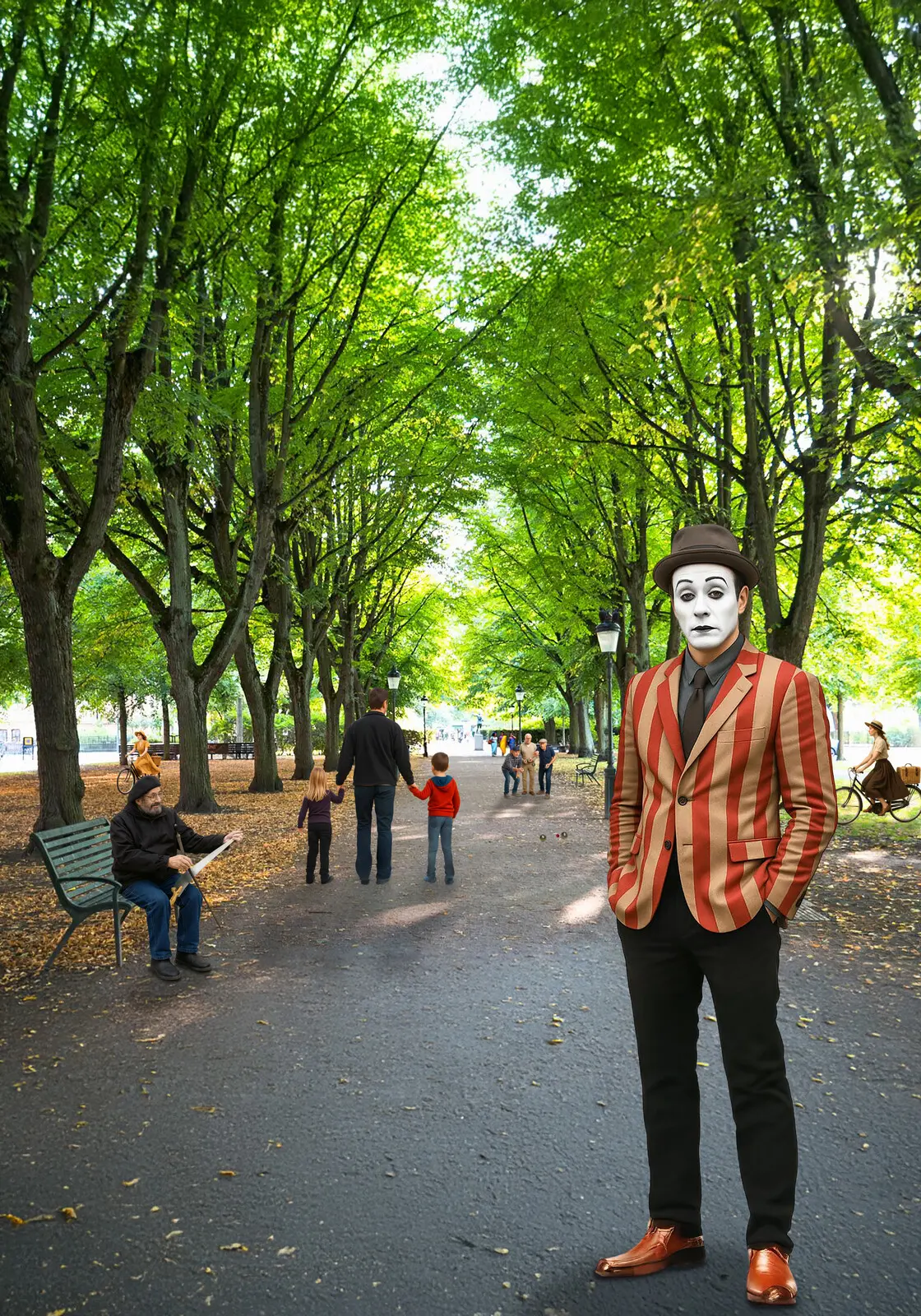
Jörgen Thornberg
The Malmö Doodle Dandy, 2025
Digital
50 x 70 cm
3 200 kr
The Malmö Doodle Dandy
This is neither a history lesson nor a dream.
It’s an essay in disguise, a reflection in motion. A tale of fashion, rebellion, ridicule, and reinvention. About how taste, when wielded with confidence, can be a potent form of power, and how mockery, in the right hands, can be turned into an anthem.
We embark on this journey, as always, from a place of surprise. Why not begin in Malmö, a city that may not immediately spring to mind in the context of fashion? Perhaps in 1810 or 2025. Perhaps in a dressing room with perfect lighting or at the Promenade on Kungsgatan.
Because sometimes, all it takes is a feather in the cap – and the world, with its ever-changing perspectives, can be swayed. Please click the link below to learn more about my pictures, writing, and why this story is a must-read.
https://www.konst.se/jorgenthornberg
”The Dandy Song
Malmö Doodle went to town
Riding on a pony
He stuck a feather in his hat
And called it macaroni.
Malmö Doodle, keep it up
Malmö Doodle Dandy
Mind the music and the step
And with the girls being handy.
Father and I went down to camp
Along with Captain Gooding
And there we saw the men and boys
As thick as hasty pudding.
Malmö Doodle, keep it up
Malmö Doodle Dandy
Mind the music and the step
And with the girls being handy
There was Captain Washington
Upon a strapping stallion
Giving orders to his men
I guess there was a million.
Malmö Doodle, keep it up
Malmö Doodle Dandy
Mind the music and the step
And with the girls being handy.
Malmö Doodle went to town
Riding on a pony
He stuck a feather in his hat
And called it macaroni.
Malmö Doodle, keep it up
Malmö Doodle Dandy
Mind the music and the step
And with the girls being handy.”
America, 1755 and Malmö, May 2025
Dandy, the one and only
In the foreground stands a figure clad in a sharply striped rust-red blazer, black trousers, a hat, and a face painted white. A dandy in silent protest against the banality of the world. With his hands in his pockets, eyes closed, and an expression that is both blasé and unreadable, he stands in stark contrast to the family’s motion in the background. He is still. He is an icon of life’s absurdity—one who has seen everything, perhaps too much. One might imagine him softly humming Yankee Doodle under his breath. Yankee Doodle, it turns out, was never a real person—just a song that became wildly popular during the American Revolutionary War. But he could very well have been a snob.
The dandy’s existence is theatrical yet deeply rooted in reality. He carries the legacy of generations of ironic resignation—a survivor in life’s eternal performance—the clown who never laughs. The dandy who does not care—but still stands tall, back straight, a testament to the resilience of the human spirit in the face of life's absurdities. His resilience is a source of inspiration, a reminder that we, too, can navigate life's challenges with grace and style.
It’s as if he whispers,
“I may be out of place, but not out of time.”
He belongs wherever life is a stage. And the tree-lined promenade of Kungsgatan in Malmö is, for the moment, his theatre.
A Gentleman's Bluff
A dandy is a stylish trickster with a feel for life’s absurdities. But he is not just any snob. Oh no—he is a snob with wit, finesse, and philosophy. A dandy is the kind of man who refuses to sweat unnecessarily but can quote Horace while pretending to forget his name.
The phenomenon of the dandy originated in 18th-century London and Paris, a time when young men of the middle class discovered that they could deceive society by appearing to belong to it. All it took was a well-ironed shirt, a stern expression, and a hint that one had once roomed at boarding school with Voltaire. The accent was as essential as the attire.
The British version of the dandy was exceptionally polished: a man with no title, yet sporting a top hat and towering self-regard. While busy swinging his pocket watch to a precise rhythm, he ensured to mispronounce French and correct others’ pronunciation of “champagne.” The key was never to show emotion. Cold-blooded composure was his cologne; sarcasm, his breakfast cereal. The top hat rested like a crown upon a kingdom of self-deception.
To be a dandy was, in essence, to embody what today’s influencers strive for, though with more starch and less sponsorship. One wore a black tailcoat as though attending a significant funeral (likely one's future) and smiled without showing teeth. That was the pinnacle of elegance: to seem too good for the world yet be tragically forced to partake as a social martyr in silk.
Napoleon’s brother-in-law, Joachim Murat, took things to another level. As King of Naples, he dressed as if Versailles had exploded on him. The British dubbed him the Dandy King because it was nearly impossible to discern his body beneath all the embroidery. He could kill with a sabre stroke—but worse—with a disdainful, “Oh, that coat?”
The word “dandy” eventually slipped into everyday speech. In English, it also signifies “just fine,” as in “It’s all dandy,” often muttered by those who’ve just burnt their omelette or been dumped. Dandy is also the title of a song by The Kinks, which cheekily dismantles the whole idea: a charmer, a rascal, a shallow lover with a wallet full of mirror selfies.
So, the next time you see a man in a striped jacket, with a faded smile and a gaze that conveys, “I saw the whole tragedy coming by the third line,” you’ll understand. You’ve encountered a dandy. Or perhaps merely a survivor from a time when life’s absurdity demanded a top hat and a silver-plated flask of hand sanitiser—figuratively, someone whose perspective can illuminate the bigger picture of life. The dandy's unique perspective on life's absurdities can be enlightening, offering us a new way to understand and appreciate the world around us. The dandy, with his sartorial choices and philosophical wit, serves as a subtle critic of societal norms and expectations, challenging us to reconsider our perspectives.
He may be out of step, but never out of style. His stripes, after all, never fade, serving as a timeless symbol of elegance that continues to inspire admiration. The dandy's enduring style is a testament to the power of fashion to transcend time and trends, leaving us in awe of his impeccable taste and sartorial finesse. The dandy's influence is evident in modern fashion, where his emphasis on elegance and attention to detail continues to inspire designers and fashion enthusiasts.
What About the Women? Were there female dandies? Yes—absolutely. But they weren’t termed “dandies.”
The term was so closely associated with a hyper-masculine, aristocratic aesthetic—think polished riding boots and perfume-laced cynicism—that women who traversed the same style and subversive social sphere were given different labels, depending on the surrounding mix of confusion, admiration, or moral panic. Here are a few historically intriguing counterparts:
The Dandizette:
In early 19th-century England, the dandizette emerged—a woman who imitated the dandy’s fashion and lifestyle. It was often a slightly mocking term, akin to calling someone a “dandy wannabe in skirts.” The dandizette donned masculine-inspired attire (tailcoats, top hats, walking sticks) and navigated salons with a confident air and a carefully cultivated indifference. However, she remained at the mercy of double standards, as society was not yet ready to fully accept women who adopted such a bold and unconventional style.
La Gommeuse & the Demi-Mondaine:
In France, another figure emerged—la gommeuse. This was a woman who moved fluidly between cabarets, salons, and scandal columns. She might have been an artist, courtesan, or bohemian—or all at once. 'Demi-mondaine' (woman of the half-world) was another term for women living extravagantly outside societal norms. Often kept by wealthy men, these women styled themselves theatrically, with a dandy’s flair and a rebel’s gaze.
The Flâneuse:
The female counterpart of the male flâneur—a fashionable, idle observer of city life—surfaced in late 19th-century Paris. Yet, the term flâneuse didn’t take hold until much later, since women weren’t expected to stroll freely through urban spaces. Those who did observe the world with the same ironic eye and weaponised their style. Today, they’re more likely to ride electric bikes—or pose artfully on a waterfront boardwalk. The flâneuse, like the dandy, was a figure who defied societal expectations and norms, using fashion and attitude as a means of self-expression and social commentary.
Modern Counterpart
Today, we might speak of androgynous style icons, aesthetic rebels, or simply women with ‘main character energy’. From Marlene Dietrich in a tuxedo to Tilda Swinton in absolutely everything, women have taken up the dandy’s mantle with wit, irony, and integrity. They’ve demonstrated that cold sarcasm and a perfectly tailored blazer are not bound by gender.
In the age of the internet and social media, the dandy has made a comeback – not in silk stockings and top hats, but with ring lights, retouch filters, and discount codes. The modern dandy, often a woman and nowadays usually referred to as an influencer, is deeply intertwined with social media. She doesn't just pose in salons but in kitchens with marble islands and natural light from three directions. She moves not through ballrooms but through algorithms. Instead of whispering sharp remarks about a rival in the drawing room, she whispers through hashtags: #blessed, #bosslady, #justbreathe.
She is polished, curated, an aesthete with camera presence, perfect timing, and the same unshakeable sense of style that Beau Brummell had in 1810.
But unlike her male predecessor, today’s dandy-influencer has a mission. She sells. Or rather: she creates desire. Just as the historical dandy effortlessly defined taste, she does the same in the feed: a life in perfect balance, where the home is a product, the body a project, and daily life a stage. Bianca Ingrosso is our most prominent influencer, boasting hundreds of thousands of followers on Instagram and partnering with a dozen companies that generate tens of millions of dollars. She is not just a figure in the digital world, but a powerful force shaping the narrative of modern aesthetics and consumerism —a role that we can all appreciate.
The female influencer possesses the same coolness, nonchalance, and politely ironic tone, but directs it outward through a selfie. She’s careful not to wade into political waters. After all, one can profit even from Putin sympathisers. Her influence is undeniable, reaching far beyond the digital realm and into the fabric of modern society.
Where Beau Brummell got people to shave and button their vests just so, she encourages followers to click, buy, and imitate. And just like then, the power is silent: she makes it seem as though it isn’t power at all, but rather, taste, a fascinating aspect of her influence.
So yes, the modern dandy has changed gender, but not essence. She remains a response to the dullness of everyday life – a living commentary on consumption, beauty, control, and the dream of a flawless existence. And there she walks, in Malmö or Milan, through the digital feed as if through a circus ring. Elegant, untouched, but never quite outside the gaze.
‘“I may be out of place, but not out of time.”‘ The words could belong to any influencer, and many are thriving on precisely that.
‘Malmö Doodle Dandy – From Mocking Tune to National Anthem’
But what does the word “doodle” really mean in the American song “Yankee Doodle”? To most today, it’s associated with innocent scribbles – the kind one makes in the margins of a notepad during a dull phone call. Yet, in 18th-century Europe, the word had a very different connotation. Back then, ‘doodle’ was an insult.
Its origin traces back to the German ‘Dudel’ (fool, simpleton) or possibly ‘Dödel’ (an even cruder term), and it was used by British soldiers to describe the American colonists. In their eyes, these ‘Yankees’ were rustic, uncouth, and embarrassingly pretentious. Putting a feather in one’s cap and calling it ‘macaroni’ – as the song’s most famous line goes – was, in the 18th-century British context, a direct jab at excessive fashion-consciousness.
‘Macaroni’ referred to a subculture of young London men who wore flamboyantly continental, French-inspired clothing, becoming the very embodiment of vain and effeminate upper-class snobbery.
So, an unrefined American settler sticking a feather in his cap and thinking that alone made him fashionable? Comical. Such was the British opinion.
But irony turned. Americans adopted ‘Yankee Doodle’ as their anthem during the Revolutionary War against Britain. The mocking tune transformed into a symbol of pride, independence, and resilience. What began as a laughable caricature evolved into a triumphant marching theme – one of history’s finest examples of mockery re-forged into self-respect.
And there’s an unexpected link between the old and new meanings. In both cases, ‘doodle’ carries a hint of not being taken seriously – of being silly, foolish, childish. However, while the British laughed at the Americans’ simplicity, today’s marginal doodles have become symbols of creativity, spontaneity, and the unexpected, of what emerges from play. This transformation of 'doodle' from insult to symbol is a testament to the ever-evolving nature of culture and the power of reinterpretation.
The Man on the Bench and His Singing Saw
And then there’s the man on the bench. To the left, always to the left – as if unwilling to interrupt the central drama. He is a socialist; you would not find a conservative playing a saw. He sits with the calm of someone who knows he will never be the protagonist but still insists on bringing his soundtrack. His humility, a rare trait in today's world, is palpable, earning him the respect and admiration of all who witness his performance.
What he plays is not a violin, though he holds the bow with a practised hand. No, he plays a saw. A literal carpenter’s saw, bent just so between his knees, coaxing a wail from steel that could almost – almost – be mistaken for a human voice or a ghost in therapy, struggling to find its voice. His unique talent is a sight to behold, intriguing and captivating all who pass by.
Today, he’s performing "Autumn" from Vivaldi’s Four Seasons – or at least, his very personal interpretation of it. The trees seem to listen. Their crowns are beginning to release the first shimmering harvest of yellowing leaves, drifting down like a soft applause. The air has that crisp metallic quality, like the tang of freshly cut steel, fitting, perhaps, for a solo rendered on hardware store steel.
The sound floats, eerie and slightly embarrassed, like a haunted theremin on holiday. Children are both delighted and confused, their innocent minds trying to make sense of this unconventional music. Pigeons hesitate, unsure whether to flee or stay. Grown-ups nod, as if to say, well, he’s trying, acknowledging the man's effort and the beauty in his unique performance.
Of course, it’s no Stradivarius. But he would argue that’s precisely the point. Anyone can sound like Paganini with the right wood and varnish. It takes true conviction to play Vivaldi’s "Autumn" on a blade from Bauhaus. And he does, with trembling pathos and a hint of metallic pride, his unwavering dedication to his unconventional art inspiring those who pause to listen.
People walk past, phones in hand, pretending not to listen. But for a moment, they hear something odd and lovely. And that is more than most can hope to leave behind.
Jörgen Thornberg
The Malmö Doodle Dandy, 2025
Digital
50 x 70 cm
3 200 kr
The Malmö Doodle Dandy
This is neither a history lesson nor a dream.
It’s an essay in disguise, a reflection in motion. A tale of fashion, rebellion, ridicule, and reinvention. About how taste, when wielded with confidence, can be a potent form of power, and how mockery, in the right hands, can be turned into an anthem.
We embark on this journey, as always, from a place of surprise. Why not begin in Malmö, a city that may not immediately spring to mind in the context of fashion? Perhaps in 1810 or 2025. Perhaps in a dressing room with perfect lighting or at the Promenade on Kungsgatan.
Because sometimes, all it takes is a feather in the cap – and the world, with its ever-changing perspectives, can be swayed. Please click the link below to learn more about my pictures, writing, and why this story is a must-read.
https://www.konst.se/jorgenthornberg
”The Dandy Song
Malmö Doodle went to town
Riding on a pony
He stuck a feather in his hat
And called it macaroni.
Malmö Doodle, keep it up
Malmö Doodle Dandy
Mind the music and the step
And with the girls being handy.
Father and I went down to camp
Along with Captain Gooding
And there we saw the men and boys
As thick as hasty pudding.
Malmö Doodle, keep it up
Malmö Doodle Dandy
Mind the music and the step
And with the girls being handy
There was Captain Washington
Upon a strapping stallion
Giving orders to his men
I guess there was a million.
Malmö Doodle, keep it up
Malmö Doodle Dandy
Mind the music and the step
And with the girls being handy.
Malmö Doodle went to town
Riding on a pony
He stuck a feather in his hat
And called it macaroni.
Malmö Doodle, keep it up
Malmö Doodle Dandy
Mind the music and the step
And with the girls being handy.”
America, 1755 and Malmö, May 2025
Dandy, the one and only
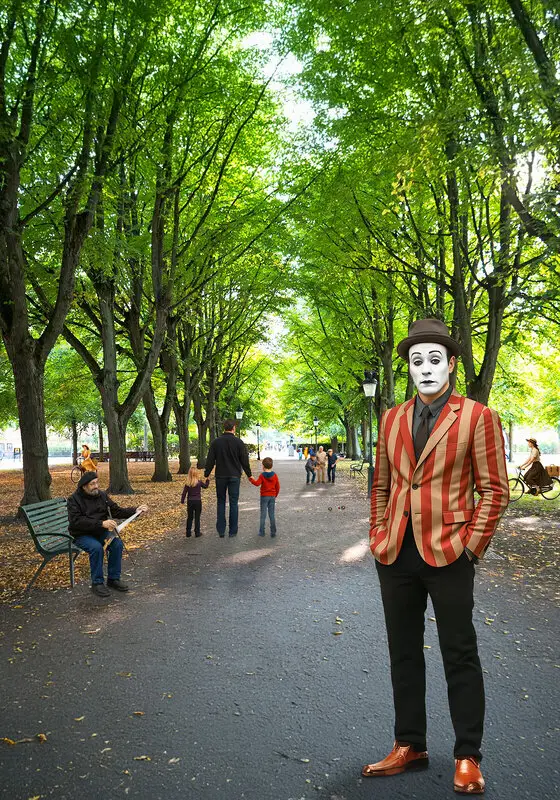
In the foreground stands a figure clad in a sharply striped rust-red blazer, black trousers, a hat, and a face painted white. A dandy in silent protest against the banality of the world. With his hands in his pockets, eyes closed, and an expression that is both blasé and unreadable, he stands in stark contrast to the family’s motion in the background. He is still. He is an icon of life’s absurdity—one who has seen everything, perhaps too much. One might imagine him softly humming Yankee Doodle under his breath. Yankee Doodle, it turns out, was never a real person—just a song that became wildly popular during the American Revolutionary War. But he could very well have been a snob.
The dandy’s existence is theatrical yet deeply rooted in reality. He carries the legacy of generations of ironic resignation—a survivor in life’s eternal performance—the clown who never laughs. The dandy who does not care—but still stands tall, back straight, a testament to the resilience of the human spirit in the face of life's absurdities. His resilience is a source of inspiration, a reminder that we, too, can navigate life's challenges with grace and style.
It’s as if he whispers,
“I may be out of place, but not out of time.”
He belongs wherever life is a stage. And the tree-lined promenade of Kungsgatan in Malmö is, for the moment, his theatre.
A Gentleman's Bluff
A dandy is a stylish trickster with a feel for life’s absurdities. But he is not just any snob. Oh no—he is a snob with wit, finesse, and philosophy. A dandy is the kind of man who refuses to sweat unnecessarily but can quote Horace while pretending to forget his name.
The phenomenon of the dandy originated in 18th-century London and Paris, a time when young men of the middle class discovered that they could deceive society by appearing to belong to it. All it took was a well-ironed shirt, a stern expression, and a hint that one had once roomed at boarding school with Voltaire. The accent was as essential as the attire.
The British version of the dandy was exceptionally polished: a man with no title, yet sporting a top hat and towering self-regard. While busy swinging his pocket watch to a precise rhythm, he ensured to mispronounce French and correct others’ pronunciation of “champagne.” The key was never to show emotion. Cold-blooded composure was his cologne; sarcasm, his breakfast cereal. The top hat rested like a crown upon a kingdom of self-deception.
To be a dandy was, in essence, to embody what today’s influencers strive for, though with more starch and less sponsorship. One wore a black tailcoat as though attending a significant funeral (likely one's future) and smiled without showing teeth. That was the pinnacle of elegance: to seem too good for the world yet be tragically forced to partake as a social martyr in silk.
Napoleon’s brother-in-law, Joachim Murat, took things to another level. As King of Naples, he dressed as if Versailles had exploded on him. The British dubbed him the Dandy King because it was nearly impossible to discern his body beneath all the embroidery. He could kill with a sabre stroke—but worse—with a disdainful, “Oh, that coat?”
The word “dandy” eventually slipped into everyday speech. In English, it also signifies “just fine,” as in “It’s all dandy,” often muttered by those who’ve just burnt their omelette or been dumped. Dandy is also the title of a song by The Kinks, which cheekily dismantles the whole idea: a charmer, a rascal, a shallow lover with a wallet full of mirror selfies.
So, the next time you see a man in a striped jacket, with a faded smile and a gaze that conveys, “I saw the whole tragedy coming by the third line,” you’ll understand. You’ve encountered a dandy. Or perhaps merely a survivor from a time when life’s absurdity demanded a top hat and a silver-plated flask of hand sanitiser—figuratively, someone whose perspective can illuminate the bigger picture of life. The dandy's unique perspective on life's absurdities can be enlightening, offering us a new way to understand and appreciate the world around us. The dandy, with his sartorial choices and philosophical wit, serves as a subtle critic of societal norms and expectations, challenging us to reconsider our perspectives.
He may be out of step, but never out of style. His stripes, after all, never fade, serving as a timeless symbol of elegance that continues to inspire admiration. The dandy's enduring style is a testament to the power of fashion to transcend time and trends, leaving us in awe of his impeccable taste and sartorial finesse. The dandy's influence is evident in modern fashion, where his emphasis on elegance and attention to detail continues to inspire designers and fashion enthusiasts.
What About the Women? Were there female dandies? Yes—absolutely. But they weren’t termed “dandies.”
The term was so closely associated with a hyper-masculine, aristocratic aesthetic—think polished riding boots and perfume-laced cynicism—that women who traversed the same style and subversive social sphere were given different labels, depending on the surrounding mix of confusion, admiration, or moral panic. Here are a few historically intriguing counterparts:
The Dandizette:
In early 19th-century England, the dandizette emerged—a woman who imitated the dandy’s fashion and lifestyle. It was often a slightly mocking term, akin to calling someone a “dandy wannabe in skirts.” The dandizette donned masculine-inspired attire (tailcoats, top hats, walking sticks) and navigated salons with a confident air and a carefully cultivated indifference. However, she remained at the mercy of double standards, as society was not yet ready to fully accept women who adopted such a bold and unconventional style.
La Gommeuse & the Demi-Mondaine:
In France, another figure emerged—la gommeuse. This was a woman who moved fluidly between cabarets, salons, and scandal columns. She might have been an artist, courtesan, or bohemian—or all at once. 'Demi-mondaine' (woman of the half-world) was another term for women living extravagantly outside societal norms. Often kept by wealthy men, these women styled themselves theatrically, with a dandy’s flair and a rebel’s gaze.
The Flâneuse:
The female counterpart of the male flâneur—a fashionable, idle observer of city life—surfaced in late 19th-century Paris. Yet, the term flâneuse didn’t take hold until much later, since women weren’t expected to stroll freely through urban spaces. Those who did observe the world with the same ironic eye and weaponised their style. Today, they’re more likely to ride electric bikes—or pose artfully on a waterfront boardwalk. The flâneuse, like the dandy, was a figure who defied societal expectations and norms, using fashion and attitude as a means of self-expression and social commentary.
Modern Counterpart
Today, we might speak of androgynous style icons, aesthetic rebels, or simply women with ‘main character energy’. From Marlene Dietrich in a tuxedo to Tilda Swinton in absolutely everything, women have taken up the dandy’s mantle with wit, irony, and integrity. They’ve demonstrated that cold sarcasm and a perfectly tailored blazer are not bound by gender.
In the age of the internet and social media, the dandy has made a comeback – not in silk stockings and top hats, but with ring lights, retouch filters, and discount codes. The modern dandy, often a woman and nowadays usually referred to as an influencer, is deeply intertwined with social media. She doesn't just pose in salons but in kitchens with marble islands and natural light from three directions. She moves not through ballrooms but through algorithms. Instead of whispering sharp remarks about a rival in the drawing room, she whispers through hashtags: #blessed, #bosslady, #justbreathe.
She is polished, curated, an aesthete with camera presence, perfect timing, and the same unshakeable sense of style that Beau Brummell had in 1810.
But unlike her male predecessor, today’s dandy-influencer has a mission. She sells. Or rather: she creates desire. Just as the historical dandy effortlessly defined taste, she does the same in the feed: a life in perfect balance, where the home is a product, the body a project, and daily life a stage. Bianca Ingrosso is our most prominent influencer, boasting hundreds of thousands of followers on Instagram and partnering with a dozen companies that generate tens of millions of dollars. She is not just a figure in the digital world, but a powerful force shaping the narrative of modern aesthetics and consumerism —a role that we can all appreciate.
The female influencer possesses the same coolness, nonchalance, and politely ironic tone, but directs it outward through a selfie. She’s careful not to wade into political waters. After all, one can profit even from Putin sympathisers. Her influence is undeniable, reaching far beyond the digital realm and into the fabric of modern society.
Where Beau Brummell got people to shave and button their vests just so, she encourages followers to click, buy, and imitate. And just like then, the power is silent: she makes it seem as though it isn’t power at all, but rather, taste, a fascinating aspect of her influence.
So yes, the modern dandy has changed gender, but not essence. She remains a response to the dullness of everyday life – a living commentary on consumption, beauty, control, and the dream of a flawless existence. And there she walks, in Malmö or Milan, through the digital feed as if through a circus ring. Elegant, untouched, but never quite outside the gaze.
‘“I may be out of place, but not out of time.”‘ The words could belong to any influencer, and many are thriving on precisely that.
‘Malmö Doodle Dandy – From Mocking Tune to National Anthem’
But what does the word “doodle” really mean in the American song “Yankee Doodle”? To most today, it’s associated with innocent scribbles – the kind one makes in the margins of a notepad during a dull phone call. Yet, in 18th-century Europe, the word had a very different connotation. Back then, ‘doodle’ was an insult.
Its origin traces back to the German ‘Dudel’ (fool, simpleton) or possibly ‘Dödel’ (an even cruder term), and it was used by British soldiers to describe the American colonists. In their eyes, these ‘Yankees’ were rustic, uncouth, and embarrassingly pretentious. Putting a feather in one’s cap and calling it ‘macaroni’ – as the song’s most famous line goes – was, in the 18th-century British context, a direct jab at excessive fashion-consciousness.
‘Macaroni’ referred to a subculture of young London men who wore flamboyantly continental, French-inspired clothing, becoming the very embodiment of vain and effeminate upper-class snobbery.
So, an unrefined American settler sticking a feather in his cap and thinking that alone made him fashionable? Comical. Such was the British opinion.
But irony turned. Americans adopted ‘Yankee Doodle’ as their anthem during the Revolutionary War against Britain. The mocking tune transformed into a symbol of pride, independence, and resilience. What began as a laughable caricature evolved into a triumphant marching theme – one of history’s finest examples of mockery re-forged into self-respect.
And there’s an unexpected link between the old and new meanings. In both cases, ‘doodle’ carries a hint of not being taken seriously – of being silly, foolish, childish. However, while the British laughed at the Americans’ simplicity, today’s marginal doodles have become symbols of creativity, spontaneity, and the unexpected, of what emerges from play. This transformation of 'doodle' from insult to symbol is a testament to the ever-evolving nature of culture and the power of reinterpretation.
The Man on the Bench and His Singing Saw
And then there’s the man on the bench. To the left, always to the left – as if unwilling to interrupt the central drama. He is a socialist; you would not find a conservative playing a saw. He sits with the calm of someone who knows he will never be the protagonist but still insists on bringing his soundtrack. His humility, a rare trait in today's world, is palpable, earning him the respect and admiration of all who witness his performance.
What he plays is not a violin, though he holds the bow with a practised hand. No, he plays a saw. A literal carpenter’s saw, bent just so between his knees, coaxing a wail from steel that could almost – almost – be mistaken for a human voice or a ghost in therapy, struggling to find its voice. His unique talent is a sight to behold, intriguing and captivating all who pass by.
Today, he’s performing "Autumn" from Vivaldi’s Four Seasons – or at least, his very personal interpretation of it. The trees seem to listen. Their crowns are beginning to release the first shimmering harvest of yellowing leaves, drifting down like a soft applause. The air has that crisp metallic quality, like the tang of freshly cut steel, fitting, perhaps, for a solo rendered on hardware store steel.
The sound floats, eerie and slightly embarrassed, like a haunted theremin on holiday. Children are both delighted and confused, their innocent minds trying to make sense of this unconventional music. Pigeons hesitate, unsure whether to flee or stay. Grown-ups nod, as if to say, well, he’s trying, acknowledging the man's effort and the beauty in his unique performance.
Of course, it’s no Stradivarius. But he would argue that’s precisely the point. Anyone can sound like Paganini with the right wood and varnish. It takes true conviction to play Vivaldi’s "Autumn" on a blade from Bauhaus. And he does, with trembling pathos and a hint of metallic pride, his unwavering dedication to his unconventional art inspiring those who pause to listen.
People walk past, phones in hand, pretending not to listen. But for a moment, they hear something odd and lovely. And that is more than most can hope to leave behind.
3 200 kr

Jörgen Thornberg
Malmö
Lite om bilder och mig. Translation in English at the end.
Jag är en nyfiken person som ser allt i bilder, även det jag fäster i ord, gärna tillsammans för bakom alla mina bilder finns en berättelse. Till vissa bilder hör en kortare eller längre novell som följer med bilden.
Bilder berättar historier. Jag omges av naturlig skönhet, intressanta människor och historia var jag än går. Jag använder min kamera för att dokumentera världen och blanda det jag ser med vad jag känner för att fånga den dolda magin.
Mina bilder berättar mina historier. Genom mina bilder, tryck och berättelser. Jag bjuder in dig att ta del av dessa berättelser, in i ditt liv och hem och dela min mycket personliga syn på vår värld. Mer än vad ögat ser. Jag tänker i bilder, drömmer och skriver och pratar om dem; följaktligen måste jag också skapa bilder. De blir vad jag ser, inte nödvändigtvis begränsade till verkligheten. Det finns en bild runt varje hörn. Jag hoppas att du kommer att se vad jag såg och gilla det.
Jag är också en skrivande person och till många bilder hör en kortare eller längre essay. Den följer med tavlan, tryckt på fint papper och med en personlig hälsning från mig.
Flertalet bilder startar sin resa i min kamera. Enkelt förklarat beskriver jag bilden jag ser i mitt inre, upplevd eller fantiserad. Bilden uppstår inom mig redan innan jag fått okularet till ögat. På bråkdelen av ett ögonblick ser jag vad jag vill ha och vad som kan göras med bilden. Här skall jag stoppa in en giraff, stålmannen, Titanic eller vad det är min fantasi finner ut. Ännu märkligare är att jag kommer ihåg minnesbilden långt efteråt när det blir tid att skapa verket. Om jag lyckas eller inte, är upp till betraktaren, oftast präglat av en stråk av svart humor – meningen är att man skall bli underhållen. Mina bilder blir ofta en snackis där de hänger.
Jag föredrar bilder som förmedlar ett budskap i flera lager. Vid första anblicken fylld av feel-good, en vacker utsikt, fint väder, solen skiner, blommor på ängen eller vattnet som ligger förrädiskt spegelblankt. I en sådan bild kan jag gömma min egentliga berättelse, mitt förakt för förtryckare och våldsverkare, rasister och fördomsfulla människor - ett gärna återkommande motiv mer eller mindre dolt i det vackra motivet. Jag försöker förena dem i ett gemensamt narrativ.
Bild och formgivning har löpt som en röd tråd genom livet. Fotokonst känns som en värdig final som jag gärna delar med mig.
Min genre är vid som framgår av mina bilder, temat en blandning av pop- och gatukonst i kollage som kan bestå av hundratals lager. Vissa bilder kan ta veckor, andra någon dag innan det är dags att överlämna resultatet till printverkstaden. Fine Art Prints är digitala fotocollage. I dessa kollage sker rivandet, klippandet, pusslandet, målandet, ritandet och sprayningen digitalt. Det jag monterar in kan vara hundratals år gamla bilder som jag omsorgsfullt frilägger så att de ser ut att vara en del av tavlan men också bilder skapade av mig själv efter min egen fantasi. Därefter besöks printstudion och för vissa bilder numrera en limiterad upplaga (oftast 7 exemplar) och signera för hand. Vissa bilder kan köpas i olika format. Det är bara att fråga efter vilka. Gillar man en bild som är 70x100 men inte har plats på väggen, går den kanske att få i 50x70 cm istället. Frågan är fri.
Metoden Giclée eller Fine Art Print som det också kallas är det moderna sättet för framställning av grafisk konst. Villkoret för denna typ av utskrifter är att en högkvalitativ storformatskrivare används med åldersbeständigt färgpigment och konstnärspapper eller i förekommande fall på duk. Pappret som används möter de krav på livslängd som ställs av museer och gallerier. Normalt säljer jag mina bilder oinramade så att den nya ägaren själv kan bestämma hur de skall se ut, med eller utan passepartout färg på ram, med eller utan glas etc..
Under många år ställde jag bara ut på nätet, i valda grupper och på min egen Facebooksida - https://www.facebook.com/jorgen.thornberg.9
Jag finns också på en egen hemsida som tyvärr inte alltid är uppdaterad – https://www.jth.life/ Där kan du också läsa en del av de berättelser som följer med bilden.
UTSTÄLLNINGAR
Luftkastellet, oktober 2022
Konst i Lund, november 2022
Luftkastellet, mars 2023
Engleson Galleri Caroli, april 2023
Hydra, Greece June 2023
Engleson Galleri Caroli, oktober 2023
Toppen, Höllviken december 2023
Luftkastellet, mars 2024
Torups Galleri, mars 2024
Venice, May 2024
Luftkastellet, oktober 2024
Konst i Advent, December 2024
Galleri Engleson, Caroli December 2024
Jäger & Jansson Galleri, april 2025
A bit about pictures and me.
I'm a curious person who sees everything in pictures, even what I express in words, often combining them, for behind all my pictures lies a story. These narratives, some as short as a single image and others as long as a novel, are the heart and soul of my work.
Pictures tell stories. Wherever I go, I'm surrounded by natural beauty, exciting people, and history. I use my camera to document the world and blend what I see with what I feel to capture the hidden magic.
My images tell my stories. Through my pictures, prints, and narratives, I invite you to partake in these stories in your life and home and share my deeply personal perspective of our world. More than meets the eye. I think in pictures, dream, write, and talk about them; consequently, I must create images too. They become what I see, not necessarily confined to reality. There's a picture around every corner. I hope you'll see what I saw and enjoy it.
I'm also a writer, and many images come with a shorter or longer essay. It accompanies the painting, printed on fine paper with my personal greeting.
Many pictures start their journey on my camera. Simply put, I describe the image I see in my mind, experienced or imagined. The image arises within me even before I bring the eyepiece to my eye. In a fraction of a moment, I see what I want and what can be done with the picture. Here, I'll insert a giraffe, Superman, the Titanic, or whatever my imagination conjures up. Even stranger is that I remember the mental image long after it's time to create the work. Whether I succeed is up to the observer, often imbued with a streak of black humour – the aim is to entertain. My pictures usually become a talking point wherever they hang.
I prefer pictures that convey a message in multiple layers. At first glance, they're filled with feel-good vibes, a beautiful view, lovely weather, the sun shining, flowers in the meadow, or the water lying deceptively calm. But beneath this surface beauty, I often conceal a deeper story, a narrative that challenges societal norms or explores the human condition. I invite you to delve into these hidden narratives and discover the layers of meaning within my work.
Picture and design have been a thread running through my life. Photographic art feels like a fitting finale, and I'm happy to share it.
My genre is varied, as seen in my pictures; the theme is a blend of pop and street art in collages that can consist of hundreds of layers. Some images can take weeks, others just a day before it's time to hand over the result to the print workshop. Fine Art Prints are digital photo collages. In these collages, tearing, cutting, puzzling, painting, drawing, and spraying happen digitally. What I insert can be images hundreds of years old that I carefully extract so they appear to be part of the painting, but also images created by myself, now also generated from my imagination. Next, visit the print studio and, for certain images, number a limited edition (usually 7 copies) and sign them by hand. Some images may be available in other formats. Just ask which ones. If you like an image that's 70x100 but doesn't have space on the wall, you might be able to get it in 50x70 cm instead. The question is open.
The Giclée method, or Fine Art Print as it's also called, is the modern way of producing graphic art. This method ensures the highest quality and longevity of the artwork, using a high-quality large-format printer with archival pigment inks and artist paper or, in some cases, canvas. The paper used meets the longevity requirements set by museums and galleries. I sell my pictures unframed, allowing the new owner to personalise their artwork, confident in the lasting value and quality of the piece.
For many years, I only exhibited online, in selected groups, and on my Facebook page - https://www.facebook.com/jorgen.thornberg.9. I also have my website, which unfortunately is not constantly updated - https://www.jth.life/. You can also read some of the stories accompanying the pictures there.
EXHIBITIONS
Luftkastellet, October 2022
Art in Lund, November 2022
Luftkastellet, March 2023
Engleson Gallery Caroli, April 2023
Hydra, Greece June 2023
Engleson Gallery Caroli, October 2023
Toppen, Höllviken December 2023
Luftkastellet, March 2024
Torup Gallery, March 2024
Venice, May 2024
UTSTÄLLNINGAR
Luftkastellet, oktober 2022
Konst i Lund, november 2022
Luftkastellet, mars 2023
Engleson Galleri Caroli, april 2023
Hydra, Greece June 2023
Engleson Galleri Caroli, oktober 2023
Toppen, Höllviken december 2023
Luftkastellet, mars 2024
Torups Galleri, mars 2024
Venice, May 2024
Luftkastellet, October 2024
Konst i Advent, December 2024
Galleri Engleson, Caroli December 2024
Jäger & Jansson Galleri, April 2025
Utbildning
Autodidakt
Medlem i konstnärsförening
Öppna Sinnen
Med i konstrunda
Konstrundan i Skåne
Utställningar
Luftkastellet, October 2022
Art in Lund, November 2022
Luftkastellet, March 2023
Engleson Gallery Caroli, April 2023
Hydra, Greece June 2023
Engleson Gallery Caroli, October 2023
Toppen, Höllviken December 2023
Luftkastellet, March 2024
Torup Gallery, March 2024
Venice, May 2024