Vi använder cookies för att ge dig bästa möjliga upplevelse. Välj vilka cookies du tillåter.
Läs mer i vår integritetspolicy
Jörgen Thornberg
The Devil and the Details, 2025
Digital
50 x 70 cm
3 200 kr
The Devil and the Details
This isn’t a sermon. Nor is it an attempt to absolve humanity of its carelessness. But it is a story about details—the tiny seams we’d rather ignore until everything begins to come apart. And what can happen when we do? These overlooked details, insignificant at first glance, hold a profound significance that we often fail to recognise.
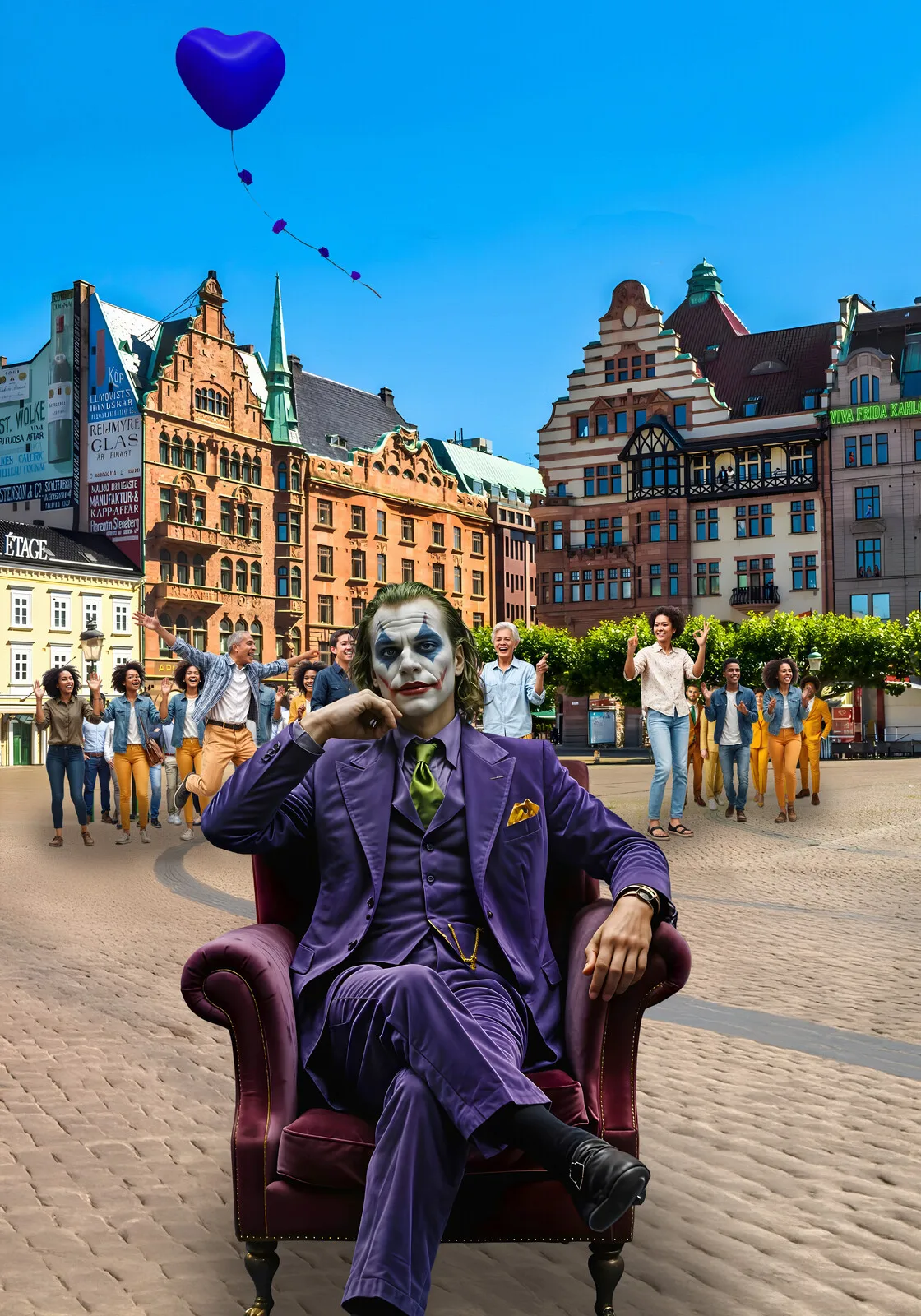
Because something lives in the margins. A whisper, a crack, a laugh that doesn’t quite belong. And suddenly he’s there—The Joker, the Devil’s henchman—seated in a velvet armchair in the middle of the square, as if he’s always been there, a harbinger of danger with a grin carved into his face and a giant purple balloon floating above him.
“It’s just a balloon,” someone says. “Just a laugh. Just a mistake.”
But those who’ve learned to listen know: it’s never just anything.
Because in those seemingly insignificant details—in a loosely tied string, in a lost grip—that’s where he waits. And smiles.
“The Devil in the Details
The painter forgot a single line—
now Mona Lisa squints, not shines.
A comma missed in legal text,
and now the cat owns all your ex.
The wedding cake looked like a dream,
until the bride fell through the cream.
A castle built with perfect pride—
But someone left the moat inside.
A surgeon paused to take a call,
and stitched the glove in after all.
The spaceship’s fuel was slightly low,
so off they went... and couldn’t go.
A button wrong on every shirt,
a fire drill done in concert skirts,
a violin that played in B—
when the whole thing was meant in C.
A typo in the Pope’s address,
turned “love thy poor” to “love thy mess.”
A traffic sign reversed one night—
and left three towns stuck in a fight.
A period placed not quite right
gave Death his due by morning light.
“Execute, don’t wait,” the note was sent—
The pardon was lost to poor intent.
But strangest still, in a Malmö square,
a purple heart balloon took to the air.
The Joker wept, though carved with glee—
He’d lost the bait for devilry.”
Malmö May 2025
The Devil and the Details
The image conveys nearly everything—if you think about it. Should one be surprised? The Joker, seated in an armchair right in the middle of Stortorget, is surrounded by people laughing hysterically. But he’s hardly someone to laugh at. He’s the devil’s henchman. The fact that he placed himself in a velvet armchair in a public space is not surprising—The Joker loves to provoke. But why all the joy? He didn’t look pleased himself, despite the grin etched into his cheeks. That was when I noticed the purple balloon floating above. It was enormous, several metres in diameter. The Joker had lost it, which explained the crowd’s laughter—it was schadenfreude. The only genuine joy in this case. A clumsy move on his part. Sitting in a square with a balloon hinted at one of his devilish schemes, probably to lure children—and with them, their mothers—and expose them to something diabolical.
The purple, heart-shaped balloon was eye-catching, adorned with lilac roses tied to the string he had lost grip of. It was large enough to lift a five-year-old—what a dreadful thought. How could he let go of it? Because it was written all over his face that it hadn’t been intentional. He must have carefully planned his mischief—this kind of balloon isn’t something you pick up at the corner shop, not even at Buttricks. And then it has to be filled. The cunning Joker had likely used it to float the heavy armchair into place. The plan was probably to hand the balloon off to a child, letting it lift the poor kid into the sky while a distraught mother remained standing on the cobblestones. What a devilish plan—thwarted by accident. That was when it struck me: the devil is in the details. He had, of course, tied the thick string around a few fingers but forgot to make a loop at the end to secure it. So it ended the way it did. The string slipped from his hand. And fortunately so, for the children.
I started contemplating the phrase “the devil is in the details.” It turns out the expression has a surprisingly well-documented etymology—at least back to the early 20th century, when the saying instead went, “God is in the details.” Who said it first is unclear. Some attribute it to the German architect Mies van der Rohe; others view it as an older proverb that has moved between languages and the arts.
But regardless of its origin, the theological shift is fascinating. Replacing God with the Devil suggests more than just a linguistic nuance. It perhaps reflects a certain mistrust toward the fussy, the meticulous, the things that often delay projects, stir up conflict, and make us sweat over footnotes. Maybe someone came to believe that nothing good could reside down there—in that hell of detail—only red horns and bureaucracy.
So that’s what I started to investigate: the journey of the phrase, its historical traces—but also a few mildly blasphemous speculations on why we eventually placed the Devil where God was once said to dwell—in the details. The Joker must have known this. But he had forgotten to apply the lesson, and of the eternal struggle among the supernatural over the dominion of detail. The Joker’s actions, his forgetfulness, and the unintended consequences of his plan serve as a powerful metaphor for the phrase, highlighting the potential dangers of overlooking the details. His failure to secure the balloon's string, a seemingly insignificant detail, led to the thwarting of his devilish plan, demonstrating the truth of the phrase 'the devil is in the details.
And that is what I set out to explore: the phrase’s history, its shadowy genealogy—and a few semi-heretical speculations about why, in the end, we let the Devil take up residence where God was once said to live in the details. These speculations delve into the societal shifts and cultural attitudes that may have led to the replacement of 'God' with 'the Devil' in the phrase. It's possible that as society became more focused on efficiency and speed, the meticulous attention to detail that 'God' represented was replaced by the potential for error and chaos that 'the Devil' symbolises. This offers a unique perspective on the phrase's evolution.
The Joker, with his cunning intellect, must have been aware of the phrase's implications. He knows most things. But even he, in all his cunning, forgets to put theory into practice. Theories are always best when tested. This emphasis on the practical application of theories invites readers to engage in the exploration and understanding of philosophical concepts actively.
And in the battle between God and the Joker’s master, the Devil, for the dominion of detail, it was he, the Joker, who accidentally let go of the string. This unintended consequence of his plan serves as a stark reminder of the potential dangers of overlooking the details, even for the most cunning intellect.
The saying “God is in the details” underscores the profound importance of precision and attention to detail. It emphasises that the actual value, craftsmanship, or beauty of something is revealed in the small elements—the meticulous, the seemingly insignificant. Whether it is an architect designing a grand palace, a novelist crafting a story, or an embroiderer stitching a pattern, they all recognise that the whole becomes extraordinary only when the details are meticulously aligned. This concept, deeply rooted in our cultural and philosophical history, is a testament to the power of nuance and the beauty of intricacy.
The origin of the phrase is unclear, although it’s often attributed to Ludwig Mies van der Rohe, the modernist architect also known for “Less is more.” However, this is doubtful—there’s no verifiable source documenting his first use of the phrase.
A more plausible scenario is that it originated earlier in German: “Der liebe Gott steckt im Detail,” which roughly translates to “The good God is in the details.” This version predates the English one and is a likely precursor to it.
It began appearing in English-language publications in the early 20th century, often in the context of art, architecture, or academic writing.
The shift—from God to the Devil—seems to have occurred gradually. Sometime during the second half of the 20th century, people began saying, “The devil is in the details.” Here, an ironic or cynical inversion occurs: where God suggests that beauty, perfection, or truth emerge in detail, the Devil implies that this is where trouble hides. This interpretation resonates with me—after all, it aligns well with the old proverb that “a small bump can overturn a large cart,” a wisdom known since the invention of the wheel. The Devil was also present at that time.
Thus, the phrase becomes a warning: a plan may appear solid on the surface, but it is in the details—in the legal fine print, the exceptions, the implementation, the polish—where complications lie. It’s akin to when I work on my images; the final details often become excessive or poorly chosen. “Kill your darlings,” as the saying goes. The same is true of filmmaking—editing is what makes or breaks the final product, the one we present to others.
In this way, the phrase has transitioned from reverence to caution, from heaven to hell—but both versions acknowledge the same truth: details matter. If you aspire to create something that endures, that is where you must begin. This shift in interpretation adds a layer of complexity and depth to the phrase.
Have God and the Devil, since the beginning of creation, been locked in an eternal battle over the details of human life? And how did Satan seem to gain the upper hand?
The history of the phrases “God is in the details” and “The devil is in the details” has long been a thorn in the side of aphorism historians. The first version is often attributed to Mies van der Rohe, the modernist architect whose minimalist style regarded “detail” not as ornamentation but as a matter of proportion, precision, and the interplay of surfaces. For him, it wasn’t about decorative flourishes—it was about the seam between two steel beams. That’s where the divine lived.
Van der Rohe may, in turn, have been channelling Gustave Flaubert, who, according to some traditions, is said to have declared: “Le bon Dieu est dans le détail”—“The good God is in the detail.” Strangely, though, there is no confirmed source for this quote in Flaubert’s letters or published writings. (Not even on French Wikipedia.) This suggests that the phrase may have existed orally for a long time before it was ever recorded in print. A piece of folk wisdom passed down through generations is more than a tidy literary attribution.
And perhaps that’s fitting—a phrase about details with a rather tangled, detail-filled backstory of its own.
So what about the Devil’s version? “The devil is in the details” has a murkier and shorter history, but it’s no less fascinating. According to Google Books, the phrase appeared in English around 1965. In German, it was already in use by 1951—“Der Teufel steckt im Detail.” Meanwhile, the older “Gott steckt im Detail” continued in parallel. It wasn’t until around 1965 that the Devil surpassed God in German usage—coincidentally, about the same time the English version gained traction. One might suspect a kind of linguistic coup rooted in postwar modernity.
But what do these phrases mean?
At their core, both refer to details—how it’s often the tiniest, seemingly insignificant things that determine whether something holds together or collapses. The difference lies in tone.
“The devil is in the details” is a warning. It’s usually said too late, as an excuse once something has already gone wrong. It refers to those vague parts of a plan, the forgotten questions, the trivial matters that suddenly, once it’s too late, turn out to be critical. Like in:
“Why is the whole damn set tilting?” Stellan stares at the blueprint as if it’s bitten him.
“I thought we could adjust it on-site,” David mumbles, chewing his pen and shrugging.
“On-site?! We open in three hours, and the set looks like a jealous house of cards!”
David scans the room for sympathy but finds only empty coffee cups and passive-aggressive glares. He sighs.
“The devil’s in the details. And I forgot the spirit level.”
It’s not exactly that “God is in the details” means the opposite. It’s more of a quiet reminder to pay attention from the beginning—to see the details as a place for precision, care, even reverence. To approach them with respect, not fear. That aligns well with Mies van der Rohe’s architectural philosophy: to create spaces that are quiet in themselves, yet empower those within them, precisely because every line, joint, and proportion has been considered.
Both phrases, in essence, refer to the same idea: that the details determine the whole. However, they approach this from different perspectives. God demands reverence, while the Devil demands revenge. The former appeals to our conscience, whereas the latter whispers in our ear: “You forgot something.”
Perhaps it is no coincidence that it was during the 1960s—the beginning of an era of computerisation and systems theory—that the Devil seized power over the realm of detail. Suddenly, details were no longer merely aspects of craftsmanship; they became bugs, gaps, exceptions in algorithms, and chasms between input and output. And there, in the margins of the code, he sat grinning.
Although the expression “God is in the details” has faded from everyday use—or even come to sound antiquated—the sentiment behind it still endures. It conveys the importance of genuinely engaging with the details in your work: noticing them, respecting them, and viewing them as foundational rather than as irritants that “ruin the big picture.” This connection to the details is what truly brings your work to life and ensures its quality.
Robert M. Pirsig’s book Zen and the Art of Motorcycle Maintenance became significant precisely because of this perspective. Today, when we speak of doing something “in a Zen way,” we rarely refer to Buddhist philosophy in its strictest sense; instead, we mean Pirsig’s idea of becoming fully immersed in what we are doing. Not avoiding the details, but allowing them to become the very gateway to understanding, presence, and quality.
A similar concept exists in the idea of flow. In a flow state, the boundary between the person and the task dissolves. What may have seemed, from the outside, like tedious or disruptive moments—moments where everything appears to get stuck—emerge as what fosters connection, drawing you deeply into the work. Paradoxically, this enhances your performance precisely because you are right there, engaged in every tiny detail.
So why did we lose faith in details? One possible explanation is the rise of secularisation. It is a well-known fact that even when belief in God diminishes, belief in the Devil tends to persist. Perhaps that is why the old proverb was inverted—from God to the Devil in the details. However, there is also a more technical, less mythological explanation.
In the 1960s, around the time the saying began to gain traction, computerisation took off. With it came a new perspective on work: not as something to be understood in detail, but as something that could be abstracted away. We input values and rules, enabling machines to perform tasks quickly, efficiently, and without fatigue. We no longer need to handle the particulars ourselves. And perhaps it’s in this digital detachment from the concrete that we began to perceive details as something threatening. Something best avoided. Something God no longer cared for—but where the Devil still lurked.
At a certain point, our tasks stop feeling like tasks. From a human perspective, they’ve transformed into consequences. All it takes is a push of a button—and then everything unfolds automatically, alongside other tasks we’ve also abstracted away. They trigger one another in chains that can be endlessly long.
In theory, this constitutes liberation. We no longer need to worry about every single detail and can focus on other priorities—or even on nothing at all—reassured by the belief that our tasks are securely embedded in code. They no longer need to be “done”—they happen, automatically, with the same regularity as a pendulum. Our modern world rests on that sense of security.
But at the corner of our eye, in the margins, something begins to stir. We sense shadows. Something isn’t quite right.
And that’s when it dawns on us: we’ve entered into a Faustian pact. We’ve traded control for convenience, insight for automation, and presence for speed. According to the myth, Faust sells his soul to the Devil in exchange for knowledge and power—but at a terrible price. The same applies here: we sacrificed details to achieve simplicity. This cautionary tale serves as a reminder of the potential consequences of oversimplification, urging us to strike a balance between detail and abstraction.
Joel Spolsky, co-founder of Stack Overflow, wrote as early as 2002 about “leaky abstractions.” He explained how programmers try to translate human needs into binary signals—ones and zeroes. However, to make that possible, multiple layers of simplification are necessary. First, we need to understand how bits store data, then how bits influence other bits, and finally, how all of this is applied to perform something human-like, such as calculating a household budget.
The issue? Every new layer of abstraction creates more points where things can go wrong—faults we can’t see from above. To comprehend such a fault—a so-called bug—we must dig through the layers until we reach the actual point where something broke. This understanding of the layers of abstraction is crucial in our work, as it equips us with the knowledge and preparation to handle potential faults.
And then the question arises: in this metaphor, what is the difference between a tiny insect and the Devil himself?
Perhaps nothing. Perhaps it is in those tiny mistakes, buried deep within what we no longer care to understand, that the Devil sits and quietly grins.
Abstraction—if we accept it uncritically—puts us at odds with details. It turns details into a sort of fifth column, something we perceive as dangerous or disruptive. While we reach towards higher orders and systems, our hands figuratively folded in prayer towards the heaven of structure and principle, something seeps—leaks—from far below in the foundations. And before we realise what has happened, our glass houses collapse.
Confused and furious, we then flip through dusty manuals written in a time when the world was still young, attempting to comprehend where everything went wrong.
The promise of abstraction—and with it, automation—has led to a cultural shift far beyond programming. Over the years, we have learned to delegate complexity to others in areas such as visual art, film, novel writing, IT systems, and even finance. Remember the subprime loans bundled into securities and sold as safe investments? That led to a financial crisis. All because we ignored the details.
In exchange for peace of mind, we have gained greater capacity—but also an increased risk of strange errors that emerge at midnight, as if from deep within the layered machinery. But instead of cursing these ghostly disruptions, we might opt for another approach.
We can cultivate a healthy scepticism towards anything that promises to simplify life too much. We can accept that things will sometimes “leak” in the abstractions we build—and that this is a natural consequence of the digital world we have created.
And when the Devil—or perhaps God—from the realm of detail comes to collect a debt for our collective hubris, we can bite down on the flashlight, climb down into the engine room—not to fight him, but to understand his message.
The horror classic The Omen, about the Devil’s child Damien, was a strong film in its time. So why didn’t the TV series sequel achieve the same level of success? The theme and the protagonist were unchanged. Still, it was cancelled after just one season in 2016.
Because the devil is in the details.
Jörgen Thornberg
The Devil and the Details, 2025
Digital
50 x 70 cm
3 200 kr
The Devil and the Details
This isn’t a sermon. Nor is it an attempt to absolve humanity of its carelessness. But it is a story about details—the tiny seams we’d rather ignore until everything begins to come apart. And what can happen when we do? These overlooked details, insignificant at first glance, hold a profound significance that we often fail to recognise.
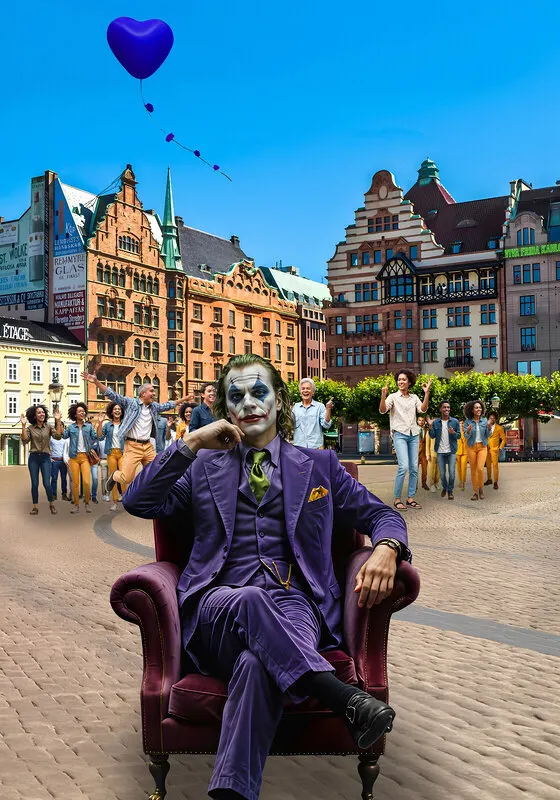
Because something lives in the margins. A whisper, a crack, a laugh that doesn’t quite belong. And suddenly he’s there—The Joker, the Devil’s henchman—seated in a velvet armchair in the middle of the square, as if he’s always been there, a harbinger of danger with a grin carved into his face and a giant purple balloon floating above him.
“It’s just a balloon,” someone says. “Just a laugh. Just a mistake.”
But those who’ve learned to listen know: it’s never just anything.
Because in those seemingly insignificant details—in a loosely tied string, in a lost grip—that’s where he waits. And smiles.
“The Devil in the Details
The painter forgot a single line—
now Mona Lisa squints, not shines.
A comma missed in legal text,
and now the cat owns all your ex.
The wedding cake looked like a dream,
until the bride fell through the cream.
A castle built with perfect pride—
But someone left the moat inside.
A surgeon paused to take a call,
and stitched the glove in after all.
The spaceship’s fuel was slightly low,
so off they went... and couldn’t go.
A button wrong on every shirt,
a fire drill done in concert skirts,
a violin that played in B—
when the whole thing was meant in C.
A typo in the Pope’s address,
turned “love thy poor” to “love thy mess.”
A traffic sign reversed one night—
and left three towns stuck in a fight.
A period placed not quite right
gave Death his due by morning light.
“Execute, don’t wait,” the note was sent—
The pardon was lost to poor intent.
But strangest still, in a Malmö square,
a purple heart balloon took to the air.
The Joker wept, though carved with glee—
He’d lost the bait for devilry.”
Malmö May 2025
The Devil and the Details
The image conveys nearly everything—if you think about it. Should one be surprised? The Joker, seated in an armchair right in the middle of Stortorget, is surrounded by people laughing hysterically. But he’s hardly someone to laugh at. He’s the devil’s henchman. The fact that he placed himself in a velvet armchair in a public space is not surprising—The Joker loves to provoke. But why all the joy? He didn’t look pleased himself, despite the grin etched into his cheeks. That was when I noticed the purple balloon floating above. It was enormous, several metres in diameter. The Joker had lost it, which explained the crowd’s laughter—it was schadenfreude. The only genuine joy in this case. A clumsy move on his part. Sitting in a square with a balloon hinted at one of his devilish schemes, probably to lure children—and with them, their mothers—and expose them to something diabolical.
The purple, heart-shaped balloon was eye-catching, adorned with lilac roses tied to the string he had lost grip of. It was large enough to lift a five-year-old—what a dreadful thought. How could he let go of it? Because it was written all over his face that it hadn’t been intentional. He must have carefully planned his mischief—this kind of balloon isn’t something you pick up at the corner shop, not even at Buttricks. And then it has to be filled. The cunning Joker had likely used it to float the heavy armchair into place. The plan was probably to hand the balloon off to a child, letting it lift the poor kid into the sky while a distraught mother remained standing on the cobblestones. What a devilish plan—thwarted by accident. That was when it struck me: the devil is in the details. He had, of course, tied the thick string around a few fingers but forgot to make a loop at the end to secure it. So it ended the way it did. The string slipped from his hand. And fortunately so, for the children.
I started contemplating the phrase “the devil is in the details.” It turns out the expression has a surprisingly well-documented etymology—at least back to the early 20th century, when the saying instead went, “God is in the details.” Who said it first is unclear. Some attribute it to the German architect Mies van der Rohe; others view it as an older proverb that has moved between languages and the arts.
But regardless of its origin, the theological shift is fascinating. Replacing God with the Devil suggests more than just a linguistic nuance. It perhaps reflects a certain mistrust toward the fussy, the meticulous, the things that often delay projects, stir up conflict, and make us sweat over footnotes. Maybe someone came to believe that nothing good could reside down there—in that hell of detail—only red horns and bureaucracy.
So that’s what I started to investigate: the journey of the phrase, its historical traces—but also a few mildly blasphemous speculations on why we eventually placed the Devil where God was once said to dwell—in the details. The Joker must have known this. But he had forgotten to apply the lesson, and of the eternal struggle among the supernatural over the dominion of detail. The Joker’s actions, his forgetfulness, and the unintended consequences of his plan serve as a powerful metaphor for the phrase, highlighting the potential dangers of overlooking the details. His failure to secure the balloon's string, a seemingly insignificant detail, led to the thwarting of his devilish plan, demonstrating the truth of the phrase 'the devil is in the details.
And that is what I set out to explore: the phrase’s history, its shadowy genealogy—and a few semi-heretical speculations about why, in the end, we let the Devil take up residence where God was once said to live in the details. These speculations delve into the societal shifts and cultural attitudes that may have led to the replacement of 'God' with 'the Devil' in the phrase. It's possible that as society became more focused on efficiency and speed, the meticulous attention to detail that 'God' represented was replaced by the potential for error and chaos that 'the Devil' symbolises. This offers a unique perspective on the phrase's evolution.
The Joker, with his cunning intellect, must have been aware of the phrase's implications. He knows most things. But even he, in all his cunning, forgets to put theory into practice. Theories are always best when tested. This emphasis on the practical application of theories invites readers to engage in the exploration and understanding of philosophical concepts actively.
And in the battle between God and the Joker’s master, the Devil, for the dominion of detail, it was he, the Joker, who accidentally let go of the string. This unintended consequence of his plan serves as a stark reminder of the potential dangers of overlooking the details, even for the most cunning intellect.
The saying “God is in the details” underscores the profound importance of precision and attention to detail. It emphasises that the actual value, craftsmanship, or beauty of something is revealed in the small elements—the meticulous, the seemingly insignificant. Whether it is an architect designing a grand palace, a novelist crafting a story, or an embroiderer stitching a pattern, they all recognise that the whole becomes extraordinary only when the details are meticulously aligned. This concept, deeply rooted in our cultural and philosophical history, is a testament to the power of nuance and the beauty of intricacy.
The origin of the phrase is unclear, although it’s often attributed to Ludwig Mies van der Rohe, the modernist architect also known for “Less is more.” However, this is doubtful—there’s no verifiable source documenting his first use of the phrase.
A more plausible scenario is that it originated earlier in German: “Der liebe Gott steckt im Detail,” which roughly translates to “The good God is in the details.” This version predates the English one and is a likely precursor to it.
It began appearing in English-language publications in the early 20th century, often in the context of art, architecture, or academic writing.
The shift—from God to the Devil—seems to have occurred gradually. Sometime during the second half of the 20th century, people began saying, “The devil is in the details.” Here, an ironic or cynical inversion occurs: where God suggests that beauty, perfection, or truth emerge in detail, the Devil implies that this is where trouble hides. This interpretation resonates with me—after all, it aligns well with the old proverb that “a small bump can overturn a large cart,” a wisdom known since the invention of the wheel. The Devil was also present at that time.
Thus, the phrase becomes a warning: a plan may appear solid on the surface, but it is in the details—in the legal fine print, the exceptions, the implementation, the polish—where complications lie. It’s akin to when I work on my images; the final details often become excessive or poorly chosen. “Kill your darlings,” as the saying goes. The same is true of filmmaking—editing is what makes or breaks the final product, the one we present to others.
In this way, the phrase has transitioned from reverence to caution, from heaven to hell—but both versions acknowledge the same truth: details matter. If you aspire to create something that endures, that is where you must begin. This shift in interpretation adds a layer of complexity and depth to the phrase.
Have God and the Devil, since the beginning of creation, been locked in an eternal battle over the details of human life? And how did Satan seem to gain the upper hand?
The history of the phrases “God is in the details” and “The devil is in the details” has long been a thorn in the side of aphorism historians. The first version is often attributed to Mies van der Rohe, the modernist architect whose minimalist style regarded “detail” not as ornamentation but as a matter of proportion, precision, and the interplay of surfaces. For him, it wasn’t about decorative flourishes—it was about the seam between two steel beams. That’s where the divine lived.
Van der Rohe may, in turn, have been channelling Gustave Flaubert, who, according to some traditions, is said to have declared: “Le bon Dieu est dans le détail”—“The good God is in the detail.” Strangely, though, there is no confirmed source for this quote in Flaubert’s letters or published writings. (Not even on French Wikipedia.) This suggests that the phrase may have existed orally for a long time before it was ever recorded in print. A piece of folk wisdom passed down through generations is more than a tidy literary attribution.
And perhaps that’s fitting—a phrase about details with a rather tangled, detail-filled backstory of its own.
So what about the Devil’s version? “The devil is in the details” has a murkier and shorter history, but it’s no less fascinating. According to Google Books, the phrase appeared in English around 1965. In German, it was already in use by 1951—“Der Teufel steckt im Detail.” Meanwhile, the older “Gott steckt im Detail” continued in parallel. It wasn’t until around 1965 that the Devil surpassed God in German usage—coincidentally, about the same time the English version gained traction. One might suspect a kind of linguistic coup rooted in postwar modernity.
But what do these phrases mean?
At their core, both refer to details—how it’s often the tiniest, seemingly insignificant things that determine whether something holds together or collapses. The difference lies in tone.
“The devil is in the details” is a warning. It’s usually said too late, as an excuse once something has already gone wrong. It refers to those vague parts of a plan, the forgotten questions, the trivial matters that suddenly, once it’s too late, turn out to be critical. Like in:
“Why is the whole damn set tilting?” Stellan stares at the blueprint as if it’s bitten him.
“I thought we could adjust it on-site,” David mumbles, chewing his pen and shrugging.
“On-site?! We open in three hours, and the set looks like a jealous house of cards!”
David scans the room for sympathy but finds only empty coffee cups and passive-aggressive glares. He sighs.
“The devil’s in the details. And I forgot the spirit level.”
It’s not exactly that “God is in the details” means the opposite. It’s more of a quiet reminder to pay attention from the beginning—to see the details as a place for precision, care, even reverence. To approach them with respect, not fear. That aligns well with Mies van der Rohe’s architectural philosophy: to create spaces that are quiet in themselves, yet empower those within them, precisely because every line, joint, and proportion has been considered.
Both phrases, in essence, refer to the same idea: that the details determine the whole. However, they approach this from different perspectives. God demands reverence, while the Devil demands revenge. The former appeals to our conscience, whereas the latter whispers in our ear: “You forgot something.”
Perhaps it is no coincidence that it was during the 1960s—the beginning of an era of computerisation and systems theory—that the Devil seized power over the realm of detail. Suddenly, details were no longer merely aspects of craftsmanship; they became bugs, gaps, exceptions in algorithms, and chasms between input and output. And there, in the margins of the code, he sat grinning.
Although the expression “God is in the details” has faded from everyday use—or even come to sound antiquated—the sentiment behind it still endures. It conveys the importance of genuinely engaging with the details in your work: noticing them, respecting them, and viewing them as foundational rather than as irritants that “ruin the big picture.” This connection to the details is what truly brings your work to life and ensures its quality.
Robert M. Pirsig’s book Zen and the Art of Motorcycle Maintenance became significant precisely because of this perspective. Today, when we speak of doing something “in a Zen way,” we rarely refer to Buddhist philosophy in its strictest sense; instead, we mean Pirsig’s idea of becoming fully immersed in what we are doing. Not avoiding the details, but allowing them to become the very gateway to understanding, presence, and quality.
A similar concept exists in the idea of flow. In a flow state, the boundary between the person and the task dissolves. What may have seemed, from the outside, like tedious or disruptive moments—moments where everything appears to get stuck—emerge as what fosters connection, drawing you deeply into the work. Paradoxically, this enhances your performance precisely because you are right there, engaged in every tiny detail.
So why did we lose faith in details? One possible explanation is the rise of secularisation. It is a well-known fact that even when belief in God diminishes, belief in the Devil tends to persist. Perhaps that is why the old proverb was inverted—from God to the Devil in the details. However, there is also a more technical, less mythological explanation.
In the 1960s, around the time the saying began to gain traction, computerisation took off. With it came a new perspective on work: not as something to be understood in detail, but as something that could be abstracted away. We input values and rules, enabling machines to perform tasks quickly, efficiently, and without fatigue. We no longer need to handle the particulars ourselves. And perhaps it’s in this digital detachment from the concrete that we began to perceive details as something threatening. Something best avoided. Something God no longer cared for—but where the Devil still lurked.
At a certain point, our tasks stop feeling like tasks. From a human perspective, they’ve transformed into consequences. All it takes is a push of a button—and then everything unfolds automatically, alongside other tasks we’ve also abstracted away. They trigger one another in chains that can be endlessly long.
In theory, this constitutes liberation. We no longer need to worry about every single detail and can focus on other priorities—or even on nothing at all—reassured by the belief that our tasks are securely embedded in code. They no longer need to be “done”—they happen, automatically, with the same regularity as a pendulum. Our modern world rests on that sense of security.
But at the corner of our eye, in the margins, something begins to stir. We sense shadows. Something isn’t quite right.
And that’s when it dawns on us: we’ve entered into a Faustian pact. We’ve traded control for convenience, insight for automation, and presence for speed. According to the myth, Faust sells his soul to the Devil in exchange for knowledge and power—but at a terrible price. The same applies here: we sacrificed details to achieve simplicity. This cautionary tale serves as a reminder of the potential consequences of oversimplification, urging us to strike a balance between detail and abstraction.
Joel Spolsky, co-founder of Stack Overflow, wrote as early as 2002 about “leaky abstractions.” He explained how programmers try to translate human needs into binary signals—ones and zeroes. However, to make that possible, multiple layers of simplification are necessary. First, we need to understand how bits store data, then how bits influence other bits, and finally, how all of this is applied to perform something human-like, such as calculating a household budget.
The issue? Every new layer of abstraction creates more points where things can go wrong—faults we can’t see from above. To comprehend such a fault—a so-called bug—we must dig through the layers until we reach the actual point where something broke. This understanding of the layers of abstraction is crucial in our work, as it equips us with the knowledge and preparation to handle potential faults.
And then the question arises: in this metaphor, what is the difference between a tiny insect and the Devil himself?
Perhaps nothing. Perhaps it is in those tiny mistakes, buried deep within what we no longer care to understand, that the Devil sits and quietly grins.
Abstraction—if we accept it uncritically—puts us at odds with details. It turns details into a sort of fifth column, something we perceive as dangerous or disruptive. While we reach towards higher orders and systems, our hands figuratively folded in prayer towards the heaven of structure and principle, something seeps—leaks—from far below in the foundations. And before we realise what has happened, our glass houses collapse.
Confused and furious, we then flip through dusty manuals written in a time when the world was still young, attempting to comprehend where everything went wrong.
The promise of abstraction—and with it, automation—has led to a cultural shift far beyond programming. Over the years, we have learned to delegate complexity to others in areas such as visual art, film, novel writing, IT systems, and even finance. Remember the subprime loans bundled into securities and sold as safe investments? That led to a financial crisis. All because we ignored the details.
In exchange for peace of mind, we have gained greater capacity—but also an increased risk of strange errors that emerge at midnight, as if from deep within the layered machinery. But instead of cursing these ghostly disruptions, we might opt for another approach.
We can cultivate a healthy scepticism towards anything that promises to simplify life too much. We can accept that things will sometimes “leak” in the abstractions we build—and that this is a natural consequence of the digital world we have created.
And when the Devil—or perhaps God—from the realm of detail comes to collect a debt for our collective hubris, we can bite down on the flashlight, climb down into the engine room—not to fight him, but to understand his message.
The horror classic The Omen, about the Devil’s child Damien, was a strong film in its time. So why didn’t the TV series sequel achieve the same level of success? The theme and the protagonist were unchanged. Still, it was cancelled after just one season in 2016.
Because the devil is in the details.
3 200 kr

Jörgen Thornberg
Malmö
Lite om bilder och mig. Translation in English at the end.
Jag är en nyfiken person som ser allt i bilder, även det jag fäster i ord, gärna tillsammans för bakom alla mina bilder finns en berättelse. Till vissa bilder hör en kortare eller längre novell som följer med bilden.
Bilder berättar historier. Jag omges av naturlig skönhet, intressanta människor och historia var jag än går. Jag använder min kamera för att dokumentera världen och blanda det jag ser med vad jag känner för att fånga den dolda magin.
Mina bilder berättar mina historier. Genom mina bilder, tryck och berättelser. Jag bjuder in dig att ta del av dessa berättelser, in i ditt liv och hem och dela min mycket personliga syn på vår värld. Mer än vad ögat ser. Jag tänker i bilder, drömmer och skriver och pratar om dem; följaktligen måste jag också skapa bilder. De blir vad jag ser, inte nödvändigtvis begränsade till verkligheten. Det finns en bild runt varje hörn. Jag hoppas att du kommer att se vad jag såg och gilla det.
Jag är också en skrivande person och till många bilder hör en kortare eller längre essay. Den följer med tavlan, tryckt på fint papper och med en personlig hälsning från mig.
Flertalet bilder startar sin resa i min kamera. Enkelt förklarat beskriver jag bilden jag ser i mitt inre, upplevd eller fantiserad. Bilden uppstår inom mig redan innan jag fått okularet till ögat. På bråkdelen av ett ögonblick ser jag vad jag vill ha och vad som kan göras med bilden. Här skall jag stoppa in en giraff, stålmannen, Titanic eller vad det är min fantasi finner ut. Ännu märkligare är att jag kommer ihåg minnesbilden långt efteråt när det blir tid att skapa verket. Om jag lyckas eller inte, är upp till betraktaren, oftast präglat av en stråk av svart humor – meningen är att man skall bli underhållen. Mina bilder blir ofta en snackis där de hänger.
Jag föredrar bilder som förmedlar ett budskap i flera lager. Vid första anblicken fylld av feel-good, en vacker utsikt, fint väder, solen skiner, blommor på ängen eller vattnet som ligger förrädiskt spegelblankt. I en sådan bild kan jag gömma min egentliga berättelse, mitt förakt för förtryckare och våldsverkare, rasister och fördomsfulla människor - ett gärna återkommande motiv mer eller mindre dolt i det vackra motivet. Jag försöker förena dem i ett gemensamt narrativ.
Bild och formgivning har löpt som en röd tråd genom livet. Fotokonst känns som en värdig final som jag gärna delar med mig.
Min genre är vid som framgår av mina bilder, temat en blandning av pop- och gatukonst i kollage som kan bestå av hundratals lager. Vissa bilder kan ta veckor, andra någon dag innan det är dags att överlämna resultatet till printverkstaden. Fine Art Prints är digitala fotocollage. I dessa kollage sker rivandet, klippandet, pusslandet, målandet, ritandet och sprayningen digitalt. Det jag monterar in kan vara hundratals år gamla bilder som jag omsorgsfullt frilägger så att de ser ut att vara en del av tavlan men också bilder skapade av mig själv efter min egen fantasi. Därefter besöks printstudion och för vissa bilder numrera en limiterad upplaga (oftast 7 exemplar) och signera för hand. Vissa bilder kan köpas i olika format. Det är bara att fråga efter vilka. Gillar man en bild som är 70x100 men inte har plats på väggen, går den kanske att få i 50x70 cm istället. Frågan är fri.
Metoden Giclée eller Fine Art Print som det också kallas är det moderna sättet för framställning av grafisk konst. Villkoret för denna typ av utskrifter är att en högkvalitativ storformatskrivare används med åldersbeständigt färgpigment och konstnärspapper eller i förekommande fall på duk. Pappret som används möter de krav på livslängd som ställs av museer och gallerier. Normalt säljer jag mina bilder oinramade så att den nya ägaren själv kan bestämma hur de skall se ut, med eller utan passepartout färg på ram, med eller utan glas etc..
Under många år ställde jag bara ut på nätet, i valda grupper och på min egen Facebooksida - https://www.facebook.com/jorgen.thornberg.9
Jag finns också på en egen hemsida som tyvärr inte alltid är uppdaterad – https://www.jth.life/ Där kan du också läsa en del av de berättelser som följer med bilden.
UTSTÄLLNINGAR
Luftkastellet, oktober 2022
Konst i Lund, november 2022
Luftkastellet, mars 2023
Engleson Galleri Caroli, april 2023
Hydra, Greece June 2023
Engleson Galleri Caroli, oktober 2023
Toppen, Höllviken december 2023
Luftkastellet, mars 2024
Torups Galleri, mars 2024
Venice, May 2024
Luftkastellet, oktober 2024
Konst i Advent, December 2024
Galleri Engleson, Caroli December 2024
Jäger & Jansson Galleri, april 2025
A bit about pictures and me.
I'm a curious person who sees everything in pictures, even what I express in words, often combining them, for behind all my pictures lies a story. These narratives, some as short as a single image and others as long as a novel, are the heart and soul of my work.
Pictures tell stories. Wherever I go, I'm surrounded by natural beauty, exciting people, and history. I use my camera to document the world and blend what I see with what I feel to capture the hidden magic.
My images tell my stories. Through my pictures, prints, and narratives, I invite you to partake in these stories in your life and home and share my deeply personal perspective of our world. More than meets the eye. I think in pictures, dream, write, and talk about them; consequently, I must create images too. They become what I see, not necessarily confined to reality. There's a picture around every corner. I hope you'll see what I saw and enjoy it.
I'm also a writer, and many images come with a shorter or longer essay. It accompanies the painting, printed on fine paper with my personal greeting.
Many pictures start their journey on my camera. Simply put, I describe the image I see in my mind, experienced or imagined. The image arises within me even before I bring the eyepiece to my eye. In a fraction of a moment, I see what I want and what can be done with the picture. Here, I'll insert a giraffe, Superman, the Titanic, or whatever my imagination conjures up. Even stranger is that I remember the mental image long after it's time to create the work. Whether I succeed is up to the observer, often imbued with a streak of black humour – the aim is to entertain. My pictures usually become a talking point wherever they hang.
I prefer pictures that convey a message in multiple layers. At first glance, they're filled with feel-good vibes, a beautiful view, lovely weather, the sun shining, flowers in the meadow, or the water lying deceptively calm. But beneath this surface beauty, I often conceal a deeper story, a narrative that challenges societal norms or explores the human condition. I invite you to delve into these hidden narratives and discover the layers of meaning within my work.
Picture and design have been a thread running through my life. Photographic art feels like a fitting finale, and I'm happy to share it.
My genre is varied, as seen in my pictures; the theme is a blend of pop and street art in collages that can consist of hundreds of layers. Some images can take weeks, others just a day before it's time to hand over the result to the print workshop. Fine Art Prints are digital photo collages. In these collages, tearing, cutting, puzzling, painting, drawing, and spraying happen digitally. What I insert can be images hundreds of years old that I carefully extract so they appear to be part of the painting, but also images created by myself, now also generated from my imagination. Next, visit the print studio and, for certain images, number a limited edition (usually 7 copies) and sign them by hand. Some images may be available in other formats. Just ask which ones. If you like an image that's 70x100 but doesn't have space on the wall, you might be able to get it in 50x70 cm instead. The question is open.
The Giclée method, or Fine Art Print as it's also called, is the modern way of producing graphic art. This method ensures the highest quality and longevity of the artwork, using a high-quality large-format printer with archival pigment inks and artist paper or, in some cases, canvas. The paper used meets the longevity requirements set by museums and galleries. I sell my pictures unframed, allowing the new owner to personalise their artwork, confident in the lasting value and quality of the piece.
For many years, I only exhibited online, in selected groups, and on my Facebook page - https://www.facebook.com/jorgen.thornberg.9. I also have my website, which unfortunately is not constantly updated - https://www.jth.life/. You can also read some of the stories accompanying the pictures there.
EXHIBITIONS
Luftkastellet, October 2022
Art in Lund, November 2022
Luftkastellet, March 2023
Engleson Gallery Caroli, April 2023
Hydra, Greece June 2023
Engleson Gallery Caroli, October 2023
Toppen, Höllviken December 2023
Luftkastellet, March 2024
Torup Gallery, March 2024
Venice, May 2024
UTSTÄLLNINGAR
Luftkastellet, oktober 2022
Konst i Lund, november 2022
Luftkastellet, mars 2023
Engleson Galleri Caroli, april 2023
Hydra, Greece June 2023
Engleson Galleri Caroli, oktober 2023
Toppen, Höllviken december 2023
Luftkastellet, mars 2024
Torups Galleri, mars 2024
Venice, May 2024
Luftkastellet, October 2024
Konst i Advent, December 2024
Galleri Engleson, Caroli December 2024
Jäger & Jansson Galleri, April 2025
Utbildning
Autodidakt
Medlem i konstnärsförening
Öppna Sinnen
Med i konstrunda
Konstrundan i Skåne
Utställningar
Luftkastellet, October 2022
Art in Lund, November 2022
Luftkastellet, March 2023
Engleson Gallery Caroli, April 2023
Hydra, Greece June 2023
Engleson Gallery Caroli, October 2023
Toppen, Höllviken December 2023
Luftkastellet, March 2024
Torup Gallery, March 2024
Venice, May 2024