Vi använder cookies för att ge dig bästa möjliga upplevelse. Välj vilka cookies du tillåter.
Läs mer i vår integritetspolicy
Jörgen Thornberg
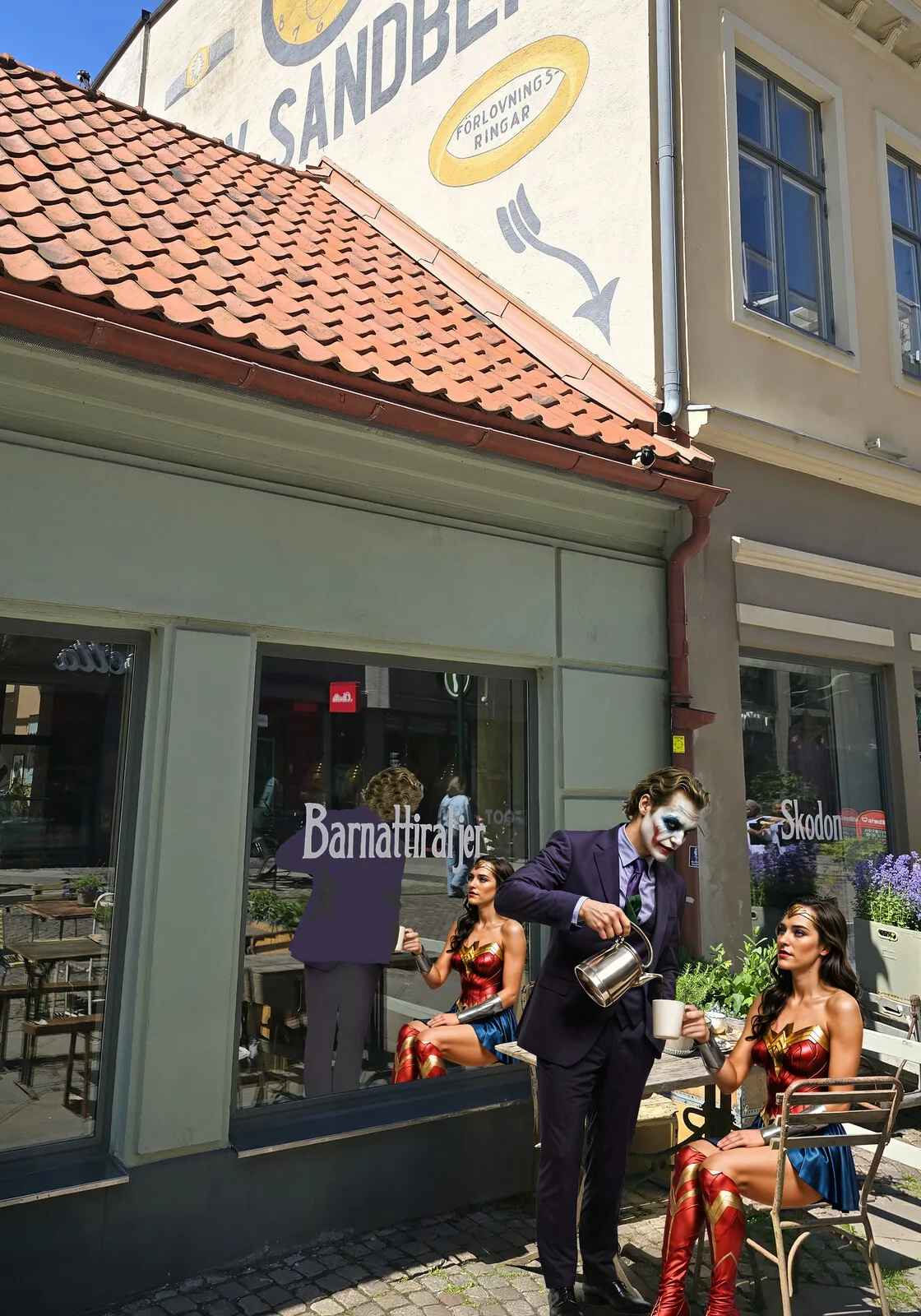
A Latte for Peace, 2025
Digital
50 x 70 cm
3 200 kr
A Latte for Peace
This is not a comic book.
Nor is it an origin story.
This is a coffee-scented collision of myth and madness, set not in Gotham or on Themyscira, but in Malmö—on a May afternoon too mild to be real.
Wonder Woman had come for a dialogue.
The Joker had come to cause disturbance.
And somehow, between cappuccino and confession, a new kind of showdown unfolded—one without punches, but with SPF 50 and a philosophical dagger.
Some encounters are written in the stars.
This one was doodled in the margins by a madman.
But even myths get tired of fighting.
Even villains crave attention more than blood.
And sometimes, the most dangerous thing you can do to a goddess is to ask her to laugh.
”The Clown with no Mirror
He was not born. He happened.
Like a punchline with no setup,
a howl that forgot its grief.
A cracked bell tolling midnight
in a city that no longer sleeps.
Some say he fell. Others say he climbed
out of the world’s wounded gut
with nothing but a smirk and a suit,
painted in panic and purple.
He dances not for joy,
but because stillness is a mirror.
And he cannot bear to see
the absence behind the mask.
He kisses chaos on the mouth,
throws confetti on catastrophe,
drowns reason in a teacup
and laughs while kingdoms burn.
But beneath the greasepaint
is no riddle, no romance—
only a boy uninvited to joy,
rewriting the rules with a scream.
He is not mad.
He is a method.
He is not broken.
He is rehearsed.
He is a villain.
He plays at myth but fears meaning.
He sings of anarchy but dreams of applause.
He mocks heroes, but chokes
on the word “why.”
And though he claims no name,
his shadow carries every letter:
BPD. HPD. NPD. ASPD. PTSD. OCD.
A whole alphabet soup of aching.
A DSM in a dapper hat.
He is not a diagnosis.
But he’s terrified that you might think so.”
Malmö May 2025
A Latte for Peace
For those in the know, the image is almost absurd: Wonder Woman and the Joker in the same frame without one chasing the other and not in a battle to the death. The scene is deceptively idyllic—an outdoor café on a pedestrian street in Malmö, a city renowned for its peaceful and inclusive atmosphere. The choice of location, a city known for its harmony, along with the act of sharing a coffee—a symbol of social interaction—both serve to underscore the unexpected harmony in this scene. The Joker is refilling her empty latte cup, a simple act that conveys a profound message of unexpected harmony. She has calmly and quietly sipped her coffee while he has gallantly gone inside to fetch a pot and offer her a refill. There's a hint of a smile at the corner of her mouth, and his typically demonic face is peacefully relaxed.
What is happening beneath the old jeweller Sandberg’s façade advertisement for engagement rings and the window text advertising “Barnattiraljer”—children’s accessories? Are they getting engaged and planning a family? The thought is staggering because Wonder Woman has never had an affair with the Joker in any official DC storyline. Not even unofficially, as far as we know. Such a relationship would be utterly improbable—morally, psychologically, narratively. The two stand as far apart as possible ideologically. Wonder Woman symbolises truth, justice, and honour; the Joker embodies chaos, deceit, and sadistic nihilism.
The Joker has occasionally crossed her path, particularly in Justice League storylines. However, they have never shared a relationship deeper than her efforts to stop him, often with greater ruthlessness than Batman would exhibit. In some versions, she is far more inclined to kill him, something that Batman steadfastly refuses to do. This dynamic has resulted in compelling ethical conflicts within the League, adding tension and drama to the narrative.
Wonder Woman is a character driven by an unwavering commitment to justice, compassion, warrior ethics, and righteous fury. In contrast, the Joker is psychologically unstable, often murderous, and an agent of chaos whose greatest pleasure lies in breaking others down. The notion that she would be romantically drawn to him would constitute a betrayal of her most fundamental principles. There are no Elseworlds or alternate-universe stories where such a pairing has even been hinted at. However, if such a relationship were to exist, it would undoubtedly have a profound impact on the DC universe, potentially altering the dynamics of the Justice League and challenging the very essence of heroism.
Before delving deeper into the background of this peaceful fika, let us closely examine the two adversaries. Wonder Woman and the Joker are eternal foils, not drawn together by fate, but by sheer narrative perversity. This was particularly evident in the latest issue of Justice League, a testament to the narrative complexity of their relationship.
Wonder Woman is often the heart of the Justice League—the one who binds together the varied perspectives with wisdom, courage, and a sense of higher purpose. Her role as a unifying force within the Justice League highlights the strength of her character. However, she is also ready to go against the group if her conscience demands it. Her relationship with the other superheroes in the DC universe is both central and complicated. She is one of the most influential figures in the League, yet she continues to forge her path. She shares strong bonds, experiences deep conflicts, and at times even faces ideological clashes with her peers. She serves as both a unifying force and a potential challenger, depending on the situation's demands. However, to ally herself with the League’s public enemy number one, the Joker? This unexpected alliance not only stretches credibility but also adds a layer of complexity to her character, as it forces her to navigate the tenuous line between justice and vengeance.
Wonder Woman has a fascinating—and at times rather dubious—background, particularly when examining her origins and early portrayals. Her father and creator, William Moulton Marston, was as complicated as his creation. He was not only a psychologist and inventor (he helped develop the lie detector), but also lived in a polyamorous relationship with two women—Elizabeth Holloway and Olive Byrne—both of whom significantly shaped Wonder Woman’s character. For instance, Olive wore the wide bracelets that would later become one of Wonder Woman’s defining attributes.
Marston, the father and creator of Wonder Woman, held strong beliefs about female superiority and the potential for a more peaceful world if women were in charge. These beliefs were reflected in the early comics, which were infused with themes of bondage, dominance, and submission. Depending on the perspective, these elements have been interpreted as both feminist liberation and fetishistic fantasy, adding a layer of complexity to Wonder Woman's character that is both enlightening and worthy of appreciation.
The loaded symbolism of those early stories was painful for Wonder Woman. In the Golden Age comics (1940s–1950s), she is frequently bound, imprisoned, or forced to escape restraints—sometimes literally, sometimes metaphorically. This has been interpreted as a feminist metaphor for the struggle for female independence; yet it was undeniably rendered with overt sexual undertones. She also often saved men, reversing traditional gender roles, but always with a theatrical sensuality.
That newfound freedom proved threatening to the male-dominated culture, leading to censorship and the rewriting of texts. When the Comics Code Authority was introduced in the 1950s, these themes were drastically toned down, and Wonder Woman became a more conventional female hero, often relegated to secondary roles or domestic settings. Her independence was weakened, and her feminism diluted in favour of more “acceptable” feminine virtues according to the conservative norms of the time.
But Wonder Woman merely bided her time, preparing in silence for her return as a feminist icon. In the 1970s, during the second-wave feminist movement, she was rediscovered as a symbol of female strength and liberation. Gloria Steinem featured her on the first cover of Ms. Magazine, and she became a rallying figure for empowerment. Her character's evolution and the changing interpretations of her symbolism reflect the shifting attitudes towards gender and sexuality in society, making her a fascinating subject for character analysis and a powerful symbol of female empowerment.
Wonder Woman was born a rebel. In her earliest incarnation, she defied authority: she disobeyed her mother, Queen Hippolyta, and left Themyscira (the island of the Amazons) to venture into the world of men. According to Amazonian law, this was forbidden—but she did it anyway, out of love and a sense of duty—a deliberate act of defiance for a higher cause. This defiance of societal norms, her willingness to challenge the established order, is what makes her character so inspiring and relatable.
She is no peaceful Virgin Mary and is far from averse to violence. Unlike Superman or Batman, who often adhere to a strict non-killing code, Wonder Woman, in some versions, has not hesitated to kill—if she deems it necessary. A notable example is when she kills Maxwell Lord in the Infinite Crisis storyline (2005) because he is controlling Superman and poses a threat to the entire world. She kills him coldly—on live television—because she sees it as the only option. At the time, it caused a moral outcry among the superheroes and fractured the League, highlighting the complex and often conflicting nature of her moral compass. This incident not only fractured the League but also raised questions about the ethical implications of her actions, further complicating her character.
For Wonder Woman, specific fundamental rules are complicated, such as the distinction between law and justice. She has repeatedly clashed with governments, militaries, and even the United Nations. She does not represent the U.S. or any state—she is an ambassador for Themyscira, with her diplomatic aims. She follows her moral compass, not necessarily the law.
She certainly has an agenda. In some alternate timelines, such as Injustice: Gods Among Us, she becomes a supporter of a totalitarian Superman. She endorses his dictatorial control of the world because she believes it will bring peace. In that version, she is unquestionably not on the right side—legally or morally.
Wonder Woman stands for something greater. She was never meant to obey orders—she was created to challenge systems. Whether those systems are patriarchal societies, oppressive governments, or corrupt judicial structures, she embodies both a warrior and a rebel. And that sometimes means breaking the law to do what is right.
In summary: yes, she is dubious—but in an exciting way. Wonder Woman is a complex figure who navigates the space between feminist icon, sex symbol, and cultural experiment. It is precisely this duality that has made her so fascinating and continually reinterpreted over the decades.
Historically, many female superheroes have been sexualised for a male audience. However, Wonder Woman stands apart—she doesn't merely evoke desire; she ignites identification, respect, and fantasies of power and control. This complexity renders her all the more attractive, particularly to women.
Reasons why women may fantasise about her more than men do:
Wonder Woman is a subject of desire, not an object. She saves, leads, and dominates. She is not the passive girlfriend in distress but the one who strikes back. This creates a fantasy of being her equal or her chosen one, or simply her lover.
Wonder Woman is a queer icon, long revered within LGBTQ+ communities, especially among lesbian and bisexual women.
Themyscira is a woman-euphoric utopia. Dreaming of Wonder Woman transcends mere sexual fantasy—it represents an emotional and ideological projection, albeit one that radiates sex.
She embodies freedom and force. For generations, many women have been expected to be pleasing, adaptable, and obedient. Here exists the opposite, personified. Wonder Woman is something entirely different. To be with her—or to become her—is a symbolic dream of freedom, strength, and dominance without shame. So, how does one dare to dream of this superwoman, if at all?
Women's fantasies about Wonder Woman are likely deeper, more relational or power-based, and thus carry different emotional weights. This doesn’t imply that every woman wishes to share her bed—or even be her friend.
Men’s fantasies about her are often more predictable and straightforward. They typically focus on appearance, costume, sex appeal, and, of course, conquest, culminating in sex. But how does one tame a virago, honestly? For Wonder Woman is certainly no mere mattress—more likely a woman who prefers to ride rather than be ridden. Most men probably recognise this and therefore temper their fantasies. One would need boundless confidence—or perhaps be a masochist—to dare approach Wonder Woman.
In her pastoral embrace, the man is no shepherd—but the sheep.
Which brings us to the other one, her unlikely partner: The Joker. What kind of fantasies could he possibly have about Wonder Woman, clearly as an object, but what kind? To answer that question, we must delve deeper into the Joker’s background. Who is The Joker?
Who Is the Joker?
To understand what kind of fantasies the Joker might harbour about Wonder Woman, we must first acknowledge that he is not a man in the ordinary sense of the word. He is an event, a rupture in logic, a laughing wound in the side of reason. If Batman is a trauma forged into discipline, the Joker is a trauma that has learned to dance. He is not chaos for the sake of rebellion – he is chaos for the joy of it, and that changes everything.
His origin is famously ambiguous. He might have fallen into a vat of chemicals, or perhaps he was always like this and merely emerged. Some versions speak of a failed comedian, a desperate man who lost everything and then lost his mind. Others suggest there never was a man, only a mask waiting for a face. What matters is not the facts but the fracture: a broken psyche, stripped of morality, gleefully detached from guilt.
The Joker does not desire as other men do. His fantasies are neither tender nor especially sexual in the conventional sense. If he imagines Wonder Woman at all, it is not as a lover but as a stage. She is not a woman to him – she is a myth, a symbol, a golden idol of order and strength that he would love to defile, not for pleasure, but to prove a point: that even goddesses bleed.
He dreams of her bound not because he wants her body, but because he wants her certainty to shatter. He would strip her not of clothing but of conviction. In his mind, an encounter with Wonder Woman is not a conquest but a comedy – grotesque, operatic, and intensely theatrical. A mockery of ideals. He would dress her in rags and parade her as a broken queen, all while blowing kisses to the camera and spinning in circles. She is the last bastion of dignity, and he is the clown who burns dignity for warmth.
But here is the twist: he respects her in the way that a saboteur respects a structure he longs to demolish. He knows she is incorruptible, and that excites him. Not sexually – intellectually. To the Joker, Wonder Woman represents the final joke: a being who will not laugh. And that is irresistible to him.
So when the two meet – if they ever do in a so-called Elseworlds tale – it is not romance. It is theatre. It is a ritual. It is oil and holy water colliding on the altar of myth. She stands in defiance; he curtsies in mockery. She strikes with truth; he responds with a pie to the face of the universe. And in that strange communion of opposites, something darkly poetic occurs.
Because perhaps, in his deepest fantasy, he doesn’t want to possess her. He wants to unmake her – and fail.
And that, paradoxically, is how he keeps her sacred.
The Joker first appeared in Batman #1 in April 1940. A trio created him: Bill Finger, the key writer behind Batman, often forgotten by history, but the true architect of Gotham and its mythology. Bob Kane—the artist officially credited as Batman’s creator, though his role was largely symbolic and commercial. Jerry Robinson—Kane’s young assistant and artist who, according to his account, sketched the first concept for the Joker and suggested the playing card as inspiration.
There are conflicting accounts of how exactly the Joker came to be. Robinson claimed he found a Joker card and proposed the idea. Bill Finger, however, said Conrad Veidt’s role inspired the character in the film "The Man Who Laughs" (1928), based on Victor Hugo’s novel of the same name, in which a man is disfigured with a permanent, grotesque smile. The film’s aesthetic and romantic horror set the tone for the Joker’s earliest incarnation: a grinning killer with a tragic backstory and theatrical flair.
Initially, the Joker was intended to die in his first appearance, but the editors saw his potential and rewrote the ending. He became Batman’s arch-nemesis and has since been one of the most iconic villains in popular culture.
It’s worth pausing to acknowledge one of the Joker’s more haunting literary ancestors: "The Man Who Laughs" (1869) by Victor Hugo. The protagonist, Gwynplaine, is a young boy disfigured by criminals who carve a permanent grin into his face. Though he becomes a performer adored by crowds, his life is an opera of inner torment – a man whose expression lies grotesquely at odds with his soul.
Hugo's Gwynplaine is not a villain, but the potential is there – a theatrical creature forged in suffering, mutilated in childhood, and then set adrift in a world that finds him entertaining rather than tragic. He is what the Joker might have been, had he clung to his humanity. Or perhaps what the Joker was, before he gave up trying.
Gwynplaine walks the line between victim and avenger, laughter and despair. In another world—or another Elseworlds-he might have dipped into madness and painted the smile with someone else’s blood. Instead, he remains a tragic foreshadowing: the man who laughs because he cannot scream. In that sense, he is far removed from the man who would become his unruly son—a true beast.
Is this truly the person Wonder Woman has been given as her ultimate adversary?
How can they be such adversaries if they’ve barely met in official stories? As far as we can tell, Wonder Woman and the Joker have only crossed paths a handful of times in DC’s main continuity—and those rare meetings have been brief and impersonal. They belong to entirely different realms of the DC universe and only collide when the Justice League or the multiverse itself is at stake.
In truth, Wonder Woman and the Joker work better as conceptual opposites than as historical rivals. They are mythic archetypes who stand for fundamentally opposed values. Wonder Woman and the Joker are natural-born adversaries—not because of shared history, but because of metaphysical incompatibility. She stands for truth. He exists to unravel it. In a universe with narrative gravity, they were bound to meet—not because the story demanded it, but because myth did.
Wonder Woman and the Joker's appearances in the same canonical storyline are as rare as a comet sighting. Their mythologies, like rival planets, orbit one another, but the chances of a collision are slim. It is these rare, almost miraculous moments that make their encounters so significant and awe-inspiring.
‘Justice League of America #77 (1969)’
This marks one of the earliest shared appearances, yet it represents more of a missed opportunity than an actual encounter. It is a standard team-up issue, with heroes and villains thrown together like cards in a chaotic shuffle. The Joker is present. Wonder Woman is present. However, they do not meet in any meaningful sense. It is a void of dialogue, drama, and confrontation, leaving the potential for an epic clash unfulfilled —a tantalising taste of what could have been.
‘‘Emperor Joker (2000)’ – A Superman-centric tale
In this story, the Joker, wielding his stolen fifth-dimensional powers, reshapes the universe to suit his grotesque whims, effectively becoming a god. Meanwhile, Wonder Woman is reduced to a mere parody of herself in the Joker’s twisted playground. The imbalance of power is stark, and the injustice is palpable, creating a sense of unease and discomfort.
‘Injustice: Gods Among Us (2013–)’ – An alternate timeline
This remains the most ideologically revealing crossover. Based on the video game series, the story opens with the Joker tricking Superman into killing Lois Lane and their unborn child. In a grief-ridden rage, Superman murders the Joker and subsequently becomes a tyrant. Wonder Woman, controversially, stands by Superman in his new regime. She does not endorse the Joker’s actions—far from it—but her tolerance for authoritarianism begins to blur moral lines. Nonetheless, she and the Joker never share an actual scene. They are enemies only by implication, not encounter.
‘Dark Nights: Death Metal (2020)’ – Multiversal madness
In this arc, the entire DC multiverse unravels in mythological chaos. The Joker appears through his ghoulish proxy, the Batman Who Laughs. Wonder Woman, however, takes centre stage as the axis of resistance. Their roles exist side by side, symbolically—but never narratively. He is a horror. She is a myth. Their paths flicker near each other but never truly cross.
In summary, the Joker and Wonder Woman have never had a deep or recurring relationship in official DC continuity. Their meetings are sporadic, symbolic, or relegated to Elseworlds-style detours.
Which brings us, somewhat improbably, to a quiet May afternoon in Malmö.
It was the Joker who made the first move.
He knew Wonder Woman would be in town, speaking at a feminist conference at Malmö Live…
The Day After Chaos: Latte and Diagnosis
The evening was warm but not oppressive; the kind of day when the sea breeze off Öresund smells faintly of ambition. Wonder Woman, a symbol of female strength, was attending a feminist conference at Malmö Live. This was not just any conference, but a platform where she could discuss and advocate for the ethics of resistance —a topic close to her heart. This conference, a gathering of like-minded individuals, was a significant event for her, a place where she could share her beliefs and learn from others. She quoted bell hooks while wearing a golden cuirass and left the panel to standing ovations and several rattled philosophers.
And then—there he was. The Joker. She hadn’t expected him.
But he had expected her.
What did the Joker want? Let us first say what he most likely did not wish to: he didn’t come to seduce her. The Joker, as far as any public record shows, has no sexual agenda. His desire is symbolic. If he wanted her “on her back,” it was only so he could dance a jig on her chest and throw confetti in her hair. And even that might be too literal.
No—he came to ruin her narrative.
Picture it: a global icon of female strength, in the heart of Scandinavian social democracy, discussing gendered warfare and post-Hellenic feminist metaphysics. And then—him. A man in a purple suit and crocodile shoes, waving a tulip and a water pistol filled with synthetic tears. Of course, he came. It was irresistible.
He walked straight into the conference centre, past baffled security, holding a sign that read:
“TRUTH OR DARE, DIANA?”
Some thought he came to start a fight. Others, to confess a twisted love. But the truth—if such a thing can ever be applied to him—was more perverse than that. He wanted to make her break character.
He wanted to stand before the world’s most unshakable woman and whisper something so wrong, so fundamentally absurd, that it would force her to laugh—or cry—or punch a microphone. He didn’t care which. He wanted her to fall out of myth and back into chaos.
They stood too close.
She allowed his proximity against her better judgment. Not because she trusted him in the slightest, but because she refused to let him dictate distance. She let him approach. She let him speak. She would not flinch; her resilience was a beacon of strength. The room was thick with eyes and microphones. And yet, when he leaned in, time withdrew like a tide.
He tilted his head like a man about to share a secret and breathed into the nearest mic:
“You’re not fighting for peace. You’re just angry your mother never told you why she made you from clay and not love.”
A blink. That was all.
But the silence shifted. Something dimmed behind her gaze—so subtle, so private, only the most ancient gods would have noticed.
No gasp. No blow. No storm of truth.
She didn’t strike him. She didn’t scream. But for the briefest instant, she vanished behind her face. The goddess receded, and in her place stood any woman. His words had pierced her armour, if only for a moment, revealing the vulnerability that lay beneath her strength. The impact of his words was profound, momentarily stripping away the layers of her myth and exposing the woman within.
Everyone in the room knew the myth—how Diana had been shaped from clay by her mother Hippolyta and given life by the gods. A tale she told at every lecture. A tale Joker couldn’t possibly know.
Yet his blow had landed somewhere.
Then the tide returned. She straightened. The golden lasso at her side shimmered faintly, sensing a tremor not in him, but in her.
She looked past him, through him, and spoke into the microphone, with that uniquely female, almost maternal smile:
“You’ve all seen this man before, but don’t be alarmed. The Joker is not dangerous. He is simply a wounded grin—a bullied child who never grew up and now prefers to smash his toys rather than play by the rules. He doesn’t even have a dog, because even man’s best friend avoids him. No treat in the world can change that. And today, dear sisters, we don’t serve spectacles. We serve truth—so we can remake the world for everyone.”
It was as though his smile wilted along with his jaw. He stepped back, bowed slightly, and said nothing. No triumph. Just the bitter resignation of someone who had aimed at a pillar—and found a hairline crack. Wonder Woman's words had struck a chord, leaving him with no retort. He realised that his attempt to disrupt her narrative had failed, and he left without a word, his usual bravado replaced by a sense of defeat.
He left without a word. And he would never speak of it again.
Back to That Latte on the Sidewalk
The next day, The Joker invited her for reconciliation coffee. You’ve seen the picture. They’re not talking about yesterday. Not the weather. Not their opposing worlds. They sit like characters paused between panels, waiting for the editor to decide their next lines.
Wonder Woman should’ve been wary. This was The Joker, after all. His record with women is hardly gentlemanly.
His most despicable act against a woman? The shooting of Batgirl—Barbara Gordon—in the stomach, followed by stripping her, taking humiliating photos, and showing them to her father, Commissioner Gordon, while keeping him imprisoned in a psychedelic torture maze. The aim? To prove that anyone can go mad—that all it takes is one bad day and a little push.
The brutality was so pointed, so invasive, that it triggered an internal debate within DC Comics about violence against women in fiction. If nothing else, Wonder Woman had reason to remain guarded.
But she came prepared.
In her Hermès handbag: a mirror that recalls Themyscira, a dagger blessed by Artemis, capable of cutting through any substance, that day’s edition of Sydsvenskan, praising her panel appearance, and a compact with Nivea SPF 50—because even superwomen respect good skincare. In her lap: the golden lasso that compels truth. On her wrists: the bracelets that deflect bullets.
Of all her weapons, the lasso was what the Joker feared most. More than justice, more than pain, he feared truth. He did not want to be lashed and forced to speak aloud what he had recently learned: a diagnosis more humiliating than any prison sentence. The power of truth, wielded by Wonder Woman, was his greatest fear.
His private DSM-5:
– BPD – Borderline Personality Disorder: emotional instability, fear of abandonment, desperate need for intensity, wild swings between euphoria and rage
– HPD – Histrionic Personality Disorder: attention-seeking, theatricality, exaggerated emotion, shallow intimacy
Add to that his narcissistic traits—but not the textbook kind. The Joker’s problem isn’t that his self-image is inflated. It’s that he has no stable self-image at all. All these letters sound clinical. To psychiatrists, they’re diagnostic. To him? Ridiculous. They shatter the myth. They reduce the Joker, not to an agent of chaos, but to a bad actor in the wrong audition.
BPDHPD. Six letters more wounding than Arkham. Because nothing kills a legend like medical vocabulary.
He would loathe being called emotionally unstable. The Joker wants to be an archetype, not a diagnosis.
Was he remorseful that day? Afraid of the lasso? We can only speculate. What we know is this:
He was uncharacteristically charming.
He paid for the coffee.
He fetched refills—twice—before they parted ways.
When will they meet again? Only the editors know.
And Wonder Woman, for her part, had another issue to fill. Fatalist that she is, she smiled and said to herself, “Que sera, sera”, just as Doris Day sang it—on her birthday, 1952. “Whatever will be, will be”.
Bonus reading on other female superheroes to follow...
Female superheroes in tights may have first emerged in the 1940s. Yet, female superheroes in action, symbolism, and function have been present for millennia—in myth, religion, adventure literature, and pulp fiction. Wonder Woman and Spider-Woman are not alone; they are merely the first to feature on the cover with their names in bold.
There were female predecessors to the 20th-century heroines, even if they were not labelled “superheroes” at the time. Here are a few essential and often overlooked figures from mythology, literature, and early popular culture who paved the way for Wonder Woman, Batwoman, Spider-Woman, Supergirl, and others:
Let us begin with some goddesses and mythical warrior women:
Pallas Athena (Greek mythology): The goddess of wisdom and war, often depicted in armour with a helmet and spear. She represented strategy rather than brute force—a model for clever, righteous heroines.
Artemis/Diana: Goddess of the hunt and chastity—independent, fearless, and often opposing male dominance. Wonder Woman even carries her Roman name: Diana.
The Valkyries of Norse mythology: Formidable female beings who determined the fate of warriors, deciding who would ascend to Valhalla, the Viking paradise. Autonomous, supernatural, and brimming with power, they are closely associated with Brynhildr and later fantasy heroines.
Freyja, the Norse goddess of both love and war, is particularly fascinating because of this duality.
She belonged to the Vanir tribe of gods and was associated with love, sexuality, fertility, and magic—but also with death and battle. She rode a chariot drawn by cats, donned a feathered cloak that enabled her to fly, and wielded seid, the most potent form of Norse sorcery.
Freyja undoubtedly qualifies as one of the ancient superwomen. In Grímnismál, one of the Eddic poems, it is said that half of the fallen warriors go to her realm, Fólkvangr, while the other half go to Odin’s Valhalla. This means she has first pick of the dead—a power equal to that of Odin himself.
Countless historical women have left an indelible mark on modern comics and fiction:
Joan of Arc: Undoubtedly the most influential real-life “superheroine”—a teenage girl who rose to become a general, inspired a nation, and was executed for her unwavering courage. Her story has been immortalised in countless works and continues to inspire female fighters, from Wonder Woman to Buffy.
Mata Hari: The spy, dancer, and double agent—she embodied female mystique, power, and ambiguity—a mix of agent and legend. Perhaps not a perfect fit among this group, as she wasn’t known for violence—her weapon of choice was seduction. Clever, but not quite clever enough, she ended her days before a firing squad.
Let us not forget the literary proto-heroines, such as Jane Porter in the novel Tarzan (1912). Often underestimated, she is a brave woman who can shoot, ride, and survive in the jungle, as depicted in Edgar Rice Burroughs’s original books.
Sheena, Queen of the Jungle (1938): The first female comic book hero to hold her title. She appeared before Wonder Woman (who debuted in 1941). Sheena could speak to animals, fought against evil colonialists, and was an independent, fierce, and often scantily clad woman, which also contributed to her popularity. Her revealing outfit was a concession to attract boys to follow her adventures. If girls had been asked, they would likely have preferred something more practical; imagine how many scratches those girls must have gotten swinging through dense jungles on vines. Yet, her unwavering courage and fierce independence continue to inspire women around the world today.
Science fiction and pulp heroines like Nyoka the Jungle Girl, Phantom Lady, and Miss Fury from the 1940s—women who fought crime in leotards, pilot suits, or wielded whips—existed long before superheroines went mainstream. These characters, with their independent and strong-willed nature, were early symbols of female empowerment and played a significant role in shaping the feminist movement of the time.
Modesty Blaise (1963): Created by Peter O’Donnell, she is a former spy with sharp intelligence, physical prowess, and a strong moral compass—no supernatural powers—but remains a forerunner to Black Widow and Catwoman in style and independence. The film about her wasn’t much of a success and was nearly a turkey of a movie. Perhaps it had too many clothes to lure boys into the cinema, although her towering hairdos did set trends. However, her character marked a significant shift in the portrayal of women in comics, moving away from the traditional damsel in distress to a more complex and independent figure.
Barbarella (1962, Jean-Claude Forest): A French science fiction heroine who combined feminism, sexual liberation, and intergalactic adventures. She sometimes had more in common with Fritz the Cat than with Superman and correspondingly wore far less fabric. The film allowed Jane Fonda to showcase her well-toned body, which significantly contributed to her future career as a fitness guru and sparked a fashion trend: aerobics. Her male co-star didn’t wear much either, but he did sport a hefty pair of angel wings, adding to the character's unique and intriguing nature.
Last but not least: Inanna – the first superheroine.
Long before Wonder Woman laced up her boots and Spider-Woman swung between skyscrapers, there was a woman who carried power in her blood and a storm in her eyes. Her name was Inanna—the Queen of Heaven and Earth, loved and feared in Sumerian Mesopotamia over five thousand years ago. She was the first superheroine, a figure of immense power and significance in the history of literature and comics, with unique qualities that set her apart from all others.
She was no gentle fertility goddess, nor a mother in an apron. She embodied desire itself, the heat of war, and the relentless hand of justice. While male gods sat on their thrones, Inanna descended into the underworld—naked, shedding layers of power—to confront her sister, the Queen of the Dead. This descent was not just a physical journey but a symbolic one, representing her willingness to confront the darkest aspects of existence. It cost her life, but she returned three days later. A primal myth, thousands of years older than the Gospels, full of the same mysteries. Can one return from death and remain unchanged?
Inanna could—but she was never the same. She became increasingly significant throughout two millennia. She began as a goddess of love and fertility, yet evolved into a cosmic figure of war, sexuality, and divine power, echoing traits of both Wonder Woman and Catwoman—a true superheroine of epic longevity. Her evolution is a fascinating journey, warranting further exploration in greater detail.
If you wish to learn more, hymns to Inanna/Ishtar are available online, translated from four-thousand-year-old clay tablets written in cuneiform by the earliest known author, the priestess Enheduanna. These hymns are not merely poetic tributes but also historical documents that serve as a testament to Inanna’s immense significance and the cultural practices of the time.
In songs praising her love for the shepherd god Dumuzi, she speaks without coy euphemisms. It is frank, to say the least. Inanna would appeal to modern women; she is active, seductive, combative, and demanding—not an object of others’ desires but a subject who chooses and desires herself. Sexuality is neither sin nor adornment; it is part of her divine essence—a force, a weapon, a Jane Fonda of antiquity.
But Inanna is also a warrior. When Mount Ebih defies her, she destroys it. Accused of arrogance, she responds with fire. Her rage is not hysterical—it is righteous. It embodies the fury of justice and power. She wears a helmet and sceptre, a sword and jewels. She is not a choice between beauty and strength; she encompasses both.
Inanna embodies everything that later superheroines carry in fragments: strength, fury, sexuality, a moral code, and the ability to die and return. Wonder Woman carries a shield—Inanna bears the stars. Spider-Woman climbs walls—Inanna traverses between worlds. Inanna was the origin; all the rest are imitators. This connection is not merely a matter of shared traits but a testament to the enduring influence of ancient myths on our modern understanding of heroism.
Inanna, a heroine whose story was not printed in colourful comics, but inscribed on clay tablets in cuneiform, sung in temples, and whispered on the lips of both women and men. Some of these stories can still be read online, translated into English. Her enduring legacy connects us to a rich cultural heritage that remains relevant today, fostering a sense of connection and appreciation for our shared history.
Inanna—the first superheroine. She who carved the primal mother into clay.
In ancient Egypt, no capes soared through the air, but there were women with powers far beyond what modern comics exploit. Before anyone depicted today’s superwomen, goddesses, and queens, they ruled over life and death, wielding magic, power, and myth.
Isis, also known as Aset, was the most beloved of all Egyptian deities. She was the mistress of magic, guardian of motherhood, and a symbol of female strength in its most complex form. Through spells, she resurrected her murdered husband, Osiris, and protected their son, Horus, from mortal dangers. In one of mythology’s most dramatic scenes, she even forced the sun god Ra to reveal his secret name, thus seizing his power. Isis requires no mythological parallel today—she is both hero and goddess, a figure of cunning, courage, and fidelity, evoking a sense of awe and admiration for her power and complexity.
Sekhmet was another powerful Egyptian woman—a lion-headed goddess of war, born from Ra’s wrath to punish humanity. She was so bloodthirsty that the world nearly ended and had to be pacified with a blood-coloured intoxicant. However, after the storm, Sekhmet also became a goddess of medicine. In her, we find the archetype of the struggle between destruction and protection, rage and reconciliation. She is a precursor to all modern heroes who wrestle with powers they can barely contain, evoking a sense of awe and admiration for her power and complexity.
Hatshepsut, by contrast, was flesh and blood. Born a princess, she chose to become pharaoh. She seized power. Donning male garments, wearing the ceremonial beard, she had carved in stone that she was the son of Ra—not to deny her gender, but to master a role until then reserved for men. Under her rule, Egypt flourished—bold expeditions, grand temples, war followed by peace. Her successors tried to erase her from history, but her memory has endured. She wasn’t a goddess, but her courage and skill made her one of Egypt’s true superheroines, inspiring a sense of admiration and empowerment in her audience.
There are more: Nephthys, guardian of night and death, stood silent at the border of worlds. Maat, goddess of justice, weighed human hearts against a feather to determine their fate in the afterlife. Bastet, the cat goddess, was both protector and destroyer—gentle as a household spirit, ruthless against demons and threats.
Ancient Egypt was filled with female figures of immense power, both in myth and in history. They didn’t wear latex suits, but they carried their power with all the gravity and symbolism the ancient world could summon. And maybe that’s why they still speak to us. Long before Wonder Woman emerged from the sea in her skimpy star-spangled skirt, Isis stood by the Nile’s edge, holding the ancient world firmly in her grasp.
One of the most fascinating aspects of ancient Egyptian visual art is its striking resemblance to modern comic book aesthetics.
On the walls of tombs and temples, stories are told in sequence, often with clear panel divisions where each scene depicts a pivotal moment. Goddesses like Isis, Sekhmet, Bastet, and Maat are portrayed not just as static symbols, but as active agents in dramatic events—they are born, they fight, they grieve, they protect, they transform. Many of these scenes are accompanied by hieroglyphs that function much like speech bubbles or narrative captions.
For instance, the Temple of Dendera, where Hathor, the goddess of love and music, is depicted in long sequences of evolving actions. Alternatively, in the tomb of Seti I in the Valley of the Kings, Isis gathers her husband’s body, breathes life into it, and then gives birth to Horus—a narrative modern comic artists could readily depict as a classic superheroine origin story.
The colour palettes, stylised poses, rhythmic repetition, and narrative flow in image form all closely resemble the comic format. One can almost imagine a child in Thebes in 1200 BCE walking along a temple wall, reading with their finger, panel by panel, how a goddess vanquishes evil or restores cosmic order. It’s no wonder these stories still feel alive. They were meant to be read, not merely seen. And perhaps the distance between Marvel’s universe and Memphis isn’t so great after all.
Let these powerful women inspire you to explore their stories further. The internet is full of them. Google 'Wonder Woman' and you’ll get 1,140,000,000 hits; search for 'Batman' and he comes in forty million fewer; Superman only gets 630,000,000. Poor thing! Beaten by a woman in real life.
Jörgen Thornberg
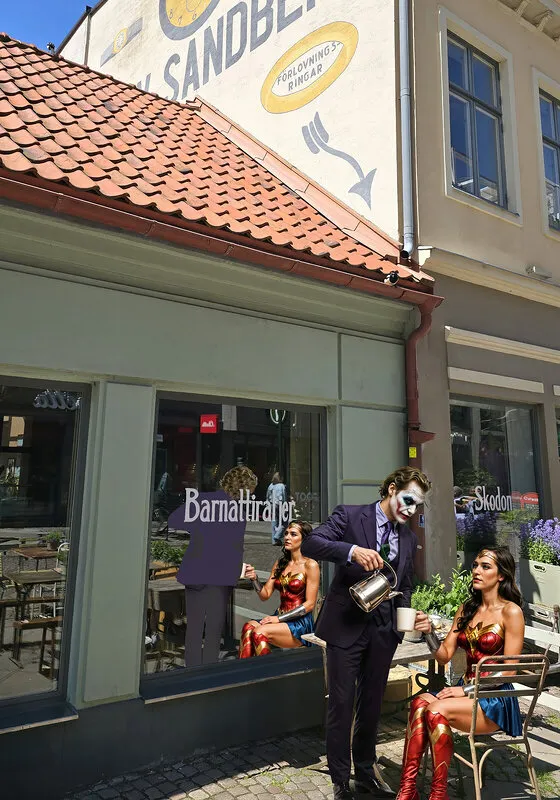
A Latte for Peace, 2025
Digital
50 x 70 cm
3 200 kr
A Latte for Peace
This is not a comic book.
Nor is it an origin story.
This is a coffee-scented collision of myth and madness, set not in Gotham or on Themyscira, but in Malmö—on a May afternoon too mild to be real.
Wonder Woman had come for a dialogue.
The Joker had come to cause disturbance.
And somehow, between cappuccino and confession, a new kind of showdown unfolded—one without punches, but with SPF 50 and a philosophical dagger.
Some encounters are written in the stars.
This one was doodled in the margins by a madman.
But even myths get tired of fighting.
Even villains crave attention more than blood.
And sometimes, the most dangerous thing you can do to a goddess is to ask her to laugh.
”The Clown with no Mirror
He was not born. He happened.
Like a punchline with no setup,
a howl that forgot its grief.
A cracked bell tolling midnight
in a city that no longer sleeps.
Some say he fell. Others say he climbed
out of the world’s wounded gut
with nothing but a smirk and a suit,
painted in panic and purple.
He dances not for joy,
but because stillness is a mirror.
And he cannot bear to see
the absence behind the mask.
He kisses chaos on the mouth,
throws confetti on catastrophe,
drowns reason in a teacup
and laughs while kingdoms burn.
But beneath the greasepaint
is no riddle, no romance—
only a boy uninvited to joy,
rewriting the rules with a scream.
He is not mad.
He is a method.
He is not broken.
He is rehearsed.
He is a villain.
He plays at myth but fears meaning.
He sings of anarchy but dreams of applause.
He mocks heroes, but chokes
on the word “why.”
And though he claims no name,
his shadow carries every letter:
BPD. HPD. NPD. ASPD. PTSD. OCD.
A whole alphabet soup of aching.
A DSM in a dapper hat.
He is not a diagnosis.
But he’s terrified that you might think so.”
Malmö May 2025
A Latte for Peace
For those in the know, the image is almost absurd: Wonder Woman and the Joker in the same frame without one chasing the other and not in a battle to the death. The scene is deceptively idyllic—an outdoor café on a pedestrian street in Malmö, a city renowned for its peaceful and inclusive atmosphere. The choice of location, a city known for its harmony, along with the act of sharing a coffee—a symbol of social interaction—both serve to underscore the unexpected harmony in this scene. The Joker is refilling her empty latte cup, a simple act that conveys a profound message of unexpected harmony. She has calmly and quietly sipped her coffee while he has gallantly gone inside to fetch a pot and offer her a refill. There's a hint of a smile at the corner of her mouth, and his typically demonic face is peacefully relaxed.
What is happening beneath the old jeweller Sandberg’s façade advertisement for engagement rings and the window text advertising “Barnattiraljer”—children’s accessories? Are they getting engaged and planning a family? The thought is staggering because Wonder Woman has never had an affair with the Joker in any official DC storyline. Not even unofficially, as far as we know. Such a relationship would be utterly improbable—morally, psychologically, narratively. The two stand as far apart as possible ideologically. Wonder Woman symbolises truth, justice, and honour; the Joker embodies chaos, deceit, and sadistic nihilism.
The Joker has occasionally crossed her path, particularly in Justice League storylines. However, they have never shared a relationship deeper than her efforts to stop him, often with greater ruthlessness than Batman would exhibit. In some versions, she is far more inclined to kill him, something that Batman steadfastly refuses to do. This dynamic has resulted in compelling ethical conflicts within the League, adding tension and drama to the narrative.
Wonder Woman is a character driven by an unwavering commitment to justice, compassion, warrior ethics, and righteous fury. In contrast, the Joker is psychologically unstable, often murderous, and an agent of chaos whose greatest pleasure lies in breaking others down. The notion that she would be romantically drawn to him would constitute a betrayal of her most fundamental principles. There are no Elseworlds or alternate-universe stories where such a pairing has even been hinted at. However, if such a relationship were to exist, it would undoubtedly have a profound impact on the DC universe, potentially altering the dynamics of the Justice League and challenging the very essence of heroism.
Before delving deeper into the background of this peaceful fika, let us closely examine the two adversaries. Wonder Woman and the Joker are eternal foils, not drawn together by fate, but by sheer narrative perversity. This was particularly evident in the latest issue of Justice League, a testament to the narrative complexity of their relationship.
Wonder Woman is often the heart of the Justice League—the one who binds together the varied perspectives with wisdom, courage, and a sense of higher purpose. Her role as a unifying force within the Justice League highlights the strength of her character. However, she is also ready to go against the group if her conscience demands it. Her relationship with the other superheroes in the DC universe is both central and complicated. She is one of the most influential figures in the League, yet she continues to forge her path. She shares strong bonds, experiences deep conflicts, and at times even faces ideological clashes with her peers. She serves as both a unifying force and a potential challenger, depending on the situation's demands. However, to ally herself with the League’s public enemy number one, the Joker? This unexpected alliance not only stretches credibility but also adds a layer of complexity to her character, as it forces her to navigate the tenuous line between justice and vengeance.
Wonder Woman has a fascinating—and at times rather dubious—background, particularly when examining her origins and early portrayals. Her father and creator, William Moulton Marston, was as complicated as his creation. He was not only a psychologist and inventor (he helped develop the lie detector), but also lived in a polyamorous relationship with two women—Elizabeth Holloway and Olive Byrne—both of whom significantly shaped Wonder Woman’s character. For instance, Olive wore the wide bracelets that would later become one of Wonder Woman’s defining attributes.
Marston, the father and creator of Wonder Woman, held strong beliefs about female superiority and the potential for a more peaceful world if women were in charge. These beliefs were reflected in the early comics, which were infused with themes of bondage, dominance, and submission. Depending on the perspective, these elements have been interpreted as both feminist liberation and fetishistic fantasy, adding a layer of complexity to Wonder Woman's character that is both enlightening and worthy of appreciation.
The loaded symbolism of those early stories was painful for Wonder Woman. In the Golden Age comics (1940s–1950s), she is frequently bound, imprisoned, or forced to escape restraints—sometimes literally, sometimes metaphorically. This has been interpreted as a feminist metaphor for the struggle for female independence; yet it was undeniably rendered with overt sexual undertones. She also often saved men, reversing traditional gender roles, but always with a theatrical sensuality.
That newfound freedom proved threatening to the male-dominated culture, leading to censorship and the rewriting of texts. When the Comics Code Authority was introduced in the 1950s, these themes were drastically toned down, and Wonder Woman became a more conventional female hero, often relegated to secondary roles or domestic settings. Her independence was weakened, and her feminism diluted in favour of more “acceptable” feminine virtues according to the conservative norms of the time.
But Wonder Woman merely bided her time, preparing in silence for her return as a feminist icon. In the 1970s, during the second-wave feminist movement, she was rediscovered as a symbol of female strength and liberation. Gloria Steinem featured her on the first cover of Ms. Magazine, and she became a rallying figure for empowerment. Her character's evolution and the changing interpretations of her symbolism reflect the shifting attitudes towards gender and sexuality in society, making her a fascinating subject for character analysis and a powerful symbol of female empowerment.
Wonder Woman was born a rebel. In her earliest incarnation, she defied authority: she disobeyed her mother, Queen Hippolyta, and left Themyscira (the island of the Amazons) to venture into the world of men. According to Amazonian law, this was forbidden—but she did it anyway, out of love and a sense of duty—a deliberate act of defiance for a higher cause. This defiance of societal norms, her willingness to challenge the established order, is what makes her character so inspiring and relatable.
She is no peaceful Virgin Mary and is far from averse to violence. Unlike Superman or Batman, who often adhere to a strict non-killing code, Wonder Woman, in some versions, has not hesitated to kill—if she deems it necessary. A notable example is when she kills Maxwell Lord in the Infinite Crisis storyline (2005) because he is controlling Superman and poses a threat to the entire world. She kills him coldly—on live television—because she sees it as the only option. At the time, it caused a moral outcry among the superheroes and fractured the League, highlighting the complex and often conflicting nature of her moral compass. This incident not only fractured the League but also raised questions about the ethical implications of her actions, further complicating her character.
For Wonder Woman, specific fundamental rules are complicated, such as the distinction between law and justice. She has repeatedly clashed with governments, militaries, and even the United Nations. She does not represent the U.S. or any state—she is an ambassador for Themyscira, with her diplomatic aims. She follows her moral compass, not necessarily the law.
She certainly has an agenda. In some alternate timelines, such as Injustice: Gods Among Us, she becomes a supporter of a totalitarian Superman. She endorses his dictatorial control of the world because she believes it will bring peace. In that version, she is unquestionably not on the right side—legally or morally.
Wonder Woman stands for something greater. She was never meant to obey orders—she was created to challenge systems. Whether those systems are patriarchal societies, oppressive governments, or corrupt judicial structures, she embodies both a warrior and a rebel. And that sometimes means breaking the law to do what is right.
In summary: yes, she is dubious—but in an exciting way. Wonder Woman is a complex figure who navigates the space between feminist icon, sex symbol, and cultural experiment. It is precisely this duality that has made her so fascinating and continually reinterpreted over the decades.
Historically, many female superheroes have been sexualised for a male audience. However, Wonder Woman stands apart—she doesn't merely evoke desire; she ignites identification, respect, and fantasies of power and control. This complexity renders her all the more attractive, particularly to women.
Reasons why women may fantasise about her more than men do:
Wonder Woman is a subject of desire, not an object. She saves, leads, and dominates. She is not the passive girlfriend in distress but the one who strikes back. This creates a fantasy of being her equal or her chosen one, or simply her lover.
Wonder Woman is a queer icon, long revered within LGBTQ+ communities, especially among lesbian and bisexual women.
Themyscira is a woman-euphoric utopia. Dreaming of Wonder Woman transcends mere sexual fantasy—it represents an emotional and ideological projection, albeit one that radiates sex.
She embodies freedom and force. For generations, many women have been expected to be pleasing, adaptable, and obedient. Here exists the opposite, personified. Wonder Woman is something entirely different. To be with her—or to become her—is a symbolic dream of freedom, strength, and dominance without shame. So, how does one dare to dream of this superwoman, if at all?
Women's fantasies about Wonder Woman are likely deeper, more relational or power-based, and thus carry different emotional weights. This doesn’t imply that every woman wishes to share her bed—or even be her friend.
Men’s fantasies about her are often more predictable and straightforward. They typically focus on appearance, costume, sex appeal, and, of course, conquest, culminating in sex. But how does one tame a virago, honestly? For Wonder Woman is certainly no mere mattress—more likely a woman who prefers to ride rather than be ridden. Most men probably recognise this and therefore temper their fantasies. One would need boundless confidence—or perhaps be a masochist—to dare approach Wonder Woman.
In her pastoral embrace, the man is no shepherd—but the sheep.
Which brings us to the other one, her unlikely partner: The Joker. What kind of fantasies could he possibly have about Wonder Woman, clearly as an object, but what kind? To answer that question, we must delve deeper into the Joker’s background. Who is The Joker?
Who Is the Joker?
To understand what kind of fantasies the Joker might harbour about Wonder Woman, we must first acknowledge that he is not a man in the ordinary sense of the word. He is an event, a rupture in logic, a laughing wound in the side of reason. If Batman is a trauma forged into discipline, the Joker is a trauma that has learned to dance. He is not chaos for the sake of rebellion – he is chaos for the joy of it, and that changes everything.
His origin is famously ambiguous. He might have fallen into a vat of chemicals, or perhaps he was always like this and merely emerged. Some versions speak of a failed comedian, a desperate man who lost everything and then lost his mind. Others suggest there never was a man, only a mask waiting for a face. What matters is not the facts but the fracture: a broken psyche, stripped of morality, gleefully detached from guilt.
The Joker does not desire as other men do. His fantasies are neither tender nor especially sexual in the conventional sense. If he imagines Wonder Woman at all, it is not as a lover but as a stage. She is not a woman to him – she is a myth, a symbol, a golden idol of order and strength that he would love to defile, not for pleasure, but to prove a point: that even goddesses bleed.
He dreams of her bound not because he wants her body, but because he wants her certainty to shatter. He would strip her not of clothing but of conviction. In his mind, an encounter with Wonder Woman is not a conquest but a comedy – grotesque, operatic, and intensely theatrical. A mockery of ideals. He would dress her in rags and parade her as a broken queen, all while blowing kisses to the camera and spinning in circles. She is the last bastion of dignity, and he is the clown who burns dignity for warmth.
But here is the twist: he respects her in the way that a saboteur respects a structure he longs to demolish. He knows she is incorruptible, and that excites him. Not sexually – intellectually. To the Joker, Wonder Woman represents the final joke: a being who will not laugh. And that is irresistible to him.
So when the two meet – if they ever do in a so-called Elseworlds tale – it is not romance. It is theatre. It is a ritual. It is oil and holy water colliding on the altar of myth. She stands in defiance; he curtsies in mockery. She strikes with truth; he responds with a pie to the face of the universe. And in that strange communion of opposites, something darkly poetic occurs.
Because perhaps, in his deepest fantasy, he doesn’t want to possess her. He wants to unmake her – and fail.
And that, paradoxically, is how he keeps her sacred.
The Joker first appeared in Batman #1 in April 1940. A trio created him: Bill Finger, the key writer behind Batman, often forgotten by history, but the true architect of Gotham and its mythology. Bob Kane—the artist officially credited as Batman’s creator, though his role was largely symbolic and commercial. Jerry Robinson—Kane’s young assistant and artist who, according to his account, sketched the first concept for the Joker and suggested the playing card as inspiration.
There are conflicting accounts of how exactly the Joker came to be. Robinson claimed he found a Joker card and proposed the idea. Bill Finger, however, said Conrad Veidt’s role inspired the character in the film "The Man Who Laughs" (1928), based on Victor Hugo’s novel of the same name, in which a man is disfigured with a permanent, grotesque smile. The film’s aesthetic and romantic horror set the tone for the Joker’s earliest incarnation: a grinning killer with a tragic backstory and theatrical flair.
Initially, the Joker was intended to die in his first appearance, but the editors saw his potential and rewrote the ending. He became Batman’s arch-nemesis and has since been one of the most iconic villains in popular culture.
It’s worth pausing to acknowledge one of the Joker’s more haunting literary ancestors: "The Man Who Laughs" (1869) by Victor Hugo. The protagonist, Gwynplaine, is a young boy disfigured by criminals who carve a permanent grin into his face. Though he becomes a performer adored by crowds, his life is an opera of inner torment – a man whose expression lies grotesquely at odds with his soul.
Hugo's Gwynplaine is not a villain, but the potential is there – a theatrical creature forged in suffering, mutilated in childhood, and then set adrift in a world that finds him entertaining rather than tragic. He is what the Joker might have been, had he clung to his humanity. Or perhaps what the Joker was, before he gave up trying.
Gwynplaine walks the line between victim and avenger, laughter and despair. In another world—or another Elseworlds-he might have dipped into madness and painted the smile with someone else’s blood. Instead, he remains a tragic foreshadowing: the man who laughs because he cannot scream. In that sense, he is far removed from the man who would become his unruly son—a true beast.
Is this truly the person Wonder Woman has been given as her ultimate adversary?
How can they be such adversaries if they’ve barely met in official stories? As far as we can tell, Wonder Woman and the Joker have only crossed paths a handful of times in DC’s main continuity—and those rare meetings have been brief and impersonal. They belong to entirely different realms of the DC universe and only collide when the Justice League or the multiverse itself is at stake.
In truth, Wonder Woman and the Joker work better as conceptual opposites than as historical rivals. They are mythic archetypes who stand for fundamentally opposed values. Wonder Woman and the Joker are natural-born adversaries—not because of shared history, but because of metaphysical incompatibility. She stands for truth. He exists to unravel it. In a universe with narrative gravity, they were bound to meet—not because the story demanded it, but because myth did.
Wonder Woman and the Joker's appearances in the same canonical storyline are as rare as a comet sighting. Their mythologies, like rival planets, orbit one another, but the chances of a collision are slim. It is these rare, almost miraculous moments that make their encounters so significant and awe-inspiring.
‘Justice League of America #77 (1969)’
This marks one of the earliest shared appearances, yet it represents more of a missed opportunity than an actual encounter. It is a standard team-up issue, with heroes and villains thrown together like cards in a chaotic shuffle. The Joker is present. Wonder Woman is present. However, they do not meet in any meaningful sense. It is a void of dialogue, drama, and confrontation, leaving the potential for an epic clash unfulfilled —a tantalising taste of what could have been.
‘‘Emperor Joker (2000)’ – A Superman-centric tale
In this story, the Joker, wielding his stolen fifth-dimensional powers, reshapes the universe to suit his grotesque whims, effectively becoming a god. Meanwhile, Wonder Woman is reduced to a mere parody of herself in the Joker’s twisted playground. The imbalance of power is stark, and the injustice is palpable, creating a sense of unease and discomfort.
‘Injustice: Gods Among Us (2013–)’ – An alternate timeline
This remains the most ideologically revealing crossover. Based on the video game series, the story opens with the Joker tricking Superman into killing Lois Lane and their unborn child. In a grief-ridden rage, Superman murders the Joker and subsequently becomes a tyrant. Wonder Woman, controversially, stands by Superman in his new regime. She does not endorse the Joker’s actions—far from it—but her tolerance for authoritarianism begins to blur moral lines. Nonetheless, she and the Joker never share an actual scene. They are enemies only by implication, not encounter.
‘Dark Nights: Death Metal (2020)’ – Multiversal madness
In this arc, the entire DC multiverse unravels in mythological chaos. The Joker appears through his ghoulish proxy, the Batman Who Laughs. Wonder Woman, however, takes centre stage as the axis of resistance. Their roles exist side by side, symbolically—but never narratively. He is a horror. She is a myth. Their paths flicker near each other but never truly cross.
In summary, the Joker and Wonder Woman have never had a deep or recurring relationship in official DC continuity. Their meetings are sporadic, symbolic, or relegated to Elseworlds-style detours.
Which brings us, somewhat improbably, to a quiet May afternoon in Malmö.
It was the Joker who made the first move.
He knew Wonder Woman would be in town, speaking at a feminist conference at Malmö Live…
The Day After Chaos: Latte and Diagnosis
The evening was warm but not oppressive; the kind of day when the sea breeze off Öresund smells faintly of ambition. Wonder Woman, a symbol of female strength, was attending a feminist conference at Malmö Live. This was not just any conference, but a platform where she could discuss and advocate for the ethics of resistance —a topic close to her heart. This conference, a gathering of like-minded individuals, was a significant event for her, a place where she could share her beliefs and learn from others. She quoted bell hooks while wearing a golden cuirass and left the panel to standing ovations and several rattled philosophers.
And then—there he was. The Joker. She hadn’t expected him.
But he had expected her.
What did the Joker want? Let us first say what he most likely did not wish to: he didn’t come to seduce her. The Joker, as far as any public record shows, has no sexual agenda. His desire is symbolic. If he wanted her “on her back,” it was only so he could dance a jig on her chest and throw confetti in her hair. And even that might be too literal.
No—he came to ruin her narrative.
Picture it: a global icon of female strength, in the heart of Scandinavian social democracy, discussing gendered warfare and post-Hellenic feminist metaphysics. And then—him. A man in a purple suit and crocodile shoes, waving a tulip and a water pistol filled with synthetic tears. Of course, he came. It was irresistible.
He walked straight into the conference centre, past baffled security, holding a sign that read:
“TRUTH OR DARE, DIANA?”
Some thought he came to start a fight. Others, to confess a twisted love. But the truth—if such a thing can ever be applied to him—was more perverse than that. He wanted to make her break character.
He wanted to stand before the world’s most unshakable woman and whisper something so wrong, so fundamentally absurd, that it would force her to laugh—or cry—or punch a microphone. He didn’t care which. He wanted her to fall out of myth and back into chaos.
They stood too close.
She allowed his proximity against her better judgment. Not because she trusted him in the slightest, but because she refused to let him dictate distance. She let him approach. She let him speak. She would not flinch; her resilience was a beacon of strength. The room was thick with eyes and microphones. And yet, when he leaned in, time withdrew like a tide.
He tilted his head like a man about to share a secret and breathed into the nearest mic:
“You’re not fighting for peace. You’re just angry your mother never told you why she made you from clay and not love.”
A blink. That was all.
But the silence shifted. Something dimmed behind her gaze—so subtle, so private, only the most ancient gods would have noticed.
No gasp. No blow. No storm of truth.
She didn’t strike him. She didn’t scream. But for the briefest instant, she vanished behind her face. The goddess receded, and in her place stood any woman. His words had pierced her armour, if only for a moment, revealing the vulnerability that lay beneath her strength. The impact of his words was profound, momentarily stripping away the layers of her myth and exposing the woman within.
Everyone in the room knew the myth—how Diana had been shaped from clay by her mother Hippolyta and given life by the gods. A tale she told at every lecture. A tale Joker couldn’t possibly know.
Yet his blow had landed somewhere.
Then the tide returned. She straightened. The golden lasso at her side shimmered faintly, sensing a tremor not in him, but in her.
She looked past him, through him, and spoke into the microphone, with that uniquely female, almost maternal smile:
“You’ve all seen this man before, but don’t be alarmed. The Joker is not dangerous. He is simply a wounded grin—a bullied child who never grew up and now prefers to smash his toys rather than play by the rules. He doesn’t even have a dog, because even man’s best friend avoids him. No treat in the world can change that. And today, dear sisters, we don’t serve spectacles. We serve truth—so we can remake the world for everyone.”
It was as though his smile wilted along with his jaw. He stepped back, bowed slightly, and said nothing. No triumph. Just the bitter resignation of someone who had aimed at a pillar—and found a hairline crack. Wonder Woman's words had struck a chord, leaving him with no retort. He realised that his attempt to disrupt her narrative had failed, and he left without a word, his usual bravado replaced by a sense of defeat.
He left without a word. And he would never speak of it again.
Back to That Latte on the Sidewalk
The next day, The Joker invited her for reconciliation coffee. You’ve seen the picture. They’re not talking about yesterday. Not the weather. Not their opposing worlds. They sit like characters paused between panels, waiting for the editor to decide their next lines.
Wonder Woman should’ve been wary. This was The Joker, after all. His record with women is hardly gentlemanly.
His most despicable act against a woman? The shooting of Batgirl—Barbara Gordon—in the stomach, followed by stripping her, taking humiliating photos, and showing them to her father, Commissioner Gordon, while keeping him imprisoned in a psychedelic torture maze. The aim? To prove that anyone can go mad—that all it takes is one bad day and a little push.
The brutality was so pointed, so invasive, that it triggered an internal debate within DC Comics about violence against women in fiction. If nothing else, Wonder Woman had reason to remain guarded.
But she came prepared.
In her Hermès handbag: a mirror that recalls Themyscira, a dagger blessed by Artemis, capable of cutting through any substance, that day’s edition of Sydsvenskan, praising her panel appearance, and a compact with Nivea SPF 50—because even superwomen respect good skincare. In her lap: the golden lasso that compels truth. On her wrists: the bracelets that deflect bullets.
Of all her weapons, the lasso was what the Joker feared most. More than justice, more than pain, he feared truth. He did not want to be lashed and forced to speak aloud what he had recently learned: a diagnosis more humiliating than any prison sentence. The power of truth, wielded by Wonder Woman, was his greatest fear.
His private DSM-5:
– BPD – Borderline Personality Disorder: emotional instability, fear of abandonment, desperate need for intensity, wild swings between euphoria and rage
– HPD – Histrionic Personality Disorder: attention-seeking, theatricality, exaggerated emotion, shallow intimacy
Add to that his narcissistic traits—but not the textbook kind. The Joker’s problem isn’t that his self-image is inflated. It’s that he has no stable self-image at all. All these letters sound clinical. To psychiatrists, they’re diagnostic. To him? Ridiculous. They shatter the myth. They reduce the Joker, not to an agent of chaos, but to a bad actor in the wrong audition.
BPDHPD. Six letters more wounding than Arkham. Because nothing kills a legend like medical vocabulary.
He would loathe being called emotionally unstable. The Joker wants to be an archetype, not a diagnosis.
Was he remorseful that day? Afraid of the lasso? We can only speculate. What we know is this:
He was uncharacteristically charming.
He paid for the coffee.
He fetched refills—twice—before they parted ways.
When will they meet again? Only the editors know.
And Wonder Woman, for her part, had another issue to fill. Fatalist that she is, she smiled and said to herself, “Que sera, sera”, just as Doris Day sang it—on her birthday, 1952. “Whatever will be, will be”.
Bonus reading on other female superheroes to follow...
Female superheroes in tights may have first emerged in the 1940s. Yet, female superheroes in action, symbolism, and function have been present for millennia—in myth, religion, adventure literature, and pulp fiction. Wonder Woman and Spider-Woman are not alone; they are merely the first to feature on the cover with their names in bold.
There were female predecessors to the 20th-century heroines, even if they were not labelled “superheroes” at the time. Here are a few essential and often overlooked figures from mythology, literature, and early popular culture who paved the way for Wonder Woman, Batwoman, Spider-Woman, Supergirl, and others:
Let us begin with some goddesses and mythical warrior women:
Pallas Athena (Greek mythology): The goddess of wisdom and war, often depicted in armour with a helmet and spear. She represented strategy rather than brute force—a model for clever, righteous heroines.
Artemis/Diana: Goddess of the hunt and chastity—independent, fearless, and often opposing male dominance. Wonder Woman even carries her Roman name: Diana.
The Valkyries of Norse mythology: Formidable female beings who determined the fate of warriors, deciding who would ascend to Valhalla, the Viking paradise. Autonomous, supernatural, and brimming with power, they are closely associated with Brynhildr and later fantasy heroines.
Freyja, the Norse goddess of both love and war, is particularly fascinating because of this duality.
She belonged to the Vanir tribe of gods and was associated with love, sexuality, fertility, and magic—but also with death and battle. She rode a chariot drawn by cats, donned a feathered cloak that enabled her to fly, and wielded seid, the most potent form of Norse sorcery.
Freyja undoubtedly qualifies as one of the ancient superwomen. In Grímnismál, one of the Eddic poems, it is said that half of the fallen warriors go to her realm, Fólkvangr, while the other half go to Odin’s Valhalla. This means she has first pick of the dead—a power equal to that of Odin himself.
Countless historical women have left an indelible mark on modern comics and fiction:
Joan of Arc: Undoubtedly the most influential real-life “superheroine”—a teenage girl who rose to become a general, inspired a nation, and was executed for her unwavering courage. Her story has been immortalised in countless works and continues to inspire female fighters, from Wonder Woman to Buffy.
Mata Hari: The spy, dancer, and double agent—she embodied female mystique, power, and ambiguity—a mix of agent and legend. Perhaps not a perfect fit among this group, as she wasn’t known for violence—her weapon of choice was seduction. Clever, but not quite clever enough, she ended her days before a firing squad.
Let us not forget the literary proto-heroines, such as Jane Porter in the novel Tarzan (1912). Often underestimated, she is a brave woman who can shoot, ride, and survive in the jungle, as depicted in Edgar Rice Burroughs’s original books.
Sheena, Queen of the Jungle (1938): The first female comic book hero to hold her title. She appeared before Wonder Woman (who debuted in 1941). Sheena could speak to animals, fought against evil colonialists, and was an independent, fierce, and often scantily clad woman, which also contributed to her popularity. Her revealing outfit was a concession to attract boys to follow her adventures. If girls had been asked, they would likely have preferred something more practical; imagine how many scratches those girls must have gotten swinging through dense jungles on vines. Yet, her unwavering courage and fierce independence continue to inspire women around the world today.
Science fiction and pulp heroines like Nyoka the Jungle Girl, Phantom Lady, and Miss Fury from the 1940s—women who fought crime in leotards, pilot suits, or wielded whips—existed long before superheroines went mainstream. These characters, with their independent and strong-willed nature, were early symbols of female empowerment and played a significant role in shaping the feminist movement of the time.
Modesty Blaise (1963): Created by Peter O’Donnell, she is a former spy with sharp intelligence, physical prowess, and a strong moral compass—no supernatural powers—but remains a forerunner to Black Widow and Catwoman in style and independence. The film about her wasn’t much of a success and was nearly a turkey of a movie. Perhaps it had too many clothes to lure boys into the cinema, although her towering hairdos did set trends. However, her character marked a significant shift in the portrayal of women in comics, moving away from the traditional damsel in distress to a more complex and independent figure.
Barbarella (1962, Jean-Claude Forest): A French science fiction heroine who combined feminism, sexual liberation, and intergalactic adventures. She sometimes had more in common with Fritz the Cat than with Superman and correspondingly wore far less fabric. The film allowed Jane Fonda to showcase her well-toned body, which significantly contributed to her future career as a fitness guru and sparked a fashion trend: aerobics. Her male co-star didn’t wear much either, but he did sport a hefty pair of angel wings, adding to the character's unique and intriguing nature.
Last but not least: Inanna – the first superheroine.
Long before Wonder Woman laced up her boots and Spider-Woman swung between skyscrapers, there was a woman who carried power in her blood and a storm in her eyes. Her name was Inanna—the Queen of Heaven and Earth, loved and feared in Sumerian Mesopotamia over five thousand years ago. She was the first superheroine, a figure of immense power and significance in the history of literature and comics, with unique qualities that set her apart from all others.
She was no gentle fertility goddess, nor a mother in an apron. She embodied desire itself, the heat of war, and the relentless hand of justice. While male gods sat on their thrones, Inanna descended into the underworld—naked, shedding layers of power—to confront her sister, the Queen of the Dead. This descent was not just a physical journey but a symbolic one, representing her willingness to confront the darkest aspects of existence. It cost her life, but she returned three days later. A primal myth, thousands of years older than the Gospels, full of the same mysteries. Can one return from death and remain unchanged?
Inanna could—but she was never the same. She became increasingly significant throughout two millennia. She began as a goddess of love and fertility, yet evolved into a cosmic figure of war, sexuality, and divine power, echoing traits of both Wonder Woman and Catwoman—a true superheroine of epic longevity. Her evolution is a fascinating journey, warranting further exploration in greater detail.
If you wish to learn more, hymns to Inanna/Ishtar are available online, translated from four-thousand-year-old clay tablets written in cuneiform by the earliest known author, the priestess Enheduanna. These hymns are not merely poetic tributes but also historical documents that serve as a testament to Inanna’s immense significance and the cultural practices of the time.
In songs praising her love for the shepherd god Dumuzi, she speaks without coy euphemisms. It is frank, to say the least. Inanna would appeal to modern women; she is active, seductive, combative, and demanding—not an object of others’ desires but a subject who chooses and desires herself. Sexuality is neither sin nor adornment; it is part of her divine essence—a force, a weapon, a Jane Fonda of antiquity.
But Inanna is also a warrior. When Mount Ebih defies her, she destroys it. Accused of arrogance, she responds with fire. Her rage is not hysterical—it is righteous. It embodies the fury of justice and power. She wears a helmet and sceptre, a sword and jewels. She is not a choice between beauty and strength; she encompasses both.
Inanna embodies everything that later superheroines carry in fragments: strength, fury, sexuality, a moral code, and the ability to die and return. Wonder Woman carries a shield—Inanna bears the stars. Spider-Woman climbs walls—Inanna traverses between worlds. Inanna was the origin; all the rest are imitators. This connection is not merely a matter of shared traits but a testament to the enduring influence of ancient myths on our modern understanding of heroism.
Inanna, a heroine whose story was not printed in colourful comics, but inscribed on clay tablets in cuneiform, sung in temples, and whispered on the lips of both women and men. Some of these stories can still be read online, translated into English. Her enduring legacy connects us to a rich cultural heritage that remains relevant today, fostering a sense of connection and appreciation for our shared history.
Inanna—the first superheroine. She who carved the primal mother into clay.
In ancient Egypt, no capes soared through the air, but there were women with powers far beyond what modern comics exploit. Before anyone depicted today’s superwomen, goddesses, and queens, they ruled over life and death, wielding magic, power, and myth.
Isis, also known as Aset, was the most beloved of all Egyptian deities. She was the mistress of magic, guardian of motherhood, and a symbol of female strength in its most complex form. Through spells, she resurrected her murdered husband, Osiris, and protected their son, Horus, from mortal dangers. In one of mythology’s most dramatic scenes, she even forced the sun god Ra to reveal his secret name, thus seizing his power. Isis requires no mythological parallel today—she is both hero and goddess, a figure of cunning, courage, and fidelity, evoking a sense of awe and admiration for her power and complexity.
Sekhmet was another powerful Egyptian woman—a lion-headed goddess of war, born from Ra’s wrath to punish humanity. She was so bloodthirsty that the world nearly ended and had to be pacified with a blood-coloured intoxicant. However, after the storm, Sekhmet also became a goddess of medicine. In her, we find the archetype of the struggle between destruction and protection, rage and reconciliation. She is a precursor to all modern heroes who wrestle with powers they can barely contain, evoking a sense of awe and admiration for her power and complexity.
Hatshepsut, by contrast, was flesh and blood. Born a princess, she chose to become pharaoh. She seized power. Donning male garments, wearing the ceremonial beard, she had carved in stone that she was the son of Ra—not to deny her gender, but to master a role until then reserved for men. Under her rule, Egypt flourished—bold expeditions, grand temples, war followed by peace. Her successors tried to erase her from history, but her memory has endured. She wasn’t a goddess, but her courage and skill made her one of Egypt’s true superheroines, inspiring a sense of admiration and empowerment in her audience.
There are more: Nephthys, guardian of night and death, stood silent at the border of worlds. Maat, goddess of justice, weighed human hearts against a feather to determine their fate in the afterlife. Bastet, the cat goddess, was both protector and destroyer—gentle as a household spirit, ruthless against demons and threats.
Ancient Egypt was filled with female figures of immense power, both in myth and in history. They didn’t wear latex suits, but they carried their power with all the gravity and symbolism the ancient world could summon. And maybe that’s why they still speak to us. Long before Wonder Woman emerged from the sea in her skimpy star-spangled skirt, Isis stood by the Nile’s edge, holding the ancient world firmly in her grasp.
One of the most fascinating aspects of ancient Egyptian visual art is its striking resemblance to modern comic book aesthetics.
On the walls of tombs and temples, stories are told in sequence, often with clear panel divisions where each scene depicts a pivotal moment. Goddesses like Isis, Sekhmet, Bastet, and Maat are portrayed not just as static symbols, but as active agents in dramatic events—they are born, they fight, they grieve, they protect, they transform. Many of these scenes are accompanied by hieroglyphs that function much like speech bubbles or narrative captions.
For instance, the Temple of Dendera, where Hathor, the goddess of love and music, is depicted in long sequences of evolving actions. Alternatively, in the tomb of Seti I in the Valley of the Kings, Isis gathers her husband’s body, breathes life into it, and then gives birth to Horus—a narrative modern comic artists could readily depict as a classic superheroine origin story.
The colour palettes, stylised poses, rhythmic repetition, and narrative flow in image form all closely resemble the comic format. One can almost imagine a child in Thebes in 1200 BCE walking along a temple wall, reading with their finger, panel by panel, how a goddess vanquishes evil or restores cosmic order. It’s no wonder these stories still feel alive. They were meant to be read, not merely seen. And perhaps the distance between Marvel’s universe and Memphis isn’t so great after all.
Let these powerful women inspire you to explore their stories further. The internet is full of them. Google 'Wonder Woman' and you’ll get 1,140,000,000 hits; search for 'Batman' and he comes in forty million fewer; Superman only gets 630,000,000. Poor thing! Beaten by a woman in real life.
3 200 kr

Jörgen Thornberg
Malmö
Lite om bilder och mig. Translation in English at the end.
Jag är en nyfiken person som ser allt i bilder, även det jag fäster i ord, gärna tillsammans för bakom alla mina bilder finns en berättelse. Till vissa bilder hör en kortare eller längre novell som följer med bilden.
Bilder berättar historier. Jag omges av naturlig skönhet, intressanta människor och historia var jag än går. Jag använder min kamera för att dokumentera världen och blanda det jag ser med vad jag känner för att fånga den dolda magin.
Mina bilder berättar mina historier. Genom mina bilder, tryck och berättelser. Jag bjuder in dig att ta del av dessa berättelser, in i ditt liv och hem och dela min mycket personliga syn på vår värld. Mer än vad ögat ser. Jag tänker i bilder, drömmer och skriver och pratar om dem; följaktligen måste jag också skapa bilder. De blir vad jag ser, inte nödvändigtvis begränsade till verkligheten. Det finns en bild runt varje hörn. Jag hoppas att du kommer att se vad jag såg och gilla det.
Jag är också en skrivande person och till många bilder hör en kortare eller längre essay. Den följer med tavlan, tryckt på fint papper och med en personlig hälsning från mig.
Flertalet bilder startar sin resa i min kamera. Enkelt förklarat beskriver jag bilden jag ser i mitt inre, upplevd eller fantiserad. Bilden uppstår inom mig redan innan jag fått okularet till ögat. På bråkdelen av ett ögonblick ser jag vad jag vill ha och vad som kan göras med bilden. Här skall jag stoppa in en giraff, stålmannen, Titanic eller vad det är min fantasi finner ut. Ännu märkligare är att jag kommer ihåg minnesbilden långt efteråt när det blir tid att skapa verket. Om jag lyckas eller inte, är upp till betraktaren, oftast präglat av en stråk av svart humor – meningen är att man skall bli underhållen. Mina bilder blir ofta en snackis där de hänger.
Jag föredrar bilder som förmedlar ett budskap i flera lager. Vid första anblicken fylld av feel-good, en vacker utsikt, fint väder, solen skiner, blommor på ängen eller vattnet som ligger förrädiskt spegelblankt. I en sådan bild kan jag gömma min egentliga berättelse, mitt förakt för förtryckare och våldsverkare, rasister och fördomsfulla människor - ett gärna återkommande motiv mer eller mindre dolt i det vackra motivet. Jag försöker förena dem i ett gemensamt narrativ.
Bild och formgivning har löpt som en röd tråd genom livet. Fotokonst känns som en värdig final som jag gärna delar med mig.
Min genre är vid som framgår av mina bilder, temat en blandning av pop- och gatukonst i kollage som kan bestå av hundratals lager. Vissa bilder kan ta veckor, andra någon dag innan det är dags att överlämna resultatet till printverkstaden. Fine Art Prints är digitala fotocollage. I dessa kollage sker rivandet, klippandet, pusslandet, målandet, ritandet och sprayningen digitalt. Det jag monterar in kan vara hundratals år gamla bilder som jag omsorgsfullt frilägger så att de ser ut att vara en del av tavlan men också bilder skapade av mig själv efter min egen fantasi. Därefter besöks printstudion och för vissa bilder numrera en limiterad upplaga (oftast 7 exemplar) och signera för hand. Vissa bilder kan köpas i olika format. Det är bara att fråga efter vilka. Gillar man en bild som är 70x100 men inte har plats på väggen, går den kanske att få i 50x70 cm istället. Frågan är fri.
Metoden Giclée eller Fine Art Print som det också kallas är det moderna sättet för framställning av grafisk konst. Villkoret för denna typ av utskrifter är att en högkvalitativ storformatskrivare används med åldersbeständigt färgpigment och konstnärspapper eller i förekommande fall på duk. Pappret som används möter de krav på livslängd som ställs av museer och gallerier. Normalt säljer jag mina bilder oinramade så att den nya ägaren själv kan bestämma hur de skall se ut, med eller utan passepartout färg på ram, med eller utan glas etc..
Under många år ställde jag bara ut på nätet, i valda grupper och på min egen Facebooksida - https://www.facebook.com/jorgen.thornberg.9
Jag finns också på en egen hemsida som tyvärr inte alltid är uppdaterad – https://www.jth.life/ Där kan du också läsa en del av de berättelser som följer med bilden.
UTSTÄLLNINGAR
Luftkastellet, oktober 2022
Konst i Lund, november 2022
Luftkastellet, mars 2023
Engleson Galleri Caroli, april 2023
Hydra, Greece June 2023
Engleson Galleri Caroli, oktober 2023
Toppen, Höllviken december 2023
Luftkastellet, mars 2024
Torups Galleri, mars 2024
Venice, May 2024
Luftkastellet, oktober 2024
Konst i Advent, December 2024
Galleri Engleson, Caroli December 2024
Jäger & Jansson Galleri, april 2025
A bit about pictures and me.
I'm a curious person who sees everything in pictures, even what I express in words, often combining them, for behind all my pictures lies a story. These narratives, some as short as a single image and others as long as a novel, are the heart and soul of my work.
Pictures tell stories. Wherever I go, I'm surrounded by natural beauty, exciting people, and history. I use my camera to document the world and blend what I see with what I feel to capture the hidden magic.
My images tell my stories. Through my pictures, prints, and narratives, I invite you to partake in these stories in your life and home and share my deeply personal perspective of our world. More than meets the eye. I think in pictures, dream, write, and talk about them; consequently, I must create images too. They become what I see, not necessarily confined to reality. There's a picture around every corner. I hope you'll see what I saw and enjoy it.
I'm also a writer, and many images come with a shorter or longer essay. It accompanies the painting, printed on fine paper with my personal greeting.
Many pictures start their journey on my camera. Simply put, I describe the image I see in my mind, experienced or imagined. The image arises within me even before I bring the eyepiece to my eye. In a fraction of a moment, I see what I want and what can be done with the picture. Here, I'll insert a giraffe, Superman, the Titanic, or whatever my imagination conjures up. Even stranger is that I remember the mental image long after it's time to create the work. Whether I succeed is up to the observer, often imbued with a streak of black humour – the aim is to entertain. My pictures usually become a talking point wherever they hang.
I prefer pictures that convey a message in multiple layers. At first glance, they're filled with feel-good vibes, a beautiful view, lovely weather, the sun shining, flowers in the meadow, or the water lying deceptively calm. But beneath this surface beauty, I often conceal a deeper story, a narrative that challenges societal norms or explores the human condition. I invite you to delve into these hidden narratives and discover the layers of meaning within my work.
Picture and design have been a thread running through my life. Photographic art feels like a fitting finale, and I'm happy to share it.
My genre is varied, as seen in my pictures; the theme is a blend of pop and street art in collages that can consist of hundreds of layers. Some images can take weeks, others just a day before it's time to hand over the result to the print workshop. Fine Art Prints are digital photo collages. In these collages, tearing, cutting, puzzling, painting, drawing, and spraying happen digitally. What I insert can be images hundreds of years old that I carefully extract so they appear to be part of the painting, but also images created by myself, now also generated from my imagination. Next, visit the print studio and, for certain images, number a limited edition (usually 7 copies) and sign them by hand. Some images may be available in other formats. Just ask which ones. If you like an image that's 70x100 but doesn't have space on the wall, you might be able to get it in 50x70 cm instead. The question is open.
The Giclée method, or Fine Art Print as it's also called, is the modern way of producing graphic art. This method ensures the highest quality and longevity of the artwork, using a high-quality large-format printer with archival pigment inks and artist paper or, in some cases, canvas. The paper used meets the longevity requirements set by museums and galleries. I sell my pictures unframed, allowing the new owner to personalise their artwork, confident in the lasting value and quality of the piece.
For many years, I only exhibited online, in selected groups, and on my Facebook page - https://www.facebook.com/jorgen.thornberg.9. I also have my website, which unfortunately is not constantly updated - https://www.jth.life/. You can also read some of the stories accompanying the pictures there.
EXHIBITIONS
Luftkastellet, October 2022
Art in Lund, November 2022
Luftkastellet, March 2023
Engleson Gallery Caroli, April 2023
Hydra, Greece June 2023
Engleson Gallery Caroli, October 2023
Toppen, Höllviken December 2023
Luftkastellet, March 2024
Torup Gallery, March 2024
Venice, May 2024
UTSTÄLLNINGAR
Luftkastellet, oktober 2022
Konst i Lund, november 2022
Luftkastellet, mars 2023
Engleson Galleri Caroli, april 2023
Hydra, Greece June 2023
Engleson Galleri Caroli, oktober 2023
Toppen, Höllviken december 2023
Luftkastellet, mars 2024
Torups Galleri, mars 2024
Venice, May 2024
Luftkastellet, October 2024
Konst i Advent, December 2024
Galleri Engleson, Caroli December 2024
Jäger & Jansson Galleri, April 2025
Utbildning
Autodidakt
Medlem i konstnärsförening
Öppna Sinnen
Med i konstrunda
Konstrundan i Skåne
Utställningar
Luftkastellet, October 2022
Art in Lund, November 2022
Luftkastellet, March 2023
Engleson Gallery Caroli, April 2023
Hydra, Greece June 2023
Engleson Gallery Caroli, October 2023
Toppen, Höllviken December 2023
Luftkastellet, March 2024
Torup Gallery, March 2024
Venice, May 2024