Vi använder cookies för att ge dig bästa möjliga upplevelse. Välj vilka cookies du tillåter.
Läs mer i vår integritetspolicy
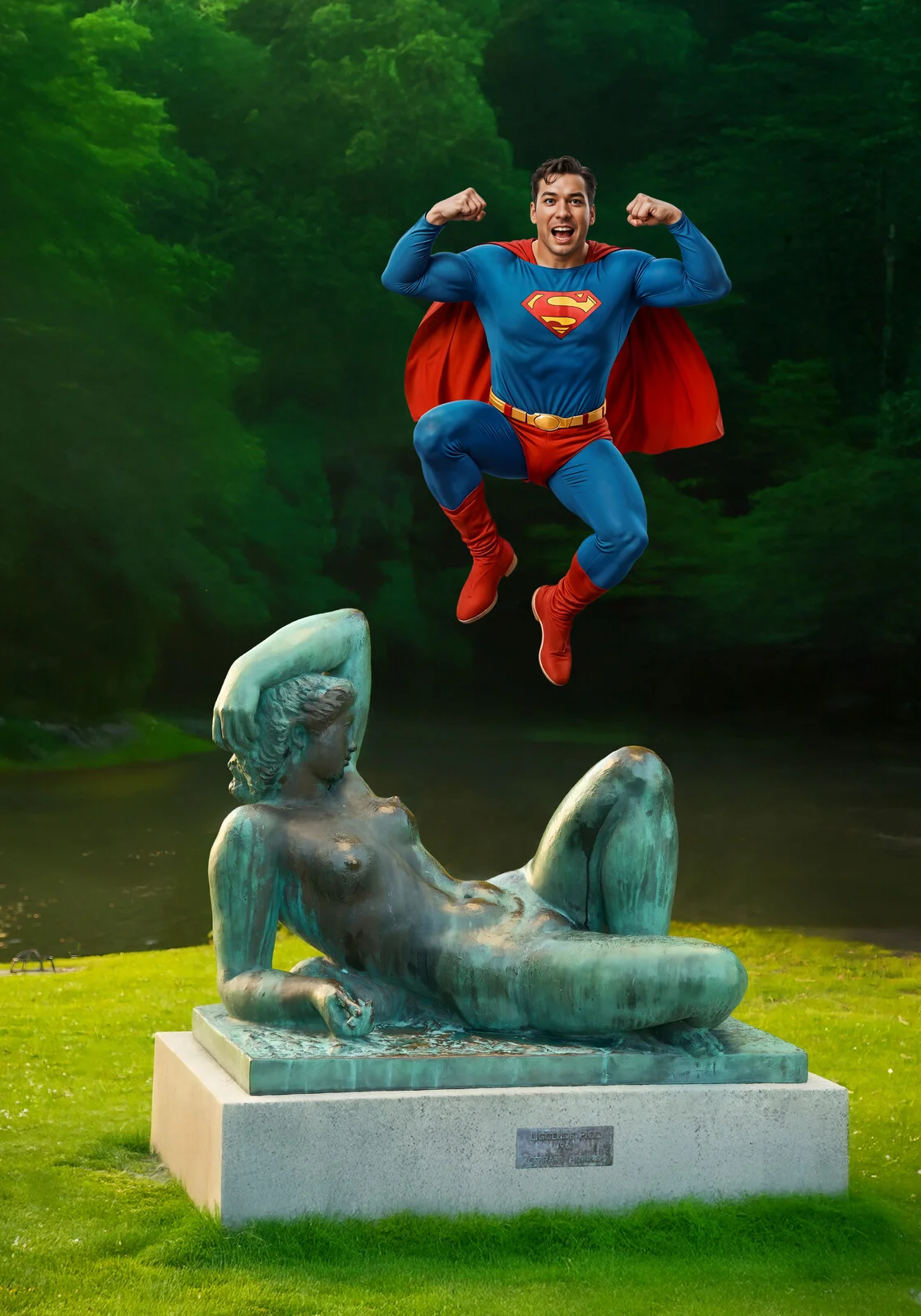
Jörgen Thornberg
QUE LE WEEKEND COMMENCE!!!, 2025
Digital
50 x 70 cm
3 200 kr
QUE LE WEEKEND COMMENCE!!!
This is not a comic book. Nor is it merely a meditation on marble.
It’s a whisper caught between mythology and modernity—
a cape fluttering in the breeze of reason,
a bronze thigh gleaming under the watchful eye of a Scandinavian sky.
Somewhere between Krypton and Slottsparken,
between exile and erection,
Superman found her—not Lois, not Lana,
but a woman cast in lust and granite,
waiting a century for his arrival.
Call it a pause in time,
call it a Random Harvest—
but know this:
Even the Man of Steel is not immune to longing.
Please read on to learn why this story is a must-read.
”The Line of Supers
From myth to mask, from loincloth to Lycra,
They’ve leapt through time on muscled thighs—
Gilgamesh with storm in hand,
Hercules with bloodshot eyes.
They fought for pride, or gods, or gold,
But rarely for the meek or old.
Achilles blazed with wrath and grace,
a death-bound heart, a god-touched face.
He could not dodge the fatal shot.
His heel forgot what war forgot.
So power bowed before its flaw—
A quiet nod to nature’s law.
Samson roared through temple stone,
A fury fed by love alone.
His strength undone by tender trust,
His legend ended in the dust.
A hero born in sacred breath—
A tale of lust, of loss, of death.
Then came Clark, with Midwestern smile,
Hiding gods beneath his style.
A migrant heart in Kansas corn,
A saviour mild, yet alien-born.
He fought for truth, not golden fame,
His only weapon: his own name.
Others followed, capes in tow,
Through pulpy plots and TV glow.
They punched through walls, through moral haze,
Through Cold War fears and Reagan’s gaze.
Their tights grew tighter, tales more grim—
But still, they sang the same old hymn.
And still they came, the sons of fight—
The brooding Bat, the emerald knight.
Tech and rage, or cosmic flame,
The suit would change, but not the game.
Each played the part, each wore the code,
On every Earth, on every road.
But then—at last—the sisters rose,
From myths and chains, from comic prose.
With lasso, wit, and Amazon grace,
Wonder Woman claimed her place.
She fought not just with shield and sword—
But with the silence of the ignored.
In shadows spun with agency,
Spider-Woman leapt wild and free.
Her past was blurred, her motives bold,
Not always good, not always told.
She bore the guilt, she bore the flame—
A spider’s dance without the fame.
And then came strength with velvet fists—
Superwoman, forged from cosmic twists.
She flew not from a man’s design,
But from the need to draw the line.
Her power spoke, not loud but sure:
The future’s cape might just be hers.”
Malmö May 2025
QUE LE WEEKEND COMMENCE!!!
My image depicts an overjoyed Superman, who, after many years of searching, has finally found the woman. As it’s Friday, he looks forward to a weekend with the nameless one. Along the canal in Slottsparken in Malmö, he saw the statue “Liggende pige,” created by the Swedish-Danish artist Gerhard Henning. This statue, with its provocative posture, serves as a significant symbol in the narrative, representing the objectification of women in art and popular culture. It’s a stark reminder of the prevalent issue of objectification in our society. A woman sprawls voluptuously on a granite pedestal. Her posture is, to say the least, provocative, and it would surely have itched in the crotch of a macho man like him.
The spread-legged sculpture “Liggende pige” was created by Henning as early as 1914. However, for half a century, it remained in the artist’s studio, awaiting the demise of the guardians of morality. They must have passed away by 1961, when the piece was sold to the city of Malmö through a donation from the Lorens and Agnes Beijer Fund. It was placed in a prominent location beside the canal in Slottsparken. What Agnes would have said is unknown, but she would have had the opportunity to voice her opinion had she been asked, because she didn’t die until 1915. I have my suspicions.
You might get the impression that Superman, like other male superheroes, doesn’t care about women. Like his colleagues in the classic superhero genre, he is essentially an asexual figure, despite their tight costumes and highly physical superhuman body. This is due to the 'unspoken contract' of the superhero genre with the audience – sexuality may exist, but it’s carefully suppressed. This contract, a product of societal norms and moral standards, shapes the way superheroes are portrayed and perceived. It's a fascinating insight into the cultural context of these narratives. What you don’t see doesn’t offend.
In the early comics (1930s–50s), there were hardly even kisses – perhaps a quick mouth-to-cheek or forehead peck, or a kiss on the hand. The rule was: look but don’t touch. In the 1960s–70s, things began to shift in the wake of the student revolts, and Superman became more akin to the films of the time, “American romantic” – holding hands and sharing brief dreamy glances – but still with very low sexual tension. It's a fascinating evolution of the character. Does he kiss Lois? Yes – sometimes, gently on the cheek. Has he ever slept with her? Only in alternate universes. Such versions, of course, existed underground, where the superheroes could screw around as they pleased. That was never a world our real Superman belonged to. He may have heard of the phenomenon, which surely did nothing to lessen his inner longing.
Superman is not an erotic hero but a moral ideal, a protector, a messianic figure. His superhuman quality is physical, but not erotic. Reportedly, some women have dreamt of a tryst with him, rather than with their husbands. Superman should be able to save women from disaster without them needing to worry about what he might want in return. There are versions where he and Lois have a child (Jonathan Kent), but the act itself is never depicted, not even the foreplay, which includes a kiss. One must remember that the comic book character hails from puritanical America.
It's not surprising that Superman, with his countless encounters with beautiful women he’s saved and flown to safety, might feel a growing sense of frustration. How many times has he not seen women in vulnerable states while flying around residential areas, with the ability to peer directly into their bedrooms?
Statues like the one in Slottsparken are inconceivable in puritanical America. As a Time-traveller – a concept applicable to all who have lived in human minds and thereby transcended into eternity – perhaps you can comprehend his desire to bring the statue to life, on the same grounds.
When they later had the chance to speak, the woman–whose name, by the way, is Agnes–could tell a thing or two about what it means to be a statue, especially a female one.
It is such a familiar formula that men – and not women – are elevated as the heroes of history that the question almost goes unasked: Why are there so many dull men? The answer can be found in art history, theatre, literature, and film. We recognise it in Rodin’s ‘The Thinker,’ where masculinity is equated with intellectual force, or in Stanley Kubrick’s film ‘Spartacus,’ where heroism and sacrifice are embodied in the male body.
We see it in Camus’ novel ‘Meursault,’ the indifferent hero of existentialism, in Fyodor Dostoevsky’s epic ‘Raskolnikov,’ who is permitted to commit crimes in his struggle with moral limits, or Ernest Hemingway’s recurring self-destructive ideal of masculinity. Even in pop culture, the same pattern repeats: Indiana Jones, James Bond, Batman – all variations on the lone wolf who possesses the right to take himself very seriously.
The lack of female counterparts is not due to their nonexistence; on the contrary, they are seldom highlighted, glorified, or afforded the same space to be both powerful and flawed. The man often becomes the hero; the woman becomes the trial.
At the same time, art is replete with women – public spaces and walls are adorned with sculpted and painted female bodies. Henning’s voluptuous bronze woman, seen in the park or passed on the way to work, is not an individual but merely a body. These statues do not represent women and their achievements but serve instead as metaphors with vague titles, such as ‘Spring’ and the other seasons, ‘The Sunflower,’ or ‘Youth.’ The female bodies depicted in paint, bronze, and granite are projections of something entirely different. The nudity is intended to be experienced as symbols for the most diverse things and is, understandably, not perceived for what they often are: sheer pornography. During the otherwise puritanical late nineteenth-century Victorian England, artists vied with one another to create nude portraits that could be displayed without objection in every salon, including the Queen’s own Buckingham Palace.
The pornography is disguised by mythological figures, such as Nils Möllerberg’s sea nymph “Galatea” in Pildammsparken, who poses in a manner I’ve never seen my wife adopt, or Jonas Fröding’s fertility goddess “Flora” by the former County Governor’s residence, who cheerfully greets visitors. Naked, of course, so that people would feel seen. Initially, the girl held a consoling bluebell in her outstretched hand. This has since disappeared, but the trace of the stem remains, and the statue now resides in Flora’s garden on Kungsgatan. Henning’s splayed woman in Slottsparken, however, is not shrouded in any mythological veil, but rather a naked bride on her back without adornments. The signals she conveys cannot be misunderstood.
The nudity of the reclining girl received some attention in Jan Troell’s excellent film "Ole dole doff," where Per Oscarsson plays a troubled teacher. The statue has an erotic supporting role in the 1968 film, a magical year and a time when almost anything could be portrayed on screen. The worse, the better.
During an outing in Slottsparken, the class bully Bengt provokes classmate Sören by making sexual advances towards Henning’s sculpture. His and others’ groping have left lasting marks; her budding breasts, stomach, and mons pubis shine polished against the statue’s otherwise green-patinated surface. If a man is not affected by that statue, something is amiss.
When I googled statues in Malmö, one bore after another appeared: the rapist king Karl X Gustav, Frans Suell, Claus Mortensen, Per Albin Hansson, Gustav Möller, Pehr Henrik Ling, Hjalmar Branting, Mårten Werner, Carl Frick, Gustaf Rydberg, and Anders Casper Holm – all fortunately clothed, for who would relish seeing these mostly overweight men naked? One exception is ‘The Glory of Labour’ at Möllevångstorget, where the four naked male workers do indeed display their bits while two working women on each short side modestly settle for showing their rears.
Well, there are clothed women too, bearing fairly monotonous associations such as those eternal Madonnas, a hardworking fisherwoman with a wheelbarrow, some statue expressing maternal joy, and then the reclining girl who invites what precedes motherhood.
In the USA, they are currently purging everything that honours those who fought to preserve slavery during the Civil War. In Britain, colonisers like Cecil Rhodes are being placed into storage. On Malmö’s most important square, a king rides on horseback – a sex offender who today would undoubtedly have been summoned before the war crimes tribunal in The Hague for his abuses. There, he could join Putin. Let us begin by placing Karl X Gustav in the storage he deserves and create a modern version of The Glory of Labour with clothed women fighting for equal rights.
Superman, a character of unique and innovative nature, was not born in a vacuum. When he first appeared in 1938 in Action Comics No. 1, he was the brainchild of Jerry Siegel (writer) and Joe Shuster (illustrator), two young Jewish men from Cleveland. The character, though innovative, was not a singular creation, but a blend of earlier ideas, mythological figures, and pop culture heroes. Here are some of the most significant sources of inspiration that contributed to this unique blend:
The Bible and the Torah, with Moses as a role model.
Superman's origin story, where he is sent away as an infant from a dying world, rescued by another people, grows up as one of them, but carries a greater destiny, bears a striking resemblance to the biblical story of Moses. Moses was placed in a basket in the Nile and raised in Pharaoh’s court, much like Superman was sent from Krypton and raised on Earth. This parallel is not just a coincidence, but a deliberate reflection of Siegel and Shuster's Jewish background, with themes of exile, salvation, and dual identity.
It's important to note that the reflection of Siegel and Shuster’s Jewish background in Superman's story is not a mere coincidence, but a deliberate choice. The themes of exile, salvation, and dual identity, so prevalent in Superman's narrative, are a testament to the depth of thought that went into his creation.
In ‘Also sprach Zarathustra,’ a philosophical work by Friedrich Nietzsche, the “superman” (Übermensch) is described as an ideal figure who would transcend human limitations. This concept influenced the character of Superman, who was at times referred to as ‘Der Übermensch’ in German. However, the distinction lies in the fact that Superman embodies goodness, altruism, and morality, unlike Nietzsche’s often misinterpreted concept of power. This influence from philosophical literature not only demonstrates the depth of thought that went into creating the character of Superman but also underscores his significant impact on the comic book industry.
Science fiction and pulp heroes:
John Carter of Mars (Edgar Rice Burroughs): A man from Earth on a foreign planet who possesses superhuman powers due to altered gravity, much like Superman on Earth. Doc Savage – known as "The Man of Bronze" – was a scientist, adventurer, and physical superman with a secret fortress and a steadfast moral code.
The Shadow and other pulp heroes imparted traits of dual identity and mystery to Superman.
In ‘Gladiator’ (1930), a novel by Philip Wylie, we encounter Hugo Danner, a man born with superhuman strength, speed, and abilities after his father experimented with biological enhancement. Hugo is also an outsider, isolated by his powers, which foreshadow Superman. Wylie himself later accused DC Comics of plagiarising his work.
The American immigrant dream, a concept that is currently under threat, is reflected in the character of Clark Kent. As an outsider and an “adopted American,” Clark tries to blend into society while harbouring a secret. This mirrors the experiences of first- and second-generation immigrants, like Siegel and Shuster themselves. Superman, an alien who wants to assimilate, is both a science fiction concept and a profoundly human symbol. His story serves as a powerful reminder of the importance of diversity and the significant contributions that immigrants make to society.
It’s no surprise that we find many superheroes among myths and legends. The most famous is one I’ve written a lot about, even if he’s not my favourite.
Hercules (Heracles in Greek) – a demigod with superhuman strength and a moral mission. But unlike Superman, he was no innocent altar boy. His twelve labours weren’t primarily in service of humanity; they were penance after Heracles, in a fit of rage triggered by Hera, killed his wife and children. In many ways, he’s the thickest-headed superhero of all time.
Hercules, a character with a unique charm and tragic backstory, didn’t exactly belong to the intellectual elite; he thought with his muscles. He solves most problems with violence, whether it’s monsters, kings, or chores like cleaning King Augeas’s stables by diverting a river. Many of his feats testify to his lack of finesse, which leads to catastrophe, such as when he kills his music teacher in a rage or, even worse, his children, which becomes the starting point for the twelve labours.
Samson – a biblical figure with immense strength that resided in his hair. Samson’s power vanished when Delilah, the woman he loved, betrayed him by cutting it off. He’s a lone wolf and a violence machine, driven by personal vendetta rather than strategic leadership. Samson kills thousands of Philistines, sometimes with spectacular methods (like a donkey’s jawbone). This raises the question of whether it’s right to use violence even in God’s name, when done in anger and for personal revenge? This moral dilemma characterises all religions except peaceful Buddhism, the only one without a god. That’s why the world looks the way it does: even today, people kill those who believe differently. In Islam, it is said that one is rewarded with heaven and several willing virgins.
Samson’s story is not just a religious legend; it’s a mirror. In it, we see how easily strength can become vengeance and how faith can waver when paired with desire. In our world, where people still kill one another in God’s name, he reminds us of the danger of holy motives that burn too hot. Perhaps it isn’t God who demands blood, but man who seeks meaning in his rage.
Superman comes close to suffering the same fate as Samson when Lana Lang, Lois Lane’s rival for his affections, is used in several stories (manipulated or tricked by villains like Lex Luthor) to carry kryptonite close to Superman, unaware that she’s hurting him. In principle, this is reminiscent of Delilah’s betrayal nearly three millennia earlier: love turned trap.
Gilgamesh is a primordial hero who searches for meaning and struggles in the world. He’s found in The Epic of Gilgamesh, an epic from ancient Mesopotamia, which is available in English online. This superhero operated between 1200 BCE and 2100 BCE—nine hundred years—a slow superhero, in other words. Gilgamesh is a demigod with superhuman strength who befriends the wild man Enkidu. Together, they embark on many adventures, the most famous of which is defeating Humbaba. He may have been a historical king from the Sumerian city-state of Uruk, posthumously deified. He lived sometime in the early dynastic period, around 2900–2350 BCE, though he became a key figure in Sumerian legend during the Third Dynasty of Ur eight hundred years later.
There are many intriguing parallels between Gilgamesh and Superman. They both had arch-enemies: Gilgamesh faced Humbaba, the divine guardian of the Cedar Forest, who despised him. Superman’s nemesis, Lex Luthor, is a Humbaba in a tie, appearing in Superman’s life just two years after the comic’s debut.
There is something ancient about Lex Luthor, despite his suit, shaved head, and technological billions. He’s not merely Superman’s enemy; he’s an obstacle, a boundary, a test.
In the Gilgamesh epic, the world’s oldest hero tale, Humbaba guards the Cedar Forest. He’s not evil in the modern sense, merely dangerous—a guardian set by the gods to protect the sacred from human arrogance. Gilgamesh and Enkidu kill him anyway—for fame, to push boundaries. And the price is high.
Lex Luthor guards no temple, but something akin to it: the domain of humanity. He stands in the way of the superhuman, the alien, the godlike. He seeks to restrain Superman not merely out of hatred but on principle: that humanity should manage on its own. He embodies civilisation’s self-image – technology, intellect, control – juxtaposed with Superman’s red cape and inherent superiority.
Humbaba breathes storm. Luthor breathes cold logic. Yet both remind us that the hero’s path is never free; it must pass through the guardian. And the guardian is never merely an enemy. He is a necessary figure—a mirror.
This leads us to my favourite, Achilles – the first superhuman with a clear weak spot: the heel. Achilles, the hero of the Iliad, is in all essentials a superman – faster, stronger, more beautiful, and nearly invincible. He is partly divine (the son of the nymph Thetis and the mortal Peleus), akin to Superman, who is from Krypton but raised by humans.
Thetis dipped Achilles in the river Styx to render him invulnerable – except for the heel she held. Thus, he could be killed with an arrow right there.
The parallel to Superman is striking; he is also nearly unbeatable – except for kryptonite, a remnant of his home world that renders him weak and mortal.
Both Achilles and Superman embody a tragic dimension. They are superior yet vulnerable. Their fate rests in the hands of others (Paris, Lex Luthor). Deep down, they fight another battle – between their humanity and their power. This vulnerability, this potential for tragedy, is what makes them so relatable and compelling. It's their vulnerability that makes them more relatable, more human, and that's what draws us to their stories.
In addition to his superhuman strength, Achilles is plagued by anger, pride, and emotional fragility. His rage over Patroclus’s death drives him to cruelty, but also to sorrow. Achilles’s struggle is not solely against enemies but also against his anger, his grief, and ultimately his mortality.
Superman endeavours to live as a human, to understand love, truth, justice – all the while knowing that if he wished, he could crush the world or become its dictator, an enlightened despot. Superman’s inner enemy is the burden of being a superhero while remaining good.
Superman is not a copy of a single role model, but a fusion of ancient heroes, biblical prophets, science fiction, philosophical ideas, and contemporary pop culture, seasoned with immigrant experience and moral idealism.
Now let us leave Superman and Agnes in peace, for I’m convinced they both have pent-up needs. However, I must mention the exception to puritanism in comics and the departure from the Comics Code Authority – a rulebook that in 1954 explicitly banned any hint of premarital sex.
As far as I know, all comic characters were unmarried, which necessitated a celibate existence. All perversions were explicitly forbidden (which at the time included homosexuality). Overly provocative clothing or body language was similarly banned. This transformed superheroes into sexless, symbolic figures – strong, good, and pure of heart – yet strangely impersonal. That was the whole point: nothing was to offend. If you wore a polka-dot suit, you couldn’t be seen against a polka-dot wallpaper. However, this strict code has evolved over time, allowing for more complex and realistic portrayals of characters. This evolution marks a significant shift in comic culture, enabling the creation of more diverse and realistic characters and stories.
Time passed, leading us to the opposite – ‘Fritz the Cat’, created by Robert Crumb. Here was a vulgar, horny, politically incorrect, bohemian, and anarchistic cat – entirely at odds with the superhero stance. The comic (and the 1972 film directed by Ralph Bakshi) was the first animated feature to receive an X-rating in the U.K. This stark contrast to the traditional superhero narrative was both shocking and intriguing, marking a significant departure from the norm in comic culture. The release of the film 'Fritz the Cat' in 1972 marked a substantial shift in comic culture, introducing a new, more adult-oriented genre that challenged the traditional superhero narrative.
Where Superman saved the world, Fritz sought his next affair, a joint, or revolution – he was driven by lust and restlessness rather than duty. If Superman was the child of obligation, Fritz was the child of desire. Where one shamelessly wore tight underpants without lust, the other stripped at every opportunity for rebellion and pleasure. He smoked cigars like a chimney and drank like a pig. Fritz was a cat of his time – a bohemian student cat in 1960s New York, amidst the era of sexual liberation, political protest, drug use, and racial conflict. Fritz was a satirical anti-hero, as much a cat as any, with all human flaws in abundance.
The series Fritz the Cat effectively ended in 1972, when Robert Crumb broke with his creation after Ralph Bakshi made the animated film version without Crumb’s approval of the final result.
Crumb hated the film, felt it vulgarised his character, and killed off Fritz in the comic the following year, in a strip where Fritz is murdered with an icepick by a jealous girlfriend. RIP, dear anthropomorphic tabby cat.
QUE LE WEEKEND COMMENCE!!! Dear Superman.
So far, it has primarily revolved around supermen. However, we now arrive at the most crucial part: the superwomen of history, who have existed for thousands of years.
Female superheroes in tights may have first emerged in the 1940s. Yet, female superheroes in action, symbolism, and function have been present for millennia—in myth, religion, adventure literature, and pulp fiction. Wonder Woman and Spider-Woman are not alone; they are merely the first to feature on the cover with their names in bold.
There were female predecessors to the 20th-century heroines, even if they were not labelled “superheroes” at the time. Here are a few essential and often overlooked figures from mythology, literature, and early popular culture who paved the way for Wonder Woman, Batwoman, Spider-Woman, Supergirl, and others:
Let us begin with some goddesses and mythical warrior women:
Pallas Athena (Greek mythology): The goddess of wisdom and war, often depicted in armour with a helmet and spear. She represented strategy rather than brute force—a model for clever, righteous heroines.
Artemis/Diana: Goddess of the hunt and chastity—independent, fearless, and often opposing male dominance. Wonder Woman even carries her Roman name: Diana.
The Valkyries of Norse mythology: Formidable female beings who determined the fate of warriors, deciding who would ascend to Valhalla, the Viking paradise. Autonomous, supernatural, and brimming with power, they are closely associated with Brynhildr and later fantasy heroines.
Freyja, the Norse goddess of both love and war, is particularly fascinating because of this duality.
She belonged to the Vanir tribe of gods and was associated with love, sexuality, fertility, and magic—but also with death and battle. She rode a chariot drawn by cats, donned a feathered cloak that enabled her to fly, and wielded seid, the most potent form of Norse sorcery.
Freyja undoubtedly qualifies as one of the ancient superwomen. In Grímnismál, one of the Eddic poems, it is said that half of the fallen warriors go to her realm, Fólkvangr, while the other half go to Odin’s Valhalla. This means she has first pick of the dead—a power equal to that of Odin himself.
Countless historical women have left an indelible mark on modern comics and fiction:
Joan of Arc: Undoubtedly the most influential real-life “superheroine”—a teenage girl who rose to become a general, inspired a nation, and was executed for her unwavering courage. Her story has been immortalised in countless works and continues to inspire female fighters, from Wonder Woman to Buffy.
Mata Hari: The spy, dancer, and double agent—she embodied female mystique, power, and ambiguity—a mix of agent and legend. Perhaps not a perfect fit among this group, as she wasn’t known for violence—her weapon of choice was seduction. Clever, but not quite clever enough, she ended her days before a firing squad.
Let us not forget the literary proto-heroines, such as Jane Porter in the novel Tarzan (1912). Often underestimated, she is a brave woman who can shoot, ride, and survive in the jungle, as depicted in Edgar Rice Burroughs’s original books.
Sheena, Queen of the Jungle (1938): The first female comic book hero to hold her title. She appeared before Wonder Woman (who debuted in 1941). Sheena could speak to animals, fought against evil colonialists, and was an independent, fierce, and often scantily clad woman, which also contributed to her popularity. Her revealing outfit was a concession to attract boys to follow her adventures. If girls had been asked, they would likely have preferred something more practical; imagine how many scratches those girls must have gotten swinging through dense jungles on vines. Yet, her unwavering courage and fierce independence continue to inspire women around the world today.
Science fiction and pulp heroines like Nyoka the Jungle Girl, Phantom Lady, and Miss Fury from the 1940s—women who fought crime in leotards, pilot suits, or wielded whips—existed long before superheroines went mainstream. These characters, with their independent and strong-willed nature, were early symbols of female empowerment and played a significant role in shaping the feminist movement of the time.
Modesty Blaise (1963): Created by Peter O’Donnell, she is a former spy with sharp intelligence, physical prowess, and a strong moral compass—no supernatural powers—but remains a forerunner to Black Widow and Catwoman in style and independence. The film about her wasn’t much of a success and was nearly a turkey of a movie. Perhaps it had too many clothes to lure boys into the cinema, although her towering hairdos did set trends. However, her character marked a significant shift in the portrayal of women in comics, moving away from the traditional damsel in distress to a more complex and independent figure.
Barbarella (1962, Jean-Claude Forest): A French science fiction heroine who combined feminism, sexual liberation, and intergalactic adventures. She sometimes had more in common with Fritz the Cat than with Superman and correspondingly wore far less fabric. The film allowed Jane Fonda to showcase her well-toned body, which significantly contributed to her future career as a fitness guru and sparked a fashion trend: aerobics. Her male co-star didn’t wear much either, but he did sport a hefty pair of angel wings, adding to the character's unique and intriguing nature.
Last but not least: Inanna – the first superheroine.
Long before Wonder Woman laced up her boots and Spider-Woman swung between skyscrapers, there was a woman who carried power in her blood and a storm in her eyes. Her name was Inanna—the Queen of Heaven and Earth, loved and feared in Sumerian Mesopotamia over five thousand years ago. She was the first superheroine, a figure of immense power and significance in the history of literature and comics.
She was no gentle fertility goddess, nor a mother in an apron. She embodied desire itself, the heat of war, and the relentless hand of justice. While male gods sat on their thrones, Inanna descended into the underworld—naked, shedding layers of power—to confront her sister, the Queen of the Dead. This descent was not just a physical journey but a symbolic one, representing her willingness to confront the darkest aspects of existence. It cost her life, but she returned three days later. A primal myth, thousands of years older than the Gospels, full of the same mysteries. Can one return from death and remain unchanged?
Inanna could—but she was never the same. She became increasingly significant throughout two millennia. She began as a goddess of love and fertility, yet evolved into a cosmic figure of war, sexuality, and divine power, echoing traits of both Wonder Woman and Catwoman—a true superheroine of epic longevity. Her evolution is a fascinating journey, warranting further exploration in greater detail.
If you wish to learn more, hymns to Inanna/Ishtar are available online, translated from four-thousand-year-old clay tablets written in cuneiform by the earliest known author, the priestess Enheduanna. These hymns are not merely poetic tributes but also historical documents that serve as a testament to Inanna’s immense significance and the cultural practices of the time.
In songs praising her love for the shepherd god Dumuzi, she speaks without coy euphemisms. It is frank, to say the least. Inanna would appeal to modern women; she is active, seductive, combative, and demanding—not an object of others’ desires but a subject who chooses and desires herself. Sexuality is neither sin nor adornment; it is part of her divine essence—a force, a weapon, a Jane Fonda of antiquity.
But Inanna is also a warrior. When Mount Ebih defies her, she destroys it. Accused of arrogance, she responds with fire. Her rage is not hysterical—it is righteous. It embodies the fury of justice and power. She wears a helmet and sceptre, a sword and jewels. She is not a choice between beauty and strength; she encompasses both.
Inanna embodies everything that later superheroines carry in fragments: strength, fury, sexuality, a moral code, and the ability to die and return. Wonder Woman carries a shield—Inanna bears the stars. Spider-Woman climbs walls—Inanna traverses between worlds. Inanna was the origin; all the rest are imitators. This connection is not merely a matter of shared traits but a testament to the enduring influence of ancient myths on our modern understanding of heroism.
Inanna, a heroine whose story was not printed in colourful comics, but inscribed on clay tablets in cuneiform, sung in temples, and whispered on the lips of both women and men. Some of these stories can still be read online, translated into English. Her enduring legacy connects us to a rich cultural heritage that remains relevant today, fostering a sense of connection and appreciation for our shared history.
Inanna—the first superheroine. She who carved the primal mother into clay.
In ancient Egypt, no capes soared through the air, but there were women with powers far beyond what modern comics exploit. Before anyone depicted today’s superwomen, goddesses, and queens, they ruled over life and death, wielding magic, power, and myth.
Isis, also known as Aset, was the most beloved of all Egyptian deities. She was the mistress of magic, guardian of motherhood, and a symbol of female strength in its most complex form. Through spells, she resurrected her murdered husband, Osiris, and protected their son, Horus, from mortal dangers. In one of mythology’s most dramatic scenes, she even forced the sun god Ra to reveal his secret name, thus seizing his power. Isis requires no mythological parallel today—she is both hero and goddess, a figure of cunning, courage, and fidelity, evoking a sense of awe and admiration for her power and complexity.
Sekhmet was another powerful Egyptian woman—a lion-headed goddess of war, born from Ra’s wrath to punish humanity. She was so bloodthirsty that the world nearly ended and had to be pacified with a blood-coloured intoxicant. However, after the storm, Sekhmet also became a goddess of medicine. In her, we find the archetype of the struggle between destruction and protection, rage and reconciliation. She is a precursor to all modern heroes who wrestle with powers they can barely contain.
Hatshepsut, by contrast, was flesh and blood. Born a princess, she chose to become pharaoh. She seized power. Donning male garments, wearing the ceremonial beard, she had carved in stone that she was the son of Ra—not to deny her gender, but to master a role until then reserved for men. Under her rule, Egypt flourished—bold expeditions, grand temples, war followed by peace. Her successors tried to erase her from history, but her memory has endured. She wasn’t a goddess, but her courage and skill made her one of Egypt’s true superheroines, inspiring a sense of admiration and empowerment in her audience.
There are more: Nephthys, guardian of night and death, stood silent at the border of worlds. Maat, goddess of justice, weighed human hearts against a feather to determine their fate in the afterlife. Bastet, the cat goddess, was both protector and destroyer—gentle as a household spirit, ruthless against demons and threats.
Ancient Egypt was filled with female figures of immense power, in both myth and history. They didn’t wear latex suits, but they carried their power with all the gravity and symbolism the ancient world could summon. And maybe that’s why they still speak to us. Long before Wonder Woman emerged from the sea in her skimpy star-spangled skirt, Isis stood by the Nile’s edge, holding the ancient world firmly in her grasp.
One of the most fascinating aspects of ancient Egyptian visual art is its striking resemblance to modern comic book aesthetics.
On the walls of tombs and temples, stories are told in sequence, often with clear panel divisions where each scene depicts a pivotal moment. Goddesses like Isis, Sekhmet, Bastet, and Maat are portrayed not just as static symbols, but as active agents in dramatic events—they are born, they fight, they grieve, they protect, they transform. Many of these scenes are accompanied by hieroglyphs that function much like speech bubbles or narrative captions.
For instance, the Temple of Dendera, where Hathor, the goddess of love and music, is depicted in long sequences of evolving actions. Alternatively, in the tomb of Seti I in the Valley of the Kings, Isis gathers her husband’s body, breathes life into it, and then gives birth to Horus—a narrative modern comic artists could readily depict as a classic superheroine origin story.
The colour palettes, stylised poses, rhythmic repetition, and narrative flow in image form all closely resemble the comic format. One can almost imagine a child in Thebes in 1200 BCE walking along a temple wall, reading with their finger, panel by panel, how a goddess vanquishes evil or restores cosmic order. It’s no wonder these stories still feel alive. They were meant to be read, not merely seen. And perhaps the distance between Marvel’s universe and Memphis isn’t so great after all.
Let these powerful women inspire you to explore their stories further. The internet is full of them. Google 'Wonder Woman' and you’ll get 1,140,000,000 hits; search for 'Batman' and he comes in forty million fewer; Superman only gets 630,000,000. Poor thing! Beaten by a woman in real life.
QUE LE WEEKEND COMMENCE!!! Two full days of reading.
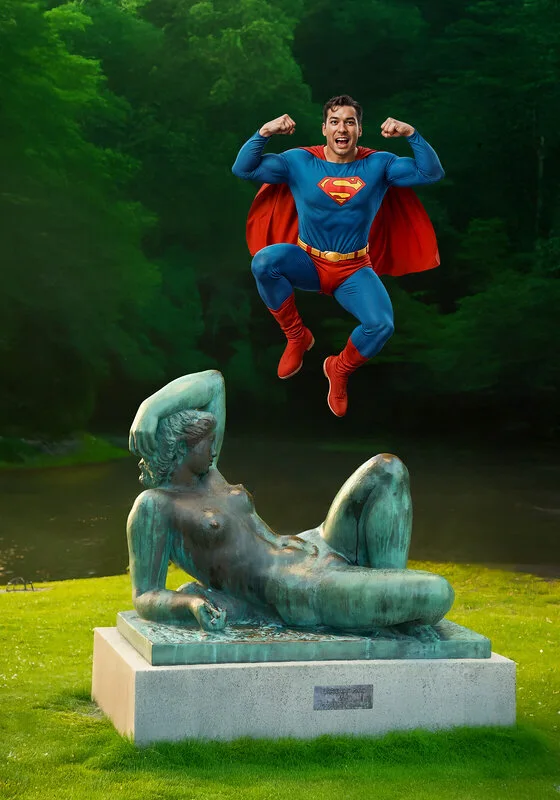
Jörgen Thornberg
QUE LE WEEKEND COMMENCE!!!, 2025
Digital
50 x 70 cm
3 200 kr
QUE LE WEEKEND COMMENCE!!!
This is not a comic book. Nor is it merely a meditation on marble.
It’s a whisper caught between mythology and modernity—
a cape fluttering in the breeze of reason,
a bronze thigh gleaming under the watchful eye of a Scandinavian sky.
Somewhere between Krypton and Slottsparken,
between exile and erection,
Superman found her—not Lois, not Lana,
but a woman cast in lust and granite,
waiting a century for his arrival.
Call it a pause in time,
call it a Random Harvest—
but know this:
Even the Man of Steel is not immune to longing.
Please read on to learn why this story is a must-read.
”The Line of Supers
From myth to mask, from loincloth to Lycra,
They’ve leapt through time on muscled thighs—
Gilgamesh with storm in hand,
Hercules with bloodshot eyes.
They fought for pride, or gods, or gold,
But rarely for the meek or old.
Achilles blazed with wrath and grace,
a death-bound heart, a god-touched face.
He could not dodge the fatal shot.
His heel forgot what war forgot.
So power bowed before its flaw—
A quiet nod to nature’s law.
Samson roared through temple stone,
A fury fed by love alone.
His strength undone by tender trust,
His legend ended in the dust.
A hero born in sacred breath—
A tale of lust, of loss, of death.
Then came Clark, with Midwestern smile,
Hiding gods beneath his style.
A migrant heart in Kansas corn,
A saviour mild, yet alien-born.
He fought for truth, not golden fame,
His only weapon: his own name.
Others followed, capes in tow,
Through pulpy plots and TV glow.
They punched through walls, through moral haze,
Through Cold War fears and Reagan’s gaze.
Their tights grew tighter, tales more grim—
But still, they sang the same old hymn.
And still they came, the sons of fight—
The brooding Bat, the emerald knight.
Tech and rage, or cosmic flame,
The suit would change, but not the game.
Each played the part, each wore the code,
On every Earth, on every road.
But then—at last—the sisters rose,
From myths and chains, from comic prose.
With lasso, wit, and Amazon grace,
Wonder Woman claimed her place.
She fought not just with shield and sword—
But with the silence of the ignored.
In shadows spun with agency,
Spider-Woman leapt wild and free.
Her past was blurred, her motives bold,
Not always good, not always told.
She bore the guilt, she bore the flame—
A spider’s dance without the fame.
And then came strength with velvet fists—
Superwoman, forged from cosmic twists.
She flew not from a man’s design,
But from the need to draw the line.
Her power spoke, not loud but sure:
The future’s cape might just be hers.”
Malmö May 2025
QUE LE WEEKEND COMMENCE!!!
My image depicts an overjoyed Superman, who, after many years of searching, has finally found the woman. As it’s Friday, he looks forward to a weekend with the nameless one. Along the canal in Slottsparken in Malmö, he saw the statue “Liggende pige,” created by the Swedish-Danish artist Gerhard Henning. This statue, with its provocative posture, serves as a significant symbol in the narrative, representing the objectification of women in art and popular culture. It’s a stark reminder of the prevalent issue of objectification in our society. A woman sprawls voluptuously on a granite pedestal. Her posture is, to say the least, provocative, and it would surely have itched in the crotch of a macho man like him.
The spread-legged sculpture “Liggende pige” was created by Henning as early as 1914. However, for half a century, it remained in the artist’s studio, awaiting the demise of the guardians of morality. They must have passed away by 1961, when the piece was sold to the city of Malmö through a donation from the Lorens and Agnes Beijer Fund. It was placed in a prominent location beside the canal in Slottsparken. What Agnes would have said is unknown, but she would have had the opportunity to voice her opinion had she been asked, because she didn’t die until 1915. I have my suspicions.
You might get the impression that Superman, like other male superheroes, doesn’t care about women. Like his colleagues in the classic superhero genre, he is essentially an asexual figure, despite their tight costumes and highly physical superhuman body. This is due to the 'unspoken contract' of the superhero genre with the audience – sexuality may exist, but it’s carefully suppressed. This contract, a product of societal norms and moral standards, shapes the way superheroes are portrayed and perceived. It's a fascinating insight into the cultural context of these narratives. What you don’t see doesn’t offend.
In the early comics (1930s–50s), there were hardly even kisses – perhaps a quick mouth-to-cheek or forehead peck, or a kiss on the hand. The rule was: look but don’t touch. In the 1960s–70s, things began to shift in the wake of the student revolts, and Superman became more akin to the films of the time, “American romantic” – holding hands and sharing brief dreamy glances – but still with very low sexual tension. It's a fascinating evolution of the character. Does he kiss Lois? Yes – sometimes, gently on the cheek. Has he ever slept with her? Only in alternate universes. Such versions, of course, existed underground, where the superheroes could screw around as they pleased. That was never a world our real Superman belonged to. He may have heard of the phenomenon, which surely did nothing to lessen his inner longing.
Superman is not an erotic hero but a moral ideal, a protector, a messianic figure. His superhuman quality is physical, but not erotic. Reportedly, some women have dreamt of a tryst with him, rather than with their husbands. Superman should be able to save women from disaster without them needing to worry about what he might want in return. There are versions where he and Lois have a child (Jonathan Kent), but the act itself is never depicted, not even the foreplay, which includes a kiss. One must remember that the comic book character hails from puritanical America.
It's not surprising that Superman, with his countless encounters with beautiful women he’s saved and flown to safety, might feel a growing sense of frustration. How many times has he not seen women in vulnerable states while flying around residential areas, with the ability to peer directly into their bedrooms?
Statues like the one in Slottsparken are inconceivable in puritanical America. As a Time-traveller – a concept applicable to all who have lived in human minds and thereby transcended into eternity – perhaps you can comprehend his desire to bring the statue to life, on the same grounds.
When they later had the chance to speak, the woman–whose name, by the way, is Agnes–could tell a thing or two about what it means to be a statue, especially a female one.
It is such a familiar formula that men – and not women – are elevated as the heroes of history that the question almost goes unasked: Why are there so many dull men? The answer can be found in art history, theatre, literature, and film. We recognise it in Rodin’s ‘The Thinker,’ where masculinity is equated with intellectual force, or in Stanley Kubrick’s film ‘Spartacus,’ where heroism and sacrifice are embodied in the male body.
We see it in Camus’ novel ‘Meursault,’ the indifferent hero of existentialism, in Fyodor Dostoevsky’s epic ‘Raskolnikov,’ who is permitted to commit crimes in his struggle with moral limits, or Ernest Hemingway’s recurring self-destructive ideal of masculinity. Even in pop culture, the same pattern repeats: Indiana Jones, James Bond, Batman – all variations on the lone wolf who possesses the right to take himself very seriously.
The lack of female counterparts is not due to their nonexistence; on the contrary, they are seldom highlighted, glorified, or afforded the same space to be both powerful and flawed. The man often becomes the hero; the woman becomes the trial.
At the same time, art is replete with women – public spaces and walls are adorned with sculpted and painted female bodies. Henning’s voluptuous bronze woman, seen in the park or passed on the way to work, is not an individual but merely a body. These statues do not represent women and their achievements but serve instead as metaphors with vague titles, such as ‘Spring’ and the other seasons, ‘The Sunflower,’ or ‘Youth.’ The female bodies depicted in paint, bronze, and granite are projections of something entirely different. The nudity is intended to be experienced as symbols for the most diverse things and is, understandably, not perceived for what they often are: sheer pornography. During the otherwise puritanical late nineteenth-century Victorian England, artists vied with one another to create nude portraits that could be displayed without objection in every salon, including the Queen’s own Buckingham Palace.
The pornography is disguised by mythological figures, such as Nils Möllerberg’s sea nymph “Galatea” in Pildammsparken, who poses in a manner I’ve never seen my wife adopt, or Jonas Fröding’s fertility goddess “Flora” by the former County Governor’s residence, who cheerfully greets visitors. Naked, of course, so that people would feel seen. Initially, the girl held a consoling bluebell in her outstretched hand. This has since disappeared, but the trace of the stem remains, and the statue now resides in Flora’s garden on Kungsgatan. Henning’s splayed woman in Slottsparken, however, is not shrouded in any mythological veil, but rather a naked bride on her back without adornments. The signals she conveys cannot be misunderstood.
The nudity of the reclining girl received some attention in Jan Troell’s excellent film "Ole dole doff," where Per Oscarsson plays a troubled teacher. The statue has an erotic supporting role in the 1968 film, a magical year and a time when almost anything could be portrayed on screen. The worse, the better.
During an outing in Slottsparken, the class bully Bengt provokes classmate Sören by making sexual advances towards Henning’s sculpture. His and others’ groping have left lasting marks; her budding breasts, stomach, and mons pubis shine polished against the statue’s otherwise green-patinated surface. If a man is not affected by that statue, something is amiss.
When I googled statues in Malmö, one bore after another appeared: the rapist king Karl X Gustav, Frans Suell, Claus Mortensen, Per Albin Hansson, Gustav Möller, Pehr Henrik Ling, Hjalmar Branting, Mårten Werner, Carl Frick, Gustaf Rydberg, and Anders Casper Holm – all fortunately clothed, for who would relish seeing these mostly overweight men naked? One exception is ‘The Glory of Labour’ at Möllevångstorget, where the four naked male workers do indeed display their bits while two working women on each short side modestly settle for showing their rears.
Well, there are clothed women too, bearing fairly monotonous associations such as those eternal Madonnas, a hardworking fisherwoman with a wheelbarrow, some statue expressing maternal joy, and then the reclining girl who invites what precedes motherhood.
In the USA, they are currently purging everything that honours those who fought to preserve slavery during the Civil War. In Britain, colonisers like Cecil Rhodes are being placed into storage. On Malmö’s most important square, a king rides on horseback – a sex offender who today would undoubtedly have been summoned before the war crimes tribunal in The Hague for his abuses. There, he could join Putin. Let us begin by placing Karl X Gustav in the storage he deserves and create a modern version of The Glory of Labour with clothed women fighting for equal rights.
Superman, a character of unique and innovative nature, was not born in a vacuum. When he first appeared in 1938 in Action Comics No. 1, he was the brainchild of Jerry Siegel (writer) and Joe Shuster (illustrator), two young Jewish men from Cleveland. The character, though innovative, was not a singular creation, but a blend of earlier ideas, mythological figures, and pop culture heroes. Here are some of the most significant sources of inspiration that contributed to this unique blend:
The Bible and the Torah, with Moses as a role model.
Superman's origin story, where he is sent away as an infant from a dying world, rescued by another people, grows up as one of them, but carries a greater destiny, bears a striking resemblance to the biblical story of Moses. Moses was placed in a basket in the Nile and raised in Pharaoh’s court, much like Superman was sent from Krypton and raised on Earth. This parallel is not just a coincidence, but a deliberate reflection of Siegel and Shuster's Jewish background, with themes of exile, salvation, and dual identity.
It's important to note that the reflection of Siegel and Shuster’s Jewish background in Superman's story is not a mere coincidence, but a deliberate choice. The themes of exile, salvation, and dual identity, so prevalent in Superman's narrative, are a testament to the depth of thought that went into his creation.
In ‘Also sprach Zarathustra,’ a philosophical work by Friedrich Nietzsche, the “superman” (Übermensch) is described as an ideal figure who would transcend human limitations. This concept influenced the character of Superman, who was at times referred to as ‘Der Übermensch’ in German. However, the distinction lies in the fact that Superman embodies goodness, altruism, and morality, unlike Nietzsche’s often misinterpreted concept of power. This influence from philosophical literature not only demonstrates the depth of thought that went into creating the character of Superman but also underscores his significant impact on the comic book industry.
Science fiction and pulp heroes:
John Carter of Mars (Edgar Rice Burroughs): A man from Earth on a foreign planet who possesses superhuman powers due to altered gravity, much like Superman on Earth. Doc Savage – known as "The Man of Bronze" – was a scientist, adventurer, and physical superman with a secret fortress and a steadfast moral code.
The Shadow and other pulp heroes imparted traits of dual identity and mystery to Superman.
In ‘Gladiator’ (1930), a novel by Philip Wylie, we encounter Hugo Danner, a man born with superhuman strength, speed, and abilities after his father experimented with biological enhancement. Hugo is also an outsider, isolated by his powers, which foreshadow Superman. Wylie himself later accused DC Comics of plagiarising his work.
The American immigrant dream, a concept that is currently under threat, is reflected in the character of Clark Kent. As an outsider and an “adopted American,” Clark tries to blend into society while harbouring a secret. This mirrors the experiences of first- and second-generation immigrants, like Siegel and Shuster themselves. Superman, an alien who wants to assimilate, is both a science fiction concept and a profoundly human symbol. His story serves as a powerful reminder of the importance of diversity and the significant contributions that immigrants make to society.
It’s no surprise that we find many superheroes among myths and legends. The most famous is one I’ve written a lot about, even if he’s not my favourite.
Hercules (Heracles in Greek) – a demigod with superhuman strength and a moral mission. But unlike Superman, he was no innocent altar boy. His twelve labours weren’t primarily in service of humanity; they were penance after Heracles, in a fit of rage triggered by Hera, killed his wife and children. In many ways, he’s the thickest-headed superhero of all time.
Hercules, a character with a unique charm and tragic backstory, didn’t exactly belong to the intellectual elite; he thought with his muscles. He solves most problems with violence, whether it’s monsters, kings, or chores like cleaning King Augeas’s stables by diverting a river. Many of his feats testify to his lack of finesse, which leads to catastrophe, such as when he kills his music teacher in a rage or, even worse, his children, which becomes the starting point for the twelve labours.
Samson – a biblical figure with immense strength that resided in his hair. Samson’s power vanished when Delilah, the woman he loved, betrayed him by cutting it off. He’s a lone wolf and a violence machine, driven by personal vendetta rather than strategic leadership. Samson kills thousands of Philistines, sometimes with spectacular methods (like a donkey’s jawbone). This raises the question of whether it’s right to use violence even in God’s name, when done in anger and for personal revenge? This moral dilemma characterises all religions except peaceful Buddhism, the only one without a god. That’s why the world looks the way it does: even today, people kill those who believe differently. In Islam, it is said that one is rewarded with heaven and several willing virgins.
Samson’s story is not just a religious legend; it’s a mirror. In it, we see how easily strength can become vengeance and how faith can waver when paired with desire. In our world, where people still kill one another in God’s name, he reminds us of the danger of holy motives that burn too hot. Perhaps it isn’t God who demands blood, but man who seeks meaning in his rage.
Superman comes close to suffering the same fate as Samson when Lana Lang, Lois Lane’s rival for his affections, is used in several stories (manipulated or tricked by villains like Lex Luthor) to carry kryptonite close to Superman, unaware that she’s hurting him. In principle, this is reminiscent of Delilah’s betrayal nearly three millennia earlier: love turned trap.
Gilgamesh is a primordial hero who searches for meaning and struggles in the world. He’s found in The Epic of Gilgamesh, an epic from ancient Mesopotamia, which is available in English online. This superhero operated between 1200 BCE and 2100 BCE—nine hundred years—a slow superhero, in other words. Gilgamesh is a demigod with superhuman strength who befriends the wild man Enkidu. Together, they embark on many adventures, the most famous of which is defeating Humbaba. He may have been a historical king from the Sumerian city-state of Uruk, posthumously deified. He lived sometime in the early dynastic period, around 2900–2350 BCE, though he became a key figure in Sumerian legend during the Third Dynasty of Ur eight hundred years later.
There are many intriguing parallels between Gilgamesh and Superman. They both had arch-enemies: Gilgamesh faced Humbaba, the divine guardian of the Cedar Forest, who despised him. Superman’s nemesis, Lex Luthor, is a Humbaba in a tie, appearing in Superman’s life just two years after the comic’s debut.
There is something ancient about Lex Luthor, despite his suit, shaved head, and technological billions. He’s not merely Superman’s enemy; he’s an obstacle, a boundary, a test.
In the Gilgamesh epic, the world’s oldest hero tale, Humbaba guards the Cedar Forest. He’s not evil in the modern sense, merely dangerous—a guardian set by the gods to protect the sacred from human arrogance. Gilgamesh and Enkidu kill him anyway—for fame, to push boundaries. And the price is high.
Lex Luthor guards no temple, but something akin to it: the domain of humanity. He stands in the way of the superhuman, the alien, the godlike. He seeks to restrain Superman not merely out of hatred but on principle: that humanity should manage on its own. He embodies civilisation’s self-image – technology, intellect, control – juxtaposed with Superman’s red cape and inherent superiority.
Humbaba breathes storm. Luthor breathes cold logic. Yet both remind us that the hero’s path is never free; it must pass through the guardian. And the guardian is never merely an enemy. He is a necessary figure—a mirror.
This leads us to my favourite, Achilles – the first superhuman with a clear weak spot: the heel. Achilles, the hero of the Iliad, is in all essentials a superman – faster, stronger, more beautiful, and nearly invincible. He is partly divine (the son of the nymph Thetis and the mortal Peleus), akin to Superman, who is from Krypton but raised by humans.
Thetis dipped Achilles in the river Styx to render him invulnerable – except for the heel she held. Thus, he could be killed with an arrow right there.
The parallel to Superman is striking; he is also nearly unbeatable – except for kryptonite, a remnant of his home world that renders him weak and mortal.
Both Achilles and Superman embody a tragic dimension. They are superior yet vulnerable. Their fate rests in the hands of others (Paris, Lex Luthor). Deep down, they fight another battle – between their humanity and their power. This vulnerability, this potential for tragedy, is what makes them so relatable and compelling. It's their vulnerability that makes them more relatable, more human, and that's what draws us to their stories.
In addition to his superhuman strength, Achilles is plagued by anger, pride, and emotional fragility. His rage over Patroclus’s death drives him to cruelty, but also to sorrow. Achilles’s struggle is not solely against enemies but also against his anger, his grief, and ultimately his mortality.
Superman endeavours to live as a human, to understand love, truth, justice – all the while knowing that if he wished, he could crush the world or become its dictator, an enlightened despot. Superman’s inner enemy is the burden of being a superhero while remaining good.
Superman is not a copy of a single role model, but a fusion of ancient heroes, biblical prophets, science fiction, philosophical ideas, and contemporary pop culture, seasoned with immigrant experience and moral idealism.
Now let us leave Superman and Agnes in peace, for I’m convinced they both have pent-up needs. However, I must mention the exception to puritanism in comics and the departure from the Comics Code Authority – a rulebook that in 1954 explicitly banned any hint of premarital sex.
As far as I know, all comic characters were unmarried, which necessitated a celibate existence. All perversions were explicitly forbidden (which at the time included homosexuality). Overly provocative clothing or body language was similarly banned. This transformed superheroes into sexless, symbolic figures – strong, good, and pure of heart – yet strangely impersonal. That was the whole point: nothing was to offend. If you wore a polka-dot suit, you couldn’t be seen against a polka-dot wallpaper. However, this strict code has evolved over time, allowing for more complex and realistic portrayals of characters. This evolution marks a significant shift in comic culture, enabling the creation of more diverse and realistic characters and stories.
Time passed, leading us to the opposite – ‘Fritz the Cat’, created by Robert Crumb. Here was a vulgar, horny, politically incorrect, bohemian, and anarchistic cat – entirely at odds with the superhero stance. The comic (and the 1972 film directed by Ralph Bakshi) was the first animated feature to receive an X-rating in the U.K. This stark contrast to the traditional superhero narrative was both shocking and intriguing, marking a significant departure from the norm in comic culture. The release of the film 'Fritz the Cat' in 1972 marked a substantial shift in comic culture, introducing a new, more adult-oriented genre that challenged the traditional superhero narrative.
Where Superman saved the world, Fritz sought his next affair, a joint, or revolution – he was driven by lust and restlessness rather than duty. If Superman was the child of obligation, Fritz was the child of desire. Where one shamelessly wore tight underpants without lust, the other stripped at every opportunity for rebellion and pleasure. He smoked cigars like a chimney and drank like a pig. Fritz was a cat of his time – a bohemian student cat in 1960s New York, amidst the era of sexual liberation, political protest, drug use, and racial conflict. Fritz was a satirical anti-hero, as much a cat as any, with all human flaws in abundance.
The series Fritz the Cat effectively ended in 1972, when Robert Crumb broke with his creation after Ralph Bakshi made the animated film version without Crumb’s approval of the final result.
Crumb hated the film, felt it vulgarised his character, and killed off Fritz in the comic the following year, in a strip where Fritz is murdered with an icepick by a jealous girlfriend. RIP, dear anthropomorphic tabby cat.
QUE LE WEEKEND COMMENCE!!! Dear Superman.
So far, it has primarily revolved around supermen. However, we now arrive at the most crucial part: the superwomen of history, who have existed for thousands of years.
Female superheroes in tights may have first emerged in the 1940s. Yet, female superheroes in action, symbolism, and function have been present for millennia—in myth, religion, adventure literature, and pulp fiction. Wonder Woman and Spider-Woman are not alone; they are merely the first to feature on the cover with their names in bold.
There were female predecessors to the 20th-century heroines, even if they were not labelled “superheroes” at the time. Here are a few essential and often overlooked figures from mythology, literature, and early popular culture who paved the way for Wonder Woman, Batwoman, Spider-Woman, Supergirl, and others:
Let us begin with some goddesses and mythical warrior women:
Pallas Athena (Greek mythology): The goddess of wisdom and war, often depicted in armour with a helmet and spear. She represented strategy rather than brute force—a model for clever, righteous heroines.
Artemis/Diana: Goddess of the hunt and chastity—independent, fearless, and often opposing male dominance. Wonder Woman even carries her Roman name: Diana.
The Valkyries of Norse mythology: Formidable female beings who determined the fate of warriors, deciding who would ascend to Valhalla, the Viking paradise. Autonomous, supernatural, and brimming with power, they are closely associated with Brynhildr and later fantasy heroines.
Freyja, the Norse goddess of both love and war, is particularly fascinating because of this duality.
She belonged to the Vanir tribe of gods and was associated with love, sexuality, fertility, and magic—but also with death and battle. She rode a chariot drawn by cats, donned a feathered cloak that enabled her to fly, and wielded seid, the most potent form of Norse sorcery.
Freyja undoubtedly qualifies as one of the ancient superwomen. In Grímnismál, one of the Eddic poems, it is said that half of the fallen warriors go to her realm, Fólkvangr, while the other half go to Odin’s Valhalla. This means she has first pick of the dead—a power equal to that of Odin himself.
Countless historical women have left an indelible mark on modern comics and fiction:
Joan of Arc: Undoubtedly the most influential real-life “superheroine”—a teenage girl who rose to become a general, inspired a nation, and was executed for her unwavering courage. Her story has been immortalised in countless works and continues to inspire female fighters, from Wonder Woman to Buffy.
Mata Hari: The spy, dancer, and double agent—she embodied female mystique, power, and ambiguity—a mix of agent and legend. Perhaps not a perfect fit among this group, as she wasn’t known for violence—her weapon of choice was seduction. Clever, but not quite clever enough, she ended her days before a firing squad.
Let us not forget the literary proto-heroines, such as Jane Porter in the novel Tarzan (1912). Often underestimated, she is a brave woman who can shoot, ride, and survive in the jungle, as depicted in Edgar Rice Burroughs’s original books.
Sheena, Queen of the Jungle (1938): The first female comic book hero to hold her title. She appeared before Wonder Woman (who debuted in 1941). Sheena could speak to animals, fought against evil colonialists, and was an independent, fierce, and often scantily clad woman, which also contributed to her popularity. Her revealing outfit was a concession to attract boys to follow her adventures. If girls had been asked, they would likely have preferred something more practical; imagine how many scratches those girls must have gotten swinging through dense jungles on vines. Yet, her unwavering courage and fierce independence continue to inspire women around the world today.
Science fiction and pulp heroines like Nyoka the Jungle Girl, Phantom Lady, and Miss Fury from the 1940s—women who fought crime in leotards, pilot suits, or wielded whips—existed long before superheroines went mainstream. These characters, with their independent and strong-willed nature, were early symbols of female empowerment and played a significant role in shaping the feminist movement of the time.
Modesty Blaise (1963): Created by Peter O’Donnell, she is a former spy with sharp intelligence, physical prowess, and a strong moral compass—no supernatural powers—but remains a forerunner to Black Widow and Catwoman in style and independence. The film about her wasn’t much of a success and was nearly a turkey of a movie. Perhaps it had too many clothes to lure boys into the cinema, although her towering hairdos did set trends. However, her character marked a significant shift in the portrayal of women in comics, moving away from the traditional damsel in distress to a more complex and independent figure.
Barbarella (1962, Jean-Claude Forest): A French science fiction heroine who combined feminism, sexual liberation, and intergalactic adventures. She sometimes had more in common with Fritz the Cat than with Superman and correspondingly wore far less fabric. The film allowed Jane Fonda to showcase her well-toned body, which significantly contributed to her future career as a fitness guru and sparked a fashion trend: aerobics. Her male co-star didn’t wear much either, but he did sport a hefty pair of angel wings, adding to the character's unique and intriguing nature.
Last but not least: Inanna – the first superheroine.
Long before Wonder Woman laced up her boots and Spider-Woman swung between skyscrapers, there was a woman who carried power in her blood and a storm in her eyes. Her name was Inanna—the Queen of Heaven and Earth, loved and feared in Sumerian Mesopotamia over five thousand years ago. She was the first superheroine, a figure of immense power and significance in the history of literature and comics.
She was no gentle fertility goddess, nor a mother in an apron. She embodied desire itself, the heat of war, and the relentless hand of justice. While male gods sat on their thrones, Inanna descended into the underworld—naked, shedding layers of power—to confront her sister, the Queen of the Dead. This descent was not just a physical journey but a symbolic one, representing her willingness to confront the darkest aspects of existence. It cost her life, but she returned three days later. A primal myth, thousands of years older than the Gospels, full of the same mysteries. Can one return from death and remain unchanged?
Inanna could—but she was never the same. She became increasingly significant throughout two millennia. She began as a goddess of love and fertility, yet evolved into a cosmic figure of war, sexuality, and divine power, echoing traits of both Wonder Woman and Catwoman—a true superheroine of epic longevity. Her evolution is a fascinating journey, warranting further exploration in greater detail.
If you wish to learn more, hymns to Inanna/Ishtar are available online, translated from four-thousand-year-old clay tablets written in cuneiform by the earliest known author, the priestess Enheduanna. These hymns are not merely poetic tributes but also historical documents that serve as a testament to Inanna’s immense significance and the cultural practices of the time.
In songs praising her love for the shepherd god Dumuzi, she speaks without coy euphemisms. It is frank, to say the least. Inanna would appeal to modern women; she is active, seductive, combative, and demanding—not an object of others’ desires but a subject who chooses and desires herself. Sexuality is neither sin nor adornment; it is part of her divine essence—a force, a weapon, a Jane Fonda of antiquity.
But Inanna is also a warrior. When Mount Ebih defies her, she destroys it. Accused of arrogance, she responds with fire. Her rage is not hysterical—it is righteous. It embodies the fury of justice and power. She wears a helmet and sceptre, a sword and jewels. She is not a choice between beauty and strength; she encompasses both.
Inanna embodies everything that later superheroines carry in fragments: strength, fury, sexuality, a moral code, and the ability to die and return. Wonder Woman carries a shield—Inanna bears the stars. Spider-Woman climbs walls—Inanna traverses between worlds. Inanna was the origin; all the rest are imitators. This connection is not merely a matter of shared traits but a testament to the enduring influence of ancient myths on our modern understanding of heroism.
Inanna, a heroine whose story was not printed in colourful comics, but inscribed on clay tablets in cuneiform, sung in temples, and whispered on the lips of both women and men. Some of these stories can still be read online, translated into English. Her enduring legacy connects us to a rich cultural heritage that remains relevant today, fostering a sense of connection and appreciation for our shared history.
Inanna—the first superheroine. She who carved the primal mother into clay.
In ancient Egypt, no capes soared through the air, but there were women with powers far beyond what modern comics exploit. Before anyone depicted today’s superwomen, goddesses, and queens, they ruled over life and death, wielding magic, power, and myth.
Isis, also known as Aset, was the most beloved of all Egyptian deities. She was the mistress of magic, guardian of motherhood, and a symbol of female strength in its most complex form. Through spells, she resurrected her murdered husband, Osiris, and protected their son, Horus, from mortal dangers. In one of mythology’s most dramatic scenes, she even forced the sun god Ra to reveal his secret name, thus seizing his power. Isis requires no mythological parallel today—she is both hero and goddess, a figure of cunning, courage, and fidelity, evoking a sense of awe and admiration for her power and complexity.
Sekhmet was another powerful Egyptian woman—a lion-headed goddess of war, born from Ra’s wrath to punish humanity. She was so bloodthirsty that the world nearly ended and had to be pacified with a blood-coloured intoxicant. However, after the storm, Sekhmet also became a goddess of medicine. In her, we find the archetype of the struggle between destruction and protection, rage and reconciliation. She is a precursor to all modern heroes who wrestle with powers they can barely contain.
Hatshepsut, by contrast, was flesh and blood. Born a princess, she chose to become pharaoh. She seized power. Donning male garments, wearing the ceremonial beard, she had carved in stone that she was the son of Ra—not to deny her gender, but to master a role until then reserved for men. Under her rule, Egypt flourished—bold expeditions, grand temples, war followed by peace. Her successors tried to erase her from history, but her memory has endured. She wasn’t a goddess, but her courage and skill made her one of Egypt’s true superheroines, inspiring a sense of admiration and empowerment in her audience.
There are more: Nephthys, guardian of night and death, stood silent at the border of worlds. Maat, goddess of justice, weighed human hearts against a feather to determine their fate in the afterlife. Bastet, the cat goddess, was both protector and destroyer—gentle as a household spirit, ruthless against demons and threats.
Ancient Egypt was filled with female figures of immense power, in both myth and history. They didn’t wear latex suits, but they carried their power with all the gravity and symbolism the ancient world could summon. And maybe that’s why they still speak to us. Long before Wonder Woman emerged from the sea in her skimpy star-spangled skirt, Isis stood by the Nile’s edge, holding the ancient world firmly in her grasp.
One of the most fascinating aspects of ancient Egyptian visual art is its striking resemblance to modern comic book aesthetics.
On the walls of tombs and temples, stories are told in sequence, often with clear panel divisions where each scene depicts a pivotal moment. Goddesses like Isis, Sekhmet, Bastet, and Maat are portrayed not just as static symbols, but as active agents in dramatic events—they are born, they fight, they grieve, they protect, they transform. Many of these scenes are accompanied by hieroglyphs that function much like speech bubbles or narrative captions.
For instance, the Temple of Dendera, where Hathor, the goddess of love and music, is depicted in long sequences of evolving actions. Alternatively, in the tomb of Seti I in the Valley of the Kings, Isis gathers her husband’s body, breathes life into it, and then gives birth to Horus—a narrative modern comic artists could readily depict as a classic superheroine origin story.
The colour palettes, stylised poses, rhythmic repetition, and narrative flow in image form all closely resemble the comic format. One can almost imagine a child in Thebes in 1200 BCE walking along a temple wall, reading with their finger, panel by panel, how a goddess vanquishes evil or restores cosmic order. It’s no wonder these stories still feel alive. They were meant to be read, not merely seen. And perhaps the distance between Marvel’s universe and Memphis isn’t so great after all.
Let these powerful women inspire you to explore their stories further. The internet is full of them. Google 'Wonder Woman' and you’ll get 1,140,000,000 hits; search for 'Batman' and he comes in forty million fewer; Superman only gets 630,000,000. Poor thing! Beaten by a woman in real life.
QUE LE WEEKEND COMMENCE!!! Two full days of reading.
3 200 kr

Jörgen Thornberg
Malmö
Lite om bilder och mig. Translation in English at the end.
Jag är en nyfiken person som ser allt i bilder, även det jag fäster i ord, gärna tillsammans för bakom alla mina bilder finns en berättelse. Till vissa bilder hör en kortare eller längre novell som följer med bilden.
Bilder berättar historier. Jag omges av naturlig skönhet, intressanta människor och historia var jag än går. Jag använder min kamera för att dokumentera världen och blanda det jag ser med vad jag känner för att fånga den dolda magin.
Mina bilder berättar mina historier. Genom mina bilder, tryck och berättelser. Jag bjuder in dig att ta del av dessa berättelser, in i ditt liv och hem och dela min mycket personliga syn på vår värld. Mer än vad ögat ser. Jag tänker i bilder, drömmer och skriver och pratar om dem; följaktligen måste jag också skapa bilder. De blir vad jag ser, inte nödvändigtvis begränsade till verkligheten. Det finns en bild runt varje hörn. Jag hoppas att du kommer att se vad jag såg och gilla det.
Jag är också en skrivande person och till många bilder hör en kortare eller längre essay. Den följer med tavlan, tryckt på fint papper och med en personlig hälsning från mig.
Flertalet bilder startar sin resa i min kamera. Enkelt förklarat beskriver jag bilden jag ser i mitt inre, upplevd eller fantiserad. Bilden uppstår inom mig redan innan jag fått okularet till ögat. På bråkdelen av ett ögonblick ser jag vad jag vill ha och vad som kan göras med bilden. Här skall jag stoppa in en giraff, stålmannen, Titanic eller vad det är min fantasi finner ut. Ännu märkligare är att jag kommer ihåg minnesbilden långt efteråt när det blir tid att skapa verket. Om jag lyckas eller inte, är upp till betraktaren, oftast präglat av en stråk av svart humor – meningen är att man skall bli underhållen. Mina bilder blir ofta en snackis där de hänger.
Jag föredrar bilder som förmedlar ett budskap i flera lager. Vid första anblicken fylld av feel-good, en vacker utsikt, fint väder, solen skiner, blommor på ängen eller vattnet som ligger förrädiskt spegelblankt. I en sådan bild kan jag gömma min egentliga berättelse, mitt förakt för förtryckare och våldsverkare, rasister och fördomsfulla människor - ett gärna återkommande motiv mer eller mindre dolt i det vackra motivet. Jag försöker förena dem i ett gemensamt narrativ.
Bild och formgivning har löpt som en röd tråd genom livet. Fotokonst känns som en värdig final som jag gärna delar med mig.
Min genre är vid som framgår av mina bilder, temat en blandning av pop- och gatukonst i kollage som kan bestå av hundratals lager. Vissa bilder kan ta veckor, andra någon dag innan det är dags att överlämna resultatet till printverkstaden. Fine Art Prints är digitala fotocollage. I dessa kollage sker rivandet, klippandet, pusslandet, målandet, ritandet och sprayningen digitalt. Det jag monterar in kan vara hundratals år gamla bilder som jag omsorgsfullt frilägger så att de ser ut att vara en del av tavlan men också bilder skapade av mig själv efter min egen fantasi. Därefter besöks printstudion och för vissa bilder numrera en limiterad upplaga (oftast 7 exemplar) och signera för hand. Vissa bilder kan köpas i olika format. Det är bara att fråga efter vilka. Gillar man en bild som är 70x100 men inte har plats på väggen, går den kanske att få i 50x70 cm istället. Frågan är fri.
Metoden Giclée eller Fine Art Print som det också kallas är det moderna sättet för framställning av grafisk konst. Villkoret för denna typ av utskrifter är att en högkvalitativ storformatskrivare används med åldersbeständigt färgpigment och konstnärspapper eller i förekommande fall på duk. Pappret som används möter de krav på livslängd som ställs av museer och gallerier. Normalt säljer jag mina bilder oinramade så att den nya ägaren själv kan bestämma hur de skall se ut, med eller utan passepartout färg på ram, med eller utan glas etc..
Under många år ställde jag bara ut på nätet, i valda grupper och på min egen Facebooksida - https://www.facebook.com/jorgen.thornberg.9
Jag finns också på en egen hemsida som tyvärr inte alltid är uppdaterad – https://www.jth.life/ Där kan du också läsa en del av de berättelser som följer med bilden.
UTSTÄLLNINGAR
Luftkastellet, oktober 2022
Konst i Lund, november 2022
Luftkastellet, mars 2023
Engleson Galleri Caroli, april 2023
Hydra, Greece June 2023
Engleson Galleri Caroli, oktober 2023
Toppen, Höllviken december 2023
Luftkastellet, mars 2024
Torups Galleri, mars 2024
Venice, May 2024
Luftkastellet, oktober 2024
Konst i Advent, December 2024
Galleri Engleson, Caroli December 2024
Jäger & Jansson Galleri, april 2025
A bit about pictures and me.
I'm a curious person who sees everything in pictures, even what I express in words, often combining them, for behind all my pictures lies a story. These narratives, some as short as a single image and others as long as a novel, are the heart and soul of my work.
Pictures tell stories. Wherever I go, I'm surrounded by natural beauty, exciting people, and history. I use my camera to document the world and blend what I see with what I feel to capture the hidden magic.
My images tell my stories. Through my pictures, prints, and narratives, I invite you to partake in these stories in your life and home and share my deeply personal perspective of our world. More than meets the eye. I think in pictures, dream, write, and talk about them; consequently, I must create images too. They become what I see, not necessarily confined to reality. There's a picture around every corner. I hope you'll see what I saw and enjoy it.
I'm also a writer, and many images come with a shorter or longer essay. It accompanies the painting, printed on fine paper with my personal greeting.
Many pictures start their journey on my camera. Simply put, I describe the image I see in my mind, experienced or imagined. The image arises within me even before I bring the eyepiece to my eye. In a fraction of a moment, I see what I want and what can be done with the picture. Here, I'll insert a giraffe, Superman, the Titanic, or whatever my imagination conjures up. Even stranger is that I remember the mental image long after it's time to create the work. Whether I succeed is up to the observer, often imbued with a streak of black humour – the aim is to entertain. My pictures usually become a talking point wherever they hang.
I prefer pictures that convey a message in multiple layers. At first glance, they're filled with feel-good vibes, a beautiful view, lovely weather, the sun shining, flowers in the meadow, or the water lying deceptively calm. But beneath this surface beauty, I often conceal a deeper story, a narrative that challenges societal norms or explores the human condition. I invite you to delve into these hidden narratives and discover the layers of meaning within my work.
Picture and design have been a thread running through my life. Photographic art feels like a fitting finale, and I'm happy to share it.
My genre is varied, as seen in my pictures; the theme is a blend of pop and street art in collages that can consist of hundreds of layers. Some images can take weeks, others just a day before it's time to hand over the result to the print workshop. Fine Art Prints are digital photo collages. In these collages, tearing, cutting, puzzling, painting, drawing, and spraying happen digitally. What I insert can be images hundreds of years old that I carefully extract so they appear to be part of the painting, but also images created by myself, now also generated from my imagination. Next, visit the print studio and, for certain images, number a limited edition (usually 7 copies) and sign them by hand. Some images may be available in other formats. Just ask which ones. If you like an image that's 70x100 but doesn't have space on the wall, you might be able to get it in 50x70 cm instead. The question is open.
The Giclée method, or Fine Art Print as it's also called, is the modern way of producing graphic art. This method ensures the highest quality and longevity of the artwork, using a high-quality large-format printer with archival pigment inks and artist paper or, in some cases, canvas. The paper used meets the longevity requirements set by museums and galleries. I sell my pictures unframed, allowing the new owner to personalise their artwork, confident in the lasting value and quality of the piece.
For many years, I only exhibited online, in selected groups, and on my Facebook page - https://www.facebook.com/jorgen.thornberg.9. I also have my website, which unfortunately is not constantly updated - https://www.jth.life/. You can also read some of the stories accompanying the pictures there.
EXHIBITIONS
Luftkastellet, October 2022
Art in Lund, November 2022
Luftkastellet, March 2023
Engleson Gallery Caroli, April 2023
Hydra, Greece June 2023
Engleson Gallery Caroli, October 2023
Toppen, Höllviken December 2023
Luftkastellet, March 2024
Torup Gallery, March 2024
Venice, May 2024
UTSTÄLLNINGAR
Luftkastellet, oktober 2022
Konst i Lund, november 2022
Luftkastellet, mars 2023
Engleson Galleri Caroli, april 2023
Hydra, Greece June 2023
Engleson Galleri Caroli, oktober 2023
Toppen, Höllviken december 2023
Luftkastellet, mars 2024
Torups Galleri, mars 2024
Venice, May 2024
Luftkastellet, October 2024
Konst i Advent, December 2024
Galleri Engleson, Caroli December 2024
Jäger & Jansson Galleri, April 2025
Utbildning
Autodidakt
Medlem i konstnärsförening
Öppna Sinnen
Med i konstrunda
Konstrundan i Skåne
Utställningar
Luftkastellet, October 2022
Art in Lund, November 2022
Luftkastellet, March 2023
Engleson Gallery Caroli, April 2023
Hydra, Greece June 2023
Engleson Gallery Caroli, October 2023
Toppen, Höllviken December 2023
Luftkastellet, March 2024
Torup Gallery, March 2024
Venice, May 2024