Vi använder cookies för att ge dig bästa möjliga upplevelse. Välj vilka cookies du tillåter.
Läs mer i vår integritetspolicy
Jörgen Thornberg
Random Harvest, 2025
Digital
50 x 70 cm
3 200 kr
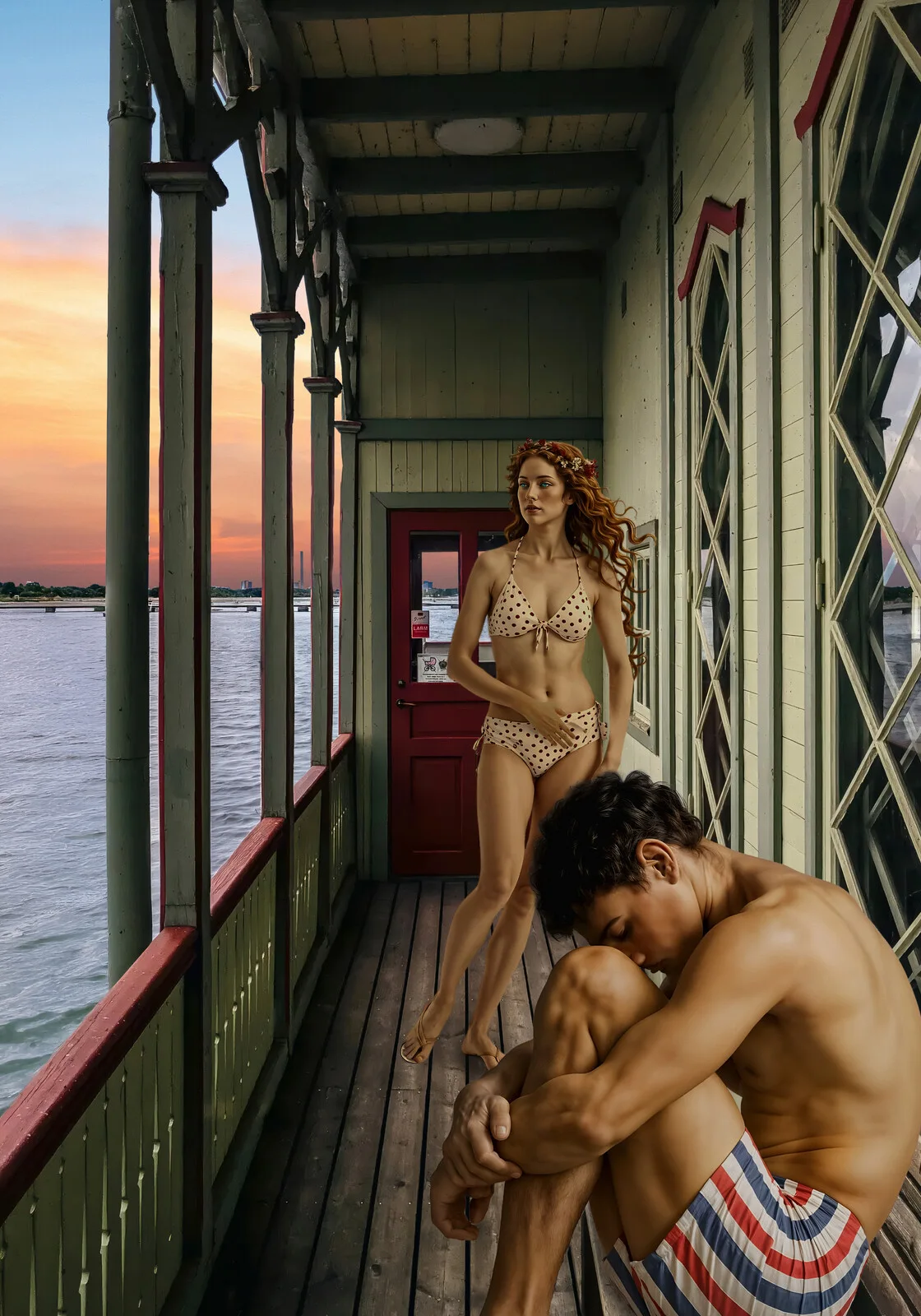
Random Harvest - Venus Aphrodite and Apollon
This is neither pure mythology nor merely a matter of memory. It is a tale woven from twilight and tides, chance and consequence—where gods don their swimwear and history drips quietly from the end of a pier. It's a story that unfolds like a 'Random Harvest', a collection of seemingly random events that shape the course of history, a term borrowed from the works of James Hilton, where the unexpected and the unexplained converge.
It begins, not in ancient Delphi or classical Athens, but somewhere between a thundercloud over Santorini and the soft light of a Malmö summer night. One destroyed cities with fire, while the other reveals them with fog. Yet both serve as reminders that time doesn’t always flow—it loops, it lingers, it doubles back.
You’ve heard of Aphrodite and Apollo—the goddess of impossible beauty and the golden boy with too many lovers. But this isn’t Olympus. This is Skåne. The gods are on holiday. It's not a retirement or a sabbatical, just a pause between responsibilities. She arrives on a shell, he in tricolour swim shorts. They meet at the cold bathhouse as if nothing had transpired, though everything has. The mystery of their meeting, the intrigue of their holiday, and the captivation of their pause between responsibilities draw the audience into their story.
And long before this moment—before the bathers left, before the sea calmed—there were decisions, disasters, and desires—labyrinths built from longing. Cliffs jumped from. Missed turns and ill-timed glances undid empires. All recorded not by historians, but by what they call Random Harvest, a collection of seemingly random events that shape the course of history. It's a concept that echoes the philosophical debate on fate and chance, suggesting that our lives are not just a series of planned events, but a collection of random occurrences that shape our destinies.
What follows is a tale of love and loss, coincidence and cycles. It includes tidal waves, misdelivered letters, shared boys, atomic shadows, and the kind of heartbreak only gods can carry without wrinkling. It’s a story that questions whether eternity has seasons, and whether Malmö might be the only place left where two ancient deities can meet without being recognised. And at the heart of it all is the 'Random Harvest', the collection of seemingly random events that shape the course of history, and in this case, the love story of Venus Aphrodite and Apollo.
This may not be how it happened. Or perhaps it is. Either way, it’s a story that resonates with the human experience, a story you already carry in your blood.
Please click the link below to learn more about my pictures, writing, and why this story is a must-read.
https://www.konst.se/jorgenthornberg
”Random Journey
They left before the counting of days,
when mountains still murmured the gods' names.
In ziggurats, in cypress shade,
they danced through smoke, through vow and flame.
In Babylon’s dusk and Athens’ light,
they whispered truths beneath star-split skies.
One bore the seashell, salt and skin,
the other strummed time on a golden string.
They walked through empires' rising breaths,
in marble courts, on fields of death.
They shared Adonis, lost him twice—
Once to love, once to devise.
In Rome, they kissed behind the veil,
in Byzantium, she wept in braids.
He sang through plagues, through steam and steel,
while she grew roses in the shade.
They split in Paris, met in Prague,
missed each other in the smog of war.
She turned left where he turned flame,
a thousand years—then met again.
Now twilight breathes on Baltic waves,
the summer air is still, not grave.
She steps onto the wooden pier,
in Botticelli’s pose, less shy, more near.
He waits in tricoloured swimwear, worn,
with sand between immortal toes.
They do not speak, they do not plan—
For gods don’t need what mortals know.
And someone watching might not see,
the hush between the sky and sea,
the gaze that weighs a thousand falls,
a silent sigh, where memory calls.
At Ribersborg, as seagulls cry,
two timeless beings pass you by.
Their journey never ends, just bends—
and starts again where evening ends.”
Malmö May 2025
Venus Aphrodite and Apollon
Imagine the improbability of stumbling upon a retired goddess during a leisurely evening stroll. Now, consider the even more unlikely scenario of finding her in the company of a dethroned god. Yet, as the soft dusk light occasionally unveils a path to the unknown, the concept of Random Harvest unfolds. This notion, pondered by the Greek philosophers Herodotus and Sophocles, explores the idea that human life is shaped by fate or chance. The phrase itself is steeped in classical metaphor and an ancient philosophical perspective on humanity’s vulnerability to the forces of destiny and randomness. It even applies to gods, even at the Ribersborg cold bathing house in Malmö. This philosophical perspective adds depth to the narrative, inviting the audience to ponder the role of fate and chance in their lives.
They, the timeless beings, have both sailed through time for over four thousand years, born divine and bearing different names in various ages, yet with the same soul and core identity. Venus Aphrodite, whose roots reach back to the Sumerian goddess Inanna and the Babylonian Ishtar, has always embodied the force of love, the essence of beauty, and the mystery of tireless desire. Apollo—the golden one, the radiant—has wandered from Delphi’s temple to modern poetry, from sun god to LGBTQ icon with a tangled love life. In Rick Riordan’s contemporary mythology, he is 4,612 years old. But for gods, time is something else entirely: a movement, a feeling, not a measurable flow. That’s how eternity works.
Venus Aphrodite, the goddess of love, and Apollo, the radiant one, have journeyed through time, their passion enduring across the ages. By chance—or fate, or what mortals call coincidence—they met during Malmö’s Sommarscen festival, at Scaniaplatsen in the Western Harbour. Music unites. Of course, they had met before—glances exchanged in smoky palaces, whispers traded in sacred groves. And more than that, but long ago. For as long as humans have found new gods, Venus, Aphrodite, and Apollo now live as if on an eternal holiday. Yet this time felt different. This was a reunion. It was then that Random Harvest brought them together again, their enduring love for each other shining through the ages, a testament to the power of love that transcends time and space.
Once, Venus, Aphrodite, and Apollo shared the beautiful Adonis—in what became the archetype of a love triangle, and a deadly one at that. It was Apollo, consumed by jealousy, who took the form of a wild boar and killed him. Aphrodite was inconsolable. She wept until the seas rose, and her grief ran so deep that Apollo, at last, took pity. He told her to throw herself from the white cliffs of Leukas (also known as the Leukadian cliffs, on the island of Leukas—today’s Lefkada—in the Ionian Sea). When she did, sinking into the water and leaving her love behind, her suffering ceased. It was a rebirth, and she could move on.
Sappho, the Greek poet from Lesbos, is also said to have leapt from those same cliffs—driven by unrequited love for a young man named Phaon. As a mortal, she could not be reborn, yet she lives on through her poetry. Sappho and Venus Aphrodite were kindred spirits. Sappho’s poems are often dedicated to Aphrodite in intimate, almost erotic tones. Her first ode begins with a direct plea to Aphrodite for help in love, interpreted by some as addressed to a female beloved.
Despite the weight of their past, Venus Aphrodite, Apollo, and their timeless companions remain unbroken. It is the concept of Random Harvest that leads them to Malmö’s cold bathing house, on a summer evening after closing. The pale Nordic night, the cool but pleasant air, the soft light that never quite fades—all these elements draw them there, as they do me. Venus Aphrodite feels the pull of Apollo once more, that gorgeous man with cultural depth and a mastery of harp-playing. He, in turn, is torn between her and a young mortal man from Malmö—a seller of mobile phones, of all things—who has touched his heart in a way that gods rarely allow. Their resilience in the face of such emotional turmoil is truly inspiring.
But can Apollo trust Venus, Aphrodite? Her track record should serve as a warning. That is why, in the image, he wears an expression of regret. Apollo carries his memories as wounds to the soul; his love stories are a string of betrayals, losses, and bittersweet moments. The last time they saw each other may have been when Adonis perished. Or perhaps during the Trojan War, when Apollo and Aphrodite persuaded Ares to fight—an unholy alliance, with consequences so vast they fill the Iliad, a sprawling epic of some 16,000 lines, divided into 24 books. It is among the longest poems in history.
Perhaps time has softened the pain. Maybe this is the evening when something new might be born—or lost forever. Their meeting on the wooden pier of the bathing house is a moment steeped in silent tension, in thousands of years of longing, guilt, and reconciliation, with the multicultural city of Malmö as an unexpected, yet not entirely unfitting, backdrop. The future, with all its possibilities, hangs in the air, leaving us all intrigued.
Even gods’ sorrows can heal with time, and Venus Aphrodite is more beautiful than ever. Apollo, too, remains untouched by the passage of time, for in eternity, time is relative. It is not counted in seconds, minutes, hours, days, or years but in cycles—periods that cannot be translated into human logic.
A summer evening with Skåne at its finest—the bright June night had drawn both deities to the mild air, lagom, as the Swedes say: neither as hot as their respective suns nor as cold as the absolute zero of outer space. It was reminiscent of a deserted theatre stage in ancient Delphi. Time was diffuse—it could have been today, yesterday, or three thousand years ago.
Venus Aphrodite stood in a pose I recognised from Botticelli’s painting, though now she wore a bikini. Apollo sat on a simple wooden bench in swim trunks the colour of the tricolore. That’s when I began to hear their voices within me. I’ve encountered Time-travellers before, and their millennia-old voices rang clear as the evening air.
VENUS APHRODITE:
They call it Random Harvest, a metaphor for the unpredictable nature of life. It's as if the world were a field where coincidences ripen like wheat and are winnowed by the wind.
But we know better, you and I. It’s not always the wind that chooses—sometimes it’s a door left ajar. A moment of hesitation. A meeting that never should have happened… and yet it does.
APOLLO:
Yes. Like that day in Troy, when Paris chose you—and in doing so, chose war.
Or when Caesar crossed the Rubicon—not because he knew what awaited him, but because a flock of birds crossed the river before him.
Birds, Venus! What else could it be, if not Random Harvest?
VENUS APHRODITE:
And yet each step made perfect sense in its moment. Like love. We believe we choose, but most often, we happen to be there when the heart stumbles.
Cleopatra met Antony at the right—or wrong—moment. One hour’s delay, and Rome might never have fallen. It wasn’t the gods, Apollo. It was Random Harvest.
APOLLO:
Is that why people fear randomness? Because it resembles divine will but lacks intent?
No prophecy. No plan. Just… the rain that fell at the moment someone stood bareheaded. And thus, everything changed.
VENUS APHRODITE:
Many say, "It was fate. What fate?"
But you and I know: fate often wears randomness as a disguise to avoid accountability. What if Napoleon had stayed in Corsica? What if a banana peel—or a glance—had made someone turn around?
APOLLO:
We’ve seen it.
A glance across a square.
A misfired arrow.
A misdelivered letter.
A cry lost in the woods.
So many worlds have teetered because of what humankind calls insignificant. Yet, in the rearview mirror, the accident transforms into the cause—a new axis in world history.
VENUS APHRODITE:
And sometimes love is to blame.
A soldier stays one more night.
A woman in a foreign land smiles at a stranger.
And so, a child is born.
A future. A revolution.
All because the train was delayed.
The messenger stumbled.
Random Harvest, Apollo. Love’s side shoots.
APOLLO:
Perhaps that’s why humanity needs stories.
To give pattern to the patternless.
And us—to give voice to the random.
A poem.
A song.
A reason why it all still matters.
VENUS APHRODITE:
And so we still walk here—you with your lyre, I with the echo of my shell.
We gather the harvests not because they suffice, but to remember that sometimes it’s a single step to the left that separates a kiss from a war.
APOLLO: It occurred in the palace at Knossos. A bull that could not be tamed, a labyrinth formed from humanity’s attempts to restrain its desire. Had Ariadne fallen asleep or pulled a different skein of thread, perhaps history would have unfolded differently. But one path was chosen—and another lost. The concept of 'Random Harvest', the unpredictable and uncontrollable forces of fate, caused the eventual collapse of Minoan civilisation: the earthquake on distant Thera, the island of Santorini, and the tsunami that followed, pulling Knossos’ harbour city, Amnisos, into the sea, drowning countless people—including Icarus—serving as a metaphor for the unpredictable nature of life. It is Arus who did not fall from the sky, as the myth claims, but who lived in Amnisos when the wave struck. That he lives on in myth is itself Random Harvest. It is correct that Daedalus and his son Icarus were imprisoned by King Minos, likely as punishment for Daedalus's involvement in the death of Talus, an apprentice. This sets the stage for their desperate attempt to escape and the tragic consequences of their choices. That they were drowned by a tidal wave sixteen hundred years before the beginning of humanity’s calendars was not particularly poetic, so the myth arose.
VENUS APHRODITE: Wasn’t it Pindar, a thousand years later, who, in his poem, alludes to Icarus’ fate—but very briefly? He doesn’t mention the tidal wave at all, only transmitting the poetic lie about the father and son’s tragic flight, a flight that ended in a sea of regret and loss.
APOLLO: Correct. It was the metaphor of hubris that mattered, not the Random Harvest that drowned an entire city. The weight of this metaphor, the arrogance that led to such a tragic end, is a lesson that echoes through the ages.
VENUS APHRODITE: It occurred in Pompeii in the year 79, on an ordinary morning. A woman brushed her hair; her husband was just about to say something tender, but paused to listen to a distant rumble. A silence. And then shadow. Many bodies were preserved mid-flight, in gestures of everyday life, in attempts to reach safety. What held them there that day, in that house? Perhaps a bodice that needed fastening. Maybe a kiss delayed half a second, but preserved for eternity in a cavity of ash.
APOLLO: And in Sarajevo, 1914, Random Harvest struck again. A wrong turn. A chauffeur who drove onto a street he wasn’t supposed to take. A revolutionary who had already given up, but suddenly found himself standing face to face with his target—a gunshot. An empire began to tremble. A century commenced to bleed. All because the car stopped at the wrong café, a sudden twist of fate that changed the course of history.
VENUS APHRODITE: In Hiroshima, 1945, like lightning from a clear sky. A city waking to the sound of children’s voices and the tea vendor’s cart. Someone didn’t fetch the laundry. Another paused to watch the clouds. And then everything turned blindingly white. In the ash lay shadows of people who had sat on steps, bent down to tie a shoe. Time split there, Apollo—into a before and an after that can never be stitched back together.
APOLLO: And on the Baltic Sea, one September night. Estonia. A ferry. A restless sea. A sudden giant wave and a visor that gave way. Who danced their final dance, who fell asleep in their cabin with their thoughts still in Tallinn? And who switched tickets at the last moment? There too—Random Harvest. A wave, a moment, a sleep too deep to awaken from.
VENUS APHRODITE: And in fiction, Apollo, as if we didn’t already know that humans need to hide the truth in a fable. Titanic. A lonely iceberg in a vast ocean. An orchestra that kept playing. A couple who never should have met, yet did, and lost everything. People watch the film as if it were about someone else. But it might just as well have been them, had Random Harvest struck in their place. In every love encounter, there is a possible iceberg, a potential 'Random Harvest' that could alter the course of history.
APOLLO: So we walk on, you and I. Not as judges, not as saviours, but as bearers of memory. For when humanity asks why, and no one can answer, we gods whisper from the shadows: It was only the wind.
Or the birds.
Or a door that happened to be left ajar. Just like today, when Random Harvest draws us both to the same musical event, one among thousands happening in the world this very day. And yet there are no other gods but us to explain why we both ended up in Malmö at the same time.
VENUS APHRODITE: "Random Harvest," she said, having the final word before I withdrew to avoid disturbing what might yet occur.
"Venus Aphrodite and Apollo"—it’s not merely a story. It’s an echo that keeps returning, a cycle that endures. A moment in eternity where two ancient gods meet again, perhaps for the last time, perhaps for the first true encounter. However, Apollo’s phone-seller risks sharing Adonis’ fate—three is one too many. Let’s hope Random Harvest does not allow an innocent citizen of Malmö to become its next casualty.
Jörgen Thornberg
Random Harvest, 2025
Digital
50 x 70 cm
3 200 kr
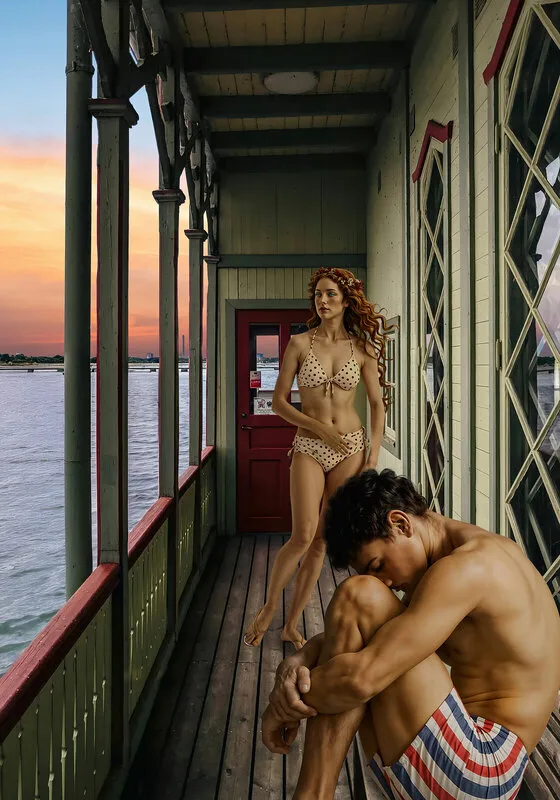
Random Harvest - Venus Aphrodite and Apollon
This is neither pure mythology nor merely a matter of memory. It is a tale woven from twilight and tides, chance and consequence—where gods don their swimwear and history drips quietly from the end of a pier. It's a story that unfolds like a 'Random Harvest', a collection of seemingly random events that shape the course of history, a term borrowed from the works of James Hilton, where the unexpected and the unexplained converge.
It begins, not in ancient Delphi or classical Athens, but somewhere between a thundercloud over Santorini and the soft light of a Malmö summer night. One destroyed cities with fire, while the other reveals them with fog. Yet both serve as reminders that time doesn’t always flow—it loops, it lingers, it doubles back.
You’ve heard of Aphrodite and Apollo—the goddess of impossible beauty and the golden boy with too many lovers. But this isn’t Olympus. This is Skåne. The gods are on holiday. It's not a retirement or a sabbatical, just a pause between responsibilities. She arrives on a shell, he in tricolour swim shorts. They meet at the cold bathhouse as if nothing had transpired, though everything has. The mystery of their meeting, the intrigue of their holiday, and the captivation of their pause between responsibilities draw the audience into their story.
And long before this moment—before the bathers left, before the sea calmed—there were decisions, disasters, and desires—labyrinths built from longing. Cliffs jumped from. Missed turns and ill-timed glances undid empires. All recorded not by historians, but by what they call Random Harvest, a collection of seemingly random events that shape the course of history. It's a concept that echoes the philosophical debate on fate and chance, suggesting that our lives are not just a series of planned events, but a collection of random occurrences that shape our destinies.
What follows is a tale of love and loss, coincidence and cycles. It includes tidal waves, misdelivered letters, shared boys, atomic shadows, and the kind of heartbreak only gods can carry without wrinkling. It’s a story that questions whether eternity has seasons, and whether Malmö might be the only place left where two ancient deities can meet without being recognised. And at the heart of it all is the 'Random Harvest', the collection of seemingly random events that shape the course of history, and in this case, the love story of Venus Aphrodite and Apollo.
This may not be how it happened. Or perhaps it is. Either way, it’s a story that resonates with the human experience, a story you already carry in your blood.
Please click the link below to learn more about my pictures, writing, and why this story is a must-read.
https://www.konst.se/jorgenthornberg
”Random Journey
They left before the counting of days,
when mountains still murmured the gods' names.
In ziggurats, in cypress shade,
they danced through smoke, through vow and flame.
In Babylon’s dusk and Athens’ light,
they whispered truths beneath star-split skies.
One bore the seashell, salt and skin,
the other strummed time on a golden string.
They walked through empires' rising breaths,
in marble courts, on fields of death.
They shared Adonis, lost him twice—
Once to love, once to devise.
In Rome, they kissed behind the veil,
in Byzantium, she wept in braids.
He sang through plagues, through steam and steel,
while she grew roses in the shade.
They split in Paris, met in Prague,
missed each other in the smog of war.
She turned left where he turned flame,
a thousand years—then met again.
Now twilight breathes on Baltic waves,
the summer air is still, not grave.
She steps onto the wooden pier,
in Botticelli’s pose, less shy, more near.
He waits in tricoloured swimwear, worn,
with sand between immortal toes.
They do not speak, they do not plan—
For gods don’t need what mortals know.
And someone watching might not see,
the hush between the sky and sea,
the gaze that weighs a thousand falls,
a silent sigh, where memory calls.
At Ribersborg, as seagulls cry,
two timeless beings pass you by.
Their journey never ends, just bends—
and starts again where evening ends.”
Malmö May 2025
Venus Aphrodite and Apollon
Imagine the improbability of stumbling upon a retired goddess during a leisurely evening stroll. Now, consider the even more unlikely scenario of finding her in the company of a dethroned god. Yet, as the soft dusk light occasionally unveils a path to the unknown, the concept of Random Harvest unfolds. This notion, pondered by the Greek philosophers Herodotus and Sophocles, explores the idea that human life is shaped by fate or chance. The phrase itself is steeped in classical metaphor and an ancient philosophical perspective on humanity’s vulnerability to the forces of destiny and randomness. It even applies to gods, even at the Ribersborg cold bathing house in Malmö. This philosophical perspective adds depth to the narrative, inviting the audience to ponder the role of fate and chance in their lives.
They, the timeless beings, have both sailed through time for over four thousand years, born divine and bearing different names in various ages, yet with the same soul and core identity. Venus Aphrodite, whose roots reach back to the Sumerian goddess Inanna and the Babylonian Ishtar, has always embodied the force of love, the essence of beauty, and the mystery of tireless desire. Apollo—the golden one, the radiant—has wandered from Delphi’s temple to modern poetry, from sun god to LGBTQ icon with a tangled love life. In Rick Riordan’s contemporary mythology, he is 4,612 years old. But for gods, time is something else entirely: a movement, a feeling, not a measurable flow. That’s how eternity works.
Venus Aphrodite, the goddess of love, and Apollo, the radiant one, have journeyed through time, their passion enduring across the ages. By chance—or fate, or what mortals call coincidence—they met during Malmö’s Sommarscen festival, at Scaniaplatsen in the Western Harbour. Music unites. Of course, they had met before—glances exchanged in smoky palaces, whispers traded in sacred groves. And more than that, but long ago. For as long as humans have found new gods, Venus, Aphrodite, and Apollo now live as if on an eternal holiday. Yet this time felt different. This was a reunion. It was then that Random Harvest brought them together again, their enduring love for each other shining through the ages, a testament to the power of love that transcends time and space.
Once, Venus, Aphrodite, and Apollo shared the beautiful Adonis—in what became the archetype of a love triangle, and a deadly one at that. It was Apollo, consumed by jealousy, who took the form of a wild boar and killed him. Aphrodite was inconsolable. She wept until the seas rose, and her grief ran so deep that Apollo, at last, took pity. He told her to throw herself from the white cliffs of Leukas (also known as the Leukadian cliffs, on the island of Leukas—today’s Lefkada—in the Ionian Sea). When she did, sinking into the water and leaving her love behind, her suffering ceased. It was a rebirth, and she could move on.
Sappho, the Greek poet from Lesbos, is also said to have leapt from those same cliffs—driven by unrequited love for a young man named Phaon. As a mortal, she could not be reborn, yet she lives on through her poetry. Sappho and Venus Aphrodite were kindred spirits. Sappho’s poems are often dedicated to Aphrodite in intimate, almost erotic tones. Her first ode begins with a direct plea to Aphrodite for help in love, interpreted by some as addressed to a female beloved.
Despite the weight of their past, Venus Aphrodite, Apollo, and their timeless companions remain unbroken. It is the concept of Random Harvest that leads them to Malmö’s cold bathing house, on a summer evening after closing. The pale Nordic night, the cool but pleasant air, the soft light that never quite fades—all these elements draw them there, as they do me. Venus Aphrodite feels the pull of Apollo once more, that gorgeous man with cultural depth and a mastery of harp-playing. He, in turn, is torn between her and a young mortal man from Malmö—a seller of mobile phones, of all things—who has touched his heart in a way that gods rarely allow. Their resilience in the face of such emotional turmoil is truly inspiring.
But can Apollo trust Venus, Aphrodite? Her track record should serve as a warning. That is why, in the image, he wears an expression of regret. Apollo carries his memories as wounds to the soul; his love stories are a string of betrayals, losses, and bittersweet moments. The last time they saw each other may have been when Adonis perished. Or perhaps during the Trojan War, when Apollo and Aphrodite persuaded Ares to fight—an unholy alliance, with consequences so vast they fill the Iliad, a sprawling epic of some 16,000 lines, divided into 24 books. It is among the longest poems in history.
Perhaps time has softened the pain. Maybe this is the evening when something new might be born—or lost forever. Their meeting on the wooden pier of the bathing house is a moment steeped in silent tension, in thousands of years of longing, guilt, and reconciliation, with the multicultural city of Malmö as an unexpected, yet not entirely unfitting, backdrop. The future, with all its possibilities, hangs in the air, leaving us all intrigued.
Even gods’ sorrows can heal with time, and Venus Aphrodite is more beautiful than ever. Apollo, too, remains untouched by the passage of time, for in eternity, time is relative. It is not counted in seconds, minutes, hours, days, or years but in cycles—periods that cannot be translated into human logic.
A summer evening with Skåne at its finest—the bright June night had drawn both deities to the mild air, lagom, as the Swedes say: neither as hot as their respective suns nor as cold as the absolute zero of outer space. It was reminiscent of a deserted theatre stage in ancient Delphi. Time was diffuse—it could have been today, yesterday, or three thousand years ago.
Venus Aphrodite stood in a pose I recognised from Botticelli’s painting, though now she wore a bikini. Apollo sat on a simple wooden bench in swim trunks the colour of the tricolore. That’s when I began to hear their voices within me. I’ve encountered Time-travellers before, and their millennia-old voices rang clear as the evening air.
VENUS APHRODITE:
They call it Random Harvest, a metaphor for the unpredictable nature of life. It's as if the world were a field where coincidences ripen like wheat and are winnowed by the wind.
But we know better, you and I. It’s not always the wind that chooses—sometimes it’s a door left ajar. A moment of hesitation. A meeting that never should have happened… and yet it does.
APOLLO:
Yes. Like that day in Troy, when Paris chose you—and in doing so, chose war.
Or when Caesar crossed the Rubicon—not because he knew what awaited him, but because a flock of birds crossed the river before him.
Birds, Venus! What else could it be, if not Random Harvest?
VENUS APHRODITE:
And yet each step made perfect sense in its moment. Like love. We believe we choose, but most often, we happen to be there when the heart stumbles.
Cleopatra met Antony at the right—or wrong—moment. One hour’s delay, and Rome might never have fallen. It wasn’t the gods, Apollo. It was Random Harvest.
APOLLO:
Is that why people fear randomness? Because it resembles divine will but lacks intent?
No prophecy. No plan. Just… the rain that fell at the moment someone stood bareheaded. And thus, everything changed.
VENUS APHRODITE:
Many say, "It was fate. What fate?"
But you and I know: fate often wears randomness as a disguise to avoid accountability. What if Napoleon had stayed in Corsica? What if a banana peel—or a glance—had made someone turn around?
APOLLO:
We’ve seen it.
A glance across a square.
A misfired arrow.
A misdelivered letter.
A cry lost in the woods.
So many worlds have teetered because of what humankind calls insignificant. Yet, in the rearview mirror, the accident transforms into the cause—a new axis in world history.
VENUS APHRODITE:
And sometimes love is to blame.
A soldier stays one more night.
A woman in a foreign land smiles at a stranger.
And so, a child is born.
A future. A revolution.
All because the train was delayed.
The messenger stumbled.
Random Harvest, Apollo. Love’s side shoots.
APOLLO:
Perhaps that’s why humanity needs stories.
To give pattern to the patternless.
And us—to give voice to the random.
A poem.
A song.
A reason why it all still matters.
VENUS APHRODITE:
And so we still walk here—you with your lyre, I with the echo of my shell.
We gather the harvests not because they suffice, but to remember that sometimes it’s a single step to the left that separates a kiss from a war.
APOLLO: It occurred in the palace at Knossos. A bull that could not be tamed, a labyrinth formed from humanity’s attempts to restrain its desire. Had Ariadne fallen asleep or pulled a different skein of thread, perhaps history would have unfolded differently. But one path was chosen—and another lost. The concept of 'Random Harvest', the unpredictable and uncontrollable forces of fate, caused the eventual collapse of Minoan civilisation: the earthquake on distant Thera, the island of Santorini, and the tsunami that followed, pulling Knossos’ harbour city, Amnisos, into the sea, drowning countless people—including Icarus—serving as a metaphor for the unpredictable nature of life. It is Arus who did not fall from the sky, as the myth claims, but who lived in Amnisos when the wave struck. That he lives on in myth is itself Random Harvest. It is correct that Daedalus and his son Icarus were imprisoned by King Minos, likely as punishment for Daedalus's involvement in the death of Talus, an apprentice. This sets the stage for their desperate attempt to escape and the tragic consequences of their choices. That they were drowned by a tidal wave sixteen hundred years before the beginning of humanity’s calendars was not particularly poetic, so the myth arose.
VENUS APHRODITE: Wasn’t it Pindar, a thousand years later, who, in his poem, alludes to Icarus’ fate—but very briefly? He doesn’t mention the tidal wave at all, only transmitting the poetic lie about the father and son’s tragic flight, a flight that ended in a sea of regret and loss.
APOLLO: Correct. It was the metaphor of hubris that mattered, not the Random Harvest that drowned an entire city. The weight of this metaphor, the arrogance that led to such a tragic end, is a lesson that echoes through the ages.
VENUS APHRODITE: It occurred in Pompeii in the year 79, on an ordinary morning. A woman brushed her hair; her husband was just about to say something tender, but paused to listen to a distant rumble. A silence. And then shadow. Many bodies were preserved mid-flight, in gestures of everyday life, in attempts to reach safety. What held them there that day, in that house? Perhaps a bodice that needed fastening. Maybe a kiss delayed half a second, but preserved for eternity in a cavity of ash.
APOLLO: And in Sarajevo, 1914, Random Harvest struck again. A wrong turn. A chauffeur who drove onto a street he wasn’t supposed to take. A revolutionary who had already given up, but suddenly found himself standing face to face with his target—a gunshot. An empire began to tremble. A century commenced to bleed. All because the car stopped at the wrong café, a sudden twist of fate that changed the course of history.
VENUS APHRODITE: In Hiroshima, 1945, like lightning from a clear sky. A city waking to the sound of children’s voices and the tea vendor’s cart. Someone didn’t fetch the laundry. Another paused to watch the clouds. And then everything turned blindingly white. In the ash lay shadows of people who had sat on steps, bent down to tie a shoe. Time split there, Apollo—into a before and an after that can never be stitched back together.
APOLLO: And on the Baltic Sea, one September night. Estonia. A ferry. A restless sea. A sudden giant wave and a visor that gave way. Who danced their final dance, who fell asleep in their cabin with their thoughts still in Tallinn? And who switched tickets at the last moment? There too—Random Harvest. A wave, a moment, a sleep too deep to awaken from.
VENUS APHRODITE: And in fiction, Apollo, as if we didn’t already know that humans need to hide the truth in a fable. Titanic. A lonely iceberg in a vast ocean. An orchestra that kept playing. A couple who never should have met, yet did, and lost everything. People watch the film as if it were about someone else. But it might just as well have been them, had Random Harvest struck in their place. In every love encounter, there is a possible iceberg, a potential 'Random Harvest' that could alter the course of history.
APOLLO: So we walk on, you and I. Not as judges, not as saviours, but as bearers of memory. For when humanity asks why, and no one can answer, we gods whisper from the shadows: It was only the wind.
Or the birds.
Or a door that happened to be left ajar. Just like today, when Random Harvest draws us both to the same musical event, one among thousands happening in the world this very day. And yet there are no other gods but us to explain why we both ended up in Malmö at the same time.
VENUS APHRODITE: "Random Harvest," she said, having the final word before I withdrew to avoid disturbing what might yet occur.
"Venus Aphrodite and Apollo"—it’s not merely a story. It’s an echo that keeps returning, a cycle that endures. A moment in eternity where two ancient gods meet again, perhaps for the last time, perhaps for the first true encounter. However, Apollo’s phone-seller risks sharing Adonis’ fate—three is one too many. Let’s hope Random Harvest does not allow an innocent citizen of Malmö to become its next casualty.
3 200 kr

Jörgen Thornberg
Malmö
Lite om bilder och mig. Translation in English at the end.
Jag är en nyfiken person som ser allt i bilder, även det jag fäster i ord, gärna tillsammans för bakom alla mina bilder finns en berättelse. Till vissa bilder hör en kortare eller längre novell som följer med bilden.
Bilder berättar historier. Jag omges av naturlig skönhet, intressanta människor och historia var jag än går. Jag använder min kamera för att dokumentera världen och blanda det jag ser med vad jag känner för att fånga den dolda magin.
Mina bilder berättar mina historier. Genom mina bilder, tryck och berättelser. Jag bjuder in dig att ta del av dessa berättelser, in i ditt liv och hem och dela min mycket personliga syn på vår värld. Mer än vad ögat ser. Jag tänker i bilder, drömmer och skriver och pratar om dem; följaktligen måste jag också skapa bilder. De blir vad jag ser, inte nödvändigtvis begränsade till verkligheten. Det finns en bild runt varje hörn. Jag hoppas att du kommer att se vad jag såg och gilla det.
Jag är också en skrivande person och till många bilder hör en kortare eller längre essay. Den följer med tavlan, tryckt på fint papper och med en personlig hälsning från mig.
Flertalet bilder startar sin resa i min kamera. Enkelt förklarat beskriver jag bilden jag ser i mitt inre, upplevd eller fantiserad. Bilden uppstår inom mig redan innan jag fått okularet till ögat. På bråkdelen av ett ögonblick ser jag vad jag vill ha och vad som kan göras med bilden. Här skall jag stoppa in en giraff, stålmannen, Titanic eller vad det är min fantasi finner ut. Ännu märkligare är att jag kommer ihåg minnesbilden långt efteråt när det blir tid att skapa verket. Om jag lyckas eller inte, är upp till betraktaren, oftast präglat av en stråk av svart humor – meningen är att man skall bli underhållen. Mina bilder blir ofta en snackis där de hänger.
Jag föredrar bilder som förmedlar ett budskap i flera lager. Vid första anblicken fylld av feel-good, en vacker utsikt, fint väder, solen skiner, blommor på ängen eller vattnet som ligger förrädiskt spegelblankt. I en sådan bild kan jag gömma min egentliga berättelse, mitt förakt för förtryckare och våldsverkare, rasister och fördomsfulla människor - ett gärna återkommande motiv mer eller mindre dolt i det vackra motivet. Jag försöker förena dem i ett gemensamt narrativ.
Bild och formgivning har löpt som en röd tråd genom livet. Fotokonst känns som en värdig final som jag gärna delar med mig.
Min genre är vid som framgår av mina bilder, temat en blandning av pop- och gatukonst i kollage som kan bestå av hundratals lager. Vissa bilder kan ta veckor, andra någon dag innan det är dags att överlämna resultatet till printverkstaden. Fine Art Prints är digitala fotocollage. I dessa kollage sker rivandet, klippandet, pusslandet, målandet, ritandet och sprayningen digitalt. Det jag monterar in kan vara hundratals år gamla bilder som jag omsorgsfullt frilägger så att de ser ut att vara en del av tavlan men också bilder skapade av mig själv efter min egen fantasi. Därefter besöks printstudion och för vissa bilder numrera en limiterad upplaga (oftast 7 exemplar) och signera för hand. Vissa bilder kan köpas i olika format. Det är bara att fråga efter vilka. Gillar man en bild som är 70x100 men inte har plats på väggen, går den kanske att få i 50x70 cm istället. Frågan är fri.
Metoden Giclée eller Fine Art Print som det också kallas är det moderna sättet för framställning av grafisk konst. Villkoret för denna typ av utskrifter är att en högkvalitativ storformatskrivare används med åldersbeständigt färgpigment och konstnärspapper eller i förekommande fall på duk. Pappret som används möter de krav på livslängd som ställs av museer och gallerier. Normalt säljer jag mina bilder oinramade så att den nya ägaren själv kan bestämma hur de skall se ut, med eller utan passepartout färg på ram, med eller utan glas etc..
Under många år ställde jag bara ut på nätet, i valda grupper och på min egen Facebooksida - https://www.facebook.com/jorgen.thornberg.9
Jag finns också på en egen hemsida som tyvärr inte alltid är uppdaterad – https://www.jth.life/ Där kan du också läsa en del av de berättelser som följer med bilden.
UTSTÄLLNINGAR
Luftkastellet, oktober 2022
Konst i Lund, november 2022
Luftkastellet, mars 2023
Engleson Galleri Caroli, april 2023
Hydra, Greece June 2023
Engleson Galleri Caroli, oktober 2023
Toppen, Höllviken december 2023
Luftkastellet, mars 2024
Torups Galleri, mars 2024
Venice, May 2024
Luftkastellet, oktober 2024
Konst i Advent, December 2024
Galleri Engleson, Caroli December 2024
Jäger & Jansson Galleri, april 2025
A bit about pictures and me.
I'm a curious person who sees everything in pictures, even what I express in words, often combining them, for behind all my pictures lies a story. These narratives, some as short as a single image and others as long as a novel, are the heart and soul of my work.
Pictures tell stories. Wherever I go, I'm surrounded by natural beauty, exciting people, and history. I use my camera to document the world and blend what I see with what I feel to capture the hidden magic.
My images tell my stories. Through my pictures, prints, and narratives, I invite you to partake in these stories in your life and home and share my deeply personal perspective of our world. More than meets the eye. I think in pictures, dream, write, and talk about them; consequently, I must create images too. They become what I see, not necessarily confined to reality. There's a picture around every corner. I hope you'll see what I saw and enjoy it.
I'm also a writer, and many images come with a shorter or longer essay. It accompanies the painting, printed on fine paper with my personal greeting.
Many pictures start their journey on my camera. Simply put, I describe the image I see in my mind, experienced or imagined. The image arises within me even before I bring the eyepiece to my eye. In a fraction of a moment, I see what I want and what can be done with the picture. Here, I'll insert a giraffe, Superman, the Titanic, or whatever my imagination conjures up. Even stranger is that I remember the mental image long after it's time to create the work. Whether I succeed is up to the observer, often imbued with a streak of black humour – the aim is to entertain. My pictures usually become a talking point wherever they hang.
I prefer pictures that convey a message in multiple layers. At first glance, they're filled with feel-good vibes, a beautiful view, lovely weather, the sun shining, flowers in the meadow, or the water lying deceptively calm. But beneath this surface beauty, I often conceal a deeper story, a narrative that challenges societal norms or explores the human condition. I invite you to delve into these hidden narratives and discover the layers of meaning within my work.
Picture and design have been a thread running through my life. Photographic art feels like a fitting finale, and I'm happy to share it.
My genre is varied, as seen in my pictures; the theme is a blend of pop and street art in collages that can consist of hundreds of layers. Some images can take weeks, others just a day before it's time to hand over the result to the print workshop. Fine Art Prints are digital photo collages. In these collages, tearing, cutting, puzzling, painting, drawing, and spraying happen digitally. What I insert can be images hundreds of years old that I carefully extract so they appear to be part of the painting, but also images created by myself, now also generated from my imagination. Next, visit the print studio and, for certain images, number a limited edition (usually 7 copies) and sign them by hand. Some images may be available in other formats. Just ask which ones. If you like an image that's 70x100 but doesn't have space on the wall, you might be able to get it in 50x70 cm instead. The question is open.
The Giclée method, or Fine Art Print as it's also called, is the modern way of producing graphic art. This method ensures the highest quality and longevity of the artwork, using a high-quality large-format printer with archival pigment inks and artist paper or, in some cases, canvas. The paper used meets the longevity requirements set by museums and galleries. I sell my pictures unframed, allowing the new owner to personalise their artwork, confident in the lasting value and quality of the piece.
For many years, I only exhibited online, in selected groups, and on my Facebook page - https://www.facebook.com/jorgen.thornberg.9. I also have my website, which unfortunately is not constantly updated - https://www.jth.life/. You can also read some of the stories accompanying the pictures there.
EXHIBITIONS
Luftkastellet, October 2022
Art in Lund, November 2022
Luftkastellet, March 2023
Engleson Gallery Caroli, April 2023
Hydra, Greece June 2023
Engleson Gallery Caroli, October 2023
Toppen, Höllviken December 2023
Luftkastellet, March 2024
Torup Gallery, March 2024
Venice, May 2024
UTSTÄLLNINGAR
Luftkastellet, oktober 2022
Konst i Lund, november 2022
Luftkastellet, mars 2023
Engleson Galleri Caroli, april 2023
Hydra, Greece June 2023
Engleson Galleri Caroli, oktober 2023
Toppen, Höllviken december 2023
Luftkastellet, mars 2024
Torups Galleri, mars 2024
Venice, May 2024
Luftkastellet, October 2024
Konst i Advent, December 2024
Galleri Engleson, Caroli December 2024
Jäger & Jansson Galleri, April 2025
Utbildning
Autodidakt
Medlem i konstnärsförening
Öppna Sinnen
Med i konstrunda
Konstrundan i Skåne
Utställningar
Luftkastellet, October 2022
Art in Lund, November 2022
Luftkastellet, March 2023
Engleson Gallery Caroli, April 2023
Hydra, Greece June 2023
Engleson Gallery Caroli, October 2023
Toppen, Höllviken December 2023
Luftkastellet, March 2024
Torup Gallery, March 2024
Venice, May 2024