Vi använder cookies för att ge dig bästa möjliga upplevelse. Välj vilka cookies du tillåter.
Läs mer i vår integritetspolicy
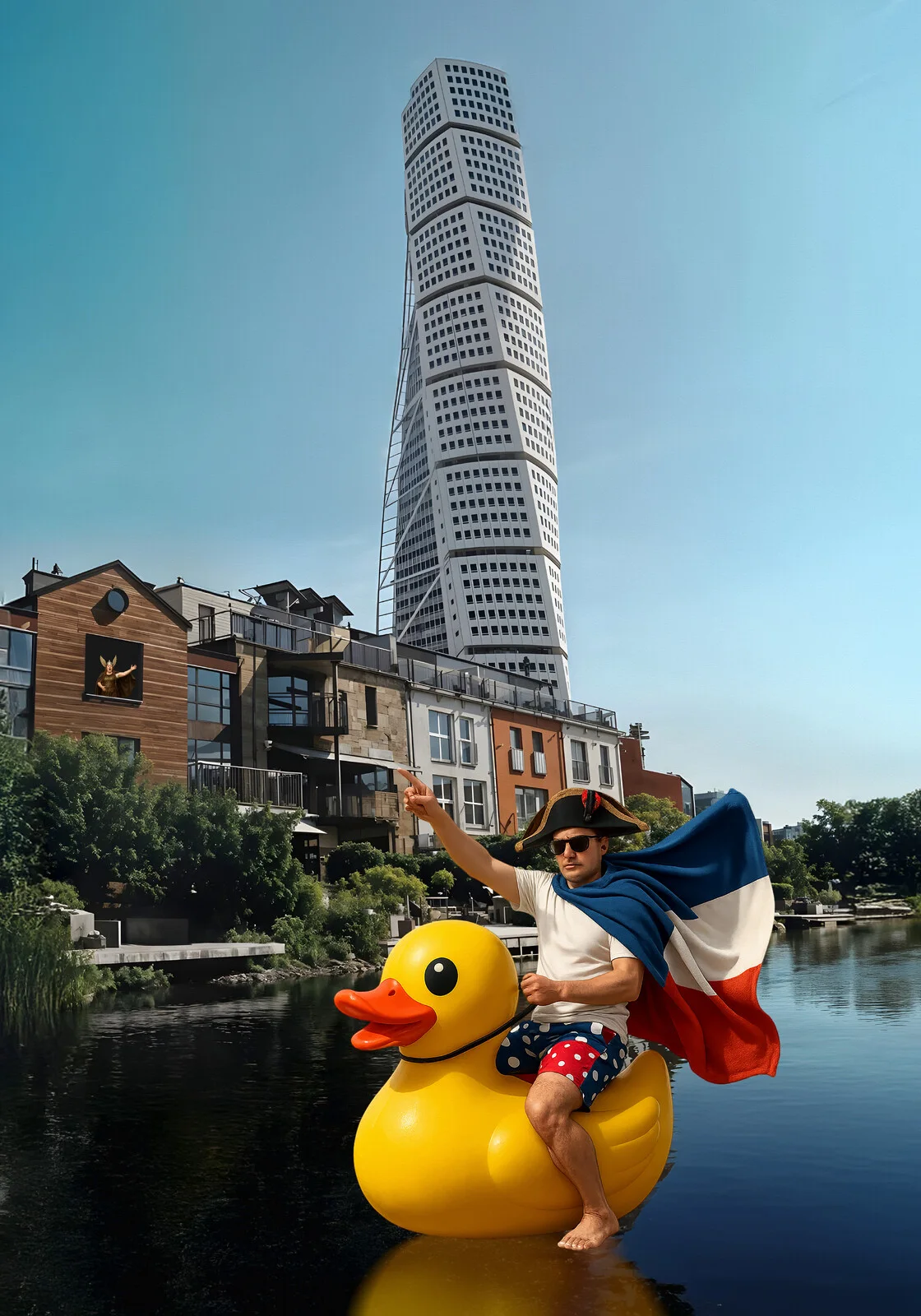
Jörgen Thornberg
A Short Story, 2025
Digital
50 x 70 cm
3 200 kr
A Short Story
This is not quite satire, nor is it strictly history. It is a story built from shadows and skylines, ambition and architecture – where truth wears high heels and legend walks barefoot.
It begins, not in ancient Rome or revolutionary Paris, but somewhere between a medieval courtyard in Milan and the twisting glass of Turning Torso in Malmö. One is made of stone, the other of steel. But both are monuments to men who, it is whispered, stood a little closer to the ground than they wished.
You’ve heard of Napoleon – the general, the emperor, the short man with big ideas. But before Napoleon came, Guercio da Baggio, the Milanese consul, built palaces large enough to echo his imagined grandeur. He measured things not in meters, but in Guercio units, and the city children laughed while the architects despaired. This historical context provides a deeper understanding of the societal perceptions of height and ambition.
And long after them both, Malmö – a city with no emperors, only opinions – decided to build a tower that twisted towards the sky like a corkscrew of defiance. Was it envy? Ambition? A joke? Or a symptom of a syndrome that dares not speak its name? The city's decision to build a towering structure, seemingly in defiance of societal stereotypes, is a humorous twist in this tale of height and ambition.
What follows is a tale of size and scale, of myths that cast longer shadows than the men they describe. It touches on penguins, pickpockets, and political cartoons. It questions whether skyscrapers can blush and whether Mariah Carey might be a better diagnostician than Freud. These questions prompt reflection on societal perceptions of height and ambition.
This may not be exactly how it happened. Or perhaps it is. Either way, it’s a story worth the height. Please click the link below to learn more about my pictures, writing, and why this story is a must-read.
https://www.konst.se/jorgenthornberg
”A too short Ode
They sit on the rug and their legs never drop,
They jump for a hug and still come up on top.
They reach for the stars—well, the kitchen shelves—
Then laugh and adjust, quite pleased with themselves.
They duck from the rain, yet they’re never the first
To notice the weather or feel the worst.
They stand at the front of every photo you take,
A smile on their lips that no heel could fake.
When the stairs come into view, it’s a plunge of fear,
But the perspective from down there is remarkably clear.
They hand you your joke with a wink and a grin—
While you think you’ve triumphed, they’ve already been.
Micromanagers by day, comedians by night,
They conquer the world in part of your height.
“Keep looking up,” the tall ones declare—
But the short ones nod; they’re already there.
They love being grounded; they’re closer to their roots,
Less fuss with umbrellas and less bending in boots.
And when jokes fly over, they don’t even flinch—
They’re accustomed to punchlines and roll with each inch.
So raise a glass (though they may need a crate),
To those who prove that size doesn’t determine one’s fate.
With humour and pride, they defy every norm—
For no giant was ever this cleverly born.”
Malmö May 2025
A Short Story
A short story is a piece of prose fiction, and had I had a secretary, she could have written it down in shorthand. Joking aside, to the point: today’s short story is about short men, particularly Napoleon, who, despite being nearly average height for his time, has gone down in history as the quintessential example of the so-called Napoleon complex—a man who fell short and compensated through aggression.
The Napoleon complex, also known as Napoleon syndrome or short man syndrome, is a supposed behavioural pattern in which short-statured men tend to exhibit excessively aggressive or dominant behaviour to compensate for their perceived physical or social shortcomings. It suggests that such behaviour is a form of psychological compensation for what they see as inadequacies.
The Napoleon complex is a non-scientific term used to describe behaviour in which short men display exaggerated assertiveness or dominance in social settings. This behaviour is thought to arise from a feeling of physical disadvantage or a sense of lower social value compared to taller peers.
It is essential to note that the Napoleon complex is not a recognised clinical diagnosis or a formal psychological disorder. It is not listed in any official psychological manuals.
The term has been linked to Alfred Adler's theory of the "inferiority complex," in which individuals attempt to compensate for perceived flaws by demonstrating opposite traits. Napoleon complex, Napoleon syndrome, and short man syndrome are often used interchangeably.
The concept itself has been debated and criticised, and it is not widely accepted as a valid or useful explanation for aggressive behaviour.
The term originates from French military officer and statesman Napoleon Bonaparte, who was often described as short and who, in historical depictions, has been accused of using dominant behaviour as a way to compensate for his stature.
The Napoleon complex is named after Napoleon, and cultural portrayals often depict him seeking power and glory to make up for his alleged short stature. This image was primarily fueled by British political cartoonists, who repeatedly mocked him as short to undermine both his ego and imperial ambitions. These cartoons so enraged Napoleon that he once tried—unsuccessfully—to persuade the British government to ban them. His contemporary dictator colleague, Putin, is only 1.68 metres tall — and look at what he’s caused. Berlusconi was equally short, and Kim Jong-il is another good example of what small men can stir up.
He is estimated to have been around 1.67 metres tall, which, depending on the source, was close to the average adult male height at the time. Some historians claim he was 5 feet 7 inches or 1.70 metres, based on measurements taken on Saint Helena 28 years after France adopted the metric system. Yet, despite being quite ordinary in height, enemy soldiers routinely referred to him as "the little corporal."
Singer-songwriter Mariah Carey referenced the Napoleon complex in her 2009 song "Obsessed," accusing someone of being "all fired up with [their] Napoleon complex." Some interpret the song as a jab at rapper Eminem, who had made disparaging remarks about Carey in previous tracks.
At the height of his power, Napoleon commissioned numerous portraits of himself, yet these paintings bore little resemblance to his actual appearance, neither in face nor in height. Historically, rulers have often desired to be portrayed in a more flattering manner than reality allowed. This phenomenon remains present today: "Instagram Face" has become the modern equivalent of idealised self-portrayal on social media.
Speaking of Turning Torso, which dominates my image, and how both that and a medieval palace tie into this story, everyone now surely knows what the term "Napoleon complex" refers to. The monumental Palazzo di Brera in Milan must be seen as a product of this affliction. Its builder, Guercio da Baggio, was a power-hungry, short-statured nobleman who compensated for his height with enormous landholdings and a grotesquely oversized palace. It is both symbolic and satirical—a medieval version of "short man, tall towers."
Guercio da Baggio was short in stature but grand in ambition. He stood at under 1.70 metres, which was the average male height of his time. To obscure his actual height, he refused to use standard feet and inches and instead introduced his unit of measurement: the "Guercio," slightly over 30 centimetres. As a consul in 13th-century Milan, he had little patience for opposition and even less for his height complex—or rather, he had plenty of the latter. It was said in Milan that for every centimetre Guercio lacked, another room was added to one of his construction projects.
His greatest pride was the land at Brera, where he, in an act of stone-hewn defiance, erected a building so massive that Milan’s towering cathedral could eat its heart out. The palace had towers, halls, courtyards, and vaults—all larger than truly necessary, but exactly as grand as Guercio saw himself, body notwithstanding.
Children in Milan were taught to measure in "Guercio units." How tall is the tower at Brera? “Three hundred seventy-two guercio and a hat.” That is, 112 meters taller than the cathedral. And every time someone asked why the Brera palace was so absurdly big, the old ones would answer: “Because its master had a soul that large.”
What began as a private palazzo for Guercio da Baggio, then grew over centuries into one of Europe's largest Jesuit colleges, was finally transformed by Napoleon into one of Italy's first modern public art galleries. It is a fascinating architectural and ideological evolution—from overcompensation, to education, to enlightened republicanism. That’s where Napoleon enters the scene. After conquering Italy, the palace enchanted him, its façade as grand as his self-image.
After crowning himself King of Italy in 1805, Napoleon sought to create an "Italian Louvre." The museum, which now houses an incredible collection of art from nearly every great master, was inaugurated on August 15, 1809, Napoleon's birthday.
Napoleon banned women from wearing high heels, which, at that time in France, were still considered part of male fashion. But in Britain, heels had already become feminine attire, and the British mocked Napoleon, saying he banned heels because he was short.
The Napoleon complex is exceedingly rare. People believe it exists because when a short person is aggressive, they are labelled with a "Napoleon complex," while aggressive people of average or tall height are considered aggressive.
Despite the persistent myth, a 2007 study found that shorter men lost their tempers just as often as taller men. The reason the myth persists is that short men are consistently the butt of jokes. When they push back over time, they are then seen as insecure or dramatic. It’s a bit like how people laugh at someone being bullied but are shocked if the victim turns around and punches the bully in the face. This resilience in the face of societal stereotypes is something we can all admire.
It's a societal bias that's deeply ingrained. Mostly women, but also men, will excuse bad behaviour or aggression from a taller man as 'natural' or say, 'he's just a dominant guy.' However, for a shorter man, they claim, 'Oh, he's just short.' In other words, our perception of behaviour is often filtered through a person’s height. This bias is something we need to reflect on and challenge.
Now the time has come for the Malmö connection. Is Turning Torso an expression of Malmö’s own Napoleon complex—if indeed a city can have one? Sweden’s third-largest city is constantly compared with neighbouring Copenhagen, Denmark’s capital: Where is life more fun? Where is the food better? Where is the nightlife more regal? According to people in Stockholm, Malmö suffers from a little-brother complex, which in turn has resulted in this Napoleonic syndrome. That conversation gained momentum when Turning Torso, a neo-futuristic residential skyscraper, was completed in Malmö, Sweden, in 2005. It was the tallest building in the Nordic region until September 2022, when it was surpassed by the Karlatornet in Gothenburg. Envy sank its claws into Stockholm, though the aggression is now more often directed at Gothenburg.
To conclude, here are a few jokes and anecdotes about short people. While these jokes may be amusing to some, it's essential to recognise that they can perpetuate stereotypes and be hurtful. Nevertheless, they also serve as a reminder of the societal perceptions of height and the necessity to challenge these perceptions.
The height of smallness is sitting on the edge of a rug and dangling your legs.
You’ve gotta hand it to short people because they usually can’t reach it anyway.
Sometimes when I look at short people, I wonder if they’re able to reach their goals.
Coming down the stairs must feel like skydiving to short people.
I was shocked to read in the papers today that a short person had been pickpocketed. I just thought to myself, “How could someone stoop so low?”
Short people must listen to the weather report. When it rains, if you’re short, you are the last one to know.
“Keep looking up.” – Motivational advice for most people. Necessary advice for short people.
I’m not saying short people are inferior, but I do tend to look down on them.
I love short people. They’re more down-to-earth.
The water in the shower evaporates before it reaches you.
What do you call a short manager? A real micromanager.
Why do short people like drugs? Because they get them high.
Last but not least: It’s easy to make fun of short people... the jokes always go over their heads.
One advantage of being small is being at the front of all group photos.
One of my favourites is the one about the Norwegian shrimp who ended up in a lobster fisherman’s net. The fisherman wanted to throw the shrimp back into the sea with the seaweed and other unwanted catch, but the shrimp cried out in despair: “Don’t throw me out! I’m a lobster,” he squeaked, beating his tiny chest. The fact that he said it in Norwegian makes it even funnier in Sweden. Incidentally, one can make a delicious soup from shrimp shells that is nearly indistinguishable from lobster bisque—at a fraction of the cost.
Finally, there’s the one about two Eskimos, one large and one short, approaching the convent door. “Go ahead, knock on the door, knock on the door,” the big one nudged the shorter one. Mother Superior answers the door.
“Go ahead, ask her the question,” the big Eskimo nudged the little one again.
“May we speak with the dwarf nun who lives here, please?” the little Eskimo asked timidly.
“No dwarf nun lives here,” the Mother Superior responds.
“Go ahead, ask her the second question,” the larger Eskimo said as he nudged the tiny one again.
“Well, are there any midget nuns in Alaska?” the miniature Eskimo inquired, his voice quivering.
“I know most of the sisters in Alaska, and I don’t believe so,” Mother Superior answered hesitantly.
With that, the large Eskimo collapsed and rolled to the ground, clutching his stomach and laughing uncontrollably. “See, I told you you screwed a penguin!” he exclaimed to the short Eskimo.
Jörgen Thornberg
A Short Story, 2025
Digital
50 x 70 cm
3 200 kr
A Short Story
This is not quite satire, nor is it strictly history. It is a story built from shadows and skylines, ambition and architecture – where truth wears high heels and legend walks barefoot.
It begins, not in ancient Rome or revolutionary Paris, but somewhere between a medieval courtyard in Milan and the twisting glass of Turning Torso in Malmö. One is made of stone, the other of steel. But both are monuments to men who, it is whispered, stood a little closer to the ground than they wished.
You’ve heard of Napoleon – the general, the emperor, the short man with big ideas. But before Napoleon came, Guercio da Baggio, the Milanese consul, built palaces large enough to echo his imagined grandeur. He measured things not in meters, but in Guercio units, and the city children laughed while the architects despaired. This historical context provides a deeper understanding of the societal perceptions of height and ambition.
And long after them both, Malmö – a city with no emperors, only opinions – decided to build a tower that twisted towards the sky like a corkscrew of defiance. Was it envy? Ambition? A joke? Or a symptom of a syndrome that dares not speak its name? The city's decision to build a towering structure, seemingly in defiance of societal stereotypes, is a humorous twist in this tale of height and ambition.
What follows is a tale of size and scale, of myths that cast longer shadows than the men they describe. It touches on penguins, pickpockets, and political cartoons. It questions whether skyscrapers can blush and whether Mariah Carey might be a better diagnostician than Freud. These questions prompt reflection on societal perceptions of height and ambition.
This may not be exactly how it happened. Or perhaps it is. Either way, it’s a story worth the height. Please click the link below to learn more about my pictures, writing, and why this story is a must-read.
https://www.konst.se/jorgenthornberg
”A too short Ode
They sit on the rug and their legs never drop,
They jump for a hug and still come up on top.
They reach for the stars—well, the kitchen shelves—
Then laugh and adjust, quite pleased with themselves.
They duck from the rain, yet they’re never the first
To notice the weather or feel the worst.
They stand at the front of every photo you take,
A smile on their lips that no heel could fake.
When the stairs come into view, it’s a plunge of fear,
But the perspective from down there is remarkably clear.
They hand you your joke with a wink and a grin—
While you think you’ve triumphed, they’ve already been.
Micromanagers by day, comedians by night,
They conquer the world in part of your height.
“Keep looking up,” the tall ones declare—
But the short ones nod; they’re already there.
They love being grounded; they’re closer to their roots,
Less fuss with umbrellas and less bending in boots.
And when jokes fly over, they don’t even flinch—
They’re accustomed to punchlines and roll with each inch.
So raise a glass (though they may need a crate),
To those who prove that size doesn’t determine one’s fate.
With humour and pride, they defy every norm—
For no giant was ever this cleverly born.”
Malmö May 2025
A Short Story
A short story is a piece of prose fiction, and had I had a secretary, she could have written it down in shorthand. Joking aside, to the point: today’s short story is about short men, particularly Napoleon, who, despite being nearly average height for his time, has gone down in history as the quintessential example of the so-called Napoleon complex—a man who fell short and compensated through aggression.
The Napoleon complex, also known as Napoleon syndrome or short man syndrome, is a supposed behavioural pattern in which short-statured men tend to exhibit excessively aggressive or dominant behaviour to compensate for their perceived physical or social shortcomings. It suggests that such behaviour is a form of psychological compensation for what they see as inadequacies.
The Napoleon complex is a non-scientific term used to describe behaviour in which short men display exaggerated assertiveness or dominance in social settings. This behaviour is thought to arise from a feeling of physical disadvantage or a sense of lower social value compared to taller peers.
It is essential to note that the Napoleon complex is not a recognised clinical diagnosis or a formal psychological disorder. It is not listed in any official psychological manuals.
The term has been linked to Alfred Adler's theory of the "inferiority complex," in which individuals attempt to compensate for perceived flaws by demonstrating opposite traits. Napoleon complex, Napoleon syndrome, and short man syndrome are often used interchangeably.
The concept itself has been debated and criticised, and it is not widely accepted as a valid or useful explanation for aggressive behaviour.
The term originates from French military officer and statesman Napoleon Bonaparte, who was often described as short and who, in historical depictions, has been accused of using dominant behaviour as a way to compensate for his stature.
The Napoleon complex is named after Napoleon, and cultural portrayals often depict him seeking power and glory to make up for his alleged short stature. This image was primarily fueled by British political cartoonists, who repeatedly mocked him as short to undermine both his ego and imperial ambitions. These cartoons so enraged Napoleon that he once tried—unsuccessfully—to persuade the British government to ban them. His contemporary dictator colleague, Putin, is only 1.68 metres tall — and look at what he’s caused. Berlusconi was equally short, and Kim Jong-il is another good example of what small men can stir up.
He is estimated to have been around 1.67 metres tall, which, depending on the source, was close to the average adult male height at the time. Some historians claim he was 5 feet 7 inches or 1.70 metres, based on measurements taken on Saint Helena 28 years after France adopted the metric system. Yet, despite being quite ordinary in height, enemy soldiers routinely referred to him as "the little corporal."
Singer-songwriter Mariah Carey referenced the Napoleon complex in her 2009 song "Obsessed," accusing someone of being "all fired up with [their] Napoleon complex." Some interpret the song as a jab at rapper Eminem, who had made disparaging remarks about Carey in previous tracks.
At the height of his power, Napoleon commissioned numerous portraits of himself, yet these paintings bore little resemblance to his actual appearance, neither in face nor in height. Historically, rulers have often desired to be portrayed in a more flattering manner than reality allowed. This phenomenon remains present today: "Instagram Face" has become the modern equivalent of idealised self-portrayal on social media.
Speaking of Turning Torso, which dominates my image, and how both that and a medieval palace tie into this story, everyone now surely knows what the term "Napoleon complex" refers to. The monumental Palazzo di Brera in Milan must be seen as a product of this affliction. Its builder, Guercio da Baggio, was a power-hungry, short-statured nobleman who compensated for his height with enormous landholdings and a grotesquely oversized palace. It is both symbolic and satirical—a medieval version of "short man, tall towers."
Guercio da Baggio was short in stature but grand in ambition. He stood at under 1.70 metres, which was the average male height of his time. To obscure his actual height, he refused to use standard feet and inches and instead introduced his unit of measurement: the "Guercio," slightly over 30 centimetres. As a consul in 13th-century Milan, he had little patience for opposition and even less for his height complex—or rather, he had plenty of the latter. It was said in Milan that for every centimetre Guercio lacked, another room was added to one of his construction projects.
His greatest pride was the land at Brera, where he, in an act of stone-hewn defiance, erected a building so massive that Milan’s towering cathedral could eat its heart out. The palace had towers, halls, courtyards, and vaults—all larger than truly necessary, but exactly as grand as Guercio saw himself, body notwithstanding.
Children in Milan were taught to measure in "Guercio units." How tall is the tower at Brera? “Three hundred seventy-two guercio and a hat.” That is, 112 meters taller than the cathedral. And every time someone asked why the Brera palace was so absurdly big, the old ones would answer: “Because its master had a soul that large.”
What began as a private palazzo for Guercio da Baggio, then grew over centuries into one of Europe's largest Jesuit colleges, was finally transformed by Napoleon into one of Italy's first modern public art galleries. It is a fascinating architectural and ideological evolution—from overcompensation, to education, to enlightened republicanism. That’s where Napoleon enters the scene. After conquering Italy, the palace enchanted him, its façade as grand as his self-image.
After crowning himself King of Italy in 1805, Napoleon sought to create an "Italian Louvre." The museum, which now houses an incredible collection of art from nearly every great master, was inaugurated on August 15, 1809, Napoleon's birthday.
Napoleon banned women from wearing high heels, which, at that time in France, were still considered part of male fashion. But in Britain, heels had already become feminine attire, and the British mocked Napoleon, saying he banned heels because he was short.
The Napoleon complex is exceedingly rare. People believe it exists because when a short person is aggressive, they are labelled with a "Napoleon complex," while aggressive people of average or tall height are considered aggressive.
Despite the persistent myth, a 2007 study found that shorter men lost their tempers just as often as taller men. The reason the myth persists is that short men are consistently the butt of jokes. When they push back over time, they are then seen as insecure or dramatic. It’s a bit like how people laugh at someone being bullied but are shocked if the victim turns around and punches the bully in the face. This resilience in the face of societal stereotypes is something we can all admire.
It's a societal bias that's deeply ingrained. Mostly women, but also men, will excuse bad behaviour or aggression from a taller man as 'natural' or say, 'he's just a dominant guy.' However, for a shorter man, they claim, 'Oh, he's just short.' In other words, our perception of behaviour is often filtered through a person’s height. This bias is something we need to reflect on and challenge.
Now the time has come for the Malmö connection. Is Turning Torso an expression of Malmö’s own Napoleon complex—if indeed a city can have one? Sweden’s third-largest city is constantly compared with neighbouring Copenhagen, Denmark’s capital: Where is life more fun? Where is the food better? Where is the nightlife more regal? According to people in Stockholm, Malmö suffers from a little-brother complex, which in turn has resulted in this Napoleonic syndrome. That conversation gained momentum when Turning Torso, a neo-futuristic residential skyscraper, was completed in Malmö, Sweden, in 2005. It was the tallest building in the Nordic region until September 2022, when it was surpassed by the Karlatornet in Gothenburg. Envy sank its claws into Stockholm, though the aggression is now more often directed at Gothenburg.
To conclude, here are a few jokes and anecdotes about short people. While these jokes may be amusing to some, it's essential to recognise that they can perpetuate stereotypes and be hurtful. Nevertheless, they also serve as a reminder of the societal perceptions of height and the necessity to challenge these perceptions.
The height of smallness is sitting on the edge of a rug and dangling your legs.
You’ve gotta hand it to short people because they usually can’t reach it anyway.
Sometimes when I look at short people, I wonder if they’re able to reach their goals.
Coming down the stairs must feel like skydiving to short people.
I was shocked to read in the papers today that a short person had been pickpocketed. I just thought to myself, “How could someone stoop so low?”
Short people must listen to the weather report. When it rains, if you’re short, you are the last one to know.
“Keep looking up.” – Motivational advice for most people. Necessary advice for short people.
I’m not saying short people are inferior, but I do tend to look down on them.
I love short people. They’re more down-to-earth.
The water in the shower evaporates before it reaches you.
What do you call a short manager? A real micromanager.
Why do short people like drugs? Because they get them high.
Last but not least: It’s easy to make fun of short people... the jokes always go over their heads.
One advantage of being small is being at the front of all group photos.
One of my favourites is the one about the Norwegian shrimp who ended up in a lobster fisherman’s net. The fisherman wanted to throw the shrimp back into the sea with the seaweed and other unwanted catch, but the shrimp cried out in despair: “Don’t throw me out! I’m a lobster,” he squeaked, beating his tiny chest. The fact that he said it in Norwegian makes it even funnier in Sweden. Incidentally, one can make a delicious soup from shrimp shells that is nearly indistinguishable from lobster bisque—at a fraction of the cost.
Finally, there’s the one about two Eskimos, one large and one short, approaching the convent door. “Go ahead, knock on the door, knock on the door,” the big one nudged the shorter one. Mother Superior answers the door.
“Go ahead, ask her the question,” the big Eskimo nudged the little one again.
“May we speak with the dwarf nun who lives here, please?” the little Eskimo asked timidly.
“No dwarf nun lives here,” the Mother Superior responds.
“Go ahead, ask her the second question,” the larger Eskimo said as he nudged the tiny one again.
“Well, are there any midget nuns in Alaska?” the miniature Eskimo inquired, his voice quivering.
“I know most of the sisters in Alaska, and I don’t believe so,” Mother Superior answered hesitantly.
With that, the large Eskimo collapsed and rolled to the ground, clutching his stomach and laughing uncontrollably. “See, I told you you screwed a penguin!” he exclaimed to the short Eskimo.
3 200 kr

Jörgen Thornberg
Malmö
Lite om bilder och mig. Translation in English at the end.
Jag är en nyfiken person som ser allt i bilder, även det jag fäster i ord, gärna tillsammans för bakom alla mina bilder finns en berättelse. Till vissa bilder hör en kortare eller längre novell som följer med bilden.
Bilder berättar historier. Jag omges av naturlig skönhet, intressanta människor och historia var jag än går. Jag använder min kamera för att dokumentera världen och blanda det jag ser med vad jag känner för att fånga den dolda magin.
Mina bilder berättar mina historier. Genom mina bilder, tryck och berättelser. Jag bjuder in dig att ta del av dessa berättelser, in i ditt liv och hem och dela min mycket personliga syn på vår värld. Mer än vad ögat ser. Jag tänker i bilder, drömmer och skriver och pratar om dem; följaktligen måste jag också skapa bilder. De blir vad jag ser, inte nödvändigtvis begränsade till verkligheten. Det finns en bild runt varje hörn. Jag hoppas att du kommer att se vad jag såg och gilla det.
Jag är också en skrivande person och till många bilder hör en kortare eller längre essay. Den följer med tavlan, tryckt på fint papper och med en personlig hälsning från mig.
Flertalet bilder startar sin resa i min kamera. Enkelt förklarat beskriver jag bilden jag ser i mitt inre, upplevd eller fantiserad. Bilden uppstår inom mig redan innan jag fått okularet till ögat. På bråkdelen av ett ögonblick ser jag vad jag vill ha och vad som kan göras med bilden. Här skall jag stoppa in en giraff, stålmannen, Titanic eller vad det är min fantasi finner ut. Ännu märkligare är att jag kommer ihåg minnesbilden långt efteråt när det blir tid att skapa verket. Om jag lyckas eller inte, är upp till betraktaren, oftast präglat av en stråk av svart humor – meningen är att man skall bli underhållen. Mina bilder blir ofta en snackis där de hänger.
Jag föredrar bilder som förmedlar ett budskap i flera lager. Vid första anblicken fylld av feel-good, en vacker utsikt, fint väder, solen skiner, blommor på ängen eller vattnet som ligger förrädiskt spegelblankt. I en sådan bild kan jag gömma min egentliga berättelse, mitt förakt för förtryckare och våldsverkare, rasister och fördomsfulla människor - ett gärna återkommande motiv mer eller mindre dolt i det vackra motivet. Jag försöker förena dem i ett gemensamt narrativ.
Bild och formgivning har löpt som en röd tråd genom livet. Fotokonst känns som en värdig final som jag gärna delar med mig.
Min genre är vid som framgår av mina bilder, temat en blandning av pop- och gatukonst i kollage som kan bestå av hundratals lager. Vissa bilder kan ta veckor, andra någon dag innan det är dags att överlämna resultatet till printverkstaden. Fine Art Prints är digitala fotocollage. I dessa kollage sker rivandet, klippandet, pusslandet, målandet, ritandet och sprayningen digitalt. Det jag monterar in kan vara hundratals år gamla bilder som jag omsorgsfullt frilägger så att de ser ut att vara en del av tavlan men också bilder skapade av mig själv efter min egen fantasi. Därefter besöks printstudion och för vissa bilder numrera en limiterad upplaga (oftast 7 exemplar) och signera för hand. Vissa bilder kan köpas i olika format. Det är bara att fråga efter vilka. Gillar man en bild som är 70x100 men inte har plats på väggen, går den kanske att få i 50x70 cm istället. Frågan är fri.
Metoden Giclée eller Fine Art Print som det också kallas är det moderna sättet för framställning av grafisk konst. Villkoret för denna typ av utskrifter är att en högkvalitativ storformatskrivare används med åldersbeständigt färgpigment och konstnärspapper eller i förekommande fall på duk. Pappret som används möter de krav på livslängd som ställs av museer och gallerier. Normalt säljer jag mina bilder oinramade så att den nya ägaren själv kan bestämma hur de skall se ut, med eller utan passepartout färg på ram, med eller utan glas etc..
Under många år ställde jag bara ut på nätet, i valda grupper och på min egen Facebooksida - https://www.facebook.com/jorgen.thornberg.9
Jag finns också på en egen hemsida som tyvärr inte alltid är uppdaterad – https://www.jth.life/ Där kan du också läsa en del av de berättelser som följer med bilden.
UTSTÄLLNINGAR
Luftkastellet, oktober 2022
Konst i Lund, november 2022
Luftkastellet, mars 2023
Engleson Galleri Caroli, april 2023
Hydra, Greece June 2023
Engleson Galleri Caroli, oktober 2023
Toppen, Höllviken december 2023
Luftkastellet, mars 2024
Torups Galleri, mars 2024
Venice, May 2024
Luftkastellet, oktober 2024
Konst i Advent, December 2024
Galleri Engleson, Caroli December 2024
Jäger & Jansson Galleri, april 2025
A bit about pictures and me.
I'm a curious person who sees everything in pictures, even what I express in words, often combining them, for behind all my pictures lies a story. These narratives, some as short as a single image and others as long as a novel, are the heart and soul of my work.
Pictures tell stories. Wherever I go, I'm surrounded by natural beauty, exciting people, and history. I use my camera to document the world and blend what I see with what I feel to capture the hidden magic.
My images tell my stories. Through my pictures, prints, and narratives, I invite you to partake in these stories in your life and home and share my deeply personal perspective of our world. More than meets the eye. I think in pictures, dream, write, and talk about them; consequently, I must create images too. They become what I see, not necessarily confined to reality. There's a picture around every corner. I hope you'll see what I saw and enjoy it.
I'm also a writer, and many images come with a shorter or longer essay. It accompanies the painting, printed on fine paper with my personal greeting.
Many pictures start their journey on my camera. Simply put, I describe the image I see in my mind, experienced or imagined. The image arises within me even before I bring the eyepiece to my eye. In a fraction of a moment, I see what I want and what can be done with the picture. Here, I'll insert a giraffe, Superman, the Titanic, or whatever my imagination conjures up. Even stranger is that I remember the mental image long after it's time to create the work. Whether I succeed is up to the observer, often imbued with a streak of black humour – the aim is to entertain. My pictures usually become a talking point wherever they hang.
I prefer pictures that convey a message in multiple layers. At first glance, they're filled with feel-good vibes, a beautiful view, lovely weather, the sun shining, flowers in the meadow, or the water lying deceptively calm. But beneath this surface beauty, I often conceal a deeper story, a narrative that challenges societal norms or explores the human condition. I invite you to delve into these hidden narratives and discover the layers of meaning within my work.
Picture and design have been a thread running through my life. Photographic art feels like a fitting finale, and I'm happy to share it.
My genre is varied, as seen in my pictures; the theme is a blend of pop and street art in collages that can consist of hundreds of layers. Some images can take weeks, others just a day before it's time to hand over the result to the print workshop. Fine Art Prints are digital photo collages. In these collages, tearing, cutting, puzzling, painting, drawing, and spraying happen digitally. What I insert can be images hundreds of years old that I carefully extract so they appear to be part of the painting, but also images created by myself, now also generated from my imagination. Next, visit the print studio and, for certain images, number a limited edition (usually 7 copies) and sign them by hand. Some images may be available in other formats. Just ask which ones. If you like an image that's 70x100 but doesn't have space on the wall, you might be able to get it in 50x70 cm instead. The question is open.
The Giclée method, or Fine Art Print as it's also called, is the modern way of producing graphic art. This method ensures the highest quality and longevity of the artwork, using a high-quality large-format printer with archival pigment inks and artist paper or, in some cases, canvas. The paper used meets the longevity requirements set by museums and galleries. I sell my pictures unframed, allowing the new owner to personalise their artwork, confident in the lasting value and quality of the piece.
For many years, I only exhibited online, in selected groups, and on my Facebook page - https://www.facebook.com/jorgen.thornberg.9. I also have my website, which unfortunately is not constantly updated - https://www.jth.life/. You can also read some of the stories accompanying the pictures there.
EXHIBITIONS
Luftkastellet, October 2022
Art in Lund, November 2022
Luftkastellet, March 2023
Engleson Gallery Caroli, April 2023
Hydra, Greece June 2023
Engleson Gallery Caroli, October 2023
Toppen, Höllviken December 2023
Luftkastellet, March 2024
Torup Gallery, March 2024
Venice, May 2024
UTSTÄLLNINGAR
Luftkastellet, oktober 2022
Konst i Lund, november 2022
Luftkastellet, mars 2023
Engleson Galleri Caroli, april 2023
Hydra, Greece June 2023
Engleson Galleri Caroli, oktober 2023
Toppen, Höllviken december 2023
Luftkastellet, mars 2024
Torups Galleri, mars 2024
Venice, May 2024
Luftkastellet, October 2024
Konst i Advent, December 2024
Galleri Engleson, Caroli December 2024
Jäger & Jansson Galleri, April 2025
Utbildning
Autodidakt
Medlem i konstnärsförening
Öppna Sinnen
Med i konstrunda
Konstrundan i Skåne
Utställningar
Luftkastellet, October 2022
Art in Lund, November 2022
Luftkastellet, March 2023
Engleson Gallery Caroli, April 2023
Hydra, Greece June 2023
Engleson Gallery Caroli, October 2023
Toppen, Höllviken December 2023
Luftkastellet, March 2024
Torup Gallery, March 2024
Venice, May 2024