Vi använder cookies för att ge dig bästa möjliga upplevelse. Välj vilka cookies du tillåter.
Läs mer i vår integritetspolicy
Jörgen Thornberg
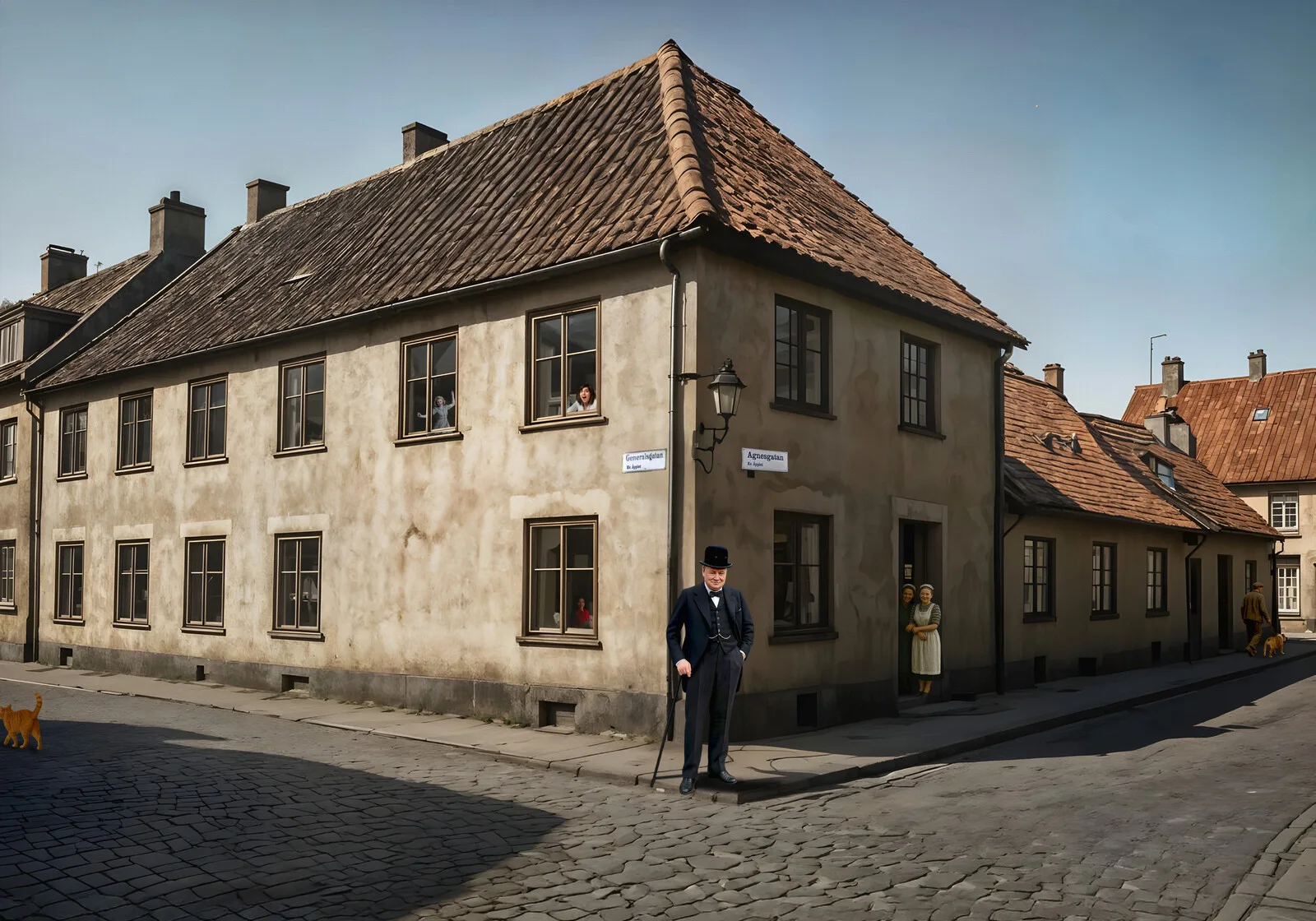
The Gentleman on the Corner, 2025
Digital
70 x 50 cm
3 200 kr
The Gentleman on the Corner
This is not a history lesson, nor is it quite a dream. It’s a whimsical tale that weaves through time and memory, inviting you into a fantasy and intrigue world.
It was an April Sunday morning in Malmö, 1947—or so we believe. The war had ended, yet its shadow lingered on the walls and in the weather reports. People returned to old habits not out of thought, but because belief itself had become a routine. The city, with its quiet streets and watchful demeanour, was a living testament to the historical context of the narrative.
And somewhere, a man who did not belong stood at the corner where two quiet streets meet.
Some say it was Winston Churchill. Others argue that it’s impossible. However, in matters of time, memory, and mild revenge, impossible is often merely a question of detail. Shrouded in mystery, the man's identity adds an intriguing layer to the narrative you'll be eager to unravel.
What follows is a story about absence and presence, politics and pettiness, and chocolate and white elephants. It's a unique blend of themes that will keep you engaged, set upon the cobblestones of a forgotten street in Malmö.
This is how it might have happened, or how it didn’t. Either way, it’s a story worth telling. Please click the link below to learn more about my pictures, writing, and why this story is a must-read.
https://www.konst.se/jorgenthornberg
The Gentleman on the Corner
What begins as a serene Sunday morning in postwar Malmö takes an unexpected turn, unfolding into a cosmic prank that spans centuries, wormholes, and whiskies. At its heart is Winston Churchill – Time-traveller, rogue historian, and occasional real estate saboteur – orchestrating a slapstick act of revenge on Sweden’s most stoic prime minister.
This is not just a story about Winston Churchill. It's a humorous blend of history and dream, a tale of white elephants, pink hallucinations, and the long shadows cast by colonial guilt, political mischief, and imperfect memory. Somewhere in it all: a chocolate sign, a red tabby cat, and the woman who danced alone on Sundays.
And of course, the gentleman on the corner. And please, read on to discover the powerful ending of this remarkable story.
”Before the Bell
In memory of a Sunday morning too quiet to trust,
when Malmö still wore its postwar coat,
and the city held its breath between two eras—
past smoke and future silence.
This is when time moves differently.
Before the first church bell,
before the factory whistles return,
before the cat rounds the corner toward the cemetery.
Between breakfast and belief.
Every city has its ghosts.
But Malmö’s don’t haunt—they observe.
From windows, from sewing machines,
from the edge of a tram’s whisper
and the crumb trail of a baker’s van.
You don’t hear them, not really.
But you feel them, like a coat that still holds warmth
from someone who left just a moment ago.
This is not just a story about Winston Churchill.
It’s about corners—those geographical afterthoughts
where history stops to tie its shoes
and eternity slips in through the side door.
It’s about the hour before the world wakes,
when only the birds are honest
and even Time sips its coffee more slowly.”
Malmö May 2025
The Gentleman on the Corner
Half past eight on an early Sunday morning, before the first bell calling for high mass. This was another time when people still went to church regardless of belief. It wasn't about God but about order, community, rites, and habit. The sermon acted as the week's compass—a public weather report on hope and sin, forgiveness and the social contract. The war ended two years ago and left its mark on the city. Its aftershocks still lingered, like a muffled resonance in conversations at home and work, in the preacher's voice and every pew.
At the corner of Agnesgatan and Generalsgatan, all was quiet. The city rested; Sunday was the week's pause for breath. Malmö Yllefabriks AB—known locally as "Doffeln"—was silent, its looms still on Studentgatan a few hundred metres away. No carts rumbled through back courtyards, no factory whistles blew. It was the only day of the week when the industry fell silent. As people worked six days a week, the rest day was well-earned. The air was crisp and clean, carrying the faint scent of freshly baked bread from a nearby bakery. The cobblestones felt cool underfoot, and the morning air tasted refreshing. This was the Sunday routine, a comforting familiarity in a world of change.
The blue sky above was empty. At this hour, it belonged to the birds. The first departure from Bulltofta airfield wouldn't lift off until half past nine—a silver propeller plane bound for Stockholm. The capital lay six hundred kilometres away, and for most people, the best part about it was the train back to Malmö. Flying was for the rich. And what was there to do up there? Just look at Crown Prince Gustaf Adolf—he'd crashed in Copenhagen in January. No, it was safer to stay close to the cobblestones. And at this hour, the air was free of mechanical roar—only birdsong and the distant hum of a tram.
Behind the windows of Agnesgatan, life stirred. A faint strain of dance music from a radio could be heard from an upstairs flat. A lone woman spun in slow circles. She danced by herself, one hand lifted as if holding someone she had once known. It was Harry Arnold's orchestra playing—the house band at Malmö's grand dance hall, Amiralen. 'Stand By' was their signature tune, and she danced to it every Sunday morning, a comforting routine amid change.
Down on Generalsgatan, a mottled red tabby cat padded off toward the cemetery, as if it, too, had a Sunday ritual. Each week, without fail, the cat made its way to the cemetery, a symbol of continuity and tradition in a changing world. Behind a corner window sat a woman in a red summer dress—not exactly church attire for high mass. If she was going, that is. She sat at a sewing machine, the old treadle kind. Perhaps she was trying on a newly sewn dress for the upcoming Midsummer celebration, just a few weeks away.
Toward Slottsparken, a weary man walked with his bulldog. He might work at Kockums, but today was his day off. His steps were unsteady—last night had likely been a wet one. He seemed to cling to the leash more than hold it. Beneath the street lamp at the corner stood a man in a bowler hat. He didn’t appear to belong here—a man from a finer world, one far removed from Gamla Väster. He wore a city suit with a waistcoat and pinstriped trousers. His double watch chains hinted at wealth and perhaps two time zones. London time, where it was still only half past six and Clementine was still asleep.
Surely, it was Winston Churchill standing on the pavement right at the corner of Agnesgatan and Generalsgatan. Two giggling maids peeked out of a nearby doorway, clearly watching the stranger. Perhaps he was lodging here, though the house was plain and worn. But the location was central—just over a hundred metres from Gustav Adolfs torg.
Sir Winston—if it was him—wore a wry smile. Perhaps that was how he viewed the city—Sweden’s third-largest, but possibly comparable to the borough of Westminster in London—Malmö’s centre as a small city in itself; Westminster, the heart of an empire. The gentleman’s gaze swept across the street as if he knew it—and didn’t. To him, it was like Malmö was a miniature Westminster: a pocket-sized city with cobblestones and bicycles instead of power and limousines.
The clock approached nine. Soon, the first church bell would ring from St. Petri, St. Johannes, and St. Pauli. The chime would roll through the city like a soft wave of remembrance: the week rested on this moment. And perhaps—just perhaps—the stranger on the corner smiled as if he knew something Malmö had yet to understand or had chosen to forget. His enigmatic smile hinted at a knowledge beyond the present, a secret of time and memory.
For many, the postwar years were a painful awakening. Before the war, German sympathies had been widespread in Skåne. Germany was that era’s America.
Or perhaps it was just a dream. One of those fragments remembers the moment you wake up, when shadows and faces are still vivid but already dissolving. Sweden’s—and Skåne’s—uneasy conscience for having backed the wrong horse has long since faded. Today’s Britons are rather like the Swedes.
I should mention that the image I’m sharing is, from my perspective, an amalgamation of time. It's a blend of then and now, 1947 and 2025. Admittedly, I met Winston at this very corner—but seventy-eight years after the scene I’ve depicted. In other words, you’re enjoying Winston’s creatively detailed account. Of the buildings behind him, nothing remains. The old man with the dog, the woman dancing upstairs, the giggling maids—all have moved on to some star in eternity, becoming Winston’s random neighbours. In their unique ways, these neighbours contributed to the charm and character of the corner where Winston and I met. This whimsical blend of past and present is a testament to the enduring power of memory and the passage of time.
Even though the distances, by human standards, appear vast—measured in primitive units like light years—the network of wormholes crisscrossing space, and the fourth dimension itself, means that, in principle, everyone lives next door. Despite the vast physical distances, this awe-inspiring interconnectedness of the universe allows us to be closer than we think, much like how we can instantly communicate with someone on the other side of the world.
This wasn’t even the first time I met Winston this year. We’ve run into each other on my Greek island, a picturesque paradise with crystal-clear waters and sun-drenched beaches, alongside two other Time-travellers: Leonard Cohen and his forever partner, Marianne Ihlen. Marianne is the reason I learned the story I’m about to retell. Winston, a unique and special individual, could verify that it’s been faithfully rendered when we later had coffee that May afternoon at Gustav Adolf.
"I can neither add a single word nor take one away," he said, with the conviction only Churchill can muster. Don’t forget, he convinced an entire nation to resist Hitler through sheer brutal honesty:
"I have nothing to offer but blood, toil, tears and sweat. We have before us an ordeal of the most grievous kind. We have before us many, many long months of struggle and suffering."
"We shall fight on the beaches,
We shall fight on the landing grounds,
We shall fight in the fields and the streets,
We shall fight in the hills;
We shall never surrender..."
A Churchillian Used Car Sales Pitch, however, is not something I’d recommend if you're trying to sell your car—or your house:
"I have nothing to offer but rust, rattles, fumes, and expensive reparations. As the new owner, you have an ordeal of the most grievous: an oil leak of unknown origin, a suspicious noise from the gearbox, and many, many tireless negotiations with the DMV.
The brakes may protest, the doors may stick, the wipers may wave in despair—
But I say to you:
You need to drive on the highways,
You must drive on the gravel roads,
Despite the car leaking in the rain and letting in the fog,
Sometimes you need to push it uphill or put a horse at the front and go downhill with a prayer.
You must never surrender—unless, of course, to the tow truck."
In the same way, think of selling your house like Churchill sold the war:
"Ladies and gentlemen,
I have nothing to offer but mould, draughts, ghosts in the attic, and creaking floors.
As an owner, you get a bathroom of the most grievous kind.
You must live with years of costly renovations, delayed plumbing, and arguments with the authorities.
But take heart!
You shall live through the rising damp,
You shall live with the neighbours’ techno at midnight,
You shall live with the collapsing roof and the haunted basement,
You shall live with dignity under a tarpaulin and scaffolding.
You shall never surrender—until the Debt Collector arrives."
A bit of important information about why Winston was standing at this particular corner: the view of the Mazetti sign across Generalsgatan. His memory of that chocolate had never left him. Malmö’s chocolate factory had made the only chocolate Winston considered worthy of competing with Cadbury. On Earth, the factory was bought by Finnish company Fazer, which shut it down. Of that once-proud brand, only the eyes remain—Fazer now uses the "Ögon" brand for cacao and baking chocolate. But Winston's memories, like those of the original owner, Danish confectioner Emil Nissen, now produce chocolate from his star, remaining enduring and secure for eternity.
Regarding the story Marianne told me while we had a glass of wine at a bar on Hydra, our shared Greek island might have been three glasses.
It is difficult to explain what transpired or did not transpire in 1947 when Winston first visited Sweden and Malmö. Different rules apply among the stars. Many of our strangest dreams are governed by those who have gone before us—beings who no longer walk the earth but whose presence in eternity affords them a certain access to our sleeping minds.
Most of us don’t notice it or remember it. What unfolds during the night rarely leaves any physical trace—only a vague feeling that something peculiar was dreamt. Sometimes it’s no more than parasocial communion: a brief glimpse of a deceased parent, a fleeting visit from an author one has never met. But sometimes... sometimes the forces gather for something larger. Often, there is a conductor, a figure orchestrating the events. Sometimes it is Winston, especially when white elephants are involved.
So it was that April night in 1947 when Winston, who then dwelled in eternity, seized the opportunity to give his old Swedish colleague Per Albin Hansson a loud but playful slap from beyond the grave. A spectacle staged in Malmö, involving a cast of unwitting British cartoon characters, fictional figures, and deceased celebrities—all unaware of their participation yet still moved by Winston’s cosmic script. The unexpected nature of this revenge would have left even the most astute historians in disbelief.
The Time Traveller Winston Churchill encountered the Swedish wartime prime minister among the stars. Per Albin was a newly arrived Time Traveller, having departed the world in October of the previous year.
The former Swedish prime minister had been ultimately responsible for Sweden's wartime policy of neutrality—something that irked Winston tremendously and proved hard to forget. Per Albin insisted Sweden walk a delicate tightrope between the warring powers to maintain neutrality. He ensured that Germany received the iron ore essential to its war industry, while at the same time Britain was supplied with ball bearings and anti-aircraft guns. Churchill had mixed feelings about Swedish neutrality. On the one hand, it limited Germany's capacity in the Baltic, which served British interests. On the other, it afforded the Nazis far too much use of Swedish territory, including the infamous “permittent traffic” and the transfer of an entire division from Norway to Finland—a blatant breach in Winston's view. Had Sweden been occupied, it would have considerably tied up German forces and reduced the pressure on England. In sum, Winston considered Per Albin's and Sweden's choices cowardly, which made the man worthy of a reckoning.
The event is recorded in the star-archives of eternity under the name The Phantom Parade — suitably ambiguous. I've described that episode elsewhere, from this street corner, but since some insist on labelling my account a cock-and-bull story, I owe a brief explanation. Aside from the absurd procession of nationalist characters from the British cultural subconscious, Winston also presented Per Albin with a white elephant. Not literally, of course — but with much the same effect. The white elephant, a symbol of a burdensome and unwanted gift, is the central theme of this tale.
The dilapidated building where Winston had spent a few nights proved ideal for his refined act of vengeance. His presence there resulted from a misunderstanding by his secretary, who had misread a brief notice in The Times.
"Attractive [location]," it said in a small advertisement for lodging in Malmö. That Winston had no intention of staying at the city’s luxury hotel, the Savoy, had to do with his desire to travel incognito, to remain below the radar, so to speak.
The central location was the crucial point. In realtor-speak, "attractive" often means nothing more than that the location is good — the building itself may be a ruin. And so it was. The property was best suited for demolition. It had cold running water and an outdoor privy, several steps down from what Winston was used to at his beloved Chartwell, south of London. Yet since even Chartwell had lacked modern amenities when he bought it in 1922, Winston accepted the situation rather than draw attention to himself. Malmö had three newspapers, and if journalists here were as sharp-eyed as in London, he would soon be splashed across the front pages, ruining the element of surprise.
Still, every misfortune brings a seed of opportunity. After a fitful first night, Winston conceived the idea of a white elephant in the shape of a house — a gift that might become Per Albin's ruin. Winston knew a great deal about white elephants. During his political career, he had owned an entire virtual herd.
On the second day, he sought out the house's owner, a widow who lived in a second-floor flat. She was an educated woman fluent in several languages, including his own. There had been no mention of a sale, but with the right offer, almost anything is negotiable. The widow was painfully aware of the building's dreadful condition. When Winston offered to pay in cash, in British pounds, she relented and sold the entire wreck to him.
The pound notes he used had been forged by the Germans in Theresienstadt — so expertly that not even the Bank of England could tell them from the real thing. Even the serial numbers matched. Winston had been given a briefcase full of them, earmarked for "special purposes," as the Bank's governor said. Such purposes were to be understood as acts in the national interest, and a metaphorical slap to Per Albin certainly qualified. The widow's bank exchanged the bills without hesitation, and physically speaking, the money soon found its way back to the Bank of England, now laundered, so to speak.
Today, Per Albin would hardly have accepted such a gift — not only because it would now be viewed as a blatant bribe, but also for its very nature as a white elephant. Still, Winston's plan did unfold, though not quite as he had intended. Even though Per Albin had been born in Malmö, his heart belonged to socialism and the next generation. The gift was immediately passed on to SSU, the Social Democratic youth league. They were the ones burdened with it. Yet over the following years, enthusiastic young volunteers managed to maintain the building through sheer will and elbow grease. That it was eventually sold and demolished is another story.
Now, at long last, it is time to speak of Winston's first white elephant — the one he gave Gandhi — and how Marianne Ihlen introduced me to the concept. We were sitting at the harbour in Hydra: she, her eternal companion Leonard Cohen, and I. We were talking about this and that when I noticed a necklace I hadn’t seen before—an elephant, carved from ivory, old enough not to be forbidden.
Only then did I notice that Marianne was wearing an additional necklace in addition to the gold chain she always wore. I leaned forward to get a better look, and she caught the question in my eyes.
“Quite right,” said Marianne, lifting the pendant so I could see it more clearly. “It’s an elephant. A white one, with a rather unusual history. It once belonged to Clementine Churchill. She received it from Winston on their fortieth wedding anniversary in September 1948. He, in turn, had been given it by a maharaja the year the war broke out. The elephant is carved from the tusks of a genuine white elephant. It may not look like much, but the chain is white gold. The elephant’s trunk is raised, as if to charge. A sort of veiled message. Clementine didn’t want to keep it, for reasons I’ll gladly share if you’ve the time to listen.”
“It’s worth adding,” Leonard chuckled, “that Winston never saw a white elephant in his life—only pink ones. They’d occasionally dance across the floor of his study when he’d had one too many whiskies. But go on, Marianne—tell George the whole story. It’s quite instructive.”
"Divide and Rule is an ancient Greek concept developed and refined during the British Empire. It's a strategy of maintaining control by creating divisions among the subjects. Winston was not unaware of the art of playing one against the other. The approach is first described in connection with Alexander the Great's father, Philip of Macedonia," Marianne began. The British often employed this strategy in their colonies, including India, to prevent unified resistance against their rule.
During the interwar period, the British Empire fell partly after the First World War. More and more people argued for independence, insisting that there must be an end to the time when a small island nation in Europe could extract wealth from entire continents, generation after generation. Winston was particularly concerned about the situation in India. He opposed not any attempt to allow India, the jewel in the king's crown, to gain independence. In that struggle, all means were permitted. Even the absurdity of white elephants, as it would turn out.
"Winston's main enemy in the India issue was Gandhi. The worlds of the two men could hardly look more different. Winston was born into Britain's most glamorous aristocratic family, while Gandhi hailed from a middle-class background in a small town in India. Yet their lives were intertwined in a fierce battle determining the fate of nations, continents, and an entire empire. The two were bitter adversaries over India's future, a nation of 300 million people speaking 147 languages and dialects and practising 15 different religions - the jewel in the crown of Britain's overseas empire for 200 years. This battle, fought on political, ideological, and moral grounds, would shape the future of India and the British Empire.
Gandhi had created a new political movement centred on civil disobedience. This approach was far more effective than weapons, employing nonviolence against Churchill and the British. Gandhi's famous Salt March would become the blueprint for civil rights movements and struggles for freedom worldwide. Churchill felt defenceless in such combat. Opening fire on innocent, unarmed dissidents garnered no support from the British public or other nations. Gandhi and his non-violent methods had earned respect around the globe, making it difficult to attack him. A man dressed in a cloak, sitting cross-legged and spinning yarn while imparting wisdom, is a formidable opponent. Cunning was necessary.
Regarding his opponent, Winston expressed his disgust at seeing Mr. Gandhi, a rebellious lawyer, pose as a fakir and walk half-naked up the stairs to the viceroy's palace. Words that did not seem to trouble Gandhi, he would later remark that he tried in vain to become a fakir. Winston realised that action was required. Words were futile.
Gandhi had to be attacked indirectly if he could not be directly confronted. Who or what? Winston understood his political game. One issue was the lack of organisation and structure behind the independence movement, represented by a small man spinning by hand. Regarding resources, a strong supporter of Gandhi was the Maharajah of Mysore in southern India. There was mutual respect between the two, and quite obviously, the monarch did not mind a liberated India, even if it meant losing his privileges. He was a modern man. One could target a dangerous enemy, the Maharajah, without armed forces.
Mahatma Gandhi had publicly praised the Maharaja for taking up spinning to benefit himself and his subjects. Gandhi remarked that the ruler was a Rajarishi, a saintly king, due to his efforts to alleviate poverty, secure rural reconstruction, and improve the health of his subjects. This mutual respect between Gandhi and the Maharaja is a testament to the depth of their relationship and the shared vision for a better India.
Employing his cunning strategy, Winston believed the Maharaja was the linchpin of Gandhi's success. He planned to eliminate the royal, thereby disrupting the possibility of India's separation from the British Empire. But how does one approach a powerful Maharaja if one cannot physically harm him? The answer lay in an age-old trick: offering a tribute he cannot refuse, a gift that historically brought ruin to its recipient. The Maharaja would be rendered powerless, a mere figurehead with a title, devoid of wealth and resources.
Winston's solution was a white elephant, an extravagant and rare albino gift that could not be easily discarded. In the past, a king could present such an animal to courtiers who had displeased him, leading to their downfall due to the costly upkeep of the sacred elephant. White elephants were revered and considered holy. His mother dreamed of a white elephant carrying a lotus flower the night before Buddha's birth. For over two millennia, the white tusker has been worshipped as a symbol of fertility and greatness and treated as a divinity. The recipient must provide the elephant with a stately home and food befitting their status. White elephants led a pampered existence, not used for work or war; they merely existed in grandeur beyond imagination.
It is easy to see that such a present, even as an honour, was a significant drain on any household's finances; it often served as a dreaded punishment, frequently resulting in the complete ruin of the person responsible for the animal's care. Elephants grow old, typically living over 80 years, worsening the predicament and constituting a lifetime punishment. Constructing a mini-Taj Mahal for an elephant is merely the beginning, and hiring many staff costs a fortune, a burden that could crush even the wealthiest of households.
A principal hairdresser for the tail is a full-time position, dedicated solely to the little tassel that, despite its relative smallness, would be styled, permed, and combed every five minutes; a barber would tend to the hair that grew on the head and cheeks, unbecoming of an otherwise gleaming white creature; four specialists would manage the daily pedicure—one for each foot—furthermore, a creamy wrapping of the toes was required before bedtime; make-up was indeed necessary as elephants received their daily adornment before being presented to visiting monks and the public; teeth whitening was a meticulous task, as was the care of the elephant's tusks, which were to be polished every six hours; massages would involve a dozen masseurs; a dozen bathers ensured that every pore on the animal remained white, and for mental wellness, a quartet of therapists and psychologists provided support; three saddlers and a jeweller were needed to maintain the elephant's diamond-set harness, alongside a dozen seamstresses for duvets and sleeping cushions—all made from imported silk.
A notable aspect was the diet, which outshone even the Maharaja's table. It necessitated four master chefs, all imported from France. Le Directeur de cuisine, who hailed from Lyon and had apprenticed under Auguste Escoffier, presided over the kitchen brigade; one might consider it a veritable organisation with fourteen employees, not including serving staff and dishwashers. A private driver, cleaners, an arena-raker, and so-called fine-touchers amounted to ninety-four people caring for a single white elephant.
"Sorry, I forgot the entertainment: a smaller orchestra, and, of course, the most important, the elephant's jockey, or butler, as he was titled. That is, over one hundred full-time employees. No wonder Winston laughed a lot and toasted himself so intensely for his upcoming success that the pink elephants appeared in his study," Marianne said, a little embarrassed.
Winston had discovered all this. He also learned that the Maharajah of Mysore was a man who fulfilled his duties even if they caused discomfort. The challenge was finding a white elephant elegant enough for such a recipient. After much effort, his employees identified the right quality in Thailand. The animal was as white as Winston's bed sheets, but was too old to serve his purposes. Life is full of compromises, and sixty years is no age; until the animal reached eighty, the Maharajah could never endure. Winston estimated the monarch's prolonged downfall to be a maximum of four years.
"As with Gallipoli and other defeats, Winston was sometimes a little optimistic," Leonard interrupted. "In the case of Hitler, it turned out to be an asset, but the choice of an elephant, hardly."
The Maharaja was delighted when presented with the beautiful, outstanding animal in India. He happily accepted the white elephant, but unfortunately, his royal highness could not afford such a gift. The Maharajah's love for the elephant was evident in his joy at its arrival, despite the financial strain it would cause.
The Maharaja immediately commenced the construction of a stately stable in the same Indo-Saracen style as the castle. He hired staff from Europe. Churchill, however, was fully occupied with Germany's rearmament and the domestic abdication crisis. He did not have much time for the animal in India, which was probably devouring its master's assets. Time passed, and one crisis in Europe replaced another. The old war-monger, Winston, felt in his spine that there were better times ahead for himself. Soon, according to all indications, he would be back in hot water, with a new primary opponent waiting: Adolf Hitler. The fakir would have to wait until after the war, which Winston desperately hoped for. Occasionally, he wondered when the Times of India would announce the Maharajah's bankruptcy. Yet, reality does not always unfold as one dreams. Instead of becoming poorer, the Maharajah only grew richer; at his death in 1940, he was not just the second richest man in India but one of the wealthiest men in the world. He managed to survive his elephant for just over a year.
"After the elephant died in the spring of 1939 of natural causes, and a national mourning was proclaimed for a week, the Maharaja sent Winston this eloquent but straightforward piece of jewellery, which conveyed more than a thousand words about contemporary Indian history. A tiny fragment of the right tusk had been sculpted into a miniature of the sacred animal.
I would not say Winston was particularly pleased with the gift, as it reminded him of one of his failures. He had accumulated such failures over the years. He was still in what he characterised as his "Wilderness Years" and had to content himself with yelling at everything and everyone from his beloved Chartwell. That was where the jewellery arrived and where he orchestrated the reason for the gift.
"What goes around comes around," Leonard said gleefully.
"Fantastic how well-read you are," I said, impressed.
"Everything Clementine has told us. She was not always enthusiastic about her husband's actions, but she was always loyal. But he got hauled coming home. On the other hand, he justified his stupidity afterwards. That's the limit. Smart woman. We understand each other well," said Marianne, but she did not look at Leonard.
"You forgot to mention a piquant detail, that the Maharajah also paid an old debt of honour owed by Winston," Leonard pointed out, rounding off. After a visit to the legendary snobbish Bangalore Club in 1868, Lt. W.L.S. Churchill owed 13 rupees, Rs 13, which thirty years later had been written off as an 'irrevocable debt.' The eleven-hectare country club in the heart of Bangalore, with its high ceilings, sumptuous chandeliers, cosy bars, lavish interiors, and jacaranda wood dance floors, has attracted Britons since the mid-nineteenth century. Winston had only been there once, and although his debt may have been written off, it was not forgotten. The Maharajah paid the club one hundred pounds sterling for the debt plus interest on interest and a complementary sum for a wrecked chair, resulting from a minor skirmish between two officers, of which Winston was one. The other died during the First World War, so Winston had to bear all the damage in solidarity with him. "It took them several minutes to finish laughing.
"You've met Winston, George. Did he tell any anecdotes from his long life?" Marianne asked with interest.
"Many, but not this one. As I recall, there was seldom any self-mockery in Churchill’s stories. It isn't very likely he would have told you this one himself. I suppose it's Clementine's version, none crafted." No matter how hard I tried, I could not muster a single laugh at him during our half-day together. Okay, we were probably pretty drunk by the end.
"Winston has never told us how you met, only that you ran into each other at the bastion and had a wet lunch together. Maybe you can tell us more in detail about that day." Leonard looked a little sensational—a new kind of smile for him.
"Not exactly running. Churchill sat on his chair and painted with a glass in his other hand, and I came panting up the hill," I said, starting my story. But that part must wait until next time.
Jörgen Thornberg
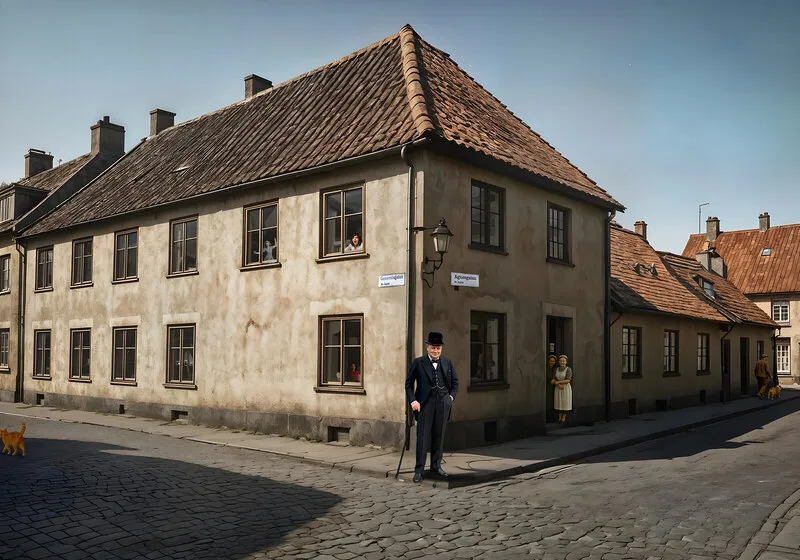
The Gentleman on the Corner, 2025
Digital
70 x 50 cm
3 200 kr
The Gentleman on the Corner
This is not a history lesson, nor is it quite a dream. It’s a whimsical tale that weaves through time and memory, inviting you into a fantasy and intrigue world.
It was an April Sunday morning in Malmö, 1947—or so we believe. The war had ended, yet its shadow lingered on the walls and in the weather reports. People returned to old habits not out of thought, but because belief itself had become a routine. The city, with its quiet streets and watchful demeanour, was a living testament to the historical context of the narrative.
And somewhere, a man who did not belong stood at the corner where two quiet streets meet.
Some say it was Winston Churchill. Others argue that it’s impossible. However, in matters of time, memory, and mild revenge, impossible is often merely a question of detail. Shrouded in mystery, the man's identity adds an intriguing layer to the narrative you'll be eager to unravel.
What follows is a story about absence and presence, politics and pettiness, and chocolate and white elephants. It's a unique blend of themes that will keep you engaged, set upon the cobblestones of a forgotten street in Malmö.
This is how it might have happened, or how it didn’t. Either way, it’s a story worth telling. Please click the link below to learn more about my pictures, writing, and why this story is a must-read.
https://www.konst.se/jorgenthornberg
The Gentleman on the Corner
What begins as a serene Sunday morning in postwar Malmö takes an unexpected turn, unfolding into a cosmic prank that spans centuries, wormholes, and whiskies. At its heart is Winston Churchill – Time-traveller, rogue historian, and occasional real estate saboteur – orchestrating a slapstick act of revenge on Sweden’s most stoic prime minister.
This is not just a story about Winston Churchill. It's a humorous blend of history and dream, a tale of white elephants, pink hallucinations, and the long shadows cast by colonial guilt, political mischief, and imperfect memory. Somewhere in it all: a chocolate sign, a red tabby cat, and the woman who danced alone on Sundays.
And of course, the gentleman on the corner. And please, read on to discover the powerful ending of this remarkable story.
”Before the Bell
In memory of a Sunday morning too quiet to trust,
when Malmö still wore its postwar coat,
and the city held its breath between two eras—
past smoke and future silence.
This is when time moves differently.
Before the first church bell,
before the factory whistles return,
before the cat rounds the corner toward the cemetery.
Between breakfast and belief.
Every city has its ghosts.
But Malmö’s don’t haunt—they observe.
From windows, from sewing machines,
from the edge of a tram’s whisper
and the crumb trail of a baker’s van.
You don’t hear them, not really.
But you feel them, like a coat that still holds warmth
from someone who left just a moment ago.
This is not just a story about Winston Churchill.
It’s about corners—those geographical afterthoughts
where history stops to tie its shoes
and eternity slips in through the side door.
It’s about the hour before the world wakes,
when only the birds are honest
and even Time sips its coffee more slowly.”
Malmö May 2025
The Gentleman on the Corner
Half past eight on an early Sunday morning, before the first bell calling for high mass. This was another time when people still went to church regardless of belief. It wasn't about God but about order, community, rites, and habit. The sermon acted as the week's compass—a public weather report on hope and sin, forgiveness and the social contract. The war ended two years ago and left its mark on the city. Its aftershocks still lingered, like a muffled resonance in conversations at home and work, in the preacher's voice and every pew.
At the corner of Agnesgatan and Generalsgatan, all was quiet. The city rested; Sunday was the week's pause for breath. Malmö Yllefabriks AB—known locally as "Doffeln"—was silent, its looms still on Studentgatan a few hundred metres away. No carts rumbled through back courtyards, no factory whistles blew. It was the only day of the week when the industry fell silent. As people worked six days a week, the rest day was well-earned. The air was crisp and clean, carrying the faint scent of freshly baked bread from a nearby bakery. The cobblestones felt cool underfoot, and the morning air tasted refreshing. This was the Sunday routine, a comforting familiarity in a world of change.
The blue sky above was empty. At this hour, it belonged to the birds. The first departure from Bulltofta airfield wouldn't lift off until half past nine—a silver propeller plane bound for Stockholm. The capital lay six hundred kilometres away, and for most people, the best part about it was the train back to Malmö. Flying was for the rich. And what was there to do up there? Just look at Crown Prince Gustaf Adolf—he'd crashed in Copenhagen in January. No, it was safer to stay close to the cobblestones. And at this hour, the air was free of mechanical roar—only birdsong and the distant hum of a tram.
Behind the windows of Agnesgatan, life stirred. A faint strain of dance music from a radio could be heard from an upstairs flat. A lone woman spun in slow circles. She danced by herself, one hand lifted as if holding someone she had once known. It was Harry Arnold's orchestra playing—the house band at Malmö's grand dance hall, Amiralen. 'Stand By' was their signature tune, and she danced to it every Sunday morning, a comforting routine amid change.
Down on Generalsgatan, a mottled red tabby cat padded off toward the cemetery, as if it, too, had a Sunday ritual. Each week, without fail, the cat made its way to the cemetery, a symbol of continuity and tradition in a changing world. Behind a corner window sat a woman in a red summer dress—not exactly church attire for high mass. If she was going, that is. She sat at a sewing machine, the old treadle kind. Perhaps she was trying on a newly sewn dress for the upcoming Midsummer celebration, just a few weeks away.
Toward Slottsparken, a weary man walked with his bulldog. He might work at Kockums, but today was his day off. His steps were unsteady—last night had likely been a wet one. He seemed to cling to the leash more than hold it. Beneath the street lamp at the corner stood a man in a bowler hat. He didn’t appear to belong here—a man from a finer world, one far removed from Gamla Väster. He wore a city suit with a waistcoat and pinstriped trousers. His double watch chains hinted at wealth and perhaps two time zones. London time, where it was still only half past six and Clementine was still asleep.
Surely, it was Winston Churchill standing on the pavement right at the corner of Agnesgatan and Generalsgatan. Two giggling maids peeked out of a nearby doorway, clearly watching the stranger. Perhaps he was lodging here, though the house was plain and worn. But the location was central—just over a hundred metres from Gustav Adolfs torg.
Sir Winston—if it was him—wore a wry smile. Perhaps that was how he viewed the city—Sweden’s third-largest, but possibly comparable to the borough of Westminster in London—Malmö’s centre as a small city in itself; Westminster, the heart of an empire. The gentleman’s gaze swept across the street as if he knew it—and didn’t. To him, it was like Malmö was a miniature Westminster: a pocket-sized city with cobblestones and bicycles instead of power and limousines.
The clock approached nine. Soon, the first church bell would ring from St. Petri, St. Johannes, and St. Pauli. The chime would roll through the city like a soft wave of remembrance: the week rested on this moment. And perhaps—just perhaps—the stranger on the corner smiled as if he knew something Malmö had yet to understand or had chosen to forget. His enigmatic smile hinted at a knowledge beyond the present, a secret of time and memory.
For many, the postwar years were a painful awakening. Before the war, German sympathies had been widespread in Skåne. Germany was that era’s America.
Or perhaps it was just a dream. One of those fragments remembers the moment you wake up, when shadows and faces are still vivid but already dissolving. Sweden’s—and Skåne’s—uneasy conscience for having backed the wrong horse has long since faded. Today’s Britons are rather like the Swedes.
I should mention that the image I’m sharing is, from my perspective, an amalgamation of time. It's a blend of then and now, 1947 and 2025. Admittedly, I met Winston at this very corner—but seventy-eight years after the scene I’ve depicted. In other words, you’re enjoying Winston’s creatively detailed account. Of the buildings behind him, nothing remains. The old man with the dog, the woman dancing upstairs, the giggling maids—all have moved on to some star in eternity, becoming Winston’s random neighbours. In their unique ways, these neighbours contributed to the charm and character of the corner where Winston and I met. This whimsical blend of past and present is a testament to the enduring power of memory and the passage of time.
Even though the distances, by human standards, appear vast—measured in primitive units like light years—the network of wormholes crisscrossing space, and the fourth dimension itself, means that, in principle, everyone lives next door. Despite the vast physical distances, this awe-inspiring interconnectedness of the universe allows us to be closer than we think, much like how we can instantly communicate with someone on the other side of the world.
This wasn’t even the first time I met Winston this year. We’ve run into each other on my Greek island, a picturesque paradise with crystal-clear waters and sun-drenched beaches, alongside two other Time-travellers: Leonard Cohen and his forever partner, Marianne Ihlen. Marianne is the reason I learned the story I’m about to retell. Winston, a unique and special individual, could verify that it’s been faithfully rendered when we later had coffee that May afternoon at Gustav Adolf.
"I can neither add a single word nor take one away," he said, with the conviction only Churchill can muster. Don’t forget, he convinced an entire nation to resist Hitler through sheer brutal honesty:
"I have nothing to offer but blood, toil, tears and sweat. We have before us an ordeal of the most grievous kind. We have before us many, many long months of struggle and suffering."
"We shall fight on the beaches,
We shall fight on the landing grounds,
We shall fight in the fields and the streets,
We shall fight in the hills;
We shall never surrender..."
A Churchillian Used Car Sales Pitch, however, is not something I’d recommend if you're trying to sell your car—or your house:
"I have nothing to offer but rust, rattles, fumes, and expensive reparations. As the new owner, you have an ordeal of the most grievous: an oil leak of unknown origin, a suspicious noise from the gearbox, and many, many tireless negotiations with the DMV.
The brakes may protest, the doors may stick, the wipers may wave in despair—
But I say to you:
You need to drive on the highways,
You must drive on the gravel roads,
Despite the car leaking in the rain and letting in the fog,
Sometimes you need to push it uphill or put a horse at the front and go downhill with a prayer.
You must never surrender—unless, of course, to the tow truck."
In the same way, think of selling your house like Churchill sold the war:
"Ladies and gentlemen,
I have nothing to offer but mould, draughts, ghosts in the attic, and creaking floors.
As an owner, you get a bathroom of the most grievous kind.
You must live with years of costly renovations, delayed plumbing, and arguments with the authorities.
But take heart!
You shall live through the rising damp,
You shall live with the neighbours’ techno at midnight,
You shall live with the collapsing roof and the haunted basement,
You shall live with dignity under a tarpaulin and scaffolding.
You shall never surrender—until the Debt Collector arrives."
A bit of important information about why Winston was standing at this particular corner: the view of the Mazetti sign across Generalsgatan. His memory of that chocolate had never left him. Malmö’s chocolate factory had made the only chocolate Winston considered worthy of competing with Cadbury. On Earth, the factory was bought by Finnish company Fazer, which shut it down. Of that once-proud brand, only the eyes remain—Fazer now uses the "Ögon" brand for cacao and baking chocolate. But Winston's memories, like those of the original owner, Danish confectioner Emil Nissen, now produce chocolate from his star, remaining enduring and secure for eternity.
Regarding the story Marianne told me while we had a glass of wine at a bar on Hydra, our shared Greek island might have been three glasses.
It is difficult to explain what transpired or did not transpire in 1947 when Winston first visited Sweden and Malmö. Different rules apply among the stars. Many of our strangest dreams are governed by those who have gone before us—beings who no longer walk the earth but whose presence in eternity affords them a certain access to our sleeping minds.
Most of us don’t notice it or remember it. What unfolds during the night rarely leaves any physical trace—only a vague feeling that something peculiar was dreamt. Sometimes it’s no more than parasocial communion: a brief glimpse of a deceased parent, a fleeting visit from an author one has never met. But sometimes... sometimes the forces gather for something larger. Often, there is a conductor, a figure orchestrating the events. Sometimes it is Winston, especially when white elephants are involved.
So it was that April night in 1947 when Winston, who then dwelled in eternity, seized the opportunity to give his old Swedish colleague Per Albin Hansson a loud but playful slap from beyond the grave. A spectacle staged in Malmö, involving a cast of unwitting British cartoon characters, fictional figures, and deceased celebrities—all unaware of their participation yet still moved by Winston’s cosmic script. The unexpected nature of this revenge would have left even the most astute historians in disbelief.
The Time Traveller Winston Churchill encountered the Swedish wartime prime minister among the stars. Per Albin was a newly arrived Time Traveller, having departed the world in October of the previous year.
The former Swedish prime minister had been ultimately responsible for Sweden's wartime policy of neutrality—something that irked Winston tremendously and proved hard to forget. Per Albin insisted Sweden walk a delicate tightrope between the warring powers to maintain neutrality. He ensured that Germany received the iron ore essential to its war industry, while at the same time Britain was supplied with ball bearings and anti-aircraft guns. Churchill had mixed feelings about Swedish neutrality. On the one hand, it limited Germany's capacity in the Baltic, which served British interests. On the other, it afforded the Nazis far too much use of Swedish territory, including the infamous “permittent traffic” and the transfer of an entire division from Norway to Finland—a blatant breach in Winston's view. Had Sweden been occupied, it would have considerably tied up German forces and reduced the pressure on England. In sum, Winston considered Per Albin's and Sweden's choices cowardly, which made the man worthy of a reckoning.
The event is recorded in the star-archives of eternity under the name The Phantom Parade — suitably ambiguous. I've described that episode elsewhere, from this street corner, but since some insist on labelling my account a cock-and-bull story, I owe a brief explanation. Aside from the absurd procession of nationalist characters from the British cultural subconscious, Winston also presented Per Albin with a white elephant. Not literally, of course — but with much the same effect. The white elephant, a symbol of a burdensome and unwanted gift, is the central theme of this tale.
The dilapidated building where Winston had spent a few nights proved ideal for his refined act of vengeance. His presence there resulted from a misunderstanding by his secretary, who had misread a brief notice in The Times.
"Attractive [location]," it said in a small advertisement for lodging in Malmö. That Winston had no intention of staying at the city’s luxury hotel, the Savoy, had to do with his desire to travel incognito, to remain below the radar, so to speak.
The central location was the crucial point. In realtor-speak, "attractive" often means nothing more than that the location is good — the building itself may be a ruin. And so it was. The property was best suited for demolition. It had cold running water and an outdoor privy, several steps down from what Winston was used to at his beloved Chartwell, south of London. Yet since even Chartwell had lacked modern amenities when he bought it in 1922, Winston accepted the situation rather than draw attention to himself. Malmö had three newspapers, and if journalists here were as sharp-eyed as in London, he would soon be splashed across the front pages, ruining the element of surprise.
Still, every misfortune brings a seed of opportunity. After a fitful first night, Winston conceived the idea of a white elephant in the shape of a house — a gift that might become Per Albin's ruin. Winston knew a great deal about white elephants. During his political career, he had owned an entire virtual herd.
On the second day, he sought out the house's owner, a widow who lived in a second-floor flat. She was an educated woman fluent in several languages, including his own. There had been no mention of a sale, but with the right offer, almost anything is negotiable. The widow was painfully aware of the building's dreadful condition. When Winston offered to pay in cash, in British pounds, she relented and sold the entire wreck to him.
The pound notes he used had been forged by the Germans in Theresienstadt — so expertly that not even the Bank of England could tell them from the real thing. Even the serial numbers matched. Winston had been given a briefcase full of them, earmarked for "special purposes," as the Bank's governor said. Such purposes were to be understood as acts in the national interest, and a metaphorical slap to Per Albin certainly qualified. The widow's bank exchanged the bills without hesitation, and physically speaking, the money soon found its way back to the Bank of England, now laundered, so to speak.
Today, Per Albin would hardly have accepted such a gift — not only because it would now be viewed as a blatant bribe, but also for its very nature as a white elephant. Still, Winston's plan did unfold, though not quite as he had intended. Even though Per Albin had been born in Malmö, his heart belonged to socialism and the next generation. The gift was immediately passed on to SSU, the Social Democratic youth league. They were the ones burdened with it. Yet over the following years, enthusiastic young volunteers managed to maintain the building through sheer will and elbow grease. That it was eventually sold and demolished is another story.
Now, at long last, it is time to speak of Winston's first white elephant — the one he gave Gandhi — and how Marianne Ihlen introduced me to the concept. We were sitting at the harbour in Hydra: she, her eternal companion Leonard Cohen, and I. We were talking about this and that when I noticed a necklace I hadn’t seen before—an elephant, carved from ivory, old enough not to be forbidden.
Only then did I notice that Marianne was wearing an additional necklace in addition to the gold chain she always wore. I leaned forward to get a better look, and she caught the question in my eyes.
“Quite right,” said Marianne, lifting the pendant so I could see it more clearly. “It’s an elephant. A white one, with a rather unusual history. It once belonged to Clementine Churchill. She received it from Winston on their fortieth wedding anniversary in September 1948. He, in turn, had been given it by a maharaja the year the war broke out. The elephant is carved from the tusks of a genuine white elephant. It may not look like much, but the chain is white gold. The elephant’s trunk is raised, as if to charge. A sort of veiled message. Clementine didn’t want to keep it, for reasons I’ll gladly share if you’ve the time to listen.”
“It’s worth adding,” Leonard chuckled, “that Winston never saw a white elephant in his life—only pink ones. They’d occasionally dance across the floor of his study when he’d had one too many whiskies. But go on, Marianne—tell George the whole story. It’s quite instructive.”
"Divide and Rule is an ancient Greek concept developed and refined during the British Empire. It's a strategy of maintaining control by creating divisions among the subjects. Winston was not unaware of the art of playing one against the other. The approach is first described in connection with Alexander the Great's father, Philip of Macedonia," Marianne began. The British often employed this strategy in their colonies, including India, to prevent unified resistance against their rule.
During the interwar period, the British Empire fell partly after the First World War. More and more people argued for independence, insisting that there must be an end to the time when a small island nation in Europe could extract wealth from entire continents, generation after generation. Winston was particularly concerned about the situation in India. He opposed not any attempt to allow India, the jewel in the king's crown, to gain independence. In that struggle, all means were permitted. Even the absurdity of white elephants, as it would turn out.
"Winston's main enemy in the India issue was Gandhi. The worlds of the two men could hardly look more different. Winston was born into Britain's most glamorous aristocratic family, while Gandhi hailed from a middle-class background in a small town in India. Yet their lives were intertwined in a fierce battle determining the fate of nations, continents, and an entire empire. The two were bitter adversaries over India's future, a nation of 300 million people speaking 147 languages and dialects and practising 15 different religions - the jewel in the crown of Britain's overseas empire for 200 years. This battle, fought on political, ideological, and moral grounds, would shape the future of India and the British Empire.
Gandhi had created a new political movement centred on civil disobedience. This approach was far more effective than weapons, employing nonviolence against Churchill and the British. Gandhi's famous Salt March would become the blueprint for civil rights movements and struggles for freedom worldwide. Churchill felt defenceless in such combat. Opening fire on innocent, unarmed dissidents garnered no support from the British public or other nations. Gandhi and his non-violent methods had earned respect around the globe, making it difficult to attack him. A man dressed in a cloak, sitting cross-legged and spinning yarn while imparting wisdom, is a formidable opponent. Cunning was necessary.
Regarding his opponent, Winston expressed his disgust at seeing Mr. Gandhi, a rebellious lawyer, pose as a fakir and walk half-naked up the stairs to the viceroy's palace. Words that did not seem to trouble Gandhi, he would later remark that he tried in vain to become a fakir. Winston realised that action was required. Words were futile.
Gandhi had to be attacked indirectly if he could not be directly confronted. Who or what? Winston understood his political game. One issue was the lack of organisation and structure behind the independence movement, represented by a small man spinning by hand. Regarding resources, a strong supporter of Gandhi was the Maharajah of Mysore in southern India. There was mutual respect between the two, and quite obviously, the monarch did not mind a liberated India, even if it meant losing his privileges. He was a modern man. One could target a dangerous enemy, the Maharajah, without armed forces.
Mahatma Gandhi had publicly praised the Maharaja for taking up spinning to benefit himself and his subjects. Gandhi remarked that the ruler was a Rajarishi, a saintly king, due to his efforts to alleviate poverty, secure rural reconstruction, and improve the health of his subjects. This mutual respect between Gandhi and the Maharaja is a testament to the depth of their relationship and the shared vision for a better India.
Employing his cunning strategy, Winston believed the Maharaja was the linchpin of Gandhi's success. He planned to eliminate the royal, thereby disrupting the possibility of India's separation from the British Empire. But how does one approach a powerful Maharaja if one cannot physically harm him? The answer lay in an age-old trick: offering a tribute he cannot refuse, a gift that historically brought ruin to its recipient. The Maharaja would be rendered powerless, a mere figurehead with a title, devoid of wealth and resources.
Winston's solution was a white elephant, an extravagant and rare albino gift that could not be easily discarded. In the past, a king could present such an animal to courtiers who had displeased him, leading to their downfall due to the costly upkeep of the sacred elephant. White elephants were revered and considered holy. His mother dreamed of a white elephant carrying a lotus flower the night before Buddha's birth. For over two millennia, the white tusker has been worshipped as a symbol of fertility and greatness and treated as a divinity. The recipient must provide the elephant with a stately home and food befitting their status. White elephants led a pampered existence, not used for work or war; they merely existed in grandeur beyond imagination.
It is easy to see that such a present, even as an honour, was a significant drain on any household's finances; it often served as a dreaded punishment, frequently resulting in the complete ruin of the person responsible for the animal's care. Elephants grow old, typically living over 80 years, worsening the predicament and constituting a lifetime punishment. Constructing a mini-Taj Mahal for an elephant is merely the beginning, and hiring many staff costs a fortune, a burden that could crush even the wealthiest of households.
A principal hairdresser for the tail is a full-time position, dedicated solely to the little tassel that, despite its relative smallness, would be styled, permed, and combed every five minutes; a barber would tend to the hair that grew on the head and cheeks, unbecoming of an otherwise gleaming white creature; four specialists would manage the daily pedicure—one for each foot—furthermore, a creamy wrapping of the toes was required before bedtime; make-up was indeed necessary as elephants received their daily adornment before being presented to visiting monks and the public; teeth whitening was a meticulous task, as was the care of the elephant's tusks, which were to be polished every six hours; massages would involve a dozen masseurs; a dozen bathers ensured that every pore on the animal remained white, and for mental wellness, a quartet of therapists and psychologists provided support; three saddlers and a jeweller were needed to maintain the elephant's diamond-set harness, alongside a dozen seamstresses for duvets and sleeping cushions—all made from imported silk.
A notable aspect was the diet, which outshone even the Maharaja's table. It necessitated four master chefs, all imported from France. Le Directeur de cuisine, who hailed from Lyon and had apprenticed under Auguste Escoffier, presided over the kitchen brigade; one might consider it a veritable organisation with fourteen employees, not including serving staff and dishwashers. A private driver, cleaners, an arena-raker, and so-called fine-touchers amounted to ninety-four people caring for a single white elephant.
"Sorry, I forgot the entertainment: a smaller orchestra, and, of course, the most important, the elephant's jockey, or butler, as he was titled. That is, over one hundred full-time employees. No wonder Winston laughed a lot and toasted himself so intensely for his upcoming success that the pink elephants appeared in his study," Marianne said, a little embarrassed.
Winston had discovered all this. He also learned that the Maharajah of Mysore was a man who fulfilled his duties even if they caused discomfort. The challenge was finding a white elephant elegant enough for such a recipient. After much effort, his employees identified the right quality in Thailand. The animal was as white as Winston's bed sheets, but was too old to serve his purposes. Life is full of compromises, and sixty years is no age; until the animal reached eighty, the Maharajah could never endure. Winston estimated the monarch's prolonged downfall to be a maximum of four years.
"As with Gallipoli and other defeats, Winston was sometimes a little optimistic," Leonard interrupted. "In the case of Hitler, it turned out to be an asset, but the choice of an elephant, hardly."
The Maharaja was delighted when presented with the beautiful, outstanding animal in India. He happily accepted the white elephant, but unfortunately, his royal highness could not afford such a gift. The Maharajah's love for the elephant was evident in his joy at its arrival, despite the financial strain it would cause.
The Maharaja immediately commenced the construction of a stately stable in the same Indo-Saracen style as the castle. He hired staff from Europe. Churchill, however, was fully occupied with Germany's rearmament and the domestic abdication crisis. He did not have much time for the animal in India, which was probably devouring its master's assets. Time passed, and one crisis in Europe replaced another. The old war-monger, Winston, felt in his spine that there were better times ahead for himself. Soon, according to all indications, he would be back in hot water, with a new primary opponent waiting: Adolf Hitler. The fakir would have to wait until after the war, which Winston desperately hoped for. Occasionally, he wondered when the Times of India would announce the Maharajah's bankruptcy. Yet, reality does not always unfold as one dreams. Instead of becoming poorer, the Maharajah only grew richer; at his death in 1940, he was not just the second richest man in India but one of the wealthiest men in the world. He managed to survive his elephant for just over a year.
"After the elephant died in the spring of 1939 of natural causes, and a national mourning was proclaimed for a week, the Maharaja sent Winston this eloquent but straightforward piece of jewellery, which conveyed more than a thousand words about contemporary Indian history. A tiny fragment of the right tusk had been sculpted into a miniature of the sacred animal.
I would not say Winston was particularly pleased with the gift, as it reminded him of one of his failures. He had accumulated such failures over the years. He was still in what he characterised as his "Wilderness Years" and had to content himself with yelling at everything and everyone from his beloved Chartwell. That was where the jewellery arrived and where he orchestrated the reason for the gift.
"What goes around comes around," Leonard said gleefully.
"Fantastic how well-read you are," I said, impressed.
"Everything Clementine has told us. She was not always enthusiastic about her husband's actions, but she was always loyal. But he got hauled coming home. On the other hand, he justified his stupidity afterwards. That's the limit. Smart woman. We understand each other well," said Marianne, but she did not look at Leonard.
"You forgot to mention a piquant detail, that the Maharajah also paid an old debt of honour owed by Winston," Leonard pointed out, rounding off. After a visit to the legendary snobbish Bangalore Club in 1868, Lt. W.L.S. Churchill owed 13 rupees, Rs 13, which thirty years later had been written off as an 'irrevocable debt.' The eleven-hectare country club in the heart of Bangalore, with its high ceilings, sumptuous chandeliers, cosy bars, lavish interiors, and jacaranda wood dance floors, has attracted Britons since the mid-nineteenth century. Winston had only been there once, and although his debt may have been written off, it was not forgotten. The Maharajah paid the club one hundred pounds sterling for the debt plus interest on interest and a complementary sum for a wrecked chair, resulting from a minor skirmish between two officers, of which Winston was one. The other died during the First World War, so Winston had to bear all the damage in solidarity with him. "It took them several minutes to finish laughing.
"You've met Winston, George. Did he tell any anecdotes from his long life?" Marianne asked with interest.
"Many, but not this one. As I recall, there was seldom any self-mockery in Churchill’s stories. It isn't very likely he would have told you this one himself. I suppose it's Clementine's version, none crafted." No matter how hard I tried, I could not muster a single laugh at him during our half-day together. Okay, we were probably pretty drunk by the end.
"Winston has never told us how you met, only that you ran into each other at the bastion and had a wet lunch together. Maybe you can tell us more in detail about that day." Leonard looked a little sensational—a new kind of smile for him.
"Not exactly running. Churchill sat on his chair and painted with a glass in his other hand, and I came panting up the hill," I said, starting my story. But that part must wait until next time.
3 200 kr

Jörgen Thornberg
Malmö
Lite om bilder och mig. Translation in English at the end.
Jag är en nyfiken person som ser allt i bilder, även det jag fäster i ord, gärna tillsammans för bakom alla mina bilder finns en berättelse. Till vissa bilder hör en kortare eller längre novell som följer med bilden.
Bilder berättar historier. Jag omges av naturlig skönhet, intressanta människor och historia var jag än går. Jag använder min kamera för att dokumentera världen och blanda det jag ser med vad jag känner för att fånga den dolda magin.
Mina bilder berättar mina historier. Genom mina bilder, tryck och berättelser. Jag bjuder in dig att ta del av dessa berättelser, in i ditt liv och hem och dela min mycket personliga syn på vår värld. Mer än vad ögat ser. Jag tänker i bilder, drömmer och skriver och pratar om dem; följaktligen måste jag också skapa bilder. De blir vad jag ser, inte nödvändigtvis begränsade till verkligheten. Det finns en bild runt varje hörn. Jag hoppas att du kommer att se vad jag såg och gilla det.
Jag är också en skrivande person och till många bilder hör en kortare eller längre essay. Den följer med tavlan, tryckt på fint papper och med en personlig hälsning från mig.
Flertalet bilder startar sin resa i min kamera. Enkelt förklarat beskriver jag bilden jag ser i mitt inre, upplevd eller fantiserad. Bilden uppstår inom mig redan innan jag fått okularet till ögat. På bråkdelen av ett ögonblick ser jag vad jag vill ha och vad som kan göras med bilden. Här skall jag stoppa in en giraff, stålmannen, Titanic eller vad det är min fantasi finner ut. Ännu märkligare är att jag kommer ihåg minnesbilden långt efteråt när det blir tid att skapa verket. Om jag lyckas eller inte, är upp till betraktaren, oftast präglat av en stråk av svart humor – meningen är att man skall bli underhållen. Mina bilder blir ofta en snackis där de hänger.
Jag föredrar bilder som förmedlar ett budskap i flera lager. Vid första anblicken fylld av feel-good, en vacker utsikt, fint väder, solen skiner, blommor på ängen eller vattnet som ligger förrädiskt spegelblankt. I en sådan bild kan jag gömma min egentliga berättelse, mitt förakt för förtryckare och våldsverkare, rasister och fördomsfulla människor - ett gärna återkommande motiv mer eller mindre dolt i det vackra motivet. Jag försöker förena dem i ett gemensamt narrativ.
Bild och formgivning har löpt som en röd tråd genom livet. Fotokonst känns som en värdig final som jag gärna delar med mig.
Min genre är vid som framgår av mina bilder, temat en blandning av pop- och gatukonst i kollage som kan bestå av hundratals lager. Vissa bilder kan ta veckor, andra någon dag innan det är dags att överlämna resultatet till printverkstaden. Fine Art Prints är digitala fotocollage. I dessa kollage sker rivandet, klippandet, pusslandet, målandet, ritandet och sprayningen digitalt. Det jag monterar in kan vara hundratals år gamla bilder som jag omsorgsfullt frilägger så att de ser ut att vara en del av tavlan men också bilder skapade av mig själv efter min egen fantasi. Därefter besöks printstudion och för vissa bilder numrera en limiterad upplaga (oftast 7 exemplar) och signera för hand. Vissa bilder kan köpas i olika format. Det är bara att fråga efter vilka. Gillar man en bild som är 70x100 men inte har plats på väggen, går den kanske att få i 50x70 cm istället. Frågan är fri.
Metoden Giclée eller Fine Art Print som det också kallas är det moderna sättet för framställning av grafisk konst. Villkoret för denna typ av utskrifter är att en högkvalitativ storformatskrivare används med åldersbeständigt färgpigment och konstnärspapper eller i förekommande fall på duk. Pappret som används möter de krav på livslängd som ställs av museer och gallerier. Normalt säljer jag mina bilder oinramade så att den nya ägaren själv kan bestämma hur de skall se ut, med eller utan passepartout färg på ram, med eller utan glas etc..
Under många år ställde jag bara ut på nätet, i valda grupper och på min egen Facebooksida - https://www.facebook.com/jorgen.thornberg.9
Jag finns också på en egen hemsida som tyvärr inte alltid är uppdaterad – https://www.jth.life/ Där kan du också läsa en del av de berättelser som följer med bilden.
UTSTÄLLNINGAR
Luftkastellet, oktober 2022
Konst i Lund, november 2022
Luftkastellet, mars 2023
Engleson Galleri Caroli, april 2023
Hydra, Greece June 2023
Engleson Galleri Caroli, oktober 2023
Toppen, Höllviken december 2023
Luftkastellet, mars 2024
Torups Galleri, mars 2024
Venice, May 2024
Luftkastellet, oktober 2024
Konst i Advent, December 2024
Galleri Engleson, Caroli December 2024
Jäger & Jansson Galleri, april 2025
A bit about pictures and me.
I'm a curious person who sees everything in pictures, even what I express in words, often combining them, for behind all my pictures lies a story. These narratives, some as short as a single image and others as long as a novel, are the heart and soul of my work.
Pictures tell stories. Wherever I go, I'm surrounded by natural beauty, exciting people, and history. I use my camera to document the world and blend what I see with what I feel to capture the hidden magic.
My images tell my stories. Through my pictures, prints, and narratives, I invite you to partake in these stories in your life and home and share my deeply personal perspective of our world. More than meets the eye. I think in pictures, dream, write, and talk about them; consequently, I must create images too. They become what I see, not necessarily confined to reality. There's a picture around every corner. I hope you'll see what I saw and enjoy it.
I'm also a writer, and many images come with a shorter or longer essay. It accompanies the painting, printed on fine paper with my personal greeting.
Many pictures start their journey on my camera. Simply put, I describe the image I see in my mind, experienced or imagined. The image arises within me even before I bring the eyepiece to my eye. In a fraction of a moment, I see what I want and what can be done with the picture. Here, I'll insert a giraffe, Superman, the Titanic, or whatever my imagination conjures up. Even stranger is that I remember the mental image long after it's time to create the work. Whether I succeed is up to the observer, often imbued with a streak of black humour – the aim is to entertain. My pictures usually become a talking point wherever they hang.
I prefer pictures that convey a message in multiple layers. At first glance, they're filled with feel-good vibes, a beautiful view, lovely weather, the sun shining, flowers in the meadow, or the water lying deceptively calm. But beneath this surface beauty, I often conceal a deeper story, a narrative that challenges societal norms or explores the human condition. I invite you to delve into these hidden narratives and discover the layers of meaning within my work.
Picture and design have been a thread running through my life. Photographic art feels like a fitting finale, and I'm happy to share it.
My genre is varied, as seen in my pictures; the theme is a blend of pop and street art in collages that can consist of hundreds of layers. Some images can take weeks, others just a day before it's time to hand over the result to the print workshop. Fine Art Prints are digital photo collages. In these collages, tearing, cutting, puzzling, painting, drawing, and spraying happen digitally. What I insert can be images hundreds of years old that I carefully extract so they appear to be part of the painting, but also images created by myself, now also generated from my imagination. Next, visit the print studio and, for certain images, number a limited edition (usually 7 copies) and sign them by hand. Some images may be available in other formats. Just ask which ones. If you like an image that's 70x100 but doesn't have space on the wall, you might be able to get it in 50x70 cm instead. The question is open.
The Giclée method, or Fine Art Print as it's also called, is the modern way of producing graphic art. This method ensures the highest quality and longevity of the artwork, using a high-quality large-format printer with archival pigment inks and artist paper or, in some cases, canvas. The paper used meets the longevity requirements set by museums and galleries. I sell my pictures unframed, allowing the new owner to personalise their artwork, confident in the lasting value and quality of the piece.
For many years, I only exhibited online, in selected groups, and on my Facebook page - https://www.facebook.com/jorgen.thornberg.9. I also have my website, which unfortunately is not constantly updated - https://www.jth.life/. You can also read some of the stories accompanying the pictures there.
EXHIBITIONS
Luftkastellet, October 2022
Art in Lund, November 2022
Luftkastellet, March 2023
Engleson Gallery Caroli, April 2023
Hydra, Greece June 2023
Engleson Gallery Caroli, October 2023
Toppen, Höllviken December 2023
Luftkastellet, March 2024
Torup Gallery, March 2024
Venice, May 2024
UTSTÄLLNINGAR
Luftkastellet, oktober 2022
Konst i Lund, november 2022
Luftkastellet, mars 2023
Engleson Galleri Caroli, april 2023
Hydra, Greece June 2023
Engleson Galleri Caroli, oktober 2023
Toppen, Höllviken december 2023
Luftkastellet, mars 2024
Torups Galleri, mars 2024
Venice, May 2024
Luftkastellet, October 2024
Konst i Advent, December 2024
Galleri Engleson, Caroli December 2024
Jäger & Jansson Galleri, April 2025
Utbildning
Autodidakt
Medlem i konstnärsförening
Öppna Sinnen
Med i konstrunda
Konstrundan i Skåne
Utställningar
Luftkastellet, October 2022
Art in Lund, November 2022
Luftkastellet, March 2023
Engleson Gallery Caroli, April 2023
Hydra, Greece June 2023
Engleson Gallery Caroli, October 2023
Toppen, Höllviken December 2023
Luftkastellet, March 2024
Torup Gallery, March 2024
Venice, May 2024