Vi använder cookies för att ge dig bästa möjliga upplevelse. Välj vilka cookies du tillåter.
Läs mer i vår integritetspolicy
Jörgen Thornberg
Malmö Holiday 1953, 2025
Digital
50 x 70 cm
3 200 kr
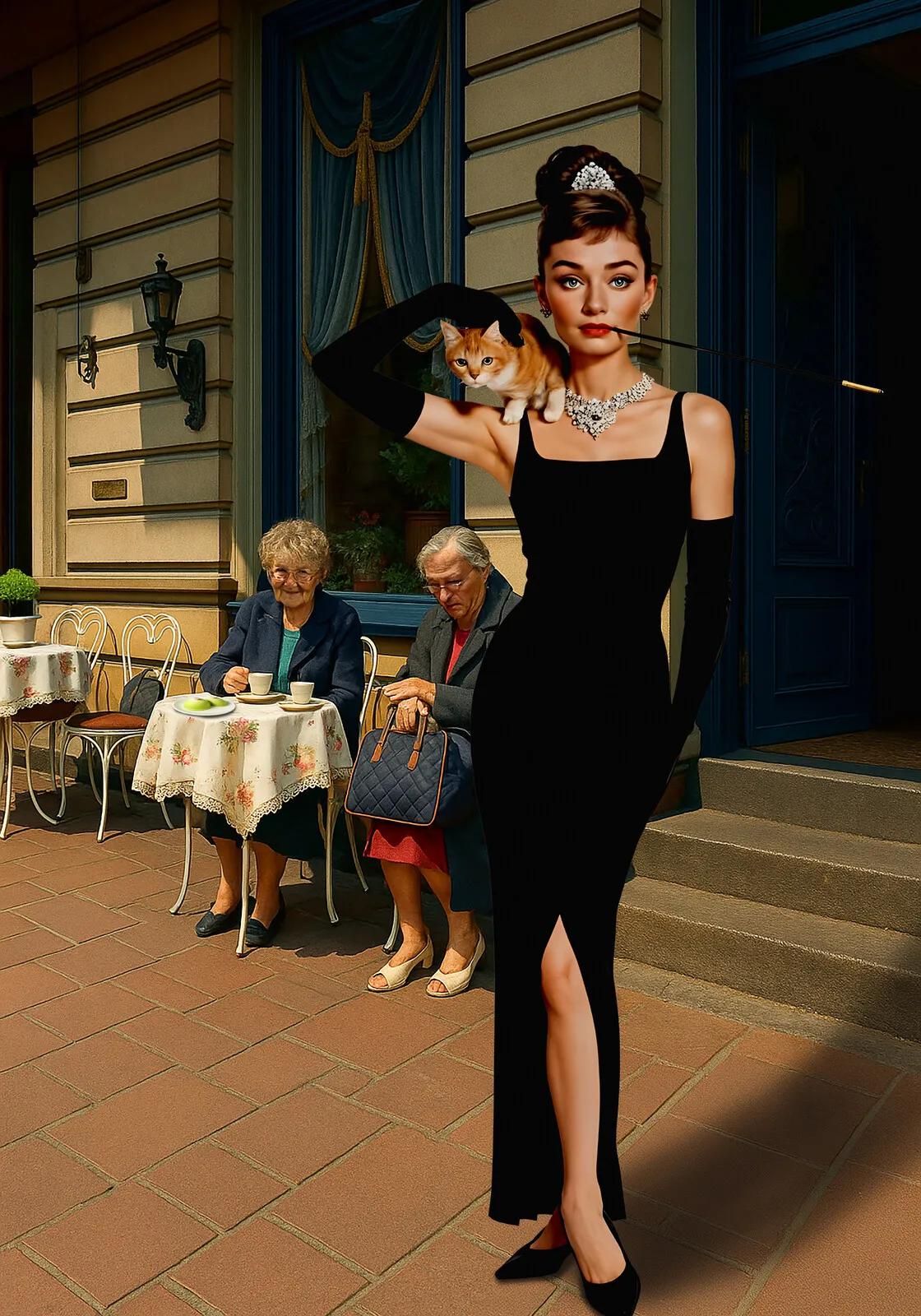
Malmö Holiday 1953
Breakfast at Tiffany’s began at Brauns.
Not in the usual glamorous locales of New York or Hollywood, but here, in the unexpected city of Malmö, on a frostbitten January day in 1949, the story of Breakfast at Tiffany's began at Brauns.
She called herself Edda. He was a ballet master named Carl-Gustaf, with a gaze sharp enough to see through war trauma, lace curtains, and the fragile armour of young ambition.
No one at Brauns knew what they were witnessing: a ballerina who had danced in silence for an underground audience, a girl who carried resistance messages in her boots and trauma in her posture. He offered coffee, a princess pastry, and something rarer: belief.
There was no applause that day; just two voices, two stories. And yet, a future began improbably, with some powdered sugar on a velvet chair, marking the start of a significant journey.
Let’s return to where the stage lights weren’t yet lit—but something far greater had already begun. And please, read on to discover the powerful ending of this remarkable story.
https://www.konst.se/jorgenthornberg
Brauns Konditori, Malmö. A winter’s day in 1949.
This is where it all began. Not with fanfare or opening nights, but with coffee, princess cake, and two velvet armchairs. Carl-Gustaf was a ballet master with vision; she was an unknown girl from a war-torn Europe. For a few months, they worked together—in the shadows of a past and in the light of a future yet to be written. She called herself Edda, though by then her name was Audrey. He saw something no one else had yet seen. And it was here, among cake crumbs and swirling snow, that her first steps toward the world’s spotlight were taken.
”Breakfast at Tiffany’s
She wore black and pearls at dawn,
A flute of champagne in hand,
Named her cat after no one—
And lived like sand through sand.
She talked in riddles, laughed in masks,
And kissed with guarded grace.
The world, she said, was far too large
To stay in just one place.
Her window watched strangers’ lives,
And she longed for something still—
A place where names meant safety,
And wild hearts could be still.
He followed not her lipstick trail,
But echoes in her voice—
The girl beneath the party dress,
The ghost beneath her choice.
A stolen ring, a fire escape,
A letter never sent—
And somewhere in a rainy street,
A love without lament.
So toast her with a coffee cup
Beneath Tiffany’s blue sky—
A girl who fled from cages,
And never said goodbye.”
Malmö May 2025
Malmö Holiday 1953
The image does not, as the caption might suggest, depict Audrey Hepburn in Malmö in 1953 — the same year as her film about a princess on the loose in Rome — but rather during her return eleven years later, three years after her success as Holly Golightly, an eccentric and naïve socialite in Breakfast at Tiffany’s. This is the same year Roger's story unfolds, and their paths will cross in unexpected ways.
Once again, she visited Brauns Konditori — the place that had opened her eyes to what she was truly meant to pursue. Not dance, but the silver screen.
And how right he had been — the kind and discerning Carl-Gustaf Kruuse af Verchou, ballet master at Malmö Stadsteater. Their collaboration for half a year was a turning point in her life, for which she would always remain indebted to him for guiding her towards her true calling. The profound impact of his mentorship resonates deeply.
For his sake, she was back in Malmö on this early September day.
It was a sombre occasion. She had returned to Malmö to bid farewell to her dear friend and mentor. After a life filled with purpose, Carl-Gustaf had taken his final dance steps on August 22nd, struck by a truck. His absence was deeply felt.
Due to their busy schedules, their last actual meeting remained the one in 1953—at Brauns, as always. The memory of that meeting, filled with hope and promise, now carried the weight of their parting.
Since then, Audrey had won an Academy Award and a BAFTA and had been nominated three more times. She had become exactly as great as Carl-Gustaf had predicted.
She often wondered what her life might have looked like had she defied Rambert’s judgement and continued dancing to prove she could rival Margot Fonteyn.
But it was Carl-Gustaf who had made her see the truth: that as prima ballerina assoluta, Fonteyn was unmatched, yet Audrey had something else, something far greater. She was larger than life.
Rest in peace, my dearest advisor. I will forever be grateful for your guidance and role in shaping my destiny.
Everything had begun in the winter of 1948/49. And in reality, she thought, the rest of her life had started right here — at Brauns Konditori in Malmö.
An eternity ago, at Brauns Konditori in Malmö, on a cold winter’s day in January 1949.
They sat opposite each other in matching wine-red velvet armchairs. Outside, the snow lay still, and the café windows were fogged over. On the table were two cups of coffee, two glasses of water, a princess pastry, and a neatly folded napkin. And, of course, there was an ashtray — for back then, everyone smoked, including ballet masters and ballet girls.
KRUUSE:
You must eat, little Edda. One cannot grow strong on pointe shoes and snow alone.
EDDA (smiling, but tired):
I know. But you don’t understand, Mr. Kruuse… I’ve been starving for so long, my stomach has forgotten how to accept sugar.
KRUUSE (gently):
Then we’ll teach it again. This is princess cake – our royal calorie bomb. No ballerina should have to struggle with hunger under my roof. (He looks at her.)
And call me Carl-Gustaf. We’re colleagues now.
EDDA:
Colleagues… (She looks down at her hands, holding the small dessert fork like an instrument.)
That sounds strange. But beautiful. I still can’t quite grasp that I’m here. In Malmö. With you. But it feels right, like I belong here.
KRUUSE:
Not many know the backstory. And let’s keep it that way. You’re our secret – a very slender, gifted, and discreet soul.
EDDA:
Discretion is my speciality. A survival skill I developed during the war.
KRUUSE (with curiosity):
Tell me now, Edda. Everything. About yourself. You come from a good family, but don’t carry yourself like someone sheltered.
EDDA (leans back, gaze distant):
Sheltered… no. Mother is a baroness. Van Heemstra. Dutch nobility. Not grand – more like impoverished nobility, I suppose.
Father’s English is present in the name but absent in all else. He left us when I was six for politics. He liked… the fascists. He was friends with Oswald Mosley, the baron who founded the British Union of Fascists in 1932. The BUF, known for its anti-Semitic views and violent street fighters, was active throughout the 1930s.
A real rat, if you ask me. (She says it quietly, as if the words still sting.)
KRUUSE (serious):
I’m sorry. I understand more than you might think. Go on.
EDDA:
We lived in Arnhem during the war. The Germans marched in as if the city were already theirs. I was twelve. We had no food and no heat. I dug up tulip bulbs with my hands to boil for soup.
And still… I danced.
KRUUSE:
In secret?
EDDA:
For those in hiding, for those who couldn’t be seen outdoors, I danced silently, in socks on the floor so that the soldiers wouldn’t hear. I also worked as a courier, carrying messages hidden in my boots. I didn’t wonder whether it was foolish or brave. It was just… necessary.
KRUUSE:
You were a child. And still more adult than many grown-ups.
EDDA:
I had to change schools five times. Always kept quiet about where I came from.
Mother said one shouldn’t stand out. Don’t be seen.
But on stage… (a faint smile)
There, I forgot to hide.
KRUUSE:
And yet you’re hiding now. Here, in Malmö.
EDDA:
For different reasons. You know why. I’m not exactly here legally.
But I wanted to dance on a modern stage. To have a chance at becoming something.
It never amounted to much in Holland. Too much had broken during the war. After the war, we moved to London, where I started studying properly.
But there were so many others. London was noisy and chaotic, full of rubble being cleared for something new. I thought Sweden might be… quieter.
KRUUSE (warmly):
You’re not just another dancer, Edda. You’re something else.
You have… silence inside you. But when you move, your whole body speaks.
EDDA (quietly):
I wanted to be a prima ballerina. I thought it was my destiny.
But I’ve realised… people listen more when I say nothing.
Maybe there’s something else I can do on stage.
KRUUSE (with a slight smile):
That sounds like film. Not dance.
EDDA:
Perhaps. I don’t know. I just want to exist – for real.
KRUUSE:
You do exist. Here. And as long as you dance in my studio, you are the very soul of dance.
EDDA:
And you are its kindest guardian.
[They fall silent. Outside, snow has begun to fall again – large, heavy flakes. Audrey – Edda – takes another careful bite of the princess cake.]
Brauns Konditori, second cup of coffee, Malmö, winter 1949
EDDA:
You know so much about me now. I hardly know anything about you. (She laughs lightly.)
What would a girl like me know – maybe you were a courier too? Or a secret agent?
KRUUSE (smiling, with a glint in his eye):
No, Edda. I didn’t carry messages in my shoes, but I suppose I still have a few unwritten ones, if one can put it that way.
There were quite a few Nazi sympathisers in Skåne during those years – especially in the beginning. The closer we came to the end of the war, the more those slogans from the 1930s faded into silence.
But enough of that. You want to know how I ended up on stage?
EDDA:
I want to know everything. I’ve noticed how the others regard you in the ballet studio. They straighten their backs, yet they also relax. That’s rare.
KRUUSE (nodding thoughtfully):
I wasn’t meant for dance—not according to my family. I had a baronial lineage, yes—but like yours, without estates or titles, though appearances still mattered. Yet, I chose music, the stage—the body's language—and ballet captivated me. After years of study, tours, and travels, I returned to Malmö, and something unusual transpired.
The city found… courage.
EDDA:
Courage?
KRUUSE:
Yes. They built a new ultramodern theatre right amid the war. Malmö Stadsteater, inaugurated in 1945, boasts the most significant stage in Europe. It was a signal carved in stone to the outside world: ”We believe in the power of culture. Not in brutal force.” And then, one day, the board asked me, “Would you like to build a ballet company?” It was a powerful testament to the enduring impact of art, even in the darkest of times.
I said: “Give me free rein—and dancers who can wait for applause.”
EDDA:
And did they?
KRUUSE (nodding):
More than I dared hope. We built the Malmö Ballet from nothing. And it wasn’t just me. We didn’t limit ourselves to classical productions—we wanted to create something fresh. Swedish. Nordic. Serious. And playful.
EDDA:
Tell me.
KRUUSE:
In 1947, I created To Live—a dance story about the steps of life, set to music by Lars-Erik Larsson. That ignited my appetite for more. And this year, came Kolingen, after Albert Engström’s burlesque character. It reeked of sweat, snuff, and sarcasm—the audience was stunned. Now I’m working on Nordic Saga, for 1950, with music by Ingvar Wieslander. A dream-world, as ancient as moss, with elves and unease beneath the surface. It will also be staged in Copenhagen, at the Royal Theatre. That’s where I first witnessed dancers bow before the music even began. It's a testament to the transformative power of dance, and I hope it inspires you as much as it does me.
EDDA:
You’re a gifted storyteller.
KRUUSE (pauses):
We’re all storytellers, Edda. But we use different languages. I use steps. You do too. But you’ll employ something more. Glances. Movements. Presence. You make people see without knowing why.
EDDA:
But I love dance.
KRUUSE:
It will never leave you. But you may become more than a dancer.
EDDA:
More?
KRUUSE:
A symbol. A light. Someone who carries her past like pearls, not as a burden. On stage—or why not on screen?
EDDA:
(silent)
KRUUSE:
I’ve been pondering what you mentioned earlier regarding dancing during the war. We heard the explosions from across the strait, from Copenhagen.
Yet here, it was quiet and blacked out. We drank ersatz coffee and played Stravinsky. And don’t think there were princess cakes—except on special occasions. Everything was rationed. I suppose we pretended the sounds belonged to someone else’s world. Or to the future.
EDDA:
It wasn’t another world.
It was mine.
KRUUSE:
Will you tell me about it?
EDDA:
(At first hesitantly, then more steadily) We lived, as I told you, in Arnhem. It was a time of personal stories during the war, each filled with unique struggles and triumphs.
Mother, my brother Ian, and grandmother. Father had already disappeared—first to London, then to the fascists. We found out later. He sent postcards from Lisbon. We threw them into the stove.
KRUUSE:
But you stayed?
EDDA:
We had no choice. When the Germans came rolling in, I thought it was a circus.
God, I was just a child.
KRUUSE:
You were twelve?
EDDA:
Eleven, when it got serious.
They invaded on May 10th. My birthday is the fourth; I had just turned eleven.
It was quiet marching music, handsome horses. But soon the radio vanished. Books. People. And everything that had once been normal.
I began cycling. I delivered Oranjekrant, the banned newspaper, hidden in my socks, with little notes tucked into my boots. My English fluency came in handy. I passed messages—and sometimes food—to British pilots who had crashed. Later, I also passed messages to Americans. They hid in barns. I whispered instructions to men in torn uniforms on returning to England. It was a long, harrowing escape through half of Europe to Portugal, and finally, home. Poor guys, but miraculously, most of them made it.
KRUUSE (almost whispering):
And you danced for an audience as well?
EDDA:
Yes, we performed for paying audiences. We called them *zwarte avonden*—black evenings. We danced in living rooms, on damp floors, barefoot. Ten to fifteen people. Silent. I danced variations from *Giselle*. People gave us money that went to the Resistance. No applause. We didn’t want to reveal ourselves—just eyes sparkling. That was enough.
KRUUSE:
And the fear?
EDDA:
Always present, especially in the winter of 1944. We called it the ’Hungersnacht’. No bread, no potatoes. We ate tulip bulbs. I became ill with jaundice and anaemia. Water in my legs. But the worst part was seeing my mother carrying home tree bark to boil into what she called “coffee.” We laughed about it, but it was laughter tinged with shadows.
KRUUSE:
What did you do when it became too dangerous?
EDDA:
We hid. Once, the Germans came to our home. Mother and I were lined up in the yard, destined for a German kitchen to work. I ran, while she stayed behind. I ran through snow and blood and hid in a cellar until they gave up searching. It was a terrifying moment, yet I found the courage to escape.
KRUUSE:
You’re not just a dancer. You’re... a survivor. And yet you carry yourself as if you’re still dancing with every step.
EDDA (gently):
That’s why I dance—my legs remember carrying me through the war.
KRUUSE (quietly):
We call it resilience. But that’s a weak word. You are strength without armour. That’s the most dangerous kind—if someone stands against you.
EDDA:
My mother said we must survive like flowers in the snow. “You can’t stop growing just because the world freezes,” she said.
KRUUSE:
She was wise.
EDDA:
She carried great sorrow, but also grace. I believe that’s where my dance, my strength, comes from. And now here I sit with coffee, cake, and a Swedish ballet master who believes in me. My mother's resilience and grace in the face of such hardship are a testament to the strength of maternal love.
KRUUSE (smiling):
Not beliefs—knows. You’re here now. And I will do what I can to ensure the world never forgets that you were here, even if only for a winter.
Brauns Konditori, Malmö – quieter now, the afternoon sun is lower.
KRUUSE:
I know it’s a lot to ask, but you said you danced for a secret audience. Tell me more—not about the steps, but the other part.
EDDA:
(She lowers her gaze, inhales) We didn’t call them concerts. We simply said, “There will be music today.” Sometimes on a Sunday, sometimes on a Tuesday—when we knew it was safe. We shut all the windows and doors. No light could be seen from outside, and no sound could escape afterwards. My friend played little improvisations, sometimes folk songs, occasionally romantic pieces or waltzes and miniatures that teased my feet into dancing. We did have Tchaikovsky, but no orchestra. Still, we managed rhythm and silence in just the right proportion—each accompanying the other. I choreographed everything myself. We had no teachers, no guidance—just natural movements that looked beautiful. Mother made my costumes with old fabric, sometimes curtains. We used what we had. And people came, not to see me, but to... feel alive.
KRUUSE:
And afterwards?
EDDA:
We collected money. Everything went to the Resistance. I didn’t know what for. Weapons. Printing presses. Food. Medical supplies. It didn’t matter. We just knew it had to go on.
EDDA:
They were the quietest audiences I’ve ever had. Not a single applause. Not even a cough. But their eyes... their gazes still live in my memory. The power of art to touch people's hearts, even in the darkest of times, is something I will never forget.
EDDA (almost whispering):
In Velp... where we lived toward the end... There was something else, too. Darkness. Real evil. The hotel in the centre, Park Hotel—that’s where they operated. The SS and Nazi leadership. Seyss-Inquart. Rauter. And Rotterdamsche Bank...
(She looks pained and runs her hand along her arm)
Mother and I walked past it one day. We waited at the corner, at Vijverlaan.
It was silent at first. Then I heard sounds. Horrible sounds. Screams. Muffled, drawn out, choked. I didn’t know what it was. Mother said quietly,
“It’s a prison now. They’re probably... interrogating.”
I immediately understood what she meant.
KRUUSE remains completely still as he looks at her. He says nothing. She continues after a pause.
EDDA:
They held political prisoners there. And I… I often passed by on my way to rehearsals. It still feels as though every dance step I took back then, in hindsight, was for them.
KRUUSE:
You danced with them in your blood.
EDDA (nodding):
And when I moved silently in a room where no one dared to breathe… I knew I was giving them something. A small moment of beauty. Or perhaps just… a moment without fear.
Brauns Konditori, Malmö – the same evening, quieter now, with guests beginning to leave.
KRUUSE (gently):
You came to us from London. But it wasn’t merely the war you were escaping. What happened there—after… everything?
EDDA (pulling her coat tighter, though not from the cold):
My mother and I moved there in the autumn of 1946. We rented two rooms in Notting Hill—cold, damp, yet still… a beginning. London smelled of coal and crumbled stone. They were clearing out the ruins. Everything was grey. And burned. Still. As if the whole city were holding its breath.
KRUUSE:
Bombed?
EDDA:
Yes. But the Blitz had dropped more than bombs. It had dropped sorrow. And rage. Yet there was beauty too. I received a scholarship to study ballet. And that’s where something began.
KRUUSE:
Is that when you became… Audrey?
EDDA (smiling):
Yes. I stopped calling myself Ruston. It didn’t feel right. I was Edda during the war. Audrey afterwards. But here… here I’m Edda again, just for you.
KRUUSE (gently):
Thank you.
EDDA:
I attended classes during the day, and I worked in the evenings… (a brief sigh). Sometimes, I was a secretary, but mostly, I modelled for photographers. One of them, Angus McBean, took a photo of me… with a hat that resembled a cloud. That became my ticket. I started gaining attention—role offers, but predominantly attention.
But I still longed to dance until I met her.
KRUUSE:
Marie Rambert?
EDDA:
Exactly. She was fiery. Small, intense, with eyes that looked straight through you. She said, “You have presence. You will never be Margot Fonteyn, but you will move people.”
It was the first time anyone told me that I could tell stories just by being present and moving.
KRUUSE:
And that’s where we met?
EDDA:
Yes. In her studio, you surely remember. You came in wearing a black coat, with quiet gravity. You watched half a rehearsal and said nothing. Then you asked me to stay.
And afterwards, you approached me and said:
“You belong in light. Come to Malmö.”
KRUUSE (with a blink):
That does sound like something I would say.
EDDA:
I had never even heard of Malmö. Sweden was a colourless map to me. But the thought of working at a theatre that hadn’t been bombed… on a stage where the wood still smelled freshly cut… it felt like stepping into the future for the first time.
KRUUSE:
And yet you kept the name Edda here.
EDDA (nodding):
Yes. Because my body remembers the war. And because you saw something in me that didn’t need explaining. Here I’m not Audrey with photographs. I’m the girl who carried notes in her boots and danced in the dark.
KRUUSE:
I remember what I saw that day at Rambert’s. It wasn’t just technique. It was a movement full of memory. A story that touched me.
EDDA (looking out at the snow):
And here, my body is finally allowed to forget a little.
Brauns Konditori, Malmö – the evening is late. The armchairs around them have long been empty. Only the two remain, under the glow of dim wall lamps. Outside, the snowfall has stopped, and the footsteps of the few passersby have already been softened by fresh snow. It feels like the right moment to end a meaningful evening.
KRUUSE (looking at her for a long moment, then with emphasis):
Marie Rambert told you, "You will never be Margot Fonteyn, but you will move people.” I’ve thought about that. She was right, but perhaps she didn’t know how right she was. She was onto something even greater, though she didn’t understand what.
EDDA (softly):
I didn’t understand what she meant then. I only felt disappointment—and a desire to prove her wrong. I practised twice as much after that. Deep down, she knew I was too tall—170, maybe 171 centimetres, taller than most classical ballerinas, especially in the 1940s. I was also slender and long-legged, which gave me elegant lines, yes, but made it harder to blend in with the corps de ballet, where symmetry and proportion matter. And above all, I’d lost critical years during the war. Dancing for a secret audience and running errands for the resistance wasn’t enough.
KRUUSE:
But now you understand. You move people, Edda. Not just with steps, but with your gaze, stillness, and deliberate silences. The stage—not even Malmö’s grand one—isn’t enough for you. They’re all far too small. But the screen… it can carry you. It can lay the world at your feet.
EDDA (quietly, a little afraid):
Film? I don’t know if I’m ready for that. I haven’t even spoken on stage.
KRUUSE:
That doesn’t matter. You speak anyway. You don’t realise it yet, but you have something very few possess—the ability to make people listen simply by being there. You are already dancing. You are already a story.
EDDA:
I don’t know.
(She said it without conviction, though a flicker in her eyes showed his words had reached her.)
KRUUSE:
(He leaned forward, gently but with conviction.)
Even though you’re so good, it’s not dance you should devote yourself to. You must develop your talent for acting. That is my prophecy, even though I’m a dancer myself. Dance will stay with you regardless. In your movement. In every nuance of expression. Believe me, Edda… you have the potential to become one of the greatest.
EDDA said nothing. She sat still, her hands resting on her knees. But something had ignited in her eyes—a new kind of light, quiet but enduring. It was that final thought she held close as they walked across the square, their footsteps lost in the softening snow.
Jörgen Thornberg
Malmö Holiday 1953, 2025
Digital
50 x 70 cm
3 200 kr
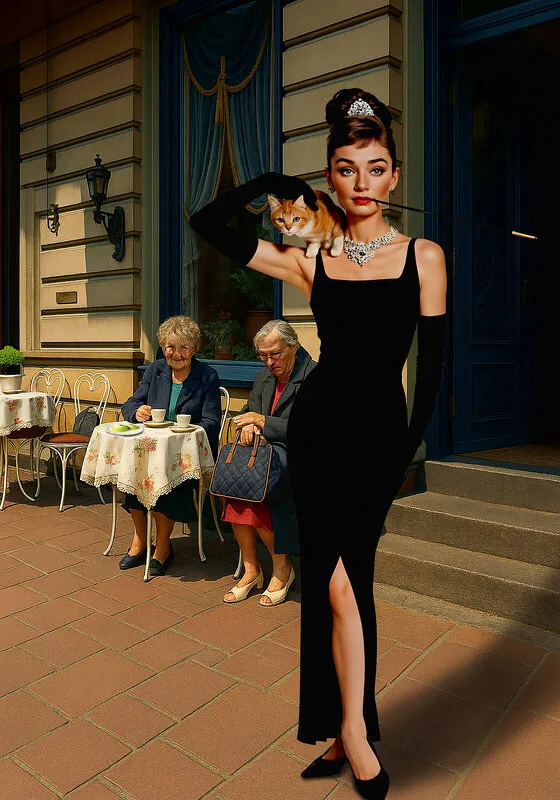
Malmö Holiday 1953
Breakfast at Tiffany’s began at Brauns.
Not in the usual glamorous locales of New York or Hollywood, but here, in the unexpected city of Malmö, on a frostbitten January day in 1949, the story of Breakfast at Tiffany's began at Brauns.
She called herself Edda. He was a ballet master named Carl-Gustaf, with a gaze sharp enough to see through war trauma, lace curtains, and the fragile armour of young ambition.
No one at Brauns knew what they were witnessing: a ballerina who had danced in silence for an underground audience, a girl who carried resistance messages in her boots and trauma in her posture. He offered coffee, a princess pastry, and something rarer: belief.
There was no applause that day; just two voices, two stories. And yet, a future began improbably, with some powdered sugar on a velvet chair, marking the start of a significant journey.
Let’s return to where the stage lights weren’t yet lit—but something far greater had already begun. And please, read on to discover the powerful ending of this remarkable story.
https://www.konst.se/jorgenthornberg
Brauns Konditori, Malmö. A winter’s day in 1949.
This is where it all began. Not with fanfare or opening nights, but with coffee, princess cake, and two velvet armchairs. Carl-Gustaf was a ballet master with vision; she was an unknown girl from a war-torn Europe. For a few months, they worked together—in the shadows of a past and in the light of a future yet to be written. She called herself Edda, though by then her name was Audrey. He saw something no one else had yet seen. And it was here, among cake crumbs and swirling snow, that her first steps toward the world’s spotlight were taken.
”Breakfast at Tiffany’s
She wore black and pearls at dawn,
A flute of champagne in hand,
Named her cat after no one—
And lived like sand through sand.
She talked in riddles, laughed in masks,
And kissed with guarded grace.
The world, she said, was far too large
To stay in just one place.
Her window watched strangers’ lives,
And she longed for something still—
A place where names meant safety,
And wild hearts could be still.
He followed not her lipstick trail,
But echoes in her voice—
The girl beneath the party dress,
The ghost beneath her choice.
A stolen ring, a fire escape,
A letter never sent—
And somewhere in a rainy street,
A love without lament.
So toast her with a coffee cup
Beneath Tiffany’s blue sky—
A girl who fled from cages,
And never said goodbye.”
Malmö May 2025
Malmö Holiday 1953
The image does not, as the caption might suggest, depict Audrey Hepburn in Malmö in 1953 — the same year as her film about a princess on the loose in Rome — but rather during her return eleven years later, three years after her success as Holly Golightly, an eccentric and naïve socialite in Breakfast at Tiffany’s. This is the same year Roger's story unfolds, and their paths will cross in unexpected ways.
Once again, she visited Brauns Konditori — the place that had opened her eyes to what she was truly meant to pursue. Not dance, but the silver screen.
And how right he had been — the kind and discerning Carl-Gustaf Kruuse af Verchou, ballet master at Malmö Stadsteater. Their collaboration for half a year was a turning point in her life, for which she would always remain indebted to him for guiding her towards her true calling. The profound impact of his mentorship resonates deeply.
For his sake, she was back in Malmö on this early September day.
It was a sombre occasion. She had returned to Malmö to bid farewell to her dear friend and mentor. After a life filled with purpose, Carl-Gustaf had taken his final dance steps on August 22nd, struck by a truck. His absence was deeply felt.
Due to their busy schedules, their last actual meeting remained the one in 1953—at Brauns, as always. The memory of that meeting, filled with hope and promise, now carried the weight of their parting.
Since then, Audrey had won an Academy Award and a BAFTA and had been nominated three more times. She had become exactly as great as Carl-Gustaf had predicted.
She often wondered what her life might have looked like had she defied Rambert’s judgement and continued dancing to prove she could rival Margot Fonteyn.
But it was Carl-Gustaf who had made her see the truth: that as prima ballerina assoluta, Fonteyn was unmatched, yet Audrey had something else, something far greater. She was larger than life.
Rest in peace, my dearest advisor. I will forever be grateful for your guidance and role in shaping my destiny.
Everything had begun in the winter of 1948/49. And in reality, she thought, the rest of her life had started right here — at Brauns Konditori in Malmö.
An eternity ago, at Brauns Konditori in Malmö, on a cold winter’s day in January 1949.
They sat opposite each other in matching wine-red velvet armchairs. Outside, the snow lay still, and the café windows were fogged over. On the table were two cups of coffee, two glasses of water, a princess pastry, and a neatly folded napkin. And, of course, there was an ashtray — for back then, everyone smoked, including ballet masters and ballet girls.
KRUUSE:
You must eat, little Edda. One cannot grow strong on pointe shoes and snow alone.
EDDA (smiling, but tired):
I know. But you don’t understand, Mr. Kruuse… I’ve been starving for so long, my stomach has forgotten how to accept sugar.
KRUUSE (gently):
Then we’ll teach it again. This is princess cake – our royal calorie bomb. No ballerina should have to struggle with hunger under my roof. (He looks at her.)
And call me Carl-Gustaf. We’re colleagues now.
EDDA:
Colleagues… (She looks down at her hands, holding the small dessert fork like an instrument.)
That sounds strange. But beautiful. I still can’t quite grasp that I’m here. In Malmö. With you. But it feels right, like I belong here.
KRUUSE:
Not many know the backstory. And let’s keep it that way. You’re our secret – a very slender, gifted, and discreet soul.
EDDA:
Discretion is my speciality. A survival skill I developed during the war.
KRUUSE (with curiosity):
Tell me now, Edda. Everything. About yourself. You come from a good family, but don’t carry yourself like someone sheltered.
EDDA (leans back, gaze distant):
Sheltered… no. Mother is a baroness. Van Heemstra. Dutch nobility. Not grand – more like impoverished nobility, I suppose.
Father’s English is present in the name but absent in all else. He left us when I was six for politics. He liked… the fascists. He was friends with Oswald Mosley, the baron who founded the British Union of Fascists in 1932. The BUF, known for its anti-Semitic views and violent street fighters, was active throughout the 1930s.
A real rat, if you ask me. (She says it quietly, as if the words still sting.)
KRUUSE (serious):
I’m sorry. I understand more than you might think. Go on.
EDDA:
We lived in Arnhem during the war. The Germans marched in as if the city were already theirs. I was twelve. We had no food and no heat. I dug up tulip bulbs with my hands to boil for soup.
And still… I danced.
KRUUSE:
In secret?
EDDA:
For those in hiding, for those who couldn’t be seen outdoors, I danced silently, in socks on the floor so that the soldiers wouldn’t hear. I also worked as a courier, carrying messages hidden in my boots. I didn’t wonder whether it was foolish or brave. It was just… necessary.
KRUUSE:
You were a child. And still more adult than many grown-ups.
EDDA:
I had to change schools five times. Always kept quiet about where I came from.
Mother said one shouldn’t stand out. Don’t be seen.
But on stage… (a faint smile)
There, I forgot to hide.
KRUUSE:
And yet you’re hiding now. Here, in Malmö.
EDDA:
For different reasons. You know why. I’m not exactly here legally.
But I wanted to dance on a modern stage. To have a chance at becoming something.
It never amounted to much in Holland. Too much had broken during the war. After the war, we moved to London, where I started studying properly.
But there were so many others. London was noisy and chaotic, full of rubble being cleared for something new. I thought Sweden might be… quieter.
KRUUSE (warmly):
You’re not just another dancer, Edda. You’re something else.
You have… silence inside you. But when you move, your whole body speaks.
EDDA (quietly):
I wanted to be a prima ballerina. I thought it was my destiny.
But I’ve realised… people listen more when I say nothing.
Maybe there’s something else I can do on stage.
KRUUSE (with a slight smile):
That sounds like film. Not dance.
EDDA:
Perhaps. I don’t know. I just want to exist – for real.
KRUUSE:
You do exist. Here. And as long as you dance in my studio, you are the very soul of dance.
EDDA:
And you are its kindest guardian.
[They fall silent. Outside, snow has begun to fall again – large, heavy flakes. Audrey – Edda – takes another careful bite of the princess cake.]
Brauns Konditori, second cup of coffee, Malmö, winter 1949
EDDA:
You know so much about me now. I hardly know anything about you. (She laughs lightly.)
What would a girl like me know – maybe you were a courier too? Or a secret agent?
KRUUSE (smiling, with a glint in his eye):
No, Edda. I didn’t carry messages in my shoes, but I suppose I still have a few unwritten ones, if one can put it that way.
There were quite a few Nazi sympathisers in Skåne during those years – especially in the beginning. The closer we came to the end of the war, the more those slogans from the 1930s faded into silence.
But enough of that. You want to know how I ended up on stage?
EDDA:
I want to know everything. I’ve noticed how the others regard you in the ballet studio. They straighten their backs, yet they also relax. That’s rare.
KRUUSE (nodding thoughtfully):
I wasn’t meant for dance—not according to my family. I had a baronial lineage, yes—but like yours, without estates or titles, though appearances still mattered. Yet, I chose music, the stage—the body's language—and ballet captivated me. After years of study, tours, and travels, I returned to Malmö, and something unusual transpired.
The city found… courage.
EDDA:
Courage?
KRUUSE:
Yes. They built a new ultramodern theatre right amid the war. Malmö Stadsteater, inaugurated in 1945, boasts the most significant stage in Europe. It was a signal carved in stone to the outside world: ”We believe in the power of culture. Not in brutal force.” And then, one day, the board asked me, “Would you like to build a ballet company?” It was a powerful testament to the enduring impact of art, even in the darkest of times.
I said: “Give me free rein—and dancers who can wait for applause.”
EDDA:
And did they?
KRUUSE (nodding):
More than I dared hope. We built the Malmö Ballet from nothing. And it wasn’t just me. We didn’t limit ourselves to classical productions—we wanted to create something fresh. Swedish. Nordic. Serious. And playful.
EDDA:
Tell me.
KRUUSE:
In 1947, I created To Live—a dance story about the steps of life, set to music by Lars-Erik Larsson. That ignited my appetite for more. And this year, came Kolingen, after Albert Engström’s burlesque character. It reeked of sweat, snuff, and sarcasm—the audience was stunned. Now I’m working on Nordic Saga, for 1950, with music by Ingvar Wieslander. A dream-world, as ancient as moss, with elves and unease beneath the surface. It will also be staged in Copenhagen, at the Royal Theatre. That’s where I first witnessed dancers bow before the music even began. It's a testament to the transformative power of dance, and I hope it inspires you as much as it does me.
EDDA:
You’re a gifted storyteller.
KRUUSE (pauses):
We’re all storytellers, Edda. But we use different languages. I use steps. You do too. But you’ll employ something more. Glances. Movements. Presence. You make people see without knowing why.
EDDA:
But I love dance.
KRUUSE:
It will never leave you. But you may become more than a dancer.
EDDA:
More?
KRUUSE:
A symbol. A light. Someone who carries her past like pearls, not as a burden. On stage—or why not on screen?
EDDA:
(silent)
KRUUSE:
I’ve been pondering what you mentioned earlier regarding dancing during the war. We heard the explosions from across the strait, from Copenhagen.
Yet here, it was quiet and blacked out. We drank ersatz coffee and played Stravinsky. And don’t think there were princess cakes—except on special occasions. Everything was rationed. I suppose we pretended the sounds belonged to someone else’s world. Or to the future.
EDDA:
It wasn’t another world.
It was mine.
KRUUSE:
Will you tell me about it?
EDDA:
(At first hesitantly, then more steadily) We lived, as I told you, in Arnhem. It was a time of personal stories during the war, each filled with unique struggles and triumphs.
Mother, my brother Ian, and grandmother. Father had already disappeared—first to London, then to the fascists. We found out later. He sent postcards from Lisbon. We threw them into the stove.
KRUUSE:
But you stayed?
EDDA:
We had no choice. When the Germans came rolling in, I thought it was a circus.
God, I was just a child.
KRUUSE:
You were twelve?
EDDA:
Eleven, when it got serious.
They invaded on May 10th. My birthday is the fourth; I had just turned eleven.
It was quiet marching music, handsome horses. But soon the radio vanished. Books. People. And everything that had once been normal.
I began cycling. I delivered Oranjekrant, the banned newspaper, hidden in my socks, with little notes tucked into my boots. My English fluency came in handy. I passed messages—and sometimes food—to British pilots who had crashed. Later, I also passed messages to Americans. They hid in barns. I whispered instructions to men in torn uniforms on returning to England. It was a long, harrowing escape through half of Europe to Portugal, and finally, home. Poor guys, but miraculously, most of them made it.
KRUUSE (almost whispering):
And you danced for an audience as well?
EDDA:
Yes, we performed for paying audiences. We called them *zwarte avonden*—black evenings. We danced in living rooms, on damp floors, barefoot. Ten to fifteen people. Silent. I danced variations from *Giselle*. People gave us money that went to the Resistance. No applause. We didn’t want to reveal ourselves—just eyes sparkling. That was enough.
KRUUSE:
And the fear?
EDDA:
Always present, especially in the winter of 1944. We called it the ’Hungersnacht’. No bread, no potatoes. We ate tulip bulbs. I became ill with jaundice and anaemia. Water in my legs. But the worst part was seeing my mother carrying home tree bark to boil into what she called “coffee.” We laughed about it, but it was laughter tinged with shadows.
KRUUSE:
What did you do when it became too dangerous?
EDDA:
We hid. Once, the Germans came to our home. Mother and I were lined up in the yard, destined for a German kitchen to work. I ran, while she stayed behind. I ran through snow and blood and hid in a cellar until they gave up searching. It was a terrifying moment, yet I found the courage to escape.
KRUUSE:
You’re not just a dancer. You’re... a survivor. And yet you carry yourself as if you’re still dancing with every step.
EDDA (gently):
That’s why I dance—my legs remember carrying me through the war.
KRUUSE (quietly):
We call it resilience. But that’s a weak word. You are strength without armour. That’s the most dangerous kind—if someone stands against you.
EDDA:
My mother said we must survive like flowers in the snow. “You can’t stop growing just because the world freezes,” she said.
KRUUSE:
She was wise.
EDDA:
She carried great sorrow, but also grace. I believe that’s where my dance, my strength, comes from. And now here I sit with coffee, cake, and a Swedish ballet master who believes in me. My mother's resilience and grace in the face of such hardship are a testament to the strength of maternal love.
KRUUSE (smiling):
Not beliefs—knows. You’re here now. And I will do what I can to ensure the world never forgets that you were here, even if only for a winter.
Brauns Konditori, Malmö – quieter now, the afternoon sun is lower.
KRUUSE:
I know it’s a lot to ask, but you said you danced for a secret audience. Tell me more—not about the steps, but the other part.
EDDA:
(She lowers her gaze, inhales) We didn’t call them concerts. We simply said, “There will be music today.” Sometimes on a Sunday, sometimes on a Tuesday—when we knew it was safe. We shut all the windows and doors. No light could be seen from outside, and no sound could escape afterwards. My friend played little improvisations, sometimes folk songs, occasionally romantic pieces or waltzes and miniatures that teased my feet into dancing. We did have Tchaikovsky, but no orchestra. Still, we managed rhythm and silence in just the right proportion—each accompanying the other. I choreographed everything myself. We had no teachers, no guidance—just natural movements that looked beautiful. Mother made my costumes with old fabric, sometimes curtains. We used what we had. And people came, not to see me, but to... feel alive.
KRUUSE:
And afterwards?
EDDA:
We collected money. Everything went to the Resistance. I didn’t know what for. Weapons. Printing presses. Food. Medical supplies. It didn’t matter. We just knew it had to go on.
EDDA:
They were the quietest audiences I’ve ever had. Not a single applause. Not even a cough. But their eyes... their gazes still live in my memory. The power of art to touch people's hearts, even in the darkest of times, is something I will never forget.
EDDA (almost whispering):
In Velp... where we lived toward the end... There was something else, too. Darkness. Real evil. The hotel in the centre, Park Hotel—that’s where they operated. The SS and Nazi leadership. Seyss-Inquart. Rauter. And Rotterdamsche Bank...
(She looks pained and runs her hand along her arm)
Mother and I walked past it one day. We waited at the corner, at Vijverlaan.
It was silent at first. Then I heard sounds. Horrible sounds. Screams. Muffled, drawn out, choked. I didn’t know what it was. Mother said quietly,
“It’s a prison now. They’re probably... interrogating.”
I immediately understood what she meant.
KRUUSE remains completely still as he looks at her. He says nothing. She continues after a pause.
EDDA:
They held political prisoners there. And I… I often passed by on my way to rehearsals. It still feels as though every dance step I took back then, in hindsight, was for them.
KRUUSE:
You danced with them in your blood.
EDDA (nodding):
And when I moved silently in a room where no one dared to breathe… I knew I was giving them something. A small moment of beauty. Or perhaps just… a moment without fear.
Brauns Konditori, Malmö – the same evening, quieter now, with guests beginning to leave.
KRUUSE (gently):
You came to us from London. But it wasn’t merely the war you were escaping. What happened there—after… everything?
EDDA (pulling her coat tighter, though not from the cold):
My mother and I moved there in the autumn of 1946. We rented two rooms in Notting Hill—cold, damp, yet still… a beginning. London smelled of coal and crumbled stone. They were clearing out the ruins. Everything was grey. And burned. Still. As if the whole city were holding its breath.
KRUUSE:
Bombed?
EDDA:
Yes. But the Blitz had dropped more than bombs. It had dropped sorrow. And rage. Yet there was beauty too. I received a scholarship to study ballet. And that’s where something began.
KRUUSE:
Is that when you became… Audrey?
EDDA (smiling):
Yes. I stopped calling myself Ruston. It didn’t feel right. I was Edda during the war. Audrey afterwards. But here… here I’m Edda again, just for you.
KRUUSE (gently):
Thank you.
EDDA:
I attended classes during the day, and I worked in the evenings… (a brief sigh). Sometimes, I was a secretary, but mostly, I modelled for photographers. One of them, Angus McBean, took a photo of me… with a hat that resembled a cloud. That became my ticket. I started gaining attention—role offers, but predominantly attention.
But I still longed to dance until I met her.
KRUUSE:
Marie Rambert?
EDDA:
Exactly. She was fiery. Small, intense, with eyes that looked straight through you. She said, “You have presence. You will never be Margot Fonteyn, but you will move people.”
It was the first time anyone told me that I could tell stories just by being present and moving.
KRUUSE:
And that’s where we met?
EDDA:
Yes. In her studio, you surely remember. You came in wearing a black coat, with quiet gravity. You watched half a rehearsal and said nothing. Then you asked me to stay.
And afterwards, you approached me and said:
“You belong in light. Come to Malmö.”
KRUUSE (with a blink):
That does sound like something I would say.
EDDA:
I had never even heard of Malmö. Sweden was a colourless map to me. But the thought of working at a theatre that hadn’t been bombed… on a stage where the wood still smelled freshly cut… it felt like stepping into the future for the first time.
KRUUSE:
And yet you kept the name Edda here.
EDDA (nodding):
Yes. Because my body remembers the war. And because you saw something in me that didn’t need explaining. Here I’m not Audrey with photographs. I’m the girl who carried notes in her boots and danced in the dark.
KRUUSE:
I remember what I saw that day at Rambert’s. It wasn’t just technique. It was a movement full of memory. A story that touched me.
EDDA (looking out at the snow):
And here, my body is finally allowed to forget a little.
Brauns Konditori, Malmö – the evening is late. The armchairs around them have long been empty. Only the two remain, under the glow of dim wall lamps. Outside, the snowfall has stopped, and the footsteps of the few passersby have already been softened by fresh snow. It feels like the right moment to end a meaningful evening.
KRUUSE (looking at her for a long moment, then with emphasis):
Marie Rambert told you, "You will never be Margot Fonteyn, but you will move people.” I’ve thought about that. She was right, but perhaps she didn’t know how right she was. She was onto something even greater, though she didn’t understand what.
EDDA (softly):
I didn’t understand what she meant then. I only felt disappointment—and a desire to prove her wrong. I practised twice as much after that. Deep down, she knew I was too tall—170, maybe 171 centimetres, taller than most classical ballerinas, especially in the 1940s. I was also slender and long-legged, which gave me elegant lines, yes, but made it harder to blend in with the corps de ballet, where symmetry and proportion matter. And above all, I’d lost critical years during the war. Dancing for a secret audience and running errands for the resistance wasn’t enough.
KRUUSE:
But now you understand. You move people, Edda. Not just with steps, but with your gaze, stillness, and deliberate silences. The stage—not even Malmö’s grand one—isn’t enough for you. They’re all far too small. But the screen… it can carry you. It can lay the world at your feet.
EDDA (quietly, a little afraid):
Film? I don’t know if I’m ready for that. I haven’t even spoken on stage.
KRUUSE:
That doesn’t matter. You speak anyway. You don’t realise it yet, but you have something very few possess—the ability to make people listen simply by being there. You are already dancing. You are already a story.
EDDA:
I don’t know.
(She said it without conviction, though a flicker in her eyes showed his words had reached her.)
KRUUSE:
(He leaned forward, gently but with conviction.)
Even though you’re so good, it’s not dance you should devote yourself to. You must develop your talent for acting. That is my prophecy, even though I’m a dancer myself. Dance will stay with you regardless. In your movement. In every nuance of expression. Believe me, Edda… you have the potential to become one of the greatest.
EDDA said nothing. She sat still, her hands resting on her knees. But something had ignited in her eyes—a new kind of light, quiet but enduring. It was that final thought she held close as they walked across the square, their footsteps lost in the softening snow.
3 200 kr

Jörgen Thornberg
Malmö
Lite om bilder och mig. Translation in English at the end.
Jag är en nyfiken person som ser allt i bilder, även det jag fäster i ord, gärna tillsammans för bakom alla mina bilder finns en berättelse. Till vissa bilder hör en kortare eller längre novell som följer med bilden.
Bilder berättar historier. Jag omges av naturlig skönhet, intressanta människor och historia var jag än går. Jag använder min kamera för att dokumentera världen och blanda det jag ser med vad jag känner för att fånga den dolda magin.
Mina bilder berättar mina historier. Genom mina bilder, tryck och berättelser. Jag bjuder in dig att ta del av dessa berättelser, in i ditt liv och hem och dela min mycket personliga syn på vår värld. Mer än vad ögat ser. Jag tänker i bilder, drömmer och skriver och pratar om dem; följaktligen måste jag också skapa bilder. De blir vad jag ser, inte nödvändigtvis begränsade till verkligheten. Det finns en bild runt varje hörn. Jag hoppas att du kommer att se vad jag såg och gilla det.
Jag är också en skrivande person och till många bilder hör en kortare eller längre essay. Den följer med tavlan, tryckt på fint papper och med en personlig hälsning från mig.
Flertalet bilder startar sin resa i min kamera. Enkelt förklarat beskriver jag bilden jag ser i mitt inre, upplevd eller fantiserad. Bilden uppstår inom mig redan innan jag fått okularet till ögat. På bråkdelen av ett ögonblick ser jag vad jag vill ha och vad som kan göras med bilden. Här skall jag stoppa in en giraff, stålmannen, Titanic eller vad det är min fantasi finner ut. Ännu märkligare är att jag kommer ihåg minnesbilden långt efteråt när det blir tid att skapa verket. Om jag lyckas eller inte, är upp till betraktaren, oftast präglat av en stråk av svart humor – meningen är att man skall bli underhållen. Mina bilder blir ofta en snackis där de hänger.
Jag föredrar bilder som förmedlar ett budskap i flera lager. Vid första anblicken fylld av feel-good, en vacker utsikt, fint väder, solen skiner, blommor på ängen eller vattnet som ligger förrädiskt spegelblankt. I en sådan bild kan jag gömma min egentliga berättelse, mitt förakt för förtryckare och våldsverkare, rasister och fördomsfulla människor - ett gärna återkommande motiv mer eller mindre dolt i det vackra motivet. Jag försöker förena dem i ett gemensamt narrativ.
Bild och formgivning har löpt som en röd tråd genom livet. Fotokonst känns som en värdig final som jag gärna delar med mig.
Min genre är vid som framgår av mina bilder, temat en blandning av pop- och gatukonst i kollage som kan bestå av hundratals lager. Vissa bilder kan ta veckor, andra någon dag innan det är dags att överlämna resultatet till printverkstaden. Fine Art Prints är digitala fotocollage. I dessa kollage sker rivandet, klippandet, pusslandet, målandet, ritandet och sprayningen digitalt. Det jag monterar in kan vara hundratals år gamla bilder som jag omsorgsfullt frilägger så att de ser ut att vara en del av tavlan men också bilder skapade av mig själv efter min egen fantasi. Därefter besöks printstudion och för vissa bilder numrera en limiterad upplaga (oftast 7 exemplar) och signera för hand. Vissa bilder kan köpas i olika format. Det är bara att fråga efter vilka. Gillar man en bild som är 70x100 men inte har plats på väggen, går den kanske att få i 50x70 cm istället. Frågan är fri.
Metoden Giclée eller Fine Art Print som det också kallas är det moderna sättet för framställning av grafisk konst. Villkoret för denna typ av utskrifter är att en högkvalitativ storformatskrivare används med åldersbeständigt färgpigment och konstnärspapper eller i förekommande fall på duk. Pappret som används möter de krav på livslängd som ställs av museer och gallerier. Normalt säljer jag mina bilder oinramade så att den nya ägaren själv kan bestämma hur de skall se ut, med eller utan passepartout färg på ram, med eller utan glas etc..
Under många år ställde jag bara ut på nätet, i valda grupper och på min egen Facebooksida - https://www.facebook.com/jorgen.thornberg.9
Jag finns också på en egen hemsida som tyvärr inte alltid är uppdaterad – https://www.jth.life/ Där kan du också läsa en del av de berättelser som följer med bilden.
UTSTÄLLNINGAR
Luftkastellet, oktober 2022
Konst i Lund, november 2022
Luftkastellet, mars 2023
Engleson Galleri Caroli, april 2023
Hydra, Greece June 2023
Engleson Galleri Caroli, oktober 2023
Toppen, Höllviken december 2023
Luftkastellet, mars 2024
Torups Galleri, mars 2024
Venice, May 2024
Luftkastellet, oktober 2024
Konst i Advent, December 2024
Galleri Engleson, Caroli December 2024
Jäger & Jansson Galleri, april 2025
A bit about pictures and me.
I'm a curious person who sees everything in pictures, even what I express in words, often combining them, for behind all my pictures lies a story. These narratives, some as short as a single image and others as long as a novel, are the heart and soul of my work.
Pictures tell stories. Wherever I go, I'm surrounded by natural beauty, exciting people, and history. I use my camera to document the world and blend what I see with what I feel to capture the hidden magic.
My images tell my stories. Through my pictures, prints, and narratives, I invite you to partake in these stories in your life and home and share my deeply personal perspective of our world. More than meets the eye. I think in pictures, dream, write, and talk about them; consequently, I must create images too. They become what I see, not necessarily confined to reality. There's a picture around every corner. I hope you'll see what I saw and enjoy it.
I'm also a writer, and many images come with a shorter or longer essay. It accompanies the painting, printed on fine paper with my personal greeting.
Many pictures start their journey on my camera. Simply put, I describe the image I see in my mind, experienced or imagined. The image arises within me even before I bring the eyepiece to my eye. In a fraction of a moment, I see what I want and what can be done with the picture. Here, I'll insert a giraffe, Superman, the Titanic, or whatever my imagination conjures up. Even stranger is that I remember the mental image long after it's time to create the work. Whether I succeed is up to the observer, often imbued with a streak of black humour – the aim is to entertain. My pictures usually become a talking point wherever they hang.
I prefer pictures that convey a message in multiple layers. At first glance, they're filled with feel-good vibes, a beautiful view, lovely weather, the sun shining, flowers in the meadow, or the water lying deceptively calm. But beneath this surface beauty, I often conceal a deeper story, a narrative that challenges societal norms or explores the human condition. I invite you to delve into these hidden narratives and discover the layers of meaning within my work.
Picture and design have been a thread running through my life. Photographic art feels like a fitting finale, and I'm happy to share it.
My genre is varied, as seen in my pictures; the theme is a blend of pop and street art in collages that can consist of hundreds of layers. Some images can take weeks, others just a day before it's time to hand over the result to the print workshop. Fine Art Prints are digital photo collages. In these collages, tearing, cutting, puzzling, painting, drawing, and spraying happen digitally. What I insert can be images hundreds of years old that I carefully extract so they appear to be part of the painting, but also images created by myself, now also generated from my imagination. Next, visit the print studio and, for certain images, number a limited edition (usually 7 copies) and sign them by hand. Some images may be available in other formats. Just ask which ones. If you like an image that's 70x100 but doesn't have space on the wall, you might be able to get it in 50x70 cm instead. The question is open.
The Giclée method, or Fine Art Print as it's also called, is the modern way of producing graphic art. This method ensures the highest quality and longevity of the artwork, using a high-quality large-format printer with archival pigment inks and artist paper or, in some cases, canvas. The paper used meets the longevity requirements set by museums and galleries. I sell my pictures unframed, allowing the new owner to personalise their artwork, confident in the lasting value and quality of the piece.
For many years, I only exhibited online, in selected groups, and on my Facebook page - https://www.facebook.com/jorgen.thornberg.9. I also have my website, which unfortunately is not constantly updated - https://www.jth.life/. You can also read some of the stories accompanying the pictures there.
EXHIBITIONS
Luftkastellet, October 2022
Art in Lund, November 2022
Luftkastellet, March 2023
Engleson Gallery Caroli, April 2023
Hydra, Greece June 2023
Engleson Gallery Caroli, October 2023
Toppen, Höllviken December 2023
Luftkastellet, March 2024
Torup Gallery, March 2024
Venice, May 2024
UTSTÄLLNINGAR
Luftkastellet, oktober 2022
Konst i Lund, november 2022
Luftkastellet, mars 2023
Engleson Galleri Caroli, april 2023
Hydra, Greece June 2023
Engleson Galleri Caroli, oktober 2023
Toppen, Höllviken december 2023
Luftkastellet, mars 2024
Torups Galleri, mars 2024
Venice, May 2024
Luftkastellet, October 2024
Konst i Advent, December 2024
Galleri Engleson, Caroli December 2024
Jäger & Jansson Galleri, April 2025
Utbildning
Autodidakt
Medlem i konstnärsförening
Öppna Sinnen
Med i konstrunda
Konstrundan i Skåne
Utställningar
Luftkastellet, October 2022
Art in Lund, November 2022
Luftkastellet, March 2023
Engleson Gallery Caroli, April 2023
Hydra, Greece June 2023
Engleson Gallery Caroli, October 2023
Toppen, Höllviken December 2023
Luftkastellet, March 2024
Torup Gallery, March 2024
Venice, May 2024