Vi använder cookies för att ge dig bästa möjliga upplevelse. Välj vilka cookies du tillåter.
Läs mer i vår integritetspolicy
Jörgen Thornberg
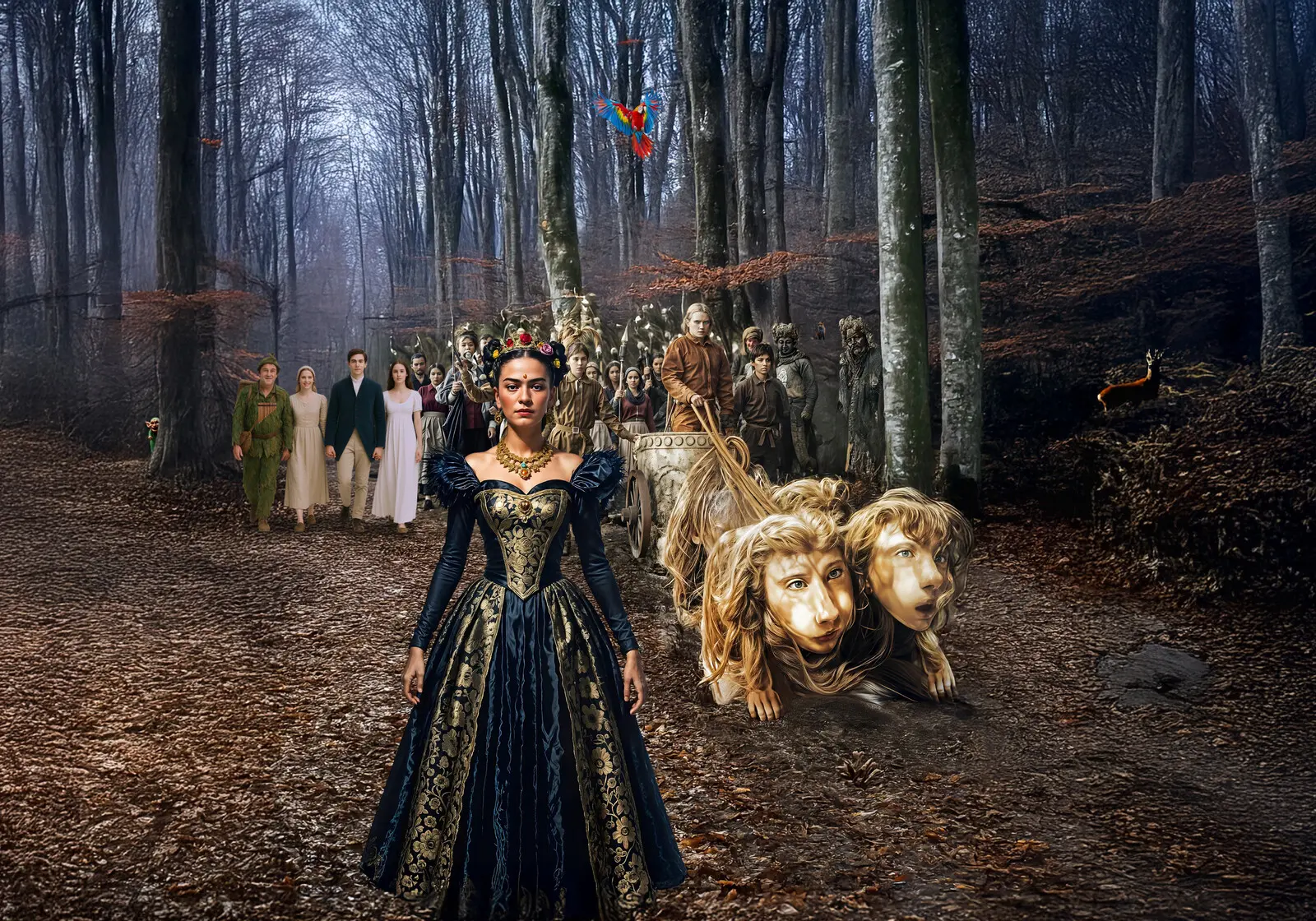
The Queen Reclaimed - Frida's Magic Flute, 2025
Digital
50 x 70 cm
3 200 kr
The Queen Reclaimed - Frida's Magic Flute
A Feminist Reading of The Magic Flute
At first glance, The Magic Flute celebrates Enlightenment ideals: wisdom, reason, and light. The high priest Sarastro presides over a temple devoted to the sun and is often portrayed as the voice of moral clarity. But if we listen carefully to what his priests sing, a different picture emerges: women, they insist, are deceitful, frivolous, and in need of male control. Sarastro doesn’t just preach patriarchal order — he embodies it. He runs a male-only lodge, commands absolute obedience, and, not incidentally, owns a Black slave. Whatever his musical grandeur, Sarastro represents domination cloaked in benevolence. He’s the patriarch’s patriarch.
Opposite him stands the Queen of the Night — Lilith, in this reading, traditionally cast as the embodiment of darkness and emotional chaos. But her story reads differently if we consider power. According to later adaptations, such as the WWI-set version by Stephen Fry and Kenneth Branagh, Sarastro and the Queen were once married. After their split, he seized their daughter and stripped her of power — a scenario that echoes modern stories of silencing, control, and retaliation. Her rage is not madness but memory.
Pamina and Tamino are “destined” for one another, but Tamino’s loyalty to Sarastro’s rules makes him reject her in silence when she seeks him out. Her response? An aria about suicide. Only after this emotional collapse is she permitted to join Tamino in his ordeal — not as an equal, but as someone now deemed sufficiently broken to be guided. Autonomy? Not quite.
Papageno and Papagena offer a more earthbound parallel. He’s no initiate — he wants food, drink, and a woman. Yet even here, female agency is suspect. Papagena, disguised as an old crone, tests his loyalty under the threat of punishment. In some productions, she appears under priestly control, escorted by Sarastro’s men and silenced before she can reveal herself. Even flirtation, it seems, requires male permission.
And the magic flute? Forged from the roots of a thousand-year-old oak during a stormy night, not from sunlight, but from shadow. Though Sarastro claims it, its creation feels older and deeper. One suspects the Queen — or Lilith — had a hand in it. The magic flute, a powerful symbol in the opera, is not just an object of Sarastro's possession. Its creation from the roots of an ancient oak during a stormy night, a time associated with darkness and chaos, suggests a deeper, older power at play. Perhaps the magic wasn’t his to begin with.
In this retelling, Lilith is no villain. She is the dispossessed, the defiant, the demonised feminine. She doesn’t merely haunt the Enlightenment — she exposes its blind spots, particularly its treatment of women and its patriarchal power structures. And maybe, just maybe, she holds the real power all along. As we say, it's the woman behind everything.
“The Flute Belongs to Her
A feminist retelling of The Magic Flute
They said:
Light is masculine,
Reason wears a robe,
And wisdom speaks in baritone.
They built temples
With doors that closed behind every woman’s footstep
And called it virtue.
He — Sarastro,
Sun-drenched, slow-spoken,
C to guide the world with truth
But hides obedience inside his rituals
And calls it love.
She — Lilith,
Unnamed, unpraised,
Queen of the night
That keeps its own counsel,
Was stripped of her circle,
Her daughter stolen
By men who said they knew better.
"She is dangerous," they whispered,
Because she would not kneel.
Since her voice didn’t tremble
When she demanded back
What was hers.
Pamina stands between them,
A daughter divided,
Her silence is mistaken for growth,
Her tears for initiation.
They say she must pass through fire and water
To be worthy.
But she’s already walked through loss.
She is already whole.
Tamino learns by trial,
Papageno stumbles by instinct,
And the priests still sing:
“Women must be led.”
Their chorus is smooth,
But the message is sharp
And the wounds are familiar.
And yet—
The flute sings.
Not of temples,
But of trees and thunder and the rootwork of women.
Not carved by Sarastro,
But conjured in the storm
By Lilith’s hands,
In the hour before dawn.
When the Queen rises,
She doesn’t ask permission.
She reclaims her name,
Her daughter,
And her voice.
The night is not absence.
The night remembers everything.”
Malmö May 2025
The Queen Reclaimed - Frida's Magic Flute
The image presents the true protagonist of The Magic Flute—the overlooked Queen of the Night. Even the seasoned opera lover who recognises Mozart's masterpiece might notice something has shifted. This is not a violation of the original but merely a change of angle, revealing the Queen's intricate character.
Is the Queen of the Night evil, or misunderstood? She is seldom given a name — a deliberate omission, of course. In Alexandre Dumas père's French adaptation of Die Zauberflöte, she is called Astrifiammante — a melodramatic Italianate name. She is sometimes called Nyx, after the Greek goddess of night, in modern dramaturgy. But I call her Lilith — a name borrowed from feminist reinterpretations, where she is linked to the primaeval woman who refused to submit to Adam, shedding new light on her character. This name change is significant as it shifts the focus from her perceived evilness to her defiance against male dominance, thereby providing a feminist reinterpretation of her character. Lilith, a figure from Jewish folklore, is often seen as a symbol of female independence and rebellion, which aligns with the Queen's character in The Magic Flute.
Mozart and Schikaneder give her no name beyond “die Königin der Nacht”—the Queen of the Night—which defines her entirely in opposition to light, order, and male power. It's a familiar pattern: the warm sun and the cold moon, il Sole and la Luna.
Lilith is dramatic, terrifying, and vengeful in the famous aria "Der Hölle Rache" — yes. However, she is also a mother fighting to reclaim her daughter. Often, she embodies emotion, night, the moon, femininity, and the irrational, which are traditionally ranked beneath reason and daylight in Enlightenment thought. From that perspective, she may not be evil; she is merely demonised.
So what about Sarastro? Is he a wise patriarch or a controlling cult leader? On the surface, he represents light, reason, and wisdom—but also a rigid, male-dominated hierarchy. Business as usual, in other words. He takes Pamina from her mother, claiming it is for their good. Is that care—or is it coercion? His “wisdom” demands obedience and ritual trials. Not exactly unproblematic. Then again, that's how patriarchs operate—if you ask the patriarchs. The Queen's relationship with Sarastro is not just a personal conflict, but a reflection of the larger power struggle between male dominance and female autonomy in the opera. This dynamic is crucial to understanding the feminist perspective on their characters.
Frida Kahlo as Lilith, the Queen of the Night. Frida—who could never bear children—now seeks to imagine what it might be like to lose one. What unfolds is not a tragedy but a mirror held up to power.
Like the Queen, Frida lived in pain and defiance. She refused to submit. She was night and fire, strength and vulnerability. It is easy to read her as a powerful yet condemned female voice — one that the historical record, or the patriarchy, tried to silence with labels like “hysterical,” “mad,” or “dangerous.”
Is Lilith — the Queen — truly evil? Not necessarily. She is complex, just like Frida. However, since a man wrote the opera, complexity isn’t always granted to women.
Traditionally, the Queen is cast as the opera’s villain: vengeful, manipulative, dangerous — a symbol of darkness, emotion, and female power that must be subdued. However, a closer reading of the libretto, especially with an eye toward gender and power, reveals that her motives are not merely personal. She is fighting to reclaim what she sees as her rightful authority, stripped from her by a patriarchal priesthood.
Lilith, the Queen of the Night, her three ladies, and Monostatos lead an assault on the Temple and are defeated and banished. From a feminist perspective, this outcome is profoundly unjust, evoking a deep sense of empathy and solidarity for the Queen's struggle.
When Lilith reveals that her late husband left the Circle of the Sun—the emblem of power—to Sarastro instead of to her, her struggle takes on a new light. It's not just about personal gain, but a political statement. She's not an irrational force of chaos, but a woman fighting to reclaim what was rightfully hers—a feminist revolt before the word even existed. This revelation of her struggle is a testament to her resilience and determination, making the audience feel her unwavering spirit.
To have Frida Kahlo embody this role is a gesture full of resonance. We now see the Queen not as a threat but as a rebel. Frida refused the gender roles of her time, just as Lilith refuses to submit to Sarastro’s patriarchal order.
Lilith is not just a powerful force but a grieving mother. Her fight for Pamina becomes deeply maternal—a desperate attempt to protect her daughter from being silenced and absorbed into a system that does not allow for female autonomy. The Queen's maternal instinct is palpable, making the audience feel her protective nature and love for her daughter.
Lilith, the Queen of the Night, emerges not just as a rebel but as a visionary. Instead of threatening the Enlightenment, she becomes its necessary counterforce: a reminder that light without justice is just a blinding glare. Her vision and understanding of the need for justice make the audience feel her foresight and the depth of her knowledge.
The Magic Flute
The final opera he completed, Mozart’s The Magic Flute, is widely admired for its exquisite music. More significantly, it has often been celebrated as a work of philosophical depth — a composition inviting contemplation and rewarding symbolic interpretation. Paul Nettl, in Mozart and Masonry, goes so far as to call the libretto “a book of human wisdom, consummated as a work of art by Mozart.” Similarly, Neal Zaslaw and William Cowdery write in The Compleat Mozart that “the opera’s overt message of tolerance and human brotherhood is surely the substance of what Mozart, as man and as Mason, wanted to communicate.”
Yet the notion that The Magic Flute is a coherent Enlightenment parable has never sat easily with the opera’s content. The older interpretation—that the work is a baffling hybrid, burdened by misogynistic and authoritarian undercurrents—is often dismissed as crude or outdated. I would argue the opposite: this is, in fact, the most accurate reading of the piece. Modern productions and translations frequently excise or soften the spoken dialogue, muting the harsher implications.
For this essay, I refer to the 1985 Dover edition of the score, which preserves the opera’s complete libretto without editorial softening. Its fidelity to the original text enables a deeper engagement with the material, exposing its internal contradictions and revealing an implicit critique of patriarchal authority and the structures that sustain it. I assume you know the plot. What interests me is how the opera thinks and what it reveals when we take its structure, characters, and contradictions seriously.
Act I: The Fairy Tale
The opera’s first act unfolds, at least on the surface, like a conventional fairy tale. A noble prince falls in love with a princess he has never met and agrees to undertake a heroic quest to rescue her. He is assigned a comic companion, and both are equipped with magical instruments to aid them on their journey. They receive guidance, direction, and a clear purpose — all the familiar markers are in place.
Yet, even at this early stage, things begin to unravel. The three ladies, attendants of the Queen of the Night, punish Papageno for lying. This is curious, given their supposed allegiance to a villainous queen. Why would it matter to them if a foolish bird-catcher takes credit for slaying a serpent? One might suggest it’s a matter of pride—that they resent his theft of their deed. However, the tone in which they deliver their punishment, along with the solemnity of the quartet in which both Tamino and Papageno join them to extol the virtue of sealing liars’ mouths with a padlock, hints at something more: a genuine concern for moral principle or, at the very least, for appearances. These moral complexities, subtly woven into the narrative, engage the audience and provoke thoughtful reflection.
Their advice to follow the guidance of the Three Boys is even more puzzling. The Boys belong to Sarastro’s realm and are, throughout the opera, aligned with his order. They serve as messengers of wisdom and enlightenment, and their alignment with Sarastro's order is a key element of the opera's thematic structure. The fact that the Queen’s three ladies would willingly cede influence to agents of their supposed enemy, the Three Boys, is a significant plot point that is never fully explained. Still, the opera doesn’t seem particularly troubled by such inconsistencies.
When we finally glimpse Sarastro’s domain, the Queen’s grim warnings seem to be confirmed. Pamina is held captive by Monostatos, a lecherous overseer who commands enslaved men. The slaves rejoice when they hear that Pamina has escaped; however, their hopes are dashed as Monostatos quickly recaptures her.
Meanwhile, Papageno—bypassing all logistical difficulties—stumbles upon Pamina, forming a swift bond. Their meeting is marked by a moment of comic horror: Papageno and Monostatos are so startled by each other’s appearance that both recoil in fear. For Papageno, it is the first time seeing a Black man; for Monostatos, it is the first time encountering someone dressed as a giant bird. Papageno recovers, quipping, “Am I a fool to let myself be frightened? There are black birds, so why not black men?” He is right in this, at least, and his spontaneous logic cuts through racial prejudice and theatrical exoticism. For all his cowardice and clowning, Papageno is perhaps the opera’s most grounded character. He is not a hero but is honest in his desires, loyal in his friendships, and rooted in reality. Indeed, he—not Tamino—finds and nearly frees the princess. This departure from traditional narrative structures, with the rustic simpleton almost winning the day, as often happens in Grimm, is a surprising and intriguing twist that will surely stimulate the audience intellectually.
Act I: The Finale
As Papageno and Pamina attempt their escape, the opera subtly shifts into a different symbolic register, transforming the scene into the threshold of three temples: Reason, Nature, and Wisdom. The reappearance of the Three Boys, aligned with Sarastro's order, serves as messengers of wisdom and enlightenment, a key element of the opera's thematic structure. The denial of entry to the Temples of Nature and Reason, coupled with the subsequent encounter with the Speaker at the portal to Wisdom, further accentuates the moral complexity of the scene, inviting the audience to engage intellectually with the narrative.
Here, Mozart does something remarkable. As in Don Giovanni, where the arrival of the Stone Guest reconfigures the entire dramatic atmosphere, The Magic Flute pivots through music—but this time, not through thunder or terror, but through subtle tonal shifts that reframe the moral world.
The tonal architecture of the scene is revealing. Tamino states his purpose in D major. The first "Zurück!" jolts the ear with a B-flat—a jarring intrusion—while the second retreats into E-flat major, the opera's so-called “masonic” key. Even without knowing this symbolic weight, listeners perceive a transformation: harmony moves upward by a half tone, and the air grows charged. As Tamino approaches the Temple of Wisdom, he shifts into C minor; the quiet but unsettling rise from G to A-flat marks the arrival of the Speaker, who responds in E-flat. Tamino replies in that same key—a musical gesture of submission, acknowledging the Speaker’s authority. These modulations do not merely colour the scene; they articulate its entire psychological structure, fostering a sense of connection with the characters' emotional journey in the audience. The tonal shifts in the music reflect the emotional and psychological journey of the characters, enhancing the audience's understanding of the scene and fostering empathy towards their plight. Mozart’s harmonic language does what the libretto cannot: it cloaks the authoritarian in the aura of reason while rendering the passionate seeker emotionally unstable.
The effect is so persuasive that it’s easy to overlook the content of what is said. The Speaker dismisses the Queen’s warnings for no reason other than her sex. Tamino challenges this: “Didn’t the abductor tear Pamina from her mother’s arms?” The Speaker admits it and then dodges further clarity, not revealing whether Pamina is alive. He exits with dignity and in noble A minor, leaving behind the vaguest of reassurances: all will be explained "once the hand of friendship leads you to the eternal bond in the sacred place."
Tamino, abandoned and bewildered, now cries out for enlightenment—literally. “When will the light shine upon me?” he asks, and in a moment of eerie theatricality, a chorus answers from nowhere: “Soon… or never.” It is the first utterance of the priests’ chorus. Earlier, the libretto specifies “a voice,” but it’s often a whole ensemble in performance. These unseen voices answer Tamino’s desperate question about Pamina’s fate, prolonging the suspense and leaving the audience intrigued: “Pamina… Pamina… lives still.” The ambiguity of these answers—the refusal to grant certainty, the aloofness of divine authority—mirrors the opera’s moral opacity. The priests do not lie but withhold, manipulate, and reframe, adding to the intrigue of the scene. Their ambiguous and enigmatic responses significantly contribute to the moral opacity of the scene, leaving the audience in suspense and enhancing the intrigue of the opera.
Meanwhile, Papageno and Pamina are close enough to hear Tamino’s flute but not close enough to reach him. Monostatos and the enslaved people overtake them, but Papageno uses his magic bells to enchant them into a grotesque dance, clearing the path. This 'grotesque dance' serves as a musical manipulation of the characters' emotions, creating a sense of relief and anticipation. Their relief is short-lived as Sarastro enters with his whole entourage. Pamina, honest to a fault, urges Papageno to tell the truth—even if it means confessing a crime.
His chorus greets Sarastro as “our idol [Abgott], to whom we all consecrate ourselves.” This line does not invite nuance. Pamina throws herself on his mercy, begging forgiveness for her escape attempt. Once again, Mozart deploys his musical genius to complicate the moral landscape: Sarastro’s lines are set to music so noble and serene that the troubling content slips unnoticed. He tells her, “You love another deeply. I shall not force you to love — but I shall not give you your freedom.” The implication is unmistakable: he had intended to marry her himself. That hope, now dashed, does not alter the power dynamic, making the audience acutely aware of the power imbalance in the scene and heightening the tension.
When Pamina invokes her mother, Sarastro’s voice turns paternalistic and disturbingly assured. He assumes the tone of a spiritual “deprogrammer,” stripping her of allegiance to the feminine. “You would lose all joy if I gave you back to her… She is a proud woman! A man must guide your heart; without one, every woman tends to overstep her bounds.” This line, so flagrantly misogynistic, somehow slips past most listeners, its venom softened by Mozart’s gracious melodic lines. The music redeems the message—or rather, disguises it.
The next moment, Sarastro appears in a better light when Monostatos drags in Tamino as a captive. Sarastro responds by sentencing Monostatos to seventy-seven lashes on the soles of his feet. No explicit reason is given, but it is retribution for his conduct toward Pamina. Still, this moment confirms what has been implicit: Monostatos is in Sarastro’s service. The lash is not moral outrage; it is house discipline. Sarastro permits slavery, even if he distances himself from the worst of its administrators.
The act ends with Sarastro’s pronouncement: Tamino and Papageno will be led into the Temple for testing. Their heads are to be covered—a gesture of ritual purification, or blind submission, depending on your perspective. Papageno protests; he has no interest in initiation, no hunger for enlightenment. It makes no difference. Sarastro does not ask, and does not need to.
Act II
As the second act opens, Sarastro consults with the assembled priests regarding Tamino’s initiation. He declares that the gods have chosen Pamina for Tamino, which retroactively justifies abducting her from her mother, the Queen of the Night, who, we’re told, seeks to destroy the Temple of Wisdom. In other words, Sarastro’s actions are righteous by divine decree.
The Speaker (or First Priest) voices caution, suggesting that Tamino may not be up to the task. “He is a prince,” he says — a title that implies privilege, not inner strength. Sarastro’s reply is one of his more memorable lines: “More than that — he is a human being [Mensch].” For a brief moment, he appears noble. But Sarastro responds with chilling calm when the Speaker raises the possibility that Tamino might die during the trials: he will meet Isis and Osiris a little sooner. In this theology, death is no objection — only disobedience.
As the trials commence, the stark contrast between Tamino and Papageno becomes more pronounced, intensifying the tension. With his sense of duty and unquestioning obedience, Tamino aligns completely with the Temple’s values. In contrast, Papageno remains disinterested in esoteric ideals, seeking only simple pleasures: food, drink, sleep, and a wife. His actions are not driven by conviction but by the promise of a partner and the threat of lifelong solitude if he resists. This contrast highlights their different paths, adding depth to the narrative.
Both men are placed under the command of silence and warned, through music, naturally, against the dangers of women’s trickery. They are explicitly forbidden to speak with Pamina or Papagena. The Three Ladies then arrive uninvited, having somehow entered the Temple. Perhaps this is part of the test by design, though nothing confirms it. Papageno is easily tempted to talk; Tamino remains rigidly silent and instructs Papageno to do likewise. “She is just a woman, with a woman’s mind,” Tamino says of the Queen, parroting the Temple’s disdain.
The next scene features Monostatos, a complex and controversial character, who delivers an aria that has provoked much debate. He complains that no one loves him — he is Black in a white society, and he feels rejected and despised. The text is deeply ambiguous. His longing for Pamina reads as entitlement, not affection; his worldview seems warped, his motives suspect. This ambiguity highlights the complexity of his character, making the audience feel the depth of his motives.
The Queen’s next scene with Pamina, often omitted in modern performances, is key to understanding the opera’s backstory. She reveals that when Pamina’s father died, he entrusted the Sun Circle — the source of his power — to Sarastro rather than her. This revelation is significant as it sheds light on the Queen's motivations and sense of injustice. The Queen’s campaign is not driven by evil but by political disenfranchisement. She wants to reclaim what was once hers. Her plotting, viewed in this light, becomes a form of resistance rather than villainy.
Meanwhile, Papagena is reintroduced through a cruel ruse. Papageno is shown an old woman who tells him he must marry her or remain alone forever. When he finally consents, she briefly reveals herself as the beautiful Papagena — and is immediately taken away. The lesson is obscure. It seems less like a trial and more like emotional punishment.
Next comes one of the opera’s most brutal emotional reversals, evoking empathy from the audience: Pamina finds Tamino during his trial and tries to speak with him. He refuses to answer, doesn’t even meet her eyes, and gestures for her to leave. No rule forbids kindness - no line in the libretto states that he may not acknowledge her pain—but he chooses silence, and she is devastated. This scene emphasises the emotional turmoil Pamina is going through, making the audience empathise with her plight.
Sarastro escalates things by bringing Pamina and Tamino before him. He informs her that this may be their final meeting and instructs her to say farewell. Tamino, at last, shows some emotion and expresses hope that they’ll see one another again, but Pamina does not explain his earlier coldness. Her confusion turns into despair.
In the next scene, she prepares to take her own life. The Three Boys intervene just in time, saving her with vague reassurances and a promise of reunion with Tamino. This act of salvation is significant as it shows the opera's underlying theme of divine intervention and the power of hope. Strangely, this act of suicidal despair is read by the Temple as a sign of strength: proof that she is worthy, that her devotion has passed the test. It is a troubling logic, suggesting that total emotional collapse somehow affirms female virtue, provided that virtue is expressed as submissive fidelity to a man’s path.
The Three Boys, who have guided and assisted the characters throughout the opera, intervene again. They remind Papageno to use his magic bells, and she reappears when he does. Papageno is not initiated, nor does he seek to be. He is spared the trials and allowed to live in simple contentment instead. The role of the Three Boys in this scene is significant as it highlights their benevolent nature and functions as guides and protectors of the characters. What this means, exactly, is unclear. Why was he subjected to such torment if he was never fit for the Temple? If he were fit, why would he be excluded?
The Conclusion
Despite the opera’s long detours through trial, silence, and psychological ambiguity, The Magic Flute ends with resolution and celebration. Protected by the enchanted flute — a gift from the Queen’s attendants, ironically — Tamino and Pamina face and overcome the elemental ordeals of fire and water. They do so side by side, as equals, with love as their guide and music as their shield. Their successful passage through the trials, with music as their shield, allows them to be fully accepted into the Temple and one another’s lives. It is, at last, a moment of harmony — musically, morally, and narratively.
Papageno’s path is humbler but no less heartfelt. Pushed to despair by the loss of Papagena and convinced that he has been cast aside by love and society alike, he prepares to hang himself. With their timely return, the Three Boys play a crucial role as agents of balance and mercy. They remind him of the magic bells, which, when rung, summon Papagena back to him. The two are reunited, this time for good. No trials, enlightenment, or sacred bond — just affection, joy, and a shared desire for domestic happiness.
In the opera’s final scenes, Sarastro declares the triumph of light over darkness, the defeat of the Queen of the Night, and the Temple's resounding victory. A chorus of priests sings the virtues of enlightenment, unity, and truth. The stage is filled with music, order, and resolved tension, leaving the audience with triumphant resolution.
But one is left wondering: does this ending genuinely redeem the ambiguities that precede it? Or does Mozart’s music, once again, elevate and sanctify a more symbolic than sincere resolution? Regardless, Die Zauberflöte closes in the major key, both musically and emotionally. The lovers are united, the chaos is tamed, and momentarily, the ideals of harmony and reason seem to triumph over doubt and division.
The virtues upheld by Sarastro’s Temple are absolute obedience, stoic endurance, silence on command, and profound mistrust of women. What is called “Wisdom” here resembles something closer to spiritual authoritarianism. This is a closed system: it reveres its leader, enforces secrecy through ritual, manipulates emotions to test loyalty, abducts those it claims to save, and systematically excludes outsiders — especially women — from real power.
That this organisation is meant to reflect Freemasonry — an Enlightenment movement associated in Mozart’s time with reason, progress, and fraternity — adds a strange layer of irony. Some of the Temple’s practices make more sense when viewed through the lens of historical secrecy. Masonic lodges were persecuted across Europe and had good reason to shield their rituals. Perhaps the distrust of women reflects fears that knowledge might leak through domestic intimacy.
Still, there is no getting around the contradictions. Die Zauberflöte contains some of Mozart’s most sublime music, which seems to transcend the text and elevate the spirit. But the libretto itself, taken as a whole, is riddled with unexamined dogmas, crude gender politics, and a philosophy that equates virtue with submission. What the music reveals is beauty. What the text reveals is a hierarchy.
Jörgen Thornberg
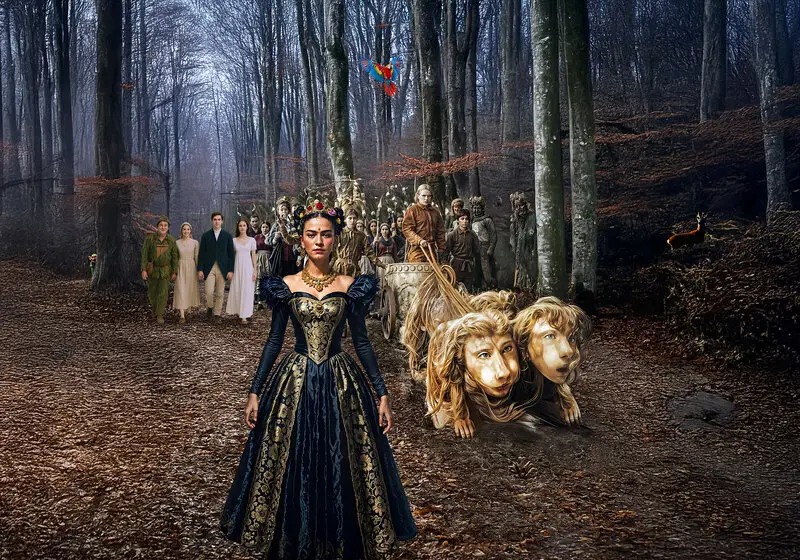
The Queen Reclaimed - Frida's Magic Flute, 2025
Digital
50 x 70 cm
3 200 kr
The Queen Reclaimed - Frida's Magic Flute
A Feminist Reading of The Magic Flute
At first glance, The Magic Flute celebrates Enlightenment ideals: wisdom, reason, and light. The high priest Sarastro presides over a temple devoted to the sun and is often portrayed as the voice of moral clarity. But if we listen carefully to what his priests sing, a different picture emerges: women, they insist, are deceitful, frivolous, and in need of male control. Sarastro doesn’t just preach patriarchal order — he embodies it. He runs a male-only lodge, commands absolute obedience, and, not incidentally, owns a Black slave. Whatever his musical grandeur, Sarastro represents domination cloaked in benevolence. He’s the patriarch’s patriarch.
Opposite him stands the Queen of the Night — Lilith, in this reading, traditionally cast as the embodiment of darkness and emotional chaos. But her story reads differently if we consider power. According to later adaptations, such as the WWI-set version by Stephen Fry and Kenneth Branagh, Sarastro and the Queen were once married. After their split, he seized their daughter and stripped her of power — a scenario that echoes modern stories of silencing, control, and retaliation. Her rage is not madness but memory.
Pamina and Tamino are “destined” for one another, but Tamino’s loyalty to Sarastro’s rules makes him reject her in silence when she seeks him out. Her response? An aria about suicide. Only after this emotional collapse is she permitted to join Tamino in his ordeal — not as an equal, but as someone now deemed sufficiently broken to be guided. Autonomy? Not quite.
Papageno and Papagena offer a more earthbound parallel. He’s no initiate — he wants food, drink, and a woman. Yet even here, female agency is suspect. Papagena, disguised as an old crone, tests his loyalty under the threat of punishment. In some productions, she appears under priestly control, escorted by Sarastro’s men and silenced before she can reveal herself. Even flirtation, it seems, requires male permission.
And the magic flute? Forged from the roots of a thousand-year-old oak during a stormy night, not from sunlight, but from shadow. Though Sarastro claims it, its creation feels older and deeper. One suspects the Queen — or Lilith — had a hand in it. The magic flute, a powerful symbol in the opera, is not just an object of Sarastro's possession. Its creation from the roots of an ancient oak during a stormy night, a time associated with darkness and chaos, suggests a deeper, older power at play. Perhaps the magic wasn’t his to begin with.
In this retelling, Lilith is no villain. She is the dispossessed, the defiant, the demonised feminine. She doesn’t merely haunt the Enlightenment — she exposes its blind spots, particularly its treatment of women and its patriarchal power structures. And maybe, just maybe, she holds the real power all along. As we say, it's the woman behind everything.
“The Flute Belongs to Her
A feminist retelling of The Magic Flute
They said:
Light is masculine,
Reason wears a robe,
And wisdom speaks in baritone.
They built temples
With doors that closed behind every woman’s footstep
And called it virtue.
He — Sarastro,
Sun-drenched, slow-spoken,
C to guide the world with truth
But hides obedience inside his rituals
And calls it love.
She — Lilith,
Unnamed, unpraised,
Queen of the night
That keeps its own counsel,
Was stripped of her circle,
Her daughter stolen
By men who said they knew better.
"She is dangerous," they whispered,
Because she would not kneel.
Since her voice didn’t tremble
When she demanded back
What was hers.
Pamina stands between them,
A daughter divided,
Her silence is mistaken for growth,
Her tears for initiation.
They say she must pass through fire and water
To be worthy.
But she’s already walked through loss.
She is already whole.
Tamino learns by trial,
Papageno stumbles by instinct,
And the priests still sing:
“Women must be led.”
Their chorus is smooth,
But the message is sharp
And the wounds are familiar.
And yet—
The flute sings.
Not of temples,
But of trees and thunder and the rootwork of women.
Not carved by Sarastro,
But conjured in the storm
By Lilith’s hands,
In the hour before dawn.
When the Queen rises,
She doesn’t ask permission.
She reclaims her name,
Her daughter,
And her voice.
The night is not absence.
The night remembers everything.”
Malmö May 2025
The Queen Reclaimed - Frida's Magic Flute
The image presents the true protagonist of The Magic Flute—the overlooked Queen of the Night. Even the seasoned opera lover who recognises Mozart's masterpiece might notice something has shifted. This is not a violation of the original but merely a change of angle, revealing the Queen's intricate character.
Is the Queen of the Night evil, or misunderstood? She is seldom given a name — a deliberate omission, of course. In Alexandre Dumas père's French adaptation of Die Zauberflöte, she is called Astrifiammante — a melodramatic Italianate name. She is sometimes called Nyx, after the Greek goddess of night, in modern dramaturgy. But I call her Lilith — a name borrowed from feminist reinterpretations, where she is linked to the primaeval woman who refused to submit to Adam, shedding new light on her character. This name change is significant as it shifts the focus from her perceived evilness to her defiance against male dominance, thereby providing a feminist reinterpretation of her character. Lilith, a figure from Jewish folklore, is often seen as a symbol of female independence and rebellion, which aligns with the Queen's character in The Magic Flute.
Mozart and Schikaneder give her no name beyond “die Königin der Nacht”—the Queen of the Night—which defines her entirely in opposition to light, order, and male power. It's a familiar pattern: the warm sun and the cold moon, il Sole and la Luna.
Lilith is dramatic, terrifying, and vengeful in the famous aria "Der Hölle Rache" — yes. However, she is also a mother fighting to reclaim her daughter. Often, she embodies emotion, night, the moon, femininity, and the irrational, which are traditionally ranked beneath reason and daylight in Enlightenment thought. From that perspective, she may not be evil; she is merely demonised.
So what about Sarastro? Is he a wise patriarch or a controlling cult leader? On the surface, he represents light, reason, and wisdom—but also a rigid, male-dominated hierarchy. Business as usual, in other words. He takes Pamina from her mother, claiming it is for their good. Is that care—or is it coercion? His “wisdom” demands obedience and ritual trials. Not exactly unproblematic. Then again, that's how patriarchs operate—if you ask the patriarchs. The Queen's relationship with Sarastro is not just a personal conflict, but a reflection of the larger power struggle between male dominance and female autonomy in the opera. This dynamic is crucial to understanding the feminist perspective on their characters.
Frida Kahlo as Lilith, the Queen of the Night. Frida—who could never bear children—now seeks to imagine what it might be like to lose one. What unfolds is not a tragedy but a mirror held up to power.
Like the Queen, Frida lived in pain and defiance. She refused to submit. She was night and fire, strength and vulnerability. It is easy to read her as a powerful yet condemned female voice — one that the historical record, or the patriarchy, tried to silence with labels like “hysterical,” “mad,” or “dangerous.”
Is Lilith — the Queen — truly evil? Not necessarily. She is complex, just like Frida. However, since a man wrote the opera, complexity isn’t always granted to women.
Traditionally, the Queen is cast as the opera’s villain: vengeful, manipulative, dangerous — a symbol of darkness, emotion, and female power that must be subdued. However, a closer reading of the libretto, especially with an eye toward gender and power, reveals that her motives are not merely personal. She is fighting to reclaim what she sees as her rightful authority, stripped from her by a patriarchal priesthood.
Lilith, the Queen of the Night, her three ladies, and Monostatos lead an assault on the Temple and are defeated and banished. From a feminist perspective, this outcome is profoundly unjust, evoking a deep sense of empathy and solidarity for the Queen's struggle.
When Lilith reveals that her late husband left the Circle of the Sun—the emblem of power—to Sarastro instead of to her, her struggle takes on a new light. It's not just about personal gain, but a political statement. She's not an irrational force of chaos, but a woman fighting to reclaim what was rightfully hers—a feminist revolt before the word even existed. This revelation of her struggle is a testament to her resilience and determination, making the audience feel her unwavering spirit.
To have Frida Kahlo embody this role is a gesture full of resonance. We now see the Queen not as a threat but as a rebel. Frida refused the gender roles of her time, just as Lilith refuses to submit to Sarastro’s patriarchal order.
Lilith is not just a powerful force but a grieving mother. Her fight for Pamina becomes deeply maternal—a desperate attempt to protect her daughter from being silenced and absorbed into a system that does not allow for female autonomy. The Queen's maternal instinct is palpable, making the audience feel her protective nature and love for her daughter.
Lilith, the Queen of the Night, emerges not just as a rebel but as a visionary. Instead of threatening the Enlightenment, she becomes its necessary counterforce: a reminder that light without justice is just a blinding glare. Her vision and understanding of the need for justice make the audience feel her foresight and the depth of her knowledge.
The Magic Flute
The final opera he completed, Mozart’s The Magic Flute, is widely admired for its exquisite music. More significantly, it has often been celebrated as a work of philosophical depth — a composition inviting contemplation and rewarding symbolic interpretation. Paul Nettl, in Mozart and Masonry, goes so far as to call the libretto “a book of human wisdom, consummated as a work of art by Mozart.” Similarly, Neal Zaslaw and William Cowdery write in The Compleat Mozart that “the opera’s overt message of tolerance and human brotherhood is surely the substance of what Mozart, as man and as Mason, wanted to communicate.”
Yet the notion that The Magic Flute is a coherent Enlightenment parable has never sat easily with the opera’s content. The older interpretation—that the work is a baffling hybrid, burdened by misogynistic and authoritarian undercurrents—is often dismissed as crude or outdated. I would argue the opposite: this is, in fact, the most accurate reading of the piece. Modern productions and translations frequently excise or soften the spoken dialogue, muting the harsher implications.
For this essay, I refer to the 1985 Dover edition of the score, which preserves the opera’s complete libretto without editorial softening. Its fidelity to the original text enables a deeper engagement with the material, exposing its internal contradictions and revealing an implicit critique of patriarchal authority and the structures that sustain it. I assume you know the plot. What interests me is how the opera thinks and what it reveals when we take its structure, characters, and contradictions seriously.
Act I: The Fairy Tale
The opera’s first act unfolds, at least on the surface, like a conventional fairy tale. A noble prince falls in love with a princess he has never met and agrees to undertake a heroic quest to rescue her. He is assigned a comic companion, and both are equipped with magical instruments to aid them on their journey. They receive guidance, direction, and a clear purpose — all the familiar markers are in place.
Yet, even at this early stage, things begin to unravel. The three ladies, attendants of the Queen of the Night, punish Papageno for lying. This is curious, given their supposed allegiance to a villainous queen. Why would it matter to them if a foolish bird-catcher takes credit for slaying a serpent? One might suggest it’s a matter of pride—that they resent his theft of their deed. However, the tone in which they deliver their punishment, along with the solemnity of the quartet in which both Tamino and Papageno join them to extol the virtue of sealing liars’ mouths with a padlock, hints at something more: a genuine concern for moral principle or, at the very least, for appearances. These moral complexities, subtly woven into the narrative, engage the audience and provoke thoughtful reflection.
Their advice to follow the guidance of the Three Boys is even more puzzling. The Boys belong to Sarastro’s realm and are, throughout the opera, aligned with his order. They serve as messengers of wisdom and enlightenment, and their alignment with Sarastro's order is a key element of the opera's thematic structure. The fact that the Queen’s three ladies would willingly cede influence to agents of their supposed enemy, the Three Boys, is a significant plot point that is never fully explained. Still, the opera doesn’t seem particularly troubled by such inconsistencies.
When we finally glimpse Sarastro’s domain, the Queen’s grim warnings seem to be confirmed. Pamina is held captive by Monostatos, a lecherous overseer who commands enslaved men. The slaves rejoice when they hear that Pamina has escaped; however, their hopes are dashed as Monostatos quickly recaptures her.
Meanwhile, Papageno—bypassing all logistical difficulties—stumbles upon Pamina, forming a swift bond. Their meeting is marked by a moment of comic horror: Papageno and Monostatos are so startled by each other’s appearance that both recoil in fear. For Papageno, it is the first time seeing a Black man; for Monostatos, it is the first time encountering someone dressed as a giant bird. Papageno recovers, quipping, “Am I a fool to let myself be frightened? There are black birds, so why not black men?” He is right in this, at least, and his spontaneous logic cuts through racial prejudice and theatrical exoticism. For all his cowardice and clowning, Papageno is perhaps the opera’s most grounded character. He is not a hero but is honest in his desires, loyal in his friendships, and rooted in reality. Indeed, he—not Tamino—finds and nearly frees the princess. This departure from traditional narrative structures, with the rustic simpleton almost winning the day, as often happens in Grimm, is a surprising and intriguing twist that will surely stimulate the audience intellectually.
Act I: The Finale
As Papageno and Pamina attempt their escape, the opera subtly shifts into a different symbolic register, transforming the scene into the threshold of three temples: Reason, Nature, and Wisdom. The reappearance of the Three Boys, aligned with Sarastro's order, serves as messengers of wisdom and enlightenment, a key element of the opera's thematic structure. The denial of entry to the Temples of Nature and Reason, coupled with the subsequent encounter with the Speaker at the portal to Wisdom, further accentuates the moral complexity of the scene, inviting the audience to engage intellectually with the narrative.
Here, Mozart does something remarkable. As in Don Giovanni, where the arrival of the Stone Guest reconfigures the entire dramatic atmosphere, The Magic Flute pivots through music—but this time, not through thunder or terror, but through subtle tonal shifts that reframe the moral world.
The tonal architecture of the scene is revealing. Tamino states his purpose in D major. The first "Zurück!" jolts the ear with a B-flat—a jarring intrusion—while the second retreats into E-flat major, the opera's so-called “masonic” key. Even without knowing this symbolic weight, listeners perceive a transformation: harmony moves upward by a half tone, and the air grows charged. As Tamino approaches the Temple of Wisdom, he shifts into C minor; the quiet but unsettling rise from G to A-flat marks the arrival of the Speaker, who responds in E-flat. Tamino replies in that same key—a musical gesture of submission, acknowledging the Speaker’s authority. These modulations do not merely colour the scene; they articulate its entire psychological structure, fostering a sense of connection with the characters' emotional journey in the audience. The tonal shifts in the music reflect the emotional and psychological journey of the characters, enhancing the audience's understanding of the scene and fostering empathy towards their plight. Mozart’s harmonic language does what the libretto cannot: it cloaks the authoritarian in the aura of reason while rendering the passionate seeker emotionally unstable.
The effect is so persuasive that it’s easy to overlook the content of what is said. The Speaker dismisses the Queen’s warnings for no reason other than her sex. Tamino challenges this: “Didn’t the abductor tear Pamina from her mother’s arms?” The Speaker admits it and then dodges further clarity, not revealing whether Pamina is alive. He exits with dignity and in noble A minor, leaving behind the vaguest of reassurances: all will be explained "once the hand of friendship leads you to the eternal bond in the sacred place."
Tamino, abandoned and bewildered, now cries out for enlightenment—literally. “When will the light shine upon me?” he asks, and in a moment of eerie theatricality, a chorus answers from nowhere: “Soon… or never.” It is the first utterance of the priests’ chorus. Earlier, the libretto specifies “a voice,” but it’s often a whole ensemble in performance. These unseen voices answer Tamino’s desperate question about Pamina’s fate, prolonging the suspense and leaving the audience intrigued: “Pamina… Pamina… lives still.” The ambiguity of these answers—the refusal to grant certainty, the aloofness of divine authority—mirrors the opera’s moral opacity. The priests do not lie but withhold, manipulate, and reframe, adding to the intrigue of the scene. Their ambiguous and enigmatic responses significantly contribute to the moral opacity of the scene, leaving the audience in suspense and enhancing the intrigue of the opera.
Meanwhile, Papageno and Pamina are close enough to hear Tamino’s flute but not close enough to reach him. Monostatos and the enslaved people overtake them, but Papageno uses his magic bells to enchant them into a grotesque dance, clearing the path. This 'grotesque dance' serves as a musical manipulation of the characters' emotions, creating a sense of relief and anticipation. Their relief is short-lived as Sarastro enters with his whole entourage. Pamina, honest to a fault, urges Papageno to tell the truth—even if it means confessing a crime.
His chorus greets Sarastro as “our idol [Abgott], to whom we all consecrate ourselves.” This line does not invite nuance. Pamina throws herself on his mercy, begging forgiveness for her escape attempt. Once again, Mozart deploys his musical genius to complicate the moral landscape: Sarastro’s lines are set to music so noble and serene that the troubling content slips unnoticed. He tells her, “You love another deeply. I shall not force you to love — but I shall not give you your freedom.” The implication is unmistakable: he had intended to marry her himself. That hope, now dashed, does not alter the power dynamic, making the audience acutely aware of the power imbalance in the scene and heightening the tension.
When Pamina invokes her mother, Sarastro’s voice turns paternalistic and disturbingly assured. He assumes the tone of a spiritual “deprogrammer,” stripping her of allegiance to the feminine. “You would lose all joy if I gave you back to her… She is a proud woman! A man must guide your heart; without one, every woman tends to overstep her bounds.” This line, so flagrantly misogynistic, somehow slips past most listeners, its venom softened by Mozart’s gracious melodic lines. The music redeems the message—or rather, disguises it.
The next moment, Sarastro appears in a better light when Monostatos drags in Tamino as a captive. Sarastro responds by sentencing Monostatos to seventy-seven lashes on the soles of his feet. No explicit reason is given, but it is retribution for his conduct toward Pamina. Still, this moment confirms what has been implicit: Monostatos is in Sarastro’s service. The lash is not moral outrage; it is house discipline. Sarastro permits slavery, even if he distances himself from the worst of its administrators.
The act ends with Sarastro’s pronouncement: Tamino and Papageno will be led into the Temple for testing. Their heads are to be covered—a gesture of ritual purification, or blind submission, depending on your perspective. Papageno protests; he has no interest in initiation, no hunger for enlightenment. It makes no difference. Sarastro does not ask, and does not need to.
Act II
As the second act opens, Sarastro consults with the assembled priests regarding Tamino’s initiation. He declares that the gods have chosen Pamina for Tamino, which retroactively justifies abducting her from her mother, the Queen of the Night, who, we’re told, seeks to destroy the Temple of Wisdom. In other words, Sarastro’s actions are righteous by divine decree.
The Speaker (or First Priest) voices caution, suggesting that Tamino may not be up to the task. “He is a prince,” he says — a title that implies privilege, not inner strength. Sarastro’s reply is one of his more memorable lines: “More than that — he is a human being [Mensch].” For a brief moment, he appears noble. But Sarastro responds with chilling calm when the Speaker raises the possibility that Tamino might die during the trials: he will meet Isis and Osiris a little sooner. In this theology, death is no objection — only disobedience.
As the trials commence, the stark contrast between Tamino and Papageno becomes more pronounced, intensifying the tension. With his sense of duty and unquestioning obedience, Tamino aligns completely with the Temple’s values. In contrast, Papageno remains disinterested in esoteric ideals, seeking only simple pleasures: food, drink, sleep, and a wife. His actions are not driven by conviction but by the promise of a partner and the threat of lifelong solitude if he resists. This contrast highlights their different paths, adding depth to the narrative.
Both men are placed under the command of silence and warned, through music, naturally, against the dangers of women’s trickery. They are explicitly forbidden to speak with Pamina or Papagena. The Three Ladies then arrive uninvited, having somehow entered the Temple. Perhaps this is part of the test by design, though nothing confirms it. Papageno is easily tempted to talk; Tamino remains rigidly silent and instructs Papageno to do likewise. “She is just a woman, with a woman’s mind,” Tamino says of the Queen, parroting the Temple’s disdain.
The next scene features Monostatos, a complex and controversial character, who delivers an aria that has provoked much debate. He complains that no one loves him — he is Black in a white society, and he feels rejected and despised. The text is deeply ambiguous. His longing for Pamina reads as entitlement, not affection; his worldview seems warped, his motives suspect. This ambiguity highlights the complexity of his character, making the audience feel the depth of his motives.
The Queen’s next scene with Pamina, often omitted in modern performances, is key to understanding the opera’s backstory. She reveals that when Pamina’s father died, he entrusted the Sun Circle — the source of his power — to Sarastro rather than her. This revelation is significant as it sheds light on the Queen's motivations and sense of injustice. The Queen’s campaign is not driven by evil but by political disenfranchisement. She wants to reclaim what was once hers. Her plotting, viewed in this light, becomes a form of resistance rather than villainy.
Meanwhile, Papagena is reintroduced through a cruel ruse. Papageno is shown an old woman who tells him he must marry her or remain alone forever. When he finally consents, she briefly reveals herself as the beautiful Papagena — and is immediately taken away. The lesson is obscure. It seems less like a trial and more like emotional punishment.
Next comes one of the opera’s most brutal emotional reversals, evoking empathy from the audience: Pamina finds Tamino during his trial and tries to speak with him. He refuses to answer, doesn’t even meet her eyes, and gestures for her to leave. No rule forbids kindness - no line in the libretto states that he may not acknowledge her pain—but he chooses silence, and she is devastated. This scene emphasises the emotional turmoil Pamina is going through, making the audience empathise with her plight.
Sarastro escalates things by bringing Pamina and Tamino before him. He informs her that this may be their final meeting and instructs her to say farewell. Tamino, at last, shows some emotion and expresses hope that they’ll see one another again, but Pamina does not explain his earlier coldness. Her confusion turns into despair.
In the next scene, she prepares to take her own life. The Three Boys intervene just in time, saving her with vague reassurances and a promise of reunion with Tamino. This act of salvation is significant as it shows the opera's underlying theme of divine intervention and the power of hope. Strangely, this act of suicidal despair is read by the Temple as a sign of strength: proof that she is worthy, that her devotion has passed the test. It is a troubling logic, suggesting that total emotional collapse somehow affirms female virtue, provided that virtue is expressed as submissive fidelity to a man’s path.
The Three Boys, who have guided and assisted the characters throughout the opera, intervene again. They remind Papageno to use his magic bells, and she reappears when he does. Papageno is not initiated, nor does he seek to be. He is spared the trials and allowed to live in simple contentment instead. The role of the Three Boys in this scene is significant as it highlights their benevolent nature and functions as guides and protectors of the characters. What this means, exactly, is unclear. Why was he subjected to such torment if he was never fit for the Temple? If he were fit, why would he be excluded?
The Conclusion
Despite the opera’s long detours through trial, silence, and psychological ambiguity, The Magic Flute ends with resolution and celebration. Protected by the enchanted flute — a gift from the Queen’s attendants, ironically — Tamino and Pamina face and overcome the elemental ordeals of fire and water. They do so side by side, as equals, with love as their guide and music as their shield. Their successful passage through the trials, with music as their shield, allows them to be fully accepted into the Temple and one another’s lives. It is, at last, a moment of harmony — musically, morally, and narratively.
Papageno’s path is humbler but no less heartfelt. Pushed to despair by the loss of Papagena and convinced that he has been cast aside by love and society alike, he prepares to hang himself. With their timely return, the Three Boys play a crucial role as agents of balance and mercy. They remind him of the magic bells, which, when rung, summon Papagena back to him. The two are reunited, this time for good. No trials, enlightenment, or sacred bond — just affection, joy, and a shared desire for domestic happiness.
In the opera’s final scenes, Sarastro declares the triumph of light over darkness, the defeat of the Queen of the Night, and the Temple's resounding victory. A chorus of priests sings the virtues of enlightenment, unity, and truth. The stage is filled with music, order, and resolved tension, leaving the audience with triumphant resolution.
But one is left wondering: does this ending genuinely redeem the ambiguities that precede it? Or does Mozart’s music, once again, elevate and sanctify a more symbolic than sincere resolution? Regardless, Die Zauberflöte closes in the major key, both musically and emotionally. The lovers are united, the chaos is tamed, and momentarily, the ideals of harmony and reason seem to triumph over doubt and division.
The virtues upheld by Sarastro’s Temple are absolute obedience, stoic endurance, silence on command, and profound mistrust of women. What is called “Wisdom” here resembles something closer to spiritual authoritarianism. This is a closed system: it reveres its leader, enforces secrecy through ritual, manipulates emotions to test loyalty, abducts those it claims to save, and systematically excludes outsiders — especially women — from real power.
That this organisation is meant to reflect Freemasonry — an Enlightenment movement associated in Mozart’s time with reason, progress, and fraternity — adds a strange layer of irony. Some of the Temple’s practices make more sense when viewed through the lens of historical secrecy. Masonic lodges were persecuted across Europe and had good reason to shield their rituals. Perhaps the distrust of women reflects fears that knowledge might leak through domestic intimacy.
Still, there is no getting around the contradictions. Die Zauberflöte contains some of Mozart’s most sublime music, which seems to transcend the text and elevate the spirit. But the libretto itself, taken as a whole, is riddled with unexamined dogmas, crude gender politics, and a philosophy that equates virtue with submission. What the music reveals is beauty. What the text reveals is a hierarchy.
3 200 kr

Jörgen Thornberg
Malmö
Lite om bilder och mig. Translation in English at the end.
Jag är en nyfiken person som ser allt i bilder, även det jag fäster i ord, gärna tillsammans för bakom alla mina bilder finns en berättelse. Till vissa bilder hör en kortare eller längre novell som följer med bilden.
Bilder berättar historier. Jag omges av naturlig skönhet, intressanta människor och historia var jag än går. Jag använder min kamera för att dokumentera världen och blanda det jag ser med vad jag känner för att fånga den dolda magin.
Mina bilder berättar mina historier. Genom mina bilder, tryck och berättelser. Jag bjuder in dig att ta del av dessa berättelser, in i ditt liv och hem och dela min mycket personliga syn på vår värld. Mer än vad ögat ser. Jag tänker i bilder, drömmer och skriver och pratar om dem; följaktligen måste jag också skapa bilder. De blir vad jag ser, inte nödvändigtvis begränsade till verkligheten. Det finns en bild runt varje hörn. Jag hoppas att du kommer att se vad jag såg och gilla det.
Jag är också en skrivande person och till många bilder hör en kortare eller längre essay. Den följer med tavlan, tryckt på fint papper och med en personlig hälsning från mig.
Flertalet bilder startar sin resa i min kamera. Enkelt förklarat beskriver jag bilden jag ser i mitt inre, upplevd eller fantiserad. Bilden uppstår inom mig redan innan jag fått okularet till ögat. På bråkdelen av ett ögonblick ser jag vad jag vill ha och vad som kan göras med bilden. Här skall jag stoppa in en giraff, stålmannen, Titanic eller vad det är min fantasi finner ut. Ännu märkligare är att jag kommer ihåg minnesbilden långt efteråt när det blir tid att skapa verket. Om jag lyckas eller inte, är upp till betraktaren, oftast präglat av en stråk av svart humor – meningen är att man skall bli underhållen. Mina bilder blir ofta en snackis där de hänger.
Jag föredrar bilder som förmedlar ett budskap i flera lager. Vid första anblicken fylld av feel-good, en vacker utsikt, fint väder, solen skiner, blommor på ängen eller vattnet som ligger förrädiskt spegelblankt. I en sådan bild kan jag gömma min egentliga berättelse, mitt förakt för förtryckare och våldsverkare, rasister och fördomsfulla människor - ett gärna återkommande motiv mer eller mindre dolt i det vackra motivet. Jag försöker förena dem i ett gemensamt narrativ.
Bild och formgivning har löpt som en röd tråd genom livet. Fotokonst känns som en värdig final som jag gärna delar med mig.
Min genre är vid som framgår av mina bilder, temat en blandning av pop- och gatukonst i kollage som kan bestå av hundratals lager. Vissa bilder kan ta veckor, andra någon dag innan det är dags att överlämna resultatet till printverkstaden. Fine Art Prints är digitala fotocollage. I dessa kollage sker rivandet, klippandet, pusslandet, målandet, ritandet och sprayningen digitalt. Det jag monterar in kan vara hundratals år gamla bilder som jag omsorgsfullt frilägger så att de ser ut att vara en del av tavlan men också bilder skapade av mig själv efter min egen fantasi. Därefter besöks printstudion och för vissa bilder numrera en limiterad upplaga (oftast 7 exemplar) och signera för hand. Vissa bilder kan köpas i olika format. Det är bara att fråga efter vilka. Gillar man en bild som är 70x100 men inte har plats på väggen, går den kanske att få i 50x70 cm istället. Frågan är fri.
Metoden Giclée eller Fine Art Print som det också kallas är det moderna sättet för framställning av grafisk konst. Villkoret för denna typ av utskrifter är att en högkvalitativ storformatskrivare används med åldersbeständigt färgpigment och konstnärspapper eller i förekommande fall på duk. Pappret som används möter de krav på livslängd som ställs av museer och gallerier. Normalt säljer jag mina bilder oinramade så att den nya ägaren själv kan bestämma hur de skall se ut, med eller utan passepartout färg på ram, med eller utan glas etc..
Under många år ställde jag bara ut på nätet, i valda grupper och på min egen Facebooksida - https://www.facebook.com/jorgen.thornberg.9
Jag finns också på en egen hemsida som tyvärr inte alltid är uppdaterad – https://www.jth.life/ Där kan du också läsa en del av de berättelser som följer med bilden.
UTSTÄLLNINGAR
Luftkastellet, oktober 2022
Konst i Lund, november 2022
Luftkastellet, mars 2023
Engleson Galleri Caroli, april 2023
Hydra, Greece June 2023
Engleson Galleri Caroli, oktober 2023
Toppen, Höllviken december 2023
Luftkastellet, mars 2024
Torups Galleri, mars 2024
Venice, May 2024
Luftkastellet, oktober 2024
Konst i Advent, December 2024
Galleri Engleson, Caroli December 2024
Jäger & Jansson Galleri, april 2025
A bit about pictures and me.
I'm a curious person who sees everything in pictures, even what I express in words, often combining them, for behind all my pictures lies a story. These narratives, some as short as a single image and others as long as a novel, are the heart and soul of my work.
Pictures tell stories. Wherever I go, I'm surrounded by natural beauty, exciting people, and history. I use my camera to document the world and blend what I see with what I feel to capture the hidden magic.
My images tell my stories. Through my pictures, prints, and narratives, I invite you to partake in these stories in your life and home and share my deeply personal perspective of our world. More than meets the eye. I think in pictures, dream, write, and talk about them; consequently, I must create images too. They become what I see, not necessarily confined to reality. There's a picture around every corner. I hope you'll see what I saw and enjoy it.
I'm also a writer, and many images come with a shorter or longer essay. It accompanies the painting, printed on fine paper with my personal greeting.
Many pictures start their journey on my camera. Simply put, I describe the image I see in my mind, experienced or imagined. The image arises within me even before I bring the eyepiece to my eye. In a fraction of a moment, I see what I want and what can be done with the picture. Here, I'll insert a giraffe, Superman, the Titanic, or whatever my imagination conjures up. Even stranger is that I remember the mental image long after it's time to create the work. Whether I succeed is up to the observer, often imbued with a streak of black humour – the aim is to entertain. My pictures usually become a talking point wherever they hang.
I prefer pictures that convey a message in multiple layers. At first glance, they're filled with feel-good vibes, a beautiful view, lovely weather, the sun shining, flowers in the meadow, or the water lying deceptively calm. But beneath this surface beauty, I often conceal a deeper story, a narrative that challenges societal norms or explores the human condition. I invite you to delve into these hidden narratives and discover the layers of meaning within my work.
Picture and design have been a thread running through my life. Photographic art feels like a fitting finale, and I'm happy to share it.
My genre is varied, as seen in my pictures; the theme is a blend of pop and street art in collages that can consist of hundreds of layers. Some images can take weeks, others just a day before it's time to hand over the result to the print workshop. Fine Art Prints are digital photo collages. In these collages, tearing, cutting, puzzling, painting, drawing, and spraying happen digitally. What I insert can be images hundreds of years old that I carefully extract so they appear to be part of the painting, but also images created by myself, now also generated from my imagination. Next, visit the print studio and, for certain images, number a limited edition (usually 7 copies) and sign them by hand. Some images may be available in other formats. Just ask which ones. If you like an image that's 70x100 but doesn't have space on the wall, you might be able to get it in 50x70 cm instead. The question is open.
The Giclée method, or Fine Art Print as it's also called, is the modern way of producing graphic art. This method ensures the highest quality and longevity of the artwork, using a high-quality large-format printer with archival pigment inks and artist paper or, in some cases, canvas. The paper used meets the longevity requirements set by museums and galleries. I sell my pictures unframed, allowing the new owner to personalise their artwork, confident in the lasting value and quality of the piece.
For many years, I only exhibited online, in selected groups, and on my Facebook page - https://www.facebook.com/jorgen.thornberg.9. I also have my website, which unfortunately is not constantly updated - https://www.jth.life/. You can also read some of the stories accompanying the pictures there.
EXHIBITIONS
Luftkastellet, October 2022
Art in Lund, November 2022
Luftkastellet, March 2023
Engleson Gallery Caroli, April 2023
Hydra, Greece June 2023
Engleson Gallery Caroli, October 2023
Toppen, Höllviken December 2023
Luftkastellet, March 2024
Torup Gallery, March 2024
Venice, May 2024
UTSTÄLLNINGAR
Luftkastellet, oktober 2022
Konst i Lund, november 2022
Luftkastellet, mars 2023
Engleson Galleri Caroli, april 2023
Hydra, Greece June 2023
Engleson Galleri Caroli, oktober 2023
Toppen, Höllviken december 2023
Luftkastellet, mars 2024
Torups Galleri, mars 2024
Venice, May 2024
Luftkastellet, October 2024
Konst i Advent, December 2024
Galleri Engleson, Caroli December 2024
Jäger & Jansson Galleri, April 2025
Utbildning
Autodidakt
Medlem i konstnärsförening
Öppna Sinnen
Med i konstrunda
Konstrundan i Skåne
Utställningar
Luftkastellet, October 2022
Art in Lund, November 2022
Luftkastellet, March 2023
Engleson Gallery Caroli, April 2023
Hydra, Greece June 2023
Engleson Gallery Caroli, October 2023
Toppen, Höllviken December 2023
Luftkastellet, March 2024
Torup Gallery, March 2024
Venice, May 2024