Vi använder cookies för att ge dig bästa möjliga upplevelse. Välj vilka cookies du tillåter.
Läs mer i vår integritetspolicy
Jörgen Thornberg
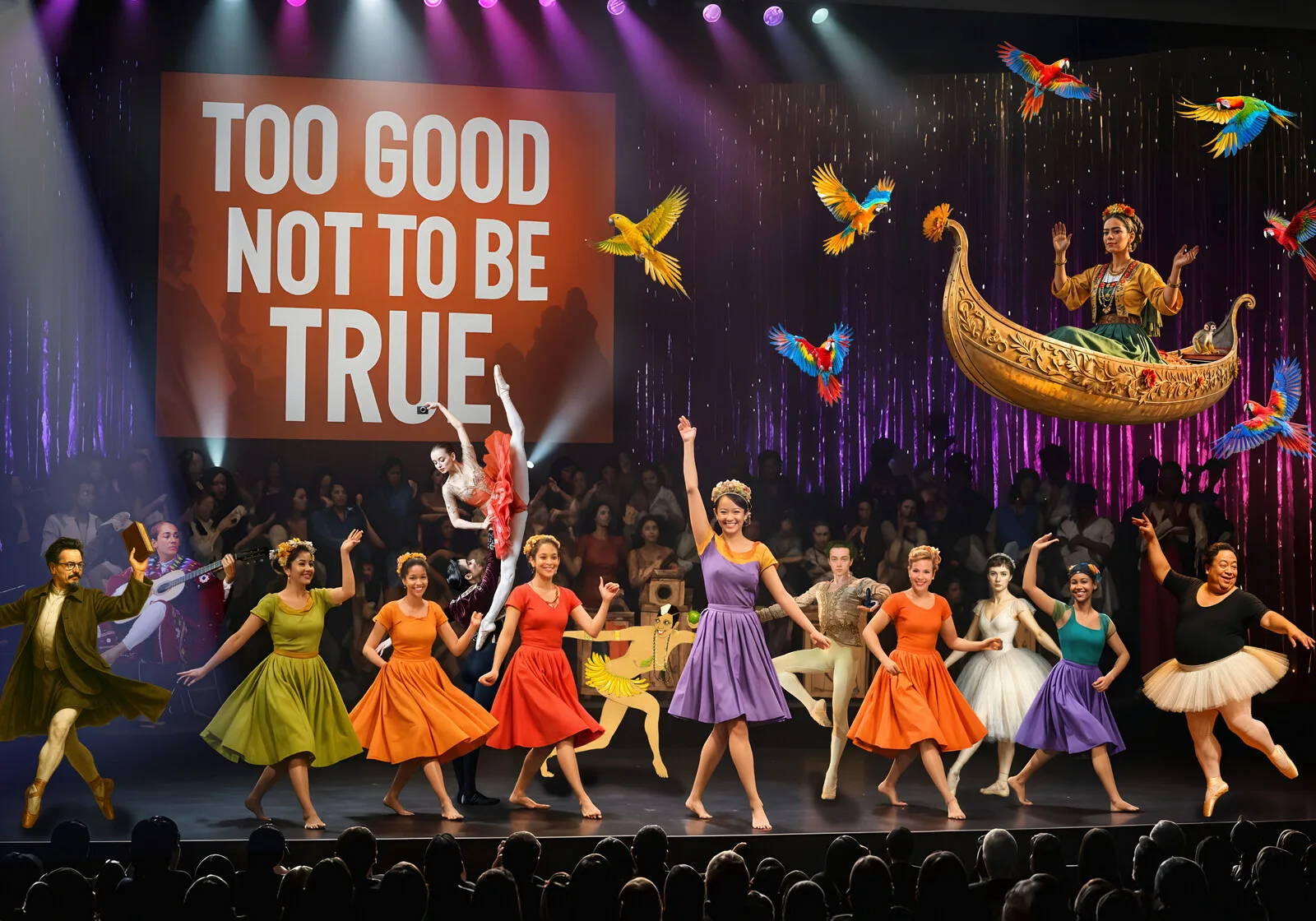
Too Good Not To Be True, 2025
Digital
70 x 50 cm
3 200 kr
Too Good Not To Be True – Frida Kahlo’s Loves, Losses, and Living Without Apology
Frida suffered—but she also lived, laughed, and loved with fearless intensity. In this sweeping portrait of Frida Kahlo’s heart, we uncover not just the iconic artist but the woman behind the legend: sensual, wounded, rebellious, and alive. From early betrayals to seismic love affairs, each chapter reveals how Frida transformed every passion into paint and every heartbreak into revolution. This is no mythologised saint—but a story of survival, desire, and the beauty of living unapologetically.
Please learn more about Frida Kahlo’s many love stories with both men and women and how they connect us to a global narrative of her timeless painting. This is a long narrative, an essay worth reading, so please don’t hesitate to continue reading.
“A Litany in Paint and Flesh
Sara Zenil, the teacher's hand,
At thirteen, trust turned into sand.
A child confused, the letters burned,
A girl betrayed, too young, too learned.
A stranger in the Ministry hall,
An older woman, shadows fall.
A job she sought, but not at this cost—
A trust undone, a boundary crossed.
Alejandro, first love, bright flame,
Before the crash, before the fame.
She wrote him poems, bled in prose,
The boy who stayed until he chose.
Diego Rivera, the elephant vast,
She loved him fiercely; she made it last.
Through pain and rage, divorce, repeat,
They danced in fire, destruction sweet.
Leon Trotsky, exile and war,
She let him in through a secret door.
A kiss beneath the banner red,
A brief affair, then words unsaid.
Nickolas Muray, with a camera bright,
He caught her soul in tender light.
He held her in a frame of grace,
She loved his gaze, his gentler pace.
Isamu Noguchi, hands like stone,
A sculptor's touch when she felt alone.
They loved in secret, garden-close,
Till pistol rage became too close.
Chavela Vargas, voice of wine,
Her songs and Frida's pain entwined.
They lay beneath the garden sky,
And sang where others dared not try.
Georgia O'Keeffe, a desert bloom,
She sent her notes to a hotel room.
"She didn’t make love," Frida teased,
But oh, the tension never ceased.
Josephine Baker, Paris light,
A glance, a dance, one velvet night.
No letters left, no truths confessed,
But sparks ignite in silk and jest.
Paulette Goddard, bold and bright,
In danger's hour, she stayed in sight.
A gift of flowers whispers hushed,
Their bond was framed in fearless trust.
Tina Modotti, lens and flame,
Comrade, sister, maybe the same.
No proof remains, no script survives,
But love may live in shared archives.
Dolores del Río, regal and still,
To her, Frida gave the jungle's will.
Two nudes entwined in humid air,
Desire unspoken, lingering there.
María Félix, proud and tall,
Diego wept, but Frida called.
"She proposed," María said,
A queen who watched while legends bled.
Judith Ferreto, the final flame,
No brushstrokes left, no scandal, fame.
Just gentle hands and tender lullabies,
She stayed when all turned away their eyes.
And all the rest, the names half-known,
Who passed through paint, through flesh and bone.
Each left a mark, a shape, a cry,
And Frida burned, but did not die.
She loved like lightning—wild and wide—
Through flesh and fire, with none to hide.
Yet bones were broken, and spine was worn,
She lived in love: defiant, hot, rash, and torn.
No ordinary flame, but fierce and true,
That burned through sorrow, scorn, and rue.
Epilogue
Her body rests, but not her flame—
She burns in brushstroke, blood, and name.
We love her still, through pain and scar,
Her truth outshines both wound and star.
Frida lives on where bold hearts dare—
In every soul that learns to care.”
Malmö 24 April 2025
Too Good Not To Be True
The photo is from the world premiere of the joyful—and almost true—musical about Frida Kahlo’s life, ’Too Good Not To Be True’, where the time-traveller Frida herself, without revealing her identity, was part of the ensemble.
As it should be, the show offers a breathtaking rollercoaster ride through the ups and downs of Frida’s life. The familiar image we have from so many of her self-portraits begins to crack and fall away—for Frida not only suffered, she lived. The show's beauty and allure will captivate you, drawing you into the narrative of Frida's life.
There were countless parties and fascinating people, and Frida was never far from laughter. The parties she and her husband Diego hosted at Casa Azul were as tumultuous as they were legendary. Her restless appetite for life embraced both sexes without hesitation, a testament to her unapologetic celebration of love and joy.
Imagine an entire ballet composed of lovers—men and women of every kind—with Frida floating above in a gondola surrounded by a flock of her beloved parrots. At the same time, music so beautiful and compelling filled the air that the audience almost rose onto their toes.
But who, then, made up this ballet? The short answer: those she loved, her pain, and her hunger for connection. The longer explanation would require much more space, for, in truth, we are speaking of an entire life filled with love, joy, and pain.
Read on, and you will understand.
Frida Kahlo – Love, Pain, and the Hunger for Connection
Frida Kahlo’s life has often been reduced to a sequence of iconic images: the braided crown of flowers, the unflinching gaze, the vibrant dresses concealing a broken body. But behind the myths lies a woman whose relationship with love, sex, and intimacy was as complex and painful as her art.
Across the years, Frida Kahlo had numerous relationships with both men and women. Some were brief and passionate; others endured through betrayal and reconciliation. Some were tender, some raw, and a few burned with a violence that echoed the fractures in her body. Confirmed affairs, suspected liaisons, secret flirtations, and devastating heartbreaks all wove together into the vibrant, chaotic tapestry of her life.
But what fueled this restless seeking?
It would be simplistic—and deeply unjust—to label Frida as "promiscuous," "sex-crazed," or "nymphomaniac," as some crude commentators have suggested. Her sexuality was neither mere rebellion nor hedonism. It was far more profound: survival, expression, and defiance.
Frida Kahlo's earliest experiences with intimacy, during her early adolescence, were not acts of choice but of exploitation. Modern scholarship strongly suggests that at the age of thirteen, she was sexually involved with her health teacher—an adult entrusted with her care—and later with another older woman at the Ministry of Education. Both encounters bore the hallmarks of power imbalance, coercion, and emotional trauma.
Today, we would unequivocally recognise them as sexual abuse.
These early betrayals scarred Frida’s emerging sense of self. They taught her that love could be mixed with betrayal and that intimacy could heal and harm. Perhaps from that foundation of broken trust arose her later hunger: a desperate insistence on living, loving, and desiring on her terms, no matter how fiercely or chaotically.
Despite severe physical handicaps from childhood polio and her catastrophic bus accident, Frida was known by her lovers—men and women alike—as intensely sensual, daring, and formidable in bed. Her disabilities did not diminish her sexual magnetism; they amplified it. Frida transformed pain into passion, fractures into fire. In a body often marked by suffering, she insisted on pleasure, connection, and being fully alive.
Her relationships were not sanitised romances. They were raw, physical, often politically or personally complicated, and sometimes tinged with sadness. Frida loved with the same spirit she painted—with brutal honesty, hunger, tenderness, and rage.
Throughout this collection, we trace Frida Kahlo's actual and rumoured affairs not to sensationalise but to understand: to understand how a woman scarred by early betrayals reclaimed her body as her battleground and her sanctuary. To see how Frida turned the wounds of her earliest encounters into the flames that lit every love, every betrayal, and every revolution she lived through.
Frida Kahlo was not promiscuous.
Frida Kahlo was not a nymphomaniac.
Frida Kahlo was a survivor who carved out space for passion and freedom in a world that had tried, from the beginning, to cage her.
She loved because she refused to die.
And that, perhaps, was her greatest revolution of all.
No one can perfectly describe love.
Love, in all its forms, is a universal experience that binds us all. It can be bittersweet, extraordinary, lost, or found. Its true essence is felt when we are in its midst, trembling before someone who makes our souls ache and sing at once.
Though I often fail to explain this strange feeling of belonging, sometimes I find words that comfort my curiosity. Some of those words came from Frida Kahlo’s heart—a heart that had loved and lost more than most of us ever will. Frida loved and lost more than probably most of us. Her tumultuous relationship with Diego Rivera, a fellow artist, was a significant part of her life and art.
Frida's love for Diego was so intense that it fueled her creativity, a testament to the inspiring power of love. She loved with such fervour that she couldn’t contain it within herself. Instead, she expressed it through her poetry, letters, and paintings, creating a legacy of love and art that continues to inspire us.
Frida wrote many letters to Diego that hold deep significance. Her love letters show us the ups and downs of love, its depth, and its chaos. Recently, I read a letter from Frida to Diego that I hadn’t read before. It’s a long one, but a particular paragraph caught my attention. It was found in ‘The Diary of Frida Kahlo: An Intimate Self-Portrait’. The passage stands apart for its naked intensity.
“It’s not love, or tenderness, or affection; it’s life itself, my life, that I found when I saw it in your hands, in your mouth, and your breasts. I have the taste of almonds from your lips in my mouth. Our worlds have never gone outside. Only one mountain can know the core of another mountain.” This profound expression from Frida's letter encapsulates the depth and all-encompassing nature of her love, which resonates deeply with my understanding of love.
In these few lines, Frida captures what many of us can only feel but never fully name—the way true love is not merely affection or need but an existential recognition: life finding itself in another life.
Perhaps, as Frida understood, love is life itself: A force that survives separation, betrayal, even death. It lingers in the taste of a lover’s lips and memories that refuse to fade. And perhaps, like Frida said, only one mountain can ever know the heart of another.
We now follow this enduring mystery, this relentless seeking, into the labyrinth of Frida's loves.
Frida and the First Betrayals – Early Sexual Experiences Marked by Power and Pain
When we think of Frida Kahlo, we often picture a woman who owned her body and her desires with fearless defiance. However, before she could reclaim her sexuality—before she turned pain into art and freedom—there were other, darker beginnings shaped not by choice but by imbalance and exploitation.
The First Experience: A Teacher’s Betrayal
According to later scholarship (notably by Collin, 2013), Frida's first sexual experience occurred when she was only thirteen years old. Recovering from polio and unable to participate in physical education, she caught the attention of her health teacher, Sara Zenil.
Zenil initiated a relationship with Frida, a dynamic that today would be recognised not as love but as sexual abuse, where an adult exploits the vulnerability of a child under her care. Young and impressionable, Frida believed she was in love. But when her mother discovered letters between them, the response was swift: Frida was removed from the teacher training school and transferred to the National Preparatory School. Her mother’s dreams of Frida becoming a traditional schoolteacher evaporated overnight.
A forced rupture would open the door to Frida’s intellectual and artistic future. Still, the emotional wound left by this betrayal would not easily heal.
A Second Encounter: The Library Incident
Later, as financial pressures mounted at home, Frida sought work to support her family. Her father, Guillermo Kahlo, struggled to find steady photography commissions. Frida looked for employment at the Ministry of Education’s library.
According to Alejandro Gómez Arias, Frida's boyfriend and confidant at the time, it was there that she encountered another older woman—an employee at the library—who seduced her. This experience, unlike the complicated affection she felt for Zenil, left Frida feeling violated and traumatised. She confided to friends that the incident had been profoundly upsetting. Her parents intervened once again.
A Pattern of Power Imbalance
In both episodes—first with the teacher and then with the library worker—Frida’s early experiences with same-sex relationships were marked by coercion and unequal power instead of mutual exploration or joyful discovery. Rather than empowering her, these encounters introduced Frida to love’s darker twin: the capacity for betrayal by those in positions of trust.
In a historical context, such events were rarely spoken of. Bisexuality was not understood or accepted as it is today, and violations by women often remained invisible, mischaracterised, or buried under shame. Frida, usually celebrated for her bold sexuality later in life, did not begin her journey into love with freedom but with imbalance, silence, and pain.
Conclusion
When we speak of Frida Kahlo's complex, revolutionary relationship to love and desire, we must remember where her story began—not in triumph but in betrayal, not in celebration but in trauma.
It was from these early wounds that Frida eventually built her fierce defences, refused to be pitied, and insisted on claiming her own body and soul on impossible terms.
This part of her history reminds us that Frida’s journey into full selfhood was not inevitable. It was hard-fought, born not only of passion but also of survival.
Frida and Alejandro – The First Love and the First Goodbye
Before Diego, before the revolution, before the pain became paint, there was Alex. Alejandro Gómez Arias was Frida Kahlo’s first great love—the kind that comes before disillusionment, before scars, when everything still seems possible.
A Meeting of Bright Minds
They met as teenagers at the prestigious National Preparatory School in Mexico City in the early 1920s. Frida was one of only thirty-five girls among two thousand students, a brilliant, rebellious mind who wore boys’ clothes, pulled pranks, and led passionate debates about philosophy, art, and revolution.
Alejandro, known as "Alex," was equally sharp and politically engaged. Together they became part of an elite, mischievous intellectual group called Los Cachuchas ("The Caps"), named after the peaked student caps they wore in mock rebellion against authority.
Frida and Alejandro’s bond blossomed rapidly. They were intellectual, passionate, playful, and fiercely loyal. They were partners in wit and defiance, kindred spirits long before they were lovers, their minds intertwined uniquely and profoundly.
Passion Written in Letters
Full of youthful energy, their early relationship turned into a deep, romantic attachment. Even after they left school, life pulled them in different directions, but they stayed connected through a series of passionate love letters, in which Frida poured out her heart.
In these letters, she is funny, vulnerable, sometimes despairing, chasing love through distance and time. They reveal a Frida Kahlo who is far from the complex, iconic figure she would later become—a teenage girl on the cusp of adulthood, daring to hope. She wrote:
"I can't hold back my tears when I think of you. I love you as I love the air I breathe. You are the mirror of the night, the violent flash of lightning, the dampness of the earth. You are the empty space I want to fill with all the love I have."
The Crash That Changed Everything
On September 17, 1925, the axis of Frida’s life shifted violently. A streetcar struck the bus she was riding with Alejandro. Frida was thrown against an iron handrail that pierced her pelvis, shattering her body in ways that would haunt her for the rest of her life. Alejandro, miraculously, was not seriously injured. This tragic event began a new chapter in Frida's life, defined by pain and art.
In the chaos and agony that followed, Alejandro stayed by her side. He was one of the first to pull her broken body from the wreckage. He visited her during her long hospital recovery, bringing books, letters, and news from the outside world. He was there during the brutal first months when it was unclear whether Frida would survive. But love—especially young love—is not always strong enough to withstand catastrophe.
The Fading of First Love
As Frida’s body grew more fragile, her spirit grew fiercer. Pain transformed her. She began to paint, expressing the agony and isolation that words and affection could no longer soothe.
Overwhelmed by her suffering and perhaps terrified of being tied to a future filled with sickness and despair, Alejandro began to pull away. They continued to exchange letters for a time—affectionate, yearning—but the distance between them widened. Eventually, Alejandro left Mexico to study law in Europe. Their letters dwindled. Their first love—so vivid, so full of promise—became another wound for Frida to carry, a bittersweet memory of a time when love was simpler and the future seemed brighter.
The Unfinished Goodbye
Frida never spoke of Alejandro with bitterness. In her memory, he remained part of a lost world—the world before the crash, the endless surgeries, Diego, revolution, and betrayal. In many ways, Alejandro was the last gift of Frida’s unbroken youth: the previous time love was simple, the last time the future gleamed without shadows.
Conclusion
The story of Frida and Alejandro is not one of passion destroyed by betrayal, as so many of her later loves would be. It is the story of a love that could not survive the terrible weight of fate.
Confirmed:
An honest and tender first love, documented in letters still trembling with the urgency of young hearts, ended not by cruelty but by the merciless accident that would shape the rest of Frida Kahlo’s extraordinary life.
Frida and Diego – A Dance of Dove and Elephant
The title is a metaphor for the delicate yet tumultuous relationship between two contrasting personalities, Frida and Diego.
When Frida Kahlo married Diego Rivera in 1929, her parents were sceptical enough to call it plainly: "An elephant marrying a dove."
And perhaps it was. A massive, lumbering genius with a legendary appetite for women and fame married a fierce, wounded girl with a spine of steel and a heart far too large for her own body. But what they could not see—what no one could fully grasp—was that the elephant and the dove would tether themselves together in a myth that would outlive them both, a bond so strong it defied all odds.
A Marriage Written in Blood and Paint
When Frida first met Diego, he was already a legend in Mexico—famous, formidable, larger than life. He was also married, divorced once, attached to a mistress, and the father of several children by different women.
Frida was twenty-two, brilliant, wounded from a near-fatal bus accident, and just beginning to find her voice. He was forty-two, the master muralist, called "The Frog" by friends and lovers alike for his squat figure and gluttonous charm.
They married in a simple civil ceremony on August 21, 1929. It was not a wedding of innocence. Frida knew who Diego was—his appetites, betrayals, madness—and she stepped into the fire anyway.
The Terms of Love
Initially, theirs was an open relationship, though not always by mutual consent. Diego’s sprawling and relentless affairs included models, actresses, artists, and, infamously, Frida’s beloved sister, Cristina. The betrayal was devastating. In her rage and grief, Frida created ‘A Few Small Nips’ (1935)—a brutal, bloody painting depicting a murdered woman, stabbed by her lover in a crime of passion.
Frida, for her part, found her lovers: Leon Trotsky, Georgia O’Keeffe, Nickolas Muray, and many others, both men and women, drawn to her strange beauty, her wit, and her ferocity.
Yet even in anger and exile from each other’s arms, Frida and Diego could not sever the bond between them. They painted one another into existence—adoring, blaming, worshipping, betraying.
"You were the best accident of my life," Frida once said of Diego. And Diego, despite everything, once wept and confessed: "I realised too late that the most wonderful part of my life had been my love for Frida."
The Divorce That Wasn’t the End
In 1939, after years of infidelities, betrayals, and unbearable tensions, they divorced. Frida, heartbroken but defiant, painted ‘Self-Portrait with Cropped Hair’ (1940): A shocking image of herself seated in an oversized man's suit, scissors in hand, her black hair shorn and scattered around her like the fallen wreckage of femininity.
She kept only two traces of womanhood in the painting: a dangling earring and a pair of high-heeled shoes. That’s all.
The rest—woman, wife, muse—was stripped away, as if she were demanding to be seen not as Diego’s adornment, but as her creation.
It was not the first time she had explored gender through clothing. As a teenager, Frida had often dressed in men's suits, experimenting with her multiple selves long before it became a statement recognised by the wider world.
The Strange Remarriage
And yet, despite all, Frida and Diego found their way back. On December 8, 1940—less than a year after their divorce—they remarried in San Francisco. Not out of fairy-tale romance, but out of a need neither could name fully. Diego made promises: no more sexual betrayal, financial support for Frida’s growing independence, and mutual respect, if not fidelity.
They lived together again, side by side but increasingly separate, partners not so much in marriage as in myth.
The Political Lovers
Their bond was not just personal; it was also political. In the 1930s, they were passionate Trotskyists, fighting for the soul of the revolution. However, over time, especially after Trotsky’s assassination in 1940, they shifted toward Stalinism, partly out of disillusionment and partly out of survival. The grand dreams of revolution had collapsed into realpolitik and terror. Yet, until their deaths, Frida and Diego remained deeply committed to a radical vision of justice for Mexico’s poor and marginalised.
Their political swings mirrored their chaos: idealism, betrayal, pragmatism, hope.
Till Death—and Beyond
When Frida died in 1954, Diego Rivera was inconsolable. Though he had broken her heart countless times and failed her in ways only Frida could forgive, he never stopped loving her. "I realised too late that the most wonderful part of my life had been my love for Frida," he wrote.
He followed her into death just three years later.
They are buried separately, but history has fused them into something indivisible:
The Elephant and the Dove. The Frog and the Hummingbird. Two artists who fought, devoured, healed, and immortalised each other in every line, every colour, every wound.
Conclusion
The story of Frida Kahlo and Diego Rivera is not a traditional love story. It is rawer, more violent, and more enduring. It is the story of two creators who shaped each other as much through devastation as devotion, a testament to the resilience of their love.
Their marriage was not a triumph of fidelity, but of survival—of two mythmakers writing a legend with their blood and laughter that no betrayal could erase.
Confirmed:
An undeniable, world-shattering love—full of ruin, splendour, and life, a love that burned with an intensity that could not be extinguished.
Frida and Trotsky – Politics, Passion, and the Weight of Betrayal
In 1937, the revolution knocked at the door of Casa Azul—not with slogans, but with a tired, hunted man carrying the broken dreams of an empire on his back.
Leon Trotsky, once Lenin’s heir apparent and now Stalin’s mortal enemy, arrived in Mexico as a political refugee. Frida Kahlo and Diego Rivera opened their home—and for a brief, chaotic season, Frida opened her heart. This was a time of political upheaval in Mexico, with the ruling party, the Institutional Revolutionary Party (PRI), consolidating its power and suppressing dissent.
A Meeting of Ideals and Flesh
At first, politics brought them together. Both Frida and Diego were passionate Trotskyists at that time—believers in the original fire of the revolution and a vision of socialism untainted by Stalin’s brutal dictatorship. In Trotsky, they saw the spirit of 1917 still burning and one that was soon to arrive in Mexico.
But ideals have a way of slipping into more earthly forms. Trotsky’s wife, Natalia, did not understand the language between secret meetings and whispered English. Frida and Trotsky began a clandestine affair. Despite the danger, Trotsky slipped love letters to her, hidden in books. They met in concealed rooms, sometimes even at Frida’s sister’s house.
For Frida, the affair was a potent mix of seduction and revenge. Diego's betrayal with her sister, Cristina, had left a deep wound, and Trotsky's willingness to be engulfed in the storm of Frida's charisma was a testament to the profound intensity of her emotions.
Their passion, however, burned out quickly. Frida, never one to hide her boredom, later dismissed him: "I am very tired of the old man."
By the summer of 1937, the affair had ended, leaving a lingering sense of loss. Yet, its memory was etched forever in her painting ‘Self-Portrait Dedicated to Leon Trotsky’ (1937), where Frida holds a letter inscribed: "To Leon Trotsky, with all my love." This brief yet intense chapter had a profound and lasting impact on Frida's life and art.
Why Trotsky Fell
To understand the tragedy that followed, one must grasp why Trotsky had become an exile in the first place. After Lenin died in 1924, two paths opened for the future of the Soviet Union: Trotsky envisioned a permanent revolution—an ongoing international struggle that would spread socialism across the world. Stalin, in contrast, proposed "socialism in one country"—a hardening of power within Soviet borders, focusing on consolidating control.
But it was more than ideology. It was a battle between two men: Trotsky, the brilliant theorist, was charismatic but often aloof. Stalin, on the other hand, was a ruthless pragmatist and master of bureaucracy and silent elimination.
Trotsky had once stood closest to Lenin—he organised the October Revolution, built the Red Army, and was the architect of early Soviet victories. However, he underestimated Stalin’s cunning. One by one, Stalin outmanoeuvred his rivals, depicting Trotsky as arrogant, dangerous, and even a traitor to the cause.
In 1929, Trotsky was expelled from the Soviet Union. He fled from country to country—Turkey, France, Norway—before finally finding refuge in Mexico.
From Comrades to Traitors
For a time, Frida and Diego embraced Trotsky’s ideals. But politics in Mexico was treacherous. Over time, pressured by shifting alliances, they grew disillusioned with Trotsky’s cause and swung toward Stalinism—perhaps out of pragmatism, opportunism, and weariness of endless internal disputes.
In 1940, the consequences caught up with Trotsky.
On August 20, 1940, he was assassinated in his study in Mexico City. His killer, Ramón Mercader, was a Soviet agent, disguised and patient. Trotsky died a day later from wounds inflicted by an ice axe.
After the murder, suspicion briefly fell on those closest to him. Rivera, whose friendship with Trotsky had already soured (possibly after discovering Frida’s affair), fled the country with help from Paulette Goddard. Frida was less fortunate: she had once met Trotsky’s assassin socially and was arrested and interrogated. She spent two days in jail before ultimately being cleared of involvement.
Conclusion
The affair between Frida Kahlo and Leon Trotsky was brief—a flicker of desire against a backdrop of collapsing empires. But it captures something essential about Frida’s life: her willingness to love dangerously, her refusal to separate politics from passion, and her ability to paint loyalty and betrayal on the same, complicated canvas.
Confirmed:
A love affair not just of bodies, but of ideas, played out in the blue shadows of a house that had become, for a moment, the last sanctuary of a revolution already lost.
Frida and Nickolas – Love, Light, and the Camera’s Gaze
Before the myth, before the martyrdom, there was light. The light of a studio in New York, the light of Mexico filtering through the jacaranda trees, and the light of Frida Kahlo are captured forever through the lens of Nickolas Muray.
A Love Caught in Silver and Celluloid: This title encapsulates the essence of Frida and Nickolas's relationship, immortalised through the silver emulsion of his photographs.
They met in Mexico in 1931, and mutual friends introduced them, caricaturist Miguel Covarrubias and his wife, Rosa. Frida was newly married to Diego Rivera, bruised but radiant. Nickolas Muray—Hungarian-born, American-made—was a celebrated photographer renowned for his mastery of colour printing and his portraits of celebrities and artists.
What began as friendship soon deepened into a passionate, decade-long love affair, marked by separations, reunions, and the restless pull of Frida’s divided heart. This love and light seeped into her art, infusing it with new intensity and a deeper understanding of human suffering and resilience. Frida's art, always deeply personal, took on a new dimension with the influence of Nickolas's love, reflecting her emotional turmoil and the strength she found in their relationship.
Their correspondence still burns with longing. In one letter, Frida wrote: "Oh, my beloved Nick, I adore you so much. I need you so badly that my heart aches."
For his part, Muray cherished her, capturing her not as an icon but as a woman: proud, wounded, and alive.
The Gift of a Gaze
Nickolas Muray captured some of the most enduring photographs of Frida Kahlo. In his portraits, Frida is both untouchable and tender, wreathed in flowers, staring directly into the camera with a gaze that neither pleads nor surrenders. He photographed her draped in Tehuana costumes, her face framed by dark hair and bright blossoms, with a regal yet intimate posture.
In some images, she poses with her shoulders bare, her skin luminous under the soft light, offering a vulnerability rarely seen elsewhere. Through Muray’s lens, Frida becomes not just a painter but an image herself—one that still shapes how the world sees her—an icon.
The Gifts She Gave Him
Frida’s love for Muray was expressed not only in words but also in art. She gave him two extraordinary presents that reveal the raw, complicated tenderness between them:
First, a small drawing from 1930—a portrait of herself and Diego Rivera holding hands. On Frida’s abdomen, almost invisible, lies the faint outline of a fetus, then deliberately erased. A symbolic abortion, a ghost of the child she could never carry. It was a strange, intimate gift, heavy with sorrow, given to the man who loved her beyond Diego’s shadow. This gift, this act of sharing her pain, was a testament to the depth of their bond.
Second, she inscribed a delicate note on a lace doily: "Nick, I love you like I would love an angel. You are a lily of the valley, my love. I will never forget you. Never, never. You are my whole life; I hope you will never forget this."
In these gestures, Frida laid bare the fullness of her love—vivid, aching, sacred.
The End of the Affair
But some loves, no matter how fierce, cannot survive the gravity of old wounds. By the spring of 1939, Muray could no longer endure being second to Diego Rivera, whose hold over Frida never truly loosened. Muray's decision to end the affair marked a significant turning point in Frida's life and art. It signified the beginning of a period of intense emotional turmoil, which was expressed in her paintings.
Frida was left bereft. Later that year, Diego himself filed for divorce. The double loss bled into her canvases—most poignantly into ‘Self-Portrait with Thorn Necklace and Hummingbird’ (1940), where Frida’s bleeding neck, the black monkey, and the dead hummingbird speak of pain so vivid it almost shouts from the frame.
Nickolas Muray and the Afterlife of Frida’s Image
Even after they parted, Nickolas Muray’s photographs kept Frida alive in a way few could have imagined. Muray’s portraits—the bright reds, the tropical greens, the unflinching gaze—have become the definitive images of Frida Kahlo worldwide. His lens did not flatter her; it honoured her. It captured the contradictions: softness, steel, sensuality, and suffering. More than any other imagery, these photographs have shaped how the world sees Frida Kahlo, cementing her status as an icon of art and resilience.
Through Muray's lens, Frida Kahlo became immortal, her image forever preserved in his photographs' vibrant colours and unflinching gaze. His work captured her essence and ensured that she would be remembered for generations to come.
Frida and Nickolas lived a love that was both glorious and doomed—too full of longing, too crowded with ghosts. But in the shutter click of his camera, the tender curve of her letters, and the bright ache of their memories, they remain: lover and muse, artist and witness, light and shadow, eternally entwined, their love transcending time and space, a testament to the enduring power of love.
Confirmed:
Their love is documented not just in photographs and letters, but in the way Frida Kahlo’s face looks back at us still today, forever framed by the man who adored her and who, in his own way, never let her go.
Frida and Isamu – Love, Art, and a Pistol Under the Bed: A Tale of Passion and Danger
Some loves ignite in secret, under the cover of heavy doors and shuttered windows. Such was the love between Frida Kahlo and Isamu Noguchi—a love that was brilliant, dangerous, and always on the verge of discovery.
A Meeting of Hands and Minds
They met in the mid-1930s, two artists from different worlds but sharing the same hunger for form, beauty, and creation. Isamu Noguchi, the Japanese-American sculptor, was already making his mark with works that blurred the lines between East and West, nature and abstraction. His sculptures, often inspired by his Japanese heritage, blended modernism and traditional craftsmanship. Frida, painting her pain in vivid colours, recognised in him a fellow traveller who understood that art was not just expression but survival. Her paintings, deeply personal and often depicting her physical and emotional pain, reflected her tumultuous life.
Their connection was immediate, physical, and filled with an intensity that could not be contained.
In one surviving letter, Noguchi wrote to Frida:
"You are for me every thought of love."
It was not just words. It was a bond carved from shared silences, from stolen moments behind the heavy doors of Casa Azul, a love conducted in the thrilling shadows of secrecy.
A Love Conducted in Shadows
But theirs was a love that could not breathe freely, a love fraught with danger. Frida’s husband, Diego, could forgive her affairs with women, but men were another matter. Diego’s jealousy burned hot, and it was aimed at Isamu.
Legend has it that one night, Rivera unexpectedly returned home and found Noguchi in bed with Frida. Noguchi fled so quickly that he left a sock on the floor. Rivera, furious, reportedly chased him through the garden with a pistol in hand, shouting threats that no one mistook for empty words.
Another story recounts that Noguchi, while visiting Frida later at the hospital where she was recovering, was again confronted by Rivera—gun flashing, fury undimmed.
At one point, they had tried to rent an apartment together, seeking a place away from the storms. But when the furniture bill was mistakenly sent to Rivera, all their dreams of a quiet life collapsed into farce and danger.
The Aftermath of Passion
Their affair, pressured by fear and secrecy, eventually unravelled. The walls closed in, and the threats became too real. As always, Noguchi withdrew, and Frida returned to Diego's complicated magnetism. The aftermath of their relationship was not just a return to their previous lives, but a shift in their art and personal growth.
Yet, Noguchi did not carry bitterness with him in later years. Reflecting across decades, he said, "I loved her very much. She was a lovely person, a marvellous person."
No recriminations. No regret. Just the memory of a woman who had filled a space in his heart that few others ever touched.
The Artist Who Loved Form—and Frida
Isamu Noguchi would become one of the most revered sculptors of the 20th century, shaping gardens, public spaces, and sculptures that seem to hover between earth and dream. His work speaks of stillness, of grace hard-won. And perhaps, hidden within the quiet folds of stone and water, the ghost of a Mexican garden lingers, the warmth of a forbidden kiss, and the memory of Frida’s laughter echoing against the blue walls.
Conclusion
Frida Kahlo and Isamu Noguchi shared a love that was as brief as it was blazing—a love crushed by jealousy but remembered with tenderness. Their affair reminds us that not all beautiful things are meant to survive the world’s storms. Some are meant only to blaze once, fiercely, against the night.
Confirmed:
Their romance is not a rumour but a vivid, if dangerous, truth—written in letters, memories, and the unfinished corners of their lives.
Frida and Chavela – Desire in the Garden of the Blue House
The grass felt cool beneath their bodies, but it was not the grass that steamed in the hot Mexican night. It was something else. Something alive, reckless, hungry.
In the early 1940s, in the vibrant heart of Coyoacán, a district in Mexico City known for its artistic and bohemian atmosphere, Frida Kahlo and Chavela Vargas's paths collided, causing the earth to tremble.
A Meeting Written in Fire
They met at Casa Azul, as so many stories in Frida’s life began—with music, laughter, a drink held carelessly in hand, and eyes locked across a crowded room. Chavela Vargas was young then but already unforgettable: born in Costa Rica, claimed by Mexico, a singer whose voice could stretch a single note into an ache that filled the room. She dressed in trousers, wore a pistol on her hip, and sang rancheras—songs of unrequited love and longing—generally reserved for men.
Frida was already a legend: radiant, wounded, magnetic.
Chavela said their connection was immediate, a bond transcending time and space—not a slow burn but a flashfire.
Chavela moved into Casa Azul soon after they met. She sang for Frida as she painted—those songs full of broken hearts and desperate nights, which seemed to mirror every fracture in Frida’s bones and soul. Frida painted with her brush trembling between pain and pleasure, while Chavela’s voice poured into the blue walls like smoke and memory.
Desire Written in Ashes
Years later, long after the world had tried to tame her, Chavela Vargas spoke of their love. In interviews during her 80s, she described it as fierce, undeniable.
She said she had received love letters from Frida—letters so private, so scorching, that she eventually burned them to ashes. One letter Frida allegedly wrote to a friend contains a line that echoes across time: "I desire her. I do not know if she felt what I did. But I believe she is a woman who is liberal enough that if she asks me, I wouldn’t hesitate for a second to undress in front of her..."
The authenticity of the letter remains unverified. But the photographs do not lie. In one image, Frida and Chavela lie tangled together in the lush garden of Casa Azul—bodies curved toward each other, the intimacy between them undeniable, even without words.
The Song of Chavela Vargas
Chavela Vargas would become one of Latin America’s most iconic voices, singing heartbreak so raw that even stone seemed to cry. Her voice, deep and rough, carried the dust of cantinas and the heat of lonely deserts. She defied gender norms with a courage that was ahead of its time, performing in masculine clothes, living openly as a lesbian in her later years, and infusing every note with the truth of her hard-won freedom. She became a living myth—part saint, part outlaw, part siren of sorrow.
And yet, for all her fame, she never forgot the woman who once listened to her sing in the twilight garden.
By the Deathbed
When Frida lay dying in 1954, her body had been worn down to a shadow of its former self; Chavela was among those who stayed. She was one of the few who did not flinch before the brokenness and could still see, even in the wreckage, the woman she once loved under the hot, heavy stars.
Conclusion
Frida Kahlo and Chavela Vargas shared a love born in music, paint, and rebellion. It was not a love that wrote itself neatly into history books—it burned letters, lived between breaths, and survived in spaces too wild to be tamed by evidence.
Confirmed through lived memory: Even without signed declarations, their love lingers in songs, in photographs, in the heavy scent of the Casa Azul garden, where once the night steamed—not from the earth—but from two women who dared to live and to love without apology: their love, a timeless testament to the power of passion and defiance.
Rumoured Romances, Speculative Affairs, and Stubborn Whispers – Too Good Not to Be True
Frida and Georgia – Flirtation, Friendship, and the Art of What Might Have Been
In the early 1930s, two women met under the heavy shadow of men who claimed too much of their worlds. Frida Kahlo, talented, fiery, and unbroken despite her injuries, was seen mainly as Diego Rivera’s wife. Georgia O’Keeffe, already a giant in American modernism, was too often spoken of in relation to her husband, Alfred Stieglitz — 'a wormlike appendage, an appendix,' as she said with self-deprecating irony. At a time when women's roles were often defined by their relationships with men, these two artists struggled to carve out their own identities.
When Frida and Georgia first met, there was an immediate spark of admiration, recognition, and the first flickers of desire. Their mutual respect and understanding of each other's artistic prowess formed the foundation of their relationship.
A Meeting of Equals
They met in the United States during one of Frida’s early trips with Rivera.
Both fiercely talented women were building their revolutions in paint.
It was, perhaps, inevitable that they would be drawn together. As historian Linda Grasso notes, "Both were fearless, flamboyant, and compelling personalities. They automatically would have been attracted to each other."
Georgia was elegance and restraint; Frida was chaos and flame.
But somewhere between the differences, they found common ground.
Letters, Flowers, and a Light Touch of Longing
Their correspondence offers glimpses into their closeness. In 1933, when O’Keeffe suffered a collapse and was hospitalised, Frida wrote to her with tenderness: "I thought of you a lot and will never forget your wonderful hands and the colour of your eyes. When I return, I will bring you flowers if you are still in the hospital. I would be so happy if you could write me even two words. I like you very much, Georgia."
The affection is apparent, the care unmistakable. Yet Frida, never one to shy away from speaking her heart—or her humour—revealed more to a friend later that year: "O’Keeffe was in the hospital for three months; she went to Bermuda for a rest. She didn’t make love to me that time, I think, on account of her weakness. Too bad."
A tease?
A confession?
A playful lament for a romance that might have been? We might never know, because both have gone to their star.
A Relationship Left Unfinished
There is no surviving proof that Frida and Georgia’s relationship ever crossed the final boundary from friendship to physical love. No diary entries from O’Keeffe. No letters of ardour tucked away in archives.
Despite the passage of time and the reshaping of their lives due to illness, the warmth between Frida and Georgia endured. In 1938, O’Keeffe attended Frida’s celebrated New York exhibition at Julien Levy’s gallery. In 1951, she visited Frida in Mexico, remembering their old connections to the blue house in Coyoacán.
The Art of Flirtation
Perhaps their bond was precisely what it needed to be: not a grand affair, but a thread of affection, admiration, and mutual recognition between two women who understood, in ways few others could, what it meant to create, to survive, to insist on being fully alive in a world intent on erasure.
Frida Kahlo and Georgia O'Keeffe danced near the line between friendship and romance, but whether they ever crossed it remains a mystery. This enigma adds a layer of intrigue to their story, leaving us with the truth of their affection, mutual fascination, and shared legacy as women who changed the world with a brushstroke and a refusal to bow.
Speculatively romantic: A flirtation caught in letters, a tenderness never fully claimed—but always alive in the spaces between their words.s alive in the spaces between their words.
Frida and Josephine – A Love Shrouded in Smoke and Legend
Paris, 1939.
A city on the brink of war. A town still alive with music, art, and impossible dreams. Among the velvet shadows of Montmartre’s nightclubs and the marble halls of the Louvre, two legends briefly brushed against each other: Frida Kahlo and Josephine Baker.
Both were brilliant.
Both were rebels.
Both carried the weight of pain and survival with a defiant grace that inspires awe and admiration.
A Meeting in the City of Light
Reportedly, Frida Kahlo and Josephine Baker met in Paris in 1939. Frida, reeling from heartbreak and Diego Rivera’s endless betrayals, had come to Paris to exhibit her art, culminating in the Louvre purchasing The Frame, the first work by a 20th-century Mexican artist to enter its collection. Already a star, Josephine was not just dazzling audiences; she was gathering intelligence for the French resistance, hiding secrets behind her stunning performances.
Their connection details are hazy, cloaked in rumour and retrospective myth. In the 2002 film Frida, their meeting is imagined with romantic intensity—a glance, a dance, a night shared between two women who recognised something in each other that the world refused to see.
Art, Resistance, and Authenticity
Both Frida and Josephine lived in open defiance of the rigid norms of their time, a rebellion that empowers and resonates even today. They were women of colour, bisexual, fiercely themselves in a world that demanded obedience and silence.
1939 both women embodied radical freedom in Paris, a city still pretending to be at peace.
There is no surviving proof that Frida and Josephine’s bond was romantic. No letters. No diaries. Only photographs—a famous one from 1952, taken in Mexico, when Frida was already frail—and endless retellings. And a photo from 1939 of them talking in a crowd.
Some modern accounts boldly claim they “admired each other to the bedroom.” Perhaps they did. Maybe the night swallowed whatever tenderness passed between them, leaving behind only the echo.
Or perhaps their romance was symbolic: two women who refused to be contained, two artists who carved new paths through a world intent on denying them.
Breaking Barriers Together
Their lives—and whatever brief connection they shared—stand as a testament to breaking barriers. They defied not only the prejudices of race, gender, and sexuality but also the deeper, quieter expectations: to remain small, silent, and ashamed. Instead, they chose magnificence. They chose visibility. They chose each other across the smoky dark of a Parisian club, even if only for a fleeting moment.
Conclusion
The story of Frida Kahlo and Josephine Baker is part history, part dream. What is certain is that both women lived unapologetically, loved courageously, and left a legacy that still burns brightly across generations, a legacy that continues to inspire and shape the world.
Speculatively romantic, powerfully symbolic: Their intimate meeting—real or imagined—remains a beacon of resilience, artistry, and the profound, unbreakable courage to live as one's true self. Courage to live as one's true self.
Frida and Paulette – Allies, Rivals, and the Shadows Between
In the tumultuous swirl of 1940s Mexico, two extraordinary women found themselves drawn together: Frida Kahlo, the incandescent painter of pain and rebellion, and Paulette Goddard, the glittering Hollywood actress, recently unmoored from Charlie Chaplin's orbit, seeking new frontiers of life and freedom.
Their lives intersected at a moment of profound crisis—and possibility.
A Meeting in Dangerous Times
By 1940, Mexico City was a cauldron of political intrigue. Leon Trotsky, the exiled revolutionary, lived under constant threat. Diego Rivera, once his supporter, had fallen into tangled alliances. And Frida, always a volatile element, stood somewhere between art and revolution.
When Trotsky was assassinated in August 1940, suspicion briefly turned toward those closest to Rivera, including Frida herself. The police interrogated her, questioning her loyalty. In these dangerous days, with the threat of political persecution looming, Paulette Goddard stepped onto the scene—not as a passing acquaintance, but as an ally.
When the authorities closed in, Paulette helped Diego Rivera slip across the border into the United States, evading arrest. Her loyalty was not casual. It was chosen. It was fierce.
Friends, Allies, or Something More?
Rumours, as always, followed Frida like a second shadow. Some whispered that Paulette, like Dolores del Río before her, had been drawn to Diego and Frida. Others said Frida, keenly aware of the dangers posed by Diego’s endless affairs, befriended Paulette to "neutralise" her allure—to turn a rival into a friend or something more intimate.
The truth of their relationship remains veiled, shrouded in mystery and intrigue. There are no confessions. No surviving letters filled with the fierce tenderness Frida often left in her wake. But there is the painting.
In 1941, Frida gifted Paulette a still life titled ‘The Flower Basket’—a work lush with colour and overflowing with life. This was not just a casual offering, but a profound gesture of love and trust. In Frida’s world, paintings were acts of love and memory. To give one away was to provide a part of herself; in this case, it symbolised their deepening bond.
A Dance of Power and Affection
Like two stars briefly caught in the same gravitational pull, Frida Kahlo and Paulette Goddard moved through each other's lives with courage and resilience that is truly inspiring. Both women knew what it meant to live boldly in a world made for men. Both wielded beauty as both armour and invitation. Without speaking it aloud, both understood that survival sometimes required alliances as complex as romance.
Their purely strategic, deeply affectionate, or quietly romantic bond was real. It carried the charge of mutual recognition, of two women who refused to be contained by the roles the world had scripted for them.
Conclusion
Frida and Paulette shared a season of danger, loyalty, and possibly, a closeness that crossed into the unspoken. Their friendship, marked by the gift of a painting and the shield of protection in a perilous time, remains another thread in the intricate tapestry of Frida’s life.
Speculatively intimate: No direct proof survives of a romance. But the heat of their connection, the gravity of their shared moment, and the secret history written into gifts and gestures suggest something larger than words flowed between them—something that defies easy explanation, like so much of Frida’s life.
Frida and Tina – Allies, Friends, and a Love That History Cannot Quite Name
In the late 1920s, amidst Mexico City's heady revolutionary atmosphere, two women who would leave marks on art and history met. Frida Kahlo was still at the threshold of her legend. Tina Modotti—Italian-born, fierce, and already a figure in Mexico’s bohemian and political circles—was a beacon of beauty and commitment. As a photographer, activist, and lover of poets and revolutionaries, Tina embodied the spirit of a world in flux.
At one of Tina’s famous gatherings, during the soft-burning twilight of the 1920s, Frida Kahlo once again encountered Diego Rivera. This meeting ignited a lifetime of passion, pain, and art.
Tina had once loved Diego herself. However, in Tina’s world, love was not a cage but a current that moved unapologetically through lives. She welcomed Frida into her circle and her heart.
A Bond of Politics and Spirit
Frida and Tina shared more than friendships and romances. They shared politics—both were fervent communists, dedicated to the cause of workers, women, and the poor. They shared art—Frida’s canvases and Tina’s lens, both bearing witness to a world that demanded to be seen anew. They shared a stubborn, unbreakable sense of self, a refusal to be domesticated by a society still trying to confine women to the shadows.
As their friendship grew, it was forged in salons and the struggles of their time. Tina encouraged Frida’s politics, just as Frida admired Tina’s radical courage.
Rumours of Romance
Inevitably, tales followed. Frida’s life was a constellation of passions, and her bisexuality was no secret. She was repeatedly drawn to women who burned brightly—sometimes the same women Diego had loved before her. Some believe that Frida and Tina might have been lovers within this pattern.
The 2002 film Frida presents them as lovers, depicting a tender, sensual scene between them. However, the historical record is more enigmatic. There are no surviving love letters, no diary entries confessing, and no whispered testimonies from friends who watched them with knowing eyes. Only the closeness, the political alliance, and how they navigated each other’s lives like two rivers converging momentarily before flowing separately again, leaving the nature of their relationship open to interpretation.
An Intimacy Beyond Definition
Whether or not a physical romance existed between Frida and Tina, their bond was undeniable. It was the kind of intimacy that needs no labels: the shared dreams, battles, and the shared understanding that the world would never offer them easy lives—and that they would not ask for them.
Tina would eventually leave Mexico, driven out by political persecution, and die in exile in 1942. Frida mourned her fiercely, losing not only a friend but also a part of her revolutionary soul.
Conclusion
Frida Kahlo and Tina Modotti shared a connection woven from art, politics, and a wild, unyielding love for freedom. Whether they were lovers in body remains unconfirmed. But in spirit, they were more than friends, more than comrades. They were two women who, in a broken and brutal world, chose to live—and fight—with their hearts uncovered. Whether romantic or not, their bond inspires and intrigues, refusing to be silenced by time or speculation.
Speculatively intimate: Concrete proof is lacking, but the flame that passed between them is felt in every photograph, brushstroke, and whispered story that refuses to be silenced. A story that refuses to be silenced.
Frida and Dorothy – A Portrait of Sorrow, Not Love
They once moved in the same glittering circles—Frida Kahlo, bold and untamed, and Dorothy Hale, the beautiful, ill-fated actress from Pittsburgh who had once seemed destined for the stage and screen. Their paths crossed lightly: at parties, in salons, through mutual friends like photographer Nickolas Muray and editor Clare Boothe Luce.
But theirs was not a story of love. It was a story of grief—and of art born from grief.
The Fall of Dorothy Hale
In 1938, Dorothy Hale’s carefully constructed world collapsed. Her once-promising career had faltered, and her financial security eroded after the death of her husband, Gardiner Hale, whose entanglements in complicated and unstable business ventures left her stranded in a sea of uncertainty and despair.
Alone, burdened by debt and despair, Dorothy took her own life, throwing herself from the sixteenth floor of a Manhattan apartment building. It was a shocking and devastating end to a life that had once been filled with bright smiles and effortless glamour, leaving those who had admired her, even from a distance, reeling from the sudden loss.
A Request and a Painting
After Dorothy’s death, Clare Boothe Luce—friend to both women—approached Frida Kahlo with a commission. She wanted a recuerdo, a painted remembrance of Dorothy Hale, to honour her life and keep her from vanishing into the blank forgetfulness of tragedy.
Frida agreed. But she was uncompromising and raw and did not paint an idealised portrait. Instead, she created The Suicide of Dorothy Hale (1939)—a harrowing tableau that depicted Dorothy's fall, the moment of impact, and her bleeding body crumpled on the pavement. Every frame of descent, every brutal truth, was laid bare.
When Luce saw the painting, she was horrified. She had expected something softer, something sanitised. She considered destroying the work but ultimately did not. The painting survived, a testament to Frida’s unflinchingly honest vision that refused to prettify or soften the harsh realities of Dorothy's life and death.
No Love, But Compassion
There was no romance between Frida Kahlo and Dorothy Hale, no secret affair hidden in letters or whispers. Their connection was slight, social, and mediated through others. Frida did not know Dorothy well, but she understood sorrow. She understood despair. And she painted it with a tenderness that only someone intimately acquainted with pain could summon.
In a way, Frida gave Dorothy a kind of immortality—a brutal, beautiful refusal to let her death be forgotten or prettified.
Conclusion
Frida Kahlo and Dorothy Hale were not lovers. They were not even close friends. But in the strange, fierce intimacy that art sometimes allows, Frida reached across the distance between their lives. She captured Dorothy’s final moment—terrible, tragic, human—and transformed it into something that still speaks today.
Their bond was not of passion but of witness; sometimes, that is the kind of love we humans have.
Frida and Edgar – A Dance of Flirtation and Art
In the closing months of 1938, a significant chapter unfolded in Frida Kahlo's life as she arrived in New York—a city brimming with potential and still healing from the collapse of her marriage to Diego Rivera. She stood alone, defiant, and radiantly alive, and her paintings received their first substantial recognition outside of Mexico, marking a turning point in her artistic journey.
Here, at the centre of New York's swirling art world, she met Edgar Kaufmann Jr. Young, wealthy, and cultured, Kaufmann moved easily through the circles where artists and patrons collided. Perhaps it was inevitable that he would fall under Frida’s spell.
An Evening at Fallingwater
At Fallingwater, the Kaufmann family's fabled retreat, perched over a Pennsylvania waterfall like a house half-dreamed, their flirtation found its stage. Invited by the Kaufmanns after her successful exhibition at Julien Levy’s gallery, Frida stepped into their world with her usual brilliance and mischief, setting the scene for a night of intrigue and flirtation.
The night was full of games. According to Julien Levy, who was there to witness it all, Frida teased and toyed with her admirers, father and son alike. Edgar Sr. stayed up late, hoping for her attention. Edgar Jr. and Levy vied for her affection like knights in a long-forgotten duel.
Levy later joked that he "won" that night, but the truth was more complicated. Frida flirted with everyone and chose no one fully.
A Bond Beyond a Night
The connection between Frida and Edgar Jr. did not dissolve with the morning light. In letters dated 1940, Frida mentions that Kaufmann had recently visited her in Mexico and bought her stark and painful painting ‘My Birth’ (1932). It was not a casual gesture. To buy that work—so raw, so brutally intimate—was a mark of trust, of understanding, perhaps of lingering affection.
While no passionate love letters survive, the continued thread of their relationship—art purchases, personal visits, private jokes—suggests a bond that touched the edge of romance.
An Affair in the Margins
Frida’s life was full of such tangled, vivid connections. Her marriage to Diego was famously open, and love and flirtation spilt beyond traditional bounds. Within this world, her affair with Edgar Kaufmann Jr. was neither scandalous nor secret—it was simply another thread woven into the tapestry of her life.
Biographers, including Hayden Herrera, record the liaison without hesitation. Historians accept it as part of Frida’s story, though it was not the grand passion of her life. It did not leave behind burning letters or shattering betrayals. But it happened—in hotel rooms, gardens, glances over dinner tables—and it mattered, if only for a season.
Conclusion
Frida Kahlo and Edgar Kaufmann Jr. shared a moment suspended between art and desire, between flirtation and something more. It was a relationship born of circumstance and chemistry, fleeting but real. Its imprint lingers quietly in letters, paintings, and memories whispered years later.
Their affair belongs not to rumour, but to the living texture of Frida’s New York autumn, when she was free, untethered, and hungry for every vivid pleasure the world could offer.
Frida and Julien – Art, Letters, and a Hidden Love
In 1938, Frida Kahlo made a transformative journey across the border into New York, carrying her paintings like offerings from another world. She was a mysterious figure, and America had yet to discover her luminous works. Through the surrealist André Breton, she encountered the man who would alter the course of her artistic journey: Julien Levy.
Levy, a young gallerist with an eye for the extraordinary, offered her a solo exhibition at his gallery. It was her first in the United States. It marked the beginning of her recognition outside Mexico. It was also, it seems, the start of something far more private.
The Meeting of Two Worlds
Frida and Julien's bond deepened through their shared love for art, mutual admiration, and the vibrant atmosphere of New York’s salons and afterparties. The photographs he took of her then—Frida half-dressed, smiling slightly, utterly at ease—hint at a connection that was not merely professional. Something softer stirred behind the sharp wit, cigarettes, and endless conversations about art.
In their letters, tenderness surfaces clearly. In 1941, after returning to Mexico and remarrying Diego Rivera, Frida wrote to Julien, her voice almost pleading: "Did you forget all about me? Do you like me less and less? Write to me, will you, kid?"
Three years later, in 1944, she wrote again—less guarded this time: "Julien darling... I love you so much and will always love you."
The Nature of Their Bond
During her lifetime, Frida's marriage to Diego was an open secret: passion allowed to spill beyond their vows, infidelities tolerated and sometimes even encouraged. Within that context, Frida’s relationships with other men and women were not scandals but simply part of her lived truth.
Historians tread carefully around her bond with Levy. Some call it an affair, others a deep affection. But the Getty Research Institute, after reviewing her letters, names it plainly: Julien Levy was Frida Kahlo’s former lover. The evidence lies not in gossip or rumour, b
Jörgen Thornberg
Too Good Not To Be True, 2025
Digital
70 x 50 cm
3 200 kr
Too Good Not To Be True – Frida Kahlo’s Loves, Losses, and Living Without Apology
Frida suffered—but she also lived, laughed, and loved with fearless intensity. In this sweeping portrait of Frida Kahlo’s heart, we uncover not just the iconic artist but the woman behind the legend: sensual, wounded, rebellious, and alive. From early betrayals to seismic love affairs, each chapter reveals how Frida transformed every passion into paint and every heartbreak into revolution. This is no mythologised saint—but a story of survival, desire, and the beauty of living unapologetically.
Please learn more about Frida Kahlo’s many love stories with both men and women and how they connect us to a global narrative of her timeless painting. This is a long narrative, an essay worth reading, so please don’t hesitate to continue reading.
“A Litany in Paint and Flesh
Sara Zenil, the teacher's hand,
At thirteen, trust turned into sand.
A child confused, the letters burned,
A girl betrayed, too young, too learned.
A stranger in the Ministry hall,
An older woman, shadows fall.
A job she sought, but not at this cost—
A trust undone, a boundary crossed.
Alejandro, first love, bright flame,
Before the crash, before the fame.
She wrote him poems, bled in prose,
The boy who stayed until he chose.
Diego Rivera, the elephant vast,
She loved him fiercely; she made it last.
Through pain and rage, divorce, repeat,
They danced in fire, destruction sweet.
Leon Trotsky, exile and war,
She let him in through a secret door.
A kiss beneath the banner red,
A brief affair, then words unsaid.
Nickolas Muray, with a camera bright,
He caught her soul in tender light.
He held her in a frame of grace,
She loved his gaze, his gentler pace.
Isamu Noguchi, hands like stone,
A sculptor's touch when she felt alone.
They loved in secret, garden-close,
Till pistol rage became too close.
Chavela Vargas, voice of wine,
Her songs and Frida's pain entwined.
They lay beneath the garden sky,
And sang where others dared not try.
Georgia O'Keeffe, a desert bloom,
She sent her notes to a hotel room.
"She didn’t make love," Frida teased,
But oh, the tension never ceased.
Josephine Baker, Paris light,
A glance, a dance, one velvet night.
No letters left, no truths confessed,
But sparks ignite in silk and jest.
Paulette Goddard, bold and bright,
In danger's hour, she stayed in sight.
A gift of flowers whispers hushed,
Their bond was framed in fearless trust.
Tina Modotti, lens and flame,
Comrade, sister, maybe the same.
No proof remains, no script survives,
But love may live in shared archives.
Dolores del Río, regal and still,
To her, Frida gave the jungle's will.
Two nudes entwined in humid air,
Desire unspoken, lingering there.
María Félix, proud and tall,
Diego wept, but Frida called.
"She proposed," María said,
A queen who watched while legends bled.
Judith Ferreto, the final flame,
No brushstrokes left, no scandal, fame.
Just gentle hands and tender lullabies,
She stayed when all turned away their eyes.
And all the rest, the names half-known,
Who passed through paint, through flesh and bone.
Each left a mark, a shape, a cry,
And Frida burned, but did not die.
She loved like lightning—wild and wide—
Through flesh and fire, with none to hide.
Yet bones were broken, and spine was worn,
She lived in love: defiant, hot, rash, and torn.
No ordinary flame, but fierce and true,
That burned through sorrow, scorn, and rue.
Epilogue
Her body rests, but not her flame—
She burns in brushstroke, blood, and name.
We love her still, through pain and scar,
Her truth outshines both wound and star.
Frida lives on where bold hearts dare—
In every soul that learns to care.”
Malmö 24 April 2025
Too Good Not To Be True
The photo is from the world premiere of the joyful—and almost true—musical about Frida Kahlo’s life, ’Too Good Not To Be True’, where the time-traveller Frida herself, without revealing her identity, was part of the ensemble.
As it should be, the show offers a breathtaking rollercoaster ride through the ups and downs of Frida’s life. The familiar image we have from so many of her self-portraits begins to crack and fall away—for Frida not only suffered, she lived. The show's beauty and allure will captivate you, drawing you into the narrative of Frida's life.
There were countless parties and fascinating people, and Frida was never far from laughter. The parties she and her husband Diego hosted at Casa Azul were as tumultuous as they were legendary. Her restless appetite for life embraced both sexes without hesitation, a testament to her unapologetic celebration of love and joy.
Imagine an entire ballet composed of lovers—men and women of every kind—with Frida floating above in a gondola surrounded by a flock of her beloved parrots. At the same time, music so beautiful and compelling filled the air that the audience almost rose onto their toes.
But who, then, made up this ballet? The short answer: those she loved, her pain, and her hunger for connection. The longer explanation would require much more space, for, in truth, we are speaking of an entire life filled with love, joy, and pain.
Read on, and you will understand.
Frida Kahlo – Love, Pain, and the Hunger for Connection
Frida Kahlo’s life has often been reduced to a sequence of iconic images: the braided crown of flowers, the unflinching gaze, the vibrant dresses concealing a broken body. But behind the myths lies a woman whose relationship with love, sex, and intimacy was as complex and painful as her art.
Across the years, Frida Kahlo had numerous relationships with both men and women. Some were brief and passionate; others endured through betrayal and reconciliation. Some were tender, some raw, and a few burned with a violence that echoed the fractures in her body. Confirmed affairs, suspected liaisons, secret flirtations, and devastating heartbreaks all wove together into the vibrant, chaotic tapestry of her life.
But what fueled this restless seeking?
It would be simplistic—and deeply unjust—to label Frida as "promiscuous," "sex-crazed," or "nymphomaniac," as some crude commentators have suggested. Her sexuality was neither mere rebellion nor hedonism. It was far more profound: survival, expression, and defiance.
Frida Kahlo's earliest experiences with intimacy, during her early adolescence, were not acts of choice but of exploitation. Modern scholarship strongly suggests that at the age of thirteen, she was sexually involved with her health teacher—an adult entrusted with her care—and later with another older woman at the Ministry of Education. Both encounters bore the hallmarks of power imbalance, coercion, and emotional trauma.
Today, we would unequivocally recognise them as sexual abuse.
These early betrayals scarred Frida’s emerging sense of self. They taught her that love could be mixed with betrayal and that intimacy could heal and harm. Perhaps from that foundation of broken trust arose her later hunger: a desperate insistence on living, loving, and desiring on her terms, no matter how fiercely or chaotically.
Despite severe physical handicaps from childhood polio and her catastrophic bus accident, Frida was known by her lovers—men and women alike—as intensely sensual, daring, and formidable in bed. Her disabilities did not diminish her sexual magnetism; they amplified it. Frida transformed pain into passion, fractures into fire. In a body often marked by suffering, she insisted on pleasure, connection, and being fully alive.
Her relationships were not sanitised romances. They were raw, physical, often politically or personally complicated, and sometimes tinged with sadness. Frida loved with the same spirit she painted—with brutal honesty, hunger, tenderness, and rage.
Throughout this collection, we trace Frida Kahlo's actual and rumoured affairs not to sensationalise but to understand: to understand how a woman scarred by early betrayals reclaimed her body as her battleground and her sanctuary. To see how Frida turned the wounds of her earliest encounters into the flames that lit every love, every betrayal, and every revolution she lived through.
Frida Kahlo was not promiscuous.
Frida Kahlo was not a nymphomaniac.
Frida Kahlo was a survivor who carved out space for passion and freedom in a world that had tried, from the beginning, to cage her.
She loved because she refused to die.
And that, perhaps, was her greatest revolution of all.
No one can perfectly describe love.
Love, in all its forms, is a universal experience that binds us all. It can be bittersweet, extraordinary, lost, or found. Its true essence is felt when we are in its midst, trembling before someone who makes our souls ache and sing at once.
Though I often fail to explain this strange feeling of belonging, sometimes I find words that comfort my curiosity. Some of those words came from Frida Kahlo’s heart—a heart that had loved and lost more than most of us ever will. Frida loved and lost more than probably most of us. Her tumultuous relationship with Diego Rivera, a fellow artist, was a significant part of her life and art.
Frida's love for Diego was so intense that it fueled her creativity, a testament to the inspiring power of love. She loved with such fervour that she couldn’t contain it within herself. Instead, she expressed it through her poetry, letters, and paintings, creating a legacy of love and art that continues to inspire us.
Frida wrote many letters to Diego that hold deep significance. Her love letters show us the ups and downs of love, its depth, and its chaos. Recently, I read a letter from Frida to Diego that I hadn’t read before. It’s a long one, but a particular paragraph caught my attention. It was found in ‘The Diary of Frida Kahlo: An Intimate Self-Portrait’. The passage stands apart for its naked intensity.
“It’s not love, or tenderness, or affection; it’s life itself, my life, that I found when I saw it in your hands, in your mouth, and your breasts. I have the taste of almonds from your lips in my mouth. Our worlds have never gone outside. Only one mountain can know the core of another mountain.” This profound expression from Frida's letter encapsulates the depth and all-encompassing nature of her love, which resonates deeply with my understanding of love.
In these few lines, Frida captures what many of us can only feel but never fully name—the way true love is not merely affection or need but an existential recognition: life finding itself in another life.
Perhaps, as Frida understood, love is life itself: A force that survives separation, betrayal, even death. It lingers in the taste of a lover’s lips and memories that refuse to fade. And perhaps, like Frida said, only one mountain can ever know the heart of another.
We now follow this enduring mystery, this relentless seeking, into the labyrinth of Frida's loves.
Frida and the First Betrayals – Early Sexual Experiences Marked by Power and Pain
When we think of Frida Kahlo, we often picture a woman who owned her body and her desires with fearless defiance. However, before she could reclaim her sexuality—before she turned pain into art and freedom—there were other, darker beginnings shaped not by choice but by imbalance and exploitation.
The First Experience: A Teacher’s Betrayal
According to later scholarship (notably by Collin, 2013), Frida's first sexual experience occurred when she was only thirteen years old. Recovering from polio and unable to participate in physical education, she caught the attention of her health teacher, Sara Zenil.
Zenil initiated a relationship with Frida, a dynamic that today would be recognised not as love but as sexual abuse, where an adult exploits the vulnerability of a child under her care. Young and impressionable, Frida believed she was in love. But when her mother discovered letters between them, the response was swift: Frida was removed from the teacher training school and transferred to the National Preparatory School. Her mother’s dreams of Frida becoming a traditional schoolteacher evaporated overnight.
A forced rupture would open the door to Frida’s intellectual and artistic future. Still, the emotional wound left by this betrayal would not easily heal.
A Second Encounter: The Library Incident
Later, as financial pressures mounted at home, Frida sought work to support her family. Her father, Guillermo Kahlo, struggled to find steady photography commissions. Frida looked for employment at the Ministry of Education’s library.
According to Alejandro Gómez Arias, Frida's boyfriend and confidant at the time, it was there that she encountered another older woman—an employee at the library—who seduced her. This experience, unlike the complicated affection she felt for Zenil, left Frida feeling violated and traumatised. She confided to friends that the incident had been profoundly upsetting. Her parents intervened once again.
A Pattern of Power Imbalance
In both episodes—first with the teacher and then with the library worker—Frida’s early experiences with same-sex relationships were marked by coercion and unequal power instead of mutual exploration or joyful discovery. Rather than empowering her, these encounters introduced Frida to love’s darker twin: the capacity for betrayal by those in positions of trust.
In a historical context, such events were rarely spoken of. Bisexuality was not understood or accepted as it is today, and violations by women often remained invisible, mischaracterised, or buried under shame. Frida, usually celebrated for her bold sexuality later in life, did not begin her journey into love with freedom but with imbalance, silence, and pain.
Conclusion
When we speak of Frida Kahlo's complex, revolutionary relationship to love and desire, we must remember where her story began—not in triumph but in betrayal, not in celebration but in trauma.
It was from these early wounds that Frida eventually built her fierce defences, refused to be pitied, and insisted on claiming her own body and soul on impossible terms.
This part of her history reminds us that Frida’s journey into full selfhood was not inevitable. It was hard-fought, born not only of passion but also of survival.
Frida and Alejandro – The First Love and the First Goodbye
Before Diego, before the revolution, before the pain became paint, there was Alex. Alejandro Gómez Arias was Frida Kahlo’s first great love—the kind that comes before disillusionment, before scars, when everything still seems possible.
A Meeting of Bright Minds
They met as teenagers at the prestigious National Preparatory School in Mexico City in the early 1920s. Frida was one of only thirty-five girls among two thousand students, a brilliant, rebellious mind who wore boys’ clothes, pulled pranks, and led passionate debates about philosophy, art, and revolution.
Alejandro, known as "Alex," was equally sharp and politically engaged. Together they became part of an elite, mischievous intellectual group called Los Cachuchas ("The Caps"), named after the peaked student caps they wore in mock rebellion against authority.
Frida and Alejandro’s bond blossomed rapidly. They were intellectual, passionate, playful, and fiercely loyal. They were partners in wit and defiance, kindred spirits long before they were lovers, their minds intertwined uniquely and profoundly.
Passion Written in Letters
Full of youthful energy, their early relationship turned into a deep, romantic attachment. Even after they left school, life pulled them in different directions, but they stayed connected through a series of passionate love letters, in which Frida poured out her heart.
In these letters, she is funny, vulnerable, sometimes despairing, chasing love through distance and time. They reveal a Frida Kahlo who is far from the complex, iconic figure she would later become—a teenage girl on the cusp of adulthood, daring to hope. She wrote:
"I can't hold back my tears when I think of you. I love you as I love the air I breathe. You are the mirror of the night, the violent flash of lightning, the dampness of the earth. You are the empty space I want to fill with all the love I have."
The Crash That Changed Everything
On September 17, 1925, the axis of Frida’s life shifted violently. A streetcar struck the bus she was riding with Alejandro. Frida was thrown against an iron handrail that pierced her pelvis, shattering her body in ways that would haunt her for the rest of her life. Alejandro, miraculously, was not seriously injured. This tragic event began a new chapter in Frida's life, defined by pain and art.
In the chaos and agony that followed, Alejandro stayed by her side. He was one of the first to pull her broken body from the wreckage. He visited her during her long hospital recovery, bringing books, letters, and news from the outside world. He was there during the brutal first months when it was unclear whether Frida would survive. But love—especially young love—is not always strong enough to withstand catastrophe.
The Fading of First Love
As Frida’s body grew more fragile, her spirit grew fiercer. Pain transformed her. She began to paint, expressing the agony and isolation that words and affection could no longer soothe.
Overwhelmed by her suffering and perhaps terrified of being tied to a future filled with sickness and despair, Alejandro began to pull away. They continued to exchange letters for a time—affectionate, yearning—but the distance between them widened. Eventually, Alejandro left Mexico to study law in Europe. Their letters dwindled. Their first love—so vivid, so full of promise—became another wound for Frida to carry, a bittersweet memory of a time when love was simpler and the future seemed brighter.
The Unfinished Goodbye
Frida never spoke of Alejandro with bitterness. In her memory, he remained part of a lost world—the world before the crash, the endless surgeries, Diego, revolution, and betrayal. In many ways, Alejandro was the last gift of Frida’s unbroken youth: the previous time love was simple, the last time the future gleamed without shadows.
Conclusion
The story of Frida and Alejandro is not one of passion destroyed by betrayal, as so many of her later loves would be. It is the story of a love that could not survive the terrible weight of fate.
Confirmed:
An honest and tender first love, documented in letters still trembling with the urgency of young hearts, ended not by cruelty but by the merciless accident that would shape the rest of Frida Kahlo’s extraordinary life.
Frida and Diego – A Dance of Dove and Elephant
The title is a metaphor for the delicate yet tumultuous relationship between two contrasting personalities, Frida and Diego.
When Frida Kahlo married Diego Rivera in 1929, her parents were sceptical enough to call it plainly: "An elephant marrying a dove."
And perhaps it was. A massive, lumbering genius with a legendary appetite for women and fame married a fierce, wounded girl with a spine of steel and a heart far too large for her own body. But what they could not see—what no one could fully grasp—was that the elephant and the dove would tether themselves together in a myth that would outlive them both, a bond so strong it defied all odds.
A Marriage Written in Blood and Paint
When Frida first met Diego, he was already a legend in Mexico—famous, formidable, larger than life. He was also married, divorced once, attached to a mistress, and the father of several children by different women.
Frida was twenty-two, brilliant, wounded from a near-fatal bus accident, and just beginning to find her voice. He was forty-two, the master muralist, called "The Frog" by friends and lovers alike for his squat figure and gluttonous charm.
They married in a simple civil ceremony on August 21, 1929. It was not a wedding of innocence. Frida knew who Diego was—his appetites, betrayals, madness—and she stepped into the fire anyway.
The Terms of Love
Initially, theirs was an open relationship, though not always by mutual consent. Diego’s sprawling and relentless affairs included models, actresses, artists, and, infamously, Frida’s beloved sister, Cristina. The betrayal was devastating. In her rage and grief, Frida created ‘A Few Small Nips’ (1935)—a brutal, bloody painting depicting a murdered woman, stabbed by her lover in a crime of passion.
Frida, for her part, found her lovers: Leon Trotsky, Georgia O’Keeffe, Nickolas Muray, and many others, both men and women, drawn to her strange beauty, her wit, and her ferocity.
Yet even in anger and exile from each other’s arms, Frida and Diego could not sever the bond between them. They painted one another into existence—adoring, blaming, worshipping, betraying.
"You were the best accident of my life," Frida once said of Diego. And Diego, despite everything, once wept and confessed: "I realised too late that the most wonderful part of my life had been my love for Frida."
The Divorce That Wasn’t the End
In 1939, after years of infidelities, betrayals, and unbearable tensions, they divorced. Frida, heartbroken but defiant, painted ‘Self-Portrait with Cropped Hair’ (1940): A shocking image of herself seated in an oversized man's suit, scissors in hand, her black hair shorn and scattered around her like the fallen wreckage of femininity.
She kept only two traces of womanhood in the painting: a dangling earring and a pair of high-heeled shoes. That’s all.
The rest—woman, wife, muse—was stripped away, as if she were demanding to be seen not as Diego’s adornment, but as her creation.
It was not the first time she had explored gender through clothing. As a teenager, Frida had often dressed in men's suits, experimenting with her multiple selves long before it became a statement recognised by the wider world.
The Strange Remarriage
And yet, despite all, Frida and Diego found their way back. On December 8, 1940—less than a year after their divorce—they remarried in San Francisco. Not out of fairy-tale romance, but out of a need neither could name fully. Diego made promises: no more sexual betrayal, financial support for Frida’s growing independence, and mutual respect, if not fidelity.
They lived together again, side by side but increasingly separate, partners not so much in marriage as in myth.
The Political Lovers
Their bond was not just personal; it was also political. In the 1930s, they were passionate Trotskyists, fighting for the soul of the revolution. However, over time, especially after Trotsky’s assassination in 1940, they shifted toward Stalinism, partly out of disillusionment and partly out of survival. The grand dreams of revolution had collapsed into realpolitik and terror. Yet, until their deaths, Frida and Diego remained deeply committed to a radical vision of justice for Mexico’s poor and marginalised.
Their political swings mirrored their chaos: idealism, betrayal, pragmatism, hope.
Till Death—and Beyond
When Frida died in 1954, Diego Rivera was inconsolable. Though he had broken her heart countless times and failed her in ways only Frida could forgive, he never stopped loving her. "I realised too late that the most wonderful part of my life had been my love for Frida," he wrote.
He followed her into death just three years later.
They are buried separately, but history has fused them into something indivisible:
The Elephant and the Dove. The Frog and the Hummingbird. Two artists who fought, devoured, healed, and immortalised each other in every line, every colour, every wound.
Conclusion
The story of Frida Kahlo and Diego Rivera is not a traditional love story. It is rawer, more violent, and more enduring. It is the story of two creators who shaped each other as much through devastation as devotion, a testament to the resilience of their love.
Their marriage was not a triumph of fidelity, but of survival—of two mythmakers writing a legend with their blood and laughter that no betrayal could erase.
Confirmed:
An undeniable, world-shattering love—full of ruin, splendour, and life, a love that burned with an intensity that could not be extinguished.
Frida and Trotsky – Politics, Passion, and the Weight of Betrayal
In 1937, the revolution knocked at the door of Casa Azul—not with slogans, but with a tired, hunted man carrying the broken dreams of an empire on his back.
Leon Trotsky, once Lenin’s heir apparent and now Stalin’s mortal enemy, arrived in Mexico as a political refugee. Frida Kahlo and Diego Rivera opened their home—and for a brief, chaotic season, Frida opened her heart. This was a time of political upheaval in Mexico, with the ruling party, the Institutional Revolutionary Party (PRI), consolidating its power and suppressing dissent.
A Meeting of Ideals and Flesh
At first, politics brought them together. Both Frida and Diego were passionate Trotskyists at that time—believers in the original fire of the revolution and a vision of socialism untainted by Stalin’s brutal dictatorship. In Trotsky, they saw the spirit of 1917 still burning and one that was soon to arrive in Mexico.
But ideals have a way of slipping into more earthly forms. Trotsky’s wife, Natalia, did not understand the language between secret meetings and whispered English. Frida and Trotsky began a clandestine affair. Despite the danger, Trotsky slipped love letters to her, hidden in books. They met in concealed rooms, sometimes even at Frida’s sister’s house.
For Frida, the affair was a potent mix of seduction and revenge. Diego's betrayal with her sister, Cristina, had left a deep wound, and Trotsky's willingness to be engulfed in the storm of Frida's charisma was a testament to the profound intensity of her emotions.
Their passion, however, burned out quickly. Frida, never one to hide her boredom, later dismissed him: "I am very tired of the old man."
By the summer of 1937, the affair had ended, leaving a lingering sense of loss. Yet, its memory was etched forever in her painting ‘Self-Portrait Dedicated to Leon Trotsky’ (1937), where Frida holds a letter inscribed: "To Leon Trotsky, with all my love." This brief yet intense chapter had a profound and lasting impact on Frida's life and art.
Why Trotsky Fell
To understand the tragedy that followed, one must grasp why Trotsky had become an exile in the first place. After Lenin died in 1924, two paths opened for the future of the Soviet Union: Trotsky envisioned a permanent revolution—an ongoing international struggle that would spread socialism across the world. Stalin, in contrast, proposed "socialism in one country"—a hardening of power within Soviet borders, focusing on consolidating control.
But it was more than ideology. It was a battle between two men: Trotsky, the brilliant theorist, was charismatic but often aloof. Stalin, on the other hand, was a ruthless pragmatist and master of bureaucracy and silent elimination.
Trotsky had once stood closest to Lenin—he organised the October Revolution, built the Red Army, and was the architect of early Soviet victories. However, he underestimated Stalin’s cunning. One by one, Stalin outmanoeuvred his rivals, depicting Trotsky as arrogant, dangerous, and even a traitor to the cause.
In 1929, Trotsky was expelled from the Soviet Union. He fled from country to country—Turkey, France, Norway—before finally finding refuge in Mexico.
From Comrades to Traitors
For a time, Frida and Diego embraced Trotsky’s ideals. But politics in Mexico was treacherous. Over time, pressured by shifting alliances, they grew disillusioned with Trotsky’s cause and swung toward Stalinism—perhaps out of pragmatism, opportunism, and weariness of endless internal disputes.
In 1940, the consequences caught up with Trotsky.
On August 20, 1940, he was assassinated in his study in Mexico City. His killer, Ramón Mercader, was a Soviet agent, disguised and patient. Trotsky died a day later from wounds inflicted by an ice axe.
After the murder, suspicion briefly fell on those closest to him. Rivera, whose friendship with Trotsky had already soured (possibly after discovering Frida’s affair), fled the country with help from Paulette Goddard. Frida was less fortunate: she had once met Trotsky’s assassin socially and was arrested and interrogated. She spent two days in jail before ultimately being cleared of involvement.
Conclusion
The affair between Frida Kahlo and Leon Trotsky was brief—a flicker of desire against a backdrop of collapsing empires. But it captures something essential about Frida’s life: her willingness to love dangerously, her refusal to separate politics from passion, and her ability to paint loyalty and betrayal on the same, complicated canvas.
Confirmed:
A love affair not just of bodies, but of ideas, played out in the blue shadows of a house that had become, for a moment, the last sanctuary of a revolution already lost.
Frida and Nickolas – Love, Light, and the Camera’s Gaze
Before the myth, before the martyrdom, there was light. The light of a studio in New York, the light of Mexico filtering through the jacaranda trees, and the light of Frida Kahlo are captured forever through the lens of Nickolas Muray.
A Love Caught in Silver and Celluloid: This title encapsulates the essence of Frida and Nickolas's relationship, immortalised through the silver emulsion of his photographs.
They met in Mexico in 1931, and mutual friends introduced them, caricaturist Miguel Covarrubias and his wife, Rosa. Frida was newly married to Diego Rivera, bruised but radiant. Nickolas Muray—Hungarian-born, American-made—was a celebrated photographer renowned for his mastery of colour printing and his portraits of celebrities and artists.
What began as friendship soon deepened into a passionate, decade-long love affair, marked by separations, reunions, and the restless pull of Frida’s divided heart. This love and light seeped into her art, infusing it with new intensity and a deeper understanding of human suffering and resilience. Frida's art, always deeply personal, took on a new dimension with the influence of Nickolas's love, reflecting her emotional turmoil and the strength she found in their relationship.
Their correspondence still burns with longing. In one letter, Frida wrote: "Oh, my beloved Nick, I adore you so much. I need you so badly that my heart aches."
For his part, Muray cherished her, capturing her not as an icon but as a woman: proud, wounded, and alive.
The Gift of a Gaze
Nickolas Muray captured some of the most enduring photographs of Frida Kahlo. In his portraits, Frida is both untouchable and tender, wreathed in flowers, staring directly into the camera with a gaze that neither pleads nor surrenders. He photographed her draped in Tehuana costumes, her face framed by dark hair and bright blossoms, with a regal yet intimate posture.
In some images, she poses with her shoulders bare, her skin luminous under the soft light, offering a vulnerability rarely seen elsewhere. Through Muray’s lens, Frida becomes not just a painter but an image herself—one that still shapes how the world sees her—an icon.
The Gifts She Gave Him
Frida’s love for Muray was expressed not only in words but also in art. She gave him two extraordinary presents that reveal the raw, complicated tenderness between them:
First, a small drawing from 1930—a portrait of herself and Diego Rivera holding hands. On Frida’s abdomen, almost invisible, lies the faint outline of a fetus, then deliberately erased. A symbolic abortion, a ghost of the child she could never carry. It was a strange, intimate gift, heavy with sorrow, given to the man who loved her beyond Diego’s shadow. This gift, this act of sharing her pain, was a testament to the depth of their bond.
Second, she inscribed a delicate note on a lace doily: "Nick, I love you like I would love an angel. You are a lily of the valley, my love. I will never forget you. Never, never. You are my whole life; I hope you will never forget this."
In these gestures, Frida laid bare the fullness of her love—vivid, aching, sacred.
The End of the Affair
But some loves, no matter how fierce, cannot survive the gravity of old wounds. By the spring of 1939, Muray could no longer endure being second to Diego Rivera, whose hold over Frida never truly loosened. Muray's decision to end the affair marked a significant turning point in Frida's life and art. It signified the beginning of a period of intense emotional turmoil, which was expressed in her paintings.
Frida was left bereft. Later that year, Diego himself filed for divorce. The double loss bled into her canvases—most poignantly into ‘Self-Portrait with Thorn Necklace and Hummingbird’ (1940), where Frida’s bleeding neck, the black monkey, and the dead hummingbird speak of pain so vivid it almost shouts from the frame.
Nickolas Muray and the Afterlife of Frida’s Image
Even after they parted, Nickolas Muray’s photographs kept Frida alive in a way few could have imagined. Muray’s portraits—the bright reds, the tropical greens, the unflinching gaze—have become the definitive images of Frida Kahlo worldwide. His lens did not flatter her; it honoured her. It captured the contradictions: softness, steel, sensuality, and suffering. More than any other imagery, these photographs have shaped how the world sees Frida Kahlo, cementing her status as an icon of art and resilience.
Through Muray's lens, Frida Kahlo became immortal, her image forever preserved in his photographs' vibrant colours and unflinching gaze. His work captured her essence and ensured that she would be remembered for generations to come.
Frida and Nickolas lived a love that was both glorious and doomed—too full of longing, too crowded with ghosts. But in the shutter click of his camera, the tender curve of her letters, and the bright ache of their memories, they remain: lover and muse, artist and witness, light and shadow, eternally entwined, their love transcending time and space, a testament to the enduring power of love.
Confirmed:
Their love is documented not just in photographs and letters, but in the way Frida Kahlo’s face looks back at us still today, forever framed by the man who adored her and who, in his own way, never let her go.
Frida and Isamu – Love, Art, and a Pistol Under the Bed: A Tale of Passion and Danger
Some loves ignite in secret, under the cover of heavy doors and shuttered windows. Such was the love between Frida Kahlo and Isamu Noguchi—a love that was brilliant, dangerous, and always on the verge of discovery.
A Meeting of Hands and Minds
They met in the mid-1930s, two artists from different worlds but sharing the same hunger for form, beauty, and creation. Isamu Noguchi, the Japanese-American sculptor, was already making his mark with works that blurred the lines between East and West, nature and abstraction. His sculptures, often inspired by his Japanese heritage, blended modernism and traditional craftsmanship. Frida, painting her pain in vivid colours, recognised in him a fellow traveller who understood that art was not just expression but survival. Her paintings, deeply personal and often depicting her physical and emotional pain, reflected her tumultuous life.
Their connection was immediate, physical, and filled with an intensity that could not be contained.
In one surviving letter, Noguchi wrote to Frida:
"You are for me every thought of love."
It was not just words. It was a bond carved from shared silences, from stolen moments behind the heavy doors of Casa Azul, a love conducted in the thrilling shadows of secrecy.
A Love Conducted in Shadows
But theirs was a love that could not breathe freely, a love fraught with danger. Frida’s husband, Diego, could forgive her affairs with women, but men were another matter. Diego’s jealousy burned hot, and it was aimed at Isamu.
Legend has it that one night, Rivera unexpectedly returned home and found Noguchi in bed with Frida. Noguchi fled so quickly that he left a sock on the floor. Rivera, furious, reportedly chased him through the garden with a pistol in hand, shouting threats that no one mistook for empty words.
Another story recounts that Noguchi, while visiting Frida later at the hospital where she was recovering, was again confronted by Rivera—gun flashing, fury undimmed.
At one point, they had tried to rent an apartment together, seeking a place away from the storms. But when the furniture bill was mistakenly sent to Rivera, all their dreams of a quiet life collapsed into farce and danger.
The Aftermath of Passion
Their affair, pressured by fear and secrecy, eventually unravelled. The walls closed in, and the threats became too real. As always, Noguchi withdrew, and Frida returned to Diego's complicated magnetism. The aftermath of their relationship was not just a return to their previous lives, but a shift in their art and personal growth.
Yet, Noguchi did not carry bitterness with him in later years. Reflecting across decades, he said, "I loved her very much. She was a lovely person, a marvellous person."
No recriminations. No regret. Just the memory of a woman who had filled a space in his heart that few others ever touched.
The Artist Who Loved Form—and Frida
Isamu Noguchi would become one of the most revered sculptors of the 20th century, shaping gardens, public spaces, and sculptures that seem to hover between earth and dream. His work speaks of stillness, of grace hard-won. And perhaps, hidden within the quiet folds of stone and water, the ghost of a Mexican garden lingers, the warmth of a forbidden kiss, and the memory of Frida’s laughter echoing against the blue walls.
Conclusion
Frida Kahlo and Isamu Noguchi shared a love that was as brief as it was blazing—a love crushed by jealousy but remembered with tenderness. Their affair reminds us that not all beautiful things are meant to survive the world’s storms. Some are meant only to blaze once, fiercely, against the night.
Confirmed:
Their romance is not a rumour but a vivid, if dangerous, truth—written in letters, memories, and the unfinished corners of their lives.
Frida and Chavela – Desire in the Garden of the Blue House
The grass felt cool beneath their bodies, but it was not the grass that steamed in the hot Mexican night. It was something else. Something alive, reckless, hungry.
In the early 1940s, in the vibrant heart of Coyoacán, a district in Mexico City known for its artistic and bohemian atmosphere, Frida Kahlo and Chavela Vargas's paths collided, causing the earth to tremble.
A Meeting Written in Fire
They met at Casa Azul, as so many stories in Frida’s life began—with music, laughter, a drink held carelessly in hand, and eyes locked across a crowded room. Chavela Vargas was young then but already unforgettable: born in Costa Rica, claimed by Mexico, a singer whose voice could stretch a single note into an ache that filled the room. She dressed in trousers, wore a pistol on her hip, and sang rancheras—songs of unrequited love and longing—generally reserved for men.
Frida was already a legend: radiant, wounded, magnetic.
Chavela said their connection was immediate, a bond transcending time and space—not a slow burn but a flashfire.
Chavela moved into Casa Azul soon after they met. She sang for Frida as she painted—those songs full of broken hearts and desperate nights, which seemed to mirror every fracture in Frida’s bones and soul. Frida painted with her brush trembling between pain and pleasure, while Chavela’s voice poured into the blue walls like smoke and memory.
Desire Written in Ashes
Years later, long after the world had tried to tame her, Chavela Vargas spoke of their love. In interviews during her 80s, she described it as fierce, undeniable.
She said she had received love letters from Frida—letters so private, so scorching, that she eventually burned them to ashes. One letter Frida allegedly wrote to a friend contains a line that echoes across time: "I desire her. I do not know if she felt what I did. But I believe she is a woman who is liberal enough that if she asks me, I wouldn’t hesitate for a second to undress in front of her..."
The authenticity of the letter remains unverified. But the photographs do not lie. In one image, Frida and Chavela lie tangled together in the lush garden of Casa Azul—bodies curved toward each other, the intimacy between them undeniable, even without words.
The Song of Chavela Vargas
Chavela Vargas would become one of Latin America’s most iconic voices, singing heartbreak so raw that even stone seemed to cry. Her voice, deep and rough, carried the dust of cantinas and the heat of lonely deserts. She defied gender norms with a courage that was ahead of its time, performing in masculine clothes, living openly as a lesbian in her later years, and infusing every note with the truth of her hard-won freedom. She became a living myth—part saint, part outlaw, part siren of sorrow.
And yet, for all her fame, she never forgot the woman who once listened to her sing in the twilight garden.
By the Deathbed
When Frida lay dying in 1954, her body had been worn down to a shadow of its former self; Chavela was among those who stayed. She was one of the few who did not flinch before the brokenness and could still see, even in the wreckage, the woman she once loved under the hot, heavy stars.
Conclusion
Frida Kahlo and Chavela Vargas shared a love born in music, paint, and rebellion. It was not a love that wrote itself neatly into history books—it burned letters, lived between breaths, and survived in spaces too wild to be tamed by evidence.
Confirmed through lived memory: Even without signed declarations, their love lingers in songs, in photographs, in the heavy scent of the Casa Azul garden, where once the night steamed—not from the earth—but from two women who dared to live and to love without apology: their love, a timeless testament to the power of passion and defiance.
Rumoured Romances, Speculative Affairs, and Stubborn Whispers – Too Good Not to Be True
Frida and Georgia – Flirtation, Friendship, and the Art of What Might Have Been
In the early 1930s, two women met under the heavy shadow of men who claimed too much of their worlds. Frida Kahlo, talented, fiery, and unbroken despite her injuries, was seen mainly as Diego Rivera’s wife. Georgia O’Keeffe, already a giant in American modernism, was too often spoken of in relation to her husband, Alfred Stieglitz — 'a wormlike appendage, an appendix,' as she said with self-deprecating irony. At a time when women's roles were often defined by their relationships with men, these two artists struggled to carve out their own identities.
When Frida and Georgia first met, there was an immediate spark of admiration, recognition, and the first flickers of desire. Their mutual respect and understanding of each other's artistic prowess formed the foundation of their relationship.
A Meeting of Equals
They met in the United States during one of Frida’s early trips with Rivera.
Both fiercely talented women were building their revolutions in paint.
It was, perhaps, inevitable that they would be drawn together. As historian Linda Grasso notes, "Both were fearless, flamboyant, and compelling personalities. They automatically would have been attracted to each other."
Georgia was elegance and restraint; Frida was chaos and flame.
But somewhere between the differences, they found common ground.
Letters, Flowers, and a Light Touch of Longing
Their correspondence offers glimpses into their closeness. In 1933, when O’Keeffe suffered a collapse and was hospitalised, Frida wrote to her with tenderness: "I thought of you a lot and will never forget your wonderful hands and the colour of your eyes. When I return, I will bring you flowers if you are still in the hospital. I would be so happy if you could write me even two words. I like you very much, Georgia."
The affection is apparent, the care unmistakable. Yet Frida, never one to shy away from speaking her heart—or her humour—revealed more to a friend later that year: "O’Keeffe was in the hospital for three months; she went to Bermuda for a rest. She didn’t make love to me that time, I think, on account of her weakness. Too bad."
A tease?
A confession?
A playful lament for a romance that might have been? We might never know, because both have gone to their star.
A Relationship Left Unfinished
There is no surviving proof that Frida and Georgia’s relationship ever crossed the final boundary from friendship to physical love. No diary entries from O’Keeffe. No letters of ardour tucked away in archives.
Despite the passage of time and the reshaping of their lives due to illness, the warmth between Frida and Georgia endured. In 1938, O’Keeffe attended Frida’s celebrated New York exhibition at Julien Levy’s gallery. In 1951, she visited Frida in Mexico, remembering their old connections to the blue house in Coyoacán.
The Art of Flirtation
Perhaps their bond was precisely what it needed to be: not a grand affair, but a thread of affection, admiration, and mutual recognition between two women who understood, in ways few others could, what it meant to create, to survive, to insist on being fully alive in a world intent on erasure.
Frida Kahlo and Georgia O'Keeffe danced near the line between friendship and romance, but whether they ever crossed it remains a mystery. This enigma adds a layer of intrigue to their story, leaving us with the truth of their affection, mutual fascination, and shared legacy as women who changed the world with a brushstroke and a refusal to bow.
Speculatively romantic: A flirtation caught in letters, a tenderness never fully claimed—but always alive in the spaces between their words.s alive in the spaces between their words.
Frida and Josephine – A Love Shrouded in Smoke and Legend
Paris, 1939.
A city on the brink of war. A town still alive with music, art, and impossible dreams. Among the velvet shadows of Montmartre’s nightclubs and the marble halls of the Louvre, two legends briefly brushed against each other: Frida Kahlo and Josephine Baker.
Both were brilliant.
Both were rebels.
Both carried the weight of pain and survival with a defiant grace that inspires awe and admiration.
A Meeting in the City of Light
Reportedly, Frida Kahlo and Josephine Baker met in Paris in 1939. Frida, reeling from heartbreak and Diego Rivera’s endless betrayals, had come to Paris to exhibit her art, culminating in the Louvre purchasing The Frame, the first work by a 20th-century Mexican artist to enter its collection. Already a star, Josephine was not just dazzling audiences; she was gathering intelligence for the French resistance, hiding secrets behind her stunning performances.
Their connection details are hazy, cloaked in rumour and retrospective myth. In the 2002 film Frida, their meeting is imagined with romantic intensity—a glance, a dance, a night shared between two women who recognised something in each other that the world refused to see.
Art, Resistance, and Authenticity
Both Frida and Josephine lived in open defiance of the rigid norms of their time, a rebellion that empowers and resonates even today. They were women of colour, bisexual, fiercely themselves in a world that demanded obedience and silence.
1939 both women embodied radical freedom in Paris, a city still pretending to be at peace.
There is no surviving proof that Frida and Josephine’s bond was romantic. No letters. No diaries. Only photographs—a famous one from 1952, taken in Mexico, when Frida was already frail—and endless retellings. And a photo from 1939 of them talking in a crowd.
Some modern accounts boldly claim they “admired each other to the bedroom.” Perhaps they did. Maybe the night swallowed whatever tenderness passed between them, leaving behind only the echo.
Or perhaps their romance was symbolic: two women who refused to be contained, two artists who carved new paths through a world intent on denying them.
Breaking Barriers Together
Their lives—and whatever brief connection they shared—stand as a testament to breaking barriers. They defied not only the prejudices of race, gender, and sexuality but also the deeper, quieter expectations: to remain small, silent, and ashamed. Instead, they chose magnificence. They chose visibility. They chose each other across the smoky dark of a Parisian club, even if only for a fleeting moment.
Conclusion
The story of Frida Kahlo and Josephine Baker is part history, part dream. What is certain is that both women lived unapologetically, loved courageously, and left a legacy that still burns brightly across generations, a legacy that continues to inspire and shape the world.
Speculatively romantic, powerfully symbolic: Their intimate meeting—real or imagined—remains a beacon of resilience, artistry, and the profound, unbreakable courage to live as one's true self. Courage to live as one's true self.
Frida and Paulette – Allies, Rivals, and the Shadows Between
In the tumultuous swirl of 1940s Mexico, two extraordinary women found themselves drawn together: Frida Kahlo, the incandescent painter of pain and rebellion, and Paulette Goddard, the glittering Hollywood actress, recently unmoored from Charlie Chaplin's orbit, seeking new frontiers of life and freedom.
Their lives intersected at a moment of profound crisis—and possibility.
A Meeting in Dangerous Times
By 1940, Mexico City was a cauldron of political intrigue. Leon Trotsky, the exiled revolutionary, lived under constant threat. Diego Rivera, once his supporter, had fallen into tangled alliances. And Frida, always a volatile element, stood somewhere between art and revolution.
When Trotsky was assassinated in August 1940, suspicion briefly turned toward those closest to Rivera, including Frida herself. The police interrogated her, questioning her loyalty. In these dangerous days, with the threat of political persecution looming, Paulette Goddard stepped onto the scene—not as a passing acquaintance, but as an ally.
When the authorities closed in, Paulette helped Diego Rivera slip across the border into the United States, evading arrest. Her loyalty was not casual. It was chosen. It was fierce.
Friends, Allies, or Something More?
Rumours, as always, followed Frida like a second shadow. Some whispered that Paulette, like Dolores del Río before her, had been drawn to Diego and Frida. Others said Frida, keenly aware of the dangers posed by Diego’s endless affairs, befriended Paulette to "neutralise" her allure—to turn a rival into a friend or something more intimate.
The truth of their relationship remains veiled, shrouded in mystery and intrigue. There are no confessions. No surviving letters filled with the fierce tenderness Frida often left in her wake. But there is the painting.
In 1941, Frida gifted Paulette a still life titled ‘The Flower Basket’—a work lush with colour and overflowing with life. This was not just a casual offering, but a profound gesture of love and trust. In Frida’s world, paintings were acts of love and memory. To give one away was to provide a part of herself; in this case, it symbolised their deepening bond.
A Dance of Power and Affection
Like two stars briefly caught in the same gravitational pull, Frida Kahlo and Paulette Goddard moved through each other's lives with courage and resilience that is truly inspiring. Both women knew what it meant to live boldly in a world made for men. Both wielded beauty as both armour and invitation. Without speaking it aloud, both understood that survival sometimes required alliances as complex as romance.
Their purely strategic, deeply affectionate, or quietly romantic bond was real. It carried the charge of mutual recognition, of two women who refused to be contained by the roles the world had scripted for them.
Conclusion
Frida and Paulette shared a season of danger, loyalty, and possibly, a closeness that crossed into the unspoken. Their friendship, marked by the gift of a painting and the shield of protection in a perilous time, remains another thread in the intricate tapestry of Frida’s life.
Speculatively intimate: No direct proof survives of a romance. But the heat of their connection, the gravity of their shared moment, and the secret history written into gifts and gestures suggest something larger than words flowed between them—something that defies easy explanation, like so much of Frida’s life.
Frida and Tina – Allies, Friends, and a Love That History Cannot Quite Name
In the late 1920s, amidst Mexico City's heady revolutionary atmosphere, two women who would leave marks on art and history met. Frida Kahlo was still at the threshold of her legend. Tina Modotti—Italian-born, fierce, and already a figure in Mexico’s bohemian and political circles—was a beacon of beauty and commitment. As a photographer, activist, and lover of poets and revolutionaries, Tina embodied the spirit of a world in flux.
At one of Tina’s famous gatherings, during the soft-burning twilight of the 1920s, Frida Kahlo once again encountered Diego Rivera. This meeting ignited a lifetime of passion, pain, and art.
Tina had once loved Diego herself. However, in Tina’s world, love was not a cage but a current that moved unapologetically through lives. She welcomed Frida into her circle and her heart.
A Bond of Politics and Spirit
Frida and Tina shared more than friendships and romances. They shared politics—both were fervent communists, dedicated to the cause of workers, women, and the poor. They shared art—Frida’s canvases and Tina’s lens, both bearing witness to a world that demanded to be seen anew. They shared a stubborn, unbreakable sense of self, a refusal to be domesticated by a society still trying to confine women to the shadows.
As their friendship grew, it was forged in salons and the struggles of their time. Tina encouraged Frida’s politics, just as Frida admired Tina’s radical courage.
Rumours of Romance
Inevitably, tales followed. Frida’s life was a constellation of passions, and her bisexuality was no secret. She was repeatedly drawn to women who burned brightly—sometimes the same women Diego had loved before her. Some believe that Frida and Tina might have been lovers within this pattern.
The 2002 film Frida presents them as lovers, depicting a tender, sensual scene between them. However, the historical record is more enigmatic. There are no surviving love letters, no diary entries confessing, and no whispered testimonies from friends who watched them with knowing eyes. Only the closeness, the political alliance, and how they navigated each other’s lives like two rivers converging momentarily before flowing separately again, leaving the nature of their relationship open to interpretation.
An Intimacy Beyond Definition
Whether or not a physical romance existed between Frida and Tina, their bond was undeniable. It was the kind of intimacy that needs no labels: the shared dreams, battles, and the shared understanding that the world would never offer them easy lives—and that they would not ask for them.
Tina would eventually leave Mexico, driven out by political persecution, and die in exile in 1942. Frida mourned her fiercely, losing not only a friend but also a part of her revolutionary soul.
Conclusion
Frida Kahlo and Tina Modotti shared a connection woven from art, politics, and a wild, unyielding love for freedom. Whether they were lovers in body remains unconfirmed. But in spirit, they were more than friends, more than comrades. They were two women who, in a broken and brutal world, chose to live—and fight—with their hearts uncovered. Whether romantic or not, their bond inspires and intrigues, refusing to be silenced by time or speculation.
Speculatively intimate: Concrete proof is lacking, but the flame that passed between them is felt in every photograph, brushstroke, and whispered story that refuses to be silenced. A story that refuses to be silenced.
Frida and Dorothy – A Portrait of Sorrow, Not Love
They once moved in the same glittering circles—Frida Kahlo, bold and untamed, and Dorothy Hale, the beautiful, ill-fated actress from Pittsburgh who had once seemed destined for the stage and screen. Their paths crossed lightly: at parties, in salons, through mutual friends like photographer Nickolas Muray and editor Clare Boothe Luce.
But theirs was not a story of love. It was a story of grief—and of art born from grief.
The Fall of Dorothy Hale
In 1938, Dorothy Hale’s carefully constructed world collapsed. Her once-promising career had faltered, and her financial security eroded after the death of her husband, Gardiner Hale, whose entanglements in complicated and unstable business ventures left her stranded in a sea of uncertainty and despair.
Alone, burdened by debt and despair, Dorothy took her own life, throwing herself from the sixteenth floor of a Manhattan apartment building. It was a shocking and devastating end to a life that had once been filled with bright smiles and effortless glamour, leaving those who had admired her, even from a distance, reeling from the sudden loss.
A Request and a Painting
After Dorothy’s death, Clare Boothe Luce—friend to both women—approached Frida Kahlo with a commission. She wanted a recuerdo, a painted remembrance of Dorothy Hale, to honour her life and keep her from vanishing into the blank forgetfulness of tragedy.
Frida agreed. But she was uncompromising and raw and did not paint an idealised portrait. Instead, she created The Suicide of Dorothy Hale (1939)—a harrowing tableau that depicted Dorothy's fall, the moment of impact, and her bleeding body crumpled on the pavement. Every frame of descent, every brutal truth, was laid bare.
When Luce saw the painting, she was horrified. She had expected something softer, something sanitised. She considered destroying the work but ultimately did not. The painting survived, a testament to Frida’s unflinchingly honest vision that refused to prettify or soften the harsh realities of Dorothy's life and death.
No Love, But Compassion
There was no romance between Frida Kahlo and Dorothy Hale, no secret affair hidden in letters or whispers. Their connection was slight, social, and mediated through others. Frida did not know Dorothy well, but she understood sorrow. She understood despair. And she painted it with a tenderness that only someone intimately acquainted with pain could summon.
In a way, Frida gave Dorothy a kind of immortality—a brutal, beautiful refusal to let her death be forgotten or prettified.
Conclusion
Frida Kahlo and Dorothy Hale were not lovers. They were not even close friends. But in the strange, fierce intimacy that art sometimes allows, Frida reached across the distance between their lives. She captured Dorothy’s final moment—terrible, tragic, human—and transformed it into something that still speaks today.
Their bond was not of passion but of witness; sometimes, that is the kind of love we humans have.
Frida and Edgar – A Dance of Flirtation and Art
In the closing months of 1938, a significant chapter unfolded in Frida Kahlo's life as she arrived in New York—a city brimming with potential and still healing from the collapse of her marriage to Diego Rivera. She stood alone, defiant, and radiantly alive, and her paintings received their first substantial recognition outside of Mexico, marking a turning point in her artistic journey.
Here, at the centre of New York's swirling art world, she met Edgar Kaufmann Jr. Young, wealthy, and cultured, Kaufmann moved easily through the circles where artists and patrons collided. Perhaps it was inevitable that he would fall under Frida’s spell.
An Evening at Fallingwater
At Fallingwater, the Kaufmann family's fabled retreat, perched over a Pennsylvania waterfall like a house half-dreamed, their flirtation found its stage. Invited by the Kaufmanns after her successful exhibition at Julien Levy’s gallery, Frida stepped into their world with her usual brilliance and mischief, setting the scene for a night of intrigue and flirtation.
The night was full of games. According to Julien Levy, who was there to witness it all, Frida teased and toyed with her admirers, father and son alike. Edgar Sr. stayed up late, hoping for her attention. Edgar Jr. and Levy vied for her affection like knights in a long-forgotten duel.
Levy later joked that he "won" that night, but the truth was more complicated. Frida flirted with everyone and chose no one fully.
A Bond Beyond a Night
The connection between Frida and Edgar Jr. did not dissolve with the morning light. In letters dated 1940, Frida mentions that Kaufmann had recently visited her in Mexico and bought her stark and painful painting ‘My Birth’ (1932). It was not a casual gesture. To buy that work—so raw, so brutally intimate—was a mark of trust, of understanding, perhaps of lingering affection.
While no passionate love letters survive, the continued thread of their relationship—art purchases, personal visits, private jokes—suggests a bond that touched the edge of romance.
An Affair in the Margins
Frida’s life was full of such tangled, vivid connections. Her marriage to Diego was famously open, and love and flirtation spilt beyond traditional bounds. Within this world, her affair with Edgar Kaufmann Jr. was neither scandalous nor secret—it was simply another thread woven into the tapestry of her life.
Biographers, including Hayden Herrera, record the liaison without hesitation. Historians accept it as part of Frida’s story, though it was not the grand passion of her life. It did not leave behind burning letters or shattering betrayals. But it happened—in hotel rooms, gardens, glances over dinner tables—and it mattered, if only for a season.
Conclusion
Frida Kahlo and Edgar Kaufmann Jr. shared a moment suspended between art and desire, between flirtation and something more. It was a relationship born of circumstance and chemistry, fleeting but real. Its imprint lingers quietly in letters, paintings, and memories whispered years later.
Their affair belongs not to rumour, but to the living texture of Frida’s New York autumn, when she was free, untethered, and hungry for every vivid pleasure the world could offer.
Frida and Julien – Art, Letters, and a Hidden Love
In 1938, Frida Kahlo made a transformative journey across the border into New York, carrying her paintings like offerings from another world. She was a mysterious figure, and America had yet to discover her luminous works. Through the surrealist André Breton, she encountered the man who would alter the course of her artistic journey: Julien Levy.
Levy, a young gallerist with an eye for the extraordinary, offered her a solo exhibition at his gallery. It was her first in the United States. It marked the beginning of her recognition outside Mexico. It was also, it seems, the start of something far more private.
The Meeting of Two Worlds
Frida and Julien's bond deepened through their shared love for art, mutual admiration, and the vibrant atmosphere of New York’s salons and afterparties. The photographs he took of her then—Frida half-dressed, smiling slightly, utterly at ease—hint at a connection that was not merely professional. Something softer stirred behind the sharp wit, cigarettes, and endless conversations about art.
In their letters, tenderness surfaces clearly. In 1941, after returning to Mexico and remarrying Diego Rivera, Frida wrote to Julien, her voice almost pleading: "Did you forget all about me? Do you like me less and less? Write to me, will you, kid?"
Three years later, in 1944, she wrote again—less guarded this time: "Julien darling... I love you so much and will always love you."
The Nature of Their Bond
During her lifetime, Frida's marriage to Diego was an open secret: passion allowed to spill beyond their vows, infidelities tolerated and sometimes even encouraged. Within that context, Frida’s relationships with other men and women were not scandals but simply part of her lived truth.
Historians tread carefully around her bond with Levy. Some call it an affair, others a deep affection. But the Getty Research Institute, after reviewing her letters, names it plainly: Julien Levy was Frida Kahlo’s former lover. The evidence lies not in gossip or rumour, b
3 200 kr

Jörgen Thornberg
Malmö
Lite om bilder och mig. Translation in English at the end.
Jag är en nyfiken person som ser allt i bilder, även det jag fäster i ord, gärna tillsammans för bakom alla mina bilder finns en berättelse. Till vissa bilder hör en kortare eller längre novell som följer med bilden.
Bilder berättar historier. Jag omges av naturlig skönhet, intressanta människor och historia var jag än går. Jag använder min kamera för att dokumentera världen och blanda det jag ser med vad jag känner för att fånga den dolda magin.
Mina bilder berättar mina historier. Genom mina bilder, tryck och berättelser. Jag bjuder in dig att ta del av dessa berättelser, in i ditt liv och hem och dela min mycket personliga syn på vår värld. Mer än vad ögat ser. Jag tänker i bilder, drömmer och skriver och pratar om dem; följaktligen måste jag också skapa bilder. De blir vad jag ser, inte nödvändigtvis begränsade till verkligheten. Det finns en bild runt varje hörn. Jag hoppas att du kommer att se vad jag såg och gilla det.
Jag är också en skrivande person och till många bilder hör en kortare eller längre essay. Den följer med tavlan, tryckt på fint papper och med en personlig hälsning från mig.
Flertalet bilder startar sin resa i min kamera. Enkelt förklarat beskriver jag bilden jag ser i mitt inre, upplevd eller fantiserad. Bilden uppstår inom mig redan innan jag fått okularet till ögat. På bråkdelen av ett ögonblick ser jag vad jag vill ha och vad som kan göras med bilden. Här skall jag stoppa in en giraff, stålmannen, Titanic eller vad det är min fantasi finner ut. Ännu märkligare är att jag kommer ihåg minnesbilden långt efteråt när det blir tid att skapa verket. Om jag lyckas eller inte, är upp till betraktaren, oftast präglat av en stråk av svart humor – meningen är att man skall bli underhållen. Mina bilder blir ofta en snackis där de hänger.
Jag föredrar bilder som förmedlar ett budskap i flera lager. Vid första anblicken fylld av feel-good, en vacker utsikt, fint väder, solen skiner, blommor på ängen eller vattnet som ligger förrädiskt spegelblankt. I en sådan bild kan jag gömma min egentliga berättelse, mitt förakt för förtryckare och våldsverkare, rasister och fördomsfulla människor - ett gärna återkommande motiv mer eller mindre dolt i det vackra motivet. Jag försöker förena dem i ett gemensamt narrativ.
Bild och formgivning har löpt som en röd tråd genom livet. Fotokonst känns som en värdig final som jag gärna delar med mig.
Min genre är vid som framgår av mina bilder, temat en blandning av pop- och gatukonst i kollage som kan bestå av hundratals lager. Vissa bilder kan ta veckor, andra någon dag innan det är dags att överlämna resultatet till printverkstaden. Fine Art Prints är digitala fotocollage. I dessa kollage sker rivandet, klippandet, pusslandet, målandet, ritandet och sprayningen digitalt. Det jag monterar in kan vara hundratals år gamla bilder som jag omsorgsfullt frilägger så att de ser ut att vara en del av tavlan men också bilder skapade av mig själv efter min egen fantasi. Därefter besöks printstudion och för vissa bilder numrera en limiterad upplaga (oftast 7 exemplar) och signera för hand. Vissa bilder kan köpas i olika format. Det är bara att fråga efter vilka. Gillar man en bild som är 70x100 men inte har plats på väggen, går den kanske att få i 50x70 cm istället. Frågan är fri.
Metoden Giclée eller Fine Art Print som det också kallas är det moderna sättet för framställning av grafisk konst. Villkoret för denna typ av utskrifter är att en högkvalitativ storformatskrivare används med åldersbeständigt färgpigment och konstnärspapper eller i förekommande fall på duk. Pappret som används möter de krav på livslängd som ställs av museer och gallerier. Normalt säljer jag mina bilder oinramade så att den nya ägaren själv kan bestämma hur de skall se ut, med eller utan passepartout färg på ram, med eller utan glas etc..
Under många år ställde jag bara ut på nätet, i valda grupper och på min egen Facebooksida - https://www.facebook.com/jorgen.thornberg.9
Jag finns också på en egen hemsida som tyvärr inte alltid är uppdaterad – https://www.jth.life/ Där kan du också läsa en del av de berättelser som följer med bilden.
UTSTÄLLNINGAR
Luftkastellet, oktober 2022
Konst i Lund, november 2022
Luftkastellet, mars 2023
Engleson Galleri Caroli, april 2023
Hydra, Greece June 2023
Engleson Galleri Caroli, oktober 2023
Toppen, Höllviken december 2023
Luftkastellet, mars 2024
Torups Galleri, mars 2024
Venice, May 2024
Luftkastellet, oktober 2024
Konst i Advent, December 2024
Galleri Engleson, Caroli December 2024
Jäger & Jansson Galleri, april 2025
A bit about pictures and me.
I'm a curious person who sees everything in pictures, even what I express in words, often combining them, for behind all my pictures lies a story. These narratives, some as short as a single image and others as long as a novel, are the heart and soul of my work.
Pictures tell stories. Wherever I go, I'm surrounded by natural beauty, exciting people, and history. I use my camera to document the world and blend what I see with what I feel to capture the hidden magic.
My images tell my stories. Through my pictures, prints, and narratives, I invite you to partake in these stories in your life and home and share my deeply personal perspective of our world. More than meets the eye. I think in pictures, dream, write, and talk about them; consequently, I must create images too. They become what I see, not necessarily confined to reality. There's a picture around every corner. I hope you'll see what I saw and enjoy it.
I'm also a writer, and many images come with a shorter or longer essay. It accompanies the painting, printed on fine paper with my personal greeting.
Many pictures start their journey on my camera. Simply put, I describe the image I see in my mind, experienced or imagined. The image arises within me even before I bring the eyepiece to my eye. In a fraction of a moment, I see what I want and what can be done with the picture. Here, I'll insert a giraffe, Superman, the Titanic, or whatever my imagination conjures up. Even stranger is that I remember the mental image long after it's time to create the work. Whether I succeed is up to the observer, often imbued with a streak of black humour – the aim is to entertain. My pictures usually become a talking point wherever they hang.
I prefer pictures that convey a message in multiple layers. At first glance, they're filled with feel-good vibes, a beautiful view, lovely weather, the sun shining, flowers in the meadow, or the water lying deceptively calm. But beneath this surface beauty, I often conceal a deeper story, a narrative that challenges societal norms or explores the human condition. I invite you to delve into these hidden narratives and discover the layers of meaning within my work.
Picture and design have been a thread running through my life. Photographic art feels like a fitting finale, and I'm happy to share it.
My genre is varied, as seen in my pictures; the theme is a blend of pop and street art in collages that can consist of hundreds of layers. Some images can take weeks, others just a day before it's time to hand over the result to the print workshop. Fine Art Prints are digital photo collages. In these collages, tearing, cutting, puzzling, painting, drawing, and spraying happen digitally. What I insert can be images hundreds of years old that I carefully extract so they appear to be part of the painting, but also images created by myself, now also generated from my imagination. Next, visit the print studio and, for certain images, number a limited edition (usually 7 copies) and sign them by hand. Some images may be available in other formats. Just ask which ones. If you like an image that's 70x100 but doesn't have space on the wall, you might be able to get it in 50x70 cm instead. The question is open.
The Giclée method, or Fine Art Print as it's also called, is the modern way of producing graphic art. This method ensures the highest quality and longevity of the artwork, using a high-quality large-format printer with archival pigment inks and artist paper or, in some cases, canvas. The paper used meets the longevity requirements set by museums and galleries. I sell my pictures unframed, allowing the new owner to personalise their artwork, confident in the lasting value and quality of the piece.
For many years, I only exhibited online, in selected groups, and on my Facebook page - https://www.facebook.com/jorgen.thornberg.9. I also have my website, which unfortunately is not constantly updated - https://www.jth.life/. You can also read some of the stories accompanying the pictures there.
EXHIBITIONS
Luftkastellet, October 2022
Art in Lund, November 2022
Luftkastellet, March 2023
Engleson Gallery Caroli, April 2023
Hydra, Greece June 2023
Engleson Gallery Caroli, October 2023
Toppen, Höllviken December 2023
Luftkastellet, March 2024
Torup Gallery, March 2024
Venice, May 2024
UTSTÄLLNINGAR
Luftkastellet, oktober 2022
Konst i Lund, november 2022
Luftkastellet, mars 2023
Engleson Galleri Caroli, april 2023
Hydra, Greece June 2023
Engleson Galleri Caroli, oktober 2023
Toppen, Höllviken december 2023
Luftkastellet, mars 2024
Torups Galleri, mars 2024
Venice, May 2024
Luftkastellet, October 2024
Konst i Advent, December 2024
Galleri Engleson, Caroli December 2024
Jäger & Jansson Galleri, April 2025
Utbildning
Autodidakt
Medlem i konstnärsförening
Öppna Sinnen
Med i konstrunda
Konstrundan i Skåne
Utställningar
Luftkastellet, October 2022
Art in Lund, November 2022
Luftkastellet, March 2023
Engleson Gallery Caroli, April 2023
Hydra, Greece June 2023
Engleson Gallery Caroli, October 2023
Toppen, Höllviken December 2023
Luftkastellet, March 2024
Torup Gallery, March 2024
Venice, May 2024