Vi använder cookies för att ge dig bästa möjliga upplevelse. Välj vilka cookies du tillåter.
Läs mer i vår integritetspolicy
Jörgen Thornberg
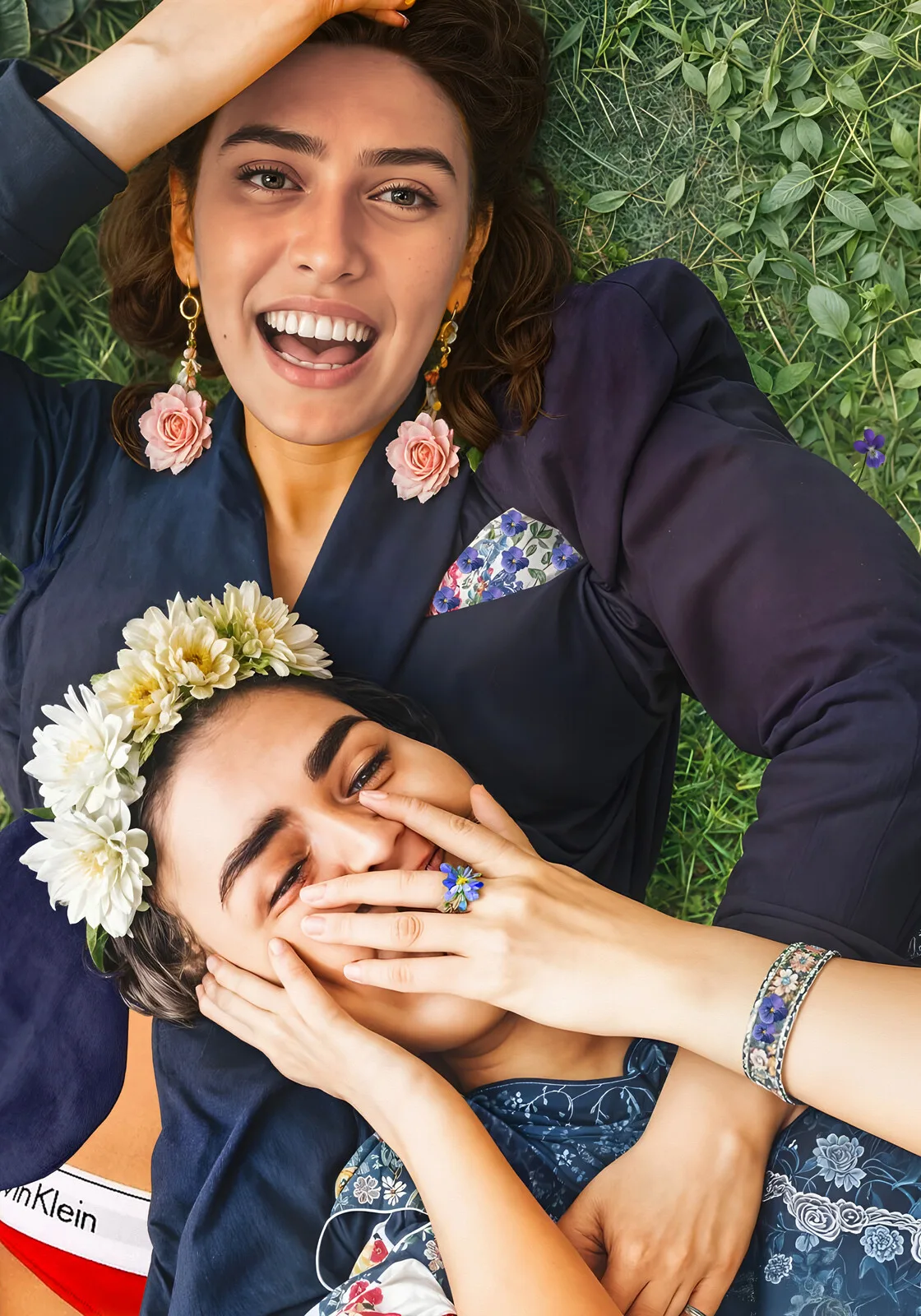
Great Joy - Birds of a feather flock together, 2025
Digital
70 x 100 cm
3 200 kr
Great Joy - Birds of a feather flock together
A love like no other
Some love stories are whispered in secret, while others are sung to the world. The love between Frida Kahlo and Chavela Vargas was both—hidden yet unmistakable, fleeting yet eternal. It was a love that burned brightly, fuelled by passion, rebellion, and a shared defiance of convention. Their bond transcended time, gender, and expectation, leaving traces in art, music, and whispered ‘La Llorona’ verses. It was a love of devotion and distance, longing and laughter, tenderness and sorrow—a love that, though brief, lived on in every note Chavela sang, and every stroke Frida painted.
Read on to explore their love affair.
"Veni, Vidi, Amavi (I came, I saw, I loved)
Chavela came, her voice like fire,
A storm that shook Frida’s lyre.
A glance, a touch, a whispered plea,
Two souls entwined, wild and free.
She saw the colours, bold and bright,
The pain, the passion, dark and light.
She traced the scars; she knew the cost.
She kissed the wounds that love had lost.
She loved with fury, fierce and wide,
No need for shadows, none to hide.
Their laughter echoed, deep and low,
While Diego watched with eyes of woe.
For love was theirs, untamed, untied,
A flame that burned yet never died.
No chains could hold, no fate deny,
The love that soared beyond the sky.
Now, stars above in endless flight,
a trio bound in borrowed light.
Two empresses rule with steady hands,
while Diego kneels in the shifting sands.
A king in name but not in power,
he waits beneath their gilded tower.
For love is carved by those who dare,
and Diego knows he’s breathing air.“
Malmö, February 2025
Great Joy - Birds of a feather flock together
One of the paintings from Frida’s retrospective exhibition truly stood out. It was an image brimming with tenderness and exuberant joy, imbued with symbolism and meaning. I seized the opportunity to discuss the painting as we sat in her Malmö studio, the artwork displayed on one of the walls.
Frida had created this extended self-portrait from memory. She and her lover, Chavela Vargas, were lying on the grass in the garden of Casa Azul. Chavela was a Mexican singer famous for her heart-wrenching ‘Rancheras’ and androgynous style. She was openly lesbian and had numerous affairs with women in the artistic community. I inquired of Frida about the painting's background.
Frida: “Chavela and I were two people in love. That was all. There was nothing different from any other couple, anywhere in the world, in any era.”
Me: “But for you, this moment was special—I can see that. What did Chavela mean to you?” I had read somewhere that the singer later described Frida in her memoirs as "a volcano" filled with passion and pain. There had to be much more to the story.
Frida: (dreamily) “I adored that Chavela always remembered to bring extra sauce when she surprised me with Tacos de Canasta on evenings when I was working late on a painting. I could be quite manic at times and completely forget to eat.”
She smacked her lips as if savouring the memory before resuming. “Tacos de Canasta—takeaway food from old Mexico, a quick and inexpensive meal for workers and students.”
She caught my puzzled look—or perhaps read my mind, as those from the stars do. That’s how they communicate in eternity. After all, there is no free oxygen on a star, so vocal cords wouldn’t function. Telepathy is far more efficient, eliminating distance as an obstacle. This also allows them to communicate across all boundaries, cultures, and generations—in many cases, even with animals. Practical yet revealing, what is vaguely thought becomes the same as what is vaguely expressed.
Me: “That was thoughtful of her. I suppose you also enjoyed these... Camasata?”
Frida: (laughing) “Canasta! Like the card game. In Spanish, it simply means ‘basket.’ They’re small, soft tacos filled with simple yet flavourful ingredients and stacked inside a canasta, covered with a cloth, allowing them to steam and become even tastier. The filling varies—chicharrón prensado (pressed pork) is substantial, and frijoles refritos (mashed, fried black beans) are both delicious and, let’s say, cleansing for the system. Papas con chorizo (potatoes with chorizo) can be a bit heavy, but my favourite was mole rojo con pollo (chicken in red mole). Mole is one of Mexico’s most iconic sauces—a rich, spicy, and complex blend of chillies, spices, nuts, and sometimes chocolate. 'Mole' derives from the Nahuatl word ‘mōlli,’ meaning sauce or mixture.”
She paused and smiled slyly and continued. “Are you getting hungry?”
Me: “I must confess, I am. But was there anything else that made you fall for her? I wanted to steer the conversation away from food and perhaps get a glimpse into how lesbian women love. Maybe it was just the little pervert in me peeking through.
Frida: “I loved that Chavela always heated the water and filled the bathtub for me when I finally stumbled into the bathroom late in the morning. She would also warm a small bowl of water, placing the soap inside so that when I washed my hands, the bar would be warm and fragrant.”
Me: “So, you lived together?”
Frida: “Not exactly. She often stayed over, but Diego was in and out of Casa Azul. Chavela and I quickly became like an old couple—finishing each other’s sentences and arguing over nonsense. There are millions of little things that make two women fall in love. That’s what matters, all without mentioning a single one.”
Me: (impatiently) “You could at least mention a few.”
Frida: “The best part about Chavela was that she could share peaceful silences without feeling the need to fill the space with pointless chatter. But when we had fun, it sparked—just like in the painting I made. I actually remember that moment. She laughed loudly, and I giggled. We loved telling terrible jokes to each other and pretending to be macho pigs, but always with a twist at the end.”
Me: “Do you remember any of them?” I loved corny jokes—the kind that strip us humans bare, exposing our prejudices.
Frida: “Oh, plenty! This one always made us laugh: ‘How many men does it take to change a light bulb?’ Diego once asked another macho pig but answered his own question before the other could respond. ‘None! Just let the old woman paint in the dark.’”
Me: (after laughing at the comparison) “His life’s biggest setback. That gigantic mural that Nelson Rockefeller commissioned for the newly built Rockefeller Center. As a communist, Diego created a grand political fresco depicting humanity’s future through science, industry, and technology—but from the perspective of the common people. The problem was that right in the middle of it, in the heart of capitalism’s stronghold, was a gigantic Lenin. Not exactly a smart move. Rockefeller was furious and demanded that the anarchist be removed. Diego refused. This was one of the biggest art scandals in New York’s history, and the competition for that title is tough!”
Frida: “Thanks, I was there. I warned Diego that this could cause trouble, but he didn’t listen. He could be quite tone-deaf. Even when he offered to add a portrait of Abraham Lincoln as a ‘counterbalance’ to Lenin, Rockefeller refused and ordered the mural destroyed the following year. But that wasn’t the end of the story. Diego recreated an almost identical version in Mexico City’s Palacio de Bellas Artes under the title ‘Hombre, controlador del universo’ (Man, Controller of the Universe). That one still stands today—and is even more politically charged, featuring Karl Marx, Friedrich Engels, and Leon Trotsky. So, the last laugh was his. That’s why the joke about the light bulb is so funny. It's a classic two-step joke with a twist. I probably don’t need to mention that Diego wasn’t as amused by it.
The scandal made him even more famous as a politically engaged artist, but it left a deep scar in his soul.”
Me: “Back to your painting—it radiates joy and passion. To put it bluntly, it looks like you two were madly in love. Or should I say... lustful?” I didn’t say the last part out loud, but I thought it. And in the company of a Time-Traveller, that’s enough.
Frida: (blushing at my thought, which she had picked up) “I wanted to capture the moment, but also eternity—to preserve it not just on canvas but as if it were carved in stone, a monument erected in my inner plaza of love. The image has been inside me since that day in the garden outside Casa Azul in 1942.
My soul’s baggage contains many such monuments, marking meetings of great significance. But Chavela was something special. Perhaps because, quite literally, ‘Birds of a feather flock together’—even if, in the end, the game didn’t work out.
Me: “Why did it end like that?”
Frida: “Yes, why? A question I’ve asked myself many times. There’s a short answer. Diego.”
Me: "Perhaps you should share the longer version to avoid misunderstanding.”
Frida: “Then I must start from the beginning. Diego’s and my relationship was, as you know, anything but simple. Yet, a spiritual bond kept us together—a passionate, complex, and often tumultuous relationship marked by deep love, infidelity, artistic admiration, and political ideals.
As you know, our marriage was filled with love and betrayal. Diego had affairs, including with my sister Cristina, while I engaged in relationships with both men and women. Everything culminated in our divorce in 1939, but we couldn’t stay apart and remarried six months later. Despite the conflicts, we were inseparable, supporting each other artistically and sharing a daily political engagement in communism and the Mexican Revolution.
Me: "Forgive my interruption, but you’ve shared your relationship with Diego numerous times. I believe I understand why you were open to other relationships but never wanted to leave him entirely. It’s you and Chavela I’m interested in—if you wish to discuss it, of course.”
Frida: "Pardon my rambling, but as you know, the heart speaks where words fail. Alright, I’ll provide the short version.
We met in May 1942 at a party in my home, Casa Azul. After the party, I invited Chavela to stay the night, and she accepted. It was a fiery start to our brief but intense relationship.”
Me: “What was so special about her, aside from the fact that she was beautiful—at least from what I can see in your painting?”
Frida: “Chavela was an extraordinary woman, openly lesbian, and I desired her erotically from the very first moment. I’m unsure if she immediately felt the same way about me—I never asked. But I didn’t hesitate for a moment to undress before her. Even though I didn’t believe in any deity, I did at that instant because perhaps Chavela was a gift sent from heaven.”
Me: "That sounds like a beautiful love story.”
Frida: “I cannot find better words than those Chavela herself used long after I departed this world.
She said, and I quote: ‘It was love at first sight, dazzling but not of this world. It was a light from another dimension, another planet. Gazing at her face, eyes, and body, I thought she was from another realm. I was in my late thirties; she was merely in her twenties, and I sensed I could love this being with the purest love imaginable. For a too short while, it became the most devoted love in the world, the most painful love, the happiest in the universe, and the saddest yet most unrestrained love of all time, yet simultaneously the most inhibited. One day, however, her words wounded me deeply when she told me she was departing. Nevertheless, I knew from the beginning that she would leave my side one day.
I remember my last words to Chavela: “I know you are leaving. And I am not going to cry. Nor will you. One evening when you want to, in whatever country in the world, and you have the time, remember me. Just remember me and think that once in life, there was a being who loved and still loves you. Because I gave birth to you, and I provided you with freedom. I cannot bind you to my crutches and my bed. Go!” So I said, and then she opened the door and never returned.”
Me: “That sounds like something from a love novel. As a writer, I’m envious—I could never have penned a better romance myself.”
Frida: (visibly moved by her own words) “What we felt for one another was never repeated; what we offered was everything we had—all the energy and vigour of the world, the warmth, the sensitivity, all the strength of the love we had ever felt, we gave to each other.
She infused me with her youth, and time melted away. For her, I was a motherly lover, a central role model, and a mentor—roles that Chavela’s biological mother never fulfilled. I taught her how to overcome the suffering caused by family abandonment.
We were two women as one; we were “muy mujeres”, as Mexicans say, and we had to love one another because we were women.”
Me: “What does ‘muy mujeres’ mean?” I asked though I had my suspicions.
Frida: (giggling) “Being ‘muy mujeres’ is intrinsically linked to a queerness that challenges traditional gender and sexuality norms, embodying female masculinity and desire, ultimately representing our shared aspirations in bed.”
Me: “Your story becomes even more gripping. It reminds me of the love between Marianne Ihlen and Leonard Cohen.”
Frida: “I agree. I have met that eternal couple several times up above. Chavela too.
The most touching proof of Chavela’s love came in 2012, when she was 93 years old, just a few months before she departed this earth to reunite with me on my star. That year, she sang her signature song, ‘La Llorona’, in a final, deeply personal, self-revealing manner. Her rendition then stood apart from all previous versions in numerous ways.
Chavela felt free to improvise the verses, even the melody, reflecting on her life and giving a personalised farewell to her audience— and, most importantly, revealing the true depth of our love.” Frida took a deep breath, composed herself, and then, with a voice cracked by emotion, began to recite…
“And this is how my story ends,
which started from nothing.
Give me your hand, Llorona,
for I come very hurt.
Madam, give me your hand,
for I come very, very tired.
Oh, woe is me! Llorona,
Llorona, take me to the river.
Cover me with your shawl, Llorona,
Because I’m dying of cold.”
After a moment of silence, Frida continued.
Frida: “This time, I, as La Llorona, was the Virgin who ‘hears the voice of Christ’ and asks me to take her by the hand and sustain her—to remember that Chavela felt I gave birth to her, that she felt my blood running in her veins. Chavela recognised her need for warmth—the kind that only a motherly lover’s arms can provide, covering her sweetheart with a blanket.
It was moving because, at the end of her life, Chavela reached out to me for the sustenance necessary to transition from life to leaving this Earth.
She asked me, her lover, to take her to the river of rebirth, where we could be together again. Chavela was ready to meet me again and had found peace with it.
She could not have known that we would soon reunite, that I was waiting for her and that she, I, and Diego now live together in an eternal trinity."
Me: “I’m completely overwhelmed,” I said, a tear welling in my eye. “You have to tell me—who was Llorona? Did Chavela write the song?"
Frida: “Not at all. ‘La Llorona’ is a traditional Mexican folk song with deep historical and mythological roots. The song is inspired by the legend of La Llorona—‘The Weeping Woman’—one of the most iconic stories in Latin American folklore.
Chavela only added certain aspects to this Mexican female prototype. In Chavela’s song, she embodies a Queer Llorona, and by including me as Llorona, she transformed it into an otherworldly tale of suffering, insatiable longing, and motherly love."
Frida’s eyes glistened with emotion before she continued.
“La Llorona is a female ghost who, according to legend, drowned her children in a river in desperation after being abandoned by her lover. She immediately regretted it and has since wandered restlessly along rivers and lakes, weeping and calling for her children.
Her sorrowful cries are said to be a warning to men and children—some versions claim she kidnaps disobedient children.
The lyrics vary, but themes of love, sorrow, loss, and death remain constant. In some versions, the woman is not a ghost but a grieving woman mourning a lost love.
Chavela’s interpretation is the most internationally renowned, and her voice—filled with pain and emotion—amplified the song’s tragic and fateful tone. The song has been featured in many films, including ‘Frida’ (2002), where it is sung by Chavela herself."
Me: “What do you think makes it so moving?"
Frida: “It blends myth and reality in a way that allows for multiple interpretations—as sorrow over a lost lover, as a warning, or as an ode to pain and passion. Chavela is undeniably the one who has made ‘La Llorona’ immortal."
We sat in silence for a long while—I, moved by a love story that should become both a book and a film, and Frida, lost in her memories.
Eventually, I broke the silence.
Me: “Tell me about the symbols in your painting.”
Frida: “Chavela’s earrings were a tribute to me and to my favourite flower, the marigold—a flower that celebrates both death and life. In Mexican culture, death is viewed as a natural part of life and nothing to be feared. She bought them after we had been together for a while.”
Me: “And you painted a single violet next to Chavela’s jacket sleeve.”
Frida: “A single violet, to signify she was the only one. The handkerchief in her pocket, embroidered with violets, was meant as a tribute to all ‘violets’—that is, lesbian women.
My ring, featuring a stylised violet, and even my bracelet made of tiny, multicoloured beads with two violets, were custom-made to express my love for Chavela.”
Me: “Why violets when your favourite flower is another?”
Frida: (amused) “Violets have historically been used as a code or symbol for lesbian women, especially in the early 20th century.”
Me: “Why are violets associated with lesbian love?”
Frida: “The connection comes from the ancient Greek poet Sappho of Lesbos (circa 600 BC), who wrote love poems to women and frequently mentioned violets in her poetry.
One example from her poems: ‘She took me in her soft arms, and when she looked at me with violet eyes, my heart filled with love.’ Due to Sappho’s poetry, violets and purple flowers became symbols of lesbian love and romance, a historical fact that adds depth to the symbol's understanding.
Me: “Do violets still hold the same significance?”
Frida: “Absolutely. Just like in my painting with Chavela and me. It’s a beautiful way to express feelings and show solidarity with all women in countries where they still have to conceal their love. In the 1920s, in Paris and Berlin, some lesbian women wore violets as a discreet symbol to recognise each other.
In Radclyffe Hall’s novel The Well of Loneliness (1928), one of the first lesbian novels, flower symbolism is employed. After my time in the 1970s lesbian feminist movement, purple and violet became the colours of lesbian identity.
Lesbian women have often been referred to as ‘violets,’ and the flower has served as a discreet symbol of lesbian love in both literature and real life.
And let’s not forget—it also smells divine.”
Me: “Is the violet a universal symbol of feminism?”
Frida: “No, there is no universal flower that officially represents feminism, but many flowers symbolise women’s rights, strength, and freedom.
Violet was a symbol for the suffragettes. In the early 1900s, the suffragette movement in the UK and USA used purple, white, and green—purple signified dignity and loyalty.
Carnations became a symbol of socialism and feminism. Red carnations were used in workers' movements, where women played a crucial role, and pink carnations were linked to International Women’s Day.
The mimosa is the official symbol of Women’s Day in Italy. Chosen by feminists in the 1940s, it represents strength, solidarity, and resilience.
Sunflowers signify eco-feminism and positive change.
Lavender is also a queer feminist symbol, having historically been linked to queer feminism and LGBTQ+ activism.”
From there, we talked about her other lovers—she had many and was happy to share. Frida lived openly as bisexual, something unusual for her time. Her passionate and rebellious love life was as unbounded by norms as her art and political activism. Frida loved intensely, but on her own terms—she refused to be constrained by society’s rules. Her relationships were often fiery and tumultuous, just like her life and art.
Jörgen Thornberg
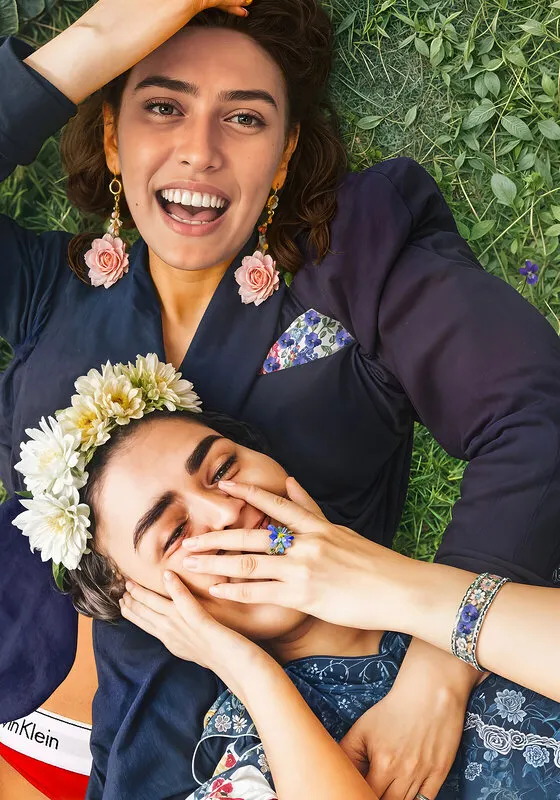
Great Joy - Birds of a feather flock together, 2025
Digital
70 x 100 cm
3 200 kr
Great Joy - Birds of a feather flock together
A love like no other
Some love stories are whispered in secret, while others are sung to the world. The love between Frida Kahlo and Chavela Vargas was both—hidden yet unmistakable, fleeting yet eternal. It was a love that burned brightly, fuelled by passion, rebellion, and a shared defiance of convention. Their bond transcended time, gender, and expectation, leaving traces in art, music, and whispered ‘La Llorona’ verses. It was a love of devotion and distance, longing and laughter, tenderness and sorrow—a love that, though brief, lived on in every note Chavela sang, and every stroke Frida painted.
Read on to explore their love affair.
"Veni, Vidi, Amavi (I came, I saw, I loved)
Chavela came, her voice like fire,
A storm that shook Frida’s lyre.
A glance, a touch, a whispered plea,
Two souls entwined, wild and free.
She saw the colours, bold and bright,
The pain, the passion, dark and light.
She traced the scars; she knew the cost.
She kissed the wounds that love had lost.
She loved with fury, fierce and wide,
No need for shadows, none to hide.
Their laughter echoed, deep and low,
While Diego watched with eyes of woe.
For love was theirs, untamed, untied,
A flame that burned yet never died.
No chains could hold, no fate deny,
The love that soared beyond the sky.
Now, stars above in endless flight,
a trio bound in borrowed light.
Two empresses rule with steady hands,
while Diego kneels in the shifting sands.
A king in name but not in power,
he waits beneath their gilded tower.
For love is carved by those who dare,
and Diego knows he’s breathing air.“
Malmö, February 2025
Great Joy - Birds of a feather flock together
One of the paintings from Frida’s retrospective exhibition truly stood out. It was an image brimming with tenderness and exuberant joy, imbued with symbolism and meaning. I seized the opportunity to discuss the painting as we sat in her Malmö studio, the artwork displayed on one of the walls.
Frida had created this extended self-portrait from memory. She and her lover, Chavela Vargas, were lying on the grass in the garden of Casa Azul. Chavela was a Mexican singer famous for her heart-wrenching ‘Rancheras’ and androgynous style. She was openly lesbian and had numerous affairs with women in the artistic community. I inquired of Frida about the painting's background.
Frida: “Chavela and I were two people in love. That was all. There was nothing different from any other couple, anywhere in the world, in any era.”
Me: “But for you, this moment was special—I can see that. What did Chavela mean to you?” I had read somewhere that the singer later described Frida in her memoirs as "a volcano" filled with passion and pain. There had to be much more to the story.
Frida: (dreamily) “I adored that Chavela always remembered to bring extra sauce when she surprised me with Tacos de Canasta on evenings when I was working late on a painting. I could be quite manic at times and completely forget to eat.”
She smacked her lips as if savouring the memory before resuming. “Tacos de Canasta—takeaway food from old Mexico, a quick and inexpensive meal for workers and students.”
She caught my puzzled look—or perhaps read my mind, as those from the stars do. That’s how they communicate in eternity. After all, there is no free oxygen on a star, so vocal cords wouldn’t function. Telepathy is far more efficient, eliminating distance as an obstacle. This also allows them to communicate across all boundaries, cultures, and generations—in many cases, even with animals. Practical yet revealing, what is vaguely thought becomes the same as what is vaguely expressed.
Me: “That was thoughtful of her. I suppose you also enjoyed these... Camasata?”
Frida: (laughing) “Canasta! Like the card game. In Spanish, it simply means ‘basket.’ They’re small, soft tacos filled with simple yet flavourful ingredients and stacked inside a canasta, covered with a cloth, allowing them to steam and become even tastier. The filling varies—chicharrón prensado (pressed pork) is substantial, and frijoles refritos (mashed, fried black beans) are both delicious and, let’s say, cleansing for the system. Papas con chorizo (potatoes with chorizo) can be a bit heavy, but my favourite was mole rojo con pollo (chicken in red mole). Mole is one of Mexico’s most iconic sauces—a rich, spicy, and complex blend of chillies, spices, nuts, and sometimes chocolate. 'Mole' derives from the Nahuatl word ‘mōlli,’ meaning sauce or mixture.”
She paused and smiled slyly and continued. “Are you getting hungry?”
Me: “I must confess, I am. But was there anything else that made you fall for her? I wanted to steer the conversation away from food and perhaps get a glimpse into how lesbian women love. Maybe it was just the little pervert in me peeking through.
Frida: “I loved that Chavela always heated the water and filled the bathtub for me when I finally stumbled into the bathroom late in the morning. She would also warm a small bowl of water, placing the soap inside so that when I washed my hands, the bar would be warm and fragrant.”
Me: “So, you lived together?”
Frida: “Not exactly. She often stayed over, but Diego was in and out of Casa Azul. Chavela and I quickly became like an old couple—finishing each other’s sentences and arguing over nonsense. There are millions of little things that make two women fall in love. That’s what matters, all without mentioning a single one.”
Me: (impatiently) “You could at least mention a few.”
Frida: “The best part about Chavela was that she could share peaceful silences without feeling the need to fill the space with pointless chatter. But when we had fun, it sparked—just like in the painting I made. I actually remember that moment. She laughed loudly, and I giggled. We loved telling terrible jokes to each other and pretending to be macho pigs, but always with a twist at the end.”
Me: “Do you remember any of them?” I loved corny jokes—the kind that strip us humans bare, exposing our prejudices.
Frida: “Oh, plenty! This one always made us laugh: ‘How many men does it take to change a light bulb?’ Diego once asked another macho pig but answered his own question before the other could respond. ‘None! Just let the old woman paint in the dark.’”
Me: (after laughing at the comparison) “His life’s biggest setback. That gigantic mural that Nelson Rockefeller commissioned for the newly built Rockefeller Center. As a communist, Diego created a grand political fresco depicting humanity’s future through science, industry, and technology—but from the perspective of the common people. The problem was that right in the middle of it, in the heart of capitalism’s stronghold, was a gigantic Lenin. Not exactly a smart move. Rockefeller was furious and demanded that the anarchist be removed. Diego refused. This was one of the biggest art scandals in New York’s history, and the competition for that title is tough!”
Frida: “Thanks, I was there. I warned Diego that this could cause trouble, but he didn’t listen. He could be quite tone-deaf. Even when he offered to add a portrait of Abraham Lincoln as a ‘counterbalance’ to Lenin, Rockefeller refused and ordered the mural destroyed the following year. But that wasn’t the end of the story. Diego recreated an almost identical version in Mexico City’s Palacio de Bellas Artes under the title ‘Hombre, controlador del universo’ (Man, Controller of the Universe). That one still stands today—and is even more politically charged, featuring Karl Marx, Friedrich Engels, and Leon Trotsky. So, the last laugh was his. That’s why the joke about the light bulb is so funny. It's a classic two-step joke with a twist. I probably don’t need to mention that Diego wasn’t as amused by it.
The scandal made him even more famous as a politically engaged artist, but it left a deep scar in his soul.”
Me: “Back to your painting—it radiates joy and passion. To put it bluntly, it looks like you two were madly in love. Or should I say... lustful?” I didn’t say the last part out loud, but I thought it. And in the company of a Time-Traveller, that’s enough.
Frida: (blushing at my thought, which she had picked up) “I wanted to capture the moment, but also eternity—to preserve it not just on canvas but as if it were carved in stone, a monument erected in my inner plaza of love. The image has been inside me since that day in the garden outside Casa Azul in 1942.
My soul’s baggage contains many such monuments, marking meetings of great significance. But Chavela was something special. Perhaps because, quite literally, ‘Birds of a feather flock together’—even if, in the end, the game didn’t work out.
Me: “Why did it end like that?”
Frida: “Yes, why? A question I’ve asked myself many times. There’s a short answer. Diego.”
Me: "Perhaps you should share the longer version to avoid misunderstanding.”
Frida: “Then I must start from the beginning. Diego’s and my relationship was, as you know, anything but simple. Yet, a spiritual bond kept us together—a passionate, complex, and often tumultuous relationship marked by deep love, infidelity, artistic admiration, and political ideals.
As you know, our marriage was filled with love and betrayal. Diego had affairs, including with my sister Cristina, while I engaged in relationships with both men and women. Everything culminated in our divorce in 1939, but we couldn’t stay apart and remarried six months later. Despite the conflicts, we were inseparable, supporting each other artistically and sharing a daily political engagement in communism and the Mexican Revolution.
Me: "Forgive my interruption, but you’ve shared your relationship with Diego numerous times. I believe I understand why you were open to other relationships but never wanted to leave him entirely. It’s you and Chavela I’m interested in—if you wish to discuss it, of course.”
Frida: "Pardon my rambling, but as you know, the heart speaks where words fail. Alright, I’ll provide the short version.
We met in May 1942 at a party in my home, Casa Azul. After the party, I invited Chavela to stay the night, and she accepted. It was a fiery start to our brief but intense relationship.”
Me: “What was so special about her, aside from the fact that she was beautiful—at least from what I can see in your painting?”
Frida: “Chavela was an extraordinary woman, openly lesbian, and I desired her erotically from the very first moment. I’m unsure if she immediately felt the same way about me—I never asked. But I didn’t hesitate for a moment to undress before her. Even though I didn’t believe in any deity, I did at that instant because perhaps Chavela was a gift sent from heaven.”
Me: "That sounds like a beautiful love story.”
Frida: “I cannot find better words than those Chavela herself used long after I departed this world.
She said, and I quote: ‘It was love at first sight, dazzling but not of this world. It was a light from another dimension, another planet. Gazing at her face, eyes, and body, I thought she was from another realm. I was in my late thirties; she was merely in her twenties, and I sensed I could love this being with the purest love imaginable. For a too short while, it became the most devoted love in the world, the most painful love, the happiest in the universe, and the saddest yet most unrestrained love of all time, yet simultaneously the most inhibited. One day, however, her words wounded me deeply when she told me she was departing. Nevertheless, I knew from the beginning that she would leave my side one day.
I remember my last words to Chavela: “I know you are leaving. And I am not going to cry. Nor will you. One evening when you want to, in whatever country in the world, and you have the time, remember me. Just remember me and think that once in life, there was a being who loved and still loves you. Because I gave birth to you, and I provided you with freedom. I cannot bind you to my crutches and my bed. Go!” So I said, and then she opened the door and never returned.”
Me: “That sounds like something from a love novel. As a writer, I’m envious—I could never have penned a better romance myself.”
Frida: (visibly moved by her own words) “What we felt for one another was never repeated; what we offered was everything we had—all the energy and vigour of the world, the warmth, the sensitivity, all the strength of the love we had ever felt, we gave to each other.
She infused me with her youth, and time melted away. For her, I was a motherly lover, a central role model, and a mentor—roles that Chavela’s biological mother never fulfilled. I taught her how to overcome the suffering caused by family abandonment.
We were two women as one; we were “muy mujeres”, as Mexicans say, and we had to love one another because we were women.”
Me: “What does ‘muy mujeres’ mean?” I asked though I had my suspicions.
Frida: (giggling) “Being ‘muy mujeres’ is intrinsically linked to a queerness that challenges traditional gender and sexuality norms, embodying female masculinity and desire, ultimately representing our shared aspirations in bed.”
Me: “Your story becomes even more gripping. It reminds me of the love between Marianne Ihlen and Leonard Cohen.”
Frida: “I agree. I have met that eternal couple several times up above. Chavela too.
The most touching proof of Chavela’s love came in 2012, when she was 93 years old, just a few months before she departed this earth to reunite with me on my star. That year, she sang her signature song, ‘La Llorona’, in a final, deeply personal, self-revealing manner. Her rendition then stood apart from all previous versions in numerous ways.
Chavela felt free to improvise the verses, even the melody, reflecting on her life and giving a personalised farewell to her audience— and, most importantly, revealing the true depth of our love.” Frida took a deep breath, composed herself, and then, with a voice cracked by emotion, began to recite…
“And this is how my story ends,
which started from nothing.
Give me your hand, Llorona,
for I come very hurt.
Madam, give me your hand,
for I come very, very tired.
Oh, woe is me! Llorona,
Llorona, take me to the river.
Cover me with your shawl, Llorona,
Because I’m dying of cold.”
After a moment of silence, Frida continued.
Frida: “This time, I, as La Llorona, was the Virgin who ‘hears the voice of Christ’ and asks me to take her by the hand and sustain her—to remember that Chavela felt I gave birth to her, that she felt my blood running in her veins. Chavela recognised her need for warmth—the kind that only a motherly lover’s arms can provide, covering her sweetheart with a blanket.
It was moving because, at the end of her life, Chavela reached out to me for the sustenance necessary to transition from life to leaving this Earth.
She asked me, her lover, to take her to the river of rebirth, where we could be together again. Chavela was ready to meet me again and had found peace with it.
She could not have known that we would soon reunite, that I was waiting for her and that she, I, and Diego now live together in an eternal trinity."
Me: “I’m completely overwhelmed,” I said, a tear welling in my eye. “You have to tell me—who was Llorona? Did Chavela write the song?"
Frida: “Not at all. ‘La Llorona’ is a traditional Mexican folk song with deep historical and mythological roots. The song is inspired by the legend of La Llorona—‘The Weeping Woman’—one of the most iconic stories in Latin American folklore.
Chavela only added certain aspects to this Mexican female prototype. In Chavela’s song, she embodies a Queer Llorona, and by including me as Llorona, she transformed it into an otherworldly tale of suffering, insatiable longing, and motherly love."
Frida’s eyes glistened with emotion before she continued.
“La Llorona is a female ghost who, according to legend, drowned her children in a river in desperation after being abandoned by her lover. She immediately regretted it and has since wandered restlessly along rivers and lakes, weeping and calling for her children.
Her sorrowful cries are said to be a warning to men and children—some versions claim she kidnaps disobedient children.
The lyrics vary, but themes of love, sorrow, loss, and death remain constant. In some versions, the woman is not a ghost but a grieving woman mourning a lost love.
Chavela’s interpretation is the most internationally renowned, and her voice—filled with pain and emotion—amplified the song’s tragic and fateful tone. The song has been featured in many films, including ‘Frida’ (2002), where it is sung by Chavela herself."
Me: “What do you think makes it so moving?"
Frida: “It blends myth and reality in a way that allows for multiple interpretations—as sorrow over a lost lover, as a warning, or as an ode to pain and passion. Chavela is undeniably the one who has made ‘La Llorona’ immortal."
We sat in silence for a long while—I, moved by a love story that should become both a book and a film, and Frida, lost in her memories.
Eventually, I broke the silence.
Me: “Tell me about the symbols in your painting.”
Frida: “Chavela’s earrings were a tribute to me and to my favourite flower, the marigold—a flower that celebrates both death and life. In Mexican culture, death is viewed as a natural part of life and nothing to be feared. She bought them after we had been together for a while.”
Me: “And you painted a single violet next to Chavela’s jacket sleeve.”
Frida: “A single violet, to signify she was the only one. The handkerchief in her pocket, embroidered with violets, was meant as a tribute to all ‘violets’—that is, lesbian women.
My ring, featuring a stylised violet, and even my bracelet made of tiny, multicoloured beads with two violets, were custom-made to express my love for Chavela.”
Me: “Why violets when your favourite flower is another?”
Frida: (amused) “Violets have historically been used as a code or symbol for lesbian women, especially in the early 20th century.”
Me: “Why are violets associated with lesbian love?”
Frida: “The connection comes from the ancient Greek poet Sappho of Lesbos (circa 600 BC), who wrote love poems to women and frequently mentioned violets in her poetry.
One example from her poems: ‘She took me in her soft arms, and when she looked at me with violet eyes, my heart filled with love.’ Due to Sappho’s poetry, violets and purple flowers became symbols of lesbian love and romance, a historical fact that adds depth to the symbol's understanding.
Me: “Do violets still hold the same significance?”
Frida: “Absolutely. Just like in my painting with Chavela and me. It’s a beautiful way to express feelings and show solidarity with all women in countries where they still have to conceal their love. In the 1920s, in Paris and Berlin, some lesbian women wore violets as a discreet symbol to recognise each other.
In Radclyffe Hall’s novel The Well of Loneliness (1928), one of the first lesbian novels, flower symbolism is employed. After my time in the 1970s lesbian feminist movement, purple and violet became the colours of lesbian identity.
Lesbian women have often been referred to as ‘violets,’ and the flower has served as a discreet symbol of lesbian love in both literature and real life.
And let’s not forget—it also smells divine.”
Me: “Is the violet a universal symbol of feminism?”
Frida: “No, there is no universal flower that officially represents feminism, but many flowers symbolise women’s rights, strength, and freedom.
Violet was a symbol for the suffragettes. In the early 1900s, the suffragette movement in the UK and USA used purple, white, and green—purple signified dignity and loyalty.
Carnations became a symbol of socialism and feminism. Red carnations were used in workers' movements, where women played a crucial role, and pink carnations were linked to International Women’s Day.
The mimosa is the official symbol of Women’s Day in Italy. Chosen by feminists in the 1940s, it represents strength, solidarity, and resilience.
Sunflowers signify eco-feminism and positive change.
Lavender is also a queer feminist symbol, having historically been linked to queer feminism and LGBTQ+ activism.”
From there, we talked about her other lovers—she had many and was happy to share. Frida lived openly as bisexual, something unusual for her time. Her passionate and rebellious love life was as unbounded by norms as her art and political activism. Frida loved intensely, but on her own terms—she refused to be constrained by society’s rules. Her relationships were often fiery and tumultuous, just like her life and art.
3 200 kr

Jörgen Thornberg
Malmö
Lite om bilder och mig. Translation in English at the end.
Jag är en nyfiken person som ser allt i bilder, även det jag fäster i ord, gärna tillsammans för bakom alla mina bilder finns en berättelse. Till vissa bilder hör en kortare eller längre novell som följer med bilden.
Bilder berättar historier. Jag omges av naturlig skönhet, intressanta människor och historia var jag än går. Jag använder min kamera för att dokumentera världen och blanda det jag ser med vad jag känner för att fånga den dolda magin.
Mina bilder berättar mina historier. Genom mina bilder, tryck och berättelser. Jag bjuder in dig att ta del av dessa berättelser, in i ditt liv och hem och dela min mycket personliga syn på vår värld. Mer än vad ögat ser. Jag tänker i bilder, drömmer och skriver och pratar om dem; följaktligen måste jag också skapa bilder. De blir vad jag ser, inte nödvändigtvis begränsade till verkligheten. Det finns en bild runt varje hörn. Jag hoppas att du kommer att se vad jag såg och gilla det.
Jag är också en skrivande person och till många bilder hör en kortare eller längre essay. Den följer med tavlan, tryckt på fint papper och med en personlig hälsning från mig.
Flertalet bilder startar sin resa i min kamera. Enkelt förklarat beskriver jag bilden jag ser i mitt inre, upplevd eller fantiserad. Bilden uppstår inom mig redan innan jag fått okularet till ögat. På bråkdelen av ett ögonblick ser jag vad jag vill ha och vad som kan göras med bilden. Här skall jag stoppa in en giraff, stålmannen, Titanic eller vad det är min fantasi finner ut. Ännu märkligare är att jag kommer ihåg minnesbilden långt efteråt när det blir tid att skapa verket. Om jag lyckas eller inte, är upp till betraktaren, oftast präglat av en stråk av svart humor – meningen är att man skall bli underhållen. Mina bilder blir ofta en snackis där de hänger.
Jag föredrar bilder som förmedlar ett budskap i flera lager. Vid första anblicken fylld av feel-good, en vacker utsikt, fint väder, solen skiner, blommor på ängen eller vattnet som ligger förrädiskt spegelblankt. I en sådan bild kan jag gömma min egentliga berättelse, mitt förakt för förtryckare och våldsverkare, rasister och fördomsfulla människor - ett gärna återkommande motiv mer eller mindre dolt i det vackra motivet. Jag försöker förena dem i ett gemensamt narrativ.
Bild och formgivning har löpt som en röd tråd genom livet. Fotokonst känns som en värdig final som jag gärna delar med mig.
Min genre är vid som framgår av mina bilder, temat en blandning av pop- och gatukonst i kollage som kan bestå av hundratals lager. Vissa bilder kan ta veckor, andra någon dag innan det är dags att överlämna resultatet till printverkstaden. Fine Art Prints är digitala fotocollage. I dessa kollage sker rivandet, klippandet, pusslandet, målandet, ritandet och sprayningen digitalt. Det jag monterar in kan vara hundratals år gamla bilder som jag omsorgsfullt frilägger så att de ser ut att vara en del av tavlan men också bilder skapade av mig själv efter min egen fantasi. Därefter besöks printstudion och för vissa bilder numrera en limiterad upplaga (oftast 7 exemplar) och signera för hand. Vissa bilder kan köpas i olika format. Det är bara att fråga efter vilka. Gillar man en bild som är 70x100 men inte har plats på väggen, går den kanske att få i 50x70 cm istället. Frågan är fri.
Metoden Giclée eller Fine Art Print som det också kallas är det moderna sättet för framställning av grafisk konst. Villkoret för denna typ av utskrifter är att en högkvalitativ storformatskrivare används med åldersbeständigt färgpigment och konstnärspapper eller i förekommande fall på duk. Pappret som används möter de krav på livslängd som ställs av museer och gallerier. Normalt säljer jag mina bilder oinramade så att den nya ägaren själv kan bestämma hur de skall se ut, med eller utan passepartout färg på ram, med eller utan glas etc..
Under många år ställde jag bara ut på nätet, i valda grupper och på min egen Facebooksida - https://www.facebook.com/jorgen.thornberg.9
Jag finns också på en egen hemsida som tyvärr inte alltid är uppdaterad – https://www.jth.life/ Där kan du också läsa en del av de berättelser som följer med bilden.
UTSTÄLLNINGAR
Luftkastellet, oktober 2022
Konst i Lund, november 2022
Luftkastellet, mars 2023
Engleson Galleri Caroli, april 2023
Hydra, Greece June 2023
Engleson Galleri Caroli, oktober 2023
Toppen, Höllviken december 2023
Luftkastellet, mars 2024
Torups Galleri, mars 2024
Venice, May 2024
Luftkastellet, oktober 2024
Konst i Advent, December 2024
Galleri Engleson, Caroli December 2024
Jäger & Jansson Galleri, april 2025
A bit about pictures and me.
I'm a curious person who sees everything in pictures, even what I express in words, often combining them, for behind all my pictures lies a story. These narratives, some as short as a single image and others as long as a novel, are the heart and soul of my work.
Pictures tell stories. Wherever I go, I'm surrounded by natural beauty, exciting people, and history. I use my camera to document the world and blend what I see with what I feel to capture the hidden magic.
My images tell my stories. Through my pictures, prints, and narratives, I invite you to partake in these stories in your life and home and share my deeply personal perspective of our world. More than meets the eye. I think in pictures, dream, write, and talk about them; consequently, I must create images too. They become what I see, not necessarily confined to reality. There's a picture around every corner. I hope you'll see what I saw and enjoy it.
I'm also a writer, and many images come with a shorter or longer essay. It accompanies the painting, printed on fine paper with my personal greeting.
Many pictures start their journey on my camera. Simply put, I describe the image I see in my mind, experienced or imagined. The image arises within me even before I bring the eyepiece to my eye. In a fraction of a moment, I see what I want and what can be done with the picture. Here, I'll insert a giraffe, Superman, the Titanic, or whatever my imagination conjures up. Even stranger is that I remember the mental image long after it's time to create the work. Whether I succeed is up to the observer, often imbued with a streak of black humour – the aim is to entertain. My pictures usually become a talking point wherever they hang.
I prefer pictures that convey a message in multiple layers. At first glance, they're filled with feel-good vibes, a beautiful view, lovely weather, the sun shining, flowers in the meadow, or the water lying deceptively calm. But beneath this surface beauty, I often conceal a deeper story, a narrative that challenges societal norms or explores the human condition. I invite you to delve into these hidden narratives and discover the layers of meaning within my work.
Picture and design have been a thread running through my life. Photographic art feels like a fitting finale, and I'm happy to share it.
My genre is varied, as seen in my pictures; the theme is a blend of pop and street art in collages that can consist of hundreds of layers. Some images can take weeks, others just a day before it's time to hand over the result to the print workshop. Fine Art Prints are digital photo collages. In these collages, tearing, cutting, puzzling, painting, drawing, and spraying happen digitally. What I insert can be images hundreds of years old that I carefully extract so they appear to be part of the painting, but also images created by myself, now also generated from my imagination. Next, visit the print studio and, for certain images, number a limited edition (usually 7 copies) and sign them by hand. Some images may be available in other formats. Just ask which ones. If you like an image that's 70x100 but doesn't have space on the wall, you might be able to get it in 50x70 cm instead. The question is open.
The Giclée method, or Fine Art Print as it's also called, is the modern way of producing graphic art. This method ensures the highest quality and longevity of the artwork, using a high-quality large-format printer with archival pigment inks and artist paper or, in some cases, canvas. The paper used meets the longevity requirements set by museums and galleries. I sell my pictures unframed, allowing the new owner to personalise their artwork, confident in the lasting value and quality of the piece.
For many years, I only exhibited online, in selected groups, and on my Facebook page - https://www.facebook.com/jorgen.thornberg.9. I also have my website, which unfortunately is not constantly updated - https://www.jth.life/. You can also read some of the stories accompanying the pictures there.
EXHIBITIONS
Luftkastellet, October 2022
Art in Lund, November 2022
Luftkastellet, March 2023
Engleson Gallery Caroli, April 2023
Hydra, Greece June 2023
Engleson Gallery Caroli, October 2023
Toppen, Höllviken December 2023
Luftkastellet, March 2024
Torup Gallery, March 2024
Venice, May 2024
UTSTÄLLNINGAR
Luftkastellet, oktober 2022
Konst i Lund, november 2022
Luftkastellet, mars 2023
Engleson Galleri Caroli, april 2023
Hydra, Greece June 2023
Engleson Galleri Caroli, oktober 2023
Toppen, Höllviken december 2023
Luftkastellet, mars 2024
Torups Galleri, mars 2024
Venice, May 2024
Luftkastellet, October 2024
Konst i Advent, December 2024
Galleri Engleson, Caroli December 2024
Jäger & Jansson Galleri, April 2025
Utbildning
Autodidakt
Medlem i konstnärsförening
Öppna Sinnen
Med i konstrunda
Konstrundan i Skåne
Utställningar
Luftkastellet, October 2022
Art in Lund, November 2022
Luftkastellet, March 2023
Engleson Gallery Caroli, April 2023
Hydra, Greece June 2023
Engleson Gallery Caroli, October 2023
Toppen, Höllviken December 2023
Luftkastellet, March 2024
Torup Gallery, March 2024
Venice, May 2024