Vi använder cookies för att ge dig bästa möjliga upplevelse. Välj vilka cookies du tillåter.
Läs mer i vår integritetspolicy
Jörgen Thornberg
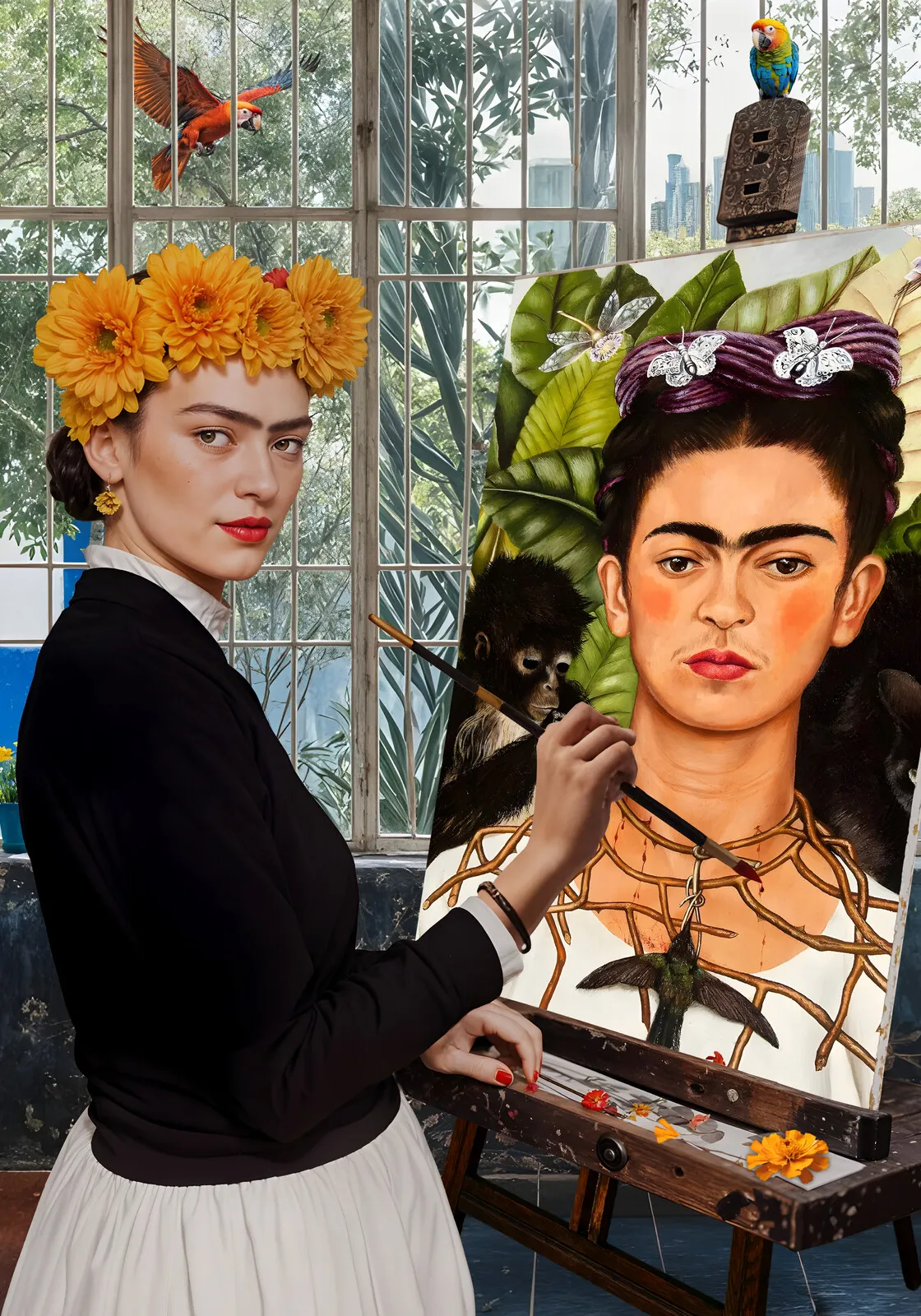
Frida Painting Frida and a Hummingbird, 2025
Digital
50 x 70 cm
3 200 kr
Frida Painting Frida and a Hummingbird.
The title, 'Frida Painting Frida and a Hummingbird ', is a window into the self-referential nature of Frida Kahlo's work. Her art is a world of raw emotion, symbolism, and rebellion, where every brushstroke tells a deeply personal story—of pain, identity, and defiance. In her self-portraits, she does not simply capture her likeness; she invites the viewer into her reality, marked by physical suffering, personal loss, and unwavering political convictions. Her paintings are a personal narrative that allows us to connect with her experiences on a profound level.
Among her most iconic works, ‘Self-Portrait with Thorn Necklace and Hummingbird’ stands out as a testament to Kahlo's resilience. It is a complex interplay of personal pain and broader struggle, transformation, and resilience themes. Every detail—her unwavering gaze, the thorn necklace, the lifeless hummingbird, the black cat, and the ever-watchful monkey—carries layers of meaning that extend beyond her grief to speak for many who suffer in silence. Frida's art is not just her story, but a reflection of the human experience, a testament to the resilience and strength that we all possess.
This exploration delves into the essence of Kahlo’s work, her motivations, and the evolution of her artistic language. Why did she revisit and repaint her image? How do her animals act as symbolic extensions of her emotions? What role do political and cultural commentaries play in her art? Through dialogue with Frida—imagined but rooted in her own words and philosophies—we step closer to understanding an artist who defied convention, challenged expectations, and turned her pain into something eternal.
This is not just about a painting. It is about the woman behind it, the symbols she chose, and the truth she insisted on telling. As she once said, 'I never paint dreams or nightmares. I paint my own reality.' Her courage to paint her reality, unapologetically and without fear, is a testament to her strength and resilience. It is an inspiration to all who face their own struggles and challenges.
Read on to explore Frida's painting.
‘‘A Thorned Gaze: Frida’s Lament
A mirror of thorns, a silent cry,
Her eyes unbroken, fixed on the sky.
A hummingbird, lifeless, black as the night,
Hangs in stillness, void of flight.
A monkey pulls, a trickster’s touch,
Tightens the pain she bears too much.
A cat crouches, dark and lean,
Watching, waiting, guarding unseen.
Blood from her finger, red on the thread,
A canvas where suffering is quietly spread.
Each thorn a memory, each stroke a scar,
She paints things that were and still are.
Beyond the portrait, beyond the frame,
A woman defies and refuses shame.
No dreamer’s world, no fantasy bright,
Only her truth, bathed in light.
The city looms, the garden sighs,
A clash of lands beneath her eyes.
Her Mexico, wild and free,
Against the march of industry.
She paints again, a step behind,
To let the world peer through her mind.
Not just for her but all who weep,
For those whose thorns cut just as deep.”
Malmö, January 2025
Frida Painting Frida and a Hummingbird
The scene is set in Frida Kahlo’s studio, which is filled with vibrant paintings and personal artefacts that inspired her work. She stands before a large canvas on an easel, her brush poised in midair. Her dark eyes are intense as she speaks, punctuating her words with gestures—pointing, shrugging, lifting her chin defiantly—empowering us with her boldness.
Frida Kahlo, a pivotal figure in 20th-century art, is renowned for her introspective and emotionally charged self-portraits. These works, a reflection of her inner world, offer viewers a unique window into her pain, struggles, and singular viewpoint. Among her most iconic pieces, Self-Portrait with Thorn Necklace and Hummingbird stands out as a powerful expression of her strength, vulnerability, and uncompromising artistic vision. The title of this piece, 'Self-Portrait with Thorn Necklace and Hummingbird', is significant as it symbolises the duality of her life. The thorn necklace represents the pain and suffering she endured, while the hummingbird implies life and resilience.
Kahlo herself once said, 'I paint self-portraits because I am so often alone because I am the person I know best.' Throughout her lifetime, she created 143 works of art, 55 of which were self-portraits. Her art was a way for her to cope with the physical and emotional pain she experienced due to a bus accident in her youth and the numerous health issues that plagued her. She unapologetically told her story through her paintings, exposing her experiences and suffering without hesitation. Her self-portraits are always infused with pain, whether it is the physical agony depicted in The Wounded Deer or the emotional turmoil of Self-Portrait with Thorn Necklace and Hummingbird.
One of Kahlo’s earliest self-portraits, Self-Portrait in a Velvet Dress, differs significantly from her later works. It reveals clear influences from European artistic traditions, particularly in the elongated proportions of her hands and neck and the stylised waves in the background. However, as she delved deeper into her Mexican heritage—especially after marrying Diego Rivera—her work became increasingly infused with Mexican symbolism. This shift can be seen in the vibrant colours, Indigenous motifs, and references to Mexican folk culture that began to appear in her paintings. At the same time, elements of surrealism started to emerge in her paintings, particularly in pieces like Henry Ford Hospital and The Broken Column.
Kahlo never shied away from any subject in her self-portraits. The heartbreak of her divorce from Rivera is laid bare in paintings like The Two Fridas and Self-Portrait with Thorn Necklace and Hummingbird, while works such as The Broken Column and Without Hope reflect her suffering as her body continued to deteriorate. Even her infertility became a recurring theme in her art, as seen in Roots, while Henry Ford Hospital directly addresses the miscarriage she endured there. As she famously declared, "I never paint dreams or nightmares. I paint my reality."
I want to pause and focus on one of my favourites—’ Self-Portrait with Thorn Necklace and Hummingbird.’ I visited her in her Malmö studio, a quaint space filled with her vibrant paintings and personal artefacts, where Frida painted herself, recreating the work as if time had frozen. This new painting maintained every brushstroke of the original self-portrait, unchanged because, as she put it, ‘"There is nothing to add. However, the world around it has shifted, offering new perspectives that did not exist when I painted it in 1940.”
Me: "The piece you are working on now, seen from an observer’s perspective, is fascinating and invites even more interpretations."
Frida: "Indeed! Scholars have offered a variety of political, cultural, and religious interpretations of ‘Self-Portrait with Thorn Necklace and Hummingbird’, calling it a visual statement of my resilience and strength. I appreciate that assessment."
Me: "The piece has obvious religious overtones, as it incorporates Jesus’s crown of thorns. You appear as a Christian martyr, enduring the pain of your failed marriage. Some have also suggested that the butterflies symbolise resurrection, which means you could portray yourself as Christ. Can you comment on that?"
Frida:’(smirks, tilting her head slightly) "Ah, so now I am Christ? Well, why not? They’ve called me many things before—surrealist, symbolist, revolutionary, even mad. But I have always said, ‘I do not paint dreams. I paint my reality.’ And my reality is pain. That thorn necklace is not just some biblical reference; it is my flesh, suffering, and truth.
People see what they want in my work. If they see martyrdom, perhaps it is because suffering is universal. If they see resurrection in the butterflies, maybe that is their hope, not mine. I do not deny that pain breaks and transforms us. But I am not looking toward salvation. I paint because I must because I am bound to my existence.
Do I look like Christ to you? ‘(raises an eyebrow, fingers brushing over the thorns in the painting)’ No. I look like Frida Kahlo. And that is enough."
Me: 'Of course not. First and foremost, he was a man, and you are a woman. He was a preacher, while you are a storyteller. His purpose was to be God's voice, while yours is to convey your suffering. What you do share, however, is a powerful political message that often aligns. If Jesus were alive today, he would likely, like you, be a communist—or at the very least, belong to the left wing.'
But to shift the subject, you often use vibrant flora and fauna as backgrounds for your self-portraits. It creates a claustrophobic space teeming with fertility, doesn’t it? Experts say that the emphasis on your monobrow and moustache—with the lines of your eyebrows mimicking the wingspan of the hummingbird around your neck—is intended as a feminist statement.
Frida: (laughs, arching an eyebrow) "Ah, the experts—always so eager to explain me, to wrap me up in neat little theories. ‘Claustrophobic space teeming with fertility’—such poetic words for my jungle! But tell me, have they ever felt the heat of Mexico, the thick air, the way the vines twist and tangle, constantly growing, always alive? My backgrounds are not just decoration; they are life itself. The life surrounding me holds me, sometimes traps me, but always reminds me that I exist.
And my face—’mi cara’, my monobrow, my moustache. Always a topic of discussion, no? ‘(grins)’ Some say it is a feminist statement. Maybe it is. Perhaps it isn’t. What I do know is that I never painted myself to please anyone. I painted myself as I was, as I am. Women are told to soften their edges, to make themselves small and delicate. I refuse. My face is strong, my brows thick, my gaze unflinching. And if that makes some people uncomfortable, ‘qué bien.’
So, let them say what they will. Feminist, surrealist, martyr—labels are for those who need them. I am simply Frida. And that is more than enough."
Me: "Yes, I can see that it's a lot to carry for eternity because what’s been said has been said, what’s been written has been written, and what’s been painted is painted—nothing can be changed." Of course, I was also thinking about all the whimsical images and overly wise words I’ve scattered throughout my life. Well, isn’t that something?
"You said it yourself," Frida replied, having seen at least some of my paintings—perhaps even reading some of the texts on my website.
Beyond its striking imagery, ‘Self-Portrait with Thorn Necklace and Hummingbird’ tells a deeply personal story. It lays bare the physical and emotional pain that shaped Frida Kahlo’s life—pain that was not merely an abstract concept but a daily reality. From the moment of her devastating bus accident, which left her body permanently damaged, Frida was forced into a life of surgeries, isolation, and relentless suffering. Yet, rather than allowing pain to define her, she transformed it into art, using the canvas as both a battleground and a refuge.
For Frida, self-portraiture was more than self-expression; it was a way to reclaim her story on her terms. In a world that often tried to reduce women to muses or symbols, she painted herself as the protagonist, confronting her reality with unwavering honesty. Her work defied convention, challenged societal expectations, and rejected the roles imposed upon her. ‘Self-Portrait with Thorn Necklace and Hummingbird’ embodies this defiance—a testament to her refusal to be silenced, her determination to exist fully and unapologetically, no matter the cost.
Me: "Why repaint a piece already painted the same way? From what I can see, it’s a perfect copy."
Frida: (shaking her head, smirking slightly) "Not at all the same way. You’re wrong about that. They are not the same painting. I wanted to take two steps back, paint myself as I was then, let everyone else peek over my shoulder, and see what I saw and felt.”
The scene shifted, and Frida’s expression changed. She gazed over the studio as if it were filled with an expectant audience. For a moment, it was as if she stood on the stage of Nöjesteatern, performing ‘Hamlet’—at least, that’s how it felt. The skull was there, resting on a shelf, grinning—a brightly painted Mexican version, waiting for the next ‘Día de los Muertos.’
Frida: (Glancing at the invisible audience, lifting a paintbrush) “Oh, don’t look so surprised. I know exactly what you’re thinking. Another self-portrait? Another painting of Frida Kahlo, by Frida Kahlo? (Smirks) Well, of course! Who else knows me better than I do? Who else has been with me through every ache, every betrayal, every flicker of joy? (Laughs, a sharp, knowing sound) I paint myself because I am always here. Because I refuse to be invisible.
(Frida turns back to the canvas, running her fingers across the surface as if feeling the image forming beneath her touch.)
This one— I call it ‘Self-Portrait with Thorn Necklace and Hummingbird’—is different, though. Look at it. Look at me. My face—calm, steady, unyielding. But do you see the thorns?” (She reaches toward her neck, pressing her fingers lightly against her skin as if feeling the prick of imaginary needles) “They pierce my throat, draw blood, but I do not cry. I do not flinch.
I painted it after Diego left.” (Scoffs) “Diego, mi amor, mi dolor. That man, that mountain, my hurricane. We devoured each other, tore each other apart. But that was a different pain when he betrayed me (pauses, eyes flashing). My little sister, Cristina? The one I held as a child? He took even her. And so, I took up my brush. I did what I always do. I painted my truth.
(Frida steps back from the canvas, tilting her head, studying her work.) “Look at the hummingbird resting at the hollow of my throat. In Mexico, we say the hummingbird brings love and luck. But this one? It is black. Lifeless. A whisper of something that was. Or—perhaps it is Huitzilopochtli, our god of war, standing guard over my heart.” (Chuckles) “Yes, maybe I am at war. With myself, with Diego, with the world.”
(Frida gestures to the animals surrounding her in the painting.) “The monkey—oh, yes, the monkey is Diego. He once gave me one as a gift, but do you see what this one does? It tugs at my thorn necklace, tightening it, deepening the pain, and always pulling and watching. And the black cat? That is death, lingering close, waiting. Do you see how it arches its back? It is ready to strike.”
(Frida wipes her hands on her skirt, leaving paint smears across the fabric. She moves closer to me and the audience, lowering her voice.) “People call my work surreal.” (Rolls her eyes) “Ha! As if I paint dreams. I paint reality. My reality. The reality of a woman bound to her own broken body, to a man who both worships and wounds her, to a country that is both her prison and her freedom. They think this portrait is about pain, but look closer. There is life here, too. The green, tangled jungle—my Mexico, my roots. The butterflies—rebirth, transformation. Even in suffering, I am still growing and still creating.”
(Frida places her brush down, crosses her arms, and looks out over the room as it is crowded.) “I never let anyone else tell my story. No priest, no doctor, no lover. Only me. My hands, my brush, my blood. If you want to know Frida Kahlo, do not read books. Do not listen to scholars who whisper about symbolism and meaning.” (Lifts her chin defiantly) “Look at my paintings. Look into my eyes. And then, maybe, you will begin to understand.” Frida laughs, tapping the brush resting on the easel’s small shelf as if she might continue, but I interrupt her.
Me: "You were talking about new symbols."
Frida: "Not new to me—I’ve used them many times, in many ways. Look closely. Blood drips from my brush, emphasising I was still in pain when I painted this. This was no fleeting suffering. The painting is retrospective today because no one carries physical pain into eternity—only their soul, which can be painful enough. (She laughed.)
“But this painting remains relevant beyond my life because so many other women have suffered as I did. You see, blood also drips from my finger. I pricked it, using my blood as paint where the thorns pierce my skin. The thorns—these are my pain, my corset, but above all, they are the agony of not being able to be a woman in the fullest sense, of not being able to have children, and the suffering over all the injustices in this world. So many endure pain that should never have been. (She shook her head)
“That is why the blood drips. And why the hummingbird is black." (Frida shifts her posture, adjusting herself as if the memory of pain still lingers, twisting slightly.
“When I portrayed my suffering, it was never just about self-pity or personal lament—it had a purpose. I wanted to transform pain into art, not only to process my own experiences but also to create something universally relatable. My self-portraits act as mirrors, reflecting not just my anguish but the struggles of others who face pain, loss, and isolation.
I often said, "I never paint dreams or nightmares. I paint my reality." And yet, that reality was never solely mine—it is a shared experience, an offering to those who see their suffering in my work. In a way, my paintings are pedagogical, teaching people that pain can be endured, that suffering can be turned into strength, and that even the most broken body can produce something powerful, something lasting. I know that.
Whether through her depiction of physical agony, emotional heartbreak, or political resistance, Frida uses art to communicate, educate, and, ultimately, help others not feel so alone.
Me: "But you have included the parrots in your new painting."
Frida: ”As you know, parrots play a significant role in my symbolic world. They are more than just colourful companions; they carry deep personal and cultural meaning in my art.
Parrots often appear in my self-portraits, most notably in ‘Me and My Parrots’ from 1941 and ‘Self-Portrait with Monkeys’, which I painted the year after. While monkeys in my paintings are often associated with Diego or temptation, the parrots represent something different—perhaps wisdom, knowledge, or even resilience. In Mexican culture, parrots are seen as symbols of vitality and free expression, creatures that speak yet remain untamed—like me, I would say.
For me, who spent much of my life confined by illness and physical pain, these birds embody a longing for freedom. Their vivid plumage contrasts with my suffering, and their ability to mimic human speech symbolises my voice—my art—echoing beyond my body and pain. At the same time, their presence in the paintings, often sitting close or perched on my shoulders, suggests they are also protectors and witnesses to my solitude.
Like many animals in my work, the parrots added another layer to my visual storytelling. Whether they symbolise companionship, defiance, or survival, they are part of my deeply personal, symbolic universe—and never included by accident.
Me: "The black cat and the monkey?"
Frida: "The black cat is often seen as a symbol of death and misfortune in Western folklore, but in my world of imagery, it holds a more personal meaning. The cat sits behind my shoulder, its posture tense, its gaze fixed, watchful. I meant it to carry an ominous presence, a constant shadow in my life."
Me: "It makes sense. Since you often portray yourself as a martyr in your self-portraits, the cat could be seen as a companion to your suffering and losses—almost like death, always watching over you."
Frida: "You understand correctly. As for the sweet-looking monkey, don’t be fooled by its innocent expression. I had several pet monkeys and felt great affection for them. As you know, Diego gave me a monkey as a companion, and in many of my paintings, monkeys cling to me—almost like the children I never had. But unlike traditional symbols of loyalty or pure affection, my monkeys are ambivalent figures. They can be protective but also suffocating and destructive. I have come to understand that children, too, can be both."
Me: "In this self-portrait, the monkey pulls at the crown of thorns around your neck, tightening it, increasing your pain. That has led to speculation that the monkey represents Diego—a central yet tormenting part of your life."
Frida: "That’s true. At the same time, in Mexican culture, monkeys are also linked to passion and desire, hinting at my complex relationship with love, pain, and self-destruction."
The presence of the cat and the monkey in this painting reinforces the feeling that Frida is not merely painting herself but her entire emotional and psychological state. They become extensions of her inner reality—symbols of the forces that have shaped her, for better or worse. As always in her art, nothing is one-dimensional; the animals surrounding her serve as guardians and reflections of her suffering and struggle.
Today, "Self Portrait with Thorn Necklace and Hummingbird" continues to captivate worldwide viewers. Its raw emotion, vivid symbolism, and masterful technique exemplify Frida Kahlo's artistic genius. The painting invites us to reflect on our struggles and triumphs, urging us to find strength and beauty in adversity. It serves as a timeless reminder of the power of art to transcend personal pain and resonate with universal human experiences.
Conclusion
In conclusion, "Self Portrait with Thorn Necklace and Hummingbird" is a profound testament to Frida Kahlo's indomitable spirit and artistic brilliance. Through this painting, she bared her soul and created a lasting legacy that inspires and resonates with audiences today.
Kahlo was heavily influenced by the Mexicanidad movement, which began after the Mexican Revolution. The movement was a resistance to the “mindset of cultural inferiority” that had resulted from colonialism and aimed to promote the history and culture of the indigenous Mexican people. The Mexican elite believed that Mexico should emulate Europe and European culture, so the traditional Mexican culture was looked down upon. After joining an activist group called the Cachuchas, Kahlo began dressing in the Tehuana style, and colourful Mexican dresses and shawls appeared in many of her pieces, such as My Dress Hangs There.
Critics have argued that Kahlo’s self-portraits portray her personal life and the political and social reform happening in her beloved Mexico. In her essay Culture, Politics and Identity in the Paintings of Frida Kahlo, art historian Jane Helland writes, “Kahlo’s pain should not eclipse her commitment to Mexico and the Mexican people. As she sought her roots, she also voiced concern for her country as it struggled for an independent cultural identity.”
You have surely noticed, above the easel, the skyscrapers peeking out behind the parrot and the garden at ‘Casa Azul’. They are symbolic—after all, the city has not yet reached this far. Much like in the aforementioned ‘My Dress Hangs There’, the skyline is meant to critique the United States. In that painting, the U.S. is depicted as a soulless landscape of skyscrapers and machinery, while Mexico is shown as a natural, lush, and fertile land. A similar contrast is explored in ‘Self-Portrait on the Border’, where the stark division between Mexico and the United States again takes centre stage.
Kahlo’s love and fierce pride in her heritage secured her place as an icon in Mexican culture. Her former home, La Casa Azul, which she shared with Rivera, is now a museum dedicated to her life and work.
Jörgen Thornberg
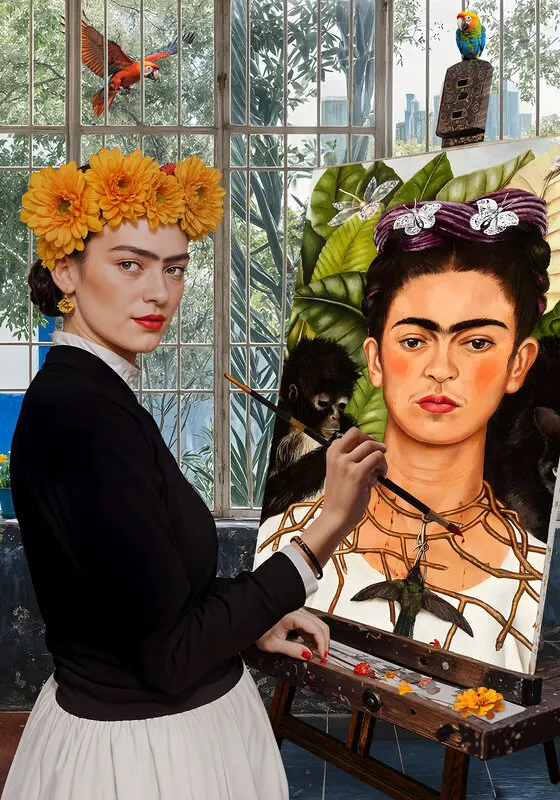
Frida Painting Frida and a Hummingbird, 2025
Digital
50 x 70 cm
3 200 kr
Frida Painting Frida and a Hummingbird.
The title, 'Frida Painting Frida and a Hummingbird ', is a window into the self-referential nature of Frida Kahlo's work. Her art is a world of raw emotion, symbolism, and rebellion, where every brushstroke tells a deeply personal story—of pain, identity, and defiance. In her self-portraits, she does not simply capture her likeness; she invites the viewer into her reality, marked by physical suffering, personal loss, and unwavering political convictions. Her paintings are a personal narrative that allows us to connect with her experiences on a profound level.
Among her most iconic works, ‘Self-Portrait with Thorn Necklace and Hummingbird’ stands out as a testament to Kahlo's resilience. It is a complex interplay of personal pain and broader struggle, transformation, and resilience themes. Every detail—her unwavering gaze, the thorn necklace, the lifeless hummingbird, the black cat, and the ever-watchful monkey—carries layers of meaning that extend beyond her grief to speak for many who suffer in silence. Frida's art is not just her story, but a reflection of the human experience, a testament to the resilience and strength that we all possess.
This exploration delves into the essence of Kahlo’s work, her motivations, and the evolution of her artistic language. Why did she revisit and repaint her image? How do her animals act as symbolic extensions of her emotions? What role do political and cultural commentaries play in her art? Through dialogue with Frida—imagined but rooted in her own words and philosophies—we step closer to understanding an artist who defied convention, challenged expectations, and turned her pain into something eternal.
This is not just about a painting. It is about the woman behind it, the symbols she chose, and the truth she insisted on telling. As she once said, 'I never paint dreams or nightmares. I paint my own reality.' Her courage to paint her reality, unapologetically and without fear, is a testament to her strength and resilience. It is an inspiration to all who face their own struggles and challenges.
Read on to explore Frida's painting.
‘‘A Thorned Gaze: Frida’s Lament
A mirror of thorns, a silent cry,
Her eyes unbroken, fixed on the sky.
A hummingbird, lifeless, black as the night,
Hangs in stillness, void of flight.
A monkey pulls, a trickster’s touch,
Tightens the pain she bears too much.
A cat crouches, dark and lean,
Watching, waiting, guarding unseen.
Blood from her finger, red on the thread,
A canvas where suffering is quietly spread.
Each thorn a memory, each stroke a scar,
She paints things that were and still are.
Beyond the portrait, beyond the frame,
A woman defies and refuses shame.
No dreamer’s world, no fantasy bright,
Only her truth, bathed in light.
The city looms, the garden sighs,
A clash of lands beneath her eyes.
Her Mexico, wild and free,
Against the march of industry.
She paints again, a step behind,
To let the world peer through her mind.
Not just for her but all who weep,
For those whose thorns cut just as deep.”
Malmö, January 2025
Frida Painting Frida and a Hummingbird
The scene is set in Frida Kahlo’s studio, which is filled with vibrant paintings and personal artefacts that inspired her work. She stands before a large canvas on an easel, her brush poised in midair. Her dark eyes are intense as she speaks, punctuating her words with gestures—pointing, shrugging, lifting her chin defiantly—empowering us with her boldness.
Frida Kahlo, a pivotal figure in 20th-century art, is renowned for her introspective and emotionally charged self-portraits. These works, a reflection of her inner world, offer viewers a unique window into her pain, struggles, and singular viewpoint. Among her most iconic pieces, Self-Portrait with Thorn Necklace and Hummingbird stands out as a powerful expression of her strength, vulnerability, and uncompromising artistic vision. The title of this piece, 'Self-Portrait with Thorn Necklace and Hummingbird', is significant as it symbolises the duality of her life. The thorn necklace represents the pain and suffering she endured, while the hummingbird implies life and resilience.
Kahlo herself once said, 'I paint self-portraits because I am so often alone because I am the person I know best.' Throughout her lifetime, she created 143 works of art, 55 of which were self-portraits. Her art was a way for her to cope with the physical and emotional pain she experienced due to a bus accident in her youth and the numerous health issues that plagued her. She unapologetically told her story through her paintings, exposing her experiences and suffering without hesitation. Her self-portraits are always infused with pain, whether it is the physical agony depicted in The Wounded Deer or the emotional turmoil of Self-Portrait with Thorn Necklace and Hummingbird.
One of Kahlo’s earliest self-portraits, Self-Portrait in a Velvet Dress, differs significantly from her later works. It reveals clear influences from European artistic traditions, particularly in the elongated proportions of her hands and neck and the stylised waves in the background. However, as she delved deeper into her Mexican heritage—especially after marrying Diego Rivera—her work became increasingly infused with Mexican symbolism. This shift can be seen in the vibrant colours, Indigenous motifs, and references to Mexican folk culture that began to appear in her paintings. At the same time, elements of surrealism started to emerge in her paintings, particularly in pieces like Henry Ford Hospital and The Broken Column.
Kahlo never shied away from any subject in her self-portraits. The heartbreak of her divorce from Rivera is laid bare in paintings like The Two Fridas and Self-Portrait with Thorn Necklace and Hummingbird, while works such as The Broken Column and Without Hope reflect her suffering as her body continued to deteriorate. Even her infertility became a recurring theme in her art, as seen in Roots, while Henry Ford Hospital directly addresses the miscarriage she endured there. As she famously declared, "I never paint dreams or nightmares. I paint my reality."
I want to pause and focus on one of my favourites—’ Self-Portrait with Thorn Necklace and Hummingbird.’ I visited her in her Malmö studio, a quaint space filled with her vibrant paintings and personal artefacts, where Frida painted herself, recreating the work as if time had frozen. This new painting maintained every brushstroke of the original self-portrait, unchanged because, as she put it, ‘"There is nothing to add. However, the world around it has shifted, offering new perspectives that did not exist when I painted it in 1940.”
Me: "The piece you are working on now, seen from an observer’s perspective, is fascinating and invites even more interpretations."
Frida: "Indeed! Scholars have offered a variety of political, cultural, and religious interpretations of ‘Self-Portrait with Thorn Necklace and Hummingbird’, calling it a visual statement of my resilience and strength. I appreciate that assessment."
Me: "The piece has obvious religious overtones, as it incorporates Jesus’s crown of thorns. You appear as a Christian martyr, enduring the pain of your failed marriage. Some have also suggested that the butterflies symbolise resurrection, which means you could portray yourself as Christ. Can you comment on that?"
Frida:’(smirks, tilting her head slightly) "Ah, so now I am Christ? Well, why not? They’ve called me many things before—surrealist, symbolist, revolutionary, even mad. But I have always said, ‘I do not paint dreams. I paint my reality.’ And my reality is pain. That thorn necklace is not just some biblical reference; it is my flesh, suffering, and truth.
People see what they want in my work. If they see martyrdom, perhaps it is because suffering is universal. If they see resurrection in the butterflies, maybe that is their hope, not mine. I do not deny that pain breaks and transforms us. But I am not looking toward salvation. I paint because I must because I am bound to my existence.
Do I look like Christ to you? ‘(raises an eyebrow, fingers brushing over the thorns in the painting)’ No. I look like Frida Kahlo. And that is enough."
Me: 'Of course not. First and foremost, he was a man, and you are a woman. He was a preacher, while you are a storyteller. His purpose was to be God's voice, while yours is to convey your suffering. What you do share, however, is a powerful political message that often aligns. If Jesus were alive today, he would likely, like you, be a communist—or at the very least, belong to the left wing.'
But to shift the subject, you often use vibrant flora and fauna as backgrounds for your self-portraits. It creates a claustrophobic space teeming with fertility, doesn’t it? Experts say that the emphasis on your monobrow and moustache—with the lines of your eyebrows mimicking the wingspan of the hummingbird around your neck—is intended as a feminist statement.
Frida: (laughs, arching an eyebrow) "Ah, the experts—always so eager to explain me, to wrap me up in neat little theories. ‘Claustrophobic space teeming with fertility’—such poetic words for my jungle! But tell me, have they ever felt the heat of Mexico, the thick air, the way the vines twist and tangle, constantly growing, always alive? My backgrounds are not just decoration; they are life itself. The life surrounding me holds me, sometimes traps me, but always reminds me that I exist.
And my face—’mi cara’, my monobrow, my moustache. Always a topic of discussion, no? ‘(grins)’ Some say it is a feminist statement. Maybe it is. Perhaps it isn’t. What I do know is that I never painted myself to please anyone. I painted myself as I was, as I am. Women are told to soften their edges, to make themselves small and delicate. I refuse. My face is strong, my brows thick, my gaze unflinching. And if that makes some people uncomfortable, ‘qué bien.’
So, let them say what they will. Feminist, surrealist, martyr—labels are for those who need them. I am simply Frida. And that is more than enough."
Me: "Yes, I can see that it's a lot to carry for eternity because what’s been said has been said, what’s been written has been written, and what’s been painted is painted—nothing can be changed." Of course, I was also thinking about all the whimsical images and overly wise words I’ve scattered throughout my life. Well, isn’t that something?
"You said it yourself," Frida replied, having seen at least some of my paintings—perhaps even reading some of the texts on my website.
Beyond its striking imagery, ‘Self-Portrait with Thorn Necklace and Hummingbird’ tells a deeply personal story. It lays bare the physical and emotional pain that shaped Frida Kahlo’s life—pain that was not merely an abstract concept but a daily reality. From the moment of her devastating bus accident, which left her body permanently damaged, Frida was forced into a life of surgeries, isolation, and relentless suffering. Yet, rather than allowing pain to define her, she transformed it into art, using the canvas as both a battleground and a refuge.
For Frida, self-portraiture was more than self-expression; it was a way to reclaim her story on her terms. In a world that often tried to reduce women to muses or symbols, she painted herself as the protagonist, confronting her reality with unwavering honesty. Her work defied convention, challenged societal expectations, and rejected the roles imposed upon her. ‘Self-Portrait with Thorn Necklace and Hummingbird’ embodies this defiance—a testament to her refusal to be silenced, her determination to exist fully and unapologetically, no matter the cost.
Me: "Why repaint a piece already painted the same way? From what I can see, it’s a perfect copy."
Frida: (shaking her head, smirking slightly) "Not at all the same way. You’re wrong about that. They are not the same painting. I wanted to take two steps back, paint myself as I was then, let everyone else peek over my shoulder, and see what I saw and felt.”
The scene shifted, and Frida’s expression changed. She gazed over the studio as if it were filled with an expectant audience. For a moment, it was as if she stood on the stage of Nöjesteatern, performing ‘Hamlet’—at least, that’s how it felt. The skull was there, resting on a shelf, grinning—a brightly painted Mexican version, waiting for the next ‘Día de los Muertos.’
Frida: (Glancing at the invisible audience, lifting a paintbrush) “Oh, don’t look so surprised. I know exactly what you’re thinking. Another self-portrait? Another painting of Frida Kahlo, by Frida Kahlo? (Smirks) Well, of course! Who else knows me better than I do? Who else has been with me through every ache, every betrayal, every flicker of joy? (Laughs, a sharp, knowing sound) I paint myself because I am always here. Because I refuse to be invisible.
(Frida turns back to the canvas, running her fingers across the surface as if feeling the image forming beneath her touch.)
This one— I call it ‘Self-Portrait with Thorn Necklace and Hummingbird’—is different, though. Look at it. Look at me. My face—calm, steady, unyielding. But do you see the thorns?” (She reaches toward her neck, pressing her fingers lightly against her skin as if feeling the prick of imaginary needles) “They pierce my throat, draw blood, but I do not cry. I do not flinch.
I painted it after Diego left.” (Scoffs) “Diego, mi amor, mi dolor. That man, that mountain, my hurricane. We devoured each other, tore each other apart. But that was a different pain when he betrayed me (pauses, eyes flashing). My little sister, Cristina? The one I held as a child? He took even her. And so, I took up my brush. I did what I always do. I painted my truth.
(Frida steps back from the canvas, tilting her head, studying her work.) “Look at the hummingbird resting at the hollow of my throat. In Mexico, we say the hummingbird brings love and luck. But this one? It is black. Lifeless. A whisper of something that was. Or—perhaps it is Huitzilopochtli, our god of war, standing guard over my heart.” (Chuckles) “Yes, maybe I am at war. With myself, with Diego, with the world.”
(Frida gestures to the animals surrounding her in the painting.) “The monkey—oh, yes, the monkey is Diego. He once gave me one as a gift, but do you see what this one does? It tugs at my thorn necklace, tightening it, deepening the pain, and always pulling and watching. And the black cat? That is death, lingering close, waiting. Do you see how it arches its back? It is ready to strike.”
(Frida wipes her hands on her skirt, leaving paint smears across the fabric. She moves closer to me and the audience, lowering her voice.) “People call my work surreal.” (Rolls her eyes) “Ha! As if I paint dreams. I paint reality. My reality. The reality of a woman bound to her own broken body, to a man who both worships and wounds her, to a country that is both her prison and her freedom. They think this portrait is about pain, but look closer. There is life here, too. The green, tangled jungle—my Mexico, my roots. The butterflies—rebirth, transformation. Even in suffering, I am still growing and still creating.”
(Frida places her brush down, crosses her arms, and looks out over the room as it is crowded.) “I never let anyone else tell my story. No priest, no doctor, no lover. Only me. My hands, my brush, my blood. If you want to know Frida Kahlo, do not read books. Do not listen to scholars who whisper about symbolism and meaning.” (Lifts her chin defiantly) “Look at my paintings. Look into my eyes. And then, maybe, you will begin to understand.” Frida laughs, tapping the brush resting on the easel’s small shelf as if she might continue, but I interrupt her.
Me: "You were talking about new symbols."
Frida: "Not new to me—I’ve used them many times, in many ways. Look closely. Blood drips from my brush, emphasising I was still in pain when I painted this. This was no fleeting suffering. The painting is retrospective today because no one carries physical pain into eternity—only their soul, which can be painful enough. (She laughed.)
“But this painting remains relevant beyond my life because so many other women have suffered as I did. You see, blood also drips from my finger. I pricked it, using my blood as paint where the thorns pierce my skin. The thorns—these are my pain, my corset, but above all, they are the agony of not being able to be a woman in the fullest sense, of not being able to have children, and the suffering over all the injustices in this world. So many endure pain that should never have been. (She shook her head)
“That is why the blood drips. And why the hummingbird is black." (Frida shifts her posture, adjusting herself as if the memory of pain still lingers, twisting slightly.
“When I portrayed my suffering, it was never just about self-pity or personal lament—it had a purpose. I wanted to transform pain into art, not only to process my own experiences but also to create something universally relatable. My self-portraits act as mirrors, reflecting not just my anguish but the struggles of others who face pain, loss, and isolation.
I often said, "I never paint dreams or nightmares. I paint my reality." And yet, that reality was never solely mine—it is a shared experience, an offering to those who see their suffering in my work. In a way, my paintings are pedagogical, teaching people that pain can be endured, that suffering can be turned into strength, and that even the most broken body can produce something powerful, something lasting. I know that.
Whether through her depiction of physical agony, emotional heartbreak, or political resistance, Frida uses art to communicate, educate, and, ultimately, help others not feel so alone.
Me: "But you have included the parrots in your new painting."
Frida: ”As you know, parrots play a significant role in my symbolic world. They are more than just colourful companions; they carry deep personal and cultural meaning in my art.
Parrots often appear in my self-portraits, most notably in ‘Me and My Parrots’ from 1941 and ‘Self-Portrait with Monkeys’, which I painted the year after. While monkeys in my paintings are often associated with Diego or temptation, the parrots represent something different—perhaps wisdom, knowledge, or even resilience. In Mexican culture, parrots are seen as symbols of vitality and free expression, creatures that speak yet remain untamed—like me, I would say.
For me, who spent much of my life confined by illness and physical pain, these birds embody a longing for freedom. Their vivid plumage contrasts with my suffering, and their ability to mimic human speech symbolises my voice—my art—echoing beyond my body and pain. At the same time, their presence in the paintings, often sitting close or perched on my shoulders, suggests they are also protectors and witnesses to my solitude.
Like many animals in my work, the parrots added another layer to my visual storytelling. Whether they symbolise companionship, defiance, or survival, they are part of my deeply personal, symbolic universe—and never included by accident.
Me: "The black cat and the monkey?"
Frida: "The black cat is often seen as a symbol of death and misfortune in Western folklore, but in my world of imagery, it holds a more personal meaning. The cat sits behind my shoulder, its posture tense, its gaze fixed, watchful. I meant it to carry an ominous presence, a constant shadow in my life."
Me: "It makes sense. Since you often portray yourself as a martyr in your self-portraits, the cat could be seen as a companion to your suffering and losses—almost like death, always watching over you."
Frida: "You understand correctly. As for the sweet-looking monkey, don’t be fooled by its innocent expression. I had several pet monkeys and felt great affection for them. As you know, Diego gave me a monkey as a companion, and in many of my paintings, monkeys cling to me—almost like the children I never had. But unlike traditional symbols of loyalty or pure affection, my monkeys are ambivalent figures. They can be protective but also suffocating and destructive. I have come to understand that children, too, can be both."
Me: "In this self-portrait, the monkey pulls at the crown of thorns around your neck, tightening it, increasing your pain. That has led to speculation that the monkey represents Diego—a central yet tormenting part of your life."
Frida: "That’s true. At the same time, in Mexican culture, monkeys are also linked to passion and desire, hinting at my complex relationship with love, pain, and self-destruction."
The presence of the cat and the monkey in this painting reinforces the feeling that Frida is not merely painting herself but her entire emotional and psychological state. They become extensions of her inner reality—symbols of the forces that have shaped her, for better or worse. As always in her art, nothing is one-dimensional; the animals surrounding her serve as guardians and reflections of her suffering and struggle.
Today, "Self Portrait with Thorn Necklace and Hummingbird" continues to captivate worldwide viewers. Its raw emotion, vivid symbolism, and masterful technique exemplify Frida Kahlo's artistic genius. The painting invites us to reflect on our struggles and triumphs, urging us to find strength and beauty in adversity. It serves as a timeless reminder of the power of art to transcend personal pain and resonate with universal human experiences.
Conclusion
In conclusion, "Self Portrait with Thorn Necklace and Hummingbird" is a profound testament to Frida Kahlo's indomitable spirit and artistic brilliance. Through this painting, she bared her soul and created a lasting legacy that inspires and resonates with audiences today.
Kahlo was heavily influenced by the Mexicanidad movement, which began after the Mexican Revolution. The movement was a resistance to the “mindset of cultural inferiority” that had resulted from colonialism and aimed to promote the history and culture of the indigenous Mexican people. The Mexican elite believed that Mexico should emulate Europe and European culture, so the traditional Mexican culture was looked down upon. After joining an activist group called the Cachuchas, Kahlo began dressing in the Tehuana style, and colourful Mexican dresses and shawls appeared in many of her pieces, such as My Dress Hangs There.
Critics have argued that Kahlo’s self-portraits portray her personal life and the political and social reform happening in her beloved Mexico. In her essay Culture, Politics and Identity in the Paintings of Frida Kahlo, art historian Jane Helland writes, “Kahlo’s pain should not eclipse her commitment to Mexico and the Mexican people. As she sought her roots, she also voiced concern for her country as it struggled for an independent cultural identity.”
You have surely noticed, above the easel, the skyscrapers peeking out behind the parrot and the garden at ‘Casa Azul’. They are symbolic—after all, the city has not yet reached this far. Much like in the aforementioned ‘My Dress Hangs There’, the skyline is meant to critique the United States. In that painting, the U.S. is depicted as a soulless landscape of skyscrapers and machinery, while Mexico is shown as a natural, lush, and fertile land. A similar contrast is explored in ‘Self-Portrait on the Border’, where the stark division between Mexico and the United States again takes centre stage.
Kahlo’s love and fierce pride in her heritage secured her place as an icon in Mexican culture. Her former home, La Casa Azul, which she shared with Rivera, is now a museum dedicated to her life and work.
3 200 kr

Jörgen Thornberg
Malmö
Lite om bilder och mig. Translation in English at the end.
Jag är en nyfiken person som ser allt i bilder, även det jag fäster i ord, gärna tillsammans för bakom alla mina bilder finns en berättelse. Till vissa bilder hör en kortare eller längre novell som följer med bilden.
Bilder berättar historier. Jag omges av naturlig skönhet, intressanta människor och historia var jag än går. Jag använder min kamera för att dokumentera världen och blanda det jag ser med vad jag känner för att fånga den dolda magin.
Mina bilder berättar mina historier. Genom mina bilder, tryck och berättelser. Jag bjuder in dig att ta del av dessa berättelser, in i ditt liv och hem och dela min mycket personliga syn på vår värld. Mer än vad ögat ser. Jag tänker i bilder, drömmer och skriver och pratar om dem; följaktligen måste jag också skapa bilder. De blir vad jag ser, inte nödvändigtvis begränsade till verkligheten. Det finns en bild runt varje hörn. Jag hoppas att du kommer att se vad jag såg och gilla det.
Jag är också en skrivande person och till många bilder hör en kortare eller längre essay. Den följer med tavlan, tryckt på fint papper och med en personlig hälsning från mig.
Flertalet bilder startar sin resa i min kamera. Enkelt förklarat beskriver jag bilden jag ser i mitt inre, upplevd eller fantiserad. Bilden uppstår inom mig redan innan jag fått okularet till ögat. På bråkdelen av ett ögonblick ser jag vad jag vill ha och vad som kan göras med bilden. Här skall jag stoppa in en giraff, stålmannen, Titanic eller vad det är min fantasi finner ut. Ännu märkligare är att jag kommer ihåg minnesbilden långt efteråt när det blir tid att skapa verket. Om jag lyckas eller inte, är upp till betraktaren, oftast präglat av en stråk av svart humor – meningen är att man skall bli underhållen. Mina bilder blir ofta en snackis där de hänger.
Jag föredrar bilder som förmedlar ett budskap i flera lager. Vid första anblicken fylld av feel-good, en vacker utsikt, fint väder, solen skiner, blommor på ängen eller vattnet som ligger förrädiskt spegelblankt. I en sådan bild kan jag gömma min egentliga berättelse, mitt förakt för förtryckare och våldsverkare, rasister och fördomsfulla människor - ett gärna återkommande motiv mer eller mindre dolt i det vackra motivet. Jag försöker förena dem i ett gemensamt narrativ.
Bild och formgivning har löpt som en röd tråd genom livet. Fotokonst känns som en värdig final som jag gärna delar med mig.
Min genre är vid som framgår av mina bilder, temat en blandning av pop- och gatukonst i kollage som kan bestå av hundratals lager. Vissa bilder kan ta veckor, andra någon dag innan det är dags att överlämna resultatet till printverkstaden. Fine Art Prints är digitala fotocollage. I dessa kollage sker rivandet, klippandet, pusslandet, målandet, ritandet och sprayningen digitalt. Det jag monterar in kan vara hundratals år gamla bilder som jag omsorgsfullt frilägger så att de ser ut att vara en del av tavlan men också bilder skapade av mig själv efter min egen fantasi. Därefter besöks printstudion och för vissa bilder numrera en limiterad upplaga (oftast 7 exemplar) och signera för hand. Vissa bilder kan köpas i olika format. Det är bara att fråga efter vilka. Gillar man en bild som är 70x100 men inte har plats på väggen, går den kanske att få i 50x70 cm istället. Frågan är fri.
Metoden Giclée eller Fine Art Print som det också kallas är det moderna sättet för framställning av grafisk konst. Villkoret för denna typ av utskrifter är att en högkvalitativ storformatskrivare används med åldersbeständigt färgpigment och konstnärspapper eller i förekommande fall på duk. Pappret som används möter de krav på livslängd som ställs av museer och gallerier. Normalt säljer jag mina bilder oinramade så att den nya ägaren själv kan bestämma hur de skall se ut, med eller utan passepartout färg på ram, med eller utan glas etc..
Under många år ställde jag bara ut på nätet, i valda grupper och på min egen Facebooksida - https://www.facebook.com/jorgen.thornberg.9
Jag finns också på en egen hemsida som tyvärr inte alltid är uppdaterad – https://www.jth.life/ Där kan du också läsa en del av de berättelser som följer med bilden.
UTSTÄLLNINGAR
Luftkastellet, oktober 2022
Konst i Lund, november 2022
Luftkastellet, mars 2023
Engleson Galleri Caroli, april 2023
Hydra, Greece June 2023
Engleson Galleri Caroli, oktober 2023
Toppen, Höllviken december 2023
Luftkastellet, mars 2024
Torups Galleri, mars 2024
Venice, May 2024
Luftkastellet, oktober 2024
Konst i Advent, December 2024
Galleri Engleson, Caroli December 2024
Jäger & Jansson Galleri, april 2025
A bit about pictures and me.
I'm a curious person who sees everything in pictures, even what I express in words, often combining them, for behind all my pictures lies a story. These narratives, some as short as a single image and others as long as a novel, are the heart and soul of my work.
Pictures tell stories. Wherever I go, I'm surrounded by natural beauty, exciting people, and history. I use my camera to document the world and blend what I see with what I feel to capture the hidden magic.
My images tell my stories. Through my pictures, prints, and narratives, I invite you to partake in these stories in your life and home and share my deeply personal perspective of our world. More than meets the eye. I think in pictures, dream, write, and talk about them; consequently, I must create images too. They become what I see, not necessarily confined to reality. There's a picture around every corner. I hope you'll see what I saw and enjoy it.
I'm also a writer, and many images come with a shorter or longer essay. It accompanies the painting, printed on fine paper with my personal greeting.
Many pictures start their journey on my camera. Simply put, I describe the image I see in my mind, experienced or imagined. The image arises within me even before I bring the eyepiece to my eye. In a fraction of a moment, I see what I want and what can be done with the picture. Here, I'll insert a giraffe, Superman, the Titanic, or whatever my imagination conjures up. Even stranger is that I remember the mental image long after it's time to create the work. Whether I succeed is up to the observer, often imbued with a streak of black humour – the aim is to entertain. My pictures usually become a talking point wherever they hang.
I prefer pictures that convey a message in multiple layers. At first glance, they're filled with feel-good vibes, a beautiful view, lovely weather, the sun shining, flowers in the meadow, or the water lying deceptively calm. But beneath this surface beauty, I often conceal a deeper story, a narrative that challenges societal norms or explores the human condition. I invite you to delve into these hidden narratives and discover the layers of meaning within my work.
Picture and design have been a thread running through my life. Photographic art feels like a fitting finale, and I'm happy to share it.
My genre is varied, as seen in my pictures; the theme is a blend of pop and street art in collages that can consist of hundreds of layers. Some images can take weeks, others just a day before it's time to hand over the result to the print workshop. Fine Art Prints are digital photo collages. In these collages, tearing, cutting, puzzling, painting, drawing, and spraying happen digitally. What I insert can be images hundreds of years old that I carefully extract so they appear to be part of the painting, but also images created by myself, now also generated from my imagination. Next, visit the print studio and, for certain images, number a limited edition (usually 7 copies) and sign them by hand. Some images may be available in other formats. Just ask which ones. If you like an image that's 70x100 but doesn't have space on the wall, you might be able to get it in 50x70 cm instead. The question is open.
The Giclée method, or Fine Art Print as it's also called, is the modern way of producing graphic art. This method ensures the highest quality and longevity of the artwork, using a high-quality large-format printer with archival pigment inks and artist paper or, in some cases, canvas. The paper used meets the longevity requirements set by museums and galleries. I sell my pictures unframed, allowing the new owner to personalise their artwork, confident in the lasting value and quality of the piece.
For many years, I only exhibited online, in selected groups, and on my Facebook page - https://www.facebook.com/jorgen.thornberg.9. I also have my website, which unfortunately is not constantly updated - https://www.jth.life/. You can also read some of the stories accompanying the pictures there.
EXHIBITIONS
Luftkastellet, October 2022
Art in Lund, November 2022
Luftkastellet, March 2023
Engleson Gallery Caroli, April 2023
Hydra, Greece June 2023
Engleson Gallery Caroli, October 2023
Toppen, Höllviken December 2023
Luftkastellet, March 2024
Torup Gallery, March 2024
Venice, May 2024
UTSTÄLLNINGAR
Luftkastellet, oktober 2022
Konst i Lund, november 2022
Luftkastellet, mars 2023
Engleson Galleri Caroli, april 2023
Hydra, Greece June 2023
Engleson Galleri Caroli, oktober 2023
Toppen, Höllviken december 2023
Luftkastellet, mars 2024
Torups Galleri, mars 2024
Venice, May 2024
Luftkastellet, October 2024
Konst i Advent, December 2024
Galleri Engleson, Caroli December 2024
Jäger & Jansson Galleri, April 2025
Utbildning
Autodidakt
Medlem i konstnärsförening
Öppna Sinnen
Med i konstrunda
Konstrundan i Skåne
Utställningar
Luftkastellet, October 2022
Art in Lund, November 2022
Luftkastellet, March 2023
Engleson Gallery Caroli, April 2023
Hydra, Greece June 2023
Engleson Gallery Caroli, October 2023
Toppen, Höllviken December 2023
Luftkastellet, March 2024
Torup Gallery, March 2024
Venice, May 2024