Vi använder cookies för att ge dig bästa möjliga upplevelse. Välj vilka cookies du tillåter.
Läs mer i vår integritetspolicy
Jörgen Thornberg
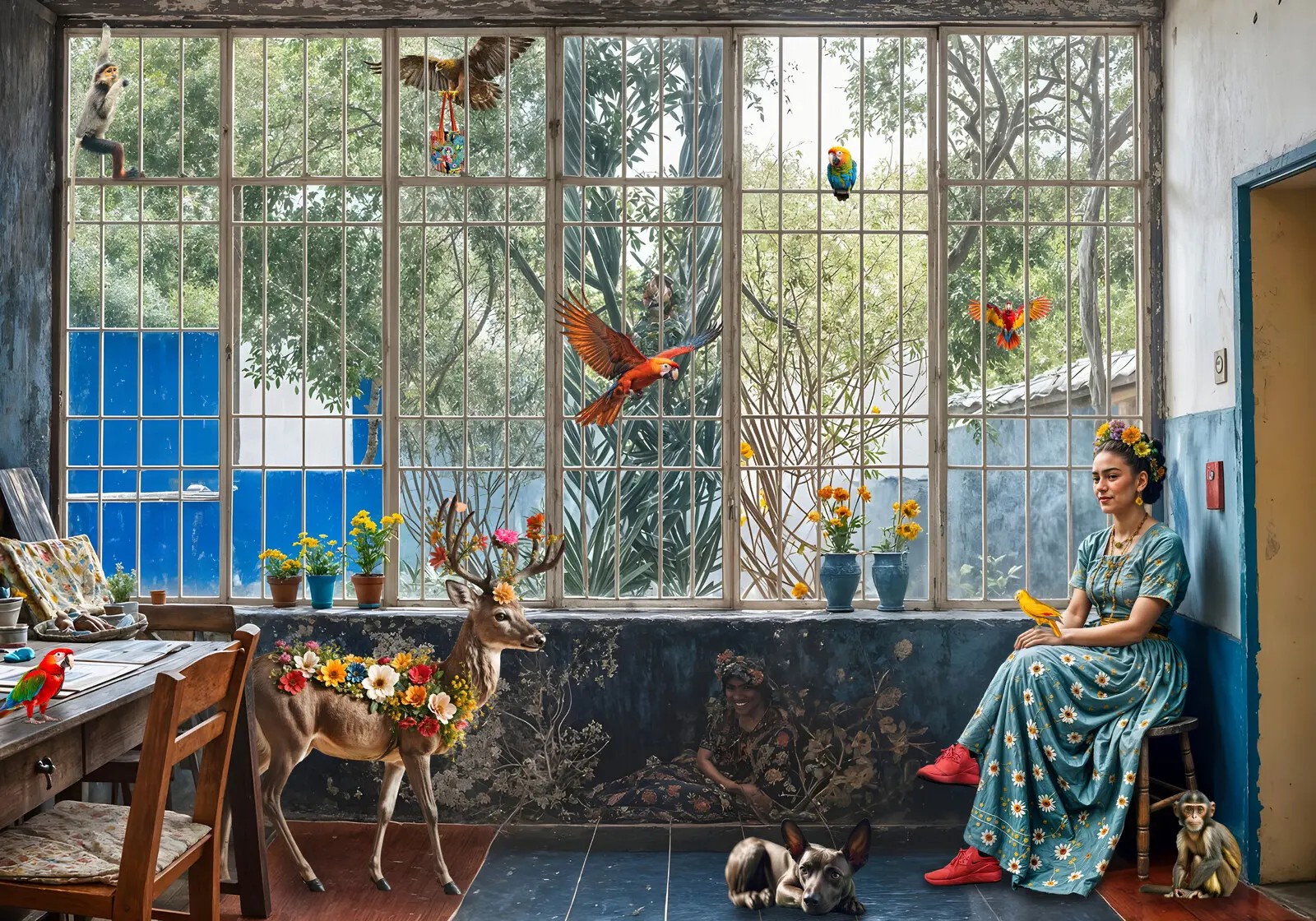
Frida´s zoological atelier, 2025
Digital
100 x 70 cm
5 200 kr
Frida´s zoological atelier
A Mischievous monkey inspired Salvador Dali.
Even in the vibrant chaos of Casa Azul, some mischief went too far—at least in Diego’s eyes. He could tolerate the monkeys swinging from the rafters, the parrots stealing fruit from his plate, and even the deer nosing through Frida’s brushes. But when mischievous Fulang Chang turned his beloved car into a swirling masterpiece of colour, Diego’s patience reached its limit. Yet, as fate would have it, what began as a monkey’s prank would later inspire none other than Salvador Dalí—proving that true artistic genius often comes from the most unexpected hands.
Read on to explore Frida's and her pets’ adventures.
‘‘A Day in Frida’s Studio
Sunlight spills through Casa Azul’s panes,
a golden glow where colour reigns.
Canvas is waiting, and brushes set,
in Frida’s world of chaos and pets.
A green parrot perches on her sleeve
Mimicking words, she hardly breathes.
"Bonito, hush," she gently pleads,
but he preens and scolds with feathered ease.
A monkey swings from the beams above.
His nimble hands pick a painter’s glove.
Dipping fingers, bold and free,
Smearing strokes of anarchy.
Granizo, curious and shy,
His velvet nose tilts toward the sky.
Too close—his muzzle meets the red,
A paint streak upon his head.
The Xolos lie in pools of light,
Silent sages, black as night.
They guard her, watch her paint,
As if their mate would faint.
A world of paws, claws and wings,
Of braying laughs and tail-tipped things.
A moving studio, breathing art,
Each beast a muse, each beast a part.
Through noise and touch, through fur and flight,
Frida paints with fearless might.
For who could dream, or love, or see,
without a studio with a wild menagerie?
Diego sighed but knew too well
In Frida’s world, he’d bend, not quell.
The monkey ruled the house, and he obeyed,
Though paint-streaked cars left tempers frayed.
But fate’s a trickster, and time’s a jest,
What’s mocked today may stand the test.
For Fulang’s strokes, so wild, so free,
Became Salvador Dalí’s legacy.”
Malmö, January 2025
Frida´s zoological atelier
The scent of freshly brewed coffee and warm pastries filled the air in the cosy restaurant inside Nöjesteatern. It was the intermission of an upcoming play's rehearsal, and Frida Kahlo sat by the window, gazing at the rainy Malmo streets beyond. She stirred her coffee absentmindedly, dressed impeccably as always in a deep red embroidered shawl draped over her shoulders, a traditional blouse with intricate floral patterns, and a full, flowing skirt. Her hair was adorned with fresh marigolds, their bright yellow contrasting against her dark braids.
"Diego never understood my love for animals," she mused, breaking the silence as she traced a finger along the rim of her cup. "He appreciated their symbolism, of course—he saw my paintings, he knew what they meant to me. But truly living with them? That was another matter entirely."
I leaned in, intrigued. "He didn't like them?"
Frida gave a knowing smirk. "Not in the way I did. He tolerated them. He even gifted me my first monkey, Fulang Chang, perhaps thinking it would amuse me, but he never had the patience to coexist with them truly. My home, Casa Azul, was a living, breathing entity filled with creatures—monkeys, parrots, dogs, and even deer. To Diego, it was chaotic. He called it 'Zoo Azul,' but for me, it was a sanctuary."
She sipped her coffee before continuing, "After our second marriage, we lived separately most of the time. He had his house, and I had mine. It was better that way. He was too restless, and I needed my own space. My animals understood me more than he ever did."
I chuckled. "A zoo, indeed. But did he ever try to befriend any of them?"
Frida laughed, shaking her head. "Befriend? No. He was too large, too loud. My spider monkeys would scatter when he approached, and my deer, Granizo, would freeze in place, uncertain whether he was friend or foe. Only my Xoloitzcuintli dogs tolerated him, but even they preferred to stay by my side."
Her eyes softened as she recalled memories. "Señor Xolotl, my great, noble Xolo, would always stretch out on the cool ceramic tiles of my studio while I painted. He had the wisdom of an ancient soul. And Bonito, my parrot, always caused trouble—mimicking voices, stealing fruit from my plate. Diego was indifferent to them. He had his obsessions—his murals, his politics, his women. But me? I needed my creatures."
The room hummed with quiet conversation, the soft clatter of cups and saucers filling the space. Frida’s fingers danced lightly over the tablecloth as she continued. "Do you know what he said once?" Her voice took on a dramatic tone. "He told me: 'Frida, if you loved me half as much as you love that damned monkey, maybe we wouldn’t fight so much.'"
I burst into laughter. "And what did you say?"
Frida grinned. "I told him, 'If you were as loyal as my monkey, Diego, perhaps we wouldn’t fight at all.'"
She leaned back in her chair, eyes twinkling with mischief. "He never brought it up again."
I swirled my coffee, watching her. "You always seemed to find companionship in everything around you—art, people, animals. Did you ever feel truly alone?"
She exhaled, looking out at the rain. "Of course. Even surrounded by friends, there were moments of unbearable solitude. The pain, the surgeries, the betrayals... nothing could fully erase that. But my animals gave me comfort when nothing else could. When Diego betrayed me with Cristina—" she paused, her fingers tightening around the cup, "—I cut my hair, I distanced myself, I tried to kill my love for him. And through it all, my animals were the only ones who never disappointed me."
She took a deep breath, shaking off the memory. "And yet, I always forgave him. Just like I always returned to my paints, my colours. Even after everything, we were bound together, like an elephant and his little dove."
The phrase hung between us, and I understood. Diego had been the elephant, large and dominant, stomping through life, while Frida, fragile in body but fierce in spirit, was the dove—small, yet unbreakable.
"Do you think Diego envied that bond you had with your animals?" I asked.
Frida considered this, a slow smile spreading across her lips. "Maybe. He had his murals, his politics, his lovers. But my animals, my paintings—they were mine alone. He could not touch them, could not claim them. Perhaps that was my quiet revenge."
The intermission bell rang softly, signalling the end of our coffee break. Frida drained the last of her latte and stretched her arms above her head. "Enough about Diego. Let’s talk about something more joyful. Have you ever seen a monkey get drunk on a Frida Colada?"
I nearly choked on my coffee. "You’re joking."
Frida shook her head, her laughter rich and full of life. "Oh no. Fulang Chang once stole my drink at a garden party. He danced like a madman before passing out in my lap. We had to carry him to bed like an honoured guest."
Fulang Chang, Frida Kahlo’s mischievous spider monkey, was always up to trouble. He had a knack for creating chaos by stealing drinks, mimicking guests, or even engaging in accidental artistry. One infamous tale involved his unexpected foray into fine art forgery.
During one of Frida’s long painting sessions at Casa Azul, Fulang Chang, always curious, managed to dip his nimble fingers into an open paint palette. Before anyone could stop him, he smeared bold strokes onto an abandoned canvas, layering vibrant reds, blues, and yellows in a chaotic but strangely compelling composition. The mess was quickly forgotten, but as fate would have it, the piece was later mistaken for an experimental work by a young, rebellious artist. A crafty art dealer eventually “discovered” the abstract splashes and sold it under a forged signature, fetching a small fortune. Fulang Chang’s masterpiece remains an unsung triumph of accidental modernism somewhere on a collector's wall.
But that wasn’t the only time he turned to artistic vandalism.
“Please tell me,” I said, having fallen in love with that mischievous monkey.
I swirled the last remnants of coffee in my cup, watching Frida as she absentmindedly traced a pattern on the tablecloth with her fingertips. She had that glint in her eyes—signalling a particularly outrageous story was about to unfold.
“You know,” she said, leaning in conspiratorially, “Diego always saw himself as a man of grandeur, a figure of importance. Everything about him had to be larger than life—including his car.”
I chuckled. “Let me guess. A massive, serious-looking automobile? Something that made a statement?”
Frida nodded, smirking. “Oh, absolutely. A grand, black beast of a machine. It was his prized possession, always polished, always looming outside Casa Azul like a damn monument to his ego.”
I took a sip of my coffee. “And let me guess… Fulang Chang had other ideas?”
Frida threw back her head and laughed. “That little devil never could resist a blank canvas. While Diego was inside one afternoon, lost in endless political discussion, Fulang Chang got into my paints. Red, blue, yellow—oh, he went for the boldest ones, of course. Then, with all the confidence of a true artist, he got to work.”
I gasped. “On the car?”
“Oh, yes,” she grinned. “Handprints, streaks, splashes—he transformed Diego’s magnificent automobile into a riot of colour. The hood, the doors, and even the tyres had traces of his artistic genius. By the time he was finished, it looked like a surrealist fever dream.”
I clapped a hand over my mouth, trying not to laugh too loudly. “Oh no. Diego must have been furious.”
Frida sighed dramatically. “Furious doesn’t even begin to describe it. He stormed out, took one look at his beloved car, and bellowed like a wounded bull. I swear, the windows rattled. He cursed, threatened exile for Fulang Chang, and swore the monkey would never set foot in Casa Azul again.”
“And what did you do?” I asked, already knowing she must have had the perfect response.
Frida leaned back, a satisfied smirk on her lips. “I placed a hand on his arm, looked him straight in the eye, and said, ‘Mi amor, you always say art belongs to the people. Now the people will see your car for the masterpiece it has become.’”
I nearly choked on my coffee. “You didn’t.”
“Oh, I did,” she confirmed, her laughter rich and full of mischief. “He huffed and puffed, but what could he do? Fulang Chang was my beloved, and besides, deep down, I think even Diego had to admire its audacity.”
I shook my head in amazement. “So what happened to the car?”
“He had it scrubbed, of course,” she said, waving a hand dismissively. “But not before he took a photograph.”
I arched an eyebrow. “A photograph?”
Frida’s eyes sparkled. “Yes. And years later, he showed it to Salvador Dalí.”
“No.”
“Oh, yes,” she said, drawing out the words with relish. “And Dalí loved it. He called it genius. And wouldn’t you know, not long after, he started making car installations—dressing Cadillacs in fabric, posing mannequins inside vehicles, even his famous ‘Rainy Taxi.’”
I let out a breath of disbelief. “So you’re telling me… Dalí stole the idea from Fulang Chang?”
Frida shrugged, her expression full of playful mischief. “Who knows? Inspiration is a tricky thing. But those of us who were there that day, watching that cheeky little monkey reinvent Diego’s car… well, we know who the real pioneer of surrealist car art was.”
I stared at her, then down at my empty cup. “I need another coffee. And maybe a drink. And I want to hear more about Dali.”
Frida laughed and lifted her cup in mock solemnity. “To Fulang Chang—artist, trickster, and ahead of his time.” She rose from her seat, adjusting her shawl. "But that’s a story for another time. I have a rehearsal to get back to."
I smiled as she turned to leave, her presence as vivid as the paintings she left behind. "Frida, thank you for sharing all of this."
She paused, looking back with a wink. "Thank you for listening, mi amiga. It’s always good to remind people that even legends had their pets, laughter, and little acts of rebellion."
And with that, she disappeared into the theatre, leaving behind the lingering scent of marigolds and mischief.
Zoo Azul, also known as the Blue House (La Casa Azul), is an art museum dedicated to Frida Kahlo's life and work. It is in the Colonia del Carmen neighbourhood of Coyoacán in Mexico City. The building was Kahlo’s birthplace, where she grew up and lived with her husband, Diego Rivera, for several years. She later died in a room on the upper floor. In 1957, Rivera donated the home and its contents to turn it into a museum in Kahlo’s honour.
All the animals are gone except for those captured in paintings and photographs. The once lively house, filled with fluttering wings, snuffling, rooting, barking dogs, and chattering monkeys—a cacophony of life and commotion—lay silent and empty until the doors opened to the day's throngs of tourists, bringing a different kind of soundscape: shuffling footsteps, murmurs, and aimless chatter.
The museum contains a collection of artwork by Frida and her husband Diego and other artists, along with the couple’s Mexican folk art, pre-Hispanic artefacts, photographs, memorabilia, and personal items. The collection is displayed in the house's rooms, which remain much as they were in the 1950s when Frida departed for her star. Initially, the house was Frida Kahlo's family home.
Casa Azul is located in the Colonia del Carmen area of the Coyoacán borough of Mexico City. This area has had an intellectual and vanguard reputation since the 1920s. The house stands out for its cobalt-blue walls, which give it the name La Casa Azul (The Blue House).
Jörgen Thornberg
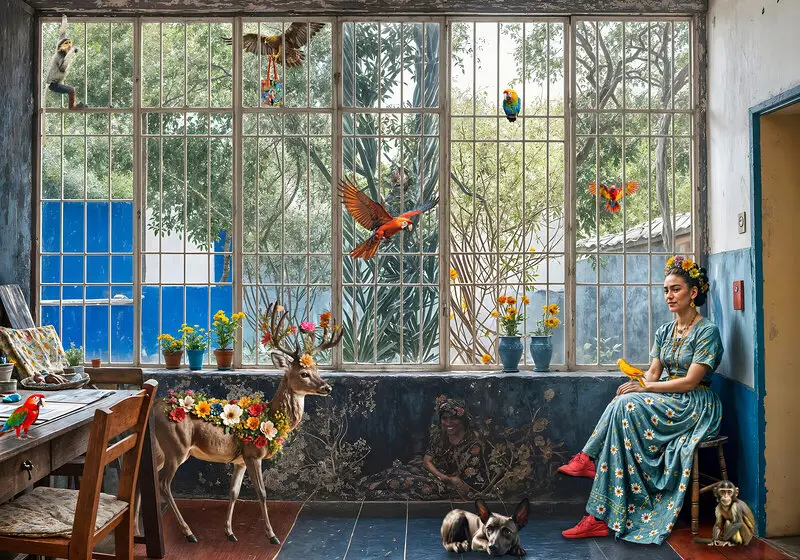
Frida´s zoological atelier, 2025
Digital
100 x 70 cm
5 200 kr
Frida´s zoological atelier
A Mischievous monkey inspired Salvador Dali.
Even in the vibrant chaos of Casa Azul, some mischief went too far—at least in Diego’s eyes. He could tolerate the monkeys swinging from the rafters, the parrots stealing fruit from his plate, and even the deer nosing through Frida’s brushes. But when mischievous Fulang Chang turned his beloved car into a swirling masterpiece of colour, Diego’s patience reached its limit. Yet, as fate would have it, what began as a monkey’s prank would later inspire none other than Salvador Dalí—proving that true artistic genius often comes from the most unexpected hands.
Read on to explore Frida's and her pets’ adventures.
‘‘A Day in Frida’s Studio
Sunlight spills through Casa Azul’s panes,
a golden glow where colour reigns.
Canvas is waiting, and brushes set,
in Frida’s world of chaos and pets.
A green parrot perches on her sleeve
Mimicking words, she hardly breathes.
"Bonito, hush," she gently pleads,
but he preens and scolds with feathered ease.
A monkey swings from the beams above.
His nimble hands pick a painter’s glove.
Dipping fingers, bold and free,
Smearing strokes of anarchy.
Granizo, curious and shy,
His velvet nose tilts toward the sky.
Too close—his muzzle meets the red,
A paint streak upon his head.
The Xolos lie in pools of light,
Silent sages, black as night.
They guard her, watch her paint,
As if their mate would faint.
A world of paws, claws and wings,
Of braying laughs and tail-tipped things.
A moving studio, breathing art,
Each beast a muse, each beast a part.
Through noise and touch, through fur and flight,
Frida paints with fearless might.
For who could dream, or love, or see,
without a studio with a wild menagerie?
Diego sighed but knew too well
In Frida’s world, he’d bend, not quell.
The monkey ruled the house, and he obeyed,
Though paint-streaked cars left tempers frayed.
But fate’s a trickster, and time’s a jest,
What’s mocked today may stand the test.
For Fulang’s strokes, so wild, so free,
Became Salvador Dalí’s legacy.”
Malmö, January 2025
Frida´s zoological atelier
The scent of freshly brewed coffee and warm pastries filled the air in the cosy restaurant inside Nöjesteatern. It was the intermission of an upcoming play's rehearsal, and Frida Kahlo sat by the window, gazing at the rainy Malmo streets beyond. She stirred her coffee absentmindedly, dressed impeccably as always in a deep red embroidered shawl draped over her shoulders, a traditional blouse with intricate floral patterns, and a full, flowing skirt. Her hair was adorned with fresh marigolds, their bright yellow contrasting against her dark braids.
"Diego never understood my love for animals," she mused, breaking the silence as she traced a finger along the rim of her cup. "He appreciated their symbolism, of course—he saw my paintings, he knew what they meant to me. But truly living with them? That was another matter entirely."
I leaned in, intrigued. "He didn't like them?"
Frida gave a knowing smirk. "Not in the way I did. He tolerated them. He even gifted me my first monkey, Fulang Chang, perhaps thinking it would amuse me, but he never had the patience to coexist with them truly. My home, Casa Azul, was a living, breathing entity filled with creatures—monkeys, parrots, dogs, and even deer. To Diego, it was chaotic. He called it 'Zoo Azul,' but for me, it was a sanctuary."
She sipped her coffee before continuing, "After our second marriage, we lived separately most of the time. He had his house, and I had mine. It was better that way. He was too restless, and I needed my own space. My animals understood me more than he ever did."
I chuckled. "A zoo, indeed. But did he ever try to befriend any of them?"
Frida laughed, shaking her head. "Befriend? No. He was too large, too loud. My spider monkeys would scatter when he approached, and my deer, Granizo, would freeze in place, uncertain whether he was friend or foe. Only my Xoloitzcuintli dogs tolerated him, but even they preferred to stay by my side."
Her eyes softened as she recalled memories. "Señor Xolotl, my great, noble Xolo, would always stretch out on the cool ceramic tiles of my studio while I painted. He had the wisdom of an ancient soul. And Bonito, my parrot, always caused trouble—mimicking voices, stealing fruit from my plate. Diego was indifferent to them. He had his obsessions—his murals, his politics, his women. But me? I needed my creatures."
The room hummed with quiet conversation, the soft clatter of cups and saucers filling the space. Frida’s fingers danced lightly over the tablecloth as she continued. "Do you know what he said once?" Her voice took on a dramatic tone. "He told me: 'Frida, if you loved me half as much as you love that damned monkey, maybe we wouldn’t fight so much.'"
I burst into laughter. "And what did you say?"
Frida grinned. "I told him, 'If you were as loyal as my monkey, Diego, perhaps we wouldn’t fight at all.'"
She leaned back in her chair, eyes twinkling with mischief. "He never brought it up again."
I swirled my coffee, watching her. "You always seemed to find companionship in everything around you—art, people, animals. Did you ever feel truly alone?"
She exhaled, looking out at the rain. "Of course. Even surrounded by friends, there were moments of unbearable solitude. The pain, the surgeries, the betrayals... nothing could fully erase that. But my animals gave me comfort when nothing else could. When Diego betrayed me with Cristina—" she paused, her fingers tightening around the cup, "—I cut my hair, I distanced myself, I tried to kill my love for him. And through it all, my animals were the only ones who never disappointed me."
She took a deep breath, shaking off the memory. "And yet, I always forgave him. Just like I always returned to my paints, my colours. Even after everything, we were bound together, like an elephant and his little dove."
The phrase hung between us, and I understood. Diego had been the elephant, large and dominant, stomping through life, while Frida, fragile in body but fierce in spirit, was the dove—small, yet unbreakable.
"Do you think Diego envied that bond you had with your animals?" I asked.
Frida considered this, a slow smile spreading across her lips. "Maybe. He had his murals, his politics, his lovers. But my animals, my paintings—they were mine alone. He could not touch them, could not claim them. Perhaps that was my quiet revenge."
The intermission bell rang softly, signalling the end of our coffee break. Frida drained the last of her latte and stretched her arms above her head. "Enough about Diego. Let’s talk about something more joyful. Have you ever seen a monkey get drunk on a Frida Colada?"
I nearly choked on my coffee. "You’re joking."
Frida shook her head, her laughter rich and full of life. "Oh no. Fulang Chang once stole my drink at a garden party. He danced like a madman before passing out in my lap. We had to carry him to bed like an honoured guest."
Fulang Chang, Frida Kahlo’s mischievous spider monkey, was always up to trouble. He had a knack for creating chaos by stealing drinks, mimicking guests, or even engaging in accidental artistry. One infamous tale involved his unexpected foray into fine art forgery.
During one of Frida’s long painting sessions at Casa Azul, Fulang Chang, always curious, managed to dip his nimble fingers into an open paint palette. Before anyone could stop him, he smeared bold strokes onto an abandoned canvas, layering vibrant reds, blues, and yellows in a chaotic but strangely compelling composition. The mess was quickly forgotten, but as fate would have it, the piece was later mistaken for an experimental work by a young, rebellious artist. A crafty art dealer eventually “discovered” the abstract splashes and sold it under a forged signature, fetching a small fortune. Fulang Chang’s masterpiece remains an unsung triumph of accidental modernism somewhere on a collector's wall.
But that wasn’t the only time he turned to artistic vandalism.
“Please tell me,” I said, having fallen in love with that mischievous monkey.
I swirled the last remnants of coffee in my cup, watching Frida as she absentmindedly traced a pattern on the tablecloth with her fingertips. She had that glint in her eyes—signalling a particularly outrageous story was about to unfold.
“You know,” she said, leaning in conspiratorially, “Diego always saw himself as a man of grandeur, a figure of importance. Everything about him had to be larger than life—including his car.”
I chuckled. “Let me guess. A massive, serious-looking automobile? Something that made a statement?”
Frida nodded, smirking. “Oh, absolutely. A grand, black beast of a machine. It was his prized possession, always polished, always looming outside Casa Azul like a damn monument to his ego.”
I took a sip of my coffee. “And let me guess… Fulang Chang had other ideas?”
Frida threw back her head and laughed. “That little devil never could resist a blank canvas. While Diego was inside one afternoon, lost in endless political discussion, Fulang Chang got into my paints. Red, blue, yellow—oh, he went for the boldest ones, of course. Then, with all the confidence of a true artist, he got to work.”
I gasped. “On the car?”
“Oh, yes,” she grinned. “Handprints, streaks, splashes—he transformed Diego’s magnificent automobile into a riot of colour. The hood, the doors, and even the tyres had traces of his artistic genius. By the time he was finished, it looked like a surrealist fever dream.”
I clapped a hand over my mouth, trying not to laugh too loudly. “Oh no. Diego must have been furious.”
Frida sighed dramatically. “Furious doesn’t even begin to describe it. He stormed out, took one look at his beloved car, and bellowed like a wounded bull. I swear, the windows rattled. He cursed, threatened exile for Fulang Chang, and swore the monkey would never set foot in Casa Azul again.”
“And what did you do?” I asked, already knowing she must have had the perfect response.
Frida leaned back, a satisfied smirk on her lips. “I placed a hand on his arm, looked him straight in the eye, and said, ‘Mi amor, you always say art belongs to the people. Now the people will see your car for the masterpiece it has become.’”
I nearly choked on my coffee. “You didn’t.”
“Oh, I did,” she confirmed, her laughter rich and full of mischief. “He huffed and puffed, but what could he do? Fulang Chang was my beloved, and besides, deep down, I think even Diego had to admire its audacity.”
I shook my head in amazement. “So what happened to the car?”
“He had it scrubbed, of course,” she said, waving a hand dismissively. “But not before he took a photograph.”
I arched an eyebrow. “A photograph?”
Frida’s eyes sparkled. “Yes. And years later, he showed it to Salvador Dalí.”
“No.”
“Oh, yes,” she said, drawing out the words with relish. “And Dalí loved it. He called it genius. And wouldn’t you know, not long after, he started making car installations—dressing Cadillacs in fabric, posing mannequins inside vehicles, even his famous ‘Rainy Taxi.’”
I let out a breath of disbelief. “So you’re telling me… Dalí stole the idea from Fulang Chang?”
Frida shrugged, her expression full of playful mischief. “Who knows? Inspiration is a tricky thing. But those of us who were there that day, watching that cheeky little monkey reinvent Diego’s car… well, we know who the real pioneer of surrealist car art was.”
I stared at her, then down at my empty cup. “I need another coffee. And maybe a drink. And I want to hear more about Dali.”
Frida laughed and lifted her cup in mock solemnity. “To Fulang Chang—artist, trickster, and ahead of his time.” She rose from her seat, adjusting her shawl. "But that’s a story for another time. I have a rehearsal to get back to."
I smiled as she turned to leave, her presence as vivid as the paintings she left behind. "Frida, thank you for sharing all of this."
She paused, looking back with a wink. "Thank you for listening, mi amiga. It’s always good to remind people that even legends had their pets, laughter, and little acts of rebellion."
And with that, she disappeared into the theatre, leaving behind the lingering scent of marigolds and mischief.
Zoo Azul, also known as the Blue House (La Casa Azul), is an art museum dedicated to Frida Kahlo's life and work. It is in the Colonia del Carmen neighbourhood of Coyoacán in Mexico City. The building was Kahlo’s birthplace, where she grew up and lived with her husband, Diego Rivera, for several years. She later died in a room on the upper floor. In 1957, Rivera donated the home and its contents to turn it into a museum in Kahlo’s honour.
All the animals are gone except for those captured in paintings and photographs. The once lively house, filled with fluttering wings, snuffling, rooting, barking dogs, and chattering monkeys—a cacophony of life and commotion—lay silent and empty until the doors opened to the day's throngs of tourists, bringing a different kind of soundscape: shuffling footsteps, murmurs, and aimless chatter.
The museum contains a collection of artwork by Frida and her husband Diego and other artists, along with the couple’s Mexican folk art, pre-Hispanic artefacts, photographs, memorabilia, and personal items. The collection is displayed in the house's rooms, which remain much as they were in the 1950s when Frida departed for her star. Initially, the house was Frida Kahlo's family home.
Casa Azul is located in the Colonia del Carmen area of the Coyoacán borough of Mexico City. This area has had an intellectual and vanguard reputation since the 1920s. The house stands out for its cobalt-blue walls, which give it the name La Casa Azul (The Blue House).
5 200 kr

Jörgen Thornberg
Malmö
Lite om bilder och mig. Translation in English at the end.
Jag är en nyfiken person som ser allt i bilder, även det jag fäster i ord, gärna tillsammans för bakom alla mina bilder finns en berättelse. Till vissa bilder hör en kortare eller längre novell som följer med bilden.
Bilder berättar historier. Jag omges av naturlig skönhet, intressanta människor och historia var jag än går. Jag använder min kamera för att dokumentera världen och blanda det jag ser med vad jag känner för att fånga den dolda magin.
Mina bilder berättar mina historier. Genom mina bilder, tryck och berättelser. Jag bjuder in dig att ta del av dessa berättelser, in i ditt liv och hem och dela min mycket personliga syn på vår värld. Mer än vad ögat ser. Jag tänker i bilder, drömmer och skriver och pratar om dem; följaktligen måste jag också skapa bilder. De blir vad jag ser, inte nödvändigtvis begränsade till verkligheten. Det finns en bild runt varje hörn. Jag hoppas att du kommer att se vad jag såg och gilla det.
Jag är också en skrivande person och till många bilder hör en kortare eller längre essay. Den följer med tavlan, tryckt på fint papper och med en personlig hälsning från mig.
Flertalet bilder startar sin resa i min kamera. Enkelt förklarat beskriver jag bilden jag ser i mitt inre, upplevd eller fantiserad. Bilden uppstår inom mig redan innan jag fått okularet till ögat. På bråkdelen av ett ögonblick ser jag vad jag vill ha och vad som kan göras med bilden. Här skall jag stoppa in en giraff, stålmannen, Titanic eller vad det är min fantasi finner ut. Ännu märkligare är att jag kommer ihåg minnesbilden långt efteråt när det blir tid att skapa verket. Om jag lyckas eller inte, är upp till betraktaren, oftast präglat av en stråk av svart humor – meningen är att man skall bli underhållen. Mina bilder blir ofta en snackis där de hänger.
Jag föredrar bilder som förmedlar ett budskap i flera lager. Vid första anblicken fylld av feel-good, en vacker utsikt, fint väder, solen skiner, blommor på ängen eller vattnet som ligger förrädiskt spegelblankt. I en sådan bild kan jag gömma min egentliga berättelse, mitt förakt för förtryckare och våldsverkare, rasister och fördomsfulla människor - ett gärna återkommande motiv mer eller mindre dolt i det vackra motivet. Jag försöker förena dem i ett gemensamt narrativ.
Bild och formgivning har löpt som en röd tråd genom livet. Fotokonst känns som en värdig final som jag gärna delar med mig.
Min genre är vid som framgår av mina bilder, temat en blandning av pop- och gatukonst i kollage som kan bestå av hundratals lager. Vissa bilder kan ta veckor, andra någon dag innan det är dags att överlämna resultatet till printverkstaden. Fine Art Prints är digitala fotocollage. I dessa kollage sker rivandet, klippandet, pusslandet, målandet, ritandet och sprayningen digitalt. Det jag monterar in kan vara hundratals år gamla bilder som jag omsorgsfullt frilägger så att de ser ut att vara en del av tavlan men också bilder skapade av mig själv efter min egen fantasi. Därefter besöks printstudion och för vissa bilder numrera en limiterad upplaga (oftast 7 exemplar) och signera för hand. Vissa bilder kan köpas i olika format. Det är bara att fråga efter vilka. Gillar man en bild som är 70x100 men inte har plats på väggen, går den kanske att få i 50x70 cm istället. Frågan är fri.
Metoden Giclée eller Fine Art Print som det också kallas är det moderna sättet för framställning av grafisk konst. Villkoret för denna typ av utskrifter är att en högkvalitativ storformatskrivare används med åldersbeständigt färgpigment och konstnärspapper eller i förekommande fall på duk. Pappret som används möter de krav på livslängd som ställs av museer och gallerier. Normalt säljer jag mina bilder oinramade så att den nya ägaren själv kan bestämma hur de skall se ut, med eller utan passepartout färg på ram, med eller utan glas etc..
Under många år ställde jag bara ut på nätet, i valda grupper och på min egen Facebooksida - https://www.facebook.com/jorgen.thornberg.9
Jag finns också på en egen hemsida som tyvärr inte alltid är uppdaterad – https://www.jth.life/ Där kan du också läsa en del av de berättelser som följer med bilden.
UTSTÄLLNINGAR
Luftkastellet, oktober 2022
Konst i Lund, november 2022
Luftkastellet, mars 2023
Engleson Galleri Caroli, april 2023
Hydra, Greece June 2023
Engleson Galleri Caroli, oktober 2023
Toppen, Höllviken december 2023
Luftkastellet, mars 2024
Torups Galleri, mars 2024
Venice, May 2024
Luftkastellet, oktober 2024
Konst i Advent, December 2024
Galleri Engleson, Caroli December 2024
Jäger & Jansson Galleri, april 2025
A bit about pictures and me.
I'm a curious person who sees everything in pictures, even what I express in words, often combining them, for behind all my pictures lies a story. These narratives, some as short as a single image and others as long as a novel, are the heart and soul of my work.
Pictures tell stories. Wherever I go, I'm surrounded by natural beauty, exciting people, and history. I use my camera to document the world and blend what I see with what I feel to capture the hidden magic.
My images tell my stories. Through my pictures, prints, and narratives, I invite you to partake in these stories in your life and home and share my deeply personal perspective of our world. More than meets the eye. I think in pictures, dream, write, and talk about them; consequently, I must create images too. They become what I see, not necessarily confined to reality. There's a picture around every corner. I hope you'll see what I saw and enjoy it.
I'm also a writer, and many images come with a shorter or longer essay. It accompanies the painting, printed on fine paper with my personal greeting.
Many pictures start their journey on my camera. Simply put, I describe the image I see in my mind, experienced or imagined. The image arises within me even before I bring the eyepiece to my eye. In a fraction of a moment, I see what I want and what can be done with the picture. Here, I'll insert a giraffe, Superman, the Titanic, or whatever my imagination conjures up. Even stranger is that I remember the mental image long after it's time to create the work. Whether I succeed is up to the observer, often imbued with a streak of black humour – the aim is to entertain. My pictures usually become a talking point wherever they hang.
I prefer pictures that convey a message in multiple layers. At first glance, they're filled with feel-good vibes, a beautiful view, lovely weather, the sun shining, flowers in the meadow, or the water lying deceptively calm. But beneath this surface beauty, I often conceal a deeper story, a narrative that challenges societal norms or explores the human condition. I invite you to delve into these hidden narratives and discover the layers of meaning within my work.
Picture and design have been a thread running through my life. Photographic art feels like a fitting finale, and I'm happy to share it.
My genre is varied, as seen in my pictures; the theme is a blend of pop and street art in collages that can consist of hundreds of layers. Some images can take weeks, others just a day before it's time to hand over the result to the print workshop. Fine Art Prints are digital photo collages. In these collages, tearing, cutting, puzzling, painting, drawing, and spraying happen digitally. What I insert can be images hundreds of years old that I carefully extract so they appear to be part of the painting, but also images created by myself, now also generated from my imagination. Next, visit the print studio and, for certain images, number a limited edition (usually 7 copies) and sign them by hand. Some images may be available in other formats. Just ask which ones. If you like an image that's 70x100 but doesn't have space on the wall, you might be able to get it in 50x70 cm instead. The question is open.
The Giclée method, or Fine Art Print as it's also called, is the modern way of producing graphic art. This method ensures the highest quality and longevity of the artwork, using a high-quality large-format printer with archival pigment inks and artist paper or, in some cases, canvas. The paper used meets the longevity requirements set by museums and galleries. I sell my pictures unframed, allowing the new owner to personalise their artwork, confident in the lasting value and quality of the piece.
For many years, I only exhibited online, in selected groups, and on my Facebook page - https://www.facebook.com/jorgen.thornberg.9. I also have my website, which unfortunately is not constantly updated - https://www.jth.life/. You can also read some of the stories accompanying the pictures there.
EXHIBITIONS
Luftkastellet, October 2022
Art in Lund, November 2022
Luftkastellet, March 2023
Engleson Gallery Caroli, April 2023
Hydra, Greece June 2023
Engleson Gallery Caroli, October 2023
Toppen, Höllviken December 2023
Luftkastellet, March 2024
Torup Gallery, March 2024
Venice, May 2024
UTSTÄLLNINGAR
Luftkastellet, oktober 2022
Konst i Lund, november 2022
Luftkastellet, mars 2023
Engleson Galleri Caroli, april 2023
Hydra, Greece June 2023
Engleson Galleri Caroli, oktober 2023
Toppen, Höllviken december 2023
Luftkastellet, mars 2024
Torups Galleri, mars 2024
Venice, May 2024
Luftkastellet, October 2024
Konst i Advent, December 2024
Galleri Engleson, Caroli December 2024
Jäger & Jansson Galleri, April 2025
Utbildning
Autodidakt
Medlem i konstnärsförening
Öppna Sinnen
Med i konstrunda
Konstrundan i Skåne
Utställningar
Luftkastellet, October 2022
Art in Lund, November 2022
Luftkastellet, March 2023
Engleson Gallery Caroli, April 2023
Hydra, Greece June 2023
Engleson Gallery Caroli, October 2023
Toppen, Höllviken December 2023
Luftkastellet, March 2024
Torup Gallery, March 2024
Venice, May 2024