Vi använder cookies för att ge dig bästa möjliga upplevelse. Välj vilka cookies du tillåter.
Läs mer i vår integritetspolicy
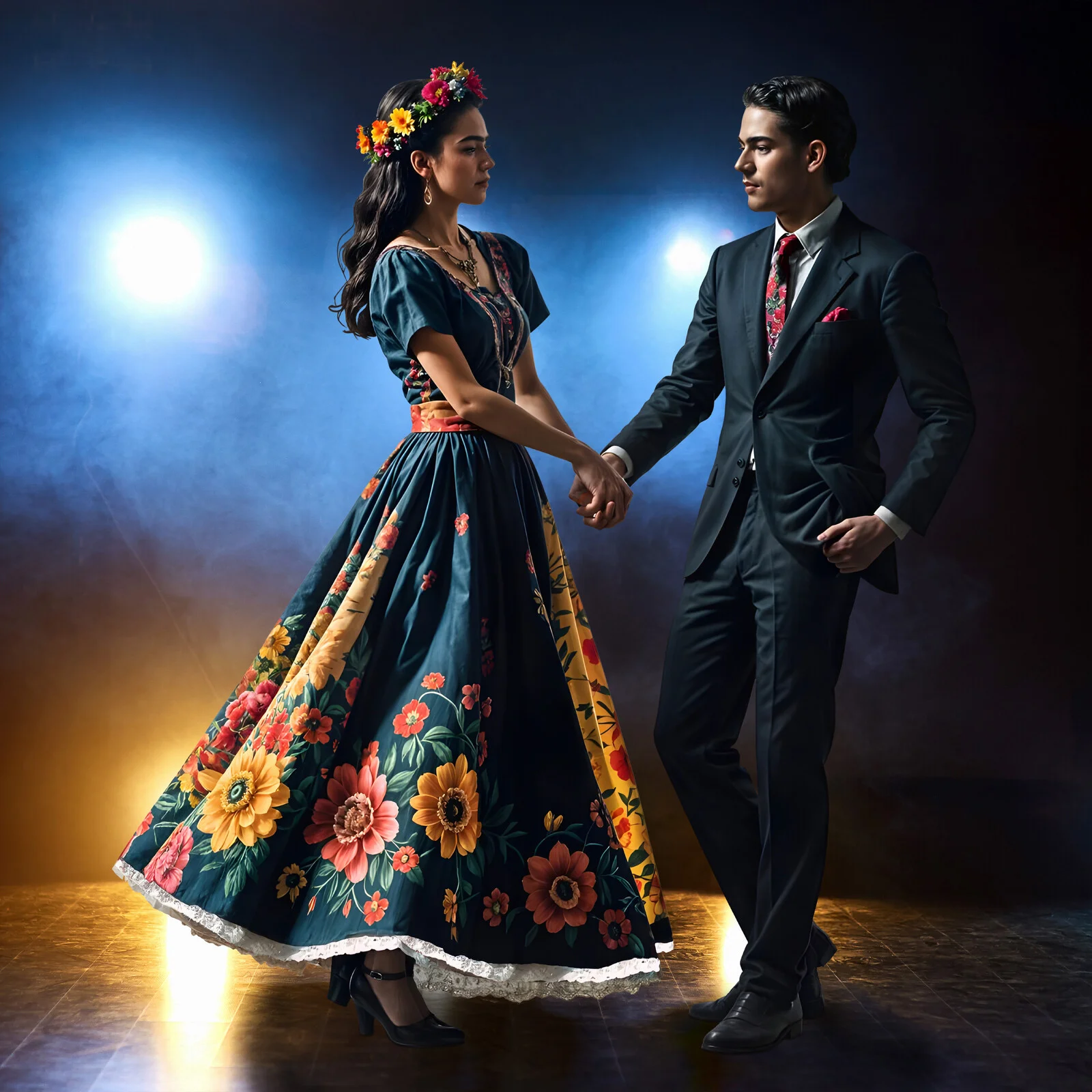
Jörgen Thornberg
Shall We Dance - Frida dancing, 2025
Digital
70 x 70 cm
2 900 kr
Shall We Dance - Frida dancing
San Francisco, 1931. The air inside Bal Tabarin was thick with cigar smoke, rum and expensive perfume lingering under the golden glow of chandeliers. A charanga orchestra played softly, flutes and violins weaving melodies and inviting bodies to move harmoniously. Frida Kahlo, radiant in a folkloric dress embroidered with marigolds, swayed effortlessly in the arms of a dashing Cuban diplomat, their steps slow, measured, charged with unspoken tension. Across the room, Diego Rivera watched, his massive frame nearly swallowing the chair beneath him, his jaw tightening with each turn she took. It was just a dance—but with Frida, nothing was ever just anything. The evening would not end without a storm, but before that, there would be passion, provocation, and, ultimately, a dance neither of them would ever forget.
Stay tuned to find out what happens in this drama. Who’s winning, the husband or the Cuban?
“Shall We Dance?
The lights were low, the air was thick,
Smoke curled slowly; perfume turned slick.
Strings and flutes began to play,
A dance of fire, a game, a sway.
Her dress was spun gold, marigolds bright,
A ribbon of colour in shimmering light.
His hands held firm, his steps were sure,
A diplomat's charm, a danger, a lure.
Diego watched, his fists held tight,
A towering storm, a jealous night.
A cigar smouldered, his patience thin,
As she laughed, twirled, and let another in.
The Danzón paused—breath held, eyes locked,
A moment suspended, the world was shocked.
And then—the music, the swell, the call,
Two bodies melting, surrendering all.
Diego rose, a shadow tall,
A hand on the shoulder, a silent brawl.
“She is mine,” his voice hard like steel,
The room stood still, the air congealed.
Frida smiled, a knowing glance,
“Then prove it, love, let’s have this dance.”
The band struck up, the rhythm bold,
The crowd leaned in, the story told.
The elephant stumbled, the dove took flight,
Strength and grace, a clumsy delight.
Step by step, the anger waned,
The music swirled, their love unchained.
A final twirl, a breathless cheer,
The storm had passed, the sky was clear.
Diego pulled her, fierce and tight,
"Only with you, mi amor, tonight."
The night rolled on, the music soared,
Two hearts entwined, no longer at war.
So raise your glass and toast the chance—
To love, to fire, to one last dance.”
Malmö. January 2025
Shall We Dance?
Frida sat in her Malmö studio, putting the final touches on a painting that would soon be part of her grand retrospective. The piece depicted a younger version of herself, 23 years old, radiant and alive, caught in the elegant embrace of a dance. She smiled as she painted, recalling that night in San Francisco in 1931, when the air was thick with smoke and the scent of expensive cigars, when Diego sat brooding in the corner, watching her with his dark, jealous eyes.
San Francisco in the early 1930s was a city teeming with life, a melting pot where cultures intertwined and thrived. The city pulsed with jazz and swing, but in the more exclusive Latin clubs, Danzón still reigned, a dance of precision and grace. At Bal Tabarin, a newly opened cabaret at 1025 Columbus Avenue, Frida was surrounded by artists, diplomats, and intellectuals one evening, the air filled with the allure of Danzón's refined movements, the vibrant setting of San Francisco adding to the energy of the evening.
She had dressed for the occasion—a folklorist-inspired short-sleeved dress with a wide skirt, its hem adorned with delicate white lace. Marigold flowers in vibrant yellows and greens sprawled across the fabric, offset by the striking red of her wide sash. In her hair, woven among her dark braids, were fresh marigolds and two deep red roses. She embodied Mexico itself, bold and beautiful, an exotic vision among the polished elegance of the café’s clientele.
The club was a spectacle of Art Deco glamour. Gilded columns framed the high ceilings, and crystal chandeliers cast a warm, golden glow over the dark mahogany floors. Smoke curled in the air, mingling with the heady scent of perfume and rum. Waiters in crisp white jackets weaved through the crowded tables, balancing trays of cocktails and whiskey on the rocks. A charanga orchestra played from the raised stage, their music filling the room with the lilting melodies of flutes and violins, setting the perfect tone for the Danzón, a stark contrast to the impending conflict.
Frida had never been one for the frenetic energy of Charleston or swing—her injuries made such movements too abrupt, too jarring—but Danzón? That was another matter entirely. It was a dance of refinement, a symphony of controlled elegance, where every step was deliberate, every pause filled with unspoken anticipation.
Her dancing partner was a Cuban diplomat, strikingly handsome with sharp cheekbones and a smile that promised danger. His tailored suit clung perfectly to his lean frame, and his scent—spiced tobacco and the ocean breeze—lingered between them. Diego watched from his seat in the corner, a cigar smouldering between his thick fingers, his expression unreadable, save for the way his jaw tightened with each passing moment.
Danzón was a dance of connection. They began with the paseo, moving side by side, their steps slow, measured. Frida lifted her chin, letting the music guide her, feeling the warmth of the diplomat’s hand on her waist. Their bodies moved in unison, a conversation without words, the space between them charged with an unspoken anticipation that electrified the air. The violins swelled, the flutes trilled, and then—
Pause.
There was a heartbeat of stillness, where eyes met, breath held, anticipation thick as honey in the air. The world seemed to shrink to just the two of them, locked at that moment before the dance continued, before their bodies melted back into rhythm.
They danced and danced, swaying to the timeless notes of ‘Almendra’ and ‘Tres Lindas Cubanas’, her dress swirling as he spun her effortlessly, their steps aligning with the pulsing rhythm of ‘Nereidas’. Frida's grace in Danzón starkly contrasted with Diego's lack of it. He was fuming, his simmering gaze burning through the haze of cigar smoke. At 188 cm and built like a mountain, he lumbered when he danced, a great bear trying to step lightly. It had always been a comical sight, her tiny frame against his massive one, the contrast only making him more possessive when another man easily led her.
Diego's irritation peaked when ‘Juárez’ began, its melancholic elegance filling the air. Frida flushed from the warmth of the dance and felt her partner's hand press just slightly firmer against the small of her back. His breath was near her cheek as he murmured a soft compliment. She laughed, tipping her head back, her eyes glimmering in the dim light, knowing full well that Diego was ready to explode.
And yet, the night was far from over.
The club was alive with smoke and music, a haven of dimly lit elegance where San Francisco’s elite, artists, and expatriates gathered to drink, converse, and forget the weight of the world outside. Frida Kahlo, barely twenty-three, was at the centre of it all.
Diego’s patience snapped, the tension in the air palpable.
With a force that sent his chair scraping back against the floor, he rose, towering over the patrons around him. Conversations paused mid-sentence, and heads turned. With all his bulk and presence, Diego made his way to the floor, shoving past a waiter who nearly toppled over his tray of cocktails.
Frida saw him before he reached them, her smile flickering with mischief. The Cuban, oblivious to the storm approaching, continued leading her in a graceful turn. But the second they faced Diego, his large hand clamped down on the man’s shoulder, interrupting the dance and the evening's tranquillity. The tension between them crackled in the air like lightning.
"Enough," Diego growled, his voice low but charged with danger. The diplomat, taken aback, straightened, his grip on Frida loosening slightly. "She is my wife."
"She is also my dance partner," the Cuban countered smoothly, his accent rolling off his tongue like silk.
A hush had settled over the room, the orchestra playing on despite the tension thickening like the cigar smoke above them. Frida, caught between them, could feel the heat radiating from Diego’s fury. Her diplomat, gallant though he was, had no idea what kind of tempest he was facing. And in Diego’s clenched fists, she saw the flash of an inevitable collision, the tension between them palpable.
"Now, now, Diego," she purred, placing a light hand on his chest. "Are you really going to cause a scandal over a little dance?"
Diego’s jaw tightened. "It is not the dance, Frida. It is how you dance it."
A collective intake of breath rippled through the audience. The Cuban adjusted his cuffs, clearly bracing for what he believed was coming. But Frida, ever the artist, ever the master of turning chaos into something poetic, merely laughed.
"Then, mi amor, let’s settle this properly."
She turned to the orchestra and gave them a nod. Sensing an opportunity to play to the drama, the violinist introduced a new song: ‘Nereidas’.
Frida stepped away from the diplomat, her skirts swishing as she pivoted on her heel and extended her hand to Diego. The great painter, still seething, hesitated, but she arched a delicate brow. The room held its breath.
Diego took her hand.
And so, the elephant and the dove danced.
It was not as smooth or effortlessly elegant as her earlier dance, but it was something else. Diego was heavy-footed and powerful, his movements less fluid but commanding. And, lighter than air, Frida adapted to his lead, weaving through his strength like a ribbon in the wind. Their chemistry, volatile and intoxicating, played out across the floor, every step a story, every turn a battle of will and passion. The audience captivated, began to clap to the rhythm, the tension dissolving into applause and laughter.
Diego, though still scowling, could not resist the pull of Frida’s gaze, the way she fit against him even when she infuriated him. He pulled her in closer, twirling her in a way that made her laugh, her head falling back in delight. And just like that, the storm was over.
As the final note of ‘Nereidas’ rang through the air, Diego dipped her low, their faces inches apart. The room erupted into cheers.
Breathless, Frida whispered, "See, Diego? You can be quite the dancer when you try."
His scowl deepened, but a ghost of a smile tugged at his lips. "Only with you, mi amor."
And with that, he scooped her up in his arms, carrying her off the floor as the crowd toasted to love, jealousy, and the kind of passion that only Frida and Diego could conjure.
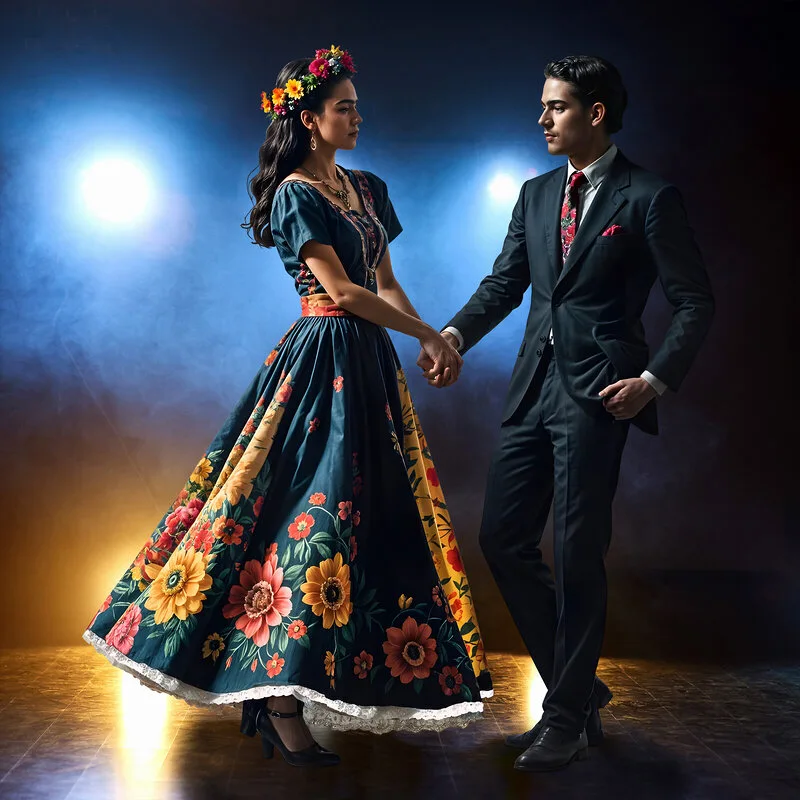
Jörgen Thornberg
Shall We Dance - Frida dancing, 2025
Digital
70 x 70 cm
2 900 kr
Shall We Dance - Frida dancing
San Francisco, 1931. The air inside Bal Tabarin was thick with cigar smoke, rum and expensive perfume lingering under the golden glow of chandeliers. A charanga orchestra played softly, flutes and violins weaving melodies and inviting bodies to move harmoniously. Frida Kahlo, radiant in a folkloric dress embroidered with marigolds, swayed effortlessly in the arms of a dashing Cuban diplomat, their steps slow, measured, charged with unspoken tension. Across the room, Diego Rivera watched, his massive frame nearly swallowing the chair beneath him, his jaw tightening with each turn she took. It was just a dance—but with Frida, nothing was ever just anything. The evening would not end without a storm, but before that, there would be passion, provocation, and, ultimately, a dance neither of them would ever forget.
Stay tuned to find out what happens in this drama. Who’s winning, the husband or the Cuban?
“Shall We Dance?
The lights were low, the air was thick,
Smoke curled slowly; perfume turned slick.
Strings and flutes began to play,
A dance of fire, a game, a sway.
Her dress was spun gold, marigolds bright,
A ribbon of colour in shimmering light.
His hands held firm, his steps were sure,
A diplomat's charm, a danger, a lure.
Diego watched, his fists held tight,
A towering storm, a jealous night.
A cigar smouldered, his patience thin,
As she laughed, twirled, and let another in.
The Danzón paused—breath held, eyes locked,
A moment suspended, the world was shocked.
And then—the music, the swell, the call,
Two bodies melting, surrendering all.
Diego rose, a shadow tall,
A hand on the shoulder, a silent brawl.
“She is mine,” his voice hard like steel,
The room stood still, the air congealed.
Frida smiled, a knowing glance,
“Then prove it, love, let’s have this dance.”
The band struck up, the rhythm bold,
The crowd leaned in, the story told.
The elephant stumbled, the dove took flight,
Strength and grace, a clumsy delight.
Step by step, the anger waned,
The music swirled, their love unchained.
A final twirl, a breathless cheer,
The storm had passed, the sky was clear.
Diego pulled her, fierce and tight,
"Only with you, mi amor, tonight."
The night rolled on, the music soared,
Two hearts entwined, no longer at war.
So raise your glass and toast the chance—
To love, to fire, to one last dance.”
Malmö. January 2025
Shall We Dance?
Frida sat in her Malmö studio, putting the final touches on a painting that would soon be part of her grand retrospective. The piece depicted a younger version of herself, 23 years old, radiant and alive, caught in the elegant embrace of a dance. She smiled as she painted, recalling that night in San Francisco in 1931, when the air was thick with smoke and the scent of expensive cigars, when Diego sat brooding in the corner, watching her with his dark, jealous eyes.
San Francisco in the early 1930s was a city teeming with life, a melting pot where cultures intertwined and thrived. The city pulsed with jazz and swing, but in the more exclusive Latin clubs, Danzón still reigned, a dance of precision and grace. At Bal Tabarin, a newly opened cabaret at 1025 Columbus Avenue, Frida was surrounded by artists, diplomats, and intellectuals one evening, the air filled with the allure of Danzón's refined movements, the vibrant setting of San Francisco adding to the energy of the evening.
She had dressed for the occasion—a folklorist-inspired short-sleeved dress with a wide skirt, its hem adorned with delicate white lace. Marigold flowers in vibrant yellows and greens sprawled across the fabric, offset by the striking red of her wide sash. In her hair, woven among her dark braids, were fresh marigolds and two deep red roses. She embodied Mexico itself, bold and beautiful, an exotic vision among the polished elegance of the café’s clientele.
The club was a spectacle of Art Deco glamour. Gilded columns framed the high ceilings, and crystal chandeliers cast a warm, golden glow over the dark mahogany floors. Smoke curled in the air, mingling with the heady scent of perfume and rum. Waiters in crisp white jackets weaved through the crowded tables, balancing trays of cocktails and whiskey on the rocks. A charanga orchestra played from the raised stage, their music filling the room with the lilting melodies of flutes and violins, setting the perfect tone for the Danzón, a stark contrast to the impending conflict.
Frida had never been one for the frenetic energy of Charleston or swing—her injuries made such movements too abrupt, too jarring—but Danzón? That was another matter entirely. It was a dance of refinement, a symphony of controlled elegance, where every step was deliberate, every pause filled with unspoken anticipation.
Her dancing partner was a Cuban diplomat, strikingly handsome with sharp cheekbones and a smile that promised danger. His tailored suit clung perfectly to his lean frame, and his scent—spiced tobacco and the ocean breeze—lingered between them. Diego watched from his seat in the corner, a cigar smouldering between his thick fingers, his expression unreadable, save for the way his jaw tightened with each passing moment.
Danzón was a dance of connection. They began with the paseo, moving side by side, their steps slow, measured. Frida lifted her chin, letting the music guide her, feeling the warmth of the diplomat’s hand on her waist. Their bodies moved in unison, a conversation without words, the space between them charged with an unspoken anticipation that electrified the air. The violins swelled, the flutes trilled, and then—
Pause.
There was a heartbeat of stillness, where eyes met, breath held, anticipation thick as honey in the air. The world seemed to shrink to just the two of them, locked at that moment before the dance continued, before their bodies melted back into rhythm.
They danced and danced, swaying to the timeless notes of ‘Almendra’ and ‘Tres Lindas Cubanas’, her dress swirling as he spun her effortlessly, their steps aligning with the pulsing rhythm of ‘Nereidas’. Frida's grace in Danzón starkly contrasted with Diego's lack of it. He was fuming, his simmering gaze burning through the haze of cigar smoke. At 188 cm and built like a mountain, he lumbered when he danced, a great bear trying to step lightly. It had always been a comical sight, her tiny frame against his massive one, the contrast only making him more possessive when another man easily led her.
Diego's irritation peaked when ‘Juárez’ began, its melancholic elegance filling the air. Frida flushed from the warmth of the dance and felt her partner's hand press just slightly firmer against the small of her back. His breath was near her cheek as he murmured a soft compliment. She laughed, tipping her head back, her eyes glimmering in the dim light, knowing full well that Diego was ready to explode.
And yet, the night was far from over.
The club was alive with smoke and music, a haven of dimly lit elegance where San Francisco’s elite, artists, and expatriates gathered to drink, converse, and forget the weight of the world outside. Frida Kahlo, barely twenty-three, was at the centre of it all.
Diego’s patience snapped, the tension in the air palpable.
With a force that sent his chair scraping back against the floor, he rose, towering over the patrons around him. Conversations paused mid-sentence, and heads turned. With all his bulk and presence, Diego made his way to the floor, shoving past a waiter who nearly toppled over his tray of cocktails.
Frida saw him before he reached them, her smile flickering with mischief. The Cuban, oblivious to the storm approaching, continued leading her in a graceful turn. But the second they faced Diego, his large hand clamped down on the man’s shoulder, interrupting the dance and the evening's tranquillity. The tension between them crackled in the air like lightning.
"Enough," Diego growled, his voice low but charged with danger. The diplomat, taken aback, straightened, his grip on Frida loosening slightly. "She is my wife."
"She is also my dance partner," the Cuban countered smoothly, his accent rolling off his tongue like silk.
A hush had settled over the room, the orchestra playing on despite the tension thickening like the cigar smoke above them. Frida, caught between them, could feel the heat radiating from Diego’s fury. Her diplomat, gallant though he was, had no idea what kind of tempest he was facing. And in Diego’s clenched fists, she saw the flash of an inevitable collision, the tension between them palpable.
"Now, now, Diego," she purred, placing a light hand on his chest. "Are you really going to cause a scandal over a little dance?"
Diego’s jaw tightened. "It is not the dance, Frida. It is how you dance it."
A collective intake of breath rippled through the audience. The Cuban adjusted his cuffs, clearly bracing for what he believed was coming. But Frida, ever the artist, ever the master of turning chaos into something poetic, merely laughed.
"Then, mi amor, let’s settle this properly."
She turned to the orchestra and gave them a nod. Sensing an opportunity to play to the drama, the violinist introduced a new song: ‘Nereidas’.
Frida stepped away from the diplomat, her skirts swishing as she pivoted on her heel and extended her hand to Diego. The great painter, still seething, hesitated, but she arched a delicate brow. The room held its breath.
Diego took her hand.
And so, the elephant and the dove danced.
It was not as smooth or effortlessly elegant as her earlier dance, but it was something else. Diego was heavy-footed and powerful, his movements less fluid but commanding. And, lighter than air, Frida adapted to his lead, weaving through his strength like a ribbon in the wind. Their chemistry, volatile and intoxicating, played out across the floor, every step a story, every turn a battle of will and passion. The audience captivated, began to clap to the rhythm, the tension dissolving into applause and laughter.
Diego, though still scowling, could not resist the pull of Frida’s gaze, the way she fit against him even when she infuriated him. He pulled her in closer, twirling her in a way that made her laugh, her head falling back in delight. And just like that, the storm was over.
As the final note of ‘Nereidas’ rang through the air, Diego dipped her low, their faces inches apart. The room erupted into cheers.
Breathless, Frida whispered, "See, Diego? You can be quite the dancer when you try."
His scowl deepened, but a ghost of a smile tugged at his lips. "Only with you, mi amor."
And with that, he scooped her up in his arms, carrying her off the floor as the crowd toasted to love, jealousy, and the kind of passion that only Frida and Diego could conjure.
2 900 kr

Jörgen Thornberg
Malmö
Lite om bilder och mig. Translation in English at the end.
Jag är en nyfiken person som ser allt i bilder, även det jag fäster i ord, gärna tillsammans för bakom alla mina bilder finns en berättelse. Till vissa bilder hör en kortare eller längre novell som följer med bilden.
Bilder berättar historier. Jag omges av naturlig skönhet, intressanta människor och historia var jag än går. Jag använder min kamera för att dokumentera världen och blanda det jag ser med vad jag känner för att fånga den dolda magin.
Mina bilder berättar mina historier. Genom mina bilder, tryck och berättelser. Jag bjuder in dig att ta del av dessa berättelser, in i ditt liv och hem och dela min mycket personliga syn på vår värld. Mer än vad ögat ser. Jag tänker i bilder, drömmer och skriver och pratar om dem; följaktligen måste jag också skapa bilder. De blir vad jag ser, inte nödvändigtvis begränsade till verkligheten. Det finns en bild runt varje hörn. Jag hoppas att du kommer att se vad jag såg och gilla det.
Jag är också en skrivande person och till många bilder hör en kortare eller längre essay. Den följer med tavlan, tryckt på fint papper och med en personlig hälsning från mig.
Flertalet bilder startar sin resa i min kamera. Enkelt förklarat beskriver jag bilden jag ser i mitt inre, upplevd eller fantiserad. Bilden uppstår inom mig redan innan jag fått okularet till ögat. På bråkdelen av ett ögonblick ser jag vad jag vill ha och vad som kan göras med bilden. Här skall jag stoppa in en giraff, stålmannen, Titanic eller vad det är min fantasi finner ut. Ännu märkligare är att jag kommer ihåg minnesbilden långt efteråt när det blir tid att skapa verket. Om jag lyckas eller inte, är upp till betraktaren, oftast präglat av en stråk av svart humor – meningen är att man skall bli underhållen. Mina bilder blir ofta en snackis där de hänger.
Jag föredrar bilder som förmedlar ett budskap i flera lager. Vid första anblicken fylld av feel-good, en vacker utsikt, fint väder, solen skiner, blommor på ängen eller vattnet som ligger förrädiskt spegelblankt. I en sådan bild kan jag gömma min egentliga berättelse, mitt förakt för förtryckare och våldsverkare, rasister och fördomsfulla människor - ett gärna återkommande motiv mer eller mindre dolt i det vackra motivet. Jag försöker förena dem i ett gemensamt narrativ.
Bild och formgivning har löpt som en röd tråd genom livet. Fotokonst känns som en värdig final som jag gärna delar med mig.
Min genre är vid som framgår av mina bilder, temat en blandning av pop- och gatukonst i kollage som kan bestå av hundratals lager. Vissa bilder kan ta veckor, andra någon dag innan det är dags att överlämna resultatet till printverkstaden. Fine Art Prints är digitala fotocollage. I dessa kollage sker rivandet, klippandet, pusslandet, målandet, ritandet och sprayningen digitalt. Det jag monterar in kan vara hundratals år gamla bilder som jag omsorgsfullt frilägger så att de ser ut att vara en del av tavlan men också bilder skapade av mig själv efter min egen fantasi. Därefter besöks printstudion och för vissa bilder numrera en limiterad upplaga (oftast 7 exemplar) och signera för hand. Vissa bilder kan köpas i olika format. Det är bara att fråga efter vilka. Gillar man en bild som är 70x100 men inte har plats på väggen, går den kanske att få i 50x70 cm istället. Frågan är fri.
Metoden Giclée eller Fine Art Print som det också kallas är det moderna sättet för framställning av grafisk konst. Villkoret för denna typ av utskrifter är att en högkvalitativ storformatskrivare används med åldersbeständigt färgpigment och konstnärspapper eller i förekommande fall på duk. Pappret som används möter de krav på livslängd som ställs av museer och gallerier. Normalt säljer jag mina bilder oinramade så att den nya ägaren själv kan bestämma hur de skall se ut, med eller utan passepartout färg på ram, med eller utan glas etc..
Under många år ställde jag bara ut på nätet, i valda grupper och på min egen Facebooksida - https://www.facebook.com/jorgen.thornberg.9
Jag finns också på en egen hemsida som tyvärr inte alltid är uppdaterad – https://www.jth.life/ Där kan du också läsa en del av de berättelser som följer med bilden.
UTSTÄLLNINGAR
Luftkastellet, oktober 2022
Konst i Lund, november 2022
Luftkastellet, mars 2023
Engleson Galleri Caroli, april 2023
Hydra, Greece June 2023
Engleson Galleri Caroli, oktober 2023
Toppen, Höllviken december 2023
Luftkastellet, mars 2024
Torups Galleri, mars 2024
Venice, May 2024
Luftkastellet, oktober 2024
Konst i Advent, December 2024
Galleri Engleson, Caroli December 2024
Jäger & Jansson Galleri, april 2025
A bit about pictures and me.
I'm a curious person who sees everything in pictures, even what I express in words, often combining them, for behind all my pictures lies a story. These narratives, some as short as a single image and others as long as a novel, are the heart and soul of my work.
Pictures tell stories. Wherever I go, I'm surrounded by natural beauty, exciting people, and history. I use my camera to document the world and blend what I see with what I feel to capture the hidden magic.
My images tell my stories. Through my pictures, prints, and narratives, I invite you to partake in these stories in your life and home and share my deeply personal perspective of our world. More than meets the eye. I think in pictures, dream, write, and talk about them; consequently, I must create images too. They become what I see, not necessarily confined to reality. There's a picture around every corner. I hope you'll see what I saw and enjoy it.
I'm also a writer, and many images come with a shorter or longer essay. It accompanies the painting, printed on fine paper with my personal greeting.
Many pictures start their journey on my camera. Simply put, I describe the image I see in my mind, experienced or imagined. The image arises within me even before I bring the eyepiece to my eye. In a fraction of a moment, I see what I want and what can be done with the picture. Here, I'll insert a giraffe, Superman, the Titanic, or whatever my imagination conjures up. Even stranger is that I remember the mental image long after it's time to create the work. Whether I succeed is up to the observer, often imbued with a streak of black humour – the aim is to entertain. My pictures usually become a talking point wherever they hang.
I prefer pictures that convey a message in multiple layers. At first glance, they're filled with feel-good vibes, a beautiful view, lovely weather, the sun shining, flowers in the meadow, or the water lying deceptively calm. But beneath this surface beauty, I often conceal a deeper story, a narrative that challenges societal norms or explores the human condition. I invite you to delve into these hidden narratives and discover the layers of meaning within my work.
Picture and design have been a thread running through my life. Photographic art feels like a fitting finale, and I'm happy to share it.
My genre is varied, as seen in my pictures; the theme is a blend of pop and street art in collages that can consist of hundreds of layers. Some images can take weeks, others just a day before it's time to hand over the result to the print workshop. Fine Art Prints are digital photo collages. In these collages, tearing, cutting, puzzling, painting, drawing, and spraying happen digitally. What I insert can be images hundreds of years old that I carefully extract so they appear to be part of the painting, but also images created by myself, now also generated from my imagination. Next, visit the print studio and, for certain images, number a limited edition (usually 7 copies) and sign them by hand. Some images may be available in other formats. Just ask which ones. If you like an image that's 70x100 but doesn't have space on the wall, you might be able to get it in 50x70 cm instead. The question is open.
The Giclée method, or Fine Art Print as it's also called, is the modern way of producing graphic art. This method ensures the highest quality and longevity of the artwork, using a high-quality large-format printer with archival pigment inks and artist paper or, in some cases, canvas. The paper used meets the longevity requirements set by museums and galleries. I sell my pictures unframed, allowing the new owner to personalise their artwork, confident in the lasting value and quality of the piece.
For many years, I only exhibited online, in selected groups, and on my Facebook page - https://www.facebook.com/jorgen.thornberg.9. I also have my website, which unfortunately is not constantly updated - https://www.jth.life/. You can also read some of the stories accompanying the pictures there.
EXHIBITIONS
Luftkastellet, October 2022
Art in Lund, November 2022
Luftkastellet, March 2023
Engleson Gallery Caroli, April 2023
Hydra, Greece June 2023
Engleson Gallery Caroli, October 2023
Toppen, Höllviken December 2023
Luftkastellet, March 2024
Torup Gallery, March 2024
Venice, May 2024
UTSTÄLLNINGAR
Luftkastellet, oktober 2022
Konst i Lund, november 2022
Luftkastellet, mars 2023
Engleson Galleri Caroli, april 2023
Hydra, Greece June 2023
Engleson Galleri Caroli, oktober 2023
Toppen, Höllviken december 2023
Luftkastellet, mars 2024
Torups Galleri, mars 2024
Venice, May 2024
Luftkastellet, October 2024
Konst i Advent, December 2024
Galleri Engleson, Caroli December 2024
Jäger & Jansson Galleri, April 2025
Utbildning
Autodidakt
Medlem i konstnärsförening
Öppna Sinnen
Med i konstrunda
Konstrundan i Skåne
Utställningar
Luftkastellet, October 2022
Art in Lund, November 2022
Luftkastellet, March 2023
Engleson Gallery Caroli, April 2023
Hydra, Greece June 2023
Engleson Gallery Caroli, October 2023
Toppen, Höllviken December 2023
Luftkastellet, March 2024
Torup Gallery, March 2024
Venice, May 2024