Vi använder cookies för att ge dig bästa möjliga upplevelse. Välj vilka cookies du tillåter.
Läs mer i vår integritetspolicy
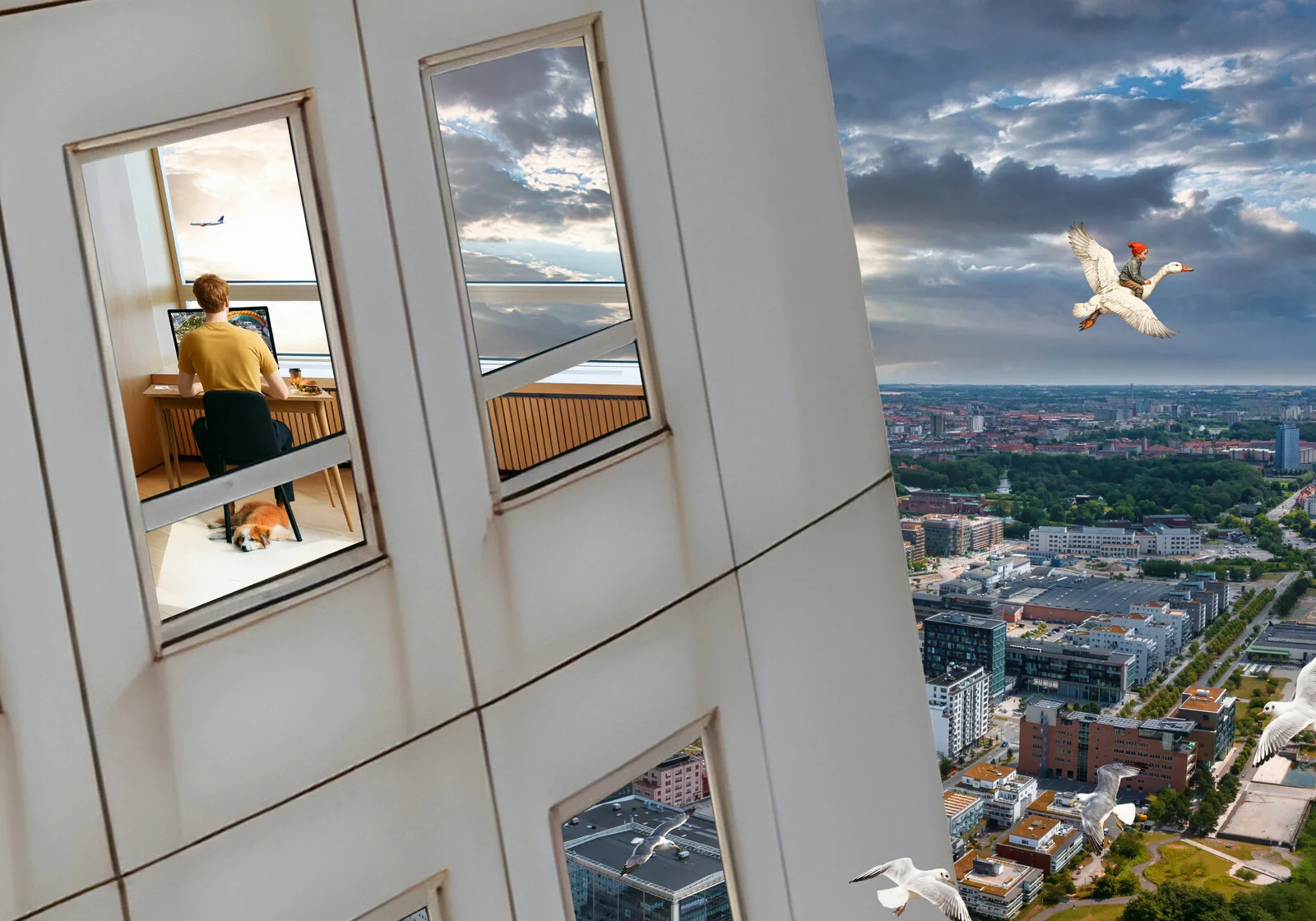
Jörgen Thornberg
All Quiet at Turning Torso, 2025
Digital
70 x 50 cm
3 200 kr
All Quiet at Turning Torso
If Buildings Could Talk
Turning Torso would whisper, laugh, and sigh if buildings could talk. But it can truly communicate if you put an ear to its façade. Even on a day like this—ordinary, almost indistinguishable from the thousands that came before—stories lie deep within its twisting spine of steel and concrete.
The view from the Sky Lounge remains unmatched: higher than the drifting police drones over Västra Hamnen, higher even than the soaring swallows brushing the rooftops of Malmö’s old city. Beyond the tangled streets and stitched-together suburbs, past the yellow blur of distant rapeseed fields, Turning Torso watches — patient, sharp-eyed, quietly amused.
At least, it's all quiet at Turning Torso—on the surface. In its beating steel heart, each passing day leaves a mark: laughter, sorrow, whispered hopes against the sky. The building itself has become part of the living, breathing story of a city and a changing country.
Turning Torso, born from a sculptor’s dream and shaped by unexpected twists of fate, learned to live with what life offered. Once envisioned as an untouchable monument, it became Sweden’s most vertical landlord—and later, a silent witness to storms, revolutions, new beginnings, and even the occasional blessing from Malmö’s notoriously disrespectful seagulls. Its adaptability is a testament to the beauty of change and the power of resilience.
This is its story—the story of a tower that twisted, stood firm, and quietly remembered everything. Read on to discover what the building says.
“A Day at Turning Torso
Morning
The sun stirs gold across Öresund,
Soft light dances on twisted bones of steel.
Sleepy windows blink awake,
And seagulls trace lazy spirals in the waking air.
Midday
Conversations buzz behind glass and concrete,
Keys jingle, coffee brews, and children laugh.
Dreams stack atop each other —
A thousand tiny hopes suspended between sky and earth.
Afternoon
The sea grows restless under the whisper of west winds,
Shadows stretch long across the harbour.
Someone argues about rent on the fifteenth floor.
Someone writes a love letter in trembling, careful script.
Evening
Lights flicker on — a constellation made of lives.
Someone sings off-key near an open window.
A toast is raised. A heart breaks. A promise blooms.
Outside, the city hums like a faraway lullaby.
Night
Clouds roll heavily across the sky.
The moon threads silver through the twisting spine.
Far below, the streets empty into dreams.
And Turning Torso listens, remembers —
Still twisting. Still watching. Still alive.
Malmö April 2025
If buildings could talk, Turning Torso would have much to say. Even on a day like this—ordinary, almost indistinguishable from thousands before—stories lie deep in its steel bones and twisting spine.
The view from the top floor is still magnificent, higher than the police drones that occasionally drift over Västra Hamnen, checking for unwanted activity. Far beyond Malmö’s official borders, beyond the patchwork of former municipalities now swallowed by Sweden’s third-largest city, lies where the rapeseed fields blur into the horizon. Turning Torso watches with sharp eyes; not even a swallow hiding on Kronprinsen’s rooftop escapes unnoticed.
All Quiet at Turning Torso. On the outside, at least. Inside, in my steel and concrete heart, every day leaves its mark—every laugh, every cry, every whispered hope against the night sky. And tomorrow? Tomorrow will be just another ordinary day. Or perhaps, not so ordinary at all.
From Sculpture to Landlord — A Twisted Fate. I was never supposed to be a rental building—not initially. When Santiago Calatrava sketched my form, it was as a sculpture—a bold twist of human movement frozen in steel and glass, a marvel for exhibitions and dreamers. It was a vision; it was a provocation.
Not a building filled with grocery lists, quarrels about rent, and children’s laughter echoing in the stairwells. And yet—here I am, Sweden’s most vertical landlord—a role I never anticipated until Gothenburg took over the baton.
Instead of standing untouched in some windswept plaza, I became part of everyday life. I learned the smells of weekend cooking, the muffled music of late-night parties, and the sigh of elevators carrying tired commuters home. I became a witness to broken hearts and new beginnings. I held secrets whispered behind closed doors and promises made behind sun-drenched windows.
At first, the idea of being a rental building stung my pride. After all, I was designed for admiration, not for mortgage papers and monthly maintenance reports. But over time, I grew fond of it. I came to understand what beauty is without life inside it. What good is tall and shining if no one dances in your shadow?
What good is it to be tall and shining if no one dances in your shadow? And so, while architects argued, critics grumbled, and investors fretted, I twisted on, floor by floor, year by year, becoming less a sculpture and more a story—a story about what it means to stand tall when the world shifts, a story about finding meaning not in perfection but in connection. My transformation is a testament to the power of adaptation and the beauty of change.
And believe me: there is no greater honour for a building than to shelter life itself.
A night inside the Storm. Some nights, even I feel the weight of the world. Like that October evening, the wind howled from Öresund, tearing at rooftops and rattling windows like a furious old god. Far below, the city blinked and shimmered — wet streets glowing under scattered lamplight, as if Malmö itself held its breath. The ocean beyond was a sheet of hammered steel, restless and dark.
At the very top, in my Sky lounge— my crown — the glass walls creaked slightly in the gusts. But the light inside was soft and golden, spilling over into the night like a silent hymn. A few souls had gathered there, sheltering from the storm. They leaned against the windows, laughing nervously, glasses in hand, watching the world tilt and sway under the heavens.
A woman in a red scarf pressed her forehead to the glass and whispered something no one else could hear—a child tracing invisible shapes on the window with a sticky finger. An old man tapped a slow rhythm on the marble floor with his cane, as if keeping time with the wind.
They weren't afraid.
Not really.
They trusted me.
And I, with my thousand tons of steel sinew and glass skin, held them steady. I rocked them gently, like a cradle, through the storm. Outside, the wind screamed. Inside, laughter floated upward like small flares of light, rising to meet the night.
When the storm finally ebbed toward dawn, and the city stretched itself awake, the guests drifted back to their lives. Their voices faded down stairwells and corridors. But I remember them. I remember every footstep on my floors, every heartbeat echoed against my bones.
Because even a tower—even one as proud and twisting as I am—is nothing without the lives that pass through it, pausing for a moment high above the storm.
A Tower Grows Older
Time does not hurry for me, but I feel it just the same. The salt winds have begun to wear fine silver threads into my surface. My bones—steel and concrete though they are—hum differently now, deeper and softer, like the voice of someone who has seen much and learned to listen more than speak.
I was built for eternity, or so they said. But I know better. Nothing—not steel, concrete, or even dreams—lasts forever. Everything twists in time, just as I was designed to twist in space.
New towers rise along the shoreline now. New voices fill the streets. The city I once knew as a small, stubborn port town has grown restless and vast, spilling out in every direction.
One day, they will say I am old. They will wonder why anyone ever thought a tower should dance like a human body caught mid-turn. But I will smile, invisibly, in my high and silent way because I remember. I remember the wild hopes poured into my foundations. I remember the hands that built me, steady and proud. I recall the first sunset reflected in my windows, and the storm rattling my soul.
And as long as I stand—as long as my shadow twists across the waking streets and sleeping fields—I will remember you, too.
You who once looked up and thought for a fleeting moment that even the coldest towers might be alive.
A Tower’s Quiet Pride
Twenty years of sky. Twenty years of wind and memory of storms and stillness. Twenty years of lives unfolding inside me—small dramas, great hopes, whispered dreams.
And even when no one looked up anymore, even when newer towers rose and the world spun faster, I stood here. Watching. Listening. Remembering.
A twisting monument not only to human ambition but to the stubborn, ordinary beauty of everyday life. And if some things turned out less noble—if the seagulls found my highest ledges and crowned me with their blessings, higher than all the bronzed generals and stone kings scattered across the old squares—so be it.
Even the proudest tower must accept that life leaves its mark in all its forms. I would not want it any other way. A tower among clouds, a memory among men. Higher than all their statues, with better views — and a little more seagull waste. Still twisting, watching. Still alive.
For two decades now, Sweden has become an increasingly diverse nation, shaped by waves of immigration. This transformation is felt nowhere more clearly than here, in Malmö, where more than half the residents today have foreign roots. From its perch, Turning Torso has witnessed it all.
The Birth of a Giant
Turning Torso was not always destined to be a residential tower. Initially, the plan flirted with the idea of condominiums, luxurious dream apartments for the fortunate few. But when the market hesitated, the dream bent like the tower’s structure — and the flats became rental units. A stroke of fate, some would say; Malmö’s skyline changed forever, but so did the lives inside it.
Since its inauguration in 2005, the tower has experienced decades of global, national, and personal changes. It has stood firm through storms both literal and political. And if you listen closely, it has stories to tell.to tell.
A Tower Grows Older
Time does not hurry for me, but I feel it just the same. The salt winds have begun to wear fine silver threads into my surface. My bones—steel and concrete though they are—hum differently now, deeper and softer, like the voice of someone who has seen much and learned to listen more than speak.
I was built for eternity, or so they said. But I know better. Nothing—not steel, concrete, or even dreams—lasts forever. Everything twists in time, just as I was designed to twist in space.
New towers rise along the shoreline now. New voices fill the streets. The city I once knew as a small, stubborn port town has grown restless and vast, spilling out in every direction.
One day, they will say I am old. They will wonder why anyone ever thought a tower should dance like a human body caught mid-turn. But I will smile, invisibly, in my high and silent way because I remember. I remember the wild hopes poured into my foundations. I remember the hands that built me, steady and proud. I recall the first sunset reflected in my windows, and the storm rattling my soul.
And as long as I stand—as long as my shadow twists across the waking streets and sleeping fields—I will remember you, too.
You who once looked up and thought for a fleeting moment that even the coldest towers might be alive.
A Tower’s Quiet Pride
Twenty years of sky. Twenty years of wind and memory of storms and stillness. Twenty years of lives unfolding inside me—small dramas, great hopes, whispered dreams.
And even when no one looked up anymore, even when newer towers rose and the world spun faster, I stood here. Watching. Listening. Remembering.
A twisting monument not only to human ambition but to the stubborn, ordinary beauty of everyday life. And if some things turned out less noble—if the seagulls found my highest ledges and crowned me with their blessings, higher than all the bronzed generals and stone kings scattered across the old squares—so be it.
Even the proudest tower must accept that life leaves its mark in all its forms. I would not want it any other way. A tower among clouds, a memory among men. Higher than all their statues, with better views — and a little more seagull waste. Still twisting, watching. Still alive.
For two decades now, Sweden has become an increasingly diverse nation, shaped by waves of immigration. This transformation is felt nowhere more clearly than here, in Malmö, where more than half the residents today have foreign roots. From its perch, Turning Torso has witnessed it all.
The Birth of a Giant
Turning Torso was not always destined to be a residential tower. Initially, the plan flirted with the idea of condominiums, luxurious dream apartments for the fortunate few. But when the market hesitated, the dream bent like the tower’s structure — and the flats became rental units. A stroke of fate, some would say; Malmö’s skyline changed forever, but so did the lives inside it.
Since its inauguration in 2005, the tower has experienced decades of global, national, and personal changes. It has stood firm through storms both literal and political. And if you listen closely, it has stories to tell.
Jörgen Thornberg
All Quiet at Turning Torso, 2025
Digital
70 x 50 cm
3 200 kr
All Quiet at Turning Torso
If Buildings Could Talk
Turning Torso would whisper, laugh, and sigh if buildings could talk. But it can truly communicate if you put an ear to its façade. Even on a day like this—ordinary, almost indistinguishable from the thousands that came before—stories lie deep within its twisting spine of steel and concrete.
The view from the Sky Lounge remains unmatched: higher than the drifting police drones over Västra Hamnen, higher even than the soaring swallows brushing the rooftops of Malmö’s old city. Beyond the tangled streets and stitched-together suburbs, past the yellow blur of distant rapeseed fields, Turning Torso watches — patient, sharp-eyed, quietly amused.
At least, it's all quiet at Turning Torso—on the surface. In its beating steel heart, each passing day leaves a mark: laughter, sorrow, whispered hopes against the sky. The building itself has become part of the living, breathing story of a city and a changing country.
Turning Torso, born from a sculptor’s dream and shaped by unexpected twists of fate, learned to live with what life offered. Once envisioned as an untouchable monument, it became Sweden’s most vertical landlord—and later, a silent witness to storms, revolutions, new beginnings, and even the occasional blessing from Malmö’s notoriously disrespectful seagulls. Its adaptability is a testament to the beauty of change and the power of resilience.
This is its story—the story of a tower that twisted, stood firm, and quietly remembered everything. Read on to discover what the building says.
“A Day at Turning Torso
Morning
The sun stirs gold across Öresund,
Soft light dances on twisted bones of steel.
Sleepy windows blink awake,
And seagulls trace lazy spirals in the waking air.
Midday
Conversations buzz behind glass and concrete,
Keys jingle, coffee brews, and children laugh.
Dreams stack atop each other —
A thousand tiny hopes suspended between sky and earth.
Afternoon
The sea grows restless under the whisper of west winds,
Shadows stretch long across the harbour.
Someone argues about rent on the fifteenth floor.
Someone writes a love letter in trembling, careful script.
Evening
Lights flicker on — a constellation made of lives.
Someone sings off-key near an open window.
A toast is raised. A heart breaks. A promise blooms.
Outside, the city hums like a faraway lullaby.
Night
Clouds roll heavily across the sky.
The moon threads silver through the twisting spine.
Far below, the streets empty into dreams.
And Turning Torso listens, remembers —
Still twisting. Still watching. Still alive.
Malmö April 2025
If buildings could talk, Turning Torso would have much to say. Even on a day like this—ordinary, almost indistinguishable from thousands before—stories lie deep in its steel bones and twisting spine.
The view from the top floor is still magnificent, higher than the police drones that occasionally drift over Västra Hamnen, checking for unwanted activity. Far beyond Malmö’s official borders, beyond the patchwork of former municipalities now swallowed by Sweden’s third-largest city, lies where the rapeseed fields blur into the horizon. Turning Torso watches with sharp eyes; not even a swallow hiding on Kronprinsen’s rooftop escapes unnoticed.
All Quiet at Turning Torso. On the outside, at least. Inside, in my steel and concrete heart, every day leaves its mark—every laugh, every cry, every whispered hope against the night sky. And tomorrow? Tomorrow will be just another ordinary day. Or perhaps, not so ordinary at all.
From Sculpture to Landlord — A Twisted Fate. I was never supposed to be a rental building—not initially. When Santiago Calatrava sketched my form, it was as a sculpture—a bold twist of human movement frozen in steel and glass, a marvel for exhibitions and dreamers. It was a vision; it was a provocation.
Not a building filled with grocery lists, quarrels about rent, and children’s laughter echoing in the stairwells. And yet—here I am, Sweden’s most vertical landlord—a role I never anticipated until Gothenburg took over the baton.
Instead of standing untouched in some windswept plaza, I became part of everyday life. I learned the smells of weekend cooking, the muffled music of late-night parties, and the sigh of elevators carrying tired commuters home. I became a witness to broken hearts and new beginnings. I held secrets whispered behind closed doors and promises made behind sun-drenched windows.
At first, the idea of being a rental building stung my pride. After all, I was designed for admiration, not for mortgage papers and monthly maintenance reports. But over time, I grew fond of it. I came to understand what beauty is without life inside it. What good is tall and shining if no one dances in your shadow?
What good is it to be tall and shining if no one dances in your shadow? And so, while architects argued, critics grumbled, and investors fretted, I twisted on, floor by floor, year by year, becoming less a sculpture and more a story—a story about what it means to stand tall when the world shifts, a story about finding meaning not in perfection but in connection. My transformation is a testament to the power of adaptation and the beauty of change.
And believe me: there is no greater honour for a building than to shelter life itself.
A night inside the Storm. Some nights, even I feel the weight of the world. Like that October evening, the wind howled from Öresund, tearing at rooftops and rattling windows like a furious old god. Far below, the city blinked and shimmered — wet streets glowing under scattered lamplight, as if Malmö itself held its breath. The ocean beyond was a sheet of hammered steel, restless and dark.
At the very top, in my Sky lounge— my crown — the glass walls creaked slightly in the gusts. But the light inside was soft and golden, spilling over into the night like a silent hymn. A few souls had gathered there, sheltering from the storm. They leaned against the windows, laughing nervously, glasses in hand, watching the world tilt and sway under the heavens.
A woman in a red scarf pressed her forehead to the glass and whispered something no one else could hear—a child tracing invisible shapes on the window with a sticky finger. An old man tapped a slow rhythm on the marble floor with his cane, as if keeping time with the wind.
They weren't afraid.
Not really.
They trusted me.
And I, with my thousand tons of steel sinew and glass skin, held them steady. I rocked them gently, like a cradle, through the storm. Outside, the wind screamed. Inside, laughter floated upward like small flares of light, rising to meet the night.
When the storm finally ebbed toward dawn, and the city stretched itself awake, the guests drifted back to their lives. Their voices faded down stairwells and corridors. But I remember them. I remember every footstep on my floors, every heartbeat echoed against my bones.
Because even a tower—even one as proud and twisting as I am—is nothing without the lives that pass through it, pausing for a moment high above the storm.
A Tower Grows Older
Time does not hurry for me, but I feel it just the same. The salt winds have begun to wear fine silver threads into my surface. My bones—steel and concrete though they are—hum differently now, deeper and softer, like the voice of someone who has seen much and learned to listen more than speak.
I was built for eternity, or so they said. But I know better. Nothing—not steel, concrete, or even dreams—lasts forever. Everything twists in time, just as I was designed to twist in space.
New towers rise along the shoreline now. New voices fill the streets. The city I once knew as a small, stubborn port town has grown restless and vast, spilling out in every direction.
One day, they will say I am old. They will wonder why anyone ever thought a tower should dance like a human body caught mid-turn. But I will smile, invisibly, in my high and silent way because I remember. I remember the wild hopes poured into my foundations. I remember the hands that built me, steady and proud. I recall the first sunset reflected in my windows, and the storm rattling my soul.
And as long as I stand—as long as my shadow twists across the waking streets and sleeping fields—I will remember you, too.
You who once looked up and thought for a fleeting moment that even the coldest towers might be alive.
A Tower’s Quiet Pride
Twenty years of sky. Twenty years of wind and memory of storms and stillness. Twenty years of lives unfolding inside me—small dramas, great hopes, whispered dreams.
And even when no one looked up anymore, even when newer towers rose and the world spun faster, I stood here. Watching. Listening. Remembering.
A twisting monument not only to human ambition but to the stubborn, ordinary beauty of everyday life. And if some things turned out less noble—if the seagulls found my highest ledges and crowned me with their blessings, higher than all the bronzed generals and stone kings scattered across the old squares—so be it.
Even the proudest tower must accept that life leaves its mark in all its forms. I would not want it any other way. A tower among clouds, a memory among men. Higher than all their statues, with better views — and a little more seagull waste. Still twisting, watching. Still alive.
For two decades now, Sweden has become an increasingly diverse nation, shaped by waves of immigration. This transformation is felt nowhere more clearly than here, in Malmö, where more than half the residents today have foreign roots. From its perch, Turning Torso has witnessed it all.
The Birth of a Giant
Turning Torso was not always destined to be a residential tower. Initially, the plan flirted with the idea of condominiums, luxurious dream apartments for the fortunate few. But when the market hesitated, the dream bent like the tower’s structure — and the flats became rental units. A stroke of fate, some would say; Malmö’s skyline changed forever, but so did the lives inside it.
Since its inauguration in 2005, the tower has experienced decades of global, national, and personal changes. It has stood firm through storms both literal and political. And if you listen closely, it has stories to tell.to tell.
A Tower Grows Older
Time does not hurry for me, but I feel it just the same. The salt winds have begun to wear fine silver threads into my surface. My bones—steel and concrete though they are—hum differently now, deeper and softer, like the voice of someone who has seen much and learned to listen more than speak.
I was built for eternity, or so they said. But I know better. Nothing—not steel, concrete, or even dreams—lasts forever. Everything twists in time, just as I was designed to twist in space.
New towers rise along the shoreline now. New voices fill the streets. The city I once knew as a small, stubborn port town has grown restless and vast, spilling out in every direction.
One day, they will say I am old. They will wonder why anyone ever thought a tower should dance like a human body caught mid-turn. But I will smile, invisibly, in my high and silent way because I remember. I remember the wild hopes poured into my foundations. I remember the hands that built me, steady and proud. I recall the first sunset reflected in my windows, and the storm rattling my soul.
And as long as I stand—as long as my shadow twists across the waking streets and sleeping fields—I will remember you, too.
You who once looked up and thought for a fleeting moment that even the coldest towers might be alive.
A Tower’s Quiet Pride
Twenty years of sky. Twenty years of wind and memory of storms and stillness. Twenty years of lives unfolding inside me—small dramas, great hopes, whispered dreams.
And even when no one looked up anymore, even when newer towers rose and the world spun faster, I stood here. Watching. Listening. Remembering.
A twisting monument not only to human ambition but to the stubborn, ordinary beauty of everyday life. And if some things turned out less noble—if the seagulls found my highest ledges and crowned me with their blessings, higher than all the bronzed generals and stone kings scattered across the old squares—so be it.
Even the proudest tower must accept that life leaves its mark in all its forms. I would not want it any other way. A tower among clouds, a memory among men. Higher than all their statues, with better views — and a little more seagull waste. Still twisting, watching. Still alive.
For two decades now, Sweden has become an increasingly diverse nation, shaped by waves of immigration. This transformation is felt nowhere more clearly than here, in Malmö, where more than half the residents today have foreign roots. From its perch, Turning Torso has witnessed it all.
The Birth of a Giant
Turning Torso was not always destined to be a residential tower. Initially, the plan flirted with the idea of condominiums, luxurious dream apartments for the fortunate few. But when the market hesitated, the dream bent like the tower’s structure — and the flats became rental units. A stroke of fate, some would say; Malmö’s skyline changed forever, but so did the lives inside it.
Since its inauguration in 2005, the tower has experienced decades of global, national, and personal changes. It has stood firm through storms both literal and political. And if you listen closely, it has stories to tell.
3 200 kr

Jörgen Thornberg
Malmö
Lite om bilder och mig. Translation in English at the end.
Jag är en nyfiken person som ser allt i bilder, även det jag fäster i ord, gärna tillsammans för bakom alla mina bilder finns en berättelse. Till vissa bilder hör en kortare eller längre novell som följer med bilden.
Bilder berättar historier. Jag omges av naturlig skönhet, intressanta människor och historia var jag än går. Jag använder min kamera för att dokumentera världen och blanda det jag ser med vad jag känner för att fånga den dolda magin.
Mina bilder berättar mina historier. Genom mina bilder, tryck och berättelser. Jag bjuder in dig att ta del av dessa berättelser, in i ditt liv och hem och dela min mycket personliga syn på vår värld. Mer än vad ögat ser. Jag tänker i bilder, drömmer och skriver och pratar om dem; följaktligen måste jag också skapa bilder. De blir vad jag ser, inte nödvändigtvis begränsade till verkligheten. Det finns en bild runt varje hörn. Jag hoppas att du kommer att se vad jag såg och gilla det.
Jag är också en skrivande person och till många bilder hör en kortare eller längre essay. Den följer med tavlan, tryckt på fint papper och med en personlig hälsning från mig.
Flertalet bilder startar sin resa i min kamera. Enkelt förklarat beskriver jag bilden jag ser i mitt inre, upplevd eller fantiserad. Bilden uppstår inom mig redan innan jag fått okularet till ögat. På bråkdelen av ett ögonblick ser jag vad jag vill ha och vad som kan göras med bilden. Här skall jag stoppa in en giraff, stålmannen, Titanic eller vad det är min fantasi finner ut. Ännu märkligare är att jag kommer ihåg minnesbilden långt efteråt när det blir tid att skapa verket. Om jag lyckas eller inte, är upp till betraktaren, oftast präglat av en stråk av svart humor – meningen är att man skall bli underhållen. Mina bilder blir ofta en snackis där de hänger.
Jag föredrar bilder som förmedlar ett budskap i flera lager. Vid första anblicken fylld av feel-good, en vacker utsikt, fint väder, solen skiner, blommor på ängen eller vattnet som ligger förrädiskt spegelblankt. I en sådan bild kan jag gömma min egentliga berättelse, mitt förakt för förtryckare och våldsverkare, rasister och fördomsfulla människor - ett gärna återkommande motiv mer eller mindre dolt i det vackra motivet. Jag försöker förena dem i ett gemensamt narrativ.
Bild och formgivning har löpt som en röd tråd genom livet. Fotokonst känns som en värdig final som jag gärna delar med mig.
Min genre är vid som framgår av mina bilder, temat en blandning av pop- och gatukonst i kollage som kan bestå av hundratals lager. Vissa bilder kan ta veckor, andra någon dag innan det är dags att överlämna resultatet till printverkstaden. Fine Art Prints är digitala fotocollage. I dessa kollage sker rivandet, klippandet, pusslandet, målandet, ritandet och sprayningen digitalt. Det jag monterar in kan vara hundratals år gamla bilder som jag omsorgsfullt frilägger så att de ser ut att vara en del av tavlan men också bilder skapade av mig själv efter min egen fantasi. Därefter besöks printstudion och för vissa bilder numrera en limiterad upplaga (oftast 7 exemplar) och signera för hand. Vissa bilder kan köpas i olika format. Det är bara att fråga efter vilka. Gillar man en bild som är 70x100 men inte har plats på väggen, går den kanske att få i 50x70 cm istället. Frågan är fri.
Metoden Giclée eller Fine Art Print som det också kallas är det moderna sättet för framställning av grafisk konst. Villkoret för denna typ av utskrifter är att en högkvalitativ storformatskrivare används med åldersbeständigt färgpigment och konstnärspapper eller i förekommande fall på duk. Pappret som används möter de krav på livslängd som ställs av museer och gallerier. Normalt säljer jag mina bilder oinramade så att den nya ägaren själv kan bestämma hur de skall se ut, med eller utan passepartout färg på ram, med eller utan glas etc..
Under många år ställde jag bara ut på nätet, i valda grupper och på min egen Facebooksida - https://www.facebook.com/jorgen.thornberg.9
Jag finns också på en egen hemsida som tyvärr inte alltid är uppdaterad – https://www.jth.life/ Där kan du också läsa en del av de berättelser som följer med bilden.
UTSTÄLLNINGAR
Luftkastellet, oktober 2022
Konst i Lund, november 2022
Luftkastellet, mars 2023
Engleson Galleri Caroli, april 2023
Hydra, Greece June 2023
Engleson Galleri Caroli, oktober 2023
Toppen, Höllviken december 2023
Luftkastellet, mars 2024
Torups Galleri, mars 2024
Venice, May 2024
Luftkastellet, oktober 2024
Konst i Advent, December 2024
Galleri Engleson, Caroli December 2024
Jäger & Jansson Galleri, april 2025
A bit about pictures and me.
I'm a curious person who sees everything in pictures, even what I express in words, often combining them, for behind all my pictures lies a story. These narratives, some as short as a single image and others as long as a novel, are the heart and soul of my work.
Pictures tell stories. Wherever I go, I'm surrounded by natural beauty, exciting people, and history. I use my camera to document the world and blend what I see with what I feel to capture the hidden magic.
My images tell my stories. Through my pictures, prints, and narratives, I invite you to partake in these stories in your life and home and share my deeply personal perspective of our world. More than meets the eye. I think in pictures, dream, write, and talk about them; consequently, I must create images too. They become what I see, not necessarily confined to reality. There's a picture around every corner. I hope you'll see what I saw and enjoy it.
I'm also a writer, and many images come with a shorter or longer essay. It accompanies the painting, printed on fine paper with my personal greeting.
Many pictures start their journey on my camera. Simply put, I describe the image I see in my mind, experienced or imagined. The image arises within me even before I bring the eyepiece to my eye. In a fraction of a moment, I see what I want and what can be done with the picture. Here, I'll insert a giraffe, Superman, the Titanic, or whatever my imagination conjures up. Even stranger is that I remember the mental image long after it's time to create the work. Whether I succeed is up to the observer, often imbued with a streak of black humour – the aim is to entertain. My pictures usually become a talking point wherever they hang.
I prefer pictures that convey a message in multiple layers. At first glance, they're filled with feel-good vibes, a beautiful view, lovely weather, the sun shining, flowers in the meadow, or the water lying deceptively calm. But beneath this surface beauty, I often conceal a deeper story, a narrative that challenges societal norms or explores the human condition. I invite you to delve into these hidden narratives and discover the layers of meaning within my work.
Picture and design have been a thread running through my life. Photographic art feels like a fitting finale, and I'm happy to share it.
My genre is varied, as seen in my pictures; the theme is a blend of pop and street art in collages that can consist of hundreds of layers. Some images can take weeks, others just a day before it's time to hand over the result to the print workshop. Fine Art Prints are digital photo collages. In these collages, tearing, cutting, puzzling, painting, drawing, and spraying happen digitally. What I insert can be images hundreds of years old that I carefully extract so they appear to be part of the painting, but also images created by myself, now also generated from my imagination. Next, visit the print studio and, for certain images, number a limited edition (usually 7 copies) and sign them by hand. Some images may be available in other formats. Just ask which ones. If you like an image that's 70x100 but doesn't have space on the wall, you might be able to get it in 50x70 cm instead. The question is open.
The Giclée method, or Fine Art Print as it's also called, is the modern way of producing graphic art. This method ensures the highest quality and longevity of the artwork, using a high-quality large-format printer with archival pigment inks and artist paper or, in some cases, canvas. The paper used meets the longevity requirements set by museums and galleries. I sell my pictures unframed, allowing the new owner to personalise their artwork, confident in the lasting value and quality of the piece.
For many years, I only exhibited online, in selected groups, and on my Facebook page - https://www.facebook.com/jorgen.thornberg.9. I also have my website, which unfortunately is not constantly updated - https://www.jth.life/. You can also read some of the stories accompanying the pictures there.
EXHIBITIONS
Luftkastellet, October 2022
Art in Lund, November 2022
Luftkastellet, March 2023
Engleson Gallery Caroli, April 2023
Hydra, Greece June 2023
Engleson Gallery Caroli, October 2023
Toppen, Höllviken December 2023
Luftkastellet, March 2024
Torup Gallery, March 2024
Venice, May 2024
UTSTÄLLNINGAR
Luftkastellet, oktober 2022
Konst i Lund, november 2022
Luftkastellet, mars 2023
Engleson Galleri Caroli, april 2023
Hydra, Greece June 2023
Engleson Galleri Caroli, oktober 2023
Toppen, Höllviken december 2023
Luftkastellet, mars 2024
Torups Galleri, mars 2024
Venice, May 2024
Luftkastellet, October 2024
Konst i Advent, December 2024
Galleri Engleson, Caroli December 2024
Jäger & Jansson Galleri, April 2025
Utbildning
Autodidakt
Medlem i konstnärsförening
Öppna Sinnen
Med i konstrunda
Konstrundan i Skåne
Utställningar
Luftkastellet, October 2022
Art in Lund, November 2022
Luftkastellet, March 2023
Engleson Gallery Caroli, April 2023
Hydra, Greece June 2023
Engleson Gallery Caroli, October 2023
Toppen, Höllviken December 2023
Luftkastellet, March 2024
Torup Gallery, March 2024
Venice, May 2024