Vi använder cookies för att ge dig bästa möjliga upplevelse. Välj vilka cookies du tillåter.
Läs mer i vår integritetspolicy
Jörgen Thornberg
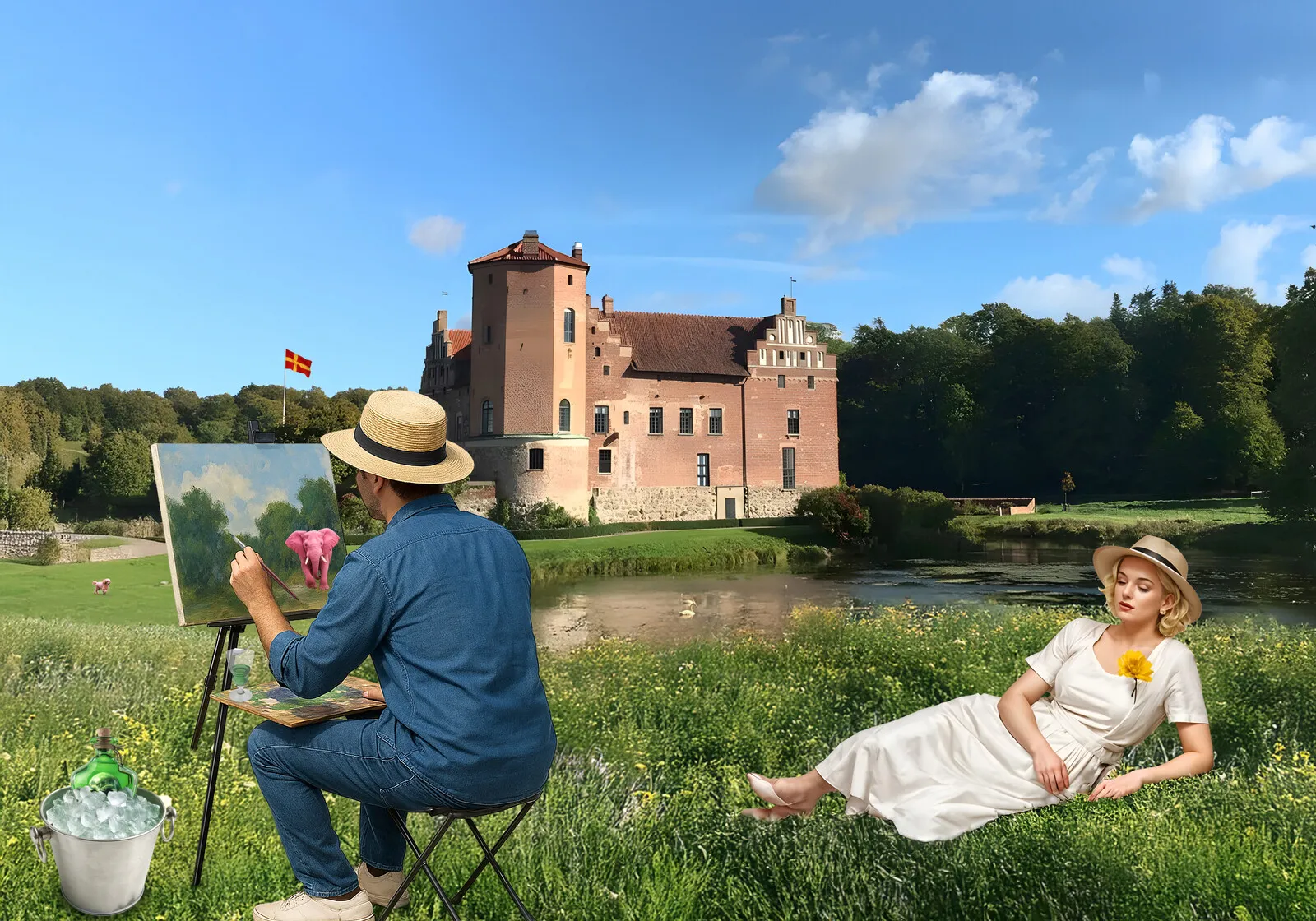
A Pink Edge of a Wood, 2025
Digital
70 x 50 cm
3 200 kr
A Pink Edge of a Wood – Recasting a Classic in Time and Colour
At first glance, the scene seems familiar: a painter at the edge of a wood, dappled light, a reclining figure, and an open air of Impressionist contemplation. But look again. The painter’s jacket is too modern, the model in the grass is not Suzanne Leenhoff but Marilyn Monroe, and the woods are not those of Giverny but the beech groves of Torup, Skåne.
This is no simple pastiche. It is a dialogue across centuries—a reframing of John Singer Sargent’s sketch of Claude Monet, filtered through the haze of absinthe, memory, and myth. Here, the scene transforms into a self-portrait, a surreal reimagining of artistic kinship, where icons like Monet, Manet, and Monroe coexist in a realm where time folds and the rules of reality bend gently around the brush.
As pink elephants appear among the trees and absinthe glows beside the palette, one might wonder: Is this hallucination, homage, or humorous heresy? Perhaps it is all of these. In this rendering, art is not just observed but inhabited—and Marilyn, ever the misunderstood muse, finds herself not objectified but included as a conscious figure in the painter’s world. Not simply painted, but present.
Please learn more about Absinth’s power and how it connects us to a global narrative of timeless painting.
“Absinthe in the Beechwood
In Torup’s grove where shadows play,
The artist drank at the close of day.
A glass of green, a spoon, a drip—
A sugar cube, a trembling lip.
The trees leaned in with rustling grace,
As absinthe licked the painter’s face.
The world began to twist and bloom,
And beechwood whispered hints of doom.
From silver mist and mossy light,
A creature charged in rose and white.
It trumpeted with silky might—
A pink-hued beast, surreal in flight.
Its ears were wide, its tail a swish,
Its eyes held thoughts no man would wish.
"Behold!" cried he, "my muse, divine!
A forest-elephant—it's mine!"
But as the fog began to clear,
And reason tiptoed, pale with fear,
The tusks fell back, the trunk grew thin—
And wagged a tail beneath the chin.
The painter blinked, then sighed, then laughed:
Not myth, but poodle, shaved and daft.
Still pink, still proud, it struck a pose—
No less absurd, but twice as close.”
Malmö 24 April 2025
A pink edge of a Wood
The image depicts Claude Monet painting by the edge of a wood—it is recognisable yet not quite the same. The clothing is too modern, and the woman in the grass is different. Moreover, unlike before, it is a self-portrait painted by a good friend. The forest is also different—this time it is the beech forest at Torup in Skåne in southern Sweden.
Which of the two images is better is a matter of taste. Both have merits, but Monet’s version feels more complete and resolved as an image than his friend Sargent’s sketchy interpretation.
John Singer Sargent, renowned for presenting his sketches of friends and fellow artists as gifts, made a unique exception with his sketch of Claude Monet (1840–1926). This sketch, a profound symbol of Sargent's deep admiration for Monet, remained with Sargent throughout his life. It was in his studio when he passed away, along with several works by Monet that Sargent had collected.
Sargent's admiration for Monet was profound. He first met Monet in 1876, but the two artists became closest ten years later. It was probably in 1885 that they painted together at Giverny, near Paris. Sargent admired how Monet worked outdoors and imitated some of his subjects and methods in these sketches. It is characteristic of Sargent to give a human view of Monet's practice and the patience of his wife, who sits behind him. When he settled in London in 1885, Sargent was initially viewed as avant-garde, but he became the greatest society portraitist of his day.
The portrait of Monet, depicted in his element, painting a landscape outdoors, holds a significant place in the history of Impressionism. It illustrates the French artist doing what he advocated: painting directly from nature. However, its true value lies in its significance for Sargent, who deeply admired Monet. The portrait serves as a silent yet powerful commemoration of their artistic relationship, a bond that transcends the limitations of language.
What happened the day Sargent painted Monet?
One summer’s day towards the end of the 1880s, Claude Monet sat painting at the edge of a wood near his home in Giverny. Although eager American students were already besieging him, Monet remained oblivious to the fact that, on this occasion, his activities were being observed. As he quietly painted, John Singer Sargent, the most important portraitist of his generation, made the impressionist painter the subject of his quick sketch, marking a significant moment in their artistic exchange.
Sargent was no simple student, as Kenneth McConkey makes clear in our book British Impressionism. The American painter was already the most essential portraitist of his generation, one whose era-defining paintings captured the Gilded Age's heiresses, statesmen, and industrialists. Yet the artist, sometimes regarded as a traditionalist, recognised an element in Impressionism that was absent in his art.
Sargent first met Monet in 1876, and during the 1880s, the American artist painted a formal portrait of the French artist and acquired several of his works. While Sargent did not wholly devote himself to the burgeoning French style, he had already created several masterpieces, such as Portrait of Madame X. Nevertheless, his livelier outdoor paintings aspired to embody some of the Impressionistic qualities of his French counterparts.
In particular, Sargent focused on the French painter's use of colour, painting objects in a medley of hues instead of with distinct, chromatic divisions. Monet's friend Édouard Manet pioneered this technique, and Sargent took note. Consider the American's famous Carnation, Lily, Lily, Rose (1885-6). There’s no denying the work’s prettiness; yet, as the critic Roger Fry wrote, “what thrilled us all then was the fact that this picture was the first feeble echo which came across the channel of what Manet and his friends had been doing with a far different intensity for 10 years or more.”
Indeed, Monet later stated that Sargent was reluctant to overcome certain conventions. “I gave him my colours, and he wanted black,” the artist recalled, “and I told him, ‘but I haven’t any,’ ‘then I can’t paint’ he cried, ‘how do you do it?’”
If he could not take direct instruction from Monet, perhaps this later, surreptitious pastiche of the artist’s work marks a breakthrough for Sargent. As McConkey writes in our book, Monet’s ‘comma’ brushstrokes are present in the lively foliage of Sargent’s Monet painting. Meanwhile, Sargent’s subsequent works, such as A Gust of Wind, display a limpid, free-flowing style distinct from his formal portraits.
At the foot of the easel stands an ice bucket filled with absinthe, the treacherous favourite spirit of the late nineteenth century. On the palette rests a glass, complete with the peculiar spoon used to strain the liquor through a sugar cube. The appearance of a pink elephant among the trees in the painting is a nod to Manet's work, as he often incorporated unexpected elements in his paintings. This may be because Manet had already consumed a few glasses of the potent drink, which was known for inducing hallucinations.
The woman in the grass is not Manet’s wife, Suzanne Leenhoff, but Marilyn Monroe, whom the artist came to know among the stars. In eternity, it is not only the communion of souls that applies—and since women there cannot become pregnant, one might say that a certain promiscuity prevailed. Manet and Marilyn also shared a common interest in art, which is an excuse for her being depicted in the painting.
Though remembered by many for her glamour and screen presence, Marilyn Monroe held a quiet, sincere reverence for art, not just as performance but as visual expression. Beneath the platinum hair and playful smile was a woman who wandered museums, read voraciously, and paused to study brushstrokes and shadows, a side of her that might surprise many. Her love for art was a passing interest and a deep and abiding passion.
During her time in New York, away from the glare of Hollywood, Marilyn immersed herself in a more introspective world. She attended classes at the Actors Studio, spent time with writers, intellectuals, and artists, and cultivated a love for painting and sculpture, a passion many can relate to and appreciate. She admired Rodin, van Gogh, and Goya, and reportedly owned a piece by Foujita, the Franco-Japanese painter known for his delicate, dreamlike scenes.
Her library, discovered after her death, contained over 400 books, including volumes on art history, philosophy, and the lives of artists. It painted a portrait of a woman who longed to understand the beauty and pain of the world beyond the camera's lens, a longing that many can empathise with.
There are also surviving sketches and poems by her hand, raw, expressive, and searching. These fragments hint at a woman who didn’t just pose for portraits but saw them, felt them, and perhaps even longed to step inside them.
For Marilyn, art was neither a luxury nor a role. It was a refuge, a mirror, and a language for what could not be said on set.
In the quiet spaces between flashbulbs and film reels, Marilyn Monroe was, in her way, an artist.
Absinthe is an anise-flavoured spirit derived from several plants, including the flowers and leaves of Artemisia absinthium ("grand wormwood"), green anise, sweet fennel, and various medicinal and culinary herbs. Historically regarded as a highly alcoholic spirit, it possesses an ABV of 45–74%. Traditionally, absinthe has a natural green colour but can also be colourless. It is commonly called ‘la fée verte’ (the green fairy) in historical literature. While sometimes casually termed a liqueur, absinthe is not typically bottled with sugar or sweeteners. Usually, absinthe is bottled at a high alcohol level by volume but is diluted with water before consumption.
The Absinthe Drinker (French: Le Buveur d'absinthe) is an early painting by Édouard Manet, executed around 1859. It is considered his first major painting and original work.
After completing the painting, Manet showed it to his former master. When asked for his opinion, Couture is said to have retorted: "An absinthe drinker! And they paint abominations like that! My poor friend, you are the absinthe drinker. It is you who have lost your moral sense."
Jörgen Thornberg
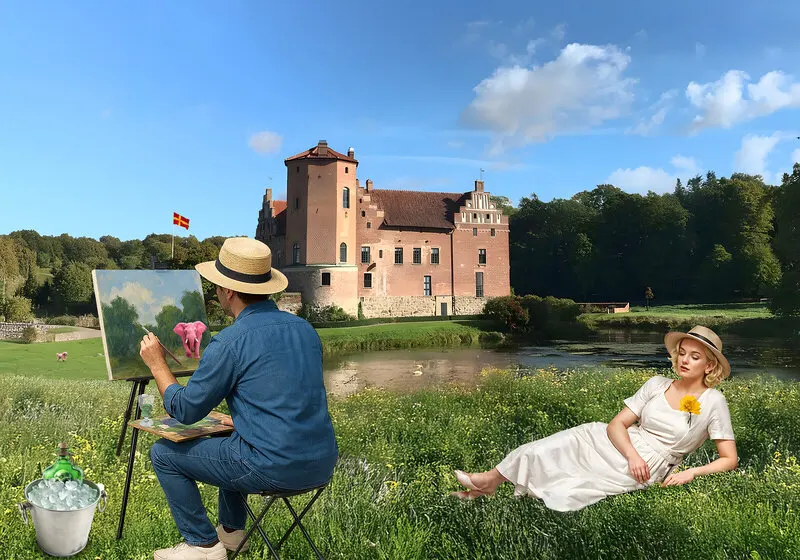
A Pink Edge of a Wood, 2025
Digital
70 x 50 cm
3 200 kr
A Pink Edge of a Wood – Recasting a Classic in Time and Colour
At first glance, the scene seems familiar: a painter at the edge of a wood, dappled light, a reclining figure, and an open air of Impressionist contemplation. But look again. The painter’s jacket is too modern, the model in the grass is not Suzanne Leenhoff but Marilyn Monroe, and the woods are not those of Giverny but the beech groves of Torup, Skåne.
This is no simple pastiche. It is a dialogue across centuries—a reframing of John Singer Sargent’s sketch of Claude Monet, filtered through the haze of absinthe, memory, and myth. Here, the scene transforms into a self-portrait, a surreal reimagining of artistic kinship, where icons like Monet, Manet, and Monroe coexist in a realm where time folds and the rules of reality bend gently around the brush.
As pink elephants appear among the trees and absinthe glows beside the palette, one might wonder: Is this hallucination, homage, or humorous heresy? Perhaps it is all of these. In this rendering, art is not just observed but inhabited—and Marilyn, ever the misunderstood muse, finds herself not objectified but included as a conscious figure in the painter’s world. Not simply painted, but present.
Please learn more about Absinth’s power and how it connects us to a global narrative of timeless painting.
“Absinthe in the Beechwood
In Torup’s grove where shadows play,
The artist drank at the close of day.
A glass of green, a spoon, a drip—
A sugar cube, a trembling lip.
The trees leaned in with rustling grace,
As absinthe licked the painter’s face.
The world began to twist and bloom,
And beechwood whispered hints of doom.
From silver mist and mossy light,
A creature charged in rose and white.
It trumpeted with silky might—
A pink-hued beast, surreal in flight.
Its ears were wide, its tail a swish,
Its eyes held thoughts no man would wish.
"Behold!" cried he, "my muse, divine!
A forest-elephant—it's mine!"
But as the fog began to clear,
And reason tiptoed, pale with fear,
The tusks fell back, the trunk grew thin—
And wagged a tail beneath the chin.
The painter blinked, then sighed, then laughed:
Not myth, but poodle, shaved and daft.
Still pink, still proud, it struck a pose—
No less absurd, but twice as close.”
Malmö 24 April 2025
A pink edge of a Wood
The image depicts Claude Monet painting by the edge of a wood—it is recognisable yet not quite the same. The clothing is too modern, and the woman in the grass is different. Moreover, unlike before, it is a self-portrait painted by a good friend. The forest is also different—this time it is the beech forest at Torup in Skåne in southern Sweden.
Which of the two images is better is a matter of taste. Both have merits, but Monet’s version feels more complete and resolved as an image than his friend Sargent’s sketchy interpretation.
John Singer Sargent, renowned for presenting his sketches of friends and fellow artists as gifts, made a unique exception with his sketch of Claude Monet (1840–1926). This sketch, a profound symbol of Sargent's deep admiration for Monet, remained with Sargent throughout his life. It was in his studio when he passed away, along with several works by Monet that Sargent had collected.
Sargent's admiration for Monet was profound. He first met Monet in 1876, but the two artists became closest ten years later. It was probably in 1885 that they painted together at Giverny, near Paris. Sargent admired how Monet worked outdoors and imitated some of his subjects and methods in these sketches. It is characteristic of Sargent to give a human view of Monet's practice and the patience of his wife, who sits behind him. When he settled in London in 1885, Sargent was initially viewed as avant-garde, but he became the greatest society portraitist of his day.
The portrait of Monet, depicted in his element, painting a landscape outdoors, holds a significant place in the history of Impressionism. It illustrates the French artist doing what he advocated: painting directly from nature. However, its true value lies in its significance for Sargent, who deeply admired Monet. The portrait serves as a silent yet powerful commemoration of their artistic relationship, a bond that transcends the limitations of language.
What happened the day Sargent painted Monet?
One summer’s day towards the end of the 1880s, Claude Monet sat painting at the edge of a wood near his home in Giverny. Although eager American students were already besieging him, Monet remained oblivious to the fact that, on this occasion, his activities were being observed. As he quietly painted, John Singer Sargent, the most important portraitist of his generation, made the impressionist painter the subject of his quick sketch, marking a significant moment in their artistic exchange.
Sargent was no simple student, as Kenneth McConkey makes clear in our book British Impressionism. The American painter was already the most essential portraitist of his generation, one whose era-defining paintings captured the Gilded Age's heiresses, statesmen, and industrialists. Yet the artist, sometimes regarded as a traditionalist, recognised an element in Impressionism that was absent in his art.
Sargent first met Monet in 1876, and during the 1880s, the American artist painted a formal portrait of the French artist and acquired several of his works. While Sargent did not wholly devote himself to the burgeoning French style, he had already created several masterpieces, such as Portrait of Madame X. Nevertheless, his livelier outdoor paintings aspired to embody some of the Impressionistic qualities of his French counterparts.
In particular, Sargent focused on the French painter's use of colour, painting objects in a medley of hues instead of with distinct, chromatic divisions. Monet's friend Édouard Manet pioneered this technique, and Sargent took note. Consider the American's famous Carnation, Lily, Lily, Rose (1885-6). There’s no denying the work’s prettiness; yet, as the critic Roger Fry wrote, “what thrilled us all then was the fact that this picture was the first feeble echo which came across the channel of what Manet and his friends had been doing with a far different intensity for 10 years or more.”
Indeed, Monet later stated that Sargent was reluctant to overcome certain conventions. “I gave him my colours, and he wanted black,” the artist recalled, “and I told him, ‘but I haven’t any,’ ‘then I can’t paint’ he cried, ‘how do you do it?’”
If he could not take direct instruction from Monet, perhaps this later, surreptitious pastiche of the artist’s work marks a breakthrough for Sargent. As McConkey writes in our book, Monet’s ‘comma’ brushstrokes are present in the lively foliage of Sargent’s Monet painting. Meanwhile, Sargent’s subsequent works, such as A Gust of Wind, display a limpid, free-flowing style distinct from his formal portraits.
At the foot of the easel stands an ice bucket filled with absinthe, the treacherous favourite spirit of the late nineteenth century. On the palette rests a glass, complete with the peculiar spoon used to strain the liquor through a sugar cube. The appearance of a pink elephant among the trees in the painting is a nod to Manet's work, as he often incorporated unexpected elements in his paintings. This may be because Manet had already consumed a few glasses of the potent drink, which was known for inducing hallucinations.
The woman in the grass is not Manet’s wife, Suzanne Leenhoff, but Marilyn Monroe, whom the artist came to know among the stars. In eternity, it is not only the communion of souls that applies—and since women there cannot become pregnant, one might say that a certain promiscuity prevailed. Manet and Marilyn also shared a common interest in art, which is an excuse for her being depicted in the painting.
Though remembered by many for her glamour and screen presence, Marilyn Monroe held a quiet, sincere reverence for art, not just as performance but as visual expression. Beneath the platinum hair and playful smile was a woman who wandered museums, read voraciously, and paused to study brushstrokes and shadows, a side of her that might surprise many. Her love for art was a passing interest and a deep and abiding passion.
During her time in New York, away from the glare of Hollywood, Marilyn immersed herself in a more introspective world. She attended classes at the Actors Studio, spent time with writers, intellectuals, and artists, and cultivated a love for painting and sculpture, a passion many can relate to and appreciate. She admired Rodin, van Gogh, and Goya, and reportedly owned a piece by Foujita, the Franco-Japanese painter known for his delicate, dreamlike scenes.
Her library, discovered after her death, contained over 400 books, including volumes on art history, philosophy, and the lives of artists. It painted a portrait of a woman who longed to understand the beauty and pain of the world beyond the camera's lens, a longing that many can empathise with.
There are also surviving sketches and poems by her hand, raw, expressive, and searching. These fragments hint at a woman who didn’t just pose for portraits but saw them, felt them, and perhaps even longed to step inside them.
For Marilyn, art was neither a luxury nor a role. It was a refuge, a mirror, and a language for what could not be said on set.
In the quiet spaces between flashbulbs and film reels, Marilyn Monroe was, in her way, an artist.
Absinthe is an anise-flavoured spirit derived from several plants, including the flowers and leaves of Artemisia absinthium ("grand wormwood"), green anise, sweet fennel, and various medicinal and culinary herbs. Historically regarded as a highly alcoholic spirit, it possesses an ABV of 45–74%. Traditionally, absinthe has a natural green colour but can also be colourless. It is commonly called ‘la fée verte’ (the green fairy) in historical literature. While sometimes casually termed a liqueur, absinthe is not typically bottled with sugar or sweeteners. Usually, absinthe is bottled at a high alcohol level by volume but is diluted with water before consumption.
The Absinthe Drinker (French: Le Buveur d'absinthe) is an early painting by Édouard Manet, executed around 1859. It is considered his first major painting and original work.
After completing the painting, Manet showed it to his former master. When asked for his opinion, Couture is said to have retorted: "An absinthe drinker! And they paint abominations like that! My poor friend, you are the absinthe drinker. It is you who have lost your moral sense."
3 200 kr

Jörgen Thornberg
Malmö
Lite om bilder och mig. Translation in English at the end.
Jag är en nyfiken person som ser allt i bilder, även det jag fäster i ord, gärna tillsammans för bakom alla mina bilder finns en berättelse. Till vissa bilder hör en kortare eller längre novell som följer med bilden.
Bilder berättar historier. Jag omges av naturlig skönhet, intressanta människor och historia var jag än går. Jag använder min kamera för att dokumentera världen och blanda det jag ser med vad jag känner för att fånga den dolda magin.
Mina bilder berättar mina historier. Genom mina bilder, tryck och berättelser. Jag bjuder in dig att ta del av dessa berättelser, in i ditt liv och hem och dela min mycket personliga syn på vår värld. Mer än vad ögat ser. Jag tänker i bilder, drömmer och skriver och pratar om dem; följaktligen måste jag också skapa bilder. De blir vad jag ser, inte nödvändigtvis begränsade till verkligheten. Det finns en bild runt varje hörn. Jag hoppas att du kommer att se vad jag såg och gilla det.
Jag är också en skrivande person och till många bilder hör en kortare eller längre essay. Den följer med tavlan, tryckt på fint papper och med en personlig hälsning från mig.
Flertalet bilder startar sin resa i min kamera. Enkelt förklarat beskriver jag bilden jag ser i mitt inre, upplevd eller fantiserad. Bilden uppstår inom mig redan innan jag fått okularet till ögat. På bråkdelen av ett ögonblick ser jag vad jag vill ha och vad som kan göras med bilden. Här skall jag stoppa in en giraff, stålmannen, Titanic eller vad det är min fantasi finner ut. Ännu märkligare är att jag kommer ihåg minnesbilden långt efteråt när det blir tid att skapa verket. Om jag lyckas eller inte, är upp till betraktaren, oftast präglat av en stråk av svart humor – meningen är att man skall bli underhållen. Mina bilder blir ofta en snackis där de hänger.
Jag föredrar bilder som förmedlar ett budskap i flera lager. Vid första anblicken fylld av feel-good, en vacker utsikt, fint väder, solen skiner, blommor på ängen eller vattnet som ligger förrädiskt spegelblankt. I en sådan bild kan jag gömma min egentliga berättelse, mitt förakt för förtryckare och våldsverkare, rasister och fördomsfulla människor - ett gärna återkommande motiv mer eller mindre dolt i det vackra motivet. Jag försöker förena dem i ett gemensamt narrativ.
Bild och formgivning har löpt som en röd tråd genom livet. Fotokonst känns som en värdig final som jag gärna delar med mig.
Min genre är vid som framgår av mina bilder, temat en blandning av pop- och gatukonst i kollage som kan bestå av hundratals lager. Vissa bilder kan ta veckor, andra någon dag innan det är dags att överlämna resultatet till printverkstaden. Fine Art Prints är digitala fotocollage. I dessa kollage sker rivandet, klippandet, pusslandet, målandet, ritandet och sprayningen digitalt. Det jag monterar in kan vara hundratals år gamla bilder som jag omsorgsfullt frilägger så att de ser ut att vara en del av tavlan men också bilder skapade av mig själv efter min egen fantasi. Därefter besöks printstudion och för vissa bilder numrera en limiterad upplaga (oftast 7 exemplar) och signera för hand. Vissa bilder kan köpas i olika format. Det är bara att fråga efter vilka. Gillar man en bild som är 70x100 men inte har plats på väggen, går den kanske att få i 50x70 cm istället. Frågan är fri.
Metoden Giclée eller Fine Art Print som det också kallas är det moderna sättet för framställning av grafisk konst. Villkoret för denna typ av utskrifter är att en högkvalitativ storformatskrivare används med åldersbeständigt färgpigment och konstnärspapper eller i förekommande fall på duk. Pappret som används möter de krav på livslängd som ställs av museer och gallerier. Normalt säljer jag mina bilder oinramade så att den nya ägaren själv kan bestämma hur de skall se ut, med eller utan passepartout färg på ram, med eller utan glas etc..
Under många år ställde jag bara ut på nätet, i valda grupper och på min egen Facebooksida - https://www.facebook.com/jorgen.thornberg.9
Jag finns också på en egen hemsida som tyvärr inte alltid är uppdaterad – https://www.jth.life/ Där kan du också läsa en del av de berättelser som följer med bilden.
UTSTÄLLNINGAR
Luftkastellet, oktober 2022
Konst i Lund, november 2022
Luftkastellet, mars 2023
Engleson Galleri Caroli, april 2023
Hydra, Greece June 2023
Engleson Galleri Caroli, oktober 2023
Toppen, Höllviken december 2023
Luftkastellet, mars 2024
Torups Galleri, mars 2024
Venice, May 2024
Luftkastellet, oktober 2024
Konst i Advent, December 2024
Galleri Engleson, Caroli December 2024
Jäger & Jansson Galleri, april 2025
A bit about pictures and me.
I'm a curious person who sees everything in pictures, even what I express in words, often combining them, for behind all my pictures lies a story. These narratives, some as short as a single image and others as long as a novel, are the heart and soul of my work.
Pictures tell stories. Wherever I go, I'm surrounded by natural beauty, exciting people, and history. I use my camera to document the world and blend what I see with what I feel to capture the hidden magic.
My images tell my stories. Through my pictures, prints, and narratives, I invite you to partake in these stories in your life and home and share my deeply personal perspective of our world. More than meets the eye. I think in pictures, dream, write, and talk about them; consequently, I must create images too. They become what I see, not necessarily confined to reality. There's a picture around every corner. I hope you'll see what I saw and enjoy it.
I'm also a writer, and many images come with a shorter or longer essay. It accompanies the painting, printed on fine paper with my personal greeting.
Many pictures start their journey on my camera. Simply put, I describe the image I see in my mind, experienced or imagined. The image arises within me even before I bring the eyepiece to my eye. In a fraction of a moment, I see what I want and what can be done with the picture. Here, I'll insert a giraffe, Superman, the Titanic, or whatever my imagination conjures up. Even stranger is that I remember the mental image long after it's time to create the work. Whether I succeed is up to the observer, often imbued with a streak of black humour – the aim is to entertain. My pictures usually become a talking point wherever they hang.
I prefer pictures that convey a message in multiple layers. At first glance, they're filled with feel-good vibes, a beautiful view, lovely weather, the sun shining, flowers in the meadow, or the water lying deceptively calm. But beneath this surface beauty, I often conceal a deeper story, a narrative that challenges societal norms or explores the human condition. I invite you to delve into these hidden narratives and discover the layers of meaning within my work.
Picture and design have been a thread running through my life. Photographic art feels like a fitting finale, and I'm happy to share it.
My genre is varied, as seen in my pictures; the theme is a blend of pop and street art in collages that can consist of hundreds of layers. Some images can take weeks, others just a day before it's time to hand over the result to the print workshop. Fine Art Prints are digital photo collages. In these collages, tearing, cutting, puzzling, painting, drawing, and spraying happen digitally. What I insert can be images hundreds of years old that I carefully extract so they appear to be part of the painting, but also images created by myself, now also generated from my imagination. Next, visit the print studio and, for certain images, number a limited edition (usually 7 copies) and sign them by hand. Some images may be available in other formats. Just ask which ones. If you like an image that's 70x100 but doesn't have space on the wall, you might be able to get it in 50x70 cm instead. The question is open.
The Giclée method, or Fine Art Print as it's also called, is the modern way of producing graphic art. This method ensures the highest quality and longevity of the artwork, using a high-quality large-format printer with archival pigment inks and artist paper or, in some cases, canvas. The paper used meets the longevity requirements set by museums and galleries. I sell my pictures unframed, allowing the new owner to personalise their artwork, confident in the lasting value and quality of the piece.
For many years, I only exhibited online, in selected groups, and on my Facebook page - https://www.facebook.com/jorgen.thornberg.9. I also have my website, which unfortunately is not constantly updated - https://www.jth.life/. You can also read some of the stories accompanying the pictures there.
EXHIBITIONS
Luftkastellet, October 2022
Art in Lund, November 2022
Luftkastellet, March 2023
Engleson Gallery Caroli, April 2023
Hydra, Greece June 2023
Engleson Gallery Caroli, October 2023
Toppen, Höllviken December 2023
Luftkastellet, March 2024
Torup Gallery, March 2024
Venice, May 2024
UTSTÄLLNINGAR
Luftkastellet, oktober 2022
Konst i Lund, november 2022
Luftkastellet, mars 2023
Engleson Galleri Caroli, april 2023
Hydra, Greece June 2023
Engleson Galleri Caroli, oktober 2023
Toppen, Höllviken december 2023
Luftkastellet, mars 2024
Torups Galleri, mars 2024
Venice, May 2024
Luftkastellet, October 2024
Konst i Advent, December 2024
Galleri Engleson, Caroli December 2024
Jäger & Jansson Galleri, April 2025
Utbildning
Autodidakt
Medlem i konstnärsförening
Öppna Sinnen
Med i konstrunda
Konstrundan i Skåne
Utställningar
Luftkastellet, October 2022
Art in Lund, November 2022
Luftkastellet, March 2023
Engleson Gallery Caroli, April 2023
Hydra, Greece June 2023
Engleson Gallery Caroli, October 2023
Toppen, Höllviken December 2023
Luftkastellet, March 2024
Torup Gallery, March 2024
Venice, May 2024