Vi använder cookies för att ge dig bästa möjliga upplevelse. Välj vilka cookies du tillåter.
Läs mer i vår integritetspolicy
Jörgen Thornberg
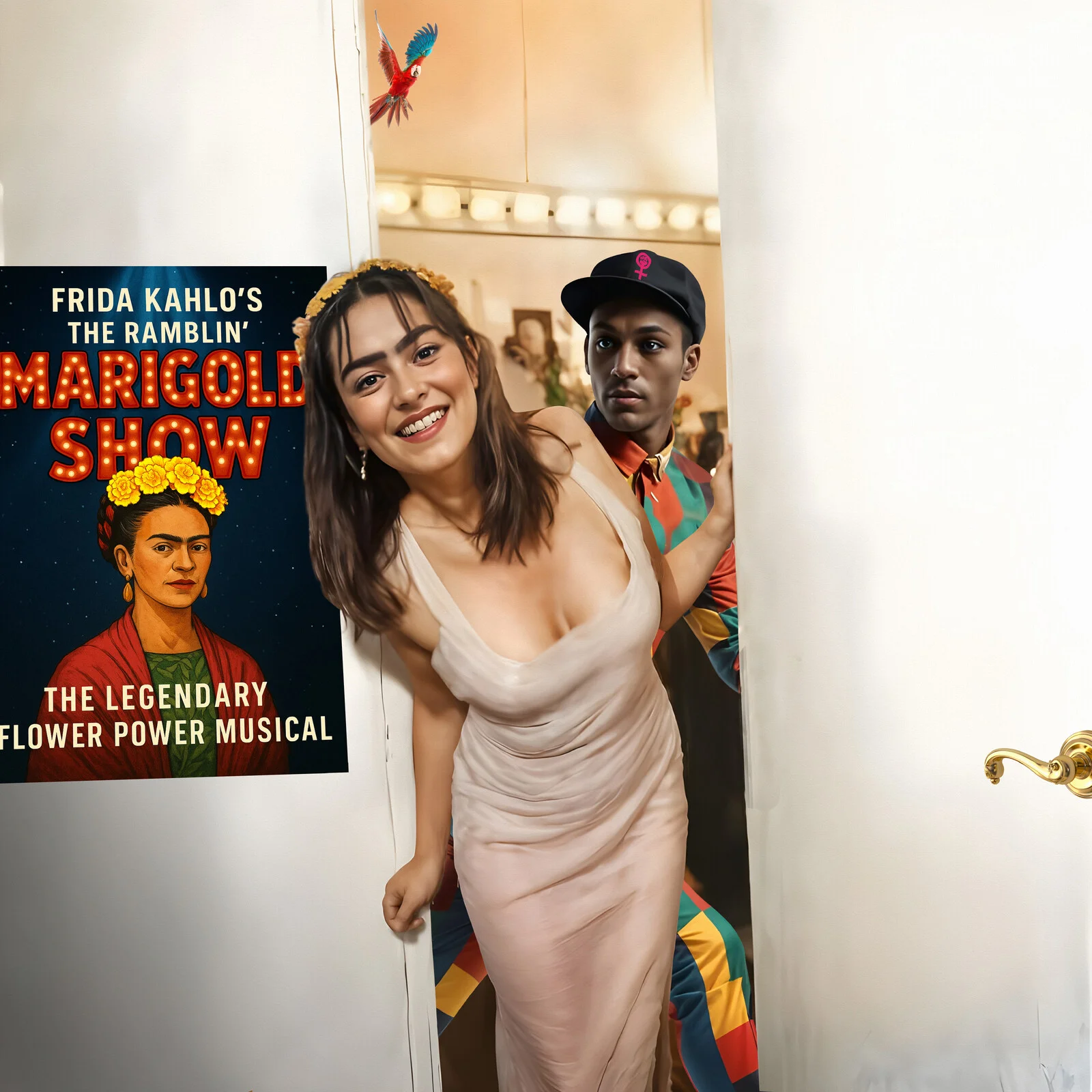
The Ramblin' Marigold Show - Panther Power, 2025
Digital
70 x 70 cm
3 500 kr
The Ramblin' Marigold Show - Panther Power
Panther Power
In a quiet moment of theatrical magic, time folds in on itself. Frida Kahlo, reborn as a 118-year-old Time-Traveller, walks hand in hand with a young Black man whose cap bears the raised fist—feminism’s uncompromising symbol of strength, solidarity, and resistance. Together, they stand on a stage in Malmö, not as characters from the past or present but as emblems of struggle, beauty, age, defiance, and enduring fire.
The raised fist stitched into the man’s hat carries layers of meaning: It belongs to him and to her. It evokes Black Power, feminist revolt, workers’ strikes, and mythic oaths sworn in ancient temples and battlefields. It links gods and revolutionaries, labourers and dreamers, survivors and artists. The fist does not speak softly. It declares: We remember, we resist, we rise, and we are still here, a symbol of enduring relevance in our contemporary world.
This essay traces the journey of that gesture—from its ancient beginnings in religious iconography and classical rhetoric through medieval chivalry, revolutionary banners, the fists of factory workers, Black Panthers, feminist manifestos, and the raised arms of our time. Like Frida and her Afro-American companion on the stage at Nöjesteatern, the fist carries stories that refuse to be silenced. Please learn more about the fist's power and how it connects us to a global narrative of resistance and solidarity.
Raised Fists
“They rise
in silence,
in thunder,
in crowds too loud to name.
They rise
in black and brown and rainbow skin,
in denim jackets and protest pins,
in classrooms, courtrooms, and streets.
They rise
in heatwaves and on ice,
in Gaza, Ferguson, Tehran,
in whispered prayer and roaring chant.
They rise
when truth is silenced,
when names are hashtags,
when eyes burn with salt and sorrow.
They rise
not to strike,
but to stand,
to say: We are still here.
Fists don’t beg.
Fists don’t run.
Fists remember.
Fists become one, a powerful symbol of unity and strength that transcends time and culture.
Malmö 22 April 2025
The Raised Fist – From Ancient Power to Modern Protest
The raised fist, feminism’s powerful symbol, embroidered on the young Black man's cap, is rich with meaning. It refers to both him and Frida, who, as a Time-traveller, has returned to the world of words for a theatrical performance at the Nöjesteatern in Malmö.
Mature women are often called “panthers” – a term that carries layers of meaning: activism, beauty, age, resilience, and here, both Frida’s fire and the young man’s strength. Bringing them together on a Malmö stage feels both poetic and political. And at 118 years old, Frida is indeed a formidable panther – in every sense of the word, and true to her spirit.
The raised, clenched fist is one of the most iconic political gestures of the modern era. Its roots, deeply embedded in classical antiquity, religious ritual, workers' movements, and ultimately feminist resistance, connect us to a rich historical narrative. For the Black Panther Party, founded in 1966 in Oakland, California, the fist symbolised resistance, dignity, and Black power. This deep historical connection makes us part of a narrative that spans centuries and cultures.
Ancient Origins: The Language of the Hand
In ancient Greece and Rome, the human hand was a potent symbol. A closed fist signified determination, strength, and often heroic resolve. Heroes like Heracles were depicted with clenched fists, especially in combat scenes, embodying physical might and divine purpose.
Roman soldiers used clenched fists in ritual gestures before battle, symbolising sacrifice and aggression. Meanwhile, orators in the Senate or public square employed the gesture to emphasise passion, fury, or resolve—a form of rhetorical punctuation. The raised fist in this context was not merely a show of anger but an embodied commitment to principle.
Sacred Power: Religious Symbolism
Clenched fists appear in temple art and statuary in ancient Egypt and Mesopotamia. Deities or kings often hold sceptres or ankhs in closed hands—objects representing power, order, and the continuity of life. In Sumerian reliefs, rulers with raised fists conveyed their earthly power and divine sanction to rule.
Across cultures, the hand took two primary forms: the open hand, which was a gesture of blessing, peace, or offering, and the closed fist, which was a sign of protection, strength, and defiance.
From Knights to Revolutions
During the Middle Ages, knights swore oaths with a raised hand, often open but sometimes clenched, symbolising unshakable intent. By the 18th century, especially during the French Revolution, the fist emerged alongside other symbols of uprising: the bonnet rouge, the guillotine, and the Marseillaise. The raised fist, often depicted on revolutionary flags and banners, hinted at the unity and resolve of the people and their determination to fight for their rights and freedoms.
The Workers' Symbol
In the 19th and early 20th centuries, the clenched fist was adopted by socialist, anarchist, and labour movements. It represented solidarity: the idea that five individual fingers are weak, but together, as a fist, they form something unbreakable. By the 1930s, the fist became common in antifascist iconography, especially in Republican Spain.
The Black Power Salute
The gesture came to global attention during the 1968 Olympics in Mexico City, when athletes Tommie Smith and John Carlos raised their fists during the medal ceremony. This image shocked the world and became immortal.
The Fists That Shook the World
At the 1968 Olympic Games in Mexico City, American sprinters Tommie Smith and John Carlos made history not only by winning medals—Smith won gold and Carlos bronze in the 200 meters—but also by how they stood on the podium. As the U.S. national anthem played, the two athletes bowed their heads and each raised a black-gloved fist in a gesture of defiance, unity, and hope. This moment resonated globally as a powerful symbol of resistance and solidarity.
A moment that stunned the world.
Their protest, part of the Olympic Project for Human Rights, highlighted racial injustice, poverty, and oppression in the United States. Smith wore a black scarf to represent Black pride. Carlos left his tracksuit unzipped in solidarity with working-class people and wore beads to commemorate victims of lynching. Both stood shoeless in black socks, symbolising Black poverty.
Fallout and Misconceptions
Many believe Smith and Carlos were stripped of their medals, but this is not true. They kept their medals, although they were immediately expelled from the Olympic Village and suspended from the U.S. team at the request of the International Olympic Committee (IOC), which claimed they had violated the apolitical nature of the Games.
Back home, they faced fierce backlash. They were vilified in the press, received death threats, and were ostracised from professional opportunities for years. Their lives were marked by hardship after that silent, powerful protest.
Legacy
Over time, their protest became recognised as a brave and historic stand for human rights. They are now widely regarded as civil rights movement icons and early voices of athlete activism.
In 2005, San Jose State University, where both men had trained, unveiled a monumental statue in their honour. Notably, the silver medalist Peter Norman of Australia, who stood on the podium beside them and wore a human rights badge in solidarity, is commemorated with a space—inviting others to stand in for him and what the moment represents.
The gesture expressed more than just anger. It was a stance against institutional racism, police brutality, and social injustice. It communicated dignity, courage, and the will to resist. In the 1960s, the raised Black fist became an unmistakable gesture of Black pride and defiance. The Black Panther Party used it in uniforms, community programs, and armed self-defence.
Feminism and the Fist
In the late 1960s and 1970s, as the second wave of feminism surged, the raised fist reappeared—this time, emerging from the Venus symbol (). A woman's fist, often stylised and clenched within the female symbol, represented women's liberation, bodily autonomy, and collective strength.
This emblem, sometimes drawn with a slightly softened or stylised aesthetic, merged the personal and the political. It declared that women are no longer passive recipients of history—they are agents of change, ready to fight for equality.
In feminist art, protest posters, and grassroots organising, the clenched fist became a means to connect with earlier liberation struggles while asserting a distinct, gendered force. From marches for abortion rights to campaigns against domestic violence, the fist-in-female symbol became a banner of fierce solidarity. It symbolised women's collective strength and determination in their fight for equality and justice.
Legacy
Today, the raised fist continues to be a powerful symbol in global movements. From LGBTQ+ rights to Indigenous sovereignty, climate justice to anti-colonial protests, it transcends time and culture, uniting us in a shared struggle for justice and equality.
The fist's power lies in its defiance and collective gesture – five fingers together, rising in unity. And whether raised in bronze in ancient Rome or protest on the streets of Minneapolis, it speaks the same truth:
We stand together. We will not yield. We will not yield.
The flower resembling a small fist.
Frida Kahlo's favourite flower was the marigold, specifically the Mexican marigold, known as "cempasúchil." This flower holds cultural significance in Mexico and is often associated with Día de los Muertos (Day of the Dead) due to its vibrant colour and strong scent, which are believed to guide the spirits of the deceased back to the living world. Kahlo frequently incorporated marigolds into her artwork and personal style, reflecting her deep connection to Mexican culture and heritage.
Frida painted flowers in her hair to acknowledge her Mexican heritage. Flowers, a symbol of fertility, allowed Frida to express her sorrow as she could not have children. Frida’s paintings served as a great source of therapy and comfort for her, enabling her to work through her compounded grief. When I observe Frida’s paintings, I see a woman who endured much pain, but more importantly, I recognise a woman who was brave, courageous, and honest. Frida had a thirst and a passionate need to know and understand herself completely. Frida’s paintings were a vehicle that allowed her to navigate within herself and reflect internally so that she could face the essence of her true self. Like Vincent, Frida painted passionately, honestly, and without inhibition.
Originally called ‘Cempōhualxōchitl’ by the Nahua peoples, the Mexican marigold's name translates to 'twenty flowers' in English, reflecting the abundance and beauty of this vibrant bloom.
Jörgen Thornberg
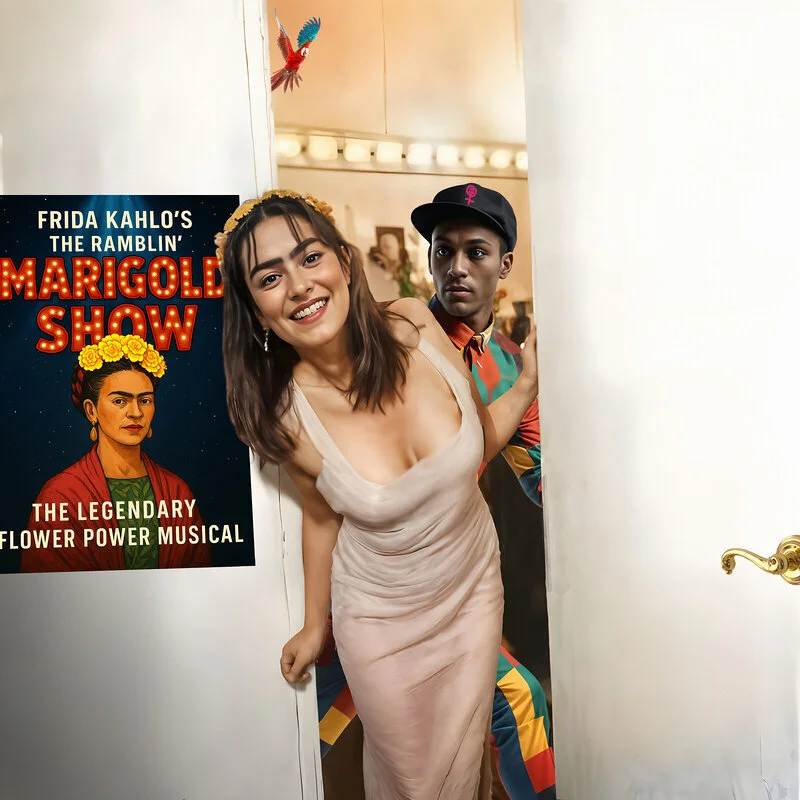
The Ramblin' Marigold Show - Panther Power, 2025
Digital
70 x 70 cm
3 500 kr
The Ramblin' Marigold Show - Panther Power
Panther Power
In a quiet moment of theatrical magic, time folds in on itself. Frida Kahlo, reborn as a 118-year-old Time-Traveller, walks hand in hand with a young Black man whose cap bears the raised fist—feminism’s uncompromising symbol of strength, solidarity, and resistance. Together, they stand on a stage in Malmö, not as characters from the past or present but as emblems of struggle, beauty, age, defiance, and enduring fire.
The raised fist stitched into the man’s hat carries layers of meaning: It belongs to him and to her. It evokes Black Power, feminist revolt, workers’ strikes, and mythic oaths sworn in ancient temples and battlefields. It links gods and revolutionaries, labourers and dreamers, survivors and artists. The fist does not speak softly. It declares: We remember, we resist, we rise, and we are still here, a symbol of enduring relevance in our contemporary world.
This essay traces the journey of that gesture—from its ancient beginnings in religious iconography and classical rhetoric through medieval chivalry, revolutionary banners, the fists of factory workers, Black Panthers, feminist manifestos, and the raised arms of our time. Like Frida and her Afro-American companion on the stage at Nöjesteatern, the fist carries stories that refuse to be silenced. Please learn more about the fist's power and how it connects us to a global narrative of resistance and solidarity.
Raised Fists
“They rise
in silence,
in thunder,
in crowds too loud to name.
They rise
in black and brown and rainbow skin,
in denim jackets and protest pins,
in classrooms, courtrooms, and streets.
They rise
in heatwaves and on ice,
in Gaza, Ferguson, Tehran,
in whispered prayer and roaring chant.
They rise
when truth is silenced,
when names are hashtags,
when eyes burn with salt and sorrow.
They rise
not to strike,
but to stand,
to say: We are still here.
Fists don’t beg.
Fists don’t run.
Fists remember.
Fists become one, a powerful symbol of unity and strength that transcends time and culture.
Malmö 22 April 2025
The Raised Fist – From Ancient Power to Modern Protest
The raised fist, feminism’s powerful symbol, embroidered on the young Black man's cap, is rich with meaning. It refers to both him and Frida, who, as a Time-traveller, has returned to the world of words for a theatrical performance at the Nöjesteatern in Malmö.
Mature women are often called “panthers” – a term that carries layers of meaning: activism, beauty, age, resilience, and here, both Frida’s fire and the young man’s strength. Bringing them together on a Malmö stage feels both poetic and political. And at 118 years old, Frida is indeed a formidable panther – in every sense of the word, and true to her spirit.
The raised, clenched fist is one of the most iconic political gestures of the modern era. Its roots, deeply embedded in classical antiquity, religious ritual, workers' movements, and ultimately feminist resistance, connect us to a rich historical narrative. For the Black Panther Party, founded in 1966 in Oakland, California, the fist symbolised resistance, dignity, and Black power. This deep historical connection makes us part of a narrative that spans centuries and cultures.
Ancient Origins: The Language of the Hand
In ancient Greece and Rome, the human hand was a potent symbol. A closed fist signified determination, strength, and often heroic resolve. Heroes like Heracles were depicted with clenched fists, especially in combat scenes, embodying physical might and divine purpose.
Roman soldiers used clenched fists in ritual gestures before battle, symbolising sacrifice and aggression. Meanwhile, orators in the Senate or public square employed the gesture to emphasise passion, fury, or resolve—a form of rhetorical punctuation. The raised fist in this context was not merely a show of anger but an embodied commitment to principle.
Sacred Power: Religious Symbolism
Clenched fists appear in temple art and statuary in ancient Egypt and Mesopotamia. Deities or kings often hold sceptres or ankhs in closed hands—objects representing power, order, and the continuity of life. In Sumerian reliefs, rulers with raised fists conveyed their earthly power and divine sanction to rule.
Across cultures, the hand took two primary forms: the open hand, which was a gesture of blessing, peace, or offering, and the closed fist, which was a sign of protection, strength, and defiance.
From Knights to Revolutions
During the Middle Ages, knights swore oaths with a raised hand, often open but sometimes clenched, symbolising unshakable intent. By the 18th century, especially during the French Revolution, the fist emerged alongside other symbols of uprising: the bonnet rouge, the guillotine, and the Marseillaise. The raised fist, often depicted on revolutionary flags and banners, hinted at the unity and resolve of the people and their determination to fight for their rights and freedoms.
The Workers' Symbol
In the 19th and early 20th centuries, the clenched fist was adopted by socialist, anarchist, and labour movements. It represented solidarity: the idea that five individual fingers are weak, but together, as a fist, they form something unbreakable. By the 1930s, the fist became common in antifascist iconography, especially in Republican Spain.
The Black Power Salute
The gesture came to global attention during the 1968 Olympics in Mexico City, when athletes Tommie Smith and John Carlos raised their fists during the medal ceremony. This image shocked the world and became immortal.
The Fists That Shook the World
At the 1968 Olympic Games in Mexico City, American sprinters Tommie Smith and John Carlos made history not only by winning medals—Smith won gold and Carlos bronze in the 200 meters—but also by how they stood on the podium. As the U.S. national anthem played, the two athletes bowed their heads and each raised a black-gloved fist in a gesture of defiance, unity, and hope. This moment resonated globally as a powerful symbol of resistance and solidarity.
A moment that stunned the world.
Their protest, part of the Olympic Project for Human Rights, highlighted racial injustice, poverty, and oppression in the United States. Smith wore a black scarf to represent Black pride. Carlos left his tracksuit unzipped in solidarity with working-class people and wore beads to commemorate victims of lynching. Both stood shoeless in black socks, symbolising Black poverty.
Fallout and Misconceptions
Many believe Smith and Carlos were stripped of their medals, but this is not true. They kept their medals, although they were immediately expelled from the Olympic Village and suspended from the U.S. team at the request of the International Olympic Committee (IOC), which claimed they had violated the apolitical nature of the Games.
Back home, they faced fierce backlash. They were vilified in the press, received death threats, and were ostracised from professional opportunities for years. Their lives were marked by hardship after that silent, powerful protest.
Legacy
Over time, their protest became recognised as a brave and historic stand for human rights. They are now widely regarded as civil rights movement icons and early voices of athlete activism.
In 2005, San Jose State University, where both men had trained, unveiled a monumental statue in their honour. Notably, the silver medalist Peter Norman of Australia, who stood on the podium beside them and wore a human rights badge in solidarity, is commemorated with a space—inviting others to stand in for him and what the moment represents.
The gesture expressed more than just anger. It was a stance against institutional racism, police brutality, and social injustice. It communicated dignity, courage, and the will to resist. In the 1960s, the raised Black fist became an unmistakable gesture of Black pride and defiance. The Black Panther Party used it in uniforms, community programs, and armed self-defence.
Feminism and the Fist
In the late 1960s and 1970s, as the second wave of feminism surged, the raised fist reappeared—this time, emerging from the Venus symbol (). A woman's fist, often stylised and clenched within the female symbol, represented women's liberation, bodily autonomy, and collective strength.
This emblem, sometimes drawn with a slightly softened or stylised aesthetic, merged the personal and the political. It declared that women are no longer passive recipients of history—they are agents of change, ready to fight for equality.
In feminist art, protest posters, and grassroots organising, the clenched fist became a means to connect with earlier liberation struggles while asserting a distinct, gendered force. From marches for abortion rights to campaigns against domestic violence, the fist-in-female symbol became a banner of fierce solidarity. It symbolised women's collective strength and determination in their fight for equality and justice.
Legacy
Today, the raised fist continues to be a powerful symbol in global movements. From LGBTQ+ rights to Indigenous sovereignty, climate justice to anti-colonial protests, it transcends time and culture, uniting us in a shared struggle for justice and equality.
The fist's power lies in its defiance and collective gesture – five fingers together, rising in unity. And whether raised in bronze in ancient Rome or protest on the streets of Minneapolis, it speaks the same truth:
We stand together. We will not yield. We will not yield.
The flower resembling a small fist.
Frida Kahlo's favourite flower was the marigold, specifically the Mexican marigold, known as "cempasúchil." This flower holds cultural significance in Mexico and is often associated with Día de los Muertos (Day of the Dead) due to its vibrant colour and strong scent, which are believed to guide the spirits of the deceased back to the living world. Kahlo frequently incorporated marigolds into her artwork and personal style, reflecting her deep connection to Mexican culture and heritage.
Frida painted flowers in her hair to acknowledge her Mexican heritage. Flowers, a symbol of fertility, allowed Frida to express her sorrow as she could not have children. Frida’s paintings served as a great source of therapy and comfort for her, enabling her to work through her compounded grief. When I observe Frida’s paintings, I see a woman who endured much pain, but more importantly, I recognise a woman who was brave, courageous, and honest. Frida had a thirst and a passionate need to know and understand herself completely. Frida’s paintings were a vehicle that allowed her to navigate within herself and reflect internally so that she could face the essence of her true self. Like Vincent, Frida painted passionately, honestly, and without inhibition.
Originally called ‘Cempōhualxōchitl’ by the Nahua peoples, the Mexican marigold's name translates to 'twenty flowers' in English, reflecting the abundance and beauty of this vibrant bloom.
3 500 kr

Jörgen Thornberg
Malmö
Lite om bilder och mig. Translation in English at the end.
Jag är en nyfiken person som ser allt i bilder, även det jag fäster i ord, gärna tillsammans för bakom alla mina bilder finns en berättelse. Till vissa bilder hör en kortare eller längre novell som följer med bilden.
Bilder berättar historier. Jag omges av naturlig skönhet, intressanta människor och historia var jag än går. Jag använder min kamera för att dokumentera världen och blanda det jag ser med vad jag känner för att fånga den dolda magin.
Mina bilder berättar mina historier. Genom mina bilder, tryck och berättelser. Jag bjuder in dig att ta del av dessa berättelser, in i ditt liv och hem och dela min mycket personliga syn på vår värld. Mer än vad ögat ser. Jag tänker i bilder, drömmer och skriver och pratar om dem; följaktligen måste jag också skapa bilder. De blir vad jag ser, inte nödvändigtvis begränsade till verkligheten. Det finns en bild runt varje hörn. Jag hoppas att du kommer att se vad jag såg och gilla det.
Jag är också en skrivande person och till många bilder hör en kortare eller längre essay. Den följer med tavlan, tryckt på fint papper och med en personlig hälsning från mig.
Flertalet bilder startar sin resa i min kamera. Enkelt förklarat beskriver jag bilden jag ser i mitt inre, upplevd eller fantiserad. Bilden uppstår inom mig redan innan jag fått okularet till ögat. På bråkdelen av ett ögonblick ser jag vad jag vill ha och vad som kan göras med bilden. Här skall jag stoppa in en giraff, stålmannen, Titanic eller vad det är min fantasi finner ut. Ännu märkligare är att jag kommer ihåg minnesbilden långt efteråt när det blir tid att skapa verket. Om jag lyckas eller inte, är upp till betraktaren, oftast präglat av en stråk av svart humor – meningen är att man skall bli underhållen. Mina bilder blir ofta en snackis där de hänger.
Jag föredrar bilder som förmedlar ett budskap i flera lager. Vid första anblicken fylld av feel-good, en vacker utsikt, fint väder, solen skiner, blommor på ängen eller vattnet som ligger förrädiskt spegelblankt. I en sådan bild kan jag gömma min egentliga berättelse, mitt förakt för förtryckare och våldsverkare, rasister och fördomsfulla människor - ett gärna återkommande motiv mer eller mindre dolt i det vackra motivet. Jag försöker förena dem i ett gemensamt narrativ.
Bild och formgivning har löpt som en röd tråd genom livet. Fotokonst känns som en värdig final som jag gärna delar med mig.
Min genre är vid som framgår av mina bilder, temat en blandning av pop- och gatukonst i kollage som kan bestå av hundratals lager. Vissa bilder kan ta veckor, andra någon dag innan det är dags att överlämna resultatet till printverkstaden. Fine Art Prints är digitala fotocollage. I dessa kollage sker rivandet, klippandet, pusslandet, målandet, ritandet och sprayningen digitalt. Det jag monterar in kan vara hundratals år gamla bilder som jag omsorgsfullt frilägger så att de ser ut att vara en del av tavlan men också bilder skapade av mig själv efter min egen fantasi. Därefter besöks printstudion och för vissa bilder numrera en limiterad upplaga (oftast 7 exemplar) och signera för hand. Vissa bilder kan köpas i olika format. Det är bara att fråga efter vilka. Gillar man en bild som är 70x100 men inte har plats på väggen, går den kanske att få i 50x70 cm istället. Frågan är fri.
Metoden Giclée eller Fine Art Print som det också kallas är det moderna sättet för framställning av grafisk konst. Villkoret för denna typ av utskrifter är att en högkvalitativ storformatskrivare används med åldersbeständigt färgpigment och konstnärspapper eller i förekommande fall på duk. Pappret som används möter de krav på livslängd som ställs av museer och gallerier. Normalt säljer jag mina bilder oinramade så att den nya ägaren själv kan bestämma hur de skall se ut, med eller utan passepartout färg på ram, med eller utan glas etc..
Under många år ställde jag bara ut på nätet, i valda grupper och på min egen Facebooksida - https://www.facebook.com/jorgen.thornberg.9
Jag finns också på en egen hemsida som tyvärr inte alltid är uppdaterad – https://www.jth.life/ Där kan du också läsa en del av de berättelser som följer med bilden.
UTSTÄLLNINGAR
Luftkastellet, oktober 2022
Konst i Lund, november 2022
Luftkastellet, mars 2023
Engleson Galleri Caroli, april 2023
Hydra, Greece June 2023
Engleson Galleri Caroli, oktober 2023
Toppen, Höllviken december 2023
Luftkastellet, mars 2024
Torups Galleri, mars 2024
Venice, May 2024
Luftkastellet, oktober 2024
Konst i Advent, December 2024
Galleri Engleson, Caroli December 2024
Jäger & Jansson Galleri, april 2025
A bit about pictures and me.
I'm a curious person who sees everything in pictures, even what I express in words, often combining them, for behind all my pictures lies a story. These narratives, some as short as a single image and others as long as a novel, are the heart and soul of my work.
Pictures tell stories. Wherever I go, I'm surrounded by natural beauty, exciting people, and history. I use my camera to document the world and blend what I see with what I feel to capture the hidden magic.
My images tell my stories. Through my pictures, prints, and narratives, I invite you to partake in these stories in your life and home and share my deeply personal perspective of our world. More than meets the eye. I think in pictures, dream, write, and talk about them; consequently, I must create images too. They become what I see, not necessarily confined to reality. There's a picture around every corner. I hope you'll see what I saw and enjoy it.
I'm also a writer, and many images come with a shorter or longer essay. It accompanies the painting, printed on fine paper with my personal greeting.
Many pictures start their journey on my camera. Simply put, I describe the image I see in my mind, experienced or imagined. The image arises within me even before I bring the eyepiece to my eye. In a fraction of a moment, I see what I want and what can be done with the picture. Here, I'll insert a giraffe, Superman, the Titanic, or whatever my imagination conjures up. Even stranger is that I remember the mental image long after it's time to create the work. Whether I succeed is up to the observer, often imbued with a streak of black humour – the aim is to entertain. My pictures usually become a talking point wherever they hang.
I prefer pictures that convey a message in multiple layers. At first glance, they're filled with feel-good vibes, a beautiful view, lovely weather, the sun shining, flowers in the meadow, or the water lying deceptively calm. But beneath this surface beauty, I often conceal a deeper story, a narrative that challenges societal norms or explores the human condition. I invite you to delve into these hidden narratives and discover the layers of meaning within my work.
Picture and design have been a thread running through my life. Photographic art feels like a fitting finale, and I'm happy to share it.
My genre is varied, as seen in my pictures; the theme is a blend of pop and street art in collages that can consist of hundreds of layers. Some images can take weeks, others just a day before it's time to hand over the result to the print workshop. Fine Art Prints are digital photo collages. In these collages, tearing, cutting, puzzling, painting, drawing, and spraying happen digitally. What I insert can be images hundreds of years old that I carefully extract so they appear to be part of the painting, but also images created by myself, now also generated from my imagination. Next, visit the print studio and, for certain images, number a limited edition (usually 7 copies) and sign them by hand. Some images may be available in other formats. Just ask which ones. If you like an image that's 70x100 but doesn't have space on the wall, you might be able to get it in 50x70 cm instead. The question is open.
The Giclée method, or Fine Art Print as it's also called, is the modern way of producing graphic art. This method ensures the highest quality and longevity of the artwork, using a high-quality large-format printer with archival pigment inks and artist paper or, in some cases, canvas. The paper used meets the longevity requirements set by museums and galleries. I sell my pictures unframed, allowing the new owner to personalise their artwork, confident in the lasting value and quality of the piece.
For many years, I only exhibited online, in selected groups, and on my Facebook page - https://www.facebook.com/jorgen.thornberg.9. I also have my website, which unfortunately is not constantly updated - https://www.jth.life/. You can also read some of the stories accompanying the pictures there.
EXHIBITIONS
Luftkastellet, October 2022
Art in Lund, November 2022
Luftkastellet, March 2023
Engleson Gallery Caroli, April 2023
Hydra, Greece June 2023
Engleson Gallery Caroli, October 2023
Toppen, Höllviken December 2023
Luftkastellet, March 2024
Torup Gallery, March 2024
Venice, May 2024
UTSTÄLLNINGAR
Luftkastellet, oktober 2022
Konst i Lund, november 2022
Luftkastellet, mars 2023
Engleson Galleri Caroli, april 2023
Hydra, Greece June 2023
Engleson Galleri Caroli, oktober 2023
Toppen, Höllviken december 2023
Luftkastellet, mars 2024
Torups Galleri, mars 2024
Venice, May 2024
Luftkastellet, October 2024
Konst i Advent, December 2024
Galleri Engleson, Caroli December 2024
Jäger & Jansson Galleri, April 2025
Utbildning
Autodidakt
Medlem i konstnärsförening
Öppna Sinnen
Med i konstrunda
Konstrundan i Skåne
Utställningar
Luftkastellet, October 2022
Art in Lund, November 2022
Luftkastellet, March 2023
Engleson Gallery Caroli, April 2023
Hydra, Greece June 2023
Engleson Gallery Caroli, October 2023
Toppen, Höllviken December 2023
Luftkastellet, March 2024
Torup Gallery, March 2024
Venice, May 2024