Vi använder cookies för att ge dig bästa möjliga upplevelse. Välj vilka cookies du tillåter.
Läs mer i vår integritetspolicy
Jörgen Thornberg
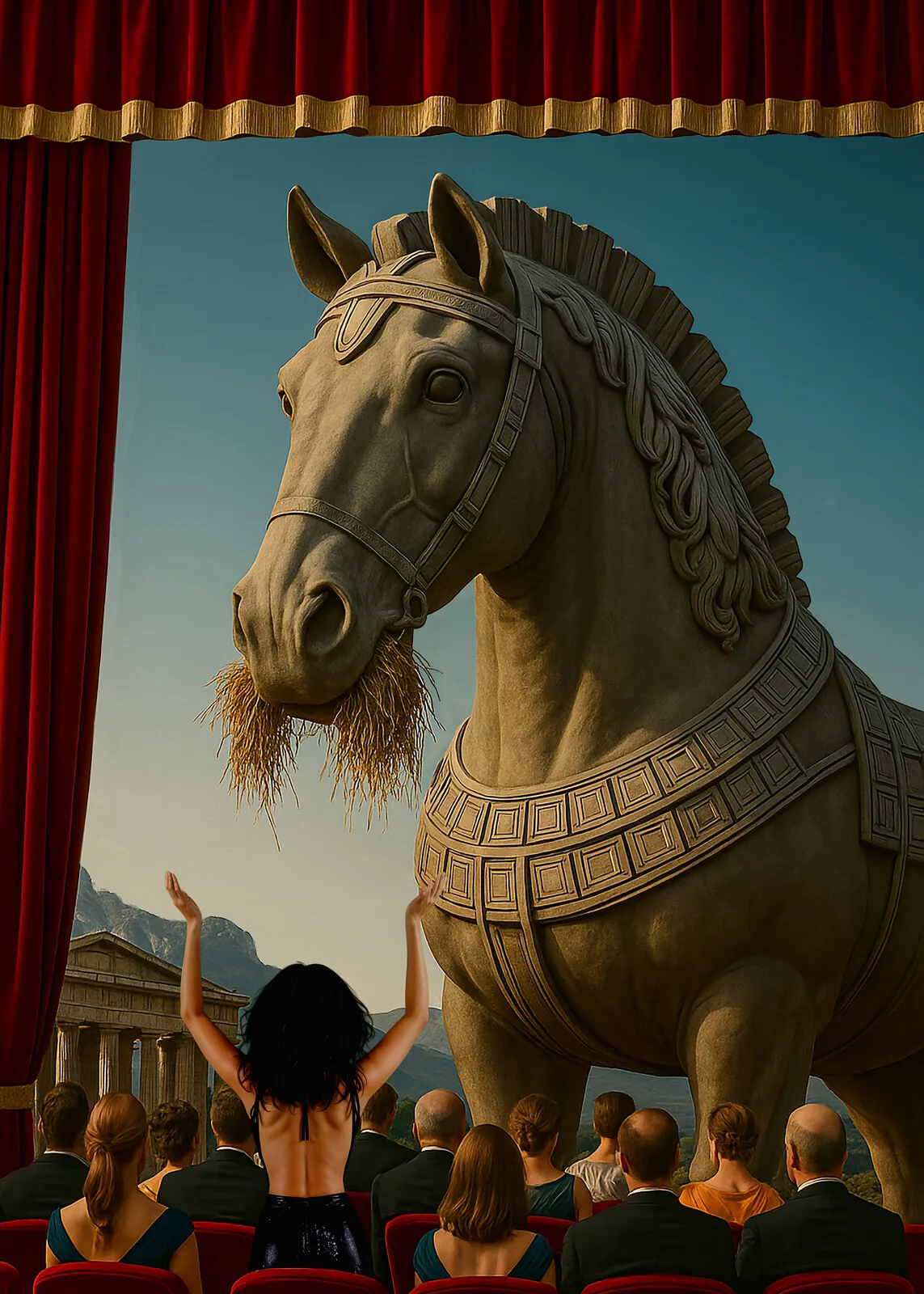
Last Fan Standing, 2025
Digital
80 x 80 cm
3 200 kr
Last Fan Standing
Come for the mystery. Stay for the wine, the laughter, and the stories only old friends dare to share.
In this midnight gathering of memories—over red wine, tiramisu, and the ghost of a galloping horse—three women trace the arc from Sherlock Holmes to snug denim and the kinds of adventures that don’t always make it into polite conversation. From clever dogs who don't bark to cowboys who most certainly do, this isn’t just a tale about horses.
It’s about trust, touch, timing—and knowing when to get off the saddle.
Click below to join the conversation, remember your own wild ride, or listen in as the night grows quiet and the innkeeper fumbles for his pyjamas.
Last Fan Standing
Three women. One bottle of red. A wooden horse, an operetta, a silent dog—and a riding lesson no one ever forgets.
It all starts after dessert, with laughter lingering from a delightfully absurd operetta featuring a lovesick soldier and a prancing wooden horse. But as the glasses refill and the night deepens, talk turns to Sherlock Holmes, a missing racehorse, and the quiet power of a dog who didn't bark.
From there, it's only a short trot to real horses, youthful crushes, and the saddle scene that stays with you, not for its elegance, but for where his hand landed.
Pull up a chair. The clock may be creeping past one, but the stories are improving. And no, the innkeeper is not a sexy cowboy.
“Riding Lesson
It began with a horse, hollow and wooden,
rolled into Troy on wheels and wishful thinking.
The city slept.
Desire always does its best work at night.
Centuries later, I climbed into the saddle
not of war, but of weekend leisure—
boots, reins,
and denim that fit like secrets.
The cowboy said I bounced too much.
He was charming in a banker's kind of way,
smelled like leather and long-term investment.
"Forward," he said.
"More."
His hand on the horn,
the other trailing down my back
like history repeating itself.
The pressure against my hips—
a slow, persuasive push
until denim and skin were
no longer sure who they belonged to.
I squirmed.
He grinned.
I made a joke about saddle balance.
He offered to test the theory.
His theory was unsound.
My exit, swift.
There are horses we ride,
and horses we dismount.
Some are made of wood,
some of muscle and bad timing.
Either way,
they leave a mark.”
Malmö May 2025
Last Fan Standing
It was a spring night in Malmö. Marissa had been to Nöjesteatern with two of her close friends, Lena and Marit—well-educated women with fine careers like hers. But unlike Marissa, they weren’t quite as deeply connected to the past. Then again, they weren’t Greek. They were from Landskrona. All three had ridden horses as girls and practically lived in the stable. Not anymore. Their professional lives didn’t allow it. But the memories remained, and that’s what they were talking about later that night as they shared a simple pizza dinner at Far i Hatten, just across from Nöjesteatern in Folkets Park, five minutes on foot. The pizza was topped with crème fraîche, fresh ramsons, parmesan, Brie de Meaux, chili oil, and toasted pine nuts. The pizza was topped with crème fraîche, fresh ramsons, parmesan, Brie de Meaux, chili oil, and toasted pine nuts. The wine was a Barbera d’Alba from Piemonte. No Greek wine—but it would do. In that moment, they all felt a deep sense of belonging, sharing their experiences and memories of the equestrian world.
Marit: The appearance of the Trojan Horse was quite a surprise, wasn't it?
Lena: Offenbach would’ve raised an eyebrow. Or loved it. Hard to tell with him.
Marissa (with a bright smile): He would’ve laughed, as he always did. But the music tonight? It felt like a fresh breeze. That overture, that barcarolle—it sparkled like chilled prosecco.
Marit: La Belle Hélène is such a treat. Witty, shameless, flirtatious. And now, with the Horse!
Lena: Didn’t see that one coming. Third act, and suddenly we’re in Homer instead of Horace.
Marissa: Yes—but don’t forget, La Belle Hélène is all prelude to the Trojan War. Paris steals Helen. Menelaus fumes. The gods bicker. It’s the amuse-bouche before the siege.
Marit: And Offenbach being Offenbach, everyone’s having affairs and singing about figs.
Marissa: He wrote it in 1864, you know. A burlesque on virtue and empire. Satire wrapped in silk.
Lena: But tell me—what did you feel when the horse rolled on stage?
Marissa (softly): Ancient recognition. Three thousand years, and it still pulls me in. That moment of deception. The quiet before the gates swing wide. It’s in my bones.
Marit: That’s your Greek blood talking.
Marissa: Diaspora, yes. But yes. At home, the myths were real. Homer wasn’t literature—he was family history.
Lena: We had Wallander.
(They all laugh.)
But really, horses. It struck me today how different their symbolism is now. Back then, only men rode. Horses meant war. This reflects how gender roles have evolved in the equestrian world, a shift worth contemplating.
Marissa: Exactly. Women had the cows and the sheep. Men had the horses and the swords. You didn’t take your mare into battle if you were a girl.
Lena: Fast forward to now: it’s mostly girls in the saddle.
Marit: Riding schools are full of them. Fewer boys every year.
The cultural claim shifted once the horse lost its role in transport, agriculture, and war. Boys drifted to engines. Girls stayed. And once trousers became standard wear for women, riding was no longer an acrobatic art on a sidesaddle. This shift in the horse-riding community reflects broader societal changes in gender roles and expectations.
Lena: Racing’s still male-dominated, though.
Marissa: Trotting, yes. Gallop is more balanced. Women are everywhere—trainers, jockeys, owners. Jessica Long winning the Danish Derby with Benny Andersson’s Ready Teddy wasn’t a fluke. It’s a movement.
Marit: And the shift started decades ago. Remember the 1956 Olympics in Stockholm? The British team brought female grooms. Swedish journalists nearly fainted. "Despite being so cute, they could handle the horses!" they wrote—all male journalists, of course.
Lena: And ex-military men started riding schools in Sweden post-war.
Marissa: By the ’60s, girls overran the stalls. I was eight in 1986 when I mounted my first pony. By then, it was already a girls’ kingdom, built on a military structure—hierarchies, mentors, discipline.
Marit: The clothes?
Marissa: Functional. Worn. Hand-me-downs. You went to the stables in what was too ruined for school. No one had matching breeches and jackets. We buried our feet in manure heaps in winter for warmth. Hygienic? No. Effective? Yes.
Lena: And strong.
Marissa: We learned to stack hay bales, pull water buckets, and wheel 130-litre barrows across the mud. We could drive trailers before we had licenses. We could balance a 15-kilo saddle above our heads. That training never leaves you.
Marit: That explains why we’re all bosses.
Lena: Yeah, not much fazes a woman who’s stared down a rogue gelding.
Marissa: Or backed a trailer uphill in the snow.
Marit: And the boys?
Marissa: They don’t know what to do with us. You can’t impress a girl who can punch a half-ton horse into line.
Lena: Or stare one down with a raised eyebrow.
Marit: In the stable, the girls took space. They learned leadership and commitment. If you promised the night shift, you didn’t bail. You biked in the snow, fed the horses, and mucked out. And all you got? Maybe an extra riding lesson.
But those girls? Many became CEOs like us. We lead because we learned. The leadership and commitment we developed in the stables have shaped us into the strong, capable women we are today.
Lena: Amen! Today’s stables are different, though.
Marissa: Much. Fewer riding schools, less volunteering, more paying, and less hanging out. Kids expect service. They want medals, not mucking.
Marit: And boys?
Marissa: Some feel awkward. Everything’s pink, and the gear’s designed for girls. Outside the stable, they get mocked. "Ballet for horse girls." That sort of thing. But inside? The stable is a sanctuary. Equal footing. Literally.
Lena: I’ve seen a grown man hide behind a twelve-year-old with a Shetland pony.
Marissa: So have I.
Marit: And those girls? The ones who held pitchforks at fifteen? They run things now. Not always visibly, but structurally. They’ve been trained in responsibility from the manure pile up.
Marissa: We should put "Head girl in the stable" on our CVs. But it only counts if the person reading it has manure memories too.
Marit: Today’s riding culture is changing. But the backbone remains.
Marissa: It’s the strongest soft power I know.
Lena: And the horse tonight?
Marissa (smiling): Not just a prop. A symbol. A memory. A friend. The horse was always with us. Inside the city. Waiting.
Marit: Like Helen?
Marissa: No. Like us. Carved out of the past. Painted new. Still rolling forward.
They sip their wine. The lights in the park glow. A gentle night hums around them. No buses tonight. Just the hush of memory.
Marit: Horses are such wise animals. I miss them. Haven’t ridden in fifteen years.
Lena: Same here. And apart from tonight, I haven’t even talked about horses in years. Strange. They used to be everything. Back then, it felt like they were everywhere.
Marissa: Funny you mention it—I saw a horse the other week. The star of one of Conan Doyle’s Sherlock Holmes stories. It was on TV, on Channel Five.
Marit: He is clever.
Lena: And handsome. Sherlock. I love him.
Marit: Benedict Cumberbatch’s version has become iconic. His intelligence, charisma, and unique looks have made him a favourite with many female viewers, not just me.
Lena: Agree.
Marissa: No, this was an older series, one of those rerun-of-a-rerun things. The Case-Book of Sherlock Holmes, early ’90s. Jeremy Brett played Sherlock. His portrayal is considered one of the most faithful and acclaimed versions. And he didn’t look half bad either.
Marit: I don’t remember that one. And no Sherlock story with a horse.
Lena: No horse rings a bell for me either. Just that dreadful Hound of the Baskervilles. That thing was creepy.
Marit: Tell us about it—maybe it’ll jog our memory.
Marissa: The episode I saw was called The Adventure of Silver Blaze—one of the 56 original Sherlock Holmes stories. The murderer wasn’t the butler, as the joke usually goes—it was the horse. “The butler did it.” A cliché, yes, but one with a kernel of truth. Because it was really the horse.
Lena: “The butler did it.” One of the most overused lines in crime fiction is a running joke among readers and writers. A wink to a time when country house murders, British titles, and afternoon tea were standard backdrops for homicide. In its most parodic form, the butler stands there with a bloody candlestick and a vacant expression—until Poirot, Miss Marple, or some other clever soul points dramatically and says: Mais oui! But behind the cliché lies something real.
Marissa: Most crimes—especially murders—are insider jobs. They’re not committed by strangers climbing in through the window, but by people already inside. Someone with a key. Someone who knows where the poison is kept. Someone who raises no suspicions.
Marit: I have read that criminology, court records, and statistics all tell the same story: the killer is usually someone the victim knew—a spouse, a friend, a coworker. The same goes for financial crime. The one stealing from the company isn’t usually some hacker in Ukraine—it’s the accountant down the hall—the one with the passwords.
Marissa: So, when the butler stands there—polite, reserved, seemingly neutral—it’s not so strange that fiction (and sometimes reality) ends up pointing the finger at him. Or her. Or whoever was “just doing their job.”
We laugh at the phrase. But we also know: most crimes come from the inside. Always someone who was already there. Just like with the horse, Silver Blaze, who went missing
Lena: Thrilling! You can't just dangle it in front of us like that. Come on—tell us everything!
Marissa (smiling, raising her glass): All right then. Sherlock Holmes and the Case of the Silent Dog.
It all begins with a train ride, as so many things do. Holmes and Watson are headed to Dartmoor—bleak, windswept, horse- breath- chilled Dartmoor—to investigate two pressing equestrian matters: the disappearance of the famous racehorse Silver Blaze and the death of his trainer, poor John Straker. The tension is palpable as they delve into this mysterious case.
Marit (half a laugh): “Horse- breath- chilled.” You do have a way with words.
Marissa: It was atmospheric. They arrive at King's Pyland, the racing stables, where the horse vanished into the moor, leaving behind a corpse, a tangle of hoofprints, and many befuddled police officers. Suspicion quickly falls on Fitzroy Simpson—a bookmaker suspiciously fond of late-night visits to other people's horses.
He had crept under the cover of darkness, bothering the maid, pestering the stable boy, and snooping around the yard. And then—Straker dead, Silver Blaze missing. Simpson's arrest—an easy conclusion. Too easy. But there's more to Simpson than meets the eye. A bookmaker with a shady past, he was known for his suspiciously fond late-night visits to other people's horses.
Lena (narrowing her eyes, reaching for the wine bottle): But not for Holmes.
Marissa: Never for Holmes. He finds the whole thing preposterous. Why would Simpson lure a famous, irreplaceable horse onto the moor to harm it? That's like trying to mug the Queen in full daylight. He couldn't sell or hide it—every bootboy from Devon to Yorkshire knew that horse by sight. The sheer disbelief in the room is palpable.
So, Holmes follows a trail—hoofprints and footprints, faint but present. He finds the horse. Alive. Hidden in a neighbouring barn. Dyed to disguise him, but unmistakably Silver Blaze. This unexpected twist in the investigation leaves everyone, including Holmes, in awe.
Marit (with mock horror): They dyed the horse?
Marissa (grinning): Silas Brown. A twitchy fellow with more fear than sense. He found the horse wandering and panicked, thinking he would be blamed. So, he covered up the white blaze with dye and hid him.
But the murder- that’s the true tangle. Straker had been found with his skull smashed in. Simpson’s cane was blamed, and his cravat, ripped, was found in Straker’s clenched hand. But Holmes noticed other details: a carefully folded coat and a surgical knife- not a weapon, but a cataract knife for eye operations. And Straker himself had a wound on his thigh: self-inflicted.
Lena: What on earth was he doing out there?
Marissa: Sabotage. That’s the twist. Straker was moonlighting as “William Derbyshire,” buying extravagant dresses for a mistress. He needed cash, so he injured Silver Blaze just enough to lose the race—and then bet against him.
He had been practising on sheep, explaining why the shepherd’s flock had turned lame. But Silver Blaze panicked and kicked back when he tried to nick the horse’s tendon with that delicate knife. One blow. Killed him instantly.
Marit: So the horse was the killer?
Marissa (nodding): Technically, yes. Though without intent. He defended himself. Holmes even lets the race go ahead without telling the owner. Silver Blaze wins the Wessex Cup in disguise, and only afterwards does Holmes reveal that the champion was never missing.
Lena (shaking her head, delighted): That’s a brilliant twist. The horse wins the race and solves the case.
Marissa (raising her glass): To the real hero—Silver Blaze. Unwitting avenger. Silent witness. Champion with a kick to kill.
Marit (laughing): And to the dog. The dog that didn’t bark.
Lena: Yes! The silent dog, the sheep, the curry, the mistress with expensive taste. It’s like a gothic opera. But with mutton.
Marissa: And with Holmes, tying it all together from a curious silence. That, my friends, is why we still read him.
Marita: Did I ever tell you why I stopped riding?
Marissa: Not that I can remember.
Lena: Then now’s your moment. Don’t hold out on us.
Marita (takes a sip of wine, half-smiling): There was this guy at the stables. I flirted with him because he was cute—a real cowboy. It was my last year in Lund. I must’ve been twenty-five, and he was a few years older; an experienced rider for once. He worked in banking and claimed he would get rich.
We had to wear boots and jeans for riding, and that morning, I wore these thin denim jeans—really snug. We started on the trail, and after a while, the cowboy pulled my horse to the side and told me I was bouncing too much in the saddle. He had me lean forward and stand slightly in the stirrups.
Then he returned, placing one hand around the horn of the western saddle and the other on the small of my back. He instructed me to move forward as far as I could. I could.
And then... he slid his hand down my back, pressed against my ass, and pushed me forward—hard—into his other hand on the saddle horn.
The denim was so thin I felt everything. His palm cupped my mound. And then he pushed again—his fingers slid right along my outer lips.
Lena (soft gasp): Whoa.
Marita: I was kind of... agog. I started squirming against his hand, not knowing what I was doing. And he said, “You won’t stay in the saddle if you keep moving like that.”
And I shot back, “Would you be able to stay in the saddle if I kept moving like that?”
Marissa (wide-eyed, half-laughing): Oh my God!
Marita: He just smiled—this adorable, mischievous smile—and said he’d be willing to try.
Lena (leaning in): Did he get hard?
Marita (with a little grin): Yeah. He did.
Marissa: So then what?
Marita: Nothing. I stopped riding—cold turkey. I didn’t want to risk seeing him again. Something might’ve happened. And sure, he was sexy—but honestly, he wasn't my type. I had a lot of opinions about the finance world. Still do, as you know.
Lena: Oh, we know. Thank God you didn’t end up with some startup cowboy in tight jeans and a pension plan.
Marissa (raising her glass): Knowing when to get off the horse.
Marita (laughing): Exactly.
Lena (glancing at her phone): Next time I’ll tell you about my little adventure—but it’s past one already, and any minute now the innkeeper’s going to walk in wearing pyjamas.
They all laughed—harsh, unfiltered—because the innkeeper was no sexy cowboy.
Jörgen Thornberg
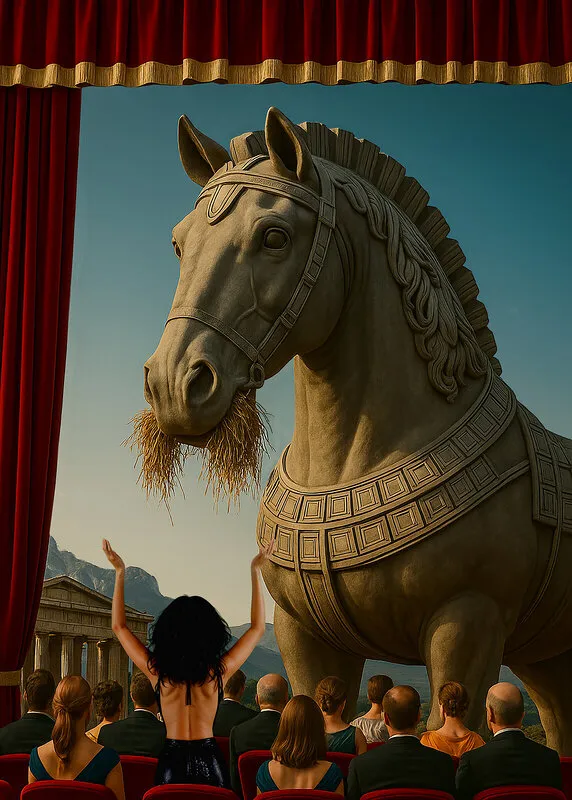
Last Fan Standing, 2025
Digital
80 x 80 cm
3 200 kr
Last Fan Standing
Come for the mystery. Stay for the wine, the laughter, and the stories only old friends dare to share.
In this midnight gathering of memories—over red wine, tiramisu, and the ghost of a galloping horse—three women trace the arc from Sherlock Holmes to snug denim and the kinds of adventures that don’t always make it into polite conversation. From clever dogs who don't bark to cowboys who most certainly do, this isn’t just a tale about horses.
It’s about trust, touch, timing—and knowing when to get off the saddle.
Click below to join the conversation, remember your own wild ride, or listen in as the night grows quiet and the innkeeper fumbles for his pyjamas.
Last Fan Standing
Three women. One bottle of red. A wooden horse, an operetta, a silent dog—and a riding lesson no one ever forgets.
It all starts after dessert, with laughter lingering from a delightfully absurd operetta featuring a lovesick soldier and a prancing wooden horse. But as the glasses refill and the night deepens, talk turns to Sherlock Holmes, a missing racehorse, and the quiet power of a dog who didn't bark.
From there, it's only a short trot to real horses, youthful crushes, and the saddle scene that stays with you, not for its elegance, but for where his hand landed.
Pull up a chair. The clock may be creeping past one, but the stories are improving. And no, the innkeeper is not a sexy cowboy.
“Riding Lesson
It began with a horse, hollow and wooden,
rolled into Troy on wheels and wishful thinking.
The city slept.
Desire always does its best work at night.
Centuries later, I climbed into the saddle
not of war, but of weekend leisure—
boots, reins,
and denim that fit like secrets.
The cowboy said I bounced too much.
He was charming in a banker's kind of way,
smelled like leather and long-term investment.
"Forward," he said.
"More."
His hand on the horn,
the other trailing down my back
like history repeating itself.
The pressure against my hips—
a slow, persuasive push
until denim and skin were
no longer sure who they belonged to.
I squirmed.
He grinned.
I made a joke about saddle balance.
He offered to test the theory.
His theory was unsound.
My exit, swift.
There are horses we ride,
and horses we dismount.
Some are made of wood,
some of muscle and bad timing.
Either way,
they leave a mark.”
Malmö May 2025
Last Fan Standing
It was a spring night in Malmö. Marissa had been to Nöjesteatern with two of her close friends, Lena and Marit—well-educated women with fine careers like hers. But unlike Marissa, they weren’t quite as deeply connected to the past. Then again, they weren’t Greek. They were from Landskrona. All three had ridden horses as girls and practically lived in the stable. Not anymore. Their professional lives didn’t allow it. But the memories remained, and that’s what they were talking about later that night as they shared a simple pizza dinner at Far i Hatten, just across from Nöjesteatern in Folkets Park, five minutes on foot. The pizza was topped with crème fraîche, fresh ramsons, parmesan, Brie de Meaux, chili oil, and toasted pine nuts. The pizza was topped with crème fraîche, fresh ramsons, parmesan, Brie de Meaux, chili oil, and toasted pine nuts. The wine was a Barbera d’Alba from Piemonte. No Greek wine—but it would do. In that moment, they all felt a deep sense of belonging, sharing their experiences and memories of the equestrian world.
Marit: The appearance of the Trojan Horse was quite a surprise, wasn't it?
Lena: Offenbach would’ve raised an eyebrow. Or loved it. Hard to tell with him.
Marissa (with a bright smile): He would’ve laughed, as he always did. But the music tonight? It felt like a fresh breeze. That overture, that barcarolle—it sparkled like chilled prosecco.
Marit: La Belle Hélène is such a treat. Witty, shameless, flirtatious. And now, with the Horse!
Lena: Didn’t see that one coming. Third act, and suddenly we’re in Homer instead of Horace.
Marissa: Yes—but don’t forget, La Belle Hélène is all prelude to the Trojan War. Paris steals Helen. Menelaus fumes. The gods bicker. It’s the amuse-bouche before the siege.
Marit: And Offenbach being Offenbach, everyone’s having affairs and singing about figs.
Marissa: He wrote it in 1864, you know. A burlesque on virtue and empire. Satire wrapped in silk.
Lena: But tell me—what did you feel when the horse rolled on stage?
Marissa (softly): Ancient recognition. Three thousand years, and it still pulls me in. That moment of deception. The quiet before the gates swing wide. It’s in my bones.
Marit: That’s your Greek blood talking.
Marissa: Diaspora, yes. But yes. At home, the myths were real. Homer wasn’t literature—he was family history.
Lena: We had Wallander.
(They all laugh.)
But really, horses. It struck me today how different their symbolism is now. Back then, only men rode. Horses meant war. This reflects how gender roles have evolved in the equestrian world, a shift worth contemplating.
Marissa: Exactly. Women had the cows and the sheep. Men had the horses and the swords. You didn’t take your mare into battle if you were a girl.
Lena: Fast forward to now: it’s mostly girls in the saddle.
Marit: Riding schools are full of them. Fewer boys every year.
The cultural claim shifted once the horse lost its role in transport, agriculture, and war. Boys drifted to engines. Girls stayed. And once trousers became standard wear for women, riding was no longer an acrobatic art on a sidesaddle. This shift in the horse-riding community reflects broader societal changes in gender roles and expectations.
Lena: Racing’s still male-dominated, though.
Marissa: Trotting, yes. Gallop is more balanced. Women are everywhere—trainers, jockeys, owners. Jessica Long winning the Danish Derby with Benny Andersson’s Ready Teddy wasn’t a fluke. It’s a movement.
Marit: And the shift started decades ago. Remember the 1956 Olympics in Stockholm? The British team brought female grooms. Swedish journalists nearly fainted. "Despite being so cute, they could handle the horses!" they wrote—all male journalists, of course.
Lena: And ex-military men started riding schools in Sweden post-war.
Marissa: By the ’60s, girls overran the stalls. I was eight in 1986 when I mounted my first pony. By then, it was already a girls’ kingdom, built on a military structure—hierarchies, mentors, discipline.
Marit: The clothes?
Marissa: Functional. Worn. Hand-me-downs. You went to the stables in what was too ruined for school. No one had matching breeches and jackets. We buried our feet in manure heaps in winter for warmth. Hygienic? No. Effective? Yes.
Lena: And strong.
Marissa: We learned to stack hay bales, pull water buckets, and wheel 130-litre barrows across the mud. We could drive trailers before we had licenses. We could balance a 15-kilo saddle above our heads. That training never leaves you.
Marit: That explains why we’re all bosses.
Lena: Yeah, not much fazes a woman who’s stared down a rogue gelding.
Marissa: Or backed a trailer uphill in the snow.
Marit: And the boys?
Marissa: They don’t know what to do with us. You can’t impress a girl who can punch a half-ton horse into line.
Lena: Or stare one down with a raised eyebrow.
Marit: In the stable, the girls took space. They learned leadership and commitment. If you promised the night shift, you didn’t bail. You biked in the snow, fed the horses, and mucked out. And all you got? Maybe an extra riding lesson.
But those girls? Many became CEOs like us. We lead because we learned. The leadership and commitment we developed in the stables have shaped us into the strong, capable women we are today.
Lena: Amen! Today’s stables are different, though.
Marissa: Much. Fewer riding schools, less volunteering, more paying, and less hanging out. Kids expect service. They want medals, not mucking.
Marit: And boys?
Marissa: Some feel awkward. Everything’s pink, and the gear’s designed for girls. Outside the stable, they get mocked. "Ballet for horse girls." That sort of thing. But inside? The stable is a sanctuary. Equal footing. Literally.
Lena: I’ve seen a grown man hide behind a twelve-year-old with a Shetland pony.
Marissa: So have I.
Marit: And those girls? The ones who held pitchforks at fifteen? They run things now. Not always visibly, but structurally. They’ve been trained in responsibility from the manure pile up.
Marissa: We should put "Head girl in the stable" on our CVs. But it only counts if the person reading it has manure memories too.
Marit: Today’s riding culture is changing. But the backbone remains.
Marissa: It’s the strongest soft power I know.
Lena: And the horse tonight?
Marissa (smiling): Not just a prop. A symbol. A memory. A friend. The horse was always with us. Inside the city. Waiting.
Marit: Like Helen?
Marissa: No. Like us. Carved out of the past. Painted new. Still rolling forward.
They sip their wine. The lights in the park glow. A gentle night hums around them. No buses tonight. Just the hush of memory.
Marit: Horses are such wise animals. I miss them. Haven’t ridden in fifteen years.
Lena: Same here. And apart from tonight, I haven’t even talked about horses in years. Strange. They used to be everything. Back then, it felt like they were everywhere.
Marissa: Funny you mention it—I saw a horse the other week. The star of one of Conan Doyle’s Sherlock Holmes stories. It was on TV, on Channel Five.
Marit: He is clever.
Lena: And handsome. Sherlock. I love him.
Marit: Benedict Cumberbatch’s version has become iconic. His intelligence, charisma, and unique looks have made him a favourite with many female viewers, not just me.
Lena: Agree.
Marissa: No, this was an older series, one of those rerun-of-a-rerun things. The Case-Book of Sherlock Holmes, early ’90s. Jeremy Brett played Sherlock. His portrayal is considered one of the most faithful and acclaimed versions. And he didn’t look half bad either.
Marit: I don’t remember that one. And no Sherlock story with a horse.
Lena: No horse rings a bell for me either. Just that dreadful Hound of the Baskervilles. That thing was creepy.
Marit: Tell us about it—maybe it’ll jog our memory.
Marissa: The episode I saw was called The Adventure of Silver Blaze—one of the 56 original Sherlock Holmes stories. The murderer wasn’t the butler, as the joke usually goes—it was the horse. “The butler did it.” A cliché, yes, but one with a kernel of truth. Because it was really the horse.
Lena: “The butler did it.” One of the most overused lines in crime fiction is a running joke among readers and writers. A wink to a time when country house murders, British titles, and afternoon tea were standard backdrops for homicide. In its most parodic form, the butler stands there with a bloody candlestick and a vacant expression—until Poirot, Miss Marple, or some other clever soul points dramatically and says: Mais oui! But behind the cliché lies something real.
Marissa: Most crimes—especially murders—are insider jobs. They’re not committed by strangers climbing in through the window, but by people already inside. Someone with a key. Someone who knows where the poison is kept. Someone who raises no suspicions.
Marit: I have read that criminology, court records, and statistics all tell the same story: the killer is usually someone the victim knew—a spouse, a friend, a coworker. The same goes for financial crime. The one stealing from the company isn’t usually some hacker in Ukraine—it’s the accountant down the hall—the one with the passwords.
Marissa: So, when the butler stands there—polite, reserved, seemingly neutral—it’s not so strange that fiction (and sometimes reality) ends up pointing the finger at him. Or her. Or whoever was “just doing their job.”
We laugh at the phrase. But we also know: most crimes come from the inside. Always someone who was already there. Just like with the horse, Silver Blaze, who went missing
Lena: Thrilling! You can't just dangle it in front of us like that. Come on—tell us everything!
Marissa (smiling, raising her glass): All right then. Sherlock Holmes and the Case of the Silent Dog.
It all begins with a train ride, as so many things do. Holmes and Watson are headed to Dartmoor—bleak, windswept, horse- breath- chilled Dartmoor—to investigate two pressing equestrian matters: the disappearance of the famous racehorse Silver Blaze and the death of his trainer, poor John Straker. The tension is palpable as they delve into this mysterious case.
Marit (half a laugh): “Horse- breath- chilled.” You do have a way with words.
Marissa: It was atmospheric. They arrive at King's Pyland, the racing stables, where the horse vanished into the moor, leaving behind a corpse, a tangle of hoofprints, and many befuddled police officers. Suspicion quickly falls on Fitzroy Simpson—a bookmaker suspiciously fond of late-night visits to other people's horses.
He had crept under the cover of darkness, bothering the maid, pestering the stable boy, and snooping around the yard. And then—Straker dead, Silver Blaze missing. Simpson's arrest—an easy conclusion. Too easy. But there's more to Simpson than meets the eye. A bookmaker with a shady past, he was known for his suspiciously fond late-night visits to other people's horses.
Lena (narrowing her eyes, reaching for the wine bottle): But not for Holmes.
Marissa: Never for Holmes. He finds the whole thing preposterous. Why would Simpson lure a famous, irreplaceable horse onto the moor to harm it? That's like trying to mug the Queen in full daylight. He couldn't sell or hide it—every bootboy from Devon to Yorkshire knew that horse by sight. The sheer disbelief in the room is palpable.
So, Holmes follows a trail—hoofprints and footprints, faint but present. He finds the horse. Alive. Hidden in a neighbouring barn. Dyed to disguise him, but unmistakably Silver Blaze. This unexpected twist in the investigation leaves everyone, including Holmes, in awe.
Marit (with mock horror): They dyed the horse?
Marissa (grinning): Silas Brown. A twitchy fellow with more fear than sense. He found the horse wandering and panicked, thinking he would be blamed. So, he covered up the white blaze with dye and hid him.
But the murder- that’s the true tangle. Straker had been found with his skull smashed in. Simpson’s cane was blamed, and his cravat, ripped, was found in Straker’s clenched hand. But Holmes noticed other details: a carefully folded coat and a surgical knife- not a weapon, but a cataract knife for eye operations. And Straker himself had a wound on his thigh: self-inflicted.
Lena: What on earth was he doing out there?
Marissa: Sabotage. That’s the twist. Straker was moonlighting as “William Derbyshire,” buying extravagant dresses for a mistress. He needed cash, so he injured Silver Blaze just enough to lose the race—and then bet against him.
He had been practising on sheep, explaining why the shepherd’s flock had turned lame. But Silver Blaze panicked and kicked back when he tried to nick the horse’s tendon with that delicate knife. One blow. Killed him instantly.
Marit: So the horse was the killer?
Marissa (nodding): Technically, yes. Though without intent. He defended himself. Holmes even lets the race go ahead without telling the owner. Silver Blaze wins the Wessex Cup in disguise, and only afterwards does Holmes reveal that the champion was never missing.
Lena (shaking her head, delighted): That’s a brilliant twist. The horse wins the race and solves the case.
Marissa (raising her glass): To the real hero—Silver Blaze. Unwitting avenger. Silent witness. Champion with a kick to kill.
Marit (laughing): And to the dog. The dog that didn’t bark.
Lena: Yes! The silent dog, the sheep, the curry, the mistress with expensive taste. It’s like a gothic opera. But with mutton.
Marissa: And with Holmes, tying it all together from a curious silence. That, my friends, is why we still read him.
Marita: Did I ever tell you why I stopped riding?
Marissa: Not that I can remember.
Lena: Then now’s your moment. Don’t hold out on us.
Marita (takes a sip of wine, half-smiling): There was this guy at the stables. I flirted with him because he was cute—a real cowboy. It was my last year in Lund. I must’ve been twenty-five, and he was a few years older; an experienced rider for once. He worked in banking and claimed he would get rich.
We had to wear boots and jeans for riding, and that morning, I wore these thin denim jeans—really snug. We started on the trail, and after a while, the cowboy pulled my horse to the side and told me I was bouncing too much in the saddle. He had me lean forward and stand slightly in the stirrups.
Then he returned, placing one hand around the horn of the western saddle and the other on the small of my back. He instructed me to move forward as far as I could. I could.
And then... he slid his hand down my back, pressed against my ass, and pushed me forward—hard—into his other hand on the saddle horn.
The denim was so thin I felt everything. His palm cupped my mound. And then he pushed again—his fingers slid right along my outer lips.
Lena (soft gasp): Whoa.
Marita: I was kind of... agog. I started squirming against his hand, not knowing what I was doing. And he said, “You won’t stay in the saddle if you keep moving like that.”
And I shot back, “Would you be able to stay in the saddle if I kept moving like that?”
Marissa (wide-eyed, half-laughing): Oh my God!
Marita: He just smiled—this adorable, mischievous smile—and said he’d be willing to try.
Lena (leaning in): Did he get hard?
Marita (with a little grin): Yeah. He did.
Marissa: So then what?
Marita: Nothing. I stopped riding—cold turkey. I didn’t want to risk seeing him again. Something might’ve happened. And sure, he was sexy—but honestly, he wasn't my type. I had a lot of opinions about the finance world. Still do, as you know.
Lena: Oh, we know. Thank God you didn’t end up with some startup cowboy in tight jeans and a pension plan.
Marissa (raising her glass): Knowing when to get off the horse.
Marita (laughing): Exactly.
Lena (glancing at her phone): Next time I’ll tell you about my little adventure—but it’s past one already, and any minute now the innkeeper’s going to walk in wearing pyjamas.
They all laughed—harsh, unfiltered—because the innkeeper was no sexy cowboy.
3 200 kr

Jörgen Thornberg
Malmö
Lite om bilder och mig. Translation in English at the end.
Jag är en nyfiken person som ser allt i bilder, även det jag fäster i ord, gärna tillsammans för bakom alla mina bilder finns en berättelse. Till vissa bilder hör en kortare eller längre novell som följer med bilden.
Bilder berättar historier. Jag omges av naturlig skönhet, intressanta människor och historia var jag än går. Jag använder min kamera för att dokumentera världen och blanda det jag ser med vad jag känner för att fånga den dolda magin.
Mina bilder berättar mina historier. Genom mina bilder, tryck och berättelser. Jag bjuder in dig att ta del av dessa berättelser, in i ditt liv och hem och dela min mycket personliga syn på vår värld. Mer än vad ögat ser. Jag tänker i bilder, drömmer och skriver och pratar om dem; följaktligen måste jag också skapa bilder. De blir vad jag ser, inte nödvändigtvis begränsade till verkligheten. Det finns en bild runt varje hörn. Jag hoppas att du kommer att se vad jag såg och gilla det.
Jag är också en skrivande person och till många bilder hör en kortare eller längre essay. Den följer med tavlan, tryckt på fint papper och med en personlig hälsning från mig.
Flertalet bilder startar sin resa i min kamera. Enkelt förklarat beskriver jag bilden jag ser i mitt inre, upplevd eller fantiserad. Bilden uppstår inom mig redan innan jag fått okularet till ögat. På bråkdelen av ett ögonblick ser jag vad jag vill ha och vad som kan göras med bilden. Här skall jag stoppa in en giraff, stålmannen, Titanic eller vad det är min fantasi finner ut. Ännu märkligare är att jag kommer ihåg minnesbilden långt efteråt när det blir tid att skapa verket. Om jag lyckas eller inte, är upp till betraktaren, oftast präglat av en stråk av svart humor – meningen är att man skall bli underhållen. Mina bilder blir ofta en snackis där de hänger.
Jag föredrar bilder som förmedlar ett budskap i flera lager. Vid första anblicken fylld av feel-good, en vacker utsikt, fint väder, solen skiner, blommor på ängen eller vattnet som ligger förrädiskt spegelblankt. I en sådan bild kan jag gömma min egentliga berättelse, mitt förakt för förtryckare och våldsverkare, rasister och fördomsfulla människor - ett gärna återkommande motiv mer eller mindre dolt i det vackra motivet. Jag försöker förena dem i ett gemensamt narrativ.
Bild och formgivning har löpt som en röd tråd genom livet. Fotokonst känns som en värdig final som jag gärna delar med mig.
Min genre är vid som framgår av mina bilder, temat en blandning av pop- och gatukonst i kollage som kan bestå av hundratals lager. Vissa bilder kan ta veckor, andra någon dag innan det är dags att överlämna resultatet till printverkstaden. Fine Art Prints är digitala fotocollage. I dessa kollage sker rivandet, klippandet, pusslandet, målandet, ritandet och sprayningen digitalt. Det jag monterar in kan vara hundratals år gamla bilder som jag omsorgsfullt frilägger så att de ser ut att vara en del av tavlan men också bilder skapade av mig själv efter min egen fantasi. Därefter besöks printstudion och för vissa bilder numrera en limiterad upplaga (oftast 7 exemplar) och signera för hand. Vissa bilder kan köpas i olika format. Det är bara att fråga efter vilka. Gillar man en bild som är 70x100 men inte har plats på väggen, går den kanske att få i 50x70 cm istället. Frågan är fri.
Metoden Giclée eller Fine Art Print som det också kallas är det moderna sättet för framställning av grafisk konst. Villkoret för denna typ av utskrifter är att en högkvalitativ storformatskrivare används med åldersbeständigt färgpigment och konstnärspapper eller i förekommande fall på duk. Pappret som används möter de krav på livslängd som ställs av museer och gallerier. Normalt säljer jag mina bilder oinramade så att den nya ägaren själv kan bestämma hur de skall se ut, med eller utan passepartout färg på ram, med eller utan glas etc..
Under många år ställde jag bara ut på nätet, i valda grupper och på min egen Facebooksida - https://www.facebook.com/jorgen.thornberg.9
Jag finns också på en egen hemsida som tyvärr inte alltid är uppdaterad – https://www.jth.life/ Där kan du också läsa en del av de berättelser som följer med bilden.
UTSTÄLLNINGAR
Luftkastellet, oktober 2022
Konst i Lund, november 2022
Luftkastellet, mars 2023
Engleson Galleri Caroli, april 2023
Hydra, Greece June 2023
Engleson Galleri Caroli, oktober 2023
Toppen, Höllviken december 2023
Luftkastellet, mars 2024
Torups Galleri, mars 2024
Venice, May 2024
Luftkastellet, oktober 2024
Konst i Advent, December 2024
Galleri Engleson, Caroli December 2024
Jäger & Jansson Galleri, april 2025
A bit about pictures and me.
I'm a curious person who sees everything in pictures, even what I express in words, often combining them, for behind all my pictures lies a story. These narratives, some as short as a single image and others as long as a novel, are the heart and soul of my work.
Pictures tell stories. Wherever I go, I'm surrounded by natural beauty, exciting people, and history. I use my camera to document the world and blend what I see with what I feel to capture the hidden magic.
My images tell my stories. Through my pictures, prints, and narratives, I invite you to partake in these stories in your life and home and share my deeply personal perspective of our world. More than meets the eye. I think in pictures, dream, write, and talk about them; consequently, I must create images too. They become what I see, not necessarily confined to reality. There's a picture around every corner. I hope you'll see what I saw and enjoy it.
I'm also a writer, and many images come with a shorter or longer essay. It accompanies the painting, printed on fine paper with my personal greeting.
Many pictures start their journey on my camera. Simply put, I describe the image I see in my mind, experienced or imagined. The image arises within me even before I bring the eyepiece to my eye. In a fraction of a moment, I see what I want and what can be done with the picture. Here, I'll insert a giraffe, Superman, the Titanic, or whatever my imagination conjures up. Even stranger is that I remember the mental image long after it's time to create the work. Whether I succeed is up to the observer, often imbued with a streak of black humour – the aim is to entertain. My pictures usually become a talking point wherever they hang.
I prefer pictures that convey a message in multiple layers. At first glance, they're filled with feel-good vibes, a beautiful view, lovely weather, the sun shining, flowers in the meadow, or the water lying deceptively calm. But beneath this surface beauty, I often conceal a deeper story, a narrative that challenges societal norms or explores the human condition. I invite you to delve into these hidden narratives and discover the layers of meaning within my work.
Picture and design have been a thread running through my life. Photographic art feels like a fitting finale, and I'm happy to share it.
My genre is varied, as seen in my pictures; the theme is a blend of pop and street art in collages that can consist of hundreds of layers. Some images can take weeks, others just a day before it's time to hand over the result to the print workshop. Fine Art Prints are digital photo collages. In these collages, tearing, cutting, puzzling, painting, drawing, and spraying happen digitally. What I insert can be images hundreds of years old that I carefully extract so they appear to be part of the painting, but also images created by myself, now also generated from my imagination. Next, visit the print studio and, for certain images, number a limited edition (usually 7 copies) and sign them by hand. Some images may be available in other formats. Just ask which ones. If you like an image that's 70x100 but doesn't have space on the wall, you might be able to get it in 50x70 cm instead. The question is open.
The Giclée method, or Fine Art Print as it's also called, is the modern way of producing graphic art. This method ensures the highest quality and longevity of the artwork, using a high-quality large-format printer with archival pigment inks and artist paper or, in some cases, canvas. The paper used meets the longevity requirements set by museums and galleries. I sell my pictures unframed, allowing the new owner to personalise their artwork, confident in the lasting value and quality of the piece.
For many years, I only exhibited online, in selected groups, and on my Facebook page - https://www.facebook.com/jorgen.thornberg.9. I also have my website, which unfortunately is not constantly updated - https://www.jth.life/. You can also read some of the stories accompanying the pictures there.
EXHIBITIONS
Luftkastellet, October 2022
Art in Lund, November 2022
Luftkastellet, March 2023
Engleson Gallery Caroli, April 2023
Hydra, Greece June 2023
Engleson Gallery Caroli, October 2023
Toppen, Höllviken December 2023
Luftkastellet, March 2024
Torup Gallery, March 2024
Venice, May 2024
UTSTÄLLNINGAR
Luftkastellet, oktober 2022
Konst i Lund, november 2022
Luftkastellet, mars 2023
Engleson Galleri Caroli, april 2023
Hydra, Greece June 2023
Engleson Galleri Caroli, oktober 2023
Toppen, Höllviken december 2023
Luftkastellet, mars 2024
Torups Galleri, mars 2024
Venice, May 2024
Luftkastellet, October 2024
Konst i Advent, December 2024
Galleri Engleson, Caroli December 2024
Jäger & Jansson Galleri, April 2025
Utbildning
Autodidakt
Medlem i konstnärsförening
Öppna Sinnen
Med i konstrunda
Konstrundan i Skåne
Utställningar
Luftkastellet, October 2022
Art in Lund, November 2022
Luftkastellet, March 2023
Engleson Gallery Caroli, April 2023
Hydra, Greece June 2023
Engleson Gallery Caroli, October 2023
Toppen, Höllviken December 2023
Luftkastellet, March 2024
Torup Gallery, March 2024
Venice, May 2024