Vi använder cookies för att ge dig bästa möjliga upplevelse. Välj vilka cookies du tillåter.
Läs mer i vår integritetspolicy
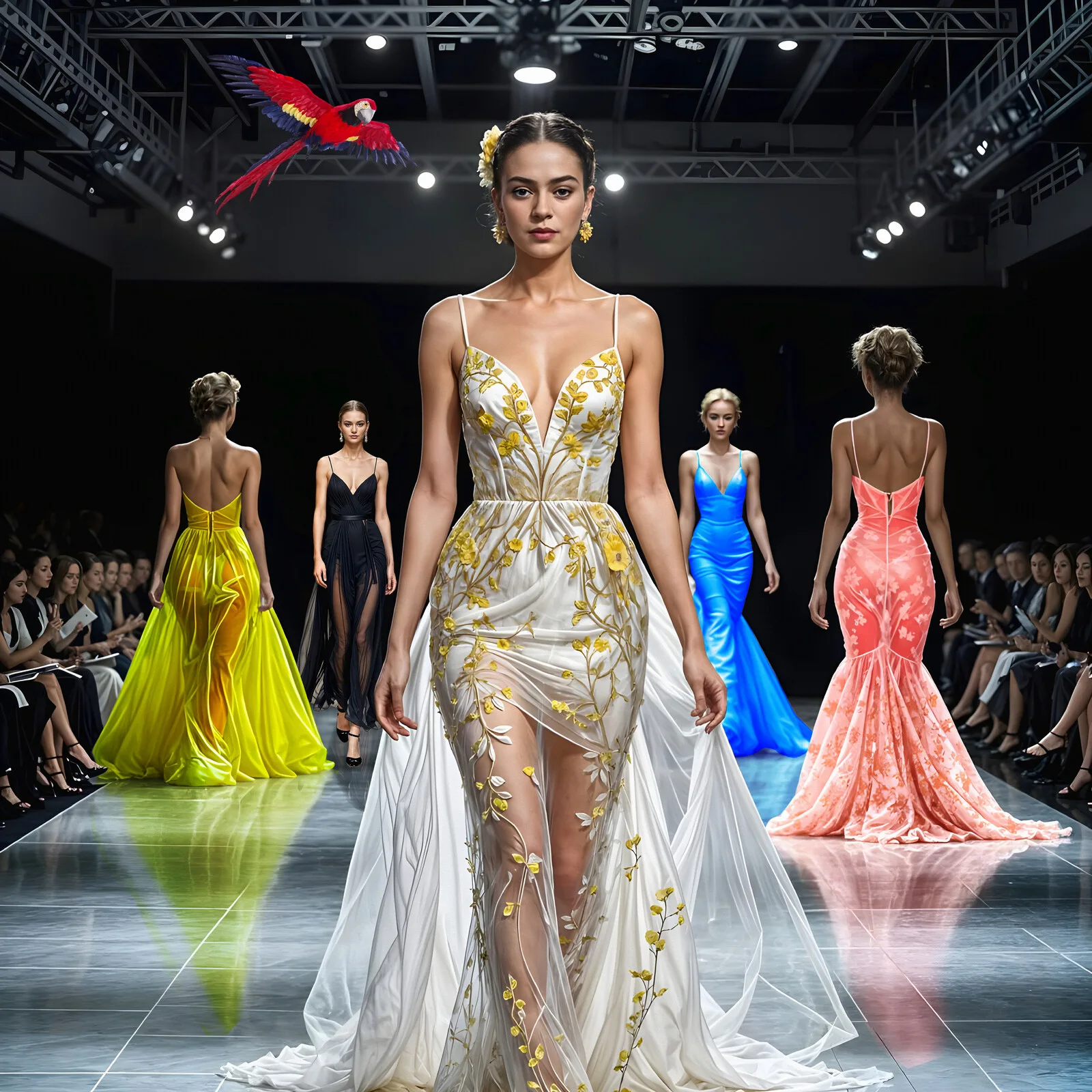
Jörgen Thornberg
Nordic Catwalk, 2025
Digital
70 x 70 cm
3 200 kr
From Catwalks to Creatures: A Journey Through Nordic Folklore in Heels and Moss
What begins with five elegant models striding down a starlit catwalk—led by Frida Kahlo herself, guarded by a parrot and dressed in gold—soon dives headlong into the shadowy fir-scented realms of the Nordic imagination. Here, the forest is alive with beings both beautiful and beastly: seductive Skogsrå spirits with hollow backs, house-protecting tomtar with short tempers, riddling trolls who fear sunlight, and gluttonous giants who can be defeated with nothing but porridge and a clever mind.
As fashion meets folktale and myth strolls beside couture, you'll meet vanity with a beard, doom scented like roasted onions, and ancient cautionary tales disguised as bedtime stories. This is the world Frida leaned into with a drink in hand—a *Frida Colada*, naturally—ready to learn why no child should mock a troll or walk too close to a forest stream.
Step carefully. Magic lives here. So do hungry giants.
Please read on and uncover the Intriguing Secrets of Frida's Fashion Party and the dangers with giants. The little boy’s transformative power will surely inspire and give you hope.
“The Boy and the Giant with the Glossy Hair
(A Tale of Wit, Porridge, and Poor Decisions)
In a valley deep, where birches creak,
And trolls and whispers like to sneak,
There lived a boy, so small, so sly—
With clever gleam and twinkling eye.
One day, he met, near moss and bank,
A hulking brute named Flåsare Flank.
His beard was long, his hair divine,
It shimmered bright in forest shine.
“Come here,” said Flank, “you scrappy bean,
Let’s see who eats the best cuisine!
A porridge duel, just you and me—
We’ll settle things appropriately.”
They boiled a pot both vast and wide,
Enough to feed a countryside.
The boy just smiled and gave a nod—
While hiding something in his sod.
A knapsack, worn, with seams quite stout,
He spooned his servings slyly out.
While Flank devoured with trollish glee,
The boy stayed slim—and tummy-free.
“Oh woe!” Flank cried, “My gut’s gone mad!
It churns and burns! It feels quite bad!”
The boy clutched his belly tight too,
And moaned, “I know just what to do!”
He took his knife with nimble grip,
And stabbed his bag with practiced zip.
Out poured the porridge, warm and wet—
A trick the giant won’t forget.
Inspired by this strange display,
Flank jabbed himself without delay.
A howl was heard across the glen—
Then, silence fell. The end of men.
The boy stood up and brushed his shirt,
He’d not a scratch, not even dirt.
He bowed toward Flank’s glossy mane,
Now, sadly, flat—and full of pain.
So heed this tale, you young and bold,
Don’t challenge trolls, don’t trust the old.
But if you must, bring brains and sack—
And always keep a porridge pack.”
Malmö. January 2025
Nordic Catwalk - Red, Yellow, White, Blue – and the Wood Nymph in Black
The headline suggested that Balenciaga had encountered fairy tales in a Nordic forest—which he indeed had that very evening. The Spanish couturier and time-traveler, Cristóbal Balenciaga, had descended from his star to demonstrate that he was still creating—and that he had no means lost his touch, despite leaving Earth in 1972. His designs, as timeless as his existence, continue to inspire and influence the fashion world.
Five models walked gracefully down the catwalk, adorned in long, elegant evening gowns made from sheer fabrics. Leading them was Frida Kahlo, dressed in white and gold, accompanied by her favorite red parrot.
Four girls donned colors representing their national flags, all incorporating the Nordic cross—a symbol of Christianity and a hallmark of the shared cultural heritage of Nordic countries. This fusion of fashion and heritage adds a layer of intrigue to the show, inviting the audience to explore the cultural narrative behind the designs.
The figure furthest in the back, dressed in black, was the Skogsrå—a being from the deep forests of the North. This female forest spirit is the mistress of the woods. She often appears as a beautiful woman when seen from the front, but her back reveals her true nature: hollow, bark-covered—or, as was the case on this evening, entirely bare. In the forest, she is sometimes bare or dressed in green or black—particularly in stories where she is portrayed as more threatening than seductive or wishes to assert her dominion.
I will tell you more about her later. But first, Frida would like to explain why it is called a "catwalk" when no cat is in sight—only a parrot.
Frida: “The linguistic divide between 'catwalk' and 'runway' reflects intriguing Anglo-American cultural differences. The British term 'catwalk' evokes an image of sleek elegance, akin to feline gracefulness that perfectly aligns with how models are expected to glide down the stage. It suggests organic, instinctive movement, like a cat carefully navigating its surroundings—poised, effortless, and self-assured. Conversely, the American term 'runway" carries propulsion, takeoff, and speed connotations. It implies that a model is not just walking but launching into stardom or racing toward the next stage of their career. In the American ethos, where speed and ambition are central themes, 'runway" fits the grand narrative of aspiration and upward mobility. It's not just about fashion—it's about getting somewhere fast.
Both terms imply performance: a controlled, choreographed movement down a narrow path, whether a model's walk or a jet's acceleration. However, while 'catwalk" suggests an innate, natural command of space, 'runway" signifies a dynamic force. The British view a high-fashion moment as a display of effortless artistry, while Americans see it as a launchpad to success.
This linguistic divergence is also reflected in how fashion is documented and celebrated. "Catwalk," the 1993 documentary by Robert Leacock, immerses the audience in the world of haute couture through a black-and-white cinéma vérité lens. Featuring top designers like John Galliano, Karl Lagerfeld, and Gianni Versace, the film captures the artistry and chaos behind the scenes, presenting fashion as both craft and performance. Using black-and-white and color cinematography enhances the contrast between the glamour on stage and the grittier reality behind it.
The film came out after my time on Earth, but I've seen it on our universal television network—ten thousand channels to choose from! Every era, every epoch, every culture must have its own. Remember, we all learn from and influence one another, especially women who aspire to be beautiful. Don't think for a second that Neanderthals still wander around in musty fur and stiff leather garments or that Viking women wear coarse woven dresses on their star—unless they choose to. Fashion in eternity is about choice; it's about self-expression without limits. My wardrobe, for instance, is a marvelous mix of Renaissance gowns and delightful short dresses from the roaring 1920s. This freedom of choice and self-expression in fashion is genuinely empowering.
But naturally, since I am who I am, much of what I wear reflects the iconic style I was known for on Earth. The vibrant Tehuana dresses, embroidered in bold colors and intricate floral motifs, remain staples in my wardrobe. My huipiles, woven with the finest craftsmanship, symbolise my heritage and defiance. My long skirts, adorned with rich textures and layered fabrics, carry a weight of history yet dance with a lightness of spirit. The beauty and elegance of these garments are truly inspiring.
And the accessories! My oversized filigree and gold earrings caught the light like miniature suns—my chunky rings—turquoise, coral, onyx, each carrying its own story. My rebozos were delicately fringed, some wrapped elegantly around my shoulders, others draped casually as if an afterthought, but always part of my signature. And shoes—oh, my shoes! Red leather boots that lace up to mid-calf, velvet slippers embroidered with golden thread, and sandals adorned with intricate beadwork, all designed to carry me confidently across a sun-drenched plaza or the pathways of a celestial garden.
I asked her about her flowers, and she smiled. "Of course, I have a garden," she said. "And it's not just any garden—Carl Linnaeus helped me design it. Every plant thrives as it should, and naturally, there isn’t a single variety of marigolds missing." The cultural significance of these marigolds in Frida's garden is intriguing and worth exploring; it will surely pique your curiosity.
Frida: “The documentary aligns more with the European concept of fashion—intimate, artistic, a study in movement and presence. The British title Catwalk feels fitting for a film that treats modelling as an art form rather than a mere career stepping stone. Had it been made with an American sensibility, it might have been called Runway: The Making of a Supermodel, emphasising ambition and success rather than aesthetics and elegance.
Whether it’s a catwalk or a runway, both define a space where beauty, performance, and commerce intersect. The difference lies in how the cultures perceive movement—one as a graceful stroll, the other as an unstoppable ascent.
Now Frida wanted to know more about the mythological beings of the North, and leaned back in her chair with her favourite drink, a Frida Colada, in hand.
Let me tell you—fully and with a twinkle in my eye—about the rich and mischievous world of Nordic forest creatures. These beings lurked behind the trees, under the moss, or beside the stream, watching over us mortals while occasionally meddling in our affairs. They were guardians, tricksters, tempters, and disciplinarians. Some were playful. Others were not. All had a lesson to teach.
First and foremost, there is the Skogsrå—the forest nymph. She may appear as a stunning young woman with flowing hair and a crown of leaves or flowers. But woe to the woodsman who follows her into the forest, for from behind, her body reveals its true nature: a hollow back, bark-like skin, or even a tail. She governs the creatures of the forest and knows every root and fern. Hunters who treat the forest respectfully may be rewarded with good fortune: those who do not often lose their way—or their minds.
Then there is Näcken, the Nixie, the seductive water spirit who lounges in forest ponds and rivers, playing a fiddle with such sorrowful beauty that it lures listeners to their doom. He is dangerous and heartbroken, cursed to sit in solitude unless someone dares to learn his music. It is said that those who master the Näck's song gain magical skills—but also risk madness. He is a melancholic figure, misunderstood yet feared.
We mustn't forget the tomtar and vättar—tiny, ancient beings who live beneath the earth or within old barns. With beards longer than their legs and tempers shorter than their noses, these creatures protect homes, animals, and families—so long as they are treated with respect. A bowl of porridge with butter on Christmas Eve is customary. Forget the butter; your cow may be mysteriously sick or your tools broken.
Of course, there are trolls. In the Nordic forests, they are not cute. They are massive, moody, stone-like beings who fear sunlight and reason in riddles. They live in caves, hoard treasure, and smell unpleasant. But even trolls can have wisdom. Some were the stuff of bedtime warnings: cautionary tales told in flickering candlelight.
Take, for instance, the tale of The Giant Flink Flott Flåsare-Flank, a Hulk who could outrun the wind but forgot his manners, a gigantic troll with the world's shiniest hair and the world's foulest breath and had a fearsome appetite for disobedient children—especially boys. Parents told this tale not for laughs but to terrify their sons into good behavior. Flink was said to swallow naughty children whole unless they were clever enough to outwit him.
The story of "The Boy Who Answered Twelve Questions" is about a clever lad who earned his freedom by outwitting this grumpy troll with riddles and wit. The Giant’s breath is said to melt butter at ten paces and cause squirrels to fall from trees. His every sigh smelled of sulfur and fermented pinecones, and no moss would grow where he yawned.
He was vain, no doubt, and cruel. Children were warned not to mock him—not because he’d eat them, but because he’d lecture them on haircare for hours. And should anyone dare to outshine him (especially in a festive braid), they’d find their braids mysteriously undone by morning, no matter how tightly woven.
Some say he still roams the glades on foggy evenings, humming lullabies into his beard and combing his locks with a pinecone. But beware—Flank is near if you smell roasted sour onions and doom.
They must be talking nonsense—or The Giant Flank has returned from the grave, for the clever boy in this tale once outwitted that fearsome giant.
The giant Flank this time challenged a sharp-witted boy to an eating contest—naturally involving porridge, the healthiest food known to Nordic parents. The boy, quick of mind and light of stomach, poured most of his porridge into his knapsack while pretending to eat heartily. Flink, both vain and gluttonous, stuffed himself until he groaned in agony.
Feigning a similar stomachache, the boy claimed to know a remedy. "Simple," he said and plunged his knife into his knapsack, releasing a dramatic spurt of porridge. Flink, not the brightest boulder in the forest, followed suit—stabbing himself in the belly and promptly dying.
With the giant vanquished, the boy walks free with all the giant’s hidden gold, much like Odysseus in antiquity escaping the Cyclops. Giants, after all, were nothing but vanity and brute force—cannibalistic, cruel, but thankfully rather dim. So long as the hero was clever, there was always a way out.
These stories were meant to entertain, yes—but also to scare children into obedience. Don’t play by the river, or Näcken will pull you under. Don’t wander in the woods; the Skogsrå will lead you astray. Always thank the tomte, or suffer the consequences. And never, ever trust a troll with a flute.
In short, the Nordic forest is no place for the careless or the cocky. However, for those who listen, respect the moss, and perhaps leave a spoon of porridge now and then, there may still be magic to find.
And then there is Näcken's watery companion—the Bäckahäst. The equivalent term in continental Scandinavian languages is ‘Bäckahäst’ or ‘Bækhest’ (Brook horse). It closely resembles the Scottish kelpie or the Welsh Ceffyl Dŵr.
The Bäckahäst is often described as a majestic white horse that appears near rivers, especially in misty or foggy weather. It is beautiful—too beautiful. Anyone who climbs onto its back finds themselves unable to get off. The horse then leaps into the water, dragging the rider to their doom.
Yet this eerie creature isn’t always deadly at first glance. The brook horse can sometimes be harnessed and made to plough—either because it tries to trick a person or because the person has outwitted it.
One tale from Lake Hjärtasjön in southern Närke tells of a strong, beautiful, clever farm girl. While ploughing one spring day with the farm’s horse, she was approached by a gleaming creature from the lake. The horse had a flowing mane, a shimmering coat, and eyes full of mischief. But the girl knew better—she recognised the creature for what it was.
When the brook horse tried to charm her, she warned it off with a sharp word and a smack of the bridle: “Disappear, you scoundrel, or you’ll be ploughing ’til you never forget it!”
The creature vanished—only to return instantly, having swapped places with the farm horse. With a wild gallop, it dragged the plough at a supernatural speed, soil and stones flying. The girl clung to the handle like a mitten, unable to jump off.
Just as the horse turned back toward the lake to drown her, she remembered the piece of steel in her pocket. She made the sign of the cross. Instantly, the spell was broken. She tumbled to the earth while the brook horse, enraged, vanished beneath the surface with only the plough in tow. To this day, the plough furrow—a deep scar in the otherwise smooth terrain—serves as a reminder of the event, and for the local people, at least, it remains proof of the brook horse’s existence.
Interestingly, the Bäckahäst has even lent its name to one of the purple Pågatågen, the regional trains that run through Skåne in southern Sweden. The train's color matches that of the Bäckahäst's wild, flowing mane—and the common lilac bush (Syringa vulgaris), the creature’s favorite plant, which the beast devoured with delight. So far, the Bäckahästen train has politely stayed on the tracks and not thrown any unsuspecting passengers into nearby lakes.
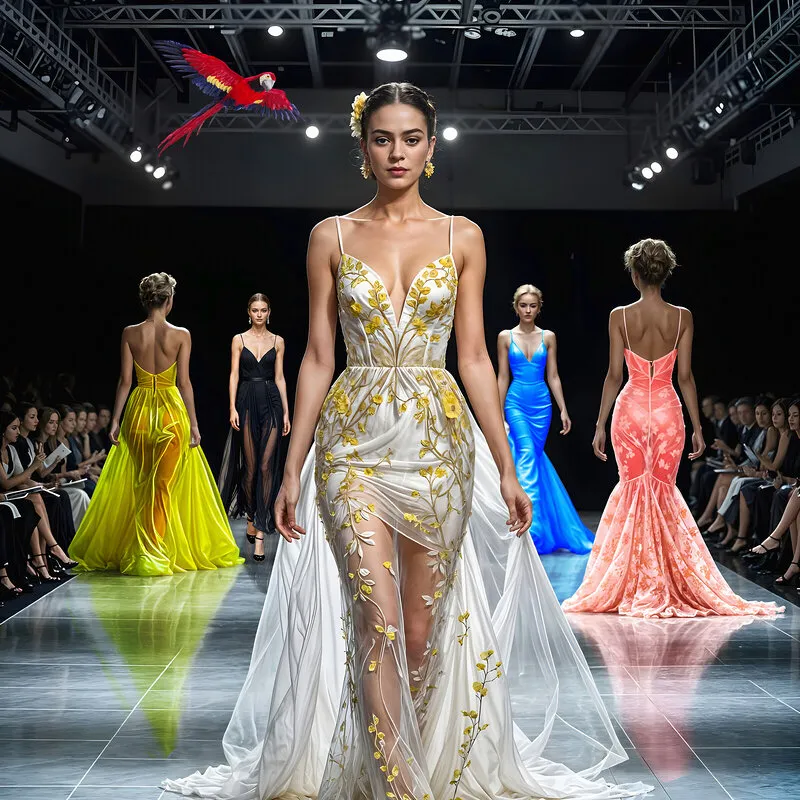
Jörgen Thornberg
Nordic Catwalk, 2025
Digital
70 x 70 cm
3 200 kr
From Catwalks to Creatures: A Journey Through Nordic Folklore in Heels and Moss
What begins with five elegant models striding down a starlit catwalk—led by Frida Kahlo herself, guarded by a parrot and dressed in gold—soon dives headlong into the shadowy fir-scented realms of the Nordic imagination. Here, the forest is alive with beings both beautiful and beastly: seductive Skogsrå spirits with hollow backs, house-protecting tomtar with short tempers, riddling trolls who fear sunlight, and gluttonous giants who can be defeated with nothing but porridge and a clever mind.
As fashion meets folktale and myth strolls beside couture, you'll meet vanity with a beard, doom scented like roasted onions, and ancient cautionary tales disguised as bedtime stories. This is the world Frida leaned into with a drink in hand—a *Frida Colada*, naturally—ready to learn why no child should mock a troll or walk too close to a forest stream.
Step carefully. Magic lives here. So do hungry giants.
Please read on and uncover the Intriguing Secrets of Frida's Fashion Party and the dangers with giants. The little boy’s transformative power will surely inspire and give you hope.
“The Boy and the Giant with the Glossy Hair
(A Tale of Wit, Porridge, and Poor Decisions)
In a valley deep, where birches creak,
And trolls and whispers like to sneak,
There lived a boy, so small, so sly—
With clever gleam and twinkling eye.
One day, he met, near moss and bank,
A hulking brute named Flåsare Flank.
His beard was long, his hair divine,
It shimmered bright in forest shine.
“Come here,” said Flank, “you scrappy bean,
Let’s see who eats the best cuisine!
A porridge duel, just you and me—
We’ll settle things appropriately.”
They boiled a pot both vast and wide,
Enough to feed a countryside.
The boy just smiled and gave a nod—
While hiding something in his sod.
A knapsack, worn, with seams quite stout,
He spooned his servings slyly out.
While Flank devoured with trollish glee,
The boy stayed slim—and tummy-free.
“Oh woe!” Flank cried, “My gut’s gone mad!
It churns and burns! It feels quite bad!”
The boy clutched his belly tight too,
And moaned, “I know just what to do!”
He took his knife with nimble grip,
And stabbed his bag with practiced zip.
Out poured the porridge, warm and wet—
A trick the giant won’t forget.
Inspired by this strange display,
Flank jabbed himself without delay.
A howl was heard across the glen—
Then, silence fell. The end of men.
The boy stood up and brushed his shirt,
He’d not a scratch, not even dirt.
He bowed toward Flank’s glossy mane,
Now, sadly, flat—and full of pain.
So heed this tale, you young and bold,
Don’t challenge trolls, don’t trust the old.
But if you must, bring brains and sack—
And always keep a porridge pack.”
Malmö. January 2025
Nordic Catwalk - Red, Yellow, White, Blue – and the Wood Nymph in Black
The headline suggested that Balenciaga had encountered fairy tales in a Nordic forest—which he indeed had that very evening. The Spanish couturier and time-traveler, Cristóbal Balenciaga, had descended from his star to demonstrate that he was still creating—and that he had no means lost his touch, despite leaving Earth in 1972. His designs, as timeless as his existence, continue to inspire and influence the fashion world.
Five models walked gracefully down the catwalk, adorned in long, elegant evening gowns made from sheer fabrics. Leading them was Frida Kahlo, dressed in white and gold, accompanied by her favorite red parrot.
Four girls donned colors representing their national flags, all incorporating the Nordic cross—a symbol of Christianity and a hallmark of the shared cultural heritage of Nordic countries. This fusion of fashion and heritage adds a layer of intrigue to the show, inviting the audience to explore the cultural narrative behind the designs.
The figure furthest in the back, dressed in black, was the Skogsrå—a being from the deep forests of the North. This female forest spirit is the mistress of the woods. She often appears as a beautiful woman when seen from the front, but her back reveals her true nature: hollow, bark-covered—or, as was the case on this evening, entirely bare. In the forest, she is sometimes bare or dressed in green or black—particularly in stories where she is portrayed as more threatening than seductive or wishes to assert her dominion.
I will tell you more about her later. But first, Frida would like to explain why it is called a "catwalk" when no cat is in sight—only a parrot.
Frida: “The linguistic divide between 'catwalk' and 'runway' reflects intriguing Anglo-American cultural differences. The British term 'catwalk' evokes an image of sleek elegance, akin to feline gracefulness that perfectly aligns with how models are expected to glide down the stage. It suggests organic, instinctive movement, like a cat carefully navigating its surroundings—poised, effortless, and self-assured. Conversely, the American term 'runway" carries propulsion, takeoff, and speed connotations. It implies that a model is not just walking but launching into stardom or racing toward the next stage of their career. In the American ethos, where speed and ambition are central themes, 'runway" fits the grand narrative of aspiration and upward mobility. It's not just about fashion—it's about getting somewhere fast.
Both terms imply performance: a controlled, choreographed movement down a narrow path, whether a model's walk or a jet's acceleration. However, while 'catwalk" suggests an innate, natural command of space, 'runway" signifies a dynamic force. The British view a high-fashion moment as a display of effortless artistry, while Americans see it as a launchpad to success.
This linguistic divergence is also reflected in how fashion is documented and celebrated. "Catwalk," the 1993 documentary by Robert Leacock, immerses the audience in the world of haute couture through a black-and-white cinéma vérité lens. Featuring top designers like John Galliano, Karl Lagerfeld, and Gianni Versace, the film captures the artistry and chaos behind the scenes, presenting fashion as both craft and performance. Using black-and-white and color cinematography enhances the contrast between the glamour on stage and the grittier reality behind it.
The film came out after my time on Earth, but I've seen it on our universal television network—ten thousand channels to choose from! Every era, every epoch, every culture must have its own. Remember, we all learn from and influence one another, especially women who aspire to be beautiful. Don't think for a second that Neanderthals still wander around in musty fur and stiff leather garments or that Viking women wear coarse woven dresses on their star—unless they choose to. Fashion in eternity is about choice; it's about self-expression without limits. My wardrobe, for instance, is a marvelous mix of Renaissance gowns and delightful short dresses from the roaring 1920s. This freedom of choice and self-expression in fashion is genuinely empowering.
But naturally, since I am who I am, much of what I wear reflects the iconic style I was known for on Earth. The vibrant Tehuana dresses, embroidered in bold colors and intricate floral motifs, remain staples in my wardrobe. My huipiles, woven with the finest craftsmanship, symbolise my heritage and defiance. My long skirts, adorned with rich textures and layered fabrics, carry a weight of history yet dance with a lightness of spirit. The beauty and elegance of these garments are truly inspiring.
And the accessories! My oversized filigree and gold earrings caught the light like miniature suns—my chunky rings—turquoise, coral, onyx, each carrying its own story. My rebozos were delicately fringed, some wrapped elegantly around my shoulders, others draped casually as if an afterthought, but always part of my signature. And shoes—oh, my shoes! Red leather boots that lace up to mid-calf, velvet slippers embroidered with golden thread, and sandals adorned with intricate beadwork, all designed to carry me confidently across a sun-drenched plaza or the pathways of a celestial garden.
I asked her about her flowers, and she smiled. "Of course, I have a garden," she said. "And it's not just any garden—Carl Linnaeus helped me design it. Every plant thrives as it should, and naturally, there isn’t a single variety of marigolds missing." The cultural significance of these marigolds in Frida's garden is intriguing and worth exploring; it will surely pique your curiosity.
Frida: “The documentary aligns more with the European concept of fashion—intimate, artistic, a study in movement and presence. The British title Catwalk feels fitting for a film that treats modelling as an art form rather than a mere career stepping stone. Had it been made with an American sensibility, it might have been called Runway: The Making of a Supermodel, emphasising ambition and success rather than aesthetics and elegance.
Whether it’s a catwalk or a runway, both define a space where beauty, performance, and commerce intersect. The difference lies in how the cultures perceive movement—one as a graceful stroll, the other as an unstoppable ascent.
Now Frida wanted to know more about the mythological beings of the North, and leaned back in her chair with her favourite drink, a Frida Colada, in hand.
Let me tell you—fully and with a twinkle in my eye—about the rich and mischievous world of Nordic forest creatures. These beings lurked behind the trees, under the moss, or beside the stream, watching over us mortals while occasionally meddling in our affairs. They were guardians, tricksters, tempters, and disciplinarians. Some were playful. Others were not. All had a lesson to teach.
First and foremost, there is the Skogsrå—the forest nymph. She may appear as a stunning young woman with flowing hair and a crown of leaves or flowers. But woe to the woodsman who follows her into the forest, for from behind, her body reveals its true nature: a hollow back, bark-like skin, or even a tail. She governs the creatures of the forest and knows every root and fern. Hunters who treat the forest respectfully may be rewarded with good fortune: those who do not often lose their way—or their minds.
Then there is Näcken, the Nixie, the seductive water spirit who lounges in forest ponds and rivers, playing a fiddle with such sorrowful beauty that it lures listeners to their doom. He is dangerous and heartbroken, cursed to sit in solitude unless someone dares to learn his music. It is said that those who master the Näck's song gain magical skills—but also risk madness. He is a melancholic figure, misunderstood yet feared.
We mustn't forget the tomtar and vättar—tiny, ancient beings who live beneath the earth or within old barns. With beards longer than their legs and tempers shorter than their noses, these creatures protect homes, animals, and families—so long as they are treated with respect. A bowl of porridge with butter on Christmas Eve is customary. Forget the butter; your cow may be mysteriously sick or your tools broken.
Of course, there are trolls. In the Nordic forests, they are not cute. They are massive, moody, stone-like beings who fear sunlight and reason in riddles. They live in caves, hoard treasure, and smell unpleasant. But even trolls can have wisdom. Some were the stuff of bedtime warnings: cautionary tales told in flickering candlelight.
Take, for instance, the tale of The Giant Flink Flott Flåsare-Flank, a Hulk who could outrun the wind but forgot his manners, a gigantic troll with the world's shiniest hair and the world's foulest breath and had a fearsome appetite for disobedient children—especially boys. Parents told this tale not for laughs but to terrify their sons into good behavior. Flink was said to swallow naughty children whole unless they were clever enough to outwit him.
The story of "The Boy Who Answered Twelve Questions" is about a clever lad who earned his freedom by outwitting this grumpy troll with riddles and wit. The Giant’s breath is said to melt butter at ten paces and cause squirrels to fall from trees. His every sigh smelled of sulfur and fermented pinecones, and no moss would grow where he yawned.
He was vain, no doubt, and cruel. Children were warned not to mock him—not because he’d eat them, but because he’d lecture them on haircare for hours. And should anyone dare to outshine him (especially in a festive braid), they’d find their braids mysteriously undone by morning, no matter how tightly woven.
Some say he still roams the glades on foggy evenings, humming lullabies into his beard and combing his locks with a pinecone. But beware—Flank is near if you smell roasted sour onions and doom.
They must be talking nonsense—or The Giant Flank has returned from the grave, for the clever boy in this tale once outwitted that fearsome giant.
The giant Flank this time challenged a sharp-witted boy to an eating contest—naturally involving porridge, the healthiest food known to Nordic parents. The boy, quick of mind and light of stomach, poured most of his porridge into his knapsack while pretending to eat heartily. Flink, both vain and gluttonous, stuffed himself until he groaned in agony.
Feigning a similar stomachache, the boy claimed to know a remedy. "Simple," he said and plunged his knife into his knapsack, releasing a dramatic spurt of porridge. Flink, not the brightest boulder in the forest, followed suit—stabbing himself in the belly and promptly dying.
With the giant vanquished, the boy walks free with all the giant’s hidden gold, much like Odysseus in antiquity escaping the Cyclops. Giants, after all, were nothing but vanity and brute force—cannibalistic, cruel, but thankfully rather dim. So long as the hero was clever, there was always a way out.
These stories were meant to entertain, yes—but also to scare children into obedience. Don’t play by the river, or Näcken will pull you under. Don’t wander in the woods; the Skogsrå will lead you astray. Always thank the tomte, or suffer the consequences. And never, ever trust a troll with a flute.
In short, the Nordic forest is no place for the careless or the cocky. However, for those who listen, respect the moss, and perhaps leave a spoon of porridge now and then, there may still be magic to find.
And then there is Näcken's watery companion—the Bäckahäst. The equivalent term in continental Scandinavian languages is ‘Bäckahäst’ or ‘Bækhest’ (Brook horse). It closely resembles the Scottish kelpie or the Welsh Ceffyl Dŵr.
The Bäckahäst is often described as a majestic white horse that appears near rivers, especially in misty or foggy weather. It is beautiful—too beautiful. Anyone who climbs onto its back finds themselves unable to get off. The horse then leaps into the water, dragging the rider to their doom.
Yet this eerie creature isn’t always deadly at first glance. The brook horse can sometimes be harnessed and made to plough—either because it tries to trick a person or because the person has outwitted it.
One tale from Lake Hjärtasjön in southern Närke tells of a strong, beautiful, clever farm girl. While ploughing one spring day with the farm’s horse, she was approached by a gleaming creature from the lake. The horse had a flowing mane, a shimmering coat, and eyes full of mischief. But the girl knew better—she recognised the creature for what it was.
When the brook horse tried to charm her, she warned it off with a sharp word and a smack of the bridle: “Disappear, you scoundrel, or you’ll be ploughing ’til you never forget it!”
The creature vanished—only to return instantly, having swapped places with the farm horse. With a wild gallop, it dragged the plough at a supernatural speed, soil and stones flying. The girl clung to the handle like a mitten, unable to jump off.
Just as the horse turned back toward the lake to drown her, she remembered the piece of steel in her pocket. She made the sign of the cross. Instantly, the spell was broken. She tumbled to the earth while the brook horse, enraged, vanished beneath the surface with only the plough in tow. To this day, the plough furrow—a deep scar in the otherwise smooth terrain—serves as a reminder of the event, and for the local people, at least, it remains proof of the brook horse’s existence.
Interestingly, the Bäckahäst has even lent its name to one of the purple Pågatågen, the regional trains that run through Skåne in southern Sweden. The train's color matches that of the Bäckahäst's wild, flowing mane—and the common lilac bush (Syringa vulgaris), the creature’s favorite plant, which the beast devoured with delight. So far, the Bäckahästen train has politely stayed on the tracks and not thrown any unsuspecting passengers into nearby lakes.
3 200 kr

Jörgen Thornberg
Malmö
Lite om bilder och mig. Translation in English at the end.
Jag är en nyfiken person som ser allt i bilder, även det jag fäster i ord, gärna tillsammans för bakom alla mina bilder finns en berättelse. Till vissa bilder hör en kortare eller längre novell som följer med bilden.
Bilder berättar historier. Jag omges av naturlig skönhet, intressanta människor och historia var jag än går. Jag använder min kamera för att dokumentera världen och blanda det jag ser med vad jag känner för att fånga den dolda magin.
Mina bilder berättar mina historier. Genom mina bilder, tryck och berättelser. Jag bjuder in dig att ta del av dessa berättelser, in i ditt liv och hem och dela min mycket personliga syn på vår värld. Mer än vad ögat ser. Jag tänker i bilder, drömmer och skriver och pratar om dem; följaktligen måste jag också skapa bilder. De blir vad jag ser, inte nödvändigtvis begränsade till verkligheten. Det finns en bild runt varje hörn. Jag hoppas att du kommer att se vad jag såg och gilla det.
Jag är också en skrivande person och till många bilder hör en kortare eller längre essay. Den följer med tavlan, tryckt på fint papper och med en personlig hälsning från mig.
Flertalet bilder startar sin resa i min kamera. Enkelt förklarat beskriver jag bilden jag ser i mitt inre, upplevd eller fantiserad. Bilden uppstår inom mig redan innan jag fått okularet till ögat. På bråkdelen av ett ögonblick ser jag vad jag vill ha och vad som kan göras med bilden. Här skall jag stoppa in en giraff, stålmannen, Titanic eller vad det är min fantasi finner ut. Ännu märkligare är att jag kommer ihåg minnesbilden långt efteråt när det blir tid att skapa verket. Om jag lyckas eller inte, är upp till betraktaren, oftast präglat av en stråk av svart humor – meningen är att man skall bli underhållen. Mina bilder blir ofta en snackis där de hänger.
Jag föredrar bilder som förmedlar ett budskap i flera lager. Vid första anblicken fylld av feel-good, en vacker utsikt, fint väder, solen skiner, blommor på ängen eller vattnet som ligger förrädiskt spegelblankt. I en sådan bild kan jag gömma min egentliga berättelse, mitt förakt för förtryckare och våldsverkare, rasister och fördomsfulla människor - ett gärna återkommande motiv mer eller mindre dolt i det vackra motivet. Jag försöker förena dem i ett gemensamt narrativ.
Bild och formgivning har löpt som en röd tråd genom livet. Fotokonst känns som en värdig final som jag gärna delar med mig.
Min genre är vid som framgår av mina bilder, temat en blandning av pop- och gatukonst i kollage som kan bestå av hundratals lager. Vissa bilder kan ta veckor, andra någon dag innan det är dags att överlämna resultatet till printverkstaden. Fine Art Prints är digitala fotocollage. I dessa kollage sker rivandet, klippandet, pusslandet, målandet, ritandet och sprayningen digitalt. Det jag monterar in kan vara hundratals år gamla bilder som jag omsorgsfullt frilägger så att de ser ut att vara en del av tavlan men också bilder skapade av mig själv efter min egen fantasi. Därefter besöks printstudion och för vissa bilder numrera en limiterad upplaga (oftast 7 exemplar) och signera för hand. Vissa bilder kan köpas i olika format. Det är bara att fråga efter vilka. Gillar man en bild som är 70x100 men inte har plats på väggen, går den kanske att få i 50x70 cm istället. Frågan är fri.
Metoden Giclée eller Fine Art Print som det också kallas är det moderna sättet för framställning av grafisk konst. Villkoret för denna typ av utskrifter är att en högkvalitativ storformatskrivare används med åldersbeständigt färgpigment och konstnärspapper eller i förekommande fall på duk. Pappret som används möter de krav på livslängd som ställs av museer och gallerier. Normalt säljer jag mina bilder oinramade så att den nya ägaren själv kan bestämma hur de skall se ut, med eller utan passepartout färg på ram, med eller utan glas etc..
Under många år ställde jag bara ut på nätet, i valda grupper och på min egen Facebooksida - https://www.facebook.com/jorgen.thornberg.9
Jag finns också på en egen hemsida som tyvärr inte alltid är uppdaterad – https://www.jth.life/ Där kan du också läsa en del av de berättelser som följer med bilden.
UTSTÄLLNINGAR
Luftkastellet, oktober 2022
Konst i Lund, november 2022
Luftkastellet, mars 2023
Engleson Galleri Caroli, april 2023
Hydra, Greece June 2023
Engleson Galleri Caroli, oktober 2023
Toppen, Höllviken december 2023
Luftkastellet, mars 2024
Torups Galleri, mars 2024
Venice, May 2024
Luftkastellet, oktober 2024
Konst i Advent, December 2024
Galleri Engleson, Caroli December 2024
Jäger & Jansson Galleri, april 2025
A bit about pictures and me.
I'm a curious person who sees everything in pictures, even what I express in words, often combining them, for behind all my pictures lies a story. These narratives, some as short as a single image and others as long as a novel, are the heart and soul of my work.
Pictures tell stories. Wherever I go, I'm surrounded by natural beauty, exciting people, and history. I use my camera to document the world and blend what I see with what I feel to capture the hidden magic.
My images tell my stories. Through my pictures, prints, and narratives, I invite you to partake in these stories in your life and home and share my deeply personal perspective of our world. More than meets the eye. I think in pictures, dream, write, and talk about them; consequently, I must create images too. They become what I see, not necessarily confined to reality. There's a picture around every corner. I hope you'll see what I saw and enjoy it.
I'm also a writer, and many images come with a shorter or longer essay. It accompanies the painting, printed on fine paper with my personal greeting.
Many pictures start their journey on my camera. Simply put, I describe the image I see in my mind, experienced or imagined. The image arises within me even before I bring the eyepiece to my eye. In a fraction of a moment, I see what I want and what can be done with the picture. Here, I'll insert a giraffe, Superman, the Titanic, or whatever my imagination conjures up. Even stranger is that I remember the mental image long after it's time to create the work. Whether I succeed is up to the observer, often imbued with a streak of black humour – the aim is to entertain. My pictures usually become a talking point wherever they hang.
I prefer pictures that convey a message in multiple layers. At first glance, they're filled with feel-good vibes, a beautiful view, lovely weather, the sun shining, flowers in the meadow, or the water lying deceptively calm. But beneath this surface beauty, I often conceal a deeper story, a narrative that challenges societal norms or explores the human condition. I invite you to delve into these hidden narratives and discover the layers of meaning within my work.
Picture and design have been a thread running through my life. Photographic art feels like a fitting finale, and I'm happy to share it.
My genre is varied, as seen in my pictures; the theme is a blend of pop and street art in collages that can consist of hundreds of layers. Some images can take weeks, others just a day before it's time to hand over the result to the print workshop. Fine Art Prints are digital photo collages. In these collages, tearing, cutting, puzzling, painting, drawing, and spraying happen digitally. What I insert can be images hundreds of years old that I carefully extract so they appear to be part of the painting, but also images created by myself, now also generated from my imagination. Next, visit the print studio and, for certain images, number a limited edition (usually 7 copies) and sign them by hand. Some images may be available in other formats. Just ask which ones. If you like an image that's 70x100 but doesn't have space on the wall, you might be able to get it in 50x70 cm instead. The question is open.
The Giclée method, or Fine Art Print as it's also called, is the modern way of producing graphic art. This method ensures the highest quality and longevity of the artwork, using a high-quality large-format printer with archival pigment inks and artist paper or, in some cases, canvas. The paper used meets the longevity requirements set by museums and galleries. I sell my pictures unframed, allowing the new owner to personalise their artwork, confident in the lasting value and quality of the piece.
For many years, I only exhibited online, in selected groups, and on my Facebook page - https://www.facebook.com/jorgen.thornberg.9. I also have my website, which unfortunately is not constantly updated - https://www.jth.life/. You can also read some of the stories accompanying the pictures there.
EXHIBITIONS
Luftkastellet, October 2022
Art in Lund, November 2022
Luftkastellet, March 2023
Engleson Gallery Caroli, April 2023
Hydra, Greece June 2023
Engleson Gallery Caroli, October 2023
Toppen, Höllviken December 2023
Luftkastellet, March 2024
Torup Gallery, March 2024
Venice, May 2024
UTSTÄLLNINGAR
Luftkastellet, oktober 2022
Konst i Lund, november 2022
Luftkastellet, mars 2023
Engleson Galleri Caroli, april 2023
Hydra, Greece June 2023
Engleson Galleri Caroli, oktober 2023
Toppen, Höllviken december 2023
Luftkastellet, mars 2024
Torups Galleri, mars 2024
Venice, May 2024
Luftkastellet, October 2024
Konst i Advent, December 2024
Galleri Engleson, Caroli December 2024
Jäger & Jansson Galleri, April 2025
Utbildning
Autodidakt
Medlem i konstnärsförening
Öppna Sinnen
Med i konstrunda
Konstrundan i Skåne
Utställningar
Luftkastellet, October 2022
Art in Lund, November 2022
Luftkastellet, March 2023
Engleson Gallery Caroli, April 2023
Hydra, Greece June 2023
Engleson Gallery Caroli, October 2023
Toppen, Höllviken December 2023
Luftkastellet, March 2024
Torup Gallery, March 2024
Venice, May 2024