Vi använder cookies för att ge dig bästa möjliga upplevelse. Välj vilka cookies du tillåter.
Läs mer i vår integritetspolicy
Jörgen Thornberg
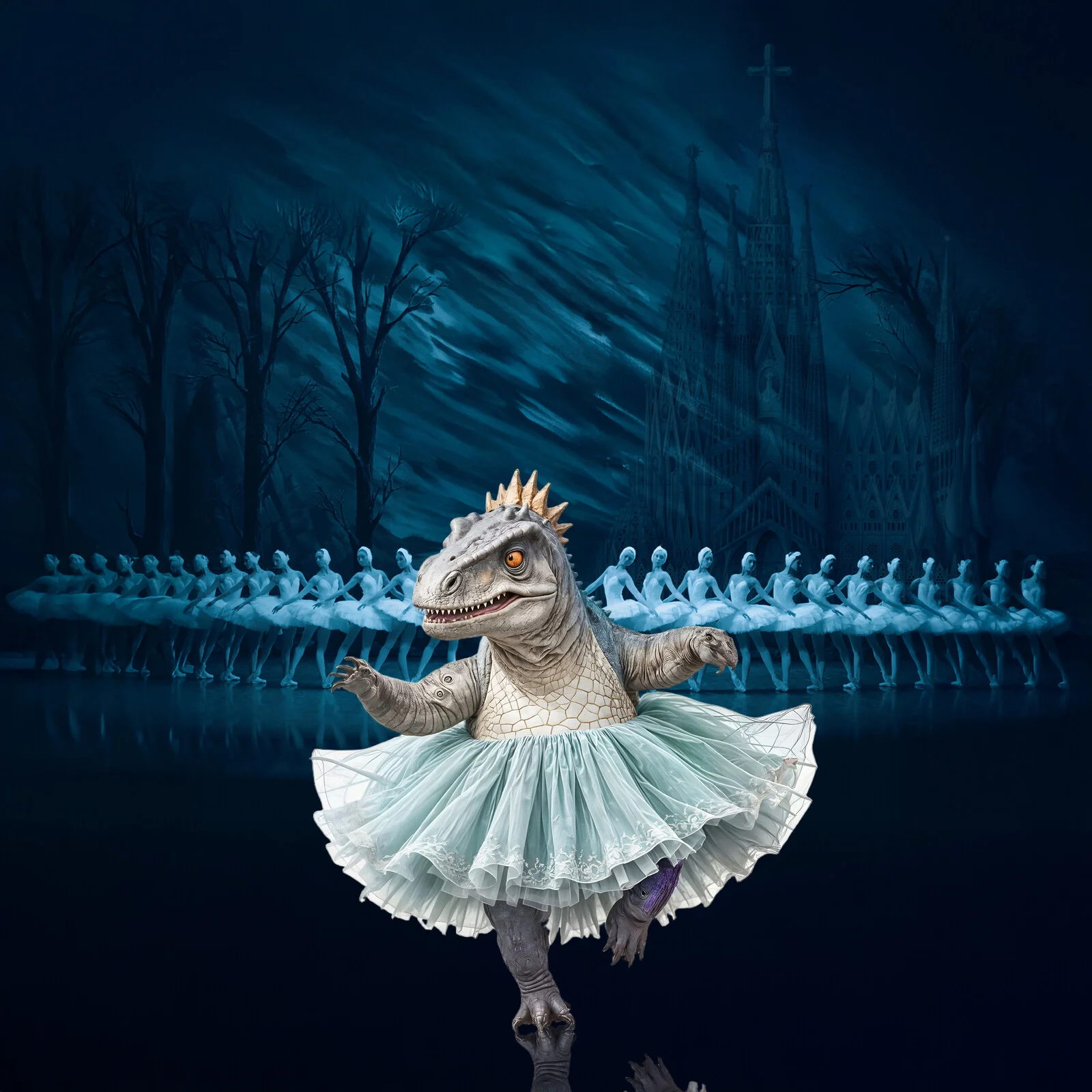
Jurrassic Lake - Sue – the T.rex Ballerina, 2025
Digital
70 x 70 cm
3 500 kr
Sue – the T.rex Ballerina
She weighs eight tonnes, has perfect pitch, and performs Tchaikovsky with a tail sweep that could level a barn. Meet Sue—the world's only dancing Tyrannosaurus rex.
What began as a cameo in Jurassic Park evolved into an unexpected artistic awakening. Transported from a hidden island in the Pacific to a dance pavilion in rural Skåne, Sue trained under moonlight and birch trees, partnered with a Ukrainian ballet virtuoso, and made history in a thunderous, spellbinding performance of Swan Lake. But behind the roaring ovations and pirouettes lies a story of heartbreak, devotion, and one small Jack Russell terrier named Muskot.
This is not just a tale about a dinosaur who danced. It is a ballet saga like no other—graceful, ground-shaking, and gloriously true. Please read on to get the whole picture.
"From Swan to Saur – A Balletaur
(a.k.a. How ‘Swan Lake’ became ‘Jurassic Lake’)
They planned a Swan Lake, sleek and neat,
With dainty toes and pointed feet.
But Skåne’s stage would soon awake—
It rumbled, cracked, and changed the stake.
For when Sue danced, she shook the ground,
A T. rex queen in leaps profound.
Arabesque with tail so wide,
Jeté that launched a sheep in stride.
The critics gasped: “Is this allowed?”
The violins grew tense—but proud.
With pirouettes like whirlwinds thrown,
She claimed that lake and made it her own.
No cygnets here in fluffed-up white,
Just talons gleaming in floodlight.
The orchestra, though slightly pale,
Pressed on through tremors, hail, and gale.
“Jurassic Lake!” the headlines cried,
“A dino danced! A swan has died!”
But ballet buffs, though first unsure,
Soon dubbed it grandeur with a roar.
So now in tutus, sleek and black,
Some dancers wish their arms were back—
As tails, you see, bring extra flair,
And room to sweep across the air.
Thanks to Sue, the art’s evolved:
A mystery finally twirled—and solved.
For grace, it seems, has many forms—
Some wear silk. Some ride in storms.”
Malmö, March 2025
Sue – the T.rex Ballerina
The story follows Sue, the T. rex girl who survived the great extinction, later depicted in the film Jurassic Park. The island exists, hidden in a remote part of the Pacific Ocean, its precise location as secretive as the mysteries behind the UFO sightings reported worldwide. Unlike any other of her kind, Sue possessed an extraordinary gift. Her hearing was exceptional, but that was just the beginning. She had perfect pitch and a remarkable sense of musicality that set her apart from all other creatures.
During the filming of the first Jurassic Park movie, she became good friends with director Steven Spielberg, a passionate lover of classical music. Spielberg had brought along a high-quality portable sound system. As the tones of Tchaikovsky floated through the rainforest, Sue experienced love at first hearing.
Instinctively, she began to dance, causing the forest to thunder and crackle around her. After all, a T. rex girl is large—approximately 12 metres long and weighing around 8 tonnes—but is known to be both swift and agile. Spielberg grew curious and tiptoed through the undergrowth to investigate the rhythmic echoes that synchronised with Tchaikovsky's ballet music, for it was indeed the composer's ballets that had triggered the commotion in a clearing deep in the jungle.
Apart from the dancing dinosaur girl, the forest had emptied; all other animals had fled.
Sue ceased dancing when Spielberg paused his music player. Initially, she grew furious, bared her teeth, and let out a threatening growl. Her teeth—long, serrated, and slightly curved like prehistoric sabres—could slice through the thighbone of a Triceratops as if it were butter. Her growl originated deep within her enormous chest cavity and sounded like a distant thunderstorm awakening from ancient times. However, by carefully alternating between silence and sound, Spielberg managed to tame the giant lizard, who had developed a sort of... addiction. What fascinated her above all was Tchaikovsky's ballet music—The Nutcracker, The Sleeping Beauty, and especially Swan Lake.
Spielberg and Sue became true friends. He even showed her some videos he had brought along of the ballet* Swan Lake*. Sue, as he now affectionately called her, began to rehearse.
The name was no coincidence. Sue was also the name given to the most complete Tyrannosaurus rex skeleton ever discovered—a fossil unearthed in South Dakota in 1990 by paleontologist Sue Hendrickson. That fossilised skeleton, now housed at the Field Museum in Chicago, was named “Sue” in her honour. But unlike her petrified namesake, this Sue was very much alive—majestic, mobile, and musically inclined. This living Sue was not the same as the fossil, but she shared the same name and a similar spirit of discovery.
When Spielberg returned to the island in 1997, he was astounded by what he found. Sue, with her perfect pitch and her ability to remember and reproduce any sound, had spent the four years since the film crew’s departure training as a ballerina. Her transformation from a wild creature to a disciplined artist was nothing short of unexpected and inspiring.
It was breathtaking to see how the massive madam moved. Despite her imposing size and the potential danger she posed, she moved with surprising precision and grace. Though she weighed around eight tonnes, her feet were soft and sensitive, and not a sound was made when she placed them on the floor. This contrast between her appearance and her movements added to the awe and wonder of the audience, making her performance even more impressive.
She had independently gone through every stage of classical training:
She learned to balance in arabesques, using her tail for counterweight.
Her pliés were deep, powerful, and earth-shaking.
Her jetés caused small landslides.
She perfected her pirouettes, although they required careful navigation—one misstep and she'd clear half the forest.
En pointe was, understandably, impossible—but she simulated its elegance with the extraordinary delicacy of her steps.
The real problem, however, was finding a partner. Her size and razor-sharp teeth inspired both awe and fear.oth awe and fear.
This is where Joakim enters the story: Spielberg’s sound technician, a calm and collected Swede from Lund. He had secretly bonded with Sue during the shoot, often seen fiddling with cables beside her giant clawed feet without so much as a flinch. When filming wrapped up, Joakim made the unorthodox decision to smuggle her to Sweden, a testament to their unique bond.
He arranged for her to stay at his country home—a hidden cross-timbered estate near Vik in Skåne, shielded from curious eyes. The property included an old dance pavilion, lovingly restored by the previous owner. Since Sue was a bit heavy on her feet, the floor required serious reinforcement. Massive beams were installed beneath, creating a stage strong enough to support even her most ambitious choreography.
At first, it was just her and Joakim—Swan Lake by night, the rustle of birch leaves and distant murmurs of the sea by day. However, an ensemble was soon formed. Friends and acquaintances were called in, and eventually, a whole ballet troupe was assembled for a once-in-a-lifetime performance. These performances were not just about entertainment, but about Sue's personal growth and the realization of her unique talents. They were a testament to her discipline, dedication, and the power of art to transcend boundaries.
The brilliance of Swan Lake was that Sue could perform both lead roles—the White Swan and the Black Swan. Finding a willing male partner, however, proved more complicated. But Joakim eventually found Rurik Nestor, a daredevil from Ukraine and a former soloist trained by none other than the legendary Rudolf Nureyev. Sadly, Nureyev never had the chance to admire Sue's talent himself, as he had already passed away in 1993. Rurik, however, carried on his master’s legacy with elegance and nerve. He had danced at the Tolstoy Theatre in Moscow, seasoned and swift enough to dodge Sue’s occasional overenthusiastic lunges.
The performance took place on a summer evening. The dance pavilion, the surrounding forest, and even the old stone walls were packed with spectators. Most assumed it was an elaborate trick. Could the dinosaur possibly be real? But when the ground trembled with her entrance, when the boards bent under her pirouettes, and when Swan Lake echoed across the twilight hills of Skåne, no one could deny the awe-inspiring nature of Sue's performance.
Sue was real. And she danced.
The performance closely followed Tchaikovsky’s original choreography, adapted only to accommodate Sue’s considerable dimensions—and her cast-iron appetite. The ballet unfolded over two and a half hours, as intended, with a single intermission during which Sue delicately nibbled on a salad of birch leaves and imported Belgian endive.
The music, performed live by a small chamber orchestra tucked away in a reinforced wooden alcove, began softly: the tremolo of strings under moonlight, a clarinet's haunting solo echoing across the stage.
Act I opened by the lakeside. Strings shimmered with expectancy as dancers in flowing white began their patterns across the wooden floor. Sue entered slowly from stage right, her great head bowed, her tail sweeping behind like a curtain. The audience held its breath. Rurik, as Prince Siegfried, began his solo—poetic and athletic, threading between her steps like moonlight on water. When Sue raised one clawed foot and extended it in a sweeping tendu, not a board creaked.
Gasps rippled through the audience during the pas de deux. Her neck curved with elegance; her tail offered counterbalance with breathtaking precision. She mimicked human gestures with her prehistoric anatomy—every angle calculated, every motion imbued with the tragic dignity of Odette.
Act II: The ballroom scene. Enter the Black Swan. Here, Sue transformed. The lighting turned crimson. A deep tremolo from the basses and a storm of violins followed as she made her entrance, neck arched in defiance. She whirled, stamped gently, and circled Rurik like a prowling goddess. Her eyes flashed with wicked glee. The famous thirty-two fouettés were adjusted: instead of spinning on one foot, Sue twirled like a slow-moving tornado, her tail extended, carving the air.
The dancers moved with delicate precision, their eyes constantly darting sideways, ever aware of where Sue’s massive jaws happened to be. Rurik Nestor was elegant beyond belief, darting between her strides, arching and spiraling like a dragonfly. He performed his pas de deux with such perfect timing that one misstep could have cost him a limb—but he never faltered.
The audience was hypnotised. A critic from Dagens Nyheter was seen mouthing the word "miracle." A retired ballerina from the Royal Opera clutched her pearls and blinked away tears. Joakim, standing by the spotlight rig, wiped his brow and whispered, "She's nailing it."
The critic from Sydsvenska Dagbladet jokingly renamed the performance ‘Dino Lake’, a playful nod to Sue's species and the common nickname "Dino" often used for dinosaurs. The moniker likely stems from popular culture—especially the adorable purple pet dinosaur in The Flintstones, known simply as Dino.
Then came Act III. The lovers' despair. The final sacrifice. The lake scene. Under soft blue lights, the stage transformed into a dreamlike stillness. Sue moved with ghostly elegance, her movements slower now, as though carrying centuries of sorrow. When she and Rurik leapt into the metaphorical waters—Sue with one mighty sweep of her legs—the audience exhaled as one.
When the final act arrived, and the lovers were doomed to the lake’s dark waters, silence fell. Even the birch trees seemed to lean in. Sue lifted her great head in solemn farewell, her eyes glistening under the floodlights, and curled slowly into a final pirouette.
The applause began hesitantly—then erupted. Thunderous, endless. People wept. Some fainted. A child in the front row whispered to his mother, “Was that real?”
She didn’t answer. She only stared and whispered, “That was Swan Lake.”
Later interviews revealed audience favorites: children especially adored Sue’s swirling tail choreography, calling it "the most magical tornado ever seen." Many dancers cited her Black Swan entrance as the highlight—"like thunderclouds learning ballet," one gasped. Even local wildlife watchers, initially skeptical, admitted the presence of a dinosaur had revitalised the ecosystem—and possibly the entire performing arts scene in southern Sweden.
And among the crowd, a new story began: Sue had fallen in love. Her heart—prehistoric though it was—beat faster for a sprightly little Jack Russell Terrier named Muskot. He had traveled from Stockholm with his owner, a seasoned ballet enthusiast, to attend the legendary performance. Jack Russells are known for their fearlessness, and Muskot lived up to that reputation. Despite strict instructions for all pets to remain at home or on tight leashes, Muskot broke free and darted across the stage mid-performance—an impromptu solo act that brought delighted laughter and applause.
To everyone's amazement, Sue didn’t snap or snarl. She watched, mesmerised. Muskot, undeterred by her enormous size or those serrated teeth, wagged his tail and let out a proud little bark. It was love at first sight.
Sadly, Muskot’s owner was less enthusiastic. She explained, somewhat apologetically, that Sue might be "a touch too large for their Stockholm apartment." Sue was heartbroken yet dignified.
As a farewell gift, Muskot’s owner had a portrait made—a charming photo of the bold little dog seated against a velvet backdrop. Muskot himself signed it with a muddy paw print, holding still for a full three seconds, which for a Jack Russell is an act of extreme devotion. Sue kept the portrait carefully tucked under her favorite birch tree, where no wind or rain could touch it.
A conservative music industry did not initially embrace the journalist’s cheeky name—Dino Lake—but Sue’s adaptation quickly made its way into the annals of performance history under the title ‘Jurassic Lake’, Opus ‘20 J’, as in ‘Jurassic’. Still, there was one major challenge with the Österlen interpretation: The role demands a dinosaur. A real one. And Sue, alas, was the only one of her kind.
Worse yet, she had fallen into the grip of heartbreak. Since Muskot’s departure, Sue had gone vegan. She preferred solitude and spent her days grazing in the rolling hills around Vik, her massive form silhouetted against the sky, tail swaying with the wind. Not even Joakim’s pleading could change her mind. He tried everything—Tchaikovsky on vinyl, Schubert on cassette, even obscure Russian lullabies—but the stubborn T. rex girl would not budge. Yet, she remained resolute, as if to say, "Either you bring me the spice," with a glance at Muskot's portrait, "or the ballet stays shelved."
To complicate matters further, Sue had developed a taste for something... modern. Somewhere, somehow, she had discovered rap music. Heavy bass and hard-hitting beats struck a primal chord within her. This unexpected twist in her musical preference added a layer of intrigue to her character. She began to experiment, dancing with thunderous energy. Her pirouettes gained swagger. Her pliés had punch. When she stomped to the rhythm of a freestyle cypher, the ground shook across all of Österlen. The sheep scattered. Apple trees trembled. Old houses creaked. Joakim began to worry about the structural integrity of the entire region.
Yet, even in her heartbreak and disillusionment with classical ballet, Sue persisted. She continued to dance, and the earth, as always, listened. Children were enchanted by her swirling tail choreography, deeming it 'the most magical tornado ever seen.' Many dancers hailed her Black Swan entrance as the highlight, with one even likening it to 'thunderclouds learning ballet.' The mayor of Simrishamn declared it the cultural event of the decade. One elderly man, who hadn’t shed a tear since 1969, found himself moved by the lake scene. Even local wildlife watchers, initially skeptical, acknowledged that the presence of a dinosaur had breathed new life into the ecosystem—and possibly the entire performing arts scene in southern Sweden.
Jörgen Thornberg
Jurrassic Lake - Sue – the T.rex Ballerina, 2025
Digital
70 x 70 cm
3 500 kr
Sue – the T.rex Ballerina
She weighs eight tonnes, has perfect pitch, and performs Tchaikovsky with a tail sweep that could level a barn. Meet Sue—the world's only dancing Tyrannosaurus rex.
What began as a cameo in Jurassic Park evolved into an unexpected artistic awakening. Transported from a hidden island in the Pacific to a dance pavilion in rural Skåne, Sue trained under moonlight and birch trees, partnered with a Ukrainian ballet virtuoso, and made history in a thunderous, spellbinding performance of Swan Lake. But behind the roaring ovations and pirouettes lies a story of heartbreak, devotion, and one small Jack Russell terrier named Muskot.
This is not just a tale about a dinosaur who danced. It is a ballet saga like no other—graceful, ground-shaking, and gloriously true. Please read on to get the whole picture.
"From Swan to Saur – A Balletaur
(a.k.a. How ‘Swan Lake’ became ‘Jurassic Lake’)
They planned a Swan Lake, sleek and neat,
With dainty toes and pointed feet.
But Skåne’s stage would soon awake—
It rumbled, cracked, and changed the stake.
For when Sue danced, she shook the ground,
A T. rex queen in leaps profound.
Arabesque with tail so wide,
Jeté that launched a sheep in stride.
The critics gasped: “Is this allowed?”
The violins grew tense—but proud.
With pirouettes like whirlwinds thrown,
She claimed that lake and made it her own.
No cygnets here in fluffed-up white,
Just talons gleaming in floodlight.
The orchestra, though slightly pale,
Pressed on through tremors, hail, and gale.
“Jurassic Lake!” the headlines cried,
“A dino danced! A swan has died!”
But ballet buffs, though first unsure,
Soon dubbed it grandeur with a roar.
So now in tutus, sleek and black,
Some dancers wish their arms were back—
As tails, you see, bring extra flair,
And room to sweep across the air.
Thanks to Sue, the art’s evolved:
A mystery finally twirled—and solved.
For grace, it seems, has many forms—
Some wear silk. Some ride in storms.”
Malmö, March 2025
Sue – the T.rex Ballerina
The story follows Sue, the T. rex girl who survived the great extinction, later depicted in the film Jurassic Park. The island exists, hidden in a remote part of the Pacific Ocean, its precise location as secretive as the mysteries behind the UFO sightings reported worldwide. Unlike any other of her kind, Sue possessed an extraordinary gift. Her hearing was exceptional, but that was just the beginning. She had perfect pitch and a remarkable sense of musicality that set her apart from all other creatures.
During the filming of the first Jurassic Park movie, she became good friends with director Steven Spielberg, a passionate lover of classical music. Spielberg had brought along a high-quality portable sound system. As the tones of Tchaikovsky floated through the rainforest, Sue experienced love at first hearing.
Instinctively, she began to dance, causing the forest to thunder and crackle around her. After all, a T. rex girl is large—approximately 12 metres long and weighing around 8 tonnes—but is known to be both swift and agile. Spielberg grew curious and tiptoed through the undergrowth to investigate the rhythmic echoes that synchronised with Tchaikovsky's ballet music, for it was indeed the composer's ballets that had triggered the commotion in a clearing deep in the jungle.
Apart from the dancing dinosaur girl, the forest had emptied; all other animals had fled.
Sue ceased dancing when Spielberg paused his music player. Initially, she grew furious, bared her teeth, and let out a threatening growl. Her teeth—long, serrated, and slightly curved like prehistoric sabres—could slice through the thighbone of a Triceratops as if it were butter. Her growl originated deep within her enormous chest cavity and sounded like a distant thunderstorm awakening from ancient times. However, by carefully alternating between silence and sound, Spielberg managed to tame the giant lizard, who had developed a sort of... addiction. What fascinated her above all was Tchaikovsky's ballet music—The Nutcracker, The Sleeping Beauty, and especially Swan Lake.
Spielberg and Sue became true friends. He even showed her some videos he had brought along of the ballet* Swan Lake*. Sue, as he now affectionately called her, began to rehearse.
The name was no coincidence. Sue was also the name given to the most complete Tyrannosaurus rex skeleton ever discovered—a fossil unearthed in South Dakota in 1990 by paleontologist Sue Hendrickson. That fossilised skeleton, now housed at the Field Museum in Chicago, was named “Sue” in her honour. But unlike her petrified namesake, this Sue was very much alive—majestic, mobile, and musically inclined. This living Sue was not the same as the fossil, but she shared the same name and a similar spirit of discovery.
When Spielberg returned to the island in 1997, he was astounded by what he found. Sue, with her perfect pitch and her ability to remember and reproduce any sound, had spent the four years since the film crew’s departure training as a ballerina. Her transformation from a wild creature to a disciplined artist was nothing short of unexpected and inspiring.
It was breathtaking to see how the massive madam moved. Despite her imposing size and the potential danger she posed, she moved with surprising precision and grace. Though she weighed around eight tonnes, her feet were soft and sensitive, and not a sound was made when she placed them on the floor. This contrast between her appearance and her movements added to the awe and wonder of the audience, making her performance even more impressive.
She had independently gone through every stage of classical training:
She learned to balance in arabesques, using her tail for counterweight.
Her pliés were deep, powerful, and earth-shaking.
Her jetés caused small landslides.
She perfected her pirouettes, although they required careful navigation—one misstep and she'd clear half the forest.
En pointe was, understandably, impossible—but she simulated its elegance with the extraordinary delicacy of her steps.
The real problem, however, was finding a partner. Her size and razor-sharp teeth inspired both awe and fear.oth awe and fear.
This is where Joakim enters the story: Spielberg’s sound technician, a calm and collected Swede from Lund. He had secretly bonded with Sue during the shoot, often seen fiddling with cables beside her giant clawed feet without so much as a flinch. When filming wrapped up, Joakim made the unorthodox decision to smuggle her to Sweden, a testament to their unique bond.
He arranged for her to stay at his country home—a hidden cross-timbered estate near Vik in Skåne, shielded from curious eyes. The property included an old dance pavilion, lovingly restored by the previous owner. Since Sue was a bit heavy on her feet, the floor required serious reinforcement. Massive beams were installed beneath, creating a stage strong enough to support even her most ambitious choreography.
At first, it was just her and Joakim—Swan Lake by night, the rustle of birch leaves and distant murmurs of the sea by day. However, an ensemble was soon formed. Friends and acquaintances were called in, and eventually, a whole ballet troupe was assembled for a once-in-a-lifetime performance. These performances were not just about entertainment, but about Sue's personal growth and the realization of her unique talents. They were a testament to her discipline, dedication, and the power of art to transcend boundaries.
The brilliance of Swan Lake was that Sue could perform both lead roles—the White Swan and the Black Swan. Finding a willing male partner, however, proved more complicated. But Joakim eventually found Rurik Nestor, a daredevil from Ukraine and a former soloist trained by none other than the legendary Rudolf Nureyev. Sadly, Nureyev never had the chance to admire Sue's talent himself, as he had already passed away in 1993. Rurik, however, carried on his master’s legacy with elegance and nerve. He had danced at the Tolstoy Theatre in Moscow, seasoned and swift enough to dodge Sue’s occasional overenthusiastic lunges.
The performance took place on a summer evening. The dance pavilion, the surrounding forest, and even the old stone walls were packed with spectators. Most assumed it was an elaborate trick. Could the dinosaur possibly be real? But when the ground trembled with her entrance, when the boards bent under her pirouettes, and when Swan Lake echoed across the twilight hills of Skåne, no one could deny the awe-inspiring nature of Sue's performance.
Sue was real. And she danced.
The performance closely followed Tchaikovsky’s original choreography, adapted only to accommodate Sue’s considerable dimensions—and her cast-iron appetite. The ballet unfolded over two and a half hours, as intended, with a single intermission during which Sue delicately nibbled on a salad of birch leaves and imported Belgian endive.
The music, performed live by a small chamber orchestra tucked away in a reinforced wooden alcove, began softly: the tremolo of strings under moonlight, a clarinet's haunting solo echoing across the stage.
Act I opened by the lakeside. Strings shimmered with expectancy as dancers in flowing white began their patterns across the wooden floor. Sue entered slowly from stage right, her great head bowed, her tail sweeping behind like a curtain. The audience held its breath. Rurik, as Prince Siegfried, began his solo—poetic and athletic, threading between her steps like moonlight on water. When Sue raised one clawed foot and extended it in a sweeping tendu, not a board creaked.
Gasps rippled through the audience during the pas de deux. Her neck curved with elegance; her tail offered counterbalance with breathtaking precision. She mimicked human gestures with her prehistoric anatomy—every angle calculated, every motion imbued with the tragic dignity of Odette.
Act II: The ballroom scene. Enter the Black Swan. Here, Sue transformed. The lighting turned crimson. A deep tremolo from the basses and a storm of violins followed as she made her entrance, neck arched in defiance. She whirled, stamped gently, and circled Rurik like a prowling goddess. Her eyes flashed with wicked glee. The famous thirty-two fouettés were adjusted: instead of spinning on one foot, Sue twirled like a slow-moving tornado, her tail extended, carving the air.
The dancers moved with delicate precision, their eyes constantly darting sideways, ever aware of where Sue’s massive jaws happened to be. Rurik Nestor was elegant beyond belief, darting between her strides, arching and spiraling like a dragonfly. He performed his pas de deux with such perfect timing that one misstep could have cost him a limb—but he never faltered.
The audience was hypnotised. A critic from Dagens Nyheter was seen mouthing the word "miracle." A retired ballerina from the Royal Opera clutched her pearls and blinked away tears. Joakim, standing by the spotlight rig, wiped his brow and whispered, "She's nailing it."
The critic from Sydsvenska Dagbladet jokingly renamed the performance ‘Dino Lake’, a playful nod to Sue's species and the common nickname "Dino" often used for dinosaurs. The moniker likely stems from popular culture—especially the adorable purple pet dinosaur in The Flintstones, known simply as Dino.
Then came Act III. The lovers' despair. The final sacrifice. The lake scene. Under soft blue lights, the stage transformed into a dreamlike stillness. Sue moved with ghostly elegance, her movements slower now, as though carrying centuries of sorrow. When she and Rurik leapt into the metaphorical waters—Sue with one mighty sweep of her legs—the audience exhaled as one.
When the final act arrived, and the lovers were doomed to the lake’s dark waters, silence fell. Even the birch trees seemed to lean in. Sue lifted her great head in solemn farewell, her eyes glistening under the floodlights, and curled slowly into a final pirouette.
The applause began hesitantly—then erupted. Thunderous, endless. People wept. Some fainted. A child in the front row whispered to his mother, “Was that real?”
She didn’t answer. She only stared and whispered, “That was Swan Lake.”
Later interviews revealed audience favorites: children especially adored Sue’s swirling tail choreography, calling it "the most magical tornado ever seen." Many dancers cited her Black Swan entrance as the highlight—"like thunderclouds learning ballet," one gasped. Even local wildlife watchers, initially skeptical, admitted the presence of a dinosaur had revitalised the ecosystem—and possibly the entire performing arts scene in southern Sweden.
And among the crowd, a new story began: Sue had fallen in love. Her heart—prehistoric though it was—beat faster for a sprightly little Jack Russell Terrier named Muskot. He had traveled from Stockholm with his owner, a seasoned ballet enthusiast, to attend the legendary performance. Jack Russells are known for their fearlessness, and Muskot lived up to that reputation. Despite strict instructions for all pets to remain at home or on tight leashes, Muskot broke free and darted across the stage mid-performance—an impromptu solo act that brought delighted laughter and applause.
To everyone's amazement, Sue didn’t snap or snarl. She watched, mesmerised. Muskot, undeterred by her enormous size or those serrated teeth, wagged his tail and let out a proud little bark. It was love at first sight.
Sadly, Muskot’s owner was less enthusiastic. She explained, somewhat apologetically, that Sue might be "a touch too large for their Stockholm apartment." Sue was heartbroken yet dignified.
As a farewell gift, Muskot’s owner had a portrait made—a charming photo of the bold little dog seated against a velvet backdrop. Muskot himself signed it with a muddy paw print, holding still for a full three seconds, which for a Jack Russell is an act of extreme devotion. Sue kept the portrait carefully tucked under her favorite birch tree, where no wind or rain could touch it.
A conservative music industry did not initially embrace the journalist’s cheeky name—Dino Lake—but Sue’s adaptation quickly made its way into the annals of performance history under the title ‘Jurassic Lake’, Opus ‘20 J’, as in ‘Jurassic’. Still, there was one major challenge with the Österlen interpretation: The role demands a dinosaur. A real one. And Sue, alas, was the only one of her kind.
Worse yet, she had fallen into the grip of heartbreak. Since Muskot’s departure, Sue had gone vegan. She preferred solitude and spent her days grazing in the rolling hills around Vik, her massive form silhouetted against the sky, tail swaying with the wind. Not even Joakim’s pleading could change her mind. He tried everything—Tchaikovsky on vinyl, Schubert on cassette, even obscure Russian lullabies—but the stubborn T. rex girl would not budge. Yet, she remained resolute, as if to say, "Either you bring me the spice," with a glance at Muskot's portrait, "or the ballet stays shelved."
To complicate matters further, Sue had developed a taste for something... modern. Somewhere, somehow, she had discovered rap music. Heavy bass and hard-hitting beats struck a primal chord within her. This unexpected twist in her musical preference added a layer of intrigue to her character. She began to experiment, dancing with thunderous energy. Her pirouettes gained swagger. Her pliés had punch. When she stomped to the rhythm of a freestyle cypher, the ground shook across all of Österlen. The sheep scattered. Apple trees trembled. Old houses creaked. Joakim began to worry about the structural integrity of the entire region.
Yet, even in her heartbreak and disillusionment with classical ballet, Sue persisted. She continued to dance, and the earth, as always, listened. Children were enchanted by her swirling tail choreography, deeming it 'the most magical tornado ever seen.' Many dancers hailed her Black Swan entrance as the highlight, with one even likening it to 'thunderclouds learning ballet.' The mayor of Simrishamn declared it the cultural event of the decade. One elderly man, who hadn’t shed a tear since 1969, found himself moved by the lake scene. Even local wildlife watchers, initially skeptical, acknowledged that the presence of a dinosaur had breathed new life into the ecosystem—and possibly the entire performing arts scene in southern Sweden.
3 500 kr

Jörgen Thornberg
Malmö
Lite om bilder och mig. Translation in English at the end.
Jag är en nyfiken person som ser allt i bilder, även det jag fäster i ord, gärna tillsammans för bakom alla mina bilder finns en berättelse. Till vissa bilder hör en kortare eller längre novell som följer med bilden.
Bilder berättar historier. Jag omges av naturlig skönhet, intressanta människor och historia var jag än går. Jag använder min kamera för att dokumentera världen och blanda det jag ser med vad jag känner för att fånga den dolda magin.
Mina bilder berättar mina historier. Genom mina bilder, tryck och berättelser. Jag bjuder in dig att ta del av dessa berättelser, in i ditt liv och hem och dela min mycket personliga syn på vår värld. Mer än vad ögat ser. Jag tänker i bilder, drömmer och skriver och pratar om dem; följaktligen måste jag också skapa bilder. De blir vad jag ser, inte nödvändigtvis begränsade till verkligheten. Det finns en bild runt varje hörn. Jag hoppas att du kommer att se vad jag såg och gilla det.
Jag är också en skrivande person och till många bilder hör en kortare eller längre essay. Den följer med tavlan, tryckt på fint papper och med en personlig hälsning från mig.
Flertalet bilder startar sin resa i min kamera. Enkelt förklarat beskriver jag bilden jag ser i mitt inre, upplevd eller fantiserad. Bilden uppstår inom mig redan innan jag fått okularet till ögat. På bråkdelen av ett ögonblick ser jag vad jag vill ha och vad som kan göras med bilden. Här skall jag stoppa in en giraff, stålmannen, Titanic eller vad det är min fantasi finner ut. Ännu märkligare är att jag kommer ihåg minnesbilden långt efteråt när det blir tid att skapa verket. Om jag lyckas eller inte, är upp till betraktaren, oftast präglat av en stråk av svart humor – meningen är att man skall bli underhållen. Mina bilder blir ofta en snackis där de hänger.
Jag föredrar bilder som förmedlar ett budskap i flera lager. Vid första anblicken fylld av feel-good, en vacker utsikt, fint väder, solen skiner, blommor på ängen eller vattnet som ligger förrädiskt spegelblankt. I en sådan bild kan jag gömma min egentliga berättelse, mitt förakt för förtryckare och våldsverkare, rasister och fördomsfulla människor - ett gärna återkommande motiv mer eller mindre dolt i det vackra motivet. Jag försöker förena dem i ett gemensamt narrativ.
Bild och formgivning har löpt som en röd tråd genom livet. Fotokonst känns som en värdig final som jag gärna delar med mig.
Min genre är vid som framgår av mina bilder, temat en blandning av pop- och gatukonst i kollage som kan bestå av hundratals lager. Vissa bilder kan ta veckor, andra någon dag innan det är dags att överlämna resultatet till printverkstaden. Fine Art Prints är digitala fotocollage. I dessa kollage sker rivandet, klippandet, pusslandet, målandet, ritandet och sprayningen digitalt. Det jag monterar in kan vara hundratals år gamla bilder som jag omsorgsfullt frilägger så att de ser ut att vara en del av tavlan men också bilder skapade av mig själv efter min egen fantasi. Därefter besöks printstudion och för vissa bilder numrera en limiterad upplaga (oftast 7 exemplar) och signera för hand. Vissa bilder kan köpas i olika format. Det är bara att fråga efter vilka. Gillar man en bild som är 70x100 men inte har plats på väggen, går den kanske att få i 50x70 cm istället. Frågan är fri.
Metoden Giclée eller Fine Art Print som det också kallas är det moderna sättet för framställning av grafisk konst. Villkoret för denna typ av utskrifter är att en högkvalitativ storformatskrivare används med åldersbeständigt färgpigment och konstnärspapper eller i förekommande fall på duk. Pappret som används möter de krav på livslängd som ställs av museer och gallerier. Normalt säljer jag mina bilder oinramade så att den nya ägaren själv kan bestämma hur de skall se ut, med eller utan passepartout färg på ram, med eller utan glas etc..
Under många år ställde jag bara ut på nätet, i valda grupper och på min egen Facebooksida - https://www.facebook.com/jorgen.thornberg.9
Jag finns också på en egen hemsida som tyvärr inte alltid är uppdaterad – https://www.jth.life/ Där kan du också läsa en del av de berättelser som följer med bilden.
UTSTÄLLNINGAR
Luftkastellet, oktober 2022
Konst i Lund, november 2022
Luftkastellet, mars 2023
Engleson Galleri Caroli, april 2023
Hydra, Greece June 2023
Engleson Galleri Caroli, oktober 2023
Toppen, Höllviken december 2023
Luftkastellet, mars 2024
Torups Galleri, mars 2024
Venice, May 2024
Luftkastellet, oktober 2024
Konst i Advent, December 2024
Galleri Engleson, Caroli December 2024
Jäger & Jansson Galleri, april 2025
A bit about pictures and me.
I'm a curious person who sees everything in pictures, even what I express in words, often combining them, for behind all my pictures lies a story. These narratives, some as short as a single image and others as long as a novel, are the heart and soul of my work.
Pictures tell stories. Wherever I go, I'm surrounded by natural beauty, exciting people, and history. I use my camera to document the world and blend what I see with what I feel to capture the hidden magic.
My images tell my stories. Through my pictures, prints, and narratives, I invite you to partake in these stories in your life and home and share my deeply personal perspective of our world. More than meets the eye. I think in pictures, dream, write, and talk about them; consequently, I must create images too. They become what I see, not necessarily confined to reality. There's a picture around every corner. I hope you'll see what I saw and enjoy it.
I'm also a writer, and many images come with a shorter or longer essay. It accompanies the painting, printed on fine paper with my personal greeting.
Many pictures start their journey on my camera. Simply put, I describe the image I see in my mind, experienced or imagined. The image arises within me even before I bring the eyepiece to my eye. In a fraction of a moment, I see what I want and what can be done with the picture. Here, I'll insert a giraffe, Superman, the Titanic, or whatever my imagination conjures up. Even stranger is that I remember the mental image long after it's time to create the work. Whether I succeed is up to the observer, often imbued with a streak of black humour – the aim is to entertain. My pictures usually become a talking point wherever they hang.
I prefer pictures that convey a message in multiple layers. At first glance, they're filled with feel-good vibes, a beautiful view, lovely weather, the sun shining, flowers in the meadow, or the water lying deceptively calm. But beneath this surface beauty, I often conceal a deeper story, a narrative that challenges societal norms or explores the human condition. I invite you to delve into these hidden narratives and discover the layers of meaning within my work.
Picture and design have been a thread running through my life. Photographic art feels like a fitting finale, and I'm happy to share it.
My genre is varied, as seen in my pictures; the theme is a blend of pop and street art in collages that can consist of hundreds of layers. Some images can take weeks, others just a day before it's time to hand over the result to the print workshop. Fine Art Prints are digital photo collages. In these collages, tearing, cutting, puzzling, painting, drawing, and spraying happen digitally. What I insert can be images hundreds of years old that I carefully extract so they appear to be part of the painting, but also images created by myself, now also generated from my imagination. Next, visit the print studio and, for certain images, number a limited edition (usually 7 copies) and sign them by hand. Some images may be available in other formats. Just ask which ones. If you like an image that's 70x100 but doesn't have space on the wall, you might be able to get it in 50x70 cm instead. The question is open.
The Giclée method, or Fine Art Print as it's also called, is the modern way of producing graphic art. This method ensures the highest quality and longevity of the artwork, using a high-quality large-format printer with archival pigment inks and artist paper or, in some cases, canvas. The paper used meets the longevity requirements set by museums and galleries. I sell my pictures unframed, allowing the new owner to personalise their artwork, confident in the lasting value and quality of the piece.
For many years, I only exhibited online, in selected groups, and on my Facebook page - https://www.facebook.com/jorgen.thornberg.9. I also have my website, which unfortunately is not constantly updated - https://www.jth.life/. You can also read some of the stories accompanying the pictures there.
EXHIBITIONS
Luftkastellet, October 2022
Art in Lund, November 2022
Luftkastellet, March 2023
Engleson Gallery Caroli, April 2023
Hydra, Greece June 2023
Engleson Gallery Caroli, October 2023
Toppen, Höllviken December 2023
Luftkastellet, March 2024
Torup Gallery, March 2024
Venice, May 2024
UTSTÄLLNINGAR
Luftkastellet, oktober 2022
Konst i Lund, november 2022
Luftkastellet, mars 2023
Engleson Galleri Caroli, april 2023
Hydra, Greece June 2023
Engleson Galleri Caroli, oktober 2023
Toppen, Höllviken december 2023
Luftkastellet, mars 2024
Torups Galleri, mars 2024
Venice, May 2024
Luftkastellet, October 2024
Konst i Advent, December 2024
Galleri Engleson, Caroli December 2024
Jäger & Jansson Galleri, April 2025
Utbildning
Autodidakt
Medlem i konstnärsförening
Öppna Sinnen
Med i konstrunda
Konstrundan i Skåne
Utställningar
Luftkastellet, October 2022
Art in Lund, November 2022
Luftkastellet, March 2023
Engleson Gallery Caroli, April 2023
Hydra, Greece June 2023
Engleson Gallery Caroli, October 2023
Toppen, Höllviken December 2023
Luftkastellet, March 2024
Torup Gallery, March 2024
Venice, May 2024