Vi använder cookies för att ge dig bästa möjliga upplevelse. Välj vilka cookies du tillåter.
Läs mer i vår integritetspolicy
Jörgen Thornberg
Narcissus and Malmö, 2024
Digital
50 x 70 cm
3 200 kr
Narcissus and Malmö
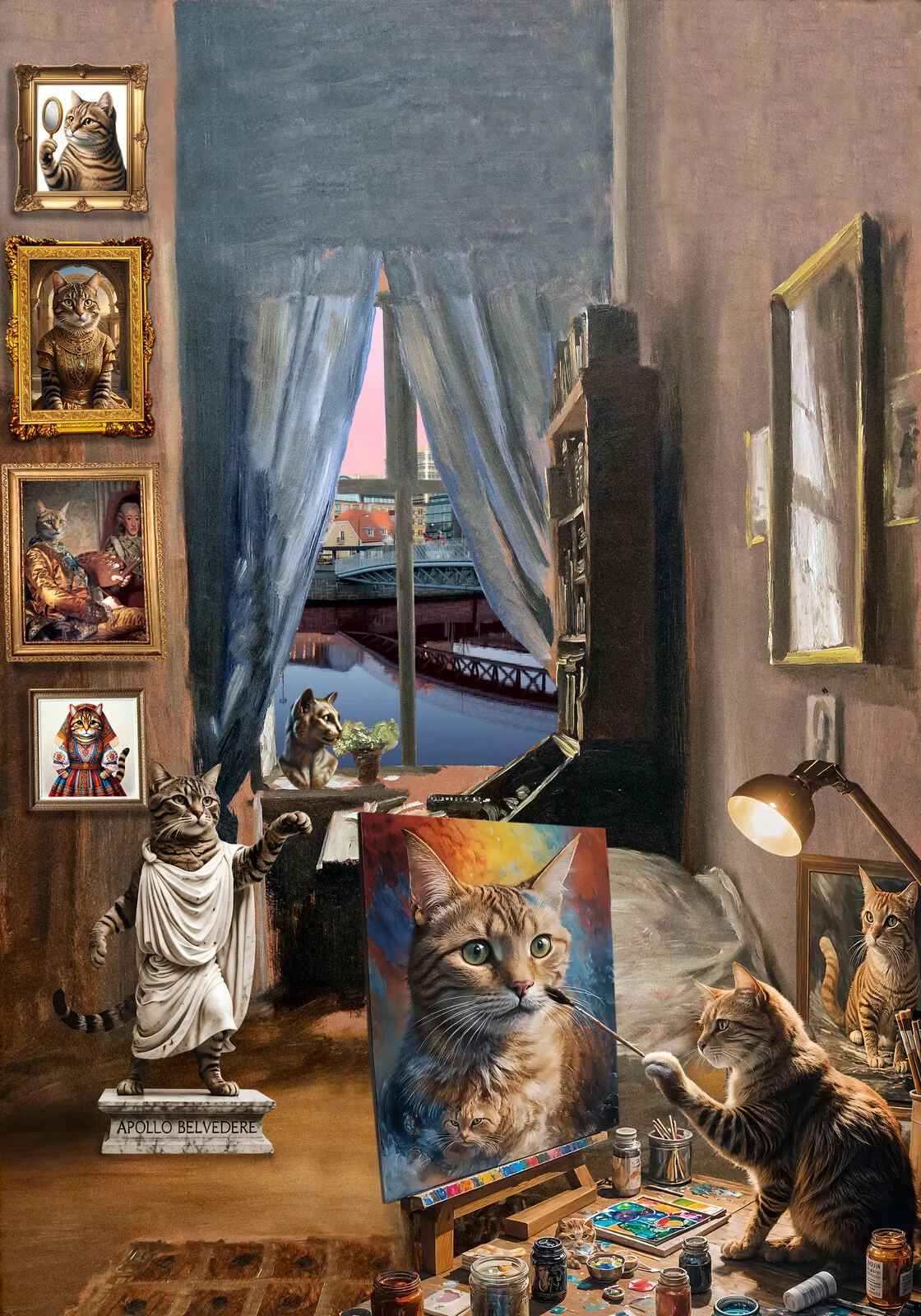
In the cat’s realm of Skåne, in a room abandoned to inheritance disputes and peeling wallpaper, lives Apollo—a cat whose self-regard rivals that of any mythic figure. Draped in stripes worthy of a Rembrandt and possessed of a gaze both vain and visionary, Apollo is not merely a feline but an artist, philosopher, and narcissist by nature and name. With fur as polished as his pride, he scavenges the remnants of human creativity to sculpt and paint himself into immortality—each canvas, each statue, a love letter to his magnificence. But behind the whiskers and whimsy lies a more profound tale—of identity, art, memory, and a world whose love, like tourism and mythology, can consume as quickly as it celebrates.
Please read on if this glimpse into Apollo’s universe has stirred your curiosity. There’s much more to discover about the secret lives of cats—especially those rare, self-aware few who paint self-portraits, one brushstroke at a time, in pursuit of beauty, legacy, and a perfectly framed reflection.
Apollo, Cat of Skåne’s Parnassus
In Malmö’s harbour, where shadows chat,
There lives a cat, proud and tabby, at that,
Apollo, named for gods of yore,
With golden eyes that seek no more
Than his reflection, deep and pure,
In every glass and mirror, love is secure.
His fur, like moonlit golden streams,
A creature born of an artist’s dreams,
He walks with grace, a royal stride,
In every step, in every quiet glide,
Malmö’s streets are his quiet stage,
A living portrait, page by page.
The summer crowds, they come and go,
Yet Apollo moves in timeless flow,
Unbothered by the human crush,
For in his heart, there’s no such rush,
He knows the world but loves just one,
The cat he sees when the day is done.
In a quiet room where echoes dwell,
He paints himself, his private spell,
On canvas, walls, and hidden nooks,
In every mirror, in every look,
For Michael’s voice no longer speaks,
Yet in his heart, Apollo seeks.
With every brushstroke, every line,
He captures all that’s feline fine,
A testament to what’s been lost,
Yet still he paints, no matter the cost,
For in his art, his spirit sings,
A cat of Skåne, born a prince.
Yet more than fame and mirrored gleam,
Apollo yearns for what once seemed,
A second home in the harbour’s light,
Where Michael’s hands, so kind, so bright,
Would stroke his fur and softly say,
“You’re the best in every way.”
He misses walks to that warm space,
Where art and love would interlace,
With every stroke of Michael’s hand,
Made Apollo feel like he could command,
The world, as both muse and king,
In that studio, his heart would sing.
So, while the world may shift and change,
And the streets grow new and strange,
Apollo, a cat of endless pride,
Will always walk with love beside,
A love for self, a love for grace,
In every stroke, in every space.
Malmö, March 2025
The cat in the emerging self-portrait is named Apollo, a name that the tabby cat in the picture lives up to effortlessly, for he truly looks splendid. His self-love, a driving force behind his artistic pursuits, is evident in his immaculate fur, every stripe seemingly painted by Rembrandt, his perfectly groomed whiskers, and his tail, an actual ornament. Apollo's self-expression is not only about his appearance but also about his artistic pursuits. He seeks his reflection on various surfaces and finds treasures among the discarded items of local artists, all to create his unique self-portraits and sculptures. His artistic endeavours, a reflection of his self-love, contribute to the creative spirit of Skåne.
Apollo was fortunate. The room he occupied was vacant due to an inheritance dispute. Seventeen siblings and cousins couldn't agree, so even if cats have nine lives, his residence seemed secure for as long as he lived. Apollo didn’t mind that the wallpaper was peeling and the curtains had faded in the sun or that the floor was worn, as long as the cracked windowpanes didn't fall out and create a draught. Rent-free and furnished—what more could a cat ask for? The entrance facing the port was boarded up, but the broken ventilation grille at the back was generously sized for feline standards. Water was available from a tap that constantly dripped just enough for a cat. Apollo was meticulous about cleanliness; there was no dirty dog here—everything was as polished as his fur. He spent several hours each day grooming himself, and painting was all he did when he wasn't sleeping. Food was never a problem with a bakery nearby. Apollo had inherited the baker's favour from his mother, who had thoroughly charmed the old man. The wholesome discards from the bakery were hardly worth mentioning; the entire cat food pyramid was on Apollo’s menu. All it took was a visit to the bakery and a pleading meow.
A row of self-portraits hung on the walls against the picturesque backdrop of the harbour view. The beauty of Bager’s Bridge in front of his apartment paled in comparison. With his unique character and artistic vision, Apollo repurposed the frames left behind by the previous owners for his images. This act proved his creativity and the distinctiveness of his character, sure to captivate any observer.
With the portrait of his mother set against a classic backdrop of columns and portals, Apollo wished to depict the timeless love he felt for her, the one who had brought him into the world—the only love Apollo had, apart from his love for himself, and even then, his mother came second. She had long since left the island and was now in cat heaven, if such a place existed. He cherished the name she had given him, taken from the most beautiful human gods. In Greek mythology, Apollo is typically portrayed as a male deity associated with various aspects, including music, poetry, prophecy, healing, and the sun. Apollo is often depicted as youthful and handsome, embodying the ideal of male beauty and athleticism in ancient Greek culture.
While Apollo is male, his characteristics often blend qualities that might be traditionally considered both masculine and feminine. For example, in some cultures, his association with the arts, especially music and poetry, might be seen as more delicate or feminine traits.
The picture with the folk costume was not of his mother but of Apollo, dressed in a fanciful creation that he felt did him justice. Apollo had always wondered if his love for himself would have been even stronger if he had been a woman—those divine beings in art constantly desired and admired.
Apollo's father did not appear in any pictures or his thoughts. His father had been a worthless stray cat who had sung beautiful songs to his mother, seducing her on a night with a full moon and the fragrant blooming of red oleanders. This was how Apollo came to be, much like his namesake when Zeus seduced Leto, the mother of the god Apollo. Apollo's feelings towards his father were complex, a mix of resentment and a strange connection to his origins. He often wondered if his father's artistic and seductive nature had been passed down to him and, if so, how he could reconcile that with his self-love and his mother's memory.
Apollo had been his mother’s favourite, and her love made him a mama’s boy. He felt great sympathy for Oedipus, the mythical king of Thebes, who loved his mother so much that he even married her. Apollo didn’t care about the female cats who paraded around him like the Muses around Narcissus, for he loved himself most, an undivided love since his mother had passed away one winter night, never to wake again. Apollo's deep love for his mother will indeed evoke empathy in you.
Fellow artists' trash had replenished Apollo’s painting supplies. But some were good and nice to cats, too. In particular, Michael Lawrence on Hydra, a distant Greek island, had become a friend. His fellow artist liked cats, but especially Apollo. Michael had taught Apollo a lot, both about painting and sculpture. Their friendship, a unique bond between humans and cats, transcended the ordinary. This bond, fueled by their mutual love for art, showed the power of friendship in nurturing creativity and the impact of human-animal relationships on artistic pursuits.
Turpentine, watercolour pastes, half-empty tubes of acrylic and oil paints, canvases with unfinished masterpieces—some of which Apollo could use as backgrounds for his self-portraits. Michael was his own harshest critic, and any watercolours he deemed unsatisfactory went into the trash, although the reverse side could still be utilised. Apollo’s collection of brushes had become the finest on Hydra. Many artists discarded their brushes prematurely, but with proper maintenance, they improved over time. Apollo was particular about the type of hair used in his brushes. Cats' sworn enemies were in peril. Marten's hair is the most sought-after for high-quality brushes, especially for watercolour painting. The hair of the Siberian Kolinsky marten is particularly prized for its ability to retain a fine point and absorb a considerable amount of colour. The marten and the cat hunt the same prey and are not exactly friends, yet they typically avoid one another. Although such pests didn’t exist on Hydra, Apollo collaborated with feline friends who had to confront these creatures in various parts of the world. His meticulous care of his brushes and dedication to his craft are genuinely inspiring.
Weasel hair is often used in high-quality brushes like marten hair but isn’t as costly. The hairs are soft and flexible, ideal for watercolour and oil painting. The weasel is a formidable mouse hunter, far more efficient than a cat, and high on Apollo’s hate list.
Badger hair is frequently used in brushes for oil painting and is somewhat stiffer, assisting in creating textured brushstrokes. Apollo possessed many such brushes. Typically, badgers don’t hunt cats; they feed on mushrooms, earthworms, berries, and the occasional vole. However, since Apollo had heard rumours of a badger in Stockholm that had attacked a cat, the species faced difficulties on Hydra. They were found here and there in Greece but had been eradicated from the island for generations. Cat killers ended up in Apollo’s brush jars.
Boar bristles in brushes render them very durable and stiff, perfect for oil and acrylic painting, and superb for creating thick, textured brushstrokes in backgrounds, for instance. According to cats, wild boars are first-rate vile creatures. Cats have few natural enemies aside from twisted humans who lay out poison. The greatest threat, by far, comes from hunting wild boars, surpassed only by being run over by cars—but such vehicles are banned on Hydra and cannot be fashioned into brushes.
Wild boars are not foolish, and careless cats pose no threat. So-called farm cats are generally bolder than pedigree cats but are also more accustomed to roaming. Pedigree cats that encounter wild boars tend to be more curious and fail to recognise that they are in danger. The wild boars chase the cat up a tree and then engage in a wild dance around it. The boar runs around so quickly that the poor cat in the tree becomes dizzy and falls, turning into a tasty morsel for the boar, who eagerly devours it. Disgusting! With his suppressed hunting instinct, Apollo found a connection between this ruthless act of nature and his artistic pursuits, pressing the brush harder against the canvas.
Squirrel hair is exceptionally soft and frequently used in watercolour brushes. It retains significant water and paint, ideal for broad, gentle brushstrokes. The squirrel is not an enemy but instead a prey for cats. Apollo's suppressed hunting instinct made him ruthless when utilising squirrel hair in brushes.
Apollo also possessed a few larger brushes made from goat and horsehair. Goat meat formed part of his diet, so he had no scruples regarding goats. Hoofed animals faced peril in Apollo’s world since a mule had kicked one of his siblings to death. As a hoofed creature, the horse had to suffer for its cousin’s misdeed. Apollo employed these types of brushes to wash large areas with watercolour.
Regardless of breed, cat hair was out of the question. Cats are commonly used in inexpensive brushes from China, a country infamous for consuming dogs, a trait many cats regard with sympathy. In some regions of China and other Asian countries, dog and cat meat have historically been eaten, though it is significantly less common today. The cat is not considered a delicacy but is valued as a rat exterminator. “Dogs are only good for chasing cats, barking, and causing trouble, so they deserve it,” Apollo thought. Besides, they aren’t even fit for making brushes.
The walls had run out of space, or Apollo lacked a frame worthy of his creations; the pictures were crowded into a closet, awaiting one to be displayed. Apollo competed daily with the rubbish truck to access several strategic bins near the artists' homes. This relentless struggle, combined with the lack of recognition for his work, added a layer of depth to his artistic pursuits.
Michael Lawrence had, of course, taught Apollo to create statues and busts of himself. Clay was expensive, and Apollo was careful not to waste the precious material. He practised on a bust that stood in the window and even managed to bronze it with a concoction inherited from Michael. This mixture made dried clay look and shine like bronze. The masterpiece on the floor, Apollo Belvedere, was, of course, himself, draped in a bedsheet as a toga. Apollo was delighted with how he replicated the fur, strand by strand, making the statue appear almost alive.
Currently, Apollo is working on another self-portrait, the largest so far, at a one-to-three scale. The acrylic painting will hang above the bed, his favourite spot, with a worn, soft mattress that makes him feel as he did seven years ago, swaying in his mother’s belly. This self-portrait, a reflection of his artistic growth and personal journey, is decidedly modern, featuring a marbled background resulting from one of Michael’s failed attempts to depict the sea seen through a bougainvillaea bush, a rare find in Malmö. Apollo would have loved to show it to his friend, who tragically passed away a few years ago. He would have relished the opportunity to boast about his latest artistic technique: two self-portraits in one, where Apollo had intricately worked his teenage cat face into the fur on the chest. Remarkably successful, he thought.
The next project is a small statue of himself as Zeus, holding a lightning bolt in his raised right paw. Zeus resembled Apollo—with lots of hair on his head and a full beard, they could have been twins. The statue would eventually occupy a place on the chiffonier, which, for the first time, would serve a purpose beyond holding the human books that Apollo couldn’t read anyway. The drawers beneath the slanted flap were too stiff for a cat. Otherwise, they would have been ideal for brushes and art supplies. He stored these under the bed, though much was on the table in front of the easel.
Had Apollo been able to read the books in the chiffonier, he might have become captivated by a volume about the god who shared his name. How his mother had managed to read her newborn kitten’s character naturally escaped Apollo’s understanding. Yet, there were striking similarities between the two who bore the name. The title should have piqued his interest: "Apollo: A History of the God and the Idea of the Beautiful" by Friedrich Nietzsche, a philosophical exploration of Apollo as a symbol of order, harmony, and aesthetics. Several other books about the god existed, but the one next to it on Narcissus, a mythological figure known for excessive self-love, should have captured his attention.
Ovid’s "Metamorphoses" contains the original tale of Narcissus and his tragic love for his reflection. In his quest for self-discovery, Apollo might have preferred a more modern work, like Hermann Hesse’s "Narcissus and Goldmund," which uses the myth of Narcissus as an allegory. It explores the philosophical and psychological themes of identity, art, and human relationships. In that book, Apollo would undoubtedly recognise many of his traits. Otto Rank, one of Freud’s disciples, examines the psychological significance of the myth in another book. That book might have proven too revealing and could have prompted Apollo to begin painting flowers instead. That would have been a tragedy, for he lived to paint and had become so skilled that he had surpassed his mentor, Michael, in technique.
Rank could have confirmed that both Apollos were nearly as selfish as Narcissus. In mythology, the god Apollo exhibits traits that can be interpreted as narcissistic, such as his delight in his beauty and pursuit of perfection. There are stories where Apollo is proud, self-absorbed, and obsessed with his status, which, according to modern psychological research, can be viewed as narcissistic traits. He often rejected those who fell in love with him, both women and men. His strictness and occasional cruelty towards those who challenged or scorned him are signs of an excessive ego or pride. This is the figure Apollo saw in the reflection before him, the one taking shape on the canvas at the easel. Imagine the self-awareness Apollo might have gained from reflecting on his traits.
Indeed, one might think that Apollo is a narcissist with all his paintings, statues, and busts depicting himself, along with his obsession with shoes—children's shoes neatly lined up in several closets, with clothes hanging above them that Apollo had ‘rescued’ from dumpsters and loved to dress up in front of the full-length wardrobe mirror. Jewellery and trinkets were another aspect of his life. Apollo had emptied the small drawers of the chiffonier of pens, erasers, and paper clips, instead filling them with discarded jewellery. Just consider Apollo dressed in a gown adorned with all the little baubles he had chosen for himself.
The concept of 'narcissism' cannot simply be dismissed as a modern psychological term that fails to apply to mythological figures, as these characters often represent various forces, aspects of human nature, and social ideals rather than being intended as complete psychological portraits. Nonetheless, people in the past understood peculiar or undesirable behaviours even if they couldn’t explain them in a modern scientific manner. Narcissists certainly existed before Narcissus; otherwise, Ovid and the Greek Pausanias before him would not have been able to describe the phenomenon.
First, Apollo would have had to painstakingly spell his way through Ovid’s tale to discover what happened and read about its reasons—the explanation for his personality. The books in the chiffonier, particularly those concerning Apollo and Narcissus, would have played a crucial role in this self-discovery. What a drama that would have been!
One day, the beautiful Echo encountered the young Narcissus. As he searched for his companions, he called out, "Come," and Echo answered in return. They continued this way until Echo rushed towards him, her arms open for an embrace. However, the vain Narcissus rejected her, and from that moment onwards, she lived in mountain caves. After her death, nothing remained of her but her voice, which echoes the words once spoken.
Echo, a lovely nymph, met a tragic fate due to her incessant talking. Her need for the last word in conversation led to her ultimate downfall. One day, as Hera searched for Zeus, she encountered Echo. The nymph's constant chatter delayed the queen of the gods in her pursuit, allowing the other nymphs to escape. When Hera realised this, she cursed Echo. From that moment on, Echo could only have the last word but could never initiate a conversation—only able to repeat what others had said. This curse, a cruel twist of fate, transformed Echo's once charming trait into a source of eternal loneliness.
As for Narcissus, he was cursed to fall in love with his reflection in the water. After his demise, his body was transformed into a flower, purple at the centre with white petals, which came to bear his name.
In the versions of the story told by classical authors Ovid and Pausanias, Narcissus dies beside a pool while staring at the reflection he has fallen in love with. He is entirely unaware of his surroundings, neither eating nor sleeping, and takes his last breath alone, dying by the image he desperately desires but can never possess.
Due to the scarcity of earlier tales about Narcissus and Echo, many scholars believe this myth and its characters originated with Ovid. According to Gildenhard and Zissos, the story of Narcissus disrupts the poetic pattern within ‘Metamorphoses’, indicating that it may have been added as an afterthought to confirm the prophecy of Tiresias. The story explains the origin of the flower and the existence of echoes. It also serves as a tale of divine retribution: Juno punishes Echo for distracting her so that the nymphs could escape Jupiter’s embrace, and Narcissus is punished for treating those who loved him with such cruelty.
The language of the original Ovidian tale discourages readers from feeling sympathy for Narcissus, emphasising that he deserved his fate due to his scornful rejection of those who loved him, particularly Echo.
Interestingly, in Pausanias' version, Ovid's story is labelled foolish. In this rationalised rendition, where Narcissus has a twin, Echo and the influence of the gods are entirely omitted, stripping away what seemed to be the core elements of the story. Pausanias even suggests that the flower existed long before Narcissus. This shifts the myth from exploring the flower's origins, echoes, and divine-human relationships to a tale told for entertainment.
Narcissus takes his last breath alone, dying beside the image he longs for but can never attain. He is utterly focused on himself, oblivious to anything else. He dies in complete solitude, devoid of love. Ovid and Pausanias demonstrate that self-absorption leads to isolation, much like Narcissus, who perishes by a pool with only his reflection for company.
The English artist John William Waterhouse created the famous painting "Echo and Narcissus." The artwork is set in a serene, wooded landscape beside a stream with rocky edges. The young Narcissus lies prone, his head hanging over the water, mesmerised by his reflection. He is draped in a red robe, symbolising his burning self-love. Nearby, across the stream, sits the nymph Echo, gripping a tree with her right hand and gazing at Narcissus in despair. Symbolically, she is separated from Narcissus, who does not turn back to look at her. Her cramped posture reflects her unrequited love. She wears a pink robe, fallen off one shoulder to reveal a breast; the softer pink represents her gentler, smouldering love for Narcissus. Yellow flowers, irises, and ‘Iris pseudacorus’ grow near her, and she has a red poppy in her auburn hair. White narcissi have sprouted from the grass by Narcissus's foot, and a yellow water lily, ‘Nuphar lutea’, floats nearby.
In psychology, narcissists are often categorised alongside psychopaths.
Reverse narcissism occurs when something is loved to the point of destruction, for nothing can thrive when loved excessively. Think of a childhood teddy bear that becomes increasingly threadbare and greasy, loses an eye, and unravels its nose until it eventually falls apart from all the hugs.
This problem can be applied to Michael’s island, Hydra, and many other tourist destinations that are being loved to the point of ruin. On one hand, tourism is essential for the town's survival; on the other, it suffocates under the weight of all that affection.
Even beautiful images become worn out when constantly repeated and spread across the internet on blogs, Facebook, Instagram, TikTok, tourism sites, and image search results. They are reiterated so often that they eventually become mere noise, and their uniqueness is drowned in a flood of other beautiful places. The uniqueness of Michael’s Hydra—its history and people—is overshadowed by stone facades, blooming bougainvillaea, breathtaking sunsets, and the blue sea.
Even a self-absorbed cat like Apollo has likely noticed the crowds on Hydra during the summer, where several cats have had their legs trampled. The dark side of modern mass tourism has become a prominent topic in media and public debate, especially as the phenomenon grows and impacts destinations worldwide. The role of media and public discussion in raising awareness about the negative impacts of mass tourism cannot be overstated. While tourism is often hailed as a vital economic lifeline for many regions, providing jobs and fostering cultural exchange, the relentless tide of visitors has also exposed severe drawbacks that demand immediate attention.
The urgency of the over-tourism issue cannot be overstated. It's a pressing concern where the sheer number of tourists overwhelms the capacity of a destination, leading to environmental degradation. Popular tourist spots, from Venice to the Great Barrier Reef, have seen their natural landscapes damaged by excessive foot traffic, pollution, and the strain on local resources. The influx of tourists often exceeds the infrastructure's capacity, leading to issues like water shortages, waste management problems, and the destruction of fragile ecosystems. In Venice, for example, the continuous arrival of cruise ships has caused significant erosion of the city's foundations, while in other places, coral reefs bleach due to the combination of climate change and physical damage from tourists.
Mass tourism can also lead to the ‘erosion of local culture’ and the loss of authenticity. As destinations cater more to tourists, there is often a shift towards commodification, where cultural practices, traditions, and even daily life become performances for visitors rather than genuine expressions of local heritage. This can lead to a homogenisation of experiences, where unique cultural identities are diluted to favour what is commercially viable. Traditional crafts, languages, and ways of life may be replaced with souvenirs, generic entertainment, and English-speaking services, all designed to meet the expectations of the global tourist.
The economic benefits of tourism are often unevenly distributed, leading to economic inequality within local communities. Large multinational corporations, rather than local businesses, usually capture most tourism revenues, with profits frequently flowing out of the region. This can exacerbate existing inequalities, as residents face rising living costs, particularly in housing, when properties are converted into holiday rentals and prices soar. In cities like Barcelona and Lisbon, locals have protested against transforming residential neighbourhoods into tourist zones, where the influx of short-term rentals displaces long-term residents. Every cat would recognise this situation; empty apartments like Apollo’s are becoming increasingly rare as renting them out proves highly lucrative.
Moreover, the constant presence of tourists can strain the social fabric of communities. Residents may feel like strangers in their towns, with their daily lives disrupted by crowds, noise, and continual catering to visitor needs. The loss of privacy, the commercialisation of public spaces, and the feeling of being outnumbered can foster a sense of alienation and resentment toward tourists, often referred to as tourism phobia.
While the economic benefits of tourism are considerable, the environmental and cultural costs are often not fully accounted for. Focusing on short-term gains can lead to long-lasting damage that is difficult, if not impossible, to reverse. The debate frequently centres around finding a balance between tourism and sustainability. Concepts like responsible tourism, eco-tourism, and sustainable tourism have emerged as alternatives aiming to minimise the negative impacts of tourism while maximising its benefits. These approaches advocate for travel practices that respect local cultures, conserve the environment, and ensure that the economic benefits of tourism are shared equitably.
Media coverage has highlighted various case studies where the negative impacts of mass tourism have become particularly evident. For instance, the Philippine Island of Boracay was closed to tourists for six months in 2018 to address severe environmental degradation caused by unregulated tourism. Similarly, Thailand temporarily closed several of its most famous beaches to allow ecosystems to recover from the damage inflicted by years of mass tourism. These actions underscore the urgent need for more sustainable tourism practices as destinations grapple with the consequences of their popularity.
Additionally, cats should be meowing for regulation and change. There is a growing call for improved tourism regulation in response to these challenges. Measures such as tourist caps, entry fees, and controlled access to sensitive areas are being considered or implemented in various destinations. Cities like Amsterdam and Venice have introduced taxes on tourists and limited the number of new hotels and short-term rentals to curb the harmful effects of overtourism. These actions demonstrate that change is possible and that a more sustainable future for tourism is within reach.
The public debate also emphasises the need for tourists to take responsibility by making more conscious choices about where, when, and how they travel. The rise of slow travel, where tourists spend more time in fewer places, seeking more profound engagement with local cultures while lessening their environmental footprint, reflects a shift in mindset among some travellers. This shift towards responsible tourism is not just a trend but a crucial step towards preserving the beauty and authenticity of our destinations.
In summary, while tourism continues to be a global economic driver, the downsides of mass tourism—environmental degradation, cultural erosion, economic inequality, and social disruption—are becoming increasingly apparent. The media and public discussion play a crucial role in advocating for more sustainable, responsible approaches to tourism. They are pushing for changes that will protect both the destinations and the communities that enrich travel.
While Apollo and Hydra wait for change, Apollo will continue to love himself and fill walls and closets with his creations. Michael's passing has been a setback in the supply of art materials; still, more than anything, Apollo misses the routine of travelling once a year to Kamini and Michael’s studio, a place that was once a second home to him. He misses the gentle pats and how Michael affirmed that Apollo was the world's best, most beautiful, and most brilliant cat.
Jörgen Thornberg
Narcissus and Malmö, 2024
Digital
50 x 70 cm
3 200 kr
Narcissus and Malmö
In the cat’s realm of Skåne, in a room abandoned to inheritance disputes and peeling wallpaper, lives Apollo—a cat whose self-regard rivals that of any mythic figure. Draped in stripes worthy of a Rembrandt and possessed of a gaze both vain and visionary, Apollo is not merely a feline but an artist, philosopher, and narcissist by nature and name. With fur as polished as his pride, he scavenges the remnants of human creativity to sculpt and paint himself into immortality—each canvas, each statue, a love letter to his magnificence. But behind the whiskers and whimsy lies a more profound tale—of identity, art, memory, and a world whose love, like tourism and mythology, can consume as quickly as it celebrates.
Please read on if this glimpse into Apollo’s universe has stirred your curiosity. There’s much more to discover about the secret lives of cats—especially those rare, self-aware few who paint self-portraits, one brushstroke at a time, in pursuit of beauty, legacy, and a perfectly framed reflection.
Apollo, Cat of Skåne’s Parnassus
In Malmö’s harbour, where shadows chat,
There lives a cat, proud and tabby, at that,
Apollo, named for gods of yore,
With golden eyes that seek no more
Than his reflection, deep and pure,
In every glass and mirror, love is secure.
His fur, like moonlit golden streams,
A creature born of an artist’s dreams,
He walks with grace, a royal stride,
In every step, in every quiet glide,
Malmö’s streets are his quiet stage,
A living portrait, page by page.
The summer crowds, they come and go,
Yet Apollo moves in timeless flow,
Unbothered by the human crush,
For in his heart, there’s no such rush,
He knows the world but loves just one,
The cat he sees when the day is done.
In a quiet room where echoes dwell,
He paints himself, his private spell,
On canvas, walls, and hidden nooks,
In every mirror, in every look,
For Michael’s voice no longer speaks,
Yet in his heart, Apollo seeks.
With every brushstroke, every line,
He captures all that’s feline fine,
A testament to what’s been lost,
Yet still he paints, no matter the cost,
For in his art, his spirit sings,
A cat of Skåne, born a prince.
Yet more than fame and mirrored gleam,
Apollo yearns for what once seemed,
A second home in the harbour’s light,
Where Michael’s hands, so kind, so bright,
Would stroke his fur and softly say,
“You’re the best in every way.”
He misses walks to that warm space,
Where art and love would interlace,
With every stroke of Michael’s hand,
Made Apollo feel like he could command,
The world, as both muse and king,
In that studio, his heart would sing.
So, while the world may shift and change,
And the streets grow new and strange,
Apollo, a cat of endless pride,
Will always walk with love beside,
A love for self, a love for grace,
In every stroke, in every space.
Malmö, March 2025
The cat in the emerging self-portrait is named Apollo, a name that the tabby cat in the picture lives up to effortlessly, for he truly looks splendid. His self-love, a driving force behind his artistic pursuits, is evident in his immaculate fur, every stripe seemingly painted by Rembrandt, his perfectly groomed whiskers, and his tail, an actual ornament. Apollo's self-expression is not only about his appearance but also about his artistic pursuits. He seeks his reflection on various surfaces and finds treasures among the discarded items of local artists, all to create his unique self-portraits and sculptures. His artistic endeavours, a reflection of his self-love, contribute to the creative spirit of Skåne.
Apollo was fortunate. The room he occupied was vacant due to an inheritance dispute. Seventeen siblings and cousins couldn't agree, so even if cats have nine lives, his residence seemed secure for as long as he lived. Apollo didn’t mind that the wallpaper was peeling and the curtains had faded in the sun or that the floor was worn, as long as the cracked windowpanes didn't fall out and create a draught. Rent-free and furnished—what more could a cat ask for? The entrance facing the port was boarded up, but the broken ventilation grille at the back was generously sized for feline standards. Water was available from a tap that constantly dripped just enough for a cat. Apollo was meticulous about cleanliness; there was no dirty dog here—everything was as polished as his fur. He spent several hours each day grooming himself, and painting was all he did when he wasn't sleeping. Food was never a problem with a bakery nearby. Apollo had inherited the baker's favour from his mother, who had thoroughly charmed the old man. The wholesome discards from the bakery were hardly worth mentioning; the entire cat food pyramid was on Apollo’s menu. All it took was a visit to the bakery and a pleading meow.
A row of self-portraits hung on the walls against the picturesque backdrop of the harbour view. The beauty of Bager’s Bridge in front of his apartment paled in comparison. With his unique character and artistic vision, Apollo repurposed the frames left behind by the previous owners for his images. This act proved his creativity and the distinctiveness of his character, sure to captivate any observer.
With the portrait of his mother set against a classic backdrop of columns and portals, Apollo wished to depict the timeless love he felt for her, the one who had brought him into the world—the only love Apollo had, apart from his love for himself, and even then, his mother came second. She had long since left the island and was now in cat heaven, if such a place existed. He cherished the name she had given him, taken from the most beautiful human gods. In Greek mythology, Apollo is typically portrayed as a male deity associated with various aspects, including music, poetry, prophecy, healing, and the sun. Apollo is often depicted as youthful and handsome, embodying the ideal of male beauty and athleticism in ancient Greek culture.
While Apollo is male, his characteristics often blend qualities that might be traditionally considered both masculine and feminine. For example, in some cultures, his association with the arts, especially music and poetry, might be seen as more delicate or feminine traits.
The picture with the folk costume was not of his mother but of Apollo, dressed in a fanciful creation that he felt did him justice. Apollo had always wondered if his love for himself would have been even stronger if he had been a woman—those divine beings in art constantly desired and admired.
Apollo's father did not appear in any pictures or his thoughts. His father had been a worthless stray cat who had sung beautiful songs to his mother, seducing her on a night with a full moon and the fragrant blooming of red oleanders. This was how Apollo came to be, much like his namesake when Zeus seduced Leto, the mother of the god Apollo. Apollo's feelings towards his father were complex, a mix of resentment and a strange connection to his origins. He often wondered if his father's artistic and seductive nature had been passed down to him and, if so, how he could reconcile that with his self-love and his mother's memory.
Apollo had been his mother’s favourite, and her love made him a mama’s boy. He felt great sympathy for Oedipus, the mythical king of Thebes, who loved his mother so much that he even married her. Apollo didn’t care about the female cats who paraded around him like the Muses around Narcissus, for he loved himself most, an undivided love since his mother had passed away one winter night, never to wake again. Apollo's deep love for his mother will indeed evoke empathy in you.
Fellow artists' trash had replenished Apollo’s painting supplies. But some were good and nice to cats, too. In particular, Michael Lawrence on Hydra, a distant Greek island, had become a friend. His fellow artist liked cats, but especially Apollo. Michael had taught Apollo a lot, both about painting and sculpture. Their friendship, a unique bond between humans and cats, transcended the ordinary. This bond, fueled by their mutual love for art, showed the power of friendship in nurturing creativity and the impact of human-animal relationships on artistic pursuits.
Turpentine, watercolour pastes, half-empty tubes of acrylic and oil paints, canvases with unfinished masterpieces—some of which Apollo could use as backgrounds for his self-portraits. Michael was his own harshest critic, and any watercolours he deemed unsatisfactory went into the trash, although the reverse side could still be utilised. Apollo’s collection of brushes had become the finest on Hydra. Many artists discarded their brushes prematurely, but with proper maintenance, they improved over time. Apollo was particular about the type of hair used in his brushes. Cats' sworn enemies were in peril. Marten's hair is the most sought-after for high-quality brushes, especially for watercolour painting. The hair of the Siberian Kolinsky marten is particularly prized for its ability to retain a fine point and absorb a considerable amount of colour. The marten and the cat hunt the same prey and are not exactly friends, yet they typically avoid one another. Although such pests didn’t exist on Hydra, Apollo collaborated with feline friends who had to confront these creatures in various parts of the world. His meticulous care of his brushes and dedication to his craft are genuinely inspiring.
Weasel hair is often used in high-quality brushes like marten hair but isn’t as costly. The hairs are soft and flexible, ideal for watercolour and oil painting. The weasel is a formidable mouse hunter, far more efficient than a cat, and high on Apollo’s hate list.
Badger hair is frequently used in brushes for oil painting and is somewhat stiffer, assisting in creating textured brushstrokes. Apollo possessed many such brushes. Typically, badgers don’t hunt cats; they feed on mushrooms, earthworms, berries, and the occasional vole. However, since Apollo had heard rumours of a badger in Stockholm that had attacked a cat, the species faced difficulties on Hydra. They were found here and there in Greece but had been eradicated from the island for generations. Cat killers ended up in Apollo’s brush jars.
Boar bristles in brushes render them very durable and stiff, perfect for oil and acrylic painting, and superb for creating thick, textured brushstrokes in backgrounds, for instance. According to cats, wild boars are first-rate vile creatures. Cats have few natural enemies aside from twisted humans who lay out poison. The greatest threat, by far, comes from hunting wild boars, surpassed only by being run over by cars—but such vehicles are banned on Hydra and cannot be fashioned into brushes.
Wild boars are not foolish, and careless cats pose no threat. So-called farm cats are generally bolder than pedigree cats but are also more accustomed to roaming. Pedigree cats that encounter wild boars tend to be more curious and fail to recognise that they are in danger. The wild boars chase the cat up a tree and then engage in a wild dance around it. The boar runs around so quickly that the poor cat in the tree becomes dizzy and falls, turning into a tasty morsel for the boar, who eagerly devours it. Disgusting! With his suppressed hunting instinct, Apollo found a connection between this ruthless act of nature and his artistic pursuits, pressing the brush harder against the canvas.
Squirrel hair is exceptionally soft and frequently used in watercolour brushes. It retains significant water and paint, ideal for broad, gentle brushstrokes. The squirrel is not an enemy but instead a prey for cats. Apollo's suppressed hunting instinct made him ruthless when utilising squirrel hair in brushes.
Apollo also possessed a few larger brushes made from goat and horsehair. Goat meat formed part of his diet, so he had no scruples regarding goats. Hoofed animals faced peril in Apollo’s world since a mule had kicked one of his siblings to death. As a hoofed creature, the horse had to suffer for its cousin’s misdeed. Apollo employed these types of brushes to wash large areas with watercolour.
Regardless of breed, cat hair was out of the question. Cats are commonly used in inexpensive brushes from China, a country infamous for consuming dogs, a trait many cats regard with sympathy. In some regions of China and other Asian countries, dog and cat meat have historically been eaten, though it is significantly less common today. The cat is not considered a delicacy but is valued as a rat exterminator. “Dogs are only good for chasing cats, barking, and causing trouble, so they deserve it,” Apollo thought. Besides, they aren’t even fit for making brushes.
The walls had run out of space, or Apollo lacked a frame worthy of his creations; the pictures were crowded into a closet, awaiting one to be displayed. Apollo competed daily with the rubbish truck to access several strategic bins near the artists' homes. This relentless struggle, combined with the lack of recognition for his work, added a layer of depth to his artistic pursuits.
Michael Lawrence had, of course, taught Apollo to create statues and busts of himself. Clay was expensive, and Apollo was careful not to waste the precious material. He practised on a bust that stood in the window and even managed to bronze it with a concoction inherited from Michael. This mixture made dried clay look and shine like bronze. The masterpiece on the floor, Apollo Belvedere, was, of course, himself, draped in a bedsheet as a toga. Apollo was delighted with how he replicated the fur, strand by strand, making the statue appear almost alive.
Currently, Apollo is working on another self-portrait, the largest so far, at a one-to-three scale. The acrylic painting will hang above the bed, his favourite spot, with a worn, soft mattress that makes him feel as he did seven years ago, swaying in his mother’s belly. This self-portrait, a reflection of his artistic growth and personal journey, is decidedly modern, featuring a marbled background resulting from one of Michael’s failed attempts to depict the sea seen through a bougainvillaea bush, a rare find in Malmö. Apollo would have loved to show it to his friend, who tragically passed away a few years ago. He would have relished the opportunity to boast about his latest artistic technique: two self-portraits in one, where Apollo had intricately worked his teenage cat face into the fur on the chest. Remarkably successful, he thought.
The next project is a small statue of himself as Zeus, holding a lightning bolt in his raised right paw. Zeus resembled Apollo—with lots of hair on his head and a full beard, they could have been twins. The statue would eventually occupy a place on the chiffonier, which, for the first time, would serve a purpose beyond holding the human books that Apollo couldn’t read anyway. The drawers beneath the slanted flap were too stiff for a cat. Otherwise, they would have been ideal for brushes and art supplies. He stored these under the bed, though much was on the table in front of the easel.
Had Apollo been able to read the books in the chiffonier, he might have become captivated by a volume about the god who shared his name. How his mother had managed to read her newborn kitten’s character naturally escaped Apollo’s understanding. Yet, there were striking similarities between the two who bore the name. The title should have piqued his interest: "Apollo: A History of the God and the Idea of the Beautiful" by Friedrich Nietzsche, a philosophical exploration of Apollo as a symbol of order, harmony, and aesthetics. Several other books about the god existed, but the one next to it on Narcissus, a mythological figure known for excessive self-love, should have captured his attention.
Ovid’s "Metamorphoses" contains the original tale of Narcissus and his tragic love for his reflection. In his quest for self-discovery, Apollo might have preferred a more modern work, like Hermann Hesse’s "Narcissus and Goldmund," which uses the myth of Narcissus as an allegory. It explores the philosophical and psychological themes of identity, art, and human relationships. In that book, Apollo would undoubtedly recognise many of his traits. Otto Rank, one of Freud’s disciples, examines the psychological significance of the myth in another book. That book might have proven too revealing and could have prompted Apollo to begin painting flowers instead. That would have been a tragedy, for he lived to paint and had become so skilled that he had surpassed his mentor, Michael, in technique.
Rank could have confirmed that both Apollos were nearly as selfish as Narcissus. In mythology, the god Apollo exhibits traits that can be interpreted as narcissistic, such as his delight in his beauty and pursuit of perfection. There are stories where Apollo is proud, self-absorbed, and obsessed with his status, which, according to modern psychological research, can be viewed as narcissistic traits. He often rejected those who fell in love with him, both women and men. His strictness and occasional cruelty towards those who challenged or scorned him are signs of an excessive ego or pride. This is the figure Apollo saw in the reflection before him, the one taking shape on the canvas at the easel. Imagine the self-awareness Apollo might have gained from reflecting on his traits.
Indeed, one might think that Apollo is a narcissist with all his paintings, statues, and busts depicting himself, along with his obsession with shoes—children's shoes neatly lined up in several closets, with clothes hanging above them that Apollo had ‘rescued’ from dumpsters and loved to dress up in front of the full-length wardrobe mirror. Jewellery and trinkets were another aspect of his life. Apollo had emptied the small drawers of the chiffonier of pens, erasers, and paper clips, instead filling them with discarded jewellery. Just consider Apollo dressed in a gown adorned with all the little baubles he had chosen for himself.
The concept of 'narcissism' cannot simply be dismissed as a modern psychological term that fails to apply to mythological figures, as these characters often represent various forces, aspects of human nature, and social ideals rather than being intended as complete psychological portraits. Nonetheless, people in the past understood peculiar or undesirable behaviours even if they couldn’t explain them in a modern scientific manner. Narcissists certainly existed before Narcissus; otherwise, Ovid and the Greek Pausanias before him would not have been able to describe the phenomenon.
First, Apollo would have had to painstakingly spell his way through Ovid’s tale to discover what happened and read about its reasons—the explanation for his personality. The books in the chiffonier, particularly those concerning Apollo and Narcissus, would have played a crucial role in this self-discovery. What a drama that would have been!
One day, the beautiful Echo encountered the young Narcissus. As he searched for his companions, he called out, "Come," and Echo answered in return. They continued this way until Echo rushed towards him, her arms open for an embrace. However, the vain Narcissus rejected her, and from that moment onwards, she lived in mountain caves. After her death, nothing remained of her but her voice, which echoes the words once spoken.
Echo, a lovely nymph, met a tragic fate due to her incessant talking. Her need for the last word in conversation led to her ultimate downfall. One day, as Hera searched for Zeus, she encountered Echo. The nymph's constant chatter delayed the queen of the gods in her pursuit, allowing the other nymphs to escape. When Hera realised this, she cursed Echo. From that moment on, Echo could only have the last word but could never initiate a conversation—only able to repeat what others had said. This curse, a cruel twist of fate, transformed Echo's once charming trait into a source of eternal loneliness.
As for Narcissus, he was cursed to fall in love with his reflection in the water. After his demise, his body was transformed into a flower, purple at the centre with white petals, which came to bear his name.
In the versions of the story told by classical authors Ovid and Pausanias, Narcissus dies beside a pool while staring at the reflection he has fallen in love with. He is entirely unaware of his surroundings, neither eating nor sleeping, and takes his last breath alone, dying by the image he desperately desires but can never possess.
Due to the scarcity of earlier tales about Narcissus and Echo, many scholars believe this myth and its characters originated with Ovid. According to Gildenhard and Zissos, the story of Narcissus disrupts the poetic pattern within ‘Metamorphoses’, indicating that it may have been added as an afterthought to confirm the prophecy of Tiresias. The story explains the origin of the flower and the existence of echoes. It also serves as a tale of divine retribution: Juno punishes Echo for distracting her so that the nymphs could escape Jupiter’s embrace, and Narcissus is punished for treating those who loved him with such cruelty.
The language of the original Ovidian tale discourages readers from feeling sympathy for Narcissus, emphasising that he deserved his fate due to his scornful rejection of those who loved him, particularly Echo.
Interestingly, in Pausanias' version, Ovid's story is labelled foolish. In this rationalised rendition, where Narcissus has a twin, Echo and the influence of the gods are entirely omitted, stripping away what seemed to be the core elements of the story. Pausanias even suggests that the flower existed long before Narcissus. This shifts the myth from exploring the flower's origins, echoes, and divine-human relationships to a tale told for entertainment.
Narcissus takes his last breath alone, dying beside the image he longs for but can never attain. He is utterly focused on himself, oblivious to anything else. He dies in complete solitude, devoid of love. Ovid and Pausanias demonstrate that self-absorption leads to isolation, much like Narcissus, who perishes by a pool with only his reflection for company.
The English artist John William Waterhouse created the famous painting "Echo and Narcissus." The artwork is set in a serene, wooded landscape beside a stream with rocky edges. The young Narcissus lies prone, his head hanging over the water, mesmerised by his reflection. He is draped in a red robe, symbolising his burning self-love. Nearby, across the stream, sits the nymph Echo, gripping a tree with her right hand and gazing at Narcissus in despair. Symbolically, she is separated from Narcissus, who does not turn back to look at her. Her cramped posture reflects her unrequited love. She wears a pink robe, fallen off one shoulder to reveal a breast; the softer pink represents her gentler, smouldering love for Narcissus. Yellow flowers, irises, and ‘Iris pseudacorus’ grow near her, and she has a red poppy in her auburn hair. White narcissi have sprouted from the grass by Narcissus's foot, and a yellow water lily, ‘Nuphar lutea’, floats nearby.
In psychology, narcissists are often categorised alongside psychopaths.
Reverse narcissism occurs when something is loved to the point of destruction, for nothing can thrive when loved excessively. Think of a childhood teddy bear that becomes increasingly threadbare and greasy, loses an eye, and unravels its nose until it eventually falls apart from all the hugs.
This problem can be applied to Michael’s island, Hydra, and many other tourist destinations that are being loved to the point of ruin. On one hand, tourism is essential for the town's survival; on the other, it suffocates under the weight of all that affection.
Even beautiful images become worn out when constantly repeated and spread across the internet on blogs, Facebook, Instagram, TikTok, tourism sites, and image search results. They are reiterated so often that they eventually become mere noise, and their uniqueness is drowned in a flood of other beautiful places. The uniqueness of Michael’s Hydra—its history and people—is overshadowed by stone facades, blooming bougainvillaea, breathtaking sunsets, and the blue sea.
Even a self-absorbed cat like Apollo has likely noticed the crowds on Hydra during the summer, where several cats have had their legs trampled. The dark side of modern mass tourism has become a prominent topic in media and public debate, especially as the phenomenon grows and impacts destinations worldwide. The role of media and public discussion in raising awareness about the negative impacts of mass tourism cannot be overstated. While tourism is often hailed as a vital economic lifeline for many regions, providing jobs and fostering cultural exchange, the relentless tide of visitors has also exposed severe drawbacks that demand immediate attention.
The urgency of the over-tourism issue cannot be overstated. It's a pressing concern where the sheer number of tourists overwhelms the capacity of a destination, leading to environmental degradation. Popular tourist spots, from Venice to the Great Barrier Reef, have seen their natural landscapes damaged by excessive foot traffic, pollution, and the strain on local resources. The influx of tourists often exceeds the infrastructure's capacity, leading to issues like water shortages, waste management problems, and the destruction of fragile ecosystems. In Venice, for example, the continuous arrival of cruise ships has caused significant erosion of the city's foundations, while in other places, coral reefs bleach due to the combination of climate change and physical damage from tourists.
Mass tourism can also lead to the ‘erosion of local culture’ and the loss of authenticity. As destinations cater more to tourists, there is often a shift towards commodification, where cultural practices, traditions, and even daily life become performances for visitors rather than genuine expressions of local heritage. This can lead to a homogenisation of experiences, where unique cultural identities are diluted to favour what is commercially viable. Traditional crafts, languages, and ways of life may be replaced with souvenirs, generic entertainment, and English-speaking services, all designed to meet the expectations of the global tourist.
The economic benefits of tourism are often unevenly distributed, leading to economic inequality within local communities. Large multinational corporations, rather than local businesses, usually capture most tourism revenues, with profits frequently flowing out of the region. This can exacerbate existing inequalities, as residents face rising living costs, particularly in housing, when properties are converted into holiday rentals and prices soar. In cities like Barcelona and Lisbon, locals have protested against transforming residential neighbourhoods into tourist zones, where the influx of short-term rentals displaces long-term residents. Every cat would recognise this situation; empty apartments like Apollo’s are becoming increasingly rare as renting them out proves highly lucrative.
Moreover, the constant presence of tourists can strain the social fabric of communities. Residents may feel like strangers in their towns, with their daily lives disrupted by crowds, noise, and continual catering to visitor needs. The loss of privacy, the commercialisation of public spaces, and the feeling of being outnumbered can foster a sense of alienation and resentment toward tourists, often referred to as tourism phobia.
While the economic benefits of tourism are considerable, the environmental and cultural costs are often not fully accounted for. Focusing on short-term gains can lead to long-lasting damage that is difficult, if not impossible, to reverse. The debate frequently centres around finding a balance between tourism and sustainability. Concepts like responsible tourism, eco-tourism, and sustainable tourism have emerged as alternatives aiming to minimise the negative impacts of tourism while maximising its benefits. These approaches advocate for travel practices that respect local cultures, conserve the environment, and ensure that the economic benefits of tourism are shared equitably.
Media coverage has highlighted various case studies where the negative impacts of mass tourism have become particularly evident. For instance, the Philippine Island of Boracay was closed to tourists for six months in 2018 to address severe environmental degradation caused by unregulated tourism. Similarly, Thailand temporarily closed several of its most famous beaches to allow ecosystems to recover from the damage inflicted by years of mass tourism. These actions underscore the urgent need for more sustainable tourism practices as destinations grapple with the consequences of their popularity.
Additionally, cats should be meowing for regulation and change. There is a growing call for improved tourism regulation in response to these challenges. Measures such as tourist caps, entry fees, and controlled access to sensitive areas are being considered or implemented in various destinations. Cities like Amsterdam and Venice have introduced taxes on tourists and limited the number of new hotels and short-term rentals to curb the harmful effects of overtourism. These actions demonstrate that change is possible and that a more sustainable future for tourism is within reach.
The public debate also emphasises the need for tourists to take responsibility by making more conscious choices about where, when, and how they travel. The rise of slow travel, where tourists spend more time in fewer places, seeking more profound engagement with local cultures while lessening their environmental footprint, reflects a shift in mindset among some travellers. This shift towards responsible tourism is not just a trend but a crucial step towards preserving the beauty and authenticity of our destinations.
In summary, while tourism continues to be a global economic driver, the downsides of mass tourism—environmental degradation, cultural erosion, economic inequality, and social disruption—are becoming increasingly apparent. The media and public discussion play a crucial role in advocating for more sustainable, responsible approaches to tourism. They are pushing for changes that will protect both the destinations and the communities that enrich travel.
While Apollo and Hydra wait for change, Apollo will continue to love himself and fill walls and closets with his creations. Michael's passing has been a setback in the supply of art materials; still, more than anything, Apollo misses the routine of travelling once a year to Kamini and Michael’s studio, a place that was once a second home to him. He misses the gentle pats and how Michael affirmed that Apollo was the world's best, most beautiful, and most brilliant cat.
3 200 kr

Jörgen Thornberg
Malmö
Lite om bilder och mig. Translation in English at the end.
Jag är en nyfiken person som ser allt i bilder, även det jag fäster i ord, gärna tillsammans för bakom alla mina bilder finns en berättelse. Till vissa bilder hör en kortare eller längre novell som följer med bilden.
Bilder berättar historier. Jag omges av naturlig skönhet, intressanta människor och historia var jag än går. Jag använder min kamera för att dokumentera världen och blanda det jag ser med vad jag känner för att fånga den dolda magin.
Mina bilder berättar mina historier. Genom mina bilder, tryck och berättelser. Jag bjuder in dig att ta del av dessa berättelser, in i ditt liv och hem och dela min mycket personliga syn på vår värld. Mer än vad ögat ser. Jag tänker i bilder, drömmer och skriver och pratar om dem; följaktligen måste jag också skapa bilder. De blir vad jag ser, inte nödvändigtvis begränsade till verkligheten. Det finns en bild runt varje hörn. Jag hoppas att du kommer att se vad jag såg och gilla det.
Jag är också en skrivande person och till många bilder hör en kortare eller längre essay. Den följer med tavlan, tryckt på fint papper och med en personlig hälsning från mig.
Flertalet bilder startar sin resa i min kamera. Enkelt förklarat beskriver jag bilden jag ser i mitt inre, upplevd eller fantiserad. Bilden uppstår inom mig redan innan jag fått okularet till ögat. På bråkdelen av ett ögonblick ser jag vad jag vill ha och vad som kan göras med bilden. Här skall jag stoppa in en giraff, stålmannen, Titanic eller vad det är min fantasi finner ut. Ännu märkligare är att jag kommer ihåg minnesbilden långt efteråt när det blir tid att skapa verket. Om jag lyckas eller inte, är upp till betraktaren, oftast präglat av en stråk av svart humor – meningen är att man skall bli underhållen. Mina bilder blir ofta en snackis där de hänger.
Jag föredrar bilder som förmedlar ett budskap i flera lager. Vid första anblicken fylld av feel-good, en vacker utsikt, fint väder, solen skiner, blommor på ängen eller vattnet som ligger förrädiskt spegelblankt. I en sådan bild kan jag gömma min egentliga berättelse, mitt förakt för förtryckare och våldsverkare, rasister och fördomsfulla människor - ett gärna återkommande motiv mer eller mindre dolt i det vackra motivet. Jag försöker förena dem i ett gemensamt narrativ.
Bild och formgivning har löpt som en röd tråd genom livet. Fotokonst känns som en värdig final som jag gärna delar med mig.
Min genre är vid som framgår av mina bilder, temat en blandning av pop- och gatukonst i kollage som kan bestå av hundratals lager. Vissa bilder kan ta veckor, andra någon dag innan det är dags att överlämna resultatet till printverkstaden. Fine Art Prints är digitala fotocollage. I dessa kollage sker rivandet, klippandet, pusslandet, målandet, ritandet och sprayningen digitalt. Det jag monterar in kan vara hundratals år gamla bilder som jag omsorgsfullt frilägger så att de ser ut att vara en del av tavlan men också bilder skapade av mig själv efter min egen fantasi. Därefter besöks printstudion och för vissa bilder numrera en limiterad upplaga (oftast 7 exemplar) och signera för hand. Vissa bilder kan köpas i olika format. Det är bara att fråga efter vilka. Gillar man en bild som är 70x100 men inte har plats på väggen, går den kanske att få i 50x70 cm istället. Frågan är fri.
Metoden Giclée eller Fine Art Print som det också kallas är det moderna sättet för framställning av grafisk konst. Villkoret för denna typ av utskrifter är att en högkvalitativ storformatskrivare används med åldersbeständigt färgpigment och konstnärspapper eller i förekommande fall på duk. Pappret som används möter de krav på livslängd som ställs av museer och gallerier. Normalt säljer jag mina bilder oinramade så att den nya ägaren själv kan bestämma hur de skall se ut, med eller utan passepartout färg på ram, med eller utan glas etc..
Under många år ställde jag bara ut på nätet, i valda grupper och på min egen Facebooksida - https://www.facebook.com/jorgen.thornberg.9
Jag finns också på en egen hemsida som tyvärr inte alltid är uppdaterad – https://www.jth.life/ Där kan du också läsa en del av de berättelser som följer med bilden.
UTSTÄLLNINGAR
Luftkastellet, oktober 2022
Konst i Lund, november 2022
Luftkastellet, mars 2023
Engleson Galleri Caroli, april 2023
Hydra, Greece June 2023
Engleson Galleri Caroli, oktober 2023
Toppen, Höllviken december 2023
Luftkastellet, mars 2024
Torups Galleri, mars 2024
Venice, May 2024
Luftkastellet, oktober 2024
Konst i Advent, December 2024
Galleri Engleson, Caroli December 2024
Jäger & Jansson Galleri, april 2025
A bit about pictures and me.
I'm a curious person who sees everything in pictures, even what I express in words, often combining them, for behind all my pictures lies a story. These narratives, some as short as a single image and others as long as a novel, are the heart and soul of my work.
Pictures tell stories. Wherever I go, I'm surrounded by natural beauty, exciting people, and history. I use my camera to document the world and blend what I see with what I feel to capture the hidden magic.
My images tell my stories. Through my pictures, prints, and narratives, I invite you to partake in these stories in your life and home and share my deeply personal perspective of our world. More than meets the eye. I think in pictures, dream, write, and talk about them; consequently, I must create images too. They become what I see, not necessarily confined to reality. There's a picture around every corner. I hope you'll see what I saw and enjoy it.
I'm also a writer, and many images come with a shorter or longer essay. It accompanies the painting, printed on fine paper with my personal greeting.
Many pictures start their journey on my camera. Simply put, I describe the image I see in my mind, experienced or imagined. The image arises within me even before I bring the eyepiece to my eye. In a fraction of a moment, I see what I want and what can be done with the picture. Here, I'll insert a giraffe, Superman, the Titanic, or whatever my imagination conjures up. Even stranger is that I remember the mental image long after it's time to create the work. Whether I succeed is up to the observer, often imbued with a streak of black humour – the aim is to entertain. My pictures usually become a talking point wherever they hang.
I prefer pictures that convey a message in multiple layers. At first glance, they're filled with feel-good vibes, a beautiful view, lovely weather, the sun shining, flowers in the meadow, or the water lying deceptively calm. But beneath this surface beauty, I often conceal a deeper story, a narrative that challenges societal norms or explores the human condition. I invite you to delve into these hidden narratives and discover the layers of meaning within my work.
Picture and design have been a thread running through my life. Photographic art feels like a fitting finale, and I'm happy to share it.
My genre is varied, as seen in my pictures; the theme is a blend of pop and street art in collages that can consist of hundreds of layers. Some images can take weeks, others just a day before it's time to hand over the result to the print workshop. Fine Art Prints are digital photo collages. In these collages, tearing, cutting, puzzling, painting, drawing, and spraying happen digitally. What I insert can be images hundreds of years old that I carefully extract so they appear to be part of the painting, but also images created by myself, now also generated from my imagination. Next, visit the print studio and, for certain images, number a limited edition (usually 7 copies) and sign them by hand. Some images may be available in other formats. Just ask which ones. If you like an image that's 70x100 but doesn't have space on the wall, you might be able to get it in 50x70 cm instead. The question is open.
The Giclée method, or Fine Art Print as it's also called, is the modern way of producing graphic art. This method ensures the highest quality and longevity of the artwork, using a high-quality large-format printer with archival pigment inks and artist paper or, in some cases, canvas. The paper used meets the longevity requirements set by museums and galleries. I sell my pictures unframed, allowing the new owner to personalise their artwork, confident in the lasting value and quality of the piece.
For many years, I only exhibited online, in selected groups, and on my Facebook page - https://www.facebook.com/jorgen.thornberg.9. I also have my website, which unfortunately is not constantly updated - https://www.jth.life/. You can also read some of the stories accompanying the pictures there.
EXHIBITIONS
Luftkastellet, October 2022
Art in Lund, November 2022
Luftkastellet, March 2023
Engleson Gallery Caroli, April 2023
Hydra, Greece June 2023
Engleson Gallery Caroli, October 2023
Toppen, Höllviken December 2023
Luftkastellet, March 2024
Torup Gallery, March 2024
Venice, May 2024
UTSTÄLLNINGAR
Luftkastellet, oktober 2022
Konst i Lund, november 2022
Luftkastellet, mars 2023
Engleson Galleri Caroli, april 2023
Hydra, Greece June 2023
Engleson Galleri Caroli, oktober 2023
Toppen, Höllviken december 2023
Luftkastellet, mars 2024
Torups Galleri, mars 2024
Venice, May 2024
Luftkastellet, October 2024
Konst i Advent, December 2024
Galleri Engleson, Caroli December 2024
Jäger & Jansson Galleri, April 2025
Utbildning
Autodidakt
Medlem i konstnärsförening
Öppna Sinnen
Med i konstrunda
Konstrundan i Skåne
Utställningar
Luftkastellet, October 2022
Art in Lund, November 2022
Luftkastellet, March 2023
Engleson Gallery Caroli, April 2023
Hydra, Greece June 2023
Engleson Gallery Caroli, October 2023
Toppen, Höllviken December 2023
Luftkastellet, March 2024
Torup Gallery, March 2024
Venice, May 2024