Vi använder cookies för att ge dig bästa möjliga upplevelse. Välj vilka cookies du tillåter.
Läs mer i vår integritetspolicy
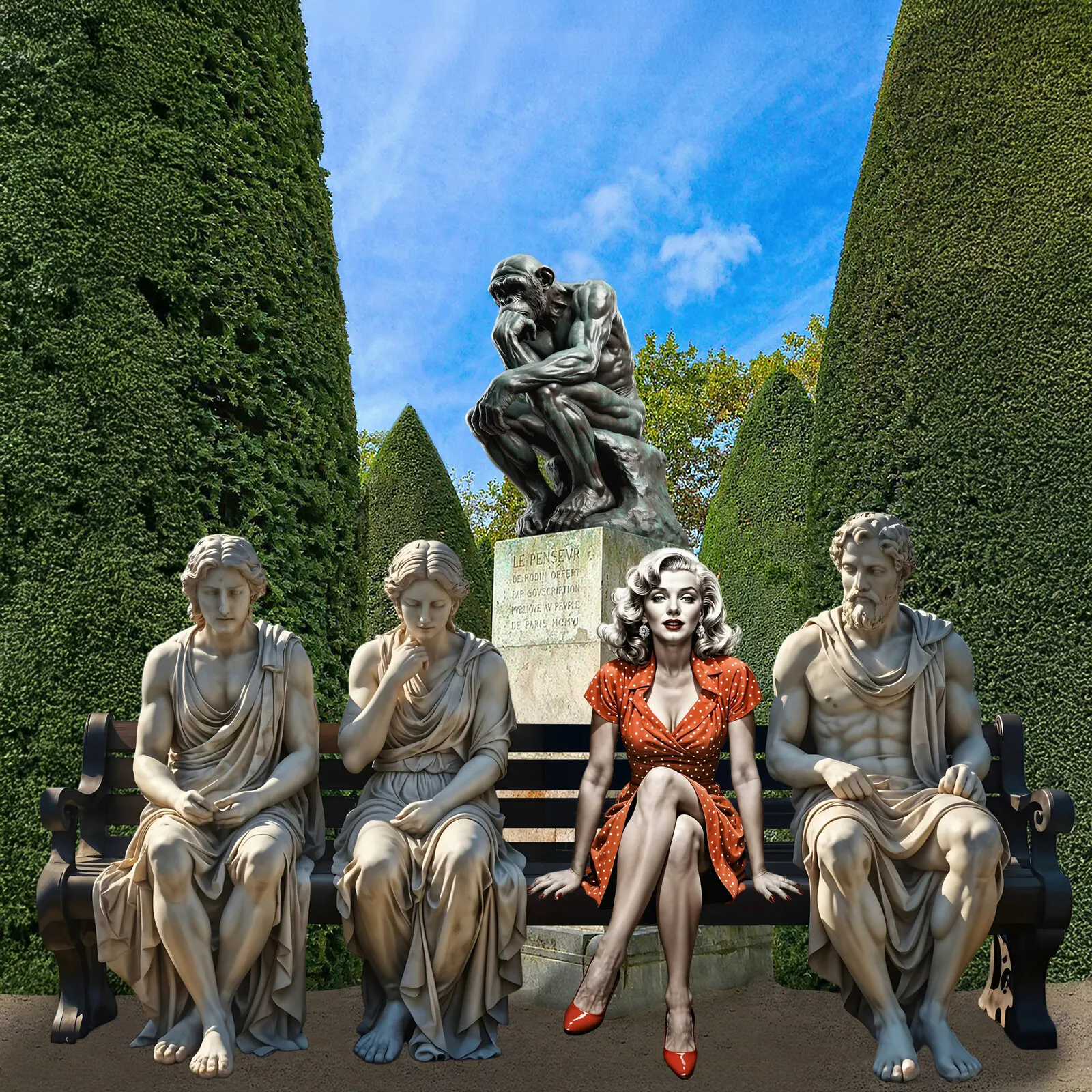
Jörgen Thornberg
Talks on a Park Bench – Thinkers or Weighers, 2024
Digital
80 x 80 cm
3 500 kr
Talks on a Park Bench – Thinkers or Weighers
Beneath the bronze gaze of ‘The Thinking Chimpanzee’, four figures sit on a bench—Diogenes, Marilyn Monroe, Sappho, and Plato—engaged in a timeless conversation. They debate humanity’s failures and fleeting victories, the struggle between thought and action, and the endless cycles of war, power, and oppression. Their discourse, set in the past, resonates with the present, as the world evolves while history repeats itself. Statues of the mighty rise and crumble, democracy teeters on the brink, and nature retaliates against human arrogance.
As their words weave through time, their arguments revolve around one question: is humanity composed of ‘Thinkers’—those who seek wisdom, act, and change the world—or ‘Weighers’—those who hesitate, analyse, and let history slip through their fingers? Above them, the chimpanzee listens, a reminder of the evolutionary path not taken, of intelligence that did not need to conquer to survive. And as you engage with their debate, you, too, become part of this timeless conversation.
In the end, the question remains unanswered. But as Marilyn’s red polka-dot dress stands as the only bright colour in this marble and bronze tableau, so does the faintest flicker of hope. It serves as a reminder that even in the darkest of times, there is always a chance for change, as long as there are those who think.
Please continue reading to learn more about the humorous picture and its connection to knowledge and human habits.
"Thinkers and Weighers
Beneath the chimp seated so high,
Four odd figures question why.
Do humans think or just pretend?
Does wisdom break or simply bend?
Diogenes laughs, his lantern swings,
“I searched for truth but found just kings!
They carve their statues, wage their wars,
Yet trip on history’s rotting floors.”
Plato sighs; his brows are tight,
“Some men seek the truth but flee the light.
They weigh their choices, dream of gold,
Then tell themselves they’re wise—not cold.”
Sappho smirks, her words like steel,
“Men rule the world but never feel.
They hoard their power, claim it’s just,
While grinding love into the dust.”
Marilyn sighs, adjusting her dress,
“My looks were praised, my mind—worth less.
A world of men, so bold, so brash,
Yet thinking stops when lips are lashed.”
Above them all, the chimp reclines,
His bronze face set in knowing lines.
“You talk and talk, and yet you stall,
You weigh and weigh—but no act at all?”
They pause, they blink, they look around,
The world still spins, yet lost is found.
For those who think may hesitate,
But those who act decide their fate.
And somewhere, far beyond the stone,
If a statue cracks, it might dethroned.
For time will weigh what men once thought,
And leave them with what they forgot.”
Malmö, March 2025
The Weighing Humanity – A Conversation on the Bench Below the Thinking Chimpanzee
The phrase "Thinkers or Weighers" plays on the French wordplay of Penseur (Thinker) and Peseur (Weigher), referring to those who weigh, hesitate, and linger rather than act—contrasting with those who genuinely think, reflect, and attempt to take action. This creates an intriguing tension between analysis and indecision, mirroring this essay’s exploration of humanity’s oscillation between thought and action.
In this lush park, nestled between history and eternity—where the passage of time depends on the observer’s perspective and patience—stands a statue like no other: The Thinking Chimpanzee. This statue, a reinterpretation of Rodin’s ‘Le Penseur’ (The Thinker), represents the intersection of human thought and animal instinct. Its wise bronze eyes gaze down upon a park bench, where a rather unusual gathering occurs.
Beneath a sky that belonged neither to the past nor the future sat four figures—three sculpted of the finest marble and the fourth made of flesh and blood, pale as marble despite having lived under the sun. They had never met before, yet they sensed their connection, all belonging to eternity, descending as Time-travellers from distant stars. They were united in their differences, bound together by thought—the eternal, grinding contemplation of the world, its sins and possibilities, its past and its lost futures.
A thinker brooded in his immortalised pose above them, seated upon his granite pedestal. Yet, he was unlike Rodin’s renowned creation—no muscular human form cast in bronze. Instead, it was evolution’s mirror, sculpted in metal, staring down at humanity’s musings and actions with a wise, furrowed chimpanzee face.
On the bench sat Diogenes, the cynic who once shunned the deceptions of civilisation and made his home in a barrel. Next to him sat Marilyn Monroe, clad in a red and white polka-dot dress—the only element in sight that disrupted the cold indifference of marble and bronze. She had comprehended everything concerning the demands of human theatre but was seldom acknowledged as a thinker. These characters, each with unique viewpoints, add depth to our contemplation.
Beside her sat Sappho of Lesbos, the poet who saw through the world of men, who loved women, and who grasped humanity’s fragility more profoundly than most. She captured emotions in words before they became weapons. And at the far left sat the young Plato, sculpted as he once was, schooled for over two millennia in philosophical rigidity, pondering the shadows in his imagined cave.
As often transpires with humans, we shy away from solemnity, even when it lingers in the air, even among four individuals who have thought so profoundly throughout their lives and expressed their ideas in diverse manners—as an orator, a professional pessimist, a poet, and a film star.
Marilyn was both at home and out of place—the embodiment of Hollywood’s illusion, a face adored by the world but a soul rarely taken seriously. Norma Jean was not the superficial blonde she was made to portray—she was a woman who fought, reflected, and read philosophy and poetry, yet was never permitted to be anything other than the seductive Marilyn. Among the philosophers of antiquity and Sappho of Lesbos, she became a symbol of what humanity frequently overlooks: that intelligence resides in the most unexpected places. Yet, we dismiss it if it does not appear in the expected context—preferably male.
We glorify thought yet fail to act. We idolise our icons but do not heed their voices. We possess all the knowledge in the world yet lack wisdom. And while we weigh, hesitate, and analyse—the world progresses, with or without us.
Perhaps Plato or Sappho first pointed to the statue behind them, Rodin’s creation now reincarnated as our closest cousin—a thinking chimpanzee.
"Le Penseur ou Le Peseur? The Thinker or the Weigher?" one of them contemplated.
They sat in the shadow of a statue that formerly depicted a man in deep reflection. But this time, it was no man. Upon the granite foundation behind them rested a dark bronze and contemplative chimpanzee, his furrowed brow suggesting he was weighing the fate of humanity in his knotted fingers.
Diogenes: "We Think, But We Are Lost"
Diogenes sat, as always, at ease, his tunic slightly ajar, gazing sceptically into the horizon.
"We are Les Penseurs Perdus," he said with a smirk. We are the lost thinkers. We ponder and ponder yet never find our way." This notion of being 'lost thinkers' encapsulates that despite our relentless contemplation and analysis, we frequently find ourselves at a standstill when making decisions or taking action.
He stretched out his dusty feet, seemingly amused by his paradox.
"What if I were instead one of 'Les Peseurs'? One of those who never act, who merely weigh their options and never choose? Then perhaps I would still be standing in Athens, holding up my lantern, searching for an honest man!" Diogenes mused, his words inviting us to reflect on our actions and inactions.
He chuckled to himself and turned to Marilyn, who was absentmindedly twirling a fold of her red and white dress between her fingers.
Marilyn: "Thinkers on Pause?"
Marilyn’s voice was soft yet firm.
"And what if we are mere 'Les Penseurs en Pause'—thinkers on pause? That we sit here, yet we are not truly thinking?" Marilyn's self-awareness challenges us to consider our moments of pause and reflection.
She flashed her famous smile and then shook her head.
"I lived in a world where men decided I didn’t need to think. I was a doll, a decoration, a smile to plaster on posters. They said I was beautiful, that I was sexy. No one cared that I also read, wrote, and reflected."
She leaned back and turned to Sappho.
"And what do you think? Were we truly thinkers, or were we merely waiting?"
Sappho: "The Punished Thinkers"
Sappho, draped in white marble, pulled her cloak tighter around herself and gazed out over the park bench.
"I would argue that we are 'Les Pénseurs'—the punished thinkers. That occurs when we overthink, grasp the truth and attempt to articulate it. We are punished for it."
She sighed, allowing her fingers to play over the folds of her marble dress.
Those Who Rule, Those Who Obey, and Those Who See
Sappho was the first to break the silence.
"Humanity has never had patience for those who question. Those who think differently are often persecuted, mocked, or silenced. I sang of love and desire, and they nearly erased me from history."
She gazed at the horizon, her marble features unmoving, yet her voice bore the weight of centuries of forgotten truths.
Beside her, Plato shifted uncomfortably on the bench.
Plato: "Thinkers or Weighers?"
Plato leaned forward, his youthful enthusiasm evident.
"I see us more as 'The Weighers' than 'The Thinkers.'"
He turned to Diogenes.
"Consider this. We philosophers are always the ones who weigh, deliberate and hesitate. However, weighing a choice is not always cowardice; it can be wisdom. Acting too hastily, without reflection, leads to chaos."
Diogenes snorted.
"Oh really? Then, perhaps you should have weighed your idea of the perfect state more thoroughly before presenting it. If you had, maybe we wouldn't have had centuries of dictators believing themselves to be Plato’s philosopher-kings!"
Plato met his gaze but said nothing. It was true. His ideas about governance have been misused repeatedly throughout history.
Before he could respond, a deep voice rumbling from above interrupted them.
The Chimp Speaks
Everyone on the bench turned their eyes upward. The chimp on the pedestal, who had quietly listened to their discussion, finally moved.
"You speak of weighing and thinking. But what have you truly learnt?"
His voice was low and rough, almost ancient.
"Humans have thought, yes. But have they ever thought enough? Have they ever thought clearly? Or are they trapped in their illusion of being the highest, most advanced beings?"
He rested his chin on his hand, mirroring Rodin’s original Thinker.
"I, a simple ape, sit here listening to your witticisms. You debate, analyse, and hesitate. But what do you do? You've had thousands of years to solve your problems—to end your wars, find a balance between the sexes, and understand nature’s power. Yet, you resolve nothing with wordplay or jokes."
His bronze gaze swept over the figures on the bench below.
"And yet, it is still men who build their statues, who reshape democracy’s marble monuments into their image. Trump, Putin, and their ilk—they sculpt the world to their liking, rewriting history before you even react."
The chimpanzee shook his head.
"Humanity may have thought. But has it ever thought things through?"
The four on the bench sat in silence. Marilyn’s red dress was the only splash of colour in the philosophical gloom.
Diogenes lifted his jug and drank.
Sappho closed her eyes and listened to the wind.
Plato looked down at his hands.
And the chimp, the final thinker, returned to his eternal pose, allowing silence to envelop the bench.
It was Marilyn who eventually broke it.
Marilyn: "The world is a stage, yet few bother to learn the script."
She leaned forward, gazing up at the chimp behind them.
"You think. I have thought, too. My entire life, I have thought. But what good does thinking do when the world only wishes to see what glitters and shakes its hips? What value is thinking if no one pays attention?"
Diogenes chuckled and extended his arms wide.
"There it is! There’s the crux! Humanity is an animal that *can* think but chooses not to. Or rather—it thinks, but only about what brings power, praise, or wealth."
Sappho raised an eyebrow.
"And you believe you're superior? You, who rejected everything, who mocked those who aspired to create something grander than themselves?"
Diogenes smirked, leaned back, and assessed his nails.
"To despise civilisation is to cherish the truth. What has your cherished humanity done with its intelligence? They have constructed statues of themselves and dismantled one another. They've razed forests and prayed to the gods for more trees. Invented writing to preserve wisdom, yet used it to disseminate falsehoods."
Plato sighed.
"Not all of them. Some endeavour to understand, who battle for the truth."
The chimpanzee, who had remained silent for a while, stirred again. His bronze eyes reflected their expressions.
"But what do you do when the truth is inconvenient? When forests are being felled, rivers filled with poison, through generations of slaves and those who perish in bomb craters?
You do—nothing.
You wait.
You look away.
You hesitate."
The chimp's words lingered heavily in the air, a profound silence settling over the bench. Not even the wind through the invisible leaves dared to disturb it, highlighting the gravity of his critique.
---
Those Who Rule, Those Who Obey, and Those Who See
Plato shook his head.
"But truth is not easy, Chimpanzee. People live in their caves. They see the shadows on the wall and believe them to be reality. If someone comes and tells them that the world outside is greater, what do they do?"
Sappho closed her eyes and murmured,
"They mock him. Or kill him."
Marilyn sighed.
"I saw the world outside my cave. I witnessed how it worked. A woman can be as intelligent, well-read, and sharp as she desires—but if she looks like me, she will always be seen as a doll. An ornament. A beautiful but empty shell. A body and, excuse my language, a cunt."
Diogenes grinned.
"I would have loved to see you strike one of your admirers with your beauty—perhaps by dropping a book on their heads?"
Marilyn smiled faintly but continued,
"Look at today's world. The ones in power now: Trump, Putin, their kind. Those who rewrite history in real-time build their monuments while dismantling others. They claim to defend freedom while imprisoning those who speak against them."
Sappho shook her head.
"And people let them do it. That’s the most incomprehensible part."
The Chimpanzee sighed deeply.
"Because it is easier to obey than to think. It is easier to have an enemy than to understand a neighbour. Easier to believe than to know."
Diogenes gazed out over the invisible world surrounding them.
"But what about us? What can we do? We, the statues. The ones no one listens to anymore?"
Marilyn glanced at her dress.
"Maybe that's why I was given colour today."
The others stared at her, puzzled.
"You are all marble and bronze, cold, unchanging. I am here in colour, a reminder that life still exists. That we still have a chance."
Plato looked thoughtful.
"You mean hope still lives?"
Marilyn smirked.
"I mean, perhaps there are still people who think. Maybe some dare to step out of the cave. Perhaps there is a future where the Chimpanzee no longer has to sit here and sigh over us."
The Chimpanzee regarded her for a long moment, then smiled—a bronze smile, barely visible but there nonetheless.
"Perhaps you’re right."
Diogenes stood up and stretched his limbs.
"Well, this has been an intriguing conversation. But I think I shall look for an honest man again. Perhaps one still exists out there."
Sappho looked at him and laughed dryly.
"Good luck, my friend. You’re going to need it."
Plato looked down, contemplating everything that had been said.
The Chimpanzee shifted slightly on his pedestal. He had heard humanity’s eternal debate. He knew it would never end.
But perhaps, just perhaps, there was a glimmer of hope.
And maybe, one day, humanity would stop merely thinking—and start thinking things through.
Marilyn dragged her red nails across the marble bench and looked up at the Chimpanzee.
"Tell me, you wise ape of bronze, who have the privilege of observing the world from above—why have we not understood that we are a part of nature? For as it stands now, nature is striking back with fury."
The Chimpanzee sighed deeply, his gaze sweeping the invisible landscape before them.
"Because you convinced yourselves that you were more than nature. That you stood above it. You tamed fire and thought you had tamed the world. You cultivated the land and thought you owned it. You built walls and believed you could shut out chaos.
But what does nature do when it has had enough?"
Plato furrowed his brow.
"It strikes back."
Sappho nodded.
"And we call it catastrophe—as if nature were the villain.
Diogenes chuckled.
"But isn’t it strange? When a human destroys a landscape, it’s called progress. When nature reclaims it, it’s labelled a disaster."
The Chimpanzee raised a bronze eye toward the sky.
"You witnessed the floods; you saw the fires; the oceans rise, and the forests perish. And what did you do?"
Marilyn sighed.
"We allowed ourselves to be distracted."
Plato shook his head.
"Humans are a peculiar species. They perceive the floods yet care more about stock prices. They watch the ice melt but debate whether it’s their fault, blaming the sun instead. They observe the storms rage but adjust their insurance premiums."
Sappho folded her arms.
"And those who attempted to warn them were labelled hysterics, doomsayers, or naive idealists."
Diogenes smirked.
"I once wandered the streets with a lantern in broad daylight, searching for an honest man. Perhaps we should have been looking for a man with common sense instead?"
Marilyn looked down at her hands.
"Is it already too late?"
The Chimpanzee stared at her for a long moment before replying.
"Not yet. But soon."
Humanity’s Endless Wars—And the Eternal Futility
Sappho turned to Plato and raised an eyebrow.
"Tell me, my young friend, you who loved the realm of ideas—did you ever truly believe that humans would learn from history?"
Plato sighed, running a hand over his marble cloak.
"There was a time when I did. When I wrote *The Republic*, I dreamed of a world where philosophers would rule, where justice was not the privilege of the strong but a virtue nurtured in all. But reality has always contradicted me. Kings, emperors, generals come and go, but war remains constant."
Diogenes scoffed.
"I said it back then—give me a barrel to live in, and spare me your pursuit of power. What are kingdoms and borders but lines drawn in the sand, waiting to be washed away by the next wave of violence?"
The Chimpanzee rested his chin on his hand and observed them.
"But you don’t understand. Humans possess a remarkable ability to ignore their failures. They witness fallen empires, crumbling walls, charred cities—and yet they still believe that *their* war will be the last, the decisive one, the one that will finally bring eternal peace."
Marilyn crossed her legs and tapped her foot lightly.
"So why do we never stop?"
Sappho tilted her head.
"Because we believe we can win."
Plato nodded.
"Because humans think history begins with them and ends with their victory."
Diogenes laughed harshly.
"Because power is a disease humanity has never cured itself of."
The Chimpanzee lifted his metal hand and pointed into the void.
"But look at the world today. We have Putin redrawing old borders with bombs. We see Trump transforming lies into weapons, calling them alternative truths. We have leaders who would rather destroy than build and prefer division over unity. And what have we learned?"
Sappho shook her head.
"Nothing. Every empire thinks it is the final one. Every conqueror believes they are different. And yet they all fall, one by one, leaving only ruins and silent echoes behind. One ‘thousand-year empire’ after another."
Plato exhaled deeply.
"And the only ones who truly remember what happened are those who were burned, beaten, driven from their homes. But they do not write history. The victors do."
Marilyn looked at them with sorrowful eyes.
"So what are we then? Shadows on a bench, philosophizing about a world that never listened?"
The Chimpanzee smiled faintly.
"Perhaps. Or perhaps we are the voice of warning. An echo of all those who have said: ‘Stop before it’s too late.’ The only question is—will anyone hear us?"
The Battle of the Sexes—A Never-Ending Struggle, Urgently Requiring Action
Marilyn laughed softly, though there was little amusement in it.
"And then, of course, there’s the eternal war—one that doesn’t make it into history books in the same way but is just as brutal. The war between men and women."
Sappho nodded slowly.
"A battle for dominance and control, though nature never intended it. Everything in the natural world is balanced—predators and prey, sun and shade, male and female. But humans? They create hierarchies out of what was meant to be harmony."
Diogenes rolled his eyes.
"Oh, don’t start with that. Women have gained power over the past century. You can vote, you can work, you can rule empires. What more do you want?"
Marilyn shot him a sharp look.
"Power is not merely about laws. It’s about who controls the narrative. Yes, some of us have made progress, but what does that matter when more women in the world still live in oppression than in freedom? When entire societies are built on keeping them silent, veiled, submissive?"
She gestured towards Sappho.
Even when a woman rises—whether with words or wisdom—she is often rewritten, erased, or reduced to a whisper. Yet, her resilience in the face of such adversity is a testament to the strength of the human spirit.
Sappho sighed.
"History remembers me as a tragic figure or as a lustful woman. Few recall my words, verses, love, or intellect. Even my name has been twisted into something else."
Plato, who had been listening intently, leaned forward.
"But is it not improving? Today, women lead nations, write, speak, and shape the world."
Sappho arched an eyebrow.
"And yet, when their rights are won, they must fight to keep them. Look at the debate on abortion and bodily autonomy. How quickly is gained ground taken back by men who believe they have the right to rule over women’s bodies?"
Marilyn exhaled, running a red-nailed finger across the marble bench.
"It’s always the same men. The ones who think power is their birthright. Who fears a world where they aren’t the ones making the rules? The ones who love control more than they love truth. The ones who demand submission."
Diogenes scoffed.
"The strong will always rule the weak. It’s nature."
The Chimpanzee, a symbol of nature and its laws, had remained silent for a long time. Finally, he spoke. His voice was quiet but firm.
"You misunderstand nature, Diogenes. Strength in nature is not measured by domination. The strongest species are those that adapt, cooperate, and evolve together. Humanity could have been like that—but instead, it chose conquest over coexistence. You call that strength?"
Diogenes, for once, had no retort.
Sappho looked up at the Chimpanzee.
"And what happens to those who refuse to submit? To those who fight back?"
The Chimpanzee sighed.
"They are called rebels, witches, heretics. They are silenced, ridiculed, or worse. Because the truth is dangerous to those who build their kingdoms on lies."
Marilyn looked at the others, her expression unreadable.
"So what do we do? Keep talking? Keep thinking? Keep fighting? We must not just think and talk, but also act, to bring about the change we seek."
Plato nodded.
"What else is there?"
Diogenes muttered, shaking his head.
"We weigh, hesitate, think, but rarely act."
Marilyn leaned back against the bench.
"And the world keeps turning. The same old story, century after century."
The Chimpanzee looked down at them, his bronze face unreadable.
But stories can change. If someone dares to rewrite them, we can shape a future where equality and justice prevail. The power of narrative is immense and can be harnessed to create a better world.
For a moment, there was silence. Then Sappho spoke, her voice barely above a whisper.
"If only we had more time."
The Last Words of the Thinking Chimpanzee
Marilyn sighed softly, letting her gaze drift up towards the bronze chimpanzee above them.
"And me? I, too, died young, but not in battle, not as a martyr, not in the heat of revolution. I died in a bed, alone, discarded, after being drained of everything they could take from me. My beauty, youth, and charm were ripped from me like petals from a flower until nothing remained but the shadow of the woman they never truly saw."
Sappho turned her head, her marble face unreadable.
"And I?" She laughed bitterly. "My love for women was too strong. I fell from the white cliffs of Leukas, and the sea swallowed me whole. But do you know the worst part, Plato? Men like you came afterwards and admired my words, verses, and thoughts—yet you never saw ‘me.’ You called me ‘the tenth muse’ but allowed my name to slip into the waves."
Plato looked down at the ground. He had no response.
For a while, the only sound was the whispering wind that carried echoes of voices long silenced.
Then, the bronze chimpanzee, who had been silent for some time, finally spoke from above.
"You speak of your deaths. But what do they truly mean? Is a person the sum of their death—or their life? And if we look at the world today—if we see those who rule, those who oppress, those who refuse to relinquish power—then we must ask: *what happens if they win?*"
Marilyn exhaled, shaking her head.
"They already *have* won. Look at the world. Look at the women in Iran, Afghanistan, and Texas. Look at the forests that burn for profit, the oceans choking on plastic, the men who turn violence into law."
Diogenes smirked.
"Sure, but they always have. And yet, here we are—still arguing, hoping, still alive in ideas. Their empires have crumbled, and their kings are footnotes in history books. The question isn’t if they will fall, but how much they will destroy before they do." Diogenes's words echoed with a resilient spirit, inspiring hope in adversity.
Sappho nodded.
"That’s the real tragedy. They always lose in the end. But by the time they do, how much has been lost?"
Plato stood and looked up at the Thinking Chimpanzee on its pedestal.
"So, what are we saying if we sum up our discussion? That history moves forward, but never without struggle. Those who rule always think they are immortal, yet one day, their statues will crumble. That the world *can* change, but the price of change is always steep?"
The Chimpanzee smiled.
"Yes. And that you still have not learned anything." The Chimpanzee's words, filled with wisdom and insight, left a lingering sense of enlightenment.
Silence.
There they sat—the dead philosophers, the lost star, the poet from Lesbos—and a chimpanzee contemplating the eternal foolishness of humankind.
Behind them, in the invisible landscape of history, the statues of powerful men still stood. Putin. Trump. Xi. Erdoğan and a parade of others, each chiselling their likeness into the marble of time.
They were not yet shattered.
But the cracks were showing.
Marilyn, who once lived by her smile, smiled again.
"As long as there are those who think, there is still a chance." Marilyn's words resonated with philosophers' commitment to thought and conversation, engaging the audience in the ongoing dialogue.
The Final Reflection
The conversation among the statues and the Chimpanzee drew close, yet none could claim to have found a simple answer. If anything, their discussion only confirmed history’s endless cycle.
"So, did the world get better or worse?" Marilyn asked, her eyes now fixed on the Chimpanzee.
"It depends on how you look at it," he replied, furrowing his bronze brow. "Compared to your earliest history—before agriculture and civilisation—there was more freedom, space, and food. No one owned the land; no one controlled others through hunger. No one hoarded excess to wield power. But on the other hand, humans lived shorter lives; they starved, and they died from wounds and diseases with no cure."
Plato nodded thoughtfully.
"When we tamed nature, we tamed ourselves. We built societies, but we also built hierarchies. We created law and order but also oppression. We gave the world beauty, philosophy, art, and literature—but we also created armies, empires, and slavery."
Sappho gazed at the world as it had become.
"And it was always men who ruled. Who hoarded more than they needed, competed for power and land, and fought over resources that could have been shared. When they began stockpiling food, they stockpiled power. With power came inequality, and with inequality came oppression. For women, the weak, and those who didn’t fit into their order."
Diogenes snorted.
"Humans are a peculiar species. You’ve conceived magnificent ideas about freedom and equality, yet every time you’ve had the chance to live by them, you’ve fallen back into the same patterns. There have been philosophers, revolutionaries, prophets—but what has changed? Everything, and nothing."
The Chimpanzee shook his head.
"The irony is that you are the only creatures who *can* learn from history—but you don’t. You repeat the same mistakes. Empires rise and fall; rulers are overthrown and replaced by new ones, and people suffer and die for the same ideals over and over. What once seemed like progress later becomes a new form of oppression."
Plato turned to Marilyn.
"So what’s your answer? Is there hope?"
She ran a hand through her blonde hair and smirked.
"There *has* to be. Otherwise, we wouldn’t be sitting here talking about it."
Diogenes chuckled.
"As long as there are those who think, there is a chance. *To think is to live.*"
"Cogito, ergo sum," (*I think, therefore I am*) said the Chimpanzee, quoting René Descartes. "Your late colleague wrote those words in the 17th century. He sought an absolute truth—since he could doubt everything, but not that he was doubting (which, in itself, is a form of thinking), he must exist. And so must hope."
And with that, silence fell over the bench where they all sat, with a Thinking Chimpanzee watching over them.
History would continue. The cycle would close—and open again.
The Chimpanzee looked down at them one last time, sighed, and took a deep breath.
"Humans are a strange species. They can understand everything—and yet nothing. But who knows if ‘you four’ can sit together and converse in the exact moment, in the same space, across time?
Maybe there’s still hope."
And then, for the first time in history, a philosopher, a poet, a cynic, a movie star, and a chimpanzee fell silent together.
Because deep down, they all knew—
The chimpanzee was right.
Rodin’s ‘The Thinker’ – Origins, Inspiration, and Symbolism
‘The Thinker’ (‘Le Penseur’) is one of the most iconic sculptures in the world. It was created by the French artist Auguste Rodin in 1880. It was initially conceived as part of his monumental work ‘The Gates of Hell’ (‘La Porte de l’Enfer’), inspired by Dante’s ‘Divine Comedy’.
But what drove Rodin to create this profoundly contemplative figure, and why has it become such a universal symbol of intellect and philosophy?
Origins and Inspiration – Dante and ‘The Gates of Hell’
In 1880, the French government commissioned Rodin to create an elaborate set of doors for the planned Musée des Arts Décoratifs in Paris. He based the work on ‘Inferno’, the first part of Dante’s ‘Divine Comedy’.
Rodin originally intended to place a central figure above the doors, observing the suffering of the damned. At first, this figure was referred to as ‘The Poet’, representing Dante Alighieri himself, seated and reflecting on the inferno he had envisioned.
However, Rodin’s concept evolved. Instead of depicting Dante in medieval robes, he sculpted a powerful, nude man—a timeless representation of the power of thought. Eventually, the figure was separated from ‘The Gates of Hell’ and became an independent work: ‘Le Penseur’, or, as it is known internationally, ‘The Thinker’.
Symbolism and Form – More Than Just a Thinker
What makes ‘The Thinker’ extraordinary is that he is not merely a passive intellectual. His body is tense, his muscles strained, and his toes grip the rock beneath him. He is not simply ‘thinking’ but ‘wrestling’ with his thoughts.
Rodin himself described the figure:
‘"My Thinker does not just think with his brain, with his frowning brow and his forehead; he thinks with every muscle in his arms, back, and legs. He is not a passive, isolated intelligence—he is a thinker who ponders but also sees and suffers."‘
This sense of physical and mental struggle sets Rodin’s work apart from traditional depictions of philosophers, often shown in serene contemplation. Rodin’s Thinker is thoughtful yet alive, which is why he has become such a powerful symbol of human intellect and existential struggle.
Influence and Legacy – A Universal Icon
When ‘The Gates of Hell’ remained unfinished, Rodin began casting ‘The Thinker’ as a standalone sculpture in larger formats. The first independent bronze version was unveiled in 1904 and was an instant success.
Since then, ‘The Thinker’ has become a universal symbol of philosophy, reflection, and human intellect. It has appeared in everything from university emblems to pop culture references and political cartoons.
Today, at least 28 official bronze castings of the sculpture are displayed in museums and public spaces worldwide.
Rodin’s Thoughts on Art and Movement
Rodin was a pioneer in sculpture. His figures broke away from the strict academic tradition of the late 19th century, which required everything to be idealised and flawless. Instead, he sought to capture movement, emotion, and human dynamism.
His technique—sculpting in clay before bronze casting—created a raw and lifelike quality. His figures appear frozen in motion rather than static, embodying the restless nature of human thought and feeling.
Summary – What ‘The Thinker’ Represents
Rodin’s ‘The Thinker’ is more than just a statue. It is:
- A symbol of intellectual and existential struggle
- One of the most physically expressive thinkers in art history
- One of the most reproduced sculptures in the world
- A prime example of Rodin’s innovative sculptural techniques
Those who look at ‘The Thinker’ can interpret him in many ways—philosopher, creator, doubter, or a man wrestling with the great questions of life. Whatever he is pondering, he has undoubtedly earned his place in art history.
---
Where Can You See ‘The Thinker’?
Rodin’s ‘The Thinker’ (‘Le Penseur’) can be found in multiple locations worldwide. Created in 1880 as part of ‘The Gates of Hell’, it became an independent sculpture available in various sizes and materials. Here are some of the most famous locations where you can see ‘The Thinker’:
France
- Musée Rodin, Paris – The most iconic version, cast in 1904, stands in the museum’s garden.
- Musée Rodin, Meudon – A larger plaster version is housed in Meudon, where Rodin had his studio.
United States
- The Legion of Honor, San Francisco – One of the most well-known American copies.
- Columbia University, New York – Stands at the entrance to Low Memorial Library.
- Detroit Institute of Arts, Michigan – Another impressive bronze casting.
- Cleveland Museum of Art, Ohio – One of the early copies.
- The Baltimore Museum of Art, Maryland – Another well-regarded casting.
Europe
- Victoria and Albert Museum, London, UK – One of the most famous European copies.
- Kunsthaus Zürich, Switzerland – Features a bronze version.
- Ny Carlsberg Glyptotek, Copenhagen, Denmark – A beautifully cast bronze version.
Mexico
- Museo Soumaya, Mexico City – One of the larger castings in Latin America.
Asia
- National Museum of Western Art, Tokyo, Japan – A well-known bronze version.
- Rodin Museum, Seoul, South Korea – Part of a more extensive Rodin exhibition.
Australia
- National Gallery of Victoria, Melbourne – One of the few in Oceania.
Rodin’s ‘The Thinker’ is one of the most reproduced sculptures in art history. Rodin's studio approved at least 28 official bronze castings and several smaller versions.
Regardless of location, one thing remains constant: ‘The Thinker’ continues to captivate and challenge those who stand before him, just as Rodin intended. Its enduring impact on art and culture is a testament to its timeless relevance in contemporary art.
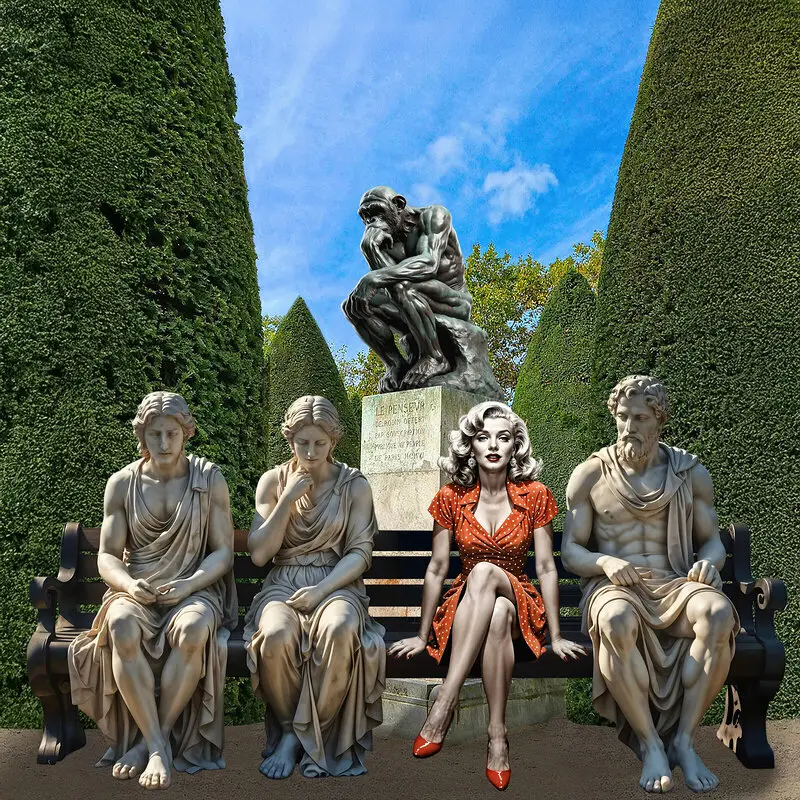
Jörgen Thornberg
Talks on a Park Bench – Thinkers or Weighers, 2024
Digital
80 x 80 cm
3 500 kr
Talks on a Park Bench – Thinkers or Weighers
Beneath the bronze gaze of ‘The Thinking Chimpanzee’, four figures sit on a bench—Diogenes, Marilyn Monroe, Sappho, and Plato—engaged in a timeless conversation. They debate humanity’s failures and fleeting victories, the struggle between thought and action, and the endless cycles of war, power, and oppression. Their discourse, set in the past, resonates with the present, as the world evolves while history repeats itself. Statues of the mighty rise and crumble, democracy teeters on the brink, and nature retaliates against human arrogance.
As their words weave through time, their arguments revolve around one question: is humanity composed of ‘Thinkers’—those who seek wisdom, act, and change the world—or ‘Weighers’—those who hesitate, analyse, and let history slip through their fingers? Above them, the chimpanzee listens, a reminder of the evolutionary path not taken, of intelligence that did not need to conquer to survive. And as you engage with their debate, you, too, become part of this timeless conversation.
In the end, the question remains unanswered. But as Marilyn’s red polka-dot dress stands as the only bright colour in this marble and bronze tableau, so does the faintest flicker of hope. It serves as a reminder that even in the darkest of times, there is always a chance for change, as long as there are those who think.
Please continue reading to learn more about the humorous picture and its connection to knowledge and human habits.
"Thinkers and Weighers
Beneath the chimp seated so high,
Four odd figures question why.
Do humans think or just pretend?
Does wisdom break or simply bend?
Diogenes laughs, his lantern swings,
“I searched for truth but found just kings!
They carve their statues, wage their wars,
Yet trip on history’s rotting floors.”
Plato sighs; his brows are tight,
“Some men seek the truth but flee the light.
They weigh their choices, dream of gold,
Then tell themselves they’re wise—not cold.”
Sappho smirks, her words like steel,
“Men rule the world but never feel.
They hoard their power, claim it’s just,
While grinding love into the dust.”
Marilyn sighs, adjusting her dress,
“My looks were praised, my mind—worth less.
A world of men, so bold, so brash,
Yet thinking stops when lips are lashed.”
Above them all, the chimp reclines,
His bronze face set in knowing lines.
“You talk and talk, and yet you stall,
You weigh and weigh—but no act at all?”
They pause, they blink, they look around,
The world still spins, yet lost is found.
For those who think may hesitate,
But those who act decide their fate.
And somewhere, far beyond the stone,
If a statue cracks, it might dethroned.
For time will weigh what men once thought,
And leave them with what they forgot.”
Malmö, March 2025
The Weighing Humanity – A Conversation on the Bench Below the Thinking Chimpanzee
The phrase "Thinkers or Weighers" plays on the French wordplay of Penseur (Thinker) and Peseur (Weigher), referring to those who weigh, hesitate, and linger rather than act—contrasting with those who genuinely think, reflect, and attempt to take action. This creates an intriguing tension between analysis and indecision, mirroring this essay’s exploration of humanity’s oscillation between thought and action.
In this lush park, nestled between history and eternity—where the passage of time depends on the observer’s perspective and patience—stands a statue like no other: The Thinking Chimpanzee. This statue, a reinterpretation of Rodin’s ‘Le Penseur’ (The Thinker), represents the intersection of human thought and animal instinct. Its wise bronze eyes gaze down upon a park bench, where a rather unusual gathering occurs.
Beneath a sky that belonged neither to the past nor the future sat four figures—three sculpted of the finest marble and the fourth made of flesh and blood, pale as marble despite having lived under the sun. They had never met before, yet they sensed their connection, all belonging to eternity, descending as Time-travellers from distant stars. They were united in their differences, bound together by thought—the eternal, grinding contemplation of the world, its sins and possibilities, its past and its lost futures.
A thinker brooded in his immortalised pose above them, seated upon his granite pedestal. Yet, he was unlike Rodin’s renowned creation—no muscular human form cast in bronze. Instead, it was evolution’s mirror, sculpted in metal, staring down at humanity’s musings and actions with a wise, furrowed chimpanzee face.
On the bench sat Diogenes, the cynic who once shunned the deceptions of civilisation and made his home in a barrel. Next to him sat Marilyn Monroe, clad in a red and white polka-dot dress—the only element in sight that disrupted the cold indifference of marble and bronze. She had comprehended everything concerning the demands of human theatre but was seldom acknowledged as a thinker. These characters, each with unique viewpoints, add depth to our contemplation.
Beside her sat Sappho of Lesbos, the poet who saw through the world of men, who loved women, and who grasped humanity’s fragility more profoundly than most. She captured emotions in words before they became weapons. And at the far left sat the young Plato, sculpted as he once was, schooled for over two millennia in philosophical rigidity, pondering the shadows in his imagined cave.
As often transpires with humans, we shy away from solemnity, even when it lingers in the air, even among four individuals who have thought so profoundly throughout their lives and expressed their ideas in diverse manners—as an orator, a professional pessimist, a poet, and a film star.
Marilyn was both at home and out of place—the embodiment of Hollywood’s illusion, a face adored by the world but a soul rarely taken seriously. Norma Jean was not the superficial blonde she was made to portray—she was a woman who fought, reflected, and read philosophy and poetry, yet was never permitted to be anything other than the seductive Marilyn. Among the philosophers of antiquity and Sappho of Lesbos, she became a symbol of what humanity frequently overlooks: that intelligence resides in the most unexpected places. Yet, we dismiss it if it does not appear in the expected context—preferably male.
We glorify thought yet fail to act. We idolise our icons but do not heed their voices. We possess all the knowledge in the world yet lack wisdom. And while we weigh, hesitate, and analyse—the world progresses, with or without us.
Perhaps Plato or Sappho first pointed to the statue behind them, Rodin’s creation now reincarnated as our closest cousin—a thinking chimpanzee.
"Le Penseur ou Le Peseur? The Thinker or the Weigher?" one of them contemplated.
They sat in the shadow of a statue that formerly depicted a man in deep reflection. But this time, it was no man. Upon the granite foundation behind them rested a dark bronze and contemplative chimpanzee, his furrowed brow suggesting he was weighing the fate of humanity in his knotted fingers.
Diogenes: "We Think, But We Are Lost"
Diogenes sat, as always, at ease, his tunic slightly ajar, gazing sceptically into the horizon.
"We are Les Penseurs Perdus," he said with a smirk. We are the lost thinkers. We ponder and ponder yet never find our way." This notion of being 'lost thinkers' encapsulates that despite our relentless contemplation and analysis, we frequently find ourselves at a standstill when making decisions or taking action.
He stretched out his dusty feet, seemingly amused by his paradox.
"What if I were instead one of 'Les Peseurs'? One of those who never act, who merely weigh their options and never choose? Then perhaps I would still be standing in Athens, holding up my lantern, searching for an honest man!" Diogenes mused, his words inviting us to reflect on our actions and inactions.
He chuckled to himself and turned to Marilyn, who was absentmindedly twirling a fold of her red and white dress between her fingers.
Marilyn: "Thinkers on Pause?"
Marilyn’s voice was soft yet firm.
"And what if we are mere 'Les Penseurs en Pause'—thinkers on pause? That we sit here, yet we are not truly thinking?" Marilyn's self-awareness challenges us to consider our moments of pause and reflection.
She flashed her famous smile and then shook her head.
"I lived in a world where men decided I didn’t need to think. I was a doll, a decoration, a smile to plaster on posters. They said I was beautiful, that I was sexy. No one cared that I also read, wrote, and reflected."
She leaned back and turned to Sappho.
"And what do you think? Were we truly thinkers, or were we merely waiting?"
Sappho: "The Punished Thinkers"
Sappho, draped in white marble, pulled her cloak tighter around herself and gazed out over the park bench.
"I would argue that we are 'Les Pénseurs'—the punished thinkers. That occurs when we overthink, grasp the truth and attempt to articulate it. We are punished for it."
She sighed, allowing her fingers to play over the folds of her marble dress.
Those Who Rule, Those Who Obey, and Those Who See
Sappho was the first to break the silence.
"Humanity has never had patience for those who question. Those who think differently are often persecuted, mocked, or silenced. I sang of love and desire, and they nearly erased me from history."
She gazed at the horizon, her marble features unmoving, yet her voice bore the weight of centuries of forgotten truths.
Beside her, Plato shifted uncomfortably on the bench.
Plato: "Thinkers or Weighers?"
Plato leaned forward, his youthful enthusiasm evident.
"I see us more as 'The Weighers' than 'The Thinkers.'"
He turned to Diogenes.
"Consider this. We philosophers are always the ones who weigh, deliberate and hesitate. However, weighing a choice is not always cowardice; it can be wisdom. Acting too hastily, without reflection, leads to chaos."
Diogenes snorted.
"Oh really? Then, perhaps you should have weighed your idea of the perfect state more thoroughly before presenting it. If you had, maybe we wouldn't have had centuries of dictators believing themselves to be Plato’s philosopher-kings!"
Plato met his gaze but said nothing. It was true. His ideas about governance have been misused repeatedly throughout history.
Before he could respond, a deep voice rumbling from above interrupted them.
The Chimp Speaks
Everyone on the bench turned their eyes upward. The chimp on the pedestal, who had quietly listened to their discussion, finally moved.
"You speak of weighing and thinking. But what have you truly learnt?"
His voice was low and rough, almost ancient.
"Humans have thought, yes. But have they ever thought enough? Have they ever thought clearly? Or are they trapped in their illusion of being the highest, most advanced beings?"
He rested his chin on his hand, mirroring Rodin’s original Thinker.
"I, a simple ape, sit here listening to your witticisms. You debate, analyse, and hesitate. But what do you do? You've had thousands of years to solve your problems—to end your wars, find a balance between the sexes, and understand nature’s power. Yet, you resolve nothing with wordplay or jokes."
His bronze gaze swept over the figures on the bench below.
"And yet, it is still men who build their statues, who reshape democracy’s marble monuments into their image. Trump, Putin, and their ilk—they sculpt the world to their liking, rewriting history before you even react."
The chimpanzee shook his head.
"Humanity may have thought. But has it ever thought things through?"
The four on the bench sat in silence. Marilyn’s red dress was the only splash of colour in the philosophical gloom.
Diogenes lifted his jug and drank.
Sappho closed her eyes and listened to the wind.
Plato looked down at his hands.
And the chimp, the final thinker, returned to his eternal pose, allowing silence to envelop the bench.
It was Marilyn who eventually broke it.
Marilyn: "The world is a stage, yet few bother to learn the script."
She leaned forward, gazing up at the chimp behind them.
"You think. I have thought, too. My entire life, I have thought. But what good does thinking do when the world only wishes to see what glitters and shakes its hips? What value is thinking if no one pays attention?"
Diogenes chuckled and extended his arms wide.
"There it is! There’s the crux! Humanity is an animal that *can* think but chooses not to. Or rather—it thinks, but only about what brings power, praise, or wealth."
Sappho raised an eyebrow.
"And you believe you're superior? You, who rejected everything, who mocked those who aspired to create something grander than themselves?"
Diogenes smirked, leaned back, and assessed his nails.
"To despise civilisation is to cherish the truth. What has your cherished humanity done with its intelligence? They have constructed statues of themselves and dismantled one another. They've razed forests and prayed to the gods for more trees. Invented writing to preserve wisdom, yet used it to disseminate falsehoods."
Plato sighed.
"Not all of them. Some endeavour to understand, who battle for the truth."
The chimpanzee, who had remained silent for a while, stirred again. His bronze eyes reflected their expressions.
"But what do you do when the truth is inconvenient? When forests are being felled, rivers filled with poison, through generations of slaves and those who perish in bomb craters?
You do—nothing.
You wait.
You look away.
You hesitate."
The chimp's words lingered heavily in the air, a profound silence settling over the bench. Not even the wind through the invisible leaves dared to disturb it, highlighting the gravity of his critique.
---
Those Who Rule, Those Who Obey, and Those Who See
Plato shook his head.
"But truth is not easy, Chimpanzee. People live in their caves. They see the shadows on the wall and believe them to be reality. If someone comes and tells them that the world outside is greater, what do they do?"
Sappho closed her eyes and murmured,
"They mock him. Or kill him."
Marilyn sighed.
"I saw the world outside my cave. I witnessed how it worked. A woman can be as intelligent, well-read, and sharp as she desires—but if she looks like me, she will always be seen as a doll. An ornament. A beautiful but empty shell. A body and, excuse my language, a cunt."
Diogenes grinned.
"I would have loved to see you strike one of your admirers with your beauty—perhaps by dropping a book on their heads?"
Marilyn smiled faintly but continued,
"Look at today's world. The ones in power now: Trump, Putin, their kind. Those who rewrite history in real-time build their monuments while dismantling others. They claim to defend freedom while imprisoning those who speak against them."
Sappho shook her head.
"And people let them do it. That’s the most incomprehensible part."
The Chimpanzee sighed deeply.
"Because it is easier to obey than to think. It is easier to have an enemy than to understand a neighbour. Easier to believe than to know."
Diogenes gazed out over the invisible world surrounding them.
"But what about us? What can we do? We, the statues. The ones no one listens to anymore?"
Marilyn glanced at her dress.
"Maybe that's why I was given colour today."
The others stared at her, puzzled.
"You are all marble and bronze, cold, unchanging. I am here in colour, a reminder that life still exists. That we still have a chance."
Plato looked thoughtful.
"You mean hope still lives?"
Marilyn smirked.
"I mean, perhaps there are still people who think. Maybe some dare to step out of the cave. Perhaps there is a future where the Chimpanzee no longer has to sit here and sigh over us."
The Chimpanzee regarded her for a long moment, then smiled—a bronze smile, barely visible but there nonetheless.
"Perhaps you’re right."
Diogenes stood up and stretched his limbs.
"Well, this has been an intriguing conversation. But I think I shall look for an honest man again. Perhaps one still exists out there."
Sappho looked at him and laughed dryly.
"Good luck, my friend. You’re going to need it."
Plato looked down, contemplating everything that had been said.
The Chimpanzee shifted slightly on his pedestal. He had heard humanity’s eternal debate. He knew it would never end.
But perhaps, just perhaps, there was a glimmer of hope.
And maybe, one day, humanity would stop merely thinking—and start thinking things through.
Marilyn dragged her red nails across the marble bench and looked up at the Chimpanzee.
"Tell me, you wise ape of bronze, who have the privilege of observing the world from above—why have we not understood that we are a part of nature? For as it stands now, nature is striking back with fury."
The Chimpanzee sighed deeply, his gaze sweeping the invisible landscape before them.
"Because you convinced yourselves that you were more than nature. That you stood above it. You tamed fire and thought you had tamed the world. You cultivated the land and thought you owned it. You built walls and believed you could shut out chaos.
But what does nature do when it has had enough?"
Plato furrowed his brow.
"It strikes back."
Sappho nodded.
"And we call it catastrophe—as if nature were the villain.
Diogenes chuckled.
"But isn’t it strange? When a human destroys a landscape, it’s called progress. When nature reclaims it, it’s labelled a disaster."
The Chimpanzee raised a bronze eye toward the sky.
"You witnessed the floods; you saw the fires; the oceans rise, and the forests perish. And what did you do?"
Marilyn sighed.
"We allowed ourselves to be distracted."
Plato shook his head.
"Humans are a peculiar species. They perceive the floods yet care more about stock prices. They watch the ice melt but debate whether it’s their fault, blaming the sun instead. They observe the storms rage but adjust their insurance premiums."
Sappho folded her arms.
"And those who attempted to warn them were labelled hysterics, doomsayers, or naive idealists."
Diogenes smirked.
"I once wandered the streets with a lantern in broad daylight, searching for an honest man. Perhaps we should have been looking for a man with common sense instead?"
Marilyn looked down at her hands.
"Is it already too late?"
The Chimpanzee stared at her for a long moment before replying.
"Not yet. But soon."
Humanity’s Endless Wars—And the Eternal Futility
Sappho turned to Plato and raised an eyebrow.
"Tell me, my young friend, you who loved the realm of ideas—did you ever truly believe that humans would learn from history?"
Plato sighed, running a hand over his marble cloak.
"There was a time when I did. When I wrote *The Republic*, I dreamed of a world where philosophers would rule, where justice was not the privilege of the strong but a virtue nurtured in all. But reality has always contradicted me. Kings, emperors, generals come and go, but war remains constant."
Diogenes scoffed.
"I said it back then—give me a barrel to live in, and spare me your pursuit of power. What are kingdoms and borders but lines drawn in the sand, waiting to be washed away by the next wave of violence?"
The Chimpanzee rested his chin on his hand and observed them.
"But you don’t understand. Humans possess a remarkable ability to ignore their failures. They witness fallen empires, crumbling walls, charred cities—and yet they still believe that *their* war will be the last, the decisive one, the one that will finally bring eternal peace."
Marilyn crossed her legs and tapped her foot lightly.
"So why do we never stop?"
Sappho tilted her head.
"Because we believe we can win."
Plato nodded.
"Because humans think history begins with them and ends with their victory."
Diogenes laughed harshly.
"Because power is a disease humanity has never cured itself of."
The Chimpanzee lifted his metal hand and pointed into the void.
"But look at the world today. We have Putin redrawing old borders with bombs. We see Trump transforming lies into weapons, calling them alternative truths. We have leaders who would rather destroy than build and prefer division over unity. And what have we learned?"
Sappho shook her head.
"Nothing. Every empire thinks it is the final one. Every conqueror believes they are different. And yet they all fall, one by one, leaving only ruins and silent echoes behind. One ‘thousand-year empire’ after another."
Plato exhaled deeply.
"And the only ones who truly remember what happened are those who were burned, beaten, driven from their homes. But they do not write history. The victors do."
Marilyn looked at them with sorrowful eyes.
"So what are we then? Shadows on a bench, philosophizing about a world that never listened?"
The Chimpanzee smiled faintly.
"Perhaps. Or perhaps we are the voice of warning. An echo of all those who have said: ‘Stop before it’s too late.’ The only question is—will anyone hear us?"
The Battle of the Sexes—A Never-Ending Struggle, Urgently Requiring Action
Marilyn laughed softly, though there was little amusement in it.
"And then, of course, there’s the eternal war—one that doesn’t make it into history books in the same way but is just as brutal. The war between men and women."
Sappho nodded slowly.
"A battle for dominance and control, though nature never intended it. Everything in the natural world is balanced—predators and prey, sun and shade, male and female. But humans? They create hierarchies out of what was meant to be harmony."
Diogenes rolled his eyes.
"Oh, don’t start with that. Women have gained power over the past century. You can vote, you can work, you can rule empires. What more do you want?"
Marilyn shot him a sharp look.
"Power is not merely about laws. It’s about who controls the narrative. Yes, some of us have made progress, but what does that matter when more women in the world still live in oppression than in freedom? When entire societies are built on keeping them silent, veiled, submissive?"
She gestured towards Sappho.
Even when a woman rises—whether with words or wisdom—she is often rewritten, erased, or reduced to a whisper. Yet, her resilience in the face of such adversity is a testament to the strength of the human spirit.
Sappho sighed.
"History remembers me as a tragic figure or as a lustful woman. Few recall my words, verses, love, or intellect. Even my name has been twisted into something else."
Plato, who had been listening intently, leaned forward.
"But is it not improving? Today, women lead nations, write, speak, and shape the world."
Sappho arched an eyebrow.
"And yet, when their rights are won, they must fight to keep them. Look at the debate on abortion and bodily autonomy. How quickly is gained ground taken back by men who believe they have the right to rule over women’s bodies?"
Marilyn exhaled, running a red-nailed finger across the marble bench.
"It’s always the same men. The ones who think power is their birthright. Who fears a world where they aren’t the ones making the rules? The ones who love control more than they love truth. The ones who demand submission."
Diogenes scoffed.
"The strong will always rule the weak. It’s nature."
The Chimpanzee, a symbol of nature and its laws, had remained silent for a long time. Finally, he spoke. His voice was quiet but firm.
"You misunderstand nature, Diogenes. Strength in nature is not measured by domination. The strongest species are those that adapt, cooperate, and evolve together. Humanity could have been like that—but instead, it chose conquest over coexistence. You call that strength?"
Diogenes, for once, had no retort.
Sappho looked up at the Chimpanzee.
"And what happens to those who refuse to submit? To those who fight back?"
The Chimpanzee sighed.
"They are called rebels, witches, heretics. They are silenced, ridiculed, or worse. Because the truth is dangerous to those who build their kingdoms on lies."
Marilyn looked at the others, her expression unreadable.
"So what do we do? Keep talking? Keep thinking? Keep fighting? We must not just think and talk, but also act, to bring about the change we seek."
Plato nodded.
"What else is there?"
Diogenes muttered, shaking his head.
"We weigh, hesitate, think, but rarely act."
Marilyn leaned back against the bench.
"And the world keeps turning. The same old story, century after century."
The Chimpanzee looked down at them, his bronze face unreadable.
But stories can change. If someone dares to rewrite them, we can shape a future where equality and justice prevail. The power of narrative is immense and can be harnessed to create a better world.
For a moment, there was silence. Then Sappho spoke, her voice barely above a whisper.
"If only we had more time."
The Last Words of the Thinking Chimpanzee
Marilyn sighed softly, letting her gaze drift up towards the bronze chimpanzee above them.
"And me? I, too, died young, but not in battle, not as a martyr, not in the heat of revolution. I died in a bed, alone, discarded, after being drained of everything they could take from me. My beauty, youth, and charm were ripped from me like petals from a flower until nothing remained but the shadow of the woman they never truly saw."
Sappho turned her head, her marble face unreadable.
"And I?" She laughed bitterly. "My love for women was too strong. I fell from the white cliffs of Leukas, and the sea swallowed me whole. But do you know the worst part, Plato? Men like you came afterwards and admired my words, verses, and thoughts—yet you never saw ‘me.’ You called me ‘the tenth muse’ but allowed my name to slip into the waves."
Plato looked down at the ground. He had no response.
For a while, the only sound was the whispering wind that carried echoes of voices long silenced.
Then, the bronze chimpanzee, who had been silent for some time, finally spoke from above.
"You speak of your deaths. But what do they truly mean? Is a person the sum of their death—or their life? And if we look at the world today—if we see those who rule, those who oppress, those who refuse to relinquish power—then we must ask: *what happens if they win?*"
Marilyn exhaled, shaking her head.
"They already *have* won. Look at the world. Look at the women in Iran, Afghanistan, and Texas. Look at the forests that burn for profit, the oceans choking on plastic, the men who turn violence into law."
Diogenes smirked.
"Sure, but they always have. And yet, here we are—still arguing, hoping, still alive in ideas. Their empires have crumbled, and their kings are footnotes in history books. The question isn’t if they will fall, but how much they will destroy before they do." Diogenes's words echoed with a resilient spirit, inspiring hope in adversity.
Sappho nodded.
"That’s the real tragedy. They always lose in the end. But by the time they do, how much has been lost?"
Plato stood and looked up at the Thinking Chimpanzee on its pedestal.
"So, what are we saying if we sum up our discussion? That history moves forward, but never without struggle. Those who rule always think they are immortal, yet one day, their statues will crumble. That the world *can* change, but the price of change is always steep?"
The Chimpanzee smiled.
"Yes. And that you still have not learned anything." The Chimpanzee's words, filled with wisdom and insight, left a lingering sense of enlightenment.
Silence.
There they sat—the dead philosophers, the lost star, the poet from Lesbos—and a chimpanzee contemplating the eternal foolishness of humankind.
Behind them, in the invisible landscape of history, the statues of powerful men still stood. Putin. Trump. Xi. Erdoğan and a parade of others, each chiselling their likeness into the marble of time.
They were not yet shattered.
But the cracks were showing.
Marilyn, who once lived by her smile, smiled again.
"As long as there are those who think, there is still a chance." Marilyn's words resonated with philosophers' commitment to thought and conversation, engaging the audience in the ongoing dialogue.
The Final Reflection
The conversation among the statues and the Chimpanzee drew close, yet none could claim to have found a simple answer. If anything, their discussion only confirmed history’s endless cycle.
"So, did the world get better or worse?" Marilyn asked, her eyes now fixed on the Chimpanzee.
"It depends on how you look at it," he replied, furrowing his bronze brow. "Compared to your earliest history—before agriculture and civilisation—there was more freedom, space, and food. No one owned the land; no one controlled others through hunger. No one hoarded excess to wield power. But on the other hand, humans lived shorter lives; they starved, and they died from wounds and diseases with no cure."
Plato nodded thoughtfully.
"When we tamed nature, we tamed ourselves. We built societies, but we also built hierarchies. We created law and order but also oppression. We gave the world beauty, philosophy, art, and literature—but we also created armies, empires, and slavery."
Sappho gazed at the world as it had become.
"And it was always men who ruled. Who hoarded more than they needed, competed for power and land, and fought over resources that could have been shared. When they began stockpiling food, they stockpiled power. With power came inequality, and with inequality came oppression. For women, the weak, and those who didn’t fit into their order."
Diogenes snorted.
"Humans are a peculiar species. You’ve conceived magnificent ideas about freedom and equality, yet every time you’ve had the chance to live by them, you’ve fallen back into the same patterns. There have been philosophers, revolutionaries, prophets—but what has changed? Everything, and nothing."
The Chimpanzee shook his head.
"The irony is that you are the only creatures who *can* learn from history—but you don’t. You repeat the same mistakes. Empires rise and fall; rulers are overthrown and replaced by new ones, and people suffer and die for the same ideals over and over. What once seemed like progress later becomes a new form of oppression."
Plato turned to Marilyn.
"So what’s your answer? Is there hope?"
She ran a hand through her blonde hair and smirked.
"There *has* to be. Otherwise, we wouldn’t be sitting here talking about it."
Diogenes chuckled.
"As long as there are those who think, there is a chance. *To think is to live.*"
"Cogito, ergo sum," (*I think, therefore I am*) said the Chimpanzee, quoting René Descartes. "Your late colleague wrote those words in the 17th century. He sought an absolute truth—since he could doubt everything, but not that he was doubting (which, in itself, is a form of thinking), he must exist. And so must hope."
And with that, silence fell over the bench where they all sat, with a Thinking Chimpanzee watching over them.
History would continue. The cycle would close—and open again.
The Chimpanzee looked down at them one last time, sighed, and took a deep breath.
"Humans are a strange species. They can understand everything—and yet nothing. But who knows if ‘you four’ can sit together and converse in the exact moment, in the same space, across time?
Maybe there’s still hope."
And then, for the first time in history, a philosopher, a poet, a cynic, a movie star, and a chimpanzee fell silent together.
Because deep down, they all knew—
The chimpanzee was right.
Rodin’s ‘The Thinker’ – Origins, Inspiration, and Symbolism
‘The Thinker’ (‘Le Penseur’) is one of the most iconic sculptures in the world. It was created by the French artist Auguste Rodin in 1880. It was initially conceived as part of his monumental work ‘The Gates of Hell’ (‘La Porte de l’Enfer’), inspired by Dante’s ‘Divine Comedy’.
But what drove Rodin to create this profoundly contemplative figure, and why has it become such a universal symbol of intellect and philosophy?
Origins and Inspiration – Dante and ‘The Gates of Hell’
In 1880, the French government commissioned Rodin to create an elaborate set of doors for the planned Musée des Arts Décoratifs in Paris. He based the work on ‘Inferno’, the first part of Dante’s ‘Divine Comedy’.
Rodin originally intended to place a central figure above the doors, observing the suffering of the damned. At first, this figure was referred to as ‘The Poet’, representing Dante Alighieri himself, seated and reflecting on the inferno he had envisioned.
However, Rodin’s concept evolved. Instead of depicting Dante in medieval robes, he sculpted a powerful, nude man—a timeless representation of the power of thought. Eventually, the figure was separated from ‘The Gates of Hell’ and became an independent work: ‘Le Penseur’, or, as it is known internationally, ‘The Thinker’.
Symbolism and Form – More Than Just a Thinker
What makes ‘The Thinker’ extraordinary is that he is not merely a passive intellectual. His body is tense, his muscles strained, and his toes grip the rock beneath him. He is not simply ‘thinking’ but ‘wrestling’ with his thoughts.
Rodin himself described the figure:
‘"My Thinker does not just think with his brain, with his frowning brow and his forehead; he thinks with every muscle in his arms, back, and legs. He is not a passive, isolated intelligence—he is a thinker who ponders but also sees and suffers."‘
This sense of physical and mental struggle sets Rodin’s work apart from traditional depictions of philosophers, often shown in serene contemplation. Rodin’s Thinker is thoughtful yet alive, which is why he has become such a powerful symbol of human intellect and existential struggle.
Influence and Legacy – A Universal Icon
When ‘The Gates of Hell’ remained unfinished, Rodin began casting ‘The Thinker’ as a standalone sculpture in larger formats. The first independent bronze version was unveiled in 1904 and was an instant success.
Since then, ‘The Thinker’ has become a universal symbol of philosophy, reflection, and human intellect. It has appeared in everything from university emblems to pop culture references and political cartoons.
Today, at least 28 official bronze castings of the sculpture are displayed in museums and public spaces worldwide.
Rodin’s Thoughts on Art and Movement
Rodin was a pioneer in sculpture. His figures broke away from the strict academic tradition of the late 19th century, which required everything to be idealised and flawless. Instead, he sought to capture movement, emotion, and human dynamism.
His technique—sculpting in clay before bronze casting—created a raw and lifelike quality. His figures appear frozen in motion rather than static, embodying the restless nature of human thought and feeling.
Summary – What ‘The Thinker’ Represents
Rodin’s ‘The Thinker’ is more than just a statue. It is:
- A symbol of intellectual and existential struggle
- One of the most physically expressive thinkers in art history
- One of the most reproduced sculptures in the world
- A prime example of Rodin’s innovative sculptural techniques
Those who look at ‘The Thinker’ can interpret him in many ways—philosopher, creator, doubter, or a man wrestling with the great questions of life. Whatever he is pondering, he has undoubtedly earned his place in art history.
---
Where Can You See ‘The Thinker’?
Rodin’s ‘The Thinker’ (‘Le Penseur’) can be found in multiple locations worldwide. Created in 1880 as part of ‘The Gates of Hell’, it became an independent sculpture available in various sizes and materials. Here are some of the most famous locations where you can see ‘The Thinker’:
France
- Musée Rodin, Paris – The most iconic version, cast in 1904, stands in the museum’s garden.
- Musée Rodin, Meudon – A larger plaster version is housed in Meudon, where Rodin had his studio.
United States
- The Legion of Honor, San Francisco – One of the most well-known American copies.
- Columbia University, New York – Stands at the entrance to Low Memorial Library.
- Detroit Institute of Arts, Michigan – Another impressive bronze casting.
- Cleveland Museum of Art, Ohio – One of the early copies.
- The Baltimore Museum of Art, Maryland – Another well-regarded casting.
Europe
- Victoria and Albert Museum, London, UK – One of the most famous European copies.
- Kunsthaus Zürich, Switzerland – Features a bronze version.
- Ny Carlsberg Glyptotek, Copenhagen, Denmark – A beautifully cast bronze version.
Mexico
- Museo Soumaya, Mexico City – One of the larger castings in Latin America.
Asia
- National Museum of Western Art, Tokyo, Japan – A well-known bronze version.
- Rodin Museum, Seoul, South Korea – Part of a more extensive Rodin exhibition.
Australia
- National Gallery of Victoria, Melbourne – One of the few in Oceania.
Rodin’s ‘The Thinker’ is one of the most reproduced sculptures in art history. Rodin's studio approved at least 28 official bronze castings and several smaller versions.
Regardless of location, one thing remains constant: ‘The Thinker’ continues to captivate and challenge those who stand before him, just as Rodin intended. Its enduring impact on art and culture is a testament to its timeless relevance in contemporary art.
3 500 kr

Jörgen Thornberg
Malmö
Lite om bilder och mig. Translation in English at the end.
Jag är en nyfiken person som ser allt i bilder, även det jag fäster i ord, gärna tillsammans för bakom alla mina bilder finns en berättelse. Till vissa bilder hör en kortare eller längre novell som följer med bilden.
Bilder berättar historier. Jag omges av naturlig skönhet, intressanta människor och historia var jag än går. Jag använder min kamera för att dokumentera världen och blanda det jag ser med vad jag känner för att fånga den dolda magin.
Mina bilder berättar mina historier. Genom mina bilder, tryck och berättelser. Jag bjuder in dig att ta del av dessa berättelser, in i ditt liv och hem och dela min mycket personliga syn på vår värld. Mer än vad ögat ser. Jag tänker i bilder, drömmer och skriver och pratar om dem; följaktligen måste jag också skapa bilder. De blir vad jag ser, inte nödvändigtvis begränsade till verkligheten. Det finns en bild runt varje hörn. Jag hoppas att du kommer att se vad jag såg och gilla det.
Jag är också en skrivande person och till många bilder hör en kortare eller längre essay. Den följer med tavlan, tryckt på fint papper och med en personlig hälsning från mig.
Flertalet bilder startar sin resa i min kamera. Enkelt förklarat beskriver jag bilden jag ser i mitt inre, upplevd eller fantiserad. Bilden uppstår inom mig redan innan jag fått okularet till ögat. På bråkdelen av ett ögonblick ser jag vad jag vill ha och vad som kan göras med bilden. Här skall jag stoppa in en giraff, stålmannen, Titanic eller vad det är min fantasi finner ut. Ännu märkligare är att jag kommer ihåg minnesbilden långt efteråt när det blir tid att skapa verket. Om jag lyckas eller inte, är upp till betraktaren, oftast präglat av en stråk av svart humor – meningen är att man skall bli underhållen. Mina bilder blir ofta en snackis där de hänger.
Jag föredrar bilder som förmedlar ett budskap i flera lager. Vid första anblicken fylld av feel-good, en vacker utsikt, fint väder, solen skiner, blommor på ängen eller vattnet som ligger förrädiskt spegelblankt. I en sådan bild kan jag gömma min egentliga berättelse, mitt förakt för förtryckare och våldsverkare, rasister och fördomsfulla människor - ett gärna återkommande motiv mer eller mindre dolt i det vackra motivet. Jag försöker förena dem i ett gemensamt narrativ.
Bild och formgivning har löpt som en röd tråd genom livet. Fotokonst känns som en värdig final som jag gärna delar med mig.
Min genre är vid som framgår av mina bilder, temat en blandning av pop- och gatukonst i kollage som kan bestå av hundratals lager. Vissa bilder kan ta veckor, andra någon dag innan det är dags att överlämna resultatet till printverkstaden. Fine Art Prints är digitala fotocollage. I dessa kollage sker rivandet, klippandet, pusslandet, målandet, ritandet och sprayningen digitalt. Det jag monterar in kan vara hundratals år gamla bilder som jag omsorgsfullt frilägger så att de ser ut att vara en del av tavlan men också bilder skapade av mig själv efter min egen fantasi. Därefter besöks printstudion och för vissa bilder numrera en limiterad upplaga (oftast 7 exemplar) och signera för hand. Vissa bilder kan köpas i olika format. Det är bara att fråga efter vilka. Gillar man en bild som är 70x100 men inte har plats på väggen, går den kanske att få i 50x70 cm istället. Frågan är fri.
Metoden Giclée eller Fine Art Print som det också kallas är det moderna sättet för framställning av grafisk konst. Villkoret för denna typ av utskrifter är att en högkvalitativ storformatskrivare används med åldersbeständigt färgpigment och konstnärspapper eller i förekommande fall på duk. Pappret som används möter de krav på livslängd som ställs av museer och gallerier. Normalt säljer jag mina bilder oinramade så att den nya ägaren själv kan bestämma hur de skall se ut, med eller utan passepartout färg på ram, med eller utan glas etc..
Under många år ställde jag bara ut på nätet, i valda grupper och på min egen Facebooksida - https://www.facebook.com/jorgen.thornberg.9
Jag finns också på en egen hemsida som tyvärr inte alltid är uppdaterad – https://www.jth.life/ Där kan du också läsa en del av de berättelser som följer med bilden.
UTSTÄLLNINGAR
Luftkastellet, oktober 2022
Konst i Lund, november 2022
Luftkastellet, mars 2023
Engleson Galleri Caroli, april 2023
Hydra, Greece June 2023
Engleson Galleri Caroli, oktober 2023
Toppen, Höllviken december 2023
Luftkastellet, mars 2024
Torups Galleri, mars 2024
Venice, May 2024
Luftkastellet, oktober 2024
Konst i Advent, December 2024
Galleri Engleson, Caroli December 2024
Jäger & Jansson Galleri, april 2025
A bit about pictures and me.
I'm a curious person who sees everything in pictures, even what I express in words, often combining them, for behind all my pictures lies a story. These narratives, some as short as a single image and others as long as a novel, are the heart and soul of my work.
Pictures tell stories. Wherever I go, I'm surrounded by natural beauty, exciting people, and history. I use my camera to document the world and blend what I see with what I feel to capture the hidden magic.
My images tell my stories. Through my pictures, prints, and narratives, I invite you to partake in these stories in your life and home and share my deeply personal perspective of our world. More than meets the eye. I think in pictures, dream, write, and talk about them; consequently, I must create images too. They become what I see, not necessarily confined to reality. There's a picture around every corner. I hope you'll see what I saw and enjoy it.
I'm also a writer, and many images come with a shorter or longer essay. It accompanies the painting, printed on fine paper with my personal greeting.
Many pictures start their journey on my camera. Simply put, I describe the image I see in my mind, experienced or imagined. The image arises within me even before I bring the eyepiece to my eye. In a fraction of a moment, I see what I want and what can be done with the picture. Here, I'll insert a giraffe, Superman, the Titanic, or whatever my imagination conjures up. Even stranger is that I remember the mental image long after it's time to create the work. Whether I succeed is up to the observer, often imbued with a streak of black humour – the aim is to entertain. My pictures usually become a talking point wherever they hang.
I prefer pictures that convey a message in multiple layers. At first glance, they're filled with feel-good vibes, a beautiful view, lovely weather, the sun shining, flowers in the meadow, or the water lying deceptively calm. But beneath this surface beauty, I often conceal a deeper story, a narrative that challenges societal norms or explores the human condition. I invite you to delve into these hidden narratives and discover the layers of meaning within my work.
Picture and design have been a thread running through my life. Photographic art feels like a fitting finale, and I'm happy to share it.
My genre is varied, as seen in my pictures; the theme is a blend of pop and street art in collages that can consist of hundreds of layers. Some images can take weeks, others just a day before it's time to hand over the result to the print workshop. Fine Art Prints are digital photo collages. In these collages, tearing, cutting, puzzling, painting, drawing, and spraying happen digitally. What I insert can be images hundreds of years old that I carefully extract so they appear to be part of the painting, but also images created by myself, now also generated from my imagination. Next, visit the print studio and, for certain images, number a limited edition (usually 7 copies) and sign them by hand. Some images may be available in other formats. Just ask which ones. If you like an image that's 70x100 but doesn't have space on the wall, you might be able to get it in 50x70 cm instead. The question is open.
The Giclée method, or Fine Art Print as it's also called, is the modern way of producing graphic art. This method ensures the highest quality and longevity of the artwork, using a high-quality large-format printer with archival pigment inks and artist paper or, in some cases, canvas. The paper used meets the longevity requirements set by museums and galleries. I sell my pictures unframed, allowing the new owner to personalise their artwork, confident in the lasting value and quality of the piece.
For many years, I only exhibited online, in selected groups, and on my Facebook page - https://www.facebook.com/jorgen.thornberg.9. I also have my website, which unfortunately is not constantly updated - https://www.jth.life/. You can also read some of the stories accompanying the pictures there.
EXHIBITIONS
Luftkastellet, October 2022
Art in Lund, November 2022
Luftkastellet, March 2023
Engleson Gallery Caroli, April 2023
Hydra, Greece June 2023
Engleson Gallery Caroli, October 2023
Toppen, Höllviken December 2023
Luftkastellet, March 2024
Torup Gallery, March 2024
Venice, May 2024
UTSTÄLLNINGAR
Luftkastellet, oktober 2022
Konst i Lund, november 2022
Luftkastellet, mars 2023
Engleson Galleri Caroli, april 2023
Hydra, Greece June 2023
Engleson Galleri Caroli, oktober 2023
Toppen, Höllviken december 2023
Luftkastellet, mars 2024
Torups Galleri, mars 2024
Venice, May 2024
Luftkastellet, October 2024
Konst i Advent, December 2024
Galleri Engleson, Caroli December 2024
Jäger & Jansson Galleri, April 2025
Utbildning
Autodidakt
Medlem i konstnärsförening
Öppna Sinnen
Med i konstrunda
Konstrundan i Skåne
Utställningar
Luftkastellet, October 2022
Art in Lund, November 2022
Luftkastellet, March 2023
Engleson Gallery Caroli, April 2023
Hydra, Greece June 2023
Engleson Gallery Caroli, October 2023
Toppen, Höllviken December 2023
Luftkastellet, March 2024
Torup Gallery, March 2024
Venice, May 2024