Vi använder cookies för att ge dig bästa möjliga upplevelse. Välj vilka cookies du tillåter.
Läs mer i vår integritetspolicy
Jörgen Thornberg
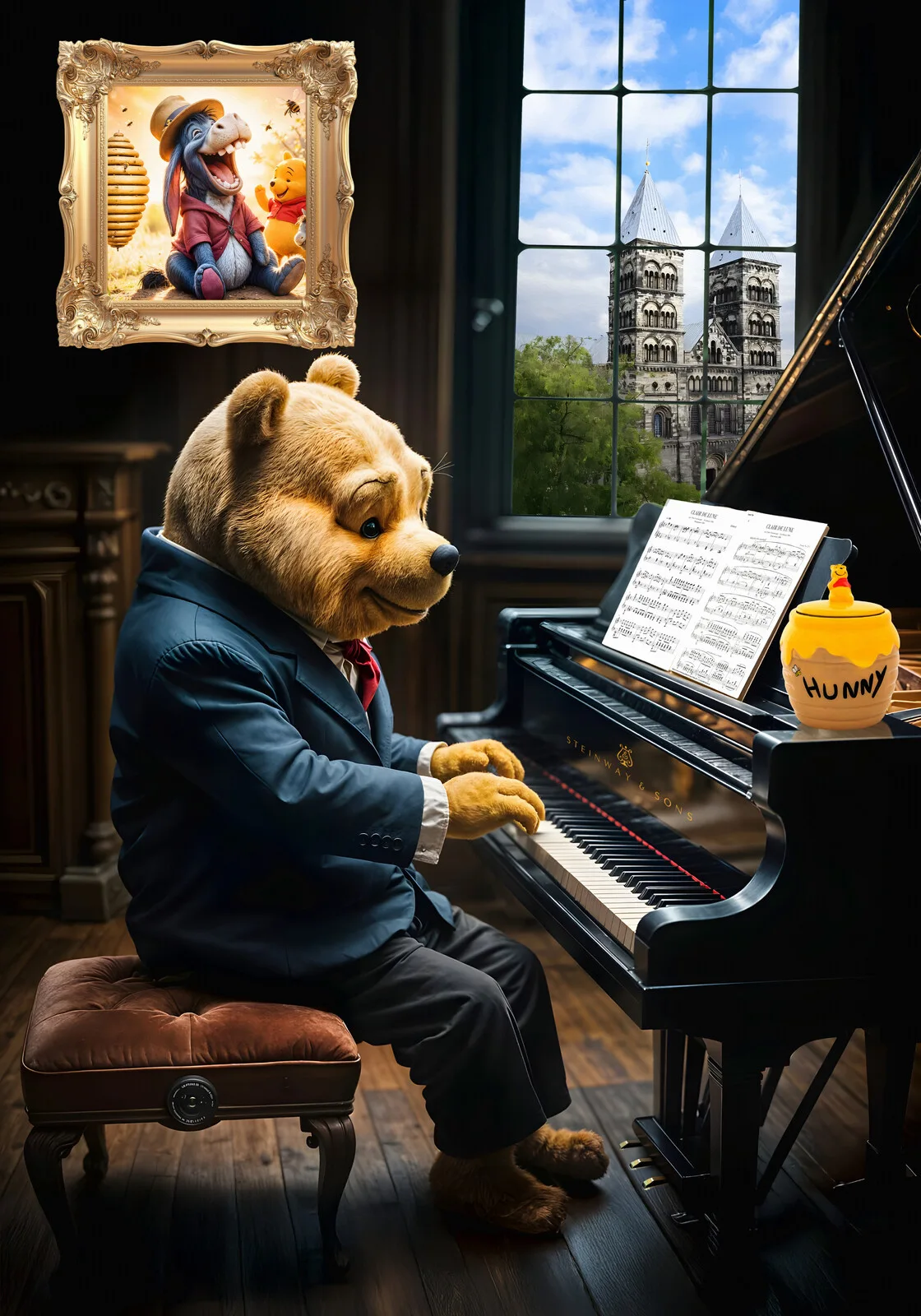
Honeylight - Winnie the Pooh plays the piano, 2025
Digital
50 x 70 cm
3 200 kr
Pooh is playing high and low.
When a bear in a red tie with sticky paws sits down at the grand piano to perform a Russian intermezzo about a buzzing bumblebee, you know this won’t be an ordinary concert. In Pooh Plays Rimsky-Korsakov – A Bumblebee Ballet in Honey Minor, Pooh takes us on a swirling inner journey, where each bar is a new twist through the forest, another step in the eternal hunt for honey—and a fresh opportunity to reflect on music, metamorphosis, and friendship. The audience, a mix of woodland creatures, reacts in their own unique ways-some tapping their feet, others nodding their heads in rhythm, and a few even humming along. A wise owl’s impromptu lecture, and a final, quiet slurp from the bottom of the honey jar, this may be the stickiest and most whimsical interpretation of classical music you’ll ever encounter.
Unravel the mystery behind the music and honey. This performance is brimming with suspense, and the tale will keep you on the edge of your seat, hungry for more. The anticipation for this unique and interactive interpretation of classical music will keep you engaged until the very end.
"Ode to the Buzz
In a glade where the flowers were waking at dawn,
A bumblebee choir began to sing on the lawn.
Not with lyrics or rhyme but a vibrato hum,
That tickled the tulips and made Daisy's drum.
They zigged and they zagged in aerial flight,
Like dots on a staff in the morning light.
Their wings beat a tempo, allegro and wild—
Conducted, it seemed, by a pollen-dazed child.
One hummed in C, another in high G,
A third tried a trill but collided with a tree.
Yet, out of the chaos, a rhythm took form,
Like Tchaikovsky’s breeze in a midsummer storm.
Pooh heard the music from deep in his chair,
Snout in a jar, he put his sticky paw in the air.
He blinked at the sound with a pondering frown,
Then pounced on the keys and wrote it all down.
“B-flat for the bounce, and D-sharp for the spin!
A cluster of triplets when they dive in a bin!
A fermata for hovering, a slur when they dart—
Each hum is a heartbeat, a buzz from the heart.”
The forest grew silent as Pooh played his tune,
A flight full of nectar and echoes of June.
Even Owl was moved, though he tried not to show,
And Piglet just whispered, “I didn’t know…”
So next time you hear that familiar drone,
Don't swat it away or grumble and moan.
It may be a prelude, a waltz on the wing—
At the start of a symphony, only bees sing.
"Now I must confess,” said Pooh with a grin,
“I nearly licked the page before the ink soaked in.
The notes looked like bees, the staves like a hive,
And I thought—well, really—how tasty they’d thrive!
But I spared the paper (just this once, you see),
Music, like honey, is best shared with tea.
So, I played what I heard and hummed what I knew—
A buzzing ballet in a sweet honey hue.“
Malmö, April 2025
Honeylight - Winnie the Pooh plays the piano. Winnie the Pooh loves to play the piano, especially pieces with a hint of honey. Eeyore and a few of his friends (including the ever-nervous Piglet and perhaps a cheerful squirrel named Nutters) have come to visit. As usual, they’re gathered by the grand piano in Pooh’s music room. Pooh always dresses for occasions like this: a jacket, a freshly pressed shirt, and a proper tie—looking every bit the gentleman bear.
“Clair de Miel” is Pooh’s version of Claude Debussy’s honey-sweet piece—Honeylight in English. Gentle and smooth, like honey in the evening light, it's the perfect way to wind down after playing The Flight of the Bumblebee by Nikolai Rimsky-Korsakov.
That buzzing piece was initially composed as an intermezzo (a musical bridge) in the composer’s opera The Tale of Tsar Saltan, based on a poem by Alexander Pushkin. In one of the most magical scenes, Prince Gvidon—son of the Tsar—is transformed into a bumblebee so he can secretly fly to visit his father. The Flight of the Bumblebee musically captures that journey: a whirling, breathless, virtuosic flight across the landscape—pure sonic mayhem.
The piece is famously fast and fiendishly difficult, especially on the piano—but it was a piece of cake for a bear who once played Chopin’s Minute Waltz in fifty-five seconds flat. (For the record, it’s supposed to last two minutes and one second.) Pooh’s paws dart across the keys, tearing through a whirlwind of eighth notes and triplets while maintaining the waltz’s “om-pah-pah” rhythm.
But we’re not here to talk about Chopin. No, we’ll let Pooh explain how he tackles Rimsky-Korsakov’s buzzing masterpiece…
Pooh Plays Rimsky-Korsakov – A Bumblebee Ballet in Honey Minor
“My interpretation of The Flight of the Bumblebee is not about some frantic insect dashing through a Russian opera. No, no. It is a dramatic and honey-glazed chapter from my own life, where each note marks a bold, if wobbly, step in the eternal search for that golden delight. If you count the number of notes in the score, you’ll see I’m not a lazy bear but a remarkably spry hundred-year-old. That’s right—I’m celebrating a full century this year," Pooh added with a proud sniff. (Sniffing is sometimes a matter of pride, especially when it carries faint notes of clover honey.)
“Tchaikovsky had his swans, but Rimsky-Korsakov had bees,” Pooh said. “He would have adored me, for I hold bees—and their nectar—in the highest regard.” The little audience chuckled, aware of his devotion to honey and all those who ensure it finds its way to his jar. And, inevitably, his tummy.
“This morning, the first buzzing note came just as I sleepily stared at a fly approaching the kitchen. I had, quite naturally, dozed off with my nose in an empty honey jar. But what’s that outside the window? A merry hum! A bumblebee—not just any bee, but one of noble, nectar-bearing lineage.”
Bars 1–10:
“My left ear twitched. My nose quivered. A bee danced provocatively just beyond the windowpane, its wings a tremolo of promise. I sat bolt upright in bed, but my mind had already taken its seat at the piano. “Where there are bees,” Pooh said softly to himself, “there is honey.”
Bars 11–30:
From the corner of the room, Piglet raised a tentative hoof. “Pooh,” he asked shyly, “do bees really sound like that when they dance?”
“Only when they’re in a good mood,” Pooh replied. “And especially when played in Allegro Molto Bumblebee.”
That seemed to satisfy him—for the moment.
“I rolled out of bed—or rather, eased into a fully upright musical stance. The sound it made was reminiscent of a dramatic chromatic glissando. I tripped over my piano stool, regained my balance with admirable flair, and donned my honey-hunting hat—a floppy felt thing with a makeshift stinger on top. Not essential for performance, but it adds a certain... resonance.”
Bars 31–60:
At this point, Eeyore let out a slow, rumbling sigh. “You’ll never catch that bee, Pooh.”
“I’m not trying to catch it,” Pooh replied. “I’m trying to understand its rhythm.”
“Out into the forest of my mind,” Pooh charged. “The music picked up: buzzing, flittering, impossible to catch. I darted through hedgerows of imagination, bounced off a dozing Eeyore, circled Rabbit’s fussiness three times, and toppled a metal birdbath from memory. “You see, the orchestra lives within me—though my timpani sometimes grumbles, and my piccolo has been known to hiccup after lunch. The violins trailed behind like bees chasing a bear with unshakable ambition.”
Bars 61–90:
Rabbit, always the practical one, muttered from behind a cushion, “If that tree of yours falls in your mind, does it still make a sound?”
“It makes a chord,” Pooh said, “usually a diminished seventh.”
“I climbed the memory of a tree—no need for bark or bruises when the piano does the lifting. My paws scampered up the keys in a cascade of 128th notes. The bee twirled above my head, and I swatted at the air with the urgency of a ballerina on a honey high. The music had transformed into a full-blown circus.”
Bars 91–120:
Piglet gasped, clutching his fizz. “Pooh, are you flying?”
“In a metaphorical sense,” he assured him. “Which is the safest kind of flying for a bear.”
“Under your umbrella, we must presume,” said the Owl.
“Right so,” Pooh said. “I spotted an imaginary umbrella and leapt from the highest mental branch, attempting a delicate aerial descent. As I conducted myself mid-air, my inner orchestra held its collective breath. Would I soar? A sharp modulation answered: not today. Kanga nodded knowingly. “The safest kind of flying is usually where your feet never quite leave the ground.” I landed with a mentally satisfying squelch in a puddle of pure D minor—and if anyone tells you D minor isn't sticky, they haven’t been inside my imagination.
“Interlude – Or the Art of Buzzing Transitions”, Pooh said, smiling.
Piglet blinked up at the ceiling. “Pooh… is it really just an intermission? That piece you played… it felt like a whole story.”
Pooh adjusted his honey-streaked collar and nodded solemnly.“Ah, Piglet,” he said, “it may be called an intermezzo, but never underestimate the power of a musical pause. It’s like the breath before a leap—or the silence before a bee takes wing.”
Rabbit straightened up. “But it’s so short, Pooh. Barely a minute long when some bears play it quickly!”
Pooh smiled. “Yes, but speed isn’t the point, Rabbit. It’s not about getting through the piece—it’s about letting it get through you. Inside that frantic flutter lives anticipation, pursuit, confusion, desire… even comedy.”
From his corner, Owl cleared his throat. “You might say, dear Pooh, that the intermezzo is a kind of existential overture to the self?”
“Indeed,” said Pooh. “It’s the moment where the audience becomes the bee—and the pianist becomes the flower. Or was it the other way round?” He paused. “Either way, nectar is involved.”
Eeyore, sucking on his blade of grass, muttered, “As I see it, buzzing or no buzzing, I’d rather have the bees humming contentedly and just lie under a cork tree like Ferdinand the Bull.”
Pooh nodded thoughtfully. “That, too, is a form of music.”
Eeyore mumbled, “I just thought it was loud.”
“It is,” Pooh agreed, “but sometimes the loudest moments are trying to say something very quiet.”
Pooh continued with the Finale (in sticky molasses tempo): “The bee disappeared. Drenched in metaphor (and mildly out of breath), I noticed an old tree stump nestled in the theatre of my thoughts. Inside: a honeycomb, golden and glistening. I gasped. A piccolo trilled. Rimsky-Korsakov surely tipped his hat somewhere among the stars, murmuring, “Well done, Pooh.”
“In my world,” Pooh said, “The Flight of the Bumblebee is not a heroic chase—it’s a buzzing ballet in honey minor. It’s all about the rhythm of the stumble, the sweetness of near-success, and finally, the moment when you find the jar still half full. He dipped his right paw into the culinary gold; golden drops fell onto the ivory keys. He licked them off. Naturally.
Then, with grand ceremony, he looked over his guests and reached for the next piece: Clair de Miel. Time to lower the pulse. Eeyore sipped his Dry Houdini (with a blade of grass for garnish—just one; two would be excessive). Piglet accepted a tall glass of Raspberry Fizz and clutched it tightly with both hooves. And Pooh, his red tie slightly askew and shirt charmingly stained, whispered to no one in particular: “Music is best played when your paws are sticky, and your heart is full of love.”
While the others listened with mild attention, Owl cleared his throat.
Piglet, ever the inquisitive one, looked up and asked, “Owl, why is there even a bumblebee in the opera at all?”
“Ah,” said Owl, delighted, “a fine question. The buzzing bit—Pooh's piece—is actually from an opera by Korsakov, as Pooh said earlier. The opera is called ‘Tsar Saltan's Tale’ and is based on Alexander Pushkin's poem. It is a fairy tale full of magic, transformations, and longing. In it, a prince named Gvidon wishes to see his father, the Tsar, but cannot. So, a magic swan transforms him into a bumblebee so he can fly invisibly to the royal court.”
Piglet tilted his head. “But why a bumblebee?”
“Because,” Owl said, “it’s fast, small, and goes unnoticed—unless it wants to be noticed. Perfect for covert flights of the heart. And the music, my dear Piglet, was written to sound just like that flight—whirling, frantic, impossible to catch. It’s a musical transformation! A piece of storytelling through notes.”
Piglet looked awestruck. “So it’s not just about buzzing?”
Owl nodded gravely. “Indeed not. It’s a magical moment of metamorphosis—just like in Pooh’s story, only in orchestral Russian.”
As Owl spoke, Pooh had quietly returned to his chair, the honey jar now empty, his snout glistening with gold. He gave a contented sigh and said, “Buzzing, flying, longing, and honey—it’s all part of the same music.”
What is a Dry Houdini, you may wonder? Allow me to explain.
It’s a vanishingly delicious drink made from the nectar of rapeseed flowers. The name comes from the great magician Houdini, who was a master of disappearing acts—just like this delightful beverage, which tends to vanish in no time at all. Eeyore muttered, “Mine disappeared before I had a proper sip.”
Jörgen Thornberg
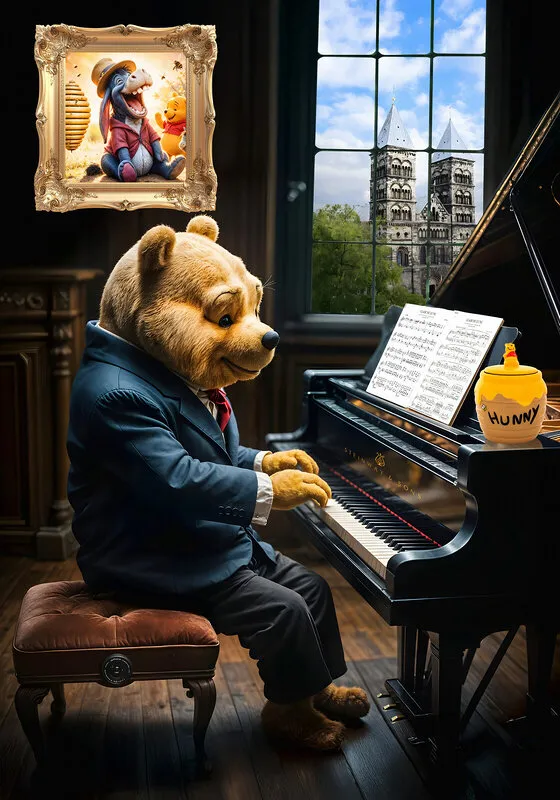
Honeylight - Winnie the Pooh plays the piano, 2025
Digital
50 x 70 cm
3 200 kr
Pooh is playing high and low.
When a bear in a red tie with sticky paws sits down at the grand piano to perform a Russian intermezzo about a buzzing bumblebee, you know this won’t be an ordinary concert. In Pooh Plays Rimsky-Korsakov – A Bumblebee Ballet in Honey Minor, Pooh takes us on a swirling inner journey, where each bar is a new twist through the forest, another step in the eternal hunt for honey—and a fresh opportunity to reflect on music, metamorphosis, and friendship. The audience, a mix of woodland creatures, reacts in their own unique ways-some tapping their feet, others nodding their heads in rhythm, and a few even humming along. A wise owl’s impromptu lecture, and a final, quiet slurp from the bottom of the honey jar, this may be the stickiest and most whimsical interpretation of classical music you’ll ever encounter.
Unravel the mystery behind the music and honey. This performance is brimming with suspense, and the tale will keep you on the edge of your seat, hungry for more. The anticipation for this unique and interactive interpretation of classical music will keep you engaged until the very end.
"Ode to the Buzz
In a glade where the flowers were waking at dawn,
A bumblebee choir began to sing on the lawn.
Not with lyrics or rhyme but a vibrato hum,
That tickled the tulips and made Daisy's drum.
They zigged and they zagged in aerial flight,
Like dots on a staff in the morning light.
Their wings beat a tempo, allegro and wild—
Conducted, it seemed, by a pollen-dazed child.
One hummed in C, another in high G,
A third tried a trill but collided with a tree.
Yet, out of the chaos, a rhythm took form,
Like Tchaikovsky’s breeze in a midsummer storm.
Pooh heard the music from deep in his chair,
Snout in a jar, he put his sticky paw in the air.
He blinked at the sound with a pondering frown,
Then pounced on the keys and wrote it all down.
“B-flat for the bounce, and D-sharp for the spin!
A cluster of triplets when they dive in a bin!
A fermata for hovering, a slur when they dart—
Each hum is a heartbeat, a buzz from the heart.”
The forest grew silent as Pooh played his tune,
A flight full of nectar and echoes of June.
Even Owl was moved, though he tried not to show,
And Piglet just whispered, “I didn’t know…”
So next time you hear that familiar drone,
Don't swat it away or grumble and moan.
It may be a prelude, a waltz on the wing—
At the start of a symphony, only bees sing.
"Now I must confess,” said Pooh with a grin,
“I nearly licked the page before the ink soaked in.
The notes looked like bees, the staves like a hive,
And I thought—well, really—how tasty they’d thrive!
But I spared the paper (just this once, you see),
Music, like honey, is best shared with tea.
So, I played what I heard and hummed what I knew—
A buzzing ballet in a sweet honey hue.“
Malmö, April 2025
Honeylight - Winnie the Pooh plays the piano. Winnie the Pooh loves to play the piano, especially pieces with a hint of honey. Eeyore and a few of his friends (including the ever-nervous Piglet and perhaps a cheerful squirrel named Nutters) have come to visit. As usual, they’re gathered by the grand piano in Pooh’s music room. Pooh always dresses for occasions like this: a jacket, a freshly pressed shirt, and a proper tie—looking every bit the gentleman bear.
“Clair de Miel” is Pooh’s version of Claude Debussy’s honey-sweet piece—Honeylight in English. Gentle and smooth, like honey in the evening light, it's the perfect way to wind down after playing The Flight of the Bumblebee by Nikolai Rimsky-Korsakov.
That buzzing piece was initially composed as an intermezzo (a musical bridge) in the composer’s opera The Tale of Tsar Saltan, based on a poem by Alexander Pushkin. In one of the most magical scenes, Prince Gvidon—son of the Tsar—is transformed into a bumblebee so he can secretly fly to visit his father. The Flight of the Bumblebee musically captures that journey: a whirling, breathless, virtuosic flight across the landscape—pure sonic mayhem.
The piece is famously fast and fiendishly difficult, especially on the piano—but it was a piece of cake for a bear who once played Chopin’s Minute Waltz in fifty-five seconds flat. (For the record, it’s supposed to last two minutes and one second.) Pooh’s paws dart across the keys, tearing through a whirlwind of eighth notes and triplets while maintaining the waltz’s “om-pah-pah” rhythm.
But we’re not here to talk about Chopin. No, we’ll let Pooh explain how he tackles Rimsky-Korsakov’s buzzing masterpiece…
Pooh Plays Rimsky-Korsakov – A Bumblebee Ballet in Honey Minor
“My interpretation of The Flight of the Bumblebee is not about some frantic insect dashing through a Russian opera. No, no. It is a dramatic and honey-glazed chapter from my own life, where each note marks a bold, if wobbly, step in the eternal search for that golden delight. If you count the number of notes in the score, you’ll see I’m not a lazy bear but a remarkably spry hundred-year-old. That’s right—I’m celebrating a full century this year," Pooh added with a proud sniff. (Sniffing is sometimes a matter of pride, especially when it carries faint notes of clover honey.)
“Tchaikovsky had his swans, but Rimsky-Korsakov had bees,” Pooh said. “He would have adored me, for I hold bees—and their nectar—in the highest regard.” The little audience chuckled, aware of his devotion to honey and all those who ensure it finds its way to his jar. And, inevitably, his tummy.
“This morning, the first buzzing note came just as I sleepily stared at a fly approaching the kitchen. I had, quite naturally, dozed off with my nose in an empty honey jar. But what’s that outside the window? A merry hum! A bumblebee—not just any bee, but one of noble, nectar-bearing lineage.”
Bars 1–10:
“My left ear twitched. My nose quivered. A bee danced provocatively just beyond the windowpane, its wings a tremolo of promise. I sat bolt upright in bed, but my mind had already taken its seat at the piano. “Where there are bees,” Pooh said softly to himself, “there is honey.”
Bars 11–30:
From the corner of the room, Piglet raised a tentative hoof. “Pooh,” he asked shyly, “do bees really sound like that when they dance?”
“Only when they’re in a good mood,” Pooh replied. “And especially when played in Allegro Molto Bumblebee.”
That seemed to satisfy him—for the moment.
“I rolled out of bed—or rather, eased into a fully upright musical stance. The sound it made was reminiscent of a dramatic chromatic glissando. I tripped over my piano stool, regained my balance with admirable flair, and donned my honey-hunting hat—a floppy felt thing with a makeshift stinger on top. Not essential for performance, but it adds a certain... resonance.”
Bars 31–60:
At this point, Eeyore let out a slow, rumbling sigh. “You’ll never catch that bee, Pooh.”
“I’m not trying to catch it,” Pooh replied. “I’m trying to understand its rhythm.”
“Out into the forest of my mind,” Pooh charged. “The music picked up: buzzing, flittering, impossible to catch. I darted through hedgerows of imagination, bounced off a dozing Eeyore, circled Rabbit’s fussiness three times, and toppled a metal birdbath from memory. “You see, the orchestra lives within me—though my timpani sometimes grumbles, and my piccolo has been known to hiccup after lunch. The violins trailed behind like bees chasing a bear with unshakable ambition.”
Bars 61–90:
Rabbit, always the practical one, muttered from behind a cushion, “If that tree of yours falls in your mind, does it still make a sound?”
“It makes a chord,” Pooh said, “usually a diminished seventh.”
“I climbed the memory of a tree—no need for bark or bruises when the piano does the lifting. My paws scampered up the keys in a cascade of 128th notes. The bee twirled above my head, and I swatted at the air with the urgency of a ballerina on a honey high. The music had transformed into a full-blown circus.”
Bars 91–120:
Piglet gasped, clutching his fizz. “Pooh, are you flying?”
“In a metaphorical sense,” he assured him. “Which is the safest kind of flying for a bear.”
“Under your umbrella, we must presume,” said the Owl.
“Right so,” Pooh said. “I spotted an imaginary umbrella and leapt from the highest mental branch, attempting a delicate aerial descent. As I conducted myself mid-air, my inner orchestra held its collective breath. Would I soar? A sharp modulation answered: not today. Kanga nodded knowingly. “The safest kind of flying is usually where your feet never quite leave the ground.” I landed with a mentally satisfying squelch in a puddle of pure D minor—and if anyone tells you D minor isn't sticky, they haven’t been inside my imagination.
“Interlude – Or the Art of Buzzing Transitions”, Pooh said, smiling.
Piglet blinked up at the ceiling. “Pooh… is it really just an intermission? That piece you played… it felt like a whole story.”
Pooh adjusted his honey-streaked collar and nodded solemnly.“Ah, Piglet,” he said, “it may be called an intermezzo, but never underestimate the power of a musical pause. It’s like the breath before a leap—or the silence before a bee takes wing.”
Rabbit straightened up. “But it’s so short, Pooh. Barely a minute long when some bears play it quickly!”
Pooh smiled. “Yes, but speed isn’t the point, Rabbit. It’s not about getting through the piece—it’s about letting it get through you. Inside that frantic flutter lives anticipation, pursuit, confusion, desire… even comedy.”
From his corner, Owl cleared his throat. “You might say, dear Pooh, that the intermezzo is a kind of existential overture to the self?”
“Indeed,” said Pooh. “It’s the moment where the audience becomes the bee—and the pianist becomes the flower. Or was it the other way round?” He paused. “Either way, nectar is involved.”
Eeyore, sucking on his blade of grass, muttered, “As I see it, buzzing or no buzzing, I’d rather have the bees humming contentedly and just lie under a cork tree like Ferdinand the Bull.”
Pooh nodded thoughtfully. “That, too, is a form of music.”
Eeyore mumbled, “I just thought it was loud.”
“It is,” Pooh agreed, “but sometimes the loudest moments are trying to say something very quiet.”
Pooh continued with the Finale (in sticky molasses tempo): “The bee disappeared. Drenched in metaphor (and mildly out of breath), I noticed an old tree stump nestled in the theatre of my thoughts. Inside: a honeycomb, golden and glistening. I gasped. A piccolo trilled. Rimsky-Korsakov surely tipped his hat somewhere among the stars, murmuring, “Well done, Pooh.”
“In my world,” Pooh said, “The Flight of the Bumblebee is not a heroic chase—it’s a buzzing ballet in honey minor. It’s all about the rhythm of the stumble, the sweetness of near-success, and finally, the moment when you find the jar still half full. He dipped his right paw into the culinary gold; golden drops fell onto the ivory keys. He licked them off. Naturally.
Then, with grand ceremony, he looked over his guests and reached for the next piece: Clair de Miel. Time to lower the pulse. Eeyore sipped his Dry Houdini (with a blade of grass for garnish—just one; two would be excessive). Piglet accepted a tall glass of Raspberry Fizz and clutched it tightly with both hooves. And Pooh, his red tie slightly askew and shirt charmingly stained, whispered to no one in particular: “Music is best played when your paws are sticky, and your heart is full of love.”
While the others listened with mild attention, Owl cleared his throat.
Piglet, ever the inquisitive one, looked up and asked, “Owl, why is there even a bumblebee in the opera at all?”
“Ah,” said Owl, delighted, “a fine question. The buzzing bit—Pooh's piece—is actually from an opera by Korsakov, as Pooh said earlier. The opera is called ‘Tsar Saltan's Tale’ and is based on Alexander Pushkin's poem. It is a fairy tale full of magic, transformations, and longing. In it, a prince named Gvidon wishes to see his father, the Tsar, but cannot. So, a magic swan transforms him into a bumblebee so he can fly invisibly to the royal court.”
Piglet tilted his head. “But why a bumblebee?”
“Because,” Owl said, “it’s fast, small, and goes unnoticed—unless it wants to be noticed. Perfect for covert flights of the heart. And the music, my dear Piglet, was written to sound just like that flight—whirling, frantic, impossible to catch. It’s a musical transformation! A piece of storytelling through notes.”
Piglet looked awestruck. “So it’s not just about buzzing?”
Owl nodded gravely. “Indeed not. It’s a magical moment of metamorphosis—just like in Pooh’s story, only in orchestral Russian.”
As Owl spoke, Pooh had quietly returned to his chair, the honey jar now empty, his snout glistening with gold. He gave a contented sigh and said, “Buzzing, flying, longing, and honey—it’s all part of the same music.”
What is a Dry Houdini, you may wonder? Allow me to explain.
It’s a vanishingly delicious drink made from the nectar of rapeseed flowers. The name comes from the great magician Houdini, who was a master of disappearing acts—just like this delightful beverage, which tends to vanish in no time at all. Eeyore muttered, “Mine disappeared before I had a proper sip.”
3 200 kr

Jörgen Thornberg
Malmö
Lite om bilder och mig. Translation in English at the end.
Jag är en nyfiken person som ser allt i bilder, även det jag fäster i ord, gärna tillsammans för bakom alla mina bilder finns en berättelse. Till vissa bilder hör en kortare eller längre novell som följer med bilden.
Bilder berättar historier. Jag omges av naturlig skönhet, intressanta människor och historia var jag än går. Jag använder min kamera för att dokumentera världen och blanda det jag ser med vad jag känner för att fånga den dolda magin.
Mina bilder berättar mina historier. Genom mina bilder, tryck och berättelser. Jag bjuder in dig att ta del av dessa berättelser, in i ditt liv och hem och dela min mycket personliga syn på vår värld. Mer än vad ögat ser. Jag tänker i bilder, drömmer och skriver och pratar om dem; följaktligen måste jag också skapa bilder. De blir vad jag ser, inte nödvändigtvis begränsade till verkligheten. Det finns en bild runt varje hörn. Jag hoppas att du kommer att se vad jag såg och gilla det.
Jag är också en skrivande person och till många bilder hör en kortare eller längre essay. Den följer med tavlan, tryckt på fint papper och med en personlig hälsning från mig.
Flertalet bilder startar sin resa i min kamera. Enkelt förklarat beskriver jag bilden jag ser i mitt inre, upplevd eller fantiserad. Bilden uppstår inom mig redan innan jag fått okularet till ögat. På bråkdelen av ett ögonblick ser jag vad jag vill ha och vad som kan göras med bilden. Här skall jag stoppa in en giraff, stålmannen, Titanic eller vad det är min fantasi finner ut. Ännu märkligare är att jag kommer ihåg minnesbilden långt efteråt när det blir tid att skapa verket. Om jag lyckas eller inte, är upp till betraktaren, oftast präglat av en stråk av svart humor – meningen är att man skall bli underhållen. Mina bilder blir ofta en snackis där de hänger.
Jag föredrar bilder som förmedlar ett budskap i flera lager. Vid första anblicken fylld av feel-good, en vacker utsikt, fint väder, solen skiner, blommor på ängen eller vattnet som ligger förrädiskt spegelblankt. I en sådan bild kan jag gömma min egentliga berättelse, mitt förakt för förtryckare och våldsverkare, rasister och fördomsfulla människor - ett gärna återkommande motiv mer eller mindre dolt i det vackra motivet. Jag försöker förena dem i ett gemensamt narrativ.
Bild och formgivning har löpt som en röd tråd genom livet. Fotokonst känns som en värdig final som jag gärna delar med mig.
Min genre är vid som framgår av mina bilder, temat en blandning av pop- och gatukonst i kollage som kan bestå av hundratals lager. Vissa bilder kan ta veckor, andra någon dag innan det är dags att överlämna resultatet till printverkstaden. Fine Art Prints är digitala fotocollage. I dessa kollage sker rivandet, klippandet, pusslandet, målandet, ritandet och sprayningen digitalt. Det jag monterar in kan vara hundratals år gamla bilder som jag omsorgsfullt frilägger så att de ser ut att vara en del av tavlan men också bilder skapade av mig själv efter min egen fantasi. Därefter besöks printstudion och för vissa bilder numrera en limiterad upplaga (oftast 7 exemplar) och signera för hand. Vissa bilder kan köpas i olika format. Det är bara att fråga efter vilka. Gillar man en bild som är 70x100 men inte har plats på väggen, går den kanske att få i 50x70 cm istället. Frågan är fri.
Metoden Giclée eller Fine Art Print som det också kallas är det moderna sättet för framställning av grafisk konst. Villkoret för denna typ av utskrifter är att en högkvalitativ storformatskrivare används med åldersbeständigt färgpigment och konstnärspapper eller i förekommande fall på duk. Pappret som används möter de krav på livslängd som ställs av museer och gallerier. Normalt säljer jag mina bilder oinramade så att den nya ägaren själv kan bestämma hur de skall se ut, med eller utan passepartout färg på ram, med eller utan glas etc..
Under många år ställde jag bara ut på nätet, i valda grupper och på min egen Facebooksida - https://www.facebook.com/jorgen.thornberg.9
Jag finns också på en egen hemsida som tyvärr inte alltid är uppdaterad – https://www.jth.life/ Där kan du också läsa en del av de berättelser som följer med bilden.
UTSTÄLLNINGAR
Luftkastellet, oktober 2022
Konst i Lund, november 2022
Luftkastellet, mars 2023
Engleson Galleri Caroli, april 2023
Hydra, Greece June 2023
Engleson Galleri Caroli, oktober 2023
Toppen, Höllviken december 2023
Luftkastellet, mars 2024
Torups Galleri, mars 2024
Venice, May 2024
Luftkastellet, oktober 2024
Konst i Advent, December 2024
Galleri Engleson, Caroli December 2024
Jäger & Jansson Galleri, april 2025
A bit about pictures and me.
I'm a curious person who sees everything in pictures, even what I express in words, often combining them, for behind all my pictures lies a story. These narratives, some as short as a single image and others as long as a novel, are the heart and soul of my work.
Pictures tell stories. Wherever I go, I'm surrounded by natural beauty, exciting people, and history. I use my camera to document the world and blend what I see with what I feel to capture the hidden magic.
My images tell my stories. Through my pictures, prints, and narratives, I invite you to partake in these stories in your life and home and share my deeply personal perspective of our world. More than meets the eye. I think in pictures, dream, write, and talk about them; consequently, I must create images too. They become what I see, not necessarily confined to reality. There's a picture around every corner. I hope you'll see what I saw and enjoy it.
I'm also a writer, and many images come with a shorter or longer essay. It accompanies the painting, printed on fine paper with my personal greeting.
Many pictures start their journey on my camera. Simply put, I describe the image I see in my mind, experienced or imagined. The image arises within me even before I bring the eyepiece to my eye. In a fraction of a moment, I see what I want and what can be done with the picture. Here, I'll insert a giraffe, Superman, the Titanic, or whatever my imagination conjures up. Even stranger is that I remember the mental image long after it's time to create the work. Whether I succeed is up to the observer, often imbued with a streak of black humour – the aim is to entertain. My pictures usually become a talking point wherever they hang.
I prefer pictures that convey a message in multiple layers. At first glance, they're filled with feel-good vibes, a beautiful view, lovely weather, the sun shining, flowers in the meadow, or the water lying deceptively calm. But beneath this surface beauty, I often conceal a deeper story, a narrative that challenges societal norms or explores the human condition. I invite you to delve into these hidden narratives and discover the layers of meaning within my work.
Picture and design have been a thread running through my life. Photographic art feels like a fitting finale, and I'm happy to share it.
My genre is varied, as seen in my pictures; the theme is a blend of pop and street art in collages that can consist of hundreds of layers. Some images can take weeks, others just a day before it's time to hand over the result to the print workshop. Fine Art Prints are digital photo collages. In these collages, tearing, cutting, puzzling, painting, drawing, and spraying happen digitally. What I insert can be images hundreds of years old that I carefully extract so they appear to be part of the painting, but also images created by myself, now also generated from my imagination. Next, visit the print studio and, for certain images, number a limited edition (usually 7 copies) and sign them by hand. Some images may be available in other formats. Just ask which ones. If you like an image that's 70x100 but doesn't have space on the wall, you might be able to get it in 50x70 cm instead. The question is open.
The Giclée method, or Fine Art Print as it's also called, is the modern way of producing graphic art. This method ensures the highest quality and longevity of the artwork, using a high-quality large-format printer with archival pigment inks and artist paper or, in some cases, canvas. The paper used meets the longevity requirements set by museums and galleries. I sell my pictures unframed, allowing the new owner to personalise their artwork, confident in the lasting value and quality of the piece.
For many years, I only exhibited online, in selected groups, and on my Facebook page - https://www.facebook.com/jorgen.thornberg.9. I also have my website, which unfortunately is not constantly updated - https://www.jth.life/. You can also read some of the stories accompanying the pictures there.
EXHIBITIONS
Luftkastellet, October 2022
Art in Lund, November 2022
Luftkastellet, March 2023
Engleson Gallery Caroli, April 2023
Hydra, Greece June 2023
Engleson Gallery Caroli, October 2023
Toppen, Höllviken December 2023
Luftkastellet, March 2024
Torup Gallery, March 2024
Venice, May 2024
UTSTÄLLNINGAR
Luftkastellet, oktober 2022
Konst i Lund, november 2022
Luftkastellet, mars 2023
Engleson Galleri Caroli, april 2023
Hydra, Greece June 2023
Engleson Galleri Caroli, oktober 2023
Toppen, Höllviken december 2023
Luftkastellet, mars 2024
Torups Galleri, mars 2024
Venice, May 2024
Luftkastellet, October 2024
Konst i Advent, December 2024
Galleri Engleson, Caroli December 2024
Jäger & Jansson Galleri, April 2025
Utbildning
Autodidakt
Medlem i konstnärsförening
Öppna Sinnen
Med i konstrunda
Konstrundan i Skåne
Utställningar
Luftkastellet, October 2022
Art in Lund, November 2022
Luftkastellet, March 2023
Engleson Gallery Caroli, April 2023
Hydra, Greece June 2023
Engleson Gallery Caroli, October 2023
Toppen, Höllviken December 2023
Luftkastellet, March 2024
Torup Gallery, March 2024
Venice, May 2024