Vi använder cookies för att ge dig bästa möjliga upplevelse. Välj vilka cookies du tillåter.
Läs mer i vår integritetspolicy
Jörgen Thornberg
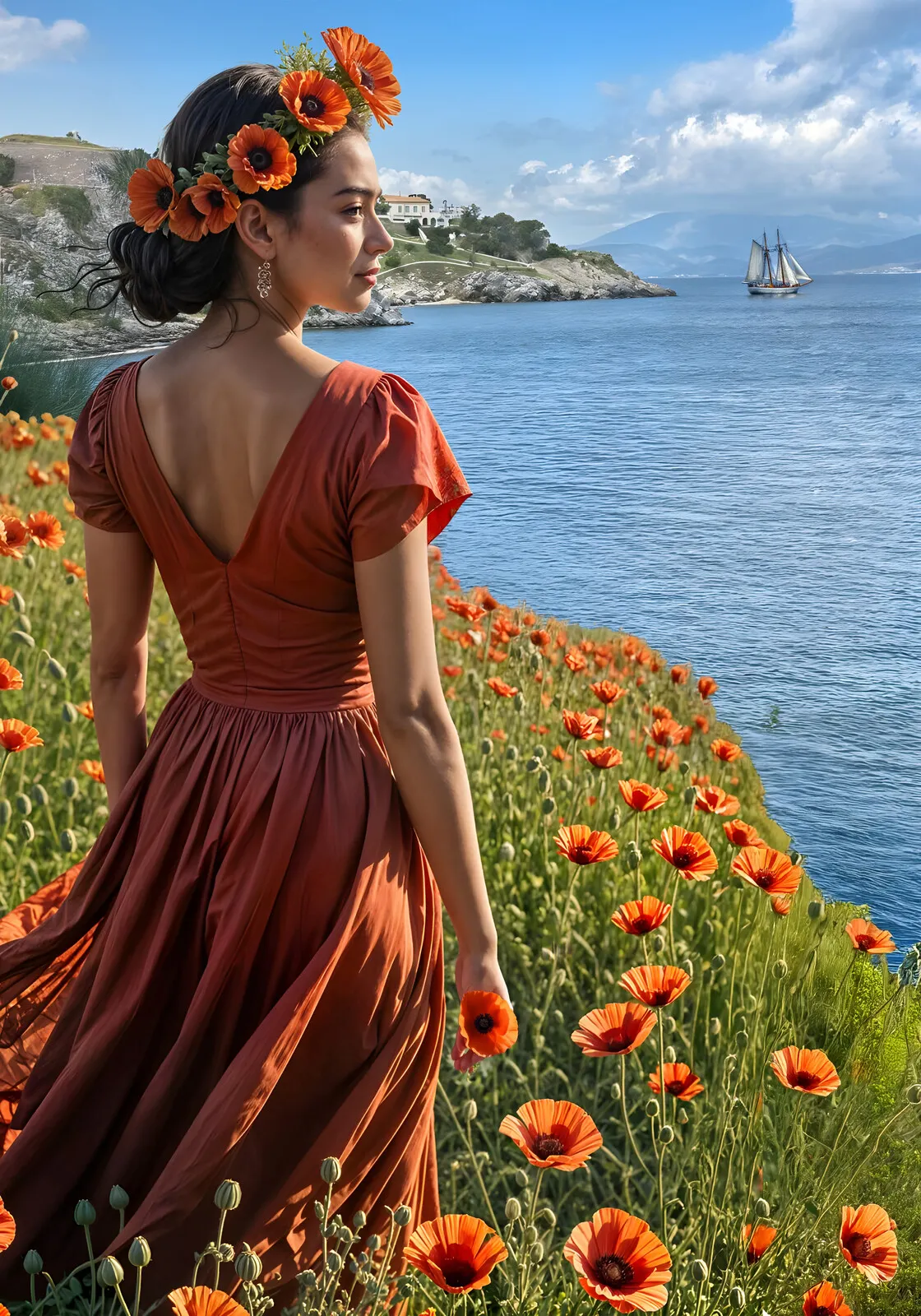
Frida at Poppy Bay, 2025
Digital
50 x 70 cm
Frida at Poppy Bay
On Hydra, near Mandraki, where sun-bleached hills slope gently toward the shimmering sea, a crimson tide has taken root—not in the water, but on land. The hillside bursts with blooming poppies, swaying in the breeze like a thousand tiny flames. And there, among them, stands Frida.
Seen from behind, crowned with poppies in her dark braided hair, she is dressed in a red summer dress that flutters wildly in the Aegean wind. The fabric echoes the flowers at her feet, the horizon before her. She turns her head just enough for us to glimpse her profile—a gaze steady, curious, and timeless.
This is not Mexico, nor is it a dream—though it may feel like both. Hydra has its kind of magic, a silence that hums beneath the waves and in the folds of sunlight. Here, at Poppy Bay, Frida has found something she rarely had: stillness without sorrow. The wind carries her memories out over the water; the flowers hold her story in bloom.
In this moment, everything breathes—art, sea, and soul—as if time has paused to let her be. Unravel the mystery behind the red flower, a symbol of life and death, beauty and pain. This tale, brimming with suspense, will keep you on the edge of your seat, hungry for more.
"Demeter’s Poppy
In fields where golden barley sways,
She walks with dust upon her gaze.
A mother lost, a world turned grey—
The earth held its breath that fateful day.
But in her hand, a bloom so red,
It burned where all the green had fled.
A poppy bold, yet soft and deep,
A flower born from death and sleep.
They say it grew where tears had dropped,
Where furrows cracked and harvests stopped.
The seed she pressed against her chest
Would soothe the soil, would give it rest.
When Persephone returned once more,
She scattered petals by the shore.
And poppies rose in vivid flame,
Each one a prayer, each one a name.
So when you see that crimson flare
In sunlit fields or goddess hair—
Remember, grief can bloom again,
And even loss will soften rain.
And Frida comes in scarlet flame,
A mortal echo, yet untamed.
She wades through seas of poppy red,
Where every petal speaks the dead.
Her dress, the wind, her gaze, the storm—
A woman's grief in vibrant form.
She walks where Demeter once wept low—
Now fire and bloom together grow.“
Malmö, April 2025
In Praise of the Poppy – A Most Unruly Bloom
Few flowers balance beauty, symbolism, danger, and delight quite like the poppy. Fragile as tissue and as fleeting as a sigh, its silken petals flare in shades of red, orange, pink, and even somber black, fluttering atop wiry stems with a mix of elegance and defiance. The poppy does not beg for attention—it claims it with colour and myth alike.
Botanically, the poppy belongs to the family Papaveraceae and, within this family, to the genus Papaver. Its most iconic representative, the familiar red poppy (Papaver rhoeas), carpets meadows and fields across Europe each summer- a spectacle that has inspired poets and pacifists alike. Another relative, Papaver somniferum, the opium poppy, has fueled both medicine and mayhem for centuries. From healing morphine to addictive heroin, its latex sap is a paradox of relief and ruin.
An Ancient Bloom
Poppies have a long and complex history. In ancient Sumeria, over 6,000 years ago, the opium poppy was called "the joy plant. " The Egyptians used it to relieve pain. Greeks and Romans associated it with both Hypnos and Morpheus, gods of sleep and dreams. Poppies adorned tombs, symbolising eternal rest while also appearing in love poems and hair garlands. What other flower can embody war, peace, sleep, and seduction in a single bouquet?
In art, poppies have been a recurring motif, from John Singer Sargent's lush watercolours to Georgia O'Keeffe's provocatively blooming petals. And who can forget Monet's poppy fields, with scarlet smudges dancing under Impressionist skies?
The Ghost of Flanders
Perhaps the most enduring association comes from the battlefields of World War I. After the horrors of trench warfare and artillery, it was the poppy that returned first, sprouting defiantly in churned-up soil. Lieutenant Colonel John McCrae immortalised this image in his 1915 poem In Flanders Fields. The red poppy became a symbol of remembrance, still worn every November.
Anecdotally, a British soldier once remarked that poppies bloomed redder in soil enriched with iron—and nothing added iron like the detritus of war. Whether botany supports this or not, the legend persists.
The Sleepy Pharaoh
When archaeologists opened the tomb of Ramses II, they discovered traces of opium poppies alongside the burial shrouds. One Egyptologist, not particularly fond of fieldwork, once joked, "Even in the afterlife, Ramses needed his sleep aid."
The Poppy Dress Debacle
In 1935, a society lady in London commissioned a gown made entirely of artificial red poppies for a charity ball in London. All went well until a few guests with hay fever suffered fits of sneezing at the mere sight of the floral explosion. A new fragrance had been added to the petals, leading the ball to be renamed the "Pollen Gala."
Frida and the Crimson Crown
Frida Kahlo often adorned her hair with poppies, weaving them into floral crowns that became an essential part of her visual identity. Once, while visiting New York, a child mistook her for a queen and asked where her castle was. "My castle is in Coyoacán," she replied with a wink, "and the poppies guard the gates."
A Flower With No Apologies
Whether growing wild along highways or cultivated in regal gardens, the poppy remains unpredictable. It can soothe pain or spark it. It can honour the dead or scandalise a dinner party. And in its brief bloom lies its most significant power: the reminder that beauty, like memory, cannot be contained.
But no account of the poppy is complete without acknowledging its darker petals—the legacy of the opium poppy,* Papaver somniferum*, whose sap has shaped empires, destroyed lives, and bled into nearly every century of recorded history. What began as a medicinal gift—the power to dull pain—soon spiralled into dependence, corruption, and war.
The opium poppy's reach is ancient. In ancient Thebes, it soothed children and wounded warriors alike. By the Renaissance, it was prized by apothecaries across Europe. However, it was in the 18th and 19th centuries that the flower's bitter price became globally apparent. The British Empire, hungry for trade and dominance, cultivated opium in India and flooded China with the narcotic. When Chinese officials attempted to halt the trade, Britain responded with military force—thus beginning the Opium Wars, which humiliated a nation, fractured a dynasty, and deepened Western colonial dominance in Asia. All in the name of a flower. Name of a flower.
The opium poppy’s latex has coursed through history like a venomous thread. In the 19th century, British traders turned addiction into imperial leverage, devastating millions of Chinese lives while profiting enormously. Later, the same opium pipelines were mirrored in French Indochina, where colonial authorities both policed and taxed poppy farming, blurring the lines between legality and exploitation. Even the United States, while banning opium in one breath, allowed pharmaceutical giants to refine it into morphine in the next.
Ancient Greeks were familiar with the poppy plant and its hypnotic properties. In the eighth century BCE, Hesiod referred to Mecone, a town near Corinth, famous for its extensive lands dedicated to cultivating the poppy. According to legend, Demeter first discovered the plant there. The Greeks considered the poppy a magical or poisonous plant that could be used in religious ceremonies. Hypnos (Sleep), Nyx (Night), and Thanatos (Death) were deities often depicted carrying poppies or wearing wreaths of poppies. The plant appeared in the statues of Apollo, Pluto, Asclepius, Aphrodite, and Kybele, while ears of corn were occasionally added to the bunch of poppies.
The poppy was associated with Demeter from an early period. Researchers have identified a Mycenaean deity holding poppies or wearing a crown adorned with poppy capsules as Demeter. However, the poppy variety most closely linked to the goddess was the opium poppy (Papaver somniferum), which the Roman poet Virgil referred to as the flower of Ceres. In one version of the myth, Demeter consumed poppies to fall asleep and forget the pain caused by the sudden loss of her daughter.
The connection between the plant and the goddess was manifold. First, the numerous seeds of the capsule symbolise fertility, Demeter’s greatest gift to humanity. The poppy was also cultivated as a cereal crop, reflecting its association with the goddess of grain and fertility. Finally, opium, a product of the plant, connects the poppy with sleep and death, another vital aspect of Demeter. The association was strong and widespread in the Greek world. Demeter is often depicted holding a wheat sheaf in one hand and poppy capsules in the other, while the poet Theocritus described a statue of Demeter “holding wheat stalks and poppies in either hand.”
As a symbol of Demeter, the poppy is present in Eleusis, but there is a catch. The flower has one or two tiers of broad petals, with eight or twelve petals in each tier. This refers to the opium poppy, but there is some confusion over the presence of two tiers of petals. Double poppies do not produce more or better opium than single poppies, and there is no evidence that the rites of Demeter were associated exclusively with either plant version. The solution may lie in the Homeric Hymn to Demeter. Persephone was in the process of admiring a “hundred-headed” flower when the earth parted, and Hades appeared. Most researchers identify this magical flower with the narcissus, the flower of the underworld and death. However, in Eleusis, the double opium poppy may have served a dual purpose. On one hand, it would evoke the association of Demeter with death and regeneration, while on the other hand, it would represent the wondrous flower that doomed Persephone.
The curse did not end with the empire. In the 20th and 21st centuries, its descendants—morphine, heroin, and synthetic opioids—fueled an ever-expanding web of addiction and despair. The Golden Triangle, a lush region where Myanmar, Thailand, and Laos meet, became notorious as a hub of illicit opium production. For decades, entire villages survived by harvesting poppies under the control of armed militias and drug lords. Warlords like Khun Sa used profits from heroin exports to fund armies, resist governments, and amass fortunes—while addiction spread like wildfire from Bangkok to Berlin. Some allege that the CIA disregarded opium shipments during the Cold War in exchange for cooperation against communism.
In Afghanistan, the world's leading producer of illicit opium for much of the 21st century, the poppy fields became both a lifeline and a curse. For impoverished farmers, poppies provided a more reliable source of income than wheat. However, the trade attracted warlords, insurgents, and foreign intervention. At times, the Taliban banned opium; at other times, they taxed it. Western coalitions attempted to eradicate the fields, only to find themselves in a bind: destroy the crop, and destroy a community's only income. Billions were spent on eradication campaigns with little lasting effect. One NATO officer famously remarked, “We 're losing the war to a flower.”
Meanwhile, Mexico and Colombia have become battlegrounds not just for cocaine but for heroin—often laced with fentanyl, a synthetic opioid that is exponentially more potent. Entire regions in Mexico are under cartel control, where poppy cultivation is guarded with rifles, and lives are deemed expendable. In Colombia, once synonymous with coca, opium poppies began to appear in the shadow of decades-long conflict, blurring the lines between insurgency, narcotrafficking, and survival. In places like Cauca and Nariño, children are recruited to tend the fields or run the supply routes, while entire towns are drawn into the deadly logistics of export.
And then there are the victims: in small-town America, where prescription opioids paved the way for heroin epidemics; in cities across Europe where synthetic opioids overwhelm emergency services; in refugee camps, prison wards, and alleyways, where the bitter harvest of the poppy delivers oblivion with a needle. Pharmaceutical giants like Purdue Pharma have faced billions in lawsuits for downplaying the addictive risks of OxyContin—essentially packaging the ancient curse into capsules and marketing it as relief. In West Virginia alone, more pills were distributed than there were residents. The crisis continues to evolve, with new synthetics emerging faster than policy can respond.
Even the language betrays a double edge: “pain management” becomes addiction; “harm reduction” becomes a desperate scramble. Artists, poets, and musicians have chronicled the bloom's pull—Coleridge's opium dreams, Burroughs's needles, Lou Reed's lullabies. The poppy inspires, intoxicates, and inevitably takes its toll.
And yet, the bloom itself—pink, white, or violet—remains achingly beautiful, its innocence belied by its legacy.
So the next time you see a poppy—bright, bold, blowing in the breeze—remember: this is no ordinary flower. This is a bloom with stories in its petals and rebellion in its roots. Its roots.
Jörgen Thornberg
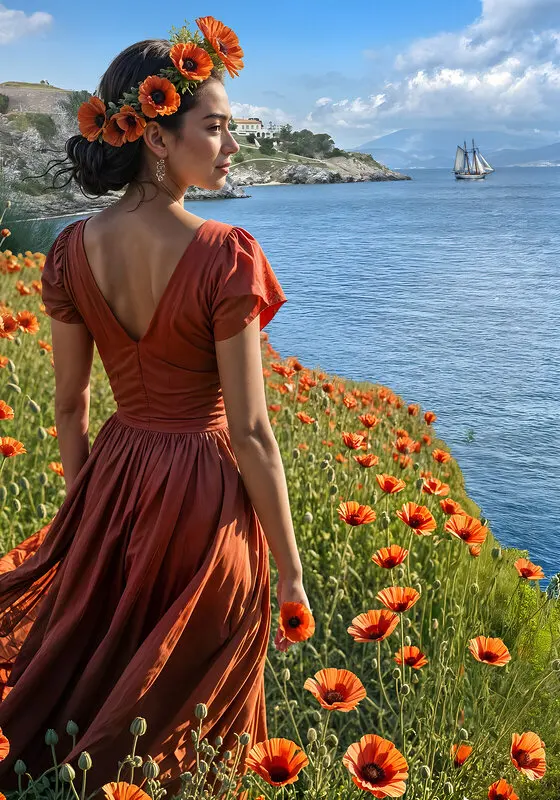
Frida at Poppy Bay, 2025
Digital
50 x 70 cm
Frida at Poppy Bay
On Hydra, near Mandraki, where sun-bleached hills slope gently toward the shimmering sea, a crimson tide has taken root—not in the water, but on land. The hillside bursts with blooming poppies, swaying in the breeze like a thousand tiny flames. And there, among them, stands Frida.
Seen from behind, crowned with poppies in her dark braided hair, she is dressed in a red summer dress that flutters wildly in the Aegean wind. The fabric echoes the flowers at her feet, the horizon before her. She turns her head just enough for us to glimpse her profile—a gaze steady, curious, and timeless.
This is not Mexico, nor is it a dream—though it may feel like both. Hydra has its kind of magic, a silence that hums beneath the waves and in the folds of sunlight. Here, at Poppy Bay, Frida has found something she rarely had: stillness without sorrow. The wind carries her memories out over the water; the flowers hold her story in bloom.
In this moment, everything breathes—art, sea, and soul—as if time has paused to let her be. Unravel the mystery behind the red flower, a symbol of life and death, beauty and pain. This tale, brimming with suspense, will keep you on the edge of your seat, hungry for more.
"Demeter’s Poppy
In fields where golden barley sways,
She walks with dust upon her gaze.
A mother lost, a world turned grey—
The earth held its breath that fateful day.
But in her hand, a bloom so red,
It burned where all the green had fled.
A poppy bold, yet soft and deep,
A flower born from death and sleep.
They say it grew where tears had dropped,
Where furrows cracked and harvests stopped.
The seed she pressed against her chest
Would soothe the soil, would give it rest.
When Persephone returned once more,
She scattered petals by the shore.
And poppies rose in vivid flame,
Each one a prayer, each one a name.
So when you see that crimson flare
In sunlit fields or goddess hair—
Remember, grief can bloom again,
And even loss will soften rain.
And Frida comes in scarlet flame,
A mortal echo, yet untamed.
She wades through seas of poppy red,
Where every petal speaks the dead.
Her dress, the wind, her gaze, the storm—
A woman's grief in vibrant form.
She walks where Demeter once wept low—
Now fire and bloom together grow.“
Malmö, April 2025
In Praise of the Poppy – A Most Unruly Bloom
Few flowers balance beauty, symbolism, danger, and delight quite like the poppy. Fragile as tissue and as fleeting as a sigh, its silken petals flare in shades of red, orange, pink, and even somber black, fluttering atop wiry stems with a mix of elegance and defiance. The poppy does not beg for attention—it claims it with colour and myth alike.
Botanically, the poppy belongs to the family Papaveraceae and, within this family, to the genus Papaver. Its most iconic representative, the familiar red poppy (Papaver rhoeas), carpets meadows and fields across Europe each summer- a spectacle that has inspired poets and pacifists alike. Another relative, Papaver somniferum, the opium poppy, has fueled both medicine and mayhem for centuries. From healing morphine to addictive heroin, its latex sap is a paradox of relief and ruin.
An Ancient Bloom
Poppies have a long and complex history. In ancient Sumeria, over 6,000 years ago, the opium poppy was called "the joy plant. " The Egyptians used it to relieve pain. Greeks and Romans associated it with both Hypnos and Morpheus, gods of sleep and dreams. Poppies adorned tombs, symbolising eternal rest while also appearing in love poems and hair garlands. What other flower can embody war, peace, sleep, and seduction in a single bouquet?
In art, poppies have been a recurring motif, from John Singer Sargent's lush watercolours to Georgia O'Keeffe's provocatively blooming petals. And who can forget Monet's poppy fields, with scarlet smudges dancing under Impressionist skies?
The Ghost of Flanders
Perhaps the most enduring association comes from the battlefields of World War I. After the horrors of trench warfare and artillery, it was the poppy that returned first, sprouting defiantly in churned-up soil. Lieutenant Colonel John McCrae immortalised this image in his 1915 poem In Flanders Fields. The red poppy became a symbol of remembrance, still worn every November.
Anecdotally, a British soldier once remarked that poppies bloomed redder in soil enriched with iron—and nothing added iron like the detritus of war. Whether botany supports this or not, the legend persists.
The Sleepy Pharaoh
When archaeologists opened the tomb of Ramses II, they discovered traces of opium poppies alongside the burial shrouds. One Egyptologist, not particularly fond of fieldwork, once joked, "Even in the afterlife, Ramses needed his sleep aid."
The Poppy Dress Debacle
In 1935, a society lady in London commissioned a gown made entirely of artificial red poppies for a charity ball in London. All went well until a few guests with hay fever suffered fits of sneezing at the mere sight of the floral explosion. A new fragrance had been added to the petals, leading the ball to be renamed the "Pollen Gala."
Frida and the Crimson Crown
Frida Kahlo often adorned her hair with poppies, weaving them into floral crowns that became an essential part of her visual identity. Once, while visiting New York, a child mistook her for a queen and asked where her castle was. "My castle is in Coyoacán," she replied with a wink, "and the poppies guard the gates."
A Flower With No Apologies
Whether growing wild along highways or cultivated in regal gardens, the poppy remains unpredictable. It can soothe pain or spark it. It can honour the dead or scandalise a dinner party. And in its brief bloom lies its most significant power: the reminder that beauty, like memory, cannot be contained.
But no account of the poppy is complete without acknowledging its darker petals—the legacy of the opium poppy,* Papaver somniferum*, whose sap has shaped empires, destroyed lives, and bled into nearly every century of recorded history. What began as a medicinal gift—the power to dull pain—soon spiralled into dependence, corruption, and war.
The opium poppy's reach is ancient. In ancient Thebes, it soothed children and wounded warriors alike. By the Renaissance, it was prized by apothecaries across Europe. However, it was in the 18th and 19th centuries that the flower's bitter price became globally apparent. The British Empire, hungry for trade and dominance, cultivated opium in India and flooded China with the narcotic. When Chinese officials attempted to halt the trade, Britain responded with military force—thus beginning the Opium Wars, which humiliated a nation, fractured a dynasty, and deepened Western colonial dominance in Asia. All in the name of a flower. Name of a flower.
The opium poppy’s latex has coursed through history like a venomous thread. In the 19th century, British traders turned addiction into imperial leverage, devastating millions of Chinese lives while profiting enormously. Later, the same opium pipelines were mirrored in French Indochina, where colonial authorities both policed and taxed poppy farming, blurring the lines between legality and exploitation. Even the United States, while banning opium in one breath, allowed pharmaceutical giants to refine it into morphine in the next.
Ancient Greeks were familiar with the poppy plant and its hypnotic properties. In the eighth century BCE, Hesiod referred to Mecone, a town near Corinth, famous for its extensive lands dedicated to cultivating the poppy. According to legend, Demeter first discovered the plant there. The Greeks considered the poppy a magical or poisonous plant that could be used in religious ceremonies. Hypnos (Sleep), Nyx (Night), and Thanatos (Death) were deities often depicted carrying poppies or wearing wreaths of poppies. The plant appeared in the statues of Apollo, Pluto, Asclepius, Aphrodite, and Kybele, while ears of corn were occasionally added to the bunch of poppies.
The poppy was associated with Demeter from an early period. Researchers have identified a Mycenaean deity holding poppies or wearing a crown adorned with poppy capsules as Demeter. However, the poppy variety most closely linked to the goddess was the opium poppy (Papaver somniferum), which the Roman poet Virgil referred to as the flower of Ceres. In one version of the myth, Demeter consumed poppies to fall asleep and forget the pain caused by the sudden loss of her daughter.
The connection between the plant and the goddess was manifold. First, the numerous seeds of the capsule symbolise fertility, Demeter’s greatest gift to humanity. The poppy was also cultivated as a cereal crop, reflecting its association with the goddess of grain and fertility. Finally, opium, a product of the plant, connects the poppy with sleep and death, another vital aspect of Demeter. The association was strong and widespread in the Greek world. Demeter is often depicted holding a wheat sheaf in one hand and poppy capsules in the other, while the poet Theocritus described a statue of Demeter “holding wheat stalks and poppies in either hand.”
As a symbol of Demeter, the poppy is present in Eleusis, but there is a catch. The flower has one or two tiers of broad petals, with eight or twelve petals in each tier. This refers to the opium poppy, but there is some confusion over the presence of two tiers of petals. Double poppies do not produce more or better opium than single poppies, and there is no evidence that the rites of Demeter were associated exclusively with either plant version. The solution may lie in the Homeric Hymn to Demeter. Persephone was in the process of admiring a “hundred-headed” flower when the earth parted, and Hades appeared. Most researchers identify this magical flower with the narcissus, the flower of the underworld and death. However, in Eleusis, the double opium poppy may have served a dual purpose. On one hand, it would evoke the association of Demeter with death and regeneration, while on the other hand, it would represent the wondrous flower that doomed Persephone.
The curse did not end with the empire. In the 20th and 21st centuries, its descendants—morphine, heroin, and synthetic opioids—fueled an ever-expanding web of addiction and despair. The Golden Triangle, a lush region where Myanmar, Thailand, and Laos meet, became notorious as a hub of illicit opium production. For decades, entire villages survived by harvesting poppies under the control of armed militias and drug lords. Warlords like Khun Sa used profits from heroin exports to fund armies, resist governments, and amass fortunes—while addiction spread like wildfire from Bangkok to Berlin. Some allege that the CIA disregarded opium shipments during the Cold War in exchange for cooperation against communism.
In Afghanistan, the world's leading producer of illicit opium for much of the 21st century, the poppy fields became both a lifeline and a curse. For impoverished farmers, poppies provided a more reliable source of income than wheat. However, the trade attracted warlords, insurgents, and foreign intervention. At times, the Taliban banned opium; at other times, they taxed it. Western coalitions attempted to eradicate the fields, only to find themselves in a bind: destroy the crop, and destroy a community's only income. Billions were spent on eradication campaigns with little lasting effect. One NATO officer famously remarked, “We 're losing the war to a flower.”
Meanwhile, Mexico and Colombia have become battlegrounds not just for cocaine but for heroin—often laced with fentanyl, a synthetic opioid that is exponentially more potent. Entire regions in Mexico are under cartel control, where poppy cultivation is guarded with rifles, and lives are deemed expendable. In Colombia, once synonymous with coca, opium poppies began to appear in the shadow of decades-long conflict, blurring the lines between insurgency, narcotrafficking, and survival. In places like Cauca and Nariño, children are recruited to tend the fields or run the supply routes, while entire towns are drawn into the deadly logistics of export.
And then there are the victims: in small-town America, where prescription opioids paved the way for heroin epidemics; in cities across Europe where synthetic opioids overwhelm emergency services; in refugee camps, prison wards, and alleyways, where the bitter harvest of the poppy delivers oblivion with a needle. Pharmaceutical giants like Purdue Pharma have faced billions in lawsuits for downplaying the addictive risks of OxyContin—essentially packaging the ancient curse into capsules and marketing it as relief. In West Virginia alone, more pills were distributed than there were residents. The crisis continues to evolve, with new synthetics emerging faster than policy can respond.
Even the language betrays a double edge: “pain management” becomes addiction; “harm reduction” becomes a desperate scramble. Artists, poets, and musicians have chronicled the bloom's pull—Coleridge's opium dreams, Burroughs's needles, Lou Reed's lullabies. The poppy inspires, intoxicates, and inevitably takes its toll.
And yet, the bloom itself—pink, white, or violet—remains achingly beautiful, its innocence belied by its legacy.
So the next time you see a poppy—bright, bold, blowing in the breeze—remember: this is no ordinary flower. This is a bloom with stories in its petals and rebellion in its roots. Its roots.

Jörgen Thornberg
Malmö
Lite om bilder och mig. Translation in English at the end.
Jag är en nyfiken person som ser allt i bilder, även det jag fäster i ord, gärna tillsammans för bakom alla mina bilder finns en berättelse. Till vissa bilder hör en kortare eller längre novell som följer med bilden.
Bilder berättar historier. Jag omges av naturlig skönhet, intressanta människor och historia var jag än går. Jag använder min kamera för att dokumentera världen och blanda det jag ser med vad jag känner för att fånga den dolda magin.
Mina bilder berättar mina historier. Genom mina bilder, tryck och berättelser. Jag bjuder in dig att ta del av dessa berättelser, in i ditt liv och hem och dela min mycket personliga syn på vår värld. Mer än vad ögat ser. Jag tänker i bilder, drömmer och skriver och pratar om dem; följaktligen måste jag också skapa bilder. De blir vad jag ser, inte nödvändigtvis begränsade till verkligheten. Det finns en bild runt varje hörn. Jag hoppas att du kommer att se vad jag såg och gilla det.
Jag är också en skrivande person och till många bilder hör en kortare eller längre essay. Den följer med tavlan, tryckt på fint papper och med en personlig hälsning från mig.
Flertalet bilder startar sin resa i min kamera. Enkelt förklarat beskriver jag bilden jag ser i mitt inre, upplevd eller fantiserad. Bilden uppstår inom mig redan innan jag fått okularet till ögat. På bråkdelen av ett ögonblick ser jag vad jag vill ha och vad som kan göras med bilden. Här skall jag stoppa in en giraff, stålmannen, Titanic eller vad det är min fantasi finner ut. Ännu märkligare är att jag kommer ihåg minnesbilden långt efteråt när det blir tid att skapa verket. Om jag lyckas eller inte, är upp till betraktaren, oftast präglat av en stråk av svart humor – meningen är att man skall bli underhållen. Mina bilder blir ofta en snackis där de hänger.
Jag föredrar bilder som förmedlar ett budskap i flera lager. Vid första anblicken fylld av feel-good, en vacker utsikt, fint väder, solen skiner, blommor på ängen eller vattnet som ligger förrädiskt spegelblankt. I en sådan bild kan jag gömma min egentliga berättelse, mitt förakt för förtryckare och våldsverkare, rasister och fördomsfulla människor - ett gärna återkommande motiv mer eller mindre dolt i det vackra motivet. Jag försöker förena dem i ett gemensamt narrativ.
Bild och formgivning har löpt som en röd tråd genom livet. Fotokonst känns som en värdig final som jag gärna delar med mig.
Min genre är vid som framgår av mina bilder, temat en blandning av pop- och gatukonst i kollage som kan bestå av hundratals lager. Vissa bilder kan ta veckor, andra någon dag innan det är dags att överlämna resultatet till printverkstaden. Fine Art Prints är digitala fotocollage. I dessa kollage sker rivandet, klippandet, pusslandet, målandet, ritandet och sprayningen digitalt. Det jag monterar in kan vara hundratals år gamla bilder som jag omsorgsfullt frilägger så att de ser ut att vara en del av tavlan men också bilder skapade av mig själv efter min egen fantasi. Därefter besöks printstudion och för vissa bilder numrera en limiterad upplaga (oftast 7 exemplar) och signera för hand. Vissa bilder kan köpas i olika format. Det är bara att fråga efter vilka. Gillar man en bild som är 70x100 men inte har plats på väggen, går den kanske att få i 50x70 cm istället. Frågan är fri.
Metoden Giclée eller Fine Art Print som det också kallas är det moderna sättet för framställning av grafisk konst. Villkoret för denna typ av utskrifter är att en högkvalitativ storformatskrivare används med åldersbeständigt färgpigment och konstnärspapper eller i förekommande fall på duk. Pappret som används möter de krav på livslängd som ställs av museer och gallerier. Normalt säljer jag mina bilder oinramade så att den nya ägaren själv kan bestämma hur de skall se ut, med eller utan passepartout färg på ram, med eller utan glas etc..
Under många år ställde jag bara ut på nätet, i valda grupper och på min egen Facebooksida - https://www.facebook.com/jorgen.thornberg.9
Jag finns också på en egen hemsida som tyvärr inte alltid är uppdaterad – https://www.jth.life/ Där kan du också läsa en del av de berättelser som följer med bilden.
UTSTÄLLNINGAR
Luftkastellet, oktober 2022
Konst i Lund, november 2022
Luftkastellet, mars 2023
Engleson Galleri Caroli, april 2023
Hydra, Greece June 2023
Engleson Galleri Caroli, oktober 2023
Toppen, Höllviken december 2023
Luftkastellet, mars 2024
Torups Galleri, mars 2024
Venice, May 2024
Luftkastellet, oktober 2024
Konst i Advent, December 2024
Galleri Engleson, Caroli December 2024
Jäger & Jansson Galleri, april 2025
A bit about pictures and me.
I'm a curious person who sees everything in pictures, even what I express in words, often combining them, for behind all my pictures lies a story. These narratives, some as short as a single image and others as long as a novel, are the heart and soul of my work.
Pictures tell stories. Wherever I go, I'm surrounded by natural beauty, exciting people, and history. I use my camera to document the world and blend what I see with what I feel to capture the hidden magic.
My images tell my stories. Through my pictures, prints, and narratives, I invite you to partake in these stories in your life and home and share my deeply personal perspective of our world. More than meets the eye. I think in pictures, dream, write, and talk about them; consequently, I must create images too. They become what I see, not necessarily confined to reality. There's a picture around every corner. I hope you'll see what I saw and enjoy it.
I'm also a writer, and many images come with a shorter or longer essay. It accompanies the painting, printed on fine paper with my personal greeting.
Many pictures start their journey on my camera. Simply put, I describe the image I see in my mind, experienced or imagined. The image arises within me even before I bring the eyepiece to my eye. In a fraction of a moment, I see what I want and what can be done with the picture. Here, I'll insert a giraffe, Superman, the Titanic, or whatever my imagination conjures up. Even stranger is that I remember the mental image long after it's time to create the work. Whether I succeed is up to the observer, often imbued with a streak of black humour – the aim is to entertain. My pictures usually become a talking point wherever they hang.
I prefer pictures that convey a message in multiple layers. At first glance, they're filled with feel-good vibes, a beautiful view, lovely weather, the sun shining, flowers in the meadow, or the water lying deceptively calm. But beneath this surface beauty, I often conceal a deeper story, a narrative that challenges societal norms or explores the human condition. I invite you to delve into these hidden narratives and discover the layers of meaning within my work.
Picture and design have been a thread running through my life. Photographic art feels like a fitting finale, and I'm happy to share it.
My genre is varied, as seen in my pictures; the theme is a blend of pop and street art in collages that can consist of hundreds of layers. Some images can take weeks, others just a day before it's time to hand over the result to the print workshop. Fine Art Prints are digital photo collages. In these collages, tearing, cutting, puzzling, painting, drawing, and spraying happen digitally. What I insert can be images hundreds of years old that I carefully extract so they appear to be part of the painting, but also images created by myself, now also generated from my imagination. Next, visit the print studio and, for certain images, number a limited edition (usually 7 copies) and sign them by hand. Some images may be available in other formats. Just ask which ones. If you like an image that's 70x100 but doesn't have space on the wall, you might be able to get it in 50x70 cm instead. The question is open.
The Giclée method, or Fine Art Print as it's also called, is the modern way of producing graphic art. This method ensures the highest quality and longevity of the artwork, using a high-quality large-format printer with archival pigment inks and artist paper or, in some cases, canvas. The paper used meets the longevity requirements set by museums and galleries. I sell my pictures unframed, allowing the new owner to personalise their artwork, confident in the lasting value and quality of the piece.
For many years, I only exhibited online, in selected groups, and on my Facebook page - https://www.facebook.com/jorgen.thornberg.9. I also have my website, which unfortunately is not constantly updated - https://www.jth.life/. You can also read some of the stories accompanying the pictures there.
EXHIBITIONS
Luftkastellet, October 2022
Art in Lund, November 2022
Luftkastellet, March 2023
Engleson Gallery Caroli, April 2023
Hydra, Greece June 2023
Engleson Gallery Caroli, October 2023
Toppen, Höllviken December 2023
Luftkastellet, March 2024
Torup Gallery, March 2024
Venice, May 2024
UTSTÄLLNINGAR
Luftkastellet, oktober 2022
Konst i Lund, november 2022
Luftkastellet, mars 2023
Engleson Galleri Caroli, april 2023
Hydra, Greece June 2023
Engleson Galleri Caroli, oktober 2023
Toppen, Höllviken december 2023
Luftkastellet, mars 2024
Torups Galleri, mars 2024
Venice, May 2024
Luftkastellet, October 2024
Konst i Advent, December 2024
Galleri Engleson, Caroli December 2024
Jäger & Jansson Galleri, April 2025
Utbildning
Autodidakt
Medlem i konstnärsförening
Öppna Sinnen
Med i konstrunda
Konstrundan i Skåne
Utställningar
Luftkastellet, October 2022
Art in Lund, November 2022
Luftkastellet, March 2023
Engleson Gallery Caroli, April 2023
Hydra, Greece June 2023
Engleson Gallery Caroli, October 2023
Toppen, Höllviken December 2023
Luftkastellet, March 2024
Torup Gallery, March 2024
Venice, May 2024