Vi använder cookies för att ge dig bästa möjliga upplevelse. Välj vilka cookies du tillåter.
Läs mer i vår integritetspolicy
Jörgen Thornberg
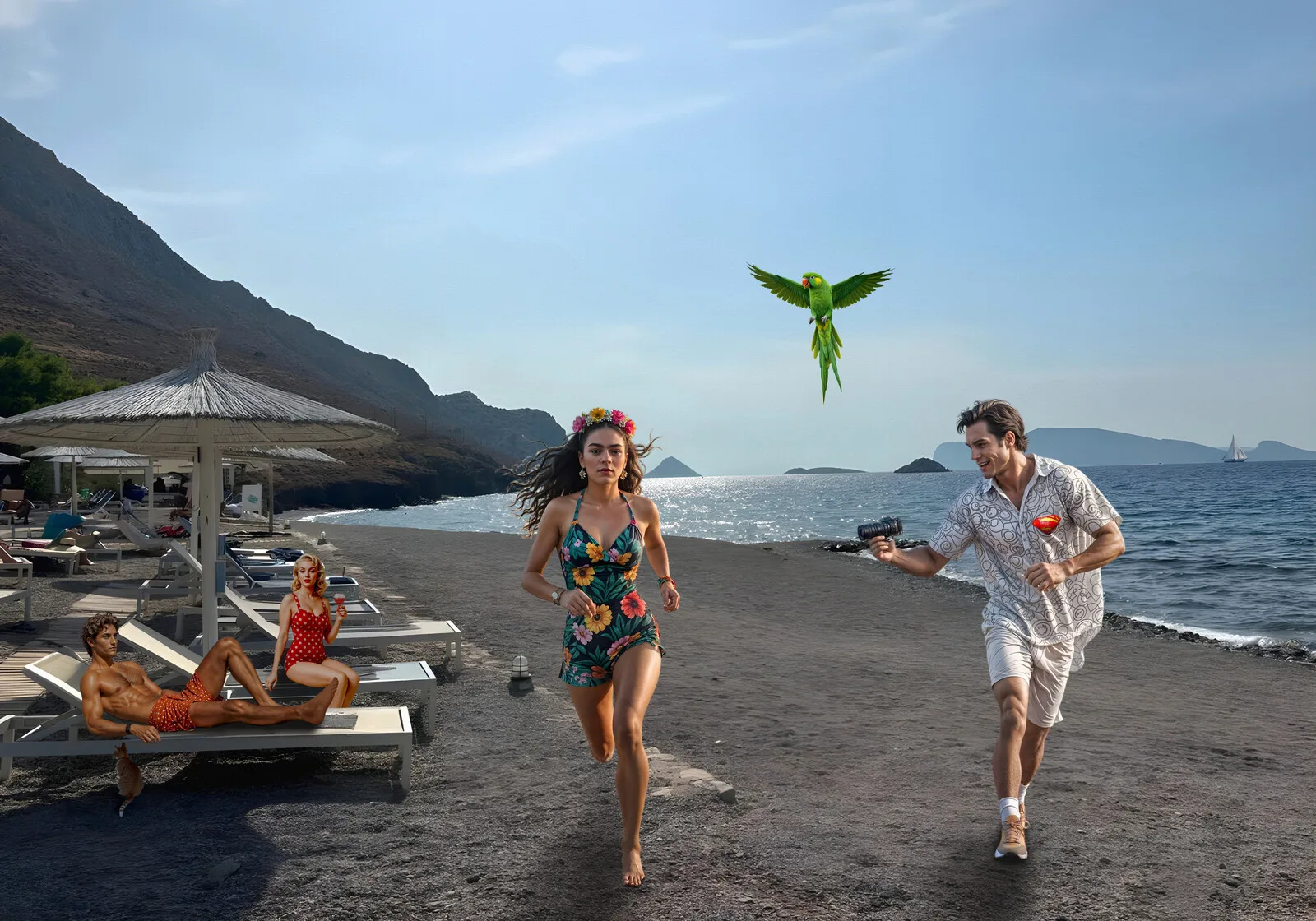
A late season afternoon at Plakes, 2025
Digital
50 x 70 cm
A late season afternoon at Plakes
The title encapsulates the essence of Frida's journey to Hydra with her deer, Granizo. It symbolises their graceful and determined stride, much like a stag's, as they embark on their mission. On Plakes Beach, it was almost an ordinary day, with people from all over the world basking in the sun and enjoying the warmth.
Hydra, the timeless island where history and myth intertwine, became an unexpected sanctuary for Frida and her four-legged companions. In a place where donkeys reign supreme as the primary mode of transport, the presence of a Mexican white-tailed deer and a Greek roe deer was a delightful surprise—yet Hydra Erato welcomed them with open arms. Granizo and Alizza, seasoned travellers across dimensions, were basking in the island sun, indulging in fresh salad leaves while the restless Frida roamed the ancient streets. However, their journey was more than an escape to a pet-friendly retreat. It was a mission—to honour lost souls, defy poachers, and uncover the secrets of taste that might one day render deer an unpalatable dish for human hunters. This mission, filled with purpose and determination, was what made their journey on Hydra so compelling.
Teleportation, loopholes in bureaucracy, and a little celestial assistance ensured a smooth arrival, yet shadows loomed in this idyllic setting. Past and present collided in the heart of Hydra, where ancient traditions clashed with modern threats, and Frida’s boundless curiosity led her to Vlychos, where time travellers slipped through wormholes, and to Kerkini, where the fight against ruthless poaching continued. Between vibrant gardens and clandestine culinary experiments, this was no ordinary holiday. This was Frida’s kind of journey—where art, nature, and defiance against poachers merged into a single brushstroke on the canvas of eternity.
Continue reading to discover the enchanting tale of Frida, Granizo, and their most unexpected adventures—where art, history, and botany converge in a story that spans centuries and continents. Every chapter of their journey, from their encounters with local flora to their defiance against poachers, is a testament to their resilience and the power of their mission.
‘‘A Day at Plakes
The sun hung low on a sky so wide,
As waves kissed sand with timeless pride.
Frida spun barefoot along the shore,
Her laughter loud, her soul restored.
Marilyn lounged in lemon and rose,
A glass of rosé, toes in repose.
She watched the sea with half-closed eyes,
And whispered secrets to dragonflies.
Adonis glowed, divine and tanned,
With olive skin and golden strands.
He fed his tabby cat a fishy prize,
And winked at gulls circling the skies.
Clark in linen, calm and neat,
Scribbled sonnets in the heat.
He sketched their joy with steady hand,
Then chased a frisbee across the sand.
Granizo wandered, noble and light,
His antlers gleamed, eyes brown and bright.
He danced with shadows, nibbled a vine,
And bowed to donkeys in silent sign.
They spoke of stars, of time and fate,
Of ancient myths and customs late.
Of deer with passports, gods who tan,
And how to outwit the modern man.
They shared figs, dreams, and sunscreen too,
And all the sea’s eternal hue.
Till twilight’s gold began to fade,
And back to Kiafa the path they made.
A day like honey, breeze, and wine—
A perfect thread in eternal design.
And though they’d part, as mortals must,
They’d left their footprints in Hydra’s dust.”
Malmö, April 2025
A late season afternoon at Plakes
It was a late season afternoon at Plakes, a day that seemed to be made for the extraordinary quartet of Frida Kahlo, Marilyn Monroe, Adonis, and Clark Kent. These four were not your average beachgoers. They were Time-travellers, having arrived through a discreet wormhole that opens between Kamini and Plakes.
On Plakes Beach, it was no ordinary day, when people from all over the world were basking in the sun and enjoying the warmth. This time of year, the sun may still shine, but according to the locals, the water is no longer suitable for swimming. Such things hardly bother those who live on a star in eternity—whether it’s thousands of degrees or just eighteen in the sea, it makes no real difference.
Frida raced alongside Clark, who snapped photos of her mid-run. Marilyn sat on her sun bench, a glass of rosé in hand, while Apollo lounged beside her. His cat, Pericles, a frequent travel companion, was enjoying the shade at his master’s feet. For a red tabby, arriving on Hydra is paradise—there are no rats on their home star, so half the day is spent chasing them here on the island. Not to eat, of course—there are far tastier options on the taverna menus. The companionship among them was palpable, adding a warm touch to the idyllic scene.
Hydra Erato, or Four Seasons, is a fantastic pet-friendly place; for instance, cats of any size are allowed at no extra charge. Dogs are also welcome, and while deer are not explicitly mentioned, they are implicitly permitted. Therefore, Frida had brought along Granizo, her favourite deer, who had wandered off up the mountain slope to reunite with his old friends among the donkeys.
The afternoon sun cast long, golden shadows over Plakes Beach, setting the stage for a whimsical tale. After her jog, Frida reclined under a striped parasol, sipping her chilled lemonade slowly. Marilyn adjusted her cat-eye sunglasses while Adonis—sun-kissed and glowing as ever—lazily stretched on his towel. Clark sat cross-legged in the sand, sketchbook in hand, occasionally glancing up from his glasses.
“So,” Frida said, brushing sand from her ankle, “you asked how I managed to get Granizo into Greece?” The mention of Granizo brought a warm smile to her face, a testament to the deep bond they shared.
Clark looked up, intrigued. “With a roe deer through customs?”
“Not through customs,” Frida said with a grin. “We time-travelled, remember? But even star children need paperwork.”
She began:
"Pets entering Greece must have a microchip," she said, her words carrying a hint of the extraordinary. “Naturally, I had this arranged by a particularly kind-hearted veterinarian who also handled the anti-rabies certificate.”
“Efficient,” muttered Adonis approvingly.
“Additionally,” Frida continued, “four-legged travellers from within Europe require an EU Pet Passport.”
"I thought passports were only for people," Marilyn mused.
“Not anymore,” Frida said. “And just like mine, their documents were handled by those friends from above—the ones who also print any currency you like. Undetectable. It helps to have eternity’s finest forgers on your side.”
“Are you saying your deer has better paperwork than most tourists?” Clark asked.
“Impeccable,” Frida replied. “Though, of course, we didn’t exactly use it. Granizo and I never rely on public transport—we teleport. Legs are for shorter distances. But it's quite a sight to see a deer with better paperwork than most tourists, isn't it?”
“That’s not laziness,” Adonis nodded. “That’s style.”
“Besides,” Frida smirked, “showing up with a Mexican deer at a check-in desk? Instant trouble.”
Marilyn giggled. “I’d love to see the face of the ferry clerk.”
“Everyone arrives in Hydra by sea,” Frida said. “Except Time-travellers like us. We landed through the wormhole just outside Vlychos. Only a few hundred metres from the hotel.”
“Did the hotel staff panic?” Clark asked.
Frida laughed. “They were speechless. Not just because of Granizo but also because of Alizza.”
“Who’s Alizza?” Marilyn asked, turning fully toward Frida.
“A small roe deer who once lived in Kerkini National Park in northern Greece. A poacher killed her. Her species is critically endangered.”
“That’s awful,” Marilyn whispered.
“Poaching laws are too soft,” Frida said firmly. “And yet it happens near one of Greece’s most important National Parks. Even birdwatchers aren’t safe.”
“Disgraceful,” Clark muttered.
“We made a quick detour to Kerkini on our way to Hydra. It took seconds. Then we arrived back at the hotel, which had the best view of the strait between Hydra and the Peloponnese. I was bursting with energy, but Granizo and Alizza preferred to lounge in deck chairs, each with their bowl of fresh salad leaves.”
“That’s... unexpectedly civilised,” Adonis said.
Since I had all the paperwork and nothing indicated that deer were banned, there was no issue. And Granizo is smaller than the Great Dane that stayed before. That one chewed up a chair.
“Oh no,” Marilyn said.
“I assured them: deer don’t eat furniture, just flowers and salad.”
“Hydra’s full of history,” Clark added. “You must have loved it.”
“I did,” said Frida. “We explored Votsi Square, a garden once filled with vibrant flowers. After a long summer, many had faded.”
“Not surprised, with two salad lovers in the crew,” Adonis teased. "But I bet the catamaran crew didn't expect to have a deer on board."
The park was a dream for the deer. And Time-travellers like us don’t need ferry tickets; we can appear anywhere. I suspected the catamaran crew would object to Granizo.
“Of course,” said Marilyn, “children need guardians, but deer?”
We strolled through Hydra Town’s oldest streets, which were floral and bright in the summer sun. I leapt, and Granizo followed. On Donkey Shit Lane, women competed for the prettiest potted flowers.
“I love that street!” Marilyn exclaimed.
“It was no coincidence we chose it,” Frida said. “It was named for the deer that once roamed there. They still do. The white-tailed deer felt at home beneath the stars.”
“Your love for animals…” Marilyn began.
“Is deep,” Frida nodded. “Casa Azul was full of them—monkeys, parrots, dogs, an eagle. Granizo was among them.”
“You had a jungle at home?” Clark asked.
“A garden, lush and full of life. Granizo, shy but social, stayed near me, especially when I was too ill to move.”
“They comforted you,” Marilyn said softly.
“They were my soul,” Frida answered. “When people betrayed me, animals never did. Granizo was special. In "The Wounded Deer," I portrayed myself as him, pierced by arrows. That was how I felt—hunted, pained, exposed.”
“Your art makes that pain beautiful,” Clark said.
“Thank you.”
“And Diego?” Adonis asked.
He liked animals but didn’t understand them as I did. He enjoyed venison, which I could never bring myself to touch.
“A bit awkward,” Marilyn remarked.
“There’s a photo of me in bed, surrounded by animals—my dog and Granizo, still a fawn.”
“I’ve seen it,” said Clark. “He looks so peaceful.”
“He was an orphan. I raised him myself.”
“They mirrored your soul,” Marilyn said.
“They did. But Granizo also had a taste for hydrangeas and hollyhocks.”
“Who doesn’t?” Adonis said with a grin.
“Deer need variety—twigs, herbs, berries. They even overran a cemetery near Casa Azul. Every morning, the staff had to replant flowers.”
“What did the priest do?” Clark asked.
“He prayed, but mostly they tried deterrents: aluminum foil, CDs, sheep’s wool, garlic water.”
“Did it work?”
“For a while. Some deer liked garlic. Blood meal helped. Cayenne was expensive. But Diego’s cigar butts? That solved it.”
“Seriously?” Marilyn laughed.
“They mailed them weekly. The priest was promised heaven for it—even though Diego was a communist.”
“Ironic,” Clark said.
“Diego never painted church murals, except once—La Creación, in 1922—for a government commission.”
“What was it like?” asked Adonis.
“Monumental. Spanning over a hundred square meters, the space features mythological and religious motifs, gold leaf, and figures that stand twelve feet tall. He struggled with it for years.”
“But he defended it?”
“Oh yes,” Frida nodded. “He said it was about humanity’s connection to nature. He made the figures Mexican, vibrant, strong.”
“The start of his legacy,” Clark said.
“Yes. But let me end with a story. Granizo became very unpopular within the local vegan community.
“Why?” Marilyn asked.
“He devoured their buffet, especially the asparagus.”
“Oh dear,” she laughed.
“Had they not been vegans, he might have ended up on a plate. Redcurrant jelly, pan-fried potatoes…”
“Mushroom sauce,” Clark added.
“Exactly.”
“But he died naturally. He lives on my star now. He followed me to Greece for Alizza. We hoped to deter poachers. We experimented with garlic-flavored plants, hoping to reverse the idea—make deer taste terrible to humans.”
“Brilliant,” Adonis said.
We tried Swedish Surströmming—it was too smelly. Umeboshi—too sour. Durian, grapefruit, bitter melon... nothing worked.”
“Licorice?” Clark asked.
“Tasted like medicine. Fennel, star anise—same. Coriander? Soap. The deer agreed.”
Adonis raised an eyebrow. “Wait—what exactly is Surströmming?”
Frida chuckled. “It’s a Swedish specialty. Fermented herring. They salt it lightly and let it rot—well, ferment—in tins until the smell could scare away the gods.”
“It’s not even possible to be nearby when someone opens the can,” she added. “It’s like... opening a small portal to the underworld.”
Clark nodded solemnly. “It’s true. That northern Swedish delicacy is, along with kryptonite, the only thing I truly can’t stand.”
“Fortunately,” he added with a grin, “neither can my enemies. So it all works out.”
“How about Greek Stamnagathi?” Marilyn asked.
“Too bitter. Even Cretan deer passed.”
“Stinky tofu?”
“Rejected. Greek deer and their Chinese cousins declined.”
“So you were back at square one?”
“Yes,” Frida said, lifting her glass. “But I’ll be back with new ideas. “There are billions of stars in the universe, and I don’t give up,” she said, touching her glass. “But I’ll be back with new ideas. There are billions of stars in the universe. And I don’t give up.”
As the shadows stretched long across the stones and the sky transformed from gold to lavender, they began packing up. Marilyn shook the sand from her sarong and slipped into her woven sandals. Clark, ever precise, rolled up the towels with near-military neatness while Adonis—eternally unbothered—lifted a yawning Pericles into the crook of his sun-bronzed arm. Granizo had returned from his hillside reunion with the donkeys and was now nosing lazily at a thistle bush, clearly disinterested in leaving.
Frida fastened her sunhat with a pin and glanced back one last time at the sea. “Come on,” she said. “Time to head up before the tavernas run out of baked feta.”
They began the winding ascent to Kiafa, where they were staying in my stone house perched high above Hydra town, overlooking the rooftops, the harbor, and the pelicans drifting like white commas across the evening sky.
“I hope they still have moussaka left,” said Clark, “with béchamel like last night. I could fly for that alone.”
“I want pastitsio,” Frida added, “the kind with extra cinnamon in the meat sauce. And those lemon potatoes. Crispy on the outside, soft on the inside.”
“Oven-baked lamb with oregano,” said Adonis dreamily. “And maybe stifado—beef with shallots. It’s practically holy.”
“I wouldn’t mind stuffed peppers and tomatoes again,” Marilyn chimed in. “Or imam bayildi—the eggplant baked with garlic and onion. Vegetarian, but sinful.”
Frida nodded. “And fava, of course. Always fava. With caramelised onions and a little olive oil from the island.”
“And kolokithokeftedes!” added Clark, surprising everyone with his pronunciation. “The zucchini fritters. I could eat an entire plate.”
Adonis gave a regal shrug. “We’ll need spanakopita. And bouyiourdi. And saganaki. And maybe just... all the cheese.”
“And the wine?” Marilyn asked, arching an eyebrow.
“Oh, white for the start,” said Frida. “Assyrtiko, dry and mineral, from Santorini.”
“Then Xinomavro with the meat,” Clark added. “Robust. Heroic.”
“Don’t forget Retsina,” said Adonis. “It tastes like pine and rebellion.”
“And for dessert?” Marilyn asked as they reached the gate of the house.
“Spoon sweets,” Frida said. “And baklava. And halva. And anything soaked in honey.”
“Plus a bottle of Vinsanto,” Adonis smiled. “For the gods. And the mortals.”
The sky was indigo now, and stars had bloomed like jasmine across the heavens. Granizo settled beneath a fig tree in the yard, with Pericles curled beside him. The house welcomed them with its open shutters and the scent of thyme from the hills beyond. Laughter followed them inside, and soon, the only sound was the clinking of glasses and the soft hum of cicadas, singing their ancient song into the Hydra night.
Jörgen Thornberg
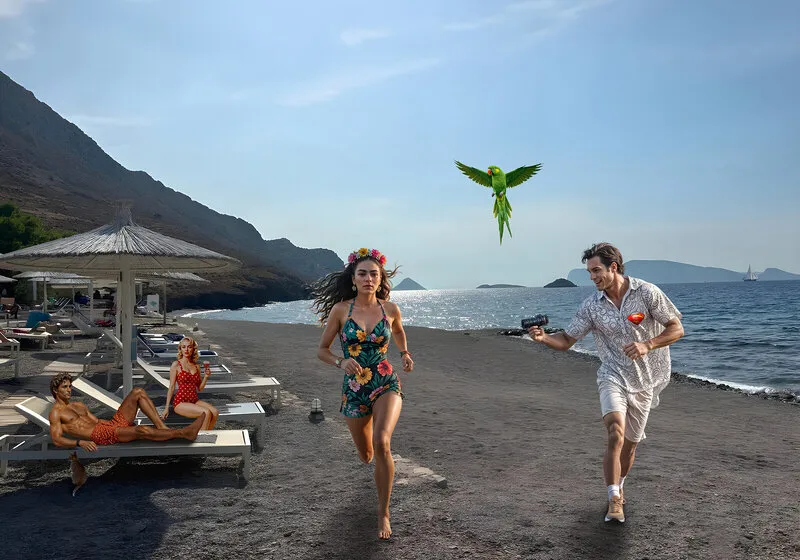
A late season afternoon at Plakes, 2025
Digital
50 x 70 cm
A late season afternoon at Plakes
The title encapsulates the essence of Frida's journey to Hydra with her deer, Granizo. It symbolises their graceful and determined stride, much like a stag's, as they embark on their mission. On Plakes Beach, it was almost an ordinary day, with people from all over the world basking in the sun and enjoying the warmth.
Hydra, the timeless island where history and myth intertwine, became an unexpected sanctuary for Frida and her four-legged companions. In a place where donkeys reign supreme as the primary mode of transport, the presence of a Mexican white-tailed deer and a Greek roe deer was a delightful surprise—yet Hydra Erato welcomed them with open arms. Granizo and Alizza, seasoned travellers across dimensions, were basking in the island sun, indulging in fresh salad leaves while the restless Frida roamed the ancient streets. However, their journey was more than an escape to a pet-friendly retreat. It was a mission—to honour lost souls, defy poachers, and uncover the secrets of taste that might one day render deer an unpalatable dish for human hunters. This mission, filled with purpose and determination, was what made their journey on Hydra so compelling.
Teleportation, loopholes in bureaucracy, and a little celestial assistance ensured a smooth arrival, yet shadows loomed in this idyllic setting. Past and present collided in the heart of Hydra, where ancient traditions clashed with modern threats, and Frida’s boundless curiosity led her to Vlychos, where time travellers slipped through wormholes, and to Kerkini, where the fight against ruthless poaching continued. Between vibrant gardens and clandestine culinary experiments, this was no ordinary holiday. This was Frida’s kind of journey—where art, nature, and defiance against poachers merged into a single brushstroke on the canvas of eternity.
Continue reading to discover the enchanting tale of Frida, Granizo, and their most unexpected adventures—where art, history, and botany converge in a story that spans centuries and continents. Every chapter of their journey, from their encounters with local flora to their defiance against poachers, is a testament to their resilience and the power of their mission.
‘‘A Day at Plakes
The sun hung low on a sky so wide,
As waves kissed sand with timeless pride.
Frida spun barefoot along the shore,
Her laughter loud, her soul restored.
Marilyn lounged in lemon and rose,
A glass of rosé, toes in repose.
She watched the sea with half-closed eyes,
And whispered secrets to dragonflies.
Adonis glowed, divine and tanned,
With olive skin and golden strands.
He fed his tabby cat a fishy prize,
And winked at gulls circling the skies.
Clark in linen, calm and neat,
Scribbled sonnets in the heat.
He sketched their joy with steady hand,
Then chased a frisbee across the sand.
Granizo wandered, noble and light,
His antlers gleamed, eyes brown and bright.
He danced with shadows, nibbled a vine,
And bowed to donkeys in silent sign.
They spoke of stars, of time and fate,
Of ancient myths and customs late.
Of deer with passports, gods who tan,
And how to outwit the modern man.
They shared figs, dreams, and sunscreen too,
And all the sea’s eternal hue.
Till twilight’s gold began to fade,
And back to Kiafa the path they made.
A day like honey, breeze, and wine—
A perfect thread in eternal design.
And though they’d part, as mortals must,
They’d left their footprints in Hydra’s dust.”
Malmö, April 2025
A late season afternoon at Plakes
It was a late season afternoon at Plakes, a day that seemed to be made for the extraordinary quartet of Frida Kahlo, Marilyn Monroe, Adonis, and Clark Kent. These four were not your average beachgoers. They were Time-travellers, having arrived through a discreet wormhole that opens between Kamini and Plakes.
On Plakes Beach, it was no ordinary day, when people from all over the world were basking in the sun and enjoying the warmth. This time of year, the sun may still shine, but according to the locals, the water is no longer suitable for swimming. Such things hardly bother those who live on a star in eternity—whether it’s thousands of degrees or just eighteen in the sea, it makes no real difference.
Frida raced alongside Clark, who snapped photos of her mid-run. Marilyn sat on her sun bench, a glass of rosé in hand, while Apollo lounged beside her. His cat, Pericles, a frequent travel companion, was enjoying the shade at his master’s feet. For a red tabby, arriving on Hydra is paradise—there are no rats on their home star, so half the day is spent chasing them here on the island. Not to eat, of course—there are far tastier options on the taverna menus. The companionship among them was palpable, adding a warm touch to the idyllic scene.
Hydra Erato, or Four Seasons, is a fantastic pet-friendly place; for instance, cats of any size are allowed at no extra charge. Dogs are also welcome, and while deer are not explicitly mentioned, they are implicitly permitted. Therefore, Frida had brought along Granizo, her favourite deer, who had wandered off up the mountain slope to reunite with his old friends among the donkeys.
The afternoon sun cast long, golden shadows over Plakes Beach, setting the stage for a whimsical tale. After her jog, Frida reclined under a striped parasol, sipping her chilled lemonade slowly. Marilyn adjusted her cat-eye sunglasses while Adonis—sun-kissed and glowing as ever—lazily stretched on his towel. Clark sat cross-legged in the sand, sketchbook in hand, occasionally glancing up from his glasses.
“So,” Frida said, brushing sand from her ankle, “you asked how I managed to get Granizo into Greece?” The mention of Granizo brought a warm smile to her face, a testament to the deep bond they shared.
Clark looked up, intrigued. “With a roe deer through customs?”
“Not through customs,” Frida said with a grin. “We time-travelled, remember? But even star children need paperwork.”
She began:
"Pets entering Greece must have a microchip," she said, her words carrying a hint of the extraordinary. “Naturally, I had this arranged by a particularly kind-hearted veterinarian who also handled the anti-rabies certificate.”
“Efficient,” muttered Adonis approvingly.
“Additionally,” Frida continued, “four-legged travellers from within Europe require an EU Pet Passport.”
"I thought passports were only for people," Marilyn mused.
“Not anymore,” Frida said. “And just like mine, their documents were handled by those friends from above—the ones who also print any currency you like. Undetectable. It helps to have eternity’s finest forgers on your side.”
“Are you saying your deer has better paperwork than most tourists?” Clark asked.
“Impeccable,” Frida replied. “Though, of course, we didn’t exactly use it. Granizo and I never rely on public transport—we teleport. Legs are for shorter distances. But it's quite a sight to see a deer with better paperwork than most tourists, isn't it?”
“That’s not laziness,” Adonis nodded. “That’s style.”
“Besides,” Frida smirked, “showing up with a Mexican deer at a check-in desk? Instant trouble.”
Marilyn giggled. “I’d love to see the face of the ferry clerk.”
“Everyone arrives in Hydra by sea,” Frida said. “Except Time-travellers like us. We landed through the wormhole just outside Vlychos. Only a few hundred metres from the hotel.”
“Did the hotel staff panic?” Clark asked.
Frida laughed. “They were speechless. Not just because of Granizo but also because of Alizza.”
“Who’s Alizza?” Marilyn asked, turning fully toward Frida.
“A small roe deer who once lived in Kerkini National Park in northern Greece. A poacher killed her. Her species is critically endangered.”
“That’s awful,” Marilyn whispered.
“Poaching laws are too soft,” Frida said firmly. “And yet it happens near one of Greece’s most important National Parks. Even birdwatchers aren’t safe.”
“Disgraceful,” Clark muttered.
“We made a quick detour to Kerkini on our way to Hydra. It took seconds. Then we arrived back at the hotel, which had the best view of the strait between Hydra and the Peloponnese. I was bursting with energy, but Granizo and Alizza preferred to lounge in deck chairs, each with their bowl of fresh salad leaves.”
“That’s... unexpectedly civilised,” Adonis said.
Since I had all the paperwork and nothing indicated that deer were banned, there was no issue. And Granizo is smaller than the Great Dane that stayed before. That one chewed up a chair.
“Oh no,” Marilyn said.
“I assured them: deer don’t eat furniture, just flowers and salad.”
“Hydra’s full of history,” Clark added. “You must have loved it.”
“I did,” said Frida. “We explored Votsi Square, a garden once filled with vibrant flowers. After a long summer, many had faded.”
“Not surprised, with two salad lovers in the crew,” Adonis teased. "But I bet the catamaran crew didn't expect to have a deer on board."
The park was a dream for the deer. And Time-travellers like us don’t need ferry tickets; we can appear anywhere. I suspected the catamaran crew would object to Granizo.
“Of course,” said Marilyn, “children need guardians, but deer?”
We strolled through Hydra Town’s oldest streets, which were floral and bright in the summer sun. I leapt, and Granizo followed. On Donkey Shit Lane, women competed for the prettiest potted flowers.
“I love that street!” Marilyn exclaimed.
“It was no coincidence we chose it,” Frida said. “It was named for the deer that once roamed there. They still do. The white-tailed deer felt at home beneath the stars.”
“Your love for animals…” Marilyn began.
“Is deep,” Frida nodded. “Casa Azul was full of them—monkeys, parrots, dogs, an eagle. Granizo was among them.”
“You had a jungle at home?” Clark asked.
“A garden, lush and full of life. Granizo, shy but social, stayed near me, especially when I was too ill to move.”
“They comforted you,” Marilyn said softly.
“They were my soul,” Frida answered. “When people betrayed me, animals never did. Granizo was special. In "The Wounded Deer," I portrayed myself as him, pierced by arrows. That was how I felt—hunted, pained, exposed.”
“Your art makes that pain beautiful,” Clark said.
“Thank you.”
“And Diego?” Adonis asked.
He liked animals but didn’t understand them as I did. He enjoyed venison, which I could never bring myself to touch.
“A bit awkward,” Marilyn remarked.
“There’s a photo of me in bed, surrounded by animals—my dog and Granizo, still a fawn.”
“I’ve seen it,” said Clark. “He looks so peaceful.”
“He was an orphan. I raised him myself.”
“They mirrored your soul,” Marilyn said.
“They did. But Granizo also had a taste for hydrangeas and hollyhocks.”
“Who doesn’t?” Adonis said with a grin.
“Deer need variety—twigs, herbs, berries. They even overran a cemetery near Casa Azul. Every morning, the staff had to replant flowers.”
“What did the priest do?” Clark asked.
“He prayed, but mostly they tried deterrents: aluminum foil, CDs, sheep’s wool, garlic water.”
“Did it work?”
“For a while. Some deer liked garlic. Blood meal helped. Cayenne was expensive. But Diego’s cigar butts? That solved it.”
“Seriously?” Marilyn laughed.
“They mailed them weekly. The priest was promised heaven for it—even though Diego was a communist.”
“Ironic,” Clark said.
“Diego never painted church murals, except once—La Creación, in 1922—for a government commission.”
“What was it like?” asked Adonis.
“Monumental. Spanning over a hundred square meters, the space features mythological and religious motifs, gold leaf, and figures that stand twelve feet tall. He struggled with it for years.”
“But he defended it?”
“Oh yes,” Frida nodded. “He said it was about humanity’s connection to nature. He made the figures Mexican, vibrant, strong.”
“The start of his legacy,” Clark said.
“Yes. But let me end with a story. Granizo became very unpopular within the local vegan community.
“Why?” Marilyn asked.
“He devoured their buffet, especially the asparagus.”
“Oh dear,” she laughed.
“Had they not been vegans, he might have ended up on a plate. Redcurrant jelly, pan-fried potatoes…”
“Mushroom sauce,” Clark added.
“Exactly.”
“But he died naturally. He lives on my star now. He followed me to Greece for Alizza. We hoped to deter poachers. We experimented with garlic-flavored plants, hoping to reverse the idea—make deer taste terrible to humans.”
“Brilliant,” Adonis said.
We tried Swedish Surströmming—it was too smelly. Umeboshi—too sour. Durian, grapefruit, bitter melon... nothing worked.”
“Licorice?” Clark asked.
“Tasted like medicine. Fennel, star anise—same. Coriander? Soap. The deer agreed.”
Adonis raised an eyebrow. “Wait—what exactly is Surströmming?”
Frida chuckled. “It’s a Swedish specialty. Fermented herring. They salt it lightly and let it rot—well, ferment—in tins until the smell could scare away the gods.”
“It’s not even possible to be nearby when someone opens the can,” she added. “It’s like... opening a small portal to the underworld.”
Clark nodded solemnly. “It’s true. That northern Swedish delicacy is, along with kryptonite, the only thing I truly can’t stand.”
“Fortunately,” he added with a grin, “neither can my enemies. So it all works out.”
“How about Greek Stamnagathi?” Marilyn asked.
“Too bitter. Even Cretan deer passed.”
“Stinky tofu?”
“Rejected. Greek deer and their Chinese cousins declined.”
“So you were back at square one?”
“Yes,” Frida said, lifting her glass. “But I’ll be back with new ideas. “There are billions of stars in the universe, and I don’t give up,” she said, touching her glass. “But I’ll be back with new ideas. There are billions of stars in the universe. And I don’t give up.”
As the shadows stretched long across the stones and the sky transformed from gold to lavender, they began packing up. Marilyn shook the sand from her sarong and slipped into her woven sandals. Clark, ever precise, rolled up the towels with near-military neatness while Adonis—eternally unbothered—lifted a yawning Pericles into the crook of his sun-bronzed arm. Granizo had returned from his hillside reunion with the donkeys and was now nosing lazily at a thistle bush, clearly disinterested in leaving.
Frida fastened her sunhat with a pin and glanced back one last time at the sea. “Come on,” she said. “Time to head up before the tavernas run out of baked feta.”
They began the winding ascent to Kiafa, where they were staying in my stone house perched high above Hydra town, overlooking the rooftops, the harbor, and the pelicans drifting like white commas across the evening sky.
“I hope they still have moussaka left,” said Clark, “with béchamel like last night. I could fly for that alone.”
“I want pastitsio,” Frida added, “the kind with extra cinnamon in the meat sauce. And those lemon potatoes. Crispy on the outside, soft on the inside.”
“Oven-baked lamb with oregano,” said Adonis dreamily. “And maybe stifado—beef with shallots. It’s practically holy.”
“I wouldn’t mind stuffed peppers and tomatoes again,” Marilyn chimed in. “Or imam bayildi—the eggplant baked with garlic and onion. Vegetarian, but sinful.”
Frida nodded. “And fava, of course. Always fava. With caramelised onions and a little olive oil from the island.”
“And kolokithokeftedes!” added Clark, surprising everyone with his pronunciation. “The zucchini fritters. I could eat an entire plate.”
Adonis gave a regal shrug. “We’ll need spanakopita. And bouyiourdi. And saganaki. And maybe just... all the cheese.”
“And the wine?” Marilyn asked, arching an eyebrow.
“Oh, white for the start,” said Frida. “Assyrtiko, dry and mineral, from Santorini.”
“Then Xinomavro with the meat,” Clark added. “Robust. Heroic.”
“Don’t forget Retsina,” said Adonis. “It tastes like pine and rebellion.”
“And for dessert?” Marilyn asked as they reached the gate of the house.
“Spoon sweets,” Frida said. “And baklava. And halva. And anything soaked in honey.”
“Plus a bottle of Vinsanto,” Adonis smiled. “For the gods. And the mortals.”
The sky was indigo now, and stars had bloomed like jasmine across the heavens. Granizo settled beneath a fig tree in the yard, with Pericles curled beside him. The house welcomed them with its open shutters and the scent of thyme from the hills beyond. Laughter followed them inside, and soon, the only sound was the clinking of glasses and the soft hum of cicadas, singing their ancient song into the Hydra night.

Jörgen Thornberg
Malmö
Lite om bilder och mig. Translation in English at the end.
Jag är en nyfiken person som ser allt i bilder, även det jag fäster i ord, gärna tillsammans för bakom alla mina bilder finns en berättelse. Till vissa bilder hör en kortare eller längre novell som följer med bilden.
Bilder berättar historier. Jag omges av naturlig skönhet, intressanta människor och historia var jag än går. Jag använder min kamera för att dokumentera världen och blanda det jag ser med vad jag känner för att fånga den dolda magin.
Mina bilder berättar mina historier. Genom mina bilder, tryck och berättelser. Jag bjuder in dig att ta del av dessa berättelser, in i ditt liv och hem och dela min mycket personliga syn på vår värld. Mer än vad ögat ser. Jag tänker i bilder, drömmer och skriver och pratar om dem; följaktligen måste jag också skapa bilder. De blir vad jag ser, inte nödvändigtvis begränsade till verkligheten. Det finns en bild runt varje hörn. Jag hoppas att du kommer att se vad jag såg och gilla det.
Jag är också en skrivande person och till många bilder hör en kortare eller längre essay. Den följer med tavlan, tryckt på fint papper och med en personlig hälsning från mig.
Flertalet bilder startar sin resa i min kamera. Enkelt förklarat beskriver jag bilden jag ser i mitt inre, upplevd eller fantiserad. Bilden uppstår inom mig redan innan jag fått okularet till ögat. På bråkdelen av ett ögonblick ser jag vad jag vill ha och vad som kan göras med bilden. Här skall jag stoppa in en giraff, stålmannen, Titanic eller vad det är min fantasi finner ut. Ännu märkligare är att jag kommer ihåg minnesbilden långt efteråt när det blir tid att skapa verket. Om jag lyckas eller inte, är upp till betraktaren, oftast präglat av en stråk av svart humor – meningen är att man skall bli underhållen. Mina bilder blir ofta en snackis där de hänger.
Jag föredrar bilder som förmedlar ett budskap i flera lager. Vid första anblicken fylld av feel-good, en vacker utsikt, fint väder, solen skiner, blommor på ängen eller vattnet som ligger förrädiskt spegelblankt. I en sådan bild kan jag gömma min egentliga berättelse, mitt förakt för förtryckare och våldsverkare, rasister och fördomsfulla människor - ett gärna återkommande motiv mer eller mindre dolt i det vackra motivet. Jag försöker förena dem i ett gemensamt narrativ.
Bild och formgivning har löpt som en röd tråd genom livet. Fotokonst känns som en värdig final som jag gärna delar med mig.
Min genre är vid som framgår av mina bilder, temat en blandning av pop- och gatukonst i kollage som kan bestå av hundratals lager. Vissa bilder kan ta veckor, andra någon dag innan det är dags att överlämna resultatet till printverkstaden. Fine Art Prints är digitala fotocollage. I dessa kollage sker rivandet, klippandet, pusslandet, målandet, ritandet och sprayningen digitalt. Det jag monterar in kan vara hundratals år gamla bilder som jag omsorgsfullt frilägger så att de ser ut att vara en del av tavlan men också bilder skapade av mig själv efter min egen fantasi. Därefter besöks printstudion och för vissa bilder numrera en limiterad upplaga (oftast 7 exemplar) och signera för hand. Vissa bilder kan köpas i olika format. Det är bara att fråga efter vilka. Gillar man en bild som är 70x100 men inte har plats på väggen, går den kanske att få i 50x70 cm istället. Frågan är fri.
Metoden Giclée eller Fine Art Print som det också kallas är det moderna sättet för framställning av grafisk konst. Villkoret för denna typ av utskrifter är att en högkvalitativ storformatskrivare används med åldersbeständigt färgpigment och konstnärspapper eller i förekommande fall på duk. Pappret som används möter de krav på livslängd som ställs av museer och gallerier. Normalt säljer jag mina bilder oinramade så att den nya ägaren själv kan bestämma hur de skall se ut, med eller utan passepartout färg på ram, med eller utan glas etc..
Under många år ställde jag bara ut på nätet, i valda grupper och på min egen Facebooksida - https://www.facebook.com/jorgen.thornberg.9
Jag finns också på en egen hemsida som tyvärr inte alltid är uppdaterad – https://www.jth.life/ Där kan du också läsa en del av de berättelser som följer med bilden.
UTSTÄLLNINGAR
Luftkastellet, oktober 2022
Konst i Lund, november 2022
Luftkastellet, mars 2023
Engleson Galleri Caroli, april 2023
Hydra, Greece June 2023
Engleson Galleri Caroli, oktober 2023
Toppen, Höllviken december 2023
Luftkastellet, mars 2024
Torups Galleri, mars 2024
Venice, May 2024
Luftkastellet, oktober 2024
Konst i Advent, December 2024
Galleri Engleson, Caroli December 2024
Jäger & Jansson Galleri, april 2025
A bit about pictures and me.
I'm a curious person who sees everything in pictures, even what I express in words, often combining them, for behind all my pictures lies a story. These narratives, some as short as a single image and others as long as a novel, are the heart and soul of my work.
Pictures tell stories. Wherever I go, I'm surrounded by natural beauty, exciting people, and history. I use my camera to document the world and blend what I see with what I feel to capture the hidden magic.
My images tell my stories. Through my pictures, prints, and narratives, I invite you to partake in these stories in your life and home and share my deeply personal perspective of our world. More than meets the eye. I think in pictures, dream, write, and talk about them; consequently, I must create images too. They become what I see, not necessarily confined to reality. There's a picture around every corner. I hope you'll see what I saw and enjoy it.
I'm also a writer, and many images come with a shorter or longer essay. It accompanies the painting, printed on fine paper with my personal greeting.
Many pictures start their journey on my camera. Simply put, I describe the image I see in my mind, experienced or imagined. The image arises within me even before I bring the eyepiece to my eye. In a fraction of a moment, I see what I want and what can be done with the picture. Here, I'll insert a giraffe, Superman, the Titanic, or whatever my imagination conjures up. Even stranger is that I remember the mental image long after it's time to create the work. Whether I succeed is up to the observer, often imbued with a streak of black humour – the aim is to entertain. My pictures usually become a talking point wherever they hang.
I prefer pictures that convey a message in multiple layers. At first glance, they're filled with feel-good vibes, a beautiful view, lovely weather, the sun shining, flowers in the meadow, or the water lying deceptively calm. But beneath this surface beauty, I often conceal a deeper story, a narrative that challenges societal norms or explores the human condition. I invite you to delve into these hidden narratives and discover the layers of meaning within my work.
Picture and design have been a thread running through my life. Photographic art feels like a fitting finale, and I'm happy to share it.
My genre is varied, as seen in my pictures; the theme is a blend of pop and street art in collages that can consist of hundreds of layers. Some images can take weeks, others just a day before it's time to hand over the result to the print workshop. Fine Art Prints are digital photo collages. In these collages, tearing, cutting, puzzling, painting, drawing, and spraying happen digitally. What I insert can be images hundreds of years old that I carefully extract so they appear to be part of the painting, but also images created by myself, now also generated from my imagination. Next, visit the print studio and, for certain images, number a limited edition (usually 7 copies) and sign them by hand. Some images may be available in other formats. Just ask which ones. If you like an image that's 70x100 but doesn't have space on the wall, you might be able to get it in 50x70 cm instead. The question is open.
The Giclée method, or Fine Art Print as it's also called, is the modern way of producing graphic art. This method ensures the highest quality and longevity of the artwork, using a high-quality large-format printer with archival pigment inks and artist paper or, in some cases, canvas. The paper used meets the longevity requirements set by museums and galleries. I sell my pictures unframed, allowing the new owner to personalise their artwork, confident in the lasting value and quality of the piece.
For many years, I only exhibited online, in selected groups, and on my Facebook page - https://www.facebook.com/jorgen.thornberg.9. I also have my website, which unfortunately is not constantly updated - https://www.jth.life/. You can also read some of the stories accompanying the pictures there.
EXHIBITIONS
Luftkastellet, October 2022
Art in Lund, November 2022
Luftkastellet, March 2023
Engleson Gallery Caroli, April 2023
Hydra, Greece June 2023
Engleson Gallery Caroli, October 2023
Toppen, Höllviken December 2023
Luftkastellet, March 2024
Torup Gallery, March 2024
Venice, May 2024
UTSTÄLLNINGAR
Luftkastellet, oktober 2022
Konst i Lund, november 2022
Luftkastellet, mars 2023
Engleson Galleri Caroli, april 2023
Hydra, Greece June 2023
Engleson Galleri Caroli, oktober 2023
Toppen, Höllviken december 2023
Luftkastellet, mars 2024
Torups Galleri, mars 2024
Venice, May 2024
Luftkastellet, October 2024
Konst i Advent, December 2024
Galleri Engleson, Caroli December 2024
Jäger & Jansson Galleri, April 2025
Utbildning
Autodidakt
Medlem i konstnärsförening
Öppna Sinnen
Med i konstrunda
Konstrundan i Skåne
Utställningar
Luftkastellet, October 2022
Art in Lund, November 2022
Luftkastellet, March 2023
Engleson Gallery Caroli, April 2023
Hydra, Greece June 2023
Engleson Gallery Caroli, October 2023
Toppen, Höllviken December 2023
Luftkastellet, March 2024
Torup Gallery, March 2024
Venice, May 2024