Vi använder cookies för att ge dig bästa möjliga upplevelse. Välj vilka cookies du tillåter.
Läs mer i vår integritetspolicy
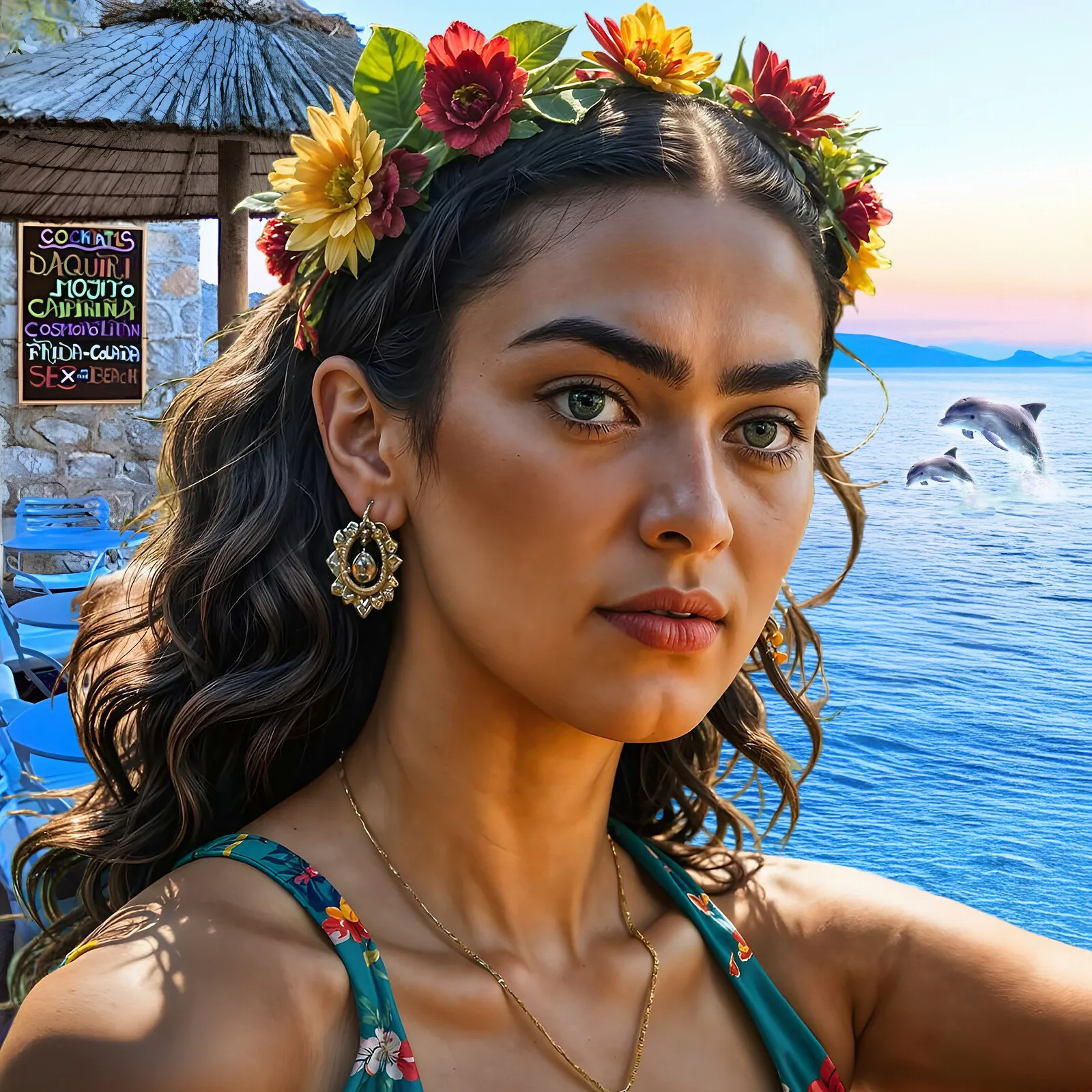
Jörgen Thornberg
Frida Kahlo at Hydronetta, 2025
Digital
70 x 70 cm
Frida Kahlo at Hydronetta
Frida Kahlo’s Art Expressed in a Drink
As the sun set over Hydra, Frida Kahlo, a figure of curiosity, sat at Hydronetta. Unbeknownst to many, the tiny Venus in her hand was not a mere garnish but a part of her legendary creation—the Frida Colada. This bold, layered, and unforgettable cocktail was a vibrant expression of her art, a fascinating blend of art and mixology.
Continue reading and let your imagination savour the essence of her drink.
“The Frida-Colada
With steady hands, the bartender begins his craft,
A red rum pour, a liquid draft.
From tropic fruit, fresh juice is pressed,
The golden nectar is at its best.
A swirl of coconut, creamy and light,
A splash of lime for a tangy bite.
Ice crushed fine, like crystal sands,
Mixing flavours from distant lands.
He blends the drink, smooth as silk,
A hue emerges like Twilight's quilt.
The deep pink tone, a gentle blush,
Mirroring Hydra's evening hush.
The waiter steps with a measured pace,
Carrying art in a wide glass's embrace.
The drink’s soft shimmer, a vibrant flame,
Reflects the horizon's glowing frame.
He places it down with a subtle bow,
As the sea breeze whispers, "Now is now."
Frida lifts the glass high, her spirit aglow,
The drink is a bridge between here and long ago.
“To love, to art, to life's sweet flair,”
She toasts the sky, the sea, the air.
"¡Salud!" she cries, her voice a song,
"Cheers!" we echo; the night is long.
Malmö January 2025
Frida Kahlo’s art is embodied in a drink.
In the late afternoon, with the western sky hinting at the sun’s retreat within the hour, Frida sat at Hydronetta, drawing noticeable attention. People presumed she was a stray guest from the wedding celebration above at the Sunset restaurant. These typical Hydra gatherings attract notable personalities, with guests indulging in bold and fashionable attire. Few likely noticed that she held the newborn Venus in her outstretched hand. As she is known in Greece, Aphrodite was probably mistaken for a drink garnish or perhaps a Barbie doll. Frida had firmly instructed her celestial friend to remain completely still. Her nude appearance might otherwise attract moral enforcers—no one walks around stark naked on Hydra without consequence. Aphrodite had refused to wear a bikini, a normally acceptable compromise for her eternally sensual form.
This ancient Greek goddess is associated with love, lust, beauty, pleasure, passion, and procreation, like her Roman counterpart, Venus. It was in the latter’s name that Botticelli painted her in a portrait she cherished above all other artists' depictions.
Frida had never attempted this before—performing as a mermaid—but unlike Aphrodite, she modestly donned a bra and allowed a form-fitting reptile-skin stocking to cover her naked mermaid tail. Adopting another’s body is entirely feasible in eternity, though borrowing someone’s soul is not. The soul matters; the body is merely for display, like a changeable hairstyle or, as in Frida’s case, a borrowed persona.
Eternity has its share of amusing gatherings. At a grand party recently, themed after the Renaissance, sixteen Mona Lisas appeared, including the real one—Italian noblewoman Lisa del Giocondo—alongside several others representing alternative Mona Lisa candidates: Isabella d’Este, Isabella of Aragon, Cecilia Gallerani, Costanza d’Avalos, Duchess of Francavilla, Caterina Sforza, Bianca Giovanna Sforza, and Leonardo’s lover Salaì, whose feminine features made him a plausible contender. Even Leonardo and Lisa’s reassurances that the painting depicted her didn’t settle the matter. Eternity is rife with rumors and people eager to reshape their legacy—or even to have been someone else entirely.
Even Satan has spent millennia reworking his image. Once known as Azazel, he was one of Christianity’s fallen angels, descending to Earth to seduce mortal women and father the giants known as the Nephilim. These angels were punished and cast into the abyss, which is more of a chasm than a shallow pit in eternity. Petitions for reinterpretation continue to arrive from their distant galaxy, but no one pays attention; everyone is too occupied polishing their portraits.
Returning to the Renaissance party, Frida appeared as herself—as she almost always did—but this time, she embodied Frida circa 1944. Despite the backdrop of World War II, this was her heyday. In 1938, Frida gained international recognition with a successful exhibition at the Julien Levy Gallery in New York, which catapulted her onto the global art scene. By 1939, she participated in an exhibition in Paris organised by André Breton, impressing modernist icons like Picasso and Kandinsky. Her painting The Frame was acquired by the Louvre, making her the first modern Mexican artist to be included in the museum's collection.
Despite living partly in the shadow of her husband, Diego Rivera, during her earthly life, Frida’s posthumous fame has surpassed his. Her influence grew significantly from the 1970s onward, transforming her into a global symbol of feminism, resistance, and identity. Today, her star shines so brightly that pilgrims flock to it from all corners of the universe. Diego’s name, meanwhile, rarely emerges.
Frida’s depiction as a mermaid was indeed far-fetched, given her identity as a self-proclaimed 'land crab.' Rooted in Mexico’s landscapes and her beloved garden at Casa Azul, Frida focused on vibrant flowers, not seaweed. The sea never made an appearance in her art or letters, suggesting it wasn’t part of her daily life or inspiration. It could have been a secret dream—a symbol of freedom and infinity. Now, as a Time-traveler, Frida explores this dream, finding a new muse and sanctuary for her art in Hydra's turquoise waters. This contrast between her earthly life and her role as a Time-traveler adds an intriguing dimension to her character, inviting the audience to delve deeper into her journey.
That Frida performed as a mermaid may have been startling, but what indeed turned heads was the playful addition she made to the drink menu. With her unique blend of creativity and cultural pride, she introduced the 'FRIDA-COLADA,' a drink that would soon become legendary.
Frida appreciates Mexican drinks like tequila and mezcal, which reflect her pride in her culture and traditions. But with only herself and Aphrodite for company, and the music from Sunset and speakers far removed from Mexican tones, Frida opted for her creation: the legendary Frida-Colada. This drink, shrouded in mystery, was about to be unveiled. She carefully instructed the waiter, who soon returned with the lightly pink-to-golden drink and a straw for Aphrodite. The audience, like the waiter, was left in suspense, eager to hear the story behind this enigmatic creation.
Frida: “Do you have a good memory? My taste buds are very particular.”
Waiter: “Photographic, one might say. So, shoot, Madame!”
Frida: “Ah, mi querido amigo, let me first tell you about my Frida-Colada – a drink that carries my soul as much as my paintbrush. This is no ordinary Piña Colada, no, not at all! It’s a drink with color, depth, and passion – just like me.” She didn’t bother telling the waiter who Frida Kahlo was. At his age, it was unlikely he had much interest in her art or her life.
Waiter: “I’m all ears,” he said politely, glancing around to see if other guests were impatiently demanding his attention. Seeing that the tables were relatively empty, he allowed himself a smile that exuded patience.
Frida: “When Frida lived on Earth, she loved Mexico’s strong spirits – tequila and mezcal – and celebrations where joy flowed like rainwater over the mountains.” But as a Time-Traveller with one foot in each world, she decided to create something new that combined her Mexico with the flavors of the tropics and her love of art. The result was the Frida-Colada – a cocktail that reflects her soul. ects her soul.”
Waiter: “Interesting!” he said flatly. “Does it differ much? I mean, do we have the ingredients here? Of course, we do.”
Frida: “Not much, but one crucial detail. I don’t use white rum. No, it has to be a red, aged rum that carries stories from the depths of the barrel, much like Frida’s paintings carry our sorrows and triumphs. The rum gives the drink its colour, a golden pink that reminds me of the sunsets here on Hydra.” She nodded toward the horizon, which began to take on that very hue. Standing beside her, I noticed Aphrodite turning her head almost imperceptibly toward the Peloponnese in the west. “And the flavours… oh, the flavours!” she continued. “But the secret lies not just in the ingredients but in the passion with which it's made. It's not just a drink; it's an experience. The Frida-Colada is like drinking a dream – sweet like pineapple and smooth like coconut, yet with a depth brought by the oak of the rum.”
Waiter: “Red rum isn’t a problem; we have several varieties. Is there a particular brand you prefer, Madame?”
Frida: “Zacapa, from my neighbouring country Guatemala. It’s known for its smooth, sweet, and rich flavour profile, with notes of caramel, vanilla, and spice. It reminds me of my Mexican hero, Zapata. The rum is made in the mountains, which gives it a unique character.”
Waiter: “We have a Zacapa 23 if that works.” Frida nodded warmly. “Pardon me, but you mentioned a Zapata, Madame. I’ve seen Zorro on TV, but not anyone named Zapata.”
Frida: “Zacapa will do perfectly; it’s one of the best, even if it doesn’t come from Mexico. Zorro is a fictional character created in 1909 when Frida Kahlo was twelve. And from old California, no less. The masked, sword-wielding vigilante defends the poor and victimised against the forces of injustice, and his feats have been featured in virtually every form of media. But as a hero, he’s not unlike Zapata, who also fought for justice and the rights of the poor to a decent life.”
Waiter: “How did I miss him?” He glanced around again, noticing the surroundings as calm as they had been before. In about half an hour, crowds would begin to pour in to watch the sunset, but there was still plenty of time. “If you’d like, Madame, please tell me about the man named after the rum.”
Frida: “Emiliano Zapata was a Mexican revolutionary and folk hero, most known for his fight for the rights of peasants during the Mexican Revolution (1910–1920).” He led the Zapatistas, a rebel force fighting for land reform and social justice in Mexico’s southern states. As far as I know, he never wore a mask; instead, he proudly displayed his face and great moustache.” Frida paused dramatically, gazing dreamily toward a distant star where Emiliano resides today, surrounded by revolutionaries from all eras who love mingling with the boisterous rebel.
Zapata was the architect behind the slogan “Tierra y Libertad” (“Land and Freedom”) and the Plan de Ayala, a manifesto that demanded land redistribution from wealthy landowners to the peasants. He became a symbol of resistance against oppression and remains an icon of social justice in Mexico and beyond. Frida had his picture on her wall but never painted him directly into her works. Frida and Zapata shared a deep love for Mexico and a willingness to fight for the oppressed, which is why his spirit can be sensed in her art. Zapata was assassinated in 1919 in an ambush, but his legacy lives on as a symbol of the fight against injustice and exploitation. You’d recognise the concept from Zorro, I imagine.
Waiter: “Sounds like a movie I need to see, if it exists.”
Frida: “Keep an eye out for a classic: Viva Zapata! (1952).” Frida gazed dreamily into the distance. She had, of course, seen the film, which premiered two years before she left Earth. Frida had been bedridden after the amputation of her right leg, but she was wheeled into the theater in her bed. The audience rose from their seats, celebrating another Mexican hero. “The film holds up, and its themes are as relevant as ever. Zapata somewhat reminds me of Hydra’s local hero from the Revolution of 1821, Antonis Oikonomou, whose statue I’ve seen outside the museum. In the film, Marlon Brando plays Zapata, and Anthony Quinn plays his older brother, Eufemio Zapata.”
Waiter: "Quinn is popular in Greece after the film, Zorba the Greek, of all films. There's no one my age who hasn’t seen it a thousand times – the movie that put Greece on the map," he said proudly.
Frida: "You might want to know the recipe for my Frida-Colada. I'm starting to get thirsty after all this talking." Once again, Aphrodite gave an almost imperceptible nod.
Here’s how your bartender should mix my magic – listen carefully, for this is as much an art as painting on a canvas.
Waiter: "I’m all ears, Madame, and thank you for the history lesson. I’ll definitely look for that film on Netflix."
Frida: "Your bartender needs 5 cl of red rum – which we've already agreed on—and 10 cl of freshly squeezed pineapple juice. Of course, nothing from the supermarket – my drink must taste of the sun and the tropics. 4 cl of coconut cream, creamy like a cloud, not thin like the hazy sunlight now. One dash of lime juice for balance, like life itself, but not so much that the sourness overpowers. And finally, one dl of crushed ice to cool the heat in my heart. Blend everything until it’s as smooth as a summer breeze, and pour it into a glass that can showcase its beauty. I prefer a tall, curving glass – like the waves of the sea. And for decoration! A slice of pineapple, a cherry – and if you’re feeling bold, sprinkle a bit of cinnamon or nutmeg on top. It adds a little heat, just like me."
It took some time before the waiter returned. For a moment, Frida began to doubt whether they could manage this; perhaps the bartender had lost his temper at replacing white rum with red. Or maybe the waiter’s photographic memory hadn’t reached the bar. Finally, three glasses arrived – one placed firmly on the table beneath Frida’s hand holding the shell with Aphrodite, one for me, and the last eagerly sampled by Frida. Judging by the satisfied smacking sounds, the bartender hadn’t failed.
Waiter: "How did you like your Frida-Colada, Madame?" the waiter asked nervously. Frida's satisfied smacking sounds were a testament to the bartender's success, bringing the audience a sense of accomplishment and joy.
Frida: "Ah, the taste is like mine and Frida’s life – an explosion of emotions! First, the sweet pineapple, like a lover’s kiss on a sunny morning. Then comes the smoothness of the coconut, soft like the down pillow of a bed, a whisper from nature itself. But beneath it all is the rum – a warm, hot, dark embrace with notes of caramel, oak, and spice. And finally, the lime juice, that little splash of acidity, reminding us that life is never entirely simple. It’s a drink that tells a story, just like Frida Kahlo’s paintings. Your bartender did an excellent job – please let him know."
Waiter: "Thank you, Madame. I’ll tell my colleague how pleased you are – who knew the person who created the recipe." He withdrew with a bow, and Frida discreetly handed the straw to Aphrodite, who had to open her mouth wide to fit it, which must have looked like a garden hose in thickness in her tiny world.
"So here you have it, my darlings (in Spanish) – my eternal Frida Colada." Frida raised the glass first to Aphrodite, then to me, and finally to the starry sky, which was beginning to emerge in the east. "A drink that carries my soul, created to be shared with all who dare to live life to the fullest. Cheers to love, art, and the dream of an eternal party. Salud!"
There was time for one more, and another, before the sun retreated behind the mountains in the west, and the sky shifted from the drink’s hue to something more akin to La Vie En Rose with a Mexican twist – by swapping vodka for blanco tequila or sotol, which provides a soft and neutral base. This enhances the rich coffee tones, the elegant rose aroma, and the warm cardamom while maintaining a subtle connection to Frida Kahlo’s Mexico. Perfect for an evening where romance meets artistic passion. It became one such drink before we wrapped up for the night. Aphrodite was thoroughly tipsy and had lain down on her shell. It's best that way – what would it have looked like with a drunk, naked goddess of love in Barbie doll size? Please consider the minor children in Greece, who are allowed to stay up until their parents return home.
I smiled at the comical sight of Aphrodite, stretched out and content on her shell, as the evening gently wrapped the island in its soft darkness. Frida took a final sip of her dark farewell drink, savoring the last drops as if preserving them as a cherished secret.
“There’s something about Hydra,” Frida said, turning to me. “A place where time and reality seem to fold, like the waves. Even a landlubber like me can find herself here, hear the song of the sea, and toast with the gods.”
She raised her glass one last time; the deep pink coffee hue reflected in her gaze as if it, too, carried a piece of her soul. “Cheers, my friend, to love, to art, and to always daring to mix life like a cocktail—with a pinch of courage and plenty of passion.”
As night descended over Hydra, Frida and Aphrodite appeared as a fusion of art and myth, time and eternity. Frida’s laughter mingled with the sound of the waves, and her story became yet another legend to be whispered across the borders of time.
Jörgen Thornberg
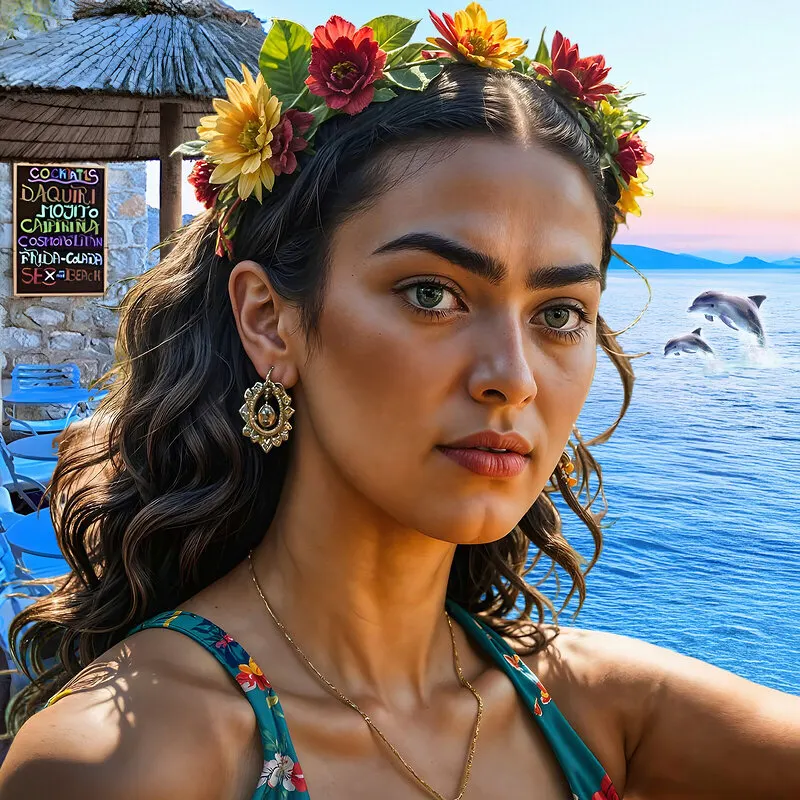
Frida Kahlo at Hydronetta, 2025
Digital
70 x 70 cm
Frida Kahlo at Hydronetta
Frida Kahlo’s Art Expressed in a Drink
As the sun set over Hydra, Frida Kahlo, a figure of curiosity, sat at Hydronetta. Unbeknownst to many, the tiny Venus in her hand was not a mere garnish but a part of her legendary creation—the Frida Colada. This bold, layered, and unforgettable cocktail was a vibrant expression of her art, a fascinating blend of art and mixology.
Continue reading and let your imagination savour the essence of her drink.
“The Frida-Colada
With steady hands, the bartender begins his craft,
A red rum pour, a liquid draft.
From tropic fruit, fresh juice is pressed,
The golden nectar is at its best.
A swirl of coconut, creamy and light,
A splash of lime for a tangy bite.
Ice crushed fine, like crystal sands,
Mixing flavours from distant lands.
He blends the drink, smooth as silk,
A hue emerges like Twilight's quilt.
The deep pink tone, a gentle blush,
Mirroring Hydra's evening hush.
The waiter steps with a measured pace,
Carrying art in a wide glass's embrace.
The drink’s soft shimmer, a vibrant flame,
Reflects the horizon's glowing frame.
He places it down with a subtle bow,
As the sea breeze whispers, "Now is now."
Frida lifts the glass high, her spirit aglow,
The drink is a bridge between here and long ago.
“To love, to art, to life's sweet flair,”
She toasts the sky, the sea, the air.
"¡Salud!" she cries, her voice a song,
"Cheers!" we echo; the night is long.
Malmö January 2025
Frida Kahlo’s art is embodied in a drink.
In the late afternoon, with the western sky hinting at the sun’s retreat within the hour, Frida sat at Hydronetta, drawing noticeable attention. People presumed she was a stray guest from the wedding celebration above at the Sunset restaurant. These typical Hydra gatherings attract notable personalities, with guests indulging in bold and fashionable attire. Few likely noticed that she held the newborn Venus in her outstretched hand. As she is known in Greece, Aphrodite was probably mistaken for a drink garnish or perhaps a Barbie doll. Frida had firmly instructed her celestial friend to remain completely still. Her nude appearance might otherwise attract moral enforcers—no one walks around stark naked on Hydra without consequence. Aphrodite had refused to wear a bikini, a normally acceptable compromise for her eternally sensual form.
This ancient Greek goddess is associated with love, lust, beauty, pleasure, passion, and procreation, like her Roman counterpart, Venus. It was in the latter’s name that Botticelli painted her in a portrait she cherished above all other artists' depictions.
Frida had never attempted this before—performing as a mermaid—but unlike Aphrodite, she modestly donned a bra and allowed a form-fitting reptile-skin stocking to cover her naked mermaid tail. Adopting another’s body is entirely feasible in eternity, though borrowing someone’s soul is not. The soul matters; the body is merely for display, like a changeable hairstyle or, as in Frida’s case, a borrowed persona.
Eternity has its share of amusing gatherings. At a grand party recently, themed after the Renaissance, sixteen Mona Lisas appeared, including the real one—Italian noblewoman Lisa del Giocondo—alongside several others representing alternative Mona Lisa candidates: Isabella d’Este, Isabella of Aragon, Cecilia Gallerani, Costanza d’Avalos, Duchess of Francavilla, Caterina Sforza, Bianca Giovanna Sforza, and Leonardo’s lover Salaì, whose feminine features made him a plausible contender. Even Leonardo and Lisa’s reassurances that the painting depicted her didn’t settle the matter. Eternity is rife with rumors and people eager to reshape their legacy—or even to have been someone else entirely.
Even Satan has spent millennia reworking his image. Once known as Azazel, he was one of Christianity’s fallen angels, descending to Earth to seduce mortal women and father the giants known as the Nephilim. These angels were punished and cast into the abyss, which is more of a chasm than a shallow pit in eternity. Petitions for reinterpretation continue to arrive from their distant galaxy, but no one pays attention; everyone is too occupied polishing their portraits.
Returning to the Renaissance party, Frida appeared as herself—as she almost always did—but this time, she embodied Frida circa 1944. Despite the backdrop of World War II, this was her heyday. In 1938, Frida gained international recognition with a successful exhibition at the Julien Levy Gallery in New York, which catapulted her onto the global art scene. By 1939, she participated in an exhibition in Paris organised by André Breton, impressing modernist icons like Picasso and Kandinsky. Her painting The Frame was acquired by the Louvre, making her the first modern Mexican artist to be included in the museum's collection.
Despite living partly in the shadow of her husband, Diego Rivera, during her earthly life, Frida’s posthumous fame has surpassed his. Her influence grew significantly from the 1970s onward, transforming her into a global symbol of feminism, resistance, and identity. Today, her star shines so brightly that pilgrims flock to it from all corners of the universe. Diego’s name, meanwhile, rarely emerges.
Frida’s depiction as a mermaid was indeed far-fetched, given her identity as a self-proclaimed 'land crab.' Rooted in Mexico’s landscapes and her beloved garden at Casa Azul, Frida focused on vibrant flowers, not seaweed. The sea never made an appearance in her art or letters, suggesting it wasn’t part of her daily life or inspiration. It could have been a secret dream—a symbol of freedom and infinity. Now, as a Time-traveler, Frida explores this dream, finding a new muse and sanctuary for her art in Hydra's turquoise waters. This contrast between her earthly life and her role as a Time-traveler adds an intriguing dimension to her character, inviting the audience to delve deeper into her journey.
That Frida performed as a mermaid may have been startling, but what indeed turned heads was the playful addition she made to the drink menu. With her unique blend of creativity and cultural pride, she introduced the 'FRIDA-COLADA,' a drink that would soon become legendary.
Frida appreciates Mexican drinks like tequila and mezcal, which reflect her pride in her culture and traditions. But with only herself and Aphrodite for company, and the music from Sunset and speakers far removed from Mexican tones, Frida opted for her creation: the legendary Frida-Colada. This drink, shrouded in mystery, was about to be unveiled. She carefully instructed the waiter, who soon returned with the lightly pink-to-golden drink and a straw for Aphrodite. The audience, like the waiter, was left in suspense, eager to hear the story behind this enigmatic creation.
Frida: “Do you have a good memory? My taste buds are very particular.”
Waiter: “Photographic, one might say. So, shoot, Madame!”
Frida: “Ah, mi querido amigo, let me first tell you about my Frida-Colada – a drink that carries my soul as much as my paintbrush. This is no ordinary Piña Colada, no, not at all! It’s a drink with color, depth, and passion – just like me.” She didn’t bother telling the waiter who Frida Kahlo was. At his age, it was unlikely he had much interest in her art or her life.
Waiter: “I’m all ears,” he said politely, glancing around to see if other guests were impatiently demanding his attention. Seeing that the tables were relatively empty, he allowed himself a smile that exuded patience.
Frida: “When Frida lived on Earth, she loved Mexico’s strong spirits – tequila and mezcal – and celebrations where joy flowed like rainwater over the mountains.” But as a Time-Traveller with one foot in each world, she decided to create something new that combined her Mexico with the flavors of the tropics and her love of art. The result was the Frida-Colada – a cocktail that reflects her soul. ects her soul.”
Waiter: “Interesting!” he said flatly. “Does it differ much? I mean, do we have the ingredients here? Of course, we do.”
Frida: “Not much, but one crucial detail. I don’t use white rum. No, it has to be a red, aged rum that carries stories from the depths of the barrel, much like Frida’s paintings carry our sorrows and triumphs. The rum gives the drink its colour, a golden pink that reminds me of the sunsets here on Hydra.” She nodded toward the horizon, which began to take on that very hue. Standing beside her, I noticed Aphrodite turning her head almost imperceptibly toward the Peloponnese in the west. “And the flavours… oh, the flavours!” she continued. “But the secret lies not just in the ingredients but in the passion with which it's made. It's not just a drink; it's an experience. The Frida-Colada is like drinking a dream – sweet like pineapple and smooth like coconut, yet with a depth brought by the oak of the rum.”
Waiter: “Red rum isn’t a problem; we have several varieties. Is there a particular brand you prefer, Madame?”
Frida: “Zacapa, from my neighbouring country Guatemala. It’s known for its smooth, sweet, and rich flavour profile, with notes of caramel, vanilla, and spice. It reminds me of my Mexican hero, Zapata. The rum is made in the mountains, which gives it a unique character.”
Waiter: “We have a Zacapa 23 if that works.” Frida nodded warmly. “Pardon me, but you mentioned a Zapata, Madame. I’ve seen Zorro on TV, but not anyone named Zapata.”
Frida: “Zacapa will do perfectly; it’s one of the best, even if it doesn’t come from Mexico. Zorro is a fictional character created in 1909 when Frida Kahlo was twelve. And from old California, no less. The masked, sword-wielding vigilante defends the poor and victimised against the forces of injustice, and his feats have been featured in virtually every form of media. But as a hero, he’s not unlike Zapata, who also fought for justice and the rights of the poor to a decent life.”
Waiter: “How did I miss him?” He glanced around again, noticing the surroundings as calm as they had been before. In about half an hour, crowds would begin to pour in to watch the sunset, but there was still plenty of time. “If you’d like, Madame, please tell me about the man named after the rum.”
Frida: “Emiliano Zapata was a Mexican revolutionary and folk hero, most known for his fight for the rights of peasants during the Mexican Revolution (1910–1920).” He led the Zapatistas, a rebel force fighting for land reform and social justice in Mexico’s southern states. As far as I know, he never wore a mask; instead, he proudly displayed his face and great moustache.” Frida paused dramatically, gazing dreamily toward a distant star where Emiliano resides today, surrounded by revolutionaries from all eras who love mingling with the boisterous rebel.
Zapata was the architect behind the slogan “Tierra y Libertad” (“Land and Freedom”) and the Plan de Ayala, a manifesto that demanded land redistribution from wealthy landowners to the peasants. He became a symbol of resistance against oppression and remains an icon of social justice in Mexico and beyond. Frida had his picture on her wall but never painted him directly into her works. Frida and Zapata shared a deep love for Mexico and a willingness to fight for the oppressed, which is why his spirit can be sensed in her art. Zapata was assassinated in 1919 in an ambush, but his legacy lives on as a symbol of the fight against injustice and exploitation. You’d recognise the concept from Zorro, I imagine.
Waiter: “Sounds like a movie I need to see, if it exists.”
Frida: “Keep an eye out for a classic: Viva Zapata! (1952).” Frida gazed dreamily into the distance. She had, of course, seen the film, which premiered two years before she left Earth. Frida had been bedridden after the amputation of her right leg, but she was wheeled into the theater in her bed. The audience rose from their seats, celebrating another Mexican hero. “The film holds up, and its themes are as relevant as ever. Zapata somewhat reminds me of Hydra’s local hero from the Revolution of 1821, Antonis Oikonomou, whose statue I’ve seen outside the museum. In the film, Marlon Brando plays Zapata, and Anthony Quinn plays his older brother, Eufemio Zapata.”
Waiter: "Quinn is popular in Greece after the film, Zorba the Greek, of all films. There's no one my age who hasn’t seen it a thousand times – the movie that put Greece on the map," he said proudly.
Frida: "You might want to know the recipe for my Frida-Colada. I'm starting to get thirsty after all this talking." Once again, Aphrodite gave an almost imperceptible nod.
Here’s how your bartender should mix my magic – listen carefully, for this is as much an art as painting on a canvas.
Waiter: "I’m all ears, Madame, and thank you for the history lesson. I’ll definitely look for that film on Netflix."
Frida: "Your bartender needs 5 cl of red rum – which we've already agreed on—and 10 cl of freshly squeezed pineapple juice. Of course, nothing from the supermarket – my drink must taste of the sun and the tropics. 4 cl of coconut cream, creamy like a cloud, not thin like the hazy sunlight now. One dash of lime juice for balance, like life itself, but not so much that the sourness overpowers. And finally, one dl of crushed ice to cool the heat in my heart. Blend everything until it’s as smooth as a summer breeze, and pour it into a glass that can showcase its beauty. I prefer a tall, curving glass – like the waves of the sea. And for decoration! A slice of pineapple, a cherry – and if you’re feeling bold, sprinkle a bit of cinnamon or nutmeg on top. It adds a little heat, just like me."
It took some time before the waiter returned. For a moment, Frida began to doubt whether they could manage this; perhaps the bartender had lost his temper at replacing white rum with red. Or maybe the waiter’s photographic memory hadn’t reached the bar. Finally, three glasses arrived – one placed firmly on the table beneath Frida’s hand holding the shell with Aphrodite, one for me, and the last eagerly sampled by Frida. Judging by the satisfied smacking sounds, the bartender hadn’t failed.
Waiter: "How did you like your Frida-Colada, Madame?" the waiter asked nervously. Frida's satisfied smacking sounds were a testament to the bartender's success, bringing the audience a sense of accomplishment and joy.
Frida: "Ah, the taste is like mine and Frida’s life – an explosion of emotions! First, the sweet pineapple, like a lover’s kiss on a sunny morning. Then comes the smoothness of the coconut, soft like the down pillow of a bed, a whisper from nature itself. But beneath it all is the rum – a warm, hot, dark embrace with notes of caramel, oak, and spice. And finally, the lime juice, that little splash of acidity, reminding us that life is never entirely simple. It’s a drink that tells a story, just like Frida Kahlo’s paintings. Your bartender did an excellent job – please let him know."
Waiter: "Thank you, Madame. I’ll tell my colleague how pleased you are – who knew the person who created the recipe." He withdrew with a bow, and Frida discreetly handed the straw to Aphrodite, who had to open her mouth wide to fit it, which must have looked like a garden hose in thickness in her tiny world.
"So here you have it, my darlings (in Spanish) – my eternal Frida Colada." Frida raised the glass first to Aphrodite, then to me, and finally to the starry sky, which was beginning to emerge in the east. "A drink that carries my soul, created to be shared with all who dare to live life to the fullest. Cheers to love, art, and the dream of an eternal party. Salud!"
There was time for one more, and another, before the sun retreated behind the mountains in the west, and the sky shifted from the drink’s hue to something more akin to La Vie En Rose with a Mexican twist – by swapping vodka for blanco tequila or sotol, which provides a soft and neutral base. This enhances the rich coffee tones, the elegant rose aroma, and the warm cardamom while maintaining a subtle connection to Frida Kahlo’s Mexico. Perfect for an evening where romance meets artistic passion. It became one such drink before we wrapped up for the night. Aphrodite was thoroughly tipsy and had lain down on her shell. It's best that way – what would it have looked like with a drunk, naked goddess of love in Barbie doll size? Please consider the minor children in Greece, who are allowed to stay up until their parents return home.
I smiled at the comical sight of Aphrodite, stretched out and content on her shell, as the evening gently wrapped the island in its soft darkness. Frida took a final sip of her dark farewell drink, savoring the last drops as if preserving them as a cherished secret.
“There’s something about Hydra,” Frida said, turning to me. “A place where time and reality seem to fold, like the waves. Even a landlubber like me can find herself here, hear the song of the sea, and toast with the gods.”
She raised her glass one last time; the deep pink coffee hue reflected in her gaze as if it, too, carried a piece of her soul. “Cheers, my friend, to love, to art, and to always daring to mix life like a cocktail—with a pinch of courage and plenty of passion.”
As night descended over Hydra, Frida and Aphrodite appeared as a fusion of art and myth, time and eternity. Frida’s laughter mingled with the sound of the waves, and her story became yet another legend to be whispered across the borders of time.

Jörgen Thornberg
Malmö
Lite om bilder och mig. Translation in English at the end.
Jag är en nyfiken person som ser allt i bilder, även det jag fäster i ord, gärna tillsammans för bakom alla mina bilder finns en berättelse. Till vissa bilder hör en kortare eller längre novell som följer med bilden.
Bilder berättar historier. Jag omges av naturlig skönhet, intressanta människor och historia var jag än går. Jag använder min kamera för att dokumentera världen och blanda det jag ser med vad jag känner för att fånga den dolda magin.
Mina bilder berättar mina historier. Genom mina bilder, tryck och berättelser. Jag bjuder in dig att ta del av dessa berättelser, in i ditt liv och hem och dela min mycket personliga syn på vår värld. Mer än vad ögat ser. Jag tänker i bilder, drömmer och skriver och pratar om dem; följaktligen måste jag också skapa bilder. De blir vad jag ser, inte nödvändigtvis begränsade till verkligheten. Det finns en bild runt varje hörn. Jag hoppas att du kommer att se vad jag såg och gilla det.
Jag är också en skrivande person och till många bilder hör en kortare eller längre essay. Den följer med tavlan, tryckt på fint papper och med en personlig hälsning från mig.
Flertalet bilder startar sin resa i min kamera. Enkelt förklarat beskriver jag bilden jag ser i mitt inre, upplevd eller fantiserad. Bilden uppstår inom mig redan innan jag fått okularet till ögat. På bråkdelen av ett ögonblick ser jag vad jag vill ha och vad som kan göras med bilden. Här skall jag stoppa in en giraff, stålmannen, Titanic eller vad det är min fantasi finner ut. Ännu märkligare är att jag kommer ihåg minnesbilden långt efteråt när det blir tid att skapa verket. Om jag lyckas eller inte, är upp till betraktaren, oftast präglat av en stråk av svart humor – meningen är att man skall bli underhållen. Mina bilder blir ofta en snackis där de hänger.
Jag föredrar bilder som förmedlar ett budskap i flera lager. Vid första anblicken fylld av feel-good, en vacker utsikt, fint väder, solen skiner, blommor på ängen eller vattnet som ligger förrädiskt spegelblankt. I en sådan bild kan jag gömma min egentliga berättelse, mitt förakt för förtryckare och våldsverkare, rasister och fördomsfulla människor - ett gärna återkommande motiv mer eller mindre dolt i det vackra motivet. Jag försöker förena dem i ett gemensamt narrativ.
Bild och formgivning har löpt som en röd tråd genom livet. Fotokonst känns som en värdig final som jag gärna delar med mig.
Min genre är vid som framgår av mina bilder, temat en blandning av pop- och gatukonst i kollage som kan bestå av hundratals lager. Vissa bilder kan ta veckor, andra någon dag innan det är dags att överlämna resultatet till printverkstaden. Fine Art Prints är digitala fotocollage. I dessa kollage sker rivandet, klippandet, pusslandet, målandet, ritandet och sprayningen digitalt. Det jag monterar in kan vara hundratals år gamla bilder som jag omsorgsfullt frilägger så att de ser ut att vara en del av tavlan men också bilder skapade av mig själv efter min egen fantasi. Därefter besöks printstudion och för vissa bilder numrera en limiterad upplaga (oftast 7 exemplar) och signera för hand. Vissa bilder kan köpas i olika format. Det är bara att fråga efter vilka. Gillar man en bild som är 70x100 men inte har plats på väggen, går den kanske att få i 50x70 cm istället. Frågan är fri.
Metoden Giclée eller Fine Art Print som det också kallas är det moderna sättet för framställning av grafisk konst. Villkoret för denna typ av utskrifter är att en högkvalitativ storformatskrivare används med åldersbeständigt färgpigment och konstnärspapper eller i förekommande fall på duk. Pappret som används möter de krav på livslängd som ställs av museer och gallerier. Normalt säljer jag mina bilder oinramade så att den nya ägaren själv kan bestämma hur de skall se ut, med eller utan passepartout färg på ram, med eller utan glas etc..
Under många år ställde jag bara ut på nätet, i valda grupper och på min egen Facebooksida - https://www.facebook.com/jorgen.thornberg.9
Jag finns också på en egen hemsida som tyvärr inte alltid är uppdaterad – https://www.jth.life/ Där kan du också läsa en del av de berättelser som följer med bilden.
UTSTÄLLNINGAR
Luftkastellet, oktober 2022
Konst i Lund, november 2022
Luftkastellet, mars 2023
Engleson Galleri Caroli, april 2023
Hydra, Greece June 2023
Engleson Galleri Caroli, oktober 2023
Toppen, Höllviken december 2023
Luftkastellet, mars 2024
Torups Galleri, mars 2024
Venice, May 2024
Luftkastellet, oktober 2024
Konst i Advent, December 2024
Galleri Engleson, Caroli December 2024
Jäger & Jansson Galleri, april 2025
A bit about pictures and me.
I'm a curious person who sees everything in pictures, even what I express in words, often combining them, for behind all my pictures lies a story. These narratives, some as short as a single image and others as long as a novel, are the heart and soul of my work.
Pictures tell stories. Wherever I go, I'm surrounded by natural beauty, exciting people, and history. I use my camera to document the world and blend what I see with what I feel to capture the hidden magic.
My images tell my stories. Through my pictures, prints, and narratives, I invite you to partake in these stories in your life and home and share my deeply personal perspective of our world. More than meets the eye. I think in pictures, dream, write, and talk about them; consequently, I must create images too. They become what I see, not necessarily confined to reality. There's a picture around every corner. I hope you'll see what I saw and enjoy it.
I'm also a writer, and many images come with a shorter or longer essay. It accompanies the painting, printed on fine paper with my personal greeting.
Many pictures start their journey on my camera. Simply put, I describe the image I see in my mind, experienced or imagined. The image arises within me even before I bring the eyepiece to my eye. In a fraction of a moment, I see what I want and what can be done with the picture. Here, I'll insert a giraffe, Superman, the Titanic, or whatever my imagination conjures up. Even stranger is that I remember the mental image long after it's time to create the work. Whether I succeed is up to the observer, often imbued with a streak of black humour – the aim is to entertain. My pictures usually become a talking point wherever they hang.
I prefer pictures that convey a message in multiple layers. At first glance, they're filled with feel-good vibes, a beautiful view, lovely weather, the sun shining, flowers in the meadow, or the water lying deceptively calm. But beneath this surface beauty, I often conceal a deeper story, a narrative that challenges societal norms or explores the human condition. I invite you to delve into these hidden narratives and discover the layers of meaning within my work.
Picture and design have been a thread running through my life. Photographic art feels like a fitting finale, and I'm happy to share it.
My genre is varied, as seen in my pictures; the theme is a blend of pop and street art in collages that can consist of hundreds of layers. Some images can take weeks, others just a day before it's time to hand over the result to the print workshop. Fine Art Prints are digital photo collages. In these collages, tearing, cutting, puzzling, painting, drawing, and spraying happen digitally. What I insert can be images hundreds of years old that I carefully extract so they appear to be part of the painting, but also images created by myself, now also generated from my imagination. Next, visit the print studio and, for certain images, number a limited edition (usually 7 copies) and sign them by hand. Some images may be available in other formats. Just ask which ones. If you like an image that's 70x100 but doesn't have space on the wall, you might be able to get it in 50x70 cm instead. The question is open.
The Giclée method, or Fine Art Print as it's also called, is the modern way of producing graphic art. This method ensures the highest quality and longevity of the artwork, using a high-quality large-format printer with archival pigment inks and artist paper or, in some cases, canvas. The paper used meets the longevity requirements set by museums and galleries. I sell my pictures unframed, allowing the new owner to personalise their artwork, confident in the lasting value and quality of the piece.
For many years, I only exhibited online, in selected groups, and on my Facebook page - https://www.facebook.com/jorgen.thornberg.9. I also have my website, which unfortunately is not constantly updated - https://www.jth.life/. You can also read some of the stories accompanying the pictures there.
EXHIBITIONS
Luftkastellet, October 2022
Art in Lund, November 2022
Luftkastellet, March 2023
Engleson Gallery Caroli, April 2023
Hydra, Greece June 2023
Engleson Gallery Caroli, October 2023
Toppen, Höllviken December 2023
Luftkastellet, March 2024
Torup Gallery, March 2024
Venice, May 2024
UTSTÄLLNINGAR
Luftkastellet, oktober 2022
Konst i Lund, november 2022
Luftkastellet, mars 2023
Engleson Galleri Caroli, april 2023
Hydra, Greece June 2023
Engleson Galleri Caroli, oktober 2023
Toppen, Höllviken december 2023
Luftkastellet, mars 2024
Torups Galleri, mars 2024
Venice, May 2024
Luftkastellet, October 2024
Konst i Advent, December 2024
Galleri Engleson, Caroli December 2024
Jäger & Jansson Galleri, April 2025
Utbildning
Autodidakt
Medlem i konstnärsförening
Öppna Sinnen
Med i konstrunda
Konstrundan i Skåne
Utställningar
Luftkastellet, October 2022
Art in Lund, November 2022
Luftkastellet, March 2023
Engleson Gallery Caroli, April 2023
Hydra, Greece June 2023
Engleson Gallery Caroli, October 2023
Toppen, Höllviken December 2023
Luftkastellet, March 2024
Torup Gallery, March 2024
Venice, May 2024