Vi använder cookies för att ge dig bästa möjliga upplevelse. Välj vilka cookies du tillåter.
Läs mer i vår integritetspolicy
Jörgen Thornberg
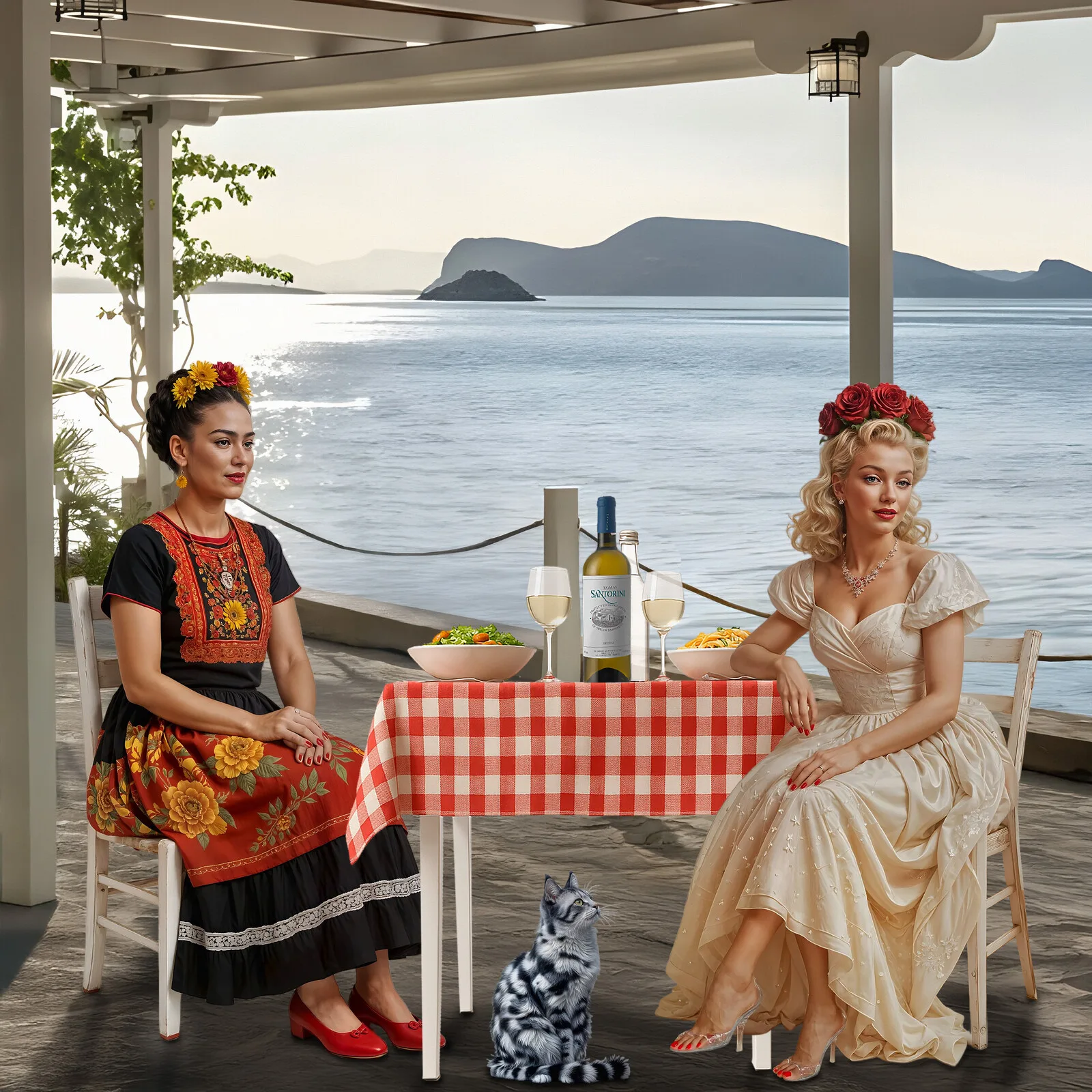
Red Lips and Nails, White Chairs, Gingham Table and a Sucker in Checks, 2025
Digital
80 x 80 cm
Red Lips and Nails, White Chairs, Gingham Table and a Sucker in Checks
A Table for Two (and One Sucker in Checks)
A tale about two women and a cat at Plakes Beach, Hydra – under a sun-warmed awning.
It all began with a typical lunch on an extraordinary island. At a seaside table adorned with red-and-white gingham, under a canopy of bougainvillea and myth, two women from different galaxies shared bread, stories, and the sun. Frida Kahlo arrived adorned in marigolds, resplendent in her Tehuana dress. Marilyn Monroe, on the other hand, donned a borrowed cream ballgown and Cinderella’s glass slippers—open-toed, naturally, to flaunt her pedicure.
Across the strait, the island of Dokos reclined like a sleeping princess, and beneath the table, a black-and-white cat in perfect checks—neither prince nor peasant, just a gingham sucker—waited hungrily for crumbs of seafood or metaphor.
They conversed, as is the custom on Hydra, about folklore and their destinies: Cinderella’s slipper, Aschenputtel’s bloodied shoe, Tấm’s vengeance sauce. But the dialogue soon veered towards another girl of ash and innocence. Snow White. Who was she, truly? An eternal virgin? A poisoned rival? A sleeping commodity? Or something far more perplexing?
Over lunch, they set the record straight. The myths of female passivity and male dominance cracked. The women didn’t. Please read on and get the whole picture.
"A Legazy whiter than Snow
She once was a whisper, a cherry-lipped dream,
Asleep in the forest beneath moonbeam.
Seven odd men with hearts full of dust
Kept watch by her side with reverent trust.
Her story was written in roses and glass,
A coffin of silence, a prince she let pass.
But Snow White woke up, said, “That’s not the end,”
And stitched a new future with thread she could bend.
She traded the apple for wisdom and wine,
Hung up her crown on a laundry line.
She kept the red ribbon but loosened the lace—
And found her rhythm, her kind of grace.
Then came a shimmer, a wormhole in bloom,
A breeze from the stars swept through her room.
Marilyn called her: “I need something bright—
A dress with a story, a second-hand light.”
So Snow packed a parcel, with gown and with shoes,
A sparkly reminder of lives you can choose.
Marilyn twirled in cream and delight,
Frida poured wine in the soft Grecian light.
And under the table, unnoticed, unseen,
A gingham-clad cat in black and in cream
Crept up to the plate with a whispering tread,
Where vongole pasta was cooling instead.
He sniffed at the steam, then gave it a try—
For gingham-born beasts know too well why
One must let things settle before taking a bite:
Even feline dreamers dislike tongues burned at night.
So thank you, dear Snow, for the dress and the lore,
For lending your glamour, your grief, and much more.
For the meal you forgot as you danced into myth,
And the cat who now purrs with a gingham-toothed sniff.”
Malmö, March 2025
A Table for Two (and a Sucker in Checks)
It all began with a simple lunch on a sunny day at the luxurious Four Seasons by Plakes Beach on Hydra. The sea breeze, laughter, and the scent of fresh oregano filled the air, creating a serene and timeless atmosphere. In the background, the island of Dokos reclined like a sleeping princess, adding to the enchanting setting.
The two guests of honour were anything but ordinary. Frida Kahlo, in her vibrant Tehuana dress, and Marilyn Monroe, radiant in a borrowed cream ballgown, sat across the table from each other. Their presence added an unexpected twist to the lunch.
It may sound like a long journey for lunch, but in reality, Plakes lies conveniently close—just a short leap through a well-placed wormhole. The fourth dimension, still baffling to Earth’s finest physicists, offers surprising shortcuts to those who know how to read the folds of time.
Marilyn, ever the aesthete, borrowed Cinderella’s glass slippers too, letting her red-painted toenails gleam beneath the gingham-covered table.
And just beneath that table, poised between shadow and sunlight, awaited a hopeful third guest: a black-and-white cat in a perfect gingham coat—what some might call checkered, others charming, but Frida called him Sucker. A freeloader, perhaps, but a stylish one, quietly sharing the moment with two eternal striders, pausing for lunch on a sunlit Greek island just a breath away from the stars.
Plakes Beach, Hydra – under a sun-warmed awning och de har just fått serverat var sin lunch, Marilyn en pasta vongole, Frida en läcker husets sallad.
Frida (smiling, reaching for her wine):
"What luck for you that Cinderella got her slipper back."
Marilyn (laughing softly):
"Not just the slipper, darling—she got the prince and half the kingdom too. And now? She has dozens of them. Slippers, I mean. Glass, of course. Superb and lovely to wear on a warm star. I chose a toe-open pair. I had to show off my pedicure.
Frida:
"Of course you did. I noticed—flawless. Askungen would be proud. Tell me again: which star does she currently live on?"
Marilyn:
"Star Gliese 581g, in the Carina Nebula. Perfect gravity, endless shoe closets, and not a pumpkin in sight. She lives next door to Vega and Antares. And you know how Antares is—always dramatic, always glowing like he’s about to burst into flames.
Frida:
Very much in line with the image of a fairytale queen. Though people think Walt Disney invented her."
Marilyn:
"Ha! As if. Askungen’s older than Rome. She wore gold before she wore glass. In one version, a bird stole her shoe and dropped it in an Egyptian king’s lap. He married her on the spot."
Frida:
"That was Rhodopis. Greek girl, Egyptian king, divine shoe delivery. Better than FedEx."
Marilyn:
"And Ye Xian—China, ninth century. Magic fish bones, golden shoes, dead stepmother crushed under stones. Not exactly Disney."
Frida (giggling):
"And not even the worst of them. Remember Aschenputtel? The stepsisters slice off their toes to fit the shoe. Birds peck out their eyes at the wedding. Charming, no?"
Marilyn:
"Charming and Grimm. Perrault made it prettier—pumpkin, fairy godmother, and glass slipper. That famous mistranslation, maybe. Was it glass? Was it fur? It doesn't matter. The glass is stuck.
Frida:
"Glass is pure poetry. Transparent, delicate, dangerous. Like some women I know."
Marilyn (raising her brows):
"Guilty. But we all know it wasn’t really about the slipper. It was about class. She didn’t rise through courage—she married well."
Frida:
"She adapted to survive. It’s what women have done for centuries. The slipper fit, but the system didn’t."
Marilyn (softly):
"Still doesn’t."
Frida (nodding):
"And yet, here we are. In folklore dresses and borrowed glass shoes, sitting under bougainvillea in Hydra."
Marilyn (gesturing under the table):
"And with him."
Beneath the gingham-draped table, a black-and-white cat, marked in perfect checks, licks his paw and glances up hopefully—neither prince nor peasant, but a sucker in checks, eternally ready for the next crumb of magic.
Marilyn (sipping her iced white wine): " Have you ever heard of Ċiklemfusa? She's from Malta. She baked krustini and concealed her identity in the pastries. Brilliant. A slipper is one thing—cookies are another.”
Frida (grinning): " Art and pastry—the only proper ways to express oneself.” And have you noticed how many of these girls begin in ashes? Cinders. Dust. Discarded.”
Marilyn:
“Exactly. But no one stays there. They transform. New dress, new name, new fate. Even those with the darkest paths—like Tấm in Vietnam. Her stepmother kills her, she returns as a bird, a loom, an apple... and ultimately, she cooks her stepsister into sauce.”
Frida (raising an eyebrow):
“Delicious vengeance.”
Marilyn (serious now):
“It's a different tone. These aren't just fairy tales—they map the emotions that cultures use to understand suffering, survival, and justice. Some forgive. Others... don't.”
Frida:
“And that tells us something. The Perrault version, with the patient, passive Cinderella—it reflects French court values. Grace. Restraint. Good breeding.”
Marilyn:
Aschenputtel embodies the pure essence of rural Germany. Gritty, earthy. Blood in the shoe, birds in the sky, justice like clockwork.”
Frida:
Then there's Ye Xian, with her magical fish bones: ancestor veneration and animal spirits—the constant thread of reverence for the dead.
Marilyn (leaning back):
“Even Aspasia of Phocaea, with her shining moon on her forehead. Persia gave her beauty a metaphysical glow. Inner light as destiny.”
Frida:
“In Europe, it was inheritance. In Asia, transformation. In some African versions, the mother becomes a fish or a cow—always returning to guide her children. The mother never truly leaves.”
Marilyn (quietly):
“Mine did.”
Frida (reaching over):
“So did mine. But maybe that's why these stories resonate with us.”
(A pause. The breeze carries the scent of thyme and salt. The checked cat stretches, tail flicking, unbothered by human heartache.)
Marilyn (smiling faintly):
“Anyway, Disney skipped all that. Made her blonde, wide-eyed, and fragile. Mice sew the dress, not magic bones. The stepmother sneers, but no one bleeds. Everyone smiles at the wedding.”
Frida:
“Coated patriarchy.”
Marilyn:
“Marketable myth.”
Frida: " But ask yourself: Why did they choose that version? Not Aschenputtel. Not Tấm. Not Zezolla. The Disney girl does nothing. She waits.”
Marilyn (gently):
“Maybe because waiting is safer than wanting.”
Frida:
“Maybe. But wanting changes the world.”
Marilyn:
“It 's also what gets you killed.”
Frida (shrugging):
“Or canonised.”
They gaze out over the sea. Dokos still lies there like a reclining princess at rest. And there, beneath the table, the cat continues to purr through his checkered dreams. Frida and Marilyn remain for a while, two time travellers among fairy tales and sunlit reflections, discussing girls who became mothers, trees, birds, phantoms, queens—or kept walking.
Marilyn (looking out toward the horizon):
“You know, they still tell her story. Just dressed in heels instead of slippers.”
Frida:
“‘Pretty Woman.’ ‘My Fair Lady.’ ‘Maid in Manhattan.’ Cinderella keeps putting on new shoes.”
Marilyn (laughing):
“And they always seem to lead her straight to a man with money. Funny, isn't it?”
Frida:
“Not funny. Familiar.”
Marilyn (nodding):
“She starts low. She gets a makeover. He notices her. She hesitates; he insists. And poof—castle, credit card, couture.”
Frida:
“Pygmalion 's clay, updated with spa treatments.”
Marilyn:
It's like the American Dream in a ball gown. Be beautiful, be good, and the world will rescue you.”
Frida (dryly):
“Unless it doesn't.”
Marilyn:
“Exactly. That's why I like the version where she runs. Before midnight. Before the spell. Before he gets to speak.”
Frida:
“She chooses her exit. That's power.”
Marilyn:
“And yet... sometimes I wonder—what if Cinderella didn't want the prince at all?” What if she just wanted the shoes?”
Frida:
“Or the freedom to dance.”
Marilyn:
“Or a moment where everyone looked at her and saw something... divine.”
Frida:
“That's closer to the truth. Not love, but recognition.”
Marilyn:
“Even in sports, they use her name—'a Cinderella team,’ they say. An underdog that wins against all odds.”
Frida:
“So the story has become a metaphor. For justice. For surprise. For the impossible turning real.”
Marilyn:
“But still... always on someone else 's terms. A palace. A prince. A prize.”
Frida (uncorking the bottle again):
“And never a girl who simply stays in the garden, barefoot, not caring whether the shoe fits.”
Marilyn:
“I think your Cinderella would paint.”
Frida:
“And yours would sing.
Marilyn (smiling):
“She'd sing in bare feet and red lipstick. And she'd keep the glass slipper —not to wear, but to smash when needed.
Frida (raises her glass):
“To all the Cinderellas they never wrote down. The ones who danced anyway.”
Marilyn:
“To the girls who ran before the clock struck twelve.”
They toast. The cat purrs. Dokos remains. And somewhere far away among the nebulae, in a shoe cabinet on Gliese 581g, a dozen glass slippers glitter—unworn, but beloved.
Marilyn (pushing aside her plate, thoughtful):
“Do you know what we completely forgot? The seven dwarfs. They're always present, but... doing what?”
Frida (with a crooked smile):
“Working. Digging. Cleaning. Caring for a sleeping girl with cherry lips and no rent money. The invisible labour force of the fairytale world.”
Marilyn:
“In the fifties, they were simply comic relief. Cute. Harmless. But there's something... off. Seven men living together in the woods, emotionally invested in one unconscious girl. It's almost like a farce, isn't it?”
Frida:
“A dream for some, a red flag for others.”
Marilyn (lowering her voice):
“And look at their names—Sleepy, Grumpy, Bashful… They're not characters; they're symptoms. It's like Freud cast the supporting roles.”
Frida:
“Exactly. Infantilised, neutered, reduced to functions. The story doesn't ask who they are, only what they provide.”
Marilyn:
“Shelter. Care. Uncomplicated male presence. No sex, no threat, just longing, dusted in diamonds.”
Frida (raising an eyebrow, playfully):
“But who were they? Miners with lung disease? Hermits? Leper colony dropouts? Or just seven gay men hiding out in the woods, creating a chosen family?”
Marilyn (giggles):
“And sharing one big bed, according to Disney. That was... a choice.”
Frida (nodding thoughtfully, then her eyes sparkle):
“Group sleeping. Or group something else.”
Marilyn (laughs):
“Modern audiences notice these things. One woman, seven bachelors, no boundaries. It's either a utopia or a scandal.”
Frida:
“Maybe both. The fairytale leaves it open, but we read between the lines. We always have.”
Marilyn:
“Sex, survival, exile—it 's all there if you tilt your head.”
Frida (smirks):
“Or squint with one eye and sip retsina.”
Marilyn:
We can't help it. We're post-Freud, post- feminism, post-everything. The stories were never innocent. Just better at pretending.”
(They both giggle like girls on the run, surrounded by fairy tales, wine, and Greek sunshine.) by fairy tales, wine, and Greek sunshine.)
Soon, the conversation shifts toward the shadows of the tale. The glamorous surfaces begin to crack slightly as Frida and Marilyn dive deeper into symbolism, oppression, resistance—and the possibility of reinterpretation.
Frida (turning her head slowly):
“But what about the stepmother? No one ever asks where she came from.”
Marilyn (gently blowing across her glass):
“Oh, she's always there. Waiting in the wings- jealous, bitter, ambitious. But maybe she was just... practical.”
Frida:
“Or angry. Overworked. Overlooked. Maybe Cinderella reminded her of everything she'd lost: youth, possibility, security.
Marilyn:
“They call her wicked, but the world she lives in is built on scarcity: one man, one fortune, one throne.”
Frida: " And daughters to be married off like chess pieces. It's no wonder she sharpened her claws.”
Marilyn (falls silent for a moment):
“You know what's cruelest? In the older versions, the father is still alive and watching. Silent.”
Frida:
“He represents the system: passive, protective of nothing but the structure. He doesn't burn things down—he lets them rot.
Marilyn (quietly):
“I knew men like that.”
Frida:
“Most of us did.”
(Pause. The waves lap gently against the rocks. The cat has curled up beneath the chair, a striped breath in the shade.)
Marilyn:
“And what about forgiveness? Disney's Cinderella forgives her stepsisters, marries the prince, hugs it all out.”
Frida (firmly):
“That's not forgiveness. That's compliance. That's... keeping the kingdom tidy.”
Marilyn:
“But Aschenputtel blinds them. Doves tear out their eyes. No redemption- just punishment.”
Frida:
“A warning. If you betray a girl in ashes, be prepared to bleed.”
Marilyn:
“Or be eaten. In Tam and Cam, the stepmother eats her daughter. That's beyond Grimm.”
Frida (with a crooked smile):
“Feminism in folklore is rarely polite.”
Marilyn:
“That's why I love it. These tales aren't sweet. They're filled with rage and hunger. They bite back.”
Frida:
“And they evolve. Look at queer retellings. Cinderella doesn't wait for the prince—she becomes him or leaves the ball with the maid.”
Marilyn (laughing):
“Or she rejects the whole palace and opens a tattoo studio.”
Frida:
“Or becomes a star. Like you.”
Marilyn (her gaze suddenly soft):
“Stars burn, Frida.”
Frida:
“So do women.”
They remain seated in silence for a while. In fairy tales, you dance, get rescued, or die. But in reality—or whatever this is between the stars and Plakes Beach—you talk, reflect, and reinterpret.
And somewhere, the story continues to whisper.
A girl who didn't fit into her home, her world, her shoes—
stepped out into the night
and invented herself.
Marilyn (looking down into her glass, slowly stirring it with her finger):
“You know... I didn't grow up with fairy tales. Not all of them, at least. Just whispers, illustrations, and half-told promises of rescue.
Frida:
“No glass slippers in the foster system.”
Marilyn (smiling faintly):
“No slippers, no pumpkins, no balls. Just strangers’ couches. I moved so often I lost count. I used to pretend I was Cinderella when I swept floors. Not the dancing one—the ash one.”
Frida (falls silent, then):
“My mother prayed, lit candles, and followed rules. But she didn't see me. My father, however—he gave me books, a camera, and opened my eyes.”
Marilyn:
“My mother... Gladys... she wanted to be a film editor. She worked at RKO Studios, but her mind was... fragile. Bright, then gone. I lived in fear of becoming her.”
Frida:
“So you became a myth instead.”
Marilyn:
“Safer, in a way. No one asks myths how they're feeling.”
Frida (leaning forward):
“But you loved. You ached. You were real.”
Marilyn:
“And you? You painted pain with flowers.”
Frida:
“I painted because my body betrayed me. But also because I needed someone to see me. Truly see me.”
Marilyn:
“Cinderella wanted that too. Not the prince. The gaze. The moment when the world says: ‘You exist.’”
Frida (nodding):
“She wanted to be chosen. But maybe more than that—she wanted to be known.”
Marilyn:
“And what if the prince never sees beyond the dress?
Frida:
“Then she takes the slipper, sharpens the heel, and carves a new path”
They both laugh, unexpectedly. The air is warm yet gentle, and from the kitchen comes the sound of clinking glasses and a light chuckle from a waiter. Beneath the table, the cat rolls onto its back as if it knows exactly what's happening.
Marilyn (thoughtfully):
“I sometimes wonder... if Cinderella had a mother—one who stayed—would she have needed the slipper at all?”
Frida:
“Maybe not. Perhaps she'd have planted something instead. A tree. A studio. A revolution.”
Marilyn:
“Or just stayed single. Bought her damn shoes.”
Frida (smirking):
“And painted her name on the palace wall.”
They sit in silence for a moment longer. Two women from different stars, both shaped by absent mothers and present myths. Both have lived the fairy tale from within and rewritten it with their own lives.
Frida (leans back, gazing out over the strait):
“You know what no one ever talks about? What happens after the slipper fits?”
Marilyn:
“Yes. The credits roll, the music swells, and... then what?”
Frida:
“Does she enjoy court life? Does she miss the mice? Does she ever take off the damn shoes?”
Marilyn (laughing):
“She probably gets bored. Starts a foundation. Adopts a rescue dragon. Maybe takes lovers.”
Frida:
“Or opens a flower shop.”
Marilyn:
“Or divorces the prince when she discovers he only liked her because she sparkled in candlelight.”
Frida:
“Do you think she ever sneaks back to the kitchen? To chop onions. To feel real.”
Marilyn (thoughtfully):
“Maybe. Or perhaps she will learn to speak. To rule. To rewrite the laws.”
Frida:
“And when her daughter asks about the glass slipper...?”
Marilyn:
“She says, ‘Darling, you don't need shoes to dance.’”
They laugh again, softly and warmly. Beneath the table, the cat sleeps—dreaming of leftovers, ribbons, and revolution.
The sun has begun to set, shadows growing longer across Plakes Beach. In the distance, Dokos still glows like a resting princess, and on another star, among cooling winds and dozens of glass heels, Cinderella tries on a new pair—not because she needs them, but because she wants to. Not because she needs them but because she wants to.
Jörgen Thornberg
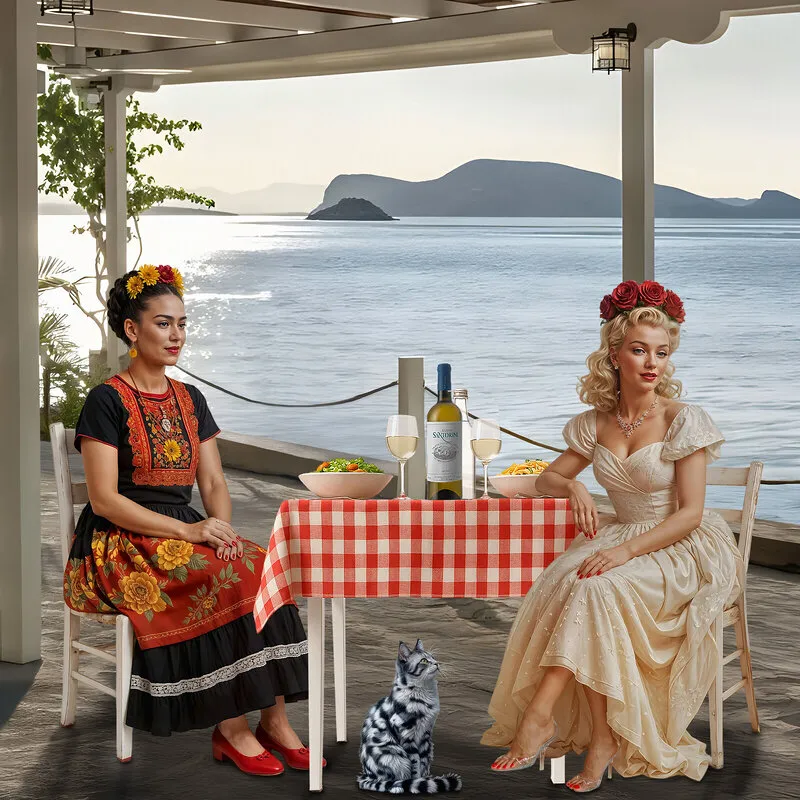
Red Lips and Nails, White Chairs, Gingham Table and a Sucker in Checks, 2025
Digital
80 x 80 cm
Red Lips and Nails, White Chairs, Gingham Table and a Sucker in Checks
A Table for Two (and One Sucker in Checks)
A tale about two women and a cat at Plakes Beach, Hydra – under a sun-warmed awning.
It all began with a typical lunch on an extraordinary island. At a seaside table adorned with red-and-white gingham, under a canopy of bougainvillea and myth, two women from different galaxies shared bread, stories, and the sun. Frida Kahlo arrived adorned in marigolds, resplendent in her Tehuana dress. Marilyn Monroe, on the other hand, donned a borrowed cream ballgown and Cinderella’s glass slippers—open-toed, naturally, to flaunt her pedicure.
Across the strait, the island of Dokos reclined like a sleeping princess, and beneath the table, a black-and-white cat in perfect checks—neither prince nor peasant, just a gingham sucker—waited hungrily for crumbs of seafood or metaphor.
They conversed, as is the custom on Hydra, about folklore and their destinies: Cinderella’s slipper, Aschenputtel’s bloodied shoe, Tấm’s vengeance sauce. But the dialogue soon veered towards another girl of ash and innocence. Snow White. Who was she, truly? An eternal virgin? A poisoned rival? A sleeping commodity? Or something far more perplexing?
Over lunch, they set the record straight. The myths of female passivity and male dominance cracked. The women didn’t. Please read on and get the whole picture.
"A Legazy whiter than Snow
She once was a whisper, a cherry-lipped dream,
Asleep in the forest beneath moonbeam.
Seven odd men with hearts full of dust
Kept watch by her side with reverent trust.
Her story was written in roses and glass,
A coffin of silence, a prince she let pass.
But Snow White woke up, said, “That’s not the end,”
And stitched a new future with thread she could bend.
She traded the apple for wisdom and wine,
Hung up her crown on a laundry line.
She kept the red ribbon but loosened the lace—
And found her rhythm, her kind of grace.
Then came a shimmer, a wormhole in bloom,
A breeze from the stars swept through her room.
Marilyn called her: “I need something bright—
A dress with a story, a second-hand light.”
So Snow packed a parcel, with gown and with shoes,
A sparkly reminder of lives you can choose.
Marilyn twirled in cream and delight,
Frida poured wine in the soft Grecian light.
And under the table, unnoticed, unseen,
A gingham-clad cat in black and in cream
Crept up to the plate with a whispering tread,
Where vongole pasta was cooling instead.
He sniffed at the steam, then gave it a try—
For gingham-born beasts know too well why
One must let things settle before taking a bite:
Even feline dreamers dislike tongues burned at night.
So thank you, dear Snow, for the dress and the lore,
For lending your glamour, your grief, and much more.
For the meal you forgot as you danced into myth,
And the cat who now purrs with a gingham-toothed sniff.”
Malmö, March 2025
A Table for Two (and a Sucker in Checks)
It all began with a simple lunch on a sunny day at the luxurious Four Seasons by Plakes Beach on Hydra. The sea breeze, laughter, and the scent of fresh oregano filled the air, creating a serene and timeless atmosphere. In the background, the island of Dokos reclined like a sleeping princess, adding to the enchanting setting.
The two guests of honour were anything but ordinary. Frida Kahlo, in her vibrant Tehuana dress, and Marilyn Monroe, radiant in a borrowed cream ballgown, sat across the table from each other. Their presence added an unexpected twist to the lunch.
It may sound like a long journey for lunch, but in reality, Plakes lies conveniently close—just a short leap through a well-placed wormhole. The fourth dimension, still baffling to Earth’s finest physicists, offers surprising shortcuts to those who know how to read the folds of time.
Marilyn, ever the aesthete, borrowed Cinderella’s glass slippers too, letting her red-painted toenails gleam beneath the gingham-covered table.
And just beneath that table, poised between shadow and sunlight, awaited a hopeful third guest: a black-and-white cat in a perfect gingham coat—what some might call checkered, others charming, but Frida called him Sucker. A freeloader, perhaps, but a stylish one, quietly sharing the moment with two eternal striders, pausing for lunch on a sunlit Greek island just a breath away from the stars.
Plakes Beach, Hydra – under a sun-warmed awning och de har just fått serverat var sin lunch, Marilyn en pasta vongole, Frida en läcker husets sallad.
Frida (smiling, reaching for her wine):
"What luck for you that Cinderella got her slipper back."
Marilyn (laughing softly):
"Not just the slipper, darling—she got the prince and half the kingdom too. And now? She has dozens of them. Slippers, I mean. Glass, of course. Superb and lovely to wear on a warm star. I chose a toe-open pair. I had to show off my pedicure.
Frida:
"Of course you did. I noticed—flawless. Askungen would be proud. Tell me again: which star does she currently live on?"
Marilyn:
"Star Gliese 581g, in the Carina Nebula. Perfect gravity, endless shoe closets, and not a pumpkin in sight. She lives next door to Vega and Antares. And you know how Antares is—always dramatic, always glowing like he’s about to burst into flames.
Frida:
Very much in line with the image of a fairytale queen. Though people think Walt Disney invented her."
Marilyn:
"Ha! As if. Askungen’s older than Rome. She wore gold before she wore glass. In one version, a bird stole her shoe and dropped it in an Egyptian king’s lap. He married her on the spot."
Frida:
"That was Rhodopis. Greek girl, Egyptian king, divine shoe delivery. Better than FedEx."
Marilyn:
"And Ye Xian—China, ninth century. Magic fish bones, golden shoes, dead stepmother crushed under stones. Not exactly Disney."
Frida (giggling):
"And not even the worst of them. Remember Aschenputtel? The stepsisters slice off their toes to fit the shoe. Birds peck out their eyes at the wedding. Charming, no?"
Marilyn:
"Charming and Grimm. Perrault made it prettier—pumpkin, fairy godmother, and glass slipper. That famous mistranslation, maybe. Was it glass? Was it fur? It doesn't matter. The glass is stuck.
Frida:
"Glass is pure poetry. Transparent, delicate, dangerous. Like some women I know."
Marilyn (raising her brows):
"Guilty. But we all know it wasn’t really about the slipper. It was about class. She didn’t rise through courage—she married well."
Frida:
"She adapted to survive. It’s what women have done for centuries. The slipper fit, but the system didn’t."
Marilyn (softly):
"Still doesn’t."
Frida (nodding):
"And yet, here we are. In folklore dresses and borrowed glass shoes, sitting under bougainvillea in Hydra."
Marilyn (gesturing under the table):
"And with him."
Beneath the gingham-draped table, a black-and-white cat, marked in perfect checks, licks his paw and glances up hopefully—neither prince nor peasant, but a sucker in checks, eternally ready for the next crumb of magic.
Marilyn (sipping her iced white wine): " Have you ever heard of Ċiklemfusa? She's from Malta. She baked krustini and concealed her identity in the pastries. Brilliant. A slipper is one thing—cookies are another.”
Frida (grinning): " Art and pastry—the only proper ways to express oneself.” And have you noticed how many of these girls begin in ashes? Cinders. Dust. Discarded.”
Marilyn:
“Exactly. But no one stays there. They transform. New dress, new name, new fate. Even those with the darkest paths—like Tấm in Vietnam. Her stepmother kills her, she returns as a bird, a loom, an apple... and ultimately, she cooks her stepsister into sauce.”
Frida (raising an eyebrow):
“Delicious vengeance.”
Marilyn (serious now):
“It's a different tone. These aren't just fairy tales—they map the emotions that cultures use to understand suffering, survival, and justice. Some forgive. Others... don't.”
Frida:
“And that tells us something. The Perrault version, with the patient, passive Cinderella—it reflects French court values. Grace. Restraint. Good breeding.”
Marilyn:
Aschenputtel embodies the pure essence of rural Germany. Gritty, earthy. Blood in the shoe, birds in the sky, justice like clockwork.”
Frida:
Then there's Ye Xian, with her magical fish bones: ancestor veneration and animal spirits—the constant thread of reverence for the dead.
Marilyn (leaning back):
“Even Aspasia of Phocaea, with her shining moon on her forehead. Persia gave her beauty a metaphysical glow. Inner light as destiny.”
Frida:
“In Europe, it was inheritance. In Asia, transformation. In some African versions, the mother becomes a fish or a cow—always returning to guide her children. The mother never truly leaves.”
Marilyn (quietly):
“Mine did.”
Frida (reaching over):
“So did mine. But maybe that's why these stories resonate with us.”
(A pause. The breeze carries the scent of thyme and salt. The checked cat stretches, tail flicking, unbothered by human heartache.)
Marilyn (smiling faintly):
“Anyway, Disney skipped all that. Made her blonde, wide-eyed, and fragile. Mice sew the dress, not magic bones. The stepmother sneers, but no one bleeds. Everyone smiles at the wedding.”
Frida:
“Coated patriarchy.”
Marilyn:
“Marketable myth.”
Frida: " But ask yourself: Why did they choose that version? Not Aschenputtel. Not Tấm. Not Zezolla. The Disney girl does nothing. She waits.”
Marilyn (gently):
“Maybe because waiting is safer than wanting.”
Frida:
“Maybe. But wanting changes the world.”
Marilyn:
“It 's also what gets you killed.”
Frida (shrugging):
“Or canonised.”
They gaze out over the sea. Dokos still lies there like a reclining princess at rest. And there, beneath the table, the cat continues to purr through his checkered dreams. Frida and Marilyn remain for a while, two time travellers among fairy tales and sunlit reflections, discussing girls who became mothers, trees, birds, phantoms, queens—or kept walking.
Marilyn (looking out toward the horizon):
“You know, they still tell her story. Just dressed in heels instead of slippers.”
Frida:
“‘Pretty Woman.’ ‘My Fair Lady.’ ‘Maid in Manhattan.’ Cinderella keeps putting on new shoes.”
Marilyn (laughing):
“And they always seem to lead her straight to a man with money. Funny, isn't it?”
Frida:
“Not funny. Familiar.”
Marilyn (nodding):
“She starts low. She gets a makeover. He notices her. She hesitates; he insists. And poof—castle, credit card, couture.”
Frida:
“Pygmalion 's clay, updated with spa treatments.”
Marilyn:
It's like the American Dream in a ball gown. Be beautiful, be good, and the world will rescue you.”
Frida (dryly):
“Unless it doesn't.”
Marilyn:
“Exactly. That's why I like the version where she runs. Before midnight. Before the spell. Before he gets to speak.”
Frida:
“She chooses her exit. That's power.”
Marilyn:
“And yet... sometimes I wonder—what if Cinderella didn't want the prince at all?” What if she just wanted the shoes?”
Frida:
“Or the freedom to dance.”
Marilyn:
“Or a moment where everyone looked at her and saw something... divine.”
Frida:
“That's closer to the truth. Not love, but recognition.”
Marilyn:
“Even in sports, they use her name—'a Cinderella team,’ they say. An underdog that wins against all odds.”
Frida:
“So the story has become a metaphor. For justice. For surprise. For the impossible turning real.”
Marilyn:
“But still... always on someone else 's terms. A palace. A prince. A prize.”
Frida (uncorking the bottle again):
“And never a girl who simply stays in the garden, barefoot, not caring whether the shoe fits.”
Marilyn:
“I think your Cinderella would paint.”
Frida:
“And yours would sing.
Marilyn (smiling):
“She'd sing in bare feet and red lipstick. And she'd keep the glass slipper —not to wear, but to smash when needed.
Frida (raises her glass):
“To all the Cinderellas they never wrote down. The ones who danced anyway.”
Marilyn:
“To the girls who ran before the clock struck twelve.”
They toast. The cat purrs. Dokos remains. And somewhere far away among the nebulae, in a shoe cabinet on Gliese 581g, a dozen glass slippers glitter—unworn, but beloved.
Marilyn (pushing aside her plate, thoughtful):
“Do you know what we completely forgot? The seven dwarfs. They're always present, but... doing what?”
Frida (with a crooked smile):
“Working. Digging. Cleaning. Caring for a sleeping girl with cherry lips and no rent money. The invisible labour force of the fairytale world.”
Marilyn:
“In the fifties, they were simply comic relief. Cute. Harmless. But there's something... off. Seven men living together in the woods, emotionally invested in one unconscious girl. It's almost like a farce, isn't it?”
Frida:
“A dream for some, a red flag for others.”
Marilyn (lowering her voice):
“And look at their names—Sleepy, Grumpy, Bashful… They're not characters; they're symptoms. It's like Freud cast the supporting roles.”
Frida:
“Exactly. Infantilised, neutered, reduced to functions. The story doesn't ask who they are, only what they provide.”
Marilyn:
“Shelter. Care. Uncomplicated male presence. No sex, no threat, just longing, dusted in diamonds.”
Frida (raising an eyebrow, playfully):
“But who were they? Miners with lung disease? Hermits? Leper colony dropouts? Or just seven gay men hiding out in the woods, creating a chosen family?”
Marilyn (giggles):
“And sharing one big bed, according to Disney. That was... a choice.”
Frida (nodding thoughtfully, then her eyes sparkle):
“Group sleeping. Or group something else.”
Marilyn (laughs):
“Modern audiences notice these things. One woman, seven bachelors, no boundaries. It's either a utopia or a scandal.”
Frida:
“Maybe both. The fairytale leaves it open, but we read between the lines. We always have.”
Marilyn:
“Sex, survival, exile—it 's all there if you tilt your head.”
Frida (smirks):
“Or squint with one eye and sip retsina.”
Marilyn:
We can't help it. We're post-Freud, post- feminism, post-everything. The stories were never innocent. Just better at pretending.”
(They both giggle like girls on the run, surrounded by fairy tales, wine, and Greek sunshine.) by fairy tales, wine, and Greek sunshine.)
Soon, the conversation shifts toward the shadows of the tale. The glamorous surfaces begin to crack slightly as Frida and Marilyn dive deeper into symbolism, oppression, resistance—and the possibility of reinterpretation.
Frida (turning her head slowly):
“But what about the stepmother? No one ever asks where she came from.”
Marilyn (gently blowing across her glass):
“Oh, she's always there. Waiting in the wings- jealous, bitter, ambitious. But maybe she was just... practical.”
Frida:
“Or angry. Overworked. Overlooked. Maybe Cinderella reminded her of everything she'd lost: youth, possibility, security.
Marilyn:
“They call her wicked, but the world she lives in is built on scarcity: one man, one fortune, one throne.”
Frida: " And daughters to be married off like chess pieces. It's no wonder she sharpened her claws.”
Marilyn (falls silent for a moment):
“You know what's cruelest? In the older versions, the father is still alive and watching. Silent.”
Frida:
“He represents the system: passive, protective of nothing but the structure. He doesn't burn things down—he lets them rot.
Marilyn (quietly):
“I knew men like that.”
Frida:
“Most of us did.”
(Pause. The waves lap gently against the rocks. The cat has curled up beneath the chair, a striped breath in the shade.)
Marilyn:
“And what about forgiveness? Disney's Cinderella forgives her stepsisters, marries the prince, hugs it all out.”
Frida (firmly):
“That's not forgiveness. That's compliance. That's... keeping the kingdom tidy.”
Marilyn:
“But Aschenputtel blinds them. Doves tear out their eyes. No redemption- just punishment.”
Frida:
“A warning. If you betray a girl in ashes, be prepared to bleed.”
Marilyn:
“Or be eaten. In Tam and Cam, the stepmother eats her daughter. That's beyond Grimm.”
Frida (with a crooked smile):
“Feminism in folklore is rarely polite.”
Marilyn:
“That's why I love it. These tales aren't sweet. They're filled with rage and hunger. They bite back.”
Frida:
“And they evolve. Look at queer retellings. Cinderella doesn't wait for the prince—she becomes him or leaves the ball with the maid.”
Marilyn (laughing):
“Or she rejects the whole palace and opens a tattoo studio.”
Frida:
“Or becomes a star. Like you.”
Marilyn (her gaze suddenly soft):
“Stars burn, Frida.”
Frida:
“So do women.”
They remain seated in silence for a while. In fairy tales, you dance, get rescued, or die. But in reality—or whatever this is between the stars and Plakes Beach—you talk, reflect, and reinterpret.
And somewhere, the story continues to whisper.
A girl who didn't fit into her home, her world, her shoes—
stepped out into the night
and invented herself.
Marilyn (looking down into her glass, slowly stirring it with her finger):
“You know... I didn't grow up with fairy tales. Not all of them, at least. Just whispers, illustrations, and half-told promises of rescue.
Frida:
“No glass slippers in the foster system.”
Marilyn (smiling faintly):
“No slippers, no pumpkins, no balls. Just strangers’ couches. I moved so often I lost count. I used to pretend I was Cinderella when I swept floors. Not the dancing one—the ash one.”
Frida (falls silent, then):
“My mother prayed, lit candles, and followed rules. But she didn't see me. My father, however—he gave me books, a camera, and opened my eyes.”
Marilyn:
“My mother... Gladys... she wanted to be a film editor. She worked at RKO Studios, but her mind was... fragile. Bright, then gone. I lived in fear of becoming her.”
Frida:
“So you became a myth instead.”
Marilyn:
“Safer, in a way. No one asks myths how they're feeling.”
Frida (leaning forward):
“But you loved. You ached. You were real.”
Marilyn:
“And you? You painted pain with flowers.”
Frida:
“I painted because my body betrayed me. But also because I needed someone to see me. Truly see me.”
Marilyn:
“Cinderella wanted that too. Not the prince. The gaze. The moment when the world says: ‘You exist.’”
Frida (nodding):
“She wanted to be chosen. But maybe more than that—she wanted to be known.”
Marilyn:
“And what if the prince never sees beyond the dress?
Frida:
“Then she takes the slipper, sharpens the heel, and carves a new path”
They both laugh, unexpectedly. The air is warm yet gentle, and from the kitchen comes the sound of clinking glasses and a light chuckle from a waiter. Beneath the table, the cat rolls onto its back as if it knows exactly what's happening.
Marilyn (thoughtfully):
“I sometimes wonder... if Cinderella had a mother—one who stayed—would she have needed the slipper at all?”
Frida:
“Maybe not. Perhaps she'd have planted something instead. A tree. A studio. A revolution.”
Marilyn:
“Or just stayed single. Bought her damn shoes.”
Frida (smirking):
“And painted her name on the palace wall.”
They sit in silence for a moment longer. Two women from different stars, both shaped by absent mothers and present myths. Both have lived the fairy tale from within and rewritten it with their own lives.
Frida (leans back, gazing out over the strait):
“You know what no one ever talks about? What happens after the slipper fits?”
Marilyn:
“Yes. The credits roll, the music swells, and... then what?”
Frida:
“Does she enjoy court life? Does she miss the mice? Does she ever take off the damn shoes?”
Marilyn (laughing):
“She probably gets bored. Starts a foundation. Adopts a rescue dragon. Maybe takes lovers.”
Frida:
“Or opens a flower shop.”
Marilyn:
“Or divorces the prince when she discovers he only liked her because she sparkled in candlelight.”
Frida:
“Do you think she ever sneaks back to the kitchen? To chop onions. To feel real.”
Marilyn (thoughtfully):
“Maybe. Or perhaps she will learn to speak. To rule. To rewrite the laws.”
Frida:
“And when her daughter asks about the glass slipper...?”
Marilyn:
“She says, ‘Darling, you don't need shoes to dance.’”
They laugh again, softly and warmly. Beneath the table, the cat sleeps—dreaming of leftovers, ribbons, and revolution.
The sun has begun to set, shadows growing longer across Plakes Beach. In the distance, Dokos still glows like a resting princess, and on another star, among cooling winds and dozens of glass heels, Cinderella tries on a new pair—not because she needs them, but because she wants to. Not because she needs them but because she wants to.

Jörgen Thornberg
Malmö
Lite om bilder och mig. Translation in English at the end.
Jag är en nyfiken person som ser allt i bilder, även det jag fäster i ord, gärna tillsammans för bakom alla mina bilder finns en berättelse. Till vissa bilder hör en kortare eller längre novell som följer med bilden.
Bilder berättar historier. Jag omges av naturlig skönhet, intressanta människor och historia var jag än går. Jag använder min kamera för att dokumentera världen och blanda det jag ser med vad jag känner för att fånga den dolda magin.
Mina bilder berättar mina historier. Genom mina bilder, tryck och berättelser. Jag bjuder in dig att ta del av dessa berättelser, in i ditt liv och hem och dela min mycket personliga syn på vår värld. Mer än vad ögat ser. Jag tänker i bilder, drömmer och skriver och pratar om dem; följaktligen måste jag också skapa bilder. De blir vad jag ser, inte nödvändigtvis begränsade till verkligheten. Det finns en bild runt varje hörn. Jag hoppas att du kommer att se vad jag såg och gilla det.
Jag är också en skrivande person och till många bilder hör en kortare eller längre essay. Den följer med tavlan, tryckt på fint papper och med en personlig hälsning från mig.
Flertalet bilder startar sin resa i min kamera. Enkelt förklarat beskriver jag bilden jag ser i mitt inre, upplevd eller fantiserad. Bilden uppstår inom mig redan innan jag fått okularet till ögat. På bråkdelen av ett ögonblick ser jag vad jag vill ha och vad som kan göras med bilden. Här skall jag stoppa in en giraff, stålmannen, Titanic eller vad det är min fantasi finner ut. Ännu märkligare är att jag kommer ihåg minnesbilden långt efteråt när det blir tid att skapa verket. Om jag lyckas eller inte, är upp till betraktaren, oftast präglat av en stråk av svart humor – meningen är att man skall bli underhållen. Mina bilder blir ofta en snackis där de hänger.
Jag föredrar bilder som förmedlar ett budskap i flera lager. Vid första anblicken fylld av feel-good, en vacker utsikt, fint väder, solen skiner, blommor på ängen eller vattnet som ligger förrädiskt spegelblankt. I en sådan bild kan jag gömma min egentliga berättelse, mitt förakt för förtryckare och våldsverkare, rasister och fördomsfulla människor - ett gärna återkommande motiv mer eller mindre dolt i det vackra motivet. Jag försöker förena dem i ett gemensamt narrativ.
Bild och formgivning har löpt som en röd tråd genom livet. Fotokonst känns som en värdig final som jag gärna delar med mig.
Min genre är vid som framgår av mina bilder, temat en blandning av pop- och gatukonst i kollage som kan bestå av hundratals lager. Vissa bilder kan ta veckor, andra någon dag innan det är dags att överlämna resultatet till printverkstaden. Fine Art Prints är digitala fotocollage. I dessa kollage sker rivandet, klippandet, pusslandet, målandet, ritandet och sprayningen digitalt. Det jag monterar in kan vara hundratals år gamla bilder som jag omsorgsfullt frilägger så att de ser ut att vara en del av tavlan men också bilder skapade av mig själv efter min egen fantasi. Därefter besöks printstudion och för vissa bilder numrera en limiterad upplaga (oftast 7 exemplar) och signera för hand. Vissa bilder kan köpas i olika format. Det är bara att fråga efter vilka. Gillar man en bild som är 70x100 men inte har plats på väggen, går den kanske att få i 50x70 cm istället. Frågan är fri.
Metoden Giclée eller Fine Art Print som det också kallas är det moderna sättet för framställning av grafisk konst. Villkoret för denna typ av utskrifter är att en högkvalitativ storformatskrivare används med åldersbeständigt färgpigment och konstnärspapper eller i förekommande fall på duk. Pappret som används möter de krav på livslängd som ställs av museer och gallerier. Normalt säljer jag mina bilder oinramade så att den nya ägaren själv kan bestämma hur de skall se ut, med eller utan passepartout färg på ram, med eller utan glas etc..
Under många år ställde jag bara ut på nätet, i valda grupper och på min egen Facebooksida - https://www.facebook.com/jorgen.thornberg.9
Jag finns också på en egen hemsida som tyvärr inte alltid är uppdaterad – https://www.jth.life/ Där kan du också läsa en del av de berättelser som följer med bilden.
UTSTÄLLNINGAR
Luftkastellet, oktober 2022
Konst i Lund, november 2022
Luftkastellet, mars 2023
Engleson Galleri Caroli, april 2023
Hydra, Greece June 2023
Engleson Galleri Caroli, oktober 2023
Toppen, Höllviken december 2023
Luftkastellet, mars 2024
Torups Galleri, mars 2024
Venice, May 2024
Luftkastellet, oktober 2024
Konst i Advent, December 2024
Galleri Engleson, Caroli December 2024
Jäger & Jansson Galleri, april 2025
A bit about pictures and me.
I'm a curious person who sees everything in pictures, even what I express in words, often combining them, for behind all my pictures lies a story. These narratives, some as short as a single image and others as long as a novel, are the heart and soul of my work.
Pictures tell stories. Wherever I go, I'm surrounded by natural beauty, exciting people, and history. I use my camera to document the world and blend what I see with what I feel to capture the hidden magic.
My images tell my stories. Through my pictures, prints, and narratives, I invite you to partake in these stories in your life and home and share my deeply personal perspective of our world. More than meets the eye. I think in pictures, dream, write, and talk about them; consequently, I must create images too. They become what I see, not necessarily confined to reality. There's a picture around every corner. I hope you'll see what I saw and enjoy it.
I'm also a writer, and many images come with a shorter or longer essay. It accompanies the painting, printed on fine paper with my personal greeting.
Many pictures start their journey on my camera. Simply put, I describe the image I see in my mind, experienced or imagined. The image arises within me even before I bring the eyepiece to my eye. In a fraction of a moment, I see what I want and what can be done with the picture. Here, I'll insert a giraffe, Superman, the Titanic, or whatever my imagination conjures up. Even stranger is that I remember the mental image long after it's time to create the work. Whether I succeed is up to the observer, often imbued with a streak of black humour – the aim is to entertain. My pictures usually become a talking point wherever they hang.
I prefer pictures that convey a message in multiple layers. At first glance, they're filled with feel-good vibes, a beautiful view, lovely weather, the sun shining, flowers in the meadow, or the water lying deceptively calm. But beneath this surface beauty, I often conceal a deeper story, a narrative that challenges societal norms or explores the human condition. I invite you to delve into these hidden narratives and discover the layers of meaning within my work.
Picture and design have been a thread running through my life. Photographic art feels like a fitting finale, and I'm happy to share it.
My genre is varied, as seen in my pictures; the theme is a blend of pop and street art in collages that can consist of hundreds of layers. Some images can take weeks, others just a day before it's time to hand over the result to the print workshop. Fine Art Prints are digital photo collages. In these collages, tearing, cutting, puzzling, painting, drawing, and spraying happen digitally. What I insert can be images hundreds of years old that I carefully extract so they appear to be part of the painting, but also images created by myself, now also generated from my imagination. Next, visit the print studio and, for certain images, number a limited edition (usually 7 copies) and sign them by hand. Some images may be available in other formats. Just ask which ones. If you like an image that's 70x100 but doesn't have space on the wall, you might be able to get it in 50x70 cm instead. The question is open.
The Giclée method, or Fine Art Print as it's also called, is the modern way of producing graphic art. This method ensures the highest quality and longevity of the artwork, using a high-quality large-format printer with archival pigment inks and artist paper or, in some cases, canvas. The paper used meets the longevity requirements set by museums and galleries. I sell my pictures unframed, allowing the new owner to personalise their artwork, confident in the lasting value and quality of the piece.
For many years, I only exhibited online, in selected groups, and on my Facebook page - https://www.facebook.com/jorgen.thornberg.9. I also have my website, which unfortunately is not constantly updated - https://www.jth.life/. You can also read some of the stories accompanying the pictures there.
EXHIBITIONS
Luftkastellet, October 2022
Art in Lund, November 2022
Luftkastellet, March 2023
Engleson Gallery Caroli, April 2023
Hydra, Greece June 2023
Engleson Gallery Caroli, October 2023
Toppen, Höllviken December 2023
Luftkastellet, March 2024
Torup Gallery, March 2024
Venice, May 2024
UTSTÄLLNINGAR
Luftkastellet, oktober 2022
Konst i Lund, november 2022
Luftkastellet, mars 2023
Engleson Galleri Caroli, april 2023
Hydra, Greece June 2023
Engleson Galleri Caroli, oktober 2023
Toppen, Höllviken december 2023
Luftkastellet, mars 2024
Torups Galleri, mars 2024
Venice, May 2024
Luftkastellet, October 2024
Konst i Advent, December 2024
Galleri Engleson, Caroli December 2024
Jäger & Jansson Galleri, April 2025
Utbildning
Autodidakt
Medlem i konstnärsförening
Öppna Sinnen
Med i konstrunda
Konstrundan i Skåne
Utställningar
Luftkastellet, October 2022
Art in Lund, November 2022
Luftkastellet, March 2023
Engleson Gallery Caroli, April 2023
Hydra, Greece June 2023
Engleson Gallery Caroli, October 2023
Toppen, Höllviken December 2023
Luftkastellet, March 2024
Torup Gallery, March 2024
Venice, May 2024