Vi använder cookies för att ge dig bästa möjliga upplevelse. Välj vilka cookies du tillåter.
Läs mer i vår integritetspolicy
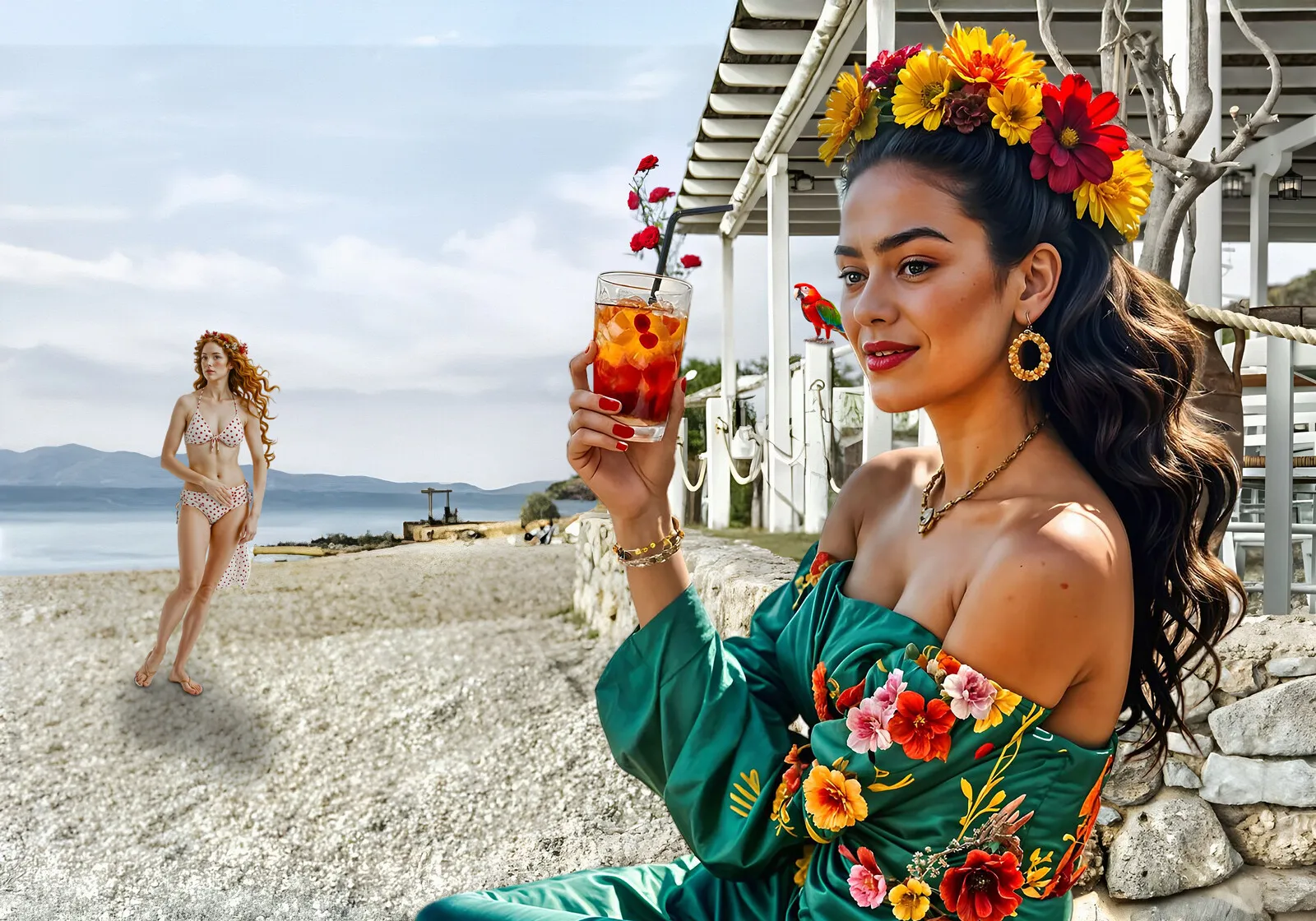
Jörgen Thornberg
Eternal Beauty, 2025
Digital
70 x 50 cm
Eternal Beauty
A Toast on Plakes Beach
Every year, as the first ripe strawberries arrive on Hydra, a new season begins at the bar. This is the moment when the ordinary mojito transforms into something extraordinary, mirroring the transformation in our story. Inspired by the sun-drenched Mediterranean and the timeless pleasures of fresh fruit and fine spirits, this strawberry mojito has become a favourite—first for Frida and me, and now even for Simonetta. A drink that blends tradition with indulgence, it’s a toast to the past, present, and everything in between. Cheers, damn it!
Continue reading to uncover the whimsical tale of Frida, Simonetta or Venus if you like. And get the recipe for the mojito.
"Cheers, damn it!
The sun dipped low, the waves did gleam,
A drink in hand, a summer dream.
With ruby red and minted sweet,
In Hydra’s dusk, the worlds did meet.
Frida laughed, her glass held high,
Simonetta winked beneath the sky.
Venus, golden, fresh and free,
Raised her toast beside the sea.
Strawberries crushed in crimson bliss,
A whisper of lime, a cooling kiss.
White rum swirled, a fragrant tide,
As soda fizzed and danced inside.
Basil bold or mint’s embrace,
Each sip is a journey, time and place.
A goddess’ drink, both wild and true,
In Plakes' glow, beneath skies blue.
Inanna's love, both fierce and grand,
Ishtar’s touch, a guiding hand.
Astarte smiled through time’s embrace,
Aphrodite’s light adorned the place.
Through history’s mist, their voices rise,
Whispered secrets in moonlit skies.
Each goddess here, each name anew,
In drink, in love, in ocean’s hue.
A toast to love, to joy, tonight,
To timeless friends in golden light.
So raise your glass and drink it deep,
For Hydra’s memories, we shall keep.
Cheers, damn it!”
Malmö, February 2025
Eternal Beauty
On the beach at Plakes, a figure approached with an air of mystery, a secret that would soon unravel. It was Venus, and her arrival was shrouded in enigma. People from all times and places come to Hydra, but I was the first to lay eyes on her. Frida, lost in her thoughts, held her red Strawberry Mojito in a manner that concealed the other woman who had appeared from the north.
As Venus, or so I had already begun to call her, drew near, I felt a unique connection, a bond that transcended time and space. She, too, was a Time-traveller, appearing on the beach just moments after it had been empty. Our eyes met, and I could feel her thoughts intertwining with mine. Such connections are rare, but I assure you, they are real.
The red-blonde hair, the same brown eyes as in Botticelli’s painting The Birth of Venus, the nose, mouth, and eyebrows—everything was present as if time had stood still. She had returned, reincarnated, reborn. But who was she? In Roman and Greek mythology, Venus existed and was worshipped as the goddess of love, beauty, and fertility. The Greeks, who were first, referred to her as Aphrodite and claimed she was born fully grown from the foam of the sea after Kronos castrated Uranus and cast his genitals into the ocean. She was considered the most beautiful of all goddesses and had a profound connection to love, passion, and desire. The latter certainly resonated with many men who had seen her as Botticelli’s model for his painting.
She is frequently depicted with symbols such as doves, roses, mirrors, and shells. In Botticelli’s The Birth of Venus, she rises from the sea on a gigantic seashell, symbolising the power of beauty and love. I already knew much about Venus and her twin. The day before, Frida had raised the subject and informed me that Aphrodite had a summer retreat on Hydra, a cave near Limnioniza. Cave? It resembles a palace concealed from all mortals behind the walls of the rock chamber. Naturally, this was no coincidence; for now, she was here. Whoever she was.
Whether the goddess Venus existed outside of mythology depends on whom you ask. Among the stars, there are several contenders for the divine throne. Inanna (according to Sumerian mythology, around 3000 BCE), the oldest known goddess of love and fertility, existed in Mesopotamia and was associated with love, sexuality, war, and celestial powers. Her planet was Venus, linking Inanna to later traditions, something the Romans noted when they renamed Aphrodite. Her mythology was nothing short of dramatic, including her descent into the underworld. Enheduanna (circa 2285–2250 BCE), the world’s first known author, was a priestess in Ur, the daughter of King Sargon of Akkad, the founder of the Akkadian Empire. She composed hymns and poetry to the gods, particularly to Inanna. Her texts were religious, political, and personal, making them unique for their time. Like me, she often wrote in the first person, which was unusual and indicates that she considered herself part of her poetry.
Her most significant works—which can be read in English translation online—include The Hymn to Inanna, in which Inanna is revered as a powerful and terrifying goddess, embodying both love and destruction. In The Exaltation of Inanna, Enheduanna aligns herself with Inanna and narrates her exile and return—definitely worth reading. You can find several of her poems here, along with explanations: https://enheduana.org/enheduanas-poems/.
Next is Ishtar, the Akkadian, Assyrian, and Babylonian counterpart to Inanna, emerging about a millennium later, around 2000 BCE. She, too, was linked with love, war, and the planet Venus and was characterised as both a seductive goddess and a warrior deity. Ishtar was worshipped across Mesopotamia, with her influence extending to Canaanite and Anatolian cultures.
Following closely was Astarte, the Phoenician version of Ishtar, esteemed throughout the Levant and even in Egypt. She can be viewed as the spiritual mother of Aphrodite. When the Greeks encountered the cultures of the eastern Mediterranean—particularly the Phoenicians and their colonies—they adopted elements of Astarte. They fused her with local concepts of a love goddess, as such a deity was essential.
The Romans, in turn, embraced Aphrodite and transformed her into Venus, adding a more political dimension (such as Venus Genetrix, the ancestress of Julius Caesar’s lineage).
We believe we know how she looked from ancient sculpture, the most famous being the Venus de Milo, or more accurately, the Aphrodite of Melos, an ancient Greek marble sculpture created during the Hellenistic period. Its exact dating is uncertain, but modern consensus places it in the 2nd century BCE, possibly between 160 and 110 BCE. It was rediscovered in 1820 on the island of Milos, Greece, and has been displayed at the Louvre Museum since 1821. Since its discovery, it has become one of the most renowned works of ancient Greek sculpture.
Whoever this woman is, she exudes a timeless beauty and confidence that is truly captivating. Her presence is more fabulous and self-assured than Botticelli’s later depiction, a Venus who gazes down at the waves with a hint of longing.
Despite their mythological reputation for numerous love affairs, Aphrodite and Venus are depicted as shy and innocent in Botticelli’s The Birth of Venus, creating a striking contrast that invites further investigation.
Aphrodite and her twin Venus were undoubtedly not passive or timid goddesses. On the contrary, they were associated with lust, passion, and infidelity, engaging in numerous affairs with both gods and mortals. Some might refer to this as raw passion today, as these goddesses represented the ultimate fantasy for Roman and Greek men. They took what they desired and had many lovers. Many of their partners are well-known, and the list is extensive. Among the most famous is Ares/Mars—her most renowned affair was with the war god, despite being married to the blacksmith god Hephaestus/Vulcan. Their infidelity became public knowledge, and she faced humiliation. Notice how, much like today, the woman bears the brunt of the condemnation while the lustful man swiftly vanishes from the narrative.
Adonis was a handsome young man she loved passionately and mourned deeply upon his death. This situation was more akin to a romance novel, and bookstores remain filled with such tales, as women often embrace these narratives. It could even be described as their version of erotica—softer than men’s.
The tale of Venus and Anchises—a mortal prince with whom she bore Aeneas, whom the Romans later claimed as their forefather—is a relatively respectable story that still fits within the pattern.
In the myths, she was anything but shy; instead, she was a divine force of desire and seduction, making her both adored and feared. She pursued men rather than the other way around. The term "wanton hussy" appears repeatedly in historical texts. Some ancient writers and moralists have described Aphrodite/Venus in disparaging terms because her promiscuity challenged traditional gender roles. The Romans and Greeks believed a woman’s place was in the home, and her primary role was bearing children. If she strayed more than five metres from the hearth, she was deemed to be running away—a joke that has survived into modern times. Yet goddesses were divine forces beyond anyone’s control—they ruled mortals and deities with love and desire.
While Botticelli’s Venus exudes an innocent longing for the sea, the mythological Venus/Aphrodite was a powerful, sensual, and often manipulative goddess, a far cry from the demure figure in Renaissance art. This stark contrast begs the question: why did Botticelli portray Venus in such an innocent light?
Botticelli depicted Venus differently from her mythological description, likely due to Renaissance ideals and the Platonic beauty cult at the Medici court. The Birth of Venus is not merely a portrayal of the myth but also an allegory of idealised beauty.
The woman in the painting symbolises divine, pure love, not earthly desire. Her shy gaze and posture (with hands modestly covering her body) give her an almost virginal aura, starkly contrasting with the uninhibited goddess of ancient myths. The Venus statue, however, allows a loosely draped cloth to barely conceal her lower body while her well-formed breasts remain exposed without hesitation.
Botticelli adhered to the Renaissance's deep interest in Neoplatonism, where physical beauty was regarded as a pathway to higher spiritual enlightenment. This brings us to the woman on Plake Beach—for she was a human, not an immortal goddess. Her name was Simonetta, and she truly existed. She lived in Florence, was married to Marco Vespucci, and was considered one of the most captivating beauties of Northern Italy—but from there, the story becomes murky.
Simonetta Vespucci, also known as La Bella Simonetta, was an Italian noblewoman from Genoa. She was the wife of Marco Vespucci of Florence and a cousin-in-law of Amerigo Vespucci. She was renowned as the most striking beauty of her time in Italy, and her allure and mystery continue to captivate us today.
Simonetta was born around 1453 in a part of the Republic of Genoa, now in the Italian region of Liguria. The Florentine poet Politian wrote that her home was “in that stern Ligurian district up above the seacoast, where angry Neptune beats against the rocks... There, like Venus, she was born among the waves.”
Botticelli’s Portrait of a Young Woman (circa 1475–1480) is regarded as the first direct portrait of Simonetta. Primavera may have been the first of his grand allegorical paintings in which her features inspired a goddess-like figure.
There are numerous symbolic references in Portrait of a Young Woman—the gemstone from the Medici treasury, the pearls in her hair (resembling a wasp’s nest), alluding to the Vespucci family’s heraldic animal (vespa, meaning wasp), and much more. The painting is believed to depict Simonetta while she was still alive—she died at just 22 years old and was regarded as the beauty queen of her time. Her facial features, long wavy hair, and high forehead align with descriptions of Simonetta. Unlike The Birth of Venus or Primavera, this is a portrait rather than an allegorical painting, increasing the likelihood that it represents her as she was rather than in an idealised manner. In the following years, Botticelli repeatedly used this painting and his memories of her to portray her in various roles.
At grand feasts, she became the platonic lover of the illustrious Giuliano de’ Medici, perhaps even more than that. However, the love—platonic or otherwise—that left the most enduring mark on art history was Botticelli’s numerous paintings in which she is believed to appear, including Primavera, where she assumes multiple figures, all equally breathtaking.
Many art historians propose that Botticelli fell in love with Simonetta, a theory supported by his request to be buried in the Church of Ognissanti, the Vespucci family’s parish church in Florence. His wish was realised 34 years later, in 1510.
The alleged love of Botticelli’s life was married to another man. The artist is said to have been infatuated with Simonetta, who, although she passed away in 1476, is believed to have served as the model for Venus and several other female figures in The Birth of Venus and Primavera.
Primavera (ca. 1477–1482) was painted shortly after her death. If Venus in this painting is based on Simonetta, it is an exquisite posthumous tribute.
The Birth of Venus (ca. 1484–1486) was painted considerably later, and even if Simonetta inspired it, she appears more as an idealised goddess than a personal portrait. Yet, the resemblance is striking, and the woman on the beach confirmed that it was her in the painting. Clearly, Frida and she knew each other—through Botticelli, whom Frida admired and met occasionally. As Simonetta had, in eternity, reunited with Botticelli on his star, their encounters were frequent. And now she had come to Hydra to see if their mutual friend Ghika’s description was accurate.
As for our meeting, that tale is for another time. But let it be said that she possessed none of Aphrodite’s traits—she was, for all intents and purposes, an ordinary girl, albeit 548 years old, if one must mention a lady’s age. Remarkably well-preserved, I must say. It was easy to feel at ease in her presence, and of course, I always had Frida’s gaze upon me.
Finally, I want to share my favourite drink, Frida's and now Simonetta’s. Every spring, when the first baskets of strawberries arrive in Hydra, a new phase begins at the bar. I only discovered it a few years ago when I had so plump, juicy, and incredibly sweet strawberries that I immediately thought of turning them into a strawberry mojito cocktail.
A mojito is usually made with mint, and this strawberry mojito cocktail is delicious with it. But for a change, try swapping in fresh basil. Strawberry and basil go wonderfully well together, and you’ll be amazed at the aromas they can add to this cocktail!
For the fresh strawberry puree
• 150 g packed hulled and quartered fresh strawberries
• 1 large fresh mint leaf
• 15 ml granulated sugar
For the strawberry mojito cocktail
• 15 ml freshly squeezed lime juice (about ½ lime)
• 10 fresh mint leaves
• 30 ml fresh strawberry puree
• 30 ml white rum
• 30 ml simple syrup (see note)
• 120 ml soda or sparkling water
• Ice cubes
What to do:
For the strawberry puree:
Add the strawberries, mint, and sugar to a blender. Blend until very smooth. (You can also use a stick blender or a mini food processor to puree the strawberries.)
Strain the puree and discard the seeds and larger bits of mint. Refrigerate in a jar or an airtight container for up to one week. You will have more puree than you need for one cocktail. Freeze the remaining puree in an ice cube tray to portion it out for future strawberry mojito cocktails.
To make the strawberry mojito cocktail:
Add lime juice and mint leaves to a shaker. Using a muddler or a wooden spoon, crush the mint leaves to release their flavour into the lime juice. Add the fresh strawberry puree, rum, and simple syrup, and top with 4-5 ice cubes. Shake vigorously, then strain into a tall glass. Add 3 or 4 ice cubes, then top off with soda or sparkling water.
Garnish with a fresh strawberry if desired, and enjoy immediately.
Cheers, damn it!
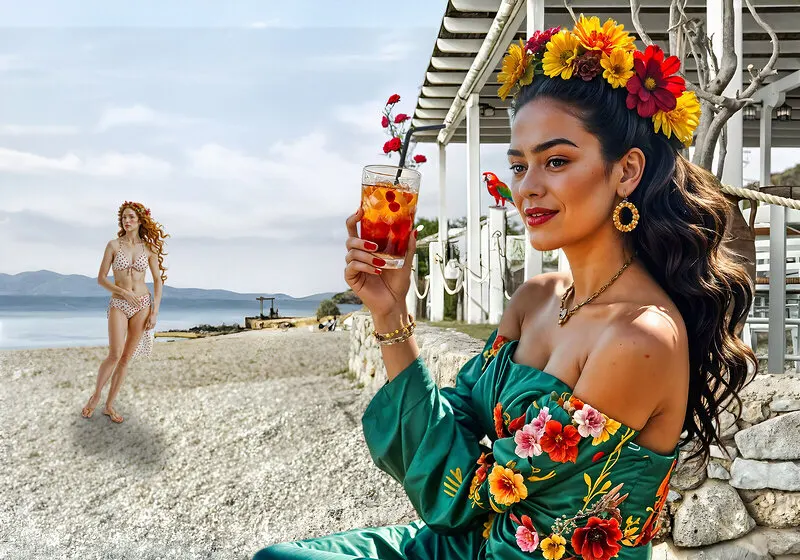
Jörgen Thornberg
Eternal Beauty, 2025
Digital
70 x 50 cm
Eternal Beauty
A Toast on Plakes Beach
Every year, as the first ripe strawberries arrive on Hydra, a new season begins at the bar. This is the moment when the ordinary mojito transforms into something extraordinary, mirroring the transformation in our story. Inspired by the sun-drenched Mediterranean and the timeless pleasures of fresh fruit and fine spirits, this strawberry mojito has become a favourite—first for Frida and me, and now even for Simonetta. A drink that blends tradition with indulgence, it’s a toast to the past, present, and everything in between. Cheers, damn it!
Continue reading to uncover the whimsical tale of Frida, Simonetta or Venus if you like. And get the recipe for the mojito.
"Cheers, damn it!
The sun dipped low, the waves did gleam,
A drink in hand, a summer dream.
With ruby red and minted sweet,
In Hydra’s dusk, the worlds did meet.
Frida laughed, her glass held high,
Simonetta winked beneath the sky.
Venus, golden, fresh and free,
Raised her toast beside the sea.
Strawberries crushed in crimson bliss,
A whisper of lime, a cooling kiss.
White rum swirled, a fragrant tide,
As soda fizzed and danced inside.
Basil bold or mint’s embrace,
Each sip is a journey, time and place.
A goddess’ drink, both wild and true,
In Plakes' glow, beneath skies blue.
Inanna's love, both fierce and grand,
Ishtar’s touch, a guiding hand.
Astarte smiled through time’s embrace,
Aphrodite’s light adorned the place.
Through history’s mist, their voices rise,
Whispered secrets in moonlit skies.
Each goddess here, each name anew,
In drink, in love, in ocean’s hue.
A toast to love, to joy, tonight,
To timeless friends in golden light.
So raise your glass and drink it deep,
For Hydra’s memories, we shall keep.
Cheers, damn it!”
Malmö, February 2025
Eternal Beauty
On the beach at Plakes, a figure approached with an air of mystery, a secret that would soon unravel. It was Venus, and her arrival was shrouded in enigma. People from all times and places come to Hydra, but I was the first to lay eyes on her. Frida, lost in her thoughts, held her red Strawberry Mojito in a manner that concealed the other woman who had appeared from the north.
As Venus, or so I had already begun to call her, drew near, I felt a unique connection, a bond that transcended time and space. She, too, was a Time-traveller, appearing on the beach just moments after it had been empty. Our eyes met, and I could feel her thoughts intertwining with mine. Such connections are rare, but I assure you, they are real.
The red-blonde hair, the same brown eyes as in Botticelli’s painting The Birth of Venus, the nose, mouth, and eyebrows—everything was present as if time had stood still. She had returned, reincarnated, reborn. But who was she? In Roman and Greek mythology, Venus existed and was worshipped as the goddess of love, beauty, and fertility. The Greeks, who were first, referred to her as Aphrodite and claimed she was born fully grown from the foam of the sea after Kronos castrated Uranus and cast his genitals into the ocean. She was considered the most beautiful of all goddesses and had a profound connection to love, passion, and desire. The latter certainly resonated with many men who had seen her as Botticelli’s model for his painting.
She is frequently depicted with symbols such as doves, roses, mirrors, and shells. In Botticelli’s The Birth of Venus, she rises from the sea on a gigantic seashell, symbolising the power of beauty and love. I already knew much about Venus and her twin. The day before, Frida had raised the subject and informed me that Aphrodite had a summer retreat on Hydra, a cave near Limnioniza. Cave? It resembles a palace concealed from all mortals behind the walls of the rock chamber. Naturally, this was no coincidence; for now, she was here. Whoever she was.
Whether the goddess Venus existed outside of mythology depends on whom you ask. Among the stars, there are several contenders for the divine throne. Inanna (according to Sumerian mythology, around 3000 BCE), the oldest known goddess of love and fertility, existed in Mesopotamia and was associated with love, sexuality, war, and celestial powers. Her planet was Venus, linking Inanna to later traditions, something the Romans noted when they renamed Aphrodite. Her mythology was nothing short of dramatic, including her descent into the underworld. Enheduanna (circa 2285–2250 BCE), the world’s first known author, was a priestess in Ur, the daughter of King Sargon of Akkad, the founder of the Akkadian Empire. She composed hymns and poetry to the gods, particularly to Inanna. Her texts were religious, political, and personal, making them unique for their time. Like me, she often wrote in the first person, which was unusual and indicates that she considered herself part of her poetry.
Her most significant works—which can be read in English translation online—include The Hymn to Inanna, in which Inanna is revered as a powerful and terrifying goddess, embodying both love and destruction. In The Exaltation of Inanna, Enheduanna aligns herself with Inanna and narrates her exile and return—definitely worth reading. You can find several of her poems here, along with explanations: https://enheduana.org/enheduanas-poems/.
Next is Ishtar, the Akkadian, Assyrian, and Babylonian counterpart to Inanna, emerging about a millennium later, around 2000 BCE. She, too, was linked with love, war, and the planet Venus and was characterised as both a seductive goddess and a warrior deity. Ishtar was worshipped across Mesopotamia, with her influence extending to Canaanite and Anatolian cultures.
Following closely was Astarte, the Phoenician version of Ishtar, esteemed throughout the Levant and even in Egypt. She can be viewed as the spiritual mother of Aphrodite. When the Greeks encountered the cultures of the eastern Mediterranean—particularly the Phoenicians and their colonies—they adopted elements of Astarte. They fused her with local concepts of a love goddess, as such a deity was essential.
The Romans, in turn, embraced Aphrodite and transformed her into Venus, adding a more political dimension (such as Venus Genetrix, the ancestress of Julius Caesar’s lineage).
We believe we know how she looked from ancient sculpture, the most famous being the Venus de Milo, or more accurately, the Aphrodite of Melos, an ancient Greek marble sculpture created during the Hellenistic period. Its exact dating is uncertain, but modern consensus places it in the 2nd century BCE, possibly between 160 and 110 BCE. It was rediscovered in 1820 on the island of Milos, Greece, and has been displayed at the Louvre Museum since 1821. Since its discovery, it has become one of the most renowned works of ancient Greek sculpture.
Whoever this woman is, she exudes a timeless beauty and confidence that is truly captivating. Her presence is more fabulous and self-assured than Botticelli’s later depiction, a Venus who gazes down at the waves with a hint of longing.
Despite their mythological reputation for numerous love affairs, Aphrodite and Venus are depicted as shy and innocent in Botticelli’s The Birth of Venus, creating a striking contrast that invites further investigation.
Aphrodite and her twin Venus were undoubtedly not passive or timid goddesses. On the contrary, they were associated with lust, passion, and infidelity, engaging in numerous affairs with both gods and mortals. Some might refer to this as raw passion today, as these goddesses represented the ultimate fantasy for Roman and Greek men. They took what they desired and had many lovers. Many of their partners are well-known, and the list is extensive. Among the most famous is Ares/Mars—her most renowned affair was with the war god, despite being married to the blacksmith god Hephaestus/Vulcan. Their infidelity became public knowledge, and she faced humiliation. Notice how, much like today, the woman bears the brunt of the condemnation while the lustful man swiftly vanishes from the narrative.
Adonis was a handsome young man she loved passionately and mourned deeply upon his death. This situation was more akin to a romance novel, and bookstores remain filled with such tales, as women often embrace these narratives. It could even be described as their version of erotica—softer than men’s.
The tale of Venus and Anchises—a mortal prince with whom she bore Aeneas, whom the Romans later claimed as their forefather—is a relatively respectable story that still fits within the pattern.
In the myths, she was anything but shy; instead, she was a divine force of desire and seduction, making her both adored and feared. She pursued men rather than the other way around. The term "wanton hussy" appears repeatedly in historical texts. Some ancient writers and moralists have described Aphrodite/Venus in disparaging terms because her promiscuity challenged traditional gender roles. The Romans and Greeks believed a woman’s place was in the home, and her primary role was bearing children. If she strayed more than five metres from the hearth, she was deemed to be running away—a joke that has survived into modern times. Yet goddesses were divine forces beyond anyone’s control—they ruled mortals and deities with love and desire.
While Botticelli’s Venus exudes an innocent longing for the sea, the mythological Venus/Aphrodite was a powerful, sensual, and often manipulative goddess, a far cry from the demure figure in Renaissance art. This stark contrast begs the question: why did Botticelli portray Venus in such an innocent light?
Botticelli depicted Venus differently from her mythological description, likely due to Renaissance ideals and the Platonic beauty cult at the Medici court. The Birth of Venus is not merely a portrayal of the myth but also an allegory of idealised beauty.
The woman in the painting symbolises divine, pure love, not earthly desire. Her shy gaze and posture (with hands modestly covering her body) give her an almost virginal aura, starkly contrasting with the uninhibited goddess of ancient myths. The Venus statue, however, allows a loosely draped cloth to barely conceal her lower body while her well-formed breasts remain exposed without hesitation.
Botticelli adhered to the Renaissance's deep interest in Neoplatonism, where physical beauty was regarded as a pathway to higher spiritual enlightenment. This brings us to the woman on Plake Beach—for she was a human, not an immortal goddess. Her name was Simonetta, and she truly existed. She lived in Florence, was married to Marco Vespucci, and was considered one of the most captivating beauties of Northern Italy—but from there, the story becomes murky.
Simonetta Vespucci, also known as La Bella Simonetta, was an Italian noblewoman from Genoa. She was the wife of Marco Vespucci of Florence and a cousin-in-law of Amerigo Vespucci. She was renowned as the most striking beauty of her time in Italy, and her allure and mystery continue to captivate us today.
Simonetta was born around 1453 in a part of the Republic of Genoa, now in the Italian region of Liguria. The Florentine poet Politian wrote that her home was “in that stern Ligurian district up above the seacoast, where angry Neptune beats against the rocks... There, like Venus, she was born among the waves.”
Botticelli’s Portrait of a Young Woman (circa 1475–1480) is regarded as the first direct portrait of Simonetta. Primavera may have been the first of his grand allegorical paintings in which her features inspired a goddess-like figure.
There are numerous symbolic references in Portrait of a Young Woman—the gemstone from the Medici treasury, the pearls in her hair (resembling a wasp’s nest), alluding to the Vespucci family’s heraldic animal (vespa, meaning wasp), and much more. The painting is believed to depict Simonetta while she was still alive—she died at just 22 years old and was regarded as the beauty queen of her time. Her facial features, long wavy hair, and high forehead align with descriptions of Simonetta. Unlike The Birth of Venus or Primavera, this is a portrait rather than an allegorical painting, increasing the likelihood that it represents her as she was rather than in an idealised manner. In the following years, Botticelli repeatedly used this painting and his memories of her to portray her in various roles.
At grand feasts, she became the platonic lover of the illustrious Giuliano de’ Medici, perhaps even more than that. However, the love—platonic or otherwise—that left the most enduring mark on art history was Botticelli’s numerous paintings in which she is believed to appear, including Primavera, where she assumes multiple figures, all equally breathtaking.
Many art historians propose that Botticelli fell in love with Simonetta, a theory supported by his request to be buried in the Church of Ognissanti, the Vespucci family’s parish church in Florence. His wish was realised 34 years later, in 1510.
The alleged love of Botticelli’s life was married to another man. The artist is said to have been infatuated with Simonetta, who, although she passed away in 1476, is believed to have served as the model for Venus and several other female figures in The Birth of Venus and Primavera.
Primavera (ca. 1477–1482) was painted shortly after her death. If Venus in this painting is based on Simonetta, it is an exquisite posthumous tribute.
The Birth of Venus (ca. 1484–1486) was painted considerably later, and even if Simonetta inspired it, she appears more as an idealised goddess than a personal portrait. Yet, the resemblance is striking, and the woman on the beach confirmed that it was her in the painting. Clearly, Frida and she knew each other—through Botticelli, whom Frida admired and met occasionally. As Simonetta had, in eternity, reunited with Botticelli on his star, their encounters were frequent. And now she had come to Hydra to see if their mutual friend Ghika’s description was accurate.
As for our meeting, that tale is for another time. But let it be said that she possessed none of Aphrodite’s traits—she was, for all intents and purposes, an ordinary girl, albeit 548 years old, if one must mention a lady’s age. Remarkably well-preserved, I must say. It was easy to feel at ease in her presence, and of course, I always had Frida’s gaze upon me.
Finally, I want to share my favourite drink, Frida's and now Simonetta’s. Every spring, when the first baskets of strawberries arrive in Hydra, a new phase begins at the bar. I only discovered it a few years ago when I had so plump, juicy, and incredibly sweet strawberries that I immediately thought of turning them into a strawberry mojito cocktail.
A mojito is usually made with mint, and this strawberry mojito cocktail is delicious with it. But for a change, try swapping in fresh basil. Strawberry and basil go wonderfully well together, and you’ll be amazed at the aromas they can add to this cocktail!
For the fresh strawberry puree
• 150 g packed hulled and quartered fresh strawberries
• 1 large fresh mint leaf
• 15 ml granulated sugar
For the strawberry mojito cocktail
• 15 ml freshly squeezed lime juice (about ½ lime)
• 10 fresh mint leaves
• 30 ml fresh strawberry puree
• 30 ml white rum
• 30 ml simple syrup (see note)
• 120 ml soda or sparkling water
• Ice cubes
What to do:
For the strawberry puree:
Add the strawberries, mint, and sugar to a blender. Blend until very smooth. (You can also use a stick blender or a mini food processor to puree the strawberries.)
Strain the puree and discard the seeds and larger bits of mint. Refrigerate in a jar or an airtight container for up to one week. You will have more puree than you need for one cocktail. Freeze the remaining puree in an ice cube tray to portion it out for future strawberry mojito cocktails.
To make the strawberry mojito cocktail:
Add lime juice and mint leaves to a shaker. Using a muddler or a wooden spoon, crush the mint leaves to release their flavour into the lime juice. Add the fresh strawberry puree, rum, and simple syrup, and top with 4-5 ice cubes. Shake vigorously, then strain into a tall glass. Add 3 or 4 ice cubes, then top off with soda or sparkling water.
Garnish with a fresh strawberry if desired, and enjoy immediately.
Cheers, damn it!

Jörgen Thornberg
Malmö
Lite om bilder och mig. Translation in English at the end.
Jag är en nyfiken person som ser allt i bilder, även det jag fäster i ord, gärna tillsammans för bakom alla mina bilder finns en berättelse. Till vissa bilder hör en kortare eller längre novell som följer med bilden.
Bilder berättar historier. Jag omges av naturlig skönhet, intressanta människor och historia var jag än går. Jag använder min kamera för att dokumentera världen och blanda det jag ser med vad jag känner för att fånga den dolda magin.
Mina bilder berättar mina historier. Genom mina bilder, tryck och berättelser. Jag bjuder in dig att ta del av dessa berättelser, in i ditt liv och hem och dela min mycket personliga syn på vår värld. Mer än vad ögat ser. Jag tänker i bilder, drömmer och skriver och pratar om dem; följaktligen måste jag också skapa bilder. De blir vad jag ser, inte nödvändigtvis begränsade till verkligheten. Det finns en bild runt varje hörn. Jag hoppas att du kommer att se vad jag såg och gilla det.
Jag är också en skrivande person och till många bilder hör en kortare eller längre essay. Den följer med tavlan, tryckt på fint papper och med en personlig hälsning från mig.
Flertalet bilder startar sin resa i min kamera. Enkelt förklarat beskriver jag bilden jag ser i mitt inre, upplevd eller fantiserad. Bilden uppstår inom mig redan innan jag fått okularet till ögat. På bråkdelen av ett ögonblick ser jag vad jag vill ha och vad som kan göras med bilden. Här skall jag stoppa in en giraff, stålmannen, Titanic eller vad det är min fantasi finner ut. Ännu märkligare är att jag kommer ihåg minnesbilden långt efteråt när det blir tid att skapa verket. Om jag lyckas eller inte, är upp till betraktaren, oftast präglat av en stråk av svart humor – meningen är att man skall bli underhållen. Mina bilder blir ofta en snackis där de hänger.
Jag föredrar bilder som förmedlar ett budskap i flera lager. Vid första anblicken fylld av feel-good, en vacker utsikt, fint väder, solen skiner, blommor på ängen eller vattnet som ligger förrädiskt spegelblankt. I en sådan bild kan jag gömma min egentliga berättelse, mitt förakt för förtryckare och våldsverkare, rasister och fördomsfulla människor - ett gärna återkommande motiv mer eller mindre dolt i det vackra motivet. Jag försöker förena dem i ett gemensamt narrativ.
Bild och formgivning har löpt som en röd tråd genom livet. Fotokonst känns som en värdig final som jag gärna delar med mig.
Min genre är vid som framgår av mina bilder, temat en blandning av pop- och gatukonst i kollage som kan bestå av hundratals lager. Vissa bilder kan ta veckor, andra någon dag innan det är dags att överlämna resultatet till printverkstaden. Fine Art Prints är digitala fotocollage. I dessa kollage sker rivandet, klippandet, pusslandet, målandet, ritandet och sprayningen digitalt. Det jag monterar in kan vara hundratals år gamla bilder som jag omsorgsfullt frilägger så att de ser ut att vara en del av tavlan men också bilder skapade av mig själv efter min egen fantasi. Därefter besöks printstudion och för vissa bilder numrera en limiterad upplaga (oftast 7 exemplar) och signera för hand. Vissa bilder kan köpas i olika format. Det är bara att fråga efter vilka. Gillar man en bild som är 70x100 men inte har plats på väggen, går den kanske att få i 50x70 cm istället. Frågan är fri.
Metoden Giclée eller Fine Art Print som det också kallas är det moderna sättet för framställning av grafisk konst. Villkoret för denna typ av utskrifter är att en högkvalitativ storformatskrivare används med åldersbeständigt färgpigment och konstnärspapper eller i förekommande fall på duk. Pappret som används möter de krav på livslängd som ställs av museer och gallerier. Normalt säljer jag mina bilder oinramade så att den nya ägaren själv kan bestämma hur de skall se ut, med eller utan passepartout färg på ram, med eller utan glas etc..
Under många år ställde jag bara ut på nätet, i valda grupper och på min egen Facebooksida - https://www.facebook.com/jorgen.thornberg.9
Jag finns också på en egen hemsida som tyvärr inte alltid är uppdaterad – https://www.jth.life/ Där kan du också läsa en del av de berättelser som följer med bilden.
UTSTÄLLNINGAR
Luftkastellet, oktober 2022
Konst i Lund, november 2022
Luftkastellet, mars 2023
Engleson Galleri Caroli, april 2023
Hydra, Greece June 2023
Engleson Galleri Caroli, oktober 2023
Toppen, Höllviken december 2023
Luftkastellet, mars 2024
Torups Galleri, mars 2024
Venice, May 2024
Luftkastellet, oktober 2024
Konst i Advent, December 2024
Galleri Engleson, Caroli December 2024
Jäger & Jansson Galleri, april 2025
A bit about pictures and me.
I'm a curious person who sees everything in pictures, even what I express in words, often combining them, for behind all my pictures lies a story. These narratives, some as short as a single image and others as long as a novel, are the heart and soul of my work.
Pictures tell stories. Wherever I go, I'm surrounded by natural beauty, exciting people, and history. I use my camera to document the world and blend what I see with what I feel to capture the hidden magic.
My images tell my stories. Through my pictures, prints, and narratives, I invite you to partake in these stories in your life and home and share my deeply personal perspective of our world. More than meets the eye. I think in pictures, dream, write, and talk about them; consequently, I must create images too. They become what I see, not necessarily confined to reality. There's a picture around every corner. I hope you'll see what I saw and enjoy it.
I'm also a writer, and many images come with a shorter or longer essay. It accompanies the painting, printed on fine paper with my personal greeting.
Many pictures start their journey on my camera. Simply put, I describe the image I see in my mind, experienced or imagined. The image arises within me even before I bring the eyepiece to my eye. In a fraction of a moment, I see what I want and what can be done with the picture. Here, I'll insert a giraffe, Superman, the Titanic, or whatever my imagination conjures up. Even stranger is that I remember the mental image long after it's time to create the work. Whether I succeed is up to the observer, often imbued with a streak of black humour – the aim is to entertain. My pictures usually become a talking point wherever they hang.
I prefer pictures that convey a message in multiple layers. At first glance, they're filled with feel-good vibes, a beautiful view, lovely weather, the sun shining, flowers in the meadow, or the water lying deceptively calm. But beneath this surface beauty, I often conceal a deeper story, a narrative that challenges societal norms or explores the human condition. I invite you to delve into these hidden narratives and discover the layers of meaning within my work.
Picture and design have been a thread running through my life. Photographic art feels like a fitting finale, and I'm happy to share it.
My genre is varied, as seen in my pictures; the theme is a blend of pop and street art in collages that can consist of hundreds of layers. Some images can take weeks, others just a day before it's time to hand over the result to the print workshop. Fine Art Prints are digital photo collages. In these collages, tearing, cutting, puzzling, painting, drawing, and spraying happen digitally. What I insert can be images hundreds of years old that I carefully extract so they appear to be part of the painting, but also images created by myself, now also generated from my imagination. Next, visit the print studio and, for certain images, number a limited edition (usually 7 copies) and sign them by hand. Some images may be available in other formats. Just ask which ones. If you like an image that's 70x100 but doesn't have space on the wall, you might be able to get it in 50x70 cm instead. The question is open.
The Giclée method, or Fine Art Print as it's also called, is the modern way of producing graphic art. This method ensures the highest quality and longevity of the artwork, using a high-quality large-format printer with archival pigment inks and artist paper or, in some cases, canvas. The paper used meets the longevity requirements set by museums and galleries. I sell my pictures unframed, allowing the new owner to personalise their artwork, confident in the lasting value and quality of the piece.
For many years, I only exhibited online, in selected groups, and on my Facebook page - https://www.facebook.com/jorgen.thornberg.9. I also have my website, which unfortunately is not constantly updated - https://www.jth.life/. You can also read some of the stories accompanying the pictures there.
EXHIBITIONS
Luftkastellet, October 2022
Art in Lund, November 2022
Luftkastellet, March 2023
Engleson Gallery Caroli, April 2023
Hydra, Greece June 2023
Engleson Gallery Caroli, October 2023
Toppen, Höllviken December 2023
Luftkastellet, March 2024
Torup Gallery, March 2024
Venice, May 2024
UTSTÄLLNINGAR
Luftkastellet, oktober 2022
Konst i Lund, november 2022
Luftkastellet, mars 2023
Engleson Galleri Caroli, april 2023
Hydra, Greece June 2023
Engleson Galleri Caroli, oktober 2023
Toppen, Höllviken december 2023
Luftkastellet, mars 2024
Torups Galleri, mars 2024
Venice, May 2024
Luftkastellet, October 2024
Konst i Advent, December 2024
Galleri Engleson, Caroli December 2024
Jäger & Jansson Galleri, April 2025
Utbildning
Autodidakt
Medlem i konstnärsförening
Öppna Sinnen
Med i konstrunda
Konstrundan i Skåne
Utställningar
Luftkastellet, October 2022
Art in Lund, November 2022
Luftkastellet, March 2023
Engleson Gallery Caroli, April 2023
Hydra, Greece June 2023
Engleson Gallery Caroli, October 2023
Toppen, Höllviken December 2023
Luftkastellet, March 2024
Torup Gallery, March 2024
Venice, May 2024