Vi använder cookies för att ge dig bästa möjliga upplevelse. Välj vilka cookies du tillåter.
Läs mer i vår integritetspolicy
Jörgen Thornberg
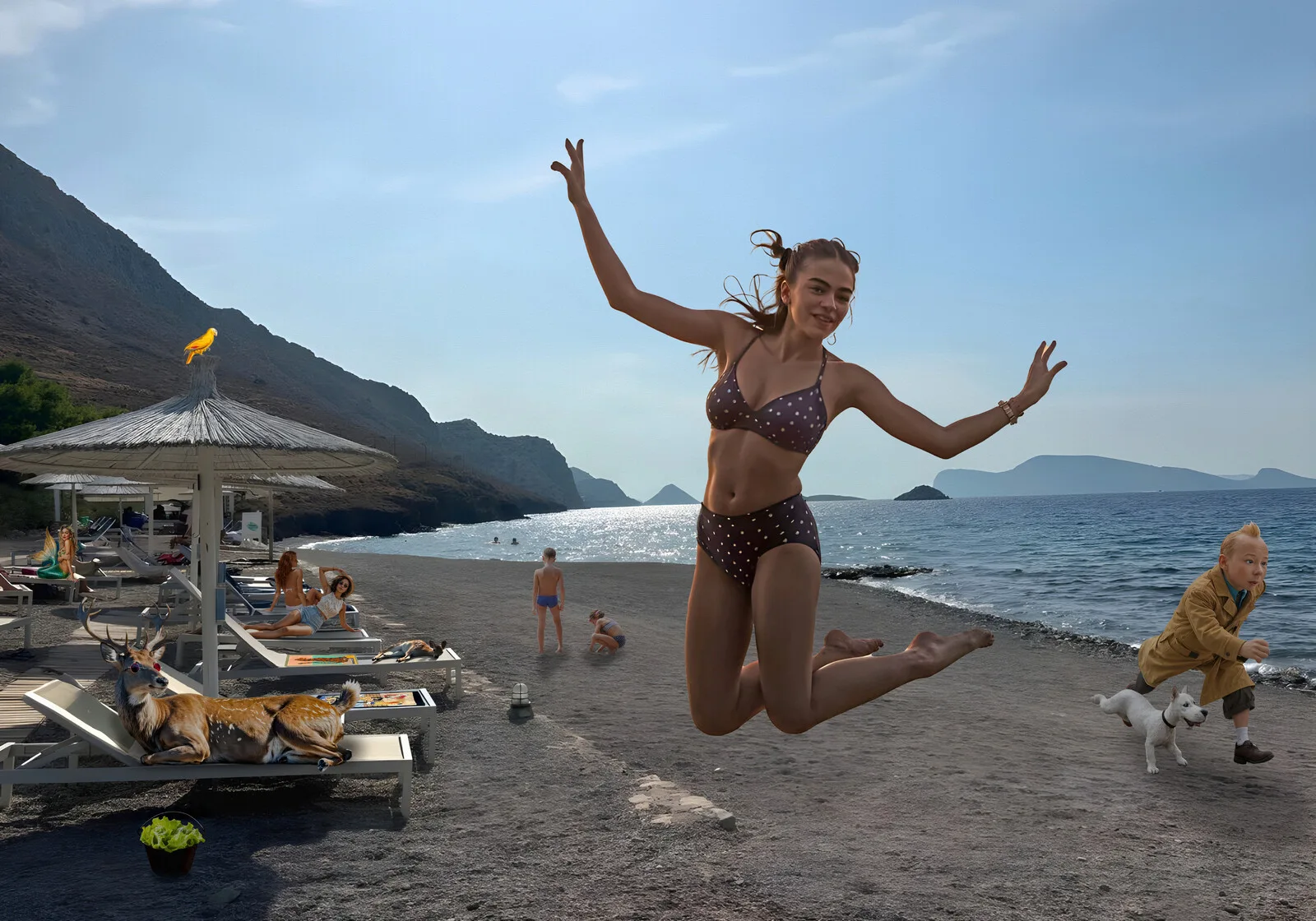
On Plakes Beach an almost ordinary day, 2025
Digital
100 x 70 cm
On Plakes Beach, an almost ordinary day
To Hydra with a Stag’s Stride
The title encapsulates the essence of Frida's journey to Hydra with her deer, Granizo. It symbolises their graceful and determined stride, much like a stag's, as they embark on their mission. On Plakes Beach, it was almost an ordinary day, with people from all over the world basking in the sun and enjoying the warmth.
Hydra, the timeless island where history and myth intertwine, became an unexpected sanctuary for Frida and her four-legged companions. In a place where donkeys reign supreme as the primary mode of transport, a Mexican white-tailed deer and a Greek roe deer might have seemed out of place—yet Hydra Erato welcomed them with open arms. Granizo and Alizza, seasoned travellers across dimensions, were basking in the island sun, indulging in fresh salad leaves while the restless Frida roamed the ancient streets. However, their journey was more than an escape to a pet-friendly retreat. It was a mission—to honour lost souls, defy poachers, and uncover the secrets of taste that might one day render deer an unpalatable dish for human hunters. This mission, filled with purpose and determination, was what made their journey on Hydra so compelling.
Teleportation, loopholes in bureaucracy, and a little celestial assistance ensured a smooth arrival, yet shadows loomed in this idyllic setting. Past and present collided in the heart of Hydra, where ancient traditions clashed with modern threats, and Frida’s boundless curiosity led her to Vlychos, where time travellers slipped through wormholes, and to Kerkini, where the fight against ruthless poaching continued. Between vibrant gardens and clandestine culinary experiments, this was no ordinary holiday. This was Frida’s kind of journey—where art, nature, and defiance merged into a single brushstroke on the canvas of eternity.
Continue reading to uncover the whimsical tale of Frida, Granizo, and their most unexpected adventures—where art, history, and botany intertwine in a story that spans centuries and continents. Every chapter of their journey, from their encounters with local flora to their defiance against poachers, is a testament to their resilience and the power of their mission.
"A Gourmand on Hydra
Through Hydra’s old paths, he made his way,
A wandering Mexican deer by the sunlit bay.
No scholar, no poet, could alter his ways,
A four-legged traveller with a gourmet gaze.
First stop: a taverna with scents so divine,
Oregano, thyme, for Frida, a splash of wine.
A nibble of olives, a taste of fig,
Oh, these Greek delights—so perfectly big!
Past donkeys and fishermen, past painted doors,
Through narrow alleys and stone-paved floors.
At the market, he pranced with a gleam in his eye,
Spotting fresh basil—oh my, oh my!
Wild capers here, sea fennel just there,
Munching through Hydra without a care.
Lavender soft, rosemary bold,
A mouthful of citrus blooms—pure floral gold!
In an old square where the bougainvillea grows,
He found a garden nobody knows.
With delicate lips, he sampled with glee,
Oh, the crisp lemon leaves—just right for me!
And when they thought he’d finally stop,
He found fig trees and nibbled the top.
Juicy and sweet, the fruit kissed by light,
A perfect dessert on a warm Greek night.
But trouble arose when the innkeeper appeared,
Waving his arms—"No deer allowed here!"
Yet Granizo, full and content as could be,
Trotted away, as carefree as he.
So, if your garden on Hydra looks mysteriously bare,
And your herbs have vanished into thin air,
Listen to the waves, where a whisper may say—
“Granizo was here, and he sent his bouquet!”
Malmö, February 2025
Eternal Striders on an Eternal Island
On Plakes Beach, it was almost an ordinary day, with people from all over the world basking in the sun and enjoying the warmth, as you can see from the picture. Hydra Erato, or Four Seasons, is a fantastic pet-friendly place; for instance, dogs of any size are allowed at no extra charge. Cats are also welcome, and while deer are not explicitly mentioned, they were implicitly permitted—therefore, Frida brought along Granizo, her favourite deer, after a few days in Lund.
Pets entering Greece must have a microchip, and Frida had arranged this with an animal-friendly veterinarian. Pet travellers also require proof of anti-rabies vaccination, which the same veterinarian provided. Additionally, an EU Pet Passport must accompany four-legged travellers from within Europe. Much like Frida’s own passport, this paperwork was quickly organised by the individuals mentioned above—coincidentally, the same people who printed money, of any currency, indistinguishable from the genuine article. Consider that history’s most skilled forgers reside among the stars, their collective expertise light-years ahead of Earth’s best counterfeit detectors.
Furthermore, Frida and Granizo did not rely on public transport; they teleported wherever they wished, using their legs only for shorter distances. This was not out of laziness but practicality. Arriving at a check-in desk with a Mexican deer was a surefire way to invite trouble.
Everyone reaches Hydra by sea—except Time-travellers, who arrive by air or through one of the wormholes that terminate in Hydra, conveniently located in Vlychos, just a few hundred metres from their hotel. Naturally, the staff were taken aback when Frida appeared, not only with Granizo but also with Alizza. This small roe deer once lived in Kerkini National Park in northern Greece. Like many other deer, she met her fate at the hands of a poacher. Her species is critically endangered.
The current penalties seem insufficient to deter poachers. Stronger laws and harsher penalties are essential to protect Greece’s wildlife. Astonishingly, hunting occurs in or near one of Greece’s most important National Parks, a destination popular for birdwatching and wildlife photography. Under the wrong circumstances, visitors could find themselves in danger from poachers.
Ordinary earthlings must rely on cars or trains, a journey of just over an hour and a half from Thessaloniki. For Frida and her four-legged companions, however, it took mere seconds to make a quick detour to Kerkini on their way to Hydra.
Back at Hydra and the hotel with a fantastic view over the strait dividing Hydra and Pelopnessos. Frida was full of energy, but Granizo and Alizza preferred to lounge in deck chairs, each with a bowl of fresh salad leaves.
Since Frida had all the paperwork in order and nothing explicitly stated that deer and roe deer were exempt, there was no issue. One should also consider that Granizo was, in fact, smaller than a previous four-legged guest—a Great Dane. That particular guest, incidentally, had chewed up a chair. Frida assured them that deer do not eat chairs; they content themselves instead with fresh salad and the occasional flower from the garden beds.
With over four hundred years of history, Hydra is steeped in the past, a past that has shaped the city's culture and character, establishing it as a hub of knowledge and innovation. Charming tavernas, lively cafés, boutique shops, and captivating museums are all within walking distance. An old garden at the centre, Votsi Square, particularly intrigued Frida’s companions. Before their arrival, it was brimming with vibrant flowers. After an afternoon, the flowers had somewhat diminished.
The lush park hosts dozens of species of flowers and trees—a dreamlike sanctuary for deer. In this context, it should be emphasised that time-travellers, both deer and humans, do not necessarily pass through an entrance to purchase a ferry ticket but can appear wherever they please. That’s precisely what Frida and Granizo had done, as she suspected the staff might object to allowing a deer onboard a catamaran. Apparently, the restriction applies to children accompanied by a guardian.
First, they enjoyed a stroll through Hydra Town’s oldest quarters, bursting with floral beauty along the streets and house façades in summer. In the picture, Frida leaps joyfully, her deer, Granizo, bounding behind her. Donkey Shit Lane and its side alleys are famous for the competition among the women of the houses to have the most beautiful flowers in pots on the steps outside. Their choice of this street was no coincidence, as you can understand. The street was named after the deer that once roamed freely in the area, a tradition that continues today. The otherwise shy white-tailed deer felt almost at home beneath the stars.
Frida's love for her animals was profound. She often kept them as companions in Casa Azul, her home in Coyoacán, Mexico City. Granizo was one of the many exotic animals she surrounded herself with—monkeys, parrots, dogs, and an eagle, each with its affectionate name.
Frida had a large, lush garden at Casa Azul, her vibrant and iconic home in Coyoacán, Mexico City. The house served as a sanctuary for her, where she could find solace and inspiration. Granizo likely roamed freely in this garden, filled with tropical plants and vibrant flowers. Since white-tailed deer are shy yet social animals, he likely stayed close to Frida and found comfort in her tropical sanctuary, where she often rested when she was too ill to work.
Frida had a deep emotional connection with animals, viewing them as more than mere companions—they were extensions of her soul. In her diary and letters, she frequently expressed that animals were her steadfast friends, especially during times when she felt lonely or betrayed by people. Granizo was one of the creatures to whom she felt particularly connected.
In ‘The Wounded Deer’, a painting featuring Granizo with Frida’s face pierced by arrows, she conveys a profound identification with him. The wounded deer symbolises Frida's physical and emotional pain, while the arrows represent her challenges and betrayals throughout her life. She perceived herself as a wounded animal, perpetually pursued and tormented by pain and betrayal. She likely felt a special kinship with the deer, perhaps due to his vulnerability and grace.
Frida’s husband, Diego Rivera, also fondled animals, but his thoughts on Granizo remain unclear. However, he was known for possessing a more pragmatic view of animal care, contrasting with Frida’s almost spiritual bond with them. He enjoyed venison, a dish that Frida would have strongly declined.
There is a well-known photograph of Frida Kahlo lying in her bed, surrounded by her beloved animals—her large dog in the foreground and the young deer Granizo nestled closely beside her. Granizo’s small antlers indicate that he was still very young—among deer, referred to as a ‘fawn’.
The image captures Frida’s deep bond with her animals, mainly how she surrounded herself with them for comfort and companionship. Due to her severe health issues, she spent much of her time in bed, where her animals were always welcome.
The fact that Granizo is so young in the photograph shows that Frida cared for him early on. She adopted him as an orphaned fawn—hardly surprising given her love for animals and nature.
The image also reflects what is evident in her art—a profound connection between herself and animals, a form of mutual understanding that evokes empathy in you. Granizo, young and innocent, symbolises the fragility within Frida herself. These moments, captured on canvas, are imbued with tenderness and loneliness, with animals as her closest confidants. However, animals also need to eat—and Granizo and his kind do not always favour what humans appreciate. This was particularly true of ‘Hjortgatan’, which appeared to be a veritable buffet for him. Occasionally, he would pause to nibble on hollyhocks and other enticing delicacies.
Deer require a diverse diet of naturally growing forage. Blooming herbs, berry bushes, twigs, and leaves from preferably deciduous and coniferous trees form a natural and essential part of their nutrition. They thrive on variety—the more plant species they consume, the better their nutritional intake. They ravage newly planted forests, invade cemeteries, and nearly overwhelm one, as in a case near ‘Casa Azul’. The deer consumed so many plants that the cemetery management tried to drive them away. Each morning, staff had to collect the damaged flowers and replant new ones.
Advice flooded in for the distraught parish priest, even though the internet did not exist then. While ultimate responsibility lay with God the Father, the clergyman felt solidarity with the gardener and his workers. After consulting the Lord and his congregation during a sermon, there was always silence from above. However, the congregation proposed clever deterrent solutions—fluttering aluminium foil and discarded CDs strung up to reflect light and scare off the animals. These worked, at least until the deer realised that nothing occurred. Some suggested hanging unwashed sheep's wool among the plants, but since the wool was also desirable to humans, the balls vanished without the deer's help. Watering with garlic-infused water was another attempt—the garlic not only "perfumed" the plants but was absorbed, making them taste unappetising. Unfortunately, some deer seemed to develop a taste for garlic, rendering the method increasingly ineffective. Blood meal mixed with water proved more effective but was still not foolproof. Sprinkling cayenne pepper over the plants was costly. One solution, however, outperformed all others—Diego’s cigar butts. With Granizo in ‘Casa Azul’, such things were strictly forbidden anywhere except in ashtrays. The congregation received weekly deliveries, and the problem was resolved. A gold star in the priest’s journal and a promised place in heaven—despite being a communist, he was assured by the church father. Diego, of course, believed neither in heaven nor hell, but maintaining a good relationship with the local church proved helpful, even for a communist and atheist.
Diego’s murals are not found in any Mexican church. His mural art was primarily secular and political, often incorporating strong socialist, historical, and revolutionary themes. His works embellish public buildings, universities, government palaces, and cultural institutions.
As a matter of principle, Rivera refrained from painting religious frescoes in churches. On the contrary, many of his works critique the church and its role in Mexican history, particularly its connections to colonialism. However, his first public commission was an exception to this rule, even though the painting was not placed in a church.
Frida recounted, amused, Diego’s struggles with this commission. It occurred long before they became a couple, yet the fresco troubled him for years.
Diego Rivera’s fresco ‘La Creación’ (1922) adorns the interior of the ‘Anfiteatro Simón Bolívar’ at ‘Colegio de San Ildefonso’ in Mexico City. This was Rivera’s first government commission, and the fresco, covering over a hundred square metres, was created using ‘hot wax painting’ and gold leaf. The work is an allegorical composition featuring mythological and religious motifs, with figures over twelve feet tall, carefully adapted to the architecture of the room and the monumental pipe organ that once stood there. At the top of the fresco is a symbol that may represent the Holy Trinity, with blessing hands, echoing ancient Egyptian iconography of ‘Aton’, the creating sun.
Frida laughed as she recalled how Diego defended his artistic liberties in La Creación, emphasising that he had explored humanity’s connection to the elements of nature, crafting a fundamental narrative of human existence. He explained how he had adapted to the vaulted architecture of the room, the walls, and the niche that once housed the organ. This was his first large-scale mural, and he endeavoured to express authentic Mexican beauty through his figures.
The fresco contrasts Christian and European themes with a vibrant Mexican colour palette and diverse Mexican figures. This synthesis of styles and influences marked the beginning of Rivera’s contribution to Mexico’s post-revolutionary avant-garde art movement.
Finally, I shall allow Frida to recount how Granizo made himself rather unpopular with the local vegan society—by devouring their buffet, notably the fresh asparagus. His antics, though mischievous, were undeniably humorous. Had they not been vegans, Granizo would indeed have ended up on a plate, the preferred resting place for deer, according to many frustrated gardeners. Ideally served with redcurrant jelly, pan-fried potatoes, and roasted vegetables. A mushroom sauce would not have been a poor addition, either.
Despite all his mischief, Granizo left the earth naturally and now resides on Frida’s star. However, this time, he had been tempted to follow along—not least because of the numerous deer roaming freely or in enclosures throughout Skåne’s landscape. But then, further on to Greece, to show his sympathy for those species threatened by ruthless poachers, the ones who had taken the life of Alizza. Inspired by the methods they had learned in Lund—how water infused with garlic gave plants a distinct taste and thus made them less appealing to deer—one could only wonder: what if the same principle could be applied in reverse? To make deer and stags taste utterly revolting to humans, perhaps even wolves and other predators. The challenge was ensuring the solution did not render the food unappetising for the animals. It was simply a matter of experimentation. This narrative, like Diego's mural, is a testament to the enduring connection between art and nature, exploring the whimsical idea of altering the taste of deer through natural means.
Swedish surströmming, fermented herring, had been tested, as had other intensely sour foods like umeboshi (Japanese plums)—extremely tart and salty. The sour herring failed due to its ghastly odour and the fact that no deer eat meat, not even fish. Durian—the king of fruits in Southeast Asia, though many consider its smell repugnant—was also rejected by the animals—a misfire. The same went for grapefruit—too bitter for many, including deer—likewise, bitter melon, a staple in Asian cuisine, is notorious for its intense bitterness and undoubtedly unsuitable for sensitive muzzles.
All forms of liquorice proved challenging—many outside the Nordic countries and the Netherlands perceive it as medicinal in taste. Star anise and fennel met the same fate, reminiscent of liquorice. Coriander could have been a choice, but some find its flavour reminiscent of soap due to genetic factors. Unfortunately, the same applied to the deer.
The native nuisance, Stamnagathi, suffered the same fate—a bitter weed, a type of wild, astringent green (resembling dandelion leaves) served boiled with olive oil and lemon. Healthy and appreciated in Crete, yet its sharp taste is divisive, and the deer unanimously agreed that the Cretans were more than welcome to keep the weed to themselves.
A tip from the East suggested stinky tofu—fermented tofu with an overwhelming odour—which appeared to be a perfect solution for Greece, a country unaccustomed to such flavours in its cuisine. However, when even their Chinese counterparts would not touch the foul concoction, the Greek deer naturally declined, their rejection echoing through the forest.
And so, they found themselves back where they began. But Frida, with a determined glint in her eye, vowed to return with new suggestions from above. Indeed, some ancient, long-forgotten remedy must exist—there are countless billions of stars to explore, and perseverance knows no defeat.
Jörgen Thornberg
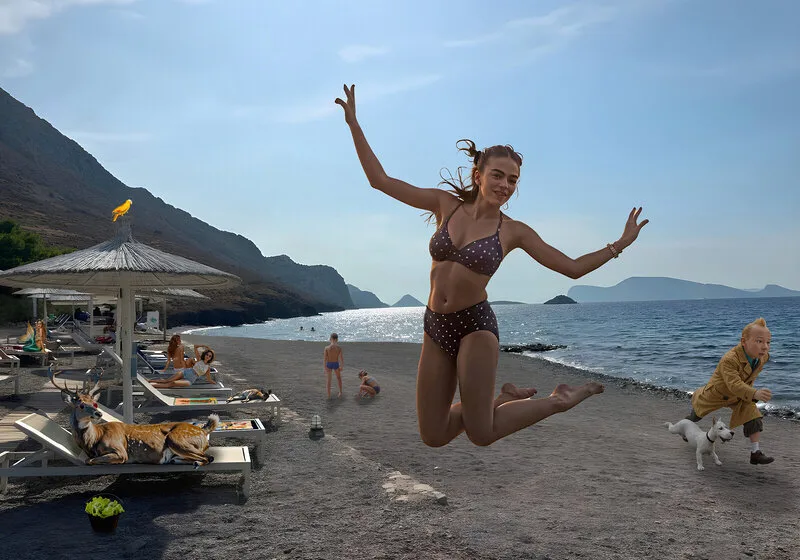
On Plakes Beach an almost ordinary day, 2025
Digital
100 x 70 cm
On Plakes Beach, an almost ordinary day
To Hydra with a Stag’s Stride
The title encapsulates the essence of Frida's journey to Hydra with her deer, Granizo. It symbolises their graceful and determined stride, much like a stag's, as they embark on their mission. On Plakes Beach, it was almost an ordinary day, with people from all over the world basking in the sun and enjoying the warmth.
Hydra, the timeless island where history and myth intertwine, became an unexpected sanctuary for Frida and her four-legged companions. In a place where donkeys reign supreme as the primary mode of transport, a Mexican white-tailed deer and a Greek roe deer might have seemed out of place—yet Hydra Erato welcomed them with open arms. Granizo and Alizza, seasoned travellers across dimensions, were basking in the island sun, indulging in fresh salad leaves while the restless Frida roamed the ancient streets. However, their journey was more than an escape to a pet-friendly retreat. It was a mission—to honour lost souls, defy poachers, and uncover the secrets of taste that might one day render deer an unpalatable dish for human hunters. This mission, filled with purpose and determination, was what made their journey on Hydra so compelling.
Teleportation, loopholes in bureaucracy, and a little celestial assistance ensured a smooth arrival, yet shadows loomed in this idyllic setting. Past and present collided in the heart of Hydra, where ancient traditions clashed with modern threats, and Frida’s boundless curiosity led her to Vlychos, where time travellers slipped through wormholes, and to Kerkini, where the fight against ruthless poaching continued. Between vibrant gardens and clandestine culinary experiments, this was no ordinary holiday. This was Frida’s kind of journey—where art, nature, and defiance merged into a single brushstroke on the canvas of eternity.
Continue reading to uncover the whimsical tale of Frida, Granizo, and their most unexpected adventures—where art, history, and botany intertwine in a story that spans centuries and continents. Every chapter of their journey, from their encounters with local flora to their defiance against poachers, is a testament to their resilience and the power of their mission.
"A Gourmand on Hydra
Through Hydra’s old paths, he made his way,
A wandering Mexican deer by the sunlit bay.
No scholar, no poet, could alter his ways,
A four-legged traveller with a gourmet gaze.
First stop: a taverna with scents so divine,
Oregano, thyme, for Frida, a splash of wine.
A nibble of olives, a taste of fig,
Oh, these Greek delights—so perfectly big!
Past donkeys and fishermen, past painted doors,
Through narrow alleys and stone-paved floors.
At the market, he pranced with a gleam in his eye,
Spotting fresh basil—oh my, oh my!
Wild capers here, sea fennel just there,
Munching through Hydra without a care.
Lavender soft, rosemary bold,
A mouthful of citrus blooms—pure floral gold!
In an old square where the bougainvillea grows,
He found a garden nobody knows.
With delicate lips, he sampled with glee,
Oh, the crisp lemon leaves—just right for me!
And when they thought he’d finally stop,
He found fig trees and nibbled the top.
Juicy and sweet, the fruit kissed by light,
A perfect dessert on a warm Greek night.
But trouble arose when the innkeeper appeared,
Waving his arms—"No deer allowed here!"
Yet Granizo, full and content as could be,
Trotted away, as carefree as he.
So, if your garden on Hydra looks mysteriously bare,
And your herbs have vanished into thin air,
Listen to the waves, where a whisper may say—
“Granizo was here, and he sent his bouquet!”
Malmö, February 2025
Eternal Striders on an Eternal Island
On Plakes Beach, it was almost an ordinary day, with people from all over the world basking in the sun and enjoying the warmth, as you can see from the picture. Hydra Erato, or Four Seasons, is a fantastic pet-friendly place; for instance, dogs of any size are allowed at no extra charge. Cats are also welcome, and while deer are not explicitly mentioned, they were implicitly permitted—therefore, Frida brought along Granizo, her favourite deer, after a few days in Lund.
Pets entering Greece must have a microchip, and Frida had arranged this with an animal-friendly veterinarian. Pet travellers also require proof of anti-rabies vaccination, which the same veterinarian provided. Additionally, an EU Pet Passport must accompany four-legged travellers from within Europe. Much like Frida’s own passport, this paperwork was quickly organised by the individuals mentioned above—coincidentally, the same people who printed money, of any currency, indistinguishable from the genuine article. Consider that history’s most skilled forgers reside among the stars, their collective expertise light-years ahead of Earth’s best counterfeit detectors.
Furthermore, Frida and Granizo did not rely on public transport; they teleported wherever they wished, using their legs only for shorter distances. This was not out of laziness but practicality. Arriving at a check-in desk with a Mexican deer was a surefire way to invite trouble.
Everyone reaches Hydra by sea—except Time-travellers, who arrive by air or through one of the wormholes that terminate in Hydra, conveniently located in Vlychos, just a few hundred metres from their hotel. Naturally, the staff were taken aback when Frida appeared, not only with Granizo but also with Alizza. This small roe deer once lived in Kerkini National Park in northern Greece. Like many other deer, she met her fate at the hands of a poacher. Her species is critically endangered.
The current penalties seem insufficient to deter poachers. Stronger laws and harsher penalties are essential to protect Greece’s wildlife. Astonishingly, hunting occurs in or near one of Greece’s most important National Parks, a destination popular for birdwatching and wildlife photography. Under the wrong circumstances, visitors could find themselves in danger from poachers.
Ordinary earthlings must rely on cars or trains, a journey of just over an hour and a half from Thessaloniki. For Frida and her four-legged companions, however, it took mere seconds to make a quick detour to Kerkini on their way to Hydra.
Back at Hydra and the hotel with a fantastic view over the strait dividing Hydra and Pelopnessos. Frida was full of energy, but Granizo and Alizza preferred to lounge in deck chairs, each with a bowl of fresh salad leaves.
Since Frida had all the paperwork in order and nothing explicitly stated that deer and roe deer were exempt, there was no issue. One should also consider that Granizo was, in fact, smaller than a previous four-legged guest—a Great Dane. That particular guest, incidentally, had chewed up a chair. Frida assured them that deer do not eat chairs; they content themselves instead with fresh salad and the occasional flower from the garden beds.
With over four hundred years of history, Hydra is steeped in the past, a past that has shaped the city's culture and character, establishing it as a hub of knowledge and innovation. Charming tavernas, lively cafés, boutique shops, and captivating museums are all within walking distance. An old garden at the centre, Votsi Square, particularly intrigued Frida’s companions. Before their arrival, it was brimming with vibrant flowers. After an afternoon, the flowers had somewhat diminished.
The lush park hosts dozens of species of flowers and trees—a dreamlike sanctuary for deer. In this context, it should be emphasised that time-travellers, both deer and humans, do not necessarily pass through an entrance to purchase a ferry ticket but can appear wherever they please. That’s precisely what Frida and Granizo had done, as she suspected the staff might object to allowing a deer onboard a catamaran. Apparently, the restriction applies to children accompanied by a guardian.
First, they enjoyed a stroll through Hydra Town’s oldest quarters, bursting with floral beauty along the streets and house façades in summer. In the picture, Frida leaps joyfully, her deer, Granizo, bounding behind her. Donkey Shit Lane and its side alleys are famous for the competition among the women of the houses to have the most beautiful flowers in pots on the steps outside. Their choice of this street was no coincidence, as you can understand. The street was named after the deer that once roamed freely in the area, a tradition that continues today. The otherwise shy white-tailed deer felt almost at home beneath the stars.
Frida's love for her animals was profound. She often kept them as companions in Casa Azul, her home in Coyoacán, Mexico City. Granizo was one of the many exotic animals she surrounded herself with—monkeys, parrots, dogs, and an eagle, each with its affectionate name.
Frida had a large, lush garden at Casa Azul, her vibrant and iconic home in Coyoacán, Mexico City. The house served as a sanctuary for her, where she could find solace and inspiration. Granizo likely roamed freely in this garden, filled with tropical plants and vibrant flowers. Since white-tailed deer are shy yet social animals, he likely stayed close to Frida and found comfort in her tropical sanctuary, where she often rested when she was too ill to work.
Frida had a deep emotional connection with animals, viewing them as more than mere companions—they were extensions of her soul. In her diary and letters, she frequently expressed that animals were her steadfast friends, especially during times when she felt lonely or betrayed by people. Granizo was one of the creatures to whom she felt particularly connected.
In ‘The Wounded Deer’, a painting featuring Granizo with Frida’s face pierced by arrows, she conveys a profound identification with him. The wounded deer symbolises Frida's physical and emotional pain, while the arrows represent her challenges and betrayals throughout her life. She perceived herself as a wounded animal, perpetually pursued and tormented by pain and betrayal. She likely felt a special kinship with the deer, perhaps due to his vulnerability and grace.
Frida’s husband, Diego Rivera, also fondled animals, but his thoughts on Granizo remain unclear. However, he was known for possessing a more pragmatic view of animal care, contrasting with Frida’s almost spiritual bond with them. He enjoyed venison, a dish that Frida would have strongly declined.
There is a well-known photograph of Frida Kahlo lying in her bed, surrounded by her beloved animals—her large dog in the foreground and the young deer Granizo nestled closely beside her. Granizo’s small antlers indicate that he was still very young—among deer, referred to as a ‘fawn’.
The image captures Frida’s deep bond with her animals, mainly how she surrounded herself with them for comfort and companionship. Due to her severe health issues, she spent much of her time in bed, where her animals were always welcome.
The fact that Granizo is so young in the photograph shows that Frida cared for him early on. She adopted him as an orphaned fawn—hardly surprising given her love for animals and nature.
The image also reflects what is evident in her art—a profound connection between herself and animals, a form of mutual understanding that evokes empathy in you. Granizo, young and innocent, symbolises the fragility within Frida herself. These moments, captured on canvas, are imbued with tenderness and loneliness, with animals as her closest confidants. However, animals also need to eat—and Granizo and his kind do not always favour what humans appreciate. This was particularly true of ‘Hjortgatan’, which appeared to be a veritable buffet for him. Occasionally, he would pause to nibble on hollyhocks and other enticing delicacies.
Deer require a diverse diet of naturally growing forage. Blooming herbs, berry bushes, twigs, and leaves from preferably deciduous and coniferous trees form a natural and essential part of their nutrition. They thrive on variety—the more plant species they consume, the better their nutritional intake. They ravage newly planted forests, invade cemeteries, and nearly overwhelm one, as in a case near ‘Casa Azul’. The deer consumed so many plants that the cemetery management tried to drive them away. Each morning, staff had to collect the damaged flowers and replant new ones.
Advice flooded in for the distraught parish priest, even though the internet did not exist then. While ultimate responsibility lay with God the Father, the clergyman felt solidarity with the gardener and his workers. After consulting the Lord and his congregation during a sermon, there was always silence from above. However, the congregation proposed clever deterrent solutions—fluttering aluminium foil and discarded CDs strung up to reflect light and scare off the animals. These worked, at least until the deer realised that nothing occurred. Some suggested hanging unwashed sheep's wool among the plants, but since the wool was also desirable to humans, the balls vanished without the deer's help. Watering with garlic-infused water was another attempt—the garlic not only "perfumed" the plants but was absorbed, making them taste unappetising. Unfortunately, some deer seemed to develop a taste for garlic, rendering the method increasingly ineffective. Blood meal mixed with water proved more effective but was still not foolproof. Sprinkling cayenne pepper over the plants was costly. One solution, however, outperformed all others—Diego’s cigar butts. With Granizo in ‘Casa Azul’, such things were strictly forbidden anywhere except in ashtrays. The congregation received weekly deliveries, and the problem was resolved. A gold star in the priest’s journal and a promised place in heaven—despite being a communist, he was assured by the church father. Diego, of course, believed neither in heaven nor hell, but maintaining a good relationship with the local church proved helpful, even for a communist and atheist.
Diego’s murals are not found in any Mexican church. His mural art was primarily secular and political, often incorporating strong socialist, historical, and revolutionary themes. His works embellish public buildings, universities, government palaces, and cultural institutions.
As a matter of principle, Rivera refrained from painting religious frescoes in churches. On the contrary, many of his works critique the church and its role in Mexican history, particularly its connections to colonialism. However, his first public commission was an exception to this rule, even though the painting was not placed in a church.
Frida recounted, amused, Diego’s struggles with this commission. It occurred long before they became a couple, yet the fresco troubled him for years.
Diego Rivera’s fresco ‘La Creación’ (1922) adorns the interior of the ‘Anfiteatro Simón Bolívar’ at ‘Colegio de San Ildefonso’ in Mexico City. This was Rivera’s first government commission, and the fresco, covering over a hundred square metres, was created using ‘hot wax painting’ and gold leaf. The work is an allegorical composition featuring mythological and religious motifs, with figures over twelve feet tall, carefully adapted to the architecture of the room and the monumental pipe organ that once stood there. At the top of the fresco is a symbol that may represent the Holy Trinity, with blessing hands, echoing ancient Egyptian iconography of ‘Aton’, the creating sun.
Frida laughed as she recalled how Diego defended his artistic liberties in La Creación, emphasising that he had explored humanity’s connection to the elements of nature, crafting a fundamental narrative of human existence. He explained how he had adapted to the vaulted architecture of the room, the walls, and the niche that once housed the organ. This was his first large-scale mural, and he endeavoured to express authentic Mexican beauty through his figures.
The fresco contrasts Christian and European themes with a vibrant Mexican colour palette and diverse Mexican figures. This synthesis of styles and influences marked the beginning of Rivera’s contribution to Mexico’s post-revolutionary avant-garde art movement.
Finally, I shall allow Frida to recount how Granizo made himself rather unpopular with the local vegan society—by devouring their buffet, notably the fresh asparagus. His antics, though mischievous, were undeniably humorous. Had they not been vegans, Granizo would indeed have ended up on a plate, the preferred resting place for deer, according to many frustrated gardeners. Ideally served with redcurrant jelly, pan-fried potatoes, and roasted vegetables. A mushroom sauce would not have been a poor addition, either.
Despite all his mischief, Granizo left the earth naturally and now resides on Frida’s star. However, this time, he had been tempted to follow along—not least because of the numerous deer roaming freely or in enclosures throughout Skåne’s landscape. But then, further on to Greece, to show his sympathy for those species threatened by ruthless poachers, the ones who had taken the life of Alizza. Inspired by the methods they had learned in Lund—how water infused with garlic gave plants a distinct taste and thus made them less appealing to deer—one could only wonder: what if the same principle could be applied in reverse? To make deer and stags taste utterly revolting to humans, perhaps even wolves and other predators. The challenge was ensuring the solution did not render the food unappetising for the animals. It was simply a matter of experimentation. This narrative, like Diego's mural, is a testament to the enduring connection between art and nature, exploring the whimsical idea of altering the taste of deer through natural means.
Swedish surströmming, fermented herring, had been tested, as had other intensely sour foods like umeboshi (Japanese plums)—extremely tart and salty. The sour herring failed due to its ghastly odour and the fact that no deer eat meat, not even fish. Durian—the king of fruits in Southeast Asia, though many consider its smell repugnant—was also rejected by the animals—a misfire. The same went for grapefruit—too bitter for many, including deer—likewise, bitter melon, a staple in Asian cuisine, is notorious for its intense bitterness and undoubtedly unsuitable for sensitive muzzles.
All forms of liquorice proved challenging—many outside the Nordic countries and the Netherlands perceive it as medicinal in taste. Star anise and fennel met the same fate, reminiscent of liquorice. Coriander could have been a choice, but some find its flavour reminiscent of soap due to genetic factors. Unfortunately, the same applied to the deer.
The native nuisance, Stamnagathi, suffered the same fate—a bitter weed, a type of wild, astringent green (resembling dandelion leaves) served boiled with olive oil and lemon. Healthy and appreciated in Crete, yet its sharp taste is divisive, and the deer unanimously agreed that the Cretans were more than welcome to keep the weed to themselves.
A tip from the East suggested stinky tofu—fermented tofu with an overwhelming odour—which appeared to be a perfect solution for Greece, a country unaccustomed to such flavours in its cuisine. However, when even their Chinese counterparts would not touch the foul concoction, the Greek deer naturally declined, their rejection echoing through the forest.
And so, they found themselves back where they began. But Frida, with a determined glint in her eye, vowed to return with new suggestions from above. Indeed, some ancient, long-forgotten remedy must exist—there are countless billions of stars to explore, and perseverance knows no defeat.

Jörgen Thornberg
Malmö
Lite om bilder och mig. Translation in English at the end.
Jag är en nyfiken person som ser allt i bilder, även det jag fäster i ord, gärna tillsammans för bakom alla mina bilder finns en berättelse. Till vissa bilder hör en kortare eller längre novell som följer med bilden.
Bilder berättar historier. Jag omges av naturlig skönhet, intressanta människor och historia var jag än går. Jag använder min kamera för att dokumentera världen och blanda det jag ser med vad jag känner för att fånga den dolda magin.
Mina bilder berättar mina historier. Genom mina bilder, tryck och berättelser. Jag bjuder in dig att ta del av dessa berättelser, in i ditt liv och hem och dela min mycket personliga syn på vår värld. Mer än vad ögat ser. Jag tänker i bilder, drömmer och skriver och pratar om dem; följaktligen måste jag också skapa bilder. De blir vad jag ser, inte nödvändigtvis begränsade till verkligheten. Det finns en bild runt varje hörn. Jag hoppas att du kommer att se vad jag såg och gilla det.
Jag är också en skrivande person och till många bilder hör en kortare eller längre essay. Den följer med tavlan, tryckt på fint papper och med en personlig hälsning från mig.
Flertalet bilder startar sin resa i min kamera. Enkelt förklarat beskriver jag bilden jag ser i mitt inre, upplevd eller fantiserad. Bilden uppstår inom mig redan innan jag fått okularet till ögat. På bråkdelen av ett ögonblick ser jag vad jag vill ha och vad som kan göras med bilden. Här skall jag stoppa in en giraff, stålmannen, Titanic eller vad det är min fantasi finner ut. Ännu märkligare är att jag kommer ihåg minnesbilden långt efteråt när det blir tid att skapa verket. Om jag lyckas eller inte, är upp till betraktaren, oftast präglat av en stråk av svart humor – meningen är att man skall bli underhållen. Mina bilder blir ofta en snackis där de hänger.
Jag föredrar bilder som förmedlar ett budskap i flera lager. Vid första anblicken fylld av feel-good, en vacker utsikt, fint väder, solen skiner, blommor på ängen eller vattnet som ligger förrädiskt spegelblankt. I en sådan bild kan jag gömma min egentliga berättelse, mitt förakt för förtryckare och våldsverkare, rasister och fördomsfulla människor - ett gärna återkommande motiv mer eller mindre dolt i det vackra motivet. Jag försöker förena dem i ett gemensamt narrativ.
Bild och formgivning har löpt som en röd tråd genom livet. Fotokonst känns som en värdig final som jag gärna delar med mig.
Min genre är vid som framgår av mina bilder, temat en blandning av pop- och gatukonst i kollage som kan bestå av hundratals lager. Vissa bilder kan ta veckor, andra någon dag innan det är dags att överlämna resultatet till printverkstaden. Fine Art Prints är digitala fotocollage. I dessa kollage sker rivandet, klippandet, pusslandet, målandet, ritandet och sprayningen digitalt. Det jag monterar in kan vara hundratals år gamla bilder som jag omsorgsfullt frilägger så att de ser ut att vara en del av tavlan men också bilder skapade av mig själv efter min egen fantasi. Därefter besöks printstudion och för vissa bilder numrera en limiterad upplaga (oftast 7 exemplar) och signera för hand. Vissa bilder kan köpas i olika format. Det är bara att fråga efter vilka. Gillar man en bild som är 70x100 men inte har plats på väggen, går den kanske att få i 50x70 cm istället. Frågan är fri.
Metoden Giclée eller Fine Art Print som det också kallas är det moderna sättet för framställning av grafisk konst. Villkoret för denna typ av utskrifter är att en högkvalitativ storformatskrivare används med åldersbeständigt färgpigment och konstnärspapper eller i förekommande fall på duk. Pappret som används möter de krav på livslängd som ställs av museer och gallerier. Normalt säljer jag mina bilder oinramade så att den nya ägaren själv kan bestämma hur de skall se ut, med eller utan passepartout färg på ram, med eller utan glas etc..
Under många år ställde jag bara ut på nätet, i valda grupper och på min egen Facebooksida - https://www.facebook.com/jorgen.thornberg.9
Jag finns också på en egen hemsida som tyvärr inte alltid är uppdaterad – https://www.jth.life/ Där kan du också läsa en del av de berättelser som följer med bilden.
UTSTÄLLNINGAR
Luftkastellet, oktober 2022
Konst i Lund, november 2022
Luftkastellet, mars 2023
Engleson Galleri Caroli, april 2023
Hydra, Greece June 2023
Engleson Galleri Caroli, oktober 2023
Toppen, Höllviken december 2023
Luftkastellet, mars 2024
Torups Galleri, mars 2024
Venice, May 2024
Luftkastellet, oktober 2024
Konst i Advent, December 2024
Galleri Engleson, Caroli December 2024
Jäger & Jansson Galleri, april 2025
A bit about pictures and me.
I'm a curious person who sees everything in pictures, even what I express in words, often combining them, for behind all my pictures lies a story. These narratives, some as short as a single image and others as long as a novel, are the heart and soul of my work.
Pictures tell stories. Wherever I go, I'm surrounded by natural beauty, exciting people, and history. I use my camera to document the world and blend what I see with what I feel to capture the hidden magic.
My images tell my stories. Through my pictures, prints, and narratives, I invite you to partake in these stories in your life and home and share my deeply personal perspective of our world. More than meets the eye. I think in pictures, dream, write, and talk about them; consequently, I must create images too. They become what I see, not necessarily confined to reality. There's a picture around every corner. I hope you'll see what I saw and enjoy it.
I'm also a writer, and many images come with a shorter or longer essay. It accompanies the painting, printed on fine paper with my personal greeting.
Many pictures start their journey on my camera. Simply put, I describe the image I see in my mind, experienced or imagined. The image arises within me even before I bring the eyepiece to my eye. In a fraction of a moment, I see what I want and what can be done with the picture. Here, I'll insert a giraffe, Superman, the Titanic, or whatever my imagination conjures up. Even stranger is that I remember the mental image long after it's time to create the work. Whether I succeed is up to the observer, often imbued with a streak of black humour – the aim is to entertain. My pictures usually become a talking point wherever they hang.
I prefer pictures that convey a message in multiple layers. At first glance, they're filled with feel-good vibes, a beautiful view, lovely weather, the sun shining, flowers in the meadow, or the water lying deceptively calm. But beneath this surface beauty, I often conceal a deeper story, a narrative that challenges societal norms or explores the human condition. I invite you to delve into these hidden narratives and discover the layers of meaning within my work.
Picture and design have been a thread running through my life. Photographic art feels like a fitting finale, and I'm happy to share it.
My genre is varied, as seen in my pictures; the theme is a blend of pop and street art in collages that can consist of hundreds of layers. Some images can take weeks, others just a day before it's time to hand over the result to the print workshop. Fine Art Prints are digital photo collages. In these collages, tearing, cutting, puzzling, painting, drawing, and spraying happen digitally. What I insert can be images hundreds of years old that I carefully extract so they appear to be part of the painting, but also images created by myself, now also generated from my imagination. Next, visit the print studio and, for certain images, number a limited edition (usually 7 copies) and sign them by hand. Some images may be available in other formats. Just ask which ones. If you like an image that's 70x100 but doesn't have space on the wall, you might be able to get it in 50x70 cm instead. The question is open.
The Giclée method, or Fine Art Print as it's also called, is the modern way of producing graphic art. This method ensures the highest quality and longevity of the artwork, using a high-quality large-format printer with archival pigment inks and artist paper or, in some cases, canvas. The paper used meets the longevity requirements set by museums and galleries. I sell my pictures unframed, allowing the new owner to personalise their artwork, confident in the lasting value and quality of the piece.
For many years, I only exhibited online, in selected groups, and on my Facebook page - https://www.facebook.com/jorgen.thornberg.9. I also have my website, which unfortunately is not constantly updated - https://www.jth.life/. You can also read some of the stories accompanying the pictures there.
EXHIBITIONS
Luftkastellet, October 2022
Art in Lund, November 2022
Luftkastellet, March 2023
Engleson Gallery Caroli, April 2023
Hydra, Greece June 2023
Engleson Gallery Caroli, October 2023
Toppen, Höllviken December 2023
Luftkastellet, March 2024
Torup Gallery, March 2024
Venice, May 2024
UTSTÄLLNINGAR
Luftkastellet, oktober 2022
Konst i Lund, november 2022
Luftkastellet, mars 2023
Engleson Galleri Caroli, april 2023
Hydra, Greece June 2023
Engleson Galleri Caroli, oktober 2023
Toppen, Höllviken december 2023
Luftkastellet, mars 2024
Torups Galleri, mars 2024
Venice, May 2024
Luftkastellet, October 2024
Konst i Advent, December 2024
Galleri Engleson, Caroli December 2024
Jäger & Jansson Galleri, April 2025
Utbildning
Autodidakt
Medlem i konstnärsförening
Öppna Sinnen
Med i konstrunda
Konstrundan i Skåne
Utställningar
Luftkastellet, October 2022
Art in Lund, November 2022
Luftkastellet, March 2023
Engleson Gallery Caroli, April 2023
Hydra, Greece June 2023
Engleson Gallery Caroli, October 2023
Toppen, Höllviken December 2023
Luftkastellet, March 2024
Torup Gallery, March 2024
Venice, May 2024