Vi använder cookies för att ge dig bästa möjliga upplevelse. Välj vilka cookies du tillåter.
Läs mer i vår integritetspolicy
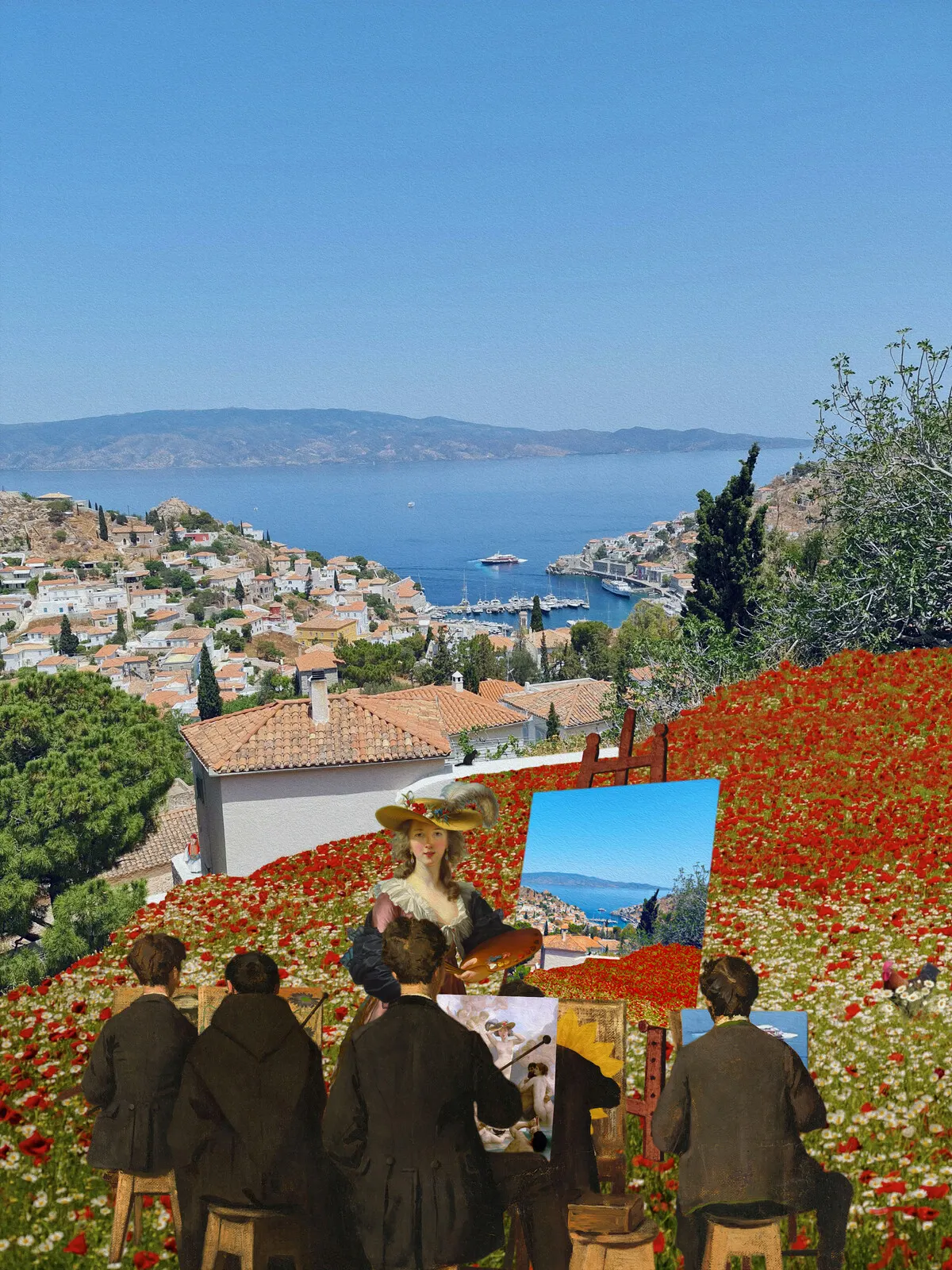
Jörgen Thornberg
What you see, is what you get. Your view is as good as mine, 2021
Digital
70 x 100 cm
What You See Is Not Always What You Get
When Élisabeth Le Brun set up her easel on Hydra's upper terrace, accompanied by her young protégés—time-travelling artists from different centuries—one might have expected them to paint the stunning view before them: the town cascading down the hillside, the vibrant sea, and the distant silhouette of the Peloponnese. Yet, as their canvases took shape, it became clear that what they perceived was something entirely different.
These young artists, with their eyes still those of youthful dreamers, filtered reality through their imaginations and desires. Each artist had captured something uniquely his own, ranging from a naked Le Brun to a solitary sunflower, a spaceship, and a catamaran. Hydra's beauty perhaps paled against the visions in their minds for these young men from eternity, which surely piques our curiosity and engages our interest.
Read on to explore what we really see.
"What We See, What We Don't
We see the sky, so vast, so bright,
But miss the stars that shine at night.
We watch the waves caress the shore,
But fail to sense the depths they store.
We see the face, the painted grace,
But not the lines time can't erase.
A fleeting smile, a glance, a tear,
Yet what's beneath—too blurred, too near.
We see the world in sharp display,
Yet, the truth is lost along the way.
A grand façade, a golden hue,
But what's concealed, we never knew.
We see what's there, or so we claim,
Still, I miss the whisper in the frame.
And sometimes, what we shouldn't see,
Reveals itself—unwillingly.
Le Brun stood tall, her hat adorned,
With plumes and flowers, finely formed.
Her students painted—each his view,
But none beheld what she once knew.
A naked muse, a distant sail,
A flower bright, a ship's white trail.
A boy saw stars beyond the sea,
Yet missed the land's raw poetry.
What they beheld was worlds apart,
Yet still, it spoke of each one's heart.
For vision bends, and truth may stray,
Yet art will see its own true way."
Malmö, February 2025
WYSIWYG – When Reality Meets Expectation
One Never Ceases to Be Surprised – A Summer on Hydra
One never ceases to be surprised; that was precisely what happened last summer on Hydra. One of my favourite artists, the Time-traveller Élisabeth Le Brun, had been drawn to Hydra by the great Nikos Ghika, the leading Greek painter, sculptor, engraver, writer, and academic. She had also brought along a few protégés—young men who had left the earth before they could pursue their dream of becoming artists.
Le Brun and her students had set up their easels on Hydra's upper terrace near my house. The task was straightforward—the students were to paint what they saw: the timeless beauty of Hydra town, climbing up the mountain toward Mount Eros, a sight that never fails to inspire awe.
The view is never truly the same, even if it appears unchanged on the surface. Hydra is like the azure sea that flows around the island—constantly shifting, eternally changing. The seasons, the weather, and the wind blend the palette's colours in an ever-changing dance. Something is always happening—down at the harbour, in the air, or on the strait between Hydra and the Peloponnese. And so it was now. One only had to open one's eyes and take in the scene, for, as the phrase goes, "What you see is what you get," succinctly summed up in the acronym WYSIWYG.
However, the abbreviation can be misleading—for what you see is not necessarily what others see. A rubbish bin overflowing with waste might dominate the image in some eyes, despite taking up only a few insignificant pixels in a grand painting of beautiful Hydra. This is a classic case of 'not seeing the forest for the trees', which means focusing on small details and missing the larger picture. Understanding this concept can enlighten us and make us more aware of the bigger picture.
The Young Gentlemen from Eternity
Despite their age, the young gentlemen visiting from eternity were much like young men tend to be—full of themselves. Not even eternity could change that. They were the same personalities they had been when they were prematurely snatched from life, and so they saw what they wanted to see. Their unique perspective, shaped by their wishful dreams, was a source of constant intrigue for those around them.
The four young Time Travellers, returning to earth for the first time since they had left it, were still boys at heart despite all the time that had passed in eternity. Their unchanging nature, youthful self-confidence, unwavering belief in their excellence, and restless need to impress one another provided a sense of continuity and familiarity that resonated with those around them.
Metusalem, who should have matured after 400 years in eternity, had changed little since he, at seventeen, had been trampled by a runaway horse and left Holland behind in the 1600s. He still surrounded himself with other young men from various eras, bound together by their blissful immaturity and playful arrogance. They carried themselves as young men always have—laughing at foolish jokes, challenging one another in pointless competitions, and puffing up their chests with the certainty only youth can provide.
Eternity had given them endless time to reflect, gather impressions, and understand the course of history—yet none of it had shaped them the way years on earth would have. They had never become men, felt the heavy hand of time on their shoulders, or been forced to take responsibility for anything beyond their whims. They still saw the world with the same boyish eyes as when they had first left it—filled with curiosity yet devoid of the wisdom only experience can bring.
Time passed, yet for the eternally young, nothing much happened on a personal level. They did not age, change, or experience the growth and development that come with living a mortal life; they stayed with an incomplete soul forever, for better or worse. This prompts us to reflect on the nature of personal growth and development, fostering a sense of contemplation and reflection in our audience.
And so they stood there, four young men from eternity, on the verge of rediscovering a world that had long since moved on. The world had evolved, cultures had changed, and new ideas had emerged—but which, to them, remained exactly as they had left it.
Metusalem, the eldest among them, had lived at the same time as Johannes Vermeer in the 1600s, yet only now had he desired to follow in his compatriot's footsteps. Just like his companions, he saw what he saw—and it was not what their teacher, Le Brun, saw. Nor what I saw, for that matter.
One of the young men, inspired by something entirely beyond the horizon, had painted an erotic motif of Élisabeth Le Brun standing stark naked—save for the very same straw hat adorned with flowers and ostrich feathers that she wore that day. He had ignored the breathtaking view of Hydra in favour of an artistic interpretation that was, shall we say, more personal.
The young man in front of him had chosen something else entirely—he had painted a massive, solitary sunflower, which had caught his attention in a garden far beyond the sea of blooming red poppies and white daisies.
The man standing to Metusalem's right seemed fascinated by boats. His canvas depicted the catamaran that shuttled between Hydra and Piraeus, gliding through the azure waters.
The boy on the far left had ventured even further into his vision—he had painted what appeared to be a flying saucer. To my knowledge, no one has ever reported seeing such things over Hydra, though they tend to pop up elsewhere, often on blurry, grainy photographs. This painting is a clear example of how one's personal perspective can greatly influence what one sees and how one interprets it.
Lastly, the young artist to the left of the saucer-painter had ignored the landscape entirely. Instead, he had created an intricate study of the flowers in Le Brun's straw hat, meticulously capturing the petals, stamens, and pistils in stunning detail.
Not a single one of them had painted the view before them.
But of course, from a star at the heart of the cosmos, even the grandest of earthly landscapes may seem insignificant in comparison.
Anyone who has ever struggled with a computer or a digital system has encountered the term WYSIWYG – What You See Is What You Get. It sounds like a reassuring promise that what you see on the screen is exactly what you'll get. But we all know that's not always the case. There are many memorable anecdotes where WYSIWYG has gone from a promising vision to pure comedy – both in the digital world and in real life.
If one story perfectly encapsulates the flawed promise of WYSIWYG, it must be Hans Christian Andersen's "The Emperor's New Clothes." The tale tells of a vain emperor who, convinced by two swindlers, believes he is wearing the finest, most delicate garments—supposedly invisible to those unfit for their positions. Proudly, he parades through the streets, seeing himself clothed in splendour while the public sees him strolling stark naked.
In the 1970s, computers were reserved for enthusiasts, featuring massive screens filled with green numbers. When Xerox developed the first graphical computer and the concept of WYSIWYG, it appeared to be a revolution. Suddenly, people could see how their text would appear before printing! However, there was a slight problem—computers were not reliable.
Who doesn't remember the panic of university students submitting papers where page numbers shifted positions or footnotes suddenly took up half the page? One professor once remarked: "Your essay is a WYSIWYG nightmare – what you see is what I can't read."
When the internet took off and people started creating their websites with WYSIWYG editors like FrontPage and Dreamweaver, it quickly became apparent that "what you see" was a lie. Users dragged and dropped images, changed text, and adjusted colours, but when they opened the page in a different browser, it looked as if a five-year-old had gone wild with a colour bomb. This was not an isolated incident. WYSIWYG often led to websites that were visually appealing in one browser but a complete mess in another, undermining the very promise of the concept.
A poor entrepreneur created his first website using an early version of WordPress and a WYSIWYG theme, a popular choice for beginners due to its user-friendly interface. He carefully arranged everything pixel-perfect—or so he thought. When he opened the site in Internet Explorer, all images had disappeared, links were off-screen, and the text was suddenly in Wingdings. This incident is a clear example of how WYSIWYG can lead to unexpected and undesirable outcomes in web development.
But WYSIWYG has caused trouble, not just in the digital world. Who hasn't ordered a burger from a fast-food chain where the juicy, perfect burger on the menu turned out to be a sad, squashed sandwich with a lone piece of wilted lettuce?
Or online shopping? That elegant jacket that looked like a designer masterpiece on the website was a polyester rag sewn with a glue gun. When the buyer complained, they got the response: "You saw how it should look in the picture." WYSIWYG at its most deceptive. This is a stark reminder to be wary and discerning in consumer experiences and always to question what we see.
The conclusion must be that WYSIWYG can be utterly misleading, a dream and a nightmare. The idea behind it is beautiful—a world where what you see is what you get. But as we know, reality is more complicated. From digital mishaps to everyday disasters, WYSIWYG has the potential to be both a revolution and a reminder that we can never fully trust technology—or fast-food chains. This should make us more sceptical and critical in our interactions with WYSIWYG, and we should always be prepared for the unexpected.
So next time someone says, "What you see is what you get," remember: it's not always true. When it comes to computers, Word documents, a dress in a web shop, and hamburgers, always be prepared for a surprise. Stay cautious and alert in the face of WYSIWYG, as it often holds unexpected twists and turns.
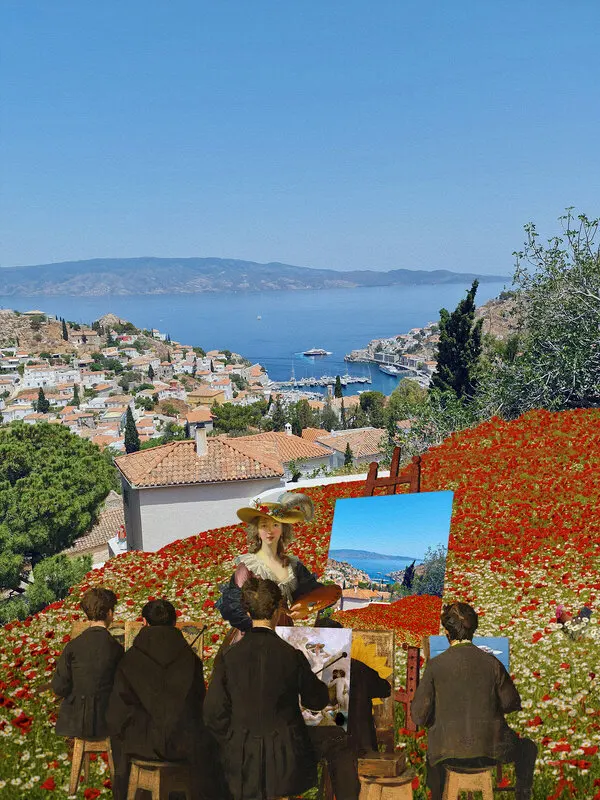
Jörgen Thornberg
What you see, is what you get. Your view is as good as mine, 2021
Digital
70 x 100 cm
What You See Is Not Always What You Get
When Élisabeth Le Brun set up her easel on Hydra's upper terrace, accompanied by her young protégés—time-travelling artists from different centuries—one might have expected them to paint the stunning view before them: the town cascading down the hillside, the vibrant sea, and the distant silhouette of the Peloponnese. Yet, as their canvases took shape, it became clear that what they perceived was something entirely different.
These young artists, with their eyes still those of youthful dreamers, filtered reality through their imaginations and desires. Each artist had captured something uniquely his own, ranging from a naked Le Brun to a solitary sunflower, a spaceship, and a catamaran. Hydra's beauty perhaps paled against the visions in their minds for these young men from eternity, which surely piques our curiosity and engages our interest.
Read on to explore what we really see.
"What We See, What We Don't
We see the sky, so vast, so bright,
But miss the stars that shine at night.
We watch the waves caress the shore,
But fail to sense the depths they store.
We see the face, the painted grace,
But not the lines time can't erase.
A fleeting smile, a glance, a tear,
Yet what's beneath—too blurred, too near.
We see the world in sharp display,
Yet, the truth is lost along the way.
A grand façade, a golden hue,
But what's concealed, we never knew.
We see what's there, or so we claim,
Still, I miss the whisper in the frame.
And sometimes, what we shouldn't see,
Reveals itself—unwillingly.
Le Brun stood tall, her hat adorned,
With plumes and flowers, finely formed.
Her students painted—each his view,
But none beheld what she once knew.
A naked muse, a distant sail,
A flower bright, a ship's white trail.
A boy saw stars beyond the sea,
Yet missed the land's raw poetry.
What they beheld was worlds apart,
Yet still, it spoke of each one's heart.
For vision bends, and truth may stray,
Yet art will see its own true way."
Malmö, February 2025
WYSIWYG – When Reality Meets Expectation
One Never Ceases to Be Surprised – A Summer on Hydra
One never ceases to be surprised; that was precisely what happened last summer on Hydra. One of my favourite artists, the Time-traveller Élisabeth Le Brun, had been drawn to Hydra by the great Nikos Ghika, the leading Greek painter, sculptor, engraver, writer, and academic. She had also brought along a few protégés—young men who had left the earth before they could pursue their dream of becoming artists.
Le Brun and her students had set up their easels on Hydra's upper terrace near my house. The task was straightforward—the students were to paint what they saw: the timeless beauty of Hydra town, climbing up the mountain toward Mount Eros, a sight that never fails to inspire awe.
The view is never truly the same, even if it appears unchanged on the surface. Hydra is like the azure sea that flows around the island—constantly shifting, eternally changing. The seasons, the weather, and the wind blend the palette's colours in an ever-changing dance. Something is always happening—down at the harbour, in the air, or on the strait between Hydra and the Peloponnese. And so it was now. One only had to open one's eyes and take in the scene, for, as the phrase goes, "What you see is what you get," succinctly summed up in the acronym WYSIWYG.
However, the abbreviation can be misleading—for what you see is not necessarily what others see. A rubbish bin overflowing with waste might dominate the image in some eyes, despite taking up only a few insignificant pixels in a grand painting of beautiful Hydra. This is a classic case of 'not seeing the forest for the trees', which means focusing on small details and missing the larger picture. Understanding this concept can enlighten us and make us more aware of the bigger picture.
The Young Gentlemen from Eternity
Despite their age, the young gentlemen visiting from eternity were much like young men tend to be—full of themselves. Not even eternity could change that. They were the same personalities they had been when they were prematurely snatched from life, and so they saw what they wanted to see. Their unique perspective, shaped by their wishful dreams, was a source of constant intrigue for those around them.
The four young Time Travellers, returning to earth for the first time since they had left it, were still boys at heart despite all the time that had passed in eternity. Their unchanging nature, youthful self-confidence, unwavering belief in their excellence, and restless need to impress one another provided a sense of continuity and familiarity that resonated with those around them.
Metusalem, who should have matured after 400 years in eternity, had changed little since he, at seventeen, had been trampled by a runaway horse and left Holland behind in the 1600s. He still surrounded himself with other young men from various eras, bound together by their blissful immaturity and playful arrogance. They carried themselves as young men always have—laughing at foolish jokes, challenging one another in pointless competitions, and puffing up their chests with the certainty only youth can provide.
Eternity had given them endless time to reflect, gather impressions, and understand the course of history—yet none of it had shaped them the way years on earth would have. They had never become men, felt the heavy hand of time on their shoulders, or been forced to take responsibility for anything beyond their whims. They still saw the world with the same boyish eyes as when they had first left it—filled with curiosity yet devoid of the wisdom only experience can bring.
Time passed, yet for the eternally young, nothing much happened on a personal level. They did not age, change, or experience the growth and development that come with living a mortal life; they stayed with an incomplete soul forever, for better or worse. This prompts us to reflect on the nature of personal growth and development, fostering a sense of contemplation and reflection in our audience.
And so they stood there, four young men from eternity, on the verge of rediscovering a world that had long since moved on. The world had evolved, cultures had changed, and new ideas had emerged—but which, to them, remained exactly as they had left it.
Metusalem, the eldest among them, had lived at the same time as Johannes Vermeer in the 1600s, yet only now had he desired to follow in his compatriot's footsteps. Just like his companions, he saw what he saw—and it was not what their teacher, Le Brun, saw. Nor what I saw, for that matter.
One of the young men, inspired by something entirely beyond the horizon, had painted an erotic motif of Élisabeth Le Brun standing stark naked—save for the very same straw hat adorned with flowers and ostrich feathers that she wore that day. He had ignored the breathtaking view of Hydra in favour of an artistic interpretation that was, shall we say, more personal.
The young man in front of him had chosen something else entirely—he had painted a massive, solitary sunflower, which had caught his attention in a garden far beyond the sea of blooming red poppies and white daisies.
The man standing to Metusalem's right seemed fascinated by boats. His canvas depicted the catamaran that shuttled between Hydra and Piraeus, gliding through the azure waters.
The boy on the far left had ventured even further into his vision—he had painted what appeared to be a flying saucer. To my knowledge, no one has ever reported seeing such things over Hydra, though they tend to pop up elsewhere, often on blurry, grainy photographs. This painting is a clear example of how one's personal perspective can greatly influence what one sees and how one interprets it.
Lastly, the young artist to the left of the saucer-painter had ignored the landscape entirely. Instead, he had created an intricate study of the flowers in Le Brun's straw hat, meticulously capturing the petals, stamens, and pistils in stunning detail.
Not a single one of them had painted the view before them.
But of course, from a star at the heart of the cosmos, even the grandest of earthly landscapes may seem insignificant in comparison.
Anyone who has ever struggled with a computer or a digital system has encountered the term WYSIWYG – What You See Is What You Get. It sounds like a reassuring promise that what you see on the screen is exactly what you'll get. But we all know that's not always the case. There are many memorable anecdotes where WYSIWYG has gone from a promising vision to pure comedy – both in the digital world and in real life.
If one story perfectly encapsulates the flawed promise of WYSIWYG, it must be Hans Christian Andersen's "The Emperor's New Clothes." The tale tells of a vain emperor who, convinced by two swindlers, believes he is wearing the finest, most delicate garments—supposedly invisible to those unfit for their positions. Proudly, he parades through the streets, seeing himself clothed in splendour while the public sees him strolling stark naked.
In the 1970s, computers were reserved for enthusiasts, featuring massive screens filled with green numbers. When Xerox developed the first graphical computer and the concept of WYSIWYG, it appeared to be a revolution. Suddenly, people could see how their text would appear before printing! However, there was a slight problem—computers were not reliable.
Who doesn't remember the panic of university students submitting papers where page numbers shifted positions or footnotes suddenly took up half the page? One professor once remarked: "Your essay is a WYSIWYG nightmare – what you see is what I can't read."
When the internet took off and people started creating their websites with WYSIWYG editors like FrontPage and Dreamweaver, it quickly became apparent that "what you see" was a lie. Users dragged and dropped images, changed text, and adjusted colours, but when they opened the page in a different browser, it looked as if a five-year-old had gone wild with a colour bomb. This was not an isolated incident. WYSIWYG often led to websites that were visually appealing in one browser but a complete mess in another, undermining the very promise of the concept.
A poor entrepreneur created his first website using an early version of WordPress and a WYSIWYG theme, a popular choice for beginners due to its user-friendly interface. He carefully arranged everything pixel-perfect—or so he thought. When he opened the site in Internet Explorer, all images had disappeared, links were off-screen, and the text was suddenly in Wingdings. This incident is a clear example of how WYSIWYG can lead to unexpected and undesirable outcomes in web development.
But WYSIWYG has caused trouble, not just in the digital world. Who hasn't ordered a burger from a fast-food chain where the juicy, perfect burger on the menu turned out to be a sad, squashed sandwich with a lone piece of wilted lettuce?
Or online shopping? That elegant jacket that looked like a designer masterpiece on the website was a polyester rag sewn with a glue gun. When the buyer complained, they got the response: "You saw how it should look in the picture." WYSIWYG at its most deceptive. This is a stark reminder to be wary and discerning in consumer experiences and always to question what we see.
The conclusion must be that WYSIWYG can be utterly misleading, a dream and a nightmare. The idea behind it is beautiful—a world where what you see is what you get. But as we know, reality is more complicated. From digital mishaps to everyday disasters, WYSIWYG has the potential to be both a revolution and a reminder that we can never fully trust technology—or fast-food chains. This should make us more sceptical and critical in our interactions with WYSIWYG, and we should always be prepared for the unexpected.
So next time someone says, "What you see is what you get," remember: it's not always true. When it comes to computers, Word documents, a dress in a web shop, and hamburgers, always be prepared for a surprise. Stay cautious and alert in the face of WYSIWYG, as it often holds unexpected twists and turns.

Jörgen Thornberg
Malmö
Lite om bilder och mig. Translation in English at the end.
Jag är en nyfiken person som ser allt i bilder, även det jag fäster i ord, gärna tillsammans för bakom alla mina bilder finns en berättelse. Till vissa bilder hör en kortare eller längre novell som följer med bilden.
Bilder berättar historier. Jag omges av naturlig skönhet, intressanta människor och historia var jag än går. Jag använder min kamera för att dokumentera världen och blanda det jag ser med vad jag känner för att fånga den dolda magin.
Mina bilder berättar mina historier. Genom mina bilder, tryck och berättelser. Jag bjuder in dig att ta del av dessa berättelser, in i ditt liv och hem och dela min mycket personliga syn på vår värld. Mer än vad ögat ser. Jag tänker i bilder, drömmer och skriver och pratar om dem; följaktligen måste jag också skapa bilder. De blir vad jag ser, inte nödvändigtvis begränsade till verkligheten. Det finns en bild runt varje hörn. Jag hoppas att du kommer att se vad jag såg och gilla det.
Jag är också en skrivande person och till många bilder hör en kortare eller längre essay. Den följer med tavlan, tryckt på fint papper och med en personlig hälsning från mig.
Flertalet bilder startar sin resa i min kamera. Enkelt förklarat beskriver jag bilden jag ser i mitt inre, upplevd eller fantiserad. Bilden uppstår inom mig redan innan jag fått okularet till ögat. På bråkdelen av ett ögonblick ser jag vad jag vill ha och vad som kan göras med bilden. Här skall jag stoppa in en giraff, stålmannen, Titanic eller vad det är min fantasi finner ut. Ännu märkligare är att jag kommer ihåg minnesbilden långt efteråt när det blir tid att skapa verket. Om jag lyckas eller inte, är upp till betraktaren, oftast präglat av en stråk av svart humor – meningen är att man skall bli underhållen. Mina bilder blir ofta en snackis där de hänger.
Jag föredrar bilder som förmedlar ett budskap i flera lager. Vid första anblicken fylld av feel-good, en vacker utsikt, fint väder, solen skiner, blommor på ängen eller vattnet som ligger förrädiskt spegelblankt. I en sådan bild kan jag gömma min egentliga berättelse, mitt förakt för förtryckare och våldsverkare, rasister och fördomsfulla människor - ett gärna återkommande motiv mer eller mindre dolt i det vackra motivet. Jag försöker förena dem i ett gemensamt narrativ.
Bild och formgivning har löpt som en röd tråd genom livet. Fotokonst känns som en värdig final som jag gärna delar med mig.
Min genre är vid som framgår av mina bilder, temat en blandning av pop- och gatukonst i kollage som kan bestå av hundratals lager. Vissa bilder kan ta veckor, andra någon dag innan det är dags att överlämna resultatet till printverkstaden. Fine Art Prints är digitala fotocollage. I dessa kollage sker rivandet, klippandet, pusslandet, målandet, ritandet och sprayningen digitalt. Det jag monterar in kan vara hundratals år gamla bilder som jag omsorgsfullt frilägger så att de ser ut att vara en del av tavlan men också bilder skapade av mig själv efter min egen fantasi. Därefter besöks printstudion och för vissa bilder numrera en limiterad upplaga (oftast 7 exemplar) och signera för hand. Vissa bilder kan köpas i olika format. Det är bara att fråga efter vilka. Gillar man en bild som är 70x100 men inte har plats på väggen, går den kanske att få i 50x70 cm istället. Frågan är fri.
Metoden Giclée eller Fine Art Print som det också kallas är det moderna sättet för framställning av grafisk konst. Villkoret för denna typ av utskrifter är att en högkvalitativ storformatskrivare används med åldersbeständigt färgpigment och konstnärspapper eller i förekommande fall på duk. Pappret som används möter de krav på livslängd som ställs av museer och gallerier. Normalt säljer jag mina bilder oinramade så att den nya ägaren själv kan bestämma hur de skall se ut, med eller utan passepartout färg på ram, med eller utan glas etc..
Under många år ställde jag bara ut på nätet, i valda grupper och på min egen Facebooksida - https://www.facebook.com/jorgen.thornberg.9
Jag finns också på en egen hemsida som tyvärr inte alltid är uppdaterad – https://www.jth.life/ Där kan du också läsa en del av de berättelser som följer med bilden.
UTSTÄLLNINGAR
Luftkastellet, oktober 2022
Konst i Lund, november 2022
Luftkastellet, mars 2023
Engleson Galleri Caroli, april 2023
Hydra, Greece June 2023
Engleson Galleri Caroli, oktober 2023
Toppen, Höllviken december 2023
Luftkastellet, mars 2024
Torups Galleri, mars 2024
Venice, May 2024
Luftkastellet, oktober 2024
Konst i Advent, December 2024
Galleri Engleson, Caroli December 2024
Jäger & Jansson Galleri, april 2025
A bit about pictures and me.
I'm a curious person who sees everything in pictures, even what I express in words, often combining them, for behind all my pictures lies a story. These narratives, some as short as a single image and others as long as a novel, are the heart and soul of my work.
Pictures tell stories. Wherever I go, I'm surrounded by natural beauty, exciting people, and history. I use my camera to document the world and blend what I see with what I feel to capture the hidden magic.
My images tell my stories. Through my pictures, prints, and narratives, I invite you to partake in these stories in your life and home and share my deeply personal perspective of our world. More than meets the eye. I think in pictures, dream, write, and talk about them; consequently, I must create images too. They become what I see, not necessarily confined to reality. There's a picture around every corner. I hope you'll see what I saw and enjoy it.
I'm also a writer, and many images come with a shorter or longer essay. It accompanies the painting, printed on fine paper with my personal greeting.
Many pictures start their journey on my camera. Simply put, I describe the image I see in my mind, experienced or imagined. The image arises within me even before I bring the eyepiece to my eye. In a fraction of a moment, I see what I want and what can be done with the picture. Here, I'll insert a giraffe, Superman, the Titanic, or whatever my imagination conjures up. Even stranger is that I remember the mental image long after it's time to create the work. Whether I succeed is up to the observer, often imbued with a streak of black humour – the aim is to entertain. My pictures usually become a talking point wherever they hang.
I prefer pictures that convey a message in multiple layers. At first glance, they're filled with feel-good vibes, a beautiful view, lovely weather, the sun shining, flowers in the meadow, or the water lying deceptively calm. But beneath this surface beauty, I often conceal a deeper story, a narrative that challenges societal norms or explores the human condition. I invite you to delve into these hidden narratives and discover the layers of meaning within my work.
Picture and design have been a thread running through my life. Photographic art feels like a fitting finale, and I'm happy to share it.
My genre is varied, as seen in my pictures; the theme is a blend of pop and street art in collages that can consist of hundreds of layers. Some images can take weeks, others just a day before it's time to hand over the result to the print workshop. Fine Art Prints are digital photo collages. In these collages, tearing, cutting, puzzling, painting, drawing, and spraying happen digitally. What I insert can be images hundreds of years old that I carefully extract so they appear to be part of the painting, but also images created by myself, now also generated from my imagination. Next, visit the print studio and, for certain images, number a limited edition (usually 7 copies) and sign them by hand. Some images may be available in other formats. Just ask which ones. If you like an image that's 70x100 but doesn't have space on the wall, you might be able to get it in 50x70 cm instead. The question is open.
The Giclée method, or Fine Art Print as it's also called, is the modern way of producing graphic art. This method ensures the highest quality and longevity of the artwork, using a high-quality large-format printer with archival pigment inks and artist paper or, in some cases, canvas. The paper used meets the longevity requirements set by museums and galleries. I sell my pictures unframed, allowing the new owner to personalise their artwork, confident in the lasting value and quality of the piece.
For many years, I only exhibited online, in selected groups, and on my Facebook page - https://www.facebook.com/jorgen.thornberg.9. I also have my website, which unfortunately is not constantly updated - https://www.jth.life/. You can also read some of the stories accompanying the pictures there.
EXHIBITIONS
Luftkastellet, October 2022
Art in Lund, November 2022
Luftkastellet, March 2023
Engleson Gallery Caroli, April 2023
Hydra, Greece June 2023
Engleson Gallery Caroli, October 2023
Toppen, Höllviken December 2023
Luftkastellet, March 2024
Torup Gallery, March 2024
Venice, May 2024
UTSTÄLLNINGAR
Luftkastellet, oktober 2022
Konst i Lund, november 2022
Luftkastellet, mars 2023
Engleson Galleri Caroli, april 2023
Hydra, Greece June 2023
Engleson Galleri Caroli, oktober 2023
Toppen, Höllviken december 2023
Luftkastellet, mars 2024
Torups Galleri, mars 2024
Venice, May 2024
Luftkastellet, October 2024
Konst i Advent, December 2024
Galleri Engleson, Caroli December 2024
Jäger & Jansson Galleri, April 2025
Utbildning
Autodidakt
Medlem i konstnärsförening
Öppna Sinnen
Med i konstrunda
Konstrundan i Skåne
Utställningar
Luftkastellet, October 2022
Art in Lund, November 2022
Luftkastellet, March 2023
Engleson Gallery Caroli, April 2023
Hydra, Greece June 2023
Engleson Gallery Caroli, October 2023
Toppen, Höllviken December 2023
Luftkastellet, March 2024
Torup Gallery, March 2024
Venice, May 2024