Vi använder cookies för att ge dig bästa möjliga upplevelse. Välj vilka cookies du tillåter.
Läs mer i vår integritetspolicy
Jörgen Thornberg
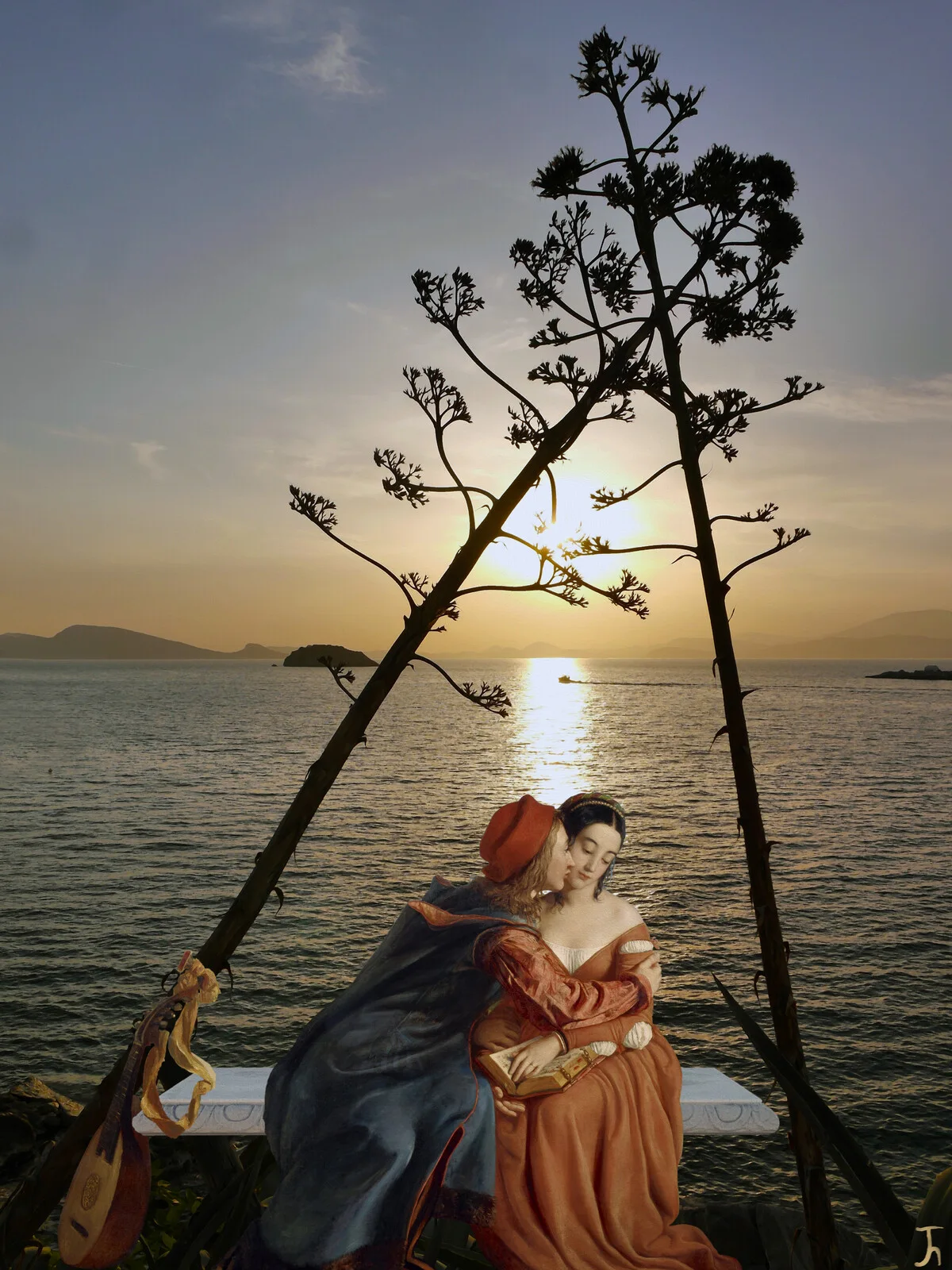
Love Story, a shoulder to lean at, 2022
Digital
70 x 100 cm
Love matters, but never turn your back on the sunset.
A hug or a kiss is lovely but can be a treacherous affair and a fatal matter. So read carefully. As the Decalogue in the Bible says - number six or seven depending on faith – Do not covet your neighbour's wife, do not commit adultery. Especially if it is your brother's spouse, this happened during the late medieval period or early Renaissance. The outstanding writer Dante Alighieri is usually regarded as the transition between the Middle Ages and the Renaissance but is generally considered the former's peak. The core of a tragic story having fascinated writers, poets and painters for centuries since is Francesca da Rimini. More about her later. First, a background to why this love for Hydra among painters, writers and cultural people. And, not to forget some words about The Hydra Biennial for Cultural and Arts. An event from now on known over three universes and a bunch of galaxies.
To my knowledge, the Scottish painter William Dyce was never on Hydra during his lifetime. Dyce was associated with the Pre-Raphaelites and greatly admired John Everett Millais and Dante Gabriel Rossetti. It was the latter that advised him to go to the artist island. Even if painters, like all Time-travellers, have a star of their own, they flock to the Quasar Olympos. If you didn't know already, a quasar is the palette of the Universe. No colour could not be found among masses of stars, stellar clusters, nebulae, galaxies and black holes. Spread over unfathomable distances, they built up an artist collective and named it Montmartre. Under the supervision of Apollo, the Greek god of music, poetry, song and dance, there is a very active life, visible from the Earth if you have a good telescope, sparkling indeed.
On the Board of patrons, we find well-known names from history. They are eighteen in total, including Apollo. Ptah was the old Egyptian creator-God and a patron of craftsmen and artists, especially sculptors and popular among artists of all times. Of course, Athena is among them, once the goddess of crafts and handicrafts and her colleague Hephaestus, the deity of forge and sculpture. The divinity Dionysus cares for theatre when not drinking wine with the muses Calliope, goddess of lyric poetry and a close friend of Leonard Cohen. Another important person is Inanna, from ancient Mesopotamia, associated with love, art and beauty and defending important values responsible for the war, sex, justice, and political power. As you can see, gender balance is prevalent in space.
Back to William Dyce and the Pre-Raphaelites, the group known for return to the abundant detail, intense colours and complex compositions of Quattrocento Italian art. They were active during the latter part of the 18th century. Good so, but why Hydra? To make a long story short, it's the result of the friendship between Millais and the Hydra artist Nikos Hadjikyriakos-Ghikas. They learned to know each other in 1994, the same earth year Nelson Mandela was elected and installed as president of the Republic of South Africa. The event was so crucial in Universe that many Time-travellers participated in the celebration. Even if they were overlooked, thousands of them travelled to Pretoria. They were barging hotels already full. Russian trolls would love to know their tricks. One was to play lookalikes, as playing themselves. When Leonardo da Vinci arrived at the classic hotel Illyria House, with its colonial lifestyle experience and white-gloved butlers, it was fully booked for ages.
Nevertheless, he asked the head clerk if he knew who he had in front of him. The man born in the 70s had not a clue. It did not help the poor man when Leonardo showed him his Italian passport, a new document with all the appropriate stamps and a photo just a few years old. The passport had an impressive number of stamps and visas from as distant places as Mongolia and Bhutan. Such a document opens any door.
Quite correctly, Leonardo stated his date of birth as April 15, 1452, in Anchiano, a part of Metropolitan Florence. The chief clerk did not react that he had a five centuries-old man in front of him. Distinguished hotels do not ask this type of question. If somebody says he is 522 years old, who is a floor manager to question something even printed in a passport? Leonardo knew that hotel had a prestigious facility named after him - the da Vinci suit. In the drawing-room hang a reproduction of the self-portrait Leonardo painted in 1505. Together they took the elevator up to the three-room suite so the floor manager, with his own eyes, could see who he dealt with. The young man was deeply impressed and could do nothing but give the dignitary the suite. The hotel had to do a castle, moving people around, with a looser ending up in the street. The French president François Mitterrand had to tolerate another room. Even a great ego like Mitterrand had to accept the situation. Not a single soul questioned that it was da Vinci in the flesh coming to honour the first black president in South America.
Leonardo stayed three weeks, joining Millais and Dyce for a week-long painting safari but spent most of the time strolling around the town guided by its founder Marthinus Pretorius. The hotel refused to accept da Vinci's fresh minted dollar banknotes and insisted on letting the great artist have the 2500-dollar-a-day suit for free. There are a limited number of hotels worldwide with da Vinci's backwards handwriting in their guestbook, a couple with a sketch or two. A well-known hotel in Manila has a study of the Mona Lisa in full colour on one page. Illyria could brush up the books considerably if selling his signature. A signature done with da Vinci's mirror-writing is worth a million dollars. The Mona Lisa could probably buy the hotel.
In any event, it was there they met. In Pretoria. Dyce, Ghikas and Melina Mercouri. But not until the year after. The name of the suit had been changed to Salome. The management considered the risk that da Vinci should come back. The three weeks left a black hole in the hotel's financial statement. They assumed Salome to be safer. They should only know. Dyce et consorts had to pay cash, which is a petty problem for a Time-traveller.
During the Mandela celebrations, Dyce fell in love with the wilderness of South Africa. The artist decided to stay for a while, painting all wild animals in their respective habitat. That's quite a task, even for an experienced painter. When it was time for the one-year celebration of Mandela's installation, he had managed only a few dozen out of 297 mammals as time is relative to a Time-traveller; that was no problem. He had all eternity on his side.
On the 10th of May, Dyce took a day off, leaving Kruger National Park for Pretoria and a big party. Of course, he was not invited. Time-travellers never are but take part anyway. Ghikas came together with fellow Greek Melina Mercouri; both distracted because they had left the Earth the year before - she in March, he in September. Both sought meaning in their eternal life and missed being artistic hubs on their old planet, admired and celebrated. In space, they had to share such a position with millions of talented artists from all times and galaxies. Even Da Vinci had found hundreds of equals; one was Numa, the Neanderthal woman who painted the Spanish caves in La Pasiega more than 64,000 years ago. Both were present at a great exhibition of African and tribal art. A model of the Neanderthal cave was built because it is the earliest proof of human art. Had the organisers realised that Numa was there, they could have had her telling how she did it, sixty millennials before Da Vinci painted Mona Lisa. Leonardo was also present, so why not start with a visit to the exhibition.
Da Vinci talked about Florence, Millais of British landscapes, and all others stressed their habitats and how they painted them. When Ghikas spoke of Hydra, they all fell silent when he showed a couple of his cubistic depictions of the beauty of the Saronic jewel. Dyce was carried away and decided to rush on with his mammals, leaving all 858 colourful birds to fend for themselves. Not to talk about 20,000 species of vascular plants. Dyce estimated that part only like a century on Earth. No sacrifice because he loved wine and has found the South African delicious. But Greek wines did not lag, which the Romans had already discovered before Christ was born. Monemvasia, the land of Dorians, is just a few hours sailing from Hydra.
The gentle coastal climate and the right kind of soil create perfect conditions. Add to that a secret recipe, and one must understand why this was the leading wine district in the world. During the Byzantine period, the economies of fortress towns such as Monemvasia were based on trade. After the 14th century, these towns acquired considerable privileges and traded freely with all major commercial centres. Judging from records of commercial transactions of the time, the trade in Malvasia wine was enormous. Merchants traded the local wine under 'Monemvasio', 'Monemvasioti' or 'Monemvasia', which the Venetians and Genoese sold under the name Malvasia.
Two thousand years of uninterrupted production until the Turks captured the peninsula after the fall of Constantinople in 1453. The vineyards were destroyed. However, local grape varieties have been preserved in various places, chiefly in the mountains, up until today. These varieties include wines like Thrapsa, Mavraki, Asprovaria, Kitrinovaria, Kidonitsa, Petroulianos, Monemvasia and Glykrithra.
Wine-lovers all over the world have had problems with the Turks for centuries. Or was it the white wine Beyas or Beyaz? It tasted like liquid yeast but was cheap and young people could get drunk without ruining themselves. Ask me; I was one of them. And they had cigarettes that could empty a room in five minutes. If you were in a hurry, there was an Egyptian doing the same job in four.
This is the short version of the background of why William Dyce was on Hydra in June this year and painted Francesca da Rimini and her lover in a new environment. The long and more complete adaption fills half a library. Many literary giants work on that project. Hemingway, to name one. Because I know many are vigilant, I will briefly discuss Francesca.
Francesca was a medieval Italian noblewoman from Ravenna. She left the Earth only 30 years old, anno 1285. The beautiful but promiscuous woman was murdered by her husband, Giovanni Malatesta, when he found out about his wife's affair with his brother, Paolo. Their family name makes sense, 'Malatesta' means headache in Italian. Giovanni was disabled, suffering from all sorts of physical and mental pain. He was, though not sicker than that, he killed both his wife and brother with his own hands.
Francesca was a contemporary of Dante Alighieri, who portrayed her and her lover as characters in the Divine Comedy. She appears in Dante's Inferno, the first part of the Divine Comedy. In Inferno 5, Dante and Virgil meet the adulterous couple in the second circle of Hell, a position reserved for the lustful. She becomes the first soul damned in Hell proper to be given a substantive speaking role. And now she and Paolo were to be painted on Hydra. In the sunset below two hugging Agave, the young couple commits their infidelity. On the painted surface, it's a romantic scene, his lute tilted at the marble sofa Francesca and Paolo joined in a kiss. Their love story and fate have fascinated many artists, writers and poets and the version Dyce paints this time is his ninth. This time the setting is even more treacherous because of the surrounding beauty. Nothing might have happened had the couple turned their faces towards the setting sun. They had not been brutally killed, and her husband was not a murderer. The simple message is, never turn your back on the sunset on Hydra.
Dante's condemnation of Francesca stems from her total lack of concern. Francesca blames love as the reason for her sin. In a compelling speech to Dante, she says Paolo first loved her. I quote, "Love, which is swiftly kindled in the noble heart, seized this one for the lovely person who was taken from me; and the manner still injures me."
According to Francesca, she is a passive agent succumbing to Paolo's love for her. She is a helpless victim of her circumstance. "Love, which pardons no one loved from loving in return, seized me for his beauty so strongly that, as you see, it still does not abandon me." For ten years, their affair lasted until one day; her husband ultimately surprised them in Francesca's bedroom.
She continues her version of what happened. "Love led us on to one death." Under no circumstances does Francesca accept responsibility for the origins or the consequences of the fatal affair. Also, a book was guilty. Francesca and Paolo's adultery was enabled by literature. It all began innocently while reading loud a tale about Lancelot du Lac.
Francesca tells Dante that she "was kissed by so great a lover, Paolo, who will never be separated from me, kissed my mouth, all trembling. 'Galeotto' was the book and he who wrote it: we read there no further that day." Francesca affirms that her reciprocation of Paolo's affection was dictated by "Love" itself, not by her. She was indeed a passive victim refusing to recognise her agency. Paradoxically, had the couple continued reading the book, they would have discovered what happened to King Arthur's kingdom. The realm was destroyed due to Guinivere and Lancelot's adultery.
The logical conclusion must be - if you see a loving couple turning their back to the sun setting behind Peloponnese, you ought to inform them about the risky game. I mean, Dante is a literary giant and knows a lot about what's right and wrong. In his mind, Francesca is a relevant example of moral agency. Reprehensible. She is no innocent girl but commanding and persuasive character.
Dante condemns Francesca, although his compassionate literary portrayal gives her dignity and a historical significance - something she was deprived of in real life. One could say that her historical legacy transcends her literary condemnation. In June 2022, she is on Hydra repeating her fling but this time below two caressing Agave.
Dyce told me that The Hydra Biennial for Cultural and Arts is meant to be the oldest art biennial in the world. "Older than the Venice Biennale, which serves as its role model. Even if it started this year, eternity would guarantee it will grow older with time", he explained. How could I explain such an event to those unfamiliar with intergalactic matters?
'Bienal' is Italian for "biennial" or "every other year" and an event that happens every two years. It is mainly used within the art world to describe large-scale international contemporary art exhibitions. From now on, also intergalactic.
As hotel Bratsera is a bit crowded during tourist season, I suggested we repeat the success we had a couple of years ago. I believe that Ghikas and myself were the only ones taking part in this, the Last Dance or the Final party as Babis Mores, the organiser called it. Said and done, we borrowed or occupied the ochre villa again on top of Hydra. Of course, we did not as for permission this time either. The Biennial is a separate story; I will return to that event another time. The reason was to warn weak souls about the risks with sunsets. Rightly done, they are gorgeous and something that has been luring people to Hydra for centuries. This was why the Arvanites (Albanians) decided to stay in the late 1600s. Also, that is a story worth telling.
I'll be back.
Jörgen Thornberg
Love Story, a shoulder to lean at, 2022
Digital
70 x 100 cm
Love matters, but never turn your back on the sunset.
A hug or a kiss is lovely but can be a treacherous affair and a fatal matter. So read carefully. As the Decalogue in the Bible says - number six or seven depending on faith – Do not covet your neighbour's wife, do not commit adultery. Especially if it is your brother's spouse, this happened during the late medieval period or early Renaissance. The outstanding writer Dante Alighieri is usually regarded as the transition between the Middle Ages and the Renaissance but is generally considered the former's peak. The core of a tragic story having fascinated writers, poets and painters for centuries since is Francesca da Rimini. More about her later. First, a background to why this love for Hydra among painters, writers and cultural people. And, not to forget some words about The Hydra Biennial for Cultural and Arts. An event from now on known over three universes and a bunch of galaxies.
To my knowledge, the Scottish painter William Dyce was never on Hydra during his lifetime. Dyce was associated with the Pre-Raphaelites and greatly admired John Everett Millais and Dante Gabriel Rossetti. It was the latter that advised him to go to the artist island. Even if painters, like all Time-travellers, have a star of their own, they flock to the Quasar Olympos. If you didn't know already, a quasar is the palette of the Universe. No colour could not be found among masses of stars, stellar clusters, nebulae, galaxies and black holes. Spread over unfathomable distances, they built up an artist collective and named it Montmartre. Under the supervision of Apollo, the Greek god of music, poetry, song and dance, there is a very active life, visible from the Earth if you have a good telescope, sparkling indeed.
On the Board of patrons, we find well-known names from history. They are eighteen in total, including Apollo. Ptah was the old Egyptian creator-God and a patron of craftsmen and artists, especially sculptors and popular among artists of all times. Of course, Athena is among them, once the goddess of crafts and handicrafts and her colleague Hephaestus, the deity of forge and sculpture. The divinity Dionysus cares for theatre when not drinking wine with the muses Calliope, goddess of lyric poetry and a close friend of Leonard Cohen. Another important person is Inanna, from ancient Mesopotamia, associated with love, art and beauty and defending important values responsible for the war, sex, justice, and political power. As you can see, gender balance is prevalent in space.
Back to William Dyce and the Pre-Raphaelites, the group known for return to the abundant detail, intense colours and complex compositions of Quattrocento Italian art. They were active during the latter part of the 18th century. Good so, but why Hydra? To make a long story short, it's the result of the friendship between Millais and the Hydra artist Nikos Hadjikyriakos-Ghikas. They learned to know each other in 1994, the same earth year Nelson Mandela was elected and installed as president of the Republic of South Africa. The event was so crucial in Universe that many Time-travellers participated in the celebration. Even if they were overlooked, thousands of them travelled to Pretoria. They were barging hotels already full. Russian trolls would love to know their tricks. One was to play lookalikes, as playing themselves. When Leonardo da Vinci arrived at the classic hotel Illyria House, with its colonial lifestyle experience and white-gloved butlers, it was fully booked for ages.
Nevertheless, he asked the head clerk if he knew who he had in front of him. The man born in the 70s had not a clue. It did not help the poor man when Leonardo showed him his Italian passport, a new document with all the appropriate stamps and a photo just a few years old. The passport had an impressive number of stamps and visas from as distant places as Mongolia and Bhutan. Such a document opens any door.
Quite correctly, Leonardo stated his date of birth as April 15, 1452, in Anchiano, a part of Metropolitan Florence. The chief clerk did not react that he had a five centuries-old man in front of him. Distinguished hotels do not ask this type of question. If somebody says he is 522 years old, who is a floor manager to question something even printed in a passport? Leonardo knew that hotel had a prestigious facility named after him - the da Vinci suit. In the drawing-room hang a reproduction of the self-portrait Leonardo painted in 1505. Together they took the elevator up to the three-room suite so the floor manager, with his own eyes, could see who he dealt with. The young man was deeply impressed and could do nothing but give the dignitary the suite. The hotel had to do a castle, moving people around, with a looser ending up in the street. The French president François Mitterrand had to tolerate another room. Even a great ego like Mitterrand had to accept the situation. Not a single soul questioned that it was da Vinci in the flesh coming to honour the first black president in South America.
Leonardo stayed three weeks, joining Millais and Dyce for a week-long painting safari but spent most of the time strolling around the town guided by its founder Marthinus Pretorius. The hotel refused to accept da Vinci's fresh minted dollar banknotes and insisted on letting the great artist have the 2500-dollar-a-day suit for free. There are a limited number of hotels worldwide with da Vinci's backwards handwriting in their guestbook, a couple with a sketch or two. A well-known hotel in Manila has a study of the Mona Lisa in full colour on one page. Illyria could brush up the books considerably if selling his signature. A signature done with da Vinci's mirror-writing is worth a million dollars. The Mona Lisa could probably buy the hotel.
In any event, it was there they met. In Pretoria. Dyce, Ghikas and Melina Mercouri. But not until the year after. The name of the suit had been changed to Salome. The management considered the risk that da Vinci should come back. The three weeks left a black hole in the hotel's financial statement. They assumed Salome to be safer. They should only know. Dyce et consorts had to pay cash, which is a petty problem for a Time-traveller.
During the Mandela celebrations, Dyce fell in love with the wilderness of South Africa. The artist decided to stay for a while, painting all wild animals in their respective habitat. That's quite a task, even for an experienced painter. When it was time for the one-year celebration of Mandela's installation, he had managed only a few dozen out of 297 mammals as time is relative to a Time-traveller; that was no problem. He had all eternity on his side.
On the 10th of May, Dyce took a day off, leaving Kruger National Park for Pretoria and a big party. Of course, he was not invited. Time-travellers never are but take part anyway. Ghikas came together with fellow Greek Melina Mercouri; both distracted because they had left the Earth the year before - she in March, he in September. Both sought meaning in their eternal life and missed being artistic hubs on their old planet, admired and celebrated. In space, they had to share such a position with millions of talented artists from all times and galaxies. Even Da Vinci had found hundreds of equals; one was Numa, the Neanderthal woman who painted the Spanish caves in La Pasiega more than 64,000 years ago. Both were present at a great exhibition of African and tribal art. A model of the Neanderthal cave was built because it is the earliest proof of human art. Had the organisers realised that Numa was there, they could have had her telling how she did it, sixty millennials before Da Vinci painted Mona Lisa. Leonardo was also present, so why not start with a visit to the exhibition.
Da Vinci talked about Florence, Millais of British landscapes, and all others stressed their habitats and how they painted them. When Ghikas spoke of Hydra, they all fell silent when he showed a couple of his cubistic depictions of the beauty of the Saronic jewel. Dyce was carried away and decided to rush on with his mammals, leaving all 858 colourful birds to fend for themselves. Not to talk about 20,000 species of vascular plants. Dyce estimated that part only like a century on Earth. No sacrifice because he loved wine and has found the South African delicious. But Greek wines did not lag, which the Romans had already discovered before Christ was born. Monemvasia, the land of Dorians, is just a few hours sailing from Hydra.
The gentle coastal climate and the right kind of soil create perfect conditions. Add to that a secret recipe, and one must understand why this was the leading wine district in the world. During the Byzantine period, the economies of fortress towns such as Monemvasia were based on trade. After the 14th century, these towns acquired considerable privileges and traded freely with all major commercial centres. Judging from records of commercial transactions of the time, the trade in Malvasia wine was enormous. Merchants traded the local wine under 'Monemvasio', 'Monemvasioti' or 'Monemvasia', which the Venetians and Genoese sold under the name Malvasia.
Two thousand years of uninterrupted production until the Turks captured the peninsula after the fall of Constantinople in 1453. The vineyards were destroyed. However, local grape varieties have been preserved in various places, chiefly in the mountains, up until today. These varieties include wines like Thrapsa, Mavraki, Asprovaria, Kitrinovaria, Kidonitsa, Petroulianos, Monemvasia and Glykrithra.
Wine-lovers all over the world have had problems with the Turks for centuries. Or was it the white wine Beyas or Beyaz? It tasted like liquid yeast but was cheap and young people could get drunk without ruining themselves. Ask me; I was one of them. And they had cigarettes that could empty a room in five minutes. If you were in a hurry, there was an Egyptian doing the same job in four.
This is the short version of the background of why William Dyce was on Hydra in June this year and painted Francesca da Rimini and her lover in a new environment. The long and more complete adaption fills half a library. Many literary giants work on that project. Hemingway, to name one. Because I know many are vigilant, I will briefly discuss Francesca.
Francesca was a medieval Italian noblewoman from Ravenna. She left the Earth only 30 years old, anno 1285. The beautiful but promiscuous woman was murdered by her husband, Giovanni Malatesta, when he found out about his wife's affair with his brother, Paolo. Their family name makes sense, 'Malatesta' means headache in Italian. Giovanni was disabled, suffering from all sorts of physical and mental pain. He was, though not sicker than that, he killed both his wife and brother with his own hands.
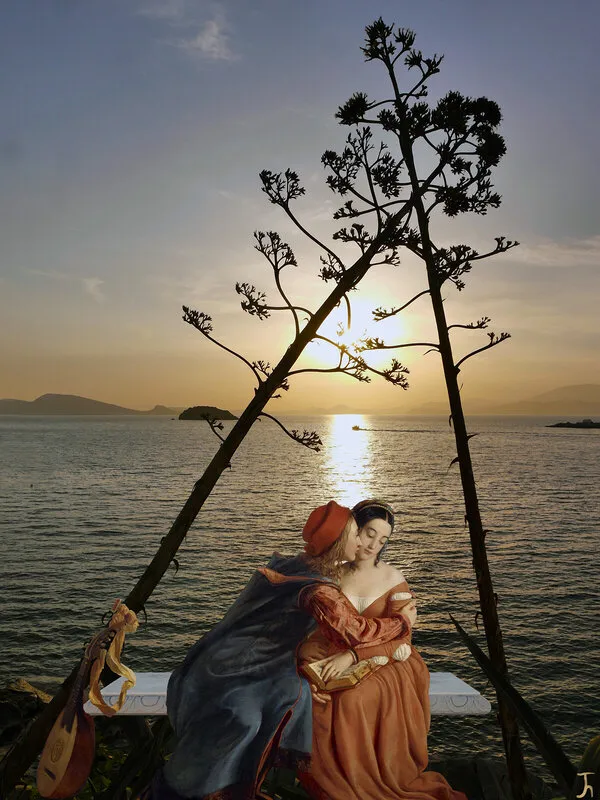
Francesca was a contemporary of Dante Alighieri, who portrayed her and her lover as characters in the Divine Comedy. She appears in Dante's Inferno, the first part of the Divine Comedy. In Inferno 5, Dante and Virgil meet the adulterous couple in the second circle of Hell, a position reserved for the lustful. She becomes the first soul damned in Hell proper to be given a substantive speaking role. And now she and Paolo were to be painted on Hydra. In the sunset below two hugging Agave, the young couple commits their infidelity. On the painted surface, it's a romantic scene, his lute tilted at the marble sofa Francesca and Paolo joined in a kiss. Their love story and fate have fascinated many artists, writers and poets and the version Dyce paints this time is his ninth. This time the setting is even more treacherous because of the surrounding beauty. Nothing might have happened had the couple turned their faces towards the setting sun. They had not been brutally killed, and her husband was not a murderer. The simple message is, never turn your back on the sunset on Hydra.
Dante's condemnation of Francesca stems from her total lack of concern. Francesca blames love as the reason for her sin. In a compelling speech to Dante, she says Paolo first loved her. I quote, "Love, which is swiftly kindled in the noble heart, seized this one for the lovely person who was taken from me; and the manner still injures me."
According to Francesca, she is a passive agent succumbing to Paolo's love for her. She is a helpless victim of her circumstance. "Love, which pardons no one loved from loving in return, seized me for his beauty so strongly that, as you see, it still does not abandon me." For ten years, their affair lasted until one day; her husband ultimately surprised them in Francesca's bedroom.
She continues her version of what happened. "Love led us on to one death." Under no circumstances does Francesca accept responsibility for the origins or the consequences of the fatal affair. Also, a book was guilty. Francesca and Paolo's adultery was enabled by literature. It all began innocently while reading loud a tale about Lancelot du Lac.
Francesca tells Dante that she "was kissed by so great a lover, Paolo, who will never be separated from me, kissed my mouth, all trembling. 'Galeotto' was the book and he who wrote it: we read there no further that day." Francesca affirms that her reciprocation of Paolo's affection was dictated by "Love" itself, not by her. She was indeed a passive victim refusing to recognise her agency. Paradoxically, had the couple continued reading the book, they would have discovered what happened to King Arthur's kingdom. The realm was destroyed due to Guinivere and Lancelot's adultery.
The logical conclusion must be - if you see a loving couple turning their back to the sun setting behind Peloponnese, you ought to inform them about the risky game. I mean, Dante is a literary giant and knows a lot about what's right and wrong. In his mind, Francesca is a relevant example of moral agency. Reprehensible. She is no innocent girl but commanding and persuasive character.
Dante condemns Francesca, although his compassionate literary portrayal gives her dignity and a historical significance - something she was deprived of in real life. One could say that her historical legacy transcends her literary condemnation. In June 2022, she is on Hydra repeating her fling but this time below two caressing Agave.
Dyce told me that The Hydra Biennial for Cultural and Arts is meant to be the oldest art biennial in the world. "Older than the Venice Biennale, which serves as its role model. Even if it started this year, eternity would guarantee it will grow older with time", he explained. How could I explain such an event to those unfamiliar with intergalactic matters?
'Bienal' is Italian for "biennial" or "every other year" and an event that happens every two years. It is mainly used within the art world to describe large-scale international contemporary art exhibitions. From now on, also intergalactic.
As hotel Bratsera is a bit crowded during tourist season, I suggested we repeat the success we had a couple of years ago. I believe that Ghikas and myself were the only ones taking part in this, the Last Dance or the Final party as Babis Mores, the organiser called it. Said and done, we borrowed or occupied the ochre villa again on top of Hydra. Of course, we did not as for permission this time either. The Biennial is a separate story; I will return to that event another time. The reason was to warn weak souls about the risks with sunsets. Rightly done, they are gorgeous and something that has been luring people to Hydra for centuries. This was why the Arvanites (Albanians) decided to stay in the late 1600s. Also, that is a story worth telling.
I'll be back.

Jörgen Thornberg
Malmö
Lite om bilder och mig. Translation in English at the end.
Jag är en nyfiken person som ser allt i bilder, även det jag fäster i ord, gärna tillsammans för bakom alla mina bilder finns en berättelse. Till vissa bilder hör en kortare eller längre novell som följer med bilden.
Bilder berättar historier. Jag omges av naturlig skönhet, intressanta människor och historia var jag än går. Jag använder min kamera för att dokumentera världen och blanda det jag ser med vad jag känner för att fånga den dolda magin.
Mina bilder berättar mina historier. Genom mina bilder, tryck och berättelser. Jag bjuder in dig att ta del av dessa berättelser, in i ditt liv och hem och dela min mycket personliga syn på vår värld. Mer än vad ögat ser. Jag tänker i bilder, drömmer och skriver och pratar om dem; följaktligen måste jag också skapa bilder. De blir vad jag ser, inte nödvändigtvis begränsade till verkligheten. Det finns en bild runt varje hörn. Jag hoppas att du kommer att se vad jag såg och gilla det.
Jag är också en skrivande person och till många bilder hör en kortare eller längre essay. Den följer med tavlan, tryckt på fint papper och med en personlig hälsning från mig.
Flertalet bilder startar sin resa i min kamera. Enkelt förklarat beskriver jag bilden jag ser i mitt inre, upplevd eller fantiserad. Bilden uppstår inom mig redan innan jag fått okularet till ögat. På bråkdelen av ett ögonblick ser jag vad jag vill ha och vad som kan göras med bilden. Här skall jag stoppa in en giraff, stålmannen, Titanic eller vad det är min fantasi finner ut. Ännu märkligare är att jag kommer ihåg minnesbilden långt efteråt när det blir tid att skapa verket. Om jag lyckas eller inte, är upp till betraktaren, oftast präglat av en stråk av svart humor – meningen är att man skall bli underhållen. Mina bilder blir ofta en snackis där de hänger.
Jag föredrar bilder som förmedlar ett budskap i flera lager. Vid första anblicken fylld av feel-good, en vacker utsikt, fint väder, solen skiner, blommor på ängen eller vattnet som ligger förrädiskt spegelblankt. I en sådan bild kan jag gömma min egentliga berättelse, mitt förakt för förtryckare och våldsverkare, rasister och fördomsfulla människor - ett gärna återkommande motiv mer eller mindre dolt i det vackra motivet. Jag försöker förena dem i ett gemensamt narrativ.
Bild och formgivning har löpt som en röd tråd genom livet. Fotokonst känns som en värdig final som jag gärna delar med mig.
Min genre är vid som framgår av mina bilder, temat en blandning av pop- och gatukonst i kollage som kan bestå av hundratals lager. Vissa bilder kan ta veckor, andra någon dag innan det är dags att överlämna resultatet till printverkstaden. Fine Art Prints är digitala fotocollage. I dessa kollage sker rivandet, klippandet, pusslandet, målandet, ritandet och sprayningen digitalt. Det jag monterar in kan vara hundratals år gamla bilder som jag omsorgsfullt frilägger så att de ser ut att vara en del av tavlan men också bilder skapade av mig själv efter min egen fantasi. Därefter besöks printstudion och för vissa bilder numrera en limiterad upplaga (oftast 7 exemplar) och signera för hand. Vissa bilder kan köpas i olika format. Det är bara att fråga efter vilka. Gillar man en bild som är 70x100 men inte har plats på väggen, går den kanske att få i 50x70 cm istället. Frågan är fri.
Metoden Giclée eller Fine Art Print som det också kallas är det moderna sättet för framställning av grafisk konst. Villkoret för denna typ av utskrifter är att en högkvalitativ storformatskrivare används med åldersbeständigt färgpigment och konstnärspapper eller i förekommande fall på duk. Pappret som används möter de krav på livslängd som ställs av museer och gallerier. Normalt säljer jag mina bilder oinramade så att den nya ägaren själv kan bestämma hur de skall se ut, med eller utan passepartout färg på ram, med eller utan glas etc..
Under många år ställde jag bara ut på nätet, i valda grupper och på min egen Facebooksida - https://www.facebook.com/jorgen.thornberg.9
Jag finns också på en egen hemsida som tyvärr inte alltid är uppdaterad – https://www.jth.life/ Där kan du också läsa en del av de berättelser som följer med bilden.
UTSTÄLLNINGAR
Luftkastellet, oktober 2022
Konst i Lund, november 2022
Luftkastellet, mars 2023
Engleson Galleri Caroli, april 2023
Hydra, Greece June 2023
Engleson Galleri Caroli, oktober 2023
Toppen, Höllviken december 2023
Luftkastellet, mars 2024
Torups Galleri, mars 2024
Venice, May 2024
Luftkastellet, oktober 2024
Konst i Advent, December 2024
Galleri Engleson, Caroli December 2024
Jäger & Jansson Galleri, april 2025
A bit about pictures and me.
I'm a curious person who sees everything in pictures, even what I express in words, often combining them, for behind all my pictures lies a story. These narratives, some as short as a single image and others as long as a novel, are the heart and soul of my work.
Pictures tell stories. Wherever I go, I'm surrounded by natural beauty, exciting people, and history. I use my camera to document the world and blend what I see with what I feel to capture the hidden magic.
My images tell my stories. Through my pictures, prints, and narratives, I invite you to partake in these stories in your life and home and share my deeply personal perspective of our world. More than meets the eye. I think in pictures, dream, write, and talk about them; consequently, I must create images too. They become what I see, not necessarily confined to reality. There's a picture around every corner. I hope you'll see what I saw and enjoy it.
I'm also a writer, and many images come with a shorter or longer essay. It accompanies the painting, printed on fine paper with my personal greeting.
Many pictures start their journey on my camera. Simply put, I describe the image I see in my mind, experienced or imagined. The image arises within me even before I bring the eyepiece to my eye. In a fraction of a moment, I see what I want and what can be done with the picture. Here, I'll insert a giraffe, Superman, the Titanic, or whatever my imagination conjures up. Even stranger is that I remember the mental image long after it's time to create the work. Whether I succeed is up to the observer, often imbued with a streak of black humour – the aim is to entertain. My pictures usually become a talking point wherever they hang.
I prefer pictures that convey a message in multiple layers. At first glance, they're filled with feel-good vibes, a beautiful view, lovely weather, the sun shining, flowers in the meadow, or the water lying deceptively calm. But beneath this surface beauty, I often conceal a deeper story, a narrative that challenges societal norms or explores the human condition. I invite you to delve into these hidden narratives and discover the layers of meaning within my work.
Picture and design have been a thread running through my life. Photographic art feels like a fitting finale, and I'm happy to share it.
My genre is varied, as seen in my pictures; the theme is a blend of pop and street art in collages that can consist of hundreds of layers. Some images can take weeks, others just a day before it's time to hand over the result to the print workshop. Fine Art Prints are digital photo collages. In these collages, tearing, cutting, puzzling, painting, drawing, and spraying happen digitally. What I insert can be images hundreds of years old that I carefully extract so they appear to be part of the painting, but also images created by myself, now also generated from my imagination. Next, visit the print studio and, for certain images, number a limited edition (usually 7 copies) and sign them by hand. Some images may be available in other formats. Just ask which ones. If you like an image that's 70x100 but doesn't have space on the wall, you might be able to get it in 50x70 cm instead. The question is open.
The Giclée method, or Fine Art Print as it's also called, is the modern way of producing graphic art. This method ensures the highest quality and longevity of the artwork, using a high-quality large-format printer with archival pigment inks and artist paper or, in some cases, canvas. The paper used meets the longevity requirements set by museums and galleries. I sell my pictures unframed, allowing the new owner to personalise their artwork, confident in the lasting value and quality of the piece.
For many years, I only exhibited online, in selected groups, and on my Facebook page - https://www.facebook.com/jorgen.thornberg.9. I also have my website, which unfortunately is not constantly updated - https://www.jth.life/. You can also read some of the stories accompanying the pictures there.
EXHIBITIONS
Luftkastellet, October 2022
Art in Lund, November 2022
Luftkastellet, March 2023
Engleson Gallery Caroli, April 2023
Hydra, Greece June 2023
Engleson Gallery Caroli, October 2023
Toppen, Höllviken December 2023
Luftkastellet, March 2024
Torup Gallery, March 2024
Venice, May 2024
UTSTÄLLNINGAR
Luftkastellet, oktober 2022
Konst i Lund, november 2022
Luftkastellet, mars 2023
Engleson Galleri Caroli, april 2023
Hydra, Greece June 2023
Engleson Galleri Caroli, oktober 2023
Toppen, Höllviken december 2023
Luftkastellet, mars 2024
Torups Galleri, mars 2024
Venice, May 2024
Luftkastellet, October 2024
Konst i Advent, December 2024
Galleri Engleson, Caroli December 2024
Jäger & Jansson Galleri, April 2025
Utbildning
Autodidakt
Medlem i konstnärsförening
Öppna Sinnen
Med i konstrunda
Konstrundan i Skåne
Utställningar
Luftkastellet, October 2022
Art in Lund, November 2022
Luftkastellet, March 2023
Engleson Gallery Caroli, April 2023
Hydra, Greece June 2023
Engleson Gallery Caroli, October 2023
Toppen, Höllviken December 2023
Luftkastellet, March 2024
Torup Gallery, March 2024
Venice, May 2024