Vi använder cookies för att ge dig bästa möjliga upplevelse. Välj vilka cookies du tillåter.
Läs mer i vår integritetspolicy
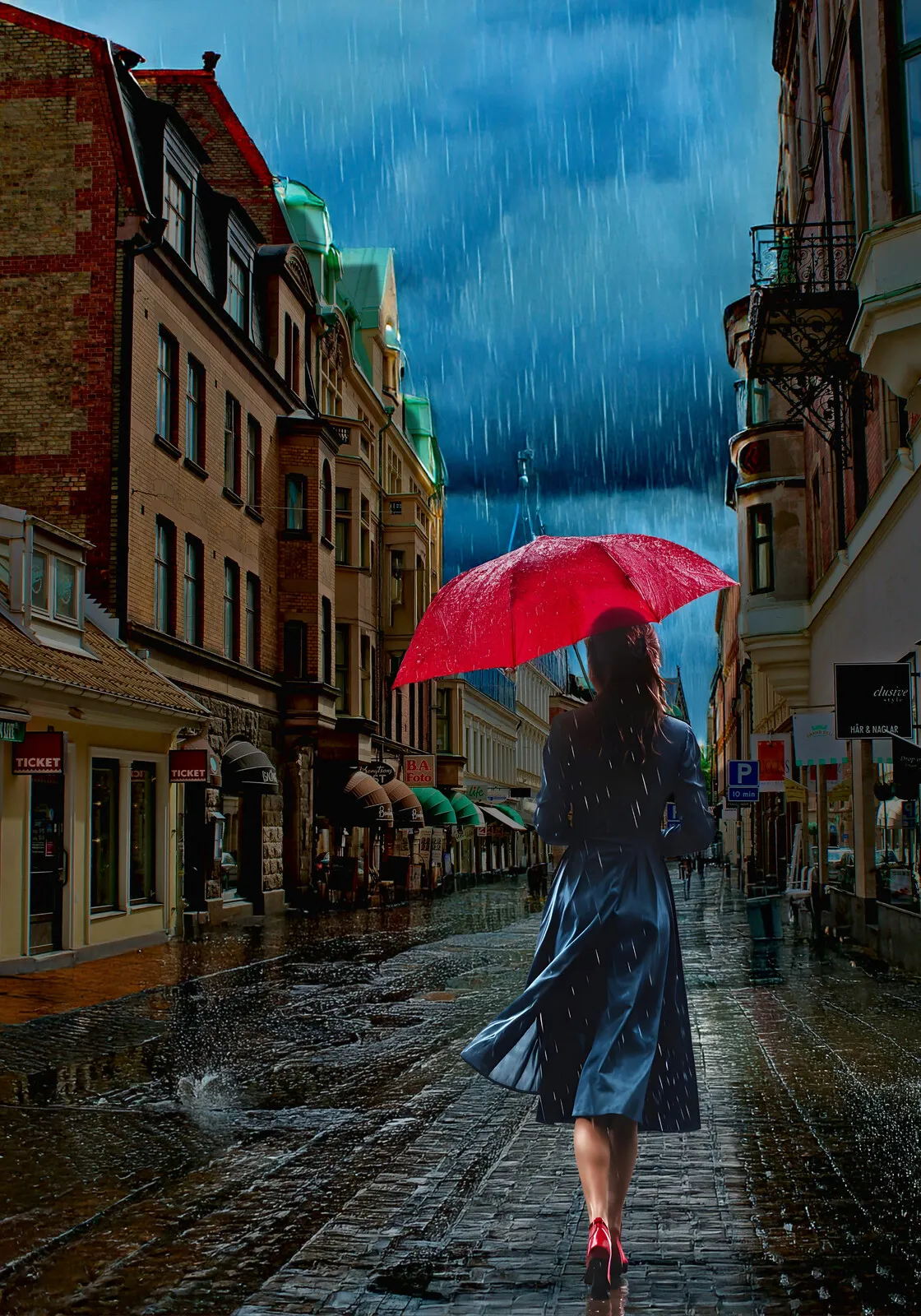
Jörgen Thornberg
Caught in a Summer Shower, 2025
Digital
50 x 70 cm
3 200 kr
Caught in a Summer Shower
From the daughter of a silk merchant in Marseille to Queen of a cold and quiet Stockholm – the life of Desirée Clary is a tale woven with revolutions, love letters, misunderstandings, and nocturnal sleigh rides through snowy landscapes. She never loved Sweden, but Sweden never forgot her. This is the story of the queen who would rather have been somewhere else.
Unravel the mystery and delve deeper into her journey to Lund. This tale, brimming with suspense, will keep you on the edge of your seat, hungry for more.
"Lost in Translation
There’s a verre on the nightstand," she said with gentle grace,
The page grabbed a shoe and stormed right in, wild fear upon his face.
"Relax!" Desirée cried, "It’s just a glass, please take it to the sink!"
"A glass?" he gasped. "Not a worm? I nearly didn’t blink!"
A word too short, a word too long,
can turn the meaning all but wrong.
A "yes" too eager, a "no" too shy —
and someone’s left confused under Stockholm’s sky.
Desirée thought the cheers were for her name,
“Vive la Reine!” — oh, what acclaim!
But farmers cried for skies to burst,
for rain, not queens, to quench nature’s thirst.
A midnight sleigh, a court of "oui,"
yet no one grasped her misery.
“Is the sea quite rough?” she asked with grace —
“Oui,” they smiled — she stayed in place.
So let this tale remind us well
that words can weave a tricky spell.
Sometimes love, sometimes despair,
but often, it's just lost mid-air.”
Malmö, March 2025
Caught in a Summer Shower
It wasn't easy to recognise her, even if you had once been close. Once, she had two and a half million followers, to put it in modern terms. After all, she was a public figure. The woman wore a blue raincoat and held a bright red umbrella to shield herself from the heavy summer shower. Water splashed around her equally red shoes as she walked purposefully down Klostergatan towards the Cathedral. The sky was a leaden grey, and the rain poured down. She praised her lucky star for having thought to bring the umbrella. Where she came from, it never rained, which, in her case, made some sense.
The weather was completely different from the last time she was here; then, the summer had been dry as tinder, crop failure loomed, and the people were upset. Just like back then, Desirée had come from Malmö, a city that had changed much more than Lund, which still looked more or less the same. In Malmö, nearly everything had been torn down — and that was just as well since she had no attachment to the city. It simply lay along the route between the wormhole stretching from her star Rigel to Papegojlyckan in Lund. As she splashed her way along the cobblestones of Klostergatan, not a single house was recognisable to her. Gone were all the charming, low half-timbered facades with inner courtyards that had lined the street in 1827, the last time she had been here. Now, the street was flanked by two- and three-storey stucco facades, with the occasional brick building. Instead of small-pane windows with women peeking out from behind curtains, the exteriors featured a long row of large display windows aimed at drawing the gaze inward. Of the once-bustling life of people and animals, not a trace remained — and not just because of the rain. Three hundred metres of emptiness stretched before her, with a dark grey ceiling and an equally grey cobblestone floor.
Klostergatan lies in the central part of the medieval town area. Closest to the Cathedral, the street runs from Kyrkogatan and connects to what is now Bantorget, which, of course, didn’t exist in 1827. The square wasn’t built until the railway arrived in Lund in 1856, with trains running between Malmö and Lund. This marked the first section of the Southern Main Line, which gradually extended north through Skåne and, in 1862, reached the Småland border — two years after Desirée had passed away. With the arrival of the railway, Klostergatan became a more significant commercial street, linking central Lund to the trains. The street had an irregular path and wasn’t fully paved until the 1790s. Artisans’ workshops primarily occupied the surrounding blocks in earlier times.
The exception was a house on Stora Gråbrödersgatan, parts of which still stood — mainly because it had since been converted into a museum. The professor and national poet Esaias Tegnér lived here until 1826 when he was appointed bishop of Växjö. He was one of the well-known cultural figures of the time and a prominent figure in Lund. Desirée could still remember the whitewashed half-timbered wing from 1768, though she met Tegnér much later — in Stockholm. It was then that he coined the phrase “the academic farm village” to describe the rustic Lund where he had lived and worked for so many years, addressing both Desirée and her husband, Jean. This phrase, 'the academic farm village', was coined by Tegnér to depict the rustic and scholarly atmosphere of Lund, a city with a strong academic tradition often referred to as a 'farm village' due to its rural surroundings.
Desirée turned onto Stora Gråbrödersgatan, which, at the time, was one of Lund’s main streets, and the location along it was one of the finest in town. The city estate Tegnér had purchased consisted, like other large town estates, of a principal residence facing the street, a courtyard surrounded by utility buildings, and behind that a garden. When Desirée visited in 1827, the poet had already moved out, and the property had been sold — but the new owner proudly showed her the advertisement from the previous year, the text that had piqued his interest.
As I prepare to depart from this town, I am extending an offer to sell my property, a significant piece of history in the city. Situated at the corner of Kloster and Gråbröders’ streets, not far from the square, the church, the pharmacy, and the post office, this property holds a unique place in the city's narrative. The residential wing, dating back to the 18th century, contains ten rooms, most of which feature plaster ceilings, wallpaper, and porcelain stoves with brass doors. In the courtyard, two wings stand as a testament to the property's rich history: one with a brewhouse, storehouse, woodsheds, carriage house, large stable, mangle room, and servants’ quarters; the other, constructed of burnt brick and oak posts, includes a threshing floor and two barns, measuring 44 ells long and 13 wide, thus sufficient for larger-scale agriculture.
Today, only the 18th-century residential wing, now housing the museum, remains, although the façade still retains its appearance from the early decades of the 19th century. At this hour in the morning, the museum was closed, the entrance was locked, and the weather was hardly inviting. But this did not deter a time-traveller—even if, like the living, they get wet. But the door, you may ask? Fear not. Desirée possesses the ability to pass through doors at will. Those from eternity think their way through, teleporting, as it’s referred to. It works for stone walls and entire mountains, as well. Desirée immediately recognised the place, especially the kitchen with its brick floor, chimney hood, and raw walls—it looked just as it did in Tegnér’s time.
Through the centuries, the street has played many roles: from a centre of ecclesiastical and royal power in the Middle Ages to a vibrant social arena for students and the bourgeoisie in the 1800s and 1900s, and in between, a place for poorhouses, merchants, and artisans.
Men and women from all social classes and ages have populated the street scene for centuries; advertising signs existed then as now—today a bit more garish, glowing with fluorescent lights inside—but the street’s cobblestones were free of horse manure. Always something. Still, Desirée missed the sounds of the past and thought: “A little filth in paradise is better than a clean hell.” On this June day in 2024, the silence was nearly total apart from the rain—quite unlike 1827. Then it had been so lively that Desirée had been compelled to flee. Proud, yes, but it was somewhat excessive. The contrast between the vibrant past and the serene present is stark, evoking a sense of nostalgia and appreciation for the history of this street.
People had streamed in from all directions, shouting the same thing: “Vive la reine! Vive la reine! Vive la reine!” — which, for those unfamiliar, translates to “Long live the Queen!” Desirée had previously been cautioned about Swedish crowds; her fellow Francophile, Axel von Fersen, had been killed by a mob in Stockholm in 1810, six months before she first arrived in Sweden.
It all came down to a linguistic misunderstanding and her self-image, which was further complicated by the fact that she had never learned to speak Swedish. It was only many years later that Desirée realised the people hadn’t been shouting “Long live the Queen!” but were lamenting the drought—as if she could have done anything about it. Just as little as she could stop the rain. In 1827, Desirée embarked on a journey southward, perhaps with the hidden intention of returning to France, which she yearned for with all her heart. Her house in Paris stood waiting for her, but she never returned—something always impeded her way. Like this time, when she thought the people were cheering her. This misunderstanding, a product of language barriers and her self-image, evokes a sense of empathy for Desirée's situation.
“Viv’ll a räjn,” which to French ears sounds just like “Vive la reine!” but was in fact “Vi vill ha regn!”—“We want rain!” as people would say even in Stockholm, though she never learned more than a few words.
In 1827, she travelled as Queen of Sweden, married to King Charles XIV John, accompanied by her entourage of ladies-in-waiting, pages, adjutants, and assorted attendants. It was they who understood the Queen’s predicament and escorted her to Tegnér’s old house. The new owner had heard the commotion outside and quickly realised that it was his and Sweden’s queen on the street. He gallantly invited her into his house, where she stayed the night until the crowd had tired and dispersed. Desirée received the best guest room, while her attendants were obliged to make do with the yard or the hayloft of the barn. A princely meal was prepared, and French wine was even available in the pantry. It turned out that both she and her host disliked Stockholm, and they exchanged grievances about the city.
“The best thing about Stockholm,” said the host, “is the stagecoach to Lund.”
Desirée could do nothing but agree, even though her journey through the darkest depths of Småland had been bumpy, despite travelling in the royal stables’ finest carriage drawn by four horses. No wonder Desirée had a soft spot for the university town of Lund.
However, much water had flowed through Stockholm’s stream outside the palace since then. For those who prefer a more detailed account, here is a concise summary.
From Marseille to the Royal Palace in Stockholm, via Napoleon’s heart and slippery winter roads.
At the beginning of the 19th century, Sweden faced a significant challenge: there was no crown prince. The man destined to inherit the throne, Danish Prince Karl August, had fallen off his horse at Kvidinge Heath in Skåne and died. Whether it was due to a stroke or if he was drunk as a Scanian magpie remains a matter of debate, but the fact is he passed away before he could ascend the throne. Thus, Sweden stood without a crown prince in a Europe teeming with wars, revolutions, and grand politics.
And so the thought arose: why not choose someone from France? It made sense at the time. Napoleon was the dominant figure in Europe, and aligning with him could be tactically advantageous. After much diplomatic scheming and a few clever intrigues, the choice fell upon Jean-Baptiste Bernadotte, a soldier from Pau who had risen through the ranks of the French army, become Prince of Ponte Corvo, and who, in his youth, had once sworn to fight the monarchy to his last drop of blood. A few years later, he was Sweden’s crown prince. The French ambassador reportedly quipped with dry irony that it was relatively swift business becoming a prince.
Jean Baptiste Bernadotte arrived in Sweden in the autumn of 1810 and was adopted by King Karl XIII. His wife, Desirée, followed in December with their son Oskar. She stepped ashore in Helsingborg, glanced around at the frosty landscape, shivered in her furs—and immediately began to long for home.
Desirée Clary, born Eugénie Bernardine Désirée, was not merely any little bourgeois girl from Marseille. Her father, François Clary, was an exceptionally wealthy silk merchant who traded with the Levant, was ennobled in 1696, and was titled échevin de Marseille. His second wife bore him nine children, and Desirée was the youngest of them all. She was pampered and spoiled—and by the mid-1790s could expect a dowry of over a million. Not exactly peanuts.
As a teenager, she came into contact with another southern French family, the exiled Bonapartes from Corsica. Joseph Bonaparte was her first admirer, perhaps even a fiancé, but when Napoleon took notice of Desirée, he is said to have redirected Joseph toward her older sister, Julie. It is said that Napoleon himself proposed to Desirée—without ever receiving a clear yes. The relationship fizzled out when he turned his attention to Joséphine de Beauharnais, a young widow. However, Desirée still managed to pen an unsent farewell letter to him, full of reproach, morbid thoughts, and teenage melancholy.
After Napoleon came General Duphot, who was killed in a riot in Rome the night before their wedding; life with Desirée was no bed of roses. However, she then met Jean Baptiste Bernadotte. Or rather, it was Joseph Bonaparte, now a member of the Council of Five Hundred, who ensured they met in the summer of 1798. A marriage was arranged, and Desirée is said to have partly agreed because Bernadotte had dared to oppose Napoleon publicly. Something about his backbone attracted her. They married on 17 August 1798, with four Bonapartes signing the contract.
The following year, their son Oskar was born. The family lived on the outskirts of Paris, on Rue Cisalpine. Bernadotte advanced in his career, became Minister of War, and received a house as a gift from Napoleon – confiscated from one General Moreau. When Napoleon staged his coup in 1799, Bernadotte stayed out of sight. According to one version, he hid with Desirée, who was disguised as a boy. Their relationship was not without drama.
As the years rolled on, Bernadotte was dispatched on various missions. Desirée mostly stayed in Paris, at the house on Rue d'Anjou, leading a quiet life with her sister Julie. She travelled only once to see her husband – when he was wounded at the Battle of Mohrungen in 1807.
When Sweden chose Bernadotte as crown prince in 1810, Desirée didn’t quite understand what it meant. She thought it was akin to being elevated to some new French title, like Prince of something-or-other. It wasn’t until she arrived in Sweden and encountered a polite yet cold court, sluggish Swedish conversation, and a climate that seemed bent on freezing her to the bone that she realised this might be more permanent.
She settled in Stockholm but felt deeply unhappy. She didn’t speak the language, didn’t understand the customs, hated the climate, and found court life stiff and dull. Her French lady-in-waiting, Mme La Flotte, stirred up some trouble, and after only half a year, Desirée returned to Paris – reportedly at her husband’s suggestion. She was referred to as the Countess of Gotland, remained in the house on Rue d’Anjou, and received visiting Swedes. Among them, the famous chemist J. J. Berzelius noted her warm hospitality.
At the same time, things weren’t entirely uncomplicated. Sweden was at war with France, yet Desirée lived in Paris without major issues. She retained a discreet title, and her contact with the Bonaparte family continued. Her sister Julie frequently stayed with her, and it was said she relayed political insights to Karl Johan via the Duke of Richelieu.
When her son Oskar travelled through Europe in 1822 to propose to Josephine of Leuchtenberg, he met his mother in Aachen and Switzerland. It was only then that Desirée began considering a return. In June 1823, she and her future daughter-in-law landed in Stockholm – with pomp and circumstance. Perhaps she realised that now it was time to step into her role as queen, lest Josephine fully take over the people’s affection.
Once in Stockholm, Desirée organised a court of thirty to forty people, slept during the day, and was awake at night, preferring to visit fashion shops at midnight. She reportedly rode around in a sleigh at night in a sort of royal vampire routine, and once, when she arrived at a boutique at the stroke of midnight on Midsummer’s Eve, the clerk began lighting candles.
But she never indeed adapted. Desirée lived her life on an inverted schedule – sleeping by day, riding by night. She never learnt Swedish, never grasped the customs, and things reached a point where she no longer dared return to France. She asked her Swedish servants whether the sea crossing would be rough, and since they didn’t understand French and replied “oui” to everything, she didn’t dare board the ship.
So she remained. She outlived her husband by sixteen years. Desirée died in 1860 after attending a performance at the Royal Opera – fittingly, the play was called ‘Life is a Dream’ – and she was buried with both Catholic and Protestant rites.
Yet perhaps it wasn’t so bad after all. Because when she travelled through Skåne in 1827, the farmers shouted “We want rain!” in hopes of a better harvest. The queen smiled, touched by the tribute. She thought they were yelling “Vive la Reine!” – she, who never wanted to be Swedish. Thus ended the tale of the pampered girl from Marseille who became Sweden’s most reluctant yet unforgettable queen.
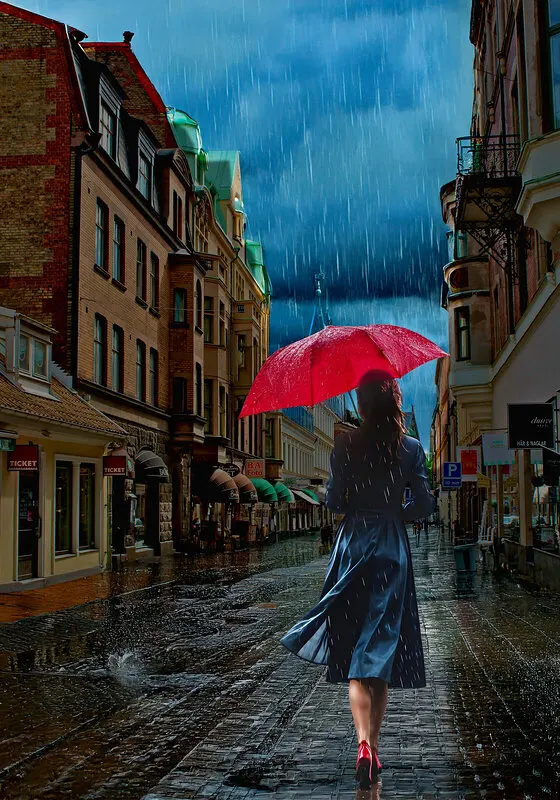
Jörgen Thornberg
Caught in a Summer Shower, 2025
Digital
50 x 70 cm
3 200 kr
Caught in a Summer Shower
From the daughter of a silk merchant in Marseille to Queen of a cold and quiet Stockholm – the life of Desirée Clary is a tale woven with revolutions, love letters, misunderstandings, and nocturnal sleigh rides through snowy landscapes. She never loved Sweden, but Sweden never forgot her. This is the story of the queen who would rather have been somewhere else.
Unravel the mystery and delve deeper into her journey to Lund. This tale, brimming with suspense, will keep you on the edge of your seat, hungry for more.
"Lost in Translation
There’s a verre on the nightstand," she said with gentle grace,
The page grabbed a shoe and stormed right in, wild fear upon his face.
"Relax!" Desirée cried, "It’s just a glass, please take it to the sink!"
"A glass?" he gasped. "Not a worm? I nearly didn’t blink!"
A word too short, a word too long,
can turn the meaning all but wrong.
A "yes" too eager, a "no" too shy —
and someone’s left confused under Stockholm’s sky.
Desirée thought the cheers were for her name,
“Vive la Reine!” — oh, what acclaim!
But farmers cried for skies to burst,
for rain, not queens, to quench nature’s thirst.
A midnight sleigh, a court of "oui,"
yet no one grasped her misery.
“Is the sea quite rough?” she asked with grace —
“Oui,” they smiled — she stayed in place.
So let this tale remind us well
that words can weave a tricky spell.
Sometimes love, sometimes despair,
but often, it's just lost mid-air.”
Malmö, March 2025
Caught in a Summer Shower
It wasn't easy to recognise her, even if you had once been close. Once, she had two and a half million followers, to put it in modern terms. After all, she was a public figure. The woman wore a blue raincoat and held a bright red umbrella to shield herself from the heavy summer shower. Water splashed around her equally red shoes as she walked purposefully down Klostergatan towards the Cathedral. The sky was a leaden grey, and the rain poured down. She praised her lucky star for having thought to bring the umbrella. Where she came from, it never rained, which, in her case, made some sense.
The weather was completely different from the last time she was here; then, the summer had been dry as tinder, crop failure loomed, and the people were upset. Just like back then, Desirée had come from Malmö, a city that had changed much more than Lund, which still looked more or less the same. In Malmö, nearly everything had been torn down — and that was just as well since she had no attachment to the city. It simply lay along the route between the wormhole stretching from her star Rigel to Papegojlyckan in Lund. As she splashed her way along the cobblestones of Klostergatan, not a single house was recognisable to her. Gone were all the charming, low half-timbered facades with inner courtyards that had lined the street in 1827, the last time she had been here. Now, the street was flanked by two- and three-storey stucco facades, with the occasional brick building. Instead of small-pane windows with women peeking out from behind curtains, the exteriors featured a long row of large display windows aimed at drawing the gaze inward. Of the once-bustling life of people and animals, not a trace remained — and not just because of the rain. Three hundred metres of emptiness stretched before her, with a dark grey ceiling and an equally grey cobblestone floor.
Klostergatan lies in the central part of the medieval town area. Closest to the Cathedral, the street runs from Kyrkogatan and connects to what is now Bantorget, which, of course, didn’t exist in 1827. The square wasn’t built until the railway arrived in Lund in 1856, with trains running between Malmö and Lund. This marked the first section of the Southern Main Line, which gradually extended north through Skåne and, in 1862, reached the Småland border — two years after Desirée had passed away. With the arrival of the railway, Klostergatan became a more significant commercial street, linking central Lund to the trains. The street had an irregular path and wasn’t fully paved until the 1790s. Artisans’ workshops primarily occupied the surrounding blocks in earlier times.
The exception was a house on Stora Gråbrödersgatan, parts of which still stood — mainly because it had since been converted into a museum. The professor and national poet Esaias Tegnér lived here until 1826 when he was appointed bishop of Växjö. He was one of the well-known cultural figures of the time and a prominent figure in Lund. Desirée could still remember the whitewashed half-timbered wing from 1768, though she met Tegnér much later — in Stockholm. It was then that he coined the phrase “the academic farm village” to describe the rustic Lund where he had lived and worked for so many years, addressing both Desirée and her husband, Jean. This phrase, 'the academic farm village', was coined by Tegnér to depict the rustic and scholarly atmosphere of Lund, a city with a strong academic tradition often referred to as a 'farm village' due to its rural surroundings.
Desirée turned onto Stora Gråbrödersgatan, which, at the time, was one of Lund’s main streets, and the location along it was one of the finest in town. The city estate Tegnér had purchased consisted, like other large town estates, of a principal residence facing the street, a courtyard surrounded by utility buildings, and behind that a garden. When Desirée visited in 1827, the poet had already moved out, and the property had been sold — but the new owner proudly showed her the advertisement from the previous year, the text that had piqued his interest.
As I prepare to depart from this town, I am extending an offer to sell my property, a significant piece of history in the city. Situated at the corner of Kloster and Gråbröders’ streets, not far from the square, the church, the pharmacy, and the post office, this property holds a unique place in the city's narrative. The residential wing, dating back to the 18th century, contains ten rooms, most of which feature plaster ceilings, wallpaper, and porcelain stoves with brass doors. In the courtyard, two wings stand as a testament to the property's rich history: one with a brewhouse, storehouse, woodsheds, carriage house, large stable, mangle room, and servants’ quarters; the other, constructed of burnt brick and oak posts, includes a threshing floor and two barns, measuring 44 ells long and 13 wide, thus sufficient for larger-scale agriculture.
Today, only the 18th-century residential wing, now housing the museum, remains, although the façade still retains its appearance from the early decades of the 19th century. At this hour in the morning, the museum was closed, the entrance was locked, and the weather was hardly inviting. But this did not deter a time-traveller—even if, like the living, they get wet. But the door, you may ask? Fear not. Desirée possesses the ability to pass through doors at will. Those from eternity think their way through, teleporting, as it’s referred to. It works for stone walls and entire mountains, as well. Desirée immediately recognised the place, especially the kitchen with its brick floor, chimney hood, and raw walls—it looked just as it did in Tegnér’s time.
Through the centuries, the street has played many roles: from a centre of ecclesiastical and royal power in the Middle Ages to a vibrant social arena for students and the bourgeoisie in the 1800s and 1900s, and in between, a place for poorhouses, merchants, and artisans.
Men and women from all social classes and ages have populated the street scene for centuries; advertising signs existed then as now—today a bit more garish, glowing with fluorescent lights inside—but the street’s cobblestones were free of horse manure. Always something. Still, Desirée missed the sounds of the past and thought: “A little filth in paradise is better than a clean hell.” On this June day in 2024, the silence was nearly total apart from the rain—quite unlike 1827. Then it had been so lively that Desirée had been compelled to flee. Proud, yes, but it was somewhat excessive. The contrast between the vibrant past and the serene present is stark, evoking a sense of nostalgia and appreciation for the history of this street.
People had streamed in from all directions, shouting the same thing: “Vive la reine! Vive la reine! Vive la reine!” — which, for those unfamiliar, translates to “Long live the Queen!” Desirée had previously been cautioned about Swedish crowds; her fellow Francophile, Axel von Fersen, had been killed by a mob in Stockholm in 1810, six months before she first arrived in Sweden.
It all came down to a linguistic misunderstanding and her self-image, which was further complicated by the fact that she had never learned to speak Swedish. It was only many years later that Desirée realised the people hadn’t been shouting “Long live the Queen!” but were lamenting the drought—as if she could have done anything about it. Just as little as she could stop the rain. In 1827, Desirée embarked on a journey southward, perhaps with the hidden intention of returning to France, which she yearned for with all her heart. Her house in Paris stood waiting for her, but she never returned—something always impeded her way. Like this time, when she thought the people were cheering her. This misunderstanding, a product of language barriers and her self-image, evokes a sense of empathy for Desirée's situation.
“Viv’ll a räjn,” which to French ears sounds just like “Vive la reine!” but was in fact “Vi vill ha regn!”—“We want rain!” as people would say even in Stockholm, though she never learned more than a few words.
In 1827, she travelled as Queen of Sweden, married to King Charles XIV John, accompanied by her entourage of ladies-in-waiting, pages, adjutants, and assorted attendants. It was they who understood the Queen’s predicament and escorted her to Tegnér’s old house. The new owner had heard the commotion outside and quickly realised that it was his and Sweden’s queen on the street. He gallantly invited her into his house, where she stayed the night until the crowd had tired and dispersed. Desirée received the best guest room, while her attendants were obliged to make do with the yard or the hayloft of the barn. A princely meal was prepared, and French wine was even available in the pantry. It turned out that both she and her host disliked Stockholm, and they exchanged grievances about the city.
“The best thing about Stockholm,” said the host, “is the stagecoach to Lund.”
Desirée could do nothing but agree, even though her journey through the darkest depths of Småland had been bumpy, despite travelling in the royal stables’ finest carriage drawn by four horses. No wonder Desirée had a soft spot for the university town of Lund.
However, much water had flowed through Stockholm’s stream outside the palace since then. For those who prefer a more detailed account, here is a concise summary.
From Marseille to the Royal Palace in Stockholm, via Napoleon’s heart and slippery winter roads.
At the beginning of the 19th century, Sweden faced a significant challenge: there was no crown prince. The man destined to inherit the throne, Danish Prince Karl August, had fallen off his horse at Kvidinge Heath in Skåne and died. Whether it was due to a stroke or if he was drunk as a Scanian magpie remains a matter of debate, but the fact is he passed away before he could ascend the throne. Thus, Sweden stood without a crown prince in a Europe teeming with wars, revolutions, and grand politics.
And so the thought arose: why not choose someone from France? It made sense at the time. Napoleon was the dominant figure in Europe, and aligning with him could be tactically advantageous. After much diplomatic scheming and a few clever intrigues, the choice fell upon Jean-Baptiste Bernadotte, a soldier from Pau who had risen through the ranks of the French army, become Prince of Ponte Corvo, and who, in his youth, had once sworn to fight the monarchy to his last drop of blood. A few years later, he was Sweden’s crown prince. The French ambassador reportedly quipped with dry irony that it was relatively swift business becoming a prince.
Jean Baptiste Bernadotte arrived in Sweden in the autumn of 1810 and was adopted by King Karl XIII. His wife, Desirée, followed in December with their son Oskar. She stepped ashore in Helsingborg, glanced around at the frosty landscape, shivered in her furs—and immediately began to long for home.
Desirée Clary, born Eugénie Bernardine Désirée, was not merely any little bourgeois girl from Marseille. Her father, François Clary, was an exceptionally wealthy silk merchant who traded with the Levant, was ennobled in 1696, and was titled échevin de Marseille. His second wife bore him nine children, and Desirée was the youngest of them all. She was pampered and spoiled—and by the mid-1790s could expect a dowry of over a million. Not exactly peanuts.
As a teenager, she came into contact with another southern French family, the exiled Bonapartes from Corsica. Joseph Bonaparte was her first admirer, perhaps even a fiancé, but when Napoleon took notice of Desirée, he is said to have redirected Joseph toward her older sister, Julie. It is said that Napoleon himself proposed to Desirée—without ever receiving a clear yes. The relationship fizzled out when he turned his attention to Joséphine de Beauharnais, a young widow. However, Desirée still managed to pen an unsent farewell letter to him, full of reproach, morbid thoughts, and teenage melancholy.
After Napoleon came General Duphot, who was killed in a riot in Rome the night before their wedding; life with Desirée was no bed of roses. However, she then met Jean Baptiste Bernadotte. Or rather, it was Joseph Bonaparte, now a member of the Council of Five Hundred, who ensured they met in the summer of 1798. A marriage was arranged, and Desirée is said to have partly agreed because Bernadotte had dared to oppose Napoleon publicly. Something about his backbone attracted her. They married on 17 August 1798, with four Bonapartes signing the contract.
The following year, their son Oskar was born. The family lived on the outskirts of Paris, on Rue Cisalpine. Bernadotte advanced in his career, became Minister of War, and received a house as a gift from Napoleon – confiscated from one General Moreau. When Napoleon staged his coup in 1799, Bernadotte stayed out of sight. According to one version, he hid with Desirée, who was disguised as a boy. Their relationship was not without drama.
As the years rolled on, Bernadotte was dispatched on various missions. Desirée mostly stayed in Paris, at the house on Rue d'Anjou, leading a quiet life with her sister Julie. She travelled only once to see her husband – when he was wounded at the Battle of Mohrungen in 1807.
When Sweden chose Bernadotte as crown prince in 1810, Desirée didn’t quite understand what it meant. She thought it was akin to being elevated to some new French title, like Prince of something-or-other. It wasn’t until she arrived in Sweden and encountered a polite yet cold court, sluggish Swedish conversation, and a climate that seemed bent on freezing her to the bone that she realised this might be more permanent.
She settled in Stockholm but felt deeply unhappy. She didn’t speak the language, didn’t understand the customs, hated the climate, and found court life stiff and dull. Her French lady-in-waiting, Mme La Flotte, stirred up some trouble, and after only half a year, Desirée returned to Paris – reportedly at her husband’s suggestion. She was referred to as the Countess of Gotland, remained in the house on Rue d’Anjou, and received visiting Swedes. Among them, the famous chemist J. J. Berzelius noted her warm hospitality.
At the same time, things weren’t entirely uncomplicated. Sweden was at war with France, yet Desirée lived in Paris without major issues. She retained a discreet title, and her contact with the Bonaparte family continued. Her sister Julie frequently stayed with her, and it was said she relayed political insights to Karl Johan via the Duke of Richelieu.
When her son Oskar travelled through Europe in 1822 to propose to Josephine of Leuchtenberg, he met his mother in Aachen and Switzerland. It was only then that Desirée began considering a return. In June 1823, she and her future daughter-in-law landed in Stockholm – with pomp and circumstance. Perhaps she realised that now it was time to step into her role as queen, lest Josephine fully take over the people’s affection.
Once in Stockholm, Desirée organised a court of thirty to forty people, slept during the day, and was awake at night, preferring to visit fashion shops at midnight. She reportedly rode around in a sleigh at night in a sort of royal vampire routine, and once, when she arrived at a boutique at the stroke of midnight on Midsummer’s Eve, the clerk began lighting candles.
But she never indeed adapted. Desirée lived her life on an inverted schedule – sleeping by day, riding by night. She never learnt Swedish, never grasped the customs, and things reached a point where she no longer dared return to France. She asked her Swedish servants whether the sea crossing would be rough, and since they didn’t understand French and replied “oui” to everything, she didn’t dare board the ship.
So she remained. She outlived her husband by sixteen years. Desirée died in 1860 after attending a performance at the Royal Opera – fittingly, the play was called ‘Life is a Dream’ – and she was buried with both Catholic and Protestant rites.
Yet perhaps it wasn’t so bad after all. Because when she travelled through Skåne in 1827, the farmers shouted “We want rain!” in hopes of a better harvest. The queen smiled, touched by the tribute. She thought they were yelling “Vive la Reine!” – she, who never wanted to be Swedish. Thus ended the tale of the pampered girl from Marseille who became Sweden’s most reluctant yet unforgettable queen.
3 200 kr

Jörgen Thornberg
Malmö
Lite om bilder och mig. Translation in English at the end.
Jag är en nyfiken person som ser allt i bilder, även det jag fäster i ord, gärna tillsammans för bakom alla mina bilder finns en berättelse. Till vissa bilder hör en kortare eller längre novell som följer med bilden.
Bilder berättar historier. Jag omges av naturlig skönhet, intressanta människor och historia var jag än går. Jag använder min kamera för att dokumentera världen och blanda det jag ser med vad jag känner för att fånga den dolda magin.
Mina bilder berättar mina historier. Genom mina bilder, tryck och berättelser. Jag bjuder in dig att ta del av dessa berättelser, in i ditt liv och hem och dela min mycket personliga syn på vår värld. Mer än vad ögat ser. Jag tänker i bilder, drömmer och skriver och pratar om dem; följaktligen måste jag också skapa bilder. De blir vad jag ser, inte nödvändigtvis begränsade till verkligheten. Det finns en bild runt varje hörn. Jag hoppas att du kommer att se vad jag såg och gilla det.
Jag är också en skrivande person och till många bilder hör en kortare eller längre essay. Den följer med tavlan, tryckt på fint papper och med en personlig hälsning från mig.
Flertalet bilder startar sin resa i min kamera. Enkelt förklarat beskriver jag bilden jag ser i mitt inre, upplevd eller fantiserad. Bilden uppstår inom mig redan innan jag fått okularet till ögat. På bråkdelen av ett ögonblick ser jag vad jag vill ha och vad som kan göras med bilden. Här skall jag stoppa in en giraff, stålmannen, Titanic eller vad det är min fantasi finner ut. Ännu märkligare är att jag kommer ihåg minnesbilden långt efteråt när det blir tid att skapa verket. Om jag lyckas eller inte, är upp till betraktaren, oftast präglat av en stråk av svart humor – meningen är att man skall bli underhållen. Mina bilder blir ofta en snackis där de hänger.
Jag föredrar bilder som förmedlar ett budskap i flera lager. Vid första anblicken fylld av feel-good, en vacker utsikt, fint väder, solen skiner, blommor på ängen eller vattnet som ligger förrädiskt spegelblankt. I en sådan bild kan jag gömma min egentliga berättelse, mitt förakt för förtryckare och våldsverkare, rasister och fördomsfulla människor - ett gärna återkommande motiv mer eller mindre dolt i det vackra motivet. Jag försöker förena dem i ett gemensamt narrativ.
Bild och formgivning har löpt som en röd tråd genom livet. Fotokonst känns som en värdig final som jag gärna delar med mig.
Min genre är vid som framgår av mina bilder, temat en blandning av pop- och gatukonst i kollage som kan bestå av hundratals lager. Vissa bilder kan ta veckor, andra någon dag innan det är dags att överlämna resultatet till printverkstaden. Fine Art Prints är digitala fotocollage. I dessa kollage sker rivandet, klippandet, pusslandet, målandet, ritandet och sprayningen digitalt. Det jag monterar in kan vara hundratals år gamla bilder som jag omsorgsfullt frilägger så att de ser ut att vara en del av tavlan men också bilder skapade av mig själv efter min egen fantasi. Därefter besöks printstudion och för vissa bilder numrera en limiterad upplaga (oftast 7 exemplar) och signera för hand. Vissa bilder kan köpas i olika format. Det är bara att fråga efter vilka. Gillar man en bild som är 70x100 men inte har plats på väggen, går den kanske att få i 50x70 cm istället. Frågan är fri.
Metoden Giclée eller Fine Art Print som det också kallas är det moderna sättet för framställning av grafisk konst. Villkoret för denna typ av utskrifter är att en högkvalitativ storformatskrivare används med åldersbeständigt färgpigment och konstnärspapper eller i förekommande fall på duk. Pappret som används möter de krav på livslängd som ställs av museer och gallerier. Normalt säljer jag mina bilder oinramade så att den nya ägaren själv kan bestämma hur de skall se ut, med eller utan passepartout färg på ram, med eller utan glas etc..
Under många år ställde jag bara ut på nätet, i valda grupper och på min egen Facebooksida - https://www.facebook.com/jorgen.thornberg.9
Jag finns också på en egen hemsida som tyvärr inte alltid är uppdaterad – https://www.jth.life/ Där kan du också läsa en del av de berättelser som följer med bilden.
UTSTÄLLNINGAR
Luftkastellet, oktober 2022
Konst i Lund, november 2022
Luftkastellet, mars 2023
Engleson Galleri Caroli, april 2023
Hydra, Greece June 2023
Engleson Galleri Caroli, oktober 2023
Toppen, Höllviken december 2023
Luftkastellet, mars 2024
Torups Galleri, mars 2024
Venice, May 2024
Luftkastellet, oktober 2024
Konst i Advent, December 2024
Galleri Engleson, Caroli December 2024
Jäger & Jansson Galleri, april 2025
A bit about pictures and me.
I'm a curious person who sees everything in pictures, even what I express in words, often combining them, for behind all my pictures lies a story. These narratives, some as short as a single image and others as long as a novel, are the heart and soul of my work.
Pictures tell stories. Wherever I go, I'm surrounded by natural beauty, exciting people, and history. I use my camera to document the world and blend what I see with what I feel to capture the hidden magic.
My images tell my stories. Through my pictures, prints, and narratives, I invite you to partake in these stories in your life and home and share my deeply personal perspective of our world. More than meets the eye. I think in pictures, dream, write, and talk about them; consequently, I must create images too. They become what I see, not necessarily confined to reality. There's a picture around every corner. I hope you'll see what I saw and enjoy it.
I'm also a writer, and many images come with a shorter or longer essay. It accompanies the painting, printed on fine paper with my personal greeting.
Many pictures start their journey on my camera. Simply put, I describe the image I see in my mind, experienced or imagined. The image arises within me even before I bring the eyepiece to my eye. In a fraction of a moment, I see what I want and what can be done with the picture. Here, I'll insert a giraffe, Superman, the Titanic, or whatever my imagination conjures up. Even stranger is that I remember the mental image long after it's time to create the work. Whether I succeed is up to the observer, often imbued with a streak of black humour – the aim is to entertain. My pictures usually become a talking point wherever they hang.
I prefer pictures that convey a message in multiple layers. At first glance, they're filled with feel-good vibes, a beautiful view, lovely weather, the sun shining, flowers in the meadow, or the water lying deceptively calm. But beneath this surface beauty, I often conceal a deeper story, a narrative that challenges societal norms or explores the human condition. I invite you to delve into these hidden narratives and discover the layers of meaning within my work.
Picture and design have been a thread running through my life. Photographic art feels like a fitting finale, and I'm happy to share it.
My genre is varied, as seen in my pictures; the theme is a blend of pop and street art in collages that can consist of hundreds of layers. Some images can take weeks, others just a day before it's time to hand over the result to the print workshop. Fine Art Prints are digital photo collages. In these collages, tearing, cutting, puzzling, painting, drawing, and spraying happen digitally. What I insert can be images hundreds of years old that I carefully extract so they appear to be part of the painting, but also images created by myself, now also generated from my imagination. Next, visit the print studio and, for certain images, number a limited edition (usually 7 copies) and sign them by hand. Some images may be available in other formats. Just ask which ones. If you like an image that's 70x100 but doesn't have space on the wall, you might be able to get it in 50x70 cm instead. The question is open.
The Giclée method, or Fine Art Print as it's also called, is the modern way of producing graphic art. This method ensures the highest quality and longevity of the artwork, using a high-quality large-format printer with archival pigment inks and artist paper or, in some cases, canvas. The paper used meets the longevity requirements set by museums and galleries. I sell my pictures unframed, allowing the new owner to personalise their artwork, confident in the lasting value and quality of the piece.
For many years, I only exhibited online, in selected groups, and on my Facebook page - https://www.facebook.com/jorgen.thornberg.9. I also have my website, which unfortunately is not constantly updated - https://www.jth.life/. You can also read some of the stories accompanying the pictures there.
EXHIBITIONS
Luftkastellet, October 2022
Art in Lund, November 2022
Luftkastellet, March 2023
Engleson Gallery Caroli, April 2023
Hydra, Greece June 2023
Engleson Gallery Caroli, October 2023
Toppen, Höllviken December 2023
Luftkastellet, March 2024
Torup Gallery, March 2024
Venice, May 2024
UTSTÄLLNINGAR
Luftkastellet, oktober 2022
Konst i Lund, november 2022
Luftkastellet, mars 2023
Engleson Galleri Caroli, april 2023
Hydra, Greece June 2023
Engleson Galleri Caroli, oktober 2023
Toppen, Höllviken december 2023
Luftkastellet, mars 2024
Torups Galleri, mars 2024
Venice, May 2024
Luftkastellet, October 2024
Konst i Advent, December 2024
Galleri Engleson, Caroli December 2024
Jäger & Jansson Galleri, April 2025
Utbildning
Autodidakt
Medlem i konstnärsförening
Öppna Sinnen
Med i konstrunda
Konstrundan i Skåne
Utställningar
Luftkastellet, October 2022
Art in Lund, November 2022
Luftkastellet, March 2023
Engleson Gallery Caroli, April 2023
Hydra, Greece June 2023
Engleson Gallery Caroli, October 2023
Toppen, Höllviken December 2023
Luftkastellet, March 2024
Torup Gallery, March 2024
Venice, May 2024