Vi använder cookies för att ge dig bästa möjliga upplevelse. Välj vilka cookies du tillåter.
Läs mer i vår integritetspolicy
Jörgen Thornberg
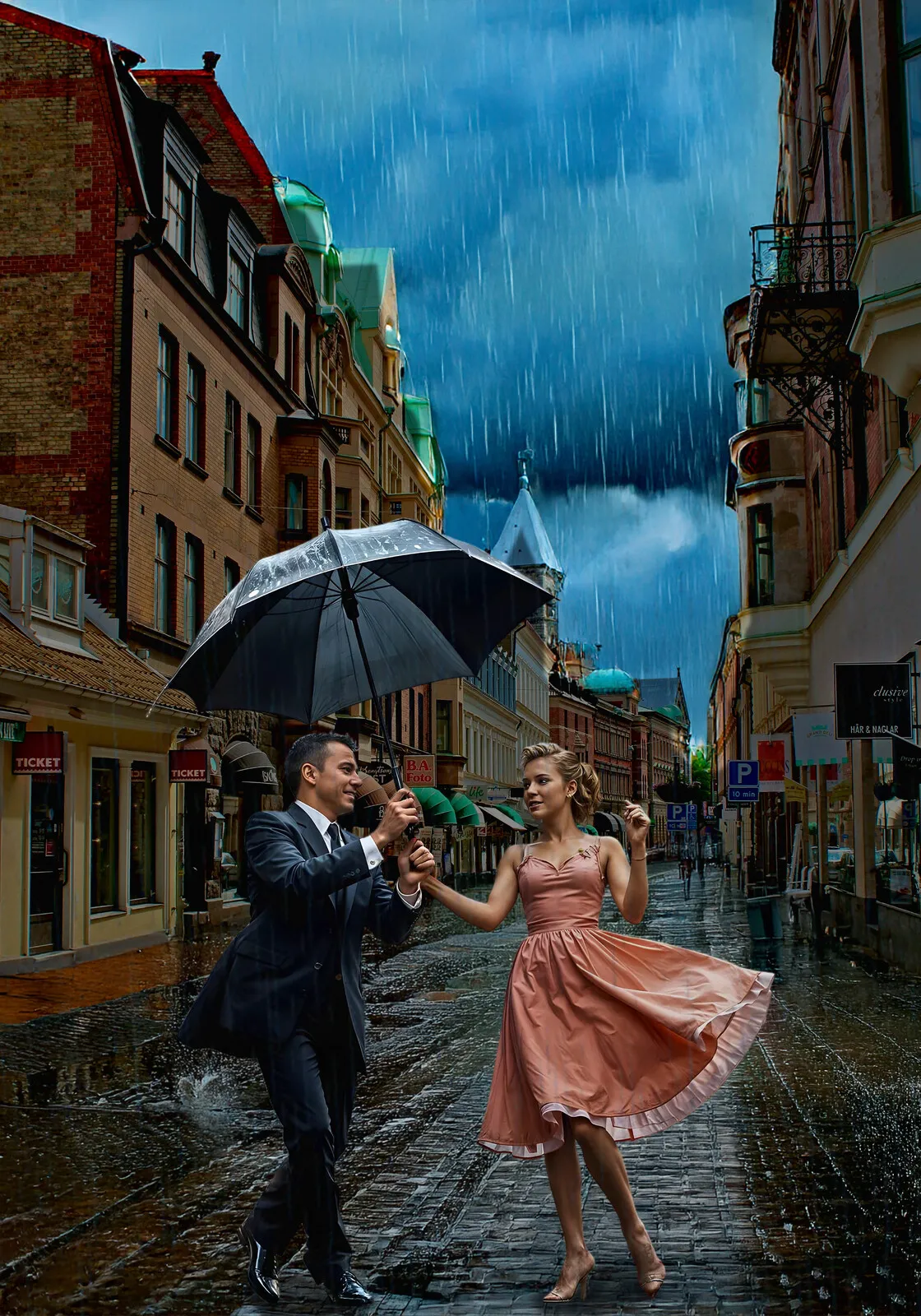
A gentleman's umbrella, 2025
Digital
50 x 70 cm
3 200 kr
A gentleman's umbrella
A man silently offers his umbrella to a woman in a summer dress, caught off guard by a sudden June downpour. It’s a small gesture, almost invisible, yet it holds something much larger – a glimpse of an ideal that once shaped entire eras. Who is he, this man who steps aside instead of forward? What does it mean today to be a gentleman – and where does the image indeed come from, of someone laying down his cloak over a puddle? This text traces the footsteps of the gentleman, from ancient philosophers to rain-soaked sidewalks, from knightly codes to Churchill and Gösta Ekman. It’s a story of courtesy, courage, wit—and umbrellas.
Unravel the mystery behind gentlemen and umbrellas. This tale, brimming with suspense, will keep you on the edge of your seat, hungry for more.
"The Quiet Art of the Gentleman
The one who offered the umbrella,
not to impress,
but because he saw her shivering.
The one who waited at the door,
with a smile
that asked for nothing in return.
Another helped old Miss Martha
onto the bus at rush hour,
and never mentioned it again.
No selfies. No stories.
A third did the dishes
after a long dinner,
even though he was the guest.
The one who listened
while everyone else spoke,
and asked a question
to the quietest one at the table.
Once, I saw a man
tip his hat to a dog—
just because it wagged its tail
like a proper little lady.
He who laid down his cloak
for a queen and a puddle—
perhaps it never happened,
but still, we remember.
Sir Winston, nearly hit by a cab,
tipped his hat and said,
“I do apologise for being
where your taxi wished to go.”
Don Quixote bowed to windmills,
not because they were noble,
but because he was.
And the knight who rode all night
not for glory,
but to return a dropped glove
to a lady who hadn’t noticed it was gone.
A gentleman isn’t always
the loudest voice,
or the sharpest suit,
or the first to speak.
He’s the quiet kindness
you barely noticed,
until you realised
it changed everything.“
Malmö, April 2025
A gentleman's umbrella
It began with a gentleman's umbrella, a symbol of protection and chivalry.
One of those temperamental June afternoons, when the day teases with sunshine and hope between drifting shadows. The professor was on his way back to his antiquarian bookshop after lunch when, without warning, the sky opened up. The rain fell in large, angry drops, not the kind that pattered politely on an umbrella but the kind that hurled themselves toward the ground as if shocked by their existence.
There she stood.
A woman in a thin, pink summer dress—the kind chosen in complete confidence that, for once, the weather forecast would keep its promise. No jacket, no protection, just an expression in her eyes that combined confusion with a gentle, almost comic indignation at nature's betrayal.
He did not hesitate.
Without a word and with a slight bow that is no longer taught anywhere, the professor offered her his umbrella. She accepted it with the same surprise one might once have shown upon receiving a handwritten love poem. And as the rain streamed down his trench coat, he could t help but smile to himself, just a little, his warmth radiating from his kind gesture.
Was it the beginning of a romance?
Possibly. But this is not a romance story. It is about something equally rare in our day: the gentleman.
The concept
The word gentleman has ancient roots, both etymological and ideological. It began as a title, a marker of class: a man who did not need to work with his hands for a living. He owned land. He was born to his privilege. But soon, the title, like a living organism, began to evolve. Over time, a gentleman was not only expected to be of the correct birth but also to behave accordingly, marking a shift from a class-based distinction to a code of conduct.
That is to say: with manners and etiquette.
But also, perhaps most importantly, discretion. A true gentleman does not boast of his gallantry—he lets his actions speak for themselves, then quietly moves on. He doesn't trumpet his generosity. And he always keeps an umbrella at the ready—metaphorically or literally—for anyone caught in the rain.
History and Ideals In Victorian England, an entire industry developed around the concept of being a gentleman. There were handbooks, etiquette manuals, and detailed dress codes. A man of style and honour was expected to dance the waltz, discuss Virgil, and, if necessary, defend a lady's honour in a duel—preferably at dawn, so as not to disturb society too much.
Of course, there was hypocrisy. Many of the men regarded as gentlemen by birth and appearance lacked the actual virtues. Conversely, Oscar Wilde himself—perhaps the wittiest man in London—often pointed out how closely morality and hypocrisy tend to walk hand in hand.
And yet, the ideal endured.
The gentleman represented something. A combination of self-control, courtesy, courage, wit, and respect—not only toward women but toward all fellow human beings, regardless of class or gender.
A Mantle Over the Puddle An image is etched in my mind—that of a man laying down his coat or cloak over a puddle so that a woman can cross without getting her feet wet. That scene has become a symbol of the ultimate gesture of gallantry and gentlemanly conduct—theatrical, old-fashioned, almost fairy-tale-like. It has a concrete origin.
Sir Walter Raleigh, the Actual Knight. This image most likely originates from an anecdote about Sir Walter Raleigh, the English courtier, poet, and explorer who served at the court of Queen Elizabeth I in the late 16th century.
According to legend—and it is simply that, a legend with no confirmed historical basis—Queen Elizabeth was out walking with her retinue when they encountered a muddy puddle in the road. Without hesitation, Sir Walter is said to have removed his cloak and spread it over the puddle, allowing the Queen to pass without getting her feet soiled.
This so-called ‘cloak over the puddle’ moment became a symbol of excessive courtesy, small-scale self-sacrifice, and the kind of courtly gentleman who took pride in being indispensably, almost absurdly, polite.
Whether it genuinely happened remains doubtful—the tale first emerged long after Raleigh's death—but the image spread quickly and became a mythic example of how a true gentleman behaves. Gentleman behaves.
The Power of Symbolism
Whether Raleigh laid down his cloak or not, the image has endured as a powerful cultural motif. It reflects not only helpfulness but also the ceremonial nature of a gentleman’s gestures: to sacrifice one’s comfort—one's cloak, one's dryness—for someone else’s sake. It is a gesture of respect, not a display of dominance. He bows, quite literally.
Modern Variations
Today, we rarely see cloaks on the streets, and even if someone were to make such a gesture, it would probably evoke more surprise than gratitude. But the essence of the act—to act selflessly in a moment without expecting a reward—is a timeless testament to the enduring nature of gentlemanly acts in our society.
Holding up an umbrella, offering one’s jacket, pulling out a chair, holding open a door—these gestures carry the same core principle: I see you, and I value your dignity.
So, next time someone holds out their umbrella in a downpour or waits a few extra seconds so you can catch the elevator, think of Walter Raleigh’s cloak. It remains in our collective imagination, waiting for someone to follow its example. Let these acts of gentlemanliness inspire us to uphold these values in our own lives.
One of the most retold stories about Winston Churchill—a man who embodied the old-fashioned gentleman—is the one where, during the Second World War, he was nearly run over by a taxi. Instead of shouting, as any grumpy Londoner might, he tipped his hat, bowed slightly, and said:
I do apologise for being in the wrong place where your taxi was intended to go.
That was, it was said, gentlemanliness in its most British form.
But we don’t need to go to London to find examples.
Sweden has its versions—think of Thor Modéen in a tuxedo or Gösta Ekman Sr. with his gently ironic gravitas. The man who holds the door not to impress but simply because it’s the right thing to do. The one who helps with a stroller on the bus, who gives up his seat for the elderly, who never talks loudly on the phone in the quiet car. These acts of gentlemanliness are not confined to a specific culture or region but are part of a global culture of respect and kindness.
An Endangered Species?
In a world where assertiveness is often rewarded over politeness and where the phrase “nice guys finish last” has become an ironic mantra, there is a real risk that the gentleman may disappear. He is sometimes mocked as old-fashioned or even as a relic of a patriarchal system. But that is a misunderstanding.
To be a gentleman is not to take over; it is to step aside. Not to dominate but to show respect. It is to utilise one’s strengths—physical, economic, and cultural—to protect, not to control.
And Finally…
The man with the umbrella disappeared into the rain, soaked but not sorrowful. The woman turned to look back and smiled for a moment. A moment that perhaps meant "thank you," possibly "we’ll meet again," or maybe simply "there’s still hope for humanity."
As long as there is someone who offers their umbrella without conditions or ulterior motives, there are still gentlemen in the world.
And then, even in the rain, we might feel just a little drier in our hearts.
The Roots of the Gentleman
The idea of the gentleman is not a British invention, even if the British Empire refined the concept to its peak. No, this figure—half moral role model, half social ideal—has existed in human imagination for as long as ideals have been recorded. From the ancient civilisations, one admired men who combined strength and education, power and humility. These ancient ideals of areté in Greece, vir bonus in Rome, and ma'at in Egypt all contributed to the development of the modern concept of gentlemanliness.
In classical Greece, the highest male virtue was areté—a word that encompassed courage, wisdom, skill, and moral excellence. The ideal man, the so-called kaloskagathos, was to be both “beautiful” (kalos) and “good” (agathos). He trained his body in the gymnasium and his soul in philosophy and was expected to speak the truth, show moderation, and protect his polis—the city and its community. Socrates himself, despite his unusual appearance, was held up as a kind of inner gentleman, with uncompromising integrity and civic courage.
The Romans refined this ideal into their version of the "vir bonus," or the concept of the virtuous man. A Roman gentleman was expected to embody gravitas (dignity), dignitas (reputation), fides (loyalty), and pietas (a sense of duty to family, ancestors, and gods). A Roman senator was not only tasked with winning debates but also with showing honour even towards his enemies. Cincinnatus, who returned to his plough after saving the republic, became a symbol of a man who prioritised duty over power.
In ancient Egypt, a similar ideal prevailed. There, ma’at was celebrated—a cosmic condition of balance, justice, and order. A man in the Pharaoh’s service was expected to show respect, control his tongue, and place the collective above himself. Officials, priests, and scribes penned their moral self-help texts—a kind of ancient etiquette manual—emphasising the importance of listening before speaking, refraining from interrupting others, and not allowing anger to govern one’s actions. A true man displayed dignity—even in small matters.
During the Middle Ages, another form of gentlemanhood emerged from the shadows of history: the knight. Chivalry became both a military and a moral ideal. A knight was expected to be brave in battle but also courtly—that is, polite and composed in court. He was to be loyal to his lord, his God, and, not least, his lady. In courtly love lay a form of spiritualised romance: the knight idealised the woman, worshiped her from afar, and let her inspire him to noble deeds.
The chivalric code encompassed not only warrior virtues but also the protection of the weak, the defense of justice, and the practice of mercy. This is where we first encounter an ideal in which physical strength is subordinated to inner moral discipline. The true knight was not the one who struck hardest but the one who could restrain his sword when necessary. It involves ethical control and a gentleness in strength, directly related to our modern gentleman.
These ideals endured, often through literature. King Arthur’s knights of the Round Table, Parsifal seeking the Grail, the French Roland, El Cid in Spain—all represent different versions of the civilised man who is strong without being brutal, polite without being weak, noble without being self-important. Literature has played a significant role in preserving and promoting these ideals of gentlemanliness, making them enduring symbols of cultural significance.
It’s easy to smile at such ideals today—in our cynical age where “kind” is often seen as synonymous with naive. But within this tradition lies a forgotten wisdom: the gentleman is not weak but self-disciplined. He is not afraid to act, yet he does so with respect, not dominance. He offers his umbrella not because he believes the woman cannot manage but because it is the most civilised thing to do in a sudden downpour.
Jörgen Thornberg
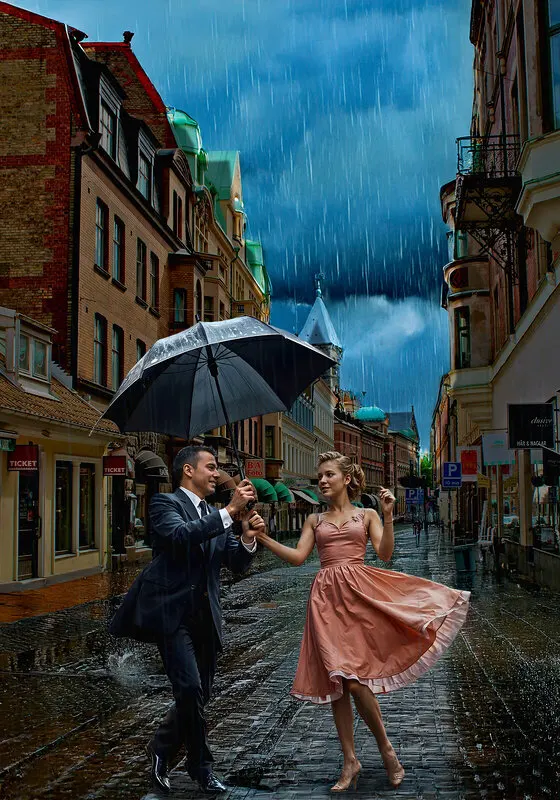
A gentleman's umbrella, 2025
Digital
50 x 70 cm
3 200 kr
A gentleman's umbrella
A man silently offers his umbrella to a woman in a summer dress, caught off guard by a sudden June downpour. It’s a small gesture, almost invisible, yet it holds something much larger – a glimpse of an ideal that once shaped entire eras. Who is he, this man who steps aside instead of forward? What does it mean today to be a gentleman – and where does the image indeed come from, of someone laying down his cloak over a puddle? This text traces the footsteps of the gentleman, from ancient philosophers to rain-soaked sidewalks, from knightly codes to Churchill and Gösta Ekman. It’s a story of courtesy, courage, wit—and umbrellas.
Unravel the mystery behind gentlemen and umbrellas. This tale, brimming with suspense, will keep you on the edge of your seat, hungry for more.
"The Quiet Art of the Gentleman
The one who offered the umbrella,
not to impress,
but because he saw her shivering.
The one who waited at the door,
with a smile
that asked for nothing in return.
Another helped old Miss Martha
onto the bus at rush hour,
and never mentioned it again.
No selfies. No stories.
A third did the dishes
after a long dinner,
even though he was the guest.
The one who listened
while everyone else spoke,
and asked a question
to the quietest one at the table.
Once, I saw a man
tip his hat to a dog—
just because it wagged its tail
like a proper little lady.
He who laid down his cloak
for a queen and a puddle—
perhaps it never happened,
but still, we remember.
Sir Winston, nearly hit by a cab,
tipped his hat and said,
“I do apologise for being
where your taxi wished to go.”
Don Quixote bowed to windmills,
not because they were noble,
but because he was.
And the knight who rode all night
not for glory,
but to return a dropped glove
to a lady who hadn’t noticed it was gone.
A gentleman isn’t always
the loudest voice,
or the sharpest suit,
or the first to speak.
He’s the quiet kindness
you barely noticed,
until you realised
it changed everything.“
Malmö, April 2025
A gentleman's umbrella
It began with a gentleman's umbrella, a symbol of protection and chivalry.
One of those temperamental June afternoons, when the day teases with sunshine and hope between drifting shadows. The professor was on his way back to his antiquarian bookshop after lunch when, without warning, the sky opened up. The rain fell in large, angry drops, not the kind that pattered politely on an umbrella but the kind that hurled themselves toward the ground as if shocked by their existence.
There she stood.
A woman in a thin, pink summer dress—the kind chosen in complete confidence that, for once, the weather forecast would keep its promise. No jacket, no protection, just an expression in her eyes that combined confusion with a gentle, almost comic indignation at nature's betrayal.
He did not hesitate.
Without a word and with a slight bow that is no longer taught anywhere, the professor offered her his umbrella. She accepted it with the same surprise one might once have shown upon receiving a handwritten love poem. And as the rain streamed down his trench coat, he could t help but smile to himself, just a little, his warmth radiating from his kind gesture.
Was it the beginning of a romance?
Possibly. But this is not a romance story. It is about something equally rare in our day: the gentleman.
The concept
The word gentleman has ancient roots, both etymological and ideological. It began as a title, a marker of class: a man who did not need to work with his hands for a living. He owned land. He was born to his privilege. But soon, the title, like a living organism, began to evolve. Over time, a gentleman was not only expected to be of the correct birth but also to behave accordingly, marking a shift from a class-based distinction to a code of conduct.
That is to say: with manners and etiquette.
But also, perhaps most importantly, discretion. A true gentleman does not boast of his gallantry—he lets his actions speak for themselves, then quietly moves on. He doesn't trumpet his generosity. And he always keeps an umbrella at the ready—metaphorically or literally—for anyone caught in the rain.
History and Ideals In Victorian England, an entire industry developed around the concept of being a gentleman. There were handbooks, etiquette manuals, and detailed dress codes. A man of style and honour was expected to dance the waltz, discuss Virgil, and, if necessary, defend a lady's honour in a duel—preferably at dawn, so as not to disturb society too much.
Of course, there was hypocrisy. Many of the men regarded as gentlemen by birth and appearance lacked the actual virtues. Conversely, Oscar Wilde himself—perhaps the wittiest man in London—often pointed out how closely morality and hypocrisy tend to walk hand in hand.
And yet, the ideal endured.
The gentleman represented something. A combination of self-control, courtesy, courage, wit, and respect—not only toward women but toward all fellow human beings, regardless of class or gender.
A Mantle Over the Puddle An image is etched in my mind—that of a man laying down his coat or cloak over a puddle so that a woman can cross without getting her feet wet. That scene has become a symbol of the ultimate gesture of gallantry and gentlemanly conduct—theatrical, old-fashioned, almost fairy-tale-like. It has a concrete origin.
Sir Walter Raleigh, the Actual Knight. This image most likely originates from an anecdote about Sir Walter Raleigh, the English courtier, poet, and explorer who served at the court of Queen Elizabeth I in the late 16th century.
According to legend—and it is simply that, a legend with no confirmed historical basis—Queen Elizabeth was out walking with her retinue when they encountered a muddy puddle in the road. Without hesitation, Sir Walter is said to have removed his cloak and spread it over the puddle, allowing the Queen to pass without getting her feet soiled.
This so-called ‘cloak over the puddle’ moment became a symbol of excessive courtesy, small-scale self-sacrifice, and the kind of courtly gentleman who took pride in being indispensably, almost absurdly, polite.
Whether it genuinely happened remains doubtful—the tale first emerged long after Raleigh's death—but the image spread quickly and became a mythic example of how a true gentleman behaves. Gentleman behaves.
The Power of Symbolism
Whether Raleigh laid down his cloak or not, the image has endured as a powerful cultural motif. It reflects not only helpfulness but also the ceremonial nature of a gentleman’s gestures: to sacrifice one’s comfort—one's cloak, one's dryness—for someone else’s sake. It is a gesture of respect, not a display of dominance. He bows, quite literally.
Modern Variations
Today, we rarely see cloaks on the streets, and even if someone were to make such a gesture, it would probably evoke more surprise than gratitude. But the essence of the act—to act selflessly in a moment without expecting a reward—is a timeless testament to the enduring nature of gentlemanly acts in our society.
Holding up an umbrella, offering one’s jacket, pulling out a chair, holding open a door—these gestures carry the same core principle: I see you, and I value your dignity.
So, next time someone holds out their umbrella in a downpour or waits a few extra seconds so you can catch the elevator, think of Walter Raleigh’s cloak. It remains in our collective imagination, waiting for someone to follow its example. Let these acts of gentlemanliness inspire us to uphold these values in our own lives.
One of the most retold stories about Winston Churchill—a man who embodied the old-fashioned gentleman—is the one where, during the Second World War, he was nearly run over by a taxi. Instead of shouting, as any grumpy Londoner might, he tipped his hat, bowed slightly, and said:
I do apologise for being in the wrong place where your taxi was intended to go.
That was, it was said, gentlemanliness in its most British form.
But we don’t need to go to London to find examples.
Sweden has its versions—think of Thor Modéen in a tuxedo or Gösta Ekman Sr. with his gently ironic gravitas. The man who holds the door not to impress but simply because it’s the right thing to do. The one who helps with a stroller on the bus, who gives up his seat for the elderly, who never talks loudly on the phone in the quiet car. These acts of gentlemanliness are not confined to a specific culture or region but are part of a global culture of respect and kindness.
An Endangered Species?
In a world where assertiveness is often rewarded over politeness and where the phrase “nice guys finish last” has become an ironic mantra, there is a real risk that the gentleman may disappear. He is sometimes mocked as old-fashioned or even as a relic of a patriarchal system. But that is a misunderstanding.
To be a gentleman is not to take over; it is to step aside. Not to dominate but to show respect. It is to utilise one’s strengths—physical, economic, and cultural—to protect, not to control.
And Finally…
The man with the umbrella disappeared into the rain, soaked but not sorrowful. The woman turned to look back and smiled for a moment. A moment that perhaps meant "thank you," possibly "we’ll meet again," or maybe simply "there’s still hope for humanity."
As long as there is someone who offers their umbrella without conditions or ulterior motives, there are still gentlemen in the world.
And then, even in the rain, we might feel just a little drier in our hearts.
The Roots of the Gentleman
The idea of the gentleman is not a British invention, even if the British Empire refined the concept to its peak. No, this figure—half moral role model, half social ideal—has existed in human imagination for as long as ideals have been recorded. From the ancient civilisations, one admired men who combined strength and education, power and humility. These ancient ideals of areté in Greece, vir bonus in Rome, and ma'at in Egypt all contributed to the development of the modern concept of gentlemanliness.
In classical Greece, the highest male virtue was areté—a word that encompassed courage, wisdom, skill, and moral excellence. The ideal man, the so-called kaloskagathos, was to be both “beautiful” (kalos) and “good” (agathos). He trained his body in the gymnasium and his soul in philosophy and was expected to speak the truth, show moderation, and protect his polis—the city and its community. Socrates himself, despite his unusual appearance, was held up as a kind of inner gentleman, with uncompromising integrity and civic courage.
The Romans refined this ideal into their version of the "vir bonus," or the concept of the virtuous man. A Roman gentleman was expected to embody gravitas (dignity), dignitas (reputation), fides (loyalty), and pietas (a sense of duty to family, ancestors, and gods). A Roman senator was not only tasked with winning debates but also with showing honour even towards his enemies. Cincinnatus, who returned to his plough after saving the republic, became a symbol of a man who prioritised duty over power.
In ancient Egypt, a similar ideal prevailed. There, ma’at was celebrated—a cosmic condition of balance, justice, and order. A man in the Pharaoh’s service was expected to show respect, control his tongue, and place the collective above himself. Officials, priests, and scribes penned their moral self-help texts—a kind of ancient etiquette manual—emphasising the importance of listening before speaking, refraining from interrupting others, and not allowing anger to govern one’s actions. A true man displayed dignity—even in small matters.
During the Middle Ages, another form of gentlemanhood emerged from the shadows of history: the knight. Chivalry became both a military and a moral ideal. A knight was expected to be brave in battle but also courtly—that is, polite and composed in court. He was to be loyal to his lord, his God, and, not least, his lady. In courtly love lay a form of spiritualised romance: the knight idealised the woman, worshiped her from afar, and let her inspire him to noble deeds.
The chivalric code encompassed not only warrior virtues but also the protection of the weak, the defense of justice, and the practice of mercy. This is where we first encounter an ideal in which physical strength is subordinated to inner moral discipline. The true knight was not the one who struck hardest but the one who could restrain his sword when necessary. It involves ethical control and a gentleness in strength, directly related to our modern gentleman.
These ideals endured, often through literature. King Arthur’s knights of the Round Table, Parsifal seeking the Grail, the French Roland, El Cid in Spain—all represent different versions of the civilised man who is strong without being brutal, polite without being weak, noble without being self-important. Literature has played a significant role in preserving and promoting these ideals of gentlemanliness, making them enduring symbols of cultural significance.
It’s easy to smile at such ideals today—in our cynical age where “kind” is often seen as synonymous with naive. But within this tradition lies a forgotten wisdom: the gentleman is not weak but self-disciplined. He is not afraid to act, yet he does so with respect, not dominance. He offers his umbrella not because he believes the woman cannot manage but because it is the most civilised thing to do in a sudden downpour.
3 200 kr

Jörgen Thornberg
Malmö
Lite om bilder och mig. Translation in English at the end.
Jag är en nyfiken person som ser allt i bilder, även det jag fäster i ord, gärna tillsammans för bakom alla mina bilder finns en berättelse. Till vissa bilder hör en kortare eller längre novell som följer med bilden.
Bilder berättar historier. Jag omges av naturlig skönhet, intressanta människor och historia var jag än går. Jag använder min kamera för att dokumentera världen och blanda det jag ser med vad jag känner för att fånga den dolda magin.
Mina bilder berättar mina historier. Genom mina bilder, tryck och berättelser. Jag bjuder in dig att ta del av dessa berättelser, in i ditt liv och hem och dela min mycket personliga syn på vår värld. Mer än vad ögat ser. Jag tänker i bilder, drömmer och skriver och pratar om dem; följaktligen måste jag också skapa bilder. De blir vad jag ser, inte nödvändigtvis begränsade till verkligheten. Det finns en bild runt varje hörn. Jag hoppas att du kommer att se vad jag såg och gilla det.
Jag är också en skrivande person och till många bilder hör en kortare eller längre essay. Den följer med tavlan, tryckt på fint papper och med en personlig hälsning från mig.
Flertalet bilder startar sin resa i min kamera. Enkelt förklarat beskriver jag bilden jag ser i mitt inre, upplevd eller fantiserad. Bilden uppstår inom mig redan innan jag fått okularet till ögat. På bråkdelen av ett ögonblick ser jag vad jag vill ha och vad som kan göras med bilden. Här skall jag stoppa in en giraff, stålmannen, Titanic eller vad det är min fantasi finner ut. Ännu märkligare är att jag kommer ihåg minnesbilden långt efteråt när det blir tid att skapa verket. Om jag lyckas eller inte, är upp till betraktaren, oftast präglat av en stråk av svart humor – meningen är att man skall bli underhållen. Mina bilder blir ofta en snackis där de hänger.
Jag föredrar bilder som förmedlar ett budskap i flera lager. Vid första anblicken fylld av feel-good, en vacker utsikt, fint väder, solen skiner, blommor på ängen eller vattnet som ligger förrädiskt spegelblankt. I en sådan bild kan jag gömma min egentliga berättelse, mitt förakt för förtryckare och våldsverkare, rasister och fördomsfulla människor - ett gärna återkommande motiv mer eller mindre dolt i det vackra motivet. Jag försöker förena dem i ett gemensamt narrativ.
Bild och formgivning har löpt som en röd tråd genom livet. Fotokonst känns som en värdig final som jag gärna delar med mig.
Min genre är vid som framgår av mina bilder, temat en blandning av pop- och gatukonst i kollage som kan bestå av hundratals lager. Vissa bilder kan ta veckor, andra någon dag innan det är dags att överlämna resultatet till printverkstaden. Fine Art Prints är digitala fotocollage. I dessa kollage sker rivandet, klippandet, pusslandet, målandet, ritandet och sprayningen digitalt. Det jag monterar in kan vara hundratals år gamla bilder som jag omsorgsfullt frilägger så att de ser ut att vara en del av tavlan men också bilder skapade av mig själv efter min egen fantasi. Därefter besöks printstudion och för vissa bilder numrera en limiterad upplaga (oftast 7 exemplar) och signera för hand. Vissa bilder kan köpas i olika format. Det är bara att fråga efter vilka. Gillar man en bild som är 70x100 men inte har plats på väggen, går den kanske att få i 50x70 cm istället. Frågan är fri.
Metoden Giclée eller Fine Art Print som det också kallas är det moderna sättet för framställning av grafisk konst. Villkoret för denna typ av utskrifter är att en högkvalitativ storformatskrivare används med åldersbeständigt färgpigment och konstnärspapper eller i förekommande fall på duk. Pappret som används möter de krav på livslängd som ställs av museer och gallerier. Normalt säljer jag mina bilder oinramade så att den nya ägaren själv kan bestämma hur de skall se ut, med eller utan passepartout färg på ram, med eller utan glas etc..
Under många år ställde jag bara ut på nätet, i valda grupper och på min egen Facebooksida - https://www.facebook.com/jorgen.thornberg.9
Jag finns också på en egen hemsida som tyvärr inte alltid är uppdaterad – https://www.jth.life/ Där kan du också läsa en del av de berättelser som följer med bilden.
UTSTÄLLNINGAR
Luftkastellet, oktober 2022
Konst i Lund, november 2022
Luftkastellet, mars 2023
Engleson Galleri Caroli, april 2023
Hydra, Greece June 2023
Engleson Galleri Caroli, oktober 2023
Toppen, Höllviken december 2023
Luftkastellet, mars 2024
Torups Galleri, mars 2024
Venice, May 2024
Luftkastellet, oktober 2024
Konst i Advent, December 2024
Galleri Engleson, Caroli December 2024
Jäger & Jansson Galleri, april 2025
A bit about pictures and me.
I'm a curious person who sees everything in pictures, even what I express in words, often combining them, for behind all my pictures lies a story. These narratives, some as short as a single image and others as long as a novel, are the heart and soul of my work.
Pictures tell stories. Wherever I go, I'm surrounded by natural beauty, exciting people, and history. I use my camera to document the world and blend what I see with what I feel to capture the hidden magic.
My images tell my stories. Through my pictures, prints, and narratives, I invite you to partake in these stories in your life and home and share my deeply personal perspective of our world. More than meets the eye. I think in pictures, dream, write, and talk about them; consequently, I must create images too. They become what I see, not necessarily confined to reality. There's a picture around every corner. I hope you'll see what I saw and enjoy it.
I'm also a writer, and many images come with a shorter or longer essay. It accompanies the painting, printed on fine paper with my personal greeting.
Many pictures start their journey on my camera. Simply put, I describe the image I see in my mind, experienced or imagined. The image arises within me even before I bring the eyepiece to my eye. In a fraction of a moment, I see what I want and what can be done with the picture. Here, I'll insert a giraffe, Superman, the Titanic, or whatever my imagination conjures up. Even stranger is that I remember the mental image long after it's time to create the work. Whether I succeed is up to the observer, often imbued with a streak of black humour – the aim is to entertain. My pictures usually become a talking point wherever they hang.
I prefer pictures that convey a message in multiple layers. At first glance, they're filled with feel-good vibes, a beautiful view, lovely weather, the sun shining, flowers in the meadow, or the water lying deceptively calm. But beneath this surface beauty, I often conceal a deeper story, a narrative that challenges societal norms or explores the human condition. I invite you to delve into these hidden narratives and discover the layers of meaning within my work.
Picture and design have been a thread running through my life. Photographic art feels like a fitting finale, and I'm happy to share it.
My genre is varied, as seen in my pictures; the theme is a blend of pop and street art in collages that can consist of hundreds of layers. Some images can take weeks, others just a day before it's time to hand over the result to the print workshop. Fine Art Prints are digital photo collages. In these collages, tearing, cutting, puzzling, painting, drawing, and spraying happen digitally. What I insert can be images hundreds of years old that I carefully extract so they appear to be part of the painting, but also images created by myself, now also generated from my imagination. Next, visit the print studio and, for certain images, number a limited edition (usually 7 copies) and sign them by hand. Some images may be available in other formats. Just ask which ones. If you like an image that's 70x100 but doesn't have space on the wall, you might be able to get it in 50x70 cm instead. The question is open.
The Giclée method, or Fine Art Print as it's also called, is the modern way of producing graphic art. This method ensures the highest quality and longevity of the artwork, using a high-quality large-format printer with archival pigment inks and artist paper or, in some cases, canvas. The paper used meets the longevity requirements set by museums and galleries. I sell my pictures unframed, allowing the new owner to personalise their artwork, confident in the lasting value and quality of the piece.
For many years, I only exhibited online, in selected groups, and on my Facebook page - https://www.facebook.com/jorgen.thornberg.9. I also have my website, which unfortunately is not constantly updated - https://www.jth.life/. You can also read some of the stories accompanying the pictures there.
EXHIBITIONS
Luftkastellet, October 2022
Art in Lund, November 2022
Luftkastellet, March 2023
Engleson Gallery Caroli, April 2023
Hydra, Greece June 2023
Engleson Gallery Caroli, October 2023
Toppen, Höllviken December 2023
Luftkastellet, March 2024
Torup Gallery, March 2024
Venice, May 2024
UTSTÄLLNINGAR
Luftkastellet, oktober 2022
Konst i Lund, november 2022
Luftkastellet, mars 2023
Engleson Galleri Caroli, april 2023
Hydra, Greece June 2023
Engleson Galleri Caroli, oktober 2023
Toppen, Höllviken december 2023
Luftkastellet, mars 2024
Torups Galleri, mars 2024
Venice, May 2024
Luftkastellet, October 2024
Konst i Advent, December 2024
Galleri Engleson, Caroli December 2024
Jäger & Jansson Galleri, April 2025
Utbildning
Autodidakt
Medlem i konstnärsförening
Öppna Sinnen
Med i konstrunda
Konstrundan i Skåne
Utställningar
Luftkastellet, October 2022
Art in Lund, November 2022
Luftkastellet, March 2023
Engleson Gallery Caroli, April 2023
Hydra, Greece June 2023
Engleson Gallery Caroli, October 2023
Toppen, Höllviken December 2023
Luftkastellet, March 2024
Torup Gallery, March 2024
Venice, May 2024