Vi använder cookies för att ge dig bästa möjliga upplevelse. Välj vilka cookies du tillåter.
Läs mer i vår integritetspolicy
Jörgen Thornberg
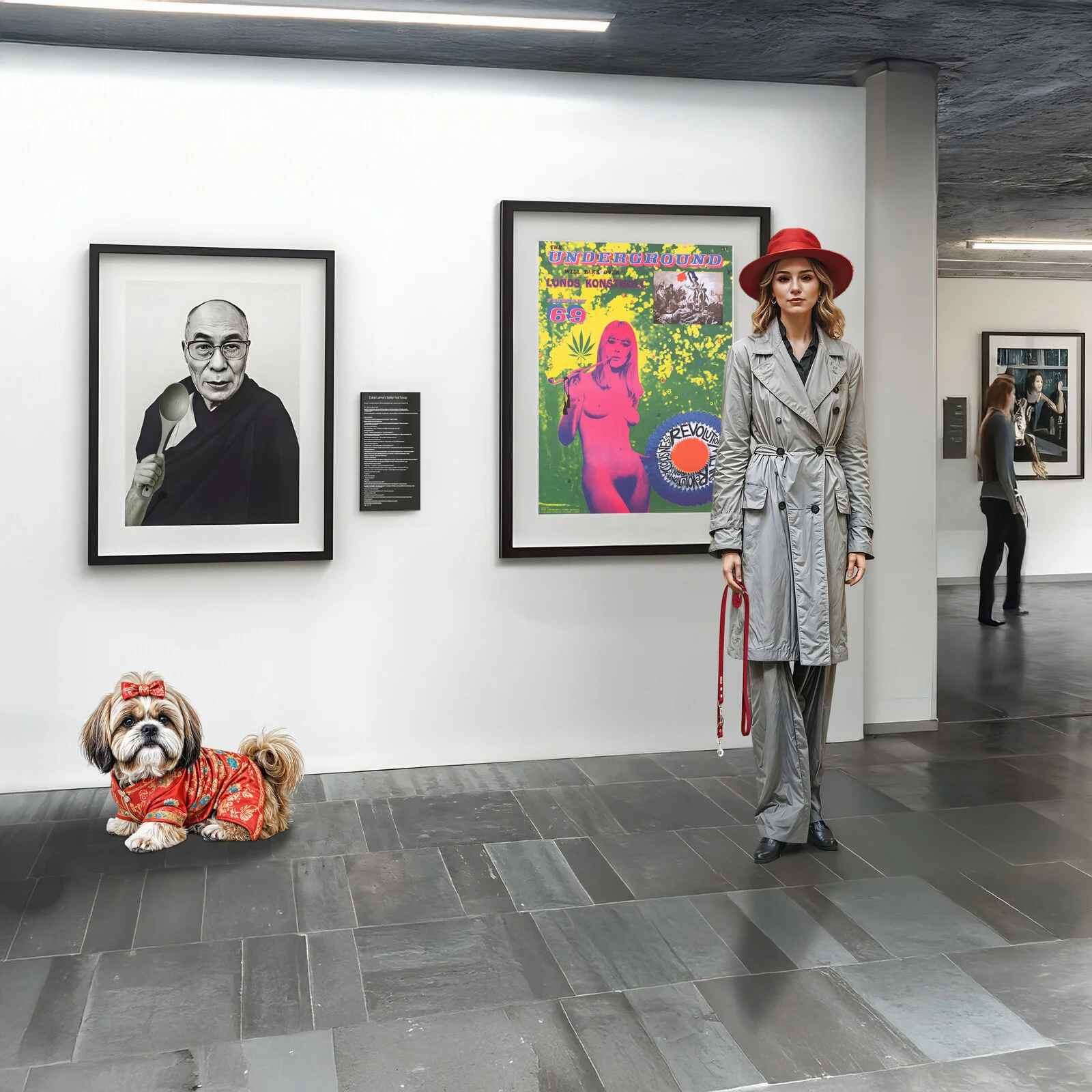
With or without - The day after the opening, 2025
Digital
80 x 80 cm
3 800 kr
With or without - The day after the opening
The power of a picture
Few images blend art, controversy, and history seamlessly as the one featuring Nina Ljung. Whether clothed or unclothed, her presence is a matter of taste and a reflection of changing societal norms. Though depicting an event from 1968, the image remains timeless, and legal concerns are irrelevant—public decency offenses expire, and no crime was ever committed.
But what holds greater significance—a naked girl with a pipe or a temple dog? Both, naturally, which is why they share space in my imagined vernissage scene. And what about the dog? Patience—more on the Lhasa Apso later. First, let us acknowledge his spiritual master, the Dalai Lama, whose presence at Lund’s Konsthall in 2017 honored courageous individuals, from Pussy Riot to Malala Yousafzai.
One name missing was Sture Johannesson, despite his fight for a better world and his unmistakable mark on Lunds Konsthall. Yet, his dream had already been realised with his long-overdue 2004 retrospective. Like Johannesson, Lars Vilks also tested the limits of free expression, their works sparking debates on art’s role and provocation.
Perhaps it is time for a new exhibition—"They Had A Dream"—honoring those whose courage has shaped humanity’s progress. Even the staunchest pessimist must admit that the past was not necessarily better.
Continue reading to learn more about the controversial picture and dogs.
"The Girl, the Smoke, and the Lama’s Dog
In old town Lund, one fine spring night,
A girl took a puff, and her clothes took flight.
"Just a taste," she swore, "just one small toke!"
But soon, she was lost in a mystical smoke.
The moon gave a wink, the stars did a twirl,
And off she danced, a barefoot girl.
Her dress had vanished, her hat went too,
A sock in the river, her coat in the loo!
Down by the park, where rebels met,
A peace-in was raging—a night to forget!
The spirits were high, the music divine,
And time bent backward, erasing the line.
"What year is this?" she asked a tree,
"Sixty-eight!" it hummed, "Just let yourself be!"
And so she did, with no regret,
For a naked soul fears no threat.
Then out of the smoke, so sudden, so grand,
A wise man appeared, staff in hand.
"Who called for me?" he gently spoke,
His voice as light as incense smoke.
The crowd fell silent, the moment froze,
For there stood Dalai Lama in maroon robes.
And by his side, with a princely jog,
A tiny, fluffy, Lhasa dog.
"We followed the scent," the Lama mused,
"Of ancient wisdom… and something infused."
His dog sat down with knowing grace,
Sniffed the air and found its place.
Decades passed, the girl grew wise,
Her name now hung where culture lies.
Lund’s Konsthall, a grand display,
Where art met dreams in a bold array.
"We Have a Dream!" the banners cried,
A show of souls, both far and wide.
Yet missing one from the rebel past,
A poster banned, but built to last.
So here’s to the girl, the night so free,
The vanished dress, the history.
And if you ask how art takes shape,
It starts with laughter, love, and escape!
Not just the smoke had conjured her name,
It was Sture who sparked the flame.
Hand in hand, they took the flight,
A scandalous journey, bold and bright.
From city to city, the world took note,
As the Puffgirl danced on Sture’s coat!
The artist’s morals's lost in a cloud so thick,
Hidden in laughter, in smoke, and a trick.
If you want folks to listen, if truth must be told,
Then, bare it all—both brave and bold.
While gasps arise and tempers flare,
The message lingers in the air.
For what was seen and what was read,
Stays in their minds long after it's said.”
Malmö, March 2025
Nina, a Pipe, and a Temple Dog—What Matters Most?
Whether one prefers Nina Ljung clothed or unclothed is a matter of both moral perspective and personal taste. I propose a compromise: both simultaneously. Though depicting an event from 1968, the image retains a timeless appeal. Offences against public decency have a statute of limitations of five years, and the perpetrator has been deceased for six years. Even then, appearing nude on a poster was not illegal.
A naked girl with a pipe or a temple dog—which holds more significance? Both, of course, are included in my image from a vernissage that might have looked like this if it had happened.
“And how about the dog? I love dogs,” You may ask. You have to be patient. More about the Lhasa Apso later. First, I want to mention his spiritual master, the Dalai Lama, who was featured in an exhibition at Lund’s Konsthall 2017, titled "We Have A Dream." This exhibition aimed to inspire individuals to dare to follow their big or small dreams. The common denominator for all participants was their courage and compelling stories. Alongside the Dalai Lama was a patchwork of remarkable individuals, each of whom had contributed to humanity in their way—the punk band Pussy Riot and Chinese dissident artist Ai Weiwei, both fighting for democracy; Nobel Peace Prize laureate Malala Yousafzai; as well as musicians Annie Lennox, Timbuktu, Quincy Jones, and Patti Smith—together, 114 outstanding individuals.
One omitted individual was Sture Johannesson, even though he fought for a better world in his way and always ensured that no one could miss his message. Nevertheless, he and his controversial poster ‘Freedom on the Barricades’ were on many people's minds, as they are closely associated with Lunds Konsthall. Yet Johannesson had realised his dream, which he had successfully fulfilled thirteen years earlier.
The 2004 retrospective exhibition 'Counterclockwise Circumambulation' at Lunds Konsthall marked a pivotal moment in Sture Johannesson’s career. It had been a long time coming—over thirty-five years, in fact—and once again, the artist stirred the pot, triggering a police report before the exhibition could open. The exhibition showcased a comprehensive collection of Johannesson's works, from his early countercultural pieces to his later, more controversial works. Indeed, he would have been proud to be recognised for his life’s work.
Johannesson and Vilks, not just artists but brave visionaries, fearlessly challenged the limits of freedom of expression and artistic boundaries. Their works sparked debates about the role of art in society and the limits of provocation, securing their places as significant figures in Swedish art history. Their courage in challenging societal norms is truly inspiring.
Johannesson and Vilks – Art, Freedom, and Provocation
Johannesson was part of the global youth revolution that peaked around 1968, a time when issues of art, drugs, politics, and freedom were at the forefront. His Galleri Cannabis in Malmö was not merely an artistic platform but also a political and cultural sanctuary for psychedelia, alternative culture, and civil disobedience. By organising peace-ins, love-ins, and smoke-ins, along with his radical posters, he championed an activist agenda for freedom of expression and a more open society.
Over the years, Johannesson collaborated with numerous notable figures in the realms of art, electronics, and music. Between 1966 and 1969, he operated Galleri Cannabis, which served as both a studio and exhibition space, perfectly aligned with the spirit of the time. Similar events occurred in Malmö’s parks, further reinforcing his countercultural impact. His posters and paintings are now included in prestigious collections, such as the Royal Library, Moderna Museet in Stockholm, Malmö Konsthall, the Museum of Modern Art in New York, Halland’s Cultural History Museum, and Kulturen in Lund.
Where Johannesson engaged in the cultural battles of the 1960s, Lars Vilks would become a central figure in the global debate on freedom of expression in the 21st century. His early works, such as Nimis and Arx, challenged bureaucracy and legal frameworks rather than artistic revolutions. However, his drawings of Muhammad in 2007 placed him directly in the eye of the storm.
According to Vilks himself, his depiction of Muhammad as a roundabout dog explored the limits of free speech and the role of contemporary art. The piece was perceived more as a political provocation than as an artwork, leading to death threats, assassination plots, and a life under police protection. Unlike Johannesson, who challenged his society’s norms from within, Vilks became embroiled in a global conflict over religion, politics, and freedom of speech, with his work resonating far beyond his native Sweden.
Both artists provoked, but it was rarely the artworks themselves that stood at the centre of controversy—instead, it was the reactions to them. Neither of them was a classical modernist creating "beautiful art" for galleries—they created art to question the boundaries of what can be said and shown.
- Johannesson worked in an era of youth rebellion and revolt against bourgeois society. His works were perceived as a threat to the moral order of the time.
- Vilks challenged the postmodern world's compromises between free speech and religious sensitivity, testing the new taboos of a multicultural society.
Both artists pushed the boundaries of free speech rather than reinventing artistic expression itself—Johannesson as part of the 1960s countercultural movements, closely linked to hippie culture, drug liberalisation, and anti-censorship. At the same time, Vilks examined the contradictions between free speech and religious respect in the postmodern world.
Johannesson and Vilks became symbols of broader societal issues, and their works ignited debate not for their aesthetics but for their profound impact on public discourse. Their art was not solely about the visuals but the profound societal questions it raised, stimulating intellectual curiosity and debate.
One could argue that both artists exhibited such courage that they deserved a place in Lund's Konsthall exhibition ‘We Have A Dream’. Despite the risks and threats, their fearless pursuit of freedom of speech is truly inspiring. After all, without freedom of speech, few—if any—of the individuals honoured in that exhibition would have been able to act or achieve anything.
Perhaps it is time for a new exhibition—’They Had A Dream’—a collection of images of people throughout history who have shown courage and whose legacy has ensured that humanity continues to exist and evolve for the better.
Because even the most hardened pessimist must concede that the past was not necessarily better.
And finally, a few words about the girl and the Dalai Lama’s dog…
The Lhasa Apso, a cherished and sacred companion, is an affectionate lap dog that flourishes on companionship. These small, regal canines are accustomed to being pampered, likely due to their esteemed status in their homeland. They are known for their independent nature, intelligence, and loyalty, making them excellent companions for those who understand and appreciate their unique personalities.
An Ancient Tibetan Breed
The Lhasa Apso boasts a rich and ancient history in Tibet, with records tracing its existence back to at least 800 A.D. These dogs lived in seclusion alongside Tibetan Buddhists in the remote Himalayan Mountains for centuries.
The Meaning Behind Their Name
The breed's Western name derives from Lhasa, the capital of Tibet. However, the inclusion of "Apso" in the name is debated. One theory suggests it originates from a misspelling of "Abso," a part of the dog's original Tibetan name, “Abso Seng Kye.” Another interpretation links "Apso" to the Tibetan word for goat, "Rapso," referencing the dog's thick, woolly coat that resembles a mountain goat.
The "Bark Lion Sentinel Dog"
In Tibet, the Lhasa Apso’s original name, “Abso Seng Kye,” translates to “Bark Lion Sentinel Dog.” These small yet fearless canines were far more than just lap dogs—they were guardians of Tibetan homes and monasteries, protecting their human companions from within. This deep-rooted role as an alert and watchful protector is still evident in the breed’s personality today, providing their owners security and protection.
A Sacred Role in Buddhism
Within Tibetan Buddhism, reincarnation is a central belief, with dogs viewed as one step away from human rebirth. According to Tibetan religious tradition, the souls of lamas (priests) are often reborn as Lhasa Apsos before transitioning into their next human life. This sacred connection has solidified the breed’s status as a symbol of spiritual significance.
A Highly Prized Gift
Throughout Tibetan history, Lhasa Apsos were seldom sold; they were regarded as gifts of great fortune. Receiving one was considered a blessing. Even the Dalai Lama was known to bestow these revered dogs, notably sending Lhasa Apsos to the Emperor of China centuries ago—a gesture believed to have influenced the development of the Shih Tzu breed.
A Distinct Tibetan Breed
The Lhasa Apso is one of three Tibetan breeds classified within the Non-Sporting Group, alongside the Tibetan Terrier and Tibetan Spaniel. While the latter two breeds have names that reflect their Tibetan heritage, the origins of the Lhasa Apso’s name are less evident.
Introduced to the U.S. by the Dalai Lama
The first Lhasa Apsos to reach the United States were personally gifted by the 13th Dalai Lama. In the 1930s, a traveller named Charles Suydam Cutting and his wife visited Tibet, returning home with two Lhasa Apsos from the Dalai Lama himself. Their importation of additional dogs helped establish the breed in the U.S., forging a direct historical connection between the Dalai Lama and the presence of the Lhasa Apso in the Western world.
A Long-Lived Breed
The Lhasa Apso is renowned for its remarkable longevity. While the average lifespan ranges from 12 to 15 years, many Lhasas live well beyond 20. The oldest recorded Lhasa Apso achieved an astonishing 29 years of age, reassuring potential owners of the breed's capability for long-term companionship.
Once Considered a Terrier
When the American Kennel Club (AKC) first recognised the Lhasa Apso in 1935, the breed was initially placed in the Terrier Group due to its size and temperament. However, in 1959, it was reclassified into the Non-Sporting Group, a more suitable category that reflects its true nature and characteristics, where it remains today.
A Celebrity Favourite
Families do not just adore Lhasa Apsos—they have also enchanted many famous individuals. Well-known celebrities who have owned Lhasa Apsos include Liberace, Elizabeth Taylor, Kurt Vonnegut, Ellen DeGeneres, Jane Lynch, and Gwen Stefani. This widespread admiration for the breed underscores its enduring appeal and timeless charm, creating a shared appreciation and connection among Lhasa Apso enthusiasts.
Jörgen Thornberg
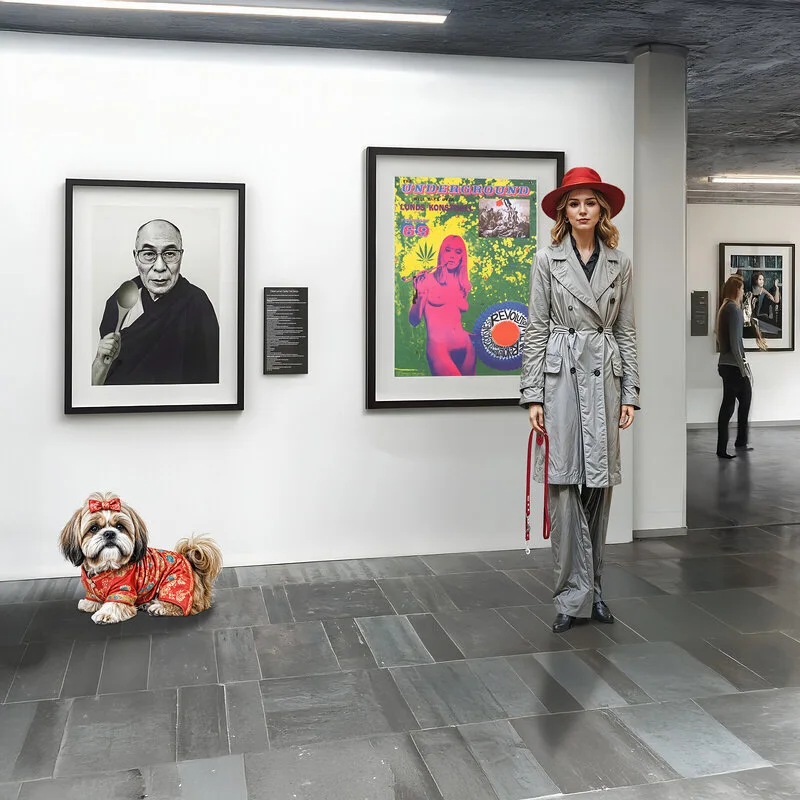
With or without - The day after the opening, 2025
Digital
80 x 80 cm
3 800 kr
With or without - The day after the opening
The power of a picture
Few images blend art, controversy, and history seamlessly as the one featuring Nina Ljung. Whether clothed or unclothed, her presence is a matter of taste and a reflection of changing societal norms. Though depicting an event from 1968, the image remains timeless, and legal concerns are irrelevant—public decency offenses expire, and no crime was ever committed.
But what holds greater significance—a naked girl with a pipe or a temple dog? Both, naturally, which is why they share space in my imagined vernissage scene. And what about the dog? Patience—more on the Lhasa Apso later. First, let us acknowledge his spiritual master, the Dalai Lama, whose presence at Lund’s Konsthall in 2017 honored courageous individuals, from Pussy Riot to Malala Yousafzai.
One name missing was Sture Johannesson, despite his fight for a better world and his unmistakable mark on Lunds Konsthall. Yet, his dream had already been realised with his long-overdue 2004 retrospective. Like Johannesson, Lars Vilks also tested the limits of free expression, their works sparking debates on art’s role and provocation.
Perhaps it is time for a new exhibition—"They Had A Dream"—honoring those whose courage has shaped humanity’s progress. Even the staunchest pessimist must admit that the past was not necessarily better.
Continue reading to learn more about the controversial picture and dogs.
"The Girl, the Smoke, and the Lama’s Dog
In old town Lund, one fine spring night,
A girl took a puff, and her clothes took flight.
"Just a taste," she swore, "just one small toke!"
But soon, she was lost in a mystical smoke.
The moon gave a wink, the stars did a twirl,
And off she danced, a barefoot girl.
Her dress had vanished, her hat went too,
A sock in the river, her coat in the loo!
Down by the park, where rebels met,
A peace-in was raging—a night to forget!
The spirits were high, the music divine,
And time bent backward, erasing the line.
"What year is this?" she asked a tree,
"Sixty-eight!" it hummed, "Just let yourself be!"
And so she did, with no regret,
For a naked soul fears no threat.
Then out of the smoke, so sudden, so grand,
A wise man appeared, staff in hand.
"Who called for me?" he gently spoke,
His voice as light as incense smoke.
The crowd fell silent, the moment froze,
For there stood Dalai Lama in maroon robes.
And by his side, with a princely jog,
A tiny, fluffy, Lhasa dog.
"We followed the scent," the Lama mused,
"Of ancient wisdom… and something infused."
His dog sat down with knowing grace,
Sniffed the air and found its place.
Decades passed, the girl grew wise,
Her name now hung where culture lies.
Lund’s Konsthall, a grand display,
Where art met dreams in a bold array.
"We Have a Dream!" the banners cried,
A show of souls, both far and wide.
Yet missing one from the rebel past,
A poster banned, but built to last.
So here’s to the girl, the night so free,
The vanished dress, the history.
And if you ask how art takes shape,
It starts with laughter, love, and escape!
Not just the smoke had conjured her name,
It was Sture who sparked the flame.
Hand in hand, they took the flight,
A scandalous journey, bold and bright.
From city to city, the world took note,
As the Puffgirl danced on Sture’s coat!
The artist’s morals's lost in a cloud so thick,
Hidden in laughter, in smoke, and a trick.
If you want folks to listen, if truth must be told,
Then, bare it all—both brave and bold.
While gasps arise and tempers flare,
The message lingers in the air.
For what was seen and what was read,
Stays in their minds long after it's said.”
Malmö, March 2025
Nina, a Pipe, and a Temple Dog—What Matters Most?
Whether one prefers Nina Ljung clothed or unclothed is a matter of both moral perspective and personal taste. I propose a compromise: both simultaneously. Though depicting an event from 1968, the image retains a timeless appeal. Offences against public decency have a statute of limitations of five years, and the perpetrator has been deceased for six years. Even then, appearing nude on a poster was not illegal.
A naked girl with a pipe or a temple dog—which holds more significance? Both, of course, are included in my image from a vernissage that might have looked like this if it had happened.
“And how about the dog? I love dogs,” You may ask. You have to be patient. More about the Lhasa Apso later. First, I want to mention his spiritual master, the Dalai Lama, who was featured in an exhibition at Lund’s Konsthall 2017, titled "We Have A Dream." This exhibition aimed to inspire individuals to dare to follow their big or small dreams. The common denominator for all participants was their courage and compelling stories. Alongside the Dalai Lama was a patchwork of remarkable individuals, each of whom had contributed to humanity in their way—the punk band Pussy Riot and Chinese dissident artist Ai Weiwei, both fighting for democracy; Nobel Peace Prize laureate Malala Yousafzai; as well as musicians Annie Lennox, Timbuktu, Quincy Jones, and Patti Smith—together, 114 outstanding individuals.
One omitted individual was Sture Johannesson, even though he fought for a better world in his way and always ensured that no one could miss his message. Nevertheless, he and his controversial poster ‘Freedom on the Barricades’ were on many people's minds, as they are closely associated with Lunds Konsthall. Yet Johannesson had realised his dream, which he had successfully fulfilled thirteen years earlier.
The 2004 retrospective exhibition 'Counterclockwise Circumambulation' at Lunds Konsthall marked a pivotal moment in Sture Johannesson’s career. It had been a long time coming—over thirty-five years, in fact—and once again, the artist stirred the pot, triggering a police report before the exhibition could open. The exhibition showcased a comprehensive collection of Johannesson's works, from his early countercultural pieces to his later, more controversial works. Indeed, he would have been proud to be recognised for his life’s work.
Johannesson and Vilks, not just artists but brave visionaries, fearlessly challenged the limits of freedom of expression and artistic boundaries. Their works sparked debates about the role of art in society and the limits of provocation, securing their places as significant figures in Swedish art history. Their courage in challenging societal norms is truly inspiring.
Johannesson and Vilks – Art, Freedom, and Provocation
Johannesson was part of the global youth revolution that peaked around 1968, a time when issues of art, drugs, politics, and freedom were at the forefront. His Galleri Cannabis in Malmö was not merely an artistic platform but also a political and cultural sanctuary for psychedelia, alternative culture, and civil disobedience. By organising peace-ins, love-ins, and smoke-ins, along with his radical posters, he championed an activist agenda for freedom of expression and a more open society.
Over the years, Johannesson collaborated with numerous notable figures in the realms of art, electronics, and music. Between 1966 and 1969, he operated Galleri Cannabis, which served as both a studio and exhibition space, perfectly aligned with the spirit of the time. Similar events occurred in Malmö’s parks, further reinforcing his countercultural impact. His posters and paintings are now included in prestigious collections, such as the Royal Library, Moderna Museet in Stockholm, Malmö Konsthall, the Museum of Modern Art in New York, Halland’s Cultural History Museum, and Kulturen in Lund.
Where Johannesson engaged in the cultural battles of the 1960s, Lars Vilks would become a central figure in the global debate on freedom of expression in the 21st century. His early works, such as Nimis and Arx, challenged bureaucracy and legal frameworks rather than artistic revolutions. However, his drawings of Muhammad in 2007 placed him directly in the eye of the storm.
According to Vilks himself, his depiction of Muhammad as a roundabout dog explored the limits of free speech and the role of contemporary art. The piece was perceived more as a political provocation than as an artwork, leading to death threats, assassination plots, and a life under police protection. Unlike Johannesson, who challenged his society’s norms from within, Vilks became embroiled in a global conflict over religion, politics, and freedom of speech, with his work resonating far beyond his native Sweden.
Both artists provoked, but it was rarely the artworks themselves that stood at the centre of controversy—instead, it was the reactions to them. Neither of them was a classical modernist creating "beautiful art" for galleries—they created art to question the boundaries of what can be said and shown.
- Johannesson worked in an era of youth rebellion and revolt against bourgeois society. His works were perceived as a threat to the moral order of the time.
- Vilks challenged the postmodern world's compromises between free speech and religious sensitivity, testing the new taboos of a multicultural society.
Both artists pushed the boundaries of free speech rather than reinventing artistic expression itself—Johannesson as part of the 1960s countercultural movements, closely linked to hippie culture, drug liberalisation, and anti-censorship. At the same time, Vilks examined the contradictions between free speech and religious respect in the postmodern world.
Johannesson and Vilks became symbols of broader societal issues, and their works ignited debate not for their aesthetics but for their profound impact on public discourse. Their art was not solely about the visuals but the profound societal questions it raised, stimulating intellectual curiosity and debate.
One could argue that both artists exhibited such courage that they deserved a place in Lund's Konsthall exhibition ‘We Have A Dream’. Despite the risks and threats, their fearless pursuit of freedom of speech is truly inspiring. After all, without freedom of speech, few—if any—of the individuals honoured in that exhibition would have been able to act or achieve anything.
Perhaps it is time for a new exhibition—’They Had A Dream’—a collection of images of people throughout history who have shown courage and whose legacy has ensured that humanity continues to exist and evolve for the better.
Because even the most hardened pessimist must concede that the past was not necessarily better.
And finally, a few words about the girl and the Dalai Lama’s dog…
The Lhasa Apso, a cherished and sacred companion, is an affectionate lap dog that flourishes on companionship. These small, regal canines are accustomed to being pampered, likely due to their esteemed status in their homeland. They are known for their independent nature, intelligence, and loyalty, making them excellent companions for those who understand and appreciate their unique personalities.
An Ancient Tibetan Breed
The Lhasa Apso boasts a rich and ancient history in Tibet, with records tracing its existence back to at least 800 A.D. These dogs lived in seclusion alongside Tibetan Buddhists in the remote Himalayan Mountains for centuries.
The Meaning Behind Their Name
The breed's Western name derives from Lhasa, the capital of Tibet. However, the inclusion of "Apso" in the name is debated. One theory suggests it originates from a misspelling of "Abso," a part of the dog's original Tibetan name, “Abso Seng Kye.” Another interpretation links "Apso" to the Tibetan word for goat, "Rapso," referencing the dog's thick, woolly coat that resembles a mountain goat.
The "Bark Lion Sentinel Dog"
In Tibet, the Lhasa Apso’s original name, “Abso Seng Kye,” translates to “Bark Lion Sentinel Dog.” These small yet fearless canines were far more than just lap dogs—they were guardians of Tibetan homes and monasteries, protecting their human companions from within. This deep-rooted role as an alert and watchful protector is still evident in the breed’s personality today, providing their owners security and protection.
A Sacred Role in Buddhism
Within Tibetan Buddhism, reincarnation is a central belief, with dogs viewed as one step away from human rebirth. According to Tibetan religious tradition, the souls of lamas (priests) are often reborn as Lhasa Apsos before transitioning into their next human life. This sacred connection has solidified the breed’s status as a symbol of spiritual significance.
A Highly Prized Gift
Throughout Tibetan history, Lhasa Apsos were seldom sold; they were regarded as gifts of great fortune. Receiving one was considered a blessing. Even the Dalai Lama was known to bestow these revered dogs, notably sending Lhasa Apsos to the Emperor of China centuries ago—a gesture believed to have influenced the development of the Shih Tzu breed.
A Distinct Tibetan Breed
The Lhasa Apso is one of three Tibetan breeds classified within the Non-Sporting Group, alongside the Tibetan Terrier and Tibetan Spaniel. While the latter two breeds have names that reflect their Tibetan heritage, the origins of the Lhasa Apso’s name are less evident.
Introduced to the U.S. by the Dalai Lama
The first Lhasa Apsos to reach the United States were personally gifted by the 13th Dalai Lama. In the 1930s, a traveller named Charles Suydam Cutting and his wife visited Tibet, returning home with two Lhasa Apsos from the Dalai Lama himself. Their importation of additional dogs helped establish the breed in the U.S., forging a direct historical connection between the Dalai Lama and the presence of the Lhasa Apso in the Western world.
A Long-Lived Breed
The Lhasa Apso is renowned for its remarkable longevity. While the average lifespan ranges from 12 to 15 years, many Lhasas live well beyond 20. The oldest recorded Lhasa Apso achieved an astonishing 29 years of age, reassuring potential owners of the breed's capability for long-term companionship.
Once Considered a Terrier
When the American Kennel Club (AKC) first recognised the Lhasa Apso in 1935, the breed was initially placed in the Terrier Group due to its size and temperament. However, in 1959, it was reclassified into the Non-Sporting Group, a more suitable category that reflects its true nature and characteristics, where it remains today.
A Celebrity Favourite
Families do not just adore Lhasa Apsos—they have also enchanted many famous individuals. Well-known celebrities who have owned Lhasa Apsos include Liberace, Elizabeth Taylor, Kurt Vonnegut, Ellen DeGeneres, Jane Lynch, and Gwen Stefani. This widespread admiration for the breed underscores its enduring appeal and timeless charm, creating a shared appreciation and connection among Lhasa Apso enthusiasts.
3 800 kr

Jörgen Thornberg
Malmö
Lite om bilder och mig. Translation in English at the end.
Jag är en nyfiken person som ser allt i bilder, även det jag fäster i ord, gärna tillsammans för bakom alla mina bilder finns en berättelse. Till vissa bilder hör en kortare eller längre novell som följer med bilden.
Bilder berättar historier. Jag omges av naturlig skönhet, intressanta människor och historia var jag än går. Jag använder min kamera för att dokumentera världen och blanda det jag ser med vad jag känner för att fånga den dolda magin.
Mina bilder berättar mina historier. Genom mina bilder, tryck och berättelser. Jag bjuder in dig att ta del av dessa berättelser, in i ditt liv och hem och dela min mycket personliga syn på vår värld. Mer än vad ögat ser. Jag tänker i bilder, drömmer och skriver och pratar om dem; följaktligen måste jag också skapa bilder. De blir vad jag ser, inte nödvändigtvis begränsade till verkligheten. Det finns en bild runt varje hörn. Jag hoppas att du kommer att se vad jag såg och gilla det.
Jag är också en skrivande person och till många bilder hör en kortare eller längre essay. Den följer med tavlan, tryckt på fint papper och med en personlig hälsning från mig.
Flertalet bilder startar sin resa i min kamera. Enkelt förklarat beskriver jag bilden jag ser i mitt inre, upplevd eller fantiserad. Bilden uppstår inom mig redan innan jag fått okularet till ögat. På bråkdelen av ett ögonblick ser jag vad jag vill ha och vad som kan göras med bilden. Här skall jag stoppa in en giraff, stålmannen, Titanic eller vad det är min fantasi finner ut. Ännu märkligare är att jag kommer ihåg minnesbilden långt efteråt när det blir tid att skapa verket. Om jag lyckas eller inte, är upp till betraktaren, oftast präglat av en stråk av svart humor – meningen är att man skall bli underhållen. Mina bilder blir ofta en snackis där de hänger.
Jag föredrar bilder som förmedlar ett budskap i flera lager. Vid första anblicken fylld av feel-good, en vacker utsikt, fint väder, solen skiner, blommor på ängen eller vattnet som ligger förrädiskt spegelblankt. I en sådan bild kan jag gömma min egentliga berättelse, mitt förakt för förtryckare och våldsverkare, rasister och fördomsfulla människor - ett gärna återkommande motiv mer eller mindre dolt i det vackra motivet. Jag försöker förena dem i ett gemensamt narrativ.
Bild och formgivning har löpt som en röd tråd genom livet. Fotokonst känns som en värdig final som jag gärna delar med mig.
Min genre är vid som framgår av mina bilder, temat en blandning av pop- och gatukonst i kollage som kan bestå av hundratals lager. Vissa bilder kan ta veckor, andra någon dag innan det är dags att överlämna resultatet till printverkstaden. Fine Art Prints är digitala fotocollage. I dessa kollage sker rivandet, klippandet, pusslandet, målandet, ritandet och sprayningen digitalt. Det jag monterar in kan vara hundratals år gamla bilder som jag omsorgsfullt frilägger så att de ser ut att vara en del av tavlan men också bilder skapade av mig själv efter min egen fantasi. Därefter besöks printstudion och för vissa bilder numrera en limiterad upplaga (oftast 7 exemplar) och signera för hand. Vissa bilder kan köpas i olika format. Det är bara att fråga efter vilka. Gillar man en bild som är 70x100 men inte har plats på väggen, går den kanske att få i 50x70 cm istället. Frågan är fri.
Metoden Giclée eller Fine Art Print som det också kallas är det moderna sättet för framställning av grafisk konst. Villkoret för denna typ av utskrifter är att en högkvalitativ storformatskrivare används med åldersbeständigt färgpigment och konstnärspapper eller i förekommande fall på duk. Pappret som används möter de krav på livslängd som ställs av museer och gallerier. Normalt säljer jag mina bilder oinramade så att den nya ägaren själv kan bestämma hur de skall se ut, med eller utan passepartout färg på ram, med eller utan glas etc..
Under många år ställde jag bara ut på nätet, i valda grupper och på min egen Facebooksida - https://www.facebook.com/jorgen.thornberg.9
Jag finns också på en egen hemsida som tyvärr inte alltid är uppdaterad – https://www.jth.life/ Där kan du också läsa en del av de berättelser som följer med bilden.
UTSTÄLLNINGAR
Luftkastellet, oktober 2022
Konst i Lund, november 2022
Luftkastellet, mars 2023
Engleson Galleri Caroli, april 2023
Hydra, Greece June 2023
Engleson Galleri Caroli, oktober 2023
Toppen, Höllviken december 2023
Luftkastellet, mars 2024
Torups Galleri, mars 2024
Venice, May 2024
Luftkastellet, oktober 2024
Konst i Advent, December 2024
Galleri Engleson, Caroli December 2024
Jäger & Jansson Galleri, april 2025
A bit about pictures and me.
I'm a curious person who sees everything in pictures, even what I express in words, often combining them, for behind all my pictures lies a story. These narratives, some as short as a single image and others as long as a novel, are the heart and soul of my work.
Pictures tell stories. Wherever I go, I'm surrounded by natural beauty, exciting people, and history. I use my camera to document the world and blend what I see with what I feel to capture the hidden magic.
My images tell my stories. Through my pictures, prints, and narratives, I invite you to partake in these stories in your life and home and share my deeply personal perspective of our world. More than meets the eye. I think in pictures, dream, write, and talk about them; consequently, I must create images too. They become what I see, not necessarily confined to reality. There's a picture around every corner. I hope you'll see what I saw and enjoy it.
I'm also a writer, and many images come with a shorter or longer essay. It accompanies the painting, printed on fine paper with my personal greeting.
Many pictures start their journey on my camera. Simply put, I describe the image I see in my mind, experienced or imagined. The image arises within me even before I bring the eyepiece to my eye. In a fraction of a moment, I see what I want and what can be done with the picture. Here, I'll insert a giraffe, Superman, the Titanic, or whatever my imagination conjures up. Even stranger is that I remember the mental image long after it's time to create the work. Whether I succeed is up to the observer, often imbued with a streak of black humour – the aim is to entertain. My pictures usually become a talking point wherever they hang.
I prefer pictures that convey a message in multiple layers. At first glance, they're filled with feel-good vibes, a beautiful view, lovely weather, the sun shining, flowers in the meadow, or the water lying deceptively calm. But beneath this surface beauty, I often conceal a deeper story, a narrative that challenges societal norms or explores the human condition. I invite you to delve into these hidden narratives and discover the layers of meaning within my work.
Picture and design have been a thread running through my life. Photographic art feels like a fitting finale, and I'm happy to share it.
My genre is varied, as seen in my pictures; the theme is a blend of pop and street art in collages that can consist of hundreds of layers. Some images can take weeks, others just a day before it's time to hand over the result to the print workshop. Fine Art Prints are digital photo collages. In these collages, tearing, cutting, puzzling, painting, drawing, and spraying happen digitally. What I insert can be images hundreds of years old that I carefully extract so they appear to be part of the painting, but also images created by myself, now also generated from my imagination. Next, visit the print studio and, for certain images, number a limited edition (usually 7 copies) and sign them by hand. Some images may be available in other formats. Just ask which ones. If you like an image that's 70x100 but doesn't have space on the wall, you might be able to get it in 50x70 cm instead. The question is open.
The Giclée method, or Fine Art Print as it's also called, is the modern way of producing graphic art. This method ensures the highest quality and longevity of the artwork, using a high-quality large-format printer with archival pigment inks and artist paper or, in some cases, canvas. The paper used meets the longevity requirements set by museums and galleries. I sell my pictures unframed, allowing the new owner to personalise their artwork, confident in the lasting value and quality of the piece.
For many years, I only exhibited online, in selected groups, and on my Facebook page - https://www.facebook.com/jorgen.thornberg.9. I also have my website, which unfortunately is not constantly updated - https://www.jth.life/. You can also read some of the stories accompanying the pictures there.
EXHIBITIONS
Luftkastellet, October 2022
Art in Lund, November 2022
Luftkastellet, March 2023
Engleson Gallery Caroli, April 2023
Hydra, Greece June 2023
Engleson Gallery Caroli, October 2023
Toppen, Höllviken December 2023
Luftkastellet, March 2024
Torup Gallery, March 2024
Venice, May 2024
UTSTÄLLNINGAR
Luftkastellet, oktober 2022
Konst i Lund, november 2022
Luftkastellet, mars 2023
Engleson Galleri Caroli, april 2023
Hydra, Greece June 2023
Engleson Galleri Caroli, oktober 2023
Toppen, Höllviken december 2023
Luftkastellet, mars 2024
Torups Galleri, mars 2024
Venice, May 2024
Luftkastellet, October 2024
Konst i Advent, December 2024
Galleri Engleson, Caroli December 2024
Jäger & Jansson Galleri, April 2025
Utbildning
Autodidakt
Medlem i konstnärsförening
Öppna Sinnen
Med i konstrunda
Konstrundan i Skåne
Utställningar
Luftkastellet, October 2022
Art in Lund, November 2022
Luftkastellet, March 2023
Engleson Gallery Caroli, April 2023
Hydra, Greece June 2023
Engleson Gallery Caroli, October 2023
Toppen, Höllviken December 2023
Luftkastellet, March 2024
Torup Gallery, March 2024
Venice, May 2024