Vi använder cookies för att ge dig bästa möjliga upplevelse. Välj vilka cookies du tillåter.
Läs mer i vår integritetspolicy
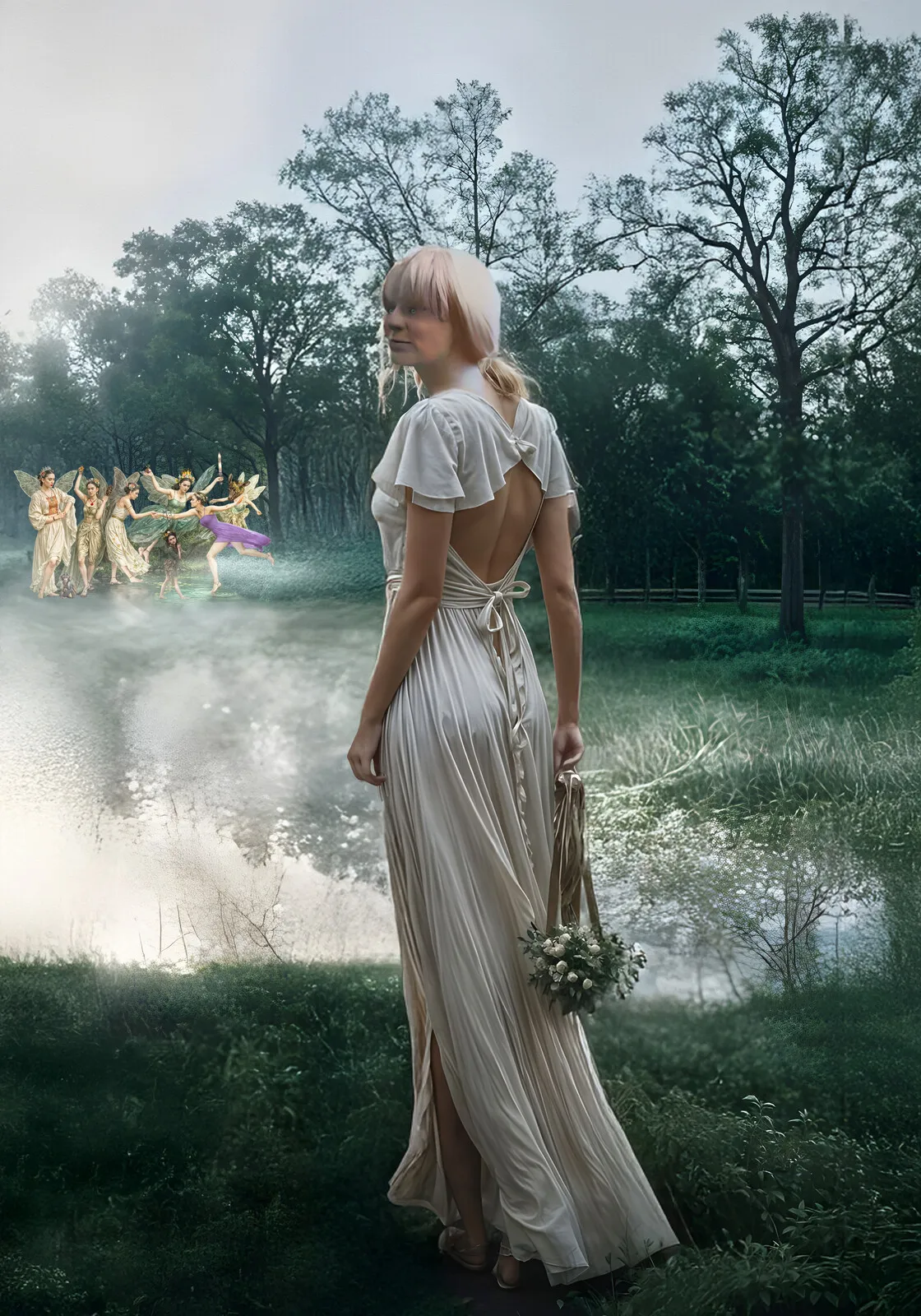
Jörgen Thornberg
Do You Believe in Angels?, 2025
Digital
70 x 100 cm
5 200 kr
Do You Believe in Angels?
As someone who has believed in angels and experienced their presence in my life, I invite you to explore this topic with me.
Read on to discover my unique perspective, which resonates deeply with the themes of angels and fairies and may offer a new way of looking at these mystical beings.
"My Angel
She walked this earth with laughter, light,
A wisp of fire, burning bright.
The painter’s soul, a poet’s grace,
A rebel heart, a smiling face.
No wings adorned her slender frame,
No halo shone, no holy name.
Yet all who met her saw the gleam,
The glow of stars within her dream.
Her hands could shape the light and shade,
Turn sorrow into art she made.
She danced through life with fearless ease,
A storm, a whisper, a summer breeze.
She lied like angels sometimes do,
To guard, to spare, to weave what's true.
Not seeking praise, nor seeking fame,
Just playing life's imperfect game.
Her love was fierce, her joy untamed,
her kindness deep, though never claimed.
She left behind a trail so bright,
A path of wonder, art, and light.
Then fate turned cruel, as fate can be,
Her mind was a ship lost out at sea.
The storm rolled in, the colours blurred,
her laughter dimmed, her voice unheard.
Yet even as the dusk drew near,
Her angel’s soul stayed bright and clear.
And when she left, she did not fall—
She rose beyond the earthly wall.
Now, on a star, she waits in time,
Where light is soft, and bells still chime.
For those who loved her, she remains
A gentle whisper in the autumn rains.
Not lost, not gone, but absent and free to roam,
An angel who has found her eternal home.”
Malmö, February 2025
Angels and Fairies – Two Worlds of Mystery and Magic
Yet, they exist all around us, at least in part, in human form. For centuries, angels and fairies have fascinated people worldwide. Both represent something supernatural beyond our physical world, yet they differ significantly in their roles, origins, and symbolism.
Angels – Messengers and Guardians
Angels appear in many religions and mythologies but are best known from the Abrahamic tradition, where they serve as God's messengers and protectors of humanity. They are often depicted as beings of light with great wings and an ethereal presence. According to tradition, angels do not possess free will like humans; instead, they are entirely devoted to carrying out the divine will.
In art and literature, angels are often portrayed as majestic and celestial. Still, there are more complex stories, such as fallen angels like Lucifer or more personal guardian angels.
Fairies – Enchanting spirits of Nature
Fairies belong more to Nordic and Celtic folklore. They are tied to nature and the forests and are often described as small, beautiful, and delicate beings with supernatural powers. In Swedish folklore, fairies were associated with the mist veils that danced over meadows at dawn and dusk. They could be both helpful and deceptive; stepping into a fairy ring could mean being enchanted or lost in another world.
In Irish and Scottish traditions, people speak of the fair folk or sidhe, fairy-like beings living in a parallel reality who are not always friendly towards humans. These creatures possess a strong sense of pride and may seek revenge if insulted.
Where Worlds Meet
Angels and fairies represent different realms—the heavenly and the earthly. Yet, in some stories, these worlds intersect, with fairies assuming a more spiritual role and angels adopting a more mythical or folkloric character. This intersection invites us to ponder the interconnectedness of our world and the spiritual realm.
In modern culture, both angels and fairies have been adapted and transformed. In fantasy and popular culture, fairies appear as powerful and independent beings, while angels are frequently depicted in a more human form. Both symbolise something beyond the ordinary, magical and enchanting. Angels are regarded as guides and protectors, whereas fairies, with their allure, entice us to explore the beauty and dangers of the hidden world.
So, what do you think? Do angels and fairies exist—and if they do, are they friends or foes? I have been close to an angel, so I know they exist. In hindsight, I have realised that angels, too, have their weaknesses. Like all of us, they experience good and bad days, strengths and flaws. My angel has departed from the Earth and resides on a star, waiting in eternity for all who loved her—and there were many. She had no wings, for angels do not fly but tread as we do, step by step, grappling with the same burdens. She had two angelic children who, thanks to her, grew into truly good people, each an angel in their way. And a little cherub who never got to be born but went straight to its star.
My angel was born an angel, and that is how I came to know her. An artistic angel, tall and slender, beautiful and funny, wonderfully eccentric—everything about her was good, even the less admirable aspects. She was a bit careless, but that added to her charm most of the time. When it mattered, she was both skilled and brave. My angel could tell a lie, too, for she did not wish to hurt with the truth like many others; thus, an alternative truth often suited the moment better, at least for her. Neither she nor those who tell such lies intend harm; it is simply in their nature. She never lied to appear better or to elevate her status; she remained the same angel throughout her life, and that is how we remember her. Like the angels in the Bible, she spread light wherever she went. However, that had nothing to do with religion, for though she was an angel, she was not religious.
My angel's final years were unjust, but she never believed in fairness. Still, injustice often befalls those who deserve it the least. She first became a forgetful angel and then increasingly confused—she had Alzheimer's, a disease that does not spare even angels. It is an especially cruel affliction, stripping away the finest parts of a person, the angel we once knew. Yet, she must have had a guardian angel who ensured she departed with dignity. Our angel passed away peacefully in her own home, in her favourite chair, spared from the final degrading years of total loss of self. Thank you, kind angel, for that mercy.
What remains are memories shared only in thought, never truly exchangeable. These personal memories, sweet almonds for the most part, filled with laughter, love, and life, alongside some bitter almonds, are the essence of our angel's legacy. They require two people to exist and rarely entertain anyone else.
My angel adored theatre, opera, books, and film. And celebration—for she had a unique way of turning life into festivity, cooking meals worthy of an angel’s table.
Angels: Do They Exist? And Those Who Certainly Did
A film my angel adored, despite its lack of Oscar nominations, was ‘Änglar, finns dom?’—translated as ‘Do You Believe in Angels?’ or ‘Love Mates’—a romantic comedy from 1961, directed by Lars-Magnus Lindgren. The film featured Jarl Kulle as the charming and worldly doctor Stellan and Christina Schollin as the innocent yet idealistic teacher Lillemor. My angel found Kulle handsome—and he indeed was. Meanwhile, Christina Schollin, modestly dressed and captured in soft backlit shots, certainly captivated the male audience.
The film’s title, ‘Love Mates,’ reflects Lillemor’s naïve but heartfelt belief in love and the inherent goodness of people. This belief parallels the innocent and idealistic nature of angels in folklore. She encounters the more cynical and experienced Stellan, resulting in a romantic and humorous narrative where their conflicting worldviews are tested against one another, much like the tension between the naive and the cynical in folklore.
The film achieved considerable success and has since become a Swedish classic, mainly due to the electric chemistry between Kulle and Schollin and its light-hearted and warm tone. It is a prime example of Swedish romantic comedies from the 1960s, a period noted for exploring love and human relationships amidst a shifting society.
Far From Angelic Beings
In another aspect of folklore, one discovers creatures far removed from celestial guidance—entities that do not lead souls to the light but instead lure them into mist-covered lands, down into dark waters, or onto winding forest paths from which there is no return. These beings were often beautiful and seductive, yet they possessed a perilous allure that demanded caution. They were not guardian angels but trials imposed upon humanity—trials that seldom ended favourably for those who fell victim to their enchantments.
Elves – The Dance of Beauty and Peril
Elves danced at dawn and dusk, ethereal figures draped in flowing white veils, yet those who stepped into their rings risked becoming ensnared by their spell. A moment within the elves’ dance could signify that a hundred years had passed in the human world. Their song was as sweet as it was deceptive, and those who listened too long could lose themselves entirely. In some tales, elves were benevolent, but in others, they stole away children or lured men to their doom.
The Skogsrå – The Deceptive Woodland Nymph
No creature possessed a more dual nature than the Woodland Nymph, the mesmerising ruler of the deep woods. She appeared as an incomparably beautiful woman from the front, yet those who glimpsed her back saw it was hollow, like a rotting tree. She could seduce hunters and foresters, making them forget time and place, but her love was treacherous—those who fell for her often became lost souls, unable to leave the forest forever.
The Nix’s Daughters – The Water’s Dangerous Lovers
Similar to elves, the daughters of the Nix were alluring yet merciless. They emerged by rivers and lakes, singing and laughing, their hair floating upon the water like silver threads in the moonlight. However, those drawn to them received only a kiss before sinking into the depths, never to return. Their father, the Nix, was a master of temptation. His violin melody was so enchanting that it lured both women and men to throw themselves into the water, yearning for something they could never attain.
Taken by the Mountain – Or Lost Forever
A common theme runs through the tales of these creatures—those who encountered them and allowed themselves to be tempted vanished. Sometimes, physically, they ventured into the woods, the water, or the mountains, but other times only in their minds. The men who returned from the Woodland Nymph came back as empty shells, lost and incapable of loving a human woman again. Those who had listened too long to the Nix’s song sat by the riverbank, gazing endlessly over the water, longing for something just out of reach.
Angels belonged in the heavens, yet these beings dwelled among us—in the forests, streams, and mist. They were not a path to paradise but a door to the unknown, to something beyond human control. Beautiful? Yes. Enchanting? Certainly. But it is always dangerous, especially for weak-willed men. Women, meanwhile, must stay far away from the lustful Nix, who is just as treacherous.
But that is a story for another time.
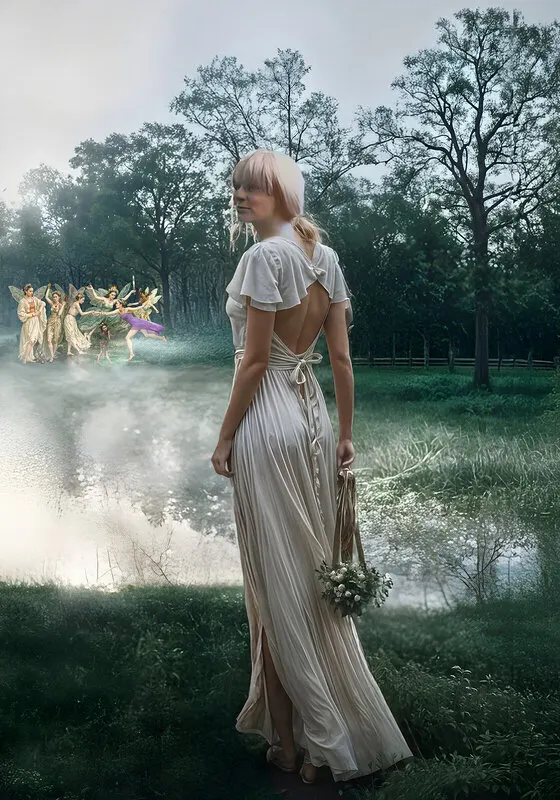
Jörgen Thornberg
Do You Believe in Angels?, 2025
Digital
70 x 100 cm
5 200 kr
Do You Believe in Angels?
As someone who has believed in angels and experienced their presence in my life, I invite you to explore this topic with me.
Read on to discover my unique perspective, which resonates deeply with the themes of angels and fairies and may offer a new way of looking at these mystical beings.
"My Angel
She walked this earth with laughter, light,
A wisp of fire, burning bright.
The painter’s soul, a poet’s grace,
A rebel heart, a smiling face.
No wings adorned her slender frame,
No halo shone, no holy name.
Yet all who met her saw the gleam,
The glow of stars within her dream.
Her hands could shape the light and shade,
Turn sorrow into art she made.
She danced through life with fearless ease,
A storm, a whisper, a summer breeze.
She lied like angels sometimes do,
To guard, to spare, to weave what's true.
Not seeking praise, nor seeking fame,
Just playing life's imperfect game.
Her love was fierce, her joy untamed,
her kindness deep, though never claimed.
She left behind a trail so bright,
A path of wonder, art, and light.
Then fate turned cruel, as fate can be,
Her mind was a ship lost out at sea.
The storm rolled in, the colours blurred,
her laughter dimmed, her voice unheard.
Yet even as the dusk drew near,
Her angel’s soul stayed bright and clear.
And when she left, she did not fall—
She rose beyond the earthly wall.
Now, on a star, she waits in time,
Where light is soft, and bells still chime.
For those who loved her, she remains
A gentle whisper in the autumn rains.
Not lost, not gone, but absent and free to roam,
An angel who has found her eternal home.”
Malmö, February 2025
Angels and Fairies – Two Worlds of Mystery and Magic
Yet, they exist all around us, at least in part, in human form. For centuries, angels and fairies have fascinated people worldwide. Both represent something supernatural beyond our physical world, yet they differ significantly in their roles, origins, and symbolism.
Angels – Messengers and Guardians
Angels appear in many religions and mythologies but are best known from the Abrahamic tradition, where they serve as God's messengers and protectors of humanity. They are often depicted as beings of light with great wings and an ethereal presence. According to tradition, angels do not possess free will like humans; instead, they are entirely devoted to carrying out the divine will.
In art and literature, angels are often portrayed as majestic and celestial. Still, there are more complex stories, such as fallen angels like Lucifer or more personal guardian angels.
Fairies – Enchanting spirits of Nature
Fairies belong more to Nordic and Celtic folklore. They are tied to nature and the forests and are often described as small, beautiful, and delicate beings with supernatural powers. In Swedish folklore, fairies were associated with the mist veils that danced over meadows at dawn and dusk. They could be both helpful and deceptive; stepping into a fairy ring could mean being enchanted or lost in another world.
In Irish and Scottish traditions, people speak of the fair folk or sidhe, fairy-like beings living in a parallel reality who are not always friendly towards humans. These creatures possess a strong sense of pride and may seek revenge if insulted.
Where Worlds Meet
Angels and fairies represent different realms—the heavenly and the earthly. Yet, in some stories, these worlds intersect, with fairies assuming a more spiritual role and angels adopting a more mythical or folkloric character. This intersection invites us to ponder the interconnectedness of our world and the spiritual realm.
In modern culture, both angels and fairies have been adapted and transformed. In fantasy and popular culture, fairies appear as powerful and independent beings, while angels are frequently depicted in a more human form. Both symbolise something beyond the ordinary, magical and enchanting. Angels are regarded as guides and protectors, whereas fairies, with their allure, entice us to explore the beauty and dangers of the hidden world.
So, what do you think? Do angels and fairies exist—and if they do, are they friends or foes? I have been close to an angel, so I know they exist. In hindsight, I have realised that angels, too, have their weaknesses. Like all of us, they experience good and bad days, strengths and flaws. My angel has departed from the Earth and resides on a star, waiting in eternity for all who loved her—and there were many. She had no wings, for angels do not fly but tread as we do, step by step, grappling with the same burdens. She had two angelic children who, thanks to her, grew into truly good people, each an angel in their way. And a little cherub who never got to be born but went straight to its star.
My angel was born an angel, and that is how I came to know her. An artistic angel, tall and slender, beautiful and funny, wonderfully eccentric—everything about her was good, even the less admirable aspects. She was a bit careless, but that added to her charm most of the time. When it mattered, she was both skilled and brave. My angel could tell a lie, too, for she did not wish to hurt with the truth like many others; thus, an alternative truth often suited the moment better, at least for her. Neither she nor those who tell such lies intend harm; it is simply in their nature. She never lied to appear better or to elevate her status; she remained the same angel throughout her life, and that is how we remember her. Like the angels in the Bible, she spread light wherever she went. However, that had nothing to do with religion, for though she was an angel, she was not religious.
My angel's final years were unjust, but she never believed in fairness. Still, injustice often befalls those who deserve it the least. She first became a forgetful angel and then increasingly confused—she had Alzheimer's, a disease that does not spare even angels. It is an especially cruel affliction, stripping away the finest parts of a person, the angel we once knew. Yet, she must have had a guardian angel who ensured she departed with dignity. Our angel passed away peacefully in her own home, in her favourite chair, spared from the final degrading years of total loss of self. Thank you, kind angel, for that mercy.
What remains are memories shared only in thought, never truly exchangeable. These personal memories, sweet almonds for the most part, filled with laughter, love, and life, alongside some bitter almonds, are the essence of our angel's legacy. They require two people to exist and rarely entertain anyone else.
My angel adored theatre, opera, books, and film. And celebration—for she had a unique way of turning life into festivity, cooking meals worthy of an angel’s table.
Angels: Do They Exist? And Those Who Certainly Did
A film my angel adored, despite its lack of Oscar nominations, was ‘Änglar, finns dom?’—translated as ‘Do You Believe in Angels?’ or ‘Love Mates’—a romantic comedy from 1961, directed by Lars-Magnus Lindgren. The film featured Jarl Kulle as the charming and worldly doctor Stellan and Christina Schollin as the innocent yet idealistic teacher Lillemor. My angel found Kulle handsome—and he indeed was. Meanwhile, Christina Schollin, modestly dressed and captured in soft backlit shots, certainly captivated the male audience.
The film’s title, ‘Love Mates,’ reflects Lillemor’s naïve but heartfelt belief in love and the inherent goodness of people. This belief parallels the innocent and idealistic nature of angels in folklore. She encounters the more cynical and experienced Stellan, resulting in a romantic and humorous narrative where their conflicting worldviews are tested against one another, much like the tension between the naive and the cynical in folklore.
The film achieved considerable success and has since become a Swedish classic, mainly due to the electric chemistry between Kulle and Schollin and its light-hearted and warm tone. It is a prime example of Swedish romantic comedies from the 1960s, a period noted for exploring love and human relationships amidst a shifting society.
Far From Angelic Beings
In another aspect of folklore, one discovers creatures far removed from celestial guidance—entities that do not lead souls to the light but instead lure them into mist-covered lands, down into dark waters, or onto winding forest paths from which there is no return. These beings were often beautiful and seductive, yet they possessed a perilous allure that demanded caution. They were not guardian angels but trials imposed upon humanity—trials that seldom ended favourably for those who fell victim to their enchantments.
Elves – The Dance of Beauty and Peril
Elves danced at dawn and dusk, ethereal figures draped in flowing white veils, yet those who stepped into their rings risked becoming ensnared by their spell. A moment within the elves’ dance could signify that a hundred years had passed in the human world. Their song was as sweet as it was deceptive, and those who listened too long could lose themselves entirely. In some tales, elves were benevolent, but in others, they stole away children or lured men to their doom.
The Skogsrå – The Deceptive Woodland Nymph
No creature possessed a more dual nature than the Woodland Nymph, the mesmerising ruler of the deep woods. She appeared as an incomparably beautiful woman from the front, yet those who glimpsed her back saw it was hollow, like a rotting tree. She could seduce hunters and foresters, making them forget time and place, but her love was treacherous—those who fell for her often became lost souls, unable to leave the forest forever.
The Nix’s Daughters – The Water’s Dangerous Lovers
Similar to elves, the daughters of the Nix were alluring yet merciless. They emerged by rivers and lakes, singing and laughing, their hair floating upon the water like silver threads in the moonlight. However, those drawn to them received only a kiss before sinking into the depths, never to return. Their father, the Nix, was a master of temptation. His violin melody was so enchanting that it lured both women and men to throw themselves into the water, yearning for something they could never attain.
Taken by the Mountain – Or Lost Forever
A common theme runs through the tales of these creatures—those who encountered them and allowed themselves to be tempted vanished. Sometimes, physically, they ventured into the woods, the water, or the mountains, but other times only in their minds. The men who returned from the Woodland Nymph came back as empty shells, lost and incapable of loving a human woman again. Those who had listened too long to the Nix’s song sat by the riverbank, gazing endlessly over the water, longing for something just out of reach.
Angels belonged in the heavens, yet these beings dwelled among us—in the forests, streams, and mist. They were not a path to paradise but a door to the unknown, to something beyond human control. Beautiful? Yes. Enchanting? Certainly. But it is always dangerous, especially for weak-willed men. Women, meanwhile, must stay far away from the lustful Nix, who is just as treacherous.
But that is a story for another time.
5 200 kr

Jörgen Thornberg
Malmö
Lite om bilder och mig. Translation in English at the end.
Jag är en nyfiken person som ser allt i bilder, även det jag fäster i ord, gärna tillsammans för bakom alla mina bilder finns en berättelse. Till vissa bilder hör en kortare eller längre novell som följer med bilden.
Bilder berättar historier. Jag omges av naturlig skönhet, intressanta människor och historia var jag än går. Jag använder min kamera för att dokumentera världen och blanda det jag ser med vad jag känner för att fånga den dolda magin.
Mina bilder berättar mina historier. Genom mina bilder, tryck och berättelser. Jag bjuder in dig att ta del av dessa berättelser, in i ditt liv och hem och dela min mycket personliga syn på vår värld. Mer än vad ögat ser. Jag tänker i bilder, drömmer och skriver och pratar om dem; följaktligen måste jag också skapa bilder. De blir vad jag ser, inte nödvändigtvis begränsade till verkligheten. Det finns en bild runt varje hörn. Jag hoppas att du kommer att se vad jag såg och gilla det.
Jag är också en skrivande person och till många bilder hör en kortare eller längre essay. Den följer med tavlan, tryckt på fint papper och med en personlig hälsning från mig.
Flertalet bilder startar sin resa i min kamera. Enkelt förklarat beskriver jag bilden jag ser i mitt inre, upplevd eller fantiserad. Bilden uppstår inom mig redan innan jag fått okularet till ögat. På bråkdelen av ett ögonblick ser jag vad jag vill ha och vad som kan göras med bilden. Här skall jag stoppa in en giraff, stålmannen, Titanic eller vad det är min fantasi finner ut. Ännu märkligare är att jag kommer ihåg minnesbilden långt efteråt när det blir tid att skapa verket. Om jag lyckas eller inte, är upp till betraktaren, oftast präglat av en stråk av svart humor – meningen är att man skall bli underhållen. Mina bilder blir ofta en snackis där de hänger.
Jag föredrar bilder som förmedlar ett budskap i flera lager. Vid första anblicken fylld av feel-good, en vacker utsikt, fint väder, solen skiner, blommor på ängen eller vattnet som ligger förrädiskt spegelblankt. I en sådan bild kan jag gömma min egentliga berättelse, mitt förakt för förtryckare och våldsverkare, rasister och fördomsfulla människor - ett gärna återkommande motiv mer eller mindre dolt i det vackra motivet. Jag försöker förena dem i ett gemensamt narrativ.
Bild och formgivning har löpt som en röd tråd genom livet. Fotokonst känns som en värdig final som jag gärna delar med mig.
Min genre är vid som framgår av mina bilder, temat en blandning av pop- och gatukonst i kollage som kan bestå av hundratals lager. Vissa bilder kan ta veckor, andra någon dag innan det är dags att överlämna resultatet till printverkstaden. Fine Art Prints är digitala fotocollage. I dessa kollage sker rivandet, klippandet, pusslandet, målandet, ritandet och sprayningen digitalt. Det jag monterar in kan vara hundratals år gamla bilder som jag omsorgsfullt frilägger så att de ser ut att vara en del av tavlan men också bilder skapade av mig själv efter min egen fantasi. Därefter besöks printstudion och för vissa bilder numrera en limiterad upplaga (oftast 7 exemplar) och signera för hand. Vissa bilder kan köpas i olika format. Det är bara att fråga efter vilka. Gillar man en bild som är 70x100 men inte har plats på väggen, går den kanske att få i 50x70 cm istället. Frågan är fri.
Metoden Giclée eller Fine Art Print som det också kallas är det moderna sättet för framställning av grafisk konst. Villkoret för denna typ av utskrifter är att en högkvalitativ storformatskrivare används med åldersbeständigt färgpigment och konstnärspapper eller i förekommande fall på duk. Pappret som används möter de krav på livslängd som ställs av museer och gallerier. Normalt säljer jag mina bilder oinramade så att den nya ägaren själv kan bestämma hur de skall se ut, med eller utan passepartout färg på ram, med eller utan glas etc..
Under många år ställde jag bara ut på nätet, i valda grupper och på min egen Facebooksida - https://www.facebook.com/jorgen.thornberg.9
Jag finns också på en egen hemsida som tyvärr inte alltid är uppdaterad – https://www.jth.life/ Där kan du också läsa en del av de berättelser som följer med bilden.
UTSTÄLLNINGAR
Luftkastellet, oktober 2022
Konst i Lund, november 2022
Luftkastellet, mars 2023
Engleson Galleri Caroli, april 2023
Hydra, Greece June 2023
Engleson Galleri Caroli, oktober 2023
Toppen, Höllviken december 2023
Luftkastellet, mars 2024
Torups Galleri, mars 2024
Venice, May 2024
Luftkastellet, oktober 2024
Konst i Advent, December 2024
Galleri Engleson, Caroli December 2024
Jäger & Jansson Galleri, april 2025
A bit about pictures and me.
I'm a curious person who sees everything in pictures, even what I express in words, often combining them, for behind all my pictures lies a story. These narratives, some as short as a single image and others as long as a novel, are the heart and soul of my work.
Pictures tell stories. Wherever I go, I'm surrounded by natural beauty, exciting people, and history. I use my camera to document the world and blend what I see with what I feel to capture the hidden magic.
My images tell my stories. Through my pictures, prints, and narratives, I invite you to partake in these stories in your life and home and share my deeply personal perspective of our world. More than meets the eye. I think in pictures, dream, write, and talk about them; consequently, I must create images too. They become what I see, not necessarily confined to reality. There's a picture around every corner. I hope you'll see what I saw and enjoy it.
I'm also a writer, and many images come with a shorter or longer essay. It accompanies the painting, printed on fine paper with my personal greeting.
Many pictures start their journey on my camera. Simply put, I describe the image I see in my mind, experienced or imagined. The image arises within me even before I bring the eyepiece to my eye. In a fraction of a moment, I see what I want and what can be done with the picture. Here, I'll insert a giraffe, Superman, the Titanic, or whatever my imagination conjures up. Even stranger is that I remember the mental image long after it's time to create the work. Whether I succeed is up to the observer, often imbued with a streak of black humour – the aim is to entertain. My pictures usually become a talking point wherever they hang.
I prefer pictures that convey a message in multiple layers. At first glance, they're filled with feel-good vibes, a beautiful view, lovely weather, the sun shining, flowers in the meadow, or the water lying deceptively calm. But beneath this surface beauty, I often conceal a deeper story, a narrative that challenges societal norms or explores the human condition. I invite you to delve into these hidden narratives and discover the layers of meaning within my work.
Picture and design have been a thread running through my life. Photographic art feels like a fitting finale, and I'm happy to share it.
My genre is varied, as seen in my pictures; the theme is a blend of pop and street art in collages that can consist of hundreds of layers. Some images can take weeks, others just a day before it's time to hand over the result to the print workshop. Fine Art Prints are digital photo collages. In these collages, tearing, cutting, puzzling, painting, drawing, and spraying happen digitally. What I insert can be images hundreds of years old that I carefully extract so they appear to be part of the painting, but also images created by myself, now also generated from my imagination. Next, visit the print studio and, for certain images, number a limited edition (usually 7 copies) and sign them by hand. Some images may be available in other formats. Just ask which ones. If you like an image that's 70x100 but doesn't have space on the wall, you might be able to get it in 50x70 cm instead. The question is open.
The Giclée method, or Fine Art Print as it's also called, is the modern way of producing graphic art. This method ensures the highest quality and longevity of the artwork, using a high-quality large-format printer with archival pigment inks and artist paper or, in some cases, canvas. The paper used meets the longevity requirements set by museums and galleries. I sell my pictures unframed, allowing the new owner to personalise their artwork, confident in the lasting value and quality of the piece.
For many years, I only exhibited online, in selected groups, and on my Facebook page - https://www.facebook.com/jorgen.thornberg.9. I also have my website, which unfortunately is not constantly updated - https://www.jth.life/. You can also read some of the stories accompanying the pictures there.
EXHIBITIONS
Luftkastellet, October 2022
Art in Lund, November 2022
Luftkastellet, March 2023
Engleson Gallery Caroli, April 2023
Hydra, Greece June 2023
Engleson Gallery Caroli, October 2023
Toppen, Höllviken December 2023
Luftkastellet, March 2024
Torup Gallery, March 2024
Venice, May 2024
UTSTÄLLNINGAR
Luftkastellet, oktober 2022
Konst i Lund, november 2022
Luftkastellet, mars 2023
Engleson Galleri Caroli, april 2023
Hydra, Greece June 2023
Engleson Galleri Caroli, oktober 2023
Toppen, Höllviken december 2023
Luftkastellet, mars 2024
Torups Galleri, mars 2024
Venice, May 2024
Luftkastellet, October 2024
Konst i Advent, December 2024
Galleri Engleson, Caroli December 2024
Jäger & Jansson Galleri, April 2025
Utbildning
Autodidakt
Medlem i konstnärsförening
Öppna Sinnen
Med i konstrunda
Konstrundan i Skåne
Utställningar
Luftkastellet, October 2022
Art in Lund, November 2022
Luftkastellet, March 2023
Engleson Gallery Caroli, April 2023
Hydra, Greece June 2023
Engleson Gallery Caroli, October 2023
Toppen, Höllviken December 2023
Luftkastellet, March 2024
Torup Gallery, March 2024
Venice, May 2024