Vi använder cookies för att ge dig bästa möjliga upplevelse. Välj vilka cookies du tillåter.
Läs mer i vår integritetspolicy
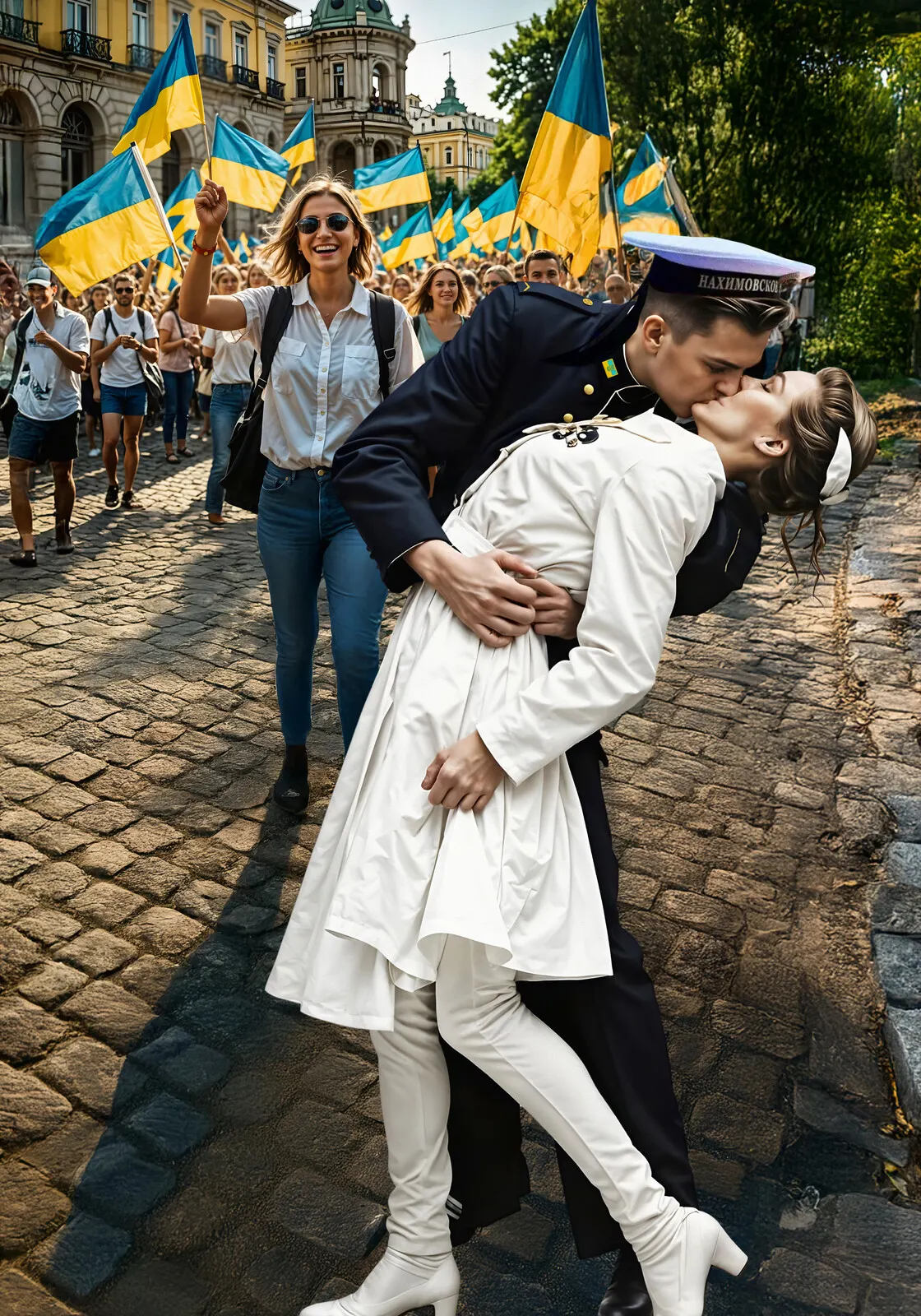
Jörgen Thornberg
The Ukrainian Victory Kiss, 2025
Digital
50 x 70 cm
3 200 kr
The Ukrainian Victory Kiss
Step into my world of unexpected adventures, from the historical significance of a kiss in public to the weighty matters of war and peace. Join me as we delve into the historical context of a kiss symbolising resilience and the triumph of unity over brute force. This is a story that spans centuries and continents, where art, history, and botany intertwine. Click the link below to discover more, share your thoughts with me, and perhaps even share your own experiences or beliefs about art.
https://www.konst.se/jorgen-thornberg
Long Live Frida!
The iconic photograph ‘V-J Day in Times Square’ by Alfred Eisenstaedt has captivated the world for decades, symbolising the sheer joy and relief at the end of World War II. Yet, beyond its immediate impact, the image has sparked discussions on spontaneity, consent, and historical interpretation. As the world anticipates a future victory kiss in Odessa’s Greek Square—one that will mark the triumph over aggression and the resilience of a free Ukraine—the legacy of Eisenstaedt’s lens remains a powerful reminder of moments that define history.
Continue reading to learn more about things behind the kiss
"The Kiss That Ended War
A fleeting touch, a captured breath,
A moment held 'tween life and death.
No bullets fired, no banners waved,
Just lips that met—our world was saved.
A sailor lost in newfound peace,
A nurse embraced, time’s hush, release.
Not words, nor treaties sealed the end,
But love’s defiant, bold transcend.
The streets alive with joyous cries,
Tears of loss in hopeful eyes.
A world reborn, a solemn vow,
To cherish peace, to live for now.
Yet history bends, its echoes call,
New battles rise, new empires fall.
Again we wait, a kiss to come,
When silence reigns, when war is done.
Yet time has turned, the winds have changed,
What once seemed pure is now estranged.
A kiss unasked, a touch unplanned,
A line now drawn, a firm demand.
No joy can strip consent away,
No victory grants the right to stray.
For hands must ask, for lips must know,
That passion’s flame must first be sown.
Still, history's weight and hearts collide,
A moment's bliss, a world’s divide.
Can impulse live where rules confine?
Can love and law in balance shine?”
Malmö, February 2025
In Expectation of Victory
Every rational person eagerly anticipates the victory kiss in Greek Square in Odessa, a moment when Ukraine will have freed itself from the aggressor, Russia. With global support, Ukrainians can rebuild their country, leaving Russia isolated for a considerable time. This is not merely a kiss, but a symbol of a nation's resilience and the triumph of unity over brute force. It signifies the moment when Putin and his cohorts, along with their aggression, have ultimately been thwarted.
It is crucial for our children, grandchildren, and future generations that our time demonstrates that, in the end, justice prevails and international laws are upheld. Morality, coupled with common sense, must succeed. Anything less would result in a catastrophe of immense proportions. To deny that it was Putin and his Russia who launched the attack on Ukraine—first in 2014, when Crimea and parts of eastern Ukraine were seized—is to reject reality. There are no alternative truths, only definitive lies. To, like Trump, twist reality into a political tool is the ultimate evidence of a complete madman, a dangerously unstable individual on par with Hitler and Stalin. Those who, for unfathomable reasons, have supported these wretched murderers ought to feel ashamed and, hopefully, have learned something that will lead them to become better human beings.
Even the gods of antiquity sometimes battled in vain against folly, but ultimately, even the most foolish come to reason. That is why we eagerly anticipate the kiss in Odessa, which will become as legendary as the one that marked the definitive end of World War II. The kiss in Odessa is a symbolic act of victory, much like the one that Alfred Eisenstaedt captured in his iconic photograph on 14 August 1945, the day known as V-J Day (Victory over Japan Day).
Alfred Eisenstaedt – The Legendary Photojournalist
Alfred Eisenstaedt was one of the most influential photojournalists of the 20th century. Born on 6 December 1898 in Dirschau (now Tczew in Poland, then part of the German Empire), he grew up in Berlin. His interest in photography developed early; by the 1920s, he had begun working as a freelance photographer. During this time, he documented the political and social landscape of the Weimar Republic and the rise of the Nazi Party.
In 1935, following the Nazi takeover, Eisenstaedt emigrated to the United States, where he became one of the first photographers hired by LIFE Magazine. This publication would go on to define photojournalism. His work for LIFE made him famous, and he remained with the magazine for over 50 years. Eisenstaedt was renowned for his ability to capture spontaneous human moments with a sense of immediacy and emotion. He worked with a Leica camera, a compact and unobtrusive device that allowed him to operate quickly and unnoticed. This proved essential for his most iconic photograph—a sailor kissing a nurse in Times Square on 14 August 1945, the day known as V-J Day (Victory over Japan Day).
The Iconic Image – V-J Day in Times Square
The most famous photograph of Eisenstaedt’s career is undoubtedly ‘V-J Day in Times Square’, also known as ‘Sailor Kissing a Nurse’. The iconic photo was taken on 14 August 1945 in New York City, at the very moment when the news of Japan’s surrender in World War II reached the United States. It was a day of euphoria, celebration, and relief after years of war and sacrifice, a moment that will forever be etched in history.
Millions had perished, all for naught, as war never leaves anything better than it was before. This has always been the case, and it will remain so. War is humanity’s worst invention, benefiting only a handful of spineless individuals who profit from it.
In a moment of spontaneous joy, a sailor in a dark uniform was seen leaning over to kiss a nurse dressed in white. As Eisenstaedt moved through the crowd to document the celebrations, he captured this fleeting moment, unaware that he had just created one of history’s most iconic images. The photo symbolised the overwhelming joy and relief at the war’s end—a national triumph and an unfiltered expression of emotion amidst the chaos, a moment that was not staged but a pure, unscripted act of jubilation.
How the Image Was Captured
Eisenstaedt later described how he managed to take the photograph:
"I saw a sailor running down the street, grabbing every woman he could find—whether an elderly lady, a young girl, or a nurse. I ran ahead and clicked my Leica just as he kissed the nurse. I didn’t even know who they were, and in the moment's excitement, I didn’t have time to ask for their names."
Eisenstaedt took several shots of the event from different angles, but the one where the sailor holds the nurse in a firm grip as she leans back became iconic. The image was published in LIFE Magazine on 27 August 1945 and quickly became one of the most recognisable photographs of the Second World War.
Who Were the Sailor and the Nurse?
Decades after the photograph was taken, many individuals came forward claiming to be the sailor or the nurse in the image. Over time, two people emerged as the most widely accepted figures in the identification process.
The Sailor: One of the strongest candidates was George Mendonsa, an American sailor serving aboard the USS The Sullivans at the time. He and his family recognised him as the man in the photograph, and 2012, facial recognition technology confirmed his identity.
The Nurse: The woman in the photo was identified as Greta Zimmer Friedman, a Jewish-Austrian immigrant. However, she was not a nurse—she was a dental assistant who happened to be in Times Square when the event occurred.
Greta later recalled that the kiss was unexpected and not a romantic moment but part of the overwhelming public celebration.
A Photo That Defined an Era
Eisenstaedt’s V-J Day in Times Square remains one of the most potent symbols of the end of World War II. While the image was initially celebrated purely as a joyous, triumphant moment, it has also been re-evaluated in light of modern discussions about consent and personal boundaries.
Despite these debates, the photograph continues to hold immense historical significance. It captures the end of the war and the human need to express relief, hope, and joy in moments of significant change.
Alfred Eisenstaedt’s legacy is that of a photographer who recognised the power of a single, well-timed image. His work for LIFE Magazine spanned decades, capturing some of the most significant moments and figures of the 20th century. His ability to immortalise emotion and spontaneity ensures that his images—particularly V-J Day in Times Square—will continue to be remembered and analysed by future generations.
Friedman later recounted being surprised by the kiss and that it was not a romantic moment; instead, it formed part of the general euphoria in Times Square.
The photograph, a subject of much symbolism and controversy, has not escaped the scrutiny of others, particularly the so-called guardians of morality, who are always eager to use it to their advantage. V-J Day in Times Square has become one of history's most celebrated and widely republished images. It is regarded as a symbol of peace, the end of the war, and a unique historical moment.
Yet the image has also faced criticism, particularly in modern times, with some questioning the non-consensual nature of the kiss. According to Greta Zimmer Friedman, it was not a romantic kiss but a surprising and spontaneous act from a stranger. In today’s era of evolving perspectives on consent and bodily autonomy, which refers to the shifting societal norms and laws that recognise an individual's right to control their own body and make decisions about their lives, the image has taken on a more nuanced interpretation than before. Of course, feeling happy does not grant anyone the right to throw themselves at others, but equating this act with assault, as some feminists have done, is taking it too far. Indeed, the joy of resisting an invader should allow for a spontaneous kiss, even in our time. Friedman herself later remarked that she too had been swept up in the euphoria of the moment and kissed back, stating that otherwise, he would have received a slap. Still, kissing someone is an intensely personal act, so regardless of how euphoric one may be, it is always important to ask first and respect a ‘no’ if the other person does not share the same enthusiasm.
I had always known about the image, but being the romantic I am, I had long hoped that the two would become a couple and live happily ever after. Things like that happen all the time in sagas. Unfortunately, that was not the case—but there were no hard feelings afterward. Instead, the moment became an exclamation mark after the fall of fascism, a moment to cherish. Take that, Putin, Trump, Musk, Orbán, and all those who believed in the right of the strong.
Eisenstaedt’s Legacy and Later Life
After capturing this legendary image, Eisenstaedt continued to work as a photojournalist for LIFE Magazine and became one of its most prominent photographers. He photographed many famous figures, including John F. Kennedy, Marilyn Monroe, Winston Churchill, and Albert Einstein.
He became renowned for his ability to capture moments of humanity and spontaneity. He published several photography books and continued to work well into old age.
Alfred Eisenstaedt passed away on August 24, 1995, at 96. His legacy endures through his iconic images, particularly V-J Day in Times Square, which remains one of world history's most recognised and discussed photographs.
We are speaking about a historical moment frozen in time, a reminder of the conclusion of something that must never be forgotten. Alfred Eisenstaedt’s Sailor Kissing a Nurse is more than just a picture; it symbolises an era, a historic moment of spontaneity and celebration at the end of World War II. With his Leica camera and keen eye for human expression, Eisenstaedt captured a scene etched into collective memory.
Although the image has been re-evaluated over the years, it remains a powerful document of a time of change, hope, and emotional release following the war's end. It is one of those rare photographs that speaks louder than words—a frozen moment that continues to fascinate and inspire generation after generation.
A Final Note on the Kiss and the Square
For those who may hold a different view on the Ukraine war, you have that right, as you live in a democracy—but take a moment to revisit history. Browse YouTube, Google, and other sources that provide documents from before, during, and after the invasion. Hitler also justified his invasions by claiming they were someone else’s fault. He, too, staged a false flag attack, whereby Germans dressed as Polish soldiers attacked their own country, providing an excuse to retaliate.
And now, we see Trump defending Putin, echoing his rhetoric that the victim was the actual aggressor. This kind of ‘alternative truth’ reveals what kind of person Mr Trump is. I do not hesitate to declare him the most despicable figure of our time, a man who joins the ranks of others on history’s garbage heap. I genuinely wonder what leverage Putin has over Trump.
Finally, here are a few words about the square where the kiss will take place: the location has been thoughtfully chosen and is no coincidence. Odessa boasts several significant squares, but one of the most notable is Greek Square (Hretska Ploshcha).
Situated in the city’s historic centre, it has a rich history dating back to the 18th century. The name originates from Greek merchants who settled in the area during the reign of Catherine II, establishing a Greek bazaar there. Greek Square is rectangular and flanked by remarkable buildings, including the 'Round House' (Majurova House), which features an oval foundation and is a significant architectural landmark in Odessa. Historically, the square has been a hub for bookselling and continues to host an extensive book market.
Today, it is a popular meeting place designated for various events such as festivals, exhibitions, and concerts. It is the perfect venue for people to be swept up in euphoria, wave flags, sing joyfully, embrace, and kiss. The square plays an essential role in Odessa’s cultural and historical landscape, functioning as a centre for both social and political activities.
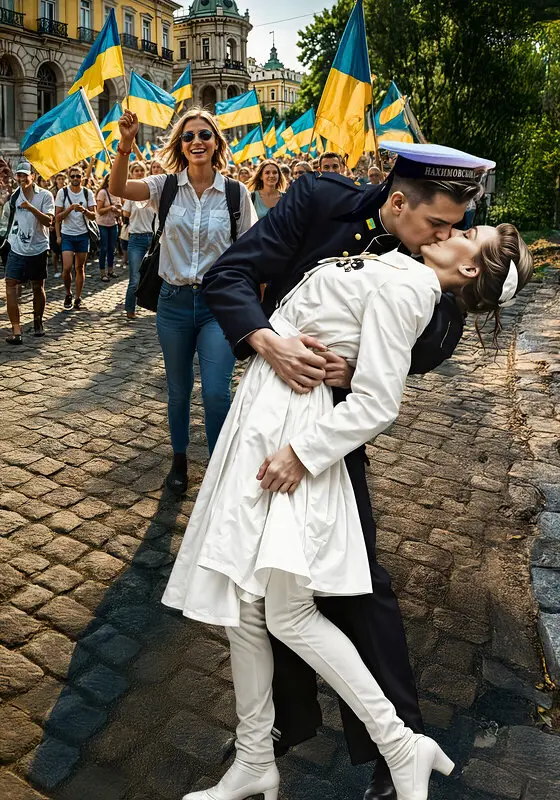
Jörgen Thornberg
The Ukrainian Victory Kiss, 2025
Digital
50 x 70 cm
3 200 kr
The Ukrainian Victory Kiss
Step into my world of unexpected adventures, from the historical significance of a kiss in public to the weighty matters of war and peace. Join me as we delve into the historical context of a kiss symbolising resilience and the triumph of unity over brute force. This is a story that spans centuries and continents, where art, history, and botany intertwine. Click the link below to discover more, share your thoughts with me, and perhaps even share your own experiences or beliefs about art.
https://www.konst.se/jorgen-thornberg
Long Live Frida!
The iconic photograph ‘V-J Day in Times Square’ by Alfred Eisenstaedt has captivated the world for decades, symbolising the sheer joy and relief at the end of World War II. Yet, beyond its immediate impact, the image has sparked discussions on spontaneity, consent, and historical interpretation. As the world anticipates a future victory kiss in Odessa’s Greek Square—one that will mark the triumph over aggression and the resilience of a free Ukraine—the legacy of Eisenstaedt’s lens remains a powerful reminder of moments that define history.
Continue reading to learn more about things behind the kiss
"The Kiss That Ended War
A fleeting touch, a captured breath,
A moment held 'tween life and death.
No bullets fired, no banners waved,
Just lips that met—our world was saved.
A sailor lost in newfound peace,
A nurse embraced, time’s hush, release.
Not words, nor treaties sealed the end,
But love’s defiant, bold transcend.
The streets alive with joyous cries,
Tears of loss in hopeful eyes.
A world reborn, a solemn vow,
To cherish peace, to live for now.
Yet history bends, its echoes call,
New battles rise, new empires fall.
Again we wait, a kiss to come,
When silence reigns, when war is done.
Yet time has turned, the winds have changed,
What once seemed pure is now estranged.
A kiss unasked, a touch unplanned,
A line now drawn, a firm demand.
No joy can strip consent away,
No victory grants the right to stray.
For hands must ask, for lips must know,
That passion’s flame must first be sown.
Still, history's weight and hearts collide,
A moment's bliss, a world’s divide.
Can impulse live where rules confine?
Can love and law in balance shine?”
Malmö, February 2025
In Expectation of Victory
Every rational person eagerly anticipates the victory kiss in Greek Square in Odessa, a moment when Ukraine will have freed itself from the aggressor, Russia. With global support, Ukrainians can rebuild their country, leaving Russia isolated for a considerable time. This is not merely a kiss, but a symbol of a nation's resilience and the triumph of unity over brute force. It signifies the moment when Putin and his cohorts, along with their aggression, have ultimately been thwarted.
It is crucial for our children, grandchildren, and future generations that our time demonstrates that, in the end, justice prevails and international laws are upheld. Morality, coupled with common sense, must succeed. Anything less would result in a catastrophe of immense proportions. To deny that it was Putin and his Russia who launched the attack on Ukraine—first in 2014, when Crimea and parts of eastern Ukraine were seized—is to reject reality. There are no alternative truths, only definitive lies. To, like Trump, twist reality into a political tool is the ultimate evidence of a complete madman, a dangerously unstable individual on par with Hitler and Stalin. Those who, for unfathomable reasons, have supported these wretched murderers ought to feel ashamed and, hopefully, have learned something that will lead them to become better human beings.
Even the gods of antiquity sometimes battled in vain against folly, but ultimately, even the most foolish come to reason. That is why we eagerly anticipate the kiss in Odessa, which will become as legendary as the one that marked the definitive end of World War II. The kiss in Odessa is a symbolic act of victory, much like the one that Alfred Eisenstaedt captured in his iconic photograph on 14 August 1945, the day known as V-J Day (Victory over Japan Day).
Alfred Eisenstaedt – The Legendary Photojournalist
Alfred Eisenstaedt was one of the most influential photojournalists of the 20th century. Born on 6 December 1898 in Dirschau (now Tczew in Poland, then part of the German Empire), he grew up in Berlin. His interest in photography developed early; by the 1920s, he had begun working as a freelance photographer. During this time, he documented the political and social landscape of the Weimar Republic and the rise of the Nazi Party.
In 1935, following the Nazi takeover, Eisenstaedt emigrated to the United States, where he became one of the first photographers hired by LIFE Magazine. This publication would go on to define photojournalism. His work for LIFE made him famous, and he remained with the magazine for over 50 years. Eisenstaedt was renowned for his ability to capture spontaneous human moments with a sense of immediacy and emotion. He worked with a Leica camera, a compact and unobtrusive device that allowed him to operate quickly and unnoticed. This proved essential for his most iconic photograph—a sailor kissing a nurse in Times Square on 14 August 1945, the day known as V-J Day (Victory over Japan Day).
The Iconic Image – V-J Day in Times Square
The most famous photograph of Eisenstaedt’s career is undoubtedly ‘V-J Day in Times Square’, also known as ‘Sailor Kissing a Nurse’. The iconic photo was taken on 14 August 1945 in New York City, at the very moment when the news of Japan’s surrender in World War II reached the United States. It was a day of euphoria, celebration, and relief after years of war and sacrifice, a moment that will forever be etched in history.
Millions had perished, all for naught, as war never leaves anything better than it was before. This has always been the case, and it will remain so. War is humanity’s worst invention, benefiting only a handful of spineless individuals who profit from it.
In a moment of spontaneous joy, a sailor in a dark uniform was seen leaning over to kiss a nurse dressed in white. As Eisenstaedt moved through the crowd to document the celebrations, he captured this fleeting moment, unaware that he had just created one of history’s most iconic images. The photo symbolised the overwhelming joy and relief at the war’s end—a national triumph and an unfiltered expression of emotion amidst the chaos, a moment that was not staged but a pure, unscripted act of jubilation.
How the Image Was Captured
Eisenstaedt later described how he managed to take the photograph:
"I saw a sailor running down the street, grabbing every woman he could find—whether an elderly lady, a young girl, or a nurse. I ran ahead and clicked my Leica just as he kissed the nurse. I didn’t even know who they were, and in the moment's excitement, I didn’t have time to ask for their names."
Eisenstaedt took several shots of the event from different angles, but the one where the sailor holds the nurse in a firm grip as she leans back became iconic. The image was published in LIFE Magazine on 27 August 1945 and quickly became one of the most recognisable photographs of the Second World War.
Who Were the Sailor and the Nurse?
Decades after the photograph was taken, many individuals came forward claiming to be the sailor or the nurse in the image. Over time, two people emerged as the most widely accepted figures in the identification process.
The Sailor: One of the strongest candidates was George Mendonsa, an American sailor serving aboard the USS The Sullivans at the time. He and his family recognised him as the man in the photograph, and 2012, facial recognition technology confirmed his identity.
The Nurse: The woman in the photo was identified as Greta Zimmer Friedman, a Jewish-Austrian immigrant. However, she was not a nurse—she was a dental assistant who happened to be in Times Square when the event occurred.
Greta later recalled that the kiss was unexpected and not a romantic moment but part of the overwhelming public celebration.
A Photo That Defined an Era
Eisenstaedt’s V-J Day in Times Square remains one of the most potent symbols of the end of World War II. While the image was initially celebrated purely as a joyous, triumphant moment, it has also been re-evaluated in light of modern discussions about consent and personal boundaries.
Despite these debates, the photograph continues to hold immense historical significance. It captures the end of the war and the human need to express relief, hope, and joy in moments of significant change.
Alfred Eisenstaedt’s legacy is that of a photographer who recognised the power of a single, well-timed image. His work for LIFE Magazine spanned decades, capturing some of the most significant moments and figures of the 20th century. His ability to immortalise emotion and spontaneity ensures that his images—particularly V-J Day in Times Square—will continue to be remembered and analysed by future generations.
Friedman later recounted being surprised by the kiss and that it was not a romantic moment; instead, it formed part of the general euphoria in Times Square.
The photograph, a subject of much symbolism and controversy, has not escaped the scrutiny of others, particularly the so-called guardians of morality, who are always eager to use it to their advantage. V-J Day in Times Square has become one of history's most celebrated and widely republished images. It is regarded as a symbol of peace, the end of the war, and a unique historical moment.
Yet the image has also faced criticism, particularly in modern times, with some questioning the non-consensual nature of the kiss. According to Greta Zimmer Friedman, it was not a romantic kiss but a surprising and spontaneous act from a stranger. In today’s era of evolving perspectives on consent and bodily autonomy, which refers to the shifting societal norms and laws that recognise an individual's right to control their own body and make decisions about their lives, the image has taken on a more nuanced interpretation than before. Of course, feeling happy does not grant anyone the right to throw themselves at others, but equating this act with assault, as some feminists have done, is taking it too far. Indeed, the joy of resisting an invader should allow for a spontaneous kiss, even in our time. Friedman herself later remarked that she too had been swept up in the euphoria of the moment and kissed back, stating that otherwise, he would have received a slap. Still, kissing someone is an intensely personal act, so regardless of how euphoric one may be, it is always important to ask first and respect a ‘no’ if the other person does not share the same enthusiasm.
I had always known about the image, but being the romantic I am, I had long hoped that the two would become a couple and live happily ever after. Things like that happen all the time in sagas. Unfortunately, that was not the case—but there were no hard feelings afterward. Instead, the moment became an exclamation mark after the fall of fascism, a moment to cherish. Take that, Putin, Trump, Musk, Orbán, and all those who believed in the right of the strong.
Eisenstaedt’s Legacy and Later Life
After capturing this legendary image, Eisenstaedt continued to work as a photojournalist for LIFE Magazine and became one of its most prominent photographers. He photographed many famous figures, including John F. Kennedy, Marilyn Monroe, Winston Churchill, and Albert Einstein.
He became renowned for his ability to capture moments of humanity and spontaneity. He published several photography books and continued to work well into old age.
Alfred Eisenstaedt passed away on August 24, 1995, at 96. His legacy endures through his iconic images, particularly V-J Day in Times Square, which remains one of world history's most recognised and discussed photographs.
We are speaking about a historical moment frozen in time, a reminder of the conclusion of something that must never be forgotten. Alfred Eisenstaedt’s Sailor Kissing a Nurse is more than just a picture; it symbolises an era, a historic moment of spontaneity and celebration at the end of World War II. With his Leica camera and keen eye for human expression, Eisenstaedt captured a scene etched into collective memory.
Although the image has been re-evaluated over the years, it remains a powerful document of a time of change, hope, and emotional release following the war's end. It is one of those rare photographs that speaks louder than words—a frozen moment that continues to fascinate and inspire generation after generation.
A Final Note on the Kiss and the Square
For those who may hold a different view on the Ukraine war, you have that right, as you live in a democracy—but take a moment to revisit history. Browse YouTube, Google, and other sources that provide documents from before, during, and after the invasion. Hitler also justified his invasions by claiming they were someone else’s fault. He, too, staged a false flag attack, whereby Germans dressed as Polish soldiers attacked their own country, providing an excuse to retaliate.
And now, we see Trump defending Putin, echoing his rhetoric that the victim was the actual aggressor. This kind of ‘alternative truth’ reveals what kind of person Mr Trump is. I do not hesitate to declare him the most despicable figure of our time, a man who joins the ranks of others on history’s garbage heap. I genuinely wonder what leverage Putin has over Trump.
Finally, here are a few words about the square where the kiss will take place: the location has been thoughtfully chosen and is no coincidence. Odessa boasts several significant squares, but one of the most notable is Greek Square (Hretska Ploshcha).
Situated in the city’s historic centre, it has a rich history dating back to the 18th century. The name originates from Greek merchants who settled in the area during the reign of Catherine II, establishing a Greek bazaar there. Greek Square is rectangular and flanked by remarkable buildings, including the 'Round House' (Majurova House), which features an oval foundation and is a significant architectural landmark in Odessa. Historically, the square has been a hub for bookselling and continues to host an extensive book market.
Today, it is a popular meeting place designated for various events such as festivals, exhibitions, and concerts. It is the perfect venue for people to be swept up in euphoria, wave flags, sing joyfully, embrace, and kiss. The square plays an essential role in Odessa’s cultural and historical landscape, functioning as a centre for both social and political activities.
3 200 kr

Jörgen Thornberg
Malmö
Lite om bilder och mig. Translation in English at the end.
Jag är en nyfiken person som ser allt i bilder, även det jag fäster i ord, gärna tillsammans för bakom alla mina bilder finns en berättelse. Till vissa bilder hör en kortare eller längre novell som följer med bilden.
Bilder berättar historier. Jag omges av naturlig skönhet, intressanta människor och historia var jag än går. Jag använder min kamera för att dokumentera världen och blanda det jag ser med vad jag känner för att fånga den dolda magin.
Mina bilder berättar mina historier. Genom mina bilder, tryck och berättelser. Jag bjuder in dig att ta del av dessa berättelser, in i ditt liv och hem och dela min mycket personliga syn på vår värld. Mer än vad ögat ser. Jag tänker i bilder, drömmer och skriver och pratar om dem; följaktligen måste jag också skapa bilder. De blir vad jag ser, inte nödvändigtvis begränsade till verkligheten. Det finns en bild runt varje hörn. Jag hoppas att du kommer att se vad jag såg och gilla det.
Jag är också en skrivande person och till många bilder hör en kortare eller längre essay. Den följer med tavlan, tryckt på fint papper och med en personlig hälsning från mig.
Flertalet bilder startar sin resa i min kamera. Enkelt förklarat beskriver jag bilden jag ser i mitt inre, upplevd eller fantiserad. Bilden uppstår inom mig redan innan jag fått okularet till ögat. På bråkdelen av ett ögonblick ser jag vad jag vill ha och vad som kan göras med bilden. Här skall jag stoppa in en giraff, stålmannen, Titanic eller vad det är min fantasi finner ut. Ännu märkligare är att jag kommer ihåg minnesbilden långt efteråt när det blir tid att skapa verket. Om jag lyckas eller inte, är upp till betraktaren, oftast präglat av en stråk av svart humor – meningen är att man skall bli underhållen. Mina bilder blir ofta en snackis där de hänger.
Jag föredrar bilder som förmedlar ett budskap i flera lager. Vid första anblicken fylld av feel-good, en vacker utsikt, fint väder, solen skiner, blommor på ängen eller vattnet som ligger förrädiskt spegelblankt. I en sådan bild kan jag gömma min egentliga berättelse, mitt förakt för förtryckare och våldsverkare, rasister och fördomsfulla människor - ett gärna återkommande motiv mer eller mindre dolt i det vackra motivet. Jag försöker förena dem i ett gemensamt narrativ.
Bild och formgivning har löpt som en röd tråd genom livet. Fotokonst känns som en värdig final som jag gärna delar med mig.
Min genre är vid som framgår av mina bilder, temat en blandning av pop- och gatukonst i kollage som kan bestå av hundratals lager. Vissa bilder kan ta veckor, andra någon dag innan det är dags att överlämna resultatet till printverkstaden. Fine Art Prints är digitala fotocollage. I dessa kollage sker rivandet, klippandet, pusslandet, målandet, ritandet och sprayningen digitalt. Det jag monterar in kan vara hundratals år gamla bilder som jag omsorgsfullt frilägger så att de ser ut att vara en del av tavlan men också bilder skapade av mig själv efter min egen fantasi. Därefter besöks printstudion och för vissa bilder numrera en limiterad upplaga (oftast 7 exemplar) och signera för hand. Vissa bilder kan köpas i olika format. Det är bara att fråga efter vilka. Gillar man en bild som är 70x100 men inte har plats på väggen, går den kanske att få i 50x70 cm istället. Frågan är fri.
Metoden Giclée eller Fine Art Print som det också kallas är det moderna sättet för framställning av grafisk konst. Villkoret för denna typ av utskrifter är att en högkvalitativ storformatskrivare används med åldersbeständigt färgpigment och konstnärspapper eller i förekommande fall på duk. Pappret som används möter de krav på livslängd som ställs av museer och gallerier. Normalt säljer jag mina bilder oinramade så att den nya ägaren själv kan bestämma hur de skall se ut, med eller utan passepartout färg på ram, med eller utan glas etc..
Under många år ställde jag bara ut på nätet, i valda grupper och på min egen Facebooksida - https://www.facebook.com/jorgen.thornberg.9
Jag finns också på en egen hemsida som tyvärr inte alltid är uppdaterad – https://www.jth.life/ Där kan du också läsa en del av de berättelser som följer med bilden.
UTSTÄLLNINGAR
Luftkastellet, oktober 2022
Konst i Lund, november 2022
Luftkastellet, mars 2023
Engleson Galleri Caroli, april 2023
Hydra, Greece June 2023
Engleson Galleri Caroli, oktober 2023
Toppen, Höllviken december 2023
Luftkastellet, mars 2024
Torups Galleri, mars 2024
Venice, May 2024
Luftkastellet, oktober 2024
Konst i Advent, December 2024
Galleri Engleson, Caroli December 2024
Jäger & Jansson Galleri, april 2025
A bit about pictures and me.
I'm a curious person who sees everything in pictures, even what I express in words, often combining them, for behind all my pictures lies a story. These narratives, some as short as a single image and others as long as a novel, are the heart and soul of my work.
Pictures tell stories. Wherever I go, I'm surrounded by natural beauty, exciting people, and history. I use my camera to document the world and blend what I see with what I feel to capture the hidden magic.
My images tell my stories. Through my pictures, prints, and narratives, I invite you to partake in these stories in your life and home and share my deeply personal perspective of our world. More than meets the eye. I think in pictures, dream, write, and talk about them; consequently, I must create images too. They become what I see, not necessarily confined to reality. There's a picture around every corner. I hope you'll see what I saw and enjoy it.
I'm also a writer, and many images come with a shorter or longer essay. It accompanies the painting, printed on fine paper with my personal greeting.
Many pictures start their journey on my camera. Simply put, I describe the image I see in my mind, experienced or imagined. The image arises within me even before I bring the eyepiece to my eye. In a fraction of a moment, I see what I want and what can be done with the picture. Here, I'll insert a giraffe, Superman, the Titanic, or whatever my imagination conjures up. Even stranger is that I remember the mental image long after it's time to create the work. Whether I succeed is up to the observer, often imbued with a streak of black humour – the aim is to entertain. My pictures usually become a talking point wherever they hang.
I prefer pictures that convey a message in multiple layers. At first glance, they're filled with feel-good vibes, a beautiful view, lovely weather, the sun shining, flowers in the meadow, or the water lying deceptively calm. But beneath this surface beauty, I often conceal a deeper story, a narrative that challenges societal norms or explores the human condition. I invite you to delve into these hidden narratives and discover the layers of meaning within my work.
Picture and design have been a thread running through my life. Photographic art feels like a fitting finale, and I'm happy to share it.
My genre is varied, as seen in my pictures; the theme is a blend of pop and street art in collages that can consist of hundreds of layers. Some images can take weeks, others just a day before it's time to hand over the result to the print workshop. Fine Art Prints are digital photo collages. In these collages, tearing, cutting, puzzling, painting, drawing, and spraying happen digitally. What I insert can be images hundreds of years old that I carefully extract so they appear to be part of the painting, but also images created by myself, now also generated from my imagination. Next, visit the print studio and, for certain images, number a limited edition (usually 7 copies) and sign them by hand. Some images may be available in other formats. Just ask which ones. If you like an image that's 70x100 but doesn't have space on the wall, you might be able to get it in 50x70 cm instead. The question is open.
The Giclée method, or Fine Art Print as it's also called, is the modern way of producing graphic art. This method ensures the highest quality and longevity of the artwork, using a high-quality large-format printer with archival pigment inks and artist paper or, in some cases, canvas. The paper used meets the longevity requirements set by museums and galleries. I sell my pictures unframed, allowing the new owner to personalise their artwork, confident in the lasting value and quality of the piece.
For many years, I only exhibited online, in selected groups, and on my Facebook page - https://www.facebook.com/jorgen.thornberg.9. I also have my website, which unfortunately is not constantly updated - https://www.jth.life/. You can also read some of the stories accompanying the pictures there.
EXHIBITIONS
Luftkastellet, October 2022
Art in Lund, November 2022
Luftkastellet, March 2023
Engleson Gallery Caroli, April 2023
Hydra, Greece June 2023
Engleson Gallery Caroli, October 2023
Toppen, Höllviken December 2023
Luftkastellet, March 2024
Torup Gallery, March 2024
Venice, May 2024
UTSTÄLLNINGAR
Luftkastellet, oktober 2022
Konst i Lund, november 2022
Luftkastellet, mars 2023
Engleson Galleri Caroli, april 2023
Hydra, Greece June 2023
Engleson Galleri Caroli, oktober 2023
Toppen, Höllviken december 2023
Luftkastellet, mars 2024
Torups Galleri, mars 2024
Venice, May 2024
Luftkastellet, October 2024
Konst i Advent, December 2024
Galleri Engleson, Caroli December 2024
Jäger & Jansson Galleri, April 2025
Utbildning
Autodidakt
Medlem i konstnärsförening
Öppna Sinnen
Med i konstrunda
Konstrundan i Skåne
Utställningar
Luftkastellet, October 2022
Art in Lund, November 2022
Luftkastellet, March 2023
Engleson Gallery Caroli, April 2023
Hydra, Greece June 2023
Engleson Gallery Caroli, October 2023
Toppen, Höllviken December 2023
Luftkastellet, March 2024
Torup Gallery, March 2024
Venice, May 2024