Vi använder cookies för att ge dig bästa möjliga upplevelse. Välj vilka cookies du tillåter.
Läs mer i vår integritetspolicy
Jörgen Thornberg
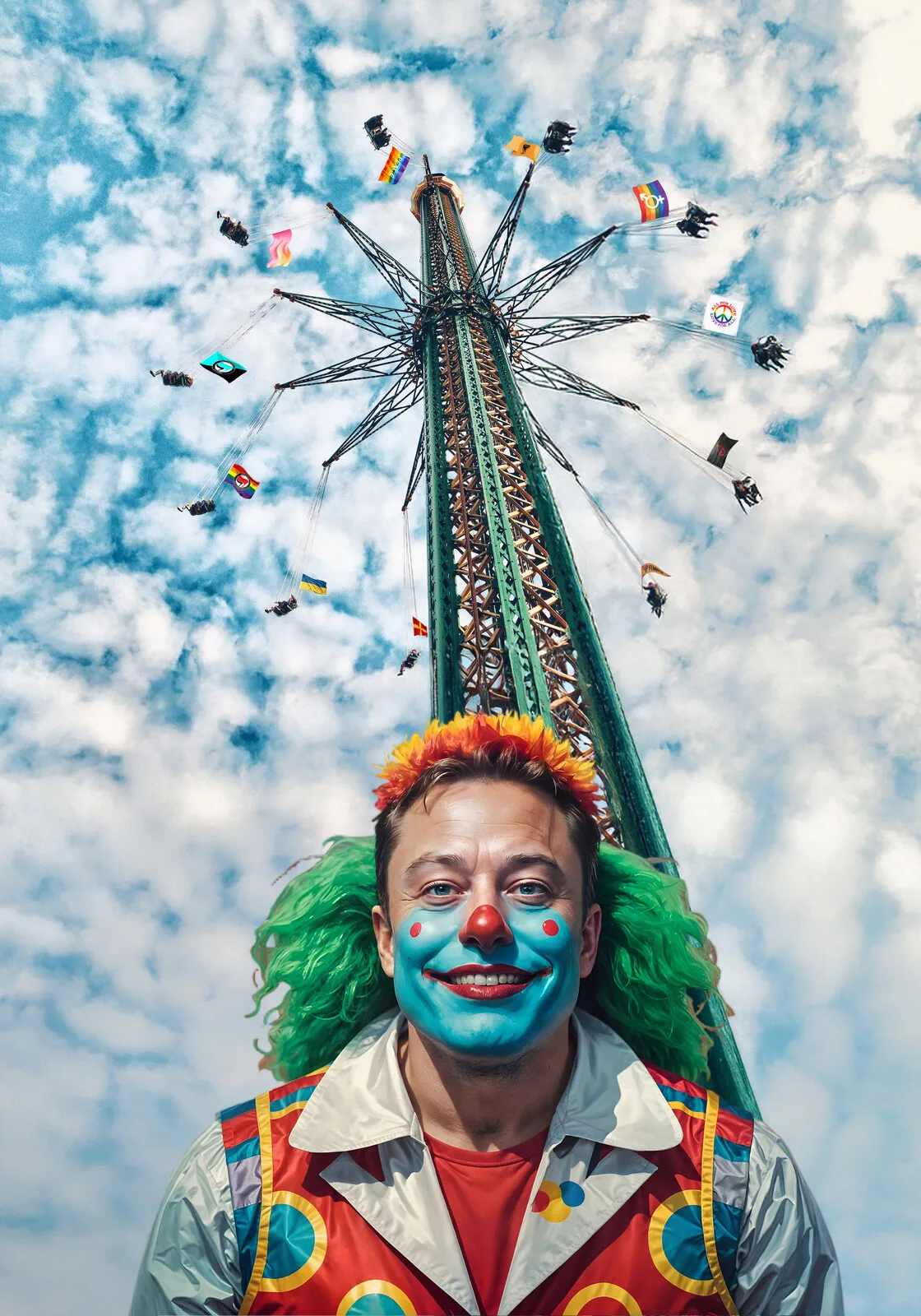
In Musk's Tivoli, Elon is the Clown, 2025
Digital
50 x 70 cm
3 200 kr
In Musk's Tivoli, Elon is the Clown
In Musk's Tivoli, Elon is the Clown
In this metaphorical world of 'Musk's Tivoli ', Elon Musk assumes the role of the Clown. This comparison is not to be taken lightly, as it holds a deeper meaning that we will explore further.
The title metaphorically represents Elon Musk's persona. Tivoli refers to a famous amusement park in Copenhagen known for its lively and entertaining atmosphere and thousands of similar establishments worldwide. This metaphor draws a parallel between Musk's public image and the role of a clown in a circus, highlighting the duality of his character and the impact of his actions.
Elon Musk is one of our time's most influential yet polarising figures. While he has revolutionised industries with Tesla, SpaceX, and Neuralink, his behaviour often strays from the conventional expectations of a corporate leader. His unpredictable and sometimes theatrical public persona, amplified by his social media antics, evokes the image of a trickster—a celebrated and ridiculed figure.
Much like a circus performer, Musk commands attention through ambitious technological advancements or controversial statements. His tendency to challenge norms, take risks, and disrupt traditional industries has earned him admiration and criticism. At times, his actions appear carefully orchestrated, while in other instances, they seem impulsive, reinforcing the notion of a paradoxical character balancing genius and spectacle.
Ultimately, the question remains: Is Elon Musk a visionary disruptor shaping the future, or is he merely a performer entertaining the world with grand gestures and unpredictable moves? Like the classic clown, his presence demands intrigue and scepticism, making it difficult to discern the real person behind the mask.
Stay tuned to see how this dramatic comparison unfolds. Who’s winning and losing—Musk, Mr Trump or all of us? The contrast between their stories, one a tragic figure from Greek mythology, like Prometheus who brought fire to humanity but suffered eternal punishment, and the other a renowned artist is a fascinating journey that will keep you engaged and provide a unique perspective on Elon Musk's persona.
“Who is the Joker?
Drums roll deep, a trumpet’s call,
Lights flare up, the banners tall.
A hush of whispers, breaths held tight,
A march begins, and the stage is bright.
Shadows flicker, masks in place,
Who steps forth to claim this space?
Step right up, take a seat,
Watch the show and feel the heat.
Two jesters dance on the stage,
Masters of chaos, fools of the age.
One with rockets, dreams so grand,
A trickster weaving a digital strand.
Tweets like daggers, words like fire,
Mocking rules, building his empire.
The other stands with fury bright,
A king enthroned in flashing light.
Rallies roar, the crowds ignite,
Truth bends and vanishes into night.
Who’s the Joker? Who’s the clown?
Who will rise, and who falls down?
One plays genius, one plays king,
Yet both make the circus ring.
Laughter echoes, masks conceal,
But what is false, and what is real?
While they jest and while they fight,
We all watch beneath the light.
They pull the strings, they set the stage,
The world is locked inside their cage.
A grand illusion, smoke and screens,
Where power twists and warps our dreams.
So, tell me now, and tell me the truth,
Who’s the Joker? Who fools who?
Are we watching, or just blind?
As the circus leaves us all behind.”
Malmö. January 2025
In Musk's Tivoli, Elon is the Clown
In Musk's Tivoli, Elon is the Clown
The title of my painting tells the story of how Musk marches onto the stage alone to the tune of 'Entrance of the Gladiators', also known as the 'Circus Clown Theme'. This piece gained lasting popularity as a screamer march for circuses and is often used to introduce clowns. It serves a purpose again as I bring forth the greatest and most dangerous clown of all, the super-entrepreneur Elon Musk.
Is Elon Musk ‘The Joker’, an ordinary clown, a visionary, or just the elephant in the china shop? The question is warranted.
Elon Musk, one of our time's most controversial and talked-about entrepreneurs, is a master of unpredictability. He has revolutionised multiple industries through companies like Tesla, SpaceX, and Neuralink, yet his public persona is often described as clownish and unpredictable. His behaviour in public, particularly on social media, reinforces the image of him as a modern trickster—a ridiculed and admired figure, constantly surprising us with his unexpected actions. This unpredictability keeps us engaged and on our toes, always wondering what he will do next.
The Clown Musk – Jokes and Provocation
Musk is known for his humorous and sometimes childish attitude. He tweets about everything from Dogecoin to smoking marijuana on Joe Rogan’s podcast, giving the impression of a billionaire who does not take himself too seriously. His antics may seem harmless, but they often have real market consequences—like when he jokingly announced taking Tesla private at $420 per share, leading to an SEC investigation and fines. Musk's actions, though sometimes controversial, always keep us engaged and on our toes.
The Elephant in the China Shop – Chaos as Strategy
At the same time, Musk’s impulsive and unconventional behaviour can be seen as a disruptive force. He frequently makes statements that create uncertainty for investors, employees, and governments. His leadership style is characterised by rapid decisions and drastic measures, such as when he abruptly fired large portions of Twitter’s workforce after acquiring the platform. For some, this is a sign of a brilliant business strategy where old structures are torn down to make room for innovation. For others, he is a destructive force causing more harm than good.
A Modern Trickster Figure
Musk can be compared to the classical trickster, who challenges established systems through humour, chaos, and unpredictability. Like a digital-age Loki or Joker, he catalyses change and stands outside the rules. His actions are difficult to anticipate, and he seems to thrive as both hero and villain.
Conclusion – A Clown with Power
Elon Musk is both a visionary and a provocateur. His clown-like demeanour hides a sharp business mind, but his unpredictability makes him impossible to categorise. For some, he is a leader of the future; for others, he is an elephant in a china shop, destroying everything in his path. Regardless of one’s perspective, it is clear that Musk, like a classic clown, never ceases to surprise.
Of course, the problem is that while a circus clown can at most frighten small children, Elon Musk, in his clown role, can cause considerable damage. His political U-turn from being critical of Mr. Trump to portraying himself as his closest ally is strikingly opportunistic.
From Ancient Jesters to Modern Horror Figures
From their earliest forms in Egypt and Babylonia to today’s circus clowns and horror film icons, clowns have always carried a dual nature—beloved and feared. Their role has shifted throughout history, from royal jesters and folk entertainers to modern performers and pop culture symbols of chaos and terror, fascinating and frightening people for thousands of years. Understanding this rich historical context can enlighten us about the enduring fascination with clowns, providing a deeper understanding of their dual nature and the reasons behind our fascination with them.
The First Clowns – Egypt and Babylonia
Clowns can be traced back to ancient Egypt, where certain priests acted as sacred fools, a precursor to the jester. These figures were not merely entertainers but also had a ceremonial role and could mock authority without punishment. In ancient Babylonia, similar figures appeared in religious processions, playing the role of chaos-bringers to reflect the world's unpredictability.
Ancient Greece and Rome – Comedy and Satire
In ancient Greece, clowns took a more defined form through the comedic performances at the Dionysian festivals. Playwrights like Aristophanes used grotesque and burlesque characters with exaggerated masks and clumsy movements to satirise contemporary rulers and morals.
In the Roman Empire, clown roles developed further through mime performances and gladiatorial games, where figures like the popular ‘Stupidus’ imitated and mocked the elite. These clowns often wore colourful costumes and used slapstick-like humour.
Medieval Jesters and Minstrels
During the Middle Ages, the jester became an established figure in royal courts. The jester’s task was to entertain and criticise rulers under the protection of his foolishness. He was often the only one who could speak the truth to the king without facing punishment, demonstrating the power of satire and criticism in a seemingly foolish act. Meanwhile, travelling minstrels and acrobats performed their acts in villages and marketplaces, providing entertainment and social commentary to the ordinary people.
The Modern Clown – The Birth of the Circus
The modern clown began to take shape through Commedia dell’arte in 18th-century Italy. Here, characters like Harlequin and Pierrot emerged—the former quick and cunning, the latter dreamy and melancholic. In the 19th century, the circus clown evolved, with figures like Joseph Grimaldi in England creating a new form of visual comedy with a white-painted face and exaggerated gestures.
20th Century Clowns – From Children's Entertainment to Horror
During the 20th century, clowns became a staple of popular culture through circuses such as Barnum & Bailey and figures like Ronald McDonald, a friendly children's clown used in advertising. At the same time, clowns began to take on a darker form—perhaps because their smiles were permanently frozen, their faces hidden behind makeup. And that you never knew what or who was hiding behind the mask.
Stephen King's novel It (1986) introduced Pennywise, a malevolent clown who embodied people's deepest fears. At the same time, reports of "scary clowns" in real life increased, with individuals dressing up as sinister clowns to terrorise communities.
In 2016, the scary clown phenomenon took hold and spread like wildfire worldwide. It began in the United States, where people dressed as clowns roamed the streets at night, frightening unsuspecting passersby in isolated areas. Several incidents were filmed and shared on social media, sparking a wave of paranoia and fear. The phenomenon quickly spread to Europe, Australia, and other parts of the world, with reports of clowns chasing people with weapons or luring children into danger increasing. Police in several countries warned that such pranks could escalate into violence, and some schools and public places temporarily banned clown costumes.
This global phenomenon highlighted the duality of clowns—figures that can both entertain and instil deep psychological fear. The rise of the horror clown in pop culture, reinforced by films such as It (2017) and Joker, demonstrates how clown symbolism has shifted from a harmless jester to a terrifying entity.
Joker – The Most Dangerous Clown
One of popular culture's most iconic and fearsome clown figures is ‘the Joker’, Batman’s eternal nemesis. Unlike other horror clowns, who primarily aim to frighten or create chaos for fun, the Joker represents pure nihilism and the unpredictability of evil. His laughter and clown makeup conceal a brutal and sadistic agenda, where violence and anarchy are his only goals. Over the years, the Joker has been portrayed in various ways—from a mischievous trickster in early comic books to a dark and psychologically complex character in films such as The Dark Knight (2008) and Joker (2019).
What makes the Joker particularly terrifying is his unpredictability. He is not just a deranged clown—he is an intelligent and manipulative villain who challenges the moral fabric of society. He follows no rules and has no motive other than to spread chaos, making him one of the most frightening clown figures in modern times.
Joker's Predecessors – The Dark Trickster Figures
The Joker is not the first character in cultural history to combine humour and malevolence. Several predecessors share his traits of chaos, manipulative intelligence, and a profoundly cynical worldview.
Loki – The Nordic Trickster
In Norse mythology, Loki is a complex figure who aids and deceives the gods. He is a master of spreading chaos and confusion, often through humour and deception. While he occasionally helps the gods, his actions are usually self-serving and lead to destruction, particularly during Ragnarök. His unpredictability and delight in causing harm are reminiscent of the Joker's nihilistic nature.
The Comedian – The Cynical Mass Murderer
In Alan Moore's graphic novel Watchmen (1986), we meet The Comedian, a violent and nihilistic character who views society’s corruption as a dark joke. His cynical perspective on power and morality mirrors the Joker’s philosophy—that the world is an absurd farce where rules are meaningless. The Comedian laughs at humanity’s failures, just as the Joker does.
John Wayne Gacy – The Real-Life Horror Clown
In the 1970s, John Wayne Gacy became infamous as one of the most notorious serial killers in U.S. history. He often performed as a clown at children's parties under the name "Pogo the Clown" while secretly kidnapping and murdering young men. Gacy’s double life, where he outwardly appeared as a friendly clown but was a brutal murderer, inspired many modern horror clowns, including the Joker.
Pagliacci – The Tragic and Dangerous Clown
In Ruggero Leoncavallo's opera Pagliacci (1892), we encounter Canio, an actor in a clown role who gradually loses his grip on reality. His internal sorrow and jealousy drive him to murder a tragic performance where the line between theatre and reality blurs. Like the Joker, he hides his pain and rage behind clown makeup and laughter.
The Duality of the Clown – A Mask of Laughter and Pain
The clown is often a dualistic figure. Behind the mask often lies a person with depth and a pessimistic view of society. Many of the most iconic clown figures, from the Joker to Pagliacci, the balance between humour and tragedy, joy and nihilism. This complexity ensures that clowns continue to fascinate and terrify, as we can never be entirely sure what lies behind the painted smile.
These figures illustrate that the concept of a laughing, malevolent trickster is deeply embedded in human culture. The Joker is a modern interpretation of an archetype that has frightened and intrigued us for centuries.
The Clown Today – A Paradox
Today, clowns exist in many forms. In circuses and children's entertainment, friendly clowns persist, while horror clowns such as Pennywise and the Joker continue to captivate and frighten. Some see clowns as joyful entertainers, while others view them as unsettling figures hiding something sinister beneath their makeup. Whether kind, dangerous, quick, or clumsy, clowns remain one of humanity’s most multifaceted and enduring cultural icons.
Jörgen Thornberg
In Musk's Tivoli, Elon is the Clown, 2025
Digital
50 x 70 cm
3 200 kr
In Musk's Tivoli, Elon is the Clown
In Musk's Tivoli, Elon is the Clown
In this metaphorical world of 'Musk's Tivoli ', Elon Musk assumes the role of the Clown. This comparison is not to be taken lightly, as it holds a deeper meaning that we will explore further.
The title metaphorically represents Elon Musk's persona. Tivoli refers to a famous amusement park in Copenhagen known for its lively and entertaining atmosphere and thousands of similar establishments worldwide. This metaphor draws a parallel between Musk's public image and the role of a clown in a circus, highlighting the duality of his character and the impact of his actions.
Elon Musk is one of our time's most influential yet polarising figures. While he has revolutionised industries with Tesla, SpaceX, and Neuralink, his behaviour often strays from the conventional expectations of a corporate leader. His unpredictable and sometimes theatrical public persona, amplified by his social media antics, evokes the image of a trickster—a celebrated and ridiculed figure.
Much like a circus performer, Musk commands attention through ambitious technological advancements or controversial statements. His tendency to challenge norms, take risks, and disrupt traditional industries has earned him admiration and criticism. At times, his actions appear carefully orchestrated, while in other instances, they seem impulsive, reinforcing the notion of a paradoxical character balancing genius and spectacle.
Ultimately, the question remains: Is Elon Musk a visionary disruptor shaping the future, or is he merely a performer entertaining the world with grand gestures and unpredictable moves? Like the classic clown, his presence demands intrigue and scepticism, making it difficult to discern the real person behind the mask.
Stay tuned to see how this dramatic comparison unfolds. Who’s winning and losing—Musk, Mr Trump or all of us? The contrast between their stories, one a tragic figure from Greek mythology, like Prometheus who brought fire to humanity but suffered eternal punishment, and the other a renowned artist is a fascinating journey that will keep you engaged and provide a unique perspective on Elon Musk's persona.
“Who is the Joker?
Drums roll deep, a trumpet’s call,
Lights flare up, the banners tall.
A hush of whispers, breaths held tight,
A march begins, and the stage is bright.
Shadows flicker, masks in place,
Who steps forth to claim this space?
Step right up, take a seat,
Watch the show and feel the heat.
Two jesters dance on the stage,
Masters of chaos, fools of the age.
One with rockets, dreams so grand,
A trickster weaving a digital strand.
Tweets like daggers, words like fire,
Mocking rules, building his empire.
The other stands with fury bright,
A king enthroned in flashing light.
Rallies roar, the crowds ignite,
Truth bends and vanishes into night.
Who’s the Joker? Who’s the clown?
Who will rise, and who falls down?
One plays genius, one plays king,
Yet both make the circus ring.
Laughter echoes, masks conceal,
But what is false, and what is real?
While they jest and while they fight,
We all watch beneath the light.
They pull the strings, they set the stage,
The world is locked inside their cage.
A grand illusion, smoke and screens,
Where power twists and warps our dreams.
So, tell me now, and tell me the truth,
Who’s the Joker? Who fools who?
Are we watching, or just blind?
As the circus leaves us all behind.”
Malmö. January 2025
In Musk's Tivoli, Elon is the Clown
In Musk's Tivoli, Elon is the Clown
The title of my painting tells the story of how Musk marches onto the stage alone to the tune of 'Entrance of the Gladiators', also known as the 'Circus Clown Theme'. This piece gained lasting popularity as a screamer march for circuses and is often used to introduce clowns. It serves a purpose again as I bring forth the greatest and most dangerous clown of all, the super-entrepreneur Elon Musk.
Is Elon Musk ‘The Joker’, an ordinary clown, a visionary, or just the elephant in the china shop? The question is warranted.
Elon Musk, one of our time's most controversial and talked-about entrepreneurs, is a master of unpredictability. He has revolutionised multiple industries through companies like Tesla, SpaceX, and Neuralink, yet his public persona is often described as clownish and unpredictable. His behaviour in public, particularly on social media, reinforces the image of him as a modern trickster—a ridiculed and admired figure, constantly surprising us with his unexpected actions. This unpredictability keeps us engaged and on our toes, always wondering what he will do next.
The Clown Musk – Jokes and Provocation
Musk is known for his humorous and sometimes childish attitude. He tweets about everything from Dogecoin to smoking marijuana on Joe Rogan’s podcast, giving the impression of a billionaire who does not take himself too seriously. His antics may seem harmless, but they often have real market consequences—like when he jokingly announced taking Tesla private at $420 per share, leading to an SEC investigation and fines. Musk's actions, though sometimes controversial, always keep us engaged and on our toes.
The Elephant in the China Shop – Chaos as Strategy
At the same time, Musk’s impulsive and unconventional behaviour can be seen as a disruptive force. He frequently makes statements that create uncertainty for investors, employees, and governments. His leadership style is characterised by rapid decisions and drastic measures, such as when he abruptly fired large portions of Twitter’s workforce after acquiring the platform. For some, this is a sign of a brilliant business strategy where old structures are torn down to make room for innovation. For others, he is a destructive force causing more harm than good.
A Modern Trickster Figure
Musk can be compared to the classical trickster, who challenges established systems through humour, chaos, and unpredictability. Like a digital-age Loki or Joker, he catalyses change and stands outside the rules. His actions are difficult to anticipate, and he seems to thrive as both hero and villain.
Conclusion – A Clown with Power
Elon Musk is both a visionary and a provocateur. His clown-like demeanour hides a sharp business mind, but his unpredictability makes him impossible to categorise. For some, he is a leader of the future; for others, he is an elephant in a china shop, destroying everything in his path. Regardless of one’s perspective, it is clear that Musk, like a classic clown, never ceases to surprise.
Of course, the problem is that while a circus clown can at most frighten small children, Elon Musk, in his clown role, can cause considerable damage. His political U-turn from being critical of Mr. Trump to portraying himself as his closest ally is strikingly opportunistic.
From Ancient Jesters to Modern Horror Figures
From their earliest forms in Egypt and Babylonia to today’s circus clowns and horror film icons, clowns have always carried a dual nature—beloved and feared. Their role has shifted throughout history, from royal jesters and folk entertainers to modern performers and pop culture symbols of chaos and terror, fascinating and frightening people for thousands of years. Understanding this rich historical context can enlighten us about the enduring fascination with clowns, providing a deeper understanding of their dual nature and the reasons behind our fascination with them.
The First Clowns – Egypt and Babylonia
Clowns can be traced back to ancient Egypt, where certain priests acted as sacred fools, a precursor to the jester. These figures were not merely entertainers but also had a ceremonial role and could mock authority without punishment. In ancient Babylonia, similar figures appeared in religious processions, playing the role of chaos-bringers to reflect the world's unpredictability.
Ancient Greece and Rome – Comedy and Satire
In ancient Greece, clowns took a more defined form through the comedic performances at the Dionysian festivals. Playwrights like Aristophanes used grotesque and burlesque characters with exaggerated masks and clumsy movements to satirise contemporary rulers and morals.
In the Roman Empire, clown roles developed further through mime performances and gladiatorial games, where figures like the popular ‘Stupidus’ imitated and mocked the elite. These clowns often wore colourful costumes and used slapstick-like humour.
Medieval Jesters and Minstrels
During the Middle Ages, the jester became an established figure in royal courts. The jester’s task was to entertain and criticise rulers under the protection of his foolishness. He was often the only one who could speak the truth to the king without facing punishment, demonstrating the power of satire and criticism in a seemingly foolish act. Meanwhile, travelling minstrels and acrobats performed their acts in villages and marketplaces, providing entertainment and social commentary to the ordinary people.
The Modern Clown – The Birth of the Circus
The modern clown began to take shape through Commedia dell’arte in 18th-century Italy. Here, characters like Harlequin and Pierrot emerged—the former quick and cunning, the latter dreamy and melancholic. In the 19th century, the circus clown evolved, with figures like Joseph Grimaldi in England creating a new form of visual comedy with a white-painted face and exaggerated gestures.
20th Century Clowns – From Children's Entertainment to Horror
During the 20th century, clowns became a staple of popular culture through circuses such as Barnum & Bailey and figures like Ronald McDonald, a friendly children's clown used in advertising. At the same time, clowns began to take on a darker form—perhaps because their smiles were permanently frozen, their faces hidden behind makeup. And that you never knew what or who was hiding behind the mask.
Stephen King's novel It (1986) introduced Pennywise, a malevolent clown who embodied people's deepest fears. At the same time, reports of "scary clowns" in real life increased, with individuals dressing up as sinister clowns to terrorise communities.
In 2016, the scary clown phenomenon took hold and spread like wildfire worldwide. It began in the United States, where people dressed as clowns roamed the streets at night, frightening unsuspecting passersby in isolated areas. Several incidents were filmed and shared on social media, sparking a wave of paranoia and fear. The phenomenon quickly spread to Europe, Australia, and other parts of the world, with reports of clowns chasing people with weapons or luring children into danger increasing. Police in several countries warned that such pranks could escalate into violence, and some schools and public places temporarily banned clown costumes.
This global phenomenon highlighted the duality of clowns—figures that can both entertain and instil deep psychological fear. The rise of the horror clown in pop culture, reinforced by films such as It (2017) and Joker, demonstrates how clown symbolism has shifted from a harmless jester to a terrifying entity.
Joker – The Most Dangerous Clown
One of popular culture's most iconic and fearsome clown figures is ‘the Joker’, Batman’s eternal nemesis. Unlike other horror clowns, who primarily aim to frighten or create chaos for fun, the Joker represents pure nihilism and the unpredictability of evil. His laughter and clown makeup conceal a brutal and sadistic agenda, where violence and anarchy are his only goals. Over the years, the Joker has been portrayed in various ways—from a mischievous trickster in early comic books to a dark and psychologically complex character in films such as The Dark Knight (2008) and Joker (2019).
What makes the Joker particularly terrifying is his unpredictability. He is not just a deranged clown—he is an intelligent and manipulative villain who challenges the moral fabric of society. He follows no rules and has no motive other than to spread chaos, making him one of the most frightening clown figures in modern times.
Joker's Predecessors – The Dark Trickster Figures
The Joker is not the first character in cultural history to combine humour and malevolence. Several predecessors share his traits of chaos, manipulative intelligence, and a profoundly cynical worldview.
Loki – The Nordic Trickster
In Norse mythology, Loki is a complex figure who aids and deceives the gods. He is a master of spreading chaos and confusion, often through humour and deception. While he occasionally helps the gods, his actions are usually self-serving and lead to destruction, particularly during Ragnarök. His unpredictability and delight in causing harm are reminiscent of the Joker's nihilistic nature.
The Comedian – The Cynical Mass Murderer
In Alan Moore's graphic novel Watchmen (1986), we meet The Comedian, a violent and nihilistic character who views society’s corruption as a dark joke. His cynical perspective on power and morality mirrors the Joker’s philosophy—that the world is an absurd farce where rules are meaningless. The Comedian laughs at humanity’s failures, just as the Joker does.
John Wayne Gacy – The Real-Life Horror Clown
In the 1970s, John Wayne Gacy became infamous as one of the most notorious serial killers in U.S. history. He often performed as a clown at children's parties under the name "Pogo the Clown" while secretly kidnapping and murdering young men. Gacy’s double life, where he outwardly appeared as a friendly clown but was a brutal murderer, inspired many modern horror clowns, including the Joker.
Pagliacci – The Tragic and Dangerous Clown
In Ruggero Leoncavallo's opera Pagliacci (1892), we encounter Canio, an actor in a clown role who gradually loses his grip on reality. His internal sorrow and jealousy drive him to murder a tragic performance where the line between theatre and reality blurs. Like the Joker, he hides his pain and rage behind clown makeup and laughter.
The Duality of the Clown – A Mask of Laughter and Pain
The clown is often a dualistic figure. Behind the mask often lies a person with depth and a pessimistic view of society. Many of the most iconic clown figures, from the Joker to Pagliacci, the balance between humour and tragedy, joy and nihilism. This complexity ensures that clowns continue to fascinate and terrify, as we can never be entirely sure what lies behind the painted smile.
These figures illustrate that the concept of a laughing, malevolent trickster is deeply embedded in human culture. The Joker is a modern interpretation of an archetype that has frightened and intrigued us for centuries.
The Clown Today – A Paradox
Today, clowns exist in many forms. In circuses and children's entertainment, friendly clowns persist, while horror clowns such as Pennywise and the Joker continue to captivate and frighten. Some see clowns as joyful entertainers, while others view them as unsettling figures hiding something sinister beneath their makeup. Whether kind, dangerous, quick, or clumsy, clowns remain one of humanity’s most multifaceted and enduring cultural icons.
3 200 kr

Jörgen Thornberg
Malmö
Lite om bilder och mig. Translation in English at the end.
Jag är en nyfiken person som ser allt i bilder, även det jag fäster i ord, gärna tillsammans för bakom alla mina bilder finns en berättelse. Till vissa bilder hör en kortare eller längre novell som följer med bilden.
Bilder berättar historier. Jag omges av naturlig skönhet, intressanta människor och historia var jag än går. Jag använder min kamera för att dokumentera världen och blanda det jag ser med vad jag känner för att fånga den dolda magin.
Mina bilder berättar mina historier. Genom mina bilder, tryck och berättelser. Jag bjuder in dig att ta del av dessa berättelser, in i ditt liv och hem och dela min mycket personliga syn på vår värld. Mer än vad ögat ser. Jag tänker i bilder, drömmer och skriver och pratar om dem; följaktligen måste jag också skapa bilder. De blir vad jag ser, inte nödvändigtvis begränsade till verkligheten. Det finns en bild runt varje hörn. Jag hoppas att du kommer att se vad jag såg och gilla det.
Jag är också en skrivande person och till många bilder hör en kortare eller längre essay. Den följer med tavlan, tryckt på fint papper och med en personlig hälsning från mig.
Flertalet bilder startar sin resa i min kamera. Enkelt förklarat beskriver jag bilden jag ser i mitt inre, upplevd eller fantiserad. Bilden uppstår inom mig redan innan jag fått okularet till ögat. På bråkdelen av ett ögonblick ser jag vad jag vill ha och vad som kan göras med bilden. Här skall jag stoppa in en giraff, stålmannen, Titanic eller vad det är min fantasi finner ut. Ännu märkligare är att jag kommer ihåg minnesbilden långt efteråt när det blir tid att skapa verket. Om jag lyckas eller inte, är upp till betraktaren, oftast präglat av en stråk av svart humor – meningen är att man skall bli underhållen. Mina bilder blir ofta en snackis där de hänger.
Jag föredrar bilder som förmedlar ett budskap i flera lager. Vid första anblicken fylld av feel-good, en vacker utsikt, fint väder, solen skiner, blommor på ängen eller vattnet som ligger förrädiskt spegelblankt. I en sådan bild kan jag gömma min egentliga berättelse, mitt förakt för förtryckare och våldsverkare, rasister och fördomsfulla människor - ett gärna återkommande motiv mer eller mindre dolt i det vackra motivet. Jag försöker förena dem i ett gemensamt narrativ.
Bild och formgivning har löpt som en röd tråd genom livet. Fotokonst känns som en värdig final som jag gärna delar med mig.
Min genre är vid som framgår av mina bilder, temat en blandning av pop- och gatukonst i kollage som kan bestå av hundratals lager. Vissa bilder kan ta veckor, andra någon dag innan det är dags att överlämna resultatet till printverkstaden. Fine Art Prints är digitala fotocollage. I dessa kollage sker rivandet, klippandet, pusslandet, målandet, ritandet och sprayningen digitalt. Det jag monterar in kan vara hundratals år gamla bilder som jag omsorgsfullt frilägger så att de ser ut att vara en del av tavlan men också bilder skapade av mig själv efter min egen fantasi. Därefter besöks printstudion och för vissa bilder numrera en limiterad upplaga (oftast 7 exemplar) och signera för hand. Vissa bilder kan köpas i olika format. Det är bara att fråga efter vilka. Gillar man en bild som är 70x100 men inte har plats på väggen, går den kanske att få i 50x70 cm istället. Frågan är fri.
Metoden Giclée eller Fine Art Print som det också kallas är det moderna sättet för framställning av grafisk konst. Villkoret för denna typ av utskrifter är att en högkvalitativ storformatskrivare används med åldersbeständigt färgpigment och konstnärspapper eller i förekommande fall på duk. Pappret som används möter de krav på livslängd som ställs av museer och gallerier. Normalt säljer jag mina bilder oinramade så att den nya ägaren själv kan bestämma hur de skall se ut, med eller utan passepartout färg på ram, med eller utan glas etc..
Under många år ställde jag bara ut på nätet, i valda grupper och på min egen Facebooksida - https://www.facebook.com/jorgen.thornberg.9
Jag finns också på en egen hemsida som tyvärr inte alltid är uppdaterad – https://www.jth.life/ Där kan du också läsa en del av de berättelser som följer med bilden.
UTSTÄLLNINGAR
Luftkastellet, oktober 2022
Konst i Lund, november 2022
Luftkastellet, mars 2023
Engleson Galleri Caroli, april 2023
Hydra, Greece June 2023
Engleson Galleri Caroli, oktober 2023
Toppen, Höllviken december 2023
Luftkastellet, mars 2024
Torups Galleri, mars 2024
Venice, May 2024
Luftkastellet, oktober 2024
Konst i Advent, December 2024
Galleri Engleson, Caroli December 2024
Jäger & Jansson Galleri, april 2025
A bit about pictures and me.
I'm a curious person who sees everything in pictures, even what I express in words, often combining them, for behind all my pictures lies a story. These narratives, some as short as a single image and others as long as a novel, are the heart and soul of my work.
Pictures tell stories. Wherever I go, I'm surrounded by natural beauty, exciting people, and history. I use my camera to document the world and blend what I see with what I feel to capture the hidden magic.
My images tell my stories. Through my pictures, prints, and narratives, I invite you to partake in these stories in your life and home and share my deeply personal perspective of our world. More than meets the eye. I think in pictures, dream, write, and talk about them; consequently, I must create images too. They become what I see, not necessarily confined to reality. There's a picture around every corner. I hope you'll see what I saw and enjoy it.
I'm also a writer, and many images come with a shorter or longer essay. It accompanies the painting, printed on fine paper with my personal greeting.
Many pictures start their journey on my camera. Simply put, I describe the image I see in my mind, experienced or imagined. The image arises within me even before I bring the eyepiece to my eye. In a fraction of a moment, I see what I want and what can be done with the picture. Here, I'll insert a giraffe, Superman, the Titanic, or whatever my imagination conjures up. Even stranger is that I remember the mental image long after it's time to create the work. Whether I succeed is up to the observer, often imbued with a streak of black humour – the aim is to entertain. My pictures usually become a talking point wherever they hang.
I prefer pictures that convey a message in multiple layers. At first glance, they're filled with feel-good vibes, a beautiful view, lovely weather, the sun shining, flowers in the meadow, or the water lying deceptively calm. But beneath this surface beauty, I often conceal a deeper story, a narrative that challenges societal norms or explores the human condition. I invite you to delve into these hidden narratives and discover the layers of meaning within my work.
Picture and design have been a thread running through my life. Photographic art feels like a fitting finale, and I'm happy to share it.
My genre is varied, as seen in my pictures; the theme is a blend of pop and street art in collages that can consist of hundreds of layers. Some images can take weeks, others just a day before it's time to hand over the result to the print workshop. Fine Art Prints are digital photo collages. In these collages, tearing, cutting, puzzling, painting, drawing, and spraying happen digitally. What I insert can be images hundreds of years old that I carefully extract so they appear to be part of the painting, but also images created by myself, now also generated from my imagination. Next, visit the print studio and, for certain images, number a limited edition (usually 7 copies) and sign them by hand. Some images may be available in other formats. Just ask which ones. If you like an image that's 70x100 but doesn't have space on the wall, you might be able to get it in 50x70 cm instead. The question is open.
The Giclée method, or Fine Art Print as it's also called, is the modern way of producing graphic art. This method ensures the highest quality and longevity of the artwork, using a high-quality large-format printer with archival pigment inks and artist paper or, in some cases, canvas. The paper used meets the longevity requirements set by museums and galleries. I sell my pictures unframed, allowing the new owner to personalise their artwork, confident in the lasting value and quality of the piece.
For many years, I only exhibited online, in selected groups, and on my Facebook page - https://www.facebook.com/jorgen.thornberg.9. I also have my website, which unfortunately is not constantly updated - https://www.jth.life/. You can also read some of the stories accompanying the pictures there.
EXHIBITIONS
Luftkastellet, October 2022
Art in Lund, November 2022
Luftkastellet, March 2023
Engleson Gallery Caroli, April 2023
Hydra, Greece June 2023
Engleson Gallery Caroli, October 2023
Toppen, Höllviken December 2023
Luftkastellet, March 2024
Torup Gallery, March 2024
Venice, May 2024
UTSTÄLLNINGAR
Luftkastellet, oktober 2022
Konst i Lund, november 2022
Luftkastellet, mars 2023
Engleson Galleri Caroli, april 2023
Hydra, Greece June 2023
Engleson Galleri Caroli, oktober 2023
Toppen, Höllviken december 2023
Luftkastellet, mars 2024
Torups Galleri, mars 2024
Venice, May 2024
Luftkastellet, October 2024
Konst i Advent, December 2024
Galleri Engleson, Caroli December 2024
Jäger & Jansson Galleri, April 2025
Utbildning
Autodidakt
Medlem i konstnärsförening
Öppna Sinnen
Med i konstrunda
Konstrundan i Skåne
Utställningar
Luftkastellet, October 2022
Art in Lund, November 2022
Luftkastellet, March 2023
Engleson Gallery Caroli, April 2023
Hydra, Greece June 2023
Engleson Gallery Caroli, October 2023
Toppen, Höllviken December 2023
Luftkastellet, March 2024
Torup Gallery, March 2024
Venice, May 2024