Vi använder cookies för att ge dig bästa möjliga upplevelse. Välj vilka cookies du tillåter.
Läs mer i vår integritetspolicy
Jörgen Thornberg
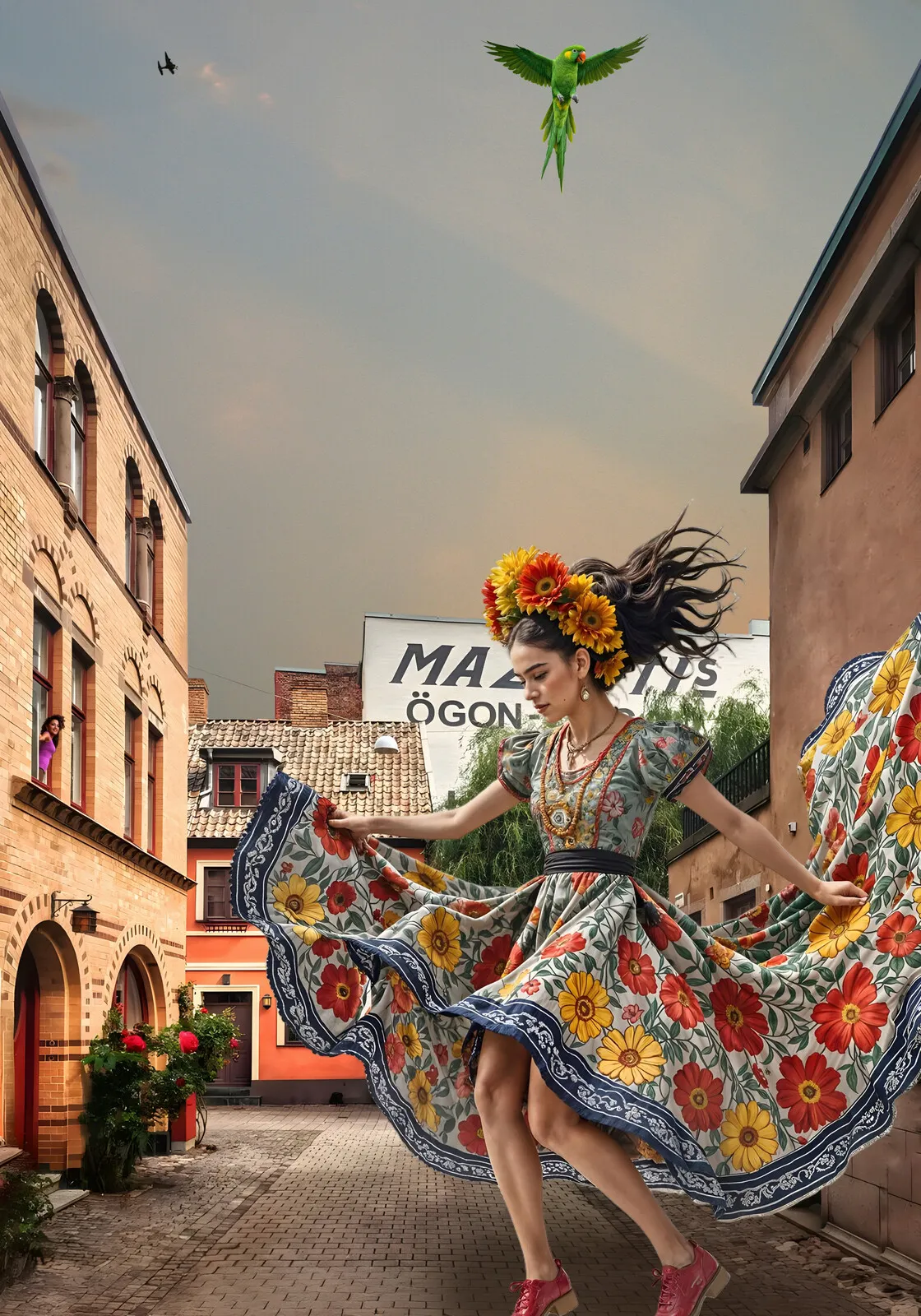
Dancing Feet, 2025
Digital
50 x 70 cm
3 200 kr
Dancing Feet
Dancing Feet
A chance encounter, a song in the air, and a rhythm too infectious to resist. Frida twirled through the streets of Malmö, her feet guided by a Brazilian Choro drifting from above. A parrot fluttered, a stranger watched in wonder, and soon, laughter and stories filled the night. What began as a dance became an evening of shared history, delicious food, and the ever-present spirit of Carmen Miranda, whose fruit-laden crown remained as steadfast as the beats that carried them all together.
Read on to explore Frida's Choro and get the recipe for a Chilean stew.
‘‘Frida’s Choro
On cobbled streets in Malmö’s old town,
Frida twirled in her flowing gown.
To a Brazilian Choro’s wild embrace,
Her feet spun light with endless grace.
Bonito the parrot soared in sync above,
A green feathered echo of her love.
From a window, Carmen stood amazed,
Enchanted by the dance, she praised.
The rhythm swayed through the sunset air,
A timeless joy beyond compare.
A moment stitched in fate’s design,
Music and movement are all aligned.
And when the final note had played,
Their laughter through the evening swayed.
With Chilean stew and crimson wine,
Two lives entwined, a dance divine.
A night where stories found their place,
In warmth, in rhythm, in time’s embrace.
And far away, yet close in heart,
Carmen Miranda played her part.
On her head, fruits and flowers in a crown,
She danced and twirled, never let them down.
Her hat stayed firm, like fate’s own thread,
A carnival queen in gold and flashing red”
Malmö, January 2025
Dancing Feet
Frida's legs tingled with energy. The music flowing from the window above her awakened old dreams—dreams from when she was so ill that dancing was out of the question, trapped in a specially constructed corset.
Mazetti’s eyes rested on her, though Frida couldn’t possibly know of Mazetti’s eye-branded chocolate, which was no longer in production. Nor could she recognise the commanding gaze of the iconic eyes that had stared at every shopper from grocery store and candy shop shelves for generations.
'Mazetti’s Ögon-Cacao and Chokolad – delicious, strong, healthy' was painted in giant letters on the house gable above her. 'Ögonchoklad', “Eye Chocolate” originated from the characteristic pair of eyes that once adorned cocoa tins and chocolate bars—a symbol that became a design classic and remains well-known today. The Ögonchoklad no longer existed, but it was part of Sweden’s culinary history and a symbol of Swedish design and industrial innovation. "See with your own eyes that you get Mazetti’s eyes," an old advertisement had once declared. The invisible eyes of the mural, of course, could not see Frida’s pirouettes, but a woman on the second floor of the neighbouring house could. That was where the music was coming from, and the young woman gave Frida a thumbs-up for her dancing.
"Imagine that a hundred-and-seventeen-year-old lady can dance well enough to get a thumbs-up from a young woman," Frida thought aloud.
Soon, Frida will learn more about eye-branded chocolate.
She sang at the top of her lungs as she twirled around the little street, her movements a testament to the resilience that had carried her through her past struggles. Time-travelers don’t have wings either, for they are no angels—those exist only in the Bible and people’s imaginations. And yet, in eternity, one can defy the laws of nature and move as if gravity did not exist. That was what Frida had dreamed of when, in life, she had struggled forward on earth in her corset. The lyrics emerged spontaneously from nowhere, barely rhyming with the music above, but they came straight from the heart:
“I wish upon my star I had a Mazetti,
The eyes were once a tasty confetti
In every mouth and nothing petty
Chocolate eaten on a cinema settee,
Or by the sea on a golden jetty.
Listening to tunes of Donizetti,
Lost among the stars like SETI
Together with a sexy straight Hetty.
“I love you and the bonbon”, said he
And made me feel like a flirty Betty.”
The music was 'Tico-Tico no Fubá,' sung by Carmen Miranda, the 'Brazilian Bombshell,' known for her signature fruit hat outfit in her American films. The song was a fast and lively Brazilian Choro, popular worldwide, resonating with Frida’s love for Latin American rhythms. It was one of her favourite songs, already known in the 1920s, but the version she remembered best was Carmen Miranda’s 1947 performance in Groucho Marx’s film Copacabana. That was how Frida could dance now, in a way she could only dream of in the 1940s when her corset confined her.
That the song would play in Gamla Väster, Malmö, in 2024 was strange—especially just as Frida happened to pass by. Like so many others unfamiliar with the area, she had relied on her phone’s navigation to find her way. She had come out of Kungsparken near the now-closed casino, and chance had led her down Agnesgatan on her way to Lilla Torg. Perhaps not the most direct route, but she liked the old houses, and when she saw the sign, she understood it was about chocolate, something she adored.
The music had stopped, and Frida halted her dance just as the young woman in the window stepped out of her doorway, curious about who could dance so beautifully. Little did she know, this encounter would lead to an unexpected connection with Carmen.
"Excuse me," Carmen said, tilting her head. "That was quite the performance. You move as if you've danced to this song forever." Frida's eyes lit up, realizing that they shared a deep love for the same song, a bond that would bring them closer.
Frida laughed, slightly out of breath. "In a way, I have. This song is special to me. It takes me back to another time."
"Would you like to come up for a cup of coffee?" Carmen asked. "I feel like we have a lot to talk about."
Frida nodded. "Women always do."
Inside, Carmen suddenly felt self-conscious. "I should apologise for my outfit," she said, tugging at her soft pink sweater. "I wasn’t expecting to meet someone so beautifully dressed. Your dress is stunning."
Frida twirled slightly, making the fabric of her Tehuana-inspired dress flare. "Thank you. I dress not just for myself but for those who came before me. Clothes carry stories, don’t they?"
Carmen smiled. "They do. Mine mostly says that I prioritise comfort at home." Carmen ground the coffee and poured it into the espresso machine, which soon sputtered and hissed.
They sat down with their coffee, the scent of roasted beans filling the air.
Carmen was the granddaughter of a couple who had fled Chile in 1973 and settled in Sweden. Her mother was born the same year the military junta took power, and she was able to grow up in a country of freedom. Being a second-generation immigrant had its challenges—not looking like the others, having darker skin, dark hair, and brown eyes in a country where the ideal woman was blonde with blue eyes. However, since her grandfather was an engineer, they quickly integrated into Swedish society and had good financial stability, so Miranda’s start in life was almost like any other Swedish child’s. Miranda followed her mother’s example and chose a healthcare career. Her mother was an ophthalmologist, and Miranda had just completed her training and was working as an intern at MAS, Malmö’s large hospital, soon to receive her medical license.
"I work as a doctor," Carmen said, stirring her cup. "An intern at MAS. Long shifts, little sleep, but I love it. What about you?"
Frida leaned back, letting the warmth of the coffee seep into her hands. "I’m both an actress and an artist. Right now, I perform at Nöjesteatern. I try to bring art and history to life, particularly through the legacy of Frida Kahlo."
Carmen’s eyes widened. "You work in her spirit? That’s incredible. I’ve admired her work for years."
They discussed their shared idol, Carmen Miranda—her famous fruit hat, her films, and her too-early death.
‘Tico-Tico no Fubá,’ which in Brazilian means ‘rufous-collared sparrow in the cornmeal,’ had a history Carmen didn’t fully know, but Frida could explain. It was a Brazilian choro song written by Zequinha de Abreu in 1917, though it received its final name much later. Its original title was ‘Tico-Tico no Farelo’ (sparrow in the bran), but since Brazilian guitarist Américo Jacomino "Canhoto" (1889–1928) had a piece with the same title, Abreu’s work was renamed in 1931. Later, Aloysio de Oliveira wrote the original Portuguese lyrics. Frida explained that Frida Kahlo adored the song, which reached popularity in the 1940s with successful recordings by Carmen Miranda and others.
They continued their conversation, exploring topics such as Frida’s performances, Carmen’s days at the hospital, and the profound influence of legacy on personal identity.
"You know," Frida said, "'Tico-Tico no Fubá' means 'rufous-collared sparrow in the cornmeal.' But its name wasn’t always that. It was originally 'Tico-Tico no Farelo,' meaning 'sparrow in the bran.' The name changed in 1931."
Carmen rested her chin on her hand. "I never knew that. You do live through these stories, don’t you?"
"I do," Frida admitted. "And this song—Frida Kahlo loved it. She may not have been able to dance as freely as she wanted, but she found ways to move, even if just with a lifted hand or a smile."
They sat in comfortable silence for a moment before Carmen chuckled. "Speaking of names, do you know where 'Mazetti' comes from? It’s from the Italian word for 'bouquet.' They even had a slogan: 'Killar med sprätt i - gillar Mazetti.'"
Frida grinned. "That rhymes nicely. How would you say it in English?"
Carmen thought for a moment before laughing. "'Guys with go like Mazetti.' Not quite the same charm, though."
Their laughter echoed through the apartment as the night deepened, two women brought together by music, stories, and the serendipity of a song playing at just the right moment.
Frida leaned forward with a playful smile. "But tell me, Carmen, do you know what your namesake was most famous for?"
Carmen furrowed her brow. "Besides the music and films?"
Frida laughed. "Her 'fruit hat'! The iconic headpiece adorned with bananas, pineapples, and other exotic fruits, balanced like a crown on her head."
Carmen shook her head, smiling. "I never really thought about it. I knew she wore colourful outfits, but the hat?"
Frida nodded eagerly. "It was her signature. An explosion of colours and life, just like her energy on stage. She was a living celebration, a Brazilian whirlwind of music and joy."
Carmen leaned back and chuckled. "And here I am, wearing a simple pink sweater. I’m not doing my name justice."
Frida shook her head warmly. "You carry the name with pride in your way. And think about it—I have always worn flowers in my hair, and Carmen Miranda wore fruit. It’s almost as if we are linked through time."
"Carmen’s hat," Frida mused. "That name is misleading. It wasn’t always just fruit. Sometimes, they were elaborate creations of flowers and leaves, like a tropical jungle bursting with colours and vines. Some of her hats were half a meter tall, while others wrapped around her head like a turban. No matter how she danced, those masterpieces always stayed in place."
Carmen then told Frida about what a twenty-seven-year-old does in Malmö—going out dancing with friends, visiting bars, and so on. She hadn’t had much time for boyfriends, just the occasional date.
Carmen took a sip of her coffee and leaned back. "I guess it’s fate that I carry her name. My mother loved Carmen Miranda—not just for her music, but because she was a symbol of joy, a woman who made something of herself in a world that wasn’t always kind to women like her."
Frida nodded. "She was incredible, and her energy was contagious to everyone around her. But it’s also tragic how it ended. She died far too young. Her heart couldn’t take it anymore."
Carmen sighed. "Yes, heart failure at only 46. My mother used to say she burned so brightly that the flame went out too fast. All that pressure, the career, the sleepless nights... and the amphetamines she took to keep up."
Frida gently touched the rim of her cup. "She was a symbol of so much more than just entertainment. Just like Frida Kahlo. The difference was that Carmen Miranda had that cheerful, colourful exterior that everyone loved, while Frida Kahlo wore her suffering openly in her art."
Carmen nodded. "And yet, that’s what made her so great. She transformed pain into something beautiful. When I saw her paintings for the first time, I was overwhelmed. It was as if her soul lived in every brushstroke."
Frida smiled faintly. "She was brave. She painted away the pain, as you said. Or perhaps painted it into something greater. Instead of letting it consume her, she used it as fuel."
Carmen tilted her head, studying Frida. "And interpreting her in your work, you must have lived with her for a long time."
Frida traced her finger along the edge of the table. "For years. At first, it was fascination, a love for her art and life. But the more I explored, the more she became a part of me. I have felt her pain, struggles, strength, and love for life."
"You say it almost as if she’s still here," Carmen said, a slight wrinkle forming on her forehead.
Frida laughed. "In a way, she is. Through her art and the people who continue to be inspired by her. And maybe even through me."
Carmen looked out the window, where dusk had begun to settle over the cobblestone streets of Gamla Väster. "Imagine if Carmen Miranda and Frida Kahlo had met. What conversations they would have had."
Frida smiled. "That would have been something. Maybe they would have danced together. Maybe they would have argued about something silly. But I’m sure they would have understood each other in a way few others could."
Carmen smiled back. "And here we are, two women carrying their names, telling their stories. Do you believe in fate, Frida?"
They talked about dance, a Mexican variation of the one Carmen performed in the film with Groucho Marx. Frida spoke about how Frida Kahlo had dreamed of dancing away all her restless energy but how her metal and plaster corsets and stiff leather straps restricted her movement, making dance steps difficult. She loved music and celebrations and danced by clapping her hands and moving to the rhythm as best she could. In her younger years, she danced much more, especially traditional Mexican dances, but as time passed, she had to limit her movements due to her declining health. Even after the amputation of her leg, sitting in her wheelchair, Frida could still follow the dance with tiny, intense movements—a lifted hand, a turn of the head, a glance, a laugh—living out the same passion as always. Frida could not tell Carmen that she was speaking about herself—Carmen would have thought she was mad. Instead, she said she had lived with Frida Kahlo for years as an artist, an interpreter, and a performer in her legacy.
Frida took a final sip of her coffee and set down the cup with a soft clink. Some meetings are meant to happen. And sometimes, it’s the music that brings us together."
They continued chatting, shifting to what a twenty-seven-year-old woman did in Malmö—dancing with friends, visiting bars, and so on. Relationships? Carmen hadn’t had much time for boyfriends beyond the occasional date.
As the evening stretched, the conversation meandered between their cultural heritage, the magic of old music, and the way fate had brought them together on a quiet street in Malmö. The night air carried the remnants of the lively tune, and for a moment, they both imagined themselves dancing through time—Carmen in the present, Frida in the past, united by rhythm, memory, and a shared love of movement and art.
"Did you see the parrot fluttering around in time with the music? It must belong to a neighbour—I’ve never seen it before. I had no idea they were so musical," Carmen asked.
Frida shook her head. It was hard to explain how Bonito, her Amazon parrot, had flown from a star—which he hadn’t. He had been sitting on her shoulder the entire way through the wormhole that ended in Pildammsparken.
Frida enjoyed speaking about herself in the third person. It gave her a certain distance, which felt right for someone who had lived in the same soul for over a century. It hadn’t been planned, but the coffee gradually became a small supper that Carmen put together. She made Charquicán, a traditional Chilean stew, easy to prepare with whatever she had in the fridge, freezer, and pantry. They shared a bottle of red Casillero del Diablo Carmenère—first one, then another—and the atmosphere was perfect.
A dinner out at Lilla Torg could never have matched this evening, which stretched into the night before Frida finally had to leave, mindful of the morning ahead. The night had given Carmen pieces of her cultural puzzle. Even though they came from different backgrounds, Chilean and Mexican, they had more in common than what set them apart. They were both women, and that was boundless. For Frida, moments like these rejuvenated her soul, borrowing a bit of the younger woman’s fearless spirit. She reflected on that as she walked home through the quiet city.
This recipe is for four people or two women who enjoy a long meal. Carmen could bring the little that remained to the hospital for lunch.
3–4 potatoes (or sweet potatoes)
2 carrots
1 onion
1 garlic clove
1 bell pepper (optional)
1 dl frozen peas or corn (optional)
1 zucchini or pumpkin (if available)
250 g ground beef, chicken, or a can of beans for a vegetarian version
1 tsp cumin
1 tsp paprika powder
Salt & pepper to taste—preferably with a bit of a kick
5 dl broth (or water with a bouillon cube)
1 egg per serving (for topping, optional)
Hus is how Carmen prepares her stew:
Peel and dice the potatoes, carrots, and any other vegetables. Chop the onion and garlic.
Sauté the onion and garlic in a bit of oil until soft. Add ground beef or chicken and brown lightly. If you make a vegetarian version, skip this step and add the beans later.
Add the potatoes, carrots, and bell pepper and fry for a few minutes. Season with cumin, paprika powder, salt, and pepper.
Pour in the broth and let everything simmer for about 20–25 minutes until the vegetables are soft.
Lightly mash the mixture with a fork to give the stew a thicker consistency.
Stir in the frozen peas or corn and let simmer for a few more minutes.
Serve with a fried or poached egg on top for the classic Chilean charquicán experience.
Jörgen Thornberg
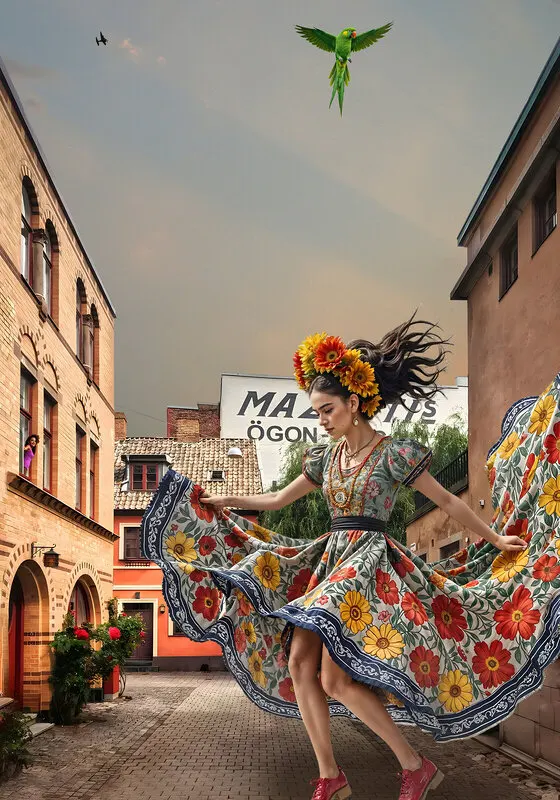
Dancing Feet, 2025
Digital
50 x 70 cm
3 200 kr
Dancing Feet
Dancing Feet
A chance encounter, a song in the air, and a rhythm too infectious to resist. Frida twirled through the streets of Malmö, her feet guided by a Brazilian Choro drifting from above. A parrot fluttered, a stranger watched in wonder, and soon, laughter and stories filled the night. What began as a dance became an evening of shared history, delicious food, and the ever-present spirit of Carmen Miranda, whose fruit-laden crown remained as steadfast as the beats that carried them all together.
Read on to explore Frida's Choro and get the recipe for a Chilean stew.
‘‘Frida’s Choro
On cobbled streets in Malmö’s old town,
Frida twirled in her flowing gown.
To a Brazilian Choro’s wild embrace,
Her feet spun light with endless grace.
Bonito the parrot soared in sync above,
A green feathered echo of her love.
From a window, Carmen stood amazed,
Enchanted by the dance, she praised.
The rhythm swayed through the sunset air,
A timeless joy beyond compare.
A moment stitched in fate’s design,
Music and movement are all aligned.
And when the final note had played,
Their laughter through the evening swayed.
With Chilean stew and crimson wine,
Two lives entwined, a dance divine.
A night where stories found their place,
In warmth, in rhythm, in time’s embrace.
And far away, yet close in heart,
Carmen Miranda played her part.
On her head, fruits and flowers in a crown,
She danced and twirled, never let them down.
Her hat stayed firm, like fate’s own thread,
A carnival queen in gold and flashing red”
Malmö, January 2025
Dancing Feet
Frida's legs tingled with energy. The music flowing from the window above her awakened old dreams—dreams from when she was so ill that dancing was out of the question, trapped in a specially constructed corset.
Mazetti’s eyes rested on her, though Frida couldn’t possibly know of Mazetti’s eye-branded chocolate, which was no longer in production. Nor could she recognise the commanding gaze of the iconic eyes that had stared at every shopper from grocery store and candy shop shelves for generations.
'Mazetti’s Ögon-Cacao and Chokolad – delicious, strong, healthy' was painted in giant letters on the house gable above her. 'Ögonchoklad', “Eye Chocolate” originated from the characteristic pair of eyes that once adorned cocoa tins and chocolate bars—a symbol that became a design classic and remains well-known today. The Ögonchoklad no longer existed, but it was part of Sweden’s culinary history and a symbol of Swedish design and industrial innovation. "See with your own eyes that you get Mazetti’s eyes," an old advertisement had once declared. The invisible eyes of the mural, of course, could not see Frida’s pirouettes, but a woman on the second floor of the neighbouring house could. That was where the music was coming from, and the young woman gave Frida a thumbs-up for her dancing.
"Imagine that a hundred-and-seventeen-year-old lady can dance well enough to get a thumbs-up from a young woman," Frida thought aloud.
Soon, Frida will learn more about eye-branded chocolate.
She sang at the top of her lungs as she twirled around the little street, her movements a testament to the resilience that had carried her through her past struggles. Time-travelers don’t have wings either, for they are no angels—those exist only in the Bible and people’s imaginations. And yet, in eternity, one can defy the laws of nature and move as if gravity did not exist. That was what Frida had dreamed of when, in life, she had struggled forward on earth in her corset. The lyrics emerged spontaneously from nowhere, barely rhyming with the music above, but they came straight from the heart:
“I wish upon my star I had a Mazetti,
The eyes were once a tasty confetti
In every mouth and nothing petty
Chocolate eaten on a cinema settee,
Or by the sea on a golden jetty.
Listening to tunes of Donizetti,
Lost among the stars like SETI
Together with a sexy straight Hetty.
“I love you and the bonbon”, said he
And made me feel like a flirty Betty.”
The music was 'Tico-Tico no Fubá,' sung by Carmen Miranda, the 'Brazilian Bombshell,' known for her signature fruit hat outfit in her American films. The song was a fast and lively Brazilian Choro, popular worldwide, resonating with Frida’s love for Latin American rhythms. It was one of her favourite songs, already known in the 1920s, but the version she remembered best was Carmen Miranda’s 1947 performance in Groucho Marx’s film Copacabana. That was how Frida could dance now, in a way she could only dream of in the 1940s when her corset confined her.
That the song would play in Gamla Väster, Malmö, in 2024 was strange—especially just as Frida happened to pass by. Like so many others unfamiliar with the area, she had relied on her phone’s navigation to find her way. She had come out of Kungsparken near the now-closed casino, and chance had led her down Agnesgatan on her way to Lilla Torg. Perhaps not the most direct route, but she liked the old houses, and when she saw the sign, she understood it was about chocolate, something she adored.
The music had stopped, and Frida halted her dance just as the young woman in the window stepped out of her doorway, curious about who could dance so beautifully. Little did she know, this encounter would lead to an unexpected connection with Carmen.
"Excuse me," Carmen said, tilting her head. "That was quite the performance. You move as if you've danced to this song forever." Frida's eyes lit up, realizing that they shared a deep love for the same song, a bond that would bring them closer.
Frida laughed, slightly out of breath. "In a way, I have. This song is special to me. It takes me back to another time."
"Would you like to come up for a cup of coffee?" Carmen asked. "I feel like we have a lot to talk about."
Frida nodded. "Women always do."
Inside, Carmen suddenly felt self-conscious. "I should apologise for my outfit," she said, tugging at her soft pink sweater. "I wasn’t expecting to meet someone so beautifully dressed. Your dress is stunning."
Frida twirled slightly, making the fabric of her Tehuana-inspired dress flare. "Thank you. I dress not just for myself but for those who came before me. Clothes carry stories, don’t they?"
Carmen smiled. "They do. Mine mostly says that I prioritise comfort at home." Carmen ground the coffee and poured it into the espresso machine, which soon sputtered and hissed.
They sat down with their coffee, the scent of roasted beans filling the air.
Carmen was the granddaughter of a couple who had fled Chile in 1973 and settled in Sweden. Her mother was born the same year the military junta took power, and she was able to grow up in a country of freedom. Being a second-generation immigrant had its challenges—not looking like the others, having darker skin, dark hair, and brown eyes in a country where the ideal woman was blonde with blue eyes. However, since her grandfather was an engineer, they quickly integrated into Swedish society and had good financial stability, so Miranda’s start in life was almost like any other Swedish child’s. Miranda followed her mother’s example and chose a healthcare career. Her mother was an ophthalmologist, and Miranda had just completed her training and was working as an intern at MAS, Malmö’s large hospital, soon to receive her medical license.
"I work as a doctor," Carmen said, stirring her cup. "An intern at MAS. Long shifts, little sleep, but I love it. What about you?"
Frida leaned back, letting the warmth of the coffee seep into her hands. "I’m both an actress and an artist. Right now, I perform at Nöjesteatern. I try to bring art and history to life, particularly through the legacy of Frida Kahlo."
Carmen’s eyes widened. "You work in her spirit? That’s incredible. I’ve admired her work for years."
They discussed their shared idol, Carmen Miranda—her famous fruit hat, her films, and her too-early death.
‘Tico-Tico no Fubá,’ which in Brazilian means ‘rufous-collared sparrow in the cornmeal,’ had a history Carmen didn’t fully know, but Frida could explain. It was a Brazilian choro song written by Zequinha de Abreu in 1917, though it received its final name much later. Its original title was ‘Tico-Tico no Farelo’ (sparrow in the bran), but since Brazilian guitarist Américo Jacomino "Canhoto" (1889–1928) had a piece with the same title, Abreu’s work was renamed in 1931. Later, Aloysio de Oliveira wrote the original Portuguese lyrics. Frida explained that Frida Kahlo adored the song, which reached popularity in the 1940s with successful recordings by Carmen Miranda and others.
They continued their conversation, exploring topics such as Frida’s performances, Carmen’s days at the hospital, and the profound influence of legacy on personal identity.
"You know," Frida said, "'Tico-Tico no Fubá' means 'rufous-collared sparrow in the cornmeal.' But its name wasn’t always that. It was originally 'Tico-Tico no Farelo,' meaning 'sparrow in the bran.' The name changed in 1931."
Carmen rested her chin on her hand. "I never knew that. You do live through these stories, don’t you?"
"I do," Frida admitted. "And this song—Frida Kahlo loved it. She may not have been able to dance as freely as she wanted, but she found ways to move, even if just with a lifted hand or a smile."
They sat in comfortable silence for a moment before Carmen chuckled. "Speaking of names, do you know where 'Mazetti' comes from? It’s from the Italian word for 'bouquet.' They even had a slogan: 'Killar med sprätt i - gillar Mazetti.'"
Frida grinned. "That rhymes nicely. How would you say it in English?"
Carmen thought for a moment before laughing. "'Guys with go like Mazetti.' Not quite the same charm, though."
Their laughter echoed through the apartment as the night deepened, two women brought together by music, stories, and the serendipity of a song playing at just the right moment.
Frida leaned forward with a playful smile. "But tell me, Carmen, do you know what your namesake was most famous for?"
Carmen furrowed her brow. "Besides the music and films?"
Frida laughed. "Her 'fruit hat'! The iconic headpiece adorned with bananas, pineapples, and other exotic fruits, balanced like a crown on her head."
Carmen shook her head, smiling. "I never really thought about it. I knew she wore colourful outfits, but the hat?"
Frida nodded eagerly. "It was her signature. An explosion of colours and life, just like her energy on stage. She was a living celebration, a Brazilian whirlwind of music and joy."
Carmen leaned back and chuckled. "And here I am, wearing a simple pink sweater. I’m not doing my name justice."
Frida shook her head warmly. "You carry the name with pride in your way. And think about it—I have always worn flowers in my hair, and Carmen Miranda wore fruit. It’s almost as if we are linked through time."
"Carmen’s hat," Frida mused. "That name is misleading. It wasn’t always just fruit. Sometimes, they were elaborate creations of flowers and leaves, like a tropical jungle bursting with colours and vines. Some of her hats were half a meter tall, while others wrapped around her head like a turban. No matter how she danced, those masterpieces always stayed in place."
Carmen then told Frida about what a twenty-seven-year-old does in Malmö—going out dancing with friends, visiting bars, and so on. She hadn’t had much time for boyfriends, just the occasional date.
Carmen took a sip of her coffee and leaned back. "I guess it’s fate that I carry her name. My mother loved Carmen Miranda—not just for her music, but because she was a symbol of joy, a woman who made something of herself in a world that wasn’t always kind to women like her."
Frida nodded. "She was incredible, and her energy was contagious to everyone around her. But it’s also tragic how it ended. She died far too young. Her heart couldn’t take it anymore."
Carmen sighed. "Yes, heart failure at only 46. My mother used to say she burned so brightly that the flame went out too fast. All that pressure, the career, the sleepless nights... and the amphetamines she took to keep up."
Frida gently touched the rim of her cup. "She was a symbol of so much more than just entertainment. Just like Frida Kahlo. The difference was that Carmen Miranda had that cheerful, colourful exterior that everyone loved, while Frida Kahlo wore her suffering openly in her art."
Carmen nodded. "And yet, that’s what made her so great. She transformed pain into something beautiful. When I saw her paintings for the first time, I was overwhelmed. It was as if her soul lived in every brushstroke."
Frida smiled faintly. "She was brave. She painted away the pain, as you said. Or perhaps painted it into something greater. Instead of letting it consume her, she used it as fuel."
Carmen tilted her head, studying Frida. "And interpreting her in your work, you must have lived with her for a long time."
Frida traced her finger along the edge of the table. "For years. At first, it was fascination, a love for her art and life. But the more I explored, the more she became a part of me. I have felt her pain, struggles, strength, and love for life."
"You say it almost as if she’s still here," Carmen said, a slight wrinkle forming on her forehead.
Frida laughed. "In a way, she is. Through her art and the people who continue to be inspired by her. And maybe even through me."
Carmen looked out the window, where dusk had begun to settle over the cobblestone streets of Gamla Väster. "Imagine if Carmen Miranda and Frida Kahlo had met. What conversations they would have had."
Frida smiled. "That would have been something. Maybe they would have danced together. Maybe they would have argued about something silly. But I’m sure they would have understood each other in a way few others could."
Carmen smiled back. "And here we are, two women carrying their names, telling their stories. Do you believe in fate, Frida?"
They talked about dance, a Mexican variation of the one Carmen performed in the film with Groucho Marx. Frida spoke about how Frida Kahlo had dreamed of dancing away all her restless energy but how her metal and plaster corsets and stiff leather straps restricted her movement, making dance steps difficult. She loved music and celebrations and danced by clapping her hands and moving to the rhythm as best she could. In her younger years, she danced much more, especially traditional Mexican dances, but as time passed, she had to limit her movements due to her declining health. Even after the amputation of her leg, sitting in her wheelchair, Frida could still follow the dance with tiny, intense movements—a lifted hand, a turn of the head, a glance, a laugh—living out the same passion as always. Frida could not tell Carmen that she was speaking about herself—Carmen would have thought she was mad. Instead, she said she had lived with Frida Kahlo for years as an artist, an interpreter, and a performer in her legacy.
Frida took a final sip of her coffee and set down the cup with a soft clink. Some meetings are meant to happen. And sometimes, it’s the music that brings us together."
They continued chatting, shifting to what a twenty-seven-year-old woman did in Malmö—dancing with friends, visiting bars, and so on. Relationships? Carmen hadn’t had much time for boyfriends beyond the occasional date.
As the evening stretched, the conversation meandered between their cultural heritage, the magic of old music, and the way fate had brought them together on a quiet street in Malmö. The night air carried the remnants of the lively tune, and for a moment, they both imagined themselves dancing through time—Carmen in the present, Frida in the past, united by rhythm, memory, and a shared love of movement and art.
"Did you see the parrot fluttering around in time with the music? It must belong to a neighbour—I’ve never seen it before. I had no idea they were so musical," Carmen asked.
Frida shook her head. It was hard to explain how Bonito, her Amazon parrot, had flown from a star—which he hadn’t. He had been sitting on her shoulder the entire way through the wormhole that ended in Pildammsparken.
Frida enjoyed speaking about herself in the third person. It gave her a certain distance, which felt right for someone who had lived in the same soul for over a century. It hadn’t been planned, but the coffee gradually became a small supper that Carmen put together. She made Charquicán, a traditional Chilean stew, easy to prepare with whatever she had in the fridge, freezer, and pantry. They shared a bottle of red Casillero del Diablo Carmenère—first one, then another—and the atmosphere was perfect.
A dinner out at Lilla Torg could never have matched this evening, which stretched into the night before Frida finally had to leave, mindful of the morning ahead. The night had given Carmen pieces of her cultural puzzle. Even though they came from different backgrounds, Chilean and Mexican, they had more in common than what set them apart. They were both women, and that was boundless. For Frida, moments like these rejuvenated her soul, borrowing a bit of the younger woman’s fearless spirit. She reflected on that as she walked home through the quiet city.
This recipe is for four people or two women who enjoy a long meal. Carmen could bring the little that remained to the hospital for lunch.
3–4 potatoes (or sweet potatoes)
2 carrots
1 onion
1 garlic clove
1 bell pepper (optional)
1 dl frozen peas or corn (optional)
1 zucchini or pumpkin (if available)
250 g ground beef, chicken, or a can of beans for a vegetarian version
1 tsp cumin
1 tsp paprika powder
Salt & pepper to taste—preferably with a bit of a kick
5 dl broth (or water with a bouillon cube)
1 egg per serving (for topping, optional)
Hus is how Carmen prepares her stew:
Peel and dice the potatoes, carrots, and any other vegetables. Chop the onion and garlic.
Sauté the onion and garlic in a bit of oil until soft. Add ground beef or chicken and brown lightly. If you make a vegetarian version, skip this step and add the beans later.
Add the potatoes, carrots, and bell pepper and fry for a few minutes. Season with cumin, paprika powder, salt, and pepper.
Pour in the broth and let everything simmer for about 20–25 minutes until the vegetables are soft.
Lightly mash the mixture with a fork to give the stew a thicker consistency.
Stir in the frozen peas or corn and let simmer for a few more minutes.
Serve with a fried or poached egg on top for the classic Chilean charquicán experience.
3 200 kr

Jörgen Thornberg
Malmö
Lite om bilder och mig. Translation in English at the end.
Jag är en nyfiken person som ser allt i bilder, även det jag fäster i ord, gärna tillsammans för bakom alla mina bilder finns en berättelse. Till vissa bilder hör en kortare eller längre novell som följer med bilden.
Bilder berättar historier. Jag omges av naturlig skönhet, intressanta människor och historia var jag än går. Jag använder min kamera för att dokumentera världen och blanda det jag ser med vad jag känner för att fånga den dolda magin.
Mina bilder berättar mina historier. Genom mina bilder, tryck och berättelser. Jag bjuder in dig att ta del av dessa berättelser, in i ditt liv och hem och dela min mycket personliga syn på vår värld. Mer än vad ögat ser. Jag tänker i bilder, drömmer och skriver och pratar om dem; följaktligen måste jag också skapa bilder. De blir vad jag ser, inte nödvändigtvis begränsade till verkligheten. Det finns en bild runt varje hörn. Jag hoppas att du kommer att se vad jag såg och gilla det.
Jag är också en skrivande person och till många bilder hör en kortare eller längre essay. Den följer med tavlan, tryckt på fint papper och med en personlig hälsning från mig.
Flertalet bilder startar sin resa i min kamera. Enkelt förklarat beskriver jag bilden jag ser i mitt inre, upplevd eller fantiserad. Bilden uppstår inom mig redan innan jag fått okularet till ögat. På bråkdelen av ett ögonblick ser jag vad jag vill ha och vad som kan göras med bilden. Här skall jag stoppa in en giraff, stålmannen, Titanic eller vad det är min fantasi finner ut. Ännu märkligare är att jag kommer ihåg minnesbilden långt efteråt när det blir tid att skapa verket. Om jag lyckas eller inte, är upp till betraktaren, oftast präglat av en stråk av svart humor – meningen är att man skall bli underhållen. Mina bilder blir ofta en snackis där de hänger.
Jag föredrar bilder som förmedlar ett budskap i flera lager. Vid första anblicken fylld av feel-good, en vacker utsikt, fint väder, solen skiner, blommor på ängen eller vattnet som ligger förrädiskt spegelblankt. I en sådan bild kan jag gömma min egentliga berättelse, mitt förakt för förtryckare och våldsverkare, rasister och fördomsfulla människor - ett gärna återkommande motiv mer eller mindre dolt i det vackra motivet. Jag försöker förena dem i ett gemensamt narrativ.
Bild och formgivning har löpt som en röd tråd genom livet. Fotokonst känns som en värdig final som jag gärna delar med mig.
Min genre är vid som framgår av mina bilder, temat en blandning av pop- och gatukonst i kollage som kan bestå av hundratals lager. Vissa bilder kan ta veckor, andra någon dag innan det är dags att överlämna resultatet till printverkstaden. Fine Art Prints är digitala fotocollage. I dessa kollage sker rivandet, klippandet, pusslandet, målandet, ritandet och sprayningen digitalt. Det jag monterar in kan vara hundratals år gamla bilder som jag omsorgsfullt frilägger så att de ser ut att vara en del av tavlan men också bilder skapade av mig själv efter min egen fantasi. Därefter besöks printstudion och för vissa bilder numrera en limiterad upplaga (oftast 7 exemplar) och signera för hand. Vissa bilder kan köpas i olika format. Det är bara att fråga efter vilka. Gillar man en bild som är 70x100 men inte har plats på väggen, går den kanske att få i 50x70 cm istället. Frågan är fri.
Metoden Giclée eller Fine Art Print som det också kallas är det moderna sättet för framställning av grafisk konst. Villkoret för denna typ av utskrifter är att en högkvalitativ storformatskrivare används med åldersbeständigt färgpigment och konstnärspapper eller i förekommande fall på duk. Pappret som används möter de krav på livslängd som ställs av museer och gallerier. Normalt säljer jag mina bilder oinramade så att den nya ägaren själv kan bestämma hur de skall se ut, med eller utan passepartout färg på ram, med eller utan glas etc..
Under många år ställde jag bara ut på nätet, i valda grupper och på min egen Facebooksida - https://www.facebook.com/jorgen.thornberg.9
Jag finns också på en egen hemsida som tyvärr inte alltid är uppdaterad – https://www.jth.life/ Där kan du också läsa en del av de berättelser som följer med bilden.
UTSTÄLLNINGAR
Luftkastellet, oktober 2022
Konst i Lund, november 2022
Luftkastellet, mars 2023
Engleson Galleri Caroli, april 2023
Hydra, Greece June 2023
Engleson Galleri Caroli, oktober 2023
Toppen, Höllviken december 2023
Luftkastellet, mars 2024
Torups Galleri, mars 2024
Venice, May 2024
Luftkastellet, oktober 2024
Konst i Advent, December 2024
Galleri Engleson, Caroli December 2024
Jäger & Jansson Galleri, april 2025
A bit about pictures and me.
I'm a curious person who sees everything in pictures, even what I express in words, often combining them, for behind all my pictures lies a story. These narratives, some as short as a single image and others as long as a novel, are the heart and soul of my work.
Pictures tell stories. Wherever I go, I'm surrounded by natural beauty, exciting people, and history. I use my camera to document the world and blend what I see with what I feel to capture the hidden magic.
My images tell my stories. Through my pictures, prints, and narratives, I invite you to partake in these stories in your life and home and share my deeply personal perspective of our world. More than meets the eye. I think in pictures, dream, write, and talk about them; consequently, I must create images too. They become what I see, not necessarily confined to reality. There's a picture around every corner. I hope you'll see what I saw and enjoy it.
I'm also a writer, and many images come with a shorter or longer essay. It accompanies the painting, printed on fine paper with my personal greeting.
Many pictures start their journey on my camera. Simply put, I describe the image I see in my mind, experienced or imagined. The image arises within me even before I bring the eyepiece to my eye. In a fraction of a moment, I see what I want and what can be done with the picture. Here, I'll insert a giraffe, Superman, the Titanic, or whatever my imagination conjures up. Even stranger is that I remember the mental image long after it's time to create the work. Whether I succeed is up to the observer, often imbued with a streak of black humour – the aim is to entertain. My pictures usually become a talking point wherever they hang.
I prefer pictures that convey a message in multiple layers. At first glance, they're filled with feel-good vibes, a beautiful view, lovely weather, the sun shining, flowers in the meadow, or the water lying deceptively calm. But beneath this surface beauty, I often conceal a deeper story, a narrative that challenges societal norms or explores the human condition. I invite you to delve into these hidden narratives and discover the layers of meaning within my work.
Picture and design have been a thread running through my life. Photographic art feels like a fitting finale, and I'm happy to share it.
My genre is varied, as seen in my pictures; the theme is a blend of pop and street art in collages that can consist of hundreds of layers. Some images can take weeks, others just a day before it's time to hand over the result to the print workshop. Fine Art Prints are digital photo collages. In these collages, tearing, cutting, puzzling, painting, drawing, and spraying happen digitally. What I insert can be images hundreds of years old that I carefully extract so they appear to be part of the painting, but also images created by myself, now also generated from my imagination. Next, visit the print studio and, for certain images, number a limited edition (usually 7 copies) and sign them by hand. Some images may be available in other formats. Just ask which ones. If you like an image that's 70x100 but doesn't have space on the wall, you might be able to get it in 50x70 cm instead. The question is open.
The Giclée method, or Fine Art Print as it's also called, is the modern way of producing graphic art. This method ensures the highest quality and longevity of the artwork, using a high-quality large-format printer with archival pigment inks and artist paper or, in some cases, canvas. The paper used meets the longevity requirements set by museums and galleries. I sell my pictures unframed, allowing the new owner to personalise their artwork, confident in the lasting value and quality of the piece.
For many years, I only exhibited online, in selected groups, and on my Facebook page - https://www.facebook.com/jorgen.thornberg.9. I also have my website, which unfortunately is not constantly updated - https://www.jth.life/. You can also read some of the stories accompanying the pictures there.
EXHIBITIONS
Luftkastellet, October 2022
Art in Lund, November 2022
Luftkastellet, March 2023
Engleson Gallery Caroli, April 2023
Hydra, Greece June 2023
Engleson Gallery Caroli, October 2023
Toppen, Höllviken December 2023
Luftkastellet, March 2024
Torup Gallery, March 2024
Venice, May 2024
UTSTÄLLNINGAR
Luftkastellet, oktober 2022
Konst i Lund, november 2022
Luftkastellet, mars 2023
Engleson Galleri Caroli, april 2023
Hydra, Greece June 2023
Engleson Galleri Caroli, oktober 2023
Toppen, Höllviken december 2023
Luftkastellet, mars 2024
Torups Galleri, mars 2024
Venice, May 2024
Luftkastellet, October 2024
Konst i Advent, December 2024
Galleri Engleson, Caroli December 2024
Jäger & Jansson Galleri, April 2025
Utbildning
Autodidakt
Medlem i konstnärsförening
Öppna Sinnen
Med i konstrunda
Konstrundan i Skåne
Utställningar
Luftkastellet, October 2022
Art in Lund, November 2022
Luftkastellet, March 2023
Engleson Gallery Caroli, April 2023
Hydra, Greece June 2023
Engleson Gallery Caroli, October 2023
Toppen, Höllviken December 2023
Luftkastellet, March 2024
Torup Gallery, March 2024
Venice, May 2024