Vi använder cookies för att ge dig bästa möjliga upplevelse. Välj vilka cookies du tillåter.
Läs mer i vår integritetspolicy
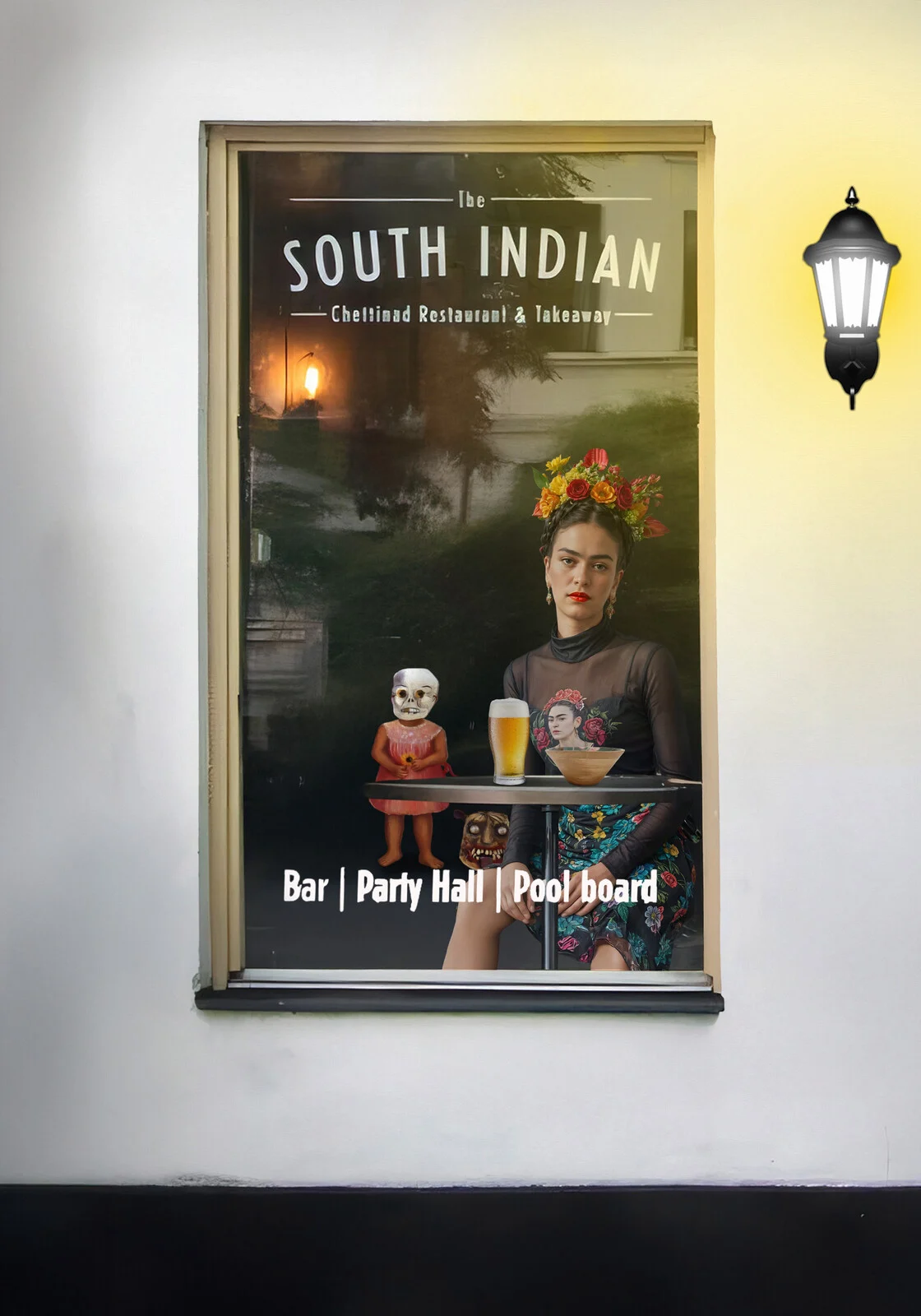
Jörgen Thornberg
Fridas corner view, 2025
Digital
70 x 100 cm
5 200 kr
Fridas corner view
Frida's corner view
Frida Kahlo, seated at a window in a South Indian restaurant in Lund, watched the vibrant streets filled with students and young families. The sight of strollers stirred painful memories of her inability to have children, a grief she carried throughout her life. After her miscarriage in 1938, Frida created ‘Girl with Death Mask’, a haunting painting that delves deep into the juxtaposition of innocence and mortality. The young girl in the painting holds a marigold, a symbol of life and death in Mexican tradition, while a tiger mask at her feet hints at protection and vulnerability. Frida’s deeply personal yet universal art transforms her pain into a powerful exploration of loss and resilience, offering a lasting connection to those who have experienced grief.
Read on to uncover the intriguing secrets of Frida's inner self that will pique your interest.
“Girl with Death Mask
A girl of four in the lonely lost land,
With a death mask clutched in her hand.
She is Frida, the failure, the child, the seed,
And the daughters lost she longed to lead.
The child's face is small, her gaze is wide,
With marigolds for the dead by her side.
A tiger mask, fierce, sits at her feet,
Guarding the pain, she cannot meet.
Frida weeps for the lives that never began,
For her womb, both cradle and cruel hand.
A betrayer, a tomb—her body’s guilt,
A fortress of love where dreams were spilt.
The vast empty sky, the desolate plain,
Echo her sorrow, reflect her pain.
No children’s laughter, no tiny cries,
Just the heavy silence of unanswered whys.
In every stroke, her anguish calls,
The lives unborn within her walls.
The girl stands alone, a paradox stark—
The innocent child and the grieving mark.
She paints her grief in a spectral hue,
For the daughters, she dreamed but never knew.
And though her heart feels a murderer's sting,
Not being a mother colours everything.
Yet, in this mask, there’s more than death,
A spark of life, a whispering breath.
A hope that the marigold’s golden fire
Can guide lost souls through the pain and mire.
Frida grieved and wept, but she also created,
Through tears, her legacy was illuminated.
In "Girl with Death Mask," Frida’s truth takes form,
A testament of love through a lifelong storm.
It was this she pondered, deep in thought,
Alone in the Indian restaurant, she sought,
Far from Mexico, far from her distant star,
With an IPA and a hot soup served in a jar.”
Malmö. January 2025
Girl with Death Mask [Niña con máscara de calavera]
The day the hot air balloons flew over Lund, Frida Kahlo was seated at the South Indian restaurant near Bantorget. She had attended a vernissage connected to her work earlier that day, and a meal of Chettinad cuisine from southern India seemed like the perfect follow-up. Frida chose an IPA, India Pale Ale, to complement the spicy soup she ordered, which paired excellently. The heat, spice, and sweetness of Indian cuisine often make wine less suitable, so beer was her choice. As always, she was deep in thought, her mind swirling with memories.
The university town Lund is a young city, with an average age of just 39 years, the eighth-lowest in Sweden. Naturally, the restaurant's guests and the passersby were predominantly young, many students. The sight of young families, passing strollers and toddling children outside the corner window where Frida was sitting stirred painful memories of her inability to have children. Her many miscarriages haunted her, most notably the near-fatal one in 1932. After another miscarriage in 1938, Frida created one of her most fascinating and enigmatic paintings, ‘Girl with Death Mask’.
The painting portrays a young girl wearing a mask reminiscent of the *Calaveras* (sugar skulls) commonly associated with Day of the Dead celebrations. In her hand, she holds a marigold, a traditional offering brought to graves during the festival. Near her feet lies a tiger mask, which, according to my research, is a totem meant to protect against evil. The entire composition is eerie, mysterious, and challenging to interpret. The contrast between the child’s innocence and the symbols of death is striking, while the desolate background only heightens the unease. This strange little girl plays alone.
Death is a common theme in Kahlo’s art. Her constant health issues and chronic pain meant that death was often on her mind; as one of Kahlo’s friends famously remarked, “Frida lived dying.” The piece has also been interpreted as a reaction to a miscarriage that Kahlo endured when the painting was completed. While some art historians have interpreted this piece as a self-portrait of Kahlo as a child- a precursor to the suffering she endured as an adult- I think it’s unnecessary to see it as totally autobiographical.
The piece can be seen as a universal scene, a modern take on the memento mori theme, a traditional painting genre designed to remind the viewer that they are mortal. The Mexican iconography that denotes death adds additional visual drama and dynamism to the piece. A death mask is pretty spooky, isn’t it?
In this work, Girl with Death Mask, the theme of death from which no one can escape is taken up. It was painted while Frida Kahlo was mourning the death of her baby by miscarriage.
In 1938, Frida painted two similar paintings with the same subject. This painting depicted a little girl, believed to be Frida herself at the age of four, wearing a skull mask. This mask is a tradition at the annual Mexican festival "Day of the Dead," where death is celebrated instead of mourned. The little girl is holding an orange blossom in her hands, which resembles the marigold bloom that Mexicans put on graves during the "Day of the Dead" festival. She stands on an empty, vast field under a gloomy sky alone. There is a carved wooden tiger mask by her feet, similar to one hanging in the dining room of Frida's Casa Azul. Both masks seem inappropriate for the innocent tiny little girl and symbolise or hint at her destiny's cruelty.
"Death" was the most intimate theme for Kahlo, who always lived close to it. Each motif in this painting reflects the traditional Mexican idea of death.
The death mask worn by the girl is a toy for the "Day of the Dead".
The orange marigold flower in her hand is traditionally offered at graves to guide the spirits of the dead. This flower often recurs in Frida's paintings and is woven into her elaborate hairstyles, symbolising her deep connection to life, death, and Mexican traditions.
The "Tiger Mask" at her feet was used as a talisman to protect the child against evil.
“Girl With Death Mask” is rife with symbolism, the most obvious being the skull on the little girl's face. The skull mask, a common element in Mexican culture, is used during Dia de los Muertos (Day of the Dead) celebrations, symbolising the connection between life and death. Death is celebrated on this day instead of mourning, although there is not an apparent celebratory tone in this piece—until we look into the girl’s hands.
She is holding a lone marigold flower. In Mexican tradition, marigolds play a central role in Dia de los Muertos, symbolising the fragility of life and the remembrance of deceased loved ones. Their vibrant orange and yellow hues are believed to guide spirits back to the living during the holiday. Aztec tradition and Hinduism hold marigolds in high regard due to their magical and purifying properties. Could this be the one seed of hope in an otherwise ghostly painting?
The tiger mask on the ground could be another, as it’s thought to help protect her against evil.
Whether this is a self-portrait or not, “Girl With Death Mask” mirrors the life of Frida Kahlo. Although she suffered many setbacks and endured a lifetime of pain, Kahlo seemed to be guided by otherworldly forces. And despite her untimely death at age 47, her life was touched by magic.
“Quietly, the grief
loudly the pain.
The accumulated poison
love faded away.
Mine was a strange world
of criminal silences
of stranger’s watchful eyes
misreading the evil.
darkness in the daytime…
Was it my fault?
I admit my great guilt
as great as pain
it was an enormous exit
which my love went through.”
—Frida Kahlo wrote in her diary
Frida Kahlo had a relationship with tragedy that is almost unparalleled. The Mexican painter began this relationship at a relatively young age—when Kahlo was eighteen, she suffered near-fatal injuries from a bus accident in which a section of metal handrail pierced her body. The accident left her with a broken spine and collarbone, several broken ribs, a dislocated shoulder, many fractures in her right leg, and a broken pelvis. She mostly recovered from these physical injuries, but her broken pelvis created a plethora of physical and psychological repercussions. The damage was such that Kahlo was unable to have children, and her attempts all ended in miscarriage and grief. Her pelvic injury served as a prelude for her traumatic reproductive life—three miscarriages, one of which caused severe haemorrhaging and a lengthy recovery. However, Kahlo did not let her reproductive tragedies consume her entire life. Instead, she examined and worked through her experiences in her paintings. Therefore, reviewing her work, we understand how she experienced the grieving process. But more than that, we can use Kahlo’s work to map a visual vocabulary that those experiencing the grief of pregnancy loss can employ to express their grief.
Similarly, one can better understand Kahlo’s grieving process through her paintings by comparing her images to the traditional stages of grief; in the same way, others may better understand their grieving processes through viewing and understanding her work. Yet, one must be careful in using Kahlo as a universal example for all women who have experienced pregnancy loss. Cultural, socioeconomic and political identities have an enormous impact on any woman’s experience, and to ignore these differences is akin to neglecting gender differences in pursuit of a masculine universal. Following the use of Kahlo as an individual rather than a universal, one finds that she had many qualities that could separate her from other women. Kahlo was an ardent Communist whose political beliefs of class abolition and planned economies would starkly contrast with those of a constituent of a democracy. Her Mexican heritage emerges in most of her paintings, and she strongly identifies with her indigenous ancestors and pre-Columbian culture. Some other characteristics that may alienate Kahlo from other women’s experiences are her bisexuality, her occupation as an artist, and her reproductive expertise. However, Kahlo is still one of the only major artists who directly communicates her reproductive grief through visual art. Her grief is personal, and her experience with pregnancy loss is individual, but that doesn’t mean others cannot relate to her work. Studying her work may provide others suffering from pregnancy loss—whether artists themselves, art scholars, or non-artists looking for a way to express their grief—an invaluable expressive vocabulary.
Although studying Kahlo’s paintings during her miscarriages provides no definite answers to her grief process, some telling patterns emerge. These patterns can be grouped into themes that seem to reveal Kahlo’s grieving process after her miscarriages. Baby imagery, a desolate or claustrophobic use of space, the “floating Frida” effect, and the appearance of vines/umbilical cords all represent different stages of the grieving process.
Kahlo’s very realistic and anatomically correct depictions of fetuses and the biological process of reproduction seem to reflect feelings of denial and yearning. Because Kahlo did not have a baby of her own, she may have allowed herself to circumvent the loss by creating a new, painted baby that allowed her to imagine a world in which her baby was still alive. Kahlo, perhaps going through a process of denial, may have recognised either her attempt to deny the loss or societal pressure to deny the loss and used visual representations of babies and reproduction to combat these feelings of denial. Later, when babies' appearances merge into representations of her pets (often seen by Kahlo as her “children”), it does not seem to represent denial as much as yearning. Her use of pets and baby imagery in the subject matter of her work may indicate not only her denial during her grieving process but perhaps the start of a means of dealing with that grief.
Kahlo’s use of space suggests more of a struggle with the grieving process. The alternating use of space and very claustrophobic space seems to provide a visual analogue to feelings of numbness and shock. These feelings are common to many people who have experienced pregnancy loss. Visual impressions of numbness are evident in Kahlo’s bare background self-portraits and works like ‘Henry Ford Hospital’. Although there are objects that occupy the picture plane, Kahlo is tiny about the bed, and the bed is relatively small and separate from the rest of the painting. The floating bed also implies a sense of detachment or listlessness. Kahlo does not relate to the rest of the world and, instead, seems to lose herself in nothingness. In contrast, the tight, claustrophobic space created by the dense jungle backgrounds in her later self-portraits appears to force Kahlo’s image out of the picture plane and at the viewer. Rich detail and patterns fill up the picture plane, starkly contrasting the empty and bare backgrounds of her earlier self-portraits, in which Kahlo is isolated. This suffocating movement is dramatic and sudden and could be one way to represent the shock experience. Kahlo may have felt like she was thrown into a situation over which she had no control, so she threw herself at the viewer.
Kahlo’s grieving process continues with the placement of the body. In many paintings, Kahlo does not look like she is physically connected to the ground. Instead, she floats delicately, hovering slightly above the ground. Many sufferers of pregnancy loss mention feelings of disconnection, even out-of-body experiences. Sufferers of depression share these same feelings of disconnect, a typical stage of grief. The floating begins as early as Frida and Diego Rivera, a painting roughly coinciding with her first miscarriage. It becomes more pronounced in works like. The large traditional skirts that Kahlo liked may contribute to this floating effect, but the disconnected feeling remains. It looks like Kahlo felt separated from the rest of the world because of her pregnancy losses and because of her grief. Perhaps her visual representation of her disconnect helped Kahlo understand her feelings of depression.
Lastly, how Kahlo uses flowing lines to connect or disconnect may correspond to her process of finding a resolution to her grief. The change in the depiction of roots may reflect Kahlo’s integration of her pregnancy losses into the rest of her life. As the vine-like lines become more solidly connected to the world around them, Kahlo becomes more connected with her grief and draws closer to resolution. These lines appear as vines, umbilical cords, ribbons, or blood vessels, but all share the same fluid, coiling quality. These lines seem to connect directly to Kahlo’s development towards resolution. The connectedness of the lines seems to show progress toward resolution. For example, in perhaps one of her most incredible self-portraits, Roots, the vines take root and securely reconnect Kahlo with the Earth. In this painting, Kahlo reclines comfortably as many tangled roots erupt from a cavity in her chest. It has been called a “childless woman’s dream,” most likely because the roots come out of her womb and extend into the world. A child is one of the ways a parent continues her or himself, but Kahlo replaces the children with vines. The vines have also been seen as umbilical cords, which suggests that they connect Kahlo to the earth, implying that Kahlo is giving birth to the world itself. No matter which interpretation one uses, it is clear that the lines in Roots, a painting from later in her career, are far more connected and grounded than the lines in some of her early paintings, such as Henry Ford Hospital.
Despite these clear echoes of reproduction, Kahlo had many reasons to continue to grieve throughout her life, from her husband’s infidelities to her debilitating injuries and illnesses. These themes of grief could be a result of any number of different traumas. It is, therefore, empirically impossible to discern if the grief revealed in any given painting is due to her miscarriages or another loss in her life.
The study of art history is often seen as an “ivory tower” endeavour, which produces research that is valuable or applicable to a select view in the same field. However, the use of Kahlo’s work to map a visual vocabulary that those experiencing the grief of pregnancy loss can employ to express their grief has several real-world applications. First, it brings attention to the silence surrounding pregnancy loss; by discussing Kahlo’s experience, we move one step closer to ending the silence. It also validates Kahlo’s expertise and recognises her pregnancy losses as significant.
Most importantly, it could give women who do not have the artistic background that Kahlo did the opportunity to use visual expression to work through their grieving processes. These women can look to Kahlo as an example of a peer who successfully used visual expression to describe her miscarriages and perhaps have hope that they may be equally successful. If women who are not artists have trouble expressing themselves through visual images, they can use Kahlo’s visual vocabulary to express their experiences. Similarly, her work may help tailor art therapy sessions to the grieving process from pregnancy loss and provide women with more specialised support. Finally, the study of Frida Kahlo may lead to similar studies of other artists who have experienced pregnancy loss to see how they express their grief either similarly or differently. Other major female artists, amateur artists who do not paint for the public eye, and men whose partners have suffered pregnancy loss—all have unique perspectives on the grieving process from pregnancy loss.

Jörgen Thornberg
Fridas corner view, 2025
Digital
70 x 100 cm
5 200 kr
Fridas corner view
Frida's corner view
Frida Kahlo, seated at a window in a South Indian restaurant in Lund, watched the vibrant streets filled with students and young families. The sight of strollers stirred painful memories of her inability to have children, a grief she carried throughout her life. After her miscarriage in 1938, Frida created ‘Girl with Death Mask’, a haunting painting that delves deep into the juxtaposition of innocence and mortality. The young girl in the painting holds a marigold, a symbol of life and death in Mexican tradition, while a tiger mask at her feet hints at protection and vulnerability. Frida’s deeply personal yet universal art transforms her pain into a powerful exploration of loss and resilience, offering a lasting connection to those who have experienced grief.
Read on to uncover the intriguing secrets of Frida's inner self that will pique your interest.
“Girl with Death Mask
A girl of four in the lonely lost land,
With a death mask clutched in her hand.
She is Frida, the failure, the child, the seed,
And the daughters lost she longed to lead.
The child's face is small, her gaze is wide,
With marigolds for the dead by her side.
A tiger mask, fierce, sits at her feet,
Guarding the pain, she cannot meet.
Frida weeps for the lives that never began,
For her womb, both cradle and cruel hand.
A betrayer, a tomb—her body’s guilt,
A fortress of love where dreams were spilt.
The vast empty sky, the desolate plain,
Echo her sorrow, reflect her pain.
No children’s laughter, no tiny cries,
Just the heavy silence of unanswered whys.
In every stroke, her anguish calls,
The lives unborn within her walls.
The girl stands alone, a paradox stark—
The innocent child and the grieving mark.
She paints her grief in a spectral hue,
For the daughters, she dreamed but never knew.
And though her heart feels a murderer's sting,
Not being a mother colours everything.
Yet, in this mask, there’s more than death,
A spark of life, a whispering breath.
A hope that the marigold’s golden fire
Can guide lost souls through the pain and mire.
Frida grieved and wept, but she also created,
Through tears, her legacy was illuminated.
In "Girl with Death Mask," Frida’s truth takes form,
A testament of love through a lifelong storm.
It was this she pondered, deep in thought,
Alone in the Indian restaurant, she sought,
Far from Mexico, far from her distant star,
With an IPA and a hot soup served in a jar.”
Malmö. January 2025
Girl with Death Mask [Niña con máscara de calavera]
The day the hot air balloons flew over Lund, Frida Kahlo was seated at the South Indian restaurant near Bantorget. She had attended a vernissage connected to her work earlier that day, and a meal of Chettinad cuisine from southern India seemed like the perfect follow-up. Frida chose an IPA, India Pale Ale, to complement the spicy soup she ordered, which paired excellently. The heat, spice, and sweetness of Indian cuisine often make wine less suitable, so beer was her choice. As always, she was deep in thought, her mind swirling with memories.
The university town Lund is a young city, with an average age of just 39 years, the eighth-lowest in Sweden. Naturally, the restaurant's guests and the passersby were predominantly young, many students. The sight of young families, passing strollers and toddling children outside the corner window where Frida was sitting stirred painful memories of her inability to have children. Her many miscarriages haunted her, most notably the near-fatal one in 1932. After another miscarriage in 1938, Frida created one of her most fascinating and enigmatic paintings, ‘Girl with Death Mask’.
The painting portrays a young girl wearing a mask reminiscent of the *Calaveras* (sugar skulls) commonly associated with Day of the Dead celebrations. In her hand, she holds a marigold, a traditional offering brought to graves during the festival. Near her feet lies a tiger mask, which, according to my research, is a totem meant to protect against evil. The entire composition is eerie, mysterious, and challenging to interpret. The contrast between the child’s innocence and the symbols of death is striking, while the desolate background only heightens the unease. This strange little girl plays alone.
Death is a common theme in Kahlo’s art. Her constant health issues and chronic pain meant that death was often on her mind; as one of Kahlo’s friends famously remarked, “Frida lived dying.” The piece has also been interpreted as a reaction to a miscarriage that Kahlo endured when the painting was completed. While some art historians have interpreted this piece as a self-portrait of Kahlo as a child- a precursor to the suffering she endured as an adult- I think it’s unnecessary to see it as totally autobiographical.
The piece can be seen as a universal scene, a modern take on the memento mori theme, a traditional painting genre designed to remind the viewer that they are mortal. The Mexican iconography that denotes death adds additional visual drama and dynamism to the piece. A death mask is pretty spooky, isn’t it?
In this work, Girl with Death Mask, the theme of death from which no one can escape is taken up. It was painted while Frida Kahlo was mourning the death of her baby by miscarriage.
In 1938, Frida painted two similar paintings with the same subject. This painting depicted a little girl, believed to be Frida herself at the age of four, wearing a skull mask. This mask is a tradition at the annual Mexican festival "Day of the Dead," where death is celebrated instead of mourned. The little girl is holding an orange blossom in her hands, which resembles the marigold bloom that Mexicans put on graves during the "Day of the Dead" festival. She stands on an empty, vast field under a gloomy sky alone. There is a carved wooden tiger mask by her feet, similar to one hanging in the dining room of Frida's Casa Azul. Both masks seem inappropriate for the innocent tiny little girl and symbolise or hint at her destiny's cruelty.
"Death" was the most intimate theme for Kahlo, who always lived close to it. Each motif in this painting reflects the traditional Mexican idea of death.
The death mask worn by the girl is a toy for the "Day of the Dead".
The orange marigold flower in her hand is traditionally offered at graves to guide the spirits of the dead. This flower often recurs in Frida's paintings and is woven into her elaborate hairstyles, symbolising her deep connection to life, death, and Mexican traditions.
The "Tiger Mask" at her feet was used as a talisman to protect the child against evil.
“Girl With Death Mask” is rife with symbolism, the most obvious being the skull on the little girl's face. The skull mask, a common element in Mexican culture, is used during Dia de los Muertos (Day of the Dead) celebrations, symbolising the connection between life and death. Death is celebrated on this day instead of mourning, although there is not an apparent celebratory tone in this piece—until we look into the girl’s hands.
She is holding a lone marigold flower. In Mexican tradition, marigolds play a central role in Dia de los Muertos, symbolising the fragility of life and the remembrance of deceased loved ones. Their vibrant orange and yellow hues are believed to guide spirits back to the living during the holiday. Aztec tradition and Hinduism hold marigolds in high regard due to their magical and purifying properties. Could this be the one seed of hope in an otherwise ghostly painting?
The tiger mask on the ground could be another, as it’s thought to help protect her against evil.
Whether this is a self-portrait or not, “Girl With Death Mask” mirrors the life of Frida Kahlo. Although she suffered many setbacks and endured a lifetime of pain, Kahlo seemed to be guided by otherworldly forces. And despite her untimely death at age 47, her life was touched by magic.
“Quietly, the grief
loudly the pain.
The accumulated poison
love faded away.
Mine was a strange world
of criminal silences
of stranger’s watchful eyes
misreading the evil.
darkness in the daytime…
Was it my fault?
I admit my great guilt
as great as pain
it was an enormous exit
which my love went through.”
—Frida Kahlo wrote in her diary
Frida Kahlo had a relationship with tragedy that is almost unparalleled. The Mexican painter began this relationship at a relatively young age—when Kahlo was eighteen, she suffered near-fatal injuries from a bus accident in which a section of metal handrail pierced her body. The accident left her with a broken spine and collarbone, several broken ribs, a dislocated shoulder, many fractures in her right leg, and a broken pelvis. She mostly recovered from these physical injuries, but her broken pelvis created a plethora of physical and psychological repercussions. The damage was such that Kahlo was unable to have children, and her attempts all ended in miscarriage and grief. Her pelvic injury served as a prelude for her traumatic reproductive life—three miscarriages, one of which caused severe haemorrhaging and a lengthy recovery. However, Kahlo did not let her reproductive tragedies consume her entire life. Instead, she examined and worked through her experiences in her paintings. Therefore, reviewing her work, we understand how she experienced the grieving process. But more than that, we can use Kahlo’s work to map a visual vocabulary that those experiencing the grief of pregnancy loss can employ to express their grief.
Similarly, one can better understand Kahlo’s grieving process through her paintings by comparing her images to the traditional stages of grief; in the same way, others may better understand their grieving processes through viewing and understanding her work. Yet, one must be careful in using Kahlo as a universal example for all women who have experienced pregnancy loss. Cultural, socioeconomic and political identities have an enormous impact on any woman’s experience, and to ignore these differences is akin to neglecting gender differences in pursuit of a masculine universal. Following the use of Kahlo as an individual rather than a universal, one finds that she had many qualities that could separate her from other women. Kahlo was an ardent Communist whose political beliefs of class abolition and planned economies would starkly contrast with those of a constituent of a democracy. Her Mexican heritage emerges in most of her paintings, and she strongly identifies with her indigenous ancestors and pre-Columbian culture. Some other characteristics that may alienate Kahlo from other women’s experiences are her bisexuality, her occupation as an artist, and her reproductive expertise. However, Kahlo is still one of the only major artists who directly communicates her reproductive grief through visual art. Her grief is personal, and her experience with pregnancy loss is individual, but that doesn’t mean others cannot relate to her work. Studying her work may provide others suffering from pregnancy loss—whether artists themselves, art scholars, or non-artists looking for a way to express their grief—an invaluable expressive vocabulary.
Although studying Kahlo’s paintings during her miscarriages provides no definite answers to her grief process, some telling patterns emerge. These patterns can be grouped into themes that seem to reveal Kahlo’s grieving process after her miscarriages. Baby imagery, a desolate or claustrophobic use of space, the “floating Frida” effect, and the appearance of vines/umbilical cords all represent different stages of the grieving process.
Kahlo’s very realistic and anatomically correct depictions of fetuses and the biological process of reproduction seem to reflect feelings of denial and yearning. Because Kahlo did not have a baby of her own, she may have allowed herself to circumvent the loss by creating a new, painted baby that allowed her to imagine a world in which her baby was still alive. Kahlo, perhaps going through a process of denial, may have recognised either her attempt to deny the loss or societal pressure to deny the loss and used visual representations of babies and reproduction to combat these feelings of denial. Later, when babies' appearances merge into representations of her pets (often seen by Kahlo as her “children”), it does not seem to represent denial as much as yearning. Her use of pets and baby imagery in the subject matter of her work may indicate not only her denial during her grieving process but perhaps the start of a means of dealing with that grief.
Kahlo’s use of space suggests more of a struggle with the grieving process. The alternating use of space and very claustrophobic space seems to provide a visual analogue to feelings of numbness and shock. These feelings are common to many people who have experienced pregnancy loss. Visual impressions of numbness are evident in Kahlo’s bare background self-portraits and works like ‘Henry Ford Hospital’. Although there are objects that occupy the picture plane, Kahlo is tiny about the bed, and the bed is relatively small and separate from the rest of the painting. The floating bed also implies a sense of detachment or listlessness. Kahlo does not relate to the rest of the world and, instead, seems to lose herself in nothingness. In contrast, the tight, claustrophobic space created by the dense jungle backgrounds in her later self-portraits appears to force Kahlo’s image out of the picture plane and at the viewer. Rich detail and patterns fill up the picture plane, starkly contrasting the empty and bare backgrounds of her earlier self-portraits, in which Kahlo is isolated. This suffocating movement is dramatic and sudden and could be one way to represent the shock experience. Kahlo may have felt like she was thrown into a situation over which she had no control, so she threw herself at the viewer.
Kahlo’s grieving process continues with the placement of the body. In many paintings, Kahlo does not look like she is physically connected to the ground. Instead, she floats delicately, hovering slightly above the ground. Many sufferers of pregnancy loss mention feelings of disconnection, even out-of-body experiences. Sufferers of depression share these same feelings of disconnect, a typical stage of grief. The floating begins as early as Frida and Diego Rivera, a painting roughly coinciding with her first miscarriage. It becomes more pronounced in works like. The large traditional skirts that Kahlo liked may contribute to this floating effect, but the disconnected feeling remains. It looks like Kahlo felt separated from the rest of the world because of her pregnancy losses and because of her grief. Perhaps her visual representation of her disconnect helped Kahlo understand her feelings of depression.
Lastly, how Kahlo uses flowing lines to connect or disconnect may correspond to her process of finding a resolution to her grief. The change in the depiction of roots may reflect Kahlo’s integration of her pregnancy losses into the rest of her life. As the vine-like lines become more solidly connected to the world around them, Kahlo becomes more connected with her grief and draws closer to resolution. These lines appear as vines, umbilical cords, ribbons, or blood vessels, but all share the same fluid, coiling quality. These lines seem to connect directly to Kahlo’s development towards resolution. The connectedness of the lines seems to show progress toward resolution. For example, in perhaps one of her most incredible self-portraits, Roots, the vines take root and securely reconnect Kahlo with the Earth. In this painting, Kahlo reclines comfortably as many tangled roots erupt from a cavity in her chest. It has been called a “childless woman’s dream,” most likely because the roots come out of her womb and extend into the world. A child is one of the ways a parent continues her or himself, but Kahlo replaces the children with vines. The vines have also been seen as umbilical cords, which suggests that they connect Kahlo to the earth, implying that Kahlo is giving birth to the world itself. No matter which interpretation one uses, it is clear that the lines in Roots, a painting from later in her career, are far more connected and grounded than the lines in some of her early paintings, such as Henry Ford Hospital.
Despite these clear echoes of reproduction, Kahlo had many reasons to continue to grieve throughout her life, from her husband’s infidelities to her debilitating injuries and illnesses. These themes of grief could be a result of any number of different traumas. It is, therefore, empirically impossible to discern if the grief revealed in any given painting is due to her miscarriages or another loss in her life.
The study of art history is often seen as an “ivory tower” endeavour, which produces research that is valuable or applicable to a select view in the same field. However, the use of Kahlo’s work to map a visual vocabulary that those experiencing the grief of pregnancy loss can employ to express their grief has several real-world applications. First, it brings attention to the silence surrounding pregnancy loss; by discussing Kahlo’s experience, we move one step closer to ending the silence. It also validates Kahlo’s expertise and recognises her pregnancy losses as significant.
Most importantly, it could give women who do not have the artistic background that Kahlo did the opportunity to use visual expression to work through their grieving processes. These women can look to Kahlo as an example of a peer who successfully used visual expression to describe her miscarriages and perhaps have hope that they may be equally successful. If women who are not artists have trouble expressing themselves through visual images, they can use Kahlo’s visual vocabulary to express their experiences. Similarly, her work may help tailor art therapy sessions to the grieving process from pregnancy loss and provide women with more specialised support. Finally, the study of Frida Kahlo may lead to similar studies of other artists who have experienced pregnancy loss to see how they express their grief either similarly or differently. Other major female artists, amateur artists who do not paint for the public eye, and men whose partners have suffered pregnancy loss—all have unique perspectives on the grieving process from pregnancy loss.
5 200 kr

Jörgen Thornberg
Malmö
Lite om bilder och mig. Translation in English at the end.
Jag är en nyfiken person som ser allt i bilder, även det jag fäster i ord, gärna tillsammans för bakom alla mina bilder finns en berättelse. Till vissa bilder hör en kortare eller längre novell som följer med bilden.
Bilder berättar historier. Jag omges av naturlig skönhet, intressanta människor och historia var jag än går. Jag använder min kamera för att dokumentera världen och blanda det jag ser med vad jag känner för att fånga den dolda magin.
Mina bilder berättar mina historier. Genom mina bilder, tryck och berättelser. Jag bjuder in dig att ta del av dessa berättelser, in i ditt liv och hem och dela min mycket personliga syn på vår värld. Mer än vad ögat ser. Jag tänker i bilder, drömmer och skriver och pratar om dem; följaktligen måste jag också skapa bilder. De blir vad jag ser, inte nödvändigtvis begränsade till verkligheten. Det finns en bild runt varje hörn. Jag hoppas att du kommer att se vad jag såg och gilla det.
Jag är också en skrivande person och till många bilder hör en kortare eller längre essay. Den följer med tavlan, tryckt på fint papper och med en personlig hälsning från mig.
Flertalet bilder startar sin resa i min kamera. Enkelt förklarat beskriver jag bilden jag ser i mitt inre, upplevd eller fantiserad. Bilden uppstår inom mig redan innan jag fått okularet till ögat. På bråkdelen av ett ögonblick ser jag vad jag vill ha och vad som kan göras med bilden. Här skall jag stoppa in en giraff, stålmannen, Titanic eller vad det är min fantasi finner ut. Ännu märkligare är att jag kommer ihåg minnesbilden långt efteråt när det blir tid att skapa verket. Om jag lyckas eller inte, är upp till betraktaren, oftast präglat av en stråk av svart humor – meningen är att man skall bli underhållen. Mina bilder blir ofta en snackis där de hänger.
Jag föredrar bilder som förmedlar ett budskap i flera lager. Vid första anblicken fylld av feel-good, en vacker utsikt, fint väder, solen skiner, blommor på ängen eller vattnet som ligger förrädiskt spegelblankt. I en sådan bild kan jag gömma min egentliga berättelse, mitt förakt för förtryckare och våldsverkare, rasister och fördomsfulla människor - ett gärna återkommande motiv mer eller mindre dolt i det vackra motivet. Jag försöker förena dem i ett gemensamt narrativ.
Bild och formgivning har löpt som en röd tråd genom livet. Fotokonst känns som en värdig final som jag gärna delar med mig.
Min genre är vid som framgår av mina bilder, temat en blandning av pop- och gatukonst i kollage som kan bestå av hundratals lager. Vissa bilder kan ta veckor, andra någon dag innan det är dags att överlämna resultatet till printverkstaden. Fine Art Prints är digitala fotocollage. I dessa kollage sker rivandet, klippandet, pusslandet, målandet, ritandet och sprayningen digitalt. Det jag monterar in kan vara hundratals år gamla bilder som jag omsorgsfullt frilägger så att de ser ut att vara en del av tavlan men också bilder skapade av mig själv efter min egen fantasi. Därefter besöks printstudion och för vissa bilder numrera en limiterad upplaga (oftast 7 exemplar) och signera för hand. Vissa bilder kan köpas i olika format. Det är bara att fråga efter vilka. Gillar man en bild som är 70x100 men inte har plats på väggen, går den kanske att få i 50x70 cm istället. Frågan är fri.
Metoden Giclée eller Fine Art Print som det också kallas är det moderna sättet för framställning av grafisk konst. Villkoret för denna typ av utskrifter är att en högkvalitativ storformatskrivare används med åldersbeständigt färgpigment och konstnärspapper eller i förekommande fall på duk. Pappret som används möter de krav på livslängd som ställs av museer och gallerier. Normalt säljer jag mina bilder oinramade så att den nya ägaren själv kan bestämma hur de skall se ut, med eller utan passepartout färg på ram, med eller utan glas etc..
Under många år ställde jag bara ut på nätet, i valda grupper och på min egen Facebooksida - https://www.facebook.com/jorgen.thornberg.9
Jag finns också på en egen hemsida som tyvärr inte alltid är uppdaterad – https://www.jth.life/ Där kan du också läsa en del av de berättelser som följer med bilden.
UTSTÄLLNINGAR
Luftkastellet, oktober 2022
Konst i Lund, november 2022
Luftkastellet, mars 2023
Engleson Galleri Caroli, april 2023
Hydra, Greece June 2023
Engleson Galleri Caroli, oktober 2023
Toppen, Höllviken december 2023
Luftkastellet, mars 2024
Torups Galleri, mars 2024
Venice, May 2024
Luftkastellet, oktober 2024
Konst i Advent, December 2024
Galleri Engleson, Caroli December 2024
Jäger & Jansson Galleri, april 2025
A bit about pictures and me.
I'm a curious person who sees everything in pictures, even what I express in words, often combining them, for behind all my pictures lies a story. These narratives, some as short as a single image and others as long as a novel, are the heart and soul of my work.
Pictures tell stories. Wherever I go, I'm surrounded by natural beauty, exciting people, and history. I use my camera to document the world and blend what I see with what I feel to capture the hidden magic.
My images tell my stories. Through my pictures, prints, and narratives, I invite you to partake in these stories in your life and home and share my deeply personal perspective of our world. More than meets the eye. I think in pictures, dream, write, and talk about them; consequently, I must create images too. They become what I see, not necessarily confined to reality. There's a picture around every corner. I hope you'll see what I saw and enjoy it.
I'm also a writer, and many images come with a shorter or longer essay. It accompanies the painting, printed on fine paper with my personal greeting.
Many pictures start their journey on my camera. Simply put, I describe the image I see in my mind, experienced or imagined. The image arises within me even before I bring the eyepiece to my eye. In a fraction of a moment, I see what I want and what can be done with the picture. Here, I'll insert a giraffe, Superman, the Titanic, or whatever my imagination conjures up. Even stranger is that I remember the mental image long after it's time to create the work. Whether I succeed is up to the observer, often imbued with a streak of black humour – the aim is to entertain. My pictures usually become a talking point wherever they hang.
I prefer pictures that convey a message in multiple layers. At first glance, they're filled with feel-good vibes, a beautiful view, lovely weather, the sun shining, flowers in the meadow, or the water lying deceptively calm. But beneath this surface beauty, I often conceal a deeper story, a narrative that challenges societal norms or explores the human condition. I invite you to delve into these hidden narratives and discover the layers of meaning within my work.
Picture and design have been a thread running through my life. Photographic art feels like a fitting finale, and I'm happy to share it.
My genre is varied, as seen in my pictures; the theme is a blend of pop and street art in collages that can consist of hundreds of layers. Some images can take weeks, others just a day before it's time to hand over the result to the print workshop. Fine Art Prints are digital photo collages. In these collages, tearing, cutting, puzzling, painting, drawing, and spraying happen digitally. What I insert can be images hundreds of years old that I carefully extract so they appear to be part of the painting, but also images created by myself, now also generated from my imagination. Next, visit the print studio and, for certain images, number a limited edition (usually 7 copies) and sign them by hand. Some images may be available in other formats. Just ask which ones. If you like an image that's 70x100 but doesn't have space on the wall, you might be able to get it in 50x70 cm instead. The question is open.
The Giclée method, or Fine Art Print as it's also called, is the modern way of producing graphic art. This method ensures the highest quality and longevity of the artwork, using a high-quality large-format printer with archival pigment inks and artist paper or, in some cases, canvas. The paper used meets the longevity requirements set by museums and galleries. I sell my pictures unframed, allowing the new owner to personalise their artwork, confident in the lasting value and quality of the piece.
For many years, I only exhibited online, in selected groups, and on my Facebook page - https://www.facebook.com/jorgen.thornberg.9. I also have my website, which unfortunately is not constantly updated - https://www.jth.life/. You can also read some of the stories accompanying the pictures there.
EXHIBITIONS
Luftkastellet, October 2022
Art in Lund, November 2022
Luftkastellet, March 2023
Engleson Gallery Caroli, April 2023
Hydra, Greece June 2023
Engleson Gallery Caroli, October 2023
Toppen, Höllviken December 2023
Luftkastellet, March 2024
Torup Gallery, March 2024
Venice, May 2024
UTSTÄLLNINGAR
Luftkastellet, oktober 2022
Konst i Lund, november 2022
Luftkastellet, mars 2023
Engleson Galleri Caroli, april 2023
Hydra, Greece June 2023
Engleson Galleri Caroli, oktober 2023
Toppen, Höllviken december 2023
Luftkastellet, mars 2024
Torups Galleri, mars 2024
Venice, May 2024
Luftkastellet, October 2024
Konst i Advent, December 2024
Galleri Engleson, Caroli December 2024
Jäger & Jansson Galleri, April 2025
Utbildning
Autodidakt
Medlem i konstnärsförening
Öppna Sinnen
Med i konstrunda
Konstrundan i Skåne
Utställningar
Luftkastellet, October 2022
Art in Lund, November 2022
Luftkastellet, March 2023
Engleson Gallery Caroli, April 2023
Hydra, Greece June 2023
Engleson Gallery Caroli, October 2023
Toppen, Höllviken December 2023
Luftkastellet, March 2024
Torup Gallery, March 2024
Venice, May 2024