Vi använder cookies för att ge dig bästa möjliga upplevelse. Välj vilka cookies du tillåter.
Läs mer i vår integritetspolicy
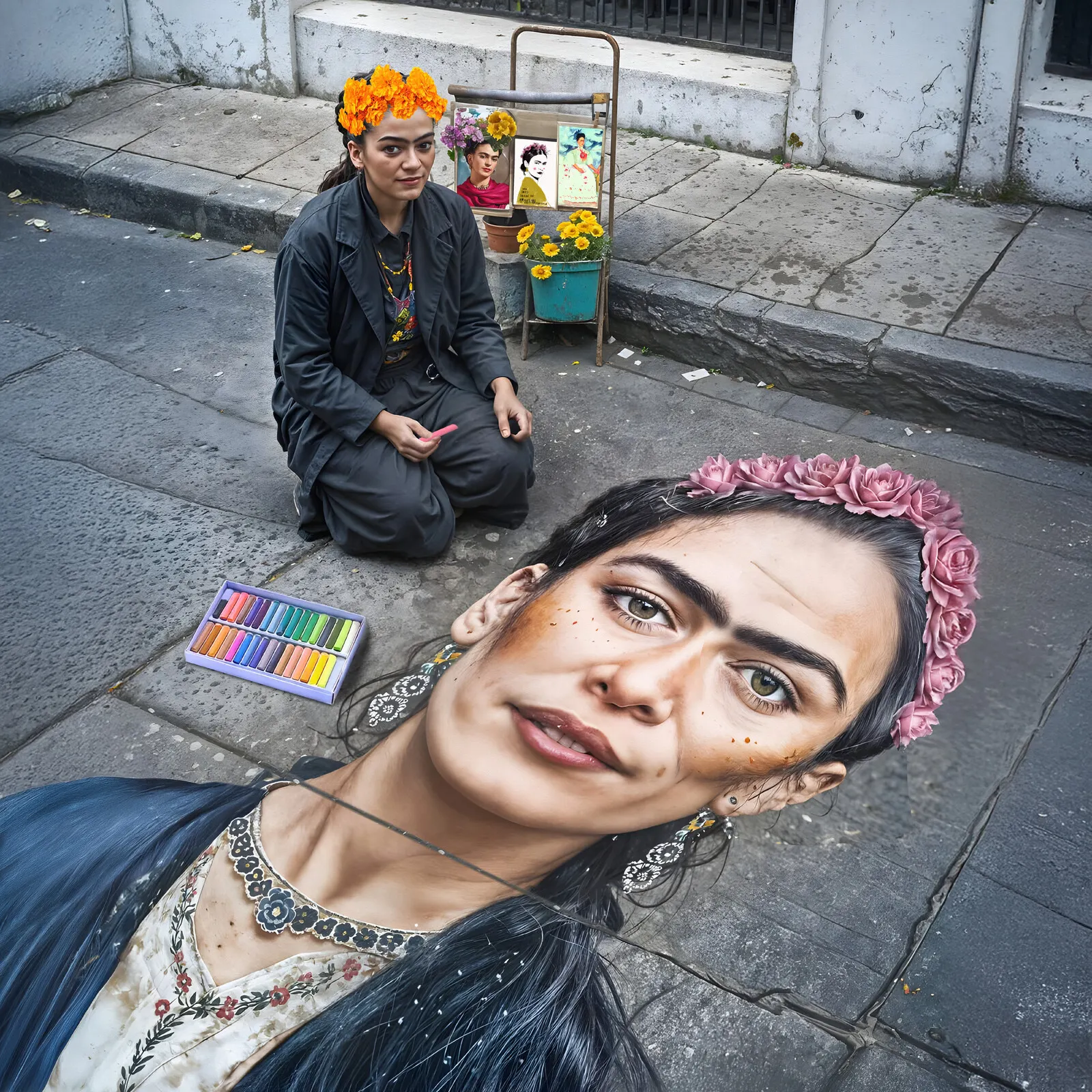
Jörgen Thornberg
A street painter with reputation, 2025
Digital
80 x 80 cm
2 900 kr
A street painter with reputation
This title encapsulates the essence of Frida Kahlo's street art project, a significant departure from her usual artistic medium and a testament to her reputation as a versatile and innovative artist. Known for her deeply personal and symbolic paintings, Frida had never ventured into large-scale murals or public artworks in her lifetime—those belonged to Diego’s domain. Yet, here she was, proving that artistic expression knows no boundaries.
With chalk, she transformed an empty street into her canvas, embracing the ephemeral nature of street art. Unlike her oil paintings, meant to endure, this creation would be at the mercy of the elements, washing away with the next rainfall. But that was precisely the point. “It was not about permanence—it was about presence.” It was about reclaiming space, making a statement, and, above all, proving to herself that her artistry could take any form she chose.
For Frida, the experience was as much an act of rebellion as it was an act of creation. And when the masterpiece was complete, she sat back, unbothered by its fleeting existence. “I have achieved what I set out to do,” she said with satisfaction. “What more can a woman ask for?”
Read on to explore Frida's painting on the street nearby.
‘‘From Caves to Streets—The Artist’s Hand
In the flickering firelight, hands pressed to stone,
Women’s touch carved history’s tone.
Red ochre whispers, fingers spread wide,
A mark of presence, of stories inside.
She painted the hunt, the stars, the rain,
Shapes in the dust, in blood and stain.
Not just a mother, not just a wife,
But an artist shaping the breath of life.
Through temples, courts and gilded halls,
Her brush defied the towering walls.
Le Brun’s face, soft yet grand,
Held power no king could command.
Through silent years, through stolen fame,
She signed with fire without a name.
They buried her voice, they erased her line,
Yet the colours bled through, bold and divine.
And now—on cracked asphalt at morning’s first light,
A woman bends low, her chalk burning bright.
With hands once bound, with feet once tied,
She paints her truth about where cars will ride.
A Sunday street, a fleeting trace,
A woman’s art, defying space.
The rain may come, the dust may claim,
But none will forget the artist’s name.
“Hit the wall, Banksy… Frida was here.”
Malmö, January 2025
A street painter with reputation
Life on Earth had been far too short for Frida to accomplish everything she had dreamed of. Painting herself on the street had long been a vision, a revelation that had now become a reality after all these years.
Slogans of protest and political or social commentary graffiti on walls are the precursor to modern graffiti and street art and continue as one genre aspect. Much of what is now defined as contemporary street art has well-documented origins dating from New York City's graffiti boom, its infancy in the 1960s, maturation in the 1970s, and peaking with the spray-painted full-car subway train murals of the 1980s centred in the Bronx. Despite her strong leftist sympathies, this was not the kind of art she had in mind—she sought her roots much further back in time.
It was a Sunday morning like any other, or so I thought. Then, out of the blue, Frida reached out to me with a surprising announcement. She was about to embark on her first street art project. The timing was deliberate, chosen to minimise foot traffic and maximise the impact of her creation.
Frida was known for her intimate and deeply personal works, often in smaller formats and with a profoundly autobiographical nature. Size had never been the defining factor in her depictions of pain, identity, feminism, and Mexican culture. But she had never worked with murals like Diego. Frida's paintings were relatively small compared to many other artists, especially in contrast to Diego's monumental murals. Her works were typically small to medium scale, which suited her working method, as she often painted from her bed or sat in a wheelchair due to her health problems. Crawling on the ground had been out of the question—she couldn't even sit directly on the floor.
She asked me to visit a worn-down industrial area on the city's outskirts. I had finished breakfast and some practical chores, so even though I hadn't planned an outing for the day, I promised to come as soon as possible. The car was parked in the building’s basement, as no buses were running to the industrial area on a Sunday morning.
It was a perfect day; it was overcast, but there was no rain. There she was, crawling around a portrait nearly three meters long. She hadn't been able to move like that since childhood when polio first struck her, and certainly not after the terrible bus accident. As a Time-traveller, she had left all ailments and pain behind on Earth, yet I was still surprised. She manoeuvred across the painting swiftly and nimbly like one of her beloved spider monkeys, picking up differently coloured pastel chalks from a small box she pushed along with her. A much younger street chalk artist wouldn't have been able to keep up with her movements.
What also struck me was that this morning, Frida had taken on the appearance of a much younger version of herself than I had previously met. This was no longer the forty-year-old woman, but rather the twenty-two-year-old who had married the twenty-years-older Diego Rivera in 1929. This younger form was probably not so much for the physical agility of crawling but rather to better think and feel as she had in her youth. For practical reasons, she was dressed in a loose blue suit that looked like it had been salvaged from a dumpster, but beneath it, she wore a brightly coloured vest. However, the portrait on the street depicted a more mature Frida Kahlo, more like the one I had been accustomed to seeing—an interesting contrast.
The image emerging on the street was not one of Frida’s best, but it was more than commendable for a first attempt. She must have started very early in the morning, for it was nearly finished by the time I arrived—ten hours in total.
It was a lot of effort for something so fleeting, something that could vanish within hours or, at best, last a few days. Many street artists, including Frida, use water-soluble paints or watercolor-based pigments to create artworks that intentionally disappear when it rains. This deliberate impermanence is part of an artistic philosophy where the passage of time becomes integral to the artwork, inviting contemplation on the nature of art and life.
"I belong to that category," Frida said. "I use water-soluble paints that wash away with the next rain. It’s both an aesthetic, philosophical, and environmentally friendly method—letting nature be part of the artwork and, for a moment, creating a new piece as the colours flow toward the gutter. It reflects human vanity and transformation in eternity."
Even though Frida herself never painted murals, her image has become one of the most frequently depicted figures in street art and graffiti today. Her face adorns walls across the world, from Mexico City to Berlin, often as a symbol of strength, resistance, and femininity.
"Expressing oneself publicly on streets and walls, on all kinds of empty surfaces just waiting to be filled, has deep historical roots. Mural painting, the more refined cousin of street art, is almost as old as humanity itself. Neanderthals, just like Homo sapiens, have left behind clear traces in caves, where their art has survived for tens of thousands of years," Frida said as we sat down next to the wall. I had brought a thermos of coffee and a few pastries.
"You should explain how you view street art," I said after pouring a cup of coffee into mugs I had bought at her exhibition. They had a laughing skull on the front, decorated with the same marigold flowers Frida often wore in her hair.
"Sure. Street art is artwork displayed in public on surrounding buildings, streets, trains, and other publicly viewed surfaces. Many instances are guerrilla art intended to make a personal statement about the society in which the artist lives. The practice has evolved from graffiti and vandalism to new modes where artists work to bring messages—or simply beauty—to an audience."
She paused to blow on her hot coffee before taking a sip.
"Some artists may use 'smart vandalism' to raise awareness of social and political issues, whereas others use urban space as an opportunity to display personal artwork. Artists may also appreciate the challenges and risks of installing illicit artwork in public places. A common motive is that creating art in a format that utilises public space allows artists who may otherwise feel disenfranchised to reach a much broader audience than traditional styles or gallery spaces would allow.
Whereas traditional graffiti artists have primarily used spray paint to produce their work, 'street art' can encompass a wide range of media, such as LED art, mosaic tiling, stencil graffiti, sticker art, reverse graffiti, 'Lock On' sculptures, wheat pasting, wood blocking, yarn bombing, and rock balancing.” She took a bite of the bun.
“New media forms, such as video projections onto large city buildings, have become increasingly popular tools for street artists. The availability of inexpensive hardware and software allows such artwork to compete with corporate advertisements. Artists can now create digital street art from their personal computers for free, challenging the dominance of commercial branding in public spaces.
In Latin America, especially in my dear Mexico, the term 'Antimonumento' has emerged as the equivalent of political guerrilla sculpture—essentially, an illegal installation of a politically themed sculpture.”
“In a way, you have already erected a statue of yourself,” I said teasingly. However, her statue as Pallas Athena in Malmö was created with the full support of the authorities. Usually, an ‘Antimonumento’ is installed during a demonstration, whereas her statue had only been met with cheers. It was part of the outdoor section of Frida’s retrospective exhibition and was left untouched for a month.
“One could say that,” she said, laughing. “The emergence of street art in Mexico began in the late 1980s in Mexico City, appearing inside multifamily buildings in the northern suburbs and the subway system. Since then, urban art and graffiti have become essential elements of cultural identity in various metropolis districts. Diego was immensely proud, as he could be considered one of its predecessors.”
“In the 2010s, London became one of the most pro-graffiti cities in the world. Although officially condemned and heavily policed, street art has garnered a massive following and is embraced by the public in various ways, such as Stik's iconic stick figures. Of course, one of the most famous examples is Banksy's 'Shop Until You Drop' in Mayfair, London. His politically subversive street art has appeared in the UK and worldwide. ‘Girl with a Balloon’ is one of Banksy's most iconic works, appearing in multiple versions. The original piece was painted on a wall in South Bank, London, in 2002, but no longer exists—it was brutally painted over. Considering the skyrocketing prices of Banksy’s artwork, this was an act of cultural vandalism worth millions. Last year, the artist inofficially authorised a large exhibition of Banksy's works in Malmö. At least he didn’t protest.
Frida leaned back against the wall and laughed. "You know, it all starts with the cave people! And don't tell me you don't have a little cave dweller inside you—we all do. Someone who wants to carve their name into a wall or leave a mark on time. That’s exactly what we’ve been doing for thousands of years."
She swept her hand through the air like a painting on an invisible canvas. "Look at the Chauvet Cave in France—our ancestors scribbled there 35,000 years ago. Okay, maybe they weren’t spraying their names in neon colours, but they painted animals, hunting scenes, and even their own hands. It was their way of saying, ‘We were here. We lived. We saw this.’ Is it so different from graffiti in a tunnel today?"
She leaned forward with a glint in her eye. "And then we have the ancient Egyptians. Do you think they carved hieroglyphs just for practical reasons? No, no, no! They were like the mural painters of their time. They told stories, marked power, and expressed their culture through images. And the Romans? They were our first street artists. Wall inscriptions in Pompeii—pure graffiti! People wrote their names, political slogans, and even love letters on the walls. Sound familiar?"
She took a sip of her coffee and continued, now more animated. "During the Renaissance, great mural painters emerged—Michelangelo and Giotto- and they certainly didn’t work on small canvases! The walls of churches became their city facades. Then we jump to the 20th century and Mexico. Diego—my Diego— and his friends Siqueiros and Orozco turned walls into political campaigns. Huge murals, big ideas, powerful movements! They wanted everyone to see and understand—just like street artists today."
She smiled and shook her head. "Then came 1970s New York. Spray cans started hissing, and graffiti was born as a movement—often illegal, always rebellious. Artists like Jean-Michel Basquiat and Keith Haring took art from the galleries and into the streets. In the 80s and 90s, stencil art and political messages became prominent—and we got names like Banksy and Shepard Fairey."
Frida leaned back again and looked upward as if she could see all these artists before her. "Humans have always wanted to leave their mark—from handprints in caves to murals in Mexico City and spray-painted subway cars. The technique has changed, but the desire to tell a story, express oneself, shout ‘I exist!’ remains the same."
She playfully pointed at me. "So, in one sentence: Graffiti, street art, and murals are our era’s cave paintings—just with more modern tools."
Frida laughed and shook her head. "And still, people claim that women can’t be great artists! As if it was ever about talent and not about opportunity. They say female artists haven’t had the same historical impact as men—but why do you think that is? Not because we weren’t capable but because we were held back. We weren’t even given the chance to create."
She shook her head, her eyes flashing with frustration. "Just look at how society worked for centuries. Women were expected to bear children, take care of the home, and live in the shadow of men. Without birth control, they were constantly pregnant, and many died in childbirth. The ones who still managed to break free and paint, write, compose—they had to fight ten times harder. And still, they succeeded! Look at Élisabeth Vigée Le Brun, for example. Look at Élisabeth Vigée Le Brun, for example. She defied every rule and became one of the greatest portrait painters of her time. As an artist, she was far greater than I was, but she was spared my suffering," Frida said, her voice suddenly hollow. I sensed that the subject of children was haunting her again. Every time she spoke of children, her unborn ones seemed to whisper through her thoughts, making her melancholic. But their resilience, their determination, is what we should remember. They fought and created despite the odds stacked against them."
"I think you're wrong about that," I countered. "Le Brun had less to say through her art. Her work reflected the upper class rather than herself. In that regard, you stand in a league of your own, Frida."
"Thank you for defending little me; that warms my heart," she smiled. Frida leaned back and tapped her fingers against the ground. "I have met Élizabeth and consider her a close friend and colleague. She painted over 660 portraits in her lifetime, plus around 200 other works, making her one of history's most prolific portrait painters. She is especially famous for her portraits of Marie Antoinette, painted while the queen still had her head, and for capturing the European aristocracy of the late 18th and early 19th centuries. Her style is elegant and lively, often conveying intimacy and naturalism, which broke with the rigid portrait traditions of her time. In that sense, we are alike, but I consider her the greatest of all time—the clearest proof that women are just as capable as men."
"Of course you are."
Frida spread her hands. "And now it turns out that many ancient handprints in caves—the very first artists—were women! It’s almost poetic. Women have been artists from the very beginning, yet people still try to write us out of history."
"How did researchers figure that out?" I asked, intrigued.
"By analysing the finger proportions in the cave paintings’ handprints! Men and women have different finger-length ratios. A woman’s ring finger is usually shorter than her index finger, while a man's is longer. By comparing these handprints with modern hands, scientists have determined that women made many of these paintings."
She took another sip of her coffee. "And that makes it even more interesting. For thousands of years, we’ve been told that men excel at art and that the great masters have always been men. But in reality, the first artists were women! How does it feel knowing all of art history needs rewriting? It's time to reevaluate, to dig deeper, and to give credit where it's due. It's time to acknowledge the true pioneers of art."
She smiled, but it was a defiant smile. "And walls—that’s where we end up again. Murals. Street art. Graffiti. Art on walls, streets, and public spaces. We women have always been there, always part of art. They wanted to limit us, lock us in, keep us at home—but we always found a way to break free.
And now, it's time to ensure no one ever questions us again."
"I might just hitch a ride with you," Frida said. "The next low-pressure system can handle the cleanup for me. It's supposed to rain heavily by evening, and I've achieved what I wanted—to prove to myself that I can master Street Art, too. What more can a woman ask for?" she said rhetorically.
She gathered her chalks and packed them back into the little carrying stand she had brought along, complete with a pot of marigolds. I snapped a picture of her and her masterpiece, and then we drove back toward the city centre.
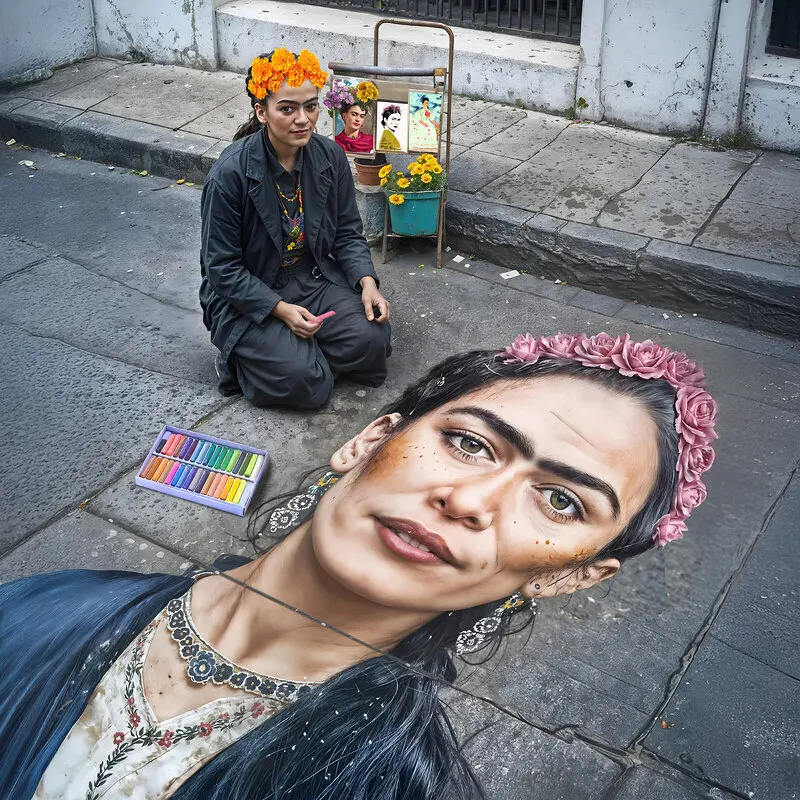
Jörgen Thornberg
A street painter with reputation, 2025
Digital
80 x 80 cm
2 900 kr
A street painter with reputation
This title encapsulates the essence of Frida Kahlo's street art project, a significant departure from her usual artistic medium and a testament to her reputation as a versatile and innovative artist. Known for her deeply personal and symbolic paintings, Frida had never ventured into large-scale murals or public artworks in her lifetime—those belonged to Diego’s domain. Yet, here she was, proving that artistic expression knows no boundaries.
With chalk, she transformed an empty street into her canvas, embracing the ephemeral nature of street art. Unlike her oil paintings, meant to endure, this creation would be at the mercy of the elements, washing away with the next rainfall. But that was precisely the point. “It was not about permanence—it was about presence.” It was about reclaiming space, making a statement, and, above all, proving to herself that her artistry could take any form she chose.
For Frida, the experience was as much an act of rebellion as it was an act of creation. And when the masterpiece was complete, she sat back, unbothered by its fleeting existence. “I have achieved what I set out to do,” she said with satisfaction. “What more can a woman ask for?”
Read on to explore Frida's painting on the street nearby.
‘‘From Caves to Streets—The Artist’s Hand
In the flickering firelight, hands pressed to stone,
Women’s touch carved history’s tone.
Red ochre whispers, fingers spread wide,
A mark of presence, of stories inside.
She painted the hunt, the stars, the rain,
Shapes in the dust, in blood and stain.
Not just a mother, not just a wife,
But an artist shaping the breath of life.
Through temples, courts and gilded halls,
Her brush defied the towering walls.
Le Brun’s face, soft yet grand,
Held power no king could command.
Through silent years, through stolen fame,
She signed with fire without a name.
They buried her voice, they erased her line,
Yet the colours bled through, bold and divine.
And now—on cracked asphalt at morning’s first light,
A woman bends low, her chalk burning bright.
With hands once bound, with feet once tied,
She paints her truth about where cars will ride.
A Sunday street, a fleeting trace,
A woman’s art, defying space.
The rain may come, the dust may claim,
But none will forget the artist’s name.
“Hit the wall, Banksy… Frida was here.”
Malmö, January 2025
A street painter with reputation
Life on Earth had been far too short for Frida to accomplish everything she had dreamed of. Painting herself on the street had long been a vision, a revelation that had now become a reality after all these years.
Slogans of protest and political or social commentary graffiti on walls are the precursor to modern graffiti and street art and continue as one genre aspect. Much of what is now defined as contemporary street art has well-documented origins dating from New York City's graffiti boom, its infancy in the 1960s, maturation in the 1970s, and peaking with the spray-painted full-car subway train murals of the 1980s centred in the Bronx. Despite her strong leftist sympathies, this was not the kind of art she had in mind—she sought her roots much further back in time.
It was a Sunday morning like any other, or so I thought. Then, out of the blue, Frida reached out to me with a surprising announcement. She was about to embark on her first street art project. The timing was deliberate, chosen to minimise foot traffic and maximise the impact of her creation.
Frida was known for her intimate and deeply personal works, often in smaller formats and with a profoundly autobiographical nature. Size had never been the defining factor in her depictions of pain, identity, feminism, and Mexican culture. But she had never worked with murals like Diego. Frida's paintings were relatively small compared to many other artists, especially in contrast to Diego's monumental murals. Her works were typically small to medium scale, which suited her working method, as she often painted from her bed or sat in a wheelchair due to her health problems. Crawling on the ground had been out of the question—she couldn't even sit directly on the floor.
She asked me to visit a worn-down industrial area on the city's outskirts. I had finished breakfast and some practical chores, so even though I hadn't planned an outing for the day, I promised to come as soon as possible. The car was parked in the building’s basement, as no buses were running to the industrial area on a Sunday morning.
It was a perfect day; it was overcast, but there was no rain. There she was, crawling around a portrait nearly three meters long. She hadn't been able to move like that since childhood when polio first struck her, and certainly not after the terrible bus accident. As a Time-traveller, she had left all ailments and pain behind on Earth, yet I was still surprised. She manoeuvred across the painting swiftly and nimbly like one of her beloved spider monkeys, picking up differently coloured pastel chalks from a small box she pushed along with her. A much younger street chalk artist wouldn't have been able to keep up with her movements.
What also struck me was that this morning, Frida had taken on the appearance of a much younger version of herself than I had previously met. This was no longer the forty-year-old woman, but rather the twenty-two-year-old who had married the twenty-years-older Diego Rivera in 1929. This younger form was probably not so much for the physical agility of crawling but rather to better think and feel as she had in her youth. For practical reasons, she was dressed in a loose blue suit that looked like it had been salvaged from a dumpster, but beneath it, she wore a brightly coloured vest. However, the portrait on the street depicted a more mature Frida Kahlo, more like the one I had been accustomed to seeing—an interesting contrast.
The image emerging on the street was not one of Frida’s best, but it was more than commendable for a first attempt. She must have started very early in the morning, for it was nearly finished by the time I arrived—ten hours in total.
It was a lot of effort for something so fleeting, something that could vanish within hours or, at best, last a few days. Many street artists, including Frida, use water-soluble paints or watercolor-based pigments to create artworks that intentionally disappear when it rains. This deliberate impermanence is part of an artistic philosophy where the passage of time becomes integral to the artwork, inviting contemplation on the nature of art and life.
"I belong to that category," Frida said. "I use water-soluble paints that wash away with the next rain. It’s both an aesthetic, philosophical, and environmentally friendly method—letting nature be part of the artwork and, for a moment, creating a new piece as the colours flow toward the gutter. It reflects human vanity and transformation in eternity."
Even though Frida herself never painted murals, her image has become one of the most frequently depicted figures in street art and graffiti today. Her face adorns walls across the world, from Mexico City to Berlin, often as a symbol of strength, resistance, and femininity.
"Expressing oneself publicly on streets and walls, on all kinds of empty surfaces just waiting to be filled, has deep historical roots. Mural painting, the more refined cousin of street art, is almost as old as humanity itself. Neanderthals, just like Homo sapiens, have left behind clear traces in caves, where their art has survived for tens of thousands of years," Frida said as we sat down next to the wall. I had brought a thermos of coffee and a few pastries.
"You should explain how you view street art," I said after pouring a cup of coffee into mugs I had bought at her exhibition. They had a laughing skull on the front, decorated with the same marigold flowers Frida often wore in her hair.
"Sure. Street art is artwork displayed in public on surrounding buildings, streets, trains, and other publicly viewed surfaces. Many instances are guerrilla art intended to make a personal statement about the society in which the artist lives. The practice has evolved from graffiti and vandalism to new modes where artists work to bring messages—or simply beauty—to an audience."
She paused to blow on her hot coffee before taking a sip.
"Some artists may use 'smart vandalism' to raise awareness of social and political issues, whereas others use urban space as an opportunity to display personal artwork. Artists may also appreciate the challenges and risks of installing illicit artwork in public places. A common motive is that creating art in a format that utilises public space allows artists who may otherwise feel disenfranchised to reach a much broader audience than traditional styles or gallery spaces would allow.
Whereas traditional graffiti artists have primarily used spray paint to produce their work, 'street art' can encompass a wide range of media, such as LED art, mosaic tiling, stencil graffiti, sticker art, reverse graffiti, 'Lock On' sculptures, wheat pasting, wood blocking, yarn bombing, and rock balancing.” She took a bite of the bun.
“New media forms, such as video projections onto large city buildings, have become increasingly popular tools for street artists. The availability of inexpensive hardware and software allows such artwork to compete with corporate advertisements. Artists can now create digital street art from their personal computers for free, challenging the dominance of commercial branding in public spaces.
In Latin America, especially in my dear Mexico, the term 'Antimonumento' has emerged as the equivalent of political guerrilla sculpture—essentially, an illegal installation of a politically themed sculpture.”
“In a way, you have already erected a statue of yourself,” I said teasingly. However, her statue as Pallas Athena in Malmö was created with the full support of the authorities. Usually, an ‘Antimonumento’ is installed during a demonstration, whereas her statue had only been met with cheers. It was part of the outdoor section of Frida’s retrospective exhibition and was left untouched for a month.
“One could say that,” she said, laughing. “The emergence of street art in Mexico began in the late 1980s in Mexico City, appearing inside multifamily buildings in the northern suburbs and the subway system. Since then, urban art and graffiti have become essential elements of cultural identity in various metropolis districts. Diego was immensely proud, as he could be considered one of its predecessors.”
“In the 2010s, London became one of the most pro-graffiti cities in the world. Although officially condemned and heavily policed, street art has garnered a massive following and is embraced by the public in various ways, such as Stik's iconic stick figures. Of course, one of the most famous examples is Banksy's 'Shop Until You Drop' in Mayfair, London. His politically subversive street art has appeared in the UK and worldwide. ‘Girl with a Balloon’ is one of Banksy's most iconic works, appearing in multiple versions. The original piece was painted on a wall in South Bank, London, in 2002, but no longer exists—it was brutally painted over. Considering the skyrocketing prices of Banksy’s artwork, this was an act of cultural vandalism worth millions. Last year, the artist inofficially authorised a large exhibition of Banksy's works in Malmö. At least he didn’t protest.
Frida leaned back against the wall and laughed. "You know, it all starts with the cave people! And don't tell me you don't have a little cave dweller inside you—we all do. Someone who wants to carve their name into a wall or leave a mark on time. That’s exactly what we’ve been doing for thousands of years."
She swept her hand through the air like a painting on an invisible canvas. "Look at the Chauvet Cave in France—our ancestors scribbled there 35,000 years ago. Okay, maybe they weren’t spraying their names in neon colours, but they painted animals, hunting scenes, and even their own hands. It was their way of saying, ‘We were here. We lived. We saw this.’ Is it so different from graffiti in a tunnel today?"
She leaned forward with a glint in her eye. "And then we have the ancient Egyptians. Do you think they carved hieroglyphs just for practical reasons? No, no, no! They were like the mural painters of their time. They told stories, marked power, and expressed their culture through images. And the Romans? They were our first street artists. Wall inscriptions in Pompeii—pure graffiti! People wrote their names, political slogans, and even love letters on the walls. Sound familiar?"
She took a sip of her coffee and continued, now more animated. "During the Renaissance, great mural painters emerged—Michelangelo and Giotto- and they certainly didn’t work on small canvases! The walls of churches became their city facades. Then we jump to the 20th century and Mexico. Diego—my Diego— and his friends Siqueiros and Orozco turned walls into political campaigns. Huge murals, big ideas, powerful movements! They wanted everyone to see and understand—just like street artists today."
She smiled and shook her head. "Then came 1970s New York. Spray cans started hissing, and graffiti was born as a movement—often illegal, always rebellious. Artists like Jean-Michel Basquiat and Keith Haring took art from the galleries and into the streets. In the 80s and 90s, stencil art and political messages became prominent—and we got names like Banksy and Shepard Fairey."
Frida leaned back again and looked upward as if she could see all these artists before her. "Humans have always wanted to leave their mark—from handprints in caves to murals in Mexico City and spray-painted subway cars. The technique has changed, but the desire to tell a story, express oneself, shout ‘I exist!’ remains the same."
She playfully pointed at me. "So, in one sentence: Graffiti, street art, and murals are our era’s cave paintings—just with more modern tools."
Frida laughed and shook her head. "And still, people claim that women can’t be great artists! As if it was ever about talent and not about opportunity. They say female artists haven’t had the same historical impact as men—but why do you think that is? Not because we weren’t capable but because we were held back. We weren’t even given the chance to create."
She shook her head, her eyes flashing with frustration. "Just look at how society worked for centuries. Women were expected to bear children, take care of the home, and live in the shadow of men. Without birth control, they were constantly pregnant, and many died in childbirth. The ones who still managed to break free and paint, write, compose—they had to fight ten times harder. And still, they succeeded! Look at Élisabeth Vigée Le Brun, for example. Look at Élisabeth Vigée Le Brun, for example. She defied every rule and became one of the greatest portrait painters of her time. As an artist, she was far greater than I was, but she was spared my suffering," Frida said, her voice suddenly hollow. I sensed that the subject of children was haunting her again. Every time she spoke of children, her unborn ones seemed to whisper through her thoughts, making her melancholic. But their resilience, their determination, is what we should remember. They fought and created despite the odds stacked against them."
"I think you're wrong about that," I countered. "Le Brun had less to say through her art. Her work reflected the upper class rather than herself. In that regard, you stand in a league of your own, Frida."
"Thank you for defending little me; that warms my heart," she smiled. Frida leaned back and tapped her fingers against the ground. "I have met Élizabeth and consider her a close friend and colleague. She painted over 660 portraits in her lifetime, plus around 200 other works, making her one of history's most prolific portrait painters. She is especially famous for her portraits of Marie Antoinette, painted while the queen still had her head, and for capturing the European aristocracy of the late 18th and early 19th centuries. Her style is elegant and lively, often conveying intimacy and naturalism, which broke with the rigid portrait traditions of her time. In that sense, we are alike, but I consider her the greatest of all time—the clearest proof that women are just as capable as men."
"Of course you are."
Frida spread her hands. "And now it turns out that many ancient handprints in caves—the very first artists—were women! It’s almost poetic. Women have been artists from the very beginning, yet people still try to write us out of history."
"How did researchers figure that out?" I asked, intrigued.
"By analysing the finger proportions in the cave paintings’ handprints! Men and women have different finger-length ratios. A woman’s ring finger is usually shorter than her index finger, while a man's is longer. By comparing these handprints with modern hands, scientists have determined that women made many of these paintings."
She took another sip of her coffee. "And that makes it even more interesting. For thousands of years, we’ve been told that men excel at art and that the great masters have always been men. But in reality, the first artists were women! How does it feel knowing all of art history needs rewriting? It's time to reevaluate, to dig deeper, and to give credit where it's due. It's time to acknowledge the true pioneers of art."
She smiled, but it was a defiant smile. "And walls—that’s where we end up again. Murals. Street art. Graffiti. Art on walls, streets, and public spaces. We women have always been there, always part of art. They wanted to limit us, lock us in, keep us at home—but we always found a way to break free.
And now, it's time to ensure no one ever questions us again."
"I might just hitch a ride with you," Frida said. "The next low-pressure system can handle the cleanup for me. It's supposed to rain heavily by evening, and I've achieved what I wanted—to prove to myself that I can master Street Art, too. What more can a woman ask for?" she said rhetorically.
She gathered her chalks and packed them back into the little carrying stand she had brought along, complete with a pot of marigolds. I snapped a picture of her and her masterpiece, and then we drove back toward the city centre.
2 900 kr

Jörgen Thornberg
Malmö
Lite om bilder och mig. Translation in English at the end.
Jag är en nyfiken person som ser allt i bilder, även det jag fäster i ord, gärna tillsammans för bakom alla mina bilder finns en berättelse. Till vissa bilder hör en kortare eller längre novell som följer med bilden.
Bilder berättar historier. Jag omges av naturlig skönhet, intressanta människor och historia var jag än går. Jag använder min kamera för att dokumentera världen och blanda det jag ser med vad jag känner för att fånga den dolda magin.
Mina bilder berättar mina historier. Genom mina bilder, tryck och berättelser. Jag bjuder in dig att ta del av dessa berättelser, in i ditt liv och hem och dela min mycket personliga syn på vår värld. Mer än vad ögat ser. Jag tänker i bilder, drömmer och skriver och pratar om dem; följaktligen måste jag också skapa bilder. De blir vad jag ser, inte nödvändigtvis begränsade till verkligheten. Det finns en bild runt varje hörn. Jag hoppas att du kommer att se vad jag såg och gilla det.
Jag är också en skrivande person och till många bilder hör en kortare eller längre essay. Den följer med tavlan, tryckt på fint papper och med en personlig hälsning från mig.
Flertalet bilder startar sin resa i min kamera. Enkelt förklarat beskriver jag bilden jag ser i mitt inre, upplevd eller fantiserad. Bilden uppstår inom mig redan innan jag fått okularet till ögat. På bråkdelen av ett ögonblick ser jag vad jag vill ha och vad som kan göras med bilden. Här skall jag stoppa in en giraff, stålmannen, Titanic eller vad det är min fantasi finner ut. Ännu märkligare är att jag kommer ihåg minnesbilden långt efteråt när det blir tid att skapa verket. Om jag lyckas eller inte, är upp till betraktaren, oftast präglat av en stråk av svart humor – meningen är att man skall bli underhållen. Mina bilder blir ofta en snackis där de hänger.
Jag föredrar bilder som förmedlar ett budskap i flera lager. Vid första anblicken fylld av feel-good, en vacker utsikt, fint väder, solen skiner, blommor på ängen eller vattnet som ligger förrädiskt spegelblankt. I en sådan bild kan jag gömma min egentliga berättelse, mitt förakt för förtryckare och våldsverkare, rasister och fördomsfulla människor - ett gärna återkommande motiv mer eller mindre dolt i det vackra motivet. Jag försöker förena dem i ett gemensamt narrativ.
Bild och formgivning har löpt som en röd tråd genom livet. Fotokonst känns som en värdig final som jag gärna delar med mig.
Min genre är vid som framgår av mina bilder, temat en blandning av pop- och gatukonst i kollage som kan bestå av hundratals lager. Vissa bilder kan ta veckor, andra någon dag innan det är dags att överlämna resultatet till printverkstaden. Fine Art Prints är digitala fotocollage. I dessa kollage sker rivandet, klippandet, pusslandet, målandet, ritandet och sprayningen digitalt. Det jag monterar in kan vara hundratals år gamla bilder som jag omsorgsfullt frilägger så att de ser ut att vara en del av tavlan men också bilder skapade av mig själv efter min egen fantasi. Därefter besöks printstudion och för vissa bilder numrera en limiterad upplaga (oftast 7 exemplar) och signera för hand. Vissa bilder kan köpas i olika format. Det är bara att fråga efter vilka. Gillar man en bild som är 70x100 men inte har plats på väggen, går den kanske att få i 50x70 cm istället. Frågan är fri.
Metoden Giclée eller Fine Art Print som det också kallas är det moderna sättet för framställning av grafisk konst. Villkoret för denna typ av utskrifter är att en högkvalitativ storformatskrivare används med åldersbeständigt färgpigment och konstnärspapper eller i förekommande fall på duk. Pappret som används möter de krav på livslängd som ställs av museer och gallerier. Normalt säljer jag mina bilder oinramade så att den nya ägaren själv kan bestämma hur de skall se ut, med eller utan passepartout färg på ram, med eller utan glas etc..
Under många år ställde jag bara ut på nätet, i valda grupper och på min egen Facebooksida - https://www.facebook.com/jorgen.thornberg.9
Jag finns också på en egen hemsida som tyvärr inte alltid är uppdaterad – https://www.jth.life/ Där kan du också läsa en del av de berättelser som följer med bilden.
UTSTÄLLNINGAR
Luftkastellet, oktober 2022
Konst i Lund, november 2022
Luftkastellet, mars 2023
Engleson Galleri Caroli, april 2023
Hydra, Greece June 2023
Engleson Galleri Caroli, oktober 2023
Toppen, Höllviken december 2023
Luftkastellet, mars 2024
Torups Galleri, mars 2024
Venice, May 2024
Luftkastellet, oktober 2024
Konst i Advent, December 2024
Galleri Engleson, Caroli December 2024
Jäger & Jansson Galleri, april 2025
A bit about pictures and me.
I'm a curious person who sees everything in pictures, even what I express in words, often combining them, for behind all my pictures lies a story. These narratives, some as short as a single image and others as long as a novel, are the heart and soul of my work.
Pictures tell stories. Wherever I go, I'm surrounded by natural beauty, exciting people, and history. I use my camera to document the world and blend what I see with what I feel to capture the hidden magic.
My images tell my stories. Through my pictures, prints, and narratives, I invite you to partake in these stories in your life and home and share my deeply personal perspective of our world. More than meets the eye. I think in pictures, dream, write, and talk about them; consequently, I must create images too. They become what I see, not necessarily confined to reality. There's a picture around every corner. I hope you'll see what I saw and enjoy it.
I'm also a writer, and many images come with a shorter or longer essay. It accompanies the painting, printed on fine paper with my personal greeting.
Many pictures start their journey on my camera. Simply put, I describe the image I see in my mind, experienced or imagined. The image arises within me even before I bring the eyepiece to my eye. In a fraction of a moment, I see what I want and what can be done with the picture. Here, I'll insert a giraffe, Superman, the Titanic, or whatever my imagination conjures up. Even stranger is that I remember the mental image long after it's time to create the work. Whether I succeed is up to the observer, often imbued with a streak of black humour – the aim is to entertain. My pictures usually become a talking point wherever they hang.
I prefer pictures that convey a message in multiple layers. At first glance, they're filled with feel-good vibes, a beautiful view, lovely weather, the sun shining, flowers in the meadow, or the water lying deceptively calm. But beneath this surface beauty, I often conceal a deeper story, a narrative that challenges societal norms or explores the human condition. I invite you to delve into these hidden narratives and discover the layers of meaning within my work.
Picture and design have been a thread running through my life. Photographic art feels like a fitting finale, and I'm happy to share it.
My genre is varied, as seen in my pictures; the theme is a blend of pop and street art in collages that can consist of hundreds of layers. Some images can take weeks, others just a day before it's time to hand over the result to the print workshop. Fine Art Prints are digital photo collages. In these collages, tearing, cutting, puzzling, painting, drawing, and spraying happen digitally. What I insert can be images hundreds of years old that I carefully extract so they appear to be part of the painting, but also images created by myself, now also generated from my imagination. Next, visit the print studio and, for certain images, number a limited edition (usually 7 copies) and sign them by hand. Some images may be available in other formats. Just ask which ones. If you like an image that's 70x100 but doesn't have space on the wall, you might be able to get it in 50x70 cm instead. The question is open.
The Giclée method, or Fine Art Print as it's also called, is the modern way of producing graphic art. This method ensures the highest quality and longevity of the artwork, using a high-quality large-format printer with archival pigment inks and artist paper or, in some cases, canvas. The paper used meets the longevity requirements set by museums and galleries. I sell my pictures unframed, allowing the new owner to personalise their artwork, confident in the lasting value and quality of the piece.
For many years, I only exhibited online, in selected groups, and on my Facebook page - https://www.facebook.com/jorgen.thornberg.9. I also have my website, which unfortunately is not constantly updated - https://www.jth.life/. You can also read some of the stories accompanying the pictures there.
EXHIBITIONS
Luftkastellet, October 2022
Art in Lund, November 2022
Luftkastellet, March 2023
Engleson Gallery Caroli, April 2023
Hydra, Greece June 2023
Engleson Gallery Caroli, October 2023
Toppen, Höllviken December 2023
Luftkastellet, March 2024
Torup Gallery, March 2024
Venice, May 2024
UTSTÄLLNINGAR
Luftkastellet, oktober 2022
Konst i Lund, november 2022
Luftkastellet, mars 2023
Engleson Galleri Caroli, april 2023
Hydra, Greece June 2023
Engleson Galleri Caroli, oktober 2023
Toppen, Höllviken december 2023
Luftkastellet, mars 2024
Torups Galleri, mars 2024
Venice, May 2024
Luftkastellet, October 2024
Konst i Advent, December 2024
Galleri Engleson, Caroli December 2024
Jäger & Jansson Galleri, April 2025
Utbildning
Autodidakt
Medlem i konstnärsförening
Öppna Sinnen
Med i konstrunda
Konstrundan i Skåne
Utställningar
Luftkastellet, October 2022
Art in Lund, November 2022
Luftkastellet, March 2023
Engleson Gallery Caroli, April 2023
Hydra, Greece June 2023
Engleson Gallery Caroli, October 2023
Toppen, Höllviken December 2023
Luftkastellet, March 2024
Torup Gallery, March 2024
Venice, May 2024