Vi använder cookies för att ge dig bästa möjliga upplevelse. Välj vilka cookies du tillåter.
Läs mer i vår integritetspolicy
Jörgen Thornberg
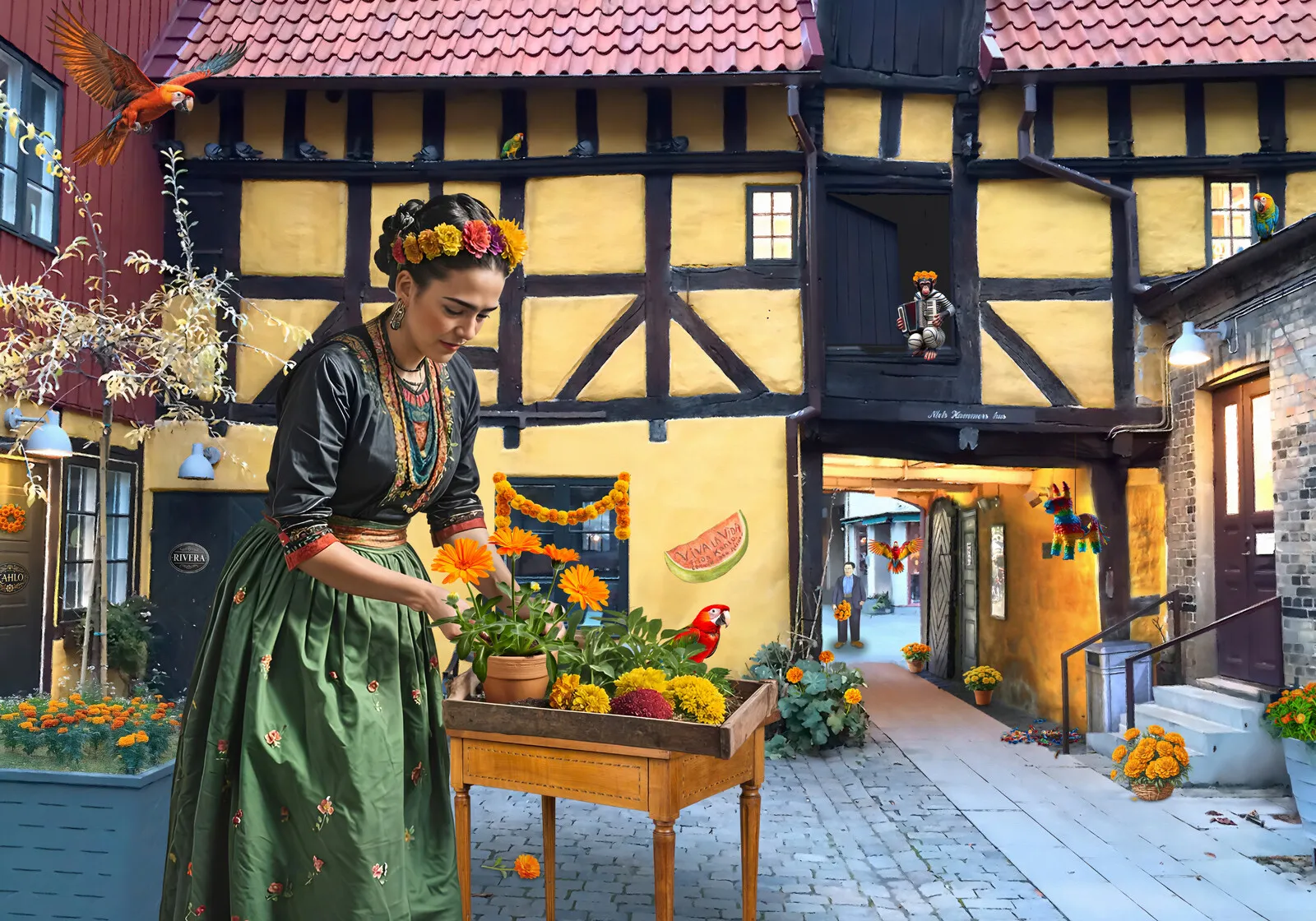
Frida planting Marigolds, 2025
Digital
100 x 70 cm
5 200 kr
Frida planting Marigolds
Frida Planting Marigolds
When Frida Kahlo throws a party, the boundaries of time, space, and logic dissolve. The grand celebration that overtook the city centre wasn’t just a local affair; it became a cosmic gathering of epic proportions. Over a hundred celestial guests came from outer space, mingling with earthly revellers in a record-breaking ring dance. Among the eclectic crowd were two repentant former popes, three reformed prophets, an apologetic surgeon, and even Leon Trotsky, rekindling old camaraderie. Not to be outdone, Buddha himself graced the event, embodying his reputation as a cosmic bon vivant. Stalin’s attempt to crash the party ended with him being unceremoniously ejected by two retired wrestling champions. It was, quite literally, a festivity for the ages—and possibly the universe. The sheer grandeur of the event left all who witnessed it in awe, a testament to Frida's unparalleled ability to bring together the most unlikely of guests.
Please read on and uncover the Intriguing Secrets of Frida's big welcome party and the Inspiring Transformative Power of Marigolds.
“Frida’s Cosmic Fiesta
In Skåne’s heart, where the winds do play,
Frida Kahlo threw a bash one fateful day.
Not just any party, oh no, my friend,
This was a blowout with no earthly end.
From Malmö to Andromeda, the invite was sent,
Even Buddha himself knew what it meant.
With tequila rivers and steady rum streams,
It was a fiesta beyond your wildest dreams.
The city square lit up with delight,
As ring dances spun through the starry night.
Three thousand danced, their laughter roared,
With a hundred Time-travellers joining the horde.
Two former popes raised their holy cheer,
While Trotsky clinked mezcal with a pioneer.
Stalin tried to sneak past the cosmic guards,
But was flung to the curb by wrestling stars.
Her surgeon came, forgiven at last,
For the leg he took from Frida’s past.
Dear old Leon and Frida exchanged sly grins,
As her exes compared who’d committed most sins.
Marigolds adorned her braided crown,
While Buddha toasted, dressed in a cosmic gown.
He winked at Frida, his glass in the air,
“No gods, no rules—just love to spare!”
The Piñatas burst with candy and light,
As Mariachi bands played into the night.
On yellow walls, her art shone bold,
“Viva la Vida!” in melon’s red and gold.
When morning came, the streets still sang,
With echoes of joy as church bells rang.
Skåne will never forget that spree,
The most incredible crush in all history.
Epilogue Verse
If your head doesn't ache, my friend, by dawn,
After this grand bash, where no limits were drawn,
Then you have no head; that much is clear,
Or you dwell in eternity, far from here.”
Malmö. January 2025
Frida Planting Marigolds
Frida had decided that living out of a suitcase wasn’t for her, not even in the charming hotels of Malmö. Her successful performances at Nöjesteatern had led to an engagement in a new play, and she wanted a proper home base. It was an easy fix: a historic timber-framed house next to Lilla Torg. The house had character, charm, and just enough space for Frida and her ever-growing entourage of parrots—immortal creatures just like her. Moving across the cosmos with her favourite bureau and dozens of trunks full of treasures, trinkets, and “just-in-case” items required using wormholes. These celestial shortcuts allowed for superluminal travel, perfect for hauling one’s essentials 36 light-years. Among her prized possessions were artefacts she had owned on Earth, which she had “borrowed” from the descendants and museums after her death. She left convincing replicas behind, sparing her fans the shock of finding exhibits suddenly empty.
Of course, she brought Diego. Still very much her eternal love and eternal roommate—though their relationship had always thrived on a bit of distance—Diego lived across the courtyard in his quarters. For an immortal couple with strong personalities, separate homes were the secret to harmonious eternity.
Once the move was complete, it was time to celebrate. And in Mexico, you don’t throw a polite little housewarming; you throw a fiesta to remember—or, if you live forever, one that might last an eternity. For a proud Mexican like Frida, the idea of a quiet, restrained Swedish-style gathering with symbolic gestures like salt and bread was laughable. “No, gracias,” she’d say. Instead, she and her guests embraced a mix of Mexican and cosmic traditions, with a bit of Skåne flair thrown in for good measure.
The festivities began with the symbolic blessing of the house, a tradition Frida, having transcended earthly concerns, wasn’t particularly interested in. Still, her guests played along, holding cocktails in one hand while nodding solemnly at traditions they didn’t entirely understand. Back on Earth, a Catholic priest might have sprinkled holy water and prayed for the home’s prosperity. But in Malmö, the “priest” is a nod to the Swedish tradition of snaps and "Helan Går, "Sweden's holiest song-improvised by sprinkling snaps in the corners and belting out a raucous rendition. This was a playful blend of Swedish and Mexican traditions, a reflection of Frida’s unique cultural identity.
Salt and bread, traditional symbols of nourishment and protection, were placed on a small table near the courtyard. While these offerings were standard in Swedish and Mexican cultures, they quickly became overshadowed by the real centrepiece of the celebration: a towering buffet of Mexican cuisine. Frida had ensured the spread was free of Swedish oddities like pickled herring, jellied eels, or liver pâté. Instead, the guests feasted on:
Tamales are corn dough filled with savoury meats or sweet fillings, wrapped in corn husks, and steamed.
Pozole is a rich, hearty soup made with hominy, pork, or chicken and garnished with lime, radishes, and lettuce.
- Mole poblano: A complex, spicy chocolate sauce poured over the tender chicken.
- Tacos al pastor: Marinated pork cooked on a spit and served on soft corn tortillas with pineapple, cilantro, and onions.
Chiles en nogada are poblano peppers stuffed with spiced meat and topped with walnut cream sauce and pomegranate seeds.
- Cochinita pibil: Slow-roasted pork marinated in citrus and achiote, served with pickled onions and fresh tortillas.
- Elote: Grilled corn smothered in lime, chilli powder, mayonnaise, and cheese.
- Guacamole: Creamy avocado dip with hints of lime, cilantro, and jalapeño.
Drinks flowed freely. While there was beer and wine for the faint of heart, the bar’s centrepiece was tequila and mezcal, served with abundant fresh lime wedges and salt. Frida was known for her love of tequila, and her reputation preceded her here. Like black holes, time travellers seemed bottomless, able to drink without ever showing the effects, and Frida needed no additional proof of her prowess.
Throughout the house and courtyard, Frida hung Milagros—small metal charms shaped like hearts, crosses, and other symbols. Some were cheeky, like tiny phalluses, said to bestow blessings of a different sort. A former pope, now a cosmic resident, even offered his champagne blessing over the guests and the home, marking the official start of the fiesta.
The guest list was as eclectic as the party itself. Alongside the Nöjesteatern ensemble were Malmö’s cultural elite, artists, writers, and curious passersby from Lilla Torg, drawn in by the music and laughter. The Mexican diaspora turned out in full force, bringing their energy to the celebration. Soon, the festivities spilt into the square, transforming it into an impromptu dance floor.
In the soft glow of candlelight, the celebration stretched on. Frida, a vision in a colourful Tehuana dress with marigolds in her hair, held the court at the centre of it all. She shared stories of life and death, art and eternity, and toasted with her guests to new beginnings—even in the timeless expanse of the cosmos. The stars above, the marigolds below, and the laughter echoing through the courtyard made it clear: Frida was home.
Many of the guests arrived bearing gifts for Frida's new home. Some, unaware exiled Mexicans, brought religious artefacts like an image of the Virgin of Guadalupe—a mestizo girl who, judging by her expression, hadn’t had much fun in life. "Dying a virgin must be dreadful," someone muttered. Others brought depictions of Jesus suffering on the cross, a sure way to dampen any festive mood. The more practical guests opted for kitchen tools, although Frida's kitchen was already fully equipped. Luckily, the local Salvation Army was not far away, and while Frida wasn't religious, she had a good heart.
One hundred and twenty-six corkscrews, heaps of dish towels, and countless small kitchen gadgets piled up—practical gifts, yet redundant, as multiple guests had the same idea. Then there were the dreadful ornaments: tiny sculptures, eerie paintings, or unimaginative decorations. Though typical, these gifts were not always to the recipient’s taste and often gathered dust in a cupboard—or, in Frida’s case, forwarded to the Salvation Army. According to reports, these donations raised over one hundred thousand pesos, helping what the charity solemnly referred to as “the unfortunate of society.” Outside on Lilla Torg, the city’s homeless had already been treated to lobster soup and champagne. If you’re wondering what became of the Virgin and all the Jesuses, they were shipped back to Mexico, where there are still plenty of believers to appreciate such things.
As part of the housewarming celebration, Frida arranged for a local priest to perform a spiritual cleansing ritual called ‘Limpia’. With his copal incense or sage, the priest embarked on a mission to banish any lingering negative energy and evil spirits from the house. This ancient ritual, deeply rooted in Mexican culture, was a testament to the spiritual traditions observed during such occasions. By the end of the ritual, the house was believed to be free of any malevolent presence, adding a profound spiritual dimension to the celebration. “Holy smoke”, Frida exclaimed, but it shouldn’t be taken literally.
A dozen ‘Piñatas’ hung across the courtyard, a sight that brought pure delight to the children present. Their eyes sparkled with excitement as they eagerly awaited their turn to smash the colourful containers open. One piñata remained dangling in the doorway, emptied of its sweets, colourful paper and candy wrappers scattered below. A piñata, often made of papier-mâché, straw, cloth, or clay, is traditionally filled with candy and smashed open as part of a celebration.
To avoid unsettling the earthly mortals, Frida also set up an ‘altar de Bienvenida’, a welcome altar featuring an image of a saint—in this case, Frida herself. She adorned it with extra flowers in her hair, fresh marigolds, and fragrant candles to signify the home’s spiritual presence. This altar, a common feature in Mexican households, was a way to welcome positive energy and protect the house from negative influences.
Some guests brought symbolic plants like cacti, basil, or aloe vera, which are believed to protect against harmful energies and bring good fortune. The following day, Frida planted everything in Slottsparken, where the plants could likely thrive through the summer—provided the weather didn’t turn too cold. As for the city’s head gardener, who attended along with the mayor, we can only imagine his thoughts about this impromptu landscaping project. The mayor, a Social Democrat, got along well with Frida, a staunch Communist—both groups are known for their lavish celebrations, often funded by the wealthy. In Frida’s case, as with all Time-travellers, she brought freshly printed banknotes from above, so expertly crafted that not even the central bank’s chief could tell the difference.
One might think Time-travellers would face difficulties in a society moving toward cashless transactions. Not at all. Despite frequent use, their plastic cards were linked to the central bank and didn’t contribute to inflation. When Time-travellers negotiated contracts, they avoided the pitfall of choosing the cheapest option. Instead, they sought the most spectacular and extravagant arrangements. It is no wonder that Frida and her kind were beloved by guests and vendors alike.
After the meal, it was time for music and dancing. The air was filled with the vibrant sounds of traditional Mexican styles like Mariachi and Ranchera, spreading joy and energy. The festivities spilled across Lilla Torg, along Baltzarsgatan, and all the way to Södergatan. Dancing broke out everywhere as the lively music captivated everyone, creating a jubilant and vibrant atmosphere. The final ring dance stretched around the entire city centre, almost sure to land in the Guinness World Records—especially considering that, out of the three thousand dancers, more than a hundred had travelled from outer space to join this celebration of celebrations. Among them were two former popes who had made their apologies, three ex-prophets, Leon Trotsky making an appearance for old friendship’s sake, four former girlfriends, a dozen male lovers, the surgeon who had amputated Frida's leg (now forgiven), and Stalin, who had tried to crash the party but was promptly thrown out by two former catch-as-catch-can champions who regularly helped keep outer space free from trash like the old Russian dictator. Perhaps the most notable guest was Buddha, widely known as a real party enthusiast. Frida had first met him at a love symposium on Sirius. Buddha had earned her respect because, during his earthly life, he preached love instead of religion. Since his teachings lacked any notion of a deity, no Buddhists felt disappointed when they arrived among the stars.
In short, moving into a new home in Mexico is more than a practical event—it’s a spiritual and social ceremony marking a new beginning. Now, the people of Skåne know this, too.
In the doorway hung a battered piñata, its candy gone, leaving colourful scraps of paper and wrappers scattered on the ground. Frida, covered in soil, replanted some of the many marigolds she’d received. From a small nook above, the sound of an accordion floated down. Simon, the monkey, had travelled with Frida from her star. He was a maestro of Norteño and Tejano music—the former a fitting choice for the occasion. Prevalent in northern Mexico and border regions, Norteño often tells tales of love, betrayal, adventure, and even smuggling culture. Its polka-like rhythms danced in pairs, making Frida’s legs twitch excitedly, flinging dirt around her.
Tejano, a similar genre influenced by American rock, blues, and country, added a contemporary touch. While the accordion may not be the first instrument one associates with Mexico—guitars, mariachi trumpets, and vihuelas are more iconic—it has become a vital part of festive occasions. Introduced to Mexico in the 19th century by German and Czech immigrants, who brought their instruments and dances like polka, waltz, and schottische, the accordion blended seamlessly with local traditions to create unique hybrids. Frida’s father, Guillermo Kahlo, was born Wilhelm Kahlo in Germany, which was why the accordion had a place in Frida’s life, adding a unique twist to the celebration.
Malmö Opera presented a short opera with Mexican connections to honour the evening. While there aren’t many operas set in Mexico, a few works touch on Mexican themes or influences. They chose ‘La Llorona for the occasion, based on the famous Mexican legend of the Weeping Woman who lost her children and wandered as a ghost searching for them. Though filled with Mexican folklore and powerful emotions of guilt, loss, and revenge, it was deemed too sorrowful for the celebration. Instead, they returned to 1733 and Antonio Vivaldi’s ‘Montezuma’. Long considered lost, the recently rediscovered score and libretto allowed this special tribute to Frida. Unlike the real Montezuma’s tragic fate during the Spanish conquest of Mexico, the opera has a happy ending and is well-received by the guests.
Sceptics may wonder how so many people fit into one space. By earthly standards, they didn’t. But the old saying holds in the boundless expanse of eternity and the limitless reality of imagination: “Where there’s heart room, there’s space enough.” And so, the thousands of Earthlings who joined Frida barely felt crowded, though some likely had splitting headaches the next day.
The story ends with ‘Viva La Vida’, which Frida had painted on one of the yellow half-timbered walls of her new home. ‘Viva la Vida, Watermelons’ was Frida’s final painting. A vibrant farewell to her life, it showcased rich colours, curves, and angles, leaving one last message from the artist herself. Just eight days before departing Earth in 1954, Frida inscribed “Viva la Vida” on the central melon wedge. It was both a simple statement and an ironic commentary on her pain-filled existence. Now, it symbolised her liberation in eternity—free from earthly pains and with her lost leg restored.
For so it works: when one leaves Earth, all physical imperfections are left behind, taking only the soul. One’s appearance becomes a choice. Most, like Frida, select the version of themselves they deem most beautiful and brilliant, often in their forties. That’s how we encounter them on Earth, though unrecognisable to most—except a rare few like me. That is why I can share how it truly is, why someone you think you know but cannot place might be your father, mother, or departed spouse. It’s a well-designed system, sparing Earthlings from hysteria and ensuring a smooth visit for Time-travellers.
Jörgen Thornberg
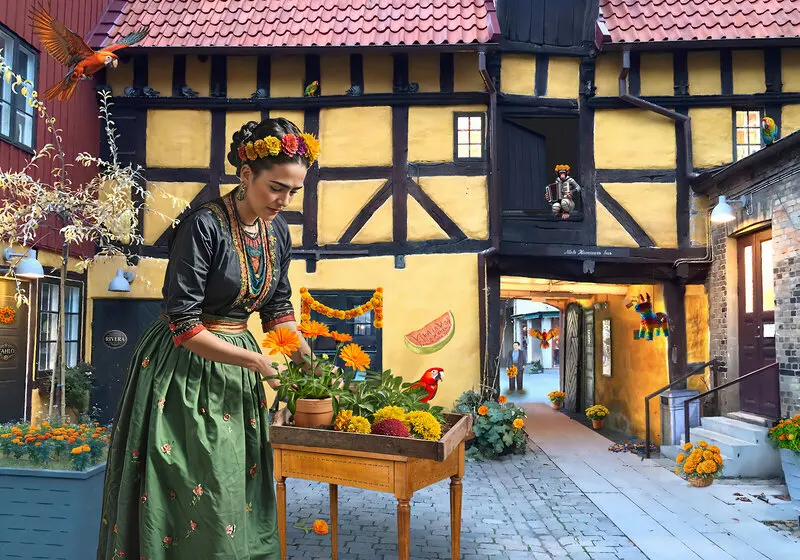
Frida planting Marigolds, 2025
Digital
100 x 70 cm
5 200 kr
Frida planting Marigolds
Frida Planting Marigolds
When Frida Kahlo throws a party, the boundaries of time, space, and logic dissolve. The grand celebration that overtook the city centre wasn’t just a local affair; it became a cosmic gathering of epic proportions. Over a hundred celestial guests came from outer space, mingling with earthly revellers in a record-breaking ring dance. Among the eclectic crowd were two repentant former popes, three reformed prophets, an apologetic surgeon, and even Leon Trotsky, rekindling old camaraderie. Not to be outdone, Buddha himself graced the event, embodying his reputation as a cosmic bon vivant. Stalin’s attempt to crash the party ended with him being unceremoniously ejected by two retired wrestling champions. It was, quite literally, a festivity for the ages—and possibly the universe. The sheer grandeur of the event left all who witnessed it in awe, a testament to Frida's unparalleled ability to bring together the most unlikely of guests.
Please read on and uncover the Intriguing Secrets of Frida's big welcome party and the Inspiring Transformative Power of Marigolds.
“Frida’s Cosmic Fiesta
In Skåne’s heart, where the winds do play,
Frida Kahlo threw a bash one fateful day.
Not just any party, oh no, my friend,
This was a blowout with no earthly end.
From Malmö to Andromeda, the invite was sent,
Even Buddha himself knew what it meant.
With tequila rivers and steady rum streams,
It was a fiesta beyond your wildest dreams.
The city square lit up with delight,
As ring dances spun through the starry night.
Three thousand danced, their laughter roared,
With a hundred Time-travellers joining the horde.
Two former popes raised their holy cheer,
While Trotsky clinked mezcal with a pioneer.
Stalin tried to sneak past the cosmic guards,
But was flung to the curb by wrestling stars.
Her surgeon came, forgiven at last,
For the leg he took from Frida’s past.
Dear old Leon and Frida exchanged sly grins,
As her exes compared who’d committed most sins.
Marigolds adorned her braided crown,
While Buddha toasted, dressed in a cosmic gown.
He winked at Frida, his glass in the air,
“No gods, no rules—just love to spare!”
The Piñatas burst with candy and light,
As Mariachi bands played into the night.
On yellow walls, her art shone bold,
“Viva la Vida!” in melon’s red and gold.
When morning came, the streets still sang,
With echoes of joy as church bells rang.
Skåne will never forget that spree,
The most incredible crush in all history.
Epilogue Verse
If your head doesn't ache, my friend, by dawn,
After this grand bash, where no limits were drawn,
Then you have no head; that much is clear,
Or you dwell in eternity, far from here.”
Malmö. January 2025
Frida Planting Marigolds
Frida had decided that living out of a suitcase wasn’t for her, not even in the charming hotels of Malmö. Her successful performances at Nöjesteatern had led to an engagement in a new play, and she wanted a proper home base. It was an easy fix: a historic timber-framed house next to Lilla Torg. The house had character, charm, and just enough space for Frida and her ever-growing entourage of parrots—immortal creatures just like her. Moving across the cosmos with her favourite bureau and dozens of trunks full of treasures, trinkets, and “just-in-case” items required using wormholes. These celestial shortcuts allowed for superluminal travel, perfect for hauling one’s essentials 36 light-years. Among her prized possessions were artefacts she had owned on Earth, which she had “borrowed” from the descendants and museums after her death. She left convincing replicas behind, sparing her fans the shock of finding exhibits suddenly empty.
Of course, she brought Diego. Still very much her eternal love and eternal roommate—though their relationship had always thrived on a bit of distance—Diego lived across the courtyard in his quarters. For an immortal couple with strong personalities, separate homes were the secret to harmonious eternity.
Once the move was complete, it was time to celebrate. And in Mexico, you don’t throw a polite little housewarming; you throw a fiesta to remember—or, if you live forever, one that might last an eternity. For a proud Mexican like Frida, the idea of a quiet, restrained Swedish-style gathering with symbolic gestures like salt and bread was laughable. “No, gracias,” she’d say. Instead, she and her guests embraced a mix of Mexican and cosmic traditions, with a bit of Skåne flair thrown in for good measure.
The festivities began with the symbolic blessing of the house, a tradition Frida, having transcended earthly concerns, wasn’t particularly interested in. Still, her guests played along, holding cocktails in one hand while nodding solemnly at traditions they didn’t entirely understand. Back on Earth, a Catholic priest might have sprinkled holy water and prayed for the home’s prosperity. But in Malmö, the “priest” is a nod to the Swedish tradition of snaps and "Helan Går, "Sweden's holiest song-improvised by sprinkling snaps in the corners and belting out a raucous rendition. This was a playful blend of Swedish and Mexican traditions, a reflection of Frida’s unique cultural identity.
Salt and bread, traditional symbols of nourishment and protection, were placed on a small table near the courtyard. While these offerings were standard in Swedish and Mexican cultures, they quickly became overshadowed by the real centrepiece of the celebration: a towering buffet of Mexican cuisine. Frida had ensured the spread was free of Swedish oddities like pickled herring, jellied eels, or liver pâté. Instead, the guests feasted on:
Tamales are corn dough filled with savoury meats or sweet fillings, wrapped in corn husks, and steamed.
Pozole is a rich, hearty soup made with hominy, pork, or chicken and garnished with lime, radishes, and lettuce.
- Mole poblano: A complex, spicy chocolate sauce poured over the tender chicken.
- Tacos al pastor: Marinated pork cooked on a spit and served on soft corn tortillas with pineapple, cilantro, and onions.
Chiles en nogada are poblano peppers stuffed with spiced meat and topped with walnut cream sauce and pomegranate seeds.
- Cochinita pibil: Slow-roasted pork marinated in citrus and achiote, served with pickled onions and fresh tortillas.
- Elote: Grilled corn smothered in lime, chilli powder, mayonnaise, and cheese.
- Guacamole: Creamy avocado dip with hints of lime, cilantro, and jalapeño.
Drinks flowed freely. While there was beer and wine for the faint of heart, the bar’s centrepiece was tequila and mezcal, served with abundant fresh lime wedges and salt. Frida was known for her love of tequila, and her reputation preceded her here. Like black holes, time travellers seemed bottomless, able to drink without ever showing the effects, and Frida needed no additional proof of her prowess.
Throughout the house and courtyard, Frida hung Milagros—small metal charms shaped like hearts, crosses, and other symbols. Some were cheeky, like tiny phalluses, said to bestow blessings of a different sort. A former pope, now a cosmic resident, even offered his champagne blessing over the guests and the home, marking the official start of the fiesta.
The guest list was as eclectic as the party itself. Alongside the Nöjesteatern ensemble were Malmö’s cultural elite, artists, writers, and curious passersby from Lilla Torg, drawn in by the music and laughter. The Mexican diaspora turned out in full force, bringing their energy to the celebration. Soon, the festivities spilt into the square, transforming it into an impromptu dance floor.
In the soft glow of candlelight, the celebration stretched on. Frida, a vision in a colourful Tehuana dress with marigolds in her hair, held the court at the centre of it all. She shared stories of life and death, art and eternity, and toasted with her guests to new beginnings—even in the timeless expanse of the cosmos. The stars above, the marigolds below, and the laughter echoing through the courtyard made it clear: Frida was home.
Many of the guests arrived bearing gifts for Frida's new home. Some, unaware exiled Mexicans, brought religious artefacts like an image of the Virgin of Guadalupe—a mestizo girl who, judging by her expression, hadn’t had much fun in life. "Dying a virgin must be dreadful," someone muttered. Others brought depictions of Jesus suffering on the cross, a sure way to dampen any festive mood. The more practical guests opted for kitchen tools, although Frida's kitchen was already fully equipped. Luckily, the local Salvation Army was not far away, and while Frida wasn't religious, she had a good heart.
One hundred and twenty-six corkscrews, heaps of dish towels, and countless small kitchen gadgets piled up—practical gifts, yet redundant, as multiple guests had the same idea. Then there were the dreadful ornaments: tiny sculptures, eerie paintings, or unimaginative decorations. Though typical, these gifts were not always to the recipient’s taste and often gathered dust in a cupboard—or, in Frida’s case, forwarded to the Salvation Army. According to reports, these donations raised over one hundred thousand pesos, helping what the charity solemnly referred to as “the unfortunate of society.” Outside on Lilla Torg, the city’s homeless had already been treated to lobster soup and champagne. If you’re wondering what became of the Virgin and all the Jesuses, they were shipped back to Mexico, where there are still plenty of believers to appreciate such things.
As part of the housewarming celebration, Frida arranged for a local priest to perform a spiritual cleansing ritual called ‘Limpia’. With his copal incense or sage, the priest embarked on a mission to banish any lingering negative energy and evil spirits from the house. This ancient ritual, deeply rooted in Mexican culture, was a testament to the spiritual traditions observed during such occasions. By the end of the ritual, the house was believed to be free of any malevolent presence, adding a profound spiritual dimension to the celebration. “Holy smoke”, Frida exclaimed, but it shouldn’t be taken literally.
A dozen ‘Piñatas’ hung across the courtyard, a sight that brought pure delight to the children present. Their eyes sparkled with excitement as they eagerly awaited their turn to smash the colourful containers open. One piñata remained dangling in the doorway, emptied of its sweets, colourful paper and candy wrappers scattered below. A piñata, often made of papier-mâché, straw, cloth, or clay, is traditionally filled with candy and smashed open as part of a celebration.
To avoid unsettling the earthly mortals, Frida also set up an ‘altar de Bienvenida’, a welcome altar featuring an image of a saint—in this case, Frida herself. She adorned it with extra flowers in her hair, fresh marigolds, and fragrant candles to signify the home’s spiritual presence. This altar, a common feature in Mexican households, was a way to welcome positive energy and protect the house from negative influences.
Some guests brought symbolic plants like cacti, basil, or aloe vera, which are believed to protect against harmful energies and bring good fortune. The following day, Frida planted everything in Slottsparken, where the plants could likely thrive through the summer—provided the weather didn’t turn too cold. As for the city’s head gardener, who attended along with the mayor, we can only imagine his thoughts about this impromptu landscaping project. The mayor, a Social Democrat, got along well with Frida, a staunch Communist—both groups are known for their lavish celebrations, often funded by the wealthy. In Frida’s case, as with all Time-travellers, she brought freshly printed banknotes from above, so expertly crafted that not even the central bank’s chief could tell the difference.
One might think Time-travellers would face difficulties in a society moving toward cashless transactions. Not at all. Despite frequent use, their plastic cards were linked to the central bank and didn’t contribute to inflation. When Time-travellers negotiated contracts, they avoided the pitfall of choosing the cheapest option. Instead, they sought the most spectacular and extravagant arrangements. It is no wonder that Frida and her kind were beloved by guests and vendors alike.
After the meal, it was time for music and dancing. The air was filled with the vibrant sounds of traditional Mexican styles like Mariachi and Ranchera, spreading joy and energy. The festivities spilled across Lilla Torg, along Baltzarsgatan, and all the way to Södergatan. Dancing broke out everywhere as the lively music captivated everyone, creating a jubilant and vibrant atmosphere. The final ring dance stretched around the entire city centre, almost sure to land in the Guinness World Records—especially considering that, out of the three thousand dancers, more than a hundred had travelled from outer space to join this celebration of celebrations. Among them were two former popes who had made their apologies, three ex-prophets, Leon Trotsky making an appearance for old friendship’s sake, four former girlfriends, a dozen male lovers, the surgeon who had amputated Frida's leg (now forgiven), and Stalin, who had tried to crash the party but was promptly thrown out by two former catch-as-catch-can champions who regularly helped keep outer space free from trash like the old Russian dictator. Perhaps the most notable guest was Buddha, widely known as a real party enthusiast. Frida had first met him at a love symposium on Sirius. Buddha had earned her respect because, during his earthly life, he preached love instead of religion. Since his teachings lacked any notion of a deity, no Buddhists felt disappointed when they arrived among the stars.
In short, moving into a new home in Mexico is more than a practical event—it’s a spiritual and social ceremony marking a new beginning. Now, the people of Skåne know this, too.
In the doorway hung a battered piñata, its candy gone, leaving colourful scraps of paper and wrappers scattered on the ground. Frida, covered in soil, replanted some of the many marigolds she’d received. From a small nook above, the sound of an accordion floated down. Simon, the monkey, had travelled with Frida from her star. He was a maestro of Norteño and Tejano music—the former a fitting choice for the occasion. Prevalent in northern Mexico and border regions, Norteño often tells tales of love, betrayal, adventure, and even smuggling culture. Its polka-like rhythms danced in pairs, making Frida’s legs twitch excitedly, flinging dirt around her.
Tejano, a similar genre influenced by American rock, blues, and country, added a contemporary touch. While the accordion may not be the first instrument one associates with Mexico—guitars, mariachi trumpets, and vihuelas are more iconic—it has become a vital part of festive occasions. Introduced to Mexico in the 19th century by German and Czech immigrants, who brought their instruments and dances like polka, waltz, and schottische, the accordion blended seamlessly with local traditions to create unique hybrids. Frida’s father, Guillermo Kahlo, was born Wilhelm Kahlo in Germany, which was why the accordion had a place in Frida’s life, adding a unique twist to the celebration.
Malmö Opera presented a short opera with Mexican connections to honour the evening. While there aren’t many operas set in Mexico, a few works touch on Mexican themes or influences. They chose ‘La Llorona for the occasion, based on the famous Mexican legend of the Weeping Woman who lost her children and wandered as a ghost searching for them. Though filled with Mexican folklore and powerful emotions of guilt, loss, and revenge, it was deemed too sorrowful for the celebration. Instead, they returned to 1733 and Antonio Vivaldi’s ‘Montezuma’. Long considered lost, the recently rediscovered score and libretto allowed this special tribute to Frida. Unlike the real Montezuma’s tragic fate during the Spanish conquest of Mexico, the opera has a happy ending and is well-received by the guests.
Sceptics may wonder how so many people fit into one space. By earthly standards, they didn’t. But the old saying holds in the boundless expanse of eternity and the limitless reality of imagination: “Where there’s heart room, there’s space enough.” And so, the thousands of Earthlings who joined Frida barely felt crowded, though some likely had splitting headaches the next day.
The story ends with ‘Viva La Vida’, which Frida had painted on one of the yellow half-timbered walls of her new home. ‘Viva la Vida, Watermelons’ was Frida’s final painting. A vibrant farewell to her life, it showcased rich colours, curves, and angles, leaving one last message from the artist herself. Just eight days before departing Earth in 1954, Frida inscribed “Viva la Vida” on the central melon wedge. It was both a simple statement and an ironic commentary on her pain-filled existence. Now, it symbolised her liberation in eternity—free from earthly pains and with her lost leg restored.
For so it works: when one leaves Earth, all physical imperfections are left behind, taking only the soul. One’s appearance becomes a choice. Most, like Frida, select the version of themselves they deem most beautiful and brilliant, often in their forties. That’s how we encounter them on Earth, though unrecognisable to most—except a rare few like me. That is why I can share how it truly is, why someone you think you know but cannot place might be your father, mother, or departed spouse. It’s a well-designed system, sparing Earthlings from hysteria and ensuring a smooth visit for Time-travellers.
5 200 kr

Jörgen Thornberg
Malmö
Lite om bilder och mig. Translation in English at the end.
Jag är en nyfiken person som ser allt i bilder, även det jag fäster i ord, gärna tillsammans för bakom alla mina bilder finns en berättelse. Till vissa bilder hör en kortare eller längre novell som följer med bilden.
Bilder berättar historier. Jag omges av naturlig skönhet, intressanta människor och historia var jag än går. Jag använder min kamera för att dokumentera världen och blanda det jag ser med vad jag känner för att fånga den dolda magin.
Mina bilder berättar mina historier. Genom mina bilder, tryck och berättelser. Jag bjuder in dig att ta del av dessa berättelser, in i ditt liv och hem och dela min mycket personliga syn på vår värld. Mer än vad ögat ser. Jag tänker i bilder, drömmer och skriver och pratar om dem; följaktligen måste jag också skapa bilder. De blir vad jag ser, inte nödvändigtvis begränsade till verkligheten. Det finns en bild runt varje hörn. Jag hoppas att du kommer att se vad jag såg och gilla det.
Jag är också en skrivande person och till många bilder hör en kortare eller längre essay. Den följer med tavlan, tryckt på fint papper och med en personlig hälsning från mig.
Flertalet bilder startar sin resa i min kamera. Enkelt förklarat beskriver jag bilden jag ser i mitt inre, upplevd eller fantiserad. Bilden uppstår inom mig redan innan jag fått okularet till ögat. På bråkdelen av ett ögonblick ser jag vad jag vill ha och vad som kan göras med bilden. Här skall jag stoppa in en giraff, stålmannen, Titanic eller vad det är min fantasi finner ut. Ännu märkligare är att jag kommer ihåg minnesbilden långt efteråt när det blir tid att skapa verket. Om jag lyckas eller inte, är upp till betraktaren, oftast präglat av en stråk av svart humor – meningen är att man skall bli underhållen. Mina bilder blir ofta en snackis där de hänger.
Jag föredrar bilder som förmedlar ett budskap i flera lager. Vid första anblicken fylld av feel-good, en vacker utsikt, fint väder, solen skiner, blommor på ängen eller vattnet som ligger förrädiskt spegelblankt. I en sådan bild kan jag gömma min egentliga berättelse, mitt förakt för förtryckare och våldsverkare, rasister och fördomsfulla människor - ett gärna återkommande motiv mer eller mindre dolt i det vackra motivet. Jag försöker förena dem i ett gemensamt narrativ.
Bild och formgivning har löpt som en röd tråd genom livet. Fotokonst känns som en värdig final som jag gärna delar med mig.
Min genre är vid som framgår av mina bilder, temat en blandning av pop- och gatukonst i kollage som kan bestå av hundratals lager. Vissa bilder kan ta veckor, andra någon dag innan det är dags att överlämna resultatet till printverkstaden. Fine Art Prints är digitala fotocollage. I dessa kollage sker rivandet, klippandet, pusslandet, målandet, ritandet och sprayningen digitalt. Det jag monterar in kan vara hundratals år gamla bilder som jag omsorgsfullt frilägger så att de ser ut att vara en del av tavlan men också bilder skapade av mig själv efter min egen fantasi. Därefter besöks printstudion och för vissa bilder numrera en limiterad upplaga (oftast 7 exemplar) och signera för hand. Vissa bilder kan köpas i olika format. Det är bara att fråga efter vilka. Gillar man en bild som är 70x100 men inte har plats på väggen, går den kanske att få i 50x70 cm istället. Frågan är fri.
Metoden Giclée eller Fine Art Print som det också kallas är det moderna sättet för framställning av grafisk konst. Villkoret för denna typ av utskrifter är att en högkvalitativ storformatskrivare används med åldersbeständigt färgpigment och konstnärspapper eller i förekommande fall på duk. Pappret som används möter de krav på livslängd som ställs av museer och gallerier. Normalt säljer jag mina bilder oinramade så att den nya ägaren själv kan bestämma hur de skall se ut, med eller utan passepartout färg på ram, med eller utan glas etc..
Under många år ställde jag bara ut på nätet, i valda grupper och på min egen Facebooksida - https://www.facebook.com/jorgen.thornberg.9
Jag finns också på en egen hemsida som tyvärr inte alltid är uppdaterad – https://www.jth.life/ Där kan du också läsa en del av de berättelser som följer med bilden.
UTSTÄLLNINGAR
Luftkastellet, oktober 2022
Konst i Lund, november 2022
Luftkastellet, mars 2023
Engleson Galleri Caroli, april 2023
Hydra, Greece June 2023
Engleson Galleri Caroli, oktober 2023
Toppen, Höllviken december 2023
Luftkastellet, mars 2024
Torups Galleri, mars 2024
Venice, May 2024
Luftkastellet, oktober 2024
Konst i Advent, December 2024
Galleri Engleson, Caroli December 2024
Jäger & Jansson Galleri, april 2025
A bit about pictures and me.
I'm a curious person who sees everything in pictures, even what I express in words, often combining them, for behind all my pictures lies a story. These narratives, some as short as a single image and others as long as a novel, are the heart and soul of my work.
Pictures tell stories. Wherever I go, I'm surrounded by natural beauty, exciting people, and history. I use my camera to document the world and blend what I see with what I feel to capture the hidden magic.
My images tell my stories. Through my pictures, prints, and narratives, I invite you to partake in these stories in your life and home and share my deeply personal perspective of our world. More than meets the eye. I think in pictures, dream, write, and talk about them; consequently, I must create images too. They become what I see, not necessarily confined to reality. There's a picture around every corner. I hope you'll see what I saw and enjoy it.
I'm also a writer, and many images come with a shorter or longer essay. It accompanies the painting, printed on fine paper with my personal greeting.
Many pictures start their journey on my camera. Simply put, I describe the image I see in my mind, experienced or imagined. The image arises within me even before I bring the eyepiece to my eye. In a fraction of a moment, I see what I want and what can be done with the picture. Here, I'll insert a giraffe, Superman, the Titanic, or whatever my imagination conjures up. Even stranger is that I remember the mental image long after it's time to create the work. Whether I succeed is up to the observer, often imbued with a streak of black humour – the aim is to entertain. My pictures usually become a talking point wherever they hang.
I prefer pictures that convey a message in multiple layers. At first glance, they're filled with feel-good vibes, a beautiful view, lovely weather, the sun shining, flowers in the meadow, or the water lying deceptively calm. But beneath this surface beauty, I often conceal a deeper story, a narrative that challenges societal norms or explores the human condition. I invite you to delve into these hidden narratives and discover the layers of meaning within my work.
Picture and design have been a thread running through my life. Photographic art feels like a fitting finale, and I'm happy to share it.
My genre is varied, as seen in my pictures; the theme is a blend of pop and street art in collages that can consist of hundreds of layers. Some images can take weeks, others just a day before it's time to hand over the result to the print workshop. Fine Art Prints are digital photo collages. In these collages, tearing, cutting, puzzling, painting, drawing, and spraying happen digitally. What I insert can be images hundreds of years old that I carefully extract so they appear to be part of the painting, but also images created by myself, now also generated from my imagination. Next, visit the print studio and, for certain images, number a limited edition (usually 7 copies) and sign them by hand. Some images may be available in other formats. Just ask which ones. If you like an image that's 70x100 but doesn't have space on the wall, you might be able to get it in 50x70 cm instead. The question is open.
The Giclée method, or Fine Art Print as it's also called, is the modern way of producing graphic art. This method ensures the highest quality and longevity of the artwork, using a high-quality large-format printer with archival pigment inks and artist paper or, in some cases, canvas. The paper used meets the longevity requirements set by museums and galleries. I sell my pictures unframed, allowing the new owner to personalise their artwork, confident in the lasting value and quality of the piece.
For many years, I only exhibited online, in selected groups, and on my Facebook page - https://www.facebook.com/jorgen.thornberg.9. I also have my website, which unfortunately is not constantly updated - https://www.jth.life/. You can also read some of the stories accompanying the pictures there.
EXHIBITIONS
Luftkastellet, October 2022
Art in Lund, November 2022
Luftkastellet, March 2023
Engleson Gallery Caroli, April 2023
Hydra, Greece June 2023
Engleson Gallery Caroli, October 2023
Toppen, Höllviken December 2023
Luftkastellet, March 2024
Torup Gallery, March 2024
Venice, May 2024
UTSTÄLLNINGAR
Luftkastellet, oktober 2022
Konst i Lund, november 2022
Luftkastellet, mars 2023
Engleson Galleri Caroli, april 2023
Hydra, Greece June 2023
Engleson Galleri Caroli, oktober 2023
Toppen, Höllviken december 2023
Luftkastellet, mars 2024
Torups Galleri, mars 2024
Venice, May 2024
Luftkastellet, October 2024
Konst i Advent, December 2024
Galleri Engleson, Caroli December 2024
Jäger & Jansson Galleri, April 2025
Utbildning
Autodidakt
Medlem i konstnärsförening
Öppna Sinnen
Med i konstrunda
Konstrundan i Skåne
Utställningar
Luftkastellet, October 2022
Art in Lund, November 2022
Luftkastellet, March 2023
Engleson Gallery Caroli, April 2023
Hydra, Greece June 2023
Engleson Gallery Caroli, October 2023
Toppen, Höllviken December 2023
Luftkastellet, March 2024
Torup Gallery, March 2024
Venice, May 2024