Vi använder cookies för att ge dig bästa möjliga upplevelse. Välj vilka cookies du tillåter.
Läs mer i vår integritetspolicy
Jörgen Thornberg
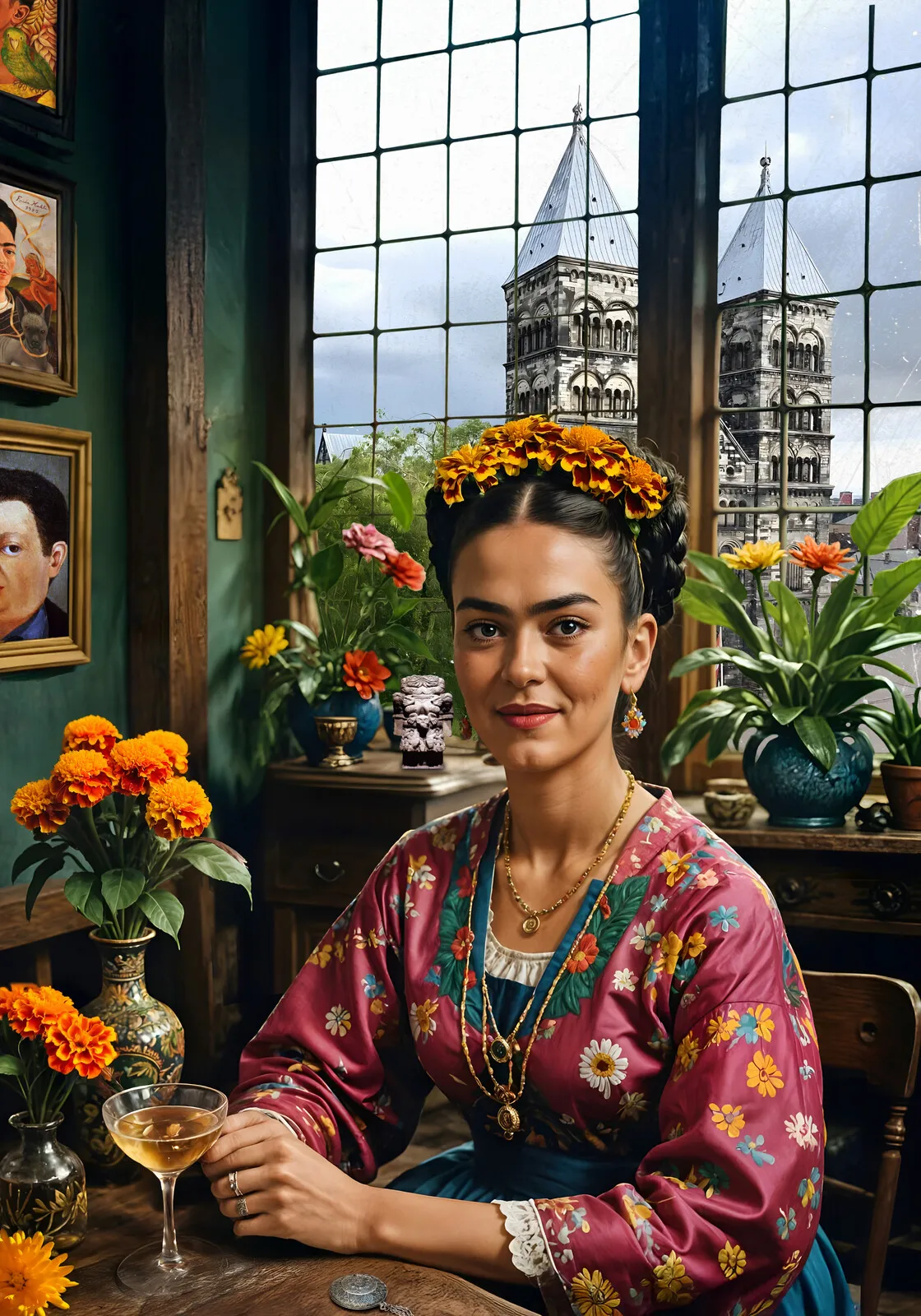
Frida and Marigolds, 2025
Digital
50 x 70 cm
3 200 kr
Frida and Marigolds
Frida and Marigolds
Frida Kahlo and I sat on a park bench on a warm early summer day, sipping Pepsi and nibbling on sticky cinnamon buns. Across the shimmering water, Pegasus soared high above the trees, a bronze guardian of the other side. Frida had just recounted the Aztec legend of the marigold, a flower believed to guide the souls of the dead back to the living world during the Day of the Dead, weaving it seamlessly with tales of her family, her art, and her deep connection to life and death. Butterflies, marigolds, and hummingbirds—symbols of transformation and love—fluttered through her words, echoing themes of her own life. In the vibrant greenery, surrounded by whispers of history and mythology, it was easy to lose oneself in her stories, each as vivid and layered as her paintings.
Please read on and uncover the Intriguing Secrets of Frida's Ancestry and the Transformative Power of Marigolds.
“Marigold’s Song
Golden petals, sunlit grace,
A flower born of time and space.
In Frida’s hands, they softly lay,
For life, for death, they weave their way.
In wild gardens, they brightly grow,
Guardians where the shadows flow.
A shield for roots, a friend to earth,
Their scent denies the pest's rebirth.
On altars high, they humbly stand,
Guiding spirits with a golden hand.
For those who’ve passed, they light the way,
A beacon through the veil's decay.
In Frida’s hair, they brightly bloom,
A crown to chase away the gloom.
Among her braids, they softly rest,
An emblem of her soul's unrest.
From humble soil to simmering pan,
Their flavours bloom and fit well in a flan.
Anise, citrus, and spice combined,
A taste of life, by nature, designed.
In paintings vast, they make their mark,
A burst of light in corners dark.
For death and life, they hold the key,
A dance of vivid symmetry.
Oh, marigold, both bright and grim,
You hum life’s ever-changing hymn.
From garden bed to funeral pyre,
You bloom, you fade, you never tire.
Frida’s muse, her golden flame,
A symbol of both grief and fame.
Through time, your petals softly fold,
A whisper: life is marigold.
Malmö. January 2025
Frida and Marigolds
It was a wonderful early summer day, and Frida Kahlo had the day off from performing at Nöjesteatern. We sat on a bench right by the pond, which faced Pegasus soaring high above on the other side of the water. Kungsparken, ‘The King's Garden’, is pretty wooded and boasts 130 different species of trees from three continents—considered an exotic luxury when it was first planted. The park’s design was inspired by the popular English garden concept of the time, blending lawns, trees, shrubs, and ponds in a harmonious landscape.
Frida had just been telling me about Pegasus, the mythical creature who served as a messenger for the gods and was used by Bellerophon to defeat the monster Chimera and the Amazons. In some legends, Pegasus carried Zeus’s thunderbolts on his back. Pegasus was also the horse of the Muses and often featured in stories about struggling and impoverished writers. One of Frida’s closest friends and lovers, Josephine Baker, lived on a star named after Pegasus. Since Josephine, much like Frida, enjoyed the company of both men and women, it seemed fitting, as Frida put it, to both ride and be ridden.
Given that Pegasus is a mythical being, there is no biological reality to consider, and in modern interpretations, Pegasus is sometimes portrayed as more gender-neutral. In the original myth, however, Pegasus is consistently male, but according to Frida, quoting Josephine, the gender shifted with the moment's intensity.
We sat silently, enjoying the pastel hues of the delicate early greenery. It was truly the most beautiful time of year.
Frida leaned back on the wooden sofa, sipping her Pepsi-Cola thoughtfully, a playful smile tugging at the corners of her lips. "You know," she began, "my father, Guillermo, didn’t always go by that name. When he was young, back in Germany, he was Wilhelm. But he didn’t get along with his stepmother at all. I can imagine the tension—it must have been unbearable for him. With his father's financial help, he boldly decided to leave Germany altogether. He was only nineteen, can you believe it? His courage in making such a life-altering decision is truly inspiring. And the reason I’m sitting here on this bench with you."
She tilted her head as if recalling a story she'd told many times but still held close to her heart. "In 1891, he boarded a freighter called *Borussia* in Hamburg. The ship was headed for Vera Cruz, Mexico. It was a completely new life for him, a reinvention. He even changed his name from Wilhelm to Guillermo, though he never lost that thick German accent. He spoke with such a heavy accent that I teased him, calling him ‘Herr Kahlo’ with mock formality."
Frida chuckled softly before continuing, "When he arrived in Mexico, he found work at an upscale jewellery store owned by the Diener Brothers. He likely got the job through his German-Jewish jeweller connections. He was meticulous and talented in his craft."
Her voice softened as she recounted the next part of the story. "My father married his first wife, Maria Cardena, in 1895. They had three daughters, though heartbreak struck early. Their second child lived only a few days. His eldest, Maria Luisa, was born in 1894, and the youngest, Margarita, in 1898. But tragedy was never far away. Maria died during childbirth when Margarita was born."
Frida's gaze drifted momentarily, her expression clouding. "Can you imagine? My father was alone with a four-year-old and a newborn, and he wasn’t even in the best health himself. He struggled with epilepsy all his life. That night, the night Maria died, he turned to a colleague from the jewellery store—my mother, Matilde Calderón, and her mother, Isabel. They came to his house to help. My mother," Frida smiled warmly, "was a remarkable woman, strong and full of contrasts. She was part Spanish Catholic and part Mexican Indian, carrying both cultures in her blood."
Frida paused, her fingers tracing the rim of her glass. "I’ve thought a lot about why my father proposed to her so soon after Maria’s death. Maybe he couldn’t handle raising two little girls on his own. Maybe he feared loneliness. Or maybe—just maybe—they truly fell in love. I like to think that’s what happened, and I’ll stand by it. They married that same year. My father was twenty-seven, and my mother was just twenty-two."
Her smile grew as she spoke of her siblings. "They went on to have four daughters together, including me. My eldest sister, Matilde, was born in 1899, then Adriana in 1902, and then me in 1907, as you know. Cristina, the baby of the family, arrived in 1908. Oh, Cristina..." Frida’s voice trailed off, a mixture of affection and unspoken memories lingering in the air. “Not all of them were good,” she added quietly, her fingers brushing the edge of her glass. “Family... it’s never simple, is it? There’s love, sure, but also so much pain, so many things left unsaid. My father, for all his tenderness and resilience, wasn’t perfect. Neither was my mother. And my siblings...” She shook her head, a bittersweet smile playing on her lips. “Let’s just say even the strongest bonds can fray.” I knew why—Cristina had had an affair with Frida’s husband, Diego. Frida was deeply hurt when she discovered that her younger sister had betrayed her in such a way. This was one of the most painful events of her life and caused a deep rift in their relationship. Frida and Cristina eventually reconciled despite the betrayal, but the incident left an indelible mark on Frida’s life and art. It catalysed several of her works, reflecting her pain, anger, and sorrow.
She looked back at me, her eyes alive with stories yet to be told. "So, my family’s story is one of reinvention, resilience, and love. My father’s journey from Wilhelm to Guillermo was just the beginning."
Me: "You’ll have to tell me more."
Frida: "My grandmother, of indigenous Mexican heritage, played a significant role in passing down the rich indigenous culture and traditions to me. She shared stories, myths, and customs that sparked my fascination with Mexico’s pre-Columbian history and culture. As you know, I identified deeply with my Mexican roots and manifested that in my art, clothing, and political beliefs. The traditional Mexican outfits I often wore, like the Tehuana dresses, were a homage to my grandmother."
Me: "And your beloved father? Your paternal grandmother, whom you never met?"
Frida: "I got to know her through my father’s stories. She was a kind woman but died early, in 1890. My grandfather remarried, and my father, just 19 at the time, didn’t get along with his stepmother. He missed his beloved ‘Mutti,’ my real grandmother."
Frida paused, sipping her Pepsi, and a thoughtful look crossed her face.
Frida: "My art often reflects the complexity of my family heritage—a fusion of European and Mexican influences. In my painting ‘My Grandparents, My Parents, and I’, also called ‘Family Tree’, which I painted in 1936, I visualised my family history and the diverse backgrounds of my ancestors. I painted myself as a child, with my grandparents symbolically represented in the background, emphasising their significance in my life. I saw myself as a bridge between cultures and epochs."
The park stretched before us in its early summer glory, the pastel greens reflected in the still waters of the pond. A couple of canoes floated lazily by, and one of those tourist pedal boats shaped like a swan glided into view.
Me: "That’s a striking way to connect with your roots. But tell me about ‘Tagetes’, the marigolds you loved so much."
Frida: "Ah, ‘Tagetes’! Its Latin name comes from ‘Tages,’ the Etruscan prophet who emerged from the earth while a ploughman was working the fields. In English, it’s called ‘marigold,’ named after the Virgin Mary’s gold."
Frida shifted on the bench, adjusting her position to enjoy her sticky cinnamon bun.
Frida: "In Nahuatl, we call it ‘Cempōhualxōchitl’. The marigold is native to Central and Southern Mexico. Its foliage has a musky scent—some people dislike it, but I found it delightful. The roots even repel pests, which makes it perfect for vegetable gardens. But did you know the florets of ‘Tagetes erecta’ are rich in carotenoids? They’re used as a food colouring and even to make egg yolks a brighter yellow when fed to chickens. I had the yellowest eggs in all of Mexico!"
Me: "And the butterflies? You painted them so often."
Frida: "Butterflies, for me, symbolised transformation, rebirth, and freedom. They appeared in my art, often in my hair or the natural surroundings of my portraits. They embodied my struggles and my ability to turn pain into beauty. In Mexican folklore, butterflies are also seen as representations of souls and spirituality. Despite my physical and emotional battles, they were a personal and cultural emblem of hope and transformation."
A child toddled past the bench, his laughter echoing as he pointed at the swan boat on the pond. Frida smiled faintly.
Frida: "You know, I even used marigolds in my cooking. ‘Tagetes lucida’—we called it ‘Pericón’—makes a sweet, anise-flavoured tea. It’s also a culinary herb, a substitute for tarragon. But more than anything, marigolds are connected to death. They’re the quintessential Mexican funeral flower. Their golden hue lights the way for spirits during ‘Día de los Muertos’, the Day of the Dead. I loved incorporating them into my paintings and hair because they meant so much. They weren’t just about death and remembering and celebrating life."
Frida’s voice softened as she continued.
Frida: "We build ‘ofrendas’—altars—with marigolds, sugar skulls, and the departed's favourite foods. Little skeletons and chocolate skulls are placed on the altars, often inscribed with the recipient’s name. It’s all about celebrating and honouring the dead, not mourning them. On November 1, after a child’s death, the godparents set the table with sweets, bread, and candles to honour their short life. I do the same on my star for the children I lost during my miscarriages. It’s my way of keeping them close."
She took a deep breath and turned to me, her eyes glinting with that mixture of humour and sadness she always carried.
Frida: "Would you like to hear an old Aztec legend about marigolds? It’s so beautiful it must be true."
I nodded, enchanted by her storytelling.
Frida: "Huitzilin and Xóchitl were two Aztec children who grew up together, always bringing flowers to the Sun God on a mountaintop. As they grew older, they fell in love, but Huitzilin died in battle. Heartbroken, Xóchitl prayed to the Sun God to reunite them. The Sun God transformed her into a marigold, and Huitzilin returned as a hummingbird. When the bird touched the flower, its petals opened, and their love lived on. That’s why marigolds and hummingbirds remain symbols of love and eternity." Frida chuckled softly.
Me: “Lovely story.”
Frida: "And then, of course, there are the practical marigolds. Some varieties grow tall with pom-poms of golden blooms that brighten even the weariest gardens. I used the single-flowered ‘Tagetes tenuifolia’ for salads. Their tarragon-like flavour adds something special."
Me: "I’ll have to try them in my Greek garden."
Frida: "You should. Even in autumn, when most plants fade, marigolds bring smiles. They’re a gift to the world, like a golden thread weaving life and death together. And I hope they bring a smile to your garden, too."
She finished her Pepsi and leaned back on the bench, gazing at the shimmering water. The sun caught her profile, and for a moment, she seemed like a painting filled with all life's pain, beauty, and colour.
Jörgen Thornberg
Frida and Marigolds, 2025
Digital
50 x 70 cm
3 200 kr
Frida and Marigolds
Frida and Marigolds
Frida Kahlo and I sat on a park bench on a warm early summer day, sipping Pepsi and nibbling on sticky cinnamon buns. Across the shimmering water, Pegasus soared high above the trees, a bronze guardian of the other side. Frida had just recounted the Aztec legend of the marigold, a flower believed to guide the souls of the dead back to the living world during the Day of the Dead, weaving it seamlessly with tales of her family, her art, and her deep connection to life and death. Butterflies, marigolds, and hummingbirds—symbols of transformation and love—fluttered through her words, echoing themes of her own life. In the vibrant greenery, surrounded by whispers of history and mythology, it was easy to lose oneself in her stories, each as vivid and layered as her paintings.
Please read on and uncover the Intriguing Secrets of Frida's Ancestry and the Transformative Power of Marigolds.
“Marigold’s Song
Golden petals, sunlit grace,
A flower born of time and space.
In Frida’s hands, they softly lay,
For life, for death, they weave their way.
In wild gardens, they brightly grow,
Guardians where the shadows flow.
A shield for roots, a friend to earth,
Their scent denies the pest's rebirth.
On altars high, they humbly stand,
Guiding spirits with a golden hand.
For those who’ve passed, they light the way,
A beacon through the veil's decay.
In Frida’s hair, they brightly bloom,
A crown to chase away the gloom.
Among her braids, they softly rest,
An emblem of her soul's unrest.
From humble soil to simmering pan,
Their flavours bloom and fit well in a flan.
Anise, citrus, and spice combined,
A taste of life, by nature, designed.
In paintings vast, they make their mark,
A burst of light in corners dark.
For death and life, they hold the key,
A dance of vivid symmetry.
Oh, marigold, both bright and grim,
You hum life’s ever-changing hymn.
From garden bed to funeral pyre,
You bloom, you fade, you never tire.
Frida’s muse, her golden flame,
A symbol of both grief and fame.
Through time, your petals softly fold,
A whisper: life is marigold.
Malmö. January 2025
Frida and Marigolds
It was a wonderful early summer day, and Frida Kahlo had the day off from performing at Nöjesteatern. We sat on a bench right by the pond, which faced Pegasus soaring high above on the other side of the water. Kungsparken, ‘The King's Garden’, is pretty wooded and boasts 130 different species of trees from three continents—considered an exotic luxury when it was first planted. The park’s design was inspired by the popular English garden concept of the time, blending lawns, trees, shrubs, and ponds in a harmonious landscape.
Frida had just been telling me about Pegasus, the mythical creature who served as a messenger for the gods and was used by Bellerophon to defeat the monster Chimera and the Amazons. In some legends, Pegasus carried Zeus’s thunderbolts on his back. Pegasus was also the horse of the Muses and often featured in stories about struggling and impoverished writers. One of Frida’s closest friends and lovers, Josephine Baker, lived on a star named after Pegasus. Since Josephine, much like Frida, enjoyed the company of both men and women, it seemed fitting, as Frida put it, to both ride and be ridden.
Given that Pegasus is a mythical being, there is no biological reality to consider, and in modern interpretations, Pegasus is sometimes portrayed as more gender-neutral. In the original myth, however, Pegasus is consistently male, but according to Frida, quoting Josephine, the gender shifted with the moment's intensity.
We sat silently, enjoying the pastel hues of the delicate early greenery. It was truly the most beautiful time of year.
Frida leaned back on the wooden sofa, sipping her Pepsi-Cola thoughtfully, a playful smile tugging at the corners of her lips. "You know," she began, "my father, Guillermo, didn’t always go by that name. When he was young, back in Germany, he was Wilhelm. But he didn’t get along with his stepmother at all. I can imagine the tension—it must have been unbearable for him. With his father's financial help, he boldly decided to leave Germany altogether. He was only nineteen, can you believe it? His courage in making such a life-altering decision is truly inspiring. And the reason I’m sitting here on this bench with you."
She tilted her head as if recalling a story she'd told many times but still held close to her heart. "In 1891, he boarded a freighter called *Borussia* in Hamburg. The ship was headed for Vera Cruz, Mexico. It was a completely new life for him, a reinvention. He even changed his name from Wilhelm to Guillermo, though he never lost that thick German accent. He spoke with such a heavy accent that I teased him, calling him ‘Herr Kahlo’ with mock formality."
Frida chuckled softly before continuing, "When he arrived in Mexico, he found work at an upscale jewellery store owned by the Diener Brothers. He likely got the job through his German-Jewish jeweller connections. He was meticulous and talented in his craft."
Her voice softened as she recounted the next part of the story. "My father married his first wife, Maria Cardena, in 1895. They had three daughters, though heartbreak struck early. Their second child lived only a few days. His eldest, Maria Luisa, was born in 1894, and the youngest, Margarita, in 1898. But tragedy was never far away. Maria died during childbirth when Margarita was born."
Frida's gaze drifted momentarily, her expression clouding. "Can you imagine? My father was alone with a four-year-old and a newborn, and he wasn’t even in the best health himself. He struggled with epilepsy all his life. That night, the night Maria died, he turned to a colleague from the jewellery store—my mother, Matilde Calderón, and her mother, Isabel. They came to his house to help. My mother," Frida smiled warmly, "was a remarkable woman, strong and full of contrasts. She was part Spanish Catholic and part Mexican Indian, carrying both cultures in her blood."
Frida paused, her fingers tracing the rim of her glass. "I’ve thought a lot about why my father proposed to her so soon after Maria’s death. Maybe he couldn’t handle raising two little girls on his own. Maybe he feared loneliness. Or maybe—just maybe—they truly fell in love. I like to think that’s what happened, and I’ll stand by it. They married that same year. My father was twenty-seven, and my mother was just twenty-two."
Her smile grew as she spoke of her siblings. "They went on to have four daughters together, including me. My eldest sister, Matilde, was born in 1899, then Adriana in 1902, and then me in 1907, as you know. Cristina, the baby of the family, arrived in 1908. Oh, Cristina..." Frida’s voice trailed off, a mixture of affection and unspoken memories lingering in the air. “Not all of them were good,” she added quietly, her fingers brushing the edge of her glass. “Family... it’s never simple, is it? There’s love, sure, but also so much pain, so many things left unsaid. My father, for all his tenderness and resilience, wasn’t perfect. Neither was my mother. And my siblings...” She shook her head, a bittersweet smile playing on her lips. “Let’s just say even the strongest bonds can fray.” I knew why—Cristina had had an affair with Frida’s husband, Diego. Frida was deeply hurt when she discovered that her younger sister had betrayed her in such a way. This was one of the most painful events of her life and caused a deep rift in their relationship. Frida and Cristina eventually reconciled despite the betrayal, but the incident left an indelible mark on Frida’s life and art. It catalysed several of her works, reflecting her pain, anger, and sorrow.
She looked back at me, her eyes alive with stories yet to be told. "So, my family’s story is one of reinvention, resilience, and love. My father’s journey from Wilhelm to Guillermo was just the beginning."
Me: "You’ll have to tell me more."
Frida: "My grandmother, of indigenous Mexican heritage, played a significant role in passing down the rich indigenous culture and traditions to me. She shared stories, myths, and customs that sparked my fascination with Mexico’s pre-Columbian history and culture. As you know, I identified deeply with my Mexican roots and manifested that in my art, clothing, and political beliefs. The traditional Mexican outfits I often wore, like the Tehuana dresses, were a homage to my grandmother."
Me: "And your beloved father? Your paternal grandmother, whom you never met?"
Frida: "I got to know her through my father’s stories. She was a kind woman but died early, in 1890. My grandfather remarried, and my father, just 19 at the time, didn’t get along with his stepmother. He missed his beloved ‘Mutti,’ my real grandmother."
Frida paused, sipping her Pepsi, and a thoughtful look crossed her face.
Frida: "My art often reflects the complexity of my family heritage—a fusion of European and Mexican influences. In my painting ‘My Grandparents, My Parents, and I’, also called ‘Family Tree’, which I painted in 1936, I visualised my family history and the diverse backgrounds of my ancestors. I painted myself as a child, with my grandparents symbolically represented in the background, emphasising their significance in my life. I saw myself as a bridge between cultures and epochs."
The park stretched before us in its early summer glory, the pastel greens reflected in the still waters of the pond. A couple of canoes floated lazily by, and one of those tourist pedal boats shaped like a swan glided into view.
Me: "That’s a striking way to connect with your roots. But tell me about ‘Tagetes’, the marigolds you loved so much."
Frida: "Ah, ‘Tagetes’! Its Latin name comes from ‘Tages,’ the Etruscan prophet who emerged from the earth while a ploughman was working the fields. In English, it’s called ‘marigold,’ named after the Virgin Mary’s gold."
Frida shifted on the bench, adjusting her position to enjoy her sticky cinnamon bun.
Frida: "In Nahuatl, we call it ‘Cempōhualxōchitl’. The marigold is native to Central and Southern Mexico. Its foliage has a musky scent—some people dislike it, but I found it delightful. The roots even repel pests, which makes it perfect for vegetable gardens. But did you know the florets of ‘Tagetes erecta’ are rich in carotenoids? They’re used as a food colouring and even to make egg yolks a brighter yellow when fed to chickens. I had the yellowest eggs in all of Mexico!"
Me: "And the butterflies? You painted them so often."
Frida: "Butterflies, for me, symbolised transformation, rebirth, and freedom. They appeared in my art, often in my hair or the natural surroundings of my portraits. They embodied my struggles and my ability to turn pain into beauty. In Mexican folklore, butterflies are also seen as representations of souls and spirituality. Despite my physical and emotional battles, they were a personal and cultural emblem of hope and transformation."
A child toddled past the bench, his laughter echoing as he pointed at the swan boat on the pond. Frida smiled faintly.
Frida: "You know, I even used marigolds in my cooking. ‘Tagetes lucida’—we called it ‘Pericón’—makes a sweet, anise-flavoured tea. It’s also a culinary herb, a substitute for tarragon. But more than anything, marigolds are connected to death. They’re the quintessential Mexican funeral flower. Their golden hue lights the way for spirits during ‘Día de los Muertos’, the Day of the Dead. I loved incorporating them into my paintings and hair because they meant so much. They weren’t just about death and remembering and celebrating life."
Frida’s voice softened as she continued.
Frida: "We build ‘ofrendas’—altars—with marigolds, sugar skulls, and the departed's favourite foods. Little skeletons and chocolate skulls are placed on the altars, often inscribed with the recipient’s name. It’s all about celebrating and honouring the dead, not mourning them. On November 1, after a child’s death, the godparents set the table with sweets, bread, and candles to honour their short life. I do the same on my star for the children I lost during my miscarriages. It’s my way of keeping them close."
She took a deep breath and turned to me, her eyes glinting with that mixture of humour and sadness she always carried.
Frida: "Would you like to hear an old Aztec legend about marigolds? It’s so beautiful it must be true."
I nodded, enchanted by her storytelling.
Frida: "Huitzilin and Xóchitl were two Aztec children who grew up together, always bringing flowers to the Sun God on a mountaintop. As they grew older, they fell in love, but Huitzilin died in battle. Heartbroken, Xóchitl prayed to the Sun God to reunite them. The Sun God transformed her into a marigold, and Huitzilin returned as a hummingbird. When the bird touched the flower, its petals opened, and their love lived on. That’s why marigolds and hummingbirds remain symbols of love and eternity." Frida chuckled softly.
Me: “Lovely story.”
Frida: "And then, of course, there are the practical marigolds. Some varieties grow tall with pom-poms of golden blooms that brighten even the weariest gardens. I used the single-flowered ‘Tagetes tenuifolia’ for salads. Their tarragon-like flavour adds something special."
Me: "I’ll have to try them in my Greek garden."
Frida: "You should. Even in autumn, when most plants fade, marigolds bring smiles. They’re a gift to the world, like a golden thread weaving life and death together. And I hope they bring a smile to your garden, too."
She finished her Pepsi and leaned back on the bench, gazing at the shimmering water. The sun caught her profile, and for a moment, she seemed like a painting filled with all life's pain, beauty, and colour.
3 200 kr

Jörgen Thornberg
Malmö
Lite om bilder och mig. Translation in English at the end.
Jag är en nyfiken person som ser allt i bilder, även det jag fäster i ord, gärna tillsammans för bakom alla mina bilder finns en berättelse. Till vissa bilder hör en kortare eller längre novell som följer med bilden.
Bilder berättar historier. Jag omges av naturlig skönhet, intressanta människor och historia var jag än går. Jag använder min kamera för att dokumentera världen och blanda det jag ser med vad jag känner för att fånga den dolda magin.
Mina bilder berättar mina historier. Genom mina bilder, tryck och berättelser. Jag bjuder in dig att ta del av dessa berättelser, in i ditt liv och hem och dela min mycket personliga syn på vår värld. Mer än vad ögat ser. Jag tänker i bilder, drömmer och skriver och pratar om dem; följaktligen måste jag också skapa bilder. De blir vad jag ser, inte nödvändigtvis begränsade till verkligheten. Det finns en bild runt varje hörn. Jag hoppas att du kommer att se vad jag såg och gilla det.
Jag är också en skrivande person och till många bilder hör en kortare eller längre essay. Den följer med tavlan, tryckt på fint papper och med en personlig hälsning från mig.
Flertalet bilder startar sin resa i min kamera. Enkelt förklarat beskriver jag bilden jag ser i mitt inre, upplevd eller fantiserad. Bilden uppstår inom mig redan innan jag fått okularet till ögat. På bråkdelen av ett ögonblick ser jag vad jag vill ha och vad som kan göras med bilden. Här skall jag stoppa in en giraff, stålmannen, Titanic eller vad det är min fantasi finner ut. Ännu märkligare är att jag kommer ihåg minnesbilden långt efteråt när det blir tid att skapa verket. Om jag lyckas eller inte, är upp till betraktaren, oftast präglat av en stråk av svart humor – meningen är att man skall bli underhållen. Mina bilder blir ofta en snackis där de hänger.
Jag föredrar bilder som förmedlar ett budskap i flera lager. Vid första anblicken fylld av feel-good, en vacker utsikt, fint väder, solen skiner, blommor på ängen eller vattnet som ligger förrädiskt spegelblankt. I en sådan bild kan jag gömma min egentliga berättelse, mitt förakt för förtryckare och våldsverkare, rasister och fördomsfulla människor - ett gärna återkommande motiv mer eller mindre dolt i det vackra motivet. Jag försöker förena dem i ett gemensamt narrativ.
Bild och formgivning har löpt som en röd tråd genom livet. Fotokonst känns som en värdig final som jag gärna delar med mig.
Min genre är vid som framgår av mina bilder, temat en blandning av pop- och gatukonst i kollage som kan bestå av hundratals lager. Vissa bilder kan ta veckor, andra någon dag innan det är dags att överlämna resultatet till printverkstaden. Fine Art Prints är digitala fotocollage. I dessa kollage sker rivandet, klippandet, pusslandet, målandet, ritandet och sprayningen digitalt. Det jag monterar in kan vara hundratals år gamla bilder som jag omsorgsfullt frilägger så att de ser ut att vara en del av tavlan men också bilder skapade av mig själv efter min egen fantasi. Därefter besöks printstudion och för vissa bilder numrera en limiterad upplaga (oftast 7 exemplar) och signera för hand. Vissa bilder kan köpas i olika format. Det är bara att fråga efter vilka. Gillar man en bild som är 70x100 men inte har plats på väggen, går den kanske att få i 50x70 cm istället. Frågan är fri.
Metoden Giclée eller Fine Art Print som det också kallas är det moderna sättet för framställning av grafisk konst. Villkoret för denna typ av utskrifter är att en högkvalitativ storformatskrivare används med åldersbeständigt färgpigment och konstnärspapper eller i förekommande fall på duk. Pappret som används möter de krav på livslängd som ställs av museer och gallerier. Normalt säljer jag mina bilder oinramade så att den nya ägaren själv kan bestämma hur de skall se ut, med eller utan passepartout färg på ram, med eller utan glas etc..
Under många år ställde jag bara ut på nätet, i valda grupper och på min egen Facebooksida - https://www.facebook.com/jorgen.thornberg.9
Jag finns också på en egen hemsida som tyvärr inte alltid är uppdaterad – https://www.jth.life/ Där kan du också läsa en del av de berättelser som följer med bilden.
UTSTÄLLNINGAR
Luftkastellet, oktober 2022
Konst i Lund, november 2022
Luftkastellet, mars 2023
Engleson Galleri Caroli, april 2023
Hydra, Greece June 2023
Engleson Galleri Caroli, oktober 2023
Toppen, Höllviken december 2023
Luftkastellet, mars 2024
Torups Galleri, mars 2024
Venice, May 2024
Luftkastellet, oktober 2024
Konst i Advent, December 2024
Galleri Engleson, Caroli December 2024
Jäger & Jansson Galleri, april 2025
A bit about pictures and me.
I'm a curious person who sees everything in pictures, even what I express in words, often combining them, for behind all my pictures lies a story. These narratives, some as short as a single image and others as long as a novel, are the heart and soul of my work.
Pictures tell stories. Wherever I go, I'm surrounded by natural beauty, exciting people, and history. I use my camera to document the world and blend what I see with what I feel to capture the hidden magic.
My images tell my stories. Through my pictures, prints, and narratives, I invite you to partake in these stories in your life and home and share my deeply personal perspective of our world. More than meets the eye. I think in pictures, dream, write, and talk about them; consequently, I must create images too. They become what I see, not necessarily confined to reality. There's a picture around every corner. I hope you'll see what I saw and enjoy it.
I'm also a writer, and many images come with a shorter or longer essay. It accompanies the painting, printed on fine paper with my personal greeting.
Many pictures start their journey on my camera. Simply put, I describe the image I see in my mind, experienced or imagined. The image arises within me even before I bring the eyepiece to my eye. In a fraction of a moment, I see what I want and what can be done with the picture. Here, I'll insert a giraffe, Superman, the Titanic, or whatever my imagination conjures up. Even stranger is that I remember the mental image long after it's time to create the work. Whether I succeed is up to the observer, often imbued with a streak of black humour – the aim is to entertain. My pictures usually become a talking point wherever they hang.
I prefer pictures that convey a message in multiple layers. At first glance, they're filled with feel-good vibes, a beautiful view, lovely weather, the sun shining, flowers in the meadow, or the water lying deceptively calm. But beneath this surface beauty, I often conceal a deeper story, a narrative that challenges societal norms or explores the human condition. I invite you to delve into these hidden narratives and discover the layers of meaning within my work.
Picture and design have been a thread running through my life. Photographic art feels like a fitting finale, and I'm happy to share it.
My genre is varied, as seen in my pictures; the theme is a blend of pop and street art in collages that can consist of hundreds of layers. Some images can take weeks, others just a day before it's time to hand over the result to the print workshop. Fine Art Prints are digital photo collages. In these collages, tearing, cutting, puzzling, painting, drawing, and spraying happen digitally. What I insert can be images hundreds of years old that I carefully extract so they appear to be part of the painting, but also images created by myself, now also generated from my imagination. Next, visit the print studio and, for certain images, number a limited edition (usually 7 copies) and sign them by hand. Some images may be available in other formats. Just ask which ones. If you like an image that's 70x100 but doesn't have space on the wall, you might be able to get it in 50x70 cm instead. The question is open.
The Giclée method, or Fine Art Print as it's also called, is the modern way of producing graphic art. This method ensures the highest quality and longevity of the artwork, using a high-quality large-format printer with archival pigment inks and artist paper or, in some cases, canvas. The paper used meets the longevity requirements set by museums and galleries. I sell my pictures unframed, allowing the new owner to personalise their artwork, confident in the lasting value and quality of the piece.
For many years, I only exhibited online, in selected groups, and on my Facebook page - https://www.facebook.com/jorgen.thornberg.9. I also have my website, which unfortunately is not constantly updated - https://www.jth.life/. You can also read some of the stories accompanying the pictures there.
EXHIBITIONS
Luftkastellet, October 2022
Art in Lund, November 2022
Luftkastellet, March 2023
Engleson Gallery Caroli, April 2023
Hydra, Greece June 2023
Engleson Gallery Caroli, October 2023
Toppen, Höllviken December 2023
Luftkastellet, March 2024
Torup Gallery, March 2024
Venice, May 2024
UTSTÄLLNINGAR
Luftkastellet, oktober 2022
Konst i Lund, november 2022
Luftkastellet, mars 2023
Engleson Galleri Caroli, april 2023
Hydra, Greece June 2023
Engleson Galleri Caroli, oktober 2023
Toppen, Höllviken december 2023
Luftkastellet, mars 2024
Torups Galleri, mars 2024
Venice, May 2024
Luftkastellet, October 2024
Konst i Advent, December 2024
Galleri Engleson, Caroli December 2024
Jäger & Jansson Galleri, April 2025
Utbildning
Autodidakt
Medlem i konstnärsförening
Öppna Sinnen
Med i konstrunda
Konstrundan i Skåne
Utställningar
Luftkastellet, October 2022
Art in Lund, November 2022
Luftkastellet, March 2023
Engleson Gallery Caroli, April 2023
Hydra, Greece June 2023
Engleson Gallery Caroli, October 2023
Toppen, Höllviken December 2023
Luftkastellet, March 2024
Torup Gallery, March 2024
Venice, May 2024