Vi använder cookies för att ge dig bästa möjliga upplevelse. Välj vilka cookies du tillåter.
Läs mer i vår integritetspolicy
Jörgen Thornberg
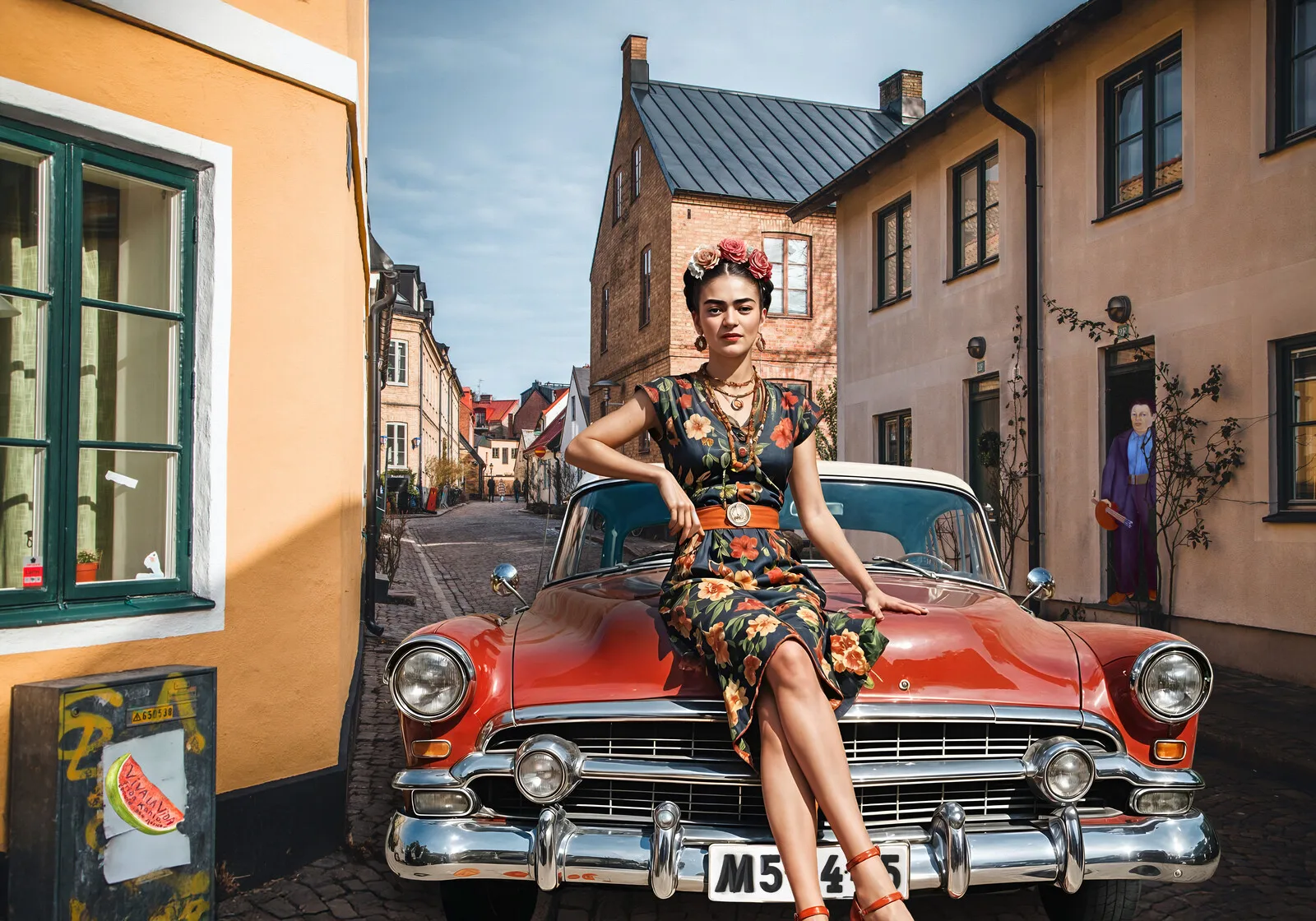
The Cadillac a Vintage Ride, 2025
Digital
100 x 70 cm
5 200 kr
The Cadillac a Vintage Ride
Frida’s Cadillac: A Rolling Manifesto and Lifeline
As Frida leaned back at the outdoor café, the sun glinting off her glass of Rioja, she shared, “Diego called our car ‘La Poderosa,’ the Mighty One.” But the Cadillac wasn’t merely a mode of transportation; it was a political tool. It was a sanctuary, a statement, and a companion through revolutions, artistic journeys, and the challenges of her health. From Teotihuacán’s sacred pyramids to the sunny beaches of Acapulco and even mundane trips to doctors—“bone-crackers,” as Frida jokingly called them—the Cadillac was an inseparable part of their lives, a steel cocoon that carried her through triumphs and turmoil alike. With her sharp humour and vivid storytelling, Frida brought each journey to life, painting as much with her words as she did on canvas.
Read on to uncover the intriguing secrets of a journey that will pique your interest.
“The Cadillac
Lovely Frida drove up in a 1946 Cadillac,
The cushioned seat was her saddleback.
And she felt like being a crackajack,
But she ain't never, ever coming back.
Its chrome gleamed bright, a silver crown,
Rolling her through the bustling town.
The engine hummed like a gentle tune,
Her battles waged beneath the moon.
Through fields and flowers, the mighty ride,
Her canvas is waiting, her pain to be hide.
The leather cradled her weary frame,
Yet her fire burned; it knew no shame.
To pyramids old and seas so wide,
It carried her heart, her pain, her pride.
A chariot bold, for a queen of art,
Whose broken body housed a lion's heart.
And names it carried, like tales it told,
Each one is a mirror of hearts so bold.
For Diego, it roared as "La Poderosa,"
The mighty beast of revolution’s Rosa.
In a city of chaos, it was “El Caracol,”
The slow, stubborn snail cursed to its soul.
But for Frida, it was always “La Reina,”
Her rolling throne, her strength sustainer.
And when it surged, it was “The Beast,”
A roaring giant, her panther, her feast.
But Frida laughed at the names they gave,
For her, it was her strength, her save.
Paint and banners in the trunk confined,
A moving stage for her brilliant mind.
Protests, whispers, laughter, tears,
The Cadillac held all her fears.
Her “Battle Tank,” her sanctuary,
A steel cocoon for the visionary.
From doctors' doors to rebel’s call,
It bore her through it all.
Now the Cadillac rests, its journey is done,
Its spirit rides in memory on Frida’s sun.
Yet echoes linger, its story untold,
Of Frida’s life, her fight, her soul of gold.
Malmö, January 2025
Driving in style
We were sitting at the outdoor café on Gustav Adolf's Square in Malmö, the sun reflecting in our glasses of Rioja as Frida took a sip and leaned back in her chair. I had just mentioned that this place used to be Brauns Konditori, the favourite spot for Malmö’s high society ladies. She gave me a broad smile. “Diego would have fit right in here,” she said. “He loved surrounding himself with people playing at being refined, but he could never act the part. He wasn’t polished enough.”
A pink Chevrolet from the early 1950s cruised by, catching Frida’s delighted eye. Either it was the car or the young driver with slicked-back hair, one arm casually hanging out of the rolled-down window.
Me: “You had a car, right? Was it similar to that one?” I ventured a guess, trying to connect with Frida in her own world.
Frida: “Of course, but not a Chevy. We had a real car.” She said the last part with emphasis, nodding meaningfully.
Me: “Oh, pardon me,” I said, realising the subject might be touchier than expected. A Chevrolet was certainly not a Volkswagen, but it wasn’t quite up to her standards either.
Frida: “We had a Cadillac, a massive Fleetwood from 1946, and I often took it downtown Mexico City. It was customised to meet my needs since walking was difficult for me with all my health issues. The car had wide seats and plenty of space, making it comfortable to use, especially after my many surgeries. The Cadillac is well-documented in photos and tells the story of my lifestyle in the later part of my life. It was a car fit for gliding, but mostly, we used it for excursions and trips around Mexico. The car became a symbol for Diego’s and my flamboyant lifestyle and shared adventures.”
Me: “It’s certainly a luxurious car. For a while, I had a Chevrolet from 1938, as pink as the one that just passed by. I called it Rosa Mathilda.”
Frida: “Isn’t it funny how we often give boats and cars women’s names? I suppose it’s so we can yell at them and blame them when we lose our way or hit something.” Frida leaned forward, her gaze sparkling. “Do you want to hear about our trips in the Cadillac? It wasn’t just a car; it was like a member of the family, one that both protected us and led us straight into chaos—like my monkeys, for example. Our car even had a name.”
Me: “What was it called? Was it a ‘she’ as well? I’m all ears.” I nodded and refilled our glasses.
Frida: “Yes, but the name depended on who was driving. For Diego, the Cadillac was ‘La Poderosa,’ ‘The Mighty One.’ After all, the car was part of our revolutionary adventures, and the name was meant to reflect its role in taking us to protests and meetings. When Diego was forced to drive it in Mexico City, he called it ‘El Caracol,’ ‘The Snail,’ and cursed it for being slow and clumsy in city traffic. For me, it was always Reina, or ‘La Reina,’ ‘The Queen,’ because that’s what she was—a symbol of luxury and strength, something I both loved and could joke about. The name had to reflect the car’s superiority and how it dominated the roads. If the car had been white, it might have been called ‘El Elefante Blanco,’ ‘The White Elephant,’ as a playful jab at Diego, who was sometimes called ‘The Elephant’—though he was more of a grey one. Diego didn’t like the idea.” Frida laughed.
Me: “So, mostly long excursions, I assume?” Frida took a deep breath and began to tell me more.
Frida: “You don’t have to cross the river for water. Mostly, we used it for shorter trips around Coyoacán and the surrounding areas. Diego and I often drove the Cadillac just a few miles around my home, Casa Azul, in Coyoacán. I visited friends and fellow artists and took guests to cultural landmarks. I loved showing visitors the beauty of the Mexican landscape. Above all, the car gave me freedom, even with all my health problems.”
Me: “But when you tired of the neighbourhood, where did you go?”
Frida: “Xochimilco was one of our favourite places,” Frida said, her eyes drifting far into the distance. “We used to take the Cadillac there, packed with friends, food, and sometimes bottle after bottle of tequila. Diego mostly drove; if he wasn’t singing, he was talking about the revolution. You should have seen him! His big hands gripped the wheel like he was steering all of Mexico. And maybe that’s exactly what he felt.”
Me: “Komilko? Where is that?”
Frida: “So-chi-MIL-co,” she repeated slowly, twice. “The name comes from Nahuatl, the Aztec language, and means ‘the place where flowers grow.’ It reflects the area’s history as a centre for cultivating and trading flowers and other crops. It’s not very far, but it’s beautiful. Xochimilco is mostly flat since it lies in an ancient lakebed that was once part of Lake Texcoco, which used to cover much of what is now Mexico City. The area is known for its canals, floating gardens—‘chinampas’—and is as flat as a pancake, making it ideal for agriculture and transport via the famous ‘trajineras,’ the colourful boats that ply the canals.”
Me: “Is it far?”
Frida: “Not at all. Xochimilco is about 28 kilometres from the centre of Mexico City, depending on where you start. Casa Azul and Xochimilco are in the southern part of this giant city, so it’s a relatively short trip between these historical and cultural sites. The heavy traffic means it can still take up to 45 minutes from my house.”
Me: “So, it’s an old plain?”
Frida: “An old lakebed, actually. To the south, Xochimilco is surrounded by some hilly and mountainous areas further away from the canals. Nearby is Cerro de la Estrella, where part of Aztec history unfolded, and other smaller hills surrounding the valley where Mexico City lies. But Xochimilco is primarily flat, making it accessible and a popular destination for recreation.”
Me: “Like Malmö’s beech forest, perhaps?”
Frida: “But without the forest. Xochimilco is known for its floating gardens and canals. Though the canals are usually visited by boat, we always drove there in our Cadillac. Boats and I don’t get along, but Diego liked the rocking motion. He said it made him feel light.” Frida tossed her head back. “I appreciated the colourful surroundings and used to pick flowers that I wore in my hair and arranged in bouquets, sometimes as inspiration for my art."
Me: “You used the trajineras?”
Frida: “Always. We rented one and loaded it with food, wine, and stronger things. Diego loved talking about the revolution there as if the water could hear and agree, its lapping waves echoing his words. I remember sitting in the boat, watching his face as he spoke. His words could lift a room—or an entire boat. The more wine and tequila, the more the water seemed to agree. But what I loved most was picking flowers. I made jewellery from them for my hair. Diego used to call me ‘the living garden.’ Though he always kept half the food for himself!” She laughed.
Me: “Sounds idyllic.”
Frida: “Usually. Once, we returned to the car and found it covered in children who had climbed onto the hood and were dancing! Diego let them be. He said, ‘Let them celebrate, Frida! They are the future.’ And I think he meant it.”
Me: “The Cadillac, whatever it was called at the time, must have taken you to all your political meetings too?”
Frida: “Yes, ‘Reina’ or ‘La Poderosa’ was like a rolling manifesto.” Frida reached for her glass, took a sip, and her eyes darkened with seriousness. “That car was as much a part of our political lives as it was of our leisure. We used the Cadillac to get to demonstrations and meetings, often loaded with banners, paint, and friends. Diego called it the cradle of revolution, but I think I was the one who used it most creatively.”
I leaned forward, curious about what she meant. She laughed. “Once, I painted a large hammer and sickle on the trunk. Diego went mad. He yelled, ‘Frida, this is a Cadillac, not a propaganda car!’ But I thought it was fitting. We were working to change Mexico. Why shouldn’t the car be part of that?”
I asked if there was any danger. She nodded. “Yes, the police stopped us several times. But Diego could always talk us out of it. He had that charisma. And me? I just smiled sweetly. That always worked.”
Me: “And sometimes you drove to Teotihuacán, the heart of Mexico?”
Frida: “We often drove to Teotihuacán,” Frida said, gesturing as if the pyramids appeared before us. “I loved climbing the Pyramid of the Moon, even though it hurt every time. But it felt like being close to the sky, close to our ancestors. Diego loved taking friends there and telling them about Mexico’s history as if he had been there when the pyramids were built. He was twenty years older than me, so I’d tease him with jokes about how he helped build the pyramids and ripped the hearts out of living enemies.”
Me: “That doesn’t sound very kind.”
Frida: “Not kind, but it was the hearts of enemies,” she said with a playful grin. I asked if she painted there. “Of course! I painted the pyramids, but I added myself as a goddess. Diego laughed and said, ‘Frida, you are the heart of Mexico.’ And I said, ‘And you are Mexico’s stomach, Diego because you’re always eating.’” She chuckled and raised her glass.
I asked if Diego was impressed by her painting, and she shrugged. “Diego? I always impressed him, but he would never admit it.”
Me: “Acapulco. Even a land crab like you must have gone to the coast sometimes.”
When I mentioned the sea, Frida lit up. “Acapulco!” she exclaimed. “Sun, sea, and art. We once took the Cadillac with a group of friends, driving in a convoy. Acapulco is about 380 kilometres south of Mexico City, so it took almost a day to get there. Diego loved the beach, even though he burned like a lobster. I preferred the shade, but I loved sitting and painting the water. Do you know what I painted there? I painted the sea as a woman, with waves as her hair and the sun as her jewellery. Now and then, I would wade along the shore to cool off, but only ankle-deep, and when the water reached my knees, I thought I would drown.” Frida’s gaze became dreamy. “We drank red rum on the beach and ate fresh fish. It was one of the few times we felt free—free from the world, politics, everything. But the tropical landscape also reminded me of my mortality. I never felt well at the sea but loved watching it.”
She took a deep breath. “But it was also a reminder of life’s fragility. The sea was always in motion, just like my life. Back then, Acapulco was a place of natural beauty that was much quieter than today's frantic, commercial version. The tropical climate and the shimmering Pacific Ocean provided a much-needed escape from the chaos of Mexico City.”
Me: “I suppose many of your drives weren’t so idyllic—like the doctor trips.”
When I asked about her health and the Cadillac, her tone softened. “Towards the end, the car was a lifeline,” Frida said. “I used it to get to doctors, chiropractors—‘bone-crackers,’ as I called them—therapists of all sorts, physiotherapists, hospitals, pharmacies, and even cane makers. It was comfortable, and it saved me from the pain of walking. Diego always insisted on coming along. He didn’t think I could manage driving ‘The Big Beast’ or just ‘The Beast’—our nickname for the car—when my legs couldn’t always be trusted. But sometimes, I just wanted to be alone in the car, with only my thoughts for company.”
I wondered if the car gave her a sense of security. “Yes,” she said thoughtfully. “The Cadillac felt like a cocoon. When I was sitting in it, I could forget that my body was failing me. It was like travelling without moving.”
Me: “Your best drives must have been the ones back to Coyoacán, to Casa Azul.”
Frida: “Without a doubt. There’s no place like home, as they say, and in my case, the saying couldn’t be more accurate. Even today, on my star,” she said warmly. “At home, people waved when we glided through the narrow streets of Coyoacán in the Cadillac. They knew us—not just as artists but as part of the city, almost like I were the queen and Diego, the king of Coyoacán.”
I asked how it felt to drive back into Casa Azul for the first time after leaving this earth. “Like breathing,” she replied. “Just as before, it was in the car that I could truly be myself, even in a rental, since the Cadillac had long been scrapped. The Cadillac was just a car, but it took me to places I could never have walked. And every journey had its own life, its memory.”
Frida raised her glass and smiled. “So, my friend, what do you think of my journeys? The car was part of them, but the people, the landscapes, and the emotions made them come alive. Cheers to that!”
Me: “One must admit that you truly travelled in style.”
Frida: “People respected us despite our extravagant habits—even the Cadillac. Even our communist friends forgave our bourgeois ways because of our genuine love for Mexico and our passion for art and politics. It’s a far cry from today’s swirling travels through wormholes in space. No one cheers for those journeys, and they go so fast that the colours disappear, leaving only black—no visual impressions despite travelling millions of light-years past all the stars and planets. Lucky it doesn’t take longer.”
For those curious about what kind of car “The Beast” was, Frida’s 1946 Cadillac Fleetwood was an impressive machine for its time. Measuring nearly 5.7 meters in length and weighing over 2 tons, it was equipped with a 5.4-liter V8 engine that delivered just over 150 horsepower through a four-speed Hydra-Matic automatic transmission. This made it easy for Frida to handle in-city traffic and longer road trips. The spacious interior, with wide leather seats and generous legroom, made it ideal for Frida, especially given her physical limitations. The Fleetwood was also known for its suspension, providing a smooth and comfortable ride even on Mexico’s often uneven roads. The car was a statement of luxury and modernity, with details like a chrome grille, elegant lines, and advanced features like electric windows. “The Beast” was not just a vehicle for Frida and Diego but a symbol of the era’s design and technology, reflecting their extravagant lifestyle and passion for the unique and grand.
Jörgen Thornberg
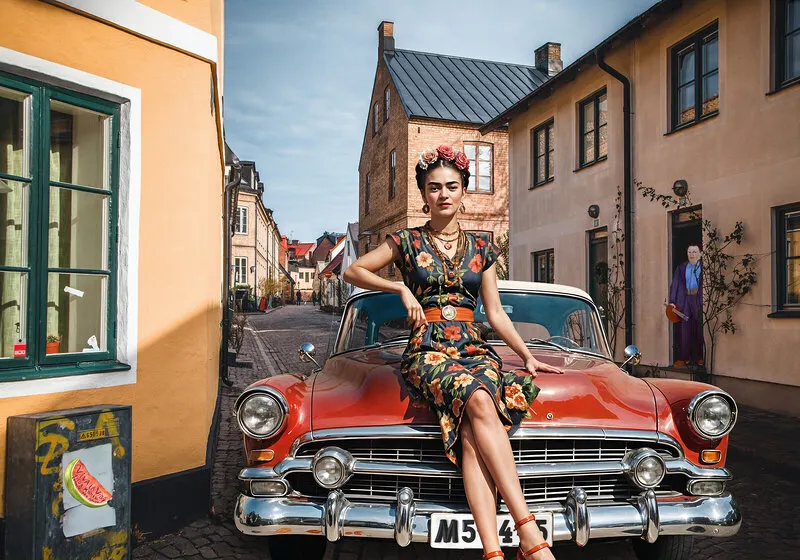
The Cadillac a Vintage Ride, 2025
Digital
100 x 70 cm
5 200 kr
The Cadillac a Vintage Ride
Frida’s Cadillac: A Rolling Manifesto and Lifeline
As Frida leaned back at the outdoor café, the sun glinting off her glass of Rioja, she shared, “Diego called our car ‘La Poderosa,’ the Mighty One.” But the Cadillac wasn’t merely a mode of transportation; it was a political tool. It was a sanctuary, a statement, and a companion through revolutions, artistic journeys, and the challenges of her health. From Teotihuacán’s sacred pyramids to the sunny beaches of Acapulco and even mundane trips to doctors—“bone-crackers,” as Frida jokingly called them—the Cadillac was an inseparable part of their lives, a steel cocoon that carried her through triumphs and turmoil alike. With her sharp humour and vivid storytelling, Frida brought each journey to life, painting as much with her words as she did on canvas.
Read on to uncover the intriguing secrets of a journey that will pique your interest.
“The Cadillac
Lovely Frida drove up in a 1946 Cadillac,
The cushioned seat was her saddleback.
And she felt like being a crackajack,
But she ain't never, ever coming back.
Its chrome gleamed bright, a silver crown,
Rolling her through the bustling town.
The engine hummed like a gentle tune,
Her battles waged beneath the moon.
Through fields and flowers, the mighty ride,
Her canvas is waiting, her pain to be hide.
The leather cradled her weary frame,
Yet her fire burned; it knew no shame.
To pyramids old and seas so wide,
It carried her heart, her pain, her pride.
A chariot bold, for a queen of art,
Whose broken body housed a lion's heart.
And names it carried, like tales it told,
Each one is a mirror of hearts so bold.
For Diego, it roared as "La Poderosa,"
The mighty beast of revolution’s Rosa.
In a city of chaos, it was “El Caracol,”
The slow, stubborn snail cursed to its soul.
But for Frida, it was always “La Reina,”
Her rolling throne, her strength sustainer.
And when it surged, it was “The Beast,”
A roaring giant, her panther, her feast.
But Frida laughed at the names they gave,
For her, it was her strength, her save.
Paint and banners in the trunk confined,
A moving stage for her brilliant mind.
Protests, whispers, laughter, tears,
The Cadillac held all her fears.
Her “Battle Tank,” her sanctuary,
A steel cocoon for the visionary.
From doctors' doors to rebel’s call,
It bore her through it all.
Now the Cadillac rests, its journey is done,
Its spirit rides in memory on Frida’s sun.
Yet echoes linger, its story untold,
Of Frida’s life, her fight, her soul of gold.
Malmö, January 2025
Driving in style
We were sitting at the outdoor café on Gustav Adolf's Square in Malmö, the sun reflecting in our glasses of Rioja as Frida took a sip and leaned back in her chair. I had just mentioned that this place used to be Brauns Konditori, the favourite spot for Malmö’s high society ladies. She gave me a broad smile. “Diego would have fit right in here,” she said. “He loved surrounding himself with people playing at being refined, but he could never act the part. He wasn’t polished enough.”
A pink Chevrolet from the early 1950s cruised by, catching Frida’s delighted eye. Either it was the car or the young driver with slicked-back hair, one arm casually hanging out of the rolled-down window.
Me: “You had a car, right? Was it similar to that one?” I ventured a guess, trying to connect with Frida in her own world.
Frida: “Of course, but not a Chevy. We had a real car.” She said the last part with emphasis, nodding meaningfully.
Me: “Oh, pardon me,” I said, realising the subject might be touchier than expected. A Chevrolet was certainly not a Volkswagen, but it wasn’t quite up to her standards either.
Frida: “We had a Cadillac, a massive Fleetwood from 1946, and I often took it downtown Mexico City. It was customised to meet my needs since walking was difficult for me with all my health issues. The car had wide seats and plenty of space, making it comfortable to use, especially after my many surgeries. The Cadillac is well-documented in photos and tells the story of my lifestyle in the later part of my life. It was a car fit for gliding, but mostly, we used it for excursions and trips around Mexico. The car became a symbol for Diego’s and my flamboyant lifestyle and shared adventures.”
Me: “It’s certainly a luxurious car. For a while, I had a Chevrolet from 1938, as pink as the one that just passed by. I called it Rosa Mathilda.”
Frida: “Isn’t it funny how we often give boats and cars women’s names? I suppose it’s so we can yell at them and blame them when we lose our way or hit something.” Frida leaned forward, her gaze sparkling. “Do you want to hear about our trips in the Cadillac? It wasn’t just a car; it was like a member of the family, one that both protected us and led us straight into chaos—like my monkeys, for example. Our car even had a name.”
Me: “What was it called? Was it a ‘she’ as well? I’m all ears.” I nodded and refilled our glasses.
Frida: “Yes, but the name depended on who was driving. For Diego, the Cadillac was ‘La Poderosa,’ ‘The Mighty One.’ After all, the car was part of our revolutionary adventures, and the name was meant to reflect its role in taking us to protests and meetings. When Diego was forced to drive it in Mexico City, he called it ‘El Caracol,’ ‘The Snail,’ and cursed it for being slow and clumsy in city traffic. For me, it was always Reina, or ‘La Reina,’ ‘The Queen,’ because that’s what she was—a symbol of luxury and strength, something I both loved and could joke about. The name had to reflect the car’s superiority and how it dominated the roads. If the car had been white, it might have been called ‘El Elefante Blanco,’ ‘The White Elephant,’ as a playful jab at Diego, who was sometimes called ‘The Elephant’—though he was more of a grey one. Diego didn’t like the idea.” Frida laughed.
Me: “So, mostly long excursions, I assume?” Frida took a deep breath and began to tell me more.
Frida: “You don’t have to cross the river for water. Mostly, we used it for shorter trips around Coyoacán and the surrounding areas. Diego and I often drove the Cadillac just a few miles around my home, Casa Azul, in Coyoacán. I visited friends and fellow artists and took guests to cultural landmarks. I loved showing visitors the beauty of the Mexican landscape. Above all, the car gave me freedom, even with all my health problems.”
Me: “But when you tired of the neighbourhood, where did you go?”
Frida: “Xochimilco was one of our favourite places,” Frida said, her eyes drifting far into the distance. “We used to take the Cadillac there, packed with friends, food, and sometimes bottle after bottle of tequila. Diego mostly drove; if he wasn’t singing, he was talking about the revolution. You should have seen him! His big hands gripped the wheel like he was steering all of Mexico. And maybe that’s exactly what he felt.”
Me: “Komilko? Where is that?”
Frida: “So-chi-MIL-co,” she repeated slowly, twice. “The name comes from Nahuatl, the Aztec language, and means ‘the place where flowers grow.’ It reflects the area’s history as a centre for cultivating and trading flowers and other crops. It’s not very far, but it’s beautiful. Xochimilco is mostly flat since it lies in an ancient lakebed that was once part of Lake Texcoco, which used to cover much of what is now Mexico City. The area is known for its canals, floating gardens—‘chinampas’—and is as flat as a pancake, making it ideal for agriculture and transport via the famous ‘trajineras,’ the colourful boats that ply the canals.”
Me: “Is it far?”
Frida: “Not at all. Xochimilco is about 28 kilometres from the centre of Mexico City, depending on where you start. Casa Azul and Xochimilco are in the southern part of this giant city, so it’s a relatively short trip between these historical and cultural sites. The heavy traffic means it can still take up to 45 minutes from my house.”
Me: “So, it’s an old plain?”
Frida: “An old lakebed, actually. To the south, Xochimilco is surrounded by some hilly and mountainous areas further away from the canals. Nearby is Cerro de la Estrella, where part of Aztec history unfolded, and other smaller hills surrounding the valley where Mexico City lies. But Xochimilco is primarily flat, making it accessible and a popular destination for recreation.”
Me: “Like Malmö’s beech forest, perhaps?”
Frida: “But without the forest. Xochimilco is known for its floating gardens and canals. Though the canals are usually visited by boat, we always drove there in our Cadillac. Boats and I don’t get along, but Diego liked the rocking motion. He said it made him feel light.” Frida tossed her head back. “I appreciated the colourful surroundings and used to pick flowers that I wore in my hair and arranged in bouquets, sometimes as inspiration for my art."
Me: “You used the trajineras?”
Frida: “Always. We rented one and loaded it with food, wine, and stronger things. Diego loved talking about the revolution there as if the water could hear and agree, its lapping waves echoing his words. I remember sitting in the boat, watching his face as he spoke. His words could lift a room—or an entire boat. The more wine and tequila, the more the water seemed to agree. But what I loved most was picking flowers. I made jewellery from them for my hair. Diego used to call me ‘the living garden.’ Though he always kept half the food for himself!” She laughed.
Me: “Sounds idyllic.”
Frida: “Usually. Once, we returned to the car and found it covered in children who had climbed onto the hood and were dancing! Diego let them be. He said, ‘Let them celebrate, Frida! They are the future.’ And I think he meant it.”
Me: “The Cadillac, whatever it was called at the time, must have taken you to all your political meetings too?”
Frida: “Yes, ‘Reina’ or ‘La Poderosa’ was like a rolling manifesto.” Frida reached for her glass, took a sip, and her eyes darkened with seriousness. “That car was as much a part of our political lives as it was of our leisure. We used the Cadillac to get to demonstrations and meetings, often loaded with banners, paint, and friends. Diego called it the cradle of revolution, but I think I was the one who used it most creatively.”
I leaned forward, curious about what she meant. She laughed. “Once, I painted a large hammer and sickle on the trunk. Diego went mad. He yelled, ‘Frida, this is a Cadillac, not a propaganda car!’ But I thought it was fitting. We were working to change Mexico. Why shouldn’t the car be part of that?”
I asked if there was any danger. She nodded. “Yes, the police stopped us several times. But Diego could always talk us out of it. He had that charisma. And me? I just smiled sweetly. That always worked.”
Me: “And sometimes you drove to Teotihuacán, the heart of Mexico?”
Frida: “We often drove to Teotihuacán,” Frida said, gesturing as if the pyramids appeared before us. “I loved climbing the Pyramid of the Moon, even though it hurt every time. But it felt like being close to the sky, close to our ancestors. Diego loved taking friends there and telling them about Mexico’s history as if he had been there when the pyramids were built. He was twenty years older than me, so I’d tease him with jokes about how he helped build the pyramids and ripped the hearts out of living enemies.”
Me: “That doesn’t sound very kind.”
Frida: “Not kind, but it was the hearts of enemies,” she said with a playful grin. I asked if she painted there. “Of course! I painted the pyramids, but I added myself as a goddess. Diego laughed and said, ‘Frida, you are the heart of Mexico.’ And I said, ‘And you are Mexico’s stomach, Diego because you’re always eating.’” She chuckled and raised her glass.
I asked if Diego was impressed by her painting, and she shrugged. “Diego? I always impressed him, but he would never admit it.”
Me: “Acapulco. Even a land crab like you must have gone to the coast sometimes.”
When I mentioned the sea, Frida lit up. “Acapulco!” she exclaimed. “Sun, sea, and art. We once took the Cadillac with a group of friends, driving in a convoy. Acapulco is about 380 kilometres south of Mexico City, so it took almost a day to get there. Diego loved the beach, even though he burned like a lobster. I preferred the shade, but I loved sitting and painting the water. Do you know what I painted there? I painted the sea as a woman, with waves as her hair and the sun as her jewellery. Now and then, I would wade along the shore to cool off, but only ankle-deep, and when the water reached my knees, I thought I would drown.” Frida’s gaze became dreamy. “We drank red rum on the beach and ate fresh fish. It was one of the few times we felt free—free from the world, politics, everything. But the tropical landscape also reminded me of my mortality. I never felt well at the sea but loved watching it.”
She took a deep breath. “But it was also a reminder of life’s fragility. The sea was always in motion, just like my life. Back then, Acapulco was a place of natural beauty that was much quieter than today's frantic, commercial version. The tropical climate and the shimmering Pacific Ocean provided a much-needed escape from the chaos of Mexico City.”
Me: “I suppose many of your drives weren’t so idyllic—like the doctor trips.”
When I asked about her health and the Cadillac, her tone softened. “Towards the end, the car was a lifeline,” Frida said. “I used it to get to doctors, chiropractors—‘bone-crackers,’ as I called them—therapists of all sorts, physiotherapists, hospitals, pharmacies, and even cane makers. It was comfortable, and it saved me from the pain of walking. Diego always insisted on coming along. He didn’t think I could manage driving ‘The Big Beast’ or just ‘The Beast’—our nickname for the car—when my legs couldn’t always be trusted. But sometimes, I just wanted to be alone in the car, with only my thoughts for company.”
I wondered if the car gave her a sense of security. “Yes,” she said thoughtfully. “The Cadillac felt like a cocoon. When I was sitting in it, I could forget that my body was failing me. It was like travelling without moving.”
Me: “Your best drives must have been the ones back to Coyoacán, to Casa Azul.”
Frida: “Without a doubt. There’s no place like home, as they say, and in my case, the saying couldn’t be more accurate. Even today, on my star,” she said warmly. “At home, people waved when we glided through the narrow streets of Coyoacán in the Cadillac. They knew us—not just as artists but as part of the city, almost like I were the queen and Diego, the king of Coyoacán.”
I asked how it felt to drive back into Casa Azul for the first time after leaving this earth. “Like breathing,” she replied. “Just as before, it was in the car that I could truly be myself, even in a rental, since the Cadillac had long been scrapped. The Cadillac was just a car, but it took me to places I could never have walked. And every journey had its own life, its memory.”
Frida raised her glass and smiled. “So, my friend, what do you think of my journeys? The car was part of them, but the people, the landscapes, and the emotions made them come alive. Cheers to that!”
Me: “One must admit that you truly travelled in style.”
Frida: “People respected us despite our extravagant habits—even the Cadillac. Even our communist friends forgave our bourgeois ways because of our genuine love for Mexico and our passion for art and politics. It’s a far cry from today’s swirling travels through wormholes in space. No one cheers for those journeys, and they go so fast that the colours disappear, leaving only black—no visual impressions despite travelling millions of light-years past all the stars and planets. Lucky it doesn’t take longer.”
For those curious about what kind of car “The Beast” was, Frida’s 1946 Cadillac Fleetwood was an impressive machine for its time. Measuring nearly 5.7 meters in length and weighing over 2 tons, it was equipped with a 5.4-liter V8 engine that delivered just over 150 horsepower through a four-speed Hydra-Matic automatic transmission. This made it easy for Frida to handle in-city traffic and longer road trips. The spacious interior, with wide leather seats and generous legroom, made it ideal for Frida, especially given her physical limitations. The Fleetwood was also known for its suspension, providing a smooth and comfortable ride even on Mexico’s often uneven roads. The car was a statement of luxury and modernity, with details like a chrome grille, elegant lines, and advanced features like electric windows. “The Beast” was not just a vehicle for Frida and Diego but a symbol of the era’s design and technology, reflecting their extravagant lifestyle and passion for the unique and grand.
5 200 kr

Jörgen Thornberg
Malmö
Lite om bilder och mig. Translation in English at the end.
Jag är en nyfiken person som ser allt i bilder, även det jag fäster i ord, gärna tillsammans för bakom alla mina bilder finns en berättelse. Till vissa bilder hör en kortare eller längre novell som följer med bilden.
Bilder berättar historier. Jag omges av naturlig skönhet, intressanta människor och historia var jag än går. Jag använder min kamera för att dokumentera världen och blanda det jag ser med vad jag känner för att fånga den dolda magin.
Mina bilder berättar mina historier. Genom mina bilder, tryck och berättelser. Jag bjuder in dig att ta del av dessa berättelser, in i ditt liv och hem och dela min mycket personliga syn på vår värld. Mer än vad ögat ser. Jag tänker i bilder, drömmer och skriver och pratar om dem; följaktligen måste jag också skapa bilder. De blir vad jag ser, inte nödvändigtvis begränsade till verkligheten. Det finns en bild runt varje hörn. Jag hoppas att du kommer att se vad jag såg och gilla det.
Jag är också en skrivande person och till många bilder hör en kortare eller längre essay. Den följer med tavlan, tryckt på fint papper och med en personlig hälsning från mig.
Flertalet bilder startar sin resa i min kamera. Enkelt förklarat beskriver jag bilden jag ser i mitt inre, upplevd eller fantiserad. Bilden uppstår inom mig redan innan jag fått okularet till ögat. På bråkdelen av ett ögonblick ser jag vad jag vill ha och vad som kan göras med bilden. Här skall jag stoppa in en giraff, stålmannen, Titanic eller vad det är min fantasi finner ut. Ännu märkligare är att jag kommer ihåg minnesbilden långt efteråt när det blir tid att skapa verket. Om jag lyckas eller inte, är upp till betraktaren, oftast präglat av en stråk av svart humor – meningen är att man skall bli underhållen. Mina bilder blir ofta en snackis där de hänger.
Jag föredrar bilder som förmedlar ett budskap i flera lager. Vid första anblicken fylld av feel-good, en vacker utsikt, fint väder, solen skiner, blommor på ängen eller vattnet som ligger förrädiskt spegelblankt. I en sådan bild kan jag gömma min egentliga berättelse, mitt förakt för förtryckare och våldsverkare, rasister och fördomsfulla människor - ett gärna återkommande motiv mer eller mindre dolt i det vackra motivet. Jag försöker förena dem i ett gemensamt narrativ.
Bild och formgivning har löpt som en röd tråd genom livet. Fotokonst känns som en värdig final som jag gärna delar med mig.
Min genre är vid som framgår av mina bilder, temat en blandning av pop- och gatukonst i kollage som kan bestå av hundratals lager. Vissa bilder kan ta veckor, andra någon dag innan det är dags att överlämna resultatet till printverkstaden. Fine Art Prints är digitala fotocollage. I dessa kollage sker rivandet, klippandet, pusslandet, målandet, ritandet och sprayningen digitalt. Det jag monterar in kan vara hundratals år gamla bilder som jag omsorgsfullt frilägger så att de ser ut att vara en del av tavlan men också bilder skapade av mig själv efter min egen fantasi. Därefter besöks printstudion och för vissa bilder numrera en limiterad upplaga (oftast 7 exemplar) och signera för hand. Vissa bilder kan köpas i olika format. Det är bara att fråga efter vilka. Gillar man en bild som är 70x100 men inte har plats på väggen, går den kanske att få i 50x70 cm istället. Frågan är fri.
Metoden Giclée eller Fine Art Print som det också kallas är det moderna sättet för framställning av grafisk konst. Villkoret för denna typ av utskrifter är att en högkvalitativ storformatskrivare används med åldersbeständigt färgpigment och konstnärspapper eller i förekommande fall på duk. Pappret som används möter de krav på livslängd som ställs av museer och gallerier. Normalt säljer jag mina bilder oinramade så att den nya ägaren själv kan bestämma hur de skall se ut, med eller utan passepartout färg på ram, med eller utan glas etc..
Under många år ställde jag bara ut på nätet, i valda grupper och på min egen Facebooksida - https://www.facebook.com/jorgen.thornberg.9
Jag finns också på en egen hemsida som tyvärr inte alltid är uppdaterad – https://www.jth.life/ Där kan du också läsa en del av de berättelser som följer med bilden.
UTSTÄLLNINGAR
Luftkastellet, oktober 2022
Konst i Lund, november 2022
Luftkastellet, mars 2023
Engleson Galleri Caroli, april 2023
Hydra, Greece June 2023
Engleson Galleri Caroli, oktober 2023
Toppen, Höllviken december 2023
Luftkastellet, mars 2024
Torups Galleri, mars 2024
Venice, May 2024
Luftkastellet, oktober 2024
Konst i Advent, December 2024
Galleri Engleson, Caroli December 2024
Jäger & Jansson Galleri, april 2025
A bit about pictures and me.
I'm a curious person who sees everything in pictures, even what I express in words, often combining them, for behind all my pictures lies a story. These narratives, some as short as a single image and others as long as a novel, are the heart and soul of my work.
Pictures tell stories. Wherever I go, I'm surrounded by natural beauty, exciting people, and history. I use my camera to document the world and blend what I see with what I feel to capture the hidden magic.
My images tell my stories. Through my pictures, prints, and narratives, I invite you to partake in these stories in your life and home and share my deeply personal perspective of our world. More than meets the eye. I think in pictures, dream, write, and talk about them; consequently, I must create images too. They become what I see, not necessarily confined to reality. There's a picture around every corner. I hope you'll see what I saw and enjoy it.
I'm also a writer, and many images come with a shorter or longer essay. It accompanies the painting, printed on fine paper with my personal greeting.
Many pictures start their journey on my camera. Simply put, I describe the image I see in my mind, experienced or imagined. The image arises within me even before I bring the eyepiece to my eye. In a fraction of a moment, I see what I want and what can be done with the picture. Here, I'll insert a giraffe, Superman, the Titanic, or whatever my imagination conjures up. Even stranger is that I remember the mental image long after it's time to create the work. Whether I succeed is up to the observer, often imbued with a streak of black humour – the aim is to entertain. My pictures usually become a talking point wherever they hang.
I prefer pictures that convey a message in multiple layers. At first glance, they're filled with feel-good vibes, a beautiful view, lovely weather, the sun shining, flowers in the meadow, or the water lying deceptively calm. But beneath this surface beauty, I often conceal a deeper story, a narrative that challenges societal norms or explores the human condition. I invite you to delve into these hidden narratives and discover the layers of meaning within my work.
Picture and design have been a thread running through my life. Photographic art feels like a fitting finale, and I'm happy to share it.
My genre is varied, as seen in my pictures; the theme is a blend of pop and street art in collages that can consist of hundreds of layers. Some images can take weeks, others just a day before it's time to hand over the result to the print workshop. Fine Art Prints are digital photo collages. In these collages, tearing, cutting, puzzling, painting, drawing, and spraying happen digitally. What I insert can be images hundreds of years old that I carefully extract so they appear to be part of the painting, but also images created by myself, now also generated from my imagination. Next, visit the print studio and, for certain images, number a limited edition (usually 7 copies) and sign them by hand. Some images may be available in other formats. Just ask which ones. If you like an image that's 70x100 but doesn't have space on the wall, you might be able to get it in 50x70 cm instead. The question is open.
The Giclée method, or Fine Art Print as it's also called, is the modern way of producing graphic art. This method ensures the highest quality and longevity of the artwork, using a high-quality large-format printer with archival pigment inks and artist paper or, in some cases, canvas. The paper used meets the longevity requirements set by museums and galleries. I sell my pictures unframed, allowing the new owner to personalise their artwork, confident in the lasting value and quality of the piece.
For many years, I only exhibited online, in selected groups, and on my Facebook page - https://www.facebook.com/jorgen.thornberg.9. I also have my website, which unfortunately is not constantly updated - https://www.jth.life/. You can also read some of the stories accompanying the pictures there.
EXHIBITIONS
Luftkastellet, October 2022
Art in Lund, November 2022
Luftkastellet, March 2023
Engleson Gallery Caroli, April 2023
Hydra, Greece June 2023
Engleson Gallery Caroli, October 2023
Toppen, Höllviken December 2023
Luftkastellet, March 2024
Torup Gallery, March 2024
Venice, May 2024
UTSTÄLLNINGAR
Luftkastellet, oktober 2022
Konst i Lund, november 2022
Luftkastellet, mars 2023
Engleson Galleri Caroli, april 2023
Hydra, Greece June 2023
Engleson Galleri Caroli, oktober 2023
Toppen, Höllviken december 2023
Luftkastellet, mars 2024
Torups Galleri, mars 2024
Venice, May 2024
Luftkastellet, October 2024
Konst i Advent, December 2024
Galleri Engleson, Caroli December 2024
Jäger & Jansson Galleri, April 2025
Utbildning
Autodidakt
Medlem i konstnärsförening
Öppna Sinnen
Med i konstrunda
Konstrundan i Skåne
Utställningar
Luftkastellet, October 2022
Art in Lund, November 2022
Luftkastellet, March 2023
Engleson Gallery Caroli, April 2023
Hydra, Greece June 2023
Engleson Gallery Caroli, October 2023
Toppen, Höllviken December 2023
Luftkastellet, March 2024
Torup Gallery, March 2024
Venice, May 2024