Vi använder cookies för att ge dig bästa möjliga upplevelse. Välj vilka cookies du tillåter.
Läs mer i vår integritetspolicy
Jörgen Thornberg
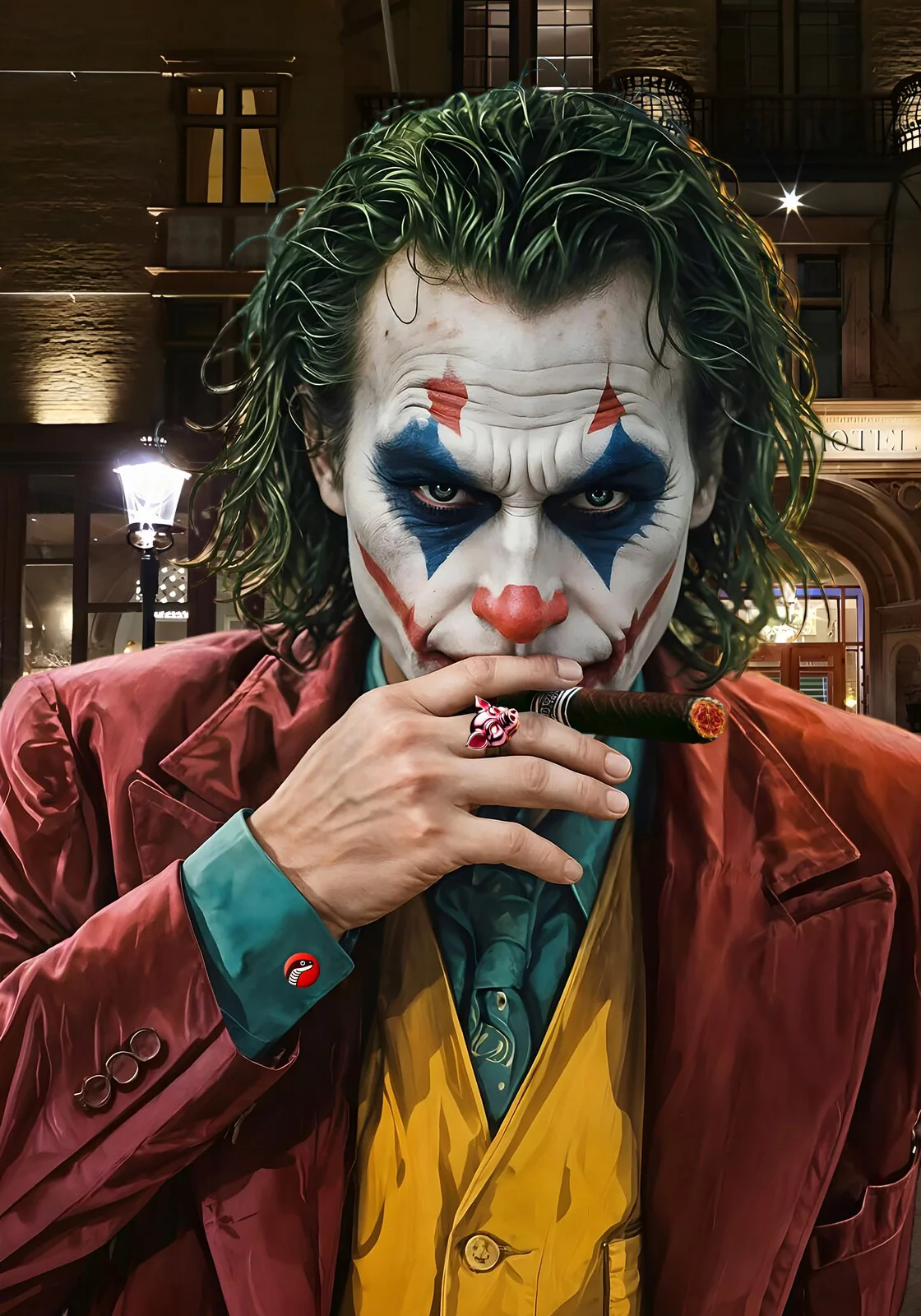
A Smoking Joker and Eel-heads, 2025
Digital
70 x 100 cm
5 200 kr
A Smoking Joker and Eel-heads
A Smoking Joker
The Joker, Gotham’s infamous madman, had just been inducted as an honorary member of the uniquely Skåne-based society, the ‘Eel-heads’ a group with the tongue-in-cheek motto ‘Capiti Anguillae Sacra’—"Sacred to the Eel’s Head." This peculiar order celebrates those affectionately dubbed ‘ålahuvuden’—a local term for individuals of questionable intelligence. In true Skåne fashion, the group embraces its reputation with humour and revelry, turning what might seem like an insult into a badge of pride. And who better to join their ranks than the Joker himself, a man whose harebrained schemes and chaotic genius fit perfectly within this unconventional fellowship?
Read on to uncover the intriguing secrets of Eels and Joker that will pique your interest.
-
“The Eel's Saga
(A drinking song to the tune of your choice, preferably one that's rowdy and fun!)
A lovely lass from the town of Gränna,
Her skill with her butt was no dilemma.
With her nimble and powerful rear,
She could choke an eel, oh dear!
And sharpen a pencil, clear!
An Eel-head from Stockholm so bold,
Claimed his mimicry skills were gold.
"I can mimic any creature," said he,
"Even a lion’s roar, just wait and see!
So name your beast, I’ll make the call!"
We said: "How ’bout smoked eel, y’all?"
Chorus:
It’s the eel from the Sargasso Sea,
At the Ålagille, where it’s meant to be!
It swam all the way to join our cheer,
And now it’s served with schnapps and beer.
We smoke it, stew it, fry it up neat,
Lay it in soup, a Skåne treat!
With every bite, a shot we toast,
To the eel, we love to boast!
The eel can be eaten by both bright and numb,
By chatterboxes, and those struck dumb.
But pair it with snaps, and here’s the thrill:
The quietest one starts talking at will!
Chorus:
It’s the eel from the Sargasso Sea,
At the Ålagille, where it’s meant to be!
It swam all the way to join our cheer,
And now it’s served with schnapps and beer.
So raise your glass to this slippery friend,
Who travelled so far to meet its end?
From the ocean's depths to the Skåne plate,
We’ll drink and laugh till it’s truly late!
Malmö. January 2025
A Smoking Joker
Standing outside Lund's Grand Hotel, the Joker was taking a smoke break. His glowing red cufflink betrayed his recent induction as an honorary member of the deeply Scanian society 'Ålahuvudenas Orden'—the Order of the Eel Heads. Their motto, 'Capiti Anguillae Sacra', meaning 'Dedicated to the Head of the Eel', was commonly shortened to 'Anguillae Sacra'. Implicitly, this was a society of brothers perceived by outsiders as Eel Heads—in other words, dimwits. Since nothing was to be done about the matter—one was born that way—it seemed best to make the most of the situation. Thus, in the 19th century, they established an order for less-than-gifted individuals, the kind that, in Skåne, were mockingly referred to as Eel-heads.
'Anguillae Sacra' – was a Scanian order without equals, where Joker, the infamous madman from Gotham, had just been made an honorary member. The Grand Master's speech explained the dubious honour:
"Welcome, Joker, to the sacred ranks of the Eel Heads. Your vision for world domination is so astoundingly foolish that it demands a place among us! Here, we are not just fools – we are proud of it."
The reason? His ideas about world domination were considered so incomprehensibly terrible that even the most thick-headed eel heads in the society couldn’t help but laugh at them. "Any eel head could figure out that you’re as credible as a lad claiming to have seen the Näcken in Malmö’s canal," one member remarked during the ceremony, and everyone agreed.
When it came to his origin story, Batman, society mostly shrugged. "Sure, Batman isn’t exactly part of the intelligentsia, but you, Joker, are dumber than the darkest black hole in space. You are in a league of your own. Your fans – the ones who buy your comics, or bought one, should say – are so stupid that here in Skåne, we don’t even have a word for their idiocy. They’re 'completely empty-headed,' and it’s so bad that it’s almost a compliment," the Eel head continued.
The Grand Master, dressed in the traditional tight-fitting eel-skin suit and wielding a staff crowned with a golden eel head, concluded the ceremony by presenting the esteemed brooch featuring an eel’s head: "Joker, you are now an official member of ‘Anguillae Sacra’. Your name will shine as brightly as an eel head in murky waters – but only if the water is truly muddy. Our pride lies not in being smart but in being so dumb that we are immortal! Welcome to the family."
And so, Joker swore the sacred oath – in broad Scanian dialect, of course – while the society cheered and waved their eel staves and goose feet:
"Long live foolishness! Long live Anguillae Sacra! Long live the Eel-heads!"
The gatherings of Anguillae Sacra were nothing short of legendary in their absurdity. Members would ritually smack each other on the head with a goose’s foot, an instrument deemed appropriate since the goose was considered so foolish that, by comparison, a hen might as well be Einstein.
Dinners were conducted in what they mockingly referred to as "academic forms," meaning everything was done backwards. The meal began with coffee and liqueur, followed by dessert, then the main course, and finally concluded with the appetizer—a slice of rye bread topped with an eel's head in aspic and a single cornichon. Naturally, this was not a decorous affair. During dinner, the members would gleefully throw food at each other, filling the room with chaos.
But the true highlight came after the final welcome drink, with the ceremonial game of "Undress the Toilet Roll," led by the Grand Master himself, known affectionately as the "Over-Pucko." Each participant received a toilet roll, and at the sound of the starting signal, they had to unravel the roll as quickly as possible. When finished, they had to shout—through the hollow roll, of course—"Now I can't poop!" It was the height of wit and sophistication, as far as the Anguillae Sacra was concerned.
Once a quarter, the society met for their most chaotic tradition: spraying each other with powder fire extinguishers. This event had gotten them banned from Grand Hotel’s premises after just one attempt, forcing them to relocate to the barn of Jönsson, a farmer who also served as the society's Master of Ceremonies, or "First Fool" (Förste Fubbick). Jönsson was widely regarded as being dumber than all his sheep combined, a title he wore with pride.
Joker, a proud member of multiple secret societies, often marvelled at the creativity of Anguillae Sacra. Though he was also a member of the global society of male chauvinists, Cavemen, it simply couldn’t compare. The local chapter of Cavemen met in the Grand Hotel’s basement, where their rituals were less chaotic but equally offensive. While Cavemen prided themselves on their collective arrogance, they lacked the pure, unadulterated silliness that defined the Anguillae Sacra. Joker couldn’t help but think that smacking someone with a goose foot and racing to strip a toilet roll had a certain charm that even Gotham's finest lunacy couldn’t match.
Their order ring's deep pink pig-head design left distinctive marks on opponents’ faces during fights—far more pronounced than those left by another chauvinist's skull ring. Naturally, the Phantom was also a member, as were all the other so-called male superheroes—or rather, "super-sexists." Among these, Tony Stark, Iron Man, is often the frontrunner for the title of the ultimate chauvinist pig. His earlier days as an arrogant, womanising billionaire with delusions of grandeur made him the ultimate super-chauvinist Male Pig. In the early Marvel films and comics, he was notorious for treating women as accessories rather than equals. Even though Tony has evolved and matured over time, his "playboy" image still lingers in the minds of many fans.
Of course, he is not alone. Bruce Wayne, Batman, is another iconic example. While his brooding persona might make him seem more complex, his emotionally unavailable and dismissive attitude toward women often places him in a similar category. On the other hand, characters like Deadpool and Lobo are more self-aware and parody chauvinist culture, frequently using it to highlight its absurdity.
What binds all these superheroes to this category is their treatment of women as decorative, their self-centeredness, or their reluctance to listen to others. That said, many of these characters have been developed over time, and their more chauvinistic traits have been toned down in modern storytelling to reflect a more progressive view of gender roles. Perhaps this shift is because their stories no longer sell as well. Why should young boys buy into a dream that, in today's society, feels entirely outdated in a world filled with talented, successful women?
According to many feminists, the most prominent "Manosphere" is often referred to as "The Patriarchy." While it is not a literal organisation, it represents a system that perpetuates male dominance and female subordination in society. Shifting the focus to real-life groups, numerous orders have been criticised for fostering sexist attitudes or cultures. Traditional gentlemen's clubs or "old boys' networks" are frequently seen as strongholds of male privilege, where men promote each other and shut women out of opportunities.
Similarly, online communities within the manosphere—like Men's Rights Activists (MRAs) and Incels—have been accused of spreading misogynistic rhetoric. Religious or conservative groups are also frequently called out, particularly those that actively oppose gender equality and reinforce traditional gender roles that restrict women's opportunities. Historical male-dominated organisations like Masonic lodges, which excluded women from leadership and membership for centuries, are often cited as examples of entrenched sexism.
Even in the corporate world, the notorious "boys' club" culture thrives in specific industries. Informal male networks often consolidate power, creating barriers for women aspiring to leadership roles. Feminists see these examples as modern manifestations of systemic sexism, which illustrates how structures continue to uphold inequality. Feminist critiques of these organisations vary—some see them as deliberately exclusionary. In contrast, others interpret them as symptoms of a more extensive, deeply ingrained system of structural sexism rather than isolated manifestations of male chauvinism.
The Grand Hotel in Lund, a historic and iconic establishment, served as the gathering spot for the 'Eel-heads' and 'Cavemen' and a wide range of societies, orders, and organisations, including a few feminist groups. It also boasts an excellent kitchen, although eel nowadays rarely features on its menu.
A Few Words About "Ålahuvuden"
Why the eel has snuck into the vocabulary of mocking expressions for foolish Skåningar remains a mystery, for the eel is undoubtedly not particularly dumb. It can find its way back and forth to the Sargasso Sea—a journey few species on Earth can make. If the saying "one grows wiser with age" holds, eels must become truly wise. One eel that spent its entire life in an aquarium lived to be 85 years old, and a so-called "well eel" from Österlen in Skåne is thought to have reached the astonishing age of 155 years. Their resilience and longevity are truly inspiring.
Despite the eel’s impressive achievements, it has still come to represent stupidity in the expression "ålahuvud." This association likely has more to do with humour, cultural connections, and misconceptions than the creature's actual intellect. The eel's long, narrow head and seemingly expressionless face may appear "blank" to human eyes, leading to the perception of a lack of intelligence. It's a bit like how sheep are often seen as foolish simply because their behaviour doesn’t align with our standards for cleverness.
Moreover, eels are slippery and notoriously hard to catch, which may have contributed to their reputation as evasive or unreliable. While this trait has little to do with stupidity, it has, over time, played into the idea of ‘Ålahuvud’ as a term for someone challenging to pin down or seemingly clueless.
The term may have begun as a humorous jab in Skåne, where eels are deeply tied to local culture through centuries of fishing traditions. The people of Skåne are known for their dry wit and playful insults, so calling someone a ålahuvud could have been a tongue-in-cheek way of teasing. Over time, it evolved into a more widespread colloquialism for someone perceived as dim-witted.
In reality, eels are far from stupid. Their ability to navigate across oceans, often returning to the exact place where they were born, is nothing short of extraordinary. But as with many animals that don’t exhibit "human-like" behaviour, they have been misjudged. The phrase ‘Eel-head’ is less a reflection of the eel’s nature and more an example of how humans project our humour, cultural quirks, and misconceptions onto the natural world.
In Skåne, the eel holds a special place as a fish rich in tradition, with a festive celebration named after it—a distinction few other species enjoy. After all, there are no invitations to cod feasts, herring parties, or plaice banquets. Still, the ‘ålagille’ (eel feast) is a cherished autumn tradition, much like the festivities dedicated to another supposedly "dumb" creature, the goose. However, the goose is far from dumb—in fact, quite the opposite! Not only is it delicious on the table, but it is also a relatively intelligent bird with impressive social and communication skills. Its reputation for being "stupid" stems more from cultural misunderstandings and sometimes comical behaviour, which people misinterpret. As a guard against thieves or unwanted guests, it outshines even a dog, which might fall asleep on duty or be bribed with a juicy piece of meat. Conversely, a goose never misses an intruder, and the entire flock sounds the alarm.
An 'Ålagille' is a traditional Skåne feast where the eel takes centre stage on the table and in the conversations. The Swedish word ‘gille’ is tricky to translate because it carries a specific meaning that doesn’t have a direct equivalent in English. To best capture the essence of the word, "Traditional Eel Feast" or "Eel Banquet" may be reasonable compromises. Still, if one wants to emphasise the cultural and ceremonial aspect, "Eel Guild Feast" or something similar could convey the right feeling. This celebration is a testament to the rich cultural heritage of Skåne, and experiencing it will deepen your respect for local traditions.
During an 'Ålagille', eel is served in various forms—smoked, fried, boiled, or even as eel soup—accompanied by classic sides like rye bread, cheese, potatoes, and generous servings of Skåne aquavit, a potent local liquor. The feast typically begins with 'Luad ål', where the eel is lightly boiled with spices to preserve its natural flavour, a highlight of the meal.
Beyond the food, the 'Ålagille' is characterised by joy, song, and tall tales about eel fishing, as well as the crowning of an 'Åla King' and 'Åla Queen'. This involves catching a live eel by hand as it swims in a large barrel filled with bladderwrack and water. Whoever manages to do this in the shortest time is crowned king or queen for the evening and the night, and they are expected to be as skilled at drinking as they are at catching the slippery eel. The 'Ålagille' is not just a feast but a celebration of community and shared traditions.
The 'Luad ål' tradition pays homage to the long history of eel fishing in Skåne, making the occasion more than just a meal—it’s a celebration of nature, community, and Skåne’s rich cultural heritage. Similarly, the goose has its festive tradition built around it, with its importance equally celebrated at the table and beyond.
Jörgen Thornberg
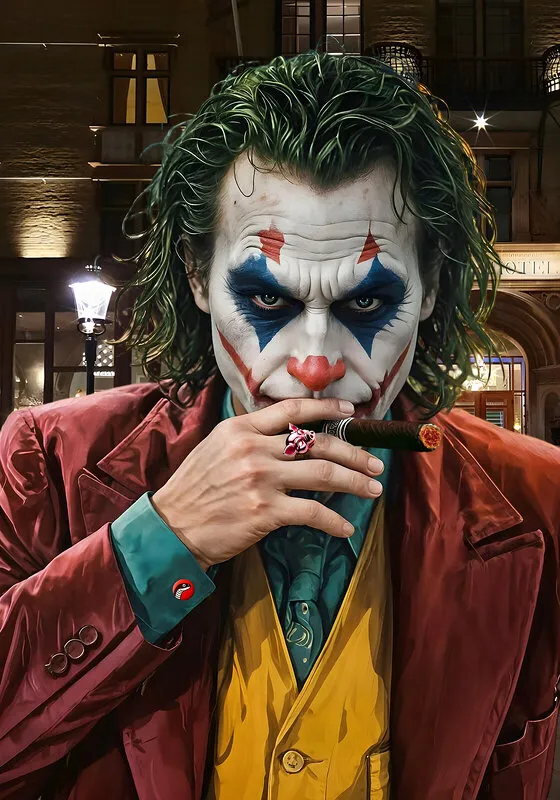
A Smoking Joker and Eel-heads, 2025
Digital
70 x 100 cm
5 200 kr
A Smoking Joker and Eel-heads
A Smoking Joker
The Joker, Gotham’s infamous madman, had just been inducted as an honorary member of the uniquely Skåne-based society, the ‘Eel-heads’ a group with the tongue-in-cheek motto ‘Capiti Anguillae Sacra’—"Sacred to the Eel’s Head." This peculiar order celebrates those affectionately dubbed ‘ålahuvuden’—a local term for individuals of questionable intelligence. In true Skåne fashion, the group embraces its reputation with humour and revelry, turning what might seem like an insult into a badge of pride. And who better to join their ranks than the Joker himself, a man whose harebrained schemes and chaotic genius fit perfectly within this unconventional fellowship?
Read on to uncover the intriguing secrets of Eels and Joker that will pique your interest.
-
“The Eel's Saga
(A drinking song to the tune of your choice, preferably one that's rowdy and fun!)
A lovely lass from the town of Gränna,
Her skill with her butt was no dilemma.
With her nimble and powerful rear,
She could choke an eel, oh dear!
And sharpen a pencil, clear!
An Eel-head from Stockholm so bold,
Claimed his mimicry skills were gold.
"I can mimic any creature," said he,
"Even a lion’s roar, just wait and see!
So name your beast, I’ll make the call!"
We said: "How ’bout smoked eel, y’all?"
Chorus:
It’s the eel from the Sargasso Sea,
At the Ålagille, where it’s meant to be!
It swam all the way to join our cheer,
And now it’s served with schnapps and beer.
We smoke it, stew it, fry it up neat,
Lay it in soup, a Skåne treat!
With every bite, a shot we toast,
To the eel, we love to boast!
The eel can be eaten by both bright and numb,
By chatterboxes, and those struck dumb.
But pair it with snaps, and here’s the thrill:
The quietest one starts talking at will!
Chorus:
It’s the eel from the Sargasso Sea,
At the Ålagille, where it’s meant to be!
It swam all the way to join our cheer,
And now it’s served with schnapps and beer.
So raise your glass to this slippery friend,
Who travelled so far to meet its end?
From the ocean's depths to the Skåne plate,
We’ll drink and laugh till it’s truly late!
Malmö. January 2025
A Smoking Joker
Standing outside Lund's Grand Hotel, the Joker was taking a smoke break. His glowing red cufflink betrayed his recent induction as an honorary member of the deeply Scanian society 'Ålahuvudenas Orden'—the Order of the Eel Heads. Their motto, 'Capiti Anguillae Sacra', meaning 'Dedicated to the Head of the Eel', was commonly shortened to 'Anguillae Sacra'. Implicitly, this was a society of brothers perceived by outsiders as Eel Heads—in other words, dimwits. Since nothing was to be done about the matter—one was born that way—it seemed best to make the most of the situation. Thus, in the 19th century, they established an order for less-than-gifted individuals, the kind that, in Skåne, were mockingly referred to as Eel-heads.
'Anguillae Sacra' – was a Scanian order without equals, where Joker, the infamous madman from Gotham, had just been made an honorary member. The Grand Master's speech explained the dubious honour:
"Welcome, Joker, to the sacred ranks of the Eel Heads. Your vision for world domination is so astoundingly foolish that it demands a place among us! Here, we are not just fools – we are proud of it."
The reason? His ideas about world domination were considered so incomprehensibly terrible that even the most thick-headed eel heads in the society couldn’t help but laugh at them. "Any eel head could figure out that you’re as credible as a lad claiming to have seen the Näcken in Malmö’s canal," one member remarked during the ceremony, and everyone agreed.
When it came to his origin story, Batman, society mostly shrugged. "Sure, Batman isn’t exactly part of the intelligentsia, but you, Joker, are dumber than the darkest black hole in space. You are in a league of your own. Your fans – the ones who buy your comics, or bought one, should say – are so stupid that here in Skåne, we don’t even have a word for their idiocy. They’re 'completely empty-headed,' and it’s so bad that it’s almost a compliment," the Eel head continued.
The Grand Master, dressed in the traditional tight-fitting eel-skin suit and wielding a staff crowned with a golden eel head, concluded the ceremony by presenting the esteemed brooch featuring an eel’s head: "Joker, you are now an official member of ‘Anguillae Sacra’. Your name will shine as brightly as an eel head in murky waters – but only if the water is truly muddy. Our pride lies not in being smart but in being so dumb that we are immortal! Welcome to the family."
And so, Joker swore the sacred oath – in broad Scanian dialect, of course – while the society cheered and waved their eel staves and goose feet:
"Long live foolishness! Long live Anguillae Sacra! Long live the Eel-heads!"
The gatherings of Anguillae Sacra were nothing short of legendary in their absurdity. Members would ritually smack each other on the head with a goose’s foot, an instrument deemed appropriate since the goose was considered so foolish that, by comparison, a hen might as well be Einstein.
Dinners were conducted in what they mockingly referred to as "academic forms," meaning everything was done backwards. The meal began with coffee and liqueur, followed by dessert, then the main course, and finally concluded with the appetizer—a slice of rye bread topped with an eel's head in aspic and a single cornichon. Naturally, this was not a decorous affair. During dinner, the members would gleefully throw food at each other, filling the room with chaos.
But the true highlight came after the final welcome drink, with the ceremonial game of "Undress the Toilet Roll," led by the Grand Master himself, known affectionately as the "Over-Pucko." Each participant received a toilet roll, and at the sound of the starting signal, they had to unravel the roll as quickly as possible. When finished, they had to shout—through the hollow roll, of course—"Now I can't poop!" It was the height of wit and sophistication, as far as the Anguillae Sacra was concerned.
Once a quarter, the society met for their most chaotic tradition: spraying each other with powder fire extinguishers. This event had gotten them banned from Grand Hotel’s premises after just one attempt, forcing them to relocate to the barn of Jönsson, a farmer who also served as the society's Master of Ceremonies, or "First Fool" (Förste Fubbick). Jönsson was widely regarded as being dumber than all his sheep combined, a title he wore with pride.
Joker, a proud member of multiple secret societies, often marvelled at the creativity of Anguillae Sacra. Though he was also a member of the global society of male chauvinists, Cavemen, it simply couldn’t compare. The local chapter of Cavemen met in the Grand Hotel’s basement, where their rituals were less chaotic but equally offensive. While Cavemen prided themselves on their collective arrogance, they lacked the pure, unadulterated silliness that defined the Anguillae Sacra. Joker couldn’t help but think that smacking someone with a goose foot and racing to strip a toilet roll had a certain charm that even Gotham's finest lunacy couldn’t match.
Their order ring's deep pink pig-head design left distinctive marks on opponents’ faces during fights—far more pronounced than those left by another chauvinist's skull ring. Naturally, the Phantom was also a member, as were all the other so-called male superheroes—or rather, "super-sexists." Among these, Tony Stark, Iron Man, is often the frontrunner for the title of the ultimate chauvinist pig. His earlier days as an arrogant, womanising billionaire with delusions of grandeur made him the ultimate super-chauvinist Male Pig. In the early Marvel films and comics, he was notorious for treating women as accessories rather than equals. Even though Tony has evolved and matured over time, his "playboy" image still lingers in the minds of many fans.
Of course, he is not alone. Bruce Wayne, Batman, is another iconic example. While his brooding persona might make him seem more complex, his emotionally unavailable and dismissive attitude toward women often places him in a similar category. On the other hand, characters like Deadpool and Lobo are more self-aware and parody chauvinist culture, frequently using it to highlight its absurdity.
What binds all these superheroes to this category is their treatment of women as decorative, their self-centeredness, or their reluctance to listen to others. That said, many of these characters have been developed over time, and their more chauvinistic traits have been toned down in modern storytelling to reflect a more progressive view of gender roles. Perhaps this shift is because their stories no longer sell as well. Why should young boys buy into a dream that, in today's society, feels entirely outdated in a world filled with talented, successful women?
According to many feminists, the most prominent "Manosphere" is often referred to as "The Patriarchy." While it is not a literal organisation, it represents a system that perpetuates male dominance and female subordination in society. Shifting the focus to real-life groups, numerous orders have been criticised for fostering sexist attitudes or cultures. Traditional gentlemen's clubs or "old boys' networks" are frequently seen as strongholds of male privilege, where men promote each other and shut women out of opportunities.
Similarly, online communities within the manosphere—like Men's Rights Activists (MRAs) and Incels—have been accused of spreading misogynistic rhetoric. Religious or conservative groups are also frequently called out, particularly those that actively oppose gender equality and reinforce traditional gender roles that restrict women's opportunities. Historical male-dominated organisations like Masonic lodges, which excluded women from leadership and membership for centuries, are often cited as examples of entrenched sexism.
Even in the corporate world, the notorious "boys' club" culture thrives in specific industries. Informal male networks often consolidate power, creating barriers for women aspiring to leadership roles. Feminists see these examples as modern manifestations of systemic sexism, which illustrates how structures continue to uphold inequality. Feminist critiques of these organisations vary—some see them as deliberately exclusionary. In contrast, others interpret them as symptoms of a more extensive, deeply ingrained system of structural sexism rather than isolated manifestations of male chauvinism.
The Grand Hotel in Lund, a historic and iconic establishment, served as the gathering spot for the 'Eel-heads' and 'Cavemen' and a wide range of societies, orders, and organisations, including a few feminist groups. It also boasts an excellent kitchen, although eel nowadays rarely features on its menu.
A Few Words About "Ålahuvuden"
Why the eel has snuck into the vocabulary of mocking expressions for foolish Skåningar remains a mystery, for the eel is undoubtedly not particularly dumb. It can find its way back and forth to the Sargasso Sea—a journey few species on Earth can make. If the saying "one grows wiser with age" holds, eels must become truly wise. One eel that spent its entire life in an aquarium lived to be 85 years old, and a so-called "well eel" from Österlen in Skåne is thought to have reached the astonishing age of 155 years. Their resilience and longevity are truly inspiring.
Despite the eel’s impressive achievements, it has still come to represent stupidity in the expression "ålahuvud." This association likely has more to do with humour, cultural connections, and misconceptions than the creature's actual intellect. The eel's long, narrow head and seemingly expressionless face may appear "blank" to human eyes, leading to the perception of a lack of intelligence. It's a bit like how sheep are often seen as foolish simply because their behaviour doesn’t align with our standards for cleverness.
Moreover, eels are slippery and notoriously hard to catch, which may have contributed to their reputation as evasive or unreliable. While this trait has little to do with stupidity, it has, over time, played into the idea of ‘Ålahuvud’ as a term for someone challenging to pin down or seemingly clueless.
The term may have begun as a humorous jab in Skåne, where eels are deeply tied to local culture through centuries of fishing traditions. The people of Skåne are known for their dry wit and playful insults, so calling someone a ålahuvud could have been a tongue-in-cheek way of teasing. Over time, it evolved into a more widespread colloquialism for someone perceived as dim-witted.
In reality, eels are far from stupid. Their ability to navigate across oceans, often returning to the exact place where they were born, is nothing short of extraordinary. But as with many animals that don’t exhibit "human-like" behaviour, they have been misjudged. The phrase ‘Eel-head’ is less a reflection of the eel’s nature and more an example of how humans project our humour, cultural quirks, and misconceptions onto the natural world.
In Skåne, the eel holds a special place as a fish rich in tradition, with a festive celebration named after it—a distinction few other species enjoy. After all, there are no invitations to cod feasts, herring parties, or plaice banquets. Still, the ‘ålagille’ (eel feast) is a cherished autumn tradition, much like the festivities dedicated to another supposedly "dumb" creature, the goose. However, the goose is far from dumb—in fact, quite the opposite! Not only is it delicious on the table, but it is also a relatively intelligent bird with impressive social and communication skills. Its reputation for being "stupid" stems more from cultural misunderstandings and sometimes comical behaviour, which people misinterpret. As a guard against thieves or unwanted guests, it outshines even a dog, which might fall asleep on duty or be bribed with a juicy piece of meat. Conversely, a goose never misses an intruder, and the entire flock sounds the alarm.
An 'Ålagille' is a traditional Skåne feast where the eel takes centre stage on the table and in the conversations. The Swedish word ‘gille’ is tricky to translate because it carries a specific meaning that doesn’t have a direct equivalent in English. To best capture the essence of the word, "Traditional Eel Feast" or "Eel Banquet" may be reasonable compromises. Still, if one wants to emphasise the cultural and ceremonial aspect, "Eel Guild Feast" or something similar could convey the right feeling. This celebration is a testament to the rich cultural heritage of Skåne, and experiencing it will deepen your respect for local traditions.
During an 'Ålagille', eel is served in various forms—smoked, fried, boiled, or even as eel soup—accompanied by classic sides like rye bread, cheese, potatoes, and generous servings of Skåne aquavit, a potent local liquor. The feast typically begins with 'Luad ål', where the eel is lightly boiled with spices to preserve its natural flavour, a highlight of the meal.
Beyond the food, the 'Ålagille' is characterised by joy, song, and tall tales about eel fishing, as well as the crowning of an 'Åla King' and 'Åla Queen'. This involves catching a live eel by hand as it swims in a large barrel filled with bladderwrack and water. Whoever manages to do this in the shortest time is crowned king or queen for the evening and the night, and they are expected to be as skilled at drinking as they are at catching the slippery eel. The 'Ålagille' is not just a feast but a celebration of community and shared traditions.
The 'Luad ål' tradition pays homage to the long history of eel fishing in Skåne, making the occasion more than just a meal—it’s a celebration of nature, community, and Skåne’s rich cultural heritage. Similarly, the goose has its festive tradition built around it, with its importance equally celebrated at the table and beyond.
5 200 kr

Jörgen Thornberg
Malmö
Lite om bilder och mig. Translation in English at the end.
Jag är en nyfiken person som ser allt i bilder, även det jag fäster i ord, gärna tillsammans för bakom alla mina bilder finns en berättelse. Till vissa bilder hör en kortare eller längre novell som följer med bilden.
Bilder berättar historier. Jag omges av naturlig skönhet, intressanta människor och historia var jag än går. Jag använder min kamera för att dokumentera världen och blanda det jag ser med vad jag känner för att fånga den dolda magin.
Mina bilder berättar mina historier. Genom mina bilder, tryck och berättelser. Jag bjuder in dig att ta del av dessa berättelser, in i ditt liv och hem och dela min mycket personliga syn på vår värld. Mer än vad ögat ser. Jag tänker i bilder, drömmer och skriver och pratar om dem; följaktligen måste jag också skapa bilder. De blir vad jag ser, inte nödvändigtvis begränsade till verkligheten. Det finns en bild runt varje hörn. Jag hoppas att du kommer att se vad jag såg och gilla det.
Jag är också en skrivande person och till många bilder hör en kortare eller längre essay. Den följer med tavlan, tryckt på fint papper och med en personlig hälsning från mig.
Flertalet bilder startar sin resa i min kamera. Enkelt förklarat beskriver jag bilden jag ser i mitt inre, upplevd eller fantiserad. Bilden uppstår inom mig redan innan jag fått okularet till ögat. På bråkdelen av ett ögonblick ser jag vad jag vill ha och vad som kan göras med bilden. Här skall jag stoppa in en giraff, stålmannen, Titanic eller vad det är min fantasi finner ut. Ännu märkligare är att jag kommer ihåg minnesbilden långt efteråt när det blir tid att skapa verket. Om jag lyckas eller inte, är upp till betraktaren, oftast präglat av en stråk av svart humor – meningen är att man skall bli underhållen. Mina bilder blir ofta en snackis där de hänger.
Jag föredrar bilder som förmedlar ett budskap i flera lager. Vid första anblicken fylld av feel-good, en vacker utsikt, fint väder, solen skiner, blommor på ängen eller vattnet som ligger förrädiskt spegelblankt. I en sådan bild kan jag gömma min egentliga berättelse, mitt förakt för förtryckare och våldsverkare, rasister och fördomsfulla människor - ett gärna återkommande motiv mer eller mindre dolt i det vackra motivet. Jag försöker förena dem i ett gemensamt narrativ.
Bild och formgivning har löpt som en röd tråd genom livet. Fotokonst känns som en värdig final som jag gärna delar med mig.
Min genre är vid som framgår av mina bilder, temat en blandning av pop- och gatukonst i kollage som kan bestå av hundratals lager. Vissa bilder kan ta veckor, andra någon dag innan det är dags att överlämna resultatet till printverkstaden. Fine Art Prints är digitala fotocollage. I dessa kollage sker rivandet, klippandet, pusslandet, målandet, ritandet och sprayningen digitalt. Det jag monterar in kan vara hundratals år gamla bilder som jag omsorgsfullt frilägger så att de ser ut att vara en del av tavlan men också bilder skapade av mig själv efter min egen fantasi. Därefter besöks printstudion och för vissa bilder numrera en limiterad upplaga (oftast 7 exemplar) och signera för hand. Vissa bilder kan köpas i olika format. Det är bara att fråga efter vilka. Gillar man en bild som är 70x100 men inte har plats på väggen, går den kanske att få i 50x70 cm istället. Frågan är fri.
Metoden Giclée eller Fine Art Print som det också kallas är det moderna sättet för framställning av grafisk konst. Villkoret för denna typ av utskrifter är att en högkvalitativ storformatskrivare används med åldersbeständigt färgpigment och konstnärspapper eller i förekommande fall på duk. Pappret som används möter de krav på livslängd som ställs av museer och gallerier. Normalt säljer jag mina bilder oinramade så att den nya ägaren själv kan bestämma hur de skall se ut, med eller utan passepartout färg på ram, med eller utan glas etc..
Under många år ställde jag bara ut på nätet, i valda grupper och på min egen Facebooksida - https://www.facebook.com/jorgen.thornberg.9
Jag finns också på en egen hemsida som tyvärr inte alltid är uppdaterad – https://www.jth.life/ Där kan du också läsa en del av de berättelser som följer med bilden.
UTSTÄLLNINGAR
Luftkastellet, oktober 2022
Konst i Lund, november 2022
Luftkastellet, mars 2023
Engleson Galleri Caroli, april 2023
Hydra, Greece June 2023
Engleson Galleri Caroli, oktober 2023
Toppen, Höllviken december 2023
Luftkastellet, mars 2024
Torups Galleri, mars 2024
Venice, May 2024
Luftkastellet, oktober 2024
Konst i Advent, December 2024
Galleri Engleson, Caroli December 2024
Jäger & Jansson Galleri, april 2025
A bit about pictures and me.
I'm a curious person who sees everything in pictures, even what I express in words, often combining them, for behind all my pictures lies a story. These narratives, some as short as a single image and others as long as a novel, are the heart and soul of my work.
Pictures tell stories. Wherever I go, I'm surrounded by natural beauty, exciting people, and history. I use my camera to document the world and blend what I see with what I feel to capture the hidden magic.
My images tell my stories. Through my pictures, prints, and narratives, I invite you to partake in these stories in your life and home and share my deeply personal perspective of our world. More than meets the eye. I think in pictures, dream, write, and talk about them; consequently, I must create images too. They become what I see, not necessarily confined to reality. There's a picture around every corner. I hope you'll see what I saw and enjoy it.
I'm also a writer, and many images come with a shorter or longer essay. It accompanies the painting, printed on fine paper with my personal greeting.
Many pictures start their journey on my camera. Simply put, I describe the image I see in my mind, experienced or imagined. The image arises within me even before I bring the eyepiece to my eye. In a fraction of a moment, I see what I want and what can be done with the picture. Here, I'll insert a giraffe, Superman, the Titanic, or whatever my imagination conjures up. Even stranger is that I remember the mental image long after it's time to create the work. Whether I succeed is up to the observer, often imbued with a streak of black humour – the aim is to entertain. My pictures usually become a talking point wherever they hang.
I prefer pictures that convey a message in multiple layers. At first glance, they're filled with feel-good vibes, a beautiful view, lovely weather, the sun shining, flowers in the meadow, or the water lying deceptively calm. But beneath this surface beauty, I often conceal a deeper story, a narrative that challenges societal norms or explores the human condition. I invite you to delve into these hidden narratives and discover the layers of meaning within my work.
Picture and design have been a thread running through my life. Photographic art feels like a fitting finale, and I'm happy to share it.
My genre is varied, as seen in my pictures; the theme is a blend of pop and street art in collages that can consist of hundreds of layers. Some images can take weeks, others just a day before it's time to hand over the result to the print workshop. Fine Art Prints are digital photo collages. In these collages, tearing, cutting, puzzling, painting, drawing, and spraying happen digitally. What I insert can be images hundreds of years old that I carefully extract so they appear to be part of the painting, but also images created by myself, now also generated from my imagination. Next, visit the print studio and, for certain images, number a limited edition (usually 7 copies) and sign them by hand. Some images may be available in other formats. Just ask which ones. If you like an image that's 70x100 but doesn't have space on the wall, you might be able to get it in 50x70 cm instead. The question is open.
The Giclée method, or Fine Art Print as it's also called, is the modern way of producing graphic art. This method ensures the highest quality and longevity of the artwork, using a high-quality large-format printer with archival pigment inks and artist paper or, in some cases, canvas. The paper used meets the longevity requirements set by museums and galleries. I sell my pictures unframed, allowing the new owner to personalise their artwork, confident in the lasting value and quality of the piece.
For many years, I only exhibited online, in selected groups, and on my Facebook page - https://www.facebook.com/jorgen.thornberg.9. I also have my website, which unfortunately is not constantly updated - https://www.jth.life/. You can also read some of the stories accompanying the pictures there.
EXHIBITIONS
Luftkastellet, October 2022
Art in Lund, November 2022
Luftkastellet, March 2023
Engleson Gallery Caroli, April 2023
Hydra, Greece June 2023
Engleson Gallery Caroli, October 2023
Toppen, Höllviken December 2023
Luftkastellet, March 2024
Torup Gallery, March 2024
Venice, May 2024
UTSTÄLLNINGAR
Luftkastellet, oktober 2022
Konst i Lund, november 2022
Luftkastellet, mars 2023
Engleson Galleri Caroli, april 2023
Hydra, Greece June 2023
Engleson Galleri Caroli, oktober 2023
Toppen, Höllviken december 2023
Luftkastellet, mars 2024
Torups Galleri, mars 2024
Venice, May 2024
Luftkastellet, October 2024
Konst i Advent, December 2024
Galleri Engleson, Caroli December 2024
Jäger & Jansson Galleri, April 2025
Utbildning
Autodidakt
Medlem i konstnärsförening
Öppna Sinnen
Med i konstrunda
Konstrundan i Skåne
Utställningar
Luftkastellet, October 2022
Art in Lund, November 2022
Luftkastellet, March 2023
Engleson Gallery Caroli, April 2023
Hydra, Greece June 2023
Engleson Gallery Caroli, October 2023
Toppen, Höllviken December 2023
Luftkastellet, March 2024
Torup Gallery, March 2024
Venice, May 2024