Vi använder cookies för att ge dig bästa möjliga upplevelse. Välj vilka cookies du tillåter.
Läs mer i vår integritetspolicy
Jörgen Thornberg
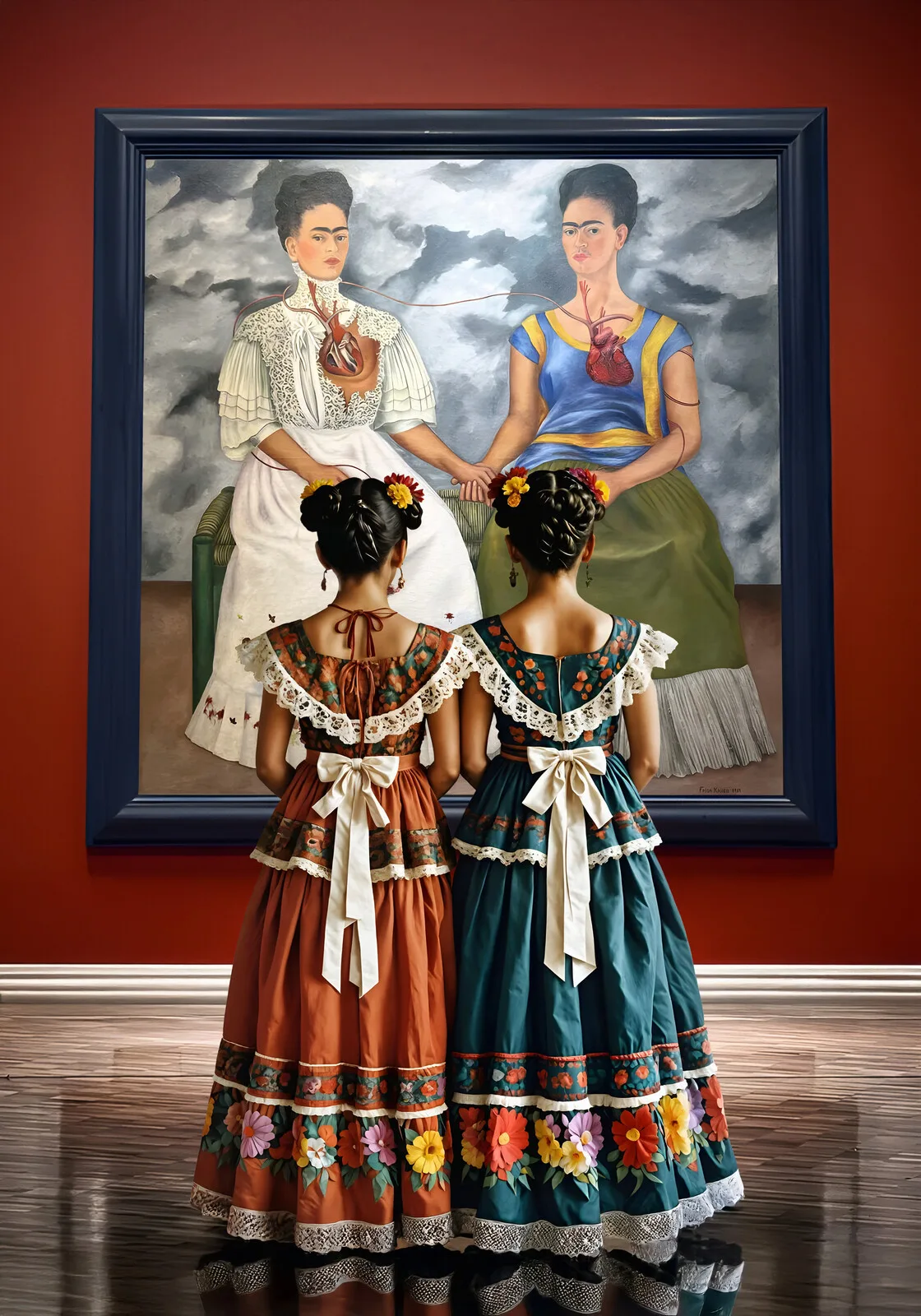
Two Frida Pairs, 2025
Digital
70 x 100 cm
5 200 kr
Two Frida Pairs
On a serene Sunday afternoon at Dockside, over a glass of rich Côtes du Rhône, I had the rare privilege of an intimate conversation with Frida Kahlo. As we delved into the haunting brilliance of The Two Fridas, Frida shared profound insights into her art, her identity, and the unyielding bond between her dual selves. Her vivid reflections, intertwined with moments of wit and vulnerability, offered a glimpse into the soul behind one of art history’s most iconic masterpieces.
Read on to explore the hidden secrets in her painting.
“Two Fridas
Two hearts exposed beneath fragile skin,
Bound by a thread, where pain begins.
One in white, stitched by the past,
A wounded echo that cannot last.
The other bold, adorned in hues,
Of Tehuana pride, where life renews.
She stands defiant, her heart intact,
While her twin bleeds, memories attacked.
One mourns the losses, the severed ties,
Her eyes reflect storm-laden skies.
The other holds strength, a culture's grace,
Yet in her chest, a mirrored space.
A child once dreamed, now lost to time,
Its absence echoes a hollow chime.
No cradle waits, no future cries,
Grief is eternal beneath the skies.
Their hands entwined, a bond unbroken,
Through veins of blood, words unspoken.
Yet scissors loom, their blades persist,
A severance sought, a pain dismissed.
One Frida weeps, her lineage torn,
The clash of roots she's always borne.
The other fights, her heritage bright,
A beacon glowing in endless night.
Two selves, one body, a world apart,
One raw mind, one fractured heart.
In their duality, the truth resides—
The Two Fridas, where conflict abides.
Malmö, January 2025
Two Frida Pairs
A Sunday afternoon at Dockside, a cosy restaurant overlooking the old Kockums dry dock, now filled with luxurious private boats. The soft hum of conversations and the occasional clink of glasses set the tone. Frida Kahlo sits across from me, her vivid presence commanding the room, her expressive hands cradling a glass of Côtes du Rhône. She has a rare day off from her performances at Nöjesteatern and exudes a relaxed aura.
Waiter: "Does the wine taste to your liking?"
Me: "Absolutely. It’s perfect."
Frida nods with a small smile, swirling her wine gently before taking a sip.
Me: "The meeting of your two selves in The Two Fridas fascinates me, Frida. Could you tell me more about its background?"
Frida: (Her eyes gleam as she leans forward, her voice both soft and intense.) "My painting The Two Fridas presents a startling duality. Two women—me and my other self—mirror images of each other like identical twins, sitting side by side on a bench against a barren, cloudy backdrop. They share my features, yet their attire and postures dramatically contrast. In a vibrant Tehuana dress symbolising my deep connection to Mexican culture, one Frida sits assertively, almost defiantly. The other Frida, clad in a white European-style dress, its lace delicate and almost ghostly, sits in a more traditional, reserved pose. Their hands clasp, suggesting an inseparable bond, yet their expressions are distinct—one stoic, the other mournful. At the centre of the image are exposed hearts, both connected by a single, pulsating blood vessel. This blood vessel becomes a lifeline, yet it’s also a point of vulnerability, visually representing the delicate balance within my being."
Me: (Gazing out at the boats bobbing in the water.) "The stark background, featuring ominous storm clouds, forebodes trouble, doesn’t it?"
Frida: (She tilts her head, her voice tinged with humour and melancholy.) "In my life, there was both wind and rain—mostly headwinds, I’m afraid. The beautiful days were rare, so the background felt natural, intensifying the viewer’s focus on the two figures. It underscores the emotional turmoil within my inner world."
Me: "The woven bench… it’s harmonious, almost unremarkable in its simplicity."
Frida: (Smiling slightly.) "Precisely. I intended it that way. It forces the viewer to confront this emotional duality without any distractions. The choice of the seat amplifies the raw, internal conflict central to the painting."
Me: "That’s exactly how it feels."
Frida: (Pausing, her gaze distant momentarily.) "This visual dichotomy speaks volumes about the internal conflict I grappled with. My father, Guillermo, was of German descent, while my mother, Matilde Calderón, was Mexican. I had a close relationship with my father. He was a photographer and an intellectual, supporting my creative development. We shared a passion for art and literature. Our relationship was defined by deep understanding and mutual respect."
(She stops as if gathering her thoughts, then continues with a deeper tone.)
"My relationship with my mother, Matilde, was more complicated. She was a strict and religious woman who didn’t always understand my independent and rebellious nature. Yet there were moments of closeness and care, especially in my early years and when I needed support after my accidents."
Me: "You weren’t traditionally religious, were you?"
Frida: (Shaking her head slightly.) "No, I wasn’t. But my art and life were deeply influenced by Catholicism, which was central to Mexican culture."
Me: "In your paintings, one often sees references to religious icons, saints, and martyrdom."
Frida: (Her voice firm, but reflective.) "Those were metaphors for my suffering and strength, rather than expressions of traditional faith. I was, in a way, more fascinated by Mexico’s pre-Columbian religious traditions and often included those in my work."
Me: (Smiling.) "Many worlds competing for space in one body. It seems crowded."
Frida smiles back, lifting her glass in a small toast. At that moment, a new guest enters, a young artist with a sketchbook under his arm, his footsteps echoing lightly on the wooden floor. Frida glances at him briefly, then turns back to me, her eyes alive with curiosity and warmth. The waiter returns to check on us, but Frida’s focus remains unwavering—anchored in our conversation, as if time has paused to allow her story to unfold.
Frida: “Crowded! I am still, in eternity, the same person, minus the religious aspects, of course, since they no longer hold any meaning. The Two Fridas become representations of this dual heritage, a constant negotiation between my European roots and my fierce embrace of so-called Mexicanidad. It’s important to note that this embrace was likely intensified by the rise of Indigenismo, a post-Mexican Revolution ideology that championed the country’s indigenous heritage. I adopted this outlook, reflecting it in my artistic style and choice of clothing, including the iconic Tehuana ensemble and flowers in my hair.”
Me: “You have offered insights into your painting, suggesting it arose from memories of an imaginary childhood friend but also references your tumultuous relationship with Diego. Your troubled marriage was marked by infidelities on both sides.”
Frida: “Don’t forget that he started it, and I wanted to get even. Enough about that!” (Frida smiled a wry smile.) “The Frida in Tehuana costume, with the intact heart, represents the woman that Diego loved, while her alter ego in white, whose heart appears wounded, symbolises the Frida that Rivera rejected. Here, the blood vessel leading to a miniature portrait of Rivera held by the Tehuana Frida is worth noting, further emphasising this connection.”
Me: “Yes, it’s a moving portrait I want to return to later. The composition subtly echoes your earlier wedding portrait, Frieda and Diego Rivera from 1931, in which you also hold hands, but with an underlying emotional distance amplified in The Two Fridas.”
Me: “For you, this is a monumental scale—more akin to how Diego worked, the bigger, the better.”
Frida: “I typically work on smaller canvases, creating intimate, often self-focused works. The decision to execute The Two Fridas on a large, almost two-by-two-meter scale, nearly life-sized, marked a significant departure. This dramatic shift amplified the emotional intensity of the subject matter. I wanted the figures to become monumental, forcing the viewer to confront the duality and pain within me. I considered this exploration of identity, heartbreak, and suffering a profound experience that transcended the intimacy of my usual work and demanded a grander presentation. The painting was my first large-scale work.”
Me: “It feels like one could walk into the painting and touch you and your twin sister. Rightfully so. In its raw brutality, it remains one of your most recognised and celebrated paintings, with its exposed blood vessels and hearts.”
Frida: “It is meant to lay bare my physical and emotional pain. The exposed hearts within my two Fridas are potent symbols on multiple levels. The strong, whole heart of the Tehuana Frida represents resilience and connection to my Mexican heritage. In contrast, the European Frida’s heart is cut and bleeding, symbolising both the emotional pain of my divorce from Diego and the toll of lifelong physical struggles, not least the loss of an unborn child and the inability to have more. These hearts are not just symbols, but a reflection of the depth of my emotional pain."
“The blood vessel connecting the two Fridas is a complex visual metaphor. It reinforces the idea of an unbreakable bond between these two aspects of my identity, yet it also becomes a source of vulnerability as the European Frida bleeds out. This could be read as a commentary on the relentless pain that I endured due to illness and numerous surgeries, miscarriages, and broken promises—pain that became inseparable from my emotional identity.”
Me: “Some art historians have drawn parallels between the exposed hearts and the tradition of human sacrifice within Aztec culture. This contextualises your work within broader themes of Mexican heritage and offers a lens through which to understand your depiction of suffering.”
Frida: “That could be, but the painting is solely about me and has nothing to do with the Aztecs’ horrible blood sacrifices.”
Me: “The scissors show loss and severance, don’t they?”
Frida: “Correct! A close-up detail focuses on a hand holding a pair of scissors, severing a vein. The cut vein is dripping blood onto the white fabric of a dress, creating a stark contrast and symbolising emotional pain and separation.”
Me: “The image captures your work's intense and raw emotion.”
Frida: “Thanks. The surgical scissors the European Frida holds introduce a chilling yet powerful motif. These instruments of cutting and severing take on a profoundly symbolic role, implying my desperate attempt to sever my emotional bond with Rivera, to excise the part of myself that remains painfully attached to him. This Frida, clad in a pristine white Victorian dress—a symbol of purity and tradition—reflects my European lineage and perhaps the independent artist I sought to be.”
Me: “The futility of your action is heartbreakingly evident, making the picture brutal in its openness.”
Frida: “I meant the blood continues to flow and gives a haunting image that the wounds of loss cannot be neatly severed but remain an ongoing struggle. The splatters of blood staining the immaculate white dress further emphasise the inescapable impact of emotional trauma. The exposed hearts of both Fridas, connected by a single vein, underscore their unbreakable bond. However, the European Frida’s attempt to cut this lifeline highlights the inner turmoil and profound pain I experienced after my divorce.”
Me: “The miniature portrait we touched on earlier, of your husband Diego in one Frida’s hand, shows your unbreakable ties.”
Frida: “There’s no denying it, and the relationship endured against all odds into eternity. The portrait is encased in an oval medallion I always carried in my handbag. In Frida’s lap, it shows Diego’s significant presence and emotional impact in my life.”
(She paused and smiled.)
Me: “Why did you depict your great man as a child?”
Frida: (Laughing.) “The choice to depict Rivera in his infant years has multiple interpretations. First, it represents the innocence of our love before its complexities, or the part of Diego that I continue to cherish despite our tumultuous relationship and repeated infidelities. The portrait’s placement close to my Tehuana Frida’s heart underscores the deep and perhaps inescapable connection between my Mexican identity and my love for Diego. It’s difficult to understand, perhaps, but it could also be my masochistic side asserting itself.” (A short laugh.)
“The portrait further highlights the tension within my being. Despite the European Frida's emotional wounds, I couldn’t fully deny the enduring connection to Diego, a key figure in my life and a fellow artist deeply intertwined with Mexican artistic movements and our shared political stance.”
Me: “How should we classify the work? As Surrealism or Symbolism?”
Frida: “That’s ultimately up to the viewer. My two Fridas invite viewers to consider whether they align strictly with Surrealism or represent a unique blend of symbolism and realism. As an artistic movement, Surrealism often focuses on dreamlike imagery, tapping into the subconscious mind and employing unexpected combinations—elements echoed in most of my work. Artists like Salvador Dalí epitomised this style.”
Me: “Is there no risk of contradiction?”
Frida: “Not according to me. While my two Fridas possess some dreamlike qualities, the symbolism primarily stems from my life experiences. The two Fridas as a twin couple, their exposed hearts, and the connecting blood vessels are not archetypal symbols in Surrealist works but deeply personal motifs relating to my identity, heartbreak, and physical suffering, and implicitly, my deep sorrow over being unable to have children.” (Frida’s face sank into deep melancholy, tears welling up in the corners of her eyes.)
“My painting could be considered more accurately as a work of symbolism infused with my brand of expressive realism. It exposes the complexities of a specific individual rather than exploring universal concepts, a hallmark of Surrealism.”
Me: “Could we summarise by saying that your Two Fridas invites layers of interpretation? It reflects your dual heritage, a raw expression of emotional pain, and a visual confrontation with physical suffering and your sorrow over not being able to have children. This complexity is precisely what makes the painting so compelling. You refuse to present a simplified view of yourself, embracing the contradictions and exposing the vulnerable core of your being. The painting The Two Fridas remains a timeless work of art. Its unflinching honesty speaks to the complexities of identity, the pain of loss, and the resilience of the human spirit—experiences we all share. This universality is why this iconic painting resonates deeply with viewers, including younger generations.”
In 1947, Frida Kahlo's painting "The Two Fridas" was acquired by the Instituto Nacional de Bellas Artes (INBA) in Mexico City for 4,000 pesos (approximately $1,000 at the time), with an additional 36 pesos for the frame. This was the highest amount Kahlo received for a painting during her lifetime.
In front of Frida's painting at the Museo de Arte Moderno in Mexico City, two young girls stand, trying to understand why adults suffer and why the sky is grey while they still see only a bright sky. But that's how it should be; children should be allowed to be children—soon enough, seriousness will come. If Frida could see the girls in her painting, she would think the same way. At the same time, her pain would become unbearable, for she never got to see her unborn daughter grow up and ask existential questions to her mother.
Jörgen Thornberg
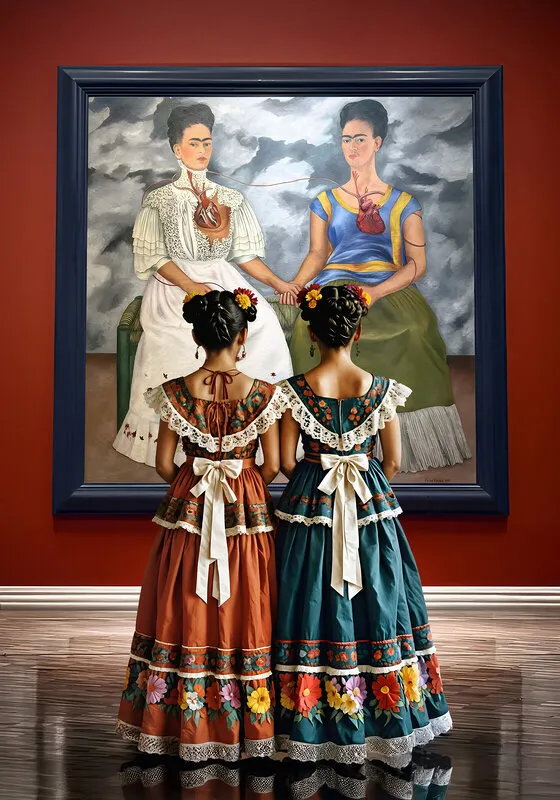
Two Frida Pairs, 2025
Digital
70 x 100 cm
5 200 kr
Two Frida Pairs
On a serene Sunday afternoon at Dockside, over a glass of rich Côtes du Rhône, I had the rare privilege of an intimate conversation with Frida Kahlo. As we delved into the haunting brilliance of The Two Fridas, Frida shared profound insights into her art, her identity, and the unyielding bond between her dual selves. Her vivid reflections, intertwined with moments of wit and vulnerability, offered a glimpse into the soul behind one of art history’s most iconic masterpieces.
Read on to explore the hidden secrets in her painting.
“Two Fridas
Two hearts exposed beneath fragile skin,
Bound by a thread, where pain begins.
One in white, stitched by the past,
A wounded echo that cannot last.
The other bold, adorned in hues,
Of Tehuana pride, where life renews.
She stands defiant, her heart intact,
While her twin bleeds, memories attacked.
One mourns the losses, the severed ties,
Her eyes reflect storm-laden skies.
The other holds strength, a culture's grace,
Yet in her chest, a mirrored space.
A child once dreamed, now lost to time,
Its absence echoes a hollow chime.
No cradle waits, no future cries,
Grief is eternal beneath the skies.
Their hands entwined, a bond unbroken,
Through veins of blood, words unspoken.
Yet scissors loom, their blades persist,
A severance sought, a pain dismissed.
One Frida weeps, her lineage torn,
The clash of roots she's always borne.
The other fights, her heritage bright,
A beacon glowing in endless night.
Two selves, one body, a world apart,
One raw mind, one fractured heart.
In their duality, the truth resides—
The Two Fridas, where conflict abides.
Malmö, January 2025
Two Frida Pairs
A Sunday afternoon at Dockside, a cosy restaurant overlooking the old Kockums dry dock, now filled with luxurious private boats. The soft hum of conversations and the occasional clink of glasses set the tone. Frida Kahlo sits across from me, her vivid presence commanding the room, her expressive hands cradling a glass of Côtes du Rhône. She has a rare day off from her performances at Nöjesteatern and exudes a relaxed aura.
Waiter: "Does the wine taste to your liking?"
Me: "Absolutely. It’s perfect."
Frida nods with a small smile, swirling her wine gently before taking a sip.
Me: "The meeting of your two selves in The Two Fridas fascinates me, Frida. Could you tell me more about its background?"
Frida: (Her eyes gleam as she leans forward, her voice both soft and intense.) "My painting The Two Fridas presents a startling duality. Two women—me and my other self—mirror images of each other like identical twins, sitting side by side on a bench against a barren, cloudy backdrop. They share my features, yet their attire and postures dramatically contrast. In a vibrant Tehuana dress symbolising my deep connection to Mexican culture, one Frida sits assertively, almost defiantly. The other Frida, clad in a white European-style dress, its lace delicate and almost ghostly, sits in a more traditional, reserved pose. Their hands clasp, suggesting an inseparable bond, yet their expressions are distinct—one stoic, the other mournful. At the centre of the image are exposed hearts, both connected by a single, pulsating blood vessel. This blood vessel becomes a lifeline, yet it’s also a point of vulnerability, visually representing the delicate balance within my being."
Me: (Gazing out at the boats bobbing in the water.) "The stark background, featuring ominous storm clouds, forebodes trouble, doesn’t it?"
Frida: (She tilts her head, her voice tinged with humour and melancholy.) "In my life, there was both wind and rain—mostly headwinds, I’m afraid. The beautiful days were rare, so the background felt natural, intensifying the viewer’s focus on the two figures. It underscores the emotional turmoil within my inner world."
Me: "The woven bench… it’s harmonious, almost unremarkable in its simplicity."
Frida: (Smiling slightly.) "Precisely. I intended it that way. It forces the viewer to confront this emotional duality without any distractions. The choice of the seat amplifies the raw, internal conflict central to the painting."
Me: "That’s exactly how it feels."
Frida: (Pausing, her gaze distant momentarily.) "This visual dichotomy speaks volumes about the internal conflict I grappled with. My father, Guillermo, was of German descent, while my mother, Matilde Calderón, was Mexican. I had a close relationship with my father. He was a photographer and an intellectual, supporting my creative development. We shared a passion for art and literature. Our relationship was defined by deep understanding and mutual respect."
(She stops as if gathering her thoughts, then continues with a deeper tone.)
"My relationship with my mother, Matilde, was more complicated. She was a strict and religious woman who didn’t always understand my independent and rebellious nature. Yet there were moments of closeness and care, especially in my early years and when I needed support after my accidents."
Me: "You weren’t traditionally religious, were you?"
Frida: (Shaking her head slightly.) "No, I wasn’t. But my art and life were deeply influenced by Catholicism, which was central to Mexican culture."
Me: "In your paintings, one often sees references to religious icons, saints, and martyrdom."
Frida: (Her voice firm, but reflective.) "Those were metaphors for my suffering and strength, rather than expressions of traditional faith. I was, in a way, more fascinated by Mexico’s pre-Columbian religious traditions and often included those in my work."
Me: (Smiling.) "Many worlds competing for space in one body. It seems crowded."
Frida smiles back, lifting her glass in a small toast. At that moment, a new guest enters, a young artist with a sketchbook under his arm, his footsteps echoing lightly on the wooden floor. Frida glances at him briefly, then turns back to me, her eyes alive with curiosity and warmth. The waiter returns to check on us, but Frida’s focus remains unwavering—anchored in our conversation, as if time has paused to allow her story to unfold.
Frida: “Crowded! I am still, in eternity, the same person, minus the religious aspects, of course, since they no longer hold any meaning. The Two Fridas become representations of this dual heritage, a constant negotiation between my European roots and my fierce embrace of so-called Mexicanidad. It’s important to note that this embrace was likely intensified by the rise of Indigenismo, a post-Mexican Revolution ideology that championed the country’s indigenous heritage. I adopted this outlook, reflecting it in my artistic style and choice of clothing, including the iconic Tehuana ensemble and flowers in my hair.”
Me: “You have offered insights into your painting, suggesting it arose from memories of an imaginary childhood friend but also references your tumultuous relationship with Diego. Your troubled marriage was marked by infidelities on both sides.”
Frida: “Don’t forget that he started it, and I wanted to get even. Enough about that!” (Frida smiled a wry smile.) “The Frida in Tehuana costume, with the intact heart, represents the woman that Diego loved, while her alter ego in white, whose heart appears wounded, symbolises the Frida that Rivera rejected. Here, the blood vessel leading to a miniature portrait of Rivera held by the Tehuana Frida is worth noting, further emphasising this connection.”
Me: “Yes, it’s a moving portrait I want to return to later. The composition subtly echoes your earlier wedding portrait, Frieda and Diego Rivera from 1931, in which you also hold hands, but with an underlying emotional distance amplified in The Two Fridas.”
Me: “For you, this is a monumental scale—more akin to how Diego worked, the bigger, the better.”
Frida: “I typically work on smaller canvases, creating intimate, often self-focused works. The decision to execute The Two Fridas on a large, almost two-by-two-meter scale, nearly life-sized, marked a significant departure. This dramatic shift amplified the emotional intensity of the subject matter. I wanted the figures to become monumental, forcing the viewer to confront the duality and pain within me. I considered this exploration of identity, heartbreak, and suffering a profound experience that transcended the intimacy of my usual work and demanded a grander presentation. The painting was my first large-scale work.”
Me: “It feels like one could walk into the painting and touch you and your twin sister. Rightfully so. In its raw brutality, it remains one of your most recognised and celebrated paintings, with its exposed blood vessels and hearts.”
Frida: “It is meant to lay bare my physical and emotional pain. The exposed hearts within my two Fridas are potent symbols on multiple levels. The strong, whole heart of the Tehuana Frida represents resilience and connection to my Mexican heritage. In contrast, the European Frida’s heart is cut and bleeding, symbolising both the emotional pain of my divorce from Diego and the toll of lifelong physical struggles, not least the loss of an unborn child and the inability to have more. These hearts are not just symbols, but a reflection of the depth of my emotional pain."
“The blood vessel connecting the two Fridas is a complex visual metaphor. It reinforces the idea of an unbreakable bond between these two aspects of my identity, yet it also becomes a source of vulnerability as the European Frida bleeds out. This could be read as a commentary on the relentless pain that I endured due to illness and numerous surgeries, miscarriages, and broken promises—pain that became inseparable from my emotional identity.”
Me: “Some art historians have drawn parallels between the exposed hearts and the tradition of human sacrifice within Aztec culture. This contextualises your work within broader themes of Mexican heritage and offers a lens through which to understand your depiction of suffering.”
Frida: “That could be, but the painting is solely about me and has nothing to do with the Aztecs’ horrible blood sacrifices.”
Me: “The scissors show loss and severance, don’t they?”
Frida: “Correct! A close-up detail focuses on a hand holding a pair of scissors, severing a vein. The cut vein is dripping blood onto the white fabric of a dress, creating a stark contrast and symbolising emotional pain and separation.”
Me: “The image captures your work's intense and raw emotion.”
Frida: “Thanks. The surgical scissors the European Frida holds introduce a chilling yet powerful motif. These instruments of cutting and severing take on a profoundly symbolic role, implying my desperate attempt to sever my emotional bond with Rivera, to excise the part of myself that remains painfully attached to him. This Frida, clad in a pristine white Victorian dress—a symbol of purity and tradition—reflects my European lineage and perhaps the independent artist I sought to be.”
Me: “The futility of your action is heartbreakingly evident, making the picture brutal in its openness.”
Frida: “I meant the blood continues to flow and gives a haunting image that the wounds of loss cannot be neatly severed but remain an ongoing struggle. The splatters of blood staining the immaculate white dress further emphasise the inescapable impact of emotional trauma. The exposed hearts of both Fridas, connected by a single vein, underscore their unbreakable bond. However, the European Frida’s attempt to cut this lifeline highlights the inner turmoil and profound pain I experienced after my divorce.”
Me: “The miniature portrait we touched on earlier, of your husband Diego in one Frida’s hand, shows your unbreakable ties.”
Frida: “There’s no denying it, and the relationship endured against all odds into eternity. The portrait is encased in an oval medallion I always carried in my handbag. In Frida’s lap, it shows Diego’s significant presence and emotional impact in my life.”
(She paused and smiled.)
Me: “Why did you depict your great man as a child?”
Frida: (Laughing.) “The choice to depict Rivera in his infant years has multiple interpretations. First, it represents the innocence of our love before its complexities, or the part of Diego that I continue to cherish despite our tumultuous relationship and repeated infidelities. The portrait’s placement close to my Tehuana Frida’s heart underscores the deep and perhaps inescapable connection between my Mexican identity and my love for Diego. It’s difficult to understand, perhaps, but it could also be my masochistic side asserting itself.” (A short laugh.)
“The portrait further highlights the tension within my being. Despite the European Frida's emotional wounds, I couldn’t fully deny the enduring connection to Diego, a key figure in my life and a fellow artist deeply intertwined with Mexican artistic movements and our shared political stance.”
Me: “How should we classify the work? As Surrealism or Symbolism?”
Frida: “That’s ultimately up to the viewer. My two Fridas invite viewers to consider whether they align strictly with Surrealism or represent a unique blend of symbolism and realism. As an artistic movement, Surrealism often focuses on dreamlike imagery, tapping into the subconscious mind and employing unexpected combinations—elements echoed in most of my work. Artists like Salvador Dalí epitomised this style.”
Me: “Is there no risk of contradiction?”
Frida: “Not according to me. While my two Fridas possess some dreamlike qualities, the symbolism primarily stems from my life experiences. The two Fridas as a twin couple, their exposed hearts, and the connecting blood vessels are not archetypal symbols in Surrealist works but deeply personal motifs relating to my identity, heartbreak, and physical suffering, and implicitly, my deep sorrow over being unable to have children.” (Frida’s face sank into deep melancholy, tears welling up in the corners of her eyes.)
“My painting could be considered more accurately as a work of symbolism infused with my brand of expressive realism. It exposes the complexities of a specific individual rather than exploring universal concepts, a hallmark of Surrealism.”
Me: “Could we summarise by saying that your Two Fridas invites layers of interpretation? It reflects your dual heritage, a raw expression of emotional pain, and a visual confrontation with physical suffering and your sorrow over not being able to have children. This complexity is precisely what makes the painting so compelling. You refuse to present a simplified view of yourself, embracing the contradictions and exposing the vulnerable core of your being. The painting The Two Fridas remains a timeless work of art. Its unflinching honesty speaks to the complexities of identity, the pain of loss, and the resilience of the human spirit—experiences we all share. This universality is why this iconic painting resonates deeply with viewers, including younger generations.”
In 1947, Frida Kahlo's painting "The Two Fridas" was acquired by the Instituto Nacional de Bellas Artes (INBA) in Mexico City for 4,000 pesos (approximately $1,000 at the time), with an additional 36 pesos for the frame. This was the highest amount Kahlo received for a painting during her lifetime.
In front of Frida's painting at the Museo de Arte Moderno in Mexico City, two young girls stand, trying to understand why adults suffer and why the sky is grey while they still see only a bright sky. But that's how it should be; children should be allowed to be children—soon enough, seriousness will come. If Frida could see the girls in her painting, she would think the same way. At the same time, her pain would become unbearable, for she never got to see her unborn daughter grow up and ask existential questions to her mother.
5 200 kr

Jörgen Thornberg
Malmö
Lite om bilder och mig. Translation in English at the end.
Jag är en nyfiken person som ser allt i bilder, även det jag fäster i ord, gärna tillsammans för bakom alla mina bilder finns en berättelse. Till vissa bilder hör en kortare eller längre novell som följer med bilden.
Bilder berättar historier. Jag omges av naturlig skönhet, intressanta människor och historia var jag än går. Jag använder min kamera för att dokumentera världen och blanda det jag ser med vad jag känner för att fånga den dolda magin.
Mina bilder berättar mina historier. Genom mina bilder, tryck och berättelser. Jag bjuder in dig att ta del av dessa berättelser, in i ditt liv och hem och dela min mycket personliga syn på vår värld. Mer än vad ögat ser. Jag tänker i bilder, drömmer och skriver och pratar om dem; följaktligen måste jag också skapa bilder. De blir vad jag ser, inte nödvändigtvis begränsade till verkligheten. Det finns en bild runt varje hörn. Jag hoppas att du kommer att se vad jag såg och gilla det.
Jag är också en skrivande person och till många bilder hör en kortare eller längre essay. Den följer med tavlan, tryckt på fint papper och med en personlig hälsning från mig.
Flertalet bilder startar sin resa i min kamera. Enkelt förklarat beskriver jag bilden jag ser i mitt inre, upplevd eller fantiserad. Bilden uppstår inom mig redan innan jag fått okularet till ögat. På bråkdelen av ett ögonblick ser jag vad jag vill ha och vad som kan göras med bilden. Här skall jag stoppa in en giraff, stålmannen, Titanic eller vad det är min fantasi finner ut. Ännu märkligare är att jag kommer ihåg minnesbilden långt efteråt när det blir tid att skapa verket. Om jag lyckas eller inte, är upp till betraktaren, oftast präglat av en stråk av svart humor – meningen är att man skall bli underhållen. Mina bilder blir ofta en snackis där de hänger.
Jag föredrar bilder som förmedlar ett budskap i flera lager. Vid första anblicken fylld av feel-good, en vacker utsikt, fint väder, solen skiner, blommor på ängen eller vattnet som ligger förrädiskt spegelblankt. I en sådan bild kan jag gömma min egentliga berättelse, mitt förakt för förtryckare och våldsverkare, rasister och fördomsfulla människor - ett gärna återkommande motiv mer eller mindre dolt i det vackra motivet. Jag försöker förena dem i ett gemensamt narrativ.
Bild och formgivning har löpt som en röd tråd genom livet. Fotokonst känns som en värdig final som jag gärna delar med mig.
Min genre är vid som framgår av mina bilder, temat en blandning av pop- och gatukonst i kollage som kan bestå av hundratals lager. Vissa bilder kan ta veckor, andra någon dag innan det är dags att överlämna resultatet till printverkstaden. Fine Art Prints är digitala fotocollage. I dessa kollage sker rivandet, klippandet, pusslandet, målandet, ritandet och sprayningen digitalt. Det jag monterar in kan vara hundratals år gamla bilder som jag omsorgsfullt frilägger så att de ser ut att vara en del av tavlan men också bilder skapade av mig själv efter min egen fantasi. Därefter besöks printstudion och för vissa bilder numrera en limiterad upplaga (oftast 7 exemplar) och signera för hand. Vissa bilder kan köpas i olika format. Det är bara att fråga efter vilka. Gillar man en bild som är 70x100 men inte har plats på väggen, går den kanske att få i 50x70 cm istället. Frågan är fri.
Metoden Giclée eller Fine Art Print som det också kallas är det moderna sättet för framställning av grafisk konst. Villkoret för denna typ av utskrifter är att en högkvalitativ storformatskrivare används med åldersbeständigt färgpigment och konstnärspapper eller i förekommande fall på duk. Pappret som används möter de krav på livslängd som ställs av museer och gallerier. Normalt säljer jag mina bilder oinramade så att den nya ägaren själv kan bestämma hur de skall se ut, med eller utan passepartout färg på ram, med eller utan glas etc..
Under många år ställde jag bara ut på nätet, i valda grupper och på min egen Facebooksida - https://www.facebook.com/jorgen.thornberg.9
Jag finns också på en egen hemsida som tyvärr inte alltid är uppdaterad – https://www.jth.life/ Där kan du också läsa en del av de berättelser som följer med bilden.
UTSTÄLLNINGAR
Luftkastellet, oktober 2022
Konst i Lund, november 2022
Luftkastellet, mars 2023
Engleson Galleri Caroli, april 2023
Hydra, Greece June 2023
Engleson Galleri Caroli, oktober 2023
Toppen, Höllviken december 2023
Luftkastellet, mars 2024
Torups Galleri, mars 2024
Venice, May 2024
Luftkastellet, oktober 2024
Konst i Advent, December 2024
Galleri Engleson, Caroli December 2024
Jäger & Jansson Galleri, april 2025
A bit about pictures and me.
I'm a curious person who sees everything in pictures, even what I express in words, often combining them, for behind all my pictures lies a story. These narratives, some as short as a single image and others as long as a novel, are the heart and soul of my work.
Pictures tell stories. Wherever I go, I'm surrounded by natural beauty, exciting people, and history. I use my camera to document the world and blend what I see with what I feel to capture the hidden magic.
My images tell my stories. Through my pictures, prints, and narratives, I invite you to partake in these stories in your life and home and share my deeply personal perspective of our world. More than meets the eye. I think in pictures, dream, write, and talk about them; consequently, I must create images too. They become what I see, not necessarily confined to reality. There's a picture around every corner. I hope you'll see what I saw and enjoy it.
I'm also a writer, and many images come with a shorter or longer essay. It accompanies the painting, printed on fine paper with my personal greeting.
Many pictures start their journey on my camera. Simply put, I describe the image I see in my mind, experienced or imagined. The image arises within me even before I bring the eyepiece to my eye. In a fraction of a moment, I see what I want and what can be done with the picture. Here, I'll insert a giraffe, Superman, the Titanic, or whatever my imagination conjures up. Even stranger is that I remember the mental image long after it's time to create the work. Whether I succeed is up to the observer, often imbued with a streak of black humour – the aim is to entertain. My pictures usually become a talking point wherever they hang.
I prefer pictures that convey a message in multiple layers. At first glance, they're filled with feel-good vibes, a beautiful view, lovely weather, the sun shining, flowers in the meadow, or the water lying deceptively calm. But beneath this surface beauty, I often conceal a deeper story, a narrative that challenges societal norms or explores the human condition. I invite you to delve into these hidden narratives and discover the layers of meaning within my work.
Picture and design have been a thread running through my life. Photographic art feels like a fitting finale, and I'm happy to share it.
My genre is varied, as seen in my pictures; the theme is a blend of pop and street art in collages that can consist of hundreds of layers. Some images can take weeks, others just a day before it's time to hand over the result to the print workshop. Fine Art Prints are digital photo collages. In these collages, tearing, cutting, puzzling, painting, drawing, and spraying happen digitally. What I insert can be images hundreds of years old that I carefully extract so they appear to be part of the painting, but also images created by myself, now also generated from my imagination. Next, visit the print studio and, for certain images, number a limited edition (usually 7 copies) and sign them by hand. Some images may be available in other formats. Just ask which ones. If you like an image that's 70x100 but doesn't have space on the wall, you might be able to get it in 50x70 cm instead. The question is open.
The Giclée method, or Fine Art Print as it's also called, is the modern way of producing graphic art. This method ensures the highest quality and longevity of the artwork, using a high-quality large-format printer with archival pigment inks and artist paper or, in some cases, canvas. The paper used meets the longevity requirements set by museums and galleries. I sell my pictures unframed, allowing the new owner to personalise their artwork, confident in the lasting value and quality of the piece.
For many years, I only exhibited online, in selected groups, and on my Facebook page - https://www.facebook.com/jorgen.thornberg.9. I also have my website, which unfortunately is not constantly updated - https://www.jth.life/. You can also read some of the stories accompanying the pictures there.
EXHIBITIONS
Luftkastellet, October 2022
Art in Lund, November 2022
Luftkastellet, March 2023
Engleson Gallery Caroli, April 2023
Hydra, Greece June 2023
Engleson Gallery Caroli, October 2023
Toppen, Höllviken December 2023
Luftkastellet, March 2024
Torup Gallery, March 2024
Venice, May 2024
UTSTÄLLNINGAR
Luftkastellet, oktober 2022
Konst i Lund, november 2022
Luftkastellet, mars 2023
Engleson Galleri Caroli, april 2023
Hydra, Greece June 2023
Engleson Galleri Caroli, oktober 2023
Toppen, Höllviken december 2023
Luftkastellet, mars 2024
Torups Galleri, mars 2024
Venice, May 2024
Luftkastellet, October 2024
Konst i Advent, December 2024
Galleri Engleson, Caroli December 2024
Jäger & Jansson Galleri, April 2025
Utbildning
Autodidakt
Medlem i konstnärsförening
Öppna Sinnen
Med i konstrunda
Konstrundan i Skåne
Utställningar
Luftkastellet, October 2022
Art in Lund, November 2022
Luftkastellet, March 2023
Engleson Gallery Caroli, April 2023
Hydra, Greece June 2023
Engleson Gallery Caroli, October 2023
Toppen, Höllviken December 2023
Luftkastellet, March 2024
Torup Gallery, March 2024
Venice, May 2024