Vi använder cookies för att ge dig bästa möjliga upplevelse. Välj vilka cookies du tillåter.
Läs mer i vår integritetspolicy
Jörgen Thornberg
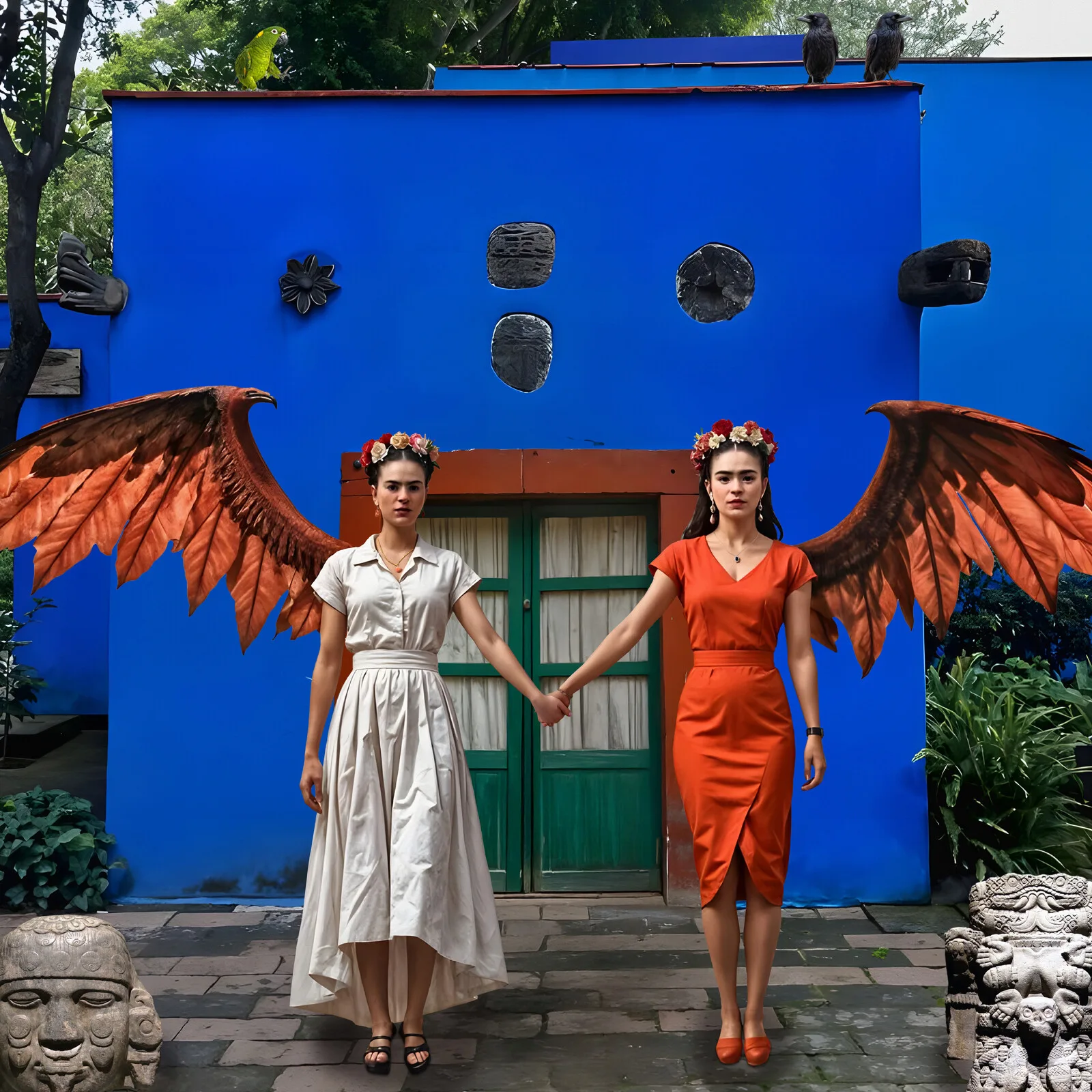
Red or White, Who Cares - Frida vs Frida, 2025
Digital
80 x 80 cm
3 500 kr
Red or White, Who Cares - Frida vs Frida
Frida vs Frida
Two sides of Frida Kahlo collide in a charged dialogue brimming with contradictions, passion, and self-awareness. The Mexican Frida, fiery and untamed, faces off against the European Frida, reserved and orderly. Together, they navigate the chaos of love, the demands of art, and the human conflicts that shaped Frida’s life. In this inner battle, their differences are exposed, and the bonds that hold them together—despite it all—are revealed.
Read on to explore all about the two Fridas' sex life and morals.
“Frida vs Frida – A Poetic Duel
Two Fridas sat upon a bench,
A fiery storm, a prim and tense.
One in lace, the other bold,
Together bound, their tale retold.
"You’re all chaos!" the white one sneered,
"With reckless love, you’ve interfered.
Your Diego’s nothing but a brute,
A horn dog in a painter’s suit."
"And you," the Tehuana hissed with glee,
"Would die a virgin sipping tea.
You judge my love, my lust, my fire,
Yet your heart’s locked up in cold attire."
The European bristled, her tone severe,
"At least my path in life was clear.
I kept to rules, I kept my pride,
While you bled your heart and nearly died!"
The Mexican laughed, her voice a roar,
"My pain's the paint on every door.
You call it madness, call it shame,
But art’s no art without the flame!"
"And what of van Gogh?" the Tehuana teased,
"His storms, like mine, refused to ease.
He bled on canvas, raw and bare,
You’d call him mad; I see him rare."
The European huffed, her chin held high,
"Leonardo’s love, at least, could lie.
A genius, sure, but scandalous too,
Men like him remind me of you."
The Mexican smirked, her words like knives,
"Ah, Diego's sins and tangled lives.
He was no saint, but who could be?
Love’s no hymn, it’s melody."
"Melody?" scoffed the one in white,
"A dirge of pain, a mournful blight.
Your passion’s poison, sweet and cruel,
Your fire consumes; you’re just a fool."
The Tehuana grinned, her teeth aglow,
"A fool for love, I’ll gladly show.
While you, my shadow, cold and pale,
Will always fear to lift the veil."
"Nice girls," the Tehuana laughed,
"May earn a dim and shadowed draft
Of heaven’s seat, obscure and plain,
While we, the bold, eternal reign.
Our sins may mark us, loud and clear,
But it’s our names the world will hear.
We burn, we fight, we risk the fall,
And hold the light that touches all."
They sat in silence, storm and lace,
Bound by veins, they can’t erase.
Two hearts exposed, their tempers flare,
Yet, in their fight, their bond is there.
"You’re the shadow," the fiery one chides.
"And you, the flame," the pale one sighs.
Together, they laugh, their war now done,
For two Fridas, after all, are one.
Malmö, January 2025
A Fiery Conversation Between The Two Fridas
Frida Kahlo is a prime example of a woman with dual personalities, visually one white and the other red, often at odds with one another. Angels are usually depicted with white wings, but in the case of ‘The Two Fridas’ from the well-known painting with the same name, even the white one must settle for red. Their lives resemble the Aztecs’ convoluted mythology: a mother, Coatlicue—her name literally means ‘Snakes-Her-Skirt’—is beheaded by her daughter, Coyolxauhqui, goddess of the Moon, who in turn has her head severed by her brother, Huitzilopochtli, the Sun god, whom Frida did not want to be included in the picture. However, the god's image remains in the garden surrounding the two Fridas’ former home, Casa Azul.
Frida Kahlo’s art was often a raw and unflinching visual diary. In ‘The Two Fridas’, painted during a period of personal upheaval, she dissected her identity with startling honesty. This large-scale work explores the complexities of Frida's mixed heritage, the profound pain of heartbreak, and how her physical suffering became inseparable from her artistic expression.
In my vision, both Fridas are caught during a revisit as Time-travellers, dressed as angels—beings that neither exist on Earth nor in eternity. If angels did exist beyond costumes, they would come in all imaginable shades, but in Frida’s case, one is red and the other white—one dangerous and the other less so, yet far from harmless.
In the famous picture, the stormy sky looms large behind them, their shared bench stark against the barren backdrop. In her vibrant Tehuana dress, the Mexican Frida sits upright, her gaze sharp and fiery. The European Frida, demure in her white lace dress, sits with a reserved posture, her pale hands nervously fidgeting with the exposed vein that connects them.
Mexican Frida: (smirking)
"Look at you, sitting there like a pale ghost. What do you even stand for? Tradition? Obedience? A stiff corset and a lifeless heart?"
European Frida: (tightening her grip on the vein, her voice cold)
"At least I bring dignity and composure. Unlike you, flaunting your loud colours and uncouth manners. Tehuana warrior? More like a reckless puta with no self-control."
Mexican Frida: (laughing harshly, leaning closer)
"Dignity? Is that what you call cowardice? Hiding behind lace and pleasantries while I carry the real weight—the pain, the passion, the fight. You’re nothing but a bland painting on a whitewashed wall."
European Frida: (her voice rising, her face flushing)
"And you think your so-called passion is admirable? It’s just chaos! You lash out, you drink too much, you throw yourself at Diego like a desperate child clinging to a useless toy!"
Mexican Frida: (slamming her fist on her knee)
"Don’t you dare speak his name like that, idiota! I loved him despite everything. At least I felt something real. You, with your sterile sense of propriety, wouldn’t understand. Love isn’t tidy, and neither is art."
European Frida: (tears welling up, her voice trembling)
"Love isn’t supposed to bleed out onto a canvas, either. You call me cold, but you’re the one who parades your pain for the world to see as if that will make it stop. You’re nothing but a narcissist obsessed with your suffering."
Mexican Frida: (leaning in, her eyes blazing)
"And what have you done? Sat quietly, clutching your broken heart like a relic? At least I’ve turned my suffering into something powerful. You’re nothing but an empty frame, content to blend into the background."
European Frida: (softly, after a pause)
"Maybe I am the frame, but you’d be nothing but wild colours spilling onto the ground without me. I hold you together, even if you refuse to admit it."
Mexican Frida: (narrowing her eyes, her voice dripping with sarcasm)
"Hold me together? That’s rich, coming from someone who couldn’t even hold on to Diego’s love. You’re jealous of my fire, my courage to burn brightly while you fade away."
European Frida: (snapping, her voice sharp)
"Jealous? Of what? Your recklessness? Your endless need for validation through rebellion? You’re a fool, blinded by your chaos. Do you even know who you are without all that noise?"
Mexican Frida: (grinning wickedly)
"Better a fool than a shadow. At least I’m alive. You, mi querida, are just a pale echo of someone else’s expectations."
The tension hangs heavy as both Fridas glare at each other, their shared vein pulsing faintly between them. Suddenly, the European Frida’s expression softens.
European Frida: (whispering, almost to herself)
"We’re both broken, aren’t we? Pieces of the same shattered mirror."
Mexican Frida: (sighing, her fiery demeanour softening slightly)
"Yes. And together, we make something whole. Ugly, beautiful, chaotic, and quiet—all at once. Isn’t that what it means to be Frida?"
European Frida: (nodding slowly, tears spilling over)
"It is. Even if it means we’ll always fight."
Mexican Frida: (smiling wryly)
"Fighting is what keeps us alive, hermana. Without the storm, there’s no fire. Come, let’s show the world what our pain looks like."
European Frida: (smiling faintly, her voice steadying)
"And let’s not forget to show them our strength too."
Mexican Frida: (laughing as she clasps her hand tighter)
"Strength? That’s all me, pálida. But you can take the credit if it makes you feel better."
European Frida: (rolling her eyes, her smile lingering)
"Idiota."
Mexican Frida: (grinning broadly)
"Narcissus."
European Frida: (arching an eyebrow, her tone sharp)
"Let’s talk about this so-called love of yours. Wasn’t it robbing the cradle? Diego, almost twice your age, swooped in like some predatory bird. And you—so young, so naive."
Mexican Frida: (grinning wickedly)
"Robbing the cradle? Please. It wasn’t some fairytale, sure, but it was thrilling! You wouldn’t understand passion if it bit you. You probably wanted your future husband to pass some test from your mother before he could even hold your hand."
European Frida: (offended)
"Of course! A man should be respectable. Diego would have needed to prove himself—regularly attending mass and showing loyalty. I wouldn’t have let him near my bed otherwise."
Mexican Frida: (bursting into laughter, throwing her head back)
"Mass? Loyalty? You sound like an old nun. You would’ve died a virgin, stuck in your lace cocoon, reading hymns and wondering what you missed. Diego would’ve bored you to death in seconds."
European Frida: (snapping)
"And what did you gain, puta? A life of heartbreak, betrayal, and humiliation? He cheated on you constantly! With your sister, no less! Where was this grand passion then?"
Mexican Frida: (leaning forward, her tone sharp and defiant)
"I gained a life that burned bright. Diego was more than a man; he was a force of nature. He challenged me and inspired me. Yes, he hurt me, but he also ignited my art, my soul. Do you think you’d have kept him in line? He would’ve crushed you."
European Frida: (crossing her arms)
"Or maybe I would’ve tamed him. Brought him to a place of stability and honour. Instead, you let him run wild like some drunken bull in a china shop."
Mexican Frida: (grinning slyly)
"Tamed him? You would’ve broken long before he did. Diego wasn’t meant to be tamed. He was chaos, just like me. That’s why we fit."
European Frida: (bitterly)
"So you admit it—you’re both the same. Selfish, reckless, unable to see past your egos."
Mexican Frida: (pausing, her gaze softening for a moment)
"Maybe. But at least I dared to love. At least I lived. You? You would’ve been a shadow, watching life pass by, afraid to touch it."
European Frida: (whispering, almost to herself)
"And who was Diego, really?"
Mexican Frida: (smiling wistfully)
"Diego was everything. A lover, a betrayer, a genius, a fool. He was the fire that burned me and the ashes I painted from. He was imperfect, like me. And I wouldn’t trade a single moment of it."
European Frida: (nodding slowly, her tone quieter)
"Maybe that’s where we’re different. I would’ve traded passion for peace. But then… perhaps I’d have never created anything at all."
Mexican Frida: (grinning, leaning back)
"Exactly. Art isn’t born from peace. It’s born from fire. And Diego… he was the match."
European Frida: (dryly)
"Your match, but not mine. Diego hated me—or rather, his wife’s European side. I can’t say he was my favourite either."
Mexican Frida: (nodding, with a wry smile)
"Yes, Diego Rivera had quite a reputation. He wasn’t just a painter; he was a womaniser, a man who couldn’t resist the allure of beauty and youth. Some of his relationships were with women so young they were barely out of childhood. Indeed, he often used his position as a famous artist to attract and seduce younger women, including some who were only teenagers."
European Frida: (folding her arms scornfully)
"A lecherous old goat. A dirty old man who couldn’t keep his pants on. He’d have been shunned even in his own time if he weren't so famous."
Mexican Frida: (shrugging)
"He was a product of his era, where men like Picasso, Gauguin, and even Dalí behaved in ways that would get them cancelled today. Power and talent gave them privileges—or at least they thought so. Diego wasn’t the worst of them, but he wasn’t innocent either."
European Frida: (raising an eyebrow)
"Not the worst? Do you call seducing teenagers acceptable? Or cheating with your sister, no less? The man had no boundaries. He disgusted me."
Mexican Frida: (leaning forward, her tone sharper)
"He disgusted you because you couldn’t handle his fire. Yes, he was flawed. He betrayed me, and I’ll never forgive him for Cristina. But he wasn’t just a man. He was a force, a tempest. I lived with that storm and painted through it. Would you have done the same? Or would you have run to your little European propriety?"
European Frida: (snapping)
"I’d have run straight to the church. At least Picasso, with all his arrogance, didn’t sleep with his wife’s sister! But I’ll admit, he wasn’t much better. Another oversexed egomaniac who thought the world revolved around him."
Mexican Frida: (grinning mischievously)
"Oh, come on. You’re just jealous. Picasso would’ve bored you stiff with his bullfighting stories. Now Caravaggio? There’s a man for you. All passion, all fire."
European Frida: (glaring)
"Caravaggio? That violent thug? He’d have killed me in a bar fight before even looking at me as a sex object. Honestly, I’m glad I didn’t meet him."
Mexican Frida: (laughing)
"It’s just as well. You’d have fainted at his temper. Besides, who needs Caravaggio when Diego is enough man for this lifetime? Or any lifetime."
European Frida: (mocking)
"Enough man? Only if you count his size. The man took up the whole bed!"
Mexican Frida: (grinning broadly)
"Not anymore! In the stars, he’s slimmed down. Doesn’t snore as much, either. He still takes up space, but only the kind that matters."
European Frida: (rolling her eyes, smirking slightly)
"If you say so. But I’ll take peace over passion any day."
Mexican Frida: (leaning back with a smirk)
"And I’ll take passion over peace. That’s why you’ll always be the ghost in the lace, and I’ll set the world on fire."
European Frida: (shaking her head with a wry smile)
"Most of them were as sex-crazed as you. Though more mad than lustful."
Mexican Frida: (grinning mischievously)
"Was Vincent van Gogh ever lucky in love?"
European Frida: (thoughtfully)
"Vincent had plenty of love interests throughout his life, but things never went smoothly. He got off to a bad start when he fell in love with his niece, Kee Vos-Stricker, who rejected his advances outright."
Mexican Frida: (raising an eyebrow)
"His niece? Diego wasn’t that bad, at least."
European Frida: (nodding)
"It didn’t end there. For a while in The Hague, Vincent lived with Sien Hoornik—a former prostitute. That brought even more shame upon his family."
Mexican Frida: (leaning forward)
"But wasn’t that just another way to rebel? Love and defiance, hand in hand?"
European Frida: (pausing, then continuing)
"In Nuenen, there was his devout, rather unstable neighbour Margot Begemann, who tried to take her own life when her family forbade her from seeing Vincent."
Mexican Frida: (grimacing)
"It sounds like his love life was as tragic as his art. How old was she?"
European Frida: (shrugging)
"Old enough to know better but young enough to still dream. Then there was his ‘impossible love affair’ with the Italian Agostina Segatori in Paris. That ended disastrously, and he finally accepted that he wasn’t destined to find true love. He settled for paying for it."
European Frida: (with a sharp tone, shaking her head)
"And then there’s Leonardo da Vinci. Do you admire him too? Another one with tangled love affairs. Do you know he supposedly had an affair with Lisa, the model for the Mona Lisa? She was a married woman, a mother of six, yet she was infatuated with him."
Mexican Frida: (leaning forward with intrigue)
"Why shouldn’t she be? Leonardo was a genius, a visionary. Who wouldn’t fall for him?"
European Frida: (sternly)
"But he wasn’t just chasing women, was he? He was secretly bisexual, and it’s said he had an affair with his young apprentice and close collaborator, Gian Giacomo Caprotti—better known as Salai. Salai inherited several of Leonardo’s works, including the Mona Lisa. Leonardo refused to deliver the portrait to Lisa’s husband, Francesco del Giocondo, who had commissioned it. Instead, he kept it with him until his death, leaving it to Salai."
Mexican Frida: (smiling slyly)
"So? Love is love. Passion finds its way, regardless of boundaries."
European Frida: (snapping, her voice rising)
"You would say that! You, with your repeated affairs with women, ignore every convention, every moral standard! What about Diego? Didn’t you care about what your infidelities did to him?"
Mexican Frida: (leaning back, crossing her arms with defiance)
"Diego? Please don’t talk to me about his morals. He could never keep his hands—or his heart—to himself. Besides, my relationships with women were about more than sex. They were connections, understanding, and shared pain. Something you, with your stiff lace and rules, could never comprehend."
European Frida: (glaring)
"Connections? Is that what you call it? Just another excuse for your impulsive, reckless behaviour."
Mexican Frida: (grinning)
"Call it what you will, hermana, but even Leonardo would agree—art and passion are inseparable. Perhaps you’d understand if you let yourself feel more and judge less."
European Frida: (with a quiet sigh, her tone softening slightly)
"Perhaps. But don’t expect me to celebrate chaos because it fuels your art. Some of us prefer order."
Mexican Frida: (laughing lightly)
"And some of us prefer fire. That’s why you’ll always be my shadow, and I’ll be the flame."
European Frida: (snorting)
"You can keep your fire-breathing Goghs and Leonardos to yourself. I’m not interested. I don’t understand them, and they wouldn’t understand me."
Mexican Frida: (leaning back, her eyes narrowing in thought)
"You don’t think van Gogh would understand me? Of course, he would. His storms were like mine, violent and relentless. He poured his soul onto the canvas, like me. He wasn’t afraid to bleed for his art."
European Frida: (frowning)
"But at what cost? He died alone, forgotten until after his death. His genius came with madness, and madness devoured him. I’d rather be Cézanne, methodical and precise. His work grew quietly until it changed everything."
Mexican Frida: (snorting)
"Cézanne? Please. You’d be happier as Mondrian, painting inside neat, perfect little boxes. Van Gogh burned, and in his fire, he created beauty. That’s where true art lives, in the chaos."
European Frida: (sharply)
"And what about Picasso? Was he chaos, too? Or was he just a manipulator, taking what he needed from everyone around him and leaving a trail of broken lives? Is that the price of genius?"
Mexican Frida: (grinning)
"Picasso? He was a bastard, sure. But look at what he gave the world. Guernica alone makes up for all his sins. You can’t create something powerful without breaking some rules, maybe even some hearts."
European Frida: (softly)
"And what of us? Are we breaking hearts or just bleeding for the sake of it?"
Mexican Frida: (quietly)
"Maybe both. But isn’t that the point? To make them feel something, even if it’s pain?"
European Frida: (after a long pause)
"Maybe you’re right. Maybe chaos and order need each other, just as we do."
Mexican Frida: (grinning, raising her hand)
"To chaos, hermana."
European Frida: (smiling faintly, raising hers)
"And to at least some order."
Jörgen Thornberg
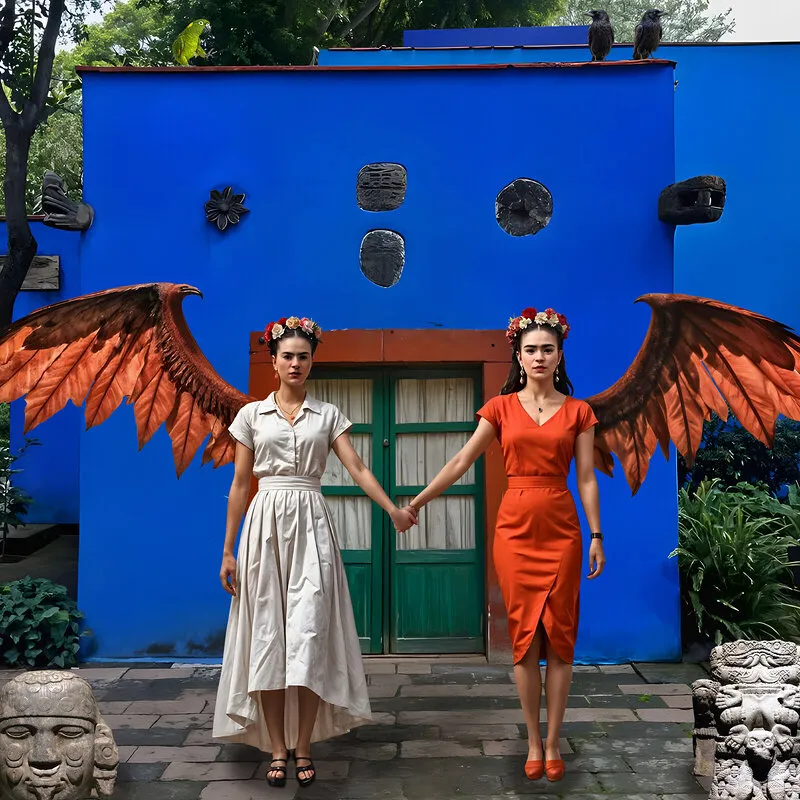
Red or White, Who Cares - Frida vs Frida, 2025
Digital
80 x 80 cm
3 500 kr
Red or White, Who Cares - Frida vs Frida
Frida vs Frida
Two sides of Frida Kahlo collide in a charged dialogue brimming with contradictions, passion, and self-awareness. The Mexican Frida, fiery and untamed, faces off against the European Frida, reserved and orderly. Together, they navigate the chaos of love, the demands of art, and the human conflicts that shaped Frida’s life. In this inner battle, their differences are exposed, and the bonds that hold them together—despite it all—are revealed.
Read on to explore all about the two Fridas' sex life and morals.
“Frida vs Frida – A Poetic Duel
Two Fridas sat upon a bench,
A fiery storm, a prim and tense.
One in lace, the other bold,
Together bound, their tale retold.
"You’re all chaos!" the white one sneered,
"With reckless love, you’ve interfered.
Your Diego’s nothing but a brute,
A horn dog in a painter’s suit."
"And you," the Tehuana hissed with glee,
"Would die a virgin sipping tea.
You judge my love, my lust, my fire,
Yet your heart’s locked up in cold attire."
The European bristled, her tone severe,
"At least my path in life was clear.
I kept to rules, I kept my pride,
While you bled your heart and nearly died!"
The Mexican laughed, her voice a roar,
"My pain's the paint on every door.
You call it madness, call it shame,
But art’s no art without the flame!"
"And what of van Gogh?" the Tehuana teased,
"His storms, like mine, refused to ease.
He bled on canvas, raw and bare,
You’d call him mad; I see him rare."
The European huffed, her chin held high,
"Leonardo’s love, at least, could lie.
A genius, sure, but scandalous too,
Men like him remind me of you."
The Mexican smirked, her words like knives,
"Ah, Diego's sins and tangled lives.
He was no saint, but who could be?
Love’s no hymn, it’s melody."
"Melody?" scoffed the one in white,
"A dirge of pain, a mournful blight.
Your passion’s poison, sweet and cruel,
Your fire consumes; you’re just a fool."
The Tehuana grinned, her teeth aglow,
"A fool for love, I’ll gladly show.
While you, my shadow, cold and pale,
Will always fear to lift the veil."
"Nice girls," the Tehuana laughed,
"May earn a dim and shadowed draft
Of heaven’s seat, obscure and plain,
While we, the bold, eternal reign.
Our sins may mark us, loud and clear,
But it’s our names the world will hear.
We burn, we fight, we risk the fall,
And hold the light that touches all."
They sat in silence, storm and lace,
Bound by veins, they can’t erase.
Two hearts exposed, their tempers flare,
Yet, in their fight, their bond is there.
"You’re the shadow," the fiery one chides.
"And you, the flame," the pale one sighs.
Together, they laugh, their war now done,
For two Fridas, after all, are one.
Malmö, January 2025
A Fiery Conversation Between The Two Fridas
Frida Kahlo is a prime example of a woman with dual personalities, visually one white and the other red, often at odds with one another. Angels are usually depicted with white wings, but in the case of ‘The Two Fridas’ from the well-known painting with the same name, even the white one must settle for red. Their lives resemble the Aztecs’ convoluted mythology: a mother, Coatlicue—her name literally means ‘Snakes-Her-Skirt’—is beheaded by her daughter, Coyolxauhqui, goddess of the Moon, who in turn has her head severed by her brother, Huitzilopochtli, the Sun god, whom Frida did not want to be included in the picture. However, the god's image remains in the garden surrounding the two Fridas’ former home, Casa Azul.
Frida Kahlo’s art was often a raw and unflinching visual diary. In ‘The Two Fridas’, painted during a period of personal upheaval, she dissected her identity with startling honesty. This large-scale work explores the complexities of Frida's mixed heritage, the profound pain of heartbreak, and how her physical suffering became inseparable from her artistic expression.
In my vision, both Fridas are caught during a revisit as Time-travellers, dressed as angels—beings that neither exist on Earth nor in eternity. If angels did exist beyond costumes, they would come in all imaginable shades, but in Frida’s case, one is red and the other white—one dangerous and the other less so, yet far from harmless.
In the famous picture, the stormy sky looms large behind them, their shared bench stark against the barren backdrop. In her vibrant Tehuana dress, the Mexican Frida sits upright, her gaze sharp and fiery. The European Frida, demure in her white lace dress, sits with a reserved posture, her pale hands nervously fidgeting with the exposed vein that connects them.
Mexican Frida: (smirking)
"Look at you, sitting there like a pale ghost. What do you even stand for? Tradition? Obedience? A stiff corset and a lifeless heart?"
European Frida: (tightening her grip on the vein, her voice cold)
"At least I bring dignity and composure. Unlike you, flaunting your loud colours and uncouth manners. Tehuana warrior? More like a reckless puta with no self-control."
Mexican Frida: (laughing harshly, leaning closer)
"Dignity? Is that what you call cowardice? Hiding behind lace and pleasantries while I carry the real weight—the pain, the passion, the fight. You’re nothing but a bland painting on a whitewashed wall."
European Frida: (her voice rising, her face flushing)
"And you think your so-called passion is admirable? It’s just chaos! You lash out, you drink too much, you throw yourself at Diego like a desperate child clinging to a useless toy!"
Mexican Frida: (slamming her fist on her knee)
"Don’t you dare speak his name like that, idiota! I loved him despite everything. At least I felt something real. You, with your sterile sense of propriety, wouldn’t understand. Love isn’t tidy, and neither is art."
European Frida: (tears welling up, her voice trembling)
"Love isn’t supposed to bleed out onto a canvas, either. You call me cold, but you’re the one who parades your pain for the world to see as if that will make it stop. You’re nothing but a narcissist obsessed with your suffering."
Mexican Frida: (leaning in, her eyes blazing)
"And what have you done? Sat quietly, clutching your broken heart like a relic? At least I’ve turned my suffering into something powerful. You’re nothing but an empty frame, content to blend into the background."
European Frida: (softly, after a pause)
"Maybe I am the frame, but you’d be nothing but wild colours spilling onto the ground without me. I hold you together, even if you refuse to admit it."
Mexican Frida: (narrowing her eyes, her voice dripping with sarcasm)
"Hold me together? That’s rich, coming from someone who couldn’t even hold on to Diego’s love. You’re jealous of my fire, my courage to burn brightly while you fade away."
European Frida: (snapping, her voice sharp)
"Jealous? Of what? Your recklessness? Your endless need for validation through rebellion? You’re a fool, blinded by your chaos. Do you even know who you are without all that noise?"
Mexican Frida: (grinning wickedly)
"Better a fool than a shadow. At least I’m alive. You, mi querida, are just a pale echo of someone else’s expectations."
The tension hangs heavy as both Fridas glare at each other, their shared vein pulsing faintly between them. Suddenly, the European Frida’s expression softens.
European Frida: (whispering, almost to herself)
"We’re both broken, aren’t we? Pieces of the same shattered mirror."
Mexican Frida: (sighing, her fiery demeanour softening slightly)
"Yes. And together, we make something whole. Ugly, beautiful, chaotic, and quiet—all at once. Isn’t that what it means to be Frida?"
European Frida: (nodding slowly, tears spilling over)
"It is. Even if it means we’ll always fight."
Mexican Frida: (smiling wryly)
"Fighting is what keeps us alive, hermana. Without the storm, there’s no fire. Come, let’s show the world what our pain looks like."
European Frida: (smiling faintly, her voice steadying)
"And let’s not forget to show them our strength too."
Mexican Frida: (laughing as she clasps her hand tighter)
"Strength? That’s all me, pálida. But you can take the credit if it makes you feel better."
European Frida: (rolling her eyes, her smile lingering)
"Idiota."
Mexican Frida: (grinning broadly)
"Narcissus."
European Frida: (arching an eyebrow, her tone sharp)
"Let’s talk about this so-called love of yours. Wasn’t it robbing the cradle? Diego, almost twice your age, swooped in like some predatory bird. And you—so young, so naive."
Mexican Frida: (grinning wickedly)
"Robbing the cradle? Please. It wasn’t some fairytale, sure, but it was thrilling! You wouldn’t understand passion if it bit you. You probably wanted your future husband to pass some test from your mother before he could even hold your hand."
European Frida: (offended)
"Of course! A man should be respectable. Diego would have needed to prove himself—regularly attending mass and showing loyalty. I wouldn’t have let him near my bed otherwise."
Mexican Frida: (bursting into laughter, throwing her head back)
"Mass? Loyalty? You sound like an old nun. You would’ve died a virgin, stuck in your lace cocoon, reading hymns and wondering what you missed. Diego would’ve bored you to death in seconds."
European Frida: (snapping)
"And what did you gain, puta? A life of heartbreak, betrayal, and humiliation? He cheated on you constantly! With your sister, no less! Where was this grand passion then?"
Mexican Frida: (leaning forward, her tone sharp and defiant)
"I gained a life that burned bright. Diego was more than a man; he was a force of nature. He challenged me and inspired me. Yes, he hurt me, but he also ignited my art, my soul. Do you think you’d have kept him in line? He would’ve crushed you."
European Frida: (crossing her arms)
"Or maybe I would’ve tamed him. Brought him to a place of stability and honour. Instead, you let him run wild like some drunken bull in a china shop."
Mexican Frida: (grinning slyly)
"Tamed him? You would’ve broken long before he did. Diego wasn’t meant to be tamed. He was chaos, just like me. That’s why we fit."
European Frida: (bitterly)
"So you admit it—you’re both the same. Selfish, reckless, unable to see past your egos."
Mexican Frida: (pausing, her gaze softening for a moment)
"Maybe. But at least I dared to love. At least I lived. You? You would’ve been a shadow, watching life pass by, afraid to touch it."
European Frida: (whispering, almost to herself)
"And who was Diego, really?"
Mexican Frida: (smiling wistfully)
"Diego was everything. A lover, a betrayer, a genius, a fool. He was the fire that burned me and the ashes I painted from. He was imperfect, like me. And I wouldn’t trade a single moment of it."
European Frida: (nodding slowly, her tone quieter)
"Maybe that’s where we’re different. I would’ve traded passion for peace. But then… perhaps I’d have never created anything at all."
Mexican Frida: (grinning, leaning back)
"Exactly. Art isn’t born from peace. It’s born from fire. And Diego… he was the match."
European Frida: (dryly)
"Your match, but not mine. Diego hated me—or rather, his wife’s European side. I can’t say he was my favourite either."
Mexican Frida: (nodding, with a wry smile)
"Yes, Diego Rivera had quite a reputation. He wasn’t just a painter; he was a womaniser, a man who couldn’t resist the allure of beauty and youth. Some of his relationships were with women so young they were barely out of childhood. Indeed, he often used his position as a famous artist to attract and seduce younger women, including some who were only teenagers."
European Frida: (folding her arms scornfully)
"A lecherous old goat. A dirty old man who couldn’t keep his pants on. He’d have been shunned even in his own time if he weren't so famous."
Mexican Frida: (shrugging)
"He was a product of his era, where men like Picasso, Gauguin, and even Dalí behaved in ways that would get them cancelled today. Power and talent gave them privileges—or at least they thought so. Diego wasn’t the worst of them, but he wasn’t innocent either."
European Frida: (raising an eyebrow)
"Not the worst? Do you call seducing teenagers acceptable? Or cheating with your sister, no less? The man had no boundaries. He disgusted me."
Mexican Frida: (leaning forward, her tone sharper)
"He disgusted you because you couldn’t handle his fire. Yes, he was flawed. He betrayed me, and I’ll never forgive him for Cristina. But he wasn’t just a man. He was a force, a tempest. I lived with that storm and painted through it. Would you have done the same? Or would you have run to your little European propriety?"
European Frida: (snapping)
"I’d have run straight to the church. At least Picasso, with all his arrogance, didn’t sleep with his wife’s sister! But I’ll admit, he wasn’t much better. Another oversexed egomaniac who thought the world revolved around him."
Mexican Frida: (grinning mischievously)
"Oh, come on. You’re just jealous. Picasso would’ve bored you stiff with his bullfighting stories. Now Caravaggio? There’s a man for you. All passion, all fire."
European Frida: (glaring)
"Caravaggio? That violent thug? He’d have killed me in a bar fight before even looking at me as a sex object. Honestly, I’m glad I didn’t meet him."
Mexican Frida: (laughing)
"It’s just as well. You’d have fainted at his temper. Besides, who needs Caravaggio when Diego is enough man for this lifetime? Or any lifetime."
European Frida: (mocking)
"Enough man? Only if you count his size. The man took up the whole bed!"
Mexican Frida: (grinning broadly)
"Not anymore! In the stars, he’s slimmed down. Doesn’t snore as much, either. He still takes up space, but only the kind that matters."
European Frida: (rolling her eyes, smirking slightly)
"If you say so. But I’ll take peace over passion any day."
Mexican Frida: (leaning back with a smirk)
"And I’ll take passion over peace. That’s why you’ll always be the ghost in the lace, and I’ll set the world on fire."
European Frida: (shaking her head with a wry smile)
"Most of them were as sex-crazed as you. Though more mad than lustful."
Mexican Frida: (grinning mischievously)
"Was Vincent van Gogh ever lucky in love?"
European Frida: (thoughtfully)
"Vincent had plenty of love interests throughout his life, but things never went smoothly. He got off to a bad start when he fell in love with his niece, Kee Vos-Stricker, who rejected his advances outright."
Mexican Frida: (raising an eyebrow)
"His niece? Diego wasn’t that bad, at least."
European Frida: (nodding)
"It didn’t end there. For a while in The Hague, Vincent lived with Sien Hoornik—a former prostitute. That brought even more shame upon his family."
Mexican Frida: (leaning forward)
"But wasn’t that just another way to rebel? Love and defiance, hand in hand?"
European Frida: (pausing, then continuing)
"In Nuenen, there was his devout, rather unstable neighbour Margot Begemann, who tried to take her own life when her family forbade her from seeing Vincent."
Mexican Frida: (grimacing)
"It sounds like his love life was as tragic as his art. How old was she?"
European Frida: (shrugging)
"Old enough to know better but young enough to still dream. Then there was his ‘impossible love affair’ with the Italian Agostina Segatori in Paris. That ended disastrously, and he finally accepted that he wasn’t destined to find true love. He settled for paying for it."
European Frida: (with a sharp tone, shaking her head)
"And then there’s Leonardo da Vinci. Do you admire him too? Another one with tangled love affairs. Do you know he supposedly had an affair with Lisa, the model for the Mona Lisa? She was a married woman, a mother of six, yet she was infatuated with him."
Mexican Frida: (leaning forward with intrigue)
"Why shouldn’t she be? Leonardo was a genius, a visionary. Who wouldn’t fall for him?"
European Frida: (sternly)
"But he wasn’t just chasing women, was he? He was secretly bisexual, and it’s said he had an affair with his young apprentice and close collaborator, Gian Giacomo Caprotti—better known as Salai. Salai inherited several of Leonardo’s works, including the Mona Lisa. Leonardo refused to deliver the portrait to Lisa’s husband, Francesco del Giocondo, who had commissioned it. Instead, he kept it with him until his death, leaving it to Salai."
Mexican Frida: (smiling slyly)
"So? Love is love. Passion finds its way, regardless of boundaries."
European Frida: (snapping, her voice rising)
"You would say that! You, with your repeated affairs with women, ignore every convention, every moral standard! What about Diego? Didn’t you care about what your infidelities did to him?"
Mexican Frida: (leaning back, crossing her arms with defiance)
"Diego? Please don’t talk to me about his morals. He could never keep his hands—or his heart—to himself. Besides, my relationships with women were about more than sex. They were connections, understanding, and shared pain. Something you, with your stiff lace and rules, could never comprehend."
European Frida: (glaring)
"Connections? Is that what you call it? Just another excuse for your impulsive, reckless behaviour."
Mexican Frida: (grinning)
"Call it what you will, hermana, but even Leonardo would agree—art and passion are inseparable. Perhaps you’d understand if you let yourself feel more and judge less."
European Frida: (with a quiet sigh, her tone softening slightly)
"Perhaps. But don’t expect me to celebrate chaos because it fuels your art. Some of us prefer order."
Mexican Frida: (laughing lightly)
"And some of us prefer fire. That’s why you’ll always be my shadow, and I’ll be the flame."
European Frida: (snorting)
"You can keep your fire-breathing Goghs and Leonardos to yourself. I’m not interested. I don’t understand them, and they wouldn’t understand me."
Mexican Frida: (leaning back, her eyes narrowing in thought)
"You don’t think van Gogh would understand me? Of course, he would. His storms were like mine, violent and relentless. He poured his soul onto the canvas, like me. He wasn’t afraid to bleed for his art."
European Frida: (frowning)
"But at what cost? He died alone, forgotten until after his death. His genius came with madness, and madness devoured him. I’d rather be Cézanne, methodical and precise. His work grew quietly until it changed everything."
Mexican Frida: (snorting)
"Cézanne? Please. You’d be happier as Mondrian, painting inside neat, perfect little boxes. Van Gogh burned, and in his fire, he created beauty. That’s where true art lives, in the chaos."
European Frida: (sharply)
"And what about Picasso? Was he chaos, too? Or was he just a manipulator, taking what he needed from everyone around him and leaving a trail of broken lives? Is that the price of genius?"
Mexican Frida: (grinning)
"Picasso? He was a bastard, sure. But look at what he gave the world. Guernica alone makes up for all his sins. You can’t create something powerful without breaking some rules, maybe even some hearts."
European Frida: (softly)
"And what of us? Are we breaking hearts or just bleeding for the sake of it?"
Mexican Frida: (quietly)
"Maybe both. But isn’t that the point? To make them feel something, even if it’s pain?"
European Frida: (after a long pause)
"Maybe you’re right. Maybe chaos and order need each other, just as we do."
Mexican Frida: (grinning, raising her hand)
"To chaos, hermana."
European Frida: (smiling faintly, raising hers)
"And to at least some order."
3 500 kr

Jörgen Thornberg
Malmö
Lite om bilder och mig. Translation in English at the end.
Jag är en nyfiken person som ser allt i bilder, även det jag fäster i ord, gärna tillsammans för bakom alla mina bilder finns en berättelse. Till vissa bilder hör en kortare eller längre novell som följer med bilden.
Bilder berättar historier. Jag omges av naturlig skönhet, intressanta människor och historia var jag än går. Jag använder min kamera för att dokumentera världen och blanda det jag ser med vad jag känner för att fånga den dolda magin.
Mina bilder berättar mina historier. Genom mina bilder, tryck och berättelser. Jag bjuder in dig att ta del av dessa berättelser, in i ditt liv och hem och dela min mycket personliga syn på vår värld. Mer än vad ögat ser. Jag tänker i bilder, drömmer och skriver och pratar om dem; följaktligen måste jag också skapa bilder. De blir vad jag ser, inte nödvändigtvis begränsade till verkligheten. Det finns en bild runt varje hörn. Jag hoppas att du kommer att se vad jag såg och gilla det.
Jag är också en skrivande person och till många bilder hör en kortare eller längre essay. Den följer med tavlan, tryckt på fint papper och med en personlig hälsning från mig.
Flertalet bilder startar sin resa i min kamera. Enkelt förklarat beskriver jag bilden jag ser i mitt inre, upplevd eller fantiserad. Bilden uppstår inom mig redan innan jag fått okularet till ögat. På bråkdelen av ett ögonblick ser jag vad jag vill ha och vad som kan göras med bilden. Här skall jag stoppa in en giraff, stålmannen, Titanic eller vad det är min fantasi finner ut. Ännu märkligare är att jag kommer ihåg minnesbilden långt efteråt när det blir tid att skapa verket. Om jag lyckas eller inte, är upp till betraktaren, oftast präglat av en stråk av svart humor – meningen är att man skall bli underhållen. Mina bilder blir ofta en snackis där de hänger.
Jag föredrar bilder som förmedlar ett budskap i flera lager. Vid första anblicken fylld av feel-good, en vacker utsikt, fint väder, solen skiner, blommor på ängen eller vattnet som ligger förrädiskt spegelblankt. I en sådan bild kan jag gömma min egentliga berättelse, mitt förakt för förtryckare och våldsverkare, rasister och fördomsfulla människor - ett gärna återkommande motiv mer eller mindre dolt i det vackra motivet. Jag försöker förena dem i ett gemensamt narrativ.
Bild och formgivning har löpt som en röd tråd genom livet. Fotokonst känns som en värdig final som jag gärna delar med mig.
Min genre är vid som framgår av mina bilder, temat en blandning av pop- och gatukonst i kollage som kan bestå av hundratals lager. Vissa bilder kan ta veckor, andra någon dag innan det är dags att överlämna resultatet till printverkstaden. Fine Art Prints är digitala fotocollage. I dessa kollage sker rivandet, klippandet, pusslandet, målandet, ritandet och sprayningen digitalt. Det jag monterar in kan vara hundratals år gamla bilder som jag omsorgsfullt frilägger så att de ser ut att vara en del av tavlan men också bilder skapade av mig själv efter min egen fantasi. Därefter besöks printstudion och för vissa bilder numrera en limiterad upplaga (oftast 7 exemplar) och signera för hand. Vissa bilder kan köpas i olika format. Det är bara att fråga efter vilka. Gillar man en bild som är 70x100 men inte har plats på väggen, går den kanske att få i 50x70 cm istället. Frågan är fri.
Metoden Giclée eller Fine Art Print som det också kallas är det moderna sättet för framställning av grafisk konst. Villkoret för denna typ av utskrifter är att en högkvalitativ storformatskrivare används med åldersbeständigt färgpigment och konstnärspapper eller i förekommande fall på duk. Pappret som används möter de krav på livslängd som ställs av museer och gallerier. Normalt säljer jag mina bilder oinramade så att den nya ägaren själv kan bestämma hur de skall se ut, med eller utan passepartout färg på ram, med eller utan glas etc..
Under många år ställde jag bara ut på nätet, i valda grupper och på min egen Facebooksida - https://www.facebook.com/jorgen.thornberg.9
Jag finns också på en egen hemsida som tyvärr inte alltid är uppdaterad – https://www.jth.life/ Där kan du också läsa en del av de berättelser som följer med bilden.
UTSTÄLLNINGAR
Luftkastellet, oktober 2022
Konst i Lund, november 2022
Luftkastellet, mars 2023
Engleson Galleri Caroli, april 2023
Hydra, Greece June 2023
Engleson Galleri Caroli, oktober 2023
Toppen, Höllviken december 2023
Luftkastellet, mars 2024
Torups Galleri, mars 2024
Venice, May 2024
Luftkastellet, oktober 2024
Konst i Advent, December 2024
Galleri Engleson, Caroli December 2024
Jäger & Jansson Galleri, april 2025
A bit about pictures and me.
I'm a curious person who sees everything in pictures, even what I express in words, often combining them, for behind all my pictures lies a story. These narratives, some as short as a single image and others as long as a novel, are the heart and soul of my work.
Pictures tell stories. Wherever I go, I'm surrounded by natural beauty, exciting people, and history. I use my camera to document the world and blend what I see with what I feel to capture the hidden magic.
My images tell my stories. Through my pictures, prints, and narratives, I invite you to partake in these stories in your life and home and share my deeply personal perspective of our world. More than meets the eye. I think in pictures, dream, write, and talk about them; consequently, I must create images too. They become what I see, not necessarily confined to reality. There's a picture around every corner. I hope you'll see what I saw and enjoy it.
I'm also a writer, and many images come with a shorter or longer essay. It accompanies the painting, printed on fine paper with my personal greeting.
Many pictures start their journey on my camera. Simply put, I describe the image I see in my mind, experienced or imagined. The image arises within me even before I bring the eyepiece to my eye. In a fraction of a moment, I see what I want and what can be done with the picture. Here, I'll insert a giraffe, Superman, the Titanic, or whatever my imagination conjures up. Even stranger is that I remember the mental image long after it's time to create the work. Whether I succeed is up to the observer, often imbued with a streak of black humour – the aim is to entertain. My pictures usually become a talking point wherever they hang.
I prefer pictures that convey a message in multiple layers. At first glance, they're filled with feel-good vibes, a beautiful view, lovely weather, the sun shining, flowers in the meadow, or the water lying deceptively calm. But beneath this surface beauty, I often conceal a deeper story, a narrative that challenges societal norms or explores the human condition. I invite you to delve into these hidden narratives and discover the layers of meaning within my work.
Picture and design have been a thread running through my life. Photographic art feels like a fitting finale, and I'm happy to share it.
My genre is varied, as seen in my pictures; the theme is a blend of pop and street art in collages that can consist of hundreds of layers. Some images can take weeks, others just a day before it's time to hand over the result to the print workshop. Fine Art Prints are digital photo collages. In these collages, tearing, cutting, puzzling, painting, drawing, and spraying happen digitally. What I insert can be images hundreds of years old that I carefully extract so they appear to be part of the painting, but also images created by myself, now also generated from my imagination. Next, visit the print studio and, for certain images, number a limited edition (usually 7 copies) and sign them by hand. Some images may be available in other formats. Just ask which ones. If you like an image that's 70x100 but doesn't have space on the wall, you might be able to get it in 50x70 cm instead. The question is open.
The Giclée method, or Fine Art Print as it's also called, is the modern way of producing graphic art. This method ensures the highest quality and longevity of the artwork, using a high-quality large-format printer with archival pigment inks and artist paper or, in some cases, canvas. The paper used meets the longevity requirements set by museums and galleries. I sell my pictures unframed, allowing the new owner to personalise their artwork, confident in the lasting value and quality of the piece.
For many years, I only exhibited online, in selected groups, and on my Facebook page - https://www.facebook.com/jorgen.thornberg.9. I also have my website, which unfortunately is not constantly updated - https://www.jth.life/. You can also read some of the stories accompanying the pictures there.
EXHIBITIONS
Luftkastellet, October 2022
Art in Lund, November 2022
Luftkastellet, March 2023
Engleson Gallery Caroli, April 2023
Hydra, Greece June 2023
Engleson Gallery Caroli, October 2023
Toppen, Höllviken December 2023
Luftkastellet, March 2024
Torup Gallery, March 2024
Venice, May 2024
UTSTÄLLNINGAR
Luftkastellet, oktober 2022
Konst i Lund, november 2022
Luftkastellet, mars 2023
Engleson Galleri Caroli, april 2023
Hydra, Greece June 2023
Engleson Galleri Caroli, oktober 2023
Toppen, Höllviken december 2023
Luftkastellet, mars 2024
Torups Galleri, mars 2024
Venice, May 2024
Luftkastellet, October 2024
Konst i Advent, December 2024
Galleri Engleson, Caroli December 2024
Jäger & Jansson Galleri, April 2025
Utbildning
Autodidakt
Medlem i konstnärsförening
Öppna Sinnen
Med i konstrunda
Konstrundan i Skåne
Utställningar
Luftkastellet, October 2022
Art in Lund, November 2022
Luftkastellet, March 2023
Engleson Gallery Caroli, April 2023
Hydra, Greece June 2023
Engleson Gallery Caroli, October 2023
Toppen, Höllviken December 2023
Luftkastellet, March 2024
Torup Gallery, March 2024
Venice, May 2024