Vi använder cookies för att ge dig bästa möjliga upplevelse. Välj vilka cookies du tillåter.
Läs mer i vår integritetspolicy
Jörgen Thornberg
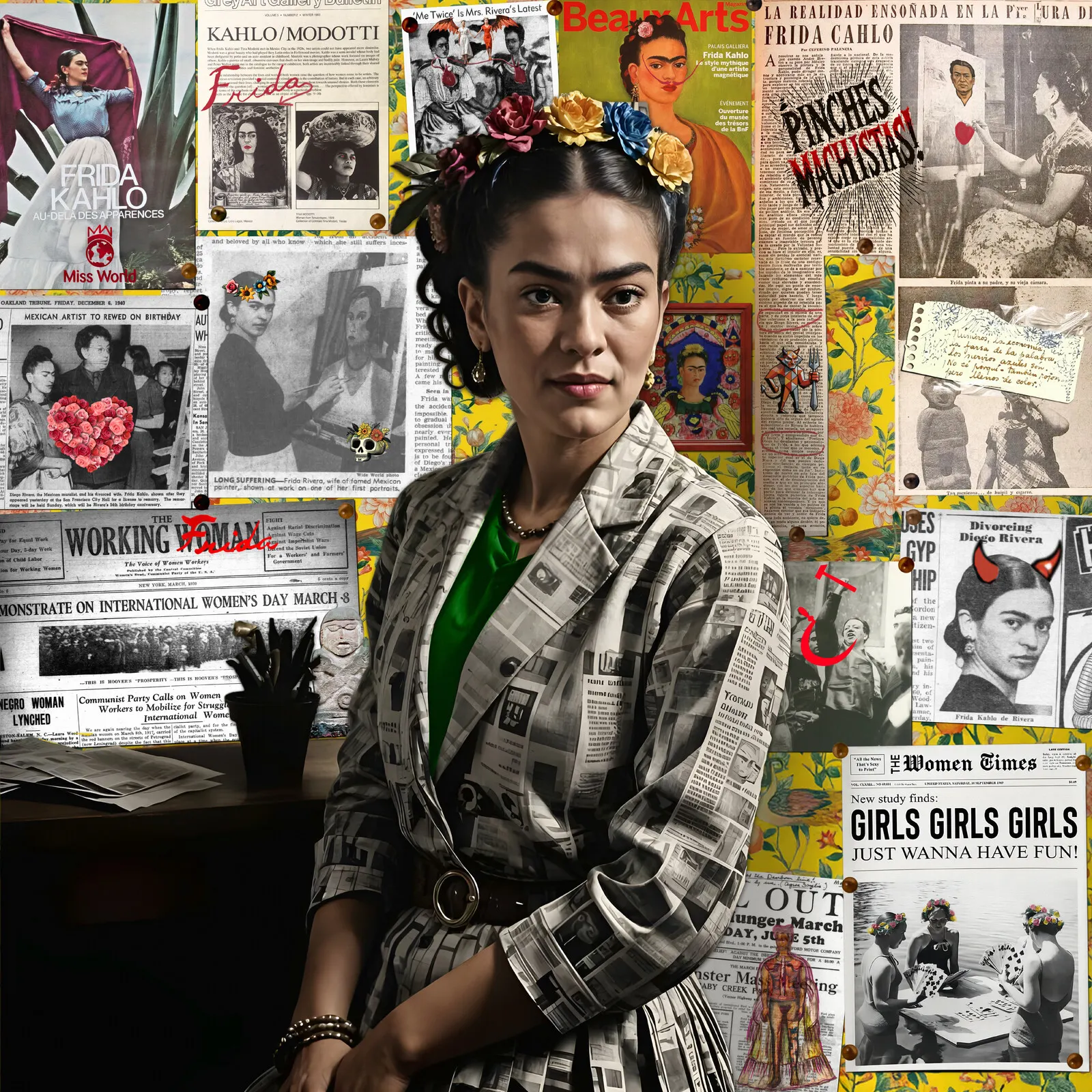
Frida Kahlo On the News, 2025
Digital
90 x 90 cm
5 500 kr
Frida Kahlo: A Life Pinned to the Wall
Frida Kahlo's life, much like her art, was a vivid tapestry of resilience, authenticity, and brilliance. From her vibrant canvases to the clippings pinned on her studio bulletin board, she revealed her humour, struggles, and defiance. Kahlo’s legacy, which lay overshadowed by her husband, Diego Rivera, during her lifetime, has grown into a global phenomenon. Today, she is a feminist icon, LGBTQ+ trailblazer, and cultural symbol whose work and life inspire millions. Kahlo exemplified what it means to defy expectations and live authentically through her unapologetic embrace of identity and her transformation of pain into art. Her story, meticulously documented through images, annotations, and bold commentary, continues to resonate, proving that the fragments of a life can echo across generations.
Read on to explore life on a bulletin board.
“Life on a Bulletin Board
Pinned and torn, the fragments cling,
A tapestry of life in spring.
Faded clippings, voices loud,
Truths and dreams behind a shroud.
A devil drawn, a heart adorned,
A love betrayed, a life reborn.
“Pinches machistas,” the ink declares,
Mocking the world and its heavy stares.
Here’s a face with a scribbled ‘stache,
There, a note on beauty dashed.
Between the cracks, the edges fray,
Yet bold remains what words convey.
A border crossed, a self-defined,
Pain and power intertwined.
The zoo of life—its beasts, its grace—
Each creature holds a sacred space.
A hammer here, a sickle there,
A banner raised for those who care.
The artist’s hand, unyielding, free,
Sketches truths for all to see.
On this board, the world takes shape,
Love and laughter, loss, escape.
Each scrap a voice, a soul, a chord,
A life lived fully—on a bulletin board.
From Diego’s wife, who sketched with flair,
To a legend whose brilliance fills the air.
No longer just a painter's muse,
But history's artist, whose fame accrues.
Diego, too painted, his genius true,
Yet now the world sees a broader view:
For Frida rose, her story now complete,
As one of the greats, her place is concrete.
Malmö, January 2025
Frida Kahlo on the News - A Life Pinned to the Wall
This title encapsulates the essence of Frida Kahlo's life and art, which were often publicised and displayed, much like the clippings on her bulletin board.
Frida Kahlo’s legacy, a testament to resilience, has transcended borders and time, emerging as a symbol of authenticity and artistic brilliance. Despite living in the shadow of her towering husband, Diego Rivera, a celebrated muralist, Frida’s genius was not fully recognised until nearly two decades after her death in 1954. Today, her name shines brighter than Diego’s, and she is celebrated as a feminist icon, environmental advocate, and compassionate animal lover. Her home, Casa Azul, was not just a sanctuary but also a significant source of inspiration, a reflection of her soul, filled with animals, memories, art, and pain.
One of the most poignant artefacts from Kahlo’s life is the bulletin board that hung in her studio. This collage of clippings, photographs, and doodles was much more than a simple memorabilia collection. It was a window into her world—her humour, struggles, and reflections on life. The bulletin board, a central part of her artistic process, spoke of her times, her thoughts on gender roles, and her complex relationship with Diego. It also illustrated how she perceived her creative achievements about his. The board was not just a collection of random items but a carefully curated reflection of her life and art, covered with biting commentary, witticisms, and raw emotion, serving as a visual diary of sorts, capturing the essence of Frida’s personality.
The Stories Told by a Bulletin Board
Frida’s board told stories not just about her but also about the world she inhabited. One clipping, riddled with her sharp handwriting, read, “Pinches Machistas” (“Damn Machos”), scrawled across an article espousing patriarchal values. Another featured a caricatured devil she had drawn between two pompous quotes from critics dismissing women’s contributions to art. These annotations reflected her defiance and her sharp critique of the gender dynamics of her time, which significantly influenced her art and made her a feminist icon.
In a newspaper article about her tumultuous divorce from Diego, Frida added a pair of horns above his head, perhaps in posthumous rebuke. Yet, another clipping from their remarriage six months later—on Diego’s birthday—was adorned with a heart made of flowers. These juxtapositions captured the contradictions in their relationship: betrayal and love, resentment and admiration. One particular image from a Communist meeting in 1930 showed Diego with a red hammer and Frida with a red sickle painted onto it, reflecting their shared political fervour.
Frida’s self-deprecating humour was evident, too. She had drawn a Salvador Dalí-style moustache on a front-page image of herself, nodding to her surrealist influences. Although she rejected the label of surrealism, famously saying, “I never painted dreams; I painted my reality,” she enjoyed the connections her work had to broader artistic movements. Her art and life intersected on her bulletin board, merging the profoundly personal with the universally political.
Her annotations also revealed a deep frustration with the art world and its treatment of women. In an article comparing her and Diego’s artistic merit, she wrote dismissively, “Of course, the wife is only a shadow. " She surrounded this note with small illustrations of mocking faces, a subtle but powerful statement on the persistent minimisation of women’s contributions.
A Life Pinned in Fragments
This bulletin board can be seen as a metaphor for Kahlo’s life—fragmented but cohesive, painful yet beautiful. It chronicled her physical suffering from the devastating bus accident that left her in lifelong pain, her miscarriages, and her turbulent marriage. But it also celebrated her triumphs: her exhibitions, relationships with other artists, and unyielding spirit. The clippings were ephemeral, but the emotions they evoked were eternal, capturing the “trivial” moments that defined her humanity.
The board’s relevance endures in today’s digital age. Much like Kahlo’s clippings, our digital footprints—social media posts, blogs, emails, and selfies—tell fragmented stories of our lives. Her annotated clippings, brimming with wit and vulnerability, invite us to reflect on how we curate and comment on our stories in an era of digital self-expression.
A poignant piece of her bulletin board featured a photograph of her with her beloved pets. She surrounded it with humorous captions about her “zoo” at Casa Azul, her home that was both a sanctuary and a reflection of her soul. Her animals—spider monkeys, parrots, and even a deer—were more than companions; they were symbols of her connection to the natural world. This sentiment echoed her disillusionment with human relationships and her deep bond with nature, a significant theme in her art.
A Universal Inspiration: Women and Resilience
As I contemplate International Women's Day, I am struck by the parallels between Frida Kahlo's indomitable spirit and the resilience of women everywhere. This cross-cultural initiative celebrates the fusion of Mexican and global crafts and aesthetics and the universal strength of women, transcending ethnicity, culture, and religion. Frida’s unwavering commitment to authenticity and her ability to transform adversity into art resonate with women across the globe.
Throughout history, women have faced immense challenges, from societal constraints to economic hardships and gender-based discrimination. Yet, much like Frida, they have risen above these obstacles with courage and determination. Whether a rural farmer toiling in the fields or a corporate professional breaking glass ceilings, women worldwide embody Frida's resilience, forming a global network of strength and inspiration.
We must honour Frida’s legacy by infusing designs with boldness and authenticity inspired by her distinctive use of colour and symbolism. This celebration is not just about the rich heritage of Mexico and other cultures but also about women's universal strength and resilience everywhere, a source of inspiration and empowerment for all.
Frida dressed far from conventional fashion, showing beauty and strength in every form. This philosophy, deeply aligned with Frida’s legacy, is a powerful call for inclusivity and a challenge to societal norms. It fosters a sense of respect and appreciation for the diversity of human experience and expression.
Frida’s spirit inspires every aspect of life. Her fearlessness in the face of adversity and her ability to channel pain into creativity serve as guiding principles. Each piece we create tells a story of triumph, courage, and beauty. As we celebrate International Women’s Day, we are reminded of Maya Angelou’s words: “Each time a woman stands up for herself, without knowing it, possibly without claiming it, she stands up for all women.” These words echo Frida’s legacy and the universal struggle for equality and empowerment.
A Legacy Beyond Borders
Frida Kahlo was more than an artist; she was a force of nature. Like her paintings, her bulletin board encapsulated her multifaceted identity: a fiercely political communist, a feminist ahead of her time, and a lover of animals and nature. In Casa Azul, her sanctuary, she surrounded herself with monkeys, parrots, and dogs, reflecting her deep connection to the natural world. This environmental consciousness, coupled with her feminist ideals, positions her as a visionary decades ahead of her time.
Her resilience resonates universally. As Carlos Monsiváis noted, Frida’s scandal wasn’t her affairs or politics but her refusal to let her illness define her. She lived with vitality and defiance, painting her pain and, in doing so, allowing the world to see its reflection.
Her political involvement was also a recurring theme on the bulletin board. Photographs from rallies and meetings showed her fierce dedication to communist ideals and her complexity. A clipping from a 1938 critique of Soviet policies had her note, “Even comrades can be fools,” next to a miniature hammer-and-sickle doodle. Her relationship with politics was as layered as her passionate but not unquestioning art.
From "Wife of the Master Mural Painter" to Icon of Her Own
In 1933, The Detroit News published an article about Frida Kahlo. At just 25 years old, she was a young artist accompanying her husband, Diego Rivera, to Detroit as he worked on his now-legendary “Detroit Industry” murals at the Detroit Institute of Arts. Rivera, a global sensation in the art world, was the primary focus of extensive media coverage during the couple’s 11-month stay. However, one reporter, Florence Davies, diverged from the norm and turned her attention to Kahlo.
The headline of Davies’ article reads, “Wife of the Master Mural Painter Gleefully Dabbles in Works of Art,” a title many today consider patronising and reductive. In the article itself, though, Kahlo’s wit and charm shine. She playfully remarked, “Of course, (Rivera) does pretty well for a little boy, but I am the big artist.” The discrepancy between the headline and the content has sparked discussions about how women artists were represented in the press at the time.
A Battle of Perception: Frida Kahlo in the Headlines
Florence Davies’s reporting highlighted Kahlo’s unique style, sharp humour, and burgeoning artistic talent, even if the editorial framing unjustly reduced her to a footnote in Rivera’s story. Critics today point to this as a glaring example of how women’s achievements were often unfairly overshadowed by their male counterparts in historical media narratives. Journalist Nicole Audrey Spector commented on this injustice when the article resurfaced on social media in 2017, noting, “This looks like a case of the editor sabotaging more honest reporting with a sensational headline.”
Andie Tucher, a professor of journalism history, echoed this sentiment, stating, “I HOPE Florence Davies didn’t write that [headline],” underscoring the likelihood that male editors were responsible for framing Kahlo as an incidental figure.
Decades later, the dynamic between Kahlo and Rivera has reversed in public perception. Today, Rivera is often introduced as “Frida’s husband” rather than vice versa. Kahlo’s fame eclipsed his years ago, with her art now gracing blockbuster exhibitions worldwide. One such show at the Philadelphia Museum of Art, titled “Paint the Revolution: Mexican Modernism, 1910-1950,” prominently featured Kahlo’s Self-Portrait on the Borderline Between Mexico and the United States, painted during her Detroit stay and mentioned in the 1933 article.
Frida’s Art and Activism: A Legacy Beyond Detroit
Kahlo’s time in Detroit marked a pivotal period in her career. While Rivera’s work celebrated industrial progress, Kahlo’s art delved into deeply personal and often painful themes. Her Self-Portrait on the Borderline juxtaposes industrial America with traditional Mexican imagery, reflecting her complex feelings about the U.S. and her cultural identity. It’s a powerful statement that inspires and provokes discussions about identity and belonging.
Beyond the canvas, Kahlo’s influence extends to modern movements. Her image—often depicted with her trademark braids, bold brows, and traditional Tehuana dress—symbolises empowerment. From the Detroit Women’s March, where protestors held signs with Kahlo’s image and the word “Fearless,” to global advertising campaigns featuring her likeness, Kahlo’s legacy transcends art. She represents resilience, cultural pride, and the fight against systemic oppression, which should make us all proud.
A Hero in Her Own Story
Catalina Cuervo, an opera soprano who portrayed Kahlo in the production Frida, aptly summarised the artist’s enduring appeal: “Frida could have been a victim in the story of her life, but she ended up being her hero. That makes her an example, an idol to many.”
Kahlo’s resilience in the face of adversity—her chronic pain, turbulent marriage, and personal losses—cements her as a universal figure of strength. The 1933 Detroit News article, while a product of its time, offers an early glimpse into the bold, unapologetic woman who would later captivate the world. Today, Kahlo is far more than the “wife of the master mural painter”—she is an icon whose legacy continues to inspire generations.
Bisexuality, Pain, and Humor in the Face of Adversity
Frida Kahlo’s rediscovery in the 1990s by North American audiences marked a pivotal moment in recognising her work and life. Today, Kahlo is celebrated not only for her provocative and hauntingly personal artwork but also for the fascinating and turbulent life she led. Her 25-year on-and-off marriage to Diego Rivera was filled with passion, betrayal, and reconciliation, and her numerous love affairs—including one with Leon Trotsky and several with women—highlight her fluid approach to love and relationships. As a bisexual woman, Kahlo is now hailed as a trailblazer and an early heroine of the LGBTQ+ movement, representing a fearless embrace of identity long before such openness was widely accepted.
A Trailblazer for LGBTQ+ Representation
Though less documented than her affairs with men, Kahlo's relationships with women were an integral part of her life and identity. Her ability to navigate both her desires and the societal constraints of her time makes her a symbol of defiance against rigid norms. In an era where bisexuality was rarely acknowledged, Kahlo lived openly and unapologetically. Today, her legacy resonates with the LGBTQ+ community, offering a beacon of authenticity and courage.
Her bisexuality is evident not only in her relationships but also in her art, where she often depicts themes of duality, fluidity, and gender. Paintings like Two Nudes in a Forest (1939) suggest an intimate connection between women, and her self-portraits frequently challenge traditional representations of femininity. In one famous image, she wears a suit, her hair cropped short, exuding an androgynous confidence that speaks to her rejection of binary gender norms.
Pain and Resilience: The Turning Point of Her Life
While her sexuality is a significant aspect of her identity, it is not the most compelling part of her story. Many are drawn to Kahlo’s life for her extraordinary resilience in the face of unimaginable pain. At 18, a horrific bus accident nearly killed her when an iron rail impaled her abdomen. The accident left her temporarily paralysed and in severe pain for the rest of her life. Over 30 surgeries followed, along with periods of confinement to a hospital bed. Yet, this catastrophic event became a turning point, driving her to embrace life with unmatched intensity and to pour her anguish and dreams into her art.
Kahlo’s paintings often depict her suffering in visceral detail. Works like The Broken Column (1944), where her body is split open to reveal a crumbling spine, and Henry Ford Hospital (1932), which portrays her miscarriage in Detroit, are raw and haunting. Through her art, Kahlo transformed her pain into a universal language, enabling others to find strength in their struggles.
The Role of Humor and Self-Distance
Despite her suffering, Kahlo never lost her sharp wit and humour. Her annotations and personal documents show her self-awareness and ability to laugh at life’s absurdities. Among the clippings on her famous studio bulletin board is a French article titled Au-delá des appearances (“Beyond Appearances”), to which she added a playful twist. Kahlo painted the logo of the newly founded Miss World pageant over the article, a cheeky commentary on beauty standards and societal expectations.
At the time of this addition in 1951, Kahlo was not in her prime physical health. She was frail, no longer the radiant woman she had once been, and her body bore the marks of decades of pain and medical interventions. Yet, her humour and self-distance remained intact. This small act of defiance and wit—drawing attention to her ageing and challenging the superficiality of beauty contests—is a testament to her indomitable spirit.
A Lasting Inspiration
Frida Kahlo’s ability to balance pain, identity, and humour makes her story universally compelling. As an artist, she painted her reality with brutal honesty; as a person, she lived authentically and unapologetically. Her embrace of bisexuality and her contributions to art and culture make her a timeless figure of empowerment.
Even as her body failed her, Kahlo never succumbed to despair. Instead, she found ways to laugh, create, and inspire, leaving a legacy that continues to resonate with people of all backgrounds. For the LGBTQ+ community, she remains a pioneer; for those who suffer, she is a beacon of resilience; and for everyone, she is a reminder of the power of authenticity, humour, and strength in the face of life’s most significant challenges.
Conclusion: A Woman of Today and Tomorrow
Frida Kahlo’s bulletin board was more than a collection of clippings; it was a mirror of her world. It captured the essence of her life: her wit, her pain, her politics, and her love. It spoke of a woman who lived authentically and unapologetically and transformed adversity into art. Today, as we navigate our fragmented stories in the digital age, Frida’s life reminds us of the power of resilience, authenticity, and self-expression. Pinned to a wall, her story inspires and challenges us, proving that even the most ephemeral fragments can leave an indelible mark on the world.
Studying her bulletin board gives us a deeper understanding of the woman behind the legend. It is a testament to her ability to turn pain into beauty, critique into action, and fragments into a cohesive narrative. Much like the board itself, her legacy is a mosaic of moments—each telling a story that resonates far beyond her time. As we celebrate the strength and resilience of women across the globe, Frida Kahlo’s life serves as both an inspiration and a call to action for generations to come.
Jörgen Thornberg
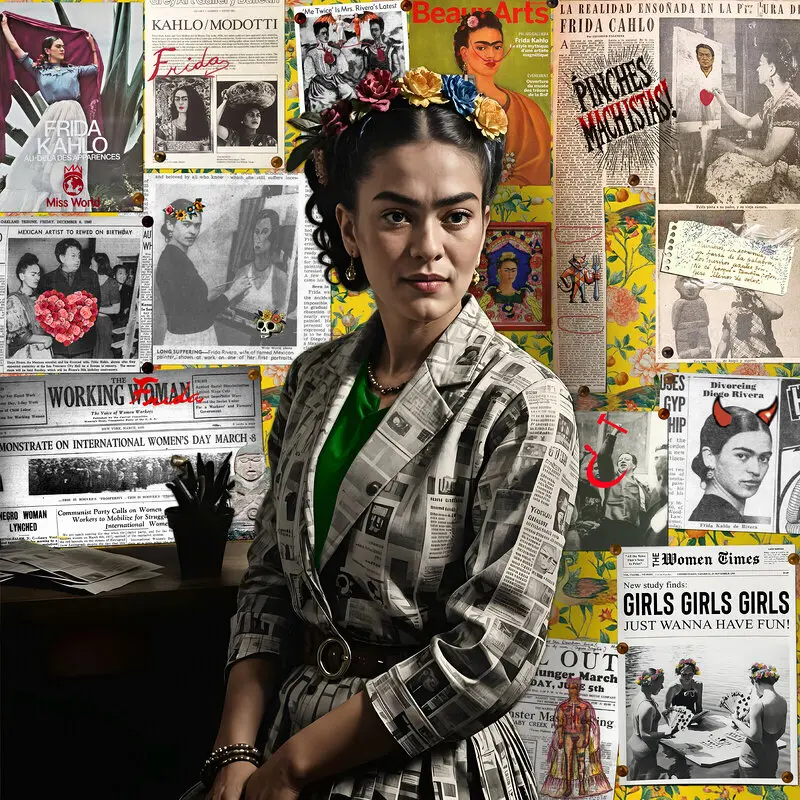
Frida Kahlo On the News, 2025
Digital
90 x 90 cm
5 500 kr
Frida Kahlo: A Life Pinned to the Wall
Frida Kahlo's life, much like her art, was a vivid tapestry of resilience, authenticity, and brilliance. From her vibrant canvases to the clippings pinned on her studio bulletin board, she revealed her humour, struggles, and defiance. Kahlo’s legacy, which lay overshadowed by her husband, Diego Rivera, during her lifetime, has grown into a global phenomenon. Today, she is a feminist icon, LGBTQ+ trailblazer, and cultural symbol whose work and life inspire millions. Kahlo exemplified what it means to defy expectations and live authentically through her unapologetic embrace of identity and her transformation of pain into art. Her story, meticulously documented through images, annotations, and bold commentary, continues to resonate, proving that the fragments of a life can echo across generations.
Read on to explore life on a bulletin board.
“Life on a Bulletin Board
Pinned and torn, the fragments cling,
A tapestry of life in spring.
Faded clippings, voices loud,
Truths and dreams behind a shroud.
A devil drawn, a heart adorned,
A love betrayed, a life reborn.
“Pinches machistas,” the ink declares,
Mocking the world and its heavy stares.
Here’s a face with a scribbled ‘stache,
There, a note on beauty dashed.
Between the cracks, the edges fray,
Yet bold remains what words convey.
A border crossed, a self-defined,
Pain and power intertwined.
The zoo of life—its beasts, its grace—
Each creature holds a sacred space.
A hammer here, a sickle there,
A banner raised for those who care.
The artist’s hand, unyielding, free,
Sketches truths for all to see.
On this board, the world takes shape,
Love and laughter, loss, escape.
Each scrap a voice, a soul, a chord,
A life lived fully—on a bulletin board.
From Diego’s wife, who sketched with flair,
To a legend whose brilliance fills the air.
No longer just a painter's muse,
But history's artist, whose fame accrues.
Diego, too painted, his genius true,
Yet now the world sees a broader view:
For Frida rose, her story now complete,
As one of the greats, her place is concrete.
Malmö, January 2025
Frida Kahlo on the News - A Life Pinned to the Wall
This title encapsulates the essence of Frida Kahlo's life and art, which were often publicised and displayed, much like the clippings on her bulletin board.
Frida Kahlo’s legacy, a testament to resilience, has transcended borders and time, emerging as a symbol of authenticity and artistic brilliance. Despite living in the shadow of her towering husband, Diego Rivera, a celebrated muralist, Frida’s genius was not fully recognised until nearly two decades after her death in 1954. Today, her name shines brighter than Diego’s, and she is celebrated as a feminist icon, environmental advocate, and compassionate animal lover. Her home, Casa Azul, was not just a sanctuary but also a significant source of inspiration, a reflection of her soul, filled with animals, memories, art, and pain.
One of the most poignant artefacts from Kahlo’s life is the bulletin board that hung in her studio. This collage of clippings, photographs, and doodles was much more than a simple memorabilia collection. It was a window into her world—her humour, struggles, and reflections on life. The bulletin board, a central part of her artistic process, spoke of her times, her thoughts on gender roles, and her complex relationship with Diego. It also illustrated how she perceived her creative achievements about his. The board was not just a collection of random items but a carefully curated reflection of her life and art, covered with biting commentary, witticisms, and raw emotion, serving as a visual diary of sorts, capturing the essence of Frida’s personality.
The Stories Told by a Bulletin Board
Frida’s board told stories not just about her but also about the world she inhabited. One clipping, riddled with her sharp handwriting, read, “Pinches Machistas” (“Damn Machos”), scrawled across an article espousing patriarchal values. Another featured a caricatured devil she had drawn between two pompous quotes from critics dismissing women’s contributions to art. These annotations reflected her defiance and her sharp critique of the gender dynamics of her time, which significantly influenced her art and made her a feminist icon.
In a newspaper article about her tumultuous divorce from Diego, Frida added a pair of horns above his head, perhaps in posthumous rebuke. Yet, another clipping from their remarriage six months later—on Diego’s birthday—was adorned with a heart made of flowers. These juxtapositions captured the contradictions in their relationship: betrayal and love, resentment and admiration. One particular image from a Communist meeting in 1930 showed Diego with a red hammer and Frida with a red sickle painted onto it, reflecting their shared political fervour.
Frida’s self-deprecating humour was evident, too. She had drawn a Salvador Dalí-style moustache on a front-page image of herself, nodding to her surrealist influences. Although she rejected the label of surrealism, famously saying, “I never painted dreams; I painted my reality,” she enjoyed the connections her work had to broader artistic movements. Her art and life intersected on her bulletin board, merging the profoundly personal with the universally political.
Her annotations also revealed a deep frustration with the art world and its treatment of women. In an article comparing her and Diego’s artistic merit, she wrote dismissively, “Of course, the wife is only a shadow. " She surrounded this note with small illustrations of mocking faces, a subtle but powerful statement on the persistent minimisation of women’s contributions.
A Life Pinned in Fragments
This bulletin board can be seen as a metaphor for Kahlo’s life—fragmented but cohesive, painful yet beautiful. It chronicled her physical suffering from the devastating bus accident that left her in lifelong pain, her miscarriages, and her turbulent marriage. But it also celebrated her triumphs: her exhibitions, relationships with other artists, and unyielding spirit. The clippings were ephemeral, but the emotions they evoked were eternal, capturing the “trivial” moments that defined her humanity.
The board’s relevance endures in today’s digital age. Much like Kahlo’s clippings, our digital footprints—social media posts, blogs, emails, and selfies—tell fragmented stories of our lives. Her annotated clippings, brimming with wit and vulnerability, invite us to reflect on how we curate and comment on our stories in an era of digital self-expression.
A poignant piece of her bulletin board featured a photograph of her with her beloved pets. She surrounded it with humorous captions about her “zoo” at Casa Azul, her home that was both a sanctuary and a reflection of her soul. Her animals—spider monkeys, parrots, and even a deer—were more than companions; they were symbols of her connection to the natural world. This sentiment echoed her disillusionment with human relationships and her deep bond with nature, a significant theme in her art.
A Universal Inspiration: Women and Resilience
As I contemplate International Women's Day, I am struck by the parallels between Frida Kahlo's indomitable spirit and the resilience of women everywhere. This cross-cultural initiative celebrates the fusion of Mexican and global crafts and aesthetics and the universal strength of women, transcending ethnicity, culture, and religion. Frida’s unwavering commitment to authenticity and her ability to transform adversity into art resonate with women across the globe.
Throughout history, women have faced immense challenges, from societal constraints to economic hardships and gender-based discrimination. Yet, much like Frida, they have risen above these obstacles with courage and determination. Whether a rural farmer toiling in the fields or a corporate professional breaking glass ceilings, women worldwide embody Frida's resilience, forming a global network of strength and inspiration.
We must honour Frida’s legacy by infusing designs with boldness and authenticity inspired by her distinctive use of colour and symbolism. This celebration is not just about the rich heritage of Mexico and other cultures but also about women's universal strength and resilience everywhere, a source of inspiration and empowerment for all.
Frida dressed far from conventional fashion, showing beauty and strength in every form. This philosophy, deeply aligned with Frida’s legacy, is a powerful call for inclusivity and a challenge to societal norms. It fosters a sense of respect and appreciation for the diversity of human experience and expression.
Frida’s spirit inspires every aspect of life. Her fearlessness in the face of adversity and her ability to channel pain into creativity serve as guiding principles. Each piece we create tells a story of triumph, courage, and beauty. As we celebrate International Women’s Day, we are reminded of Maya Angelou’s words: “Each time a woman stands up for herself, without knowing it, possibly without claiming it, she stands up for all women.” These words echo Frida’s legacy and the universal struggle for equality and empowerment.
A Legacy Beyond Borders
Frida Kahlo was more than an artist; she was a force of nature. Like her paintings, her bulletin board encapsulated her multifaceted identity: a fiercely political communist, a feminist ahead of her time, and a lover of animals and nature. In Casa Azul, her sanctuary, she surrounded herself with monkeys, parrots, and dogs, reflecting her deep connection to the natural world. This environmental consciousness, coupled with her feminist ideals, positions her as a visionary decades ahead of her time.
Her resilience resonates universally. As Carlos Monsiváis noted, Frida’s scandal wasn’t her affairs or politics but her refusal to let her illness define her. She lived with vitality and defiance, painting her pain and, in doing so, allowing the world to see its reflection.
Her political involvement was also a recurring theme on the bulletin board. Photographs from rallies and meetings showed her fierce dedication to communist ideals and her complexity. A clipping from a 1938 critique of Soviet policies had her note, “Even comrades can be fools,” next to a miniature hammer-and-sickle doodle. Her relationship with politics was as layered as her passionate but not unquestioning art.
From "Wife of the Master Mural Painter" to Icon of Her Own
In 1933, The Detroit News published an article about Frida Kahlo. At just 25 years old, she was a young artist accompanying her husband, Diego Rivera, to Detroit as he worked on his now-legendary “Detroit Industry” murals at the Detroit Institute of Arts. Rivera, a global sensation in the art world, was the primary focus of extensive media coverage during the couple’s 11-month stay. However, one reporter, Florence Davies, diverged from the norm and turned her attention to Kahlo.
The headline of Davies’ article reads, “Wife of the Master Mural Painter Gleefully Dabbles in Works of Art,” a title many today consider patronising and reductive. In the article itself, though, Kahlo’s wit and charm shine. She playfully remarked, “Of course, (Rivera) does pretty well for a little boy, but I am the big artist.” The discrepancy between the headline and the content has sparked discussions about how women artists were represented in the press at the time.
A Battle of Perception: Frida Kahlo in the Headlines
Florence Davies’s reporting highlighted Kahlo’s unique style, sharp humour, and burgeoning artistic talent, even if the editorial framing unjustly reduced her to a footnote in Rivera’s story. Critics today point to this as a glaring example of how women’s achievements were often unfairly overshadowed by their male counterparts in historical media narratives. Journalist Nicole Audrey Spector commented on this injustice when the article resurfaced on social media in 2017, noting, “This looks like a case of the editor sabotaging more honest reporting with a sensational headline.”
Andie Tucher, a professor of journalism history, echoed this sentiment, stating, “I HOPE Florence Davies didn’t write that [headline],” underscoring the likelihood that male editors were responsible for framing Kahlo as an incidental figure.
Decades later, the dynamic between Kahlo and Rivera has reversed in public perception. Today, Rivera is often introduced as “Frida’s husband” rather than vice versa. Kahlo’s fame eclipsed his years ago, with her art now gracing blockbuster exhibitions worldwide. One such show at the Philadelphia Museum of Art, titled “Paint the Revolution: Mexican Modernism, 1910-1950,” prominently featured Kahlo’s Self-Portrait on the Borderline Between Mexico and the United States, painted during her Detroit stay and mentioned in the 1933 article.
Frida’s Art and Activism: A Legacy Beyond Detroit
Kahlo’s time in Detroit marked a pivotal period in her career. While Rivera’s work celebrated industrial progress, Kahlo’s art delved into deeply personal and often painful themes. Her Self-Portrait on the Borderline juxtaposes industrial America with traditional Mexican imagery, reflecting her complex feelings about the U.S. and her cultural identity. It’s a powerful statement that inspires and provokes discussions about identity and belonging.
Beyond the canvas, Kahlo’s influence extends to modern movements. Her image—often depicted with her trademark braids, bold brows, and traditional Tehuana dress—symbolises empowerment. From the Detroit Women’s March, where protestors held signs with Kahlo’s image and the word “Fearless,” to global advertising campaigns featuring her likeness, Kahlo’s legacy transcends art. She represents resilience, cultural pride, and the fight against systemic oppression, which should make us all proud.
A Hero in Her Own Story
Catalina Cuervo, an opera soprano who portrayed Kahlo in the production Frida, aptly summarised the artist’s enduring appeal: “Frida could have been a victim in the story of her life, but she ended up being her hero. That makes her an example, an idol to many.”
Kahlo’s resilience in the face of adversity—her chronic pain, turbulent marriage, and personal losses—cements her as a universal figure of strength. The 1933 Detroit News article, while a product of its time, offers an early glimpse into the bold, unapologetic woman who would later captivate the world. Today, Kahlo is far more than the “wife of the master mural painter”—she is an icon whose legacy continues to inspire generations.
Bisexuality, Pain, and Humor in the Face of Adversity
Frida Kahlo’s rediscovery in the 1990s by North American audiences marked a pivotal moment in recognising her work and life. Today, Kahlo is celebrated not only for her provocative and hauntingly personal artwork but also for the fascinating and turbulent life she led. Her 25-year on-and-off marriage to Diego Rivera was filled with passion, betrayal, and reconciliation, and her numerous love affairs—including one with Leon Trotsky and several with women—highlight her fluid approach to love and relationships. As a bisexual woman, Kahlo is now hailed as a trailblazer and an early heroine of the LGBTQ+ movement, representing a fearless embrace of identity long before such openness was widely accepted.
A Trailblazer for LGBTQ+ Representation
Though less documented than her affairs with men, Kahlo's relationships with women were an integral part of her life and identity. Her ability to navigate both her desires and the societal constraints of her time makes her a symbol of defiance against rigid norms. In an era where bisexuality was rarely acknowledged, Kahlo lived openly and unapologetically. Today, her legacy resonates with the LGBTQ+ community, offering a beacon of authenticity and courage.
Her bisexuality is evident not only in her relationships but also in her art, where she often depicts themes of duality, fluidity, and gender. Paintings like Two Nudes in a Forest (1939) suggest an intimate connection between women, and her self-portraits frequently challenge traditional representations of femininity. In one famous image, she wears a suit, her hair cropped short, exuding an androgynous confidence that speaks to her rejection of binary gender norms.
Pain and Resilience: The Turning Point of Her Life
While her sexuality is a significant aspect of her identity, it is not the most compelling part of her story. Many are drawn to Kahlo’s life for her extraordinary resilience in the face of unimaginable pain. At 18, a horrific bus accident nearly killed her when an iron rail impaled her abdomen. The accident left her temporarily paralysed and in severe pain for the rest of her life. Over 30 surgeries followed, along with periods of confinement to a hospital bed. Yet, this catastrophic event became a turning point, driving her to embrace life with unmatched intensity and to pour her anguish and dreams into her art.
Kahlo’s paintings often depict her suffering in visceral detail. Works like The Broken Column (1944), where her body is split open to reveal a crumbling spine, and Henry Ford Hospital (1932), which portrays her miscarriage in Detroit, are raw and haunting. Through her art, Kahlo transformed her pain into a universal language, enabling others to find strength in their struggles.
The Role of Humor and Self-Distance
Despite her suffering, Kahlo never lost her sharp wit and humour. Her annotations and personal documents show her self-awareness and ability to laugh at life’s absurdities. Among the clippings on her famous studio bulletin board is a French article titled Au-delá des appearances (“Beyond Appearances”), to which she added a playful twist. Kahlo painted the logo of the newly founded Miss World pageant over the article, a cheeky commentary on beauty standards and societal expectations.
At the time of this addition in 1951, Kahlo was not in her prime physical health. She was frail, no longer the radiant woman she had once been, and her body bore the marks of decades of pain and medical interventions. Yet, her humour and self-distance remained intact. This small act of defiance and wit—drawing attention to her ageing and challenging the superficiality of beauty contests—is a testament to her indomitable spirit.
A Lasting Inspiration
Frida Kahlo’s ability to balance pain, identity, and humour makes her story universally compelling. As an artist, she painted her reality with brutal honesty; as a person, she lived authentically and unapologetically. Her embrace of bisexuality and her contributions to art and culture make her a timeless figure of empowerment.
Even as her body failed her, Kahlo never succumbed to despair. Instead, she found ways to laugh, create, and inspire, leaving a legacy that continues to resonate with people of all backgrounds. For the LGBTQ+ community, she remains a pioneer; for those who suffer, she is a beacon of resilience; and for everyone, she is a reminder of the power of authenticity, humour, and strength in the face of life’s most significant challenges.
Conclusion: A Woman of Today and Tomorrow
Frida Kahlo’s bulletin board was more than a collection of clippings; it was a mirror of her world. It captured the essence of her life: her wit, her pain, her politics, and her love. It spoke of a woman who lived authentically and unapologetically and transformed adversity into art. Today, as we navigate our fragmented stories in the digital age, Frida’s life reminds us of the power of resilience, authenticity, and self-expression. Pinned to a wall, her story inspires and challenges us, proving that even the most ephemeral fragments can leave an indelible mark on the world.
Studying her bulletin board gives us a deeper understanding of the woman behind the legend. It is a testament to her ability to turn pain into beauty, critique into action, and fragments into a cohesive narrative. Much like the board itself, her legacy is a mosaic of moments—each telling a story that resonates far beyond her time. As we celebrate the strength and resilience of women across the globe, Frida Kahlo’s life serves as both an inspiration and a call to action for generations to come.
5 500 kr

Jörgen Thornberg
Malmö
Lite om bilder och mig. Translation in English at the end.
Jag är en nyfiken person som ser allt i bilder, även det jag fäster i ord, gärna tillsammans för bakom alla mina bilder finns en berättelse. Till vissa bilder hör en kortare eller längre novell som följer med bilden.
Bilder berättar historier. Jag omges av naturlig skönhet, intressanta människor och historia var jag än går. Jag använder min kamera för att dokumentera världen och blanda det jag ser med vad jag känner för att fånga den dolda magin.
Mina bilder berättar mina historier. Genom mina bilder, tryck och berättelser. Jag bjuder in dig att ta del av dessa berättelser, in i ditt liv och hem och dela min mycket personliga syn på vår värld. Mer än vad ögat ser. Jag tänker i bilder, drömmer och skriver och pratar om dem; följaktligen måste jag också skapa bilder. De blir vad jag ser, inte nödvändigtvis begränsade till verkligheten. Det finns en bild runt varje hörn. Jag hoppas att du kommer att se vad jag såg och gilla det.
Jag är också en skrivande person och till många bilder hör en kortare eller längre essay. Den följer med tavlan, tryckt på fint papper och med en personlig hälsning från mig.
Flertalet bilder startar sin resa i min kamera. Enkelt förklarat beskriver jag bilden jag ser i mitt inre, upplevd eller fantiserad. Bilden uppstår inom mig redan innan jag fått okularet till ögat. På bråkdelen av ett ögonblick ser jag vad jag vill ha och vad som kan göras med bilden. Här skall jag stoppa in en giraff, stålmannen, Titanic eller vad det är min fantasi finner ut. Ännu märkligare är att jag kommer ihåg minnesbilden långt efteråt när det blir tid att skapa verket. Om jag lyckas eller inte, är upp till betraktaren, oftast präglat av en stråk av svart humor – meningen är att man skall bli underhållen. Mina bilder blir ofta en snackis där de hänger.
Jag föredrar bilder som förmedlar ett budskap i flera lager. Vid första anblicken fylld av feel-good, en vacker utsikt, fint väder, solen skiner, blommor på ängen eller vattnet som ligger förrädiskt spegelblankt. I en sådan bild kan jag gömma min egentliga berättelse, mitt förakt för förtryckare och våldsverkare, rasister och fördomsfulla människor - ett gärna återkommande motiv mer eller mindre dolt i det vackra motivet. Jag försöker förena dem i ett gemensamt narrativ.
Bild och formgivning har löpt som en röd tråd genom livet. Fotokonst känns som en värdig final som jag gärna delar med mig.
Min genre är vid som framgår av mina bilder, temat en blandning av pop- och gatukonst i kollage som kan bestå av hundratals lager. Vissa bilder kan ta veckor, andra någon dag innan det är dags att överlämna resultatet till printverkstaden. Fine Art Prints är digitala fotocollage. I dessa kollage sker rivandet, klippandet, pusslandet, målandet, ritandet och sprayningen digitalt. Det jag monterar in kan vara hundratals år gamla bilder som jag omsorgsfullt frilägger så att de ser ut att vara en del av tavlan men också bilder skapade av mig själv efter min egen fantasi. Därefter besöks printstudion och för vissa bilder numrera en limiterad upplaga (oftast 7 exemplar) och signera för hand. Vissa bilder kan köpas i olika format. Det är bara att fråga efter vilka. Gillar man en bild som är 70x100 men inte har plats på väggen, går den kanske att få i 50x70 cm istället. Frågan är fri.
Metoden Giclée eller Fine Art Print som det också kallas är det moderna sättet för framställning av grafisk konst. Villkoret för denna typ av utskrifter är att en högkvalitativ storformatskrivare används med åldersbeständigt färgpigment och konstnärspapper eller i förekommande fall på duk. Pappret som används möter de krav på livslängd som ställs av museer och gallerier. Normalt säljer jag mina bilder oinramade så att den nya ägaren själv kan bestämma hur de skall se ut, med eller utan passepartout färg på ram, med eller utan glas etc..
Under många år ställde jag bara ut på nätet, i valda grupper och på min egen Facebooksida - https://www.facebook.com/jorgen.thornberg.9
Jag finns också på en egen hemsida som tyvärr inte alltid är uppdaterad – https://www.jth.life/ Där kan du också läsa en del av de berättelser som följer med bilden.
UTSTÄLLNINGAR
Luftkastellet, oktober 2022
Konst i Lund, november 2022
Luftkastellet, mars 2023
Engleson Galleri Caroli, april 2023
Hydra, Greece June 2023
Engleson Galleri Caroli, oktober 2023
Toppen, Höllviken december 2023
Luftkastellet, mars 2024
Torups Galleri, mars 2024
Venice, May 2024
Luftkastellet, oktober 2024
Konst i Advent, December 2024
Galleri Engleson, Caroli December 2024
Jäger & Jansson Galleri, april 2025
A bit about pictures and me.
I'm a curious person who sees everything in pictures, even what I express in words, often combining them, for behind all my pictures lies a story. These narratives, some as short as a single image and others as long as a novel, are the heart and soul of my work.
Pictures tell stories. Wherever I go, I'm surrounded by natural beauty, exciting people, and history. I use my camera to document the world and blend what I see with what I feel to capture the hidden magic.
My images tell my stories. Through my pictures, prints, and narratives, I invite you to partake in these stories in your life and home and share my deeply personal perspective of our world. More than meets the eye. I think in pictures, dream, write, and talk about them; consequently, I must create images too. They become what I see, not necessarily confined to reality. There's a picture around every corner. I hope you'll see what I saw and enjoy it.
I'm also a writer, and many images come with a shorter or longer essay. It accompanies the painting, printed on fine paper with my personal greeting.
Many pictures start their journey on my camera. Simply put, I describe the image I see in my mind, experienced or imagined. The image arises within me even before I bring the eyepiece to my eye. In a fraction of a moment, I see what I want and what can be done with the picture. Here, I'll insert a giraffe, Superman, the Titanic, or whatever my imagination conjures up. Even stranger is that I remember the mental image long after it's time to create the work. Whether I succeed is up to the observer, often imbued with a streak of black humour – the aim is to entertain. My pictures usually become a talking point wherever they hang.
I prefer pictures that convey a message in multiple layers. At first glance, they're filled with feel-good vibes, a beautiful view, lovely weather, the sun shining, flowers in the meadow, or the water lying deceptively calm. But beneath this surface beauty, I often conceal a deeper story, a narrative that challenges societal norms or explores the human condition. I invite you to delve into these hidden narratives and discover the layers of meaning within my work.
Picture and design have been a thread running through my life. Photographic art feels like a fitting finale, and I'm happy to share it.
My genre is varied, as seen in my pictures; the theme is a blend of pop and street art in collages that can consist of hundreds of layers. Some images can take weeks, others just a day before it's time to hand over the result to the print workshop. Fine Art Prints are digital photo collages. In these collages, tearing, cutting, puzzling, painting, drawing, and spraying happen digitally. What I insert can be images hundreds of years old that I carefully extract so they appear to be part of the painting, but also images created by myself, now also generated from my imagination. Next, visit the print studio and, for certain images, number a limited edition (usually 7 copies) and sign them by hand. Some images may be available in other formats. Just ask which ones. If you like an image that's 70x100 but doesn't have space on the wall, you might be able to get it in 50x70 cm instead. The question is open.
The Giclée method, or Fine Art Print as it's also called, is the modern way of producing graphic art. This method ensures the highest quality and longevity of the artwork, using a high-quality large-format printer with archival pigment inks and artist paper or, in some cases, canvas. The paper used meets the longevity requirements set by museums and galleries. I sell my pictures unframed, allowing the new owner to personalise their artwork, confident in the lasting value and quality of the piece.
For many years, I only exhibited online, in selected groups, and on my Facebook page - https://www.facebook.com/jorgen.thornberg.9. I also have my website, which unfortunately is not constantly updated - https://www.jth.life/. You can also read some of the stories accompanying the pictures there.
EXHIBITIONS
Luftkastellet, October 2022
Art in Lund, November 2022
Luftkastellet, March 2023
Engleson Gallery Caroli, April 2023
Hydra, Greece June 2023
Engleson Gallery Caroli, October 2023
Toppen, Höllviken December 2023
Luftkastellet, March 2024
Torup Gallery, March 2024
Venice, May 2024
UTSTÄLLNINGAR
Luftkastellet, oktober 2022
Konst i Lund, november 2022
Luftkastellet, mars 2023
Engleson Galleri Caroli, april 2023
Hydra, Greece June 2023
Engleson Galleri Caroli, oktober 2023
Toppen, Höllviken december 2023
Luftkastellet, mars 2024
Torups Galleri, mars 2024
Venice, May 2024
Luftkastellet, October 2024
Konst i Advent, December 2024
Galleri Engleson, Caroli December 2024
Jäger & Jansson Galleri, April 2025
Utbildning
Autodidakt
Medlem i konstnärsförening
Öppna Sinnen
Med i konstrunda
Konstrundan i Skåne
Utställningar
Luftkastellet, October 2022
Art in Lund, November 2022
Luftkastellet, March 2023
Engleson Gallery Caroli, April 2023
Hydra, Greece June 2023
Engleson Gallery Caroli, October 2023
Toppen, Höllviken December 2023
Luftkastellet, March 2024
Torup Gallery, March 2024
Venice, May 2024