Vi använder cookies för att ge dig bästa möjliga upplevelse. Välj vilka cookies du tillåter.
Läs mer i vår integritetspolicy
Jörgen Thornberg
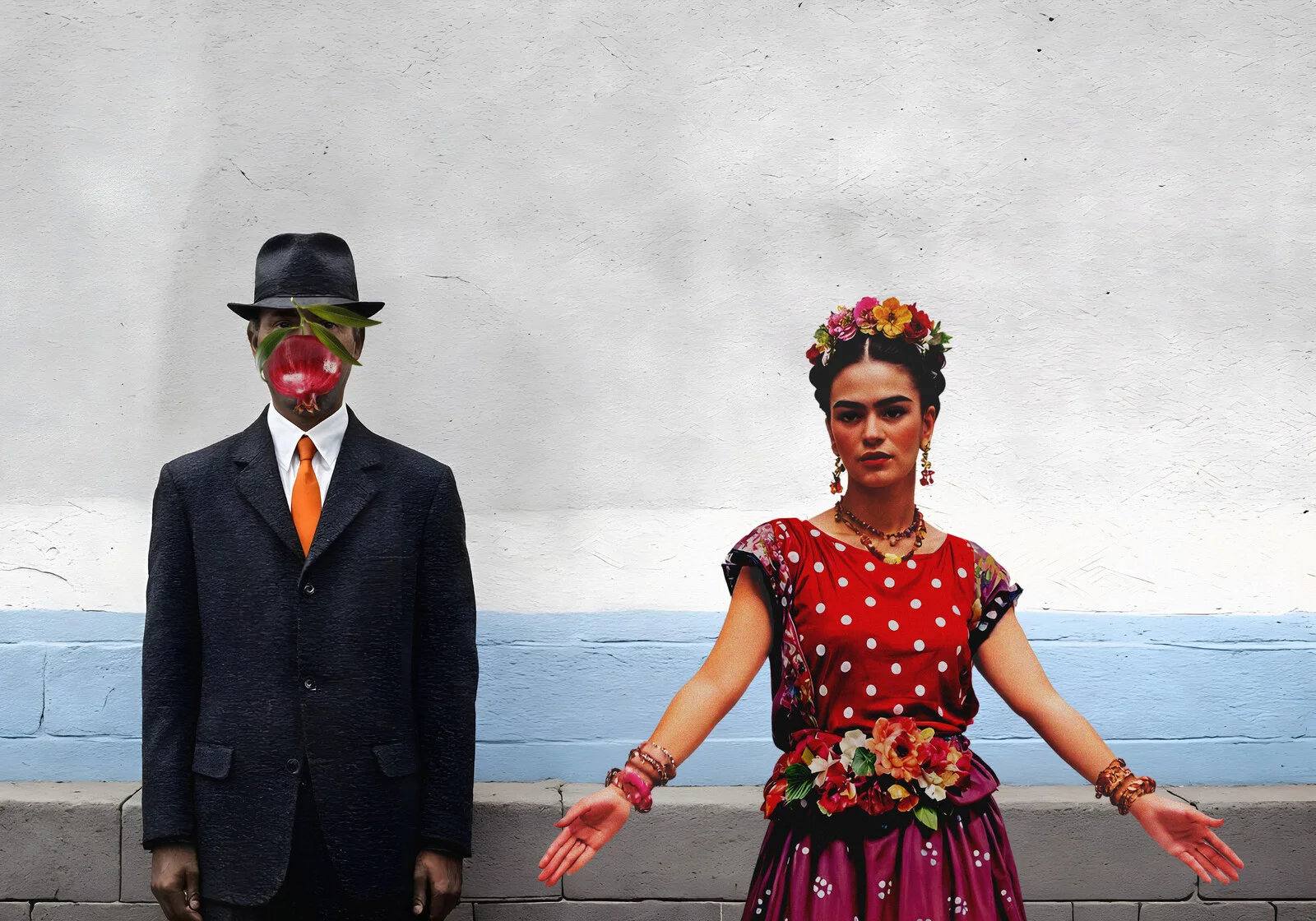
Children of Man, 2025
Digital
100 x 70 cm
5 200 kr
Children of Man
René Magritte's ‘The Son of Man’, painted in 1964, is one of the Belgian Surrealist's most enigmatic works. It epitomises his talent for crafting mysterious, thought-provoking images that challenge our perception of reality. Magritte’s paintings often leave viewers grappling with the layers of meaning beneath their deceptively simple surfaces, a mystery that continues to captivate art enthusiasts.
In Frida Kahlo’s reinterpretation, she—as always—infuses the painting with her unmistakable touch, transforming it into a self-portrait of profound personal significance. The artwork features a figure clad in an overcoat and wearing a classic Fedora hat, standing before a stark wall. Unlike Magritte's original green apple, Frida replaces it with a vibrant, ripe pomegranate that hovers in front of the figure’s face. While the fruit obscures much of the visage, the man’s eyes subtly peek over its edge, inviting the viewer to wonder what lies behind the concealment.
Magritte once described the essence of ‘The Son of Man’ in his own words:
"At least it hides the face partly well, so you have the apparent face—the apple—hiding the visible but hidden face of the person. It's something that happens constantly. Everything we see hides another thing; we always want to see what is hidden by what we see. There is an interest in what is hidden and what the visible does not show us. This interest can take the form of a quite intense feeling, a sort of conflict; one might say, between the visible that is hidden and the visible that is present."
Frida’s choice of a pomegranate rather than an apple in her reinterpretation adds layers of symbolism. The pomegranate, long associated with fertility, knowledge, and duality in various cultural and mythological traditions, invites viewers to question what is being hidden and the nature of what is revealed. Her interpretation amplifies the tension between visibility and concealment while subtly redefining Magritte’s original message with her unique, introspective perspective.
Unlike Magritte's open sea, the wall in the background of Frida's version further grounds the viewer, creating a sense of confinement. The juxtaposition of this rigid barrier with the surreal elements of the hovering fruit and the figure’s distorted arm underscores themes of limitation and the human desire to transcend it. Through her interpretation, Frida honours Magritte’s exploration of hidden truths and weaves in her own narrative, offering a fresh lens on the eternal conflict between what is seen, what is hidden, and the truths that lie in between.
Read on to explore what Frida Kahlo said….
“Open Hands
Two hands stretched forth, unarmed, laid bare,
Open to the world, to the weight of the air.
In their emptiness, a silent plea resides,
A canvas for meaning, where truth abides.
‘Surrender and Release’
“I yield,” they whisper, “to the tides of fate,
No longer fighting, I’m no longer irate.
Take what I offer, for this is all,
The fragments I hold, though they seem so small.”
‘Vulnerability and Grace’
Unhidden, unshielded, they stand in the light,
Exposing the bearer’s fragile might.
“No secrets, no armour, no veil to conceal,
These hands hold nothing but truths that are real.”
‘Generosity and Share’
“Take what you need,” they softly implore,
“These hands may be empty, but they offer more.
A gift of the self, a soul laid bare,
A gesture of giving, of love and care.”
‘Frustration and Despair’
“I’ve tried all I could, and now I let go,
To forces far greater than I’ll ever know.
Take this burden; I can bear it no more,
These hands now rest where they once swore.”
‘The State of Humanity’
Forever grasping, forever in need,
Our empty hands speak of unending greed.
“Never complete, always we yearn,
For something beyond, for lessons to learn.”
‘A Prayer for Grace’
“Help me,” they cry, “see me, hear,
Give what I lack, draw me near.
In these hands lies a plea unspoken,
A bond to be mended, a vow unbroken.”
Each open palm, a question, a thread,
Inviting reflection on what’s unsaid.
A gesture so simple yet infinite, vast,
Holding the future, the present, the past.
Malmö, January 2025
A Magical Painting full of choices
The sun shone warmly on the terrace of Gustav Adolf, formerly Brauns Konditori, now a restaurant overlooking the bustling square. Frida Kahlo and I sat at one of the outdoor tables, basking in the rare Scandinavian heat. She was radiant, wrapped in a brightly embroidered shawl, her iconic floral crown proudly on her head. Before her stood a small, delicate coffee cup, the steam rising as she traced the rim absentmindedly, while my glass of local beer sat untouched, the foam slowly dissipating.
I leaned forward, resting my hands on the table. "Frida," I began, "tell me about your magical painting—the one that feels as if it's been seen a thousand times, yet each viewing feels like the first."
She smiled faintly, tilting her head. “Like Magritte, my work dances between reality and illusion. I call the man in the painting ‘Every Single Man.’ He represents those who may have harmed humanity or did nothing to stop others. Voting for someone like Trump is taking on part of the blame—just as people did when Nazism rose to power. Both used democracy for their ends, and their voters let it happen.”
Her voice dropped slightly, her tone becoming more intense. “Every Single Man’s hidden face—obscured by a pomegranate—challenges the viewer. It asks: Are you complicit through action or inaction?”
I nodded, intrigued. "Hiding the face—does that suggest cowardice or calculation?"
Frida’s lips curved into a knowing smile. “The choice to hide his face with a pomegranate invites many interpretations. Some see temptation, recalling the biblical story of Adam and Eve. Others think it’s my favourite fruit—though they’d be wrong. My heart belongs to the papaya, a symbol of fertility, femininity, and life itself.”
Her hands gestured gracefully, emphasising her point. “Papayas have appeared often in my work, like in ‘Still Life with Parrot and Fruit.’ Their vibrant colours evoke vitality and sensuality. But for this painting, the pomegranate spoke louder.”
I tilted my head, sipping my beer as the foam coated my upper lip. “Why a pomegranate, then? Why not stick with the papaya?”
Frida’s eyes gleamed. “The pomegranate is a fruit steeped in history and meaning. Theologically, when Adam ate the forbidden fruit in Eden—often depicted as an apple—he brought Original Sin into the world. That sin remained until Christ's death reversed it. Combining this idea with the title ‘Every Single Man,’ the pomegranate on the man’s face evokes a deeper question: Is this man complicit in the original transgression? With its rich history and complex symbolism, the pomegranate is a powerful tool in my exploration of human complicity and responsibility.”
She leaned forward, lowering her voice as if sharing a secret. “And, as you might guess, the Bible doesn’t say the forbidden fruit was an apple. That’s a Western misinterpretation.”
I raised an eyebrow. “What do you mean? Isn’t the apple central to the story?”
Frida laughed softly, shaking her head. “Not at all. Genesis says, ‘Fruit from the Tree of Knowledge.’ The notion of an apple arose much later. It was likely a mix-up—a linguistic coincidence. In Latin, the word for apple (‘malum’) sounds similar to the word for evil (‘malus’). This association stuck, and the symbolism solidified in medieval Europe, where apples were common.”
I leaned back, nodding thoughtfully. “But considering the story’s Middle Eastern origins, wouldn’t a local fruit be more plausible? Perhaps a fig—it’s mentioned immediately after the fall when Adam and Eve cover themselves with fig leaves.”
Frida shrugged, her hands cupping her coffee. “Figs are a possibility, yes. But they lack the mystique of the pomegranate. Figs are small, unremarkable, and lack the mythical aura surrounding the pomegranate—a sacred fruit in many cultures, symbolising fertility and knowledge.”
Her voice took on a reflective tone. “The pomegranate appears in so many traditions. In ancient Egypt, it meant prosperity and ambition, and it was placed in tombs to ensure abundance in the afterlife. In Mesopotamia, it was sacred to Ishtar, representing love and war. And in Greek mythology, it binds Persephone to Hades—a single bite marking the change of seasons and cycles of life.”
I gestured toward her coffee. “How does that history influence your art?”
Frida paused, cradling the cup in her hands. “The pomegranate is a contradiction—its tough skin conceals a treasure of vibrant seeds. My work signifies life’s duality: beauty, pain, sweetness, and bitterness. The seeds are like droplets of blood—fragile yet full of vitality.”
Her expression softened as she added, “Other artists have inspired me. Botticelli’s ‘Madonna of the Pomegranate’—Christ cradling the fruit, its seeds foreshadowing his suffering. And Caravaggio, in his still-life paintings, captures the rawness of the pomegranate, the split skin revealing its vivid interior.”
I nodded, imagining the paintings she referenced. “It seems universal—a symbol that transcends time and culture.”
Frida smiled, her eyes glinting. “Exactly. That’s why I chose it for ‘Every Single Man.’ It’s not just a fruit—it’s a mirror, reflecting hidden truths and untold stories. It asks the viewer to look beyond the surface and confront what lies beneath.”
The sun dipped lower, casting a warm, golden light over the square. Frida’s coffee cup sat empty, the faint aroma of its contents lingering in the air. I raised my beer in a small toast.
“To the pomegranate—a fruit with endless stories.”
Frida lifted her cup, her smile serene. “And to the stories we find when we dare to look deeper.”
The warm sun bathed Gustav Adolf’s café terrace, a quiet hum of conversation mingling with the occasional clink of glasses. Frida Kahlo and I sat amidst the bustle of Malmö’s square, our drinks on the table between us—a nearly empty coffee cup for her and my beer glass, the froth long since settled. Frida’s gaze held a thoughtful intensity as I leaned in, eager to hear more about her powerful painting and its hidden meanings.
Me: “Why don’t you have a fruit obscuring your face? It seems deliberate.”
Frida smiled, her fingers lightly tracing the rim of her coffee cup. “I wanted to highlight the contrast—having something to hide versus being open about yourself. No one can accuse me of hiding anything significant. I laid myself bare in the seventy-odd self-portraits I painted before leaving Earth—and thrice as many since. Of those, fifty were displayed in my retrospective exhibition.
"The man in the painting, ‘Every Single Man,’ embodies decision-makers—powerful figures, most often men—who always have something to hide. They peek behind the fruit to see if humanity has swallowed their lies. Fake news has always been their sharpest weapon.”
Me: “You’ve positioned the two of you against a wall. Is that symbolic?”
Frida leaned forward slightly, her expression sharpening. “Exactly! By placing us against a wall—not with an open sea behind us, as Magritte did—I wanted to create a sense of no escape. It’s a visual confrontation—backed into a corner, unable to flee.”
Me: “Lastly, your open palms, facing ‘Every Single Man’ and his rigid stance. That can’t be incidental. Tell me more.”
Frida’s eyes glimmered as she placed her hands on the table, palms up, mirroring the gesture in her painting. “The painting is laden with conflict, loss, and introspection elements. The open palms serve as an emotional focal point, creating a dialogue between him and me and the viewer. They’re meant to provoke questions and invite discussion.”
Me: “Discussion about what?”
Frida sat back, a playful grin tugging at her lips. “What do we want? What are we trying to take? Are these empty hands an offering or a boundary? Submission or defiance? They can be interpreted in countless ways.”
Me: “You’ll have to elaborate.”
She laughed softly, lifting her cup for the last sip before setting it down with deliberate care. “We could sit here for days if I were to unpack every thought and symbol woven into that simple yet multifaceted gesture. But let me share some of the most significant interpretations.”
Me: “I’m all ears.”
Frida’s voice deepened with thoughtfulness as her hands gestured subtly.
“First, there’s ‘Resignation and Surrender’. The hands can denote a capitulation to life—a realisation that one no longer fights against circumstances. It expresses acceptance: ‘I have nothing left to give; all I have is this.’
"Then there’s ‘Vulnerability and Humility’. Open palms signal complete vulnerability and disarmament: ‘I have no hidden weapons, no reserves. I stand here empty-handed, with only my truth.’”
Me: “Those are both interpretations I’ve considered.”
Frida nodded. “The hands can also symbolise ‘Generosity and Sharing’. Depending on the context, the gesture might be an invitation: ‘Take what you need; I offer myself wholly.’ It could reflect a willingness to give, even when the hands are empty—like the widow’s mite in the Bible.”
She paused, her gaze briefly distant. “But just as easily, the gesture can express ‘Frustration and Despair’: ‘I’ve tried everything, and now I leave it in your hands.’ It conveys a sense of powerlessness against greater forces or circumstances.”
Me: “It feels more like powerlessness than generosity.”
Frida smiled faintly. “That’s your interpretation, and it’s valid. But others see it differently. I’ve also considered it a ‘Symbol of Humanity’s Condition’. Two empty hands can be a powerful metaphor for our eternal lack or longing. ‘We are never complete; we always reach for something more, something beyond ourselves.’”
Me: “Or perhaps it’s someone boasting about building a fortune or creating something from nothing—starting with empty hands. In this context, that feels like too prosaic a reading.”
Frida laughed lightly, her earrings catching the sunlight. “It’s entirely possible that ‘Every Single Man’ might think along those lines. But it could also be the opposite of boasting—a ‘Plea for Help or Mercy’. In its most basic and emotional state, the gesture represents a humble prayer: ‘See me, help me, give me what I cannot achieve alone.’”
She leaned forward again, her voice softening. “Finally—though this is just a fraction of the possibilities—open palms can be an invitation to dialogue, support, or reconciliation. They ask: ‘Can we bridge the gap? Can we find common ground?’”
Frida’s words lingered as the sunlight played on the table, casting soft shadows. I raised my beer, the golden liquid catching the light.
“To the questions we ask,” I said, my voice low but sincere.
Frida raised her empty coffee cup in return, her gaze steady. “And to the answers we discover—even when they’re not what we expected.”
Jörgen Thornberg
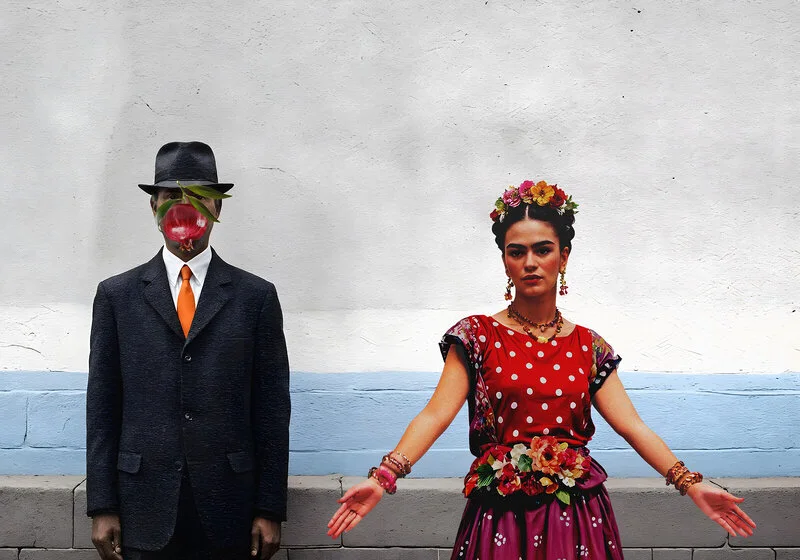
Children of Man, 2025
Digital
100 x 70 cm
5 200 kr
Children of Man
René Magritte's ‘The Son of Man’, painted in 1964, is one of the Belgian Surrealist's most enigmatic works. It epitomises his talent for crafting mysterious, thought-provoking images that challenge our perception of reality. Magritte’s paintings often leave viewers grappling with the layers of meaning beneath their deceptively simple surfaces, a mystery that continues to captivate art enthusiasts.
In Frida Kahlo’s reinterpretation, she—as always—infuses the painting with her unmistakable touch, transforming it into a self-portrait of profound personal significance. The artwork features a figure clad in an overcoat and wearing a classic Fedora hat, standing before a stark wall. Unlike Magritte's original green apple, Frida replaces it with a vibrant, ripe pomegranate that hovers in front of the figure’s face. While the fruit obscures much of the visage, the man’s eyes subtly peek over its edge, inviting the viewer to wonder what lies behind the concealment.
Magritte once described the essence of ‘The Son of Man’ in his own words:
"At least it hides the face partly well, so you have the apparent face—the apple—hiding the visible but hidden face of the person. It's something that happens constantly. Everything we see hides another thing; we always want to see what is hidden by what we see. There is an interest in what is hidden and what the visible does not show us. This interest can take the form of a quite intense feeling, a sort of conflict; one might say, between the visible that is hidden and the visible that is present."
Frida’s choice of a pomegranate rather than an apple in her reinterpretation adds layers of symbolism. The pomegranate, long associated with fertility, knowledge, and duality in various cultural and mythological traditions, invites viewers to question what is being hidden and the nature of what is revealed. Her interpretation amplifies the tension between visibility and concealment while subtly redefining Magritte’s original message with her unique, introspective perspective.
Unlike Magritte's open sea, the wall in the background of Frida's version further grounds the viewer, creating a sense of confinement. The juxtaposition of this rigid barrier with the surreal elements of the hovering fruit and the figure’s distorted arm underscores themes of limitation and the human desire to transcend it. Through her interpretation, Frida honours Magritte’s exploration of hidden truths and weaves in her own narrative, offering a fresh lens on the eternal conflict between what is seen, what is hidden, and the truths that lie in between.
Read on to explore what Frida Kahlo said….
“Open Hands
Two hands stretched forth, unarmed, laid bare,
Open to the world, to the weight of the air.
In their emptiness, a silent plea resides,
A canvas for meaning, where truth abides.
‘Surrender and Release’
“I yield,” they whisper, “to the tides of fate,
No longer fighting, I’m no longer irate.
Take what I offer, for this is all,
The fragments I hold, though they seem so small.”
‘Vulnerability and Grace’
Unhidden, unshielded, they stand in the light,
Exposing the bearer’s fragile might.
“No secrets, no armour, no veil to conceal,
These hands hold nothing but truths that are real.”
‘Generosity and Share’
“Take what you need,” they softly implore,
“These hands may be empty, but they offer more.
A gift of the self, a soul laid bare,
A gesture of giving, of love and care.”
‘Frustration and Despair’
“I’ve tried all I could, and now I let go,
To forces far greater than I’ll ever know.
Take this burden; I can bear it no more,
These hands now rest where they once swore.”
‘The State of Humanity’
Forever grasping, forever in need,
Our empty hands speak of unending greed.
“Never complete, always we yearn,
For something beyond, for lessons to learn.”
‘A Prayer for Grace’
“Help me,” they cry, “see me, hear,
Give what I lack, draw me near.
In these hands lies a plea unspoken,
A bond to be mended, a vow unbroken.”
Each open palm, a question, a thread,
Inviting reflection on what’s unsaid.
A gesture so simple yet infinite, vast,
Holding the future, the present, the past.
Malmö, January 2025
A Magical Painting full of choices
The sun shone warmly on the terrace of Gustav Adolf, formerly Brauns Konditori, now a restaurant overlooking the bustling square. Frida Kahlo and I sat at one of the outdoor tables, basking in the rare Scandinavian heat. She was radiant, wrapped in a brightly embroidered shawl, her iconic floral crown proudly on her head. Before her stood a small, delicate coffee cup, the steam rising as she traced the rim absentmindedly, while my glass of local beer sat untouched, the foam slowly dissipating.
I leaned forward, resting my hands on the table. "Frida," I began, "tell me about your magical painting—the one that feels as if it's been seen a thousand times, yet each viewing feels like the first."
She smiled faintly, tilting her head. “Like Magritte, my work dances between reality and illusion. I call the man in the painting ‘Every Single Man.’ He represents those who may have harmed humanity or did nothing to stop others. Voting for someone like Trump is taking on part of the blame—just as people did when Nazism rose to power. Both used democracy for their ends, and their voters let it happen.”
Her voice dropped slightly, her tone becoming more intense. “Every Single Man’s hidden face—obscured by a pomegranate—challenges the viewer. It asks: Are you complicit through action or inaction?”
I nodded, intrigued. "Hiding the face—does that suggest cowardice or calculation?"
Frida’s lips curved into a knowing smile. “The choice to hide his face with a pomegranate invites many interpretations. Some see temptation, recalling the biblical story of Adam and Eve. Others think it’s my favourite fruit—though they’d be wrong. My heart belongs to the papaya, a symbol of fertility, femininity, and life itself.”
Her hands gestured gracefully, emphasising her point. “Papayas have appeared often in my work, like in ‘Still Life with Parrot and Fruit.’ Their vibrant colours evoke vitality and sensuality. But for this painting, the pomegranate spoke louder.”
I tilted my head, sipping my beer as the foam coated my upper lip. “Why a pomegranate, then? Why not stick with the papaya?”
Frida’s eyes gleamed. “The pomegranate is a fruit steeped in history and meaning. Theologically, when Adam ate the forbidden fruit in Eden—often depicted as an apple—he brought Original Sin into the world. That sin remained until Christ's death reversed it. Combining this idea with the title ‘Every Single Man,’ the pomegranate on the man’s face evokes a deeper question: Is this man complicit in the original transgression? With its rich history and complex symbolism, the pomegranate is a powerful tool in my exploration of human complicity and responsibility.”
She leaned forward, lowering her voice as if sharing a secret. “And, as you might guess, the Bible doesn’t say the forbidden fruit was an apple. That’s a Western misinterpretation.”
I raised an eyebrow. “What do you mean? Isn’t the apple central to the story?”
Frida laughed softly, shaking her head. “Not at all. Genesis says, ‘Fruit from the Tree of Knowledge.’ The notion of an apple arose much later. It was likely a mix-up—a linguistic coincidence. In Latin, the word for apple (‘malum’) sounds similar to the word for evil (‘malus’). This association stuck, and the symbolism solidified in medieval Europe, where apples were common.”
I leaned back, nodding thoughtfully. “But considering the story’s Middle Eastern origins, wouldn’t a local fruit be more plausible? Perhaps a fig—it’s mentioned immediately after the fall when Adam and Eve cover themselves with fig leaves.”
Frida shrugged, her hands cupping her coffee. “Figs are a possibility, yes. But they lack the mystique of the pomegranate. Figs are small, unremarkable, and lack the mythical aura surrounding the pomegranate—a sacred fruit in many cultures, symbolising fertility and knowledge.”
Her voice took on a reflective tone. “The pomegranate appears in so many traditions. In ancient Egypt, it meant prosperity and ambition, and it was placed in tombs to ensure abundance in the afterlife. In Mesopotamia, it was sacred to Ishtar, representing love and war. And in Greek mythology, it binds Persephone to Hades—a single bite marking the change of seasons and cycles of life.”
I gestured toward her coffee. “How does that history influence your art?”
Frida paused, cradling the cup in her hands. “The pomegranate is a contradiction—its tough skin conceals a treasure of vibrant seeds. My work signifies life’s duality: beauty, pain, sweetness, and bitterness. The seeds are like droplets of blood—fragile yet full of vitality.”
Her expression softened as she added, “Other artists have inspired me. Botticelli’s ‘Madonna of the Pomegranate’—Christ cradling the fruit, its seeds foreshadowing his suffering. And Caravaggio, in his still-life paintings, captures the rawness of the pomegranate, the split skin revealing its vivid interior.”
I nodded, imagining the paintings she referenced. “It seems universal—a symbol that transcends time and culture.”
Frida smiled, her eyes glinting. “Exactly. That’s why I chose it for ‘Every Single Man.’ It’s not just a fruit—it’s a mirror, reflecting hidden truths and untold stories. It asks the viewer to look beyond the surface and confront what lies beneath.”
The sun dipped lower, casting a warm, golden light over the square. Frida’s coffee cup sat empty, the faint aroma of its contents lingering in the air. I raised my beer in a small toast.
“To the pomegranate—a fruit with endless stories.”
Frida lifted her cup, her smile serene. “And to the stories we find when we dare to look deeper.”
The warm sun bathed Gustav Adolf’s café terrace, a quiet hum of conversation mingling with the occasional clink of glasses. Frida Kahlo and I sat amidst the bustle of Malmö’s square, our drinks on the table between us—a nearly empty coffee cup for her and my beer glass, the froth long since settled. Frida’s gaze held a thoughtful intensity as I leaned in, eager to hear more about her powerful painting and its hidden meanings.
Me: “Why don’t you have a fruit obscuring your face? It seems deliberate.”
Frida smiled, her fingers lightly tracing the rim of her coffee cup. “I wanted to highlight the contrast—having something to hide versus being open about yourself. No one can accuse me of hiding anything significant. I laid myself bare in the seventy-odd self-portraits I painted before leaving Earth—and thrice as many since. Of those, fifty were displayed in my retrospective exhibition.
"The man in the painting, ‘Every Single Man,’ embodies decision-makers—powerful figures, most often men—who always have something to hide. They peek behind the fruit to see if humanity has swallowed their lies. Fake news has always been their sharpest weapon.”
Me: “You’ve positioned the two of you against a wall. Is that symbolic?”
Frida leaned forward slightly, her expression sharpening. “Exactly! By placing us against a wall—not with an open sea behind us, as Magritte did—I wanted to create a sense of no escape. It’s a visual confrontation—backed into a corner, unable to flee.”
Me: “Lastly, your open palms, facing ‘Every Single Man’ and his rigid stance. That can’t be incidental. Tell me more.”
Frida’s eyes glimmered as she placed her hands on the table, palms up, mirroring the gesture in her painting. “The painting is laden with conflict, loss, and introspection elements. The open palms serve as an emotional focal point, creating a dialogue between him and me and the viewer. They’re meant to provoke questions and invite discussion.”
Me: “Discussion about what?”
Frida sat back, a playful grin tugging at her lips. “What do we want? What are we trying to take? Are these empty hands an offering or a boundary? Submission or defiance? They can be interpreted in countless ways.”
Me: “You’ll have to elaborate.”
She laughed softly, lifting her cup for the last sip before setting it down with deliberate care. “We could sit here for days if I were to unpack every thought and symbol woven into that simple yet multifaceted gesture. But let me share some of the most significant interpretations.”
Me: “I’m all ears.”
Frida’s voice deepened with thoughtfulness as her hands gestured subtly.
“First, there’s ‘Resignation and Surrender’. The hands can denote a capitulation to life—a realisation that one no longer fights against circumstances. It expresses acceptance: ‘I have nothing left to give; all I have is this.’
"Then there’s ‘Vulnerability and Humility’. Open palms signal complete vulnerability and disarmament: ‘I have no hidden weapons, no reserves. I stand here empty-handed, with only my truth.’”
Me: “Those are both interpretations I’ve considered.”
Frida nodded. “The hands can also symbolise ‘Generosity and Sharing’. Depending on the context, the gesture might be an invitation: ‘Take what you need; I offer myself wholly.’ It could reflect a willingness to give, even when the hands are empty—like the widow’s mite in the Bible.”
She paused, her gaze briefly distant. “But just as easily, the gesture can express ‘Frustration and Despair’: ‘I’ve tried everything, and now I leave it in your hands.’ It conveys a sense of powerlessness against greater forces or circumstances.”
Me: “It feels more like powerlessness than generosity.”
Frida smiled faintly. “That’s your interpretation, and it’s valid. But others see it differently. I’ve also considered it a ‘Symbol of Humanity’s Condition’. Two empty hands can be a powerful metaphor for our eternal lack or longing. ‘We are never complete; we always reach for something more, something beyond ourselves.’”
Me: “Or perhaps it’s someone boasting about building a fortune or creating something from nothing—starting with empty hands. In this context, that feels like too prosaic a reading.”
Frida laughed lightly, her earrings catching the sunlight. “It’s entirely possible that ‘Every Single Man’ might think along those lines. But it could also be the opposite of boasting—a ‘Plea for Help or Mercy’. In its most basic and emotional state, the gesture represents a humble prayer: ‘See me, help me, give me what I cannot achieve alone.’”
She leaned forward again, her voice softening. “Finally—though this is just a fraction of the possibilities—open palms can be an invitation to dialogue, support, or reconciliation. They ask: ‘Can we bridge the gap? Can we find common ground?’”
Frida’s words lingered as the sunlight played on the table, casting soft shadows. I raised my beer, the golden liquid catching the light.
“To the questions we ask,” I said, my voice low but sincere.
Frida raised her empty coffee cup in return, her gaze steady. “And to the answers we discover—even when they’re not what we expected.”
5 200 kr

Jörgen Thornberg
Malmö
Lite om bilder och mig. Translation in English at the end.
Jag är en nyfiken person som ser allt i bilder, även det jag fäster i ord, gärna tillsammans för bakom alla mina bilder finns en berättelse. Till vissa bilder hör en kortare eller längre novell som följer med bilden.
Bilder berättar historier. Jag omges av naturlig skönhet, intressanta människor och historia var jag än går. Jag använder min kamera för att dokumentera världen och blanda det jag ser med vad jag känner för att fånga den dolda magin.
Mina bilder berättar mina historier. Genom mina bilder, tryck och berättelser. Jag bjuder in dig att ta del av dessa berättelser, in i ditt liv och hem och dela min mycket personliga syn på vår värld. Mer än vad ögat ser. Jag tänker i bilder, drömmer och skriver och pratar om dem; följaktligen måste jag också skapa bilder. De blir vad jag ser, inte nödvändigtvis begränsade till verkligheten. Det finns en bild runt varje hörn. Jag hoppas att du kommer att se vad jag såg och gilla det.
Jag är också en skrivande person och till många bilder hör en kortare eller längre essay. Den följer med tavlan, tryckt på fint papper och med en personlig hälsning från mig.
Flertalet bilder startar sin resa i min kamera. Enkelt förklarat beskriver jag bilden jag ser i mitt inre, upplevd eller fantiserad. Bilden uppstår inom mig redan innan jag fått okularet till ögat. På bråkdelen av ett ögonblick ser jag vad jag vill ha och vad som kan göras med bilden. Här skall jag stoppa in en giraff, stålmannen, Titanic eller vad det är min fantasi finner ut. Ännu märkligare är att jag kommer ihåg minnesbilden långt efteråt när det blir tid att skapa verket. Om jag lyckas eller inte, är upp till betraktaren, oftast präglat av en stråk av svart humor – meningen är att man skall bli underhållen. Mina bilder blir ofta en snackis där de hänger.
Jag föredrar bilder som förmedlar ett budskap i flera lager. Vid första anblicken fylld av feel-good, en vacker utsikt, fint väder, solen skiner, blommor på ängen eller vattnet som ligger förrädiskt spegelblankt. I en sådan bild kan jag gömma min egentliga berättelse, mitt förakt för förtryckare och våldsverkare, rasister och fördomsfulla människor - ett gärna återkommande motiv mer eller mindre dolt i det vackra motivet. Jag försöker förena dem i ett gemensamt narrativ.
Bild och formgivning har löpt som en röd tråd genom livet. Fotokonst känns som en värdig final som jag gärna delar med mig.
Min genre är vid som framgår av mina bilder, temat en blandning av pop- och gatukonst i kollage som kan bestå av hundratals lager. Vissa bilder kan ta veckor, andra någon dag innan det är dags att överlämna resultatet till printverkstaden. Fine Art Prints är digitala fotocollage. I dessa kollage sker rivandet, klippandet, pusslandet, målandet, ritandet och sprayningen digitalt. Det jag monterar in kan vara hundratals år gamla bilder som jag omsorgsfullt frilägger så att de ser ut att vara en del av tavlan men också bilder skapade av mig själv efter min egen fantasi. Därefter besöks printstudion och för vissa bilder numrera en limiterad upplaga (oftast 7 exemplar) och signera för hand. Vissa bilder kan köpas i olika format. Det är bara att fråga efter vilka. Gillar man en bild som är 70x100 men inte har plats på väggen, går den kanske att få i 50x70 cm istället. Frågan är fri.
Metoden Giclée eller Fine Art Print som det också kallas är det moderna sättet för framställning av grafisk konst. Villkoret för denna typ av utskrifter är att en högkvalitativ storformatskrivare används med åldersbeständigt färgpigment och konstnärspapper eller i förekommande fall på duk. Pappret som används möter de krav på livslängd som ställs av museer och gallerier. Normalt säljer jag mina bilder oinramade så att den nya ägaren själv kan bestämma hur de skall se ut, med eller utan passepartout färg på ram, med eller utan glas etc..
Under många år ställde jag bara ut på nätet, i valda grupper och på min egen Facebooksida - https://www.facebook.com/jorgen.thornberg.9
Jag finns också på en egen hemsida som tyvärr inte alltid är uppdaterad – https://www.jth.life/ Där kan du också läsa en del av de berättelser som följer med bilden.
UTSTÄLLNINGAR
Luftkastellet, oktober 2022
Konst i Lund, november 2022
Luftkastellet, mars 2023
Engleson Galleri Caroli, april 2023
Hydra, Greece June 2023
Engleson Galleri Caroli, oktober 2023
Toppen, Höllviken december 2023
Luftkastellet, mars 2024
Torups Galleri, mars 2024
Venice, May 2024
Luftkastellet, oktober 2024
Konst i Advent, December 2024
Galleri Engleson, Caroli December 2024
Jäger & Jansson Galleri, april 2025
A bit about pictures and me.
I'm a curious person who sees everything in pictures, even what I express in words, often combining them, for behind all my pictures lies a story. These narratives, some as short as a single image and others as long as a novel, are the heart and soul of my work.
Pictures tell stories. Wherever I go, I'm surrounded by natural beauty, exciting people, and history. I use my camera to document the world and blend what I see with what I feel to capture the hidden magic.
My images tell my stories. Through my pictures, prints, and narratives, I invite you to partake in these stories in your life and home and share my deeply personal perspective of our world. More than meets the eye. I think in pictures, dream, write, and talk about them; consequently, I must create images too. They become what I see, not necessarily confined to reality. There's a picture around every corner. I hope you'll see what I saw and enjoy it.
I'm also a writer, and many images come with a shorter or longer essay. It accompanies the painting, printed on fine paper with my personal greeting.
Many pictures start their journey on my camera. Simply put, I describe the image I see in my mind, experienced or imagined. The image arises within me even before I bring the eyepiece to my eye. In a fraction of a moment, I see what I want and what can be done with the picture. Here, I'll insert a giraffe, Superman, the Titanic, or whatever my imagination conjures up. Even stranger is that I remember the mental image long after it's time to create the work. Whether I succeed is up to the observer, often imbued with a streak of black humour – the aim is to entertain. My pictures usually become a talking point wherever they hang.
I prefer pictures that convey a message in multiple layers. At first glance, they're filled with feel-good vibes, a beautiful view, lovely weather, the sun shining, flowers in the meadow, or the water lying deceptively calm. But beneath this surface beauty, I often conceal a deeper story, a narrative that challenges societal norms or explores the human condition. I invite you to delve into these hidden narratives and discover the layers of meaning within my work.
Picture and design have been a thread running through my life. Photographic art feels like a fitting finale, and I'm happy to share it.
My genre is varied, as seen in my pictures; the theme is a blend of pop and street art in collages that can consist of hundreds of layers. Some images can take weeks, others just a day before it's time to hand over the result to the print workshop. Fine Art Prints are digital photo collages. In these collages, tearing, cutting, puzzling, painting, drawing, and spraying happen digitally. What I insert can be images hundreds of years old that I carefully extract so they appear to be part of the painting, but also images created by myself, now also generated from my imagination. Next, visit the print studio and, for certain images, number a limited edition (usually 7 copies) and sign them by hand. Some images may be available in other formats. Just ask which ones. If you like an image that's 70x100 but doesn't have space on the wall, you might be able to get it in 50x70 cm instead. The question is open.
The Giclée method, or Fine Art Print as it's also called, is the modern way of producing graphic art. This method ensures the highest quality and longevity of the artwork, using a high-quality large-format printer with archival pigment inks and artist paper or, in some cases, canvas. The paper used meets the longevity requirements set by museums and galleries. I sell my pictures unframed, allowing the new owner to personalise their artwork, confident in the lasting value and quality of the piece.
For many years, I only exhibited online, in selected groups, and on my Facebook page - https://www.facebook.com/jorgen.thornberg.9. I also have my website, which unfortunately is not constantly updated - https://www.jth.life/. You can also read some of the stories accompanying the pictures there.
EXHIBITIONS
Luftkastellet, October 2022
Art in Lund, November 2022
Luftkastellet, March 2023
Engleson Gallery Caroli, April 2023
Hydra, Greece June 2023
Engleson Gallery Caroli, October 2023
Toppen, Höllviken December 2023
Luftkastellet, March 2024
Torup Gallery, March 2024
Venice, May 2024
UTSTÄLLNINGAR
Luftkastellet, oktober 2022
Konst i Lund, november 2022
Luftkastellet, mars 2023
Engleson Galleri Caroli, april 2023
Hydra, Greece June 2023
Engleson Galleri Caroli, oktober 2023
Toppen, Höllviken december 2023
Luftkastellet, mars 2024
Torups Galleri, mars 2024
Venice, May 2024
Luftkastellet, October 2024
Konst i Advent, December 2024
Galleri Engleson, Caroli December 2024
Jäger & Jansson Galleri, April 2025
Utbildning
Autodidakt
Medlem i konstnärsförening
Öppna Sinnen
Med i konstrunda
Konstrundan i Skåne
Utställningar
Luftkastellet, October 2022
Art in Lund, November 2022
Luftkastellet, March 2023
Engleson Gallery Caroli, April 2023
Hydra, Greece June 2023
Engleson Gallery Caroli, October 2023
Toppen, Höllviken December 2023
Luftkastellet, March 2024
Torup Gallery, March 2024
Venice, May 2024